Propaganda:
Recognizing Logical Fallacies
  and Emotional Appeals
          English 10


                                1
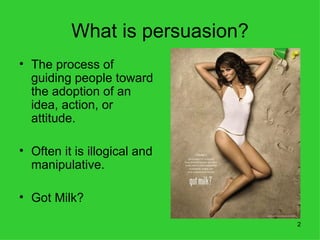
What is persuasion?
• The process of
  guiding people toward
  the adoption of an
  idea, action, or
  attitude.

• Often it is illogical and
  manipulative.

• Got Milk?

                                2
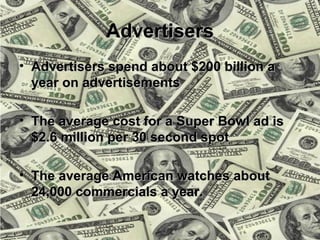
Advertisers
• Advertisers spend about $200 billion a
  year on advertisements

• The average cost for a Super Bowl ad is
  $2.6 million per 30 second spot

• The average American watches about
  24,000 commercials a year.

                                            3
Introduction to Logical Fallacies
• What is a logical fallacy?
• Logical = something that is reasonable
• Fallacy = something that is faulty


• Thus, a logical fallacy is an argument
  based on faulty logic

                                           4
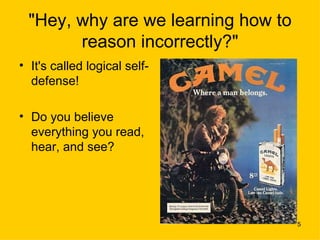
"Hey, why are we learning how to
       reason incorrectly?"
• It's called logical self-
  defense!

• Do you believe
  everything you read,
  hear, and see?


                                    5
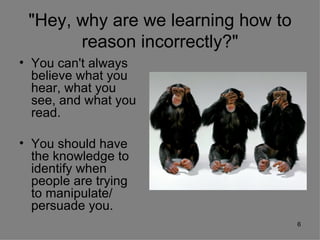
"Hey, why are we learning how to
       reason incorrectly?"
• You can't always
  believe what you
  hear, what you
  see, and what you
  read.

• You should have
  the knowledge to
  identify when
  people are trying
  to manipulate/
  persuade you.
                                    6
Circular Reasoning

• Occurs when you try to prove a
  statement by simply repeating it
  in different words

• Example 1: Our basketball team,
  the Cougars, should capture the
  regional title because the team
  deserves to be number one.

• Example 2: Mr. Smith’s drama
  club attracts a large number of
  students because many
  students come to the drama
  club.                              7
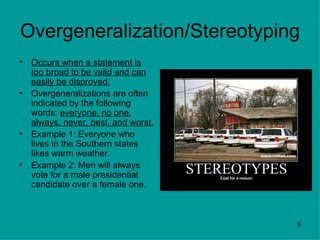
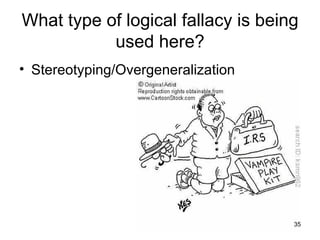
Overgeneralization/Stereotyping
•   Occurs when a statement is
    too broad to be valid and can
    easily be disproved.
•   Overgeneralizations are often
    indicated by the following
    words: everyone, no one,
    always, never, best, and worst.
•   Example 1: Everyone who
    lives in the Southern states
    likes warm weather.
•   Example 2: Men will always
    vote for a male presidential
    candidate over a female one.


                                      8
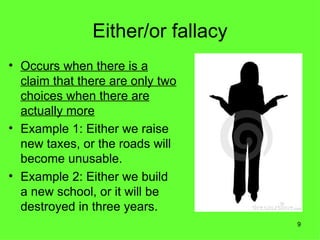
Either/or fallacy
• Occurs when there is a
  claim that there are only two
  choices when there are
  actually more
• Example 1: Either we raise
  new taxes, or the roads will
  become unusable.
• Example 2: Either we build
  a new school, or it will be
  destroyed in three years.
                                   9
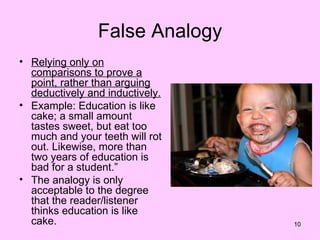
False Analogy
• Relying only on
  comparisons to prove a
  point, rather than arguing
  deductively and inductively.
• Example: Education is like
  cake; a small amount
  tastes sweet, but eat too
  much and your teeth will rot
  out. Likewise, more than
  two years of education is
  bad for a student.”
• The analogy is only
  acceptable to the degree
  that the reader/listener
  thinks education is like
  cake.                          10
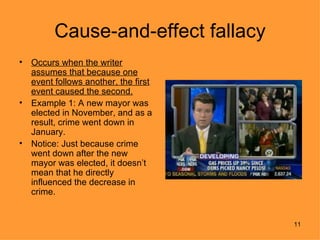
Cause-and-effect fallacy
•   Occurs when the writer
    assumes that because one
    event follows another, the first
    event caused the second.
•   Example 1: A new mayor was
    elected in November, and as a
    result, crime went down in
    January.
•   Notice: Just because crime
    went down after the new
    mayor was elected, it doesn’t
    mean that he directly
    influenced the decrease in
    crime.


                                       11
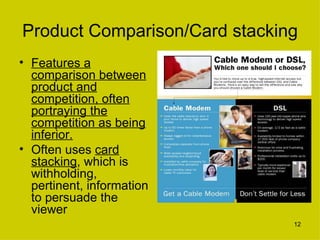
Product Comparison/Card stacking
• Features a
  comparison between
  product and
  competition, often
  portraying the
  competition as being
  inferior.
• Often uses card
  stacking, which is
  withholding,
  pertinent, information
  to persuade the
  viewer
                               12
Emotional Appeals
• The term refers to manipulating someone
  by targeting their emotions and feelings.
• For example, the ad can make viewers
  feel happy, sad, angry, fearful, etc.
• However, in the end, the advertiser wants
  to get across the point that BUYING
  SOMETHING WILL MAKE THE VIEWER
  FEEL BETTER.
• Emotional appeals also refer to the term,
                                            13
  PATHOS
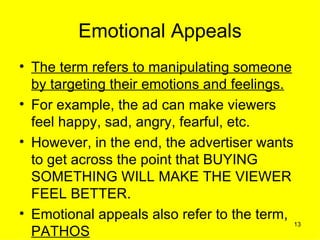
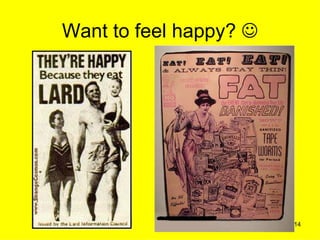
Want to feel happy? 


                        14
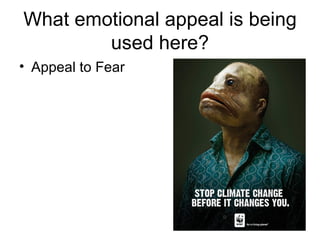
Appeal to Fear
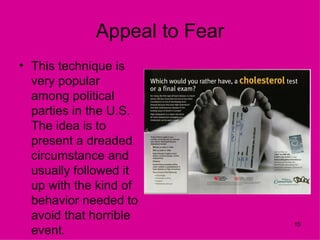
• This technique is
  very popular
  among political
  parties in the U.S.
  The idea is to
  present a dreaded
  circumstance and
  usually followed it
  up with the kind of
  behavior needed to
  avoid that horrible
                              15
  event.
Namecalling
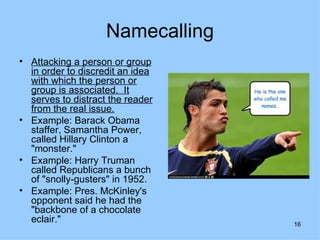
• Attacking a person or group
  in order to discredit an idea
  with which the person or
  group is associated. It
  serves to distract the reader
  from the real issue.
• Example: Barack Obama
  staffer, Samantha Power,
  called Hillary Clinton a
  "monster."
• Example: Harry Truman
  called Republicans a bunch
  of "snolly-gusters" in 1952.
• Example: Pres. McKinley's
  opponent said he had the
  "backbone of a chocolate
  eclair."                        16
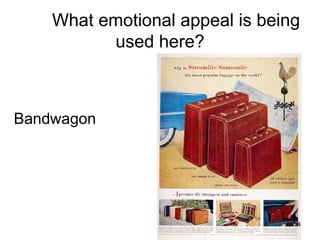
Bandwagon
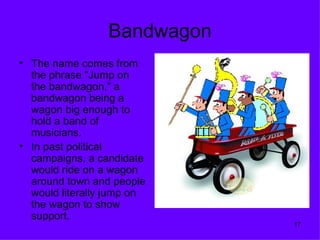
• The name comes from
  the phrase "Jump on
  the bandwagon," a
  bandwagon being a
  wagon big enough to
  hold a band of
  musicians.
• In past political
  campaigns, a candidate
  would ride on a wagon
  around town and people
  would literally jump on
  the wagon to show
  support.
                             17
Bandwagon cont.
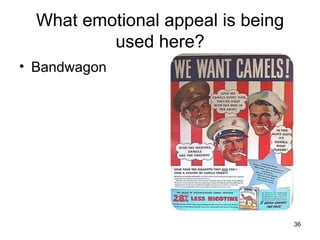
• Capitalizes on the fun of being part of a
  crowd and the desire to be socially
  accepted.
• In other words, if it's popular, it must be
  correct!
• Example 1: Don’t be the last to get the
  new Rockin’ Robots video game!
• Example 2: Join everyone else who is
  buying an IBM computer!
                                                18
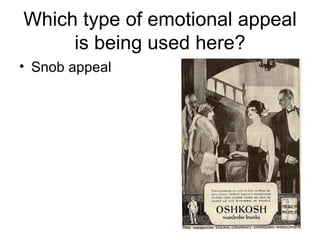
Snob appeal
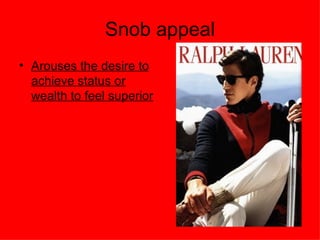
• Arouses the desire to
  achieve status or
  wealth to feel superior


                              19
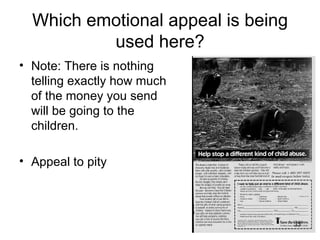
Appeal to Pity
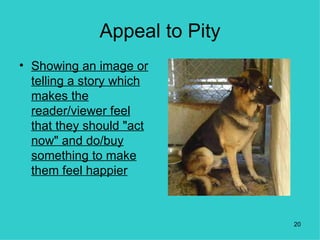
• Showing an image or
  telling a story which
  makes the
  reader/viewer feel
  that they should "act
  now" and do/buy
  something to make
  them feel happier


                               20
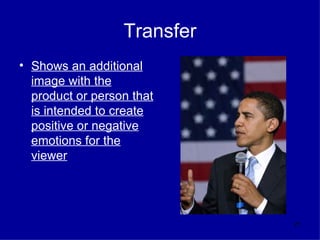
Transfer
• Shows an additional
  image with the
  product or person that
  is intended to create
  positive or negative
  emotions for the
  viewer


                             21
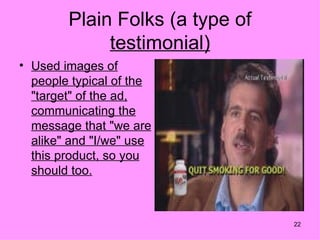
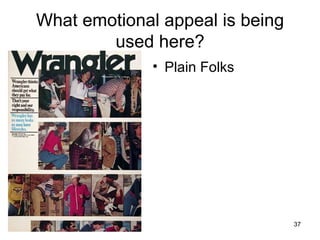
Plain Folks (a type of
             testimonial)
• Used images of
  people typical of the
  "target" of the ad,
  communicating the
  message that "we are
  alike" and "I/we" use
  this product, so you
  should too.


                                 22
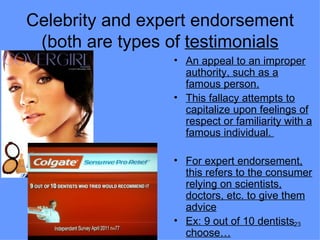
Celebrity and expert endorsement
 (both are types of testimonials
                 • An appeal to an improper
                   authority, such as a
                   famous person.
                 • This fallacy attempts to
                   capitalize upon feelings of
                   respect or familiarity with a
                   famous individual.

                 • For expert endorsement,
                   this refers to the consumer
                   relying on scientists,
                   doctors, etc. to give them
                   advice
                 • Ex: 9 out of 10 dentists23
                   choose…
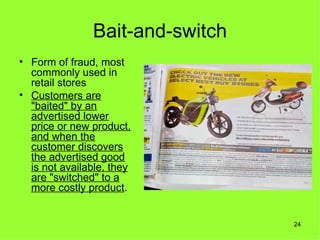
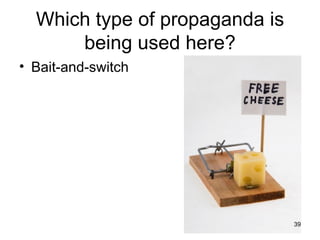
Bait-and-switch
• Form of fraud, most
  commonly used in
  retail stores
• Customers are
  "baited" by an
  advertised lower
  price or new product,
  and when the
  customer discovers
  the advertised good
  is not available, they
  are "switched" to a
  more costly product.


                                 24
Loaded Language

• When used properly, emotional language
  can add depth to writing that’s meant to
  persuade; however, the misuse of loaded
  language can cloud factual information,
  disguise poor reasoning, or unfairly
  manipulate people’s emotions in order to
  shape their opinions.

                                             25
Loaded Language
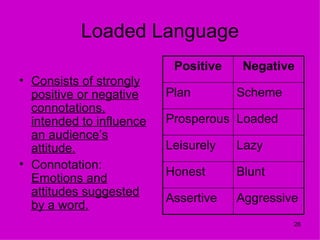
                           Positive    Negative
• Consists of strongly
  positive or negative    Plan        Scheme
  connotations,
  intended to influence   Prosperous Loaded
  an audience’s
  attitude.               Leisurely   Lazy
• Connotation:
                          Honest      Blunt
  Emotions and
  attitudes suggested
                          Assertive   Aggressive
  by a word.
                                               26
Loaded Language
• In advertising, words with positive connotations
  are called
• GLITTERING GENERALITIES (OR PURR
  WORDS)
• Examples: golden, mother, home, delightful,
  scrumptious, and success
• Words with negative connotations are called
• SNARL WORDS
• Examples: ugly, unsightly, wrinkles, dirt
• Words that are qualifiers, unclear, and purposely
  used to mislead are called
• WEASEL WORDS
                                                   27
• Examples: almost, virtually, and close to
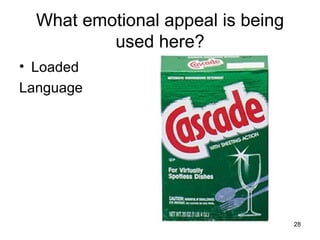
What emotional appeal is being
          used here?
• Loaded
Language


                                   28
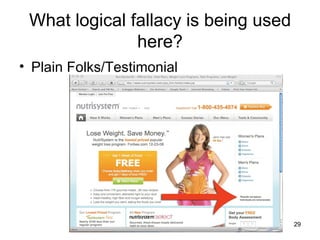
What logical fallacy is being used
               here?
• Plain Folks/Testimonial


                                      29
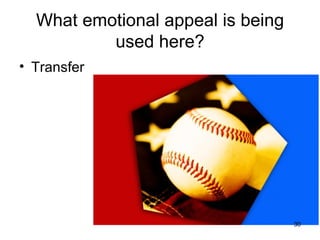
What emotional appeal is being
          used here?
• Transfer


                                   30
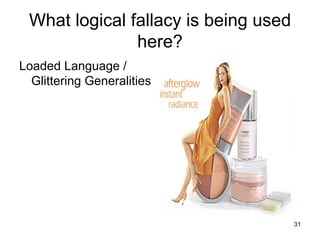
What logical fallacy is being used
               here?
Loaded Language /
  Glittering Generalities


                                      31
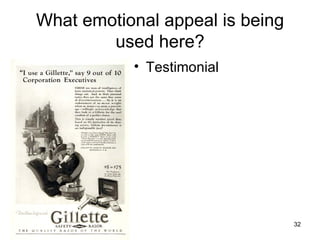
What emotional appeal is being
        used here?
           • Testimonial


                                 32
Which emotional appeal is being
          used here?
• Note: There is nothing
  telling exactly how much
  of the money you send
  will be going to the
  children.

• Appeal to pity


                                    33
What emotional appeal is being
          used here?


Bandwagon


                                 34
What type of logical fallacy is being
           used here?
• Stereotyping/Overgeneralization


                                    35
What emotional appeal is being
          used here?
• Bandwagon


                                   36
What emotional appeal is being
        used here?
              • Plain Folks


                                 37
What emotional appeal is being
        used here?
• Appeal to Fear


                             38
Which type of propaganda is
      being used here?
• Bait-and-switch


                                39
Which type of emotional appeal
     is being used here?
• Snob appeal


                             40

Recognizing logical fallacies and emotional appeals

  • 1.
    Propaganda: Recognizing Logical Fallacies and Emotional Appeals English 10 1
  • 2.
    What is persuasion? •The process of guiding people toward the adoption of an idea, action, or attitude. • Often it is illogical and manipulative. • Got Milk? 2
  • 3.
    Advertisers • Advertisers spendabout $200 billion a year on advertisements • The average cost for a Super Bowl ad is $2.6 million per 30 second spot • The average American watches about 24,000 commercials a year. 3
  • 4.
    Introduction to LogicalFallacies • What is a logical fallacy? • Logical = something that is reasonable • Fallacy = something that is faulty • Thus, a logical fallacy is an argument based on faulty logic 4
  • 5.
    "Hey, why arewe learning how to reason incorrectly?" • It's called logical self- defense! • Do you believe everything you read, hear, and see? 5
  • 6.
    "Hey, why arewe learning how to reason incorrectly?" • You can't always believe what you hear, what you see, and what you read. • You should have the knowledge to identify when people are trying to manipulate/ persuade you. 6
  • 7.
    Circular Reasoning • Occurswhen you try to prove a statement by simply repeating it in different words • Example 1: Our basketball team, the Cougars, should capture the regional title because the team deserves to be number one. • Example 2: Mr. Smith’s drama club attracts a large number of students because many students come to the drama club. 7
  • 8.
    Overgeneralization/Stereotyping • Occurs when a statement is too broad to be valid and can easily be disproved. • Overgeneralizations are often indicated by the following words: everyone, no one, always, never, best, and worst. • Example 1: Everyone who lives in the Southern states likes warm weather. • Example 2: Men will always vote for a male presidential candidate over a female one. 8
  • 9.
    Either/or fallacy • Occurswhen there is a claim that there are only two choices when there are actually more • Example 1: Either we raise new taxes, or the roads will become unusable. • Example 2: Either we build a new school, or it will be destroyed in three years. 9
  • 10.
    False Analogy • Relyingonly on comparisons to prove a point, rather than arguing deductively and inductively. • Example: Education is like cake; a small amount tastes sweet, but eat too much and your teeth will rot out. Likewise, more than two years of education is bad for a student.” • The analogy is only acceptable to the degree that the reader/listener thinks education is like cake. 10
  • 11.
    Cause-and-effect fallacy • Occurs when the writer assumes that because one event follows another, the first event caused the second. • Example 1: A new mayor was elected in November, and as a result, crime went down in January. • Notice: Just because crime went down after the new mayor was elected, it doesn’t mean that he directly influenced the decrease in crime. 11
  • 12.
    Product Comparison/Card stacking •Features a comparison between product and competition, often portraying the competition as being inferior. • Often uses card stacking, which is withholding, pertinent, information to persuade the viewer 12
  • 13.
    Emotional Appeals • Theterm refers to manipulating someone by targeting their emotions and feelings. • For example, the ad can make viewers feel happy, sad, angry, fearful, etc. • However, in the end, the advertiser wants to get across the point that BUYING SOMETHING WILL MAKE THE VIEWER FEEL BETTER. • Emotional appeals also refer to the term, 13 PATHOS
  • 14.
    Want to feelhappy?  14
  • 15.
    Appeal to Fear •This technique is very popular among political parties in the U.S. The idea is to present a dreaded circumstance and usually followed it up with the kind of behavior needed to avoid that horrible 15 event.
  • 16.
    Namecalling • Attacking aperson or group in order to discredit an idea with which the person or group is associated. It serves to distract the reader from the real issue. • Example: Barack Obama staffer, Samantha Power, called Hillary Clinton a "monster." • Example: Harry Truman called Republicans a bunch of "snolly-gusters" in 1952. • Example: Pres. McKinley's opponent said he had the "backbone of a chocolate eclair." 16
  • 17.
    Bandwagon • The namecomes from the phrase "Jump on the bandwagon," a bandwagon being a wagon big enough to hold a band of musicians. • In past political campaigns, a candidate would ride on a wagon around town and people would literally jump on the wagon to show support. 17
  • 18.
    Bandwagon cont. • Capitalizeson the fun of being part of a crowd and the desire to be socially accepted. • In other words, if it's popular, it must be correct! • Example 1: Don’t be the last to get the new Rockin’ Robots video game! • Example 2: Join everyone else who is buying an IBM computer! 18
  • 19.
    Snob appeal • Arousesthe desire to achieve status or wealth to feel superior 19
  • 20.
    Appeal to Pity •Showing an image or telling a story which makes the reader/viewer feel that they should "act now" and do/buy something to make them feel happier 20
  • 21.
    Transfer • Shows anadditional image with the product or person that is intended to create positive or negative emotions for the viewer 21
  • 22.
    Plain Folks (atype of testimonial) • Used images of people typical of the "target" of the ad, communicating the message that "we are alike" and "I/we" use this product, so you should too. 22
  • 23.
    Celebrity and expertendorsement (both are types of testimonials • An appeal to an improper authority, such as a famous person. • This fallacy attempts to capitalize upon feelings of respect or familiarity with a famous individual. • For expert endorsement, this refers to the consumer relying on scientists, doctors, etc. to give them advice • Ex: 9 out of 10 dentists23 choose…
  • 24.
    Bait-and-switch • Form offraud, most commonly used in retail stores • Customers are "baited" by an advertised lower price or new product, and when the customer discovers the advertised good is not available, they are "switched" to a more costly product. 24
  • 25.
    Loaded Language • Whenused properly, emotional language can add depth to writing that’s meant to persuade; however, the misuse of loaded language can cloud factual information, disguise poor reasoning, or unfairly manipulate people’s emotions in order to shape their opinions. 25
  • 26.
    Loaded Language Positive Negative • Consists of strongly positive or negative Plan Scheme connotations, intended to influence Prosperous Loaded an audience’s attitude. Leisurely Lazy • Connotation: Honest Blunt Emotions and attitudes suggested Assertive Aggressive by a word. 26
  • 27.
    Loaded Language • Inadvertising, words with positive connotations are called • GLITTERING GENERALITIES (OR PURR WORDS) • Examples: golden, mother, home, delightful, scrumptious, and success • Words with negative connotations are called • SNARL WORDS • Examples: ugly, unsightly, wrinkles, dirt • Words that are qualifiers, unclear, and purposely used to mislead are called • WEASEL WORDS 27 • Examples: almost, virtually, and close to
  • 28.
    What emotional appealis being used here? • Loaded Language 28
  • 29.
    What logical fallacyis being used here? • Plain Folks/Testimonial 29
  • 30.
    What emotional appealis being used here? • Transfer 30
  • 31.
    What logical fallacyis being used here? Loaded Language / Glittering Generalities 31
  • 32.
    What emotional appealis being used here? • Testimonial 32
  • 33.
    Which emotional appealis being used here? • Note: There is nothing telling exactly how much of the money you send will be going to the children. • Appeal to pity 33
  • 34.
    What emotional appealis being used here? Bandwagon 34
  • 35.
    What type oflogical fallacy is being used here? • Stereotyping/Overgeneralization 35
  • 36.
    What emotional appealis being used here? • Bandwagon 36
  • 37.
    What emotional appealis being used here? • Plain Folks 37
  • 38.
    What emotional appealis being used here? • Appeal to Fear 38
  • 39.
    Which type ofpropaganda is being used here? • Bait-and-switch 39
  • 40.
    Which type ofemotional appeal is being used here? • Snob appeal 40