Propaganda Whose  voice   guides  YOUR   choice?
How do you decide who  is the best candidate?
Or… which is the best toothpaste?
Looking for  facts  to back up your choice is an excellent idea, but find out  who  is presenting those facts.
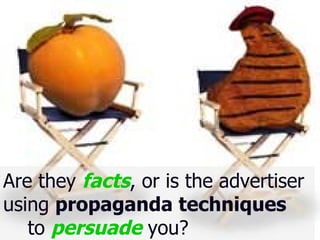
Are they  facts , or is the advertiser  using  propaganda techniques   to  persuade  you?
What is Propaganda? Propaganda is designed to   persuade   Its purpose is to   influence & manipulate   your opinions, emotions, attitudes, or behavior. It seeks to “guide your choice” by   exaggerating   the truth & using hidden messages
Who uses Propaganda? Military Media Advertisers Politicians You and me
Bandwagon Everybody   is doing this. If you want to fit in, you need to  “jump on the bandwagon”  and  do it too. The implication is that you must  JOIN in  to  FIT in .  Ask yourself, What is the evidence for and against this ad? Even though others are supporting it, why should I?
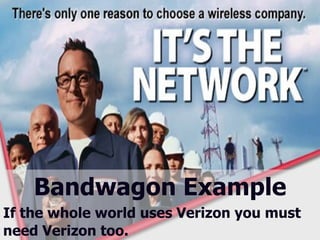
Bandwagon Example If the whole world uses Verizon you must   need   Verizon too.
Name-calling A  links a person, or idea, to a  negative  symbol.  Examples: commie, fascist, yuppie, terrorist Ask yourself, What does the name mean? Is there a real connection between the idea and the name being used?
Name-Calling Example Do we want a lazy politician to represent us?
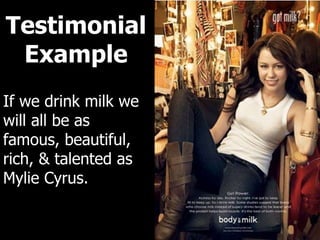
Testimonial A public figure or celebrity   endorses   an idea, product, policy, or a candidate. If someone famous uses this product, believes this idea, or supports this candidate, so should we. Examples: an athlete appears on the Wheaties box; an actor speaks at a political rally Ask yourself, Why should we regard this person as an expert or trust their testimony? Is there merit to the idea or product without the testimony?
Testimonial  Example If we drink milk we will all be as famous, beautiful, rich, & talented as Mylie Cyrus.
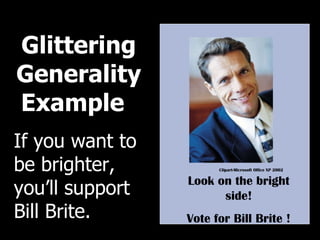
Glittering Generality A commonly   admired virtue   is used ;  emotionally appealing words  that don’t make an argument for the product;  the opposite of name calling, i.e., links a person, or idea, to a positive symbol. Examples: democracy, patriotism, family, love, beauty Ask yourself, What do the slogans or phrases really mean? Is there a legitimate connection between the main idea and the true meaning of the slogan or phrase being used? What are the merits of the idea itself if it is separated from the slogans or phrases?
Glittering Generality Example   If you want to be brighter, you’ll support Bill Brite. Look on the bright side! Vote for Bill Brite ! Clipart-Microsoft Office XP 2002
Plain-folks appeal This idea, product, or person is associated with normal,   everyday people   and activities. Ask yourself, Is the person credible and trustworthy when they are removed from the situation being discussed? Is the person trying to cover up anything? What are the facts of the situation?
Plain-Folks Example   I, too, can help win the war by working in the factory and buying war bonds.
Transfer Well-respected   or negative  symbols, quotes, or images  are used to   convey a message . The message may not necessarily be associated with them.   Ask yourself, Is there a legitimate connection between the suggestion made by the propagandist and the person or   product?
Transfer example Marlboro persuades the audience to identify smoking with the rugged, strength of an American cowboy
Card Stacking  making the   best case possible for one side   and the  worst for the opposing  viewpoint  (I.e., carefully using only those facts that support his or her side of the argument   attempting to lead the audience into accepting the facts as a conclusion by “stacking the cards against the truth” Ask yourself,  Are facts being distorted or omitted? What other arguments exist to support these assertions?
Card-stacking Example Mac vs PC   Play clip
Faulty Reasoning Factual supporting details  are used though they  do not support  the conclusion.  It works like this: Christians believe in God.  Muslims believe in God. Christians are Muslims.
Faulty Reasoning Example Example: The president supports regulating health care. Nazis regulated health care. Therefore, the president is a Nazi. Play clip
Fear  plays on deep-seated fears; warns the audience that disaster will result if they do not follow a particular course of action.  Example: an insurance company pamphlet includes pictures of houses destroyed floods, followed up by details about home-owners’ insurance. Ask yourself,  Is the speaker exaggerating the fear or threat in order to obtain my support? How legitimate is the fear that the speaker is provoking? Will performing the recommended action actually reduce the supposed threat?
Fear Example If you don’t  enlist, no one is safe including  Lady Liberty; the Germans are animals and will attack all that we hold dear…
How do we make sure that we are making informed choices, instead of allowing others to sway us in our decision-making?
WE   make our own choices when: we read and listen to  reliable sources we watch for combinations of truths and lies we check for  hidden messages we watch for use of  propaganda techniques

Propaganda

  • 1.
    Propaganda Whose voice guides YOUR choice?
  • 2.
    How do youdecide who is the best candidate?
  • 3.
    Or… which isthe best toothpaste?
  • 4.
    Looking for facts to back up your choice is an excellent idea, but find out who is presenting those facts.
  • 5.
    Are they facts , or is the advertiser using propaganda techniques to persuade you?
  • 6.
    What is Propaganda?Propaganda is designed to persuade Its purpose is to influence & manipulate your opinions, emotions, attitudes, or behavior. It seeks to “guide your choice” by exaggerating the truth & using hidden messages
  • 7.
    Who uses Propaganda?Military Media Advertisers Politicians You and me
  • 8.
    Bandwagon Everybody is doing this. If you want to fit in, you need to “jump on the bandwagon” and do it too. The implication is that you must JOIN in to FIT in . Ask yourself, What is the evidence for and against this ad? Even though others are supporting it, why should I?
  • 9.
    Bandwagon Example Ifthe whole world uses Verizon you must need Verizon too.
  • 10.
    Name-calling A links a person, or idea, to a negative symbol. Examples: commie, fascist, yuppie, terrorist Ask yourself, What does the name mean? Is there a real connection between the idea and the name being used?
  • 11.
    Name-Calling Example Dowe want a lazy politician to represent us?
  • 12.
    Testimonial A publicfigure or celebrity endorses an idea, product, policy, or a candidate. If someone famous uses this product, believes this idea, or supports this candidate, so should we. Examples: an athlete appears on the Wheaties box; an actor speaks at a political rally Ask yourself, Why should we regard this person as an expert or trust their testimony? Is there merit to the idea or product without the testimony?
  • 13.
    Testimonial ExampleIf we drink milk we will all be as famous, beautiful, rich, & talented as Mylie Cyrus.
  • 14.
    Glittering Generality Acommonly admired virtue is used ; emotionally appealing words that don’t make an argument for the product; the opposite of name calling, i.e., links a person, or idea, to a positive symbol. Examples: democracy, patriotism, family, love, beauty Ask yourself, What do the slogans or phrases really mean? Is there a legitimate connection between the main idea and the true meaning of the slogan or phrase being used? What are the merits of the idea itself if it is separated from the slogans or phrases?
  • 15.
    Glittering Generality Example If you want to be brighter, you’ll support Bill Brite. Look on the bright side! Vote for Bill Brite ! Clipart-Microsoft Office XP 2002
  • 16.
    Plain-folks appeal Thisidea, product, or person is associated with normal, everyday people and activities. Ask yourself, Is the person credible and trustworthy when they are removed from the situation being discussed? Is the person trying to cover up anything? What are the facts of the situation?
  • 17.
    Plain-Folks Example I, too, can help win the war by working in the factory and buying war bonds.
  • 18.
    Transfer Well-respected or negative symbols, quotes, or images are used to convey a message . The message may not necessarily be associated with them. Ask yourself, Is there a legitimate connection between the suggestion made by the propagandist and the person or product?
  • 19.
    Transfer example Marlboropersuades the audience to identify smoking with the rugged, strength of an American cowboy
  • 20.
    Card Stacking making the best case possible for one side and the worst for the opposing viewpoint (I.e., carefully using only those facts that support his or her side of the argument attempting to lead the audience into accepting the facts as a conclusion by “stacking the cards against the truth” Ask yourself, Are facts being distorted or omitted? What other arguments exist to support these assertions?
  • 21.
  • 22.
    Faulty Reasoning Factualsupporting details are used though they do not support the conclusion. It works like this: Christians believe in God. Muslims believe in God. Christians are Muslims.
  • 23.
    Faulty Reasoning ExampleExample: The president supports regulating health care. Nazis regulated health care. Therefore, the president is a Nazi. Play clip
  • 24.
    Fear playson deep-seated fears; warns the audience that disaster will result if they do not follow a particular course of action. Example: an insurance company pamphlet includes pictures of houses destroyed floods, followed up by details about home-owners’ insurance. Ask yourself, Is the speaker exaggerating the fear or threat in order to obtain my support? How legitimate is the fear that the speaker is provoking? Will performing the recommended action actually reduce the supposed threat?
  • 25.
    Fear Example Ifyou don’t enlist, no one is safe including Lady Liberty; the Germans are animals and will attack all that we hold dear…
  • 26.
    How do wemake sure that we are making informed choices, instead of allowing others to sway us in our decision-making?
  • 27.
    WE make our own choices when: we read and listen to reliable sources we watch for combinations of truths and lies we check for hidden messages we watch for use of propaganda techniques

Editor's Notes

  • #2 Teacher note: use the following slides to elicit student responses; use the examples to have students analyze the propaganda technique. Students may provide examples from their own experiences.
  • #3 Use the next 2 slides as a warm up
  • #6 “ Pork, the other white meat” – Ask, “Why would the pork industry dress up a pork chop and sit it next to fruit?
  • #15 http://www.pbs.org/weta/reportingamericaatwar/teachers/pdf/propaganda.pdf
  • #16 http://www.propagandacritic.com/articles/ct.wg.gg.html
  • #22 http://www.youtube.com/watch?v=GQb_Q8WRL_g
  • #24 http://www.youtube.com/watch?v=nYlZiWK2Iy8&feature=player_embedded#
  • #28 Sources: http://english.glendale.cc.ca.us/propaganda.examples.html www.pbs.org