Chapter 27 Evaluating Information
 
Separating Facts from Opinions Identifying facts A fact is a statement you can prove.  Two types of facts are observations and definitions. Some ways you can test a statement are:  Make a personal observation Refer to your experience Ask a recognized expert Consult an authoritative written source
Separating Facts from Opinions Identifying opinions An opinion is a statement that tells what a person thinks, believes or feels about a subject. You can’t prove opinions. Some ways to identify opinions are:  Look for adjectives and adverbs that express judgment. Look for words that indicate what a person feels or believes such as ought, should, think or believe.
Separating Facts from Opinions Opinions can be unsupported or informed Unsupported opinions are not backed up with facts. Informed opinions are supported with facts. BEWARE: Even though an opinion can make perfect sense and is backed up with facts, it’s still an opinion.
Examples: Fact or Opinion? An adult male African elephant weighs 12.000 pounds. Hunting elephants for their ivory tusks should be banned. An elephant can run at speeds of up to 25 miles/ hour. Elephants make odd sounds
Logical Relationships A logical relationship is a clear and reasonable connection (events,  objects, people and places) Examples of logical relationships are cause and effect, comparison and contrast and analogy.
Logical Relationships A cause is an event or action that leads directly to another event or action. An effect is the direct or logical outcome of an event or action. Words that signal cause and effect relationships include because, therefore, so, as a result, and since. DON’T assume A is a cause of B or that something has ONLY one cause when it has many.
Logical Relationships A comparison shows how two or more things are alike.  Some words that indicate similarities are also, both, likewise, and in the same way. A contrast shows how two or more things are different.  Words that indicate differences include but, however, on the other hand, and unlike. You can use Venn diagrams to compare two or more items.
Logical Relationships An analogy is a type of comparison, often used to explain something unfamiliar by likening it to something familiar. A good analogy effectively expresses an essential likeness between two things. “ In the late 1800s, The Old Farmer´s Almanac was to farmers what TV weather forecasts are to us today”  “ The blue sky was the same color as a sky blue crayon”
Interpreting Information An  INFERENCE  is a logical guess based on facts and common sense. To draw a  CONCLUSION  you review a number of facts and details and use your prior knowledge to make a logical statement about a topic.  They are statements based on evidence. A  GENERALIZATION  is a general statement based on many specific examples.
“ Glaciers are huge moving bodies of ice and are powerful causes of erosion” INFERENCE: Glaciers must exist in cold weather “ The severe wind and rain of a hurricane can cause windows to shatter” Prior knowledge: boards on the outside of a window may help. People buy many boards. CONCLUSION: Lumberyards sell a lot of boards just before hurricanes. High temperatures feel hotter when humidity is high. Low temperatures feel colder when humidity is high.
Recognizing Logical Fallacies Sometimes an idea is stated in a way that at first appears to make sense.  However if you examine the statement you might find that it actually contains a  FALLACY  or an error in logic. There are many types of logical fallacies.
Recognizing Logical Fallacies FALSE ANALOGY A  FALSE ANALOGY  involves a comparison between two things that have nothing in common.  It’s an illogical comparison.  When examining an analogy ask yourself the following questions: 1. What are the similarities between the things being compared? 2. What are the differences between the things  being compared? 3. Is there any one difference that makes the analogy illogical?
Recognizing Logical Fallacies CIRCULAR REASONING When a person tries to prove a statement by repeating it in other words, the person is using  CIRCULAR REASONING . It’s also known as begging the question.
Recognizing Logical Fallacies An error in logic False analogy:  a comparison between things that do not have features in common. Circular reasoning:  repeating a statement in  different words. Overgeneralization:  a generalization that is too broad to be valid and can easily be disproved.  They are often signaled by words as no one, everyone, always, never, best, and worst.  Either/or Thinking : a claim of only 2 choices when there are more.
Identifying logical fallacies: The orchestra was well-rehearsed because it had practiced a lot. No one understands opera. Either you have artistic talent or you don’t. Tuning an instrument is like finding the right outfit to wear. Musical talent takes time to develop because it takes years.
Misusing Emotional Appeals An emotional appeal stirs up feelings by means of carefully chosen words and images. Watch out for some advertisers and politicians!
Misusing Emotional Appeals BANDWAGON APPEAL The  BANDWAGON APPEAL  capitalizes on the fun of being part of a crowd and the desire to be socially accepted. It invites you to do or join something because “everyone” is doing it. “ Don´t be the last to have …..video game”
Misusing Emotional Appeals APPEALS TO PITY EMOTIONAL APPEALS  not only touch people’s minds, but more importantly their hearts.  This approach is especially effective for charity causes. “ 200 kids go to bed hungry, but you can help. For just one dollar…..”
Misusing Emotional Appeals NAME CALLING NAME CALLING  is attacking a person or group in order to discredit an idea with which the person or group is associated. It serves to distract the audience from the real issue. “ The narrow-minded senator opposes recycling”
Misusing Emotional Appeals TESTIMONIALS TESTIMONIALS  are statements by well-known people or satisfied customers that are used to endorse and promote products, services, people, or ideas. This persuasive technique uses people’s admiration for celebrities and their need to identity with others like themselves. They can be misleading or valid.
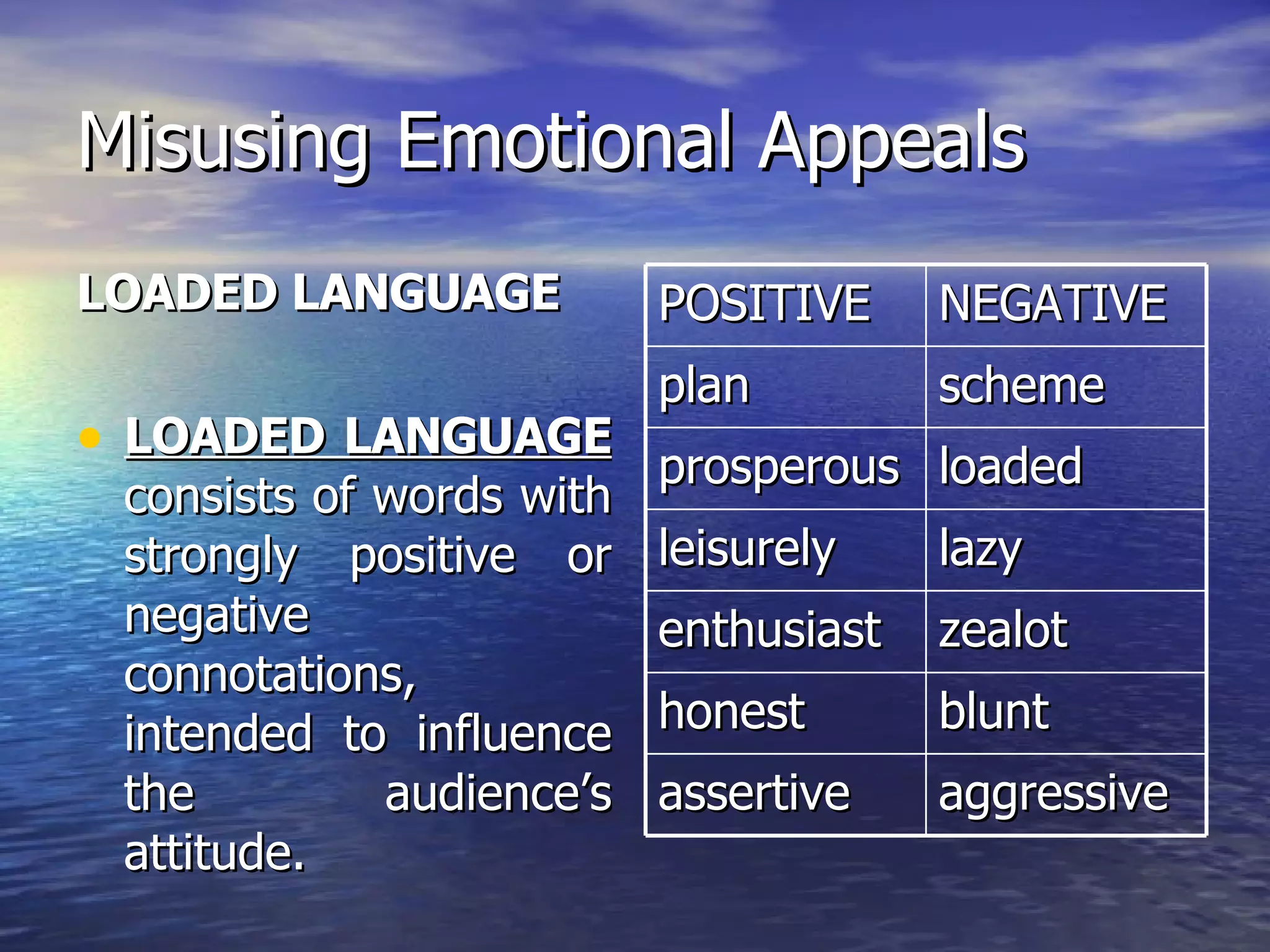
Misusing Emotional Appeals LOADED LANGUAGE LOADED LANGUAGE  consists of words with strongly positive or negative connotations, intended to influence the audience’s attitude. POSITIVE NEGATIVE plan scheme prosperous loaded leisurely lazy enthusiast zealot honest blunt assertive aggressive
Misusing Emotional Appeals In advertising words are classified as follows: PURR WORDS  are words with a  positive  connotation. SNARL WORDS  are words with a  negative  connotation. WEASEL WORDS  are qualifiers -such as almost, nearly, virtually, and close to- that are  unclear  and purposely used to mislead.

Chapter 27 Evaluating Information

  • 1.
  • 2.
  • 3.
    Separating Facts fromOpinions Identifying facts A fact is a statement you can prove. Two types of facts are observations and definitions. Some ways you can test a statement are: Make a personal observation Refer to your experience Ask a recognized expert Consult an authoritative written source
  • 4.
    Separating Facts fromOpinions Identifying opinions An opinion is a statement that tells what a person thinks, believes or feels about a subject. You can’t prove opinions. Some ways to identify opinions are: Look for adjectives and adverbs that express judgment. Look for words that indicate what a person feels or believes such as ought, should, think or believe.
  • 5.
    Separating Facts fromOpinions Opinions can be unsupported or informed Unsupported opinions are not backed up with facts. Informed opinions are supported with facts. BEWARE: Even though an opinion can make perfect sense and is backed up with facts, it’s still an opinion.
  • 6.
    Examples: Fact orOpinion? An adult male African elephant weighs 12.000 pounds. Hunting elephants for their ivory tusks should be banned. An elephant can run at speeds of up to 25 miles/ hour. Elephants make odd sounds
  • 7.
    Logical Relationships Alogical relationship is a clear and reasonable connection (events, objects, people and places) Examples of logical relationships are cause and effect, comparison and contrast and analogy.
  • 8.
    Logical Relationships Acause is an event or action that leads directly to another event or action. An effect is the direct or logical outcome of an event or action. Words that signal cause and effect relationships include because, therefore, so, as a result, and since. DON’T assume A is a cause of B or that something has ONLY one cause when it has many.
  • 9.
    Logical Relationships Acomparison shows how two or more things are alike. Some words that indicate similarities are also, both, likewise, and in the same way. A contrast shows how two or more things are different. Words that indicate differences include but, however, on the other hand, and unlike. You can use Venn diagrams to compare two or more items.
  • 10.
    Logical Relationships Ananalogy is a type of comparison, often used to explain something unfamiliar by likening it to something familiar. A good analogy effectively expresses an essential likeness between two things. “ In the late 1800s, The Old Farmer´s Almanac was to farmers what TV weather forecasts are to us today” “ The blue sky was the same color as a sky blue crayon”
  • 11.
    Interpreting Information An INFERENCE is a logical guess based on facts and common sense. To draw a CONCLUSION you review a number of facts and details and use your prior knowledge to make a logical statement about a topic. They are statements based on evidence. A GENERALIZATION is a general statement based on many specific examples.
  • 12.
    “ Glaciers arehuge moving bodies of ice and are powerful causes of erosion” INFERENCE: Glaciers must exist in cold weather “ The severe wind and rain of a hurricane can cause windows to shatter” Prior knowledge: boards on the outside of a window may help. People buy many boards. CONCLUSION: Lumberyards sell a lot of boards just before hurricanes. High temperatures feel hotter when humidity is high. Low temperatures feel colder when humidity is high.
  • 13.
    Recognizing Logical FallaciesSometimes an idea is stated in a way that at first appears to make sense. However if you examine the statement you might find that it actually contains a FALLACY or an error in logic. There are many types of logical fallacies.
  • 14.
    Recognizing Logical FallaciesFALSE ANALOGY A FALSE ANALOGY involves a comparison between two things that have nothing in common. It’s an illogical comparison. When examining an analogy ask yourself the following questions: 1. What are the similarities between the things being compared? 2. What are the differences between the things being compared? 3. Is there any one difference that makes the analogy illogical?
  • 15.
    Recognizing Logical FallaciesCIRCULAR REASONING When a person tries to prove a statement by repeating it in other words, the person is using CIRCULAR REASONING . It’s also known as begging the question.
  • 16.
    Recognizing Logical FallaciesAn error in logic False analogy: a comparison between things that do not have features in common. Circular reasoning: repeating a statement in different words. Overgeneralization: a generalization that is too broad to be valid and can easily be disproved. They are often signaled by words as no one, everyone, always, never, best, and worst. Either/or Thinking : a claim of only 2 choices when there are more.
  • 17.
    Identifying logical fallacies:The orchestra was well-rehearsed because it had practiced a lot. No one understands opera. Either you have artistic talent or you don’t. Tuning an instrument is like finding the right outfit to wear. Musical talent takes time to develop because it takes years.
  • 18.
    Misusing Emotional AppealsAn emotional appeal stirs up feelings by means of carefully chosen words and images. Watch out for some advertisers and politicians!
  • 19.
    Misusing Emotional AppealsBANDWAGON APPEAL The BANDWAGON APPEAL capitalizes on the fun of being part of a crowd and the desire to be socially accepted. It invites you to do or join something because “everyone” is doing it. “ Don´t be the last to have …..video game”
  • 20.
    Misusing Emotional AppealsAPPEALS TO PITY EMOTIONAL APPEALS not only touch people’s minds, but more importantly their hearts. This approach is especially effective for charity causes. “ 200 kids go to bed hungry, but you can help. For just one dollar…..”
  • 21.
    Misusing Emotional AppealsNAME CALLING NAME CALLING is attacking a person or group in order to discredit an idea with which the person or group is associated. It serves to distract the audience from the real issue. “ The narrow-minded senator opposes recycling”
  • 22.
    Misusing Emotional AppealsTESTIMONIALS TESTIMONIALS are statements by well-known people or satisfied customers that are used to endorse and promote products, services, people, or ideas. This persuasive technique uses people’s admiration for celebrities and their need to identity with others like themselves. They can be misleading or valid.
  • 23.
    Misusing Emotional AppealsLOADED LANGUAGE LOADED LANGUAGE consists of words with strongly positive or negative connotations, intended to influence the audience’s attitude. POSITIVE NEGATIVE plan scheme prosperous loaded leisurely lazy enthusiast zealot honest blunt assertive aggressive
  • 24.
    Misusing Emotional AppealsIn advertising words are classified as follows: PURR WORDS are words with a positive connotation. SNARL WORDS are words with a negative connotation. WEASEL WORDS are qualifiers -such as almost, nearly, virtually, and close to- that are unclear and purposely used to mislead.