English
QUARTER 3 – MODULE 2
Using a Variety Of Informative,
Persuasive, and Argumentative
writing Techniques
Lesson1
Structure of an Informative Text
Informative text Is a kind of text that offers data, definitions, and
description of phenomenaor details about a fact. It introduces a
clearly stated topic and creates an organizational structure in
which related information is grouped logically to support the
purpose of writing. It develops evidence with relevant facts,
definitions, concrete details, quotations, and example with
reference. It also uses appropriate linking ideas within and
across paragraphs to smoothly and purposefully connect the
controlling idea to evidence and provides a satisfying
conclusion related to the topic.
What’s In
Articles, textbooks chapter, passages, paragraphs or sentence
have topics and main ideas. Locating the topic, main idea, and
supporting details is important in helping you understand what
the writer is attempting to express, Moreover, identifying the
relationship between these will also increase your comprehension.
In Writing an informative essay, you have to keep in mind that
the main idea is the point of the paragraph and it is the most
important though about the topic. The main idea is usually a
sentence and it can be in different place within a paragraph
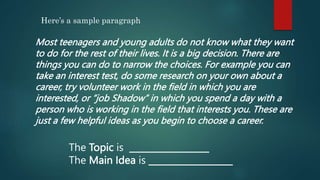
Here’s a sample paragraph
Most teenagers and young adults do not know what they want
to do for the rest of their lives. It is a big decision. There are
things you can do to narrow the choices. For example you can
take an interest test, do some research on your own about a
career, try volunteer work in the field in which you are
interested, or “job Shadow” in which you spend a day with a
person who is working in the field that interests you. These are
just a few helpful ideas as you begin to choose a career.
The Topic is __________________
The Main Idea is ___________________
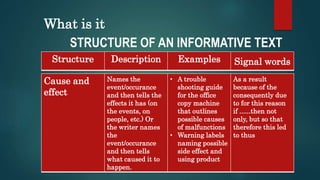
What is it
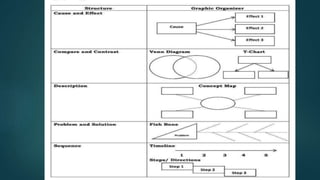
STRUCTURE OF AN INFORMATIVE TEXT
Structure Description Examples Signal words
Cause and
effect
Names the
event/occurance
and then tells the
effects it has (on
the events, on
people, etc.) Or
the writer names
the
event/occurance
and then tells
what caused it to
happen.
‱ A trouble
shooting guide
for the office
copy machine
that outlines
possible causes
of malfunctions
‱ Warning labels
naming possible
side effect and
using product
As a result
because of the
consequently due
to for this reason
if ......then not
only, but so that
therefore this led
to thus
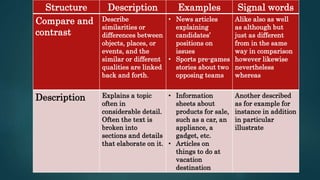
Compare and
contrast
Describe
similarities or
differences between
objects, places, or
events, and the
similar or different
qualities are linked
back and forth.
‱ News articles
explaining
candidates’
positions on
issues
‱ Sports pre-games
stories about two
opposing teams
Alike also as well
as although but
just as different
from in the same
way in comparison
however likewise
nevertheless
whereas
Description Explains a topic
often in
considerable detail.
Often the text is
broken into
sections and details
that elaborate on it.
‱ Information
sheets about
products for sale,
such as a car, an
appliance, a
gadget, etc.
‱ Articles on
things to do at
vacation
destination
Another described
as for example for
instance in addition
in particular
illustrate
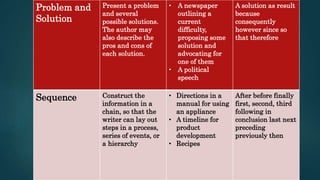
Structure Description Examples Signal words
Problem and
Solution
Present a problem
and several
possible solutions.
The author may
also describe the
pros and cons of
each solution.
‱ A newspaper
outlining a
current
difficulty,
proposing some
solution and
advocating for
one of them
‱ A political
speech
A solution as result
because
consequently
however since so
that therefore
Sequence Construct the
information in a
chain, so that the
writer can lay out
steps in a process,
series of events, or
a hierarchy
‱ Directions in a
manual for using
an appliance
‱ A timeline for
product
development
‱ Recipes
After before finally
first, second, third
following in
conclusion last next
preceding
previously then
S.A. 1 MODULE 1
S.A. 1 MODULE 1
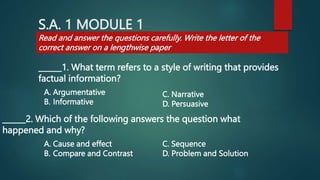
______1. What term refers to a style of writing that provides
factual information?
______2. Which of the following answers the question what
happened and why?
Read and answer the questions carefully. Write the letter of the
correct answer on a lengthwise paper
A. Argumentative
B. Informative
C. Narrative
D. Persuasive
A. Cause and effect
B. Compare and Contrast
C. Sequence
D. Problem and Solution
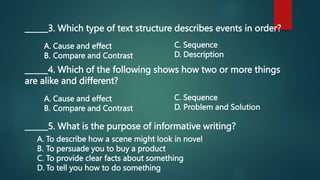
______3. Which type of text structure describes events in order?
A. Cause and effect
B. Compare and Contrast
C. Sequence
D. Description
______4. Which of the following shows how two or more things
are alike and different?
A. Cause and effect
B. Compare and Contrast
C. Sequence
D. Problem and Solution
______5. What is the purpose of informative writing?
A. To describe how a scene might look in novel
B. To persuade you to buy a product
C. To provide clear facts about something
D. To tell you how to do something
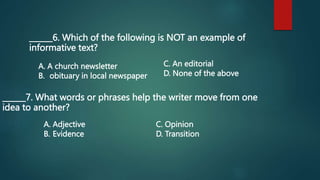
______6. Which of the following is NOT an example of
informative text?
______7. What words or phrases help the writer move from one
idea to another?
A. A church newsletter
B. obituary in local newspaper
C. An editorial
D. None of the above
A. Adjective
B. Evidence
C. Opinion
D. Transition
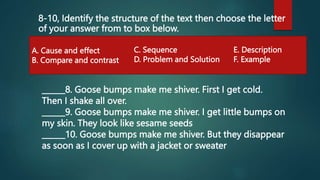
8-10, Identify the structure of the text then choose the letter
of your answer from to box below.
A. Cause and effect
B. Compare and contrast
C. Sequence
D. Problem and Solution
E. Description
F. Example
______8. Goose bumps make me shiver. First I get cold.
Then I shake all over.
______9. Goose bumps make me shiver. I get little bumps on
my skin. They look like sesame seeds
______10. Goose bumps make me shiver. But they disappear
as soon as I cover up with a jacket or sweater
Lesson2
Persuasive writing Techniques
In this one-week lesson, you will learn to write an
effective persuasion and to guard yourself from
dishonest persuasion. You will learn about
different persuasive strategies And the
important steps involved in all types of
persuasive writing. You will also use your skills
learned in getting information from persuasive
Learning the skills of persuasive writing will help
develop your critical thinking skills, for you will
practice focusing on a particular problem and
then giving specific and convincing reasons to
support your view. You will have to evaluate the
reasons you think of, choosing those that seem
soundest and most effective, and discarding
others. Being able to write persuasively, for you
will develop the skills necessary to presenting an
effective argument
What’s New
Did you know?
Persuasive texts can also be turned into a persuasive
speech. Although persuasive text and persuasive
speech don’t have exact same structure, speakers draft
their speech based on the elements, parts, techniques
and strategies used in writing a persuasive text.
Moreover, they have the same goal of convincing
others to believe in a particular point of view.
What is it
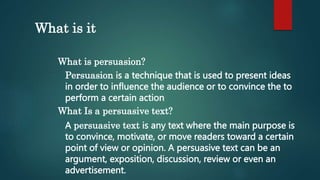
What is persuasion?
Persuasion is a technique that is used to present ideas
in order to influence the audience or to convince the to
perform a certain action
What Is a persuasive text?
A persuasive text is any text where the main purpose is
to convince, motivate, or move readers toward a certain
point of view or opinion. A persuasive text can be an
argument, exposition, discussion, review or even an
advertisement.
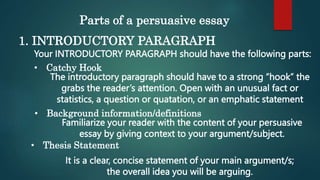
Parts of a persuasive essay
1. INTRODUCTORY PARAGRAPH
Your INTRODUCTORY PARAGRAPH should have the following parts:
‱ Catchy Hook
The introductory paragraph should have to a strong “hook” the
grabs the reader’s attention. Open with an unusual fact or
statistics, a question or quatation, or an emphatic statement
‱ Background information/definitions
Familiarize your reader with the content of your persuasive
essay by giving context to your argument/subject.
‱ Thesis Statement
It is a clear, concise statement of your main argument/s;
the overall idea you will be arguing.
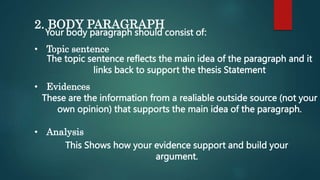
2. BODY PARAGRAPH
Your body paragraph should consist of:
‱ Topic sentence
The topic sentence reflects the main idea of the paragraph and it
links back to support the thesis Statement
‱ Evidences
These are the information from a realiable outside source (not your
own opinion) that supports the main idea of the paragraph.
‱ Analysis
This Shows how your evidence support and build your
argument.
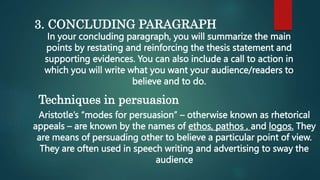
3. CONCLUDING PARAGRAPH
In your concluding paragraph, you will summarize the main
points by restating and reinforcing the thesis statement and
supporting evidences. You can also include a call to action in
which you will write what you want your audience/readers to
believe and to do.
Techniques in persuasion
Aristotle’s “modes for persuasion” – otherwise known as rhetorical
appeals – are known by the names of ethos, pathos , and logos. They
are means of persuading other to believe a particular point of view.
They are often used in speech writing and advertising to sway the
audience
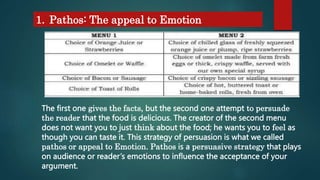
1. Pathos: The appeal to Emotion
The first one gives the facts, but the second one attempt to persuade
the reader that the food is delicious. The creator of the second menu
does not want you to just think about the food; he wants you to feel as
though you can taste it. This strategy of persuasion is what we called
pathos or appeal to Emotion. Pathos is a persuasive strategy that plays
on audience or reader’s emotions to influence the acceptance of your
argument.
2. Logos: the appeal to reason
Fifteen-year-old Anna Ortega wanted to increase her allowance.
Before she talked to her parents, however, she thought of some
reasons why she needed extra money. For example, she had more
expenses now that she was in high school; her lunch cost more; she
had to pay for her school project; and she had to pay to ride in a
tricycle.
Anna used these reasons to persuade her parents to raise her
allowance, but she could have tried other ways – appealing to their
emotions (“if you love me, you’ll raise my allowance”) However, she
decided to use an appeal to reason. This strategy of persuasion is
what we called logos or appeal to logic/reason
Logos is a way of persuading an audience with reason.
3. Ethos: The Appeal to Authority
You attended a public speaking ceremony and you have observed
that there’s a lot of people who attended the event. You yourself
decided to attend because you learned that the speaker has
achieved so many accomplishments and has already inspired and
influenced people from around the world. You were convinced that
you will learn something from the speaker because of his awards and
achievements. This strategy of persuasion is what we called Ethos or
Appeal to Authority.
Ethos is a persuasive strategy used to convince an audience based
on the author’s credibility or character.
S.A. 2 MODULE 2.1
Test Questions
1. what is the purpose of persuasive writing?
A. to convince
B. To tell a story
C. To inform
D. To entertain
2. How does an author share his opinion about an issue
through persuasive writing?
A.By sharing his personal opinion
B.By supporting is opinion through the use of facts.
C.By making a fictional information to trick the
reader.
D.By sharing the opinions of others that are
similar to his opinion
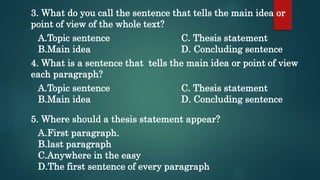
3. What do you call the sentence that tells the main idea or
point of view of the whole text?
A.Topic sentence
B.Main idea
C. Thesis statement
D. Concluding sentence
4. What is a sentence that tells the main idea or point of view
each paragraph?
A.Topic sentence
B.Main idea
C. Thesis statement
D. Concluding sentence
5. Where should a thesis statement appear?
A.First paragraph.
B.last paragraph
C.Anywhere in the easy
D.The first sentence of every paragraph
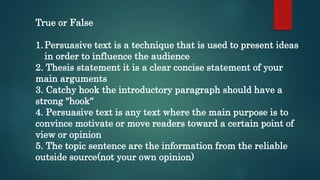
True or False
1.Persuasive text is a technique that is used to present ideas
in order to influence the audience
2. Thesis statement it is a clear concise statement of your
main arguments
3. Catchy hook the introductory paragraph should have a
strong "hook“
4. Persuasive text is any text where the main purpose is to
convince motivate or move readers toward a certain point of
view or opinion
5. The topic sentence are the information from the reliable
outside source(not your own opinion)
LET’S CHECK!
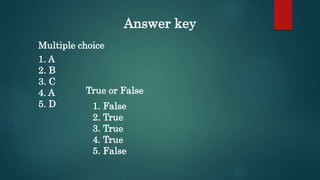
Answer key
Multiple choice
1. A
2. B
3. C
4. A
5. D
True or False
1. False
2. True
3. True
4. True
5. False

Module 2.pptx

  • 1.
    English QUARTER 3 –MODULE 2 Using a Variety Of Informative, Persuasive, and Argumentative writing Techniques
  • 2.
    Lesson1 Structure of anInformative Text Informative text Is a kind of text that offers data, definitions, and description of phenomenaor details about a fact. It introduces a clearly stated topic and creates an organizational structure in which related information is grouped logically to support the purpose of writing. It develops evidence with relevant facts, definitions, concrete details, quotations, and example with reference. It also uses appropriate linking ideas within and across paragraphs to smoothly and purposefully connect the controlling idea to evidence and provides a satisfying conclusion related to the topic.
  • 3.
    What’s In Articles, textbookschapter, passages, paragraphs or sentence have topics and main ideas. Locating the topic, main idea, and supporting details is important in helping you understand what the writer is attempting to express, Moreover, identifying the relationship between these will also increase your comprehension. In Writing an informative essay, you have to keep in mind that the main idea is the point of the paragraph and it is the most important though about the topic. The main idea is usually a sentence and it can be in different place within a paragraph
  • 4.
    Here’s a sampleparagraph Most teenagers and young adults do not know what they want to do for the rest of their lives. It is a big decision. There are things you can do to narrow the choices. For example you can take an interest test, do some research on your own about a career, try volunteer work in the field in which you are interested, or “job Shadow” in which you spend a day with a person who is working in the field that interests you. These are just a few helpful ideas as you begin to choose a career. The Topic is __________________ The Main Idea is ___________________
  • 5.
    What is it STRUCTUREOF AN INFORMATIVE TEXT Structure Description Examples Signal words Cause and effect Names the event/occurance and then tells the effects it has (on the events, on people, etc.) Or the writer names the event/occurance and then tells what caused it to happen. ‱ A trouble shooting guide for the office copy machine that outlines possible causes of malfunctions ‱ Warning labels naming possible side effect and using product As a result because of the consequently due to for this reason if ......then not only, but so that therefore this led to thus
  • 6.
    Compare and contrast Describe similarities or differencesbetween objects, places, or events, and the similar or different qualities are linked back and forth. ‱ News articles explaining candidates’ positions on issues ‱ Sports pre-games stories about two opposing teams Alike also as well as although but just as different from in the same way in comparison however likewise nevertheless whereas Description Explains a topic often in considerable detail. Often the text is broken into sections and details that elaborate on it. ‱ Information sheets about products for sale, such as a car, an appliance, a gadget, etc. ‱ Articles on things to do at vacation destination Another described as for example for instance in addition in particular illustrate Structure Description Examples Signal words
  • 7.
    Problem and Solution Present aproblem and several possible solutions. The author may also describe the pros and cons of each solution. ‱ A newspaper outlining a current difficulty, proposing some solution and advocating for one of them ‱ A political speech A solution as result because consequently however since so that therefore Sequence Construct the information in a chain, so that the writer can lay out steps in a process, series of events, or a hierarchy ‱ Directions in a manual for using an appliance ‱ A timeline for product development ‱ Recipes After before finally first, second, third following in conclusion last next preceding previously then
  • 10.
  • 11.
    S.A. 1 MODULE1 ______1. What term refers to a style of writing that provides factual information? ______2. Which of the following answers the question what happened and why? Read and answer the questions carefully. Write the letter of the correct answer on a lengthwise paper A. Argumentative B. Informative C. Narrative D. Persuasive A. Cause and effect B. Compare and Contrast C. Sequence D. Problem and Solution
  • 12.
    ______3. Which typeof text structure describes events in order? A. Cause and effect B. Compare and Contrast C. Sequence D. Description ______4. Which of the following shows how two or more things are alike and different? A. Cause and effect B. Compare and Contrast C. Sequence D. Problem and Solution ______5. What is the purpose of informative writing? A. To describe how a scene might look in novel B. To persuade you to buy a product C. To provide clear facts about something D. To tell you how to do something
  • 13.
    ______6. Which ofthe following is NOT an example of informative text? ______7. What words or phrases help the writer move from one idea to another? A. A church newsletter B. obituary in local newspaper C. An editorial D. None of the above A. Adjective B. Evidence C. Opinion D. Transition
  • 14.
    8-10, Identify thestructure of the text then choose the letter of your answer from to box below. A. Cause and effect B. Compare and contrast C. Sequence D. Problem and Solution E. Description F. Example ______8. Goose bumps make me shiver. First I get cold. Then I shake all over. ______9. Goose bumps make me shiver. I get little bumps on my skin. They look like sesame seeds ______10. Goose bumps make me shiver. But they disappear as soon as I cover up with a jacket or sweater
  • 15.
    Lesson2 Persuasive writing Techniques Inthis one-week lesson, you will learn to write an effective persuasion and to guard yourself from dishonest persuasion. You will learn about different persuasive strategies And the important steps involved in all types of persuasive writing. You will also use your skills learned in getting information from persuasive
  • 16.
    Learning the skillsof persuasive writing will help develop your critical thinking skills, for you will practice focusing on a particular problem and then giving specific and convincing reasons to support your view. You will have to evaluate the reasons you think of, choosing those that seem soundest and most effective, and discarding others. Being able to write persuasively, for you will develop the skills necessary to presenting an effective argument
  • 17.
    What’s New Did youknow? Persuasive texts can also be turned into a persuasive speech. Although persuasive text and persuasive speech don’t have exact same structure, speakers draft their speech based on the elements, parts, techniques and strategies used in writing a persuasive text. Moreover, they have the same goal of convincing others to believe in a particular point of view.
  • 18.
    What is it Whatis persuasion? Persuasion is a technique that is used to present ideas in order to influence the audience or to convince the to perform a certain action What Is a persuasive text? A persuasive text is any text where the main purpose is to convince, motivate, or move readers toward a certain point of view or opinion. A persuasive text can be an argument, exposition, discussion, review or even an advertisement.
  • 19.
    Parts of apersuasive essay 1. INTRODUCTORY PARAGRAPH Your INTRODUCTORY PARAGRAPH should have the following parts: ‱ Catchy Hook The introductory paragraph should have to a strong “hook” the grabs the reader’s attention. Open with an unusual fact or statistics, a question or quatation, or an emphatic statement ‱ Background information/definitions Familiarize your reader with the content of your persuasive essay by giving context to your argument/subject. ‱ Thesis Statement It is a clear, concise statement of your main argument/s; the overall idea you will be arguing.
  • 20.
    2. BODY PARAGRAPH Yourbody paragraph should consist of: ‱ Topic sentence The topic sentence reflects the main idea of the paragraph and it links back to support the thesis Statement ‱ Evidences These are the information from a realiable outside source (not your own opinion) that supports the main idea of the paragraph. ‱ Analysis This Shows how your evidence support and build your argument.
  • 21.
    3. CONCLUDING PARAGRAPH Inyour concluding paragraph, you will summarize the main points by restating and reinforcing the thesis statement and supporting evidences. You can also include a call to action in which you will write what you want your audience/readers to believe and to do. Techniques in persuasion Aristotle’s “modes for persuasion” – otherwise known as rhetorical appeals – are known by the names of ethos, pathos , and logos. They are means of persuading other to believe a particular point of view. They are often used in speech writing and advertising to sway the audience
  • 22.
    1. Pathos: Theappeal to Emotion The first one gives the facts, but the second one attempt to persuade the reader that the food is delicious. The creator of the second menu does not want you to just think about the food; he wants you to feel as though you can taste it. This strategy of persuasion is what we called pathos or appeal to Emotion. Pathos is a persuasive strategy that plays on audience or reader’s emotions to influence the acceptance of your argument.
  • 23.
    2. Logos: theappeal to reason Fifteen-year-old Anna Ortega wanted to increase her allowance. Before she talked to her parents, however, she thought of some reasons why she needed extra money. For example, she had more expenses now that she was in high school; her lunch cost more; she had to pay for her school project; and she had to pay to ride in a tricycle. Anna used these reasons to persuade her parents to raise her allowance, but she could have tried other ways – appealing to their emotions (“if you love me, you’ll raise my allowance”) However, she decided to use an appeal to reason. This strategy of persuasion is what we called logos or appeal to logic/reason Logos is a way of persuading an audience with reason.
  • 24.
    3. Ethos: TheAppeal to Authority You attended a public speaking ceremony and you have observed that there’s a lot of people who attended the event. You yourself decided to attend because you learned that the speaker has achieved so many accomplishments and has already inspired and influenced people from around the world. You were convinced that you will learn something from the speaker because of his awards and achievements. This strategy of persuasion is what we called Ethos or Appeal to Authority. Ethos is a persuasive strategy used to convince an audience based on the author’s credibility or character.
  • 25.
  • 26.
    Test Questions 1. whatis the purpose of persuasive writing? A. to convince B. To tell a story C. To inform D. To entertain 2. How does an author share his opinion about an issue through persuasive writing? A.By sharing his personal opinion B.By supporting is opinion through the use of facts. C.By making a fictional information to trick the reader. D.By sharing the opinions of others that are similar to his opinion
  • 27.
    3. What doyou call the sentence that tells the main idea or point of view of the whole text? A.Topic sentence B.Main idea C. Thesis statement D. Concluding sentence 4. What is a sentence that tells the main idea or point of view each paragraph? A.Topic sentence B.Main idea C. Thesis statement D. Concluding sentence 5. Where should a thesis statement appear? A.First paragraph. B.last paragraph C.Anywhere in the easy D.The first sentence of every paragraph
  • 28.
    True or False 1.Persuasivetext is a technique that is used to present ideas in order to influence the audience 2. Thesis statement it is a clear concise statement of your main arguments 3. Catchy hook the introductory paragraph should have a strong "hook“ 4. Persuasive text is any text where the main purpose is to convince motivate or move readers toward a certain point of view or opinion 5. The topic sentence are the information from the reliable outside source(not your own opinion)
  • 29.
  • 30.
    Answer key Multiple choice 1.A 2. B 3. C 4. A 5. D True or False 1. False 2. True 3. True 4. True 5. False