ENGLISH
8 QUARTER 4
LET’S TEST YOUR
PHOTOGRAPHIC
MEMORY
Identify the same words, objects
or information related to each
column and answer the following
question.
Write your answer in your
activity notebook.
ACTIVITY 1.
LET’S TEST YOUR PHOTOGRAPHIC MEMORY
Please observe these images for 15 seconds. Once the time is
up, respond to the following question without referring back to
slide of images. Stay honest to yourself to enjoy this game.
ACTIVITY 1.
Copy this
format in your
activity
notebook.
Name: Section:
Activity 1: (Title of the activity)
1.
2. ...
ANSWER ONLY
LET’S TEST YOUR PHOTOGRAPHIC MEMORY
MEMORIZE THESE IMAGES FOR 15 SECONDS ONLY
ACTIVITY 1. A.
LET’S TEST YOUR
PHOTOGRAPHIC
MEMORY
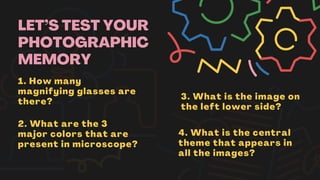
1. How many
magnifying glasses are
there?
2. What are the 3
major colors that are
present in microscope?
3. What is the image on
the left lower side?
4. What is the central
theme that appears in
all the images?
LET’S TEST YOUR PHOTOGRAPHIC MEMORY
MEMORIZE THESE IMAGES FOR 15 SECONDS ONLY
ACTIVITY 1. B.
LET’S TEST YOUR
PHOTOGRAPHIC
MEMORY
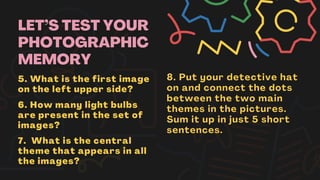
5. What is the first image
on the left upper side?
6. How many light bulbs
are present in the set of
images?
7. What is the central
theme that appears in all
the images?
8. Put your detective hat
on and connect the dots
between the two main
themes in the pictures.
Sum it up in just 5 short
sentences.
GUESS THE WORD BY
EMOJI✨
Direction: Guess the word from
the four emojis.
Write your answer on your
activity notebook.
Answer only.
ACTIVITY 2.
GUESS THE MOVIE BY THE EMOJI
GUESS THE BOOK BY THE EMOJI
GUESS THE SEASON BY THE EMOJI
GUESS THE HERO BY THE EMOJI
GUESS THE SINGER BY THE EMOJI
KEY
TAKEAWAYS
Direction: Fill in the blanks.
ACTIVITY 3.
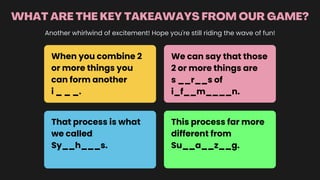
WHAT ARE THE KEY TAKEAWAYS FROM OUR GAME?
Another whirlwind of excitement! Hope you're still riding the wave of fun!
When you combine 2
or more things you
can form another
i _ _ _.
We can say that those
2 or more things are
s __r__s of
i_f__m____n.
That process is what
we called
Sy__h___s.
This process far more
different from
Su__a__z__g.
SYNTHESIZING
ESSENTIAL
INFORMATION FROM
VARIOUS SOURCES
In this lesson you will learn
how to synthesize
LEARNING
OBJECTIVES
Define synthesis;
Apply the steps in synthesizing
information in various sources.
Synthesize essential
information in a text.
01
02
03
WHAT IS SYNTHESIS?
The composition or combination of parts
or elements so as to form a whole.
The act of combining different ideas or
things to make a whole that is new and
different from the items considered
separately.
It involves looking for similarities and
differences between your sources.
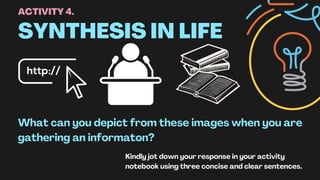
SYNTHESIS IN LIFE
What can you depict from these images when you are
gathering an informaton?
Kindly jot down your response in your activity
notebook using three concise and clear sentences.
ACTIVITY 4.
SYNTHESIS IN LIFE
In real-life scenarios, we
often unconsciously
integrate information.
That info we could get from the
internet, speakers, books, home,
conversation and school.
Real life example:
You saw a Marvel movie trailer with positive comments on
Facebook, but your Marvel fan friend at school didn't like it.
He mentioned that the cinematography in the other movie
trailers is much better than in the current one.
In that situation, you unintentionally distinguish between the two
sources and insert your personal viewpoint or opinion.
That is what we called synthesizing.
Real life example:
The key is not simply summarizing what you've read or heard;
instead, it involves analyzing information from multiple sources
and shaping your own perspective.
Explanation
Through synthesizing you can
form new ideas and opinion.
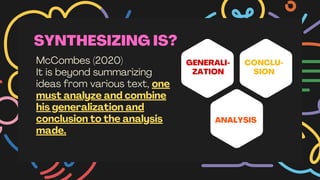
McCombes (2020)
It is beyond summarizing
ideas from various text, one
must analyze and combine
his generalization and
conclusion to the analysis
made.
SYNTHESIZING IS?
GENERALI-
ZATION
CONCLU-
SION
ANALYSIS
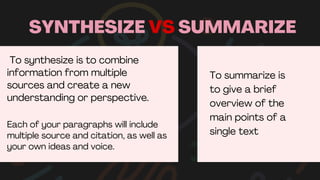
SYNTHESIZE
VS
SUMMARIZE
SYNTHESIZE VS SUMMARIZE
To summarize is
to give a brief
overview of the
main points of a
single text
To synthesize is to combine
information from multiple
sources and create a new
understanding or perspective.
Each of your paragraphs will include
multiple source and citation, as well as
your own ideas and voice.
SOURCE 1 SOURCE 2
PERSONAL
IDEAS
FORMULA
SYNTHESIZED IDEA
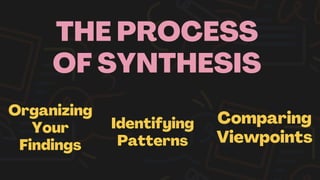
THE PROCESS
OF SYNTHESIS
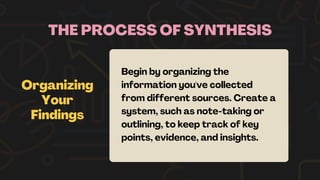
Organizing
Your
Findings
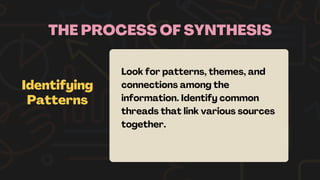
Identifying
Patterns
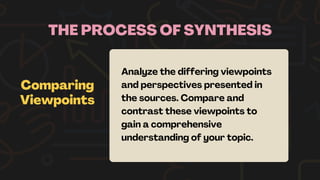
Comparing
Viewpoints
THE PROCESS OF SYNTHESIS
Organizing
Your
Findings
Begin by organizing the
information you've collected
from different sources. Create a
system, such as note-taking or
outlining, to keep track of key
points, evidence, and insights.
THE PROCESS OF SYNTHESIS
Identifying
Patterns
Look for patterns, themes, and
connections among the
information. Identify common
threads that link various sources
together.
THE PROCESS OF SYNTHESIS
Comparing
Viewpoints
Analyze the differing viewpoints
and perspectives presented in
the sources. Compare and
contrast these viewpoints to
gain a comprehensive
understanding of your topic.
THE PROCESS OF SYNTHESIS
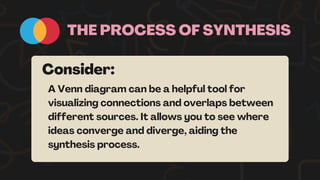
Consider:
A Venn diagram can be a helpful tool for
visualizing connections and overlaps between
different sources. It allows you to see where
ideas converge and diverge, aiding the
synthesis process.
CRITICAL
EVALUATION
OF SOURCES
CRITICAL EVALUATION
OF SOURCES
As you synthesize information from multiple
sources, it is crucial to engage in critical
evaluation to ensure the credibility and reliability
of the information you incorporate. Here are
essential aspects to consider when evaluating
your sources:
CRITICAL EVALUATION
OF SOURCES
Credibility and Reliability
Assess the credibility and reliability of each source. Be
cautious of sources with a lack of transparency or those
that present unverified claims.
CRITICAL EVALUATION
OF SOURCES
Biases and Objectivity
CRITICAL EVALUATION
OF SOURCES
Critical Evaluation of Sources
CRITICAL EVALUATION
OF SOURCES
Currency and Timeliness
LET’S
SYNTHESIZE!
ACTIVITY 5.
LET’S SYNTHESIZE!
ACTIVITY 5.
LET’S SYNTHESIZE!
ACTIVITY 5.
LET’S SYNTHESIZE!
ACTIVITY 5.
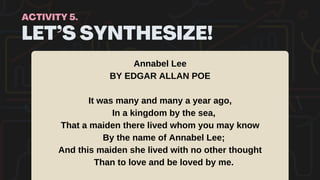
Annabel Lee
BY EDGAR ALLAN POE
It was many and many a year ago,
In a kingdom by the sea,
That a maiden there lived whom you may know
By the name of Annabel Lee;
And this maiden she lived with no other thought
Than to love and be loved by me.
LET’S SYNTHESIZE!
ACTIVITY 5.
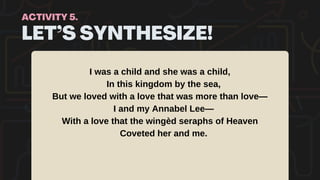
I was a child and she was a child,
In this kingdom by the sea,
But we loved with a love that was more than love—
I and my Annabel Lee—
With a love that the wingèd seraphs of Heaven
Coveted her and me.
LET’S SYNTHESIZE!
ACTIVITY 5.
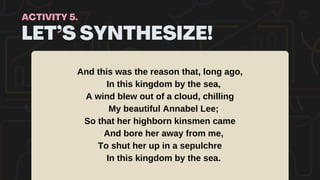
And this was the reason that, long ago,
In this kingdom by the sea,
A wind blew out of a cloud, chilling
My beautiful Annabel Lee;
So that her highborn kinsmen came
And bore her away from me,
To shut her up in a sepulchre
In this kingdom by the sea.
LET’S SYNTHESIZE!
ACTIVITY 5.
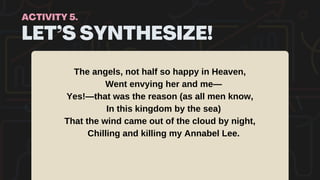
The angels, not half so happy in Heaven,
Went envying her and me—
Yes!—that was the reason (as all men know,
In this kingdom by the sea)
That the wind came out of the cloud by night,
Chilling and killing my Annabel Lee.
LET’S SYNTHESIZE!
ACTIVITY 5.
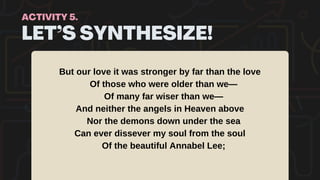
But our love it was stronger by far than the love
Of those who were older than we—
Of many far wiser than we—
And neither the angels in Heaven above
Nor the demons down under the sea
Can ever dissever my soul from the soul
Of the beautiful Annabel Lee;
LET’S SYNTHESIZE!
ACTIVITY 5.
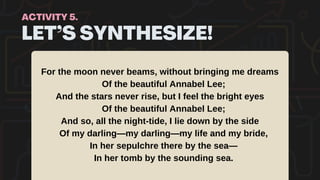
For the moon never beams, without bringing me dreams
Of the beautiful Annabel Lee;
And the stars never rise, but I feel the bright eyes
Of the beautiful Annabel Lee;
And so, all the night-tide, I lie down by the side
Of my darling—my darling—my life and my bride,
In her sepulchre there by the sea—
In her tomb by the sounding sea.
LET’S SYNTHESIZE!
ACTIVITY 5.
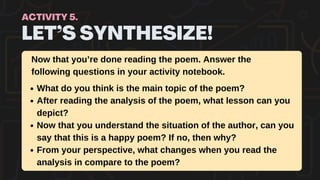
Now that you’re done reading the poem. Answer the
following questions in your activity notebook.
What do you think is the theme of the poem?
1.
Who is the speaker of the poem?
2.
What is the ending of the poem?
3.
What lesson can you depict from the story of the
two lover?
4.
LET’S SYNTHESIZE!
ACTIVITY 5.
Now read the analyzation of the poem.
‘Annabel Lee’ was the last poem Edgar Allan Poe
completed before his untimely death in 1849. Precisely
who the inspiration for the character of ‘Annabel Lee’
was remains a mystery, although Poe’s cousin,
Virginia, whom he fell in love with when she was
thirteen, is the leading candidate.
LET’S SYNTHESIZE!
ACTIVITY 5.
The narrator fell in love with Annabel Lee when they were both
young and his love for her continues even after her death;
however, the urge to offer a narrowly biographical analysis of
‘Annabel Lee’ should probably be resisted.
Poe was an extraordinarily imaginative writer (almost single-
handedly perfecting the short-story form, and inventing
detective fiction along the way); not everything he wrote
stemmed from his own personal circumstances.
LET’S SYNTHESIZE!
ACTIVITY 5.
‘Annabel Lee’: style and mode
Poe’s poems are predominantly cast in the Romantic
mode, meaning that he follows poets like John Keats
in setting many of his narrative poems in enchanted or
fairy-tale lands. ‘Annabel Lee’ is a prime example: the
fact that Annabel Lee lives in ‘a kingdom by the sea’,
and that the events the narrator outlines happened
‘many and many a year ago’ (the poet’s version of
‘once upon a time’).
LET’S SYNTHESIZE!
ACTIVITY 5.
He is looking back, nostalgically, at the young love
he and Annabel Lee shared; but putting such distance
between ‘now’ and ‘then’ also reinforces the strength of
his love for her, since he continues to visit her grave
years after her death.
Although ‘Annabel Lee’ is often described as a
ballad, this is only half-true. The poem has the ring of a
ballad that has been passed down through oral tradition
(and that was designed to be sung and danced to,
LET’S SYNTHESIZE!
ACTIVITY 5.
accompanied by music), but it doesn’t follow the strict
ballad metre (quatrains of alternating iambic
tetrameter and trimeter, rhymed abcb).
Instead, the form of ‘Annabel Lee’ is actually a little
more irregular: the poem begins with a stanza of
alternating tetrameter and trimeter, true, but there are
six lines rather than four, and the metre is more jaunty
and lively than regular iambic metre: many of the feet
LET’S SYNTHESIZE!
ACTIVITY 5.
are anapests (i.e. two unstressed syllables followed
bya stressed) as opposed to iambs (i.e. one
unstressed syllable followed by a stressed).
This keeps the metre of the poem on its toes (we
might say it keeps the poem’s ‘feet’ on its toes), and
reflects the sudden death of Annabel Lee as well as
the ballad-like feel Poe is seeking to create, harking
back to medieval ballads about true love and
kingdoms by the sea.
LET’S SYNTHESIZE!
ACTIVITY 5.
Poe never lived to see ‘Annabel Lee’ published: it
appeared posthumously in the Southern Literary
Messenger in November 1849. Poe had died a month
before, having been found delirious, and wearing
somebody else’s clothes, on the streets of Baltimore.
LET’S SYNTHESIZE!
ACTIVITY 5.
What do you think is the main topic of the poem?
After reading the analysis of the poem, what lesson can you
depict?
Now that you understand the situation of the author, can you
say that this is a happy poem? If no, then why?
From your perspective, what changes when you read the
analysis in compare to the poem?
Now that you’re done reading the poem. Answer the
following questions in your activity notebook.
MAY I SEE?
ACTIVITY 6.
Excellent work on finishing our lesson!
Take away valuable insights from the poem. To wrap up this
lesson and before your PETA, share a photo (either
individual or group) of a loved one you can't bear to lose.
Posting a picture in our group chat confirms that you have
completed studying the topic and understood the lesson
deeply.
STUDY
MORE FOR
BRIGHTER
FUTURE!
THANK YOU!

English-8-Q4-W3-Synthesizing-Essential-Information-From-Various-Sources-1.pdf

  • 1.
  • 2.
    LET’S TEST YOUR PHOTOGRAPHIC MEMORY Identifythe same words, objects or information related to each column and answer the following question. Write your answer in your activity notebook. ACTIVITY 1.
  • 3.
    LET’S TEST YOURPHOTOGRAPHIC MEMORY Please observe these images for 15 seconds. Once the time is up, respond to the following question without referring back to slide of images. Stay honest to yourself to enjoy this game. ACTIVITY 1. Copy this format in your activity notebook. Name: Section: Activity 1: (Title of the activity) 1. 2. ... ANSWER ONLY
  • 4.
    LET’S TEST YOURPHOTOGRAPHIC MEMORY MEMORIZE THESE IMAGES FOR 15 SECONDS ONLY ACTIVITY 1. A.
  • 5.
    LET’S TEST YOUR PHOTOGRAPHIC MEMORY 1.How many magnifying glasses are there? 2. What are the 3 major colors that are present in microscope? 3. What is the image on the left lower side? 4. What is the central theme that appears in all the images?
  • 6.
    LET’S TEST YOURPHOTOGRAPHIC MEMORY MEMORIZE THESE IMAGES FOR 15 SECONDS ONLY ACTIVITY 1. B.
  • 7.
    LET’S TEST YOUR PHOTOGRAPHIC MEMORY 5.What is the first image on the left upper side? 6. How many light bulbs are present in the set of images? 7. What is the central theme that appears in all the images? 8. Put your detective hat on and connect the dots between the two main themes in the pictures. Sum it up in just 5 short sentences.
  • 8.
    GUESS THE WORDBY EMOJI✨ Direction: Guess the word from the four emojis. Write your answer on your activity notebook. Answer only. ACTIVITY 2.
  • 9.
    GUESS THE MOVIEBY THE EMOJI
  • 10.
    GUESS THE BOOKBY THE EMOJI
  • 11.
    GUESS THE SEASONBY THE EMOJI
  • 12.
    GUESS THE HEROBY THE EMOJI
  • 13.
    GUESS THE SINGERBY THE EMOJI
  • 14.
    KEY TAKEAWAYS Direction: Fill inthe blanks. ACTIVITY 3.
  • 15.
    WHAT ARE THEKEY TAKEAWAYS FROM OUR GAME? Another whirlwind of excitement! Hope you're still riding the wave of fun! When you combine 2 or more things you can form another i _ _ _. We can say that those 2 or more things are s __r__s of i_f__m____n. That process is what we called Sy__h___s. This process far more different from Su__a__z__g.
  • 16.
    SYNTHESIZING ESSENTIAL INFORMATION FROM VARIOUS SOURCES Inthis lesson you will learn how to synthesize
  • 17.
    LEARNING OBJECTIVES Define synthesis; Apply thesteps in synthesizing information in various sources. Synthesize essential information in a text. 01 02 03
  • 18.
    WHAT IS SYNTHESIS? Thecomposition or combination of parts or elements so as to form a whole. The act of combining different ideas or things to make a whole that is new and different from the items considered separately. It involves looking for similarities and differences between your sources.
  • 19.
    SYNTHESIS IN LIFE Whatcan you depict from these images when you are gathering an informaton? Kindly jot down your response in your activity notebook using three concise and clear sentences. ACTIVITY 4.
  • 20.
    SYNTHESIS IN LIFE Inreal-life scenarios, we often unconsciously integrate information. That info we could get from the internet, speakers, books, home, conversation and school.
  • 21.
    Real life example: Yousaw a Marvel movie trailer with positive comments on Facebook, but your Marvel fan friend at school didn't like it. He mentioned that the cinematography in the other movie trailers is much better than in the current one. In that situation, you unintentionally distinguish between the two sources and insert your personal viewpoint or opinion. That is what we called synthesizing.
  • 22.
    Real life example: Thekey is not simply summarizing what you've read or heard; instead, it involves analyzing information from multiple sources and shaping your own perspective. Explanation Through synthesizing you can form new ideas and opinion.
  • 23.
    McCombes (2020) It isbeyond summarizing ideas from various text, one must analyze and combine his generalization and conclusion to the analysis made. SYNTHESIZING IS? GENERALI- ZATION CONCLU- SION ANALYSIS
  • 24.
  • 25.
    SYNTHESIZE VS SUMMARIZE Tosummarize is to give a brief overview of the main points of a single text To synthesize is to combine information from multiple sources and create a new understanding or perspective. Each of your paragraphs will include multiple source and citation, as well as your own ideas and voice.
  • 26.
    SOURCE 1 SOURCE2 PERSONAL IDEAS FORMULA SYNTHESIZED IDEA
  • 27.
  • 28.
    THE PROCESS OFSYNTHESIS Organizing Your Findings Begin by organizing the information you've collected from different sources. Create a system, such as note-taking or outlining, to keep track of key points, evidence, and insights.
  • 29.
    THE PROCESS OFSYNTHESIS Identifying Patterns Look for patterns, themes, and connections among the information. Identify common threads that link various sources together.
  • 30.
    THE PROCESS OFSYNTHESIS Comparing Viewpoints Analyze the differing viewpoints and perspectives presented in the sources. Compare and contrast these viewpoints to gain a comprehensive understanding of your topic.
  • 31.
    THE PROCESS OFSYNTHESIS Consider: A Venn diagram can be a helpful tool for visualizing connections and overlaps between different sources. It allows you to see where ideas converge and diverge, aiding the synthesis process.

  • 32.
  • 33.
    CRITICAL EVALUATION OF SOURCES Asyou synthesize information from multiple sources, it is crucial to engage in critical evaluation to ensure the credibility and reliability of the information you incorporate. Here are essential aspects to consider when evaluating your sources:
  • 34.
    CRITICAL EVALUATION OF SOURCES Credibilityand Reliability Assess the credibility and reliability of each source. Be cautious of sources with a lack of transparency or those that present unverified claims.
  • 35.
  • 36.
  • 37.
  • 38.
  • 39.
  • 40.
  • 41.
    LET’S SYNTHESIZE! ACTIVITY 5. AnnabelLee BY EDGAR ALLAN POE It was many and many a year ago, In a kingdom by the sea, That a maiden there lived whom you may know By the name of Annabel Lee; And this maiden she lived with no other thought Than to love and be loved by me.
  • 42.
    LET’S SYNTHESIZE! ACTIVITY 5. Iwas a child and she was a child, In this kingdom by the sea, But we loved with a love that was more than love— I and my Annabel Lee— With a love that the wingèd seraphs of Heaven Coveted her and me.
  • 43.
    LET’S SYNTHESIZE! ACTIVITY 5. Andthis was the reason that, long ago, In this kingdom by the sea, A wind blew out of a cloud, chilling My beautiful Annabel Lee; So that her highborn kinsmen came And bore her away from me, To shut her up in a sepulchre In this kingdom by the sea.
  • 44.
    LET’S SYNTHESIZE! ACTIVITY 5. Theangels, not half so happy in Heaven, Went envying her and me— Yes!—that was the reason (as all men know, In this kingdom by the sea) That the wind came out of the cloud by night, Chilling and killing my Annabel Lee.
  • 45.
    LET’S SYNTHESIZE! ACTIVITY 5. Butour love it was stronger by far than the love Of those who were older than we— Of many far wiser than we— And neither the angels in Heaven above Nor the demons down under the sea Can ever dissever my soul from the soul Of the beautiful Annabel Lee;
  • 46.
    LET’S SYNTHESIZE! ACTIVITY 5. Forthe moon never beams, without bringing me dreams Of the beautiful Annabel Lee; And the stars never rise, but I feel the bright eyes Of the beautiful Annabel Lee; And so, all the night-tide, I lie down by the side Of my darling—my darling—my life and my bride, In her sepulchre there by the sea— In her tomb by the sounding sea.
  • 47.
    LET’S SYNTHESIZE! ACTIVITY 5. Nowthat you’re done reading the poem. Answer the following questions in your activity notebook. What do you think is the theme of the poem? 1. Who is the speaker of the poem? 2. What is the ending of the poem? 3. What lesson can you depict from the story of the two lover? 4.
  • 48.
    LET’S SYNTHESIZE! ACTIVITY 5. Nowread the analyzation of the poem. ‘Annabel Lee’ was the last poem Edgar Allan Poe completed before his untimely death in 1849. Precisely who the inspiration for the character of ‘Annabel Lee’ was remains a mystery, although Poe’s cousin, Virginia, whom he fell in love with when she was thirteen, is the leading candidate.
  • 49.
    LET’S SYNTHESIZE! ACTIVITY 5. Thenarrator fell in love with Annabel Lee when they were both young and his love for her continues even after her death; however, the urge to offer a narrowly biographical analysis of ‘Annabel Lee’ should probably be resisted. Poe was an extraordinarily imaginative writer (almost single- handedly perfecting the short-story form, and inventing detective fiction along the way); not everything he wrote stemmed from his own personal circumstances.
  • 50.
    LET’S SYNTHESIZE! ACTIVITY 5. ‘AnnabelLee’: style and mode Poe’s poems are predominantly cast in the Romantic mode, meaning that he follows poets like John Keats in setting many of his narrative poems in enchanted or fairy-tale lands. ‘Annabel Lee’ is a prime example: the fact that Annabel Lee lives in ‘a kingdom by the sea’, and that the events the narrator outlines happened ‘many and many a year ago’ (the poet’s version of ‘once upon a time’).


  • 51.
    LET’S SYNTHESIZE! ACTIVITY 5. Heis looking back, nostalgically, at the young love he and Annabel Lee shared; but putting such distance between ‘now’ and ‘then’ also reinforces the strength of his love for her, since he continues to visit her grave years after her death. Although ‘Annabel Lee’ is often described as a ballad, this is only half-true. The poem has the ring of a ballad that has been passed down through oral tradition (and that was designed to be sung and danced to,
  • 52.
    LET’S SYNTHESIZE! ACTIVITY 5. accompaniedby music), but it doesn’t follow the strict ballad metre (quatrains of alternating iambic tetrameter and trimeter, rhymed abcb). Instead, the form of ‘Annabel Lee’ is actually a little more irregular: the poem begins with a stanza of alternating tetrameter and trimeter, true, but there are six lines rather than four, and the metre is more jaunty and lively than regular iambic metre: many of the feet
  • 53.
    LET’S SYNTHESIZE! ACTIVITY 5. areanapests (i.e. two unstressed syllables followed bya stressed) as opposed to iambs (i.e. one unstressed syllable followed by a stressed). This keeps the metre of the poem on its toes (we might say it keeps the poem’s ‘feet’ on its toes), and reflects the sudden death of Annabel Lee as well as the ballad-like feel Poe is seeking to create, harking back to medieval ballads about true love and kingdoms by the sea.
  • 54.
    LET’S SYNTHESIZE! ACTIVITY 5. Poenever lived to see ‘Annabel Lee’ published: it appeared posthumously in the Southern Literary Messenger in November 1849. Poe had died a month before, having been found delirious, and wearing somebody else’s clothes, on the streets of Baltimore.
  • 55.
    LET’S SYNTHESIZE! ACTIVITY 5. Whatdo you think is the main topic of the poem? After reading the analysis of the poem, what lesson can you depict? Now that you understand the situation of the author, can you say that this is a happy poem? If no, then why? From your perspective, what changes when you read the analysis in compare to the poem? Now that you’re done reading the poem. Answer the following questions in your activity notebook.
  • 56.
    MAY I SEE? ACTIVITY6. Excellent work on finishing our lesson! Take away valuable insights from the poem. To wrap up this lesson and before your PETA, share a photo (either individual or group) of a loved one you can't bear to lose. Posting a picture in our group chat confirms that you have completed studying the topic and understood the lesson deeply.
  • 57.