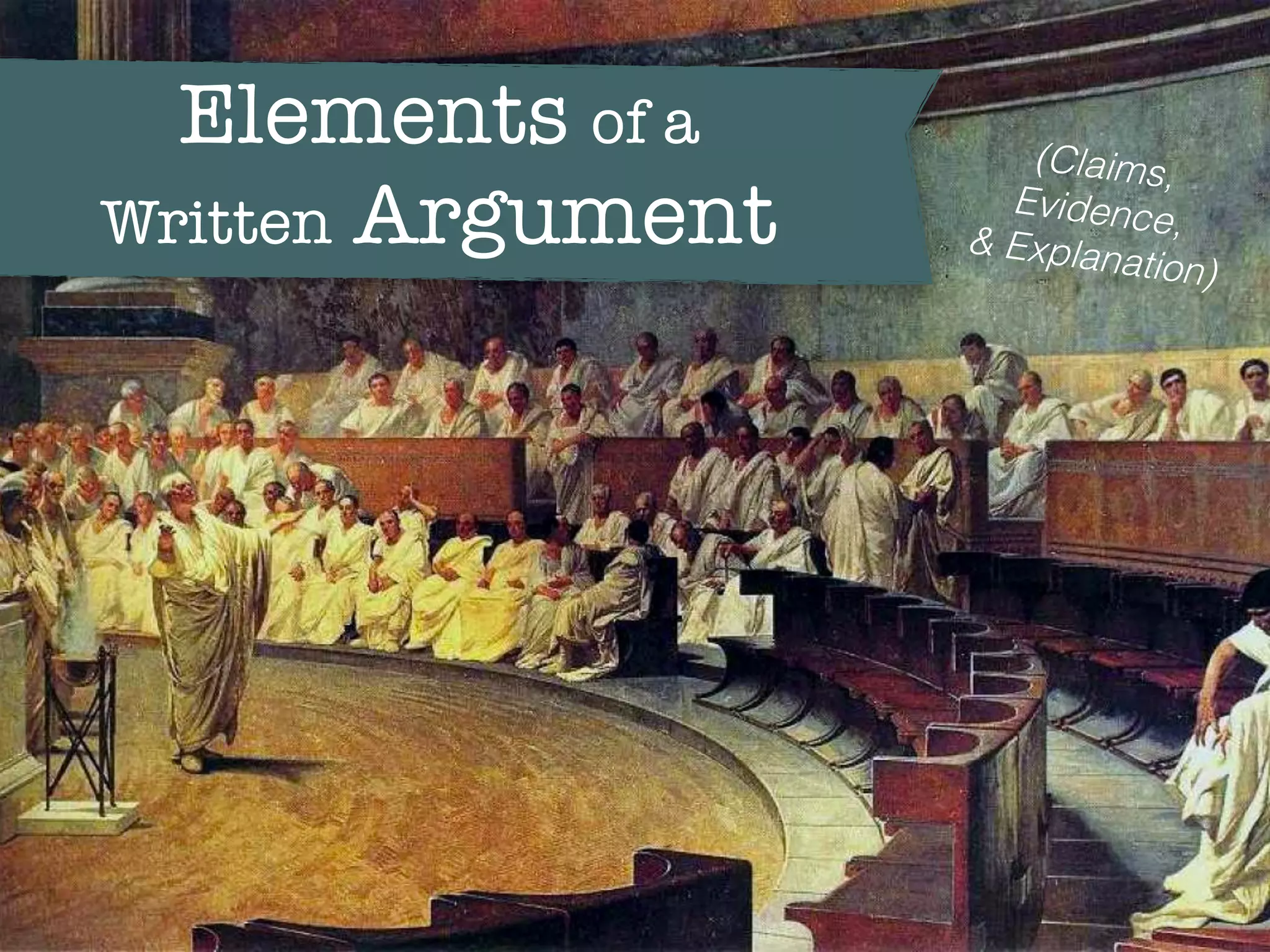
Elements of a
Written Argument
(Claims,
Evidence,& Explanation)
Parts:
1. Claim: a point you are arguing.
2. Subclaim: a point you are
arguing that supports another
claim you have already made.
3. Evidence: the sources you use
to support your claim.
4. Explanation: the reasoning for
why your evidence supports
your claim.
Claim:
A claim is a point you are arguing. Claims are
not facts but rather conclusions that the writer
draws from facts.
When you think of an “argument,”
you might imagine people taking
opposite sides and debating in a
win/lose situation.
In academics, a written argument
is not always so heated -
academic argumentation deals
with any question that does not
have a straightforward answer.
Claim Example:
See? A claim does not need to
be controversial (like, “the
death penalty should be
eliminated”) - a claim can be
any statement that you must
support with evidence. Most
academic claims are about
anything that can be
questioned within a discipline.
“Early Medieval people believed that the way burials
were conducted influenced the activity of spirits.”
Evidence:
The research, facts, and testimony that
support your claim.
The following things can NOT
be used as evidence:
Because it’s my personal opinion
Because my friends or relatives
think so or most people think so
Because it’s always been agreed
upon / it’s tradition
Because it’s obvious
Because it’s morally right
Evidence Example:
Claim: “Early Medieval people believed that the way
burials were conducted influenced the activity of spirits.”
This piece of evidence is
based on archaeological
finds and the conclusions
made by archaeologists.
Evidence: “Archaeologists have discovered that Anglo-
Saxons sometimes removed bodies from graves,
cremated them, and cast the ashes into a running water
source.”
Explanation?
As the writer, YOU might
understand how this statement
supports the claim you made, but
the reader can’t always make the
connection. There is one thing
still missing from this argument:
EXPLANATION.
Evidence: “Archaeologists have discovered that Anglo-
Saxons sometimes removed bodies from graves,
cremated them, and cast the ashes into a running water
source.”
Claim: “Early Medieval people believed that the way
burials were conducted influenced the activity of spirits.”
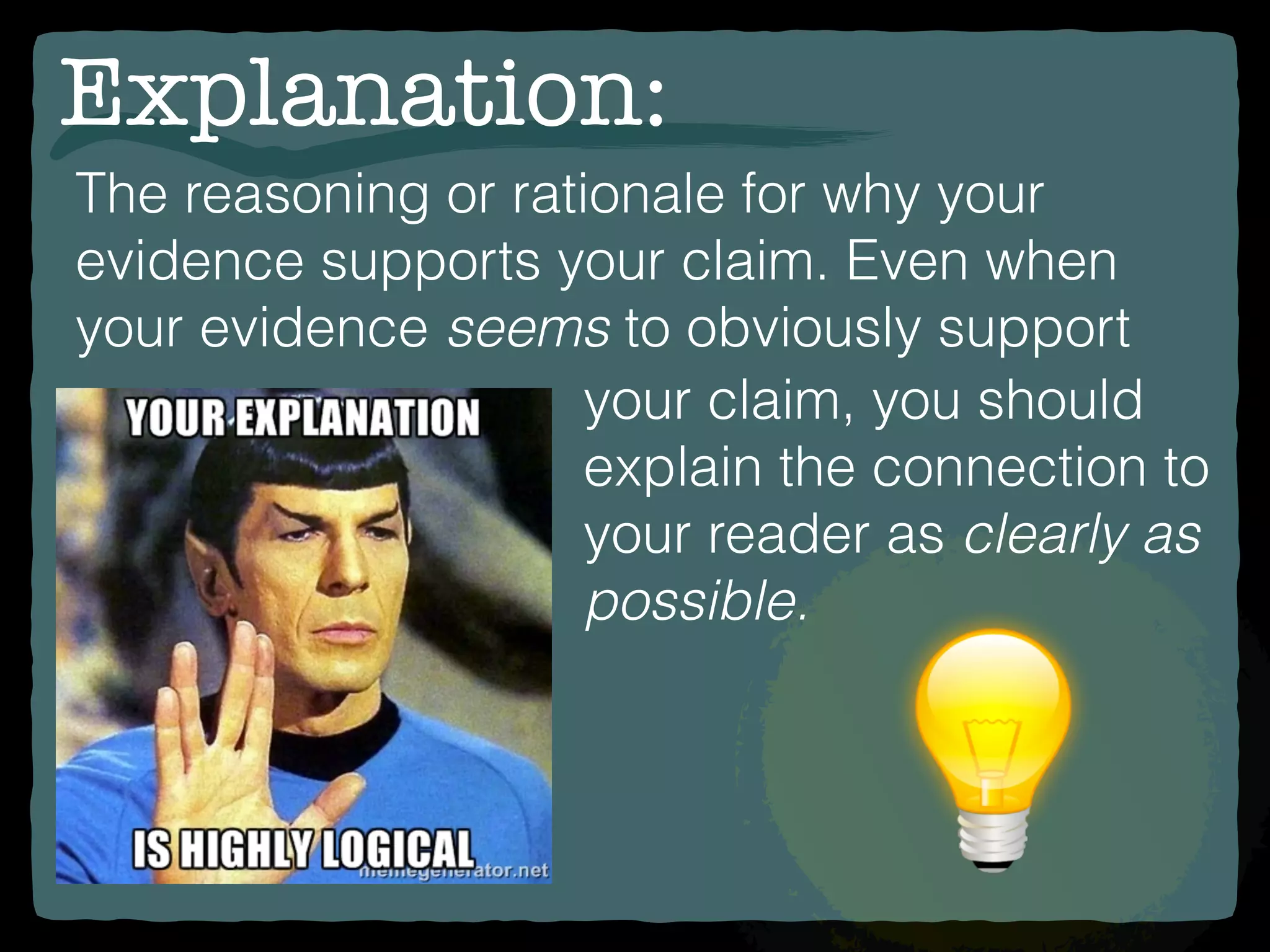
Explanation:
The reasoning or rationale for why your
evidence supports your claim. Even when
your evidence seems to obviously support
your claim, you should
explain the connection to
your reader as clearly as
possible.
Explanation?
Evidence: “Archaeologists have discovered that Anglo-
Saxons sometimes removed bodies from graves,
cremated them, and cast the ashes into a running water
source.”
Explanation: “Because the Anglo-Saxons believed that
angry spirits would often leave their graves and torment
people of the town, the living hoped that by destroying the
body and removing it from a traditional burial place, the
spirits could no longer take vengeance.”
Claim: “Early Medieval people believed that the way
burials were conducted influenced the activity of spirits.”
Example #2
Claim: “Dora the Explorer is an
educational T.V. show for kids.”
Time to gather evidence!
Choose your evidence from
reliable sources that
support your interpretation. The
evidence can be quoted,
paraphrased, or summarized.
Example #2
Claim: “Dora the Explorer is an
educational T.V. show for kids.”
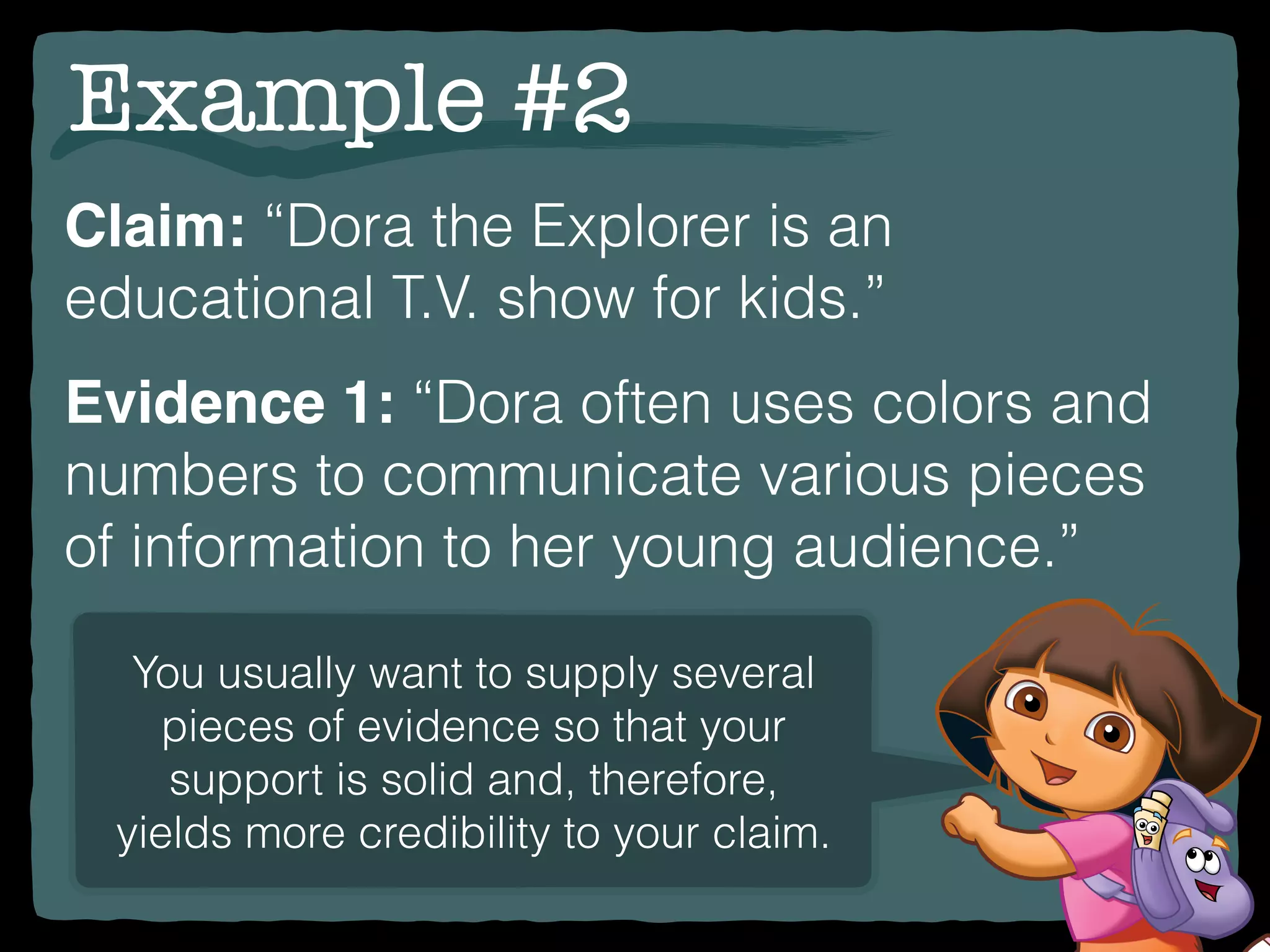
Evidence 1: “Dora often uses colors and
numbers to communicate various pieces
of information to her young audience.”
You usually want to supply several
pieces of evidence so that your
support is solid and, therefore,
yields more credibility to your claim.
Example #2
Claim: “Dora the Explorer is an
educational T.V. show for kids.”
Evidence 1: “Dora often uses colors and
numbers to communicate various pieces
of information to her young audience.”
Evidence 2: “The show uses simple words
in English and Spanish to help unfold the
plot.”
Add Explanation…
Dora the Explorer is an educational T.V. show for kids.
Dora often uses colors and numbers to communicate
various pieces of information to her young audience. The
use of color and numbers helps prepare kids for the early
stages of learning in preschool and kindergarten. Early
exposure to these basics units of knowledge helps
prepare children for their first few years in an educational
setting. Additionally, the show uses simple words in
English and Spanish to help unfold the plot. The use of
two languages in the show helps create young bilingual
speakers. Early exposure to multiple languages will help
prepare kids for the more intensive language lessons they
will experience during high school and college.
Activity
Look at the images on the screen, and
respond to the prompt questions on a
separate document. You will email your
answers to Ms. G at the end of the
activity!
You will practice making claims and
supporting them with evidence and
explanation.
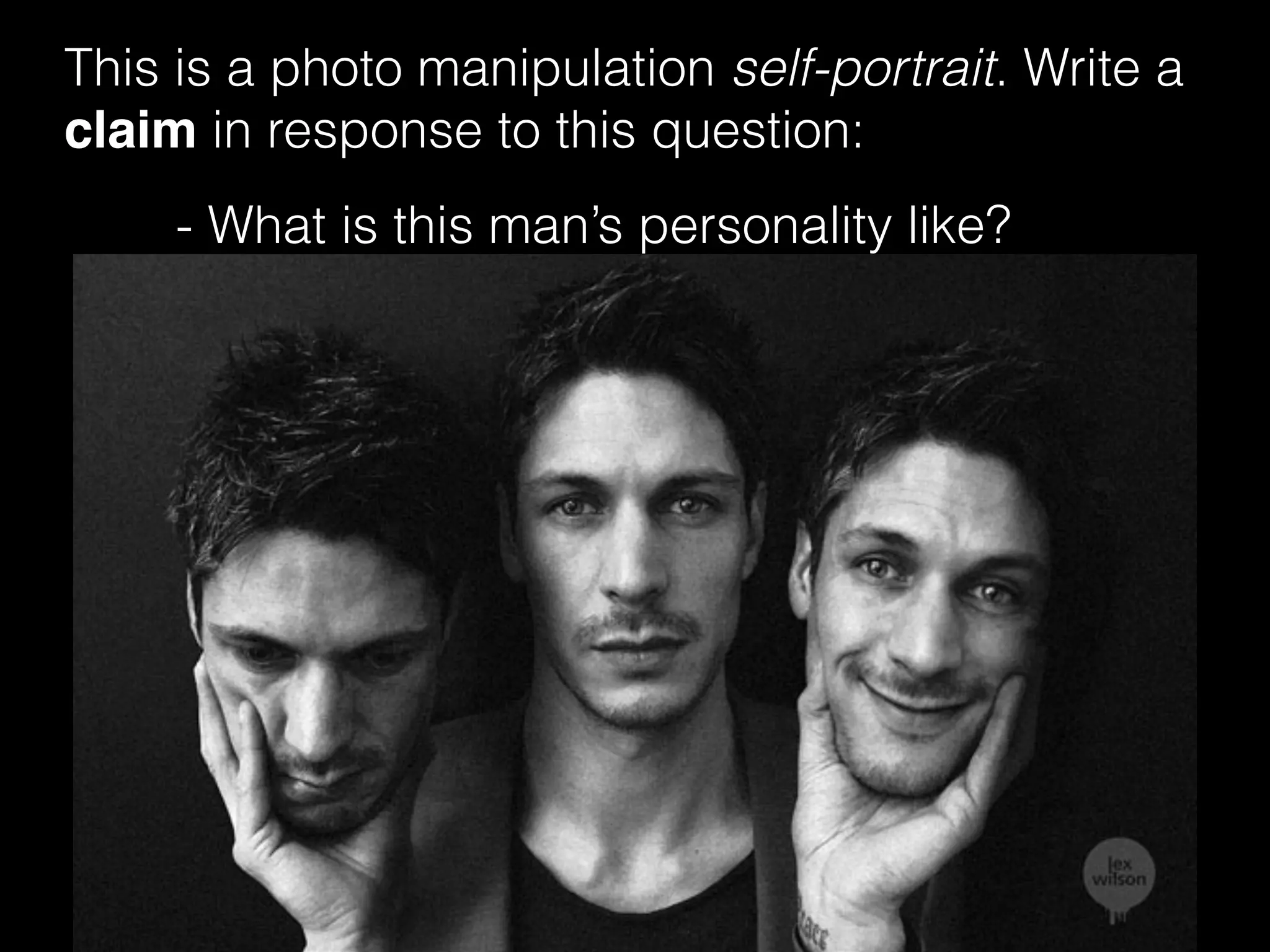
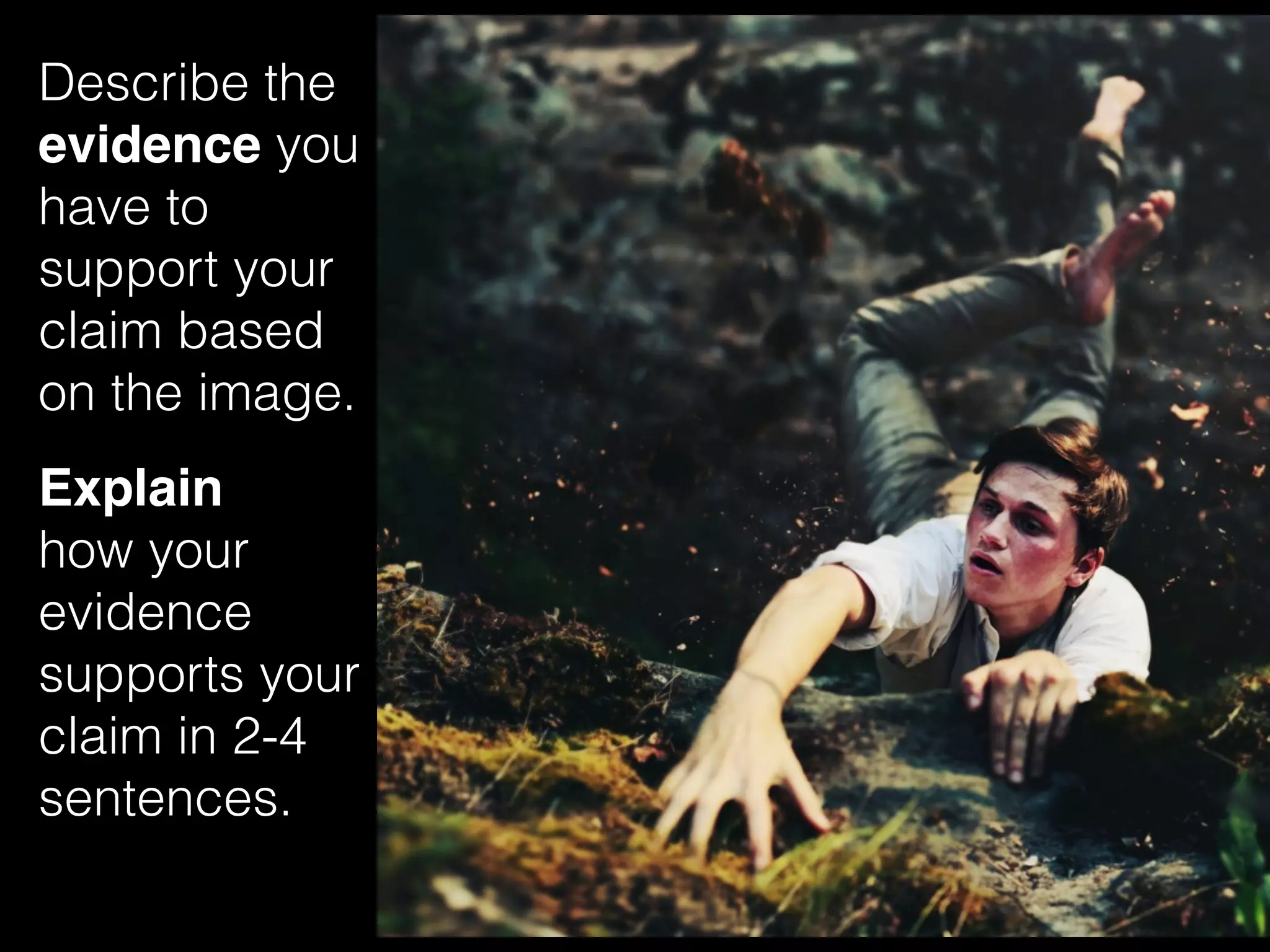
This is a photo manipulation self-portrait. Write a
claim in response to this question:
- What is this man’s personality like?
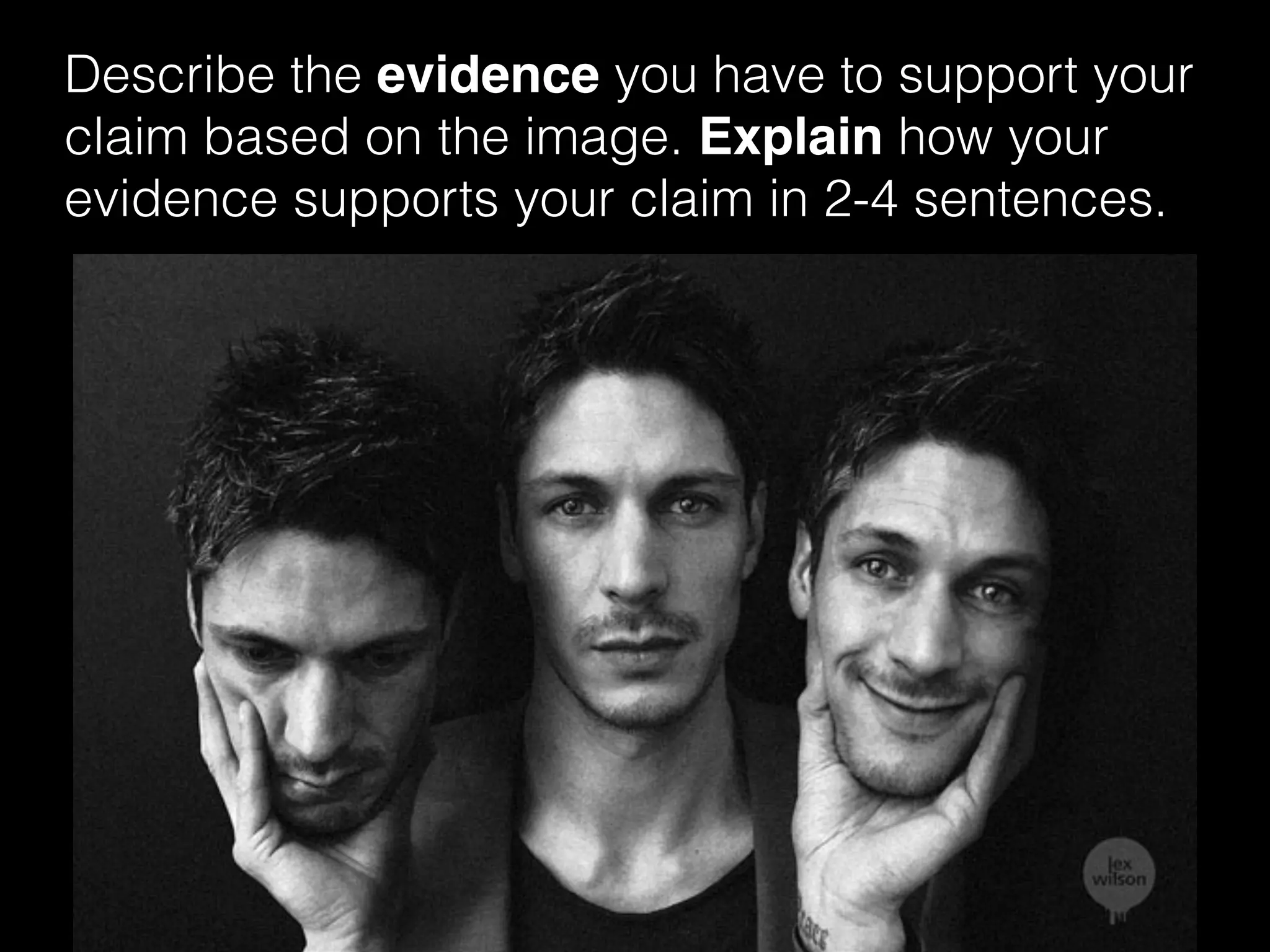
Describe the evidence you have to support your
claim based on the image. Explain how your
evidence supports your claim in 2-4 sentences.
This is a
photography
self-portrait.
Write a claim
in response to
this question:
- What is
this man’s
personality
like?
Describe the
evidence you
have to
support your
claim based
on the image.
Explain
how your
evidence
supports your
claim in 2-4
sentences.
This is a
surrealist
painting. Write
a claim in
response to
this question:
- What is
the meaning
of this
painting?
This is a
surrealist
painting. Write
a claim in
response to
this question:
- What is
the meaning
of this
painting?
This is a satire
image. Write a
claim in
response to
this question:
- What is
the meaning
of this
image?
Describe the
evidence you
have to
support your
claim based
on the image.
Explain
how your
evidence
supports your
claim in 2-4
sentences.

Claims, Evidence, & Explanation

  • 1.
    Elements of a WrittenArgument (Claims, Evidence,& Explanation)
  • 2.
    Parts: 1. Claim: apoint you are arguing. 2. Subclaim: a point you are arguing that supports another claim you have already made. 3. Evidence: the sources you use to support your claim. 4. Explanation: the reasoning for why your evidence supports your claim.
  • 3.
    Claim: A claim isa point you are arguing. Claims are not facts but rather conclusions that the writer draws from facts. When you think of an “argument,” you might imagine people taking opposite sides and debating in a win/lose situation. In academics, a written argument is not always so heated - academic argumentation deals with any question that does not have a straightforward answer.
  • 4.
    Claim Example: See? Aclaim does not need to be controversial (like, “the death penalty should be eliminated”) - a claim can be any statement that you must support with evidence. Most academic claims are about anything that can be questioned within a discipline. “Early Medieval people believed that the way burials were conducted influenced the activity of spirits.”
  • 5.
    Evidence: The research, facts,and testimony that support your claim. The following things can NOT be used as evidence: Because it’s my personal opinion Because my friends or relatives think so or most people think so Because it’s always been agreed upon / it’s tradition Because it’s obvious Because it’s morally right
  • 6.
    Evidence Example: Claim: “EarlyMedieval people believed that the way burials were conducted influenced the activity of spirits.” This piece of evidence is based on archaeological finds and the conclusions made by archaeologists. Evidence: “Archaeologists have discovered that Anglo- Saxons sometimes removed bodies from graves, cremated them, and cast the ashes into a running water source.”
  • 7.
    Explanation? As the writer,YOU might understand how this statement supports the claim you made, but the reader can’t always make the connection. There is one thing still missing from this argument: EXPLANATION. Evidence: “Archaeologists have discovered that Anglo- Saxons sometimes removed bodies from graves, cremated them, and cast the ashes into a running water source.” Claim: “Early Medieval people believed that the way burials were conducted influenced the activity of spirits.”
  • 8.
    Explanation: The reasoning orrationale for why your evidence supports your claim. Even when your evidence seems to obviously support your claim, you should explain the connection to your reader as clearly as possible.
  • 9.
    Explanation? Evidence: “Archaeologists havediscovered that Anglo- Saxons sometimes removed bodies from graves, cremated them, and cast the ashes into a running water source.” Explanation: “Because the Anglo-Saxons believed that angry spirits would often leave their graves and torment people of the town, the living hoped that by destroying the body and removing it from a traditional burial place, the spirits could no longer take vengeance.” Claim: “Early Medieval people believed that the way burials were conducted influenced the activity of spirits.”
  • 10.
    Example #2 Claim: “Dorathe Explorer is an educational T.V. show for kids.” Time to gather evidence! Choose your evidence from reliable sources that support your interpretation. The evidence can be quoted, paraphrased, or summarized.
  • 11.
    Example #2 Claim: “Dorathe Explorer is an educational T.V. show for kids.” Evidence 1: “Dora often uses colors and numbers to communicate various pieces of information to her young audience.” You usually want to supply several pieces of evidence so that your support is solid and, therefore, yields more credibility to your claim.
  • 12.
    Example #2 Claim: “Dorathe Explorer is an educational T.V. show for kids.” Evidence 1: “Dora often uses colors and numbers to communicate various pieces of information to her young audience.” Evidence 2: “The show uses simple words in English and Spanish to help unfold the plot.”
  • 13.
    Add Explanation… Dora theExplorer is an educational T.V. show for kids. Dora often uses colors and numbers to communicate various pieces of information to her young audience. The use of color and numbers helps prepare kids for the early stages of learning in preschool and kindergarten. Early exposure to these basics units of knowledge helps prepare children for their first few years in an educational setting. Additionally, the show uses simple words in English and Spanish to help unfold the plot. The use of two languages in the show helps create young bilingual speakers. Early exposure to multiple languages will help prepare kids for the more intensive language lessons they will experience during high school and college.
  • 14.
    Activity Look at theimages on the screen, and respond to the prompt questions on a separate document. You will email your answers to Ms. G at the end of the activity! You will practice making claims and supporting them with evidence and explanation.
  • 15.
    This is aphoto manipulation self-portrait. Write a claim in response to this question: - What is this man’s personality like?
  • 16.
    Describe the evidenceyou have to support your claim based on the image. Explain how your evidence supports your claim in 2-4 sentences.
  • 17.
    This is a photography self-portrait. Writea claim in response to this question: - What is this man’s personality like?
  • 18.
    Describe the evidence you haveto support your claim based on the image. Explain how your evidence supports your claim in 2-4 sentences.
  • 19.
    This is a surrealist painting.Write a claim in response to this question: - What is the meaning of this painting?
  • 20.
    This is a surrealist painting.Write a claim in response to this question: - What is the meaning of this painting?
  • 21.
    This is asatire image. Write a claim in response to this question: - What is the meaning of this image?
  • 22.
    Describe the evidence you haveto support your claim based on the image. Explain how your evidence supports your claim in 2-4 sentences.