ENGLISH 9 ACTIVITY
SHEET
QUARTER 3 - MELC 3
MOST ESSENTIAL
LEARNING COMPETENCY:
JUDGE THE VALIDITY
OF THE EVIDENCE
LISTENED TO
At the end of the lesson, the
students should be able to:
LEARNING OBJECTIVES:
Learn how to judge the
validity of the evidence
listened to.
Validity is the extent to which a concept,
conclusion or measurement is well-founded
and likely corresponds accurately to the real
world. The word “valid” is derived from the
latin “validus”, meaning strong.
VALIDITY
01
02 EVIDENCE
Evidence refers to facts,
documentations, or testimonies used
to support a claim, support an
argument, or reach conclusion.
03 LISTENING
1. Effective listening requires the ability to
evaluate whether we should believe a point
raised.
2. It involves assessing the weight of the
evidence used to support a statement.
1. Statistical
2. Testimonial
3. Anecdotal
4. Analogical
TYPES OF EVIDENCES
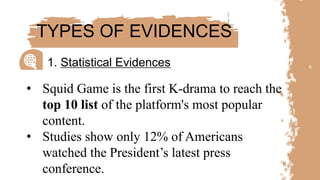
1. Statistical Evidences
TYPES OF EVIDENCES
It sums in a form of numbers,
percentage, or surveyed-type of
data.
1. Statistical Evidences
TYPES OF EVIDENCES
• Squid Game is the first K-drama to reach the
top 10 list of the platform's most popular
content.
• Studies show only 12% of Americans
watched the President’s latest press
conference.
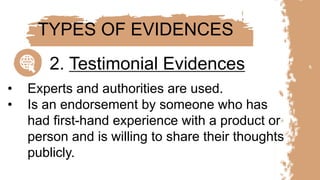
2. Testimonial Evidences
TYPES OF EVIDENCES
• Experts and authorities are used.
• Is an endorsement by someone who has
had first-hand experience with a product or
person and is willing to share their thoughts
publicly.
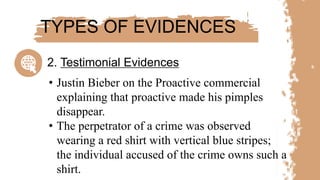
• Justin Bieber on the Proactive commercial
explaining that proactive made his pimples
disappear.
• The perpetrator of a crime was observed
wearing a red shirt with vertical blue stripes;
the individual accused of the crime owns such a
shirt.
TYPES OF EVIDENCES
2. Testimonial Evidences
3. Anecdotal Evidences
TYPES OF EVIDENCES
The speaker is telling
about his/her own
experiences.
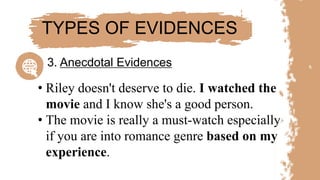
• Riley doesn't deserve to die. I watched the
movie and I know she's a good person.
• The movie is really a must-watch especially
if you are into romance genre based on my
experience.
TYPES OF EVIDENCES
3. Anecdotal Evidences
4. Analogical Evidences
TYPES OF EVIDENCES
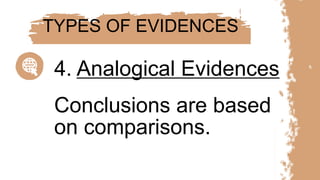
Conclusions are based
on comparisons.
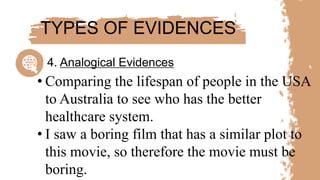
• Comparing the lifespan of people in the USA
to Australia to see who has the better
healthcare system.
• I saw a boring film that has a similar plot to
this movie, so therefore the movie must be
boring.
TYPES OF EVIDENCES
4. Analogical Evidences
Activity: Identify what is being asked in the sentence.
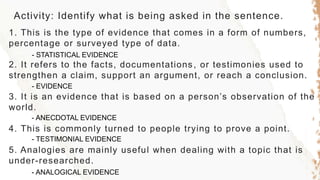
1. This is the type of evidence that comes in a form of numbers,
percentage or surveyed type of data.
2. It refers to the facts, documentations, or testimonies used to
strengthen a claim, support an argument, or reach a conclusion.
3. It is an evidence that is based on a person’s observation of the
world.
4. This is commonly turned to people trying to prove a point.
5. Analogies are mainly useful when dealing with a topic that is
under-researched.
- STATISTICAL EVIDENCE
- EVIDENCE
- ANECDOTAL EVIDENCE
- TESTIMONIAL EVIDENCE
- ANALOGICAL EVIDENCE
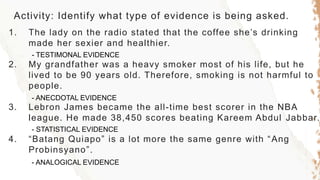
Activity: Identify what type of evidence is being asked.
1. The lady on the radio stated that the coffee she’s drinking
made her sexier and healthier.
2. My grandfather was a heavy smoker most of his life, but he
lived to be 90 years old. Therefore, smoking is not harmful to
people.
3. Lebron James became the all-time best scorer in the NBA
league. He made 38,450 scores beating Kareem Abdul Jabbar.
4. “Batang Quiapo” is a lot more the same genre with “Ang
Probinsyano”.
- TESTIMONAL EVIDENCE
- ANECDOTAL EVIDENCE
- STATISTICAL EVIDENCE
- ANALOGICAL EVIDENCE
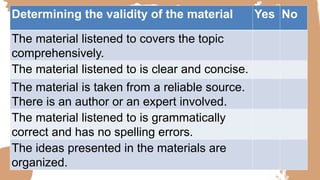
Determining the validity of the material Yes No
The material listened to covers the topic
comprehensively.
The material listened to is clear and concise.
The material is taken from a reliable source.
There is an author or an expert involved.
The material listened to is grammatically
correct and has no spelling errors.
The ideas presented in the materials are
organized.
The following are other
resources that you could
consult if the information
you have listened to
has validity:
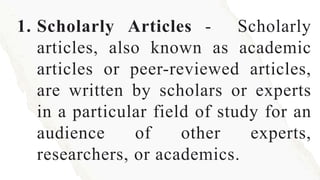
1. Scholarly Articles - Scholarly
articles, also known as academic
articles or peer-reviewed articles,
are written by scholars or experts
in a particular field of study for an
audience of other experts,
researchers, or academics.
2. Magazine Articles - Magazine articles are
typically shorter pieces of writing published
in magazines, which are periodical
publications containing a variety of articles,
stories, and other content.
Magazine articles are intended to entertain,
inform, or persuade readers on a wide range
of subjects, including current events,
lifestyle, culture, fashion, health, and
technology.
3. Newspaper Articles -
Newspaper articles are journalistic
pieces written by reporters or
journalists that provide news,
analysis, opinions, or features on
current events, issues, or topics of
interest.
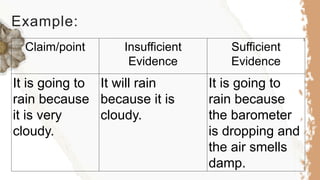
Example:
Claim/point Insufficient
Evidence
Sufficient
Evidence
It is going to
rain because
it is very
cloudy.
It will rain
because it is
cloudy.
It is going to
rain because
the barometer
is dropping and
the air smells
damp.
QUESTION:
How can you determine if
the evidence you listened
to is valid or not?
Thank You
for Listening!

PPT-Validity-of-the-evidence-listened-to (1).pptx

  • 1.
  • 2.
    MOST ESSENTIAL LEARNING COMPETENCY: JUDGETHE VALIDITY OF THE EVIDENCE LISTENED TO
  • 3.
    At the endof the lesson, the students should be able to: LEARNING OBJECTIVES: Learn how to judge the validity of the evidence listened to.
  • 4.
    Validity is theextent to which a concept, conclusion or measurement is well-founded and likely corresponds accurately to the real world. The word “valid” is derived from the latin “validus”, meaning strong. VALIDITY 01
  • 5.
    02 EVIDENCE Evidence refersto facts, documentations, or testimonies used to support a claim, support an argument, or reach conclusion.
  • 6.
    03 LISTENING 1. Effectivelistening requires the ability to evaluate whether we should believe a point raised. 2. It involves assessing the weight of the evidence used to support a statement.
  • 7.
    1. Statistical 2. Testimonial 3.Anecdotal 4. Analogical TYPES OF EVIDENCES
  • 8.
    1. Statistical Evidences TYPESOF EVIDENCES It sums in a form of numbers, percentage, or surveyed-type of data.
  • 9.
    1. Statistical Evidences TYPESOF EVIDENCES • Squid Game is the first K-drama to reach the top 10 list of the platform's most popular content. • Studies show only 12% of Americans watched the President’s latest press conference.
  • 10.
    2. Testimonial Evidences TYPESOF EVIDENCES • Experts and authorities are used. • Is an endorsement by someone who has had first-hand experience with a product or person and is willing to share their thoughts publicly.
  • 11.
    • Justin Bieberon the Proactive commercial explaining that proactive made his pimples disappear. • The perpetrator of a crime was observed wearing a red shirt with vertical blue stripes; the individual accused of the crime owns such a shirt. TYPES OF EVIDENCES 2. Testimonial Evidences
  • 12.
    3. Anecdotal Evidences TYPESOF EVIDENCES The speaker is telling about his/her own experiences.
  • 13.
    • Riley doesn'tdeserve to die. I watched the movie and I know she's a good person. • The movie is really a must-watch especially if you are into romance genre based on my experience. TYPES OF EVIDENCES 3. Anecdotal Evidences
  • 14.
    4. Analogical Evidences TYPESOF EVIDENCES Conclusions are based on comparisons.
  • 15.
    • Comparing thelifespan of people in the USA to Australia to see who has the better healthcare system. • I saw a boring film that has a similar plot to this movie, so therefore the movie must be boring. TYPES OF EVIDENCES 4. Analogical Evidences
  • 16.
    Activity: Identify whatis being asked in the sentence. 1. This is the type of evidence that comes in a form of numbers, percentage or surveyed type of data. 2. It refers to the facts, documentations, or testimonies used to strengthen a claim, support an argument, or reach a conclusion. 3. It is an evidence that is based on a person’s observation of the world. 4. This is commonly turned to people trying to prove a point. 5. Analogies are mainly useful when dealing with a topic that is under-researched. - STATISTICAL EVIDENCE - EVIDENCE - ANECDOTAL EVIDENCE - TESTIMONIAL EVIDENCE - ANALOGICAL EVIDENCE
  • 17.
    Activity: Identify whattype of evidence is being asked. 1. The lady on the radio stated that the coffee she’s drinking made her sexier and healthier. 2. My grandfather was a heavy smoker most of his life, but he lived to be 90 years old. Therefore, smoking is not harmful to people. 3. Lebron James became the all-time best scorer in the NBA league. He made 38,450 scores beating Kareem Abdul Jabbar. 4. “Batang Quiapo” is a lot more the same genre with “Ang Probinsyano”. - TESTIMONAL EVIDENCE - ANECDOTAL EVIDENCE - STATISTICAL EVIDENCE - ANALOGICAL EVIDENCE
  • 18.
    Determining the validityof the material Yes No The material listened to covers the topic comprehensively. The material listened to is clear and concise. The material is taken from a reliable source. There is an author or an expert involved. The material listened to is grammatically correct and has no spelling errors. The ideas presented in the materials are organized.
  • 19.
    The following areother resources that you could consult if the information you have listened to has validity:
  • 20.
    1. Scholarly Articles- Scholarly articles, also known as academic articles or peer-reviewed articles, are written by scholars or experts in a particular field of study for an audience of other experts, researchers, or academics.
  • 21.
    2. Magazine Articles- Magazine articles are typically shorter pieces of writing published in magazines, which are periodical publications containing a variety of articles, stories, and other content. Magazine articles are intended to entertain, inform, or persuade readers on a wide range of subjects, including current events, lifestyle, culture, fashion, health, and technology.
  • 22.
    3. Newspaper Articles- Newspaper articles are journalistic pieces written by reporters or journalists that provide news, analysis, opinions, or features on current events, issues, or topics of interest.
  • 23.
    Example: Claim/point Insufficient Evidence Sufficient Evidence It isgoing to rain because it is very cloudy. It will rain because it is cloudy. It is going to rain because the barometer is dropping and the air smells damp.
  • 24.
    QUESTION: How can youdetermine if the evidence you listened to is valid or not?
  • 25.