
Skepticism
 At Work
Recognizing
   Logical
  Fallacies
    Steve Cena
       2013
Basic Definitions

Cynicism: To doubt without evidence. To dismiss a claim out of
hand.
Skepticism: To doubt based on the evidence or the lack thereof.


Faith: To believe without evidence or in spite of contrary
evidence. “Faith is believing what you know ain’t so.”*

Belief: To accept based on the available evidence.


* Mark Twain
“I’m a skeptic not
   because I do not want
  to believe but I want to
          know.”
Michael Shermer, The Believing Brain Prolog
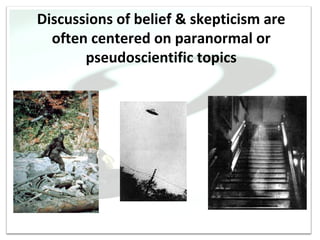
Discussions of belief & skepticism are
  often centered on paranormal or
       pseudoscientific topics
Business Claims
• We need a fresh set of eyes to work on this
  problem.
• We tried that before & it didn’t work.
• The test is 99% accurate.
• It’s just an outlier.
• I can’t explain why but whenever we do it this
  way it works.
Which Claims Should We Believe?

   WE SHOULD ONLY
  BELIEVE THINGS FOR
    WHICH THERE IS
 ADEQUATE EVIDENCE.
What is adequate evidence?
         DATA
How do we evaluate the data?
       Judgments
       Reasoning
Judgments = Opinions
      Reasoning = Logic
Errors in Reasoning = Logical Fallacies
Claims are made on what seem to be good
arguments but these arguments are based
on incorrect logical principles. Thus, the
claims are not valid.
Ad Hominem Attack
 Ad hominem is Latin for "to the person”

• Not invented here
• Outside expert error
• Guilty by group association
False Dichotomy
            (The Excluded Middle)
 Arbitrarily reducing the set of probabilities to only 2.

• “You are either for us or against us.”
• "You are either part of the solution or part of
  the problem.”
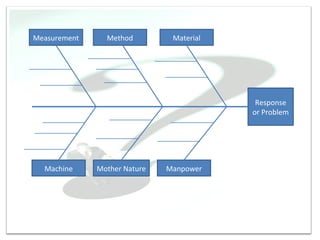
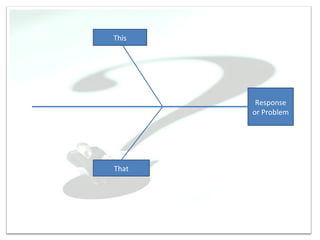
• "It's either the design or the process."
Measurement     Method         Material


                                           Response
                                          or Problem


  Machine     Mother Nature   Manpower
This


        Response
       or Problem


That
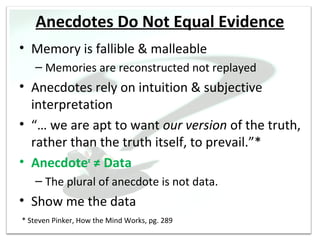
Anecdotes Do Not Equal Evidence
• Memory is fallible & malleable
   – Memories are reconstructed not replayed
• Anecdotes rely on intuition & subjective
  interpretation
• “… we are apt to want our version of the truth,
  rather than the truth itself, to prevail.”*
• Anecdotex ≠ Data
   – The plural of anecdote is not data.
• Show me the data
* Steven Pinker, How the Mind Works, pg. 289
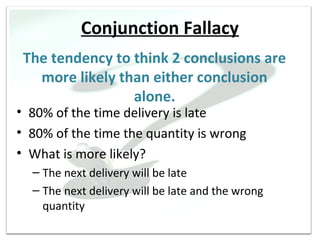
Conjunction Fallacy
 The tendency to think 2 conclusions are
   more likely than either conclusion
                 alone.
• 80% of the time delivery is late
• 80% of the time the quantity is wrong
• What is more likely?
  – The next delivery will be late
  – The next delivery will be late and the wrong
    quantity
Conjunction Fallacy

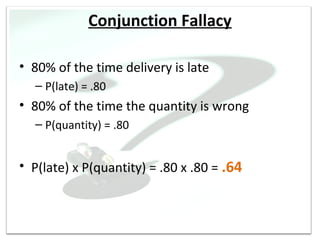
• 80% of the time delivery is late
  – P(late) = .80
• 80% of the time the quantity is wrong
  – P(quantity) = .80


• P(late) x P(quantity) = .80 x .80 = .64
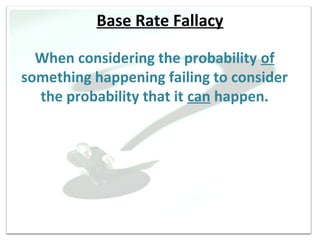
Base Rate Fallacy

  When considering the probability of
something happening failing to consider
  the probability that it can happen.
Base Rate Fallacy

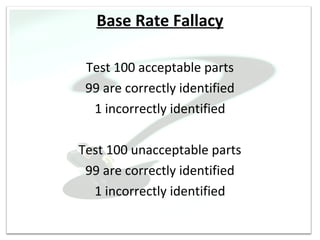
 Test 100 acceptable parts
 99 are correctly identified
  1 incorrectly identified

Test 100 unacceptable parts
 99 are correctly identified
  1 incorrectly identified
Base Rate Fallacy

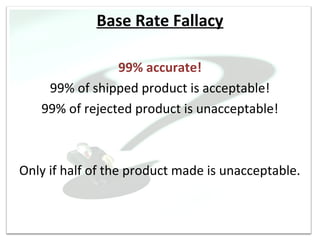
                99% accurate!
    99% of shipped product is acceptable!
   99% of rejected product is unacceptable!


Only if half of the product made is unacceptable.
Base Rate Fallacy

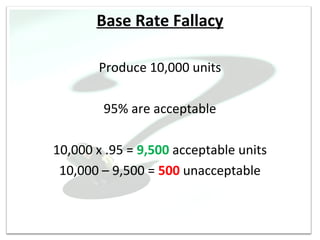
       Produce 10,000 units

        95% are acceptable

10,000 x .95 = 9,500 acceptable units
 10,000 – 9,500 = 500 unacceptable
Base Rate Fallacy

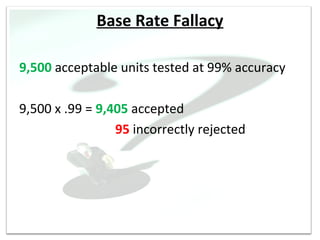
9,500 acceptable units tested at 99% accuracy

9,500 x .99 = 9,405 accepted
                 95 incorrectly rejected
Base Rate Fallacy

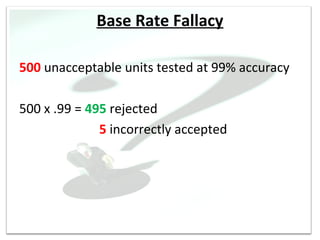
500 unacceptable units tested at 99% accuracy

500 x .99 = 495 rejected
              5 incorrectly accepted
Base Rate Fallacy
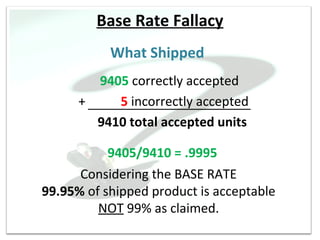
           What Shipped
        9405 correctly accepted
      +    5 incorrectly accepted
        9410 total accepted units

           9405/9410 = .9995
      Considering the BASE RATE
99.95% of shipped product is acceptable
         NOT 99% as claimed.
Base Rate Fallacy
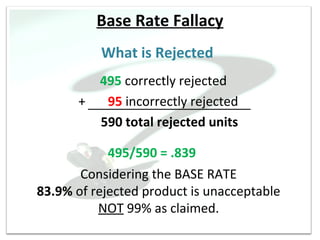
           What is Rejected
           495 correctly rejected
       +    95 incorrectly rejected
           590 total rejected units

            495/590 = .839
       Considering the BASE RATE
83.9% of rejected product is unacceptable
          NOT 99% as claimed.
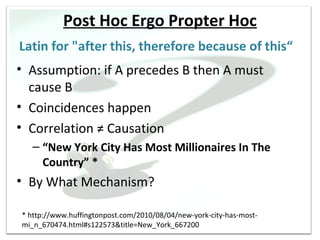
Post Hoc Ergo Propter Hoc
Latin for "after this, therefore because of this“
• Assumption: if A precedes B then A must
  cause B
• Coincidences happen
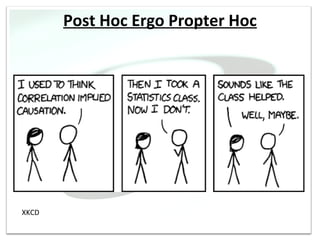
• Correlation ≠ Causation
   – “New York City Has Most Millionaires In The
     Country” *
• By What Mechanism?

* http://www.huffingtonpost.com/2010/08/04/new-york-city-has-most-
mi_n_670474.html#s122573&title=New_York_667200
Post Hoc Ergo Propter Hoc


XKCD
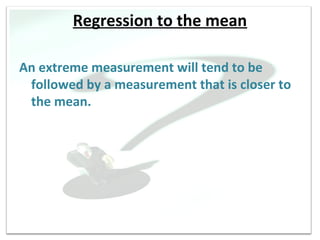
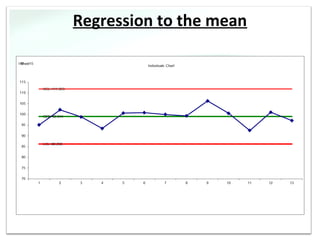
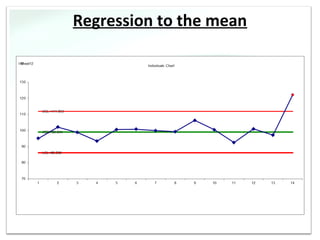
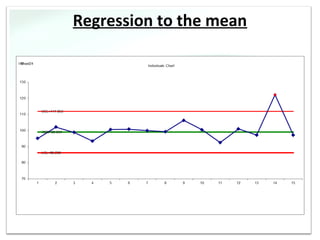
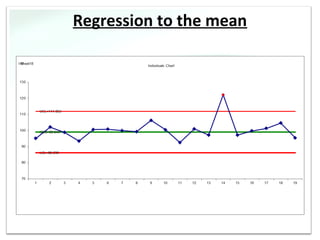
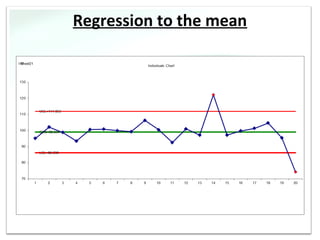
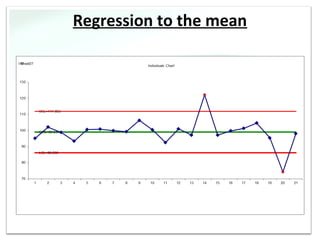
Regression to the mean

An extreme measurement will tend to be
 followed by a measurement that is closer to
 the mean.
Regression to the mean
Why do you believe?
• Is it because the belief is comfortable or
  convenient?
• Does the data reaffirm what you already
  "know" to be true?
• Are contrary data ignored or rationalized
  away?
• Did you objectively analyze the data and come
  to this conclusion?
What would change your mind?
• NOTHING!
• Falsifiable claim
   – “The Scientific method consists of the use of procedures
     designed to show not that our predictions and hypotheses
     are right, but that they might be wrong”*
• Rabbit in the Precambrian**

       What is your rabbit?
* Mistakes Were Made, Tarvis & Aronson
**J.B.S. Haldane
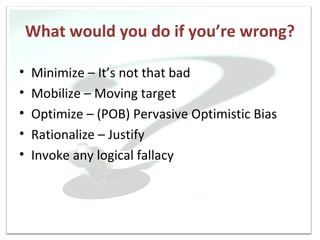
What would you do if you’re wrong?

•   Minimize – It’s not that bad
•   Mobilize – Moving target
•   Optimize – (POB) Pervasive Optimistic Bias
•   Rationalize – Justify
•   Invoke any logical fallacy
Why do you believe?

What would change your mind?

What would you do if you’re wrong?
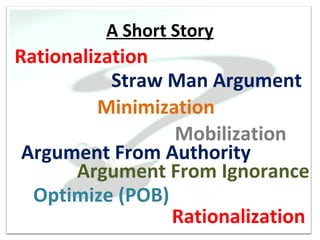
A Short Story
Rationalization
           Straw Man Argument
         Minimization
                 Mobilization
 Argument From Authority
      Argument From Ignorance
  Optimize (POB)
                 Rationalization
Skepticism at work - Logical Fallacies. ASQ Buffalo

Skepticism at work - Logical Fallacies. ASQ Buffalo

  • 1.
    Skepticism At Work Recognizing Logical Fallacies Steve Cena 2013
  • 2.
    Basic Definitions Cynicism: Todoubt without evidence. To dismiss a claim out of hand. Skepticism: To doubt based on the evidence or the lack thereof. Faith: To believe without evidence or in spite of contrary evidence. “Faith is believing what you know ain’t so.”* Belief: To accept based on the available evidence. * Mark Twain
  • 3.
    “I’m a skepticnot because I do not want to believe but I want to know.” Michael Shermer, The Believing Brain Prolog
  • 4.
    Discussions of belief& skepticism are often centered on paranormal or pseudoscientific topics
  • 5.
    Business Claims • Weneed a fresh set of eyes to work on this problem. • We tried that before & it didn’t work. • The test is 99% accurate. • It’s just an outlier. • I can’t explain why but whenever we do it this way it works.
  • 6.
    Which Claims ShouldWe Believe? WE SHOULD ONLY BELIEVE THINGS FOR WHICH THERE IS ADEQUATE EVIDENCE.
  • 7.
    What is adequateevidence? DATA How do we evaluate the data? Judgments Reasoning
  • 8.
    Judgments = Opinions Reasoning = Logic Errors in Reasoning = Logical Fallacies Claims are made on what seem to be good arguments but these arguments are based on incorrect logical principles. Thus, the claims are not valid.
  • 9.
    Ad Hominem Attack Ad hominem is Latin for "to the person” • Not invented here • Outside expert error • Guilty by group association
  • 10.
    False Dichotomy (The Excluded Middle) Arbitrarily reducing the set of probabilities to only 2. • “You are either for us or against us.” • "You are either part of the solution or part of the problem.” • "It's either the design or the process."
  • 11.
    Measurement Method Material Response or Problem Machine Mother Nature Manpower
  • 12.
    This Response or Problem That
  • 13.
    Anecdotes Do NotEqual Evidence • Memory is fallible & malleable – Memories are reconstructed not replayed • Anecdotes rely on intuition & subjective interpretation • “… we are apt to want our version of the truth, rather than the truth itself, to prevail.”* • Anecdotex ≠ Data – The plural of anecdote is not data. • Show me the data * Steven Pinker, How the Mind Works, pg. 289
  • 14.
    Conjunction Fallacy Thetendency to think 2 conclusions are more likely than either conclusion alone. • 80% of the time delivery is late • 80% of the time the quantity is wrong • What is more likely? – The next delivery will be late – The next delivery will be late and the wrong quantity
  • 15.
    Conjunction Fallacy • 80%of the time delivery is late – P(late) = .80 • 80% of the time the quantity is wrong – P(quantity) = .80 • P(late) x P(quantity) = .80 x .80 = .64
  • 16.
    Base Rate Fallacy When considering the probability of something happening failing to consider the probability that it can happen.
  • 17.
    Base Rate Fallacy Test 100 acceptable parts 99 are correctly identified 1 incorrectly identified Test 100 unacceptable parts 99 are correctly identified 1 incorrectly identified
  • 18.
    Base Rate Fallacy 99% accurate! 99% of shipped product is acceptable! 99% of rejected product is unacceptable! Only if half of the product made is unacceptable.
  • 19.
    Base Rate Fallacy Produce 10,000 units 95% are acceptable 10,000 x .95 = 9,500 acceptable units 10,000 – 9,500 = 500 unacceptable
  • 20.
    Base Rate Fallacy 9,500acceptable units tested at 99% accuracy 9,500 x .99 = 9,405 accepted 95 incorrectly rejected
  • 21.
    Base Rate Fallacy 500unacceptable units tested at 99% accuracy 500 x .99 = 495 rejected 5 incorrectly accepted
  • 22.
    Base Rate Fallacy What Shipped 9405 correctly accepted + 5 incorrectly accepted 9410 total accepted units 9405/9410 = .9995 Considering the BASE RATE 99.95% of shipped product is acceptable NOT 99% as claimed.
  • 23.
    Base Rate Fallacy What is Rejected 495 correctly rejected + 95 incorrectly rejected 590 total rejected units 495/590 = .839 Considering the BASE RATE 83.9% of rejected product is unacceptable NOT 99% as claimed.
  • 24.
    Post Hoc ErgoPropter Hoc Latin for "after this, therefore because of this“ • Assumption: if A precedes B then A must cause B • Coincidences happen • Correlation ≠ Causation – “New York City Has Most Millionaires In The Country” * • By What Mechanism? * http://www.huffingtonpost.com/2010/08/04/new-york-city-has-most- mi_n_670474.html#s122573&title=New_York_667200
  • 25.
    Post Hoc ErgoPropter Hoc XKCD
  • 26.
    Regression to themean An extreme measurement will tend to be followed by a measurement that is closer to the mean.
  • 27.
  • 28.
  • 29.
  • 30.
  • 31.
  • 32.
  • 33.
    Why do youbelieve? • Is it because the belief is comfortable or convenient? • Does the data reaffirm what you already "know" to be true? • Are contrary data ignored or rationalized away? • Did you objectively analyze the data and come to this conclusion?
  • 34.
    What would changeyour mind? • NOTHING! • Falsifiable claim – “The Scientific method consists of the use of procedures designed to show not that our predictions and hypotheses are right, but that they might be wrong”* • Rabbit in the Precambrian** What is your rabbit? * Mistakes Were Made, Tarvis & Aronson **J.B.S. Haldane
  • 35.
    What would youdo if you’re wrong? • Minimize – It’s not that bad • Mobilize – Moving target • Optimize – (POB) Pervasive Optimistic Bias • Rationalize – Justify • Invoke any logical fallacy
  • 36.
    Why do youbelieve? What would change your mind? What would you do if you’re wrong?
  • 37.
    A Short Story Rationalization Straw Man Argument Minimization Mobilization Argument From Authority Argument From Ignorance Optimize (POB) Rationalization