Introduction to
Critical Thinking
Welcome
to
Critical Thinking
Unit 4
Fallacies
ISM5001 Critical Thinking and Argumentation
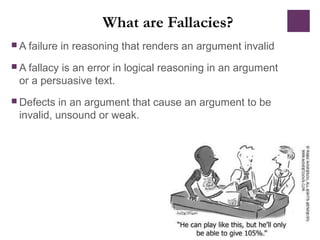
What are Fallacies?
 A failure in reasoning that renders an argument invalid
 A fallacy is an error in logical reasoning in an argument
or a persuasive text.
 Defects in an argument that cause an argument to be
invalid, unsound or weak.
Logical Fallacies
 Fallacies are standard forms of flawed reasoning that
seduce and often persuade us, but that are not logically
sound and will lead to faulty conclusions.
 Often subtle
 Learning to recognize these will:
 Strengthen your own arguments
 Help you critique other’s arguments
Groups of Fallacies
 Fallacies of Relevance:
 Mistakes in reasoning that occur because the
premise are logically irrelevant to the conclusion
 Fallacies of Insufficient Evidence:
 Mistakes in reasoning that occur because the
premises, though logically relevant to the
conclusion, fail to provide sufficient evidence to
support the conclusion
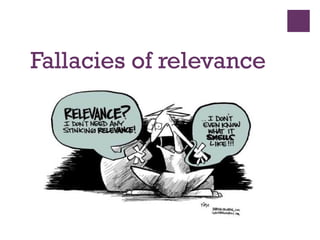
Fallacies of relevance
Fallacies of Relevance
 Occur when an arguer offers reasons that are logically irrelevant to
his or her conclusion
 Personal Attack (Ad Hominen)
 Attacking the Motive
 Look Who’s Talking (Tu Quoque, /tu kwo kw / )ʊ ɛ
 Two Wrongs Make a Right
 Scare Tactics
 Appeal to Pity
 Bandwagon Argument
 Straw Man
 Red Herring
 Equivocation
 Begging the Question
Personal Attack (Ad Hominem)
 Rejects someone’s argument or claim by attacking the person
rather than the person’s argument or claim.
a) X is a bad person.a) X is a bad person.
b) Therefore, Xb) Therefore, X’’s argument must be bads argument must be bad..
ExampleExample: Hugh Hefner, founder of playboy magazine, has: Hugh Hefner, founder of playboy magazine, has
argued against censorship of pornography. But Hefner is anargued against censorship of pornography. But Hefner is an
immature, self-indulgent millionaire who never outgrew theimmature, self-indulgent millionaire who never outgrew the
adolescent fantasies of his youth. His argument, therefore, isadolescent fantasies of his youth. His argument, therefore, is
worthless.worthless.
Hugh Hefner is a bad person.Hugh Hefner is a bad person.
Therefore, Hugh HefnerTherefore, Hugh Hefner’’s argument must be bad.s argument must be bad.
Personal Attack (Ad Hominem)
The fallacy of personal attack occurs only if
1) An arguer rejects another person’s argument
or claim,
AND
2) The arguer attacks the person who offers the
argument or claim, rather than considering the
merits of that argument or claim.
Personal Attack (Ad Hominem)
 Not all personal attacks are fallacies!!!
 Millions of innocent people died in Stalin’s ruthless
ideological purges. Clearly Stalin was one of the most brutal
dictators of the twentieth century.
 Ms Fibber has testified that she saw my client rob the Bank.
But Ms Fibber has twice been convicted of perjury. In
addition, you’ve heard her own mother testify that she is a
pathological liar. Therefore, you should not believe Ms.
Fibber’s testimony against my client.
In these cases, the personal attacks are relevant to the
conclusion so no fallacy is committed..
Attacking the Motive
An arguer criticizes a person’s motivation for offering a particular
argument or claim, rather than examining the worth of the
argument or claim itself.
a) X is biased or has questionable motives.
b) X’s argument or claim should be rejected.
Examples:
 Professor Smith has argued in favor of academic tenure.
But why should we even listen to him? As a tenured
professor, of course he supports tenure.
 Senator Pork supports the stimulus package.
Representing a state that will get a new bridge, of course
he supports itit..
BUT ….
 ā€˜Burton Wexler, spokesperson for the American Tobacco
Growers Association, has argued that there is no credible
scientific evidence that cigarette smoking causes cancer.
Given Wexler’s obvious bias in the matter, his arguments
should be taken with a grain of salt.’
This argument reflects a common sense assumption that
the arguments put forward by Mr. Wexler need to be
scrutinized with particular care. It is not a fallacy of
attacking the motive.
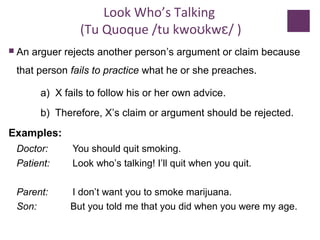
Look Who’s Talking
(Tu Quoque /tu kwo kw / )ʊ ɛ
 An arguer rejects another person’s argument or claim because
that person fails to practice what he or she preaches.
a) X fails to follow his or her own advice.
b) Therefore, X’s claim or argument should be rejected.
Examples:
Doctor: You should quit smoking.
Patient: Look who’s talking! I’ll quit when you quit.
Parent: I don’t want you to smoke marijuana.
Son: But you told me that you did when you were my age.
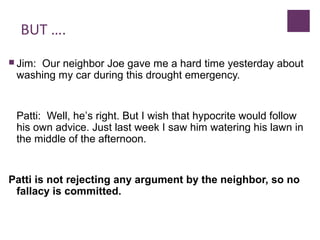
BUT ….
 Jim: Our neighbor Joe gave me a hard time yesterday about
washing my car during this drought emergency.
Patti: Well, he’s right. But I wish that hypocrite would follow
his own advice. Just last week I saw him watering his lawn in
the middle of the afternoon.
Patti is not rejecting any argument by the neighbor, so no
fallacy is committed.
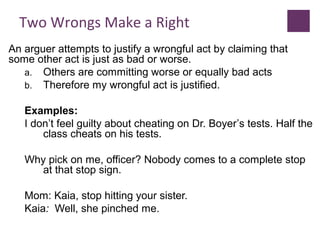
Two Wrongs Make a Right
An arguer attempts to justify a wrongful act by claiming that
some other act is just as bad or worse.
a. Others are committing worse or equally bad acts
b. Therefore my wrongful act is justified.
Examples:
I don’t feel guilty about cheating on Dr. Boyer’s tests. Half the
class cheats on his tests.
Why pick on me, officer? Nobody comes to a complete stop
at that stop sign.
Mom: Kaia, stop hitting your sister.
Kaia: Well, she pinched me.
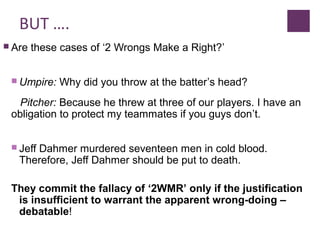
BUT ….
 Are these cases of ā€˜2 Wrongs Make a Right?’
 Umpire: Why did you throw at the batter’s head?
Pitcher: Because he threw at three of our players. I have an
obligation to protect my teammates if you guys don’t.
 Jeff Dahmer murdered seventeen men in cold blood.
Therefore, Jeff Dahmer should be put to death.
They commit the fallacy of ā€˜2WMR’ only if the justification
is insufficient to warrant the apparent wrong-doing –
debatable!
Scare Tactics
 An arguer threatens harm to the reader / listener and this
threat is irrelevant to the truth of the arguer’s conclusion.
 Diplomat to diplomat: I’m sure you’ll agree that we are the
rightful rulers of the San Marcos Islands. It would be
regrettable if we had to send armed forces to demonstrate
the validity of our claim.
 Gun lobbyist to politician: This gun-control bill is wrong for
America, and any politician who supports it will discover how
wrong they were at the next election.
BUT ….
a) Parent to teen: If you come home late one more time, your
allowance will be cut.
b) President John Kennedy to Soviet Premier Nikita Krushchev:
If you don’t remove your nuclear missiles from Cuba, we will
have no choice but to remove them by force. If we use force
to remove the missiles, that may provoke an all-out nuclear
war. Neither of us wants a nuclear war. Therefore, you
should remove your missiles from Cuba. (paraphrase)
a) = statement, not an argument; b) = not a fallacy;
premises are logically relevant to conclusion
Appeal to Pity
 An arguer attempts to evoke feelings of pity or compassion, when
such feelings are not logically relevant to the arguer’s conclusion.
 Student to professor: I know I missed half your classes and failed all my
exams, but I had a really tough semester. First my pet boa constrictor
died. Then my girlfriend told me she wants a sex-change operation. With
all I went through this semester, I don’t think I really deserved an F. Any
chance you might cut me some slack and change my grade?
 Parent to football coach: I admit that my son Billy can’t run, pass, kick,
catch, block or tackle, but he deserved to make the football team. If he
doesn’t make the team, he’s going to be an emotional wreck, and he mayand he may
even drop out of school.even drop out of school.
BUT ….
 What about these arguments?
Mother to daughter: Nana was asking about you the other day.
She’s so lonely and depressed since Grandpa passed away,
and her Alzheimer’s seems to get worse every day. She’s done
so much for you over the years. Don’t you think you should
pay her a visit?
High school softball coach: Girls, this state championship is the
biggest game of your lives. This is what you’ve been working
for all year. Your parents are counting on you, your school is
counting on you, and your community is counting on you.
Make them proud! Play like the champions you are!
Here the emotional appeals are appropriate and relevant to
the arguers’ purposes; hence no fallacy is committed.
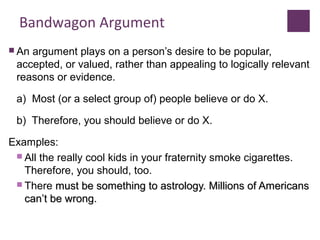
Bandwagon Argument
 An argument plays on a person’s desire to be popular,
accepted, or valued, rather than appealing to logically relevant
reasons or evidence.
a) Most (or a select group of) people believe or do X.
b) Therefore, you should believe or do X.
Examples:
 All the really cool kids in your fraternity smoke cigarettes.
Therefore, you should, too.
 There must be something to astrology. Millions of Americansmust be something to astrology. Millions of Americans
cancan’’t be wrong.t be wrong.
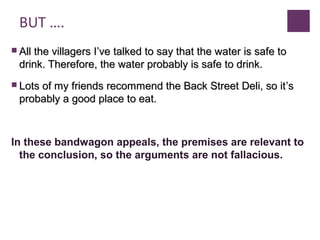
BUT ….
 All the villagers IAll the villagers I’’ve talked to say that the water is safe tove talked to say that the water is safe to
drink. Therefore, the water probably is safe to drink.drink. Therefore, the water probably is safe to drink.
 Lots of my friends recommend the Back Street Deli, so itLots of my friends recommend the Back Street Deli, so it’’ss
probably a good place to eat.probably a good place to eat.
In these bandwagon appeals, the premises are relevant to
the conclusion, so the arguments are not fallacious.
Straw Man
 An arguer distorts an opponent’s argument or claim in order to
make it easier to attack
A) X’s view is false or unjustified [but where X’s view has
been unfairly characterized].
B) Therefore, X’s view should be rejected.
 Examples:
Pete has argued that the NY Yankees are a better baseball team
than the Atlanta Braves. But the Braves aren’t a bad team. They
have a great pitching staff, and they consistently finish at or near
the top of their division, Obviously, Pete doesn’t know what he’s
talking about.
Senator Biddle has argued that we should outlaw violent
pornography. Obviously the senator favors complete
governmental censorship of books, magazines, and films.
Frankly, I’m shocked that such a view should be expressed on
the floor of the U.S. senate. It runs counter to everything this
great nation stands for.
Red Herring
 An arguer tries to sidetrack his or her audience by raising an
irrelevant issue and then claims that the original issue has
effectively been settled by the irrelevant diversion.
Examples:
Many people criticize Thomas Jefferson for being an owner of slaves.
But Jefferson was one of our greatest presidents, and his
Declaration of Independence is one of the most eloquent pleas for
freedom and democracy ever written. Clearly these criticisms are
unwarranted.
Critics have accused my administration of doing to little to save the
family farm. These critics forget that I grew up on a farm. I know
what it’s like to get up at the crack of dawn to milk the cows. I know
what it’s like to work in the field all day in the blazing sun. Family
farms are what made this country great, and those who criticize my
farm policies simply don’t know what they’re talking about.
BUT ….
Political opponent:Political opponent: Congressman Crookley, now that you haveCongressman Crookley, now that you have
been convicted of bribery, extortion, and grand theft auto,been convicted of bribery, extortion, and grand theft auto,
isnisn’’t it high time that you resigned from office?t it high time that you resigned from office?
Rep. Crookley:Rep. Crookley: HowHow ā€˜ā€˜bout those Yankees? A ten-game lead atbout those Yankees? A ten-game lead at
the All-Star break!the All-Star break!
Simply changing or evading the subject without denying
the charge or pretending to refute it is not a fallacy.
Equivocation
 A key word is used in two or more senses in the same
argument and the apparent success of the argument
depends on the shift in meaning.
 Example
 Any law can be repealed by the proper legal authority. The
law of gravity is a law. Therefore, the law of gravity can be
repealed by the proper legal authority.
When the two senses of ā€˜law’ (laws regulating human
conduct vs. uniformities of nature) are made explicit, it is
apparent that the premises don’t support the conclusion,
hence a fallacious argument!
Begging the Question
 An arguer states or assumes as a premise the very thing he or
she is trying to prove as a conclusion.
 Two common ways to beg the question
 Restating the conclusion in slightly different words.
Capital punishment is morally wrong because it is ethically
impermissible to inflict death as punishment for a crime.
 Circular reasoning
B: God wrote the bible.
N: How do you know?
B: Because it says so in the Bible and what the Bible says
is true.
N: How to you know what the Bible says is true?
B: Because God wrote the Bible.
Fallacies of Insufficient
Evidence
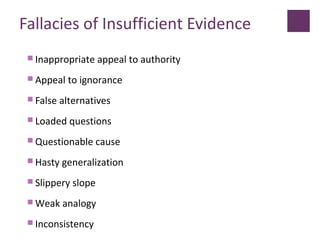
Fallacies of Insufficient Evidence
 Inappropriate appeal to authority
 Appeal to ignorance
 False alternatives
 Loaded questions
 Questionable cause
 Hasty generalization
 Slippery slope
 Weak analogy
 Inconsistency
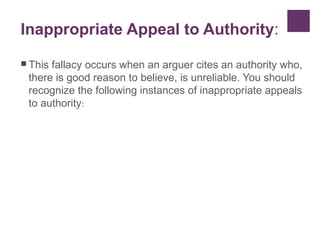
Inappropriate Appeal to Authority:
 This fallacy occurs when an arguer cites an authority who,
there is good reason to believe, is unreliable. You should
recognize the following instances of inappropriate appeals
to authority:
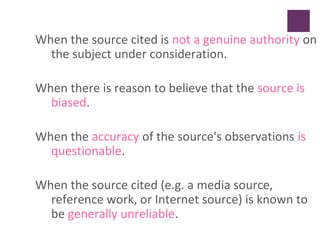
When the source cited is not a genuine authority on
the subject under consideration.
When there is reason to believe that the source is
biased.
When the accuracy of the source's observations is
questionable.
When the source cited (e.g. a media source,
reference work, or Internet source) is known to
be generally unreliable.
When the source has not been cited correctly or
the cited claim has been taken out of context.
When the source's claim conflicts with expert
consensus.
When the claim under consideration cannot be
resolved by expert opinion.
When the claim is highly improbable on its face.
Inappropriate Appeal to Authority:
 Hi, I’m former heavyweight boxing champ Mike
Tyson. After a tough night in the ring, my face needs
some tender loving care. Lather-X Sensitive Skin
Shaving Gel. You can’t get a smoother, closer shave.
Why is this an inappropriate appeal to authority?
 Source is not an authority on skin care.
Inappropriate Appeal to Authority:
 Prof. Huebner has been paid $100,000 by the National
Enquirer for his story that he is Steve Jobs’ long lost
brother. Given Dr. Huebner’s reputation for honesty, I
think we should believe him, even though he has
produced no corroborating evidence and DNA tests fail to
support his claim.
Why is this an inappropriate appeal to authority?
 The source is biased, with an obvious motive to lie.
Inappropriate Appeal to Authority:
 After taking LSD and drinking seven beers, Jill claims she
has a conversation with Elvis’ ghost at the San Jose Bar and
Grill. I’ve never known Jill to lie. So, I think we should believe
her.
Why is this an inappropriate appeal to authority?
 There is reason to doubt the reliability of the witness’s
observations.
Inappropriate Appeal to Authority:
Most immigrants who enter this country wind up in jail
or on welfare. I know this because I read it on the
Wikipedia web site.
Why is this an inappropriate appeal to authority?
– The source is generally not known to be reliable.
Inappropriate Appeal to Authority:
 It states in the Constitution that there must be a ā€˜wall of
separation’ between church and state. Publicly funded school
vouchers clearly violate this wall of separation. Therefore,
publicly funded school vouchers are unconstitutional.
Why is this an inappropriate appeal to authority?
 The Constitution does not use the phrase ā€˜wall of separation’
between church and state.
Inappropriate Appeal to Authority:
 Dr. Duane Gish, a biochemist with a Ph.D. from Berkeley
and senior vice president of the Institute for Creation
Research, has argued that there is no credible evidence
supporting the theory of evolution. In view of Dr. Gish’s
expertise on this subject, we should conclude that
evolution is a myth.
Why is this an inappropriate appeal to authority?
 The claim conflicts with the overwhelming opinion of
most experts in the field.
Inappropriate Appeal to Authority:
 Dr. Stanford P. Higginbotham, a leading social
philosopher, has argued that capital punishment is always
morally wrong. Given Dr. Higginbotham’s impressive
credentials, we should conclude that capital punishment
is always morally wrong.
Why is this an inappropriate appeal to authority?
 The source’s claim cannot be settled by an appeal to
expert opinion – no expert consensus exists.
Inappropriate Appeal to Authority:
 Old Doc Perkins says he has an eighty-year-old friend who
can run a 100-yard dash in less than ten seconds. Old Doc is
one of the most trusted members of this community. So if Old
Doc says he has an eighty-year-old friend who can run a
100-yard dash in less than ten seconds, I, for one, believe
him.
Why is this an inappropriate appeal to authority?
 The claim is so improbable it should be rejected.
Appeal to Ignorance:
 The arguer asserts that a claim must be true because no
one has proven it false, or conversely
 The arguer asserts that a claim must be false because no
one has proven it to be true.
Appeal to Ignorance:
 There must be intelligent life on other planets. No one has
proven that there isn’t.
 There isn’t any intelligent life on other planets. No one has
proven that there is.
Why is this an appeal to ignorance?
 Both claims suffer from the basic flaw that they assume
that the lack of evidence for (or against) the claim is good
reason to believe that the claim is false (or true).
Appeal to Ignorance:
Exceptions:
 Sometimes the fact that a search hasn’t found something is
good evidence that the thing isn’t there to be found (e.g.,
medical trials).
 A careful search has been conducted, and
 It is likely that the search would have found something is
there had been anything there to be found.
 Special rules require a claim to be rejected as false unless a
certain burden of proof is met.
 Innocent until proven guilty beyond a reasonable doubt.
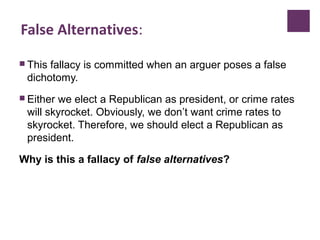
False Alternatives:
 This fallacy is committed when an arguer poses a false
dichotomy.
 Either we elect a Republican as president, or crime rates
will skyrocket. Obviously, we don’t want crime rates to
skyrocket. Therefore, we should elect a Republican as
president.
Why is this a fallacy of false alternatives?
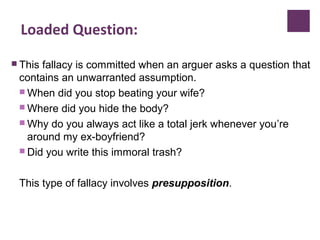
Loaded Question:
 This fallacy is committed when an arguer asks a question that
contains an unwarranted assumption.
 When did you stop beating your wife?
 Where did you hide the body?
 Why do you always act like a total jerk whenever you’re
around my ex-boyfriend?
 Did you write this immoral trash?
This type of fallacy involves presupposition.
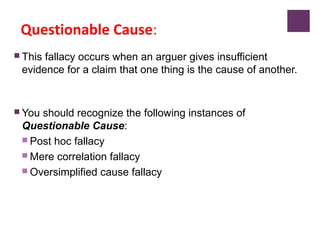
Questionable Cause:
 This fallacy occurs when an arguer gives insufficient
evidence for a claim that one thing is the cause of another.
 You should recognize the following instances of
Questionable Cause:
 Post hoc fallacy
 Mere correlation fallacy
 Oversimplified cause fallacy
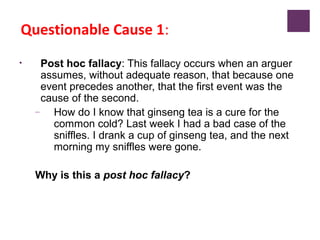
Questionable Cause 1:
• Post hoc fallacy: This fallacy occurs when an arguer
assumes, without adequate reason, that because one
event precedes another, that the first event was the
cause of the second.
– How do I know that ginseng tea is a cure for the
common cold? Last week I had a bad case of the
sniffles. I drank a cup of ginseng tea, and the next
morning my sniffles were gone.
Why is this a post hoc fallacy?
Questionable Cause 2:
• Mere correlation fallacy: This fallacy occurs when an
arguer assumes, without adequate reason, that because two
conditions or events regularly occur together, that there must
be a causal relationship between them.
– Every 52 years, the Aztecs would sacrifice tens of
thousands of prisoners to the sun god to avoids the earth
coming to an end. The earth never did come to an end.
Therefore, sacrificing thousands to the sun god has
prevented the end of the world.
Why is this a mere correlation?
Questionable Cause 3:
 Oversimplified cause fallacy: This fallacy occurs when an
arguer assumes, without sufficient evidence, that a single
condition or event is the sole cause of some effect, when
there are in fact other contributing causes.
 SAT scores have fallen sharply since the 1960s. Clearly,
students are watching too much TV.
Why is this a case of oversimplified cause?
Hasty Generalization:
 This fallacy occurs when an arguer draws a general conclusion from
a sample that is either biased or too small.
 A biased sample is one that is not representative of the
target population.
 The target population is the group of people or things that
the generalization is about.
 Hasty generalizations can often lead to false stereotypes.
I’ve hired three business majors as student help in the past year.
All three were lazy and shiftless. Obviously all business
majors are lazy and shiftless.
Why is this a hasty generalization?
Slippery Slope:
An arguer commits this fallacy when they claim, without
sufficient reason, that a seemingly harmless action will
lead to a disastrous outcome.
 Newt Gingrich says we must vigorously oppose any legalization of
same-sex marriage. I agree. Once we allow same sex couples to
marry, next we will be permitting marriages among three or more
people. Next we will allow people to marry their dogs, cats and pet
boa constrictors. Finally, people will want to marry their i-phones,
BMWs and Johnnie Walker Black Label, leading to rampant
materialism and alcohol abuse. Clearly same sex marriage is a
threat to the sanctity of traditional marriage.
A case of slippery slope? Why?
Slippery Slope:
 Slippery slope arguments generally follow this
pattern:
 The arguer claims that if a certain seemingly harmless
action, A, is permitted, A will lead to B, B will lead to C, and
so on to D.
 The arguer holds that D is a terrible thing and therefore
should not be permitted.
 In fact, there is no good reason to believe that A will
actually lead to D.
Weak Analogy:
 When the conclusion of an argument depends upon a
comparison between two (or more) things that are not similar
in relevant respects, the fallacy of weak analogy is committed.
 Why does a family who has no children in a school district
have to pay school taxes? This is like paying cigarette taxes
even though you don’t smoke.
Why is this a weak analogy?
Weak Analogy:
 This fallacy generally follows the pattern:
 A has characteristics w, x, y, and z.
 B has characteristics w, x, and y.
 Therefore, B probably has characteristic z, too.
 But characteristics w, x, and y are not relevant to z or
 A and B have differences relevant to z which are ignored
by the arguer.
Inconsistency:
 This fallacy occurs when an arguer asserts inconsistent
premises, asserts a premise that is inconsistent with his or
her conclusion, or argues for inconsistent conclusions.
Mickey Mantle: Hey, Yogi, what do you say we eat at Toots’
tonight?
Yogi Berra: That place is old news. Nobody goes there
anymore. It’s too crowded.
Why is this a case of inconsistency?
Video
The Fallacy Project: Examples of
fallacies from advertising, politics,
and popular culture

Lecturer 4 Fallacies

  • 1.
    Introduction to Critical Thinking Welcome to CriticalThinking Unit 4 Fallacies ISM5001 Critical Thinking and Argumentation
  • 2.
    What are Fallacies? A failure in reasoning that renders an argument invalid  A fallacy is an error in logical reasoning in an argument or a persuasive text.  Defects in an argument that cause an argument to be invalid, unsound or weak.
  • 3.
    Logical Fallacies  Fallaciesare standard forms of flawed reasoning that seduce and often persuade us, but that are not logically sound and will lead to faulty conclusions.  Often subtle  Learning to recognize these will:  Strengthen your own arguments  Help you critique other’s arguments
  • 4.
    Groups of Fallacies Fallacies of Relevance:  Mistakes in reasoning that occur because the premise are logically irrelevant to the conclusion  Fallacies of Insufficient Evidence:  Mistakes in reasoning that occur because the premises, though logically relevant to the conclusion, fail to provide sufficient evidence to support the conclusion
  • 5.
  • 6.
    Fallacies of Relevance Occur when an arguer offers reasons that are logically irrelevant to his or her conclusion  Personal Attack (Ad Hominen)  Attacking the Motive  Look Who’s Talking (Tu Quoque, /tu kwo kw / )ʊ ɛ  Two Wrongs Make a Right  Scare Tactics  Appeal to Pity  Bandwagon Argument  Straw Man  Red Herring  Equivocation  Begging the Question
  • 7.
    Personal Attack (AdHominem)  Rejects someone’s argument or claim by attacking the person rather than the person’s argument or claim. a) X is a bad person.a) X is a bad person. b) Therefore, Xb) Therefore, X’’s argument must be bads argument must be bad.. ExampleExample: Hugh Hefner, founder of playboy magazine, has: Hugh Hefner, founder of playboy magazine, has argued against censorship of pornography. But Hefner is anargued against censorship of pornography. But Hefner is an immature, self-indulgent millionaire who never outgrew theimmature, self-indulgent millionaire who never outgrew the adolescent fantasies of his youth. His argument, therefore, isadolescent fantasies of his youth. His argument, therefore, is worthless.worthless. Hugh Hefner is a bad person.Hugh Hefner is a bad person. Therefore, Hugh HefnerTherefore, Hugh Hefner’’s argument must be bad.s argument must be bad.
  • 8.
    Personal Attack (AdHominem) The fallacy of personal attack occurs only if 1) An arguer rejects another person’s argument or claim, AND 2) The arguer attacks the person who offers the argument or claim, rather than considering the merits of that argument or claim.
  • 9.
    Personal Attack (AdHominem)  Not all personal attacks are fallacies!!!  Millions of innocent people died in Stalin’s ruthless ideological purges. Clearly Stalin was one of the most brutal dictators of the twentieth century.  Ms Fibber has testified that she saw my client rob the Bank. But Ms Fibber has twice been convicted of perjury. In addition, you’ve heard her own mother testify that she is a pathological liar. Therefore, you should not believe Ms. Fibber’s testimony against my client. In these cases, the personal attacks are relevant to the conclusion so no fallacy is committed..
  • 10.
    Attacking the Motive Anarguer criticizes a person’s motivation for offering a particular argument or claim, rather than examining the worth of the argument or claim itself. a) X is biased or has questionable motives. b) X’s argument or claim should be rejected. Examples:  Professor Smith has argued in favor of academic tenure. But why should we even listen to him? As a tenured professor, of course he supports tenure.  Senator Pork supports the stimulus package. Representing a state that will get a new bridge, of course he supports itit..
  • 11.
    BUT ….  ā€˜BurtonWexler, spokesperson for the American Tobacco Growers Association, has argued that there is no credible scientific evidence that cigarette smoking causes cancer. Given Wexler’s obvious bias in the matter, his arguments should be taken with a grain of salt.’ This argument reflects a common sense assumption that the arguments put forward by Mr. Wexler need to be scrutinized with particular care. It is not a fallacy of attacking the motive.
  • 12.
    Look Who’s Talking (TuQuoque /tu kwo kw / )ʊ ɛ  An arguer rejects another person’s argument or claim because that person fails to practice what he or she preaches. a) X fails to follow his or her own advice. b) Therefore, X’s claim or argument should be rejected. Examples: Doctor: You should quit smoking. Patient: Look who’s talking! I’ll quit when you quit. Parent: I don’t want you to smoke marijuana. Son: But you told me that you did when you were my age.
  • 13.
    BUT ….  Jim:Our neighbor Joe gave me a hard time yesterday about washing my car during this drought emergency. Patti: Well, he’s right. But I wish that hypocrite would follow his own advice. Just last week I saw him watering his lawn in the middle of the afternoon. Patti is not rejecting any argument by the neighbor, so no fallacy is committed.
  • 14.
    Two Wrongs Makea Right An arguer attempts to justify a wrongful act by claiming that some other act is just as bad or worse. a. Others are committing worse or equally bad acts b. Therefore my wrongful act is justified. Examples: I don’t feel guilty about cheating on Dr. Boyer’s tests. Half the class cheats on his tests. Why pick on me, officer? Nobody comes to a complete stop at that stop sign. Mom: Kaia, stop hitting your sister. Kaia: Well, she pinched me.
  • 15.
    BUT ….  Arethese cases of ā€˜2 Wrongs Make a Right?’  Umpire: Why did you throw at the batter’s head? Pitcher: Because he threw at three of our players. I have an obligation to protect my teammates if you guys don’t.  Jeff Dahmer murdered seventeen men in cold blood. Therefore, Jeff Dahmer should be put to death. They commit the fallacy of ā€˜2WMR’ only if the justification is insufficient to warrant the apparent wrong-doing – debatable!
  • 16.
    Scare Tactics  Anarguer threatens harm to the reader / listener and this threat is irrelevant to the truth of the arguer’s conclusion.  Diplomat to diplomat: I’m sure you’ll agree that we are the rightful rulers of the San Marcos Islands. It would be regrettable if we had to send armed forces to demonstrate the validity of our claim.  Gun lobbyist to politician: This gun-control bill is wrong for America, and any politician who supports it will discover how wrong they were at the next election.
  • 17.
    BUT …. a) Parentto teen: If you come home late one more time, your allowance will be cut. b) President John Kennedy to Soviet Premier Nikita Krushchev: If you don’t remove your nuclear missiles from Cuba, we will have no choice but to remove them by force. If we use force to remove the missiles, that may provoke an all-out nuclear war. Neither of us wants a nuclear war. Therefore, you should remove your missiles from Cuba. (paraphrase) a) = statement, not an argument; b) = not a fallacy; premises are logically relevant to conclusion
  • 18.
    Appeal to Pity An arguer attempts to evoke feelings of pity or compassion, when such feelings are not logically relevant to the arguer’s conclusion.  Student to professor: I know I missed half your classes and failed all my exams, but I had a really tough semester. First my pet boa constrictor died. Then my girlfriend told me she wants a sex-change operation. With all I went through this semester, I don’t think I really deserved an F. Any chance you might cut me some slack and change my grade?  Parent to football coach: I admit that my son Billy can’t run, pass, kick, catch, block or tackle, but he deserved to make the football team. If he doesn’t make the team, he’s going to be an emotional wreck, and he mayand he may even drop out of school.even drop out of school.
  • 19.
    BUT ….  Whatabout these arguments? Mother to daughter: Nana was asking about you the other day. She’s so lonely and depressed since Grandpa passed away, and her Alzheimer’s seems to get worse every day. She’s done so much for you over the years. Don’t you think you should pay her a visit? High school softball coach: Girls, this state championship is the biggest game of your lives. This is what you’ve been working for all year. Your parents are counting on you, your school is counting on you, and your community is counting on you. Make them proud! Play like the champions you are! Here the emotional appeals are appropriate and relevant to the arguers’ purposes; hence no fallacy is committed.
  • 20.
    Bandwagon Argument  Anargument plays on a person’s desire to be popular, accepted, or valued, rather than appealing to logically relevant reasons or evidence. a) Most (or a select group of) people believe or do X. b) Therefore, you should believe or do X. Examples:  All the really cool kids in your fraternity smoke cigarettes. Therefore, you should, too.  There must be something to astrology. Millions of Americansmust be something to astrology. Millions of Americans cancan’’t be wrong.t be wrong.
  • 21.
    BUT ….  Allthe villagers IAll the villagers I’’ve talked to say that the water is safe tove talked to say that the water is safe to drink. Therefore, the water probably is safe to drink.drink. Therefore, the water probably is safe to drink.  Lots of my friends recommend the Back Street Deli, so itLots of my friends recommend the Back Street Deli, so it’’ss probably a good place to eat.probably a good place to eat. In these bandwagon appeals, the premises are relevant to the conclusion, so the arguments are not fallacious.
  • 22.
    Straw Man  Anarguer distorts an opponent’s argument or claim in order to make it easier to attack A) X’s view is false or unjustified [but where X’s view has been unfairly characterized]. B) Therefore, X’s view should be rejected.  Examples: Pete has argued that the NY Yankees are a better baseball team than the Atlanta Braves. But the Braves aren’t a bad team. They have a great pitching staff, and they consistently finish at or near the top of their division, Obviously, Pete doesn’t know what he’s talking about. Senator Biddle has argued that we should outlaw violent pornography. Obviously the senator favors complete governmental censorship of books, magazines, and films. Frankly, I’m shocked that such a view should be expressed on the floor of the U.S. senate. It runs counter to everything this great nation stands for.
  • 23.
    Red Herring  Anarguer tries to sidetrack his or her audience by raising an irrelevant issue and then claims that the original issue has effectively been settled by the irrelevant diversion. Examples: Many people criticize Thomas Jefferson for being an owner of slaves. But Jefferson was one of our greatest presidents, and his Declaration of Independence is one of the most eloquent pleas for freedom and democracy ever written. Clearly these criticisms are unwarranted. Critics have accused my administration of doing to little to save the family farm. These critics forget that I grew up on a farm. I know what it’s like to get up at the crack of dawn to milk the cows. I know what it’s like to work in the field all day in the blazing sun. Family farms are what made this country great, and those who criticize my farm policies simply don’t know what they’re talking about.
  • 24.
    BUT …. Political opponent:Politicalopponent: Congressman Crookley, now that you haveCongressman Crookley, now that you have been convicted of bribery, extortion, and grand theft auto,been convicted of bribery, extortion, and grand theft auto, isnisn’’t it high time that you resigned from office?t it high time that you resigned from office? Rep. Crookley:Rep. Crookley: HowHow ā€˜ā€˜bout those Yankees? A ten-game lead atbout those Yankees? A ten-game lead at the All-Star break!the All-Star break! Simply changing or evading the subject without denying the charge or pretending to refute it is not a fallacy.
  • 25.
    Equivocation  A keyword is used in two or more senses in the same argument and the apparent success of the argument depends on the shift in meaning.  Example  Any law can be repealed by the proper legal authority. The law of gravity is a law. Therefore, the law of gravity can be repealed by the proper legal authority. When the two senses of ā€˜law’ (laws regulating human conduct vs. uniformities of nature) are made explicit, it is apparent that the premises don’t support the conclusion, hence a fallacious argument!
  • 26.
    Begging the Question An arguer states or assumes as a premise the very thing he or she is trying to prove as a conclusion.  Two common ways to beg the question  Restating the conclusion in slightly different words. Capital punishment is morally wrong because it is ethically impermissible to inflict death as punishment for a crime.  Circular reasoning B: God wrote the bible. N: How do you know? B: Because it says so in the Bible and what the Bible says is true. N: How to you know what the Bible says is true? B: Because God wrote the Bible.
  • 27.
  • 28.
    Fallacies of InsufficientEvidence  Inappropriate appeal to authority  Appeal to ignorance  False alternatives  Loaded questions  Questionable cause  Hasty generalization  Slippery slope  Weak analogy  Inconsistency
  • 29.
    Inappropriate Appeal toAuthority:  This fallacy occurs when an arguer cites an authority who, there is good reason to believe, is unreliable. You should recognize the following instances of inappropriate appeals to authority:
  • 30.
    When the sourcecited is not a genuine authority on the subject under consideration. When there is reason to believe that the source is biased. When the accuracy of the source's observations is questionable. When the source cited (e.g. a media source, reference work, or Internet source) is known to be generally unreliable.
  • 31.
    When the sourcehas not been cited correctly or the cited claim has been taken out of context. When the source's claim conflicts with expert consensus. When the claim under consideration cannot be resolved by expert opinion. When the claim is highly improbable on its face.
  • 32.
    Inappropriate Appeal toAuthority:  Hi, I’m former heavyweight boxing champ Mike Tyson. After a tough night in the ring, my face needs some tender loving care. Lather-X Sensitive Skin Shaving Gel. You can’t get a smoother, closer shave. Why is this an inappropriate appeal to authority?  Source is not an authority on skin care.
  • 33.
    Inappropriate Appeal toAuthority:  Prof. Huebner has been paid $100,000 by the National Enquirer for his story that he is Steve Jobs’ long lost brother. Given Dr. Huebner’s reputation for honesty, I think we should believe him, even though he has produced no corroborating evidence and DNA tests fail to support his claim. Why is this an inappropriate appeal to authority?  The source is biased, with an obvious motive to lie.
  • 34.
    Inappropriate Appeal toAuthority:  After taking LSD and drinking seven beers, Jill claims she has a conversation with Elvis’ ghost at the San Jose Bar and Grill. I’ve never known Jill to lie. So, I think we should believe her. Why is this an inappropriate appeal to authority?  There is reason to doubt the reliability of the witness’s observations.
  • 35.
    Inappropriate Appeal toAuthority: Most immigrants who enter this country wind up in jail or on welfare. I know this because I read it on the Wikipedia web site. Why is this an inappropriate appeal to authority? – The source is generally not known to be reliable.
  • 36.
    Inappropriate Appeal toAuthority:  It states in the Constitution that there must be a ā€˜wall of separation’ between church and state. Publicly funded school vouchers clearly violate this wall of separation. Therefore, publicly funded school vouchers are unconstitutional. Why is this an inappropriate appeal to authority?  The Constitution does not use the phrase ā€˜wall of separation’ between church and state.
  • 37.
    Inappropriate Appeal toAuthority:  Dr. Duane Gish, a biochemist with a Ph.D. from Berkeley and senior vice president of the Institute for Creation Research, has argued that there is no credible evidence supporting the theory of evolution. In view of Dr. Gish’s expertise on this subject, we should conclude that evolution is a myth. Why is this an inappropriate appeal to authority?  The claim conflicts with the overwhelming opinion of most experts in the field.
  • 38.
    Inappropriate Appeal toAuthority:  Dr. Stanford P. Higginbotham, a leading social philosopher, has argued that capital punishment is always morally wrong. Given Dr. Higginbotham’s impressive credentials, we should conclude that capital punishment is always morally wrong. Why is this an inappropriate appeal to authority?  The source’s claim cannot be settled by an appeal to expert opinion – no expert consensus exists.
  • 39.
    Inappropriate Appeal toAuthority:  Old Doc Perkins says he has an eighty-year-old friend who can run a 100-yard dash in less than ten seconds. Old Doc is one of the most trusted members of this community. So if Old Doc says he has an eighty-year-old friend who can run a 100-yard dash in less than ten seconds, I, for one, believe him. Why is this an inappropriate appeal to authority?  The claim is so improbable it should be rejected.
  • 40.
    Appeal to Ignorance: The arguer asserts that a claim must be true because no one has proven it false, or conversely  The arguer asserts that a claim must be false because no one has proven it to be true.
  • 41.
    Appeal to Ignorance: There must be intelligent life on other planets. No one has proven that there isn’t.  There isn’t any intelligent life on other planets. No one has proven that there is. Why is this an appeal to ignorance?  Both claims suffer from the basic flaw that they assume that the lack of evidence for (or against) the claim is good reason to believe that the claim is false (or true).
  • 42.
    Appeal to Ignorance: Exceptions: Sometimes the fact that a search hasn’t found something is good evidence that the thing isn’t there to be found (e.g., medical trials).  A careful search has been conducted, and  It is likely that the search would have found something is there had been anything there to be found.  Special rules require a claim to be rejected as false unless a certain burden of proof is met.  Innocent until proven guilty beyond a reasonable doubt.
  • 43.
    False Alternatives:  Thisfallacy is committed when an arguer poses a false dichotomy.  Either we elect a Republican as president, or crime rates will skyrocket. Obviously, we don’t want crime rates to skyrocket. Therefore, we should elect a Republican as president. Why is this a fallacy of false alternatives?
  • 44.
    Loaded Question:  Thisfallacy is committed when an arguer asks a question that contains an unwarranted assumption.  When did you stop beating your wife?  Where did you hide the body?  Why do you always act like a total jerk whenever you’re around my ex-boyfriend?  Did you write this immoral trash? This type of fallacy involves presupposition.
  • 45.
    Questionable Cause:  Thisfallacy occurs when an arguer gives insufficient evidence for a claim that one thing is the cause of another.  You should recognize the following instances of Questionable Cause:  Post hoc fallacy  Mere correlation fallacy  Oversimplified cause fallacy
  • 46.
    Questionable Cause 1: •Post hoc fallacy: This fallacy occurs when an arguer assumes, without adequate reason, that because one event precedes another, that the first event was the cause of the second. – How do I know that ginseng tea is a cure for the common cold? Last week I had a bad case of the sniffles. I drank a cup of ginseng tea, and the next morning my sniffles were gone. Why is this a post hoc fallacy?
  • 47.
    Questionable Cause 2: •Mere correlation fallacy: This fallacy occurs when an arguer assumes, without adequate reason, that because two conditions or events regularly occur together, that there must be a causal relationship between them. – Every 52 years, the Aztecs would sacrifice tens of thousands of prisoners to the sun god to avoids the earth coming to an end. The earth never did come to an end. Therefore, sacrificing thousands to the sun god has prevented the end of the world. Why is this a mere correlation?
  • 48.
    Questionable Cause 3: Oversimplified cause fallacy: This fallacy occurs when an arguer assumes, without sufficient evidence, that a single condition or event is the sole cause of some effect, when there are in fact other contributing causes.  SAT scores have fallen sharply since the 1960s. Clearly, students are watching too much TV. Why is this a case of oversimplified cause?
  • 49.
    Hasty Generalization:  Thisfallacy occurs when an arguer draws a general conclusion from a sample that is either biased or too small.  A biased sample is one that is not representative of the target population.  The target population is the group of people or things that the generalization is about.  Hasty generalizations can often lead to false stereotypes. I’ve hired three business majors as student help in the past year. All three were lazy and shiftless. Obviously all business majors are lazy and shiftless. Why is this a hasty generalization?
  • 50.
    Slippery Slope: An arguercommits this fallacy when they claim, without sufficient reason, that a seemingly harmless action will lead to a disastrous outcome.  Newt Gingrich says we must vigorously oppose any legalization of same-sex marriage. I agree. Once we allow same sex couples to marry, next we will be permitting marriages among three or more people. Next we will allow people to marry their dogs, cats and pet boa constrictors. Finally, people will want to marry their i-phones, BMWs and Johnnie Walker Black Label, leading to rampant materialism and alcohol abuse. Clearly same sex marriage is a threat to the sanctity of traditional marriage. A case of slippery slope? Why?
  • 51.
    Slippery Slope:  Slipperyslope arguments generally follow this pattern:  The arguer claims that if a certain seemingly harmless action, A, is permitted, A will lead to B, B will lead to C, and so on to D.  The arguer holds that D is a terrible thing and therefore should not be permitted.  In fact, there is no good reason to believe that A will actually lead to D.
  • 52.
    Weak Analogy:  Whenthe conclusion of an argument depends upon a comparison between two (or more) things that are not similar in relevant respects, the fallacy of weak analogy is committed.  Why does a family who has no children in a school district have to pay school taxes? This is like paying cigarette taxes even though you don’t smoke. Why is this a weak analogy?
  • 53.
    Weak Analogy:  Thisfallacy generally follows the pattern:  A has characteristics w, x, y, and z.  B has characteristics w, x, and y.  Therefore, B probably has characteristic z, too.  But characteristics w, x, and y are not relevant to z or  A and B have differences relevant to z which are ignored by the arguer.
  • 54.
    Inconsistency:  This fallacyoccurs when an arguer asserts inconsistent premises, asserts a premise that is inconsistent with his or her conclusion, or argues for inconsistent conclusions. Mickey Mantle: Hey, Yogi, what do you say we eat at Toots’ tonight? Yogi Berra: That place is old news. Nobody goes there anymore. It’s too crowded. Why is this a case of inconsistency?
  • 55.
    Video The Fallacy Project:Examples of fallacies from advertising, politics, and popular culture