TAPESHWAR YADAV
P.G Final Year
Department Of Biochemistry
Mamata Medical College-Khammam, A.P, INDIA
Measurement of serum enzymes
Diagnostic enzymology
Enzymes are normally intracellular and LOW concentration in blood
Enzyme release (leakage)in the blood indicates cell damage (cell –
death, hypoxia, intracellular toxicity)
Quantitative measure of cell/tissue damage
Organ specificity- but not absolute specificity inspite of same
gene content.
 Most enzymes are present in most cells-differing amounts
Information from enzymes
measurements in serum
Presence of disease
Organs involved
Aetiology /nature of disease: differential diagnosis
Extent of disease-more damaged cells-more leaked enzymes in
blood
Time course of disease
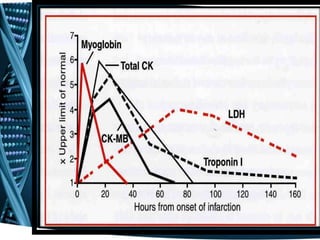
SERUM ENZYMES IN HEART DISEASES
1) CK(CPK)
2) CK-MB
3) Troponin-I/T
4) LDH
5) AST
6) Others
 Not enzymes
 Now accepted as reliable markers for
myocardial infarction
 3 subunits:-
1) Troponin T(TnT): Tropomyosin binding
elements
2) Troponin I(TnI): Actinomyosin ATPase
inhibitory elements
3)Troponin C(TnC): Calcium binding
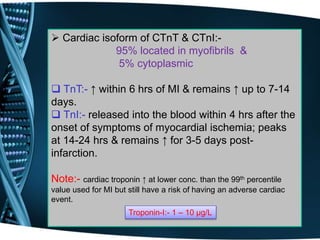
 Cardiac isoform of CTnT & CTnI:-
95% located in myofibrils &
5% cytoplasmic
 TnT:- ↑ within 6 hrs of MI & remains ↑ up to 7-14
days.
 TnI:- released into the blood within 4 hrs after the
onset of symptoms of myocardial ischemia; peaks
at 14-24 hrs & remains ↑ for 3-5 days post-
infarction.
Note:- cardiac troponin ↑ at lower conc. than the 99th percentile
value used for MI but still have a risk of having an adverse cardiac
event.
Troponin-I:- 1 – 10 µg/L
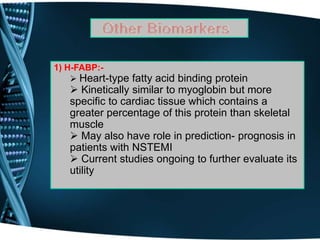
1) H-FABP:-
 Heart-type fatty acid binding protein
 Kinetically similar to myoglobin but more
specific to cardiac tissue which contains a
greater percentage of this protein than skeletal
muscle
 May also have role in prediction- prognosis in
patients with NSTEMI
 Current studies ongoing to further evaluate its
utility
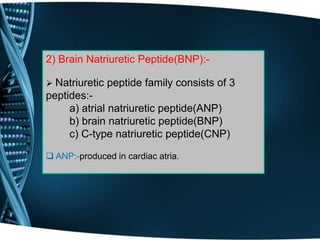
2) Brain Natriuretic Peptide(BNP):-
 Natriuretic peptide family consists of 3
peptides:-
a) atrial natriuretic peptide(ANP)
b) brain natriuretic peptide(BNP)
c) C-type natriuretic peptide(CNP)
 ANP:-produced in cardiac atria.
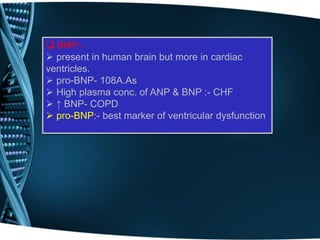
 BNP:-
 present in human brain but more in cardiac
ventricles.
 pro-BNP- 108A.As
 High plasma conc. of ANP & BNP :- CHF
 ↑ BNP- COPD
 pro-BNP:- best marker of ventricular dysfunction
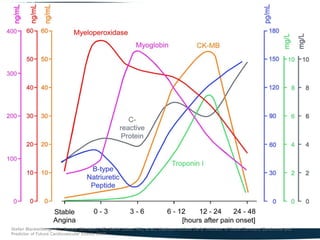
Myeloperoxidase
• MPO is an enzyme that aids white blood cells in
destroying bacteria and viral particles
• MPO catalyzes the conversion of hydrogen
peroxide and chloride ions (Cl-) into hypochlorous
acid
• Hypochlorous acid is 50 times more potent in
microbial killing than hydrogen peroxide
• MPO is released in response to infection and
inflammation
• EPIC Norfolk Study showed its predictive value
for future cardiovascular disease events in
asymptomatic adults.
• MPO leads to oxidized LDL cholesterol
– Oxidized LDL is phagocytosed by macrophages
producing foam cells*
• MPO leads to the consumption of nitric oxide
– Vasoconstriction and endothelial dysfunction
• MPO can cause endothelial denuding and
superficial platelet aggregation
• MPO indicates activated immune cells
– Activated immune cells and inflammation lead to
unstable plaque*
• Inflammatory plaque is inherently less stable
– Thin fibrous cap/fissured/denuded
Brennan, NEJM 2003
*Hansson, NEJM 2005
 Chronic inflammation also is an important
component in the development & progression of
atherosclerosis.
 Numerous epidemiological studies have
demonstrated that ↑ serum CRP conc. are +vely
associated with a risk of future CHD events when
using an hsCRP assay.
 Synthesis- LIVER
 Single hs-CRP measurement is a stong predictor
of:-
a) MI
b) Stroke
c) Peripheral vascular disease
d) Sudden cardiac death:- individuals without a
history of heart disease.
 Direct comparison of traditional and novel
biochemical markers of CHD risk, hsCRP is the
strongest predictor of future coronary events.
Stefan Blankenberg, MD; Renate Schnabel, MD; Edith Lubos, MD, et al., Myeloperoxidase Early Indicator of Acute Coronary Syndrome and
Predictor of Future Cardiovascular Events 2005
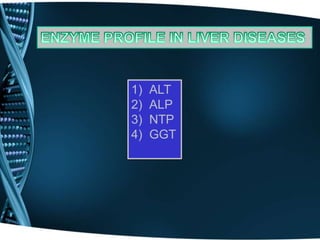
1) ALT
2) ALP
3) NTP
4) GGT
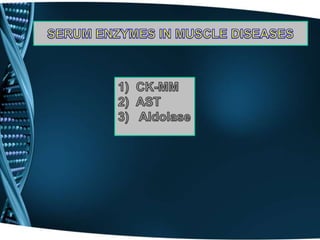
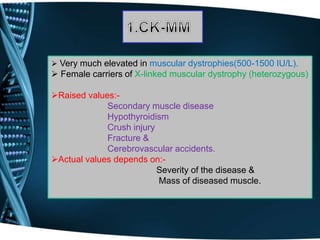
 Very much elevated in muscular dystrophies(500-1500 IU/L).
 Female carriers of X-linked muscular dystrophy (heterozygous)
Raised values:-
Secondary muscle disease
Hypothyroidism
Crush injury
Fracture &
Cerebrovascular accidents.
Actual values depends on:-
Severity of the disease &
Mass of diseased muscle.
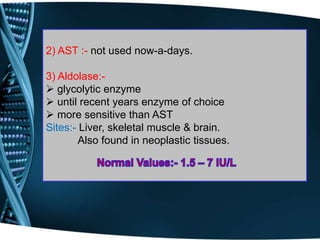
2) AST :- not used now-a-days.
3) Aldolase:-
 glycolytic enzyme
 until recent years enzyme of choice
 more sensitive than AST
Sites:- Liver, skeletal muscle & brain.
Also found in neoplastic tissues.
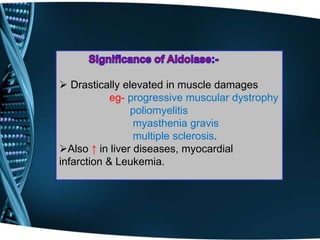
 Drastically elevated in muscle damages
eg- progressive muscular dystrophy
poliomyelitis
myasthenia gravis
multiple sclerosis.
Also ↑ in liver diseases, myocardial
infarction & Leukemia.
 Non-specific enzymes
 hydrolyses aliphatic, aromatic or heterocyclic
compounds.
 optimum PH:- betn 9-10.
 activated by magnesium & manganese.
 Zn is a constituent ion of ALP.
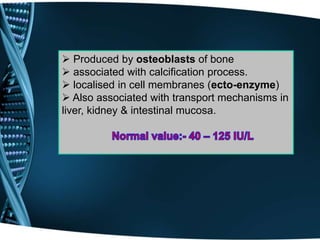
 Produced by osteoblasts of bone
 associated with calcification process.
 localised in cell membranes (ecto-enzyme)
 Also associated with transport mechanisms in
liver, kidney & intestinal mucosa.
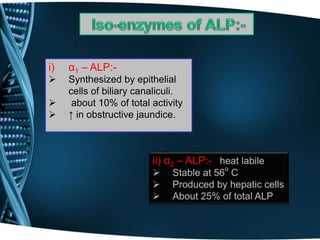
i) α1 – ALP:-
 Synthesized by epithelial
cells of biliary canaliculi.
 about 10% of total activity
 ↑ in obstructive jaundice.
ii) α2 – ALP:- heat labile
 Stable at 56
o
C
 Produced by hepatic cells
 About 25% of total ALP
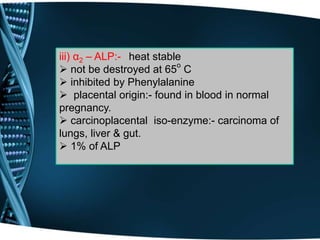
iii) α2 – ALP:- heat stable
 not be destroyed at 65o
C
 inhibited by Phenylalanine
 placental origin:- found in blood in normal
pregnancy.
 carcinoplacental iso-enzyme:- carcinoma of
lungs, liver & gut.
 1% of ALP
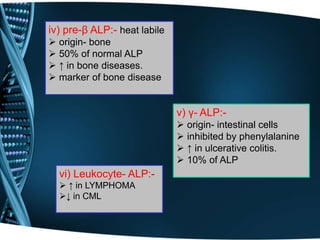
iv) pre-β ALP:- heat labile
 origin- bone
 50% of normal ALP
 ↑ in bone diseases.
 marker of bone disease
v) γ- ALP:-
 origin- intestinal cells
 inhibited by phenylalanine
 ↑ in ulcerative colitis.
 10% of ALP
vi) Leukocyte- ALP:-
 ↑ in LYMPHOMA
↓ in CML
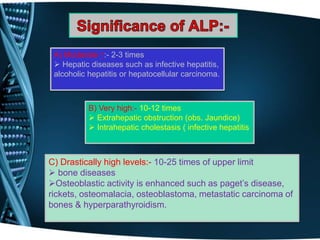
C) Drastically high levels:- 10-25 times of upper limit
 bone diseases
Osteoblastic activity is enhanced such as paget’s disease,
rickets, osteomalacia, osteoblastoma, metastatic carcinoma of
bones & hyperparathyroidism.
A) Moderate ↑:- 2-3 times
 Hepatic diseases such as infective hepatitis,
alcoholic hepatitis or hepatocellular carcinoma.
B) Very high:- 10-12 times
 Extrahepatic obstruction (obs. Jaundice)
 Intrahepatic cholestasis ( infective hepatitis
1) Prostate specific antigen (PSA)
2) Acid phosphatase (ACP)
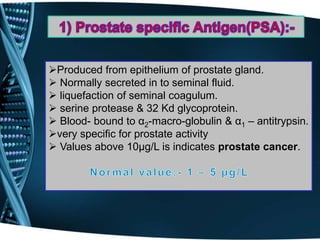
Produced from epithelium of prostate gland.
 Normally secreted in to seminal fluid.
 liquefaction of seminal coagulum.
 serine protease & 32 Kd glycoprotein.
 Blood- bound to α2-macro-globulin & α1 – antitrypsin.
very specific for prostate activity
 Values above 10µg/L is indicates prostate cancer.
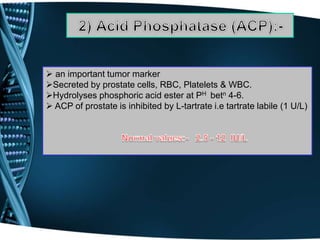
 an important tumor marker
Secreted by prostate cells, RBC, Platelets & WBC.
Hydrolyses phosphoric acid ester at PH betn 4-6.
 ACP of prostate is inhibited by L-tartrate i.e tartrate labile (1 U/L)
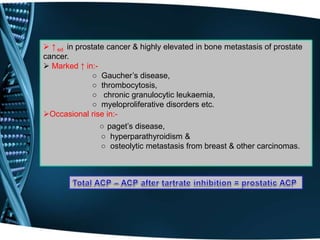
 ↑ ed in prostate cancer & highly elevated in bone metastasis of prostate
cancer.
 Marked ↑ in:-
○ Gaucher’s disease,
○ thrombocytosis,
○ chronic granulocytic leukaemia,
○ myeloproliferative disorders etc.
Occasional rise in:-
○ paget’s disease,
○ hyperparathyroidism &
○ osteolytic metastasis from breast & other carcinomas.
SERUM ENZYMES IN GI-TRACT DISEASES
1) Serum amylase
2) serum lipase
 Splits Starch to maltose.
 activated by Ca2+ & Cl- ions.
 produced by:- Pancreas & salivary glands.
– S1,S2,S3; P1,P2,P3
 Investigation of choice
 ↑ 1000 times more
 peak values: 5-12 hrs (after onset of disease)
 return to normal within 2-4 days.
 Chronic pancreatitis.
 mumps (parotitis)
 Obstruction of pancreatic duct.
 Peptic ulcer
 intestinal obstruction.
 Urine amylase:- <375 IU/L
 ↑ in acute pancreatitis.
 ↑ on 1st day & remain to be ↑ for 7-10 days.
TG ------› MAG + FFA
 Present:- pancreatic secretion.
Significance of lipase:-
 highly ↑ blood levels.
 persists for 7-14 days.
 lipase remains ↑ longer than amylase.
 not ↑ in mumps.
 Carcinoma of pancreas
 biliary diseases
 peptic ulcers.
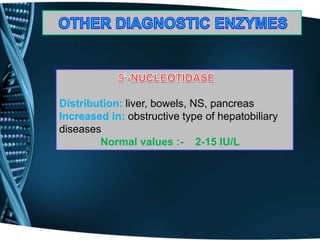
Distribution: liver, bowels, NS, pancreas
Increased in: obstructive type of hepatobiliary
diseases
Normal values :- 2-15 IU/L
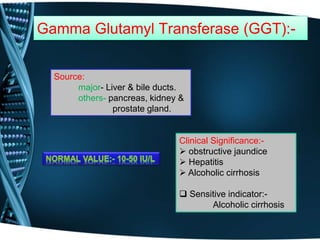
Gamma Glutamyl Transferase (GGT):-
Source:
major- Liver & bile ducts.
others- pancreas, kidney &
prostate gland.
Clinical Significance:-
 obstructive jaundice
 Hepatitis
 Alcoholic cirrhosis
 Sensitive indicator:-
Alcoholic cirrhosis
2 types:-
1) True cholineesterase :-
(acetylcholine hydrolase &
acetyl-cholineesterase)
Present:- nerve tissue & RBC.
Function:- hydrolysis of acetylcholine at the synapses &
neuromuscular junction.
2) Pseudocholinesterase :-
(acetylcholine acyl-hydrolase &
Cholinesterase)
Present:- liver, heart muscle, intestine & sera.
Function:- not known
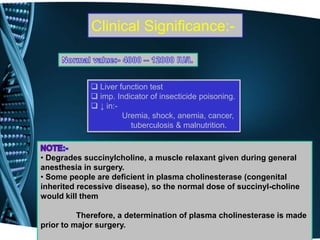
Clinical Significance:-
 Liver function test
 imp. Indicator of insecticide poisoning.
 ↓ in:-
Uremia, shock, anemia, cancer,
tuberculosis & malnutrition.
• Degrades succinylcholine, a muscle relaxant given during general
anesthesia in surgery.
• Some people are deficient in plasma cholinesterase (congenital
inherited recessive disease), so the normal dose of succinyl-choline
would kill them
Therefore, a determination of plasma cholinesterase is made
prior to major surgery.
Distribution: liver, kidney, bowels.
Increased in: hepatobiliary diseases
(obstruction, hepatic metastases).
ORNITHINE CARBAMYL TRASFERASE(OCT)
Ditribution: only liver (hepatospecific).
Increased in: liver diseases (hepatitis, cirrhosis, hepatic
metastases).
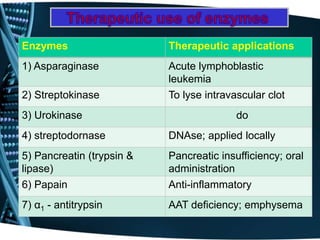
Enzymes Therapeutic applications
1) Asparaginase Acute lymphoblastic
leukemia
2) Streptokinase To lyse intravascular clot
3) Urokinase do
4) streptodornase DNAse; applied locally
5) Pancreatin (trypsin &
lipase)
Pancreatic insufficiency; oral
administration
6) Papain Anti-inflammatory
7) α1 - antitrypsin AAT deficiency; emphysema
The best six doctors anywhere
And no one can deny it
Are sunshine, water, rest, and air
Exercise and diet.
These six will gladly you attend
If only you are willing
Your mind they'll ease
Your will they'll mend
And charge you not a shilling.
‘’Centre for The Cureness’’
Recent advances in enzymology

Recent advances in enzymology

  • 1.
    TAPESHWAR YADAV P.G FinalYear Department Of Biochemistry Mamata Medical College-Khammam, A.P, INDIA
  • 2.
    Measurement of serumenzymes Diagnostic enzymology Enzymes are normally intracellular and LOW concentration in blood Enzyme release (leakage)in the blood indicates cell damage (cell – death, hypoxia, intracellular toxicity) Quantitative measure of cell/tissue damage Organ specificity- but not absolute specificity inspite of same gene content.  Most enzymes are present in most cells-differing amounts
  • 3.
    Information from enzymes measurementsin serum Presence of disease Organs involved Aetiology /nature of disease: differential diagnosis Extent of disease-more damaged cells-more leaked enzymes in blood Time course of disease
  • 4.
    SERUM ENZYMES INHEART DISEASES 1) CK(CPK) 2) CK-MB 3) Troponin-I/T 4) LDH 5) AST 6) Others
  • 5.
     Not enzymes Now accepted as reliable markers for myocardial infarction  3 subunits:- 1) Troponin T(TnT): Tropomyosin binding elements 2) Troponin I(TnI): Actinomyosin ATPase inhibitory elements 3)Troponin C(TnC): Calcium binding
  • 6.
     Cardiac isoformof CTnT & CTnI:- 95% located in myofibrils & 5% cytoplasmic  TnT:- ↑ within 6 hrs of MI & remains ↑ up to 7-14 days.  TnI:- released into the blood within 4 hrs after the onset of symptoms of myocardial ischemia; peaks at 14-24 hrs & remains ↑ for 3-5 days post- infarction. Note:- cardiac troponin ↑ at lower conc. than the 99th percentile value used for MI but still have a risk of having an adverse cardiac event. Troponin-I:- 1 – 10 µg/L
  • 7.
    1) H-FABP:-  Heart-typefatty acid binding protein  Kinetically similar to myoglobin but more specific to cardiac tissue which contains a greater percentage of this protein than skeletal muscle  May also have role in prediction- prognosis in patients with NSTEMI  Current studies ongoing to further evaluate its utility
  • 8.
    2) Brain NatriureticPeptide(BNP):-  Natriuretic peptide family consists of 3 peptides:- a) atrial natriuretic peptide(ANP) b) brain natriuretic peptide(BNP) c) C-type natriuretic peptide(CNP)  ANP:-produced in cardiac atria.
  • 9.
     BNP:-  presentin human brain but more in cardiac ventricles.  pro-BNP- 108A.As  High plasma conc. of ANP & BNP :- CHF  ↑ BNP- COPD  pro-BNP:- best marker of ventricular dysfunction
  • 10.
    Myeloperoxidase • MPO isan enzyme that aids white blood cells in destroying bacteria and viral particles • MPO catalyzes the conversion of hydrogen peroxide and chloride ions (Cl-) into hypochlorous acid • Hypochlorous acid is 50 times more potent in microbial killing than hydrogen peroxide • MPO is released in response to infection and inflammation • EPIC Norfolk Study showed its predictive value for future cardiovascular disease events in asymptomatic adults.
  • 11.
    • MPO leadsto oxidized LDL cholesterol – Oxidized LDL is phagocytosed by macrophages producing foam cells* • MPO leads to the consumption of nitric oxide – Vasoconstriction and endothelial dysfunction • MPO can cause endothelial denuding and superficial platelet aggregation • MPO indicates activated immune cells – Activated immune cells and inflammation lead to unstable plaque* • Inflammatory plaque is inherently less stable – Thin fibrous cap/fissured/denuded Brennan, NEJM 2003 *Hansson, NEJM 2005
  • 12.
     Chronic inflammationalso is an important component in the development & progression of atherosclerosis.  Numerous epidemiological studies have demonstrated that ↑ serum CRP conc. are +vely associated with a risk of future CHD events when using an hsCRP assay.  Synthesis- LIVER
  • 13.
     Single hs-CRPmeasurement is a stong predictor of:- a) MI b) Stroke c) Peripheral vascular disease d) Sudden cardiac death:- individuals without a history of heart disease.  Direct comparison of traditional and novel biochemical markers of CHD risk, hsCRP is the strongest predictor of future coronary events.
  • 15.
    Stefan Blankenberg, MD;Renate Schnabel, MD; Edith Lubos, MD, et al., Myeloperoxidase Early Indicator of Acute Coronary Syndrome and Predictor of Future Cardiovascular Events 2005
  • 16.
    1) ALT 2) ALP 3)NTP 4) GGT
  • 18.
     Very muchelevated in muscular dystrophies(500-1500 IU/L).  Female carriers of X-linked muscular dystrophy (heterozygous) Raised values:- Secondary muscle disease Hypothyroidism Crush injury Fracture & Cerebrovascular accidents. Actual values depends on:- Severity of the disease & Mass of diseased muscle.
  • 19.
    2) AST :-not used now-a-days. 3) Aldolase:-  glycolytic enzyme  until recent years enzyme of choice  more sensitive than AST Sites:- Liver, skeletal muscle & brain. Also found in neoplastic tissues.
  • 20.
     Drastically elevatedin muscle damages eg- progressive muscular dystrophy poliomyelitis myasthenia gravis multiple sclerosis. Also ↑ in liver diseases, myocardial infarction & Leukemia.
  • 21.
     Non-specific enzymes hydrolyses aliphatic, aromatic or heterocyclic compounds.  optimum PH:- betn 9-10.  activated by magnesium & manganese.  Zn is a constituent ion of ALP.
  • 22.
     Produced byosteoblasts of bone  associated with calcification process.  localised in cell membranes (ecto-enzyme)  Also associated with transport mechanisms in liver, kidney & intestinal mucosa.
  • 23.
    i) α1 –ALP:-  Synthesized by epithelial cells of biliary canaliculi.  about 10% of total activity  ↑ in obstructive jaundice. ii) α2 – ALP:- heat labile  Stable at 56 o C  Produced by hepatic cells  About 25% of total ALP
  • 24.
    iii) α2 –ALP:- heat stable  not be destroyed at 65o C  inhibited by Phenylalanine  placental origin:- found in blood in normal pregnancy.  carcinoplacental iso-enzyme:- carcinoma of lungs, liver & gut.  1% of ALP
  • 25.
    iv) pre-β ALP:-heat labile  origin- bone  50% of normal ALP  ↑ in bone diseases.  marker of bone disease v) γ- ALP:-  origin- intestinal cells  inhibited by phenylalanine  ↑ in ulcerative colitis.  10% of ALP vi) Leukocyte- ALP:-  ↑ in LYMPHOMA ↓ in CML
  • 26.
    C) Drastically highlevels:- 10-25 times of upper limit  bone diseases Osteoblastic activity is enhanced such as paget’s disease, rickets, osteomalacia, osteoblastoma, metastatic carcinoma of bones & hyperparathyroidism. A) Moderate ↑:- 2-3 times  Hepatic diseases such as infective hepatitis, alcoholic hepatitis or hepatocellular carcinoma. B) Very high:- 10-12 times  Extrahepatic obstruction (obs. Jaundice)  Intrahepatic cholestasis ( infective hepatitis
  • 27.
    1) Prostate specificantigen (PSA) 2) Acid phosphatase (ACP)
  • 28.
    Produced from epitheliumof prostate gland.  Normally secreted in to seminal fluid.  liquefaction of seminal coagulum.  serine protease & 32 Kd glycoprotein.  Blood- bound to α2-macro-globulin & α1 – antitrypsin. very specific for prostate activity  Values above 10µg/L is indicates prostate cancer.
  • 29.
     an importanttumor marker Secreted by prostate cells, RBC, Platelets & WBC. Hydrolyses phosphoric acid ester at PH betn 4-6.  ACP of prostate is inhibited by L-tartrate i.e tartrate labile (1 U/L)
  • 30.
     ↑ edin prostate cancer & highly elevated in bone metastasis of prostate cancer.  Marked ↑ in:- ○ Gaucher’s disease, ○ thrombocytosis, ○ chronic granulocytic leukaemia, ○ myeloproliferative disorders etc. Occasional rise in:- ○ paget’s disease, ○ hyperparathyroidism & ○ osteolytic metastasis from breast & other carcinomas.
  • 31.
    SERUM ENZYMES INGI-TRACT DISEASES 1) Serum amylase 2) serum lipase
  • 32.
     Splits Starchto maltose.  activated by Ca2+ & Cl- ions.  produced by:- Pancreas & salivary glands. – S1,S2,S3; P1,P2,P3
  • 33.
     Investigation ofchoice  ↑ 1000 times more  peak values: 5-12 hrs (after onset of disease)  return to normal within 2-4 days.
  • 34.
     Chronic pancreatitis. mumps (parotitis)  Obstruction of pancreatic duct.  Peptic ulcer  intestinal obstruction.  Urine amylase:- <375 IU/L  ↑ in acute pancreatitis.  ↑ on 1st day & remain to be ↑ for 7-10 days.
  • 35.
    TG ------› MAG+ FFA  Present:- pancreatic secretion.
  • 36.
    Significance of lipase:- highly ↑ blood levels.  persists for 7-14 days.  lipase remains ↑ longer than amylase.  not ↑ in mumps.  Carcinoma of pancreas  biliary diseases  peptic ulcers.
  • 37.
    Distribution: liver, bowels,NS, pancreas Increased in: obstructive type of hepatobiliary diseases Normal values :- 2-15 IU/L
  • 38.
    Gamma Glutamyl Transferase(GGT):- Source: major- Liver & bile ducts. others- pancreas, kidney & prostate gland. Clinical Significance:-  obstructive jaundice  Hepatitis  Alcoholic cirrhosis  Sensitive indicator:- Alcoholic cirrhosis
  • 39.
    2 types:- 1) Truecholineesterase :- (acetylcholine hydrolase & acetyl-cholineesterase) Present:- nerve tissue & RBC. Function:- hydrolysis of acetylcholine at the synapses & neuromuscular junction. 2) Pseudocholinesterase :- (acetylcholine acyl-hydrolase & Cholinesterase) Present:- liver, heart muscle, intestine & sera. Function:- not known
  • 40.
    Clinical Significance:-  Liverfunction test  imp. Indicator of insecticide poisoning.  ↓ in:- Uremia, shock, anemia, cancer, tuberculosis & malnutrition. • Degrades succinylcholine, a muscle relaxant given during general anesthesia in surgery. • Some people are deficient in plasma cholinesterase (congenital inherited recessive disease), so the normal dose of succinyl-choline would kill them Therefore, a determination of plasma cholinesterase is made prior to major surgery.
  • 41.
    Distribution: liver, kidney,bowels. Increased in: hepatobiliary diseases (obstruction, hepatic metastases).
  • 42.
    ORNITHINE CARBAMYL TRASFERASE(OCT) Ditribution:only liver (hepatospecific). Increased in: liver diseases (hepatitis, cirrhosis, hepatic metastases).
  • 43.
    Enzymes Therapeutic applications 1)Asparaginase Acute lymphoblastic leukemia 2) Streptokinase To lyse intravascular clot 3) Urokinase do 4) streptodornase DNAse; applied locally 5) Pancreatin (trypsin & lipase) Pancreatic insufficiency; oral administration 6) Papain Anti-inflammatory 7) α1 - antitrypsin AAT deficiency; emphysema
  • 44.
    The best sixdoctors anywhere And no one can deny it Are sunshine, water, rest, and air Exercise and diet. These six will gladly you attend If only you are willing Your mind they'll ease Your will they'll mend And charge you not a shilling.
  • 45.
    ‘’Centre for TheCureness’’