Enzyme Kinetics
Kinetics is the study of the rates of reactions

    Enzymes endow cells with the remarkable capacity
    to exert kinetic control over thermodynamic
    potentiality
    •Enzymes are the agents of metabolic function
    •What we want to be able to determine:
       – Maximum velocity
       – Substrate affinity
       – Inhibitor affinity
    • What it can tell us:
       – Flow through metabolic pathways
       – Utilization of substrates
    • What can we do with the information:
       – Control and manipulate metabolic events
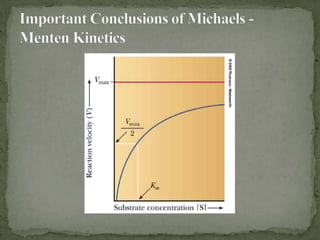
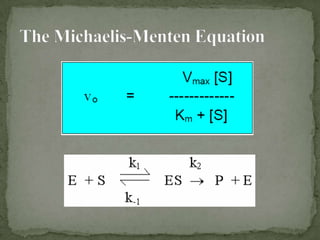
 when [S]= KM, the equation reduces to


 when [S] >> KM, the equation reduces to


 when [S] << KM, the equation reduces to
 It is difficult to determine Vmax experimentally
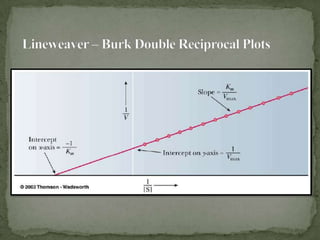
 The equation for a hyperbola can be transformed into
  the equation for a straight line by taking the reciprocal
  of each side
 The formula for a straight line is y = mx + b


 A plot of 1/V versus 1/[S] will give a straight line with
  slope of KM/Vmax and y intercept of 1/Vmax
 Such a plot is known as a Lineweaver-Burk double
  reciprocal plot
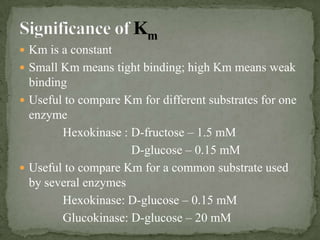
 Km is a constant
 Small Km means tight binding; high Km means weak
  binding
 Useful to compare Km for different substrates for one
  enzyme
        Hexokinase : D-fructose – 1.5 mM
                     D-glucose – 0.15 mM
 Useful to compare Km for a common substrate used
  by several enzymes
        Hexokinase: D-glucose – 0.15 mM
        Glucokinase: D-glucose – 20 mM
Enzyme inhibitors are important for a variety of reasons

1) they can be used to gain information about the shape on
  the enzyme active site and the amino acid residues in the
  active site.
2) they can be used to gain information about the chemical
  mechanism.
3) they can be used to gain information about the regulation
  or control of a metabolic pathway.
4) they can be very important in drug design.
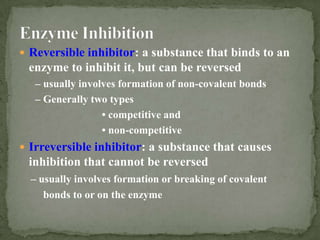
 Reversible inhibitor: a substance that binds to an
 enzyme to inhibit it, but can be reversed
   – usually involves formation of non-covalent bonds
   – Generally two types
                  • competitive and
                  • non-competitive
 Irreversible inhibitor: a substance that causes
 inhibition that cannot be reversed
  – usually involves formation or breaking of covalent
     bonds to or on the enzyme
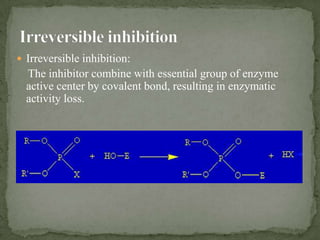
 Irreversible inhibition:
  The inhibitor combine with essential group of enzyme
  active center by covalent bond, resulting in enzymatic
  activity loss.
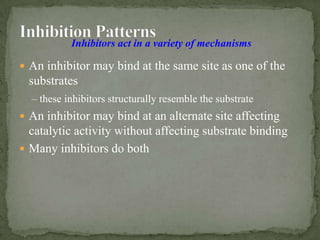
Inhibitors act in a variety of mechanisms

 An inhibitor may bind at the same site as one of the
  substrates
  – these inhibitors structurally resemble the substrate
 An inhibitor may bind at an alternate site affecting
  catalytic activity without affecting substrate binding
 Many inhibitors do both
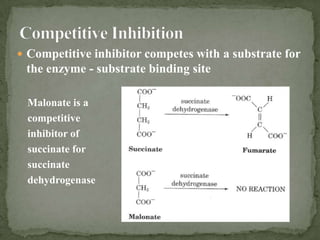
 Competitive inhibitor competes with a substrate for
 the enzyme - substrate binding site

 Malonate is a
 competitive
 inhibitor of
 succinate for
 succinate
 dehydrogenase
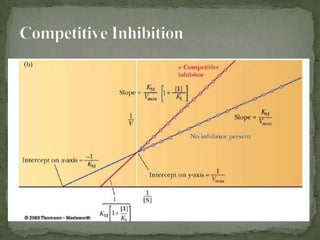
 A competitive inhibitor reduces the amount of
  free enzyme available for substrate binding thus
  increasing the Km for the substrate


 The effect of a competitive inhibitor can be
  overcome with high concentrations of the
  substrate
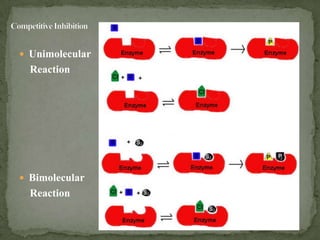
 Unimolecular
  Reaction


 Bimolecular
  Reaction
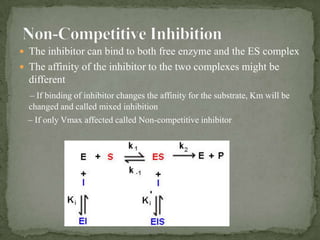
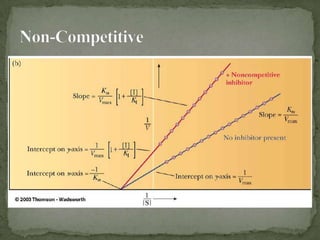
 The inhibitor can bind to both free enzyme and the ES complex
 The affinity of the inhibitor to the two complexes might be
  different
  – If binding of inhibitor changes the affinity for the substrate, Km will be
  changed and called mixed inhibition
  – If only Vmax affected called Non-competitive inhibitor
Enzyme kinetics and inhibition

Enzyme kinetics and inhibition

  • 1.
    Enzyme Kinetics Kinetics isthe study of the rates of reactions Enzymes endow cells with the remarkable capacity to exert kinetic control over thermodynamic potentiality •Enzymes are the agents of metabolic function •What we want to be able to determine: – Maximum velocity – Substrate affinity – Inhibitor affinity • What it can tell us: – Flow through metabolic pathways – Utilization of substrates • What can we do with the information: – Control and manipulate metabolic events
  • 3.
     when [S]=KM, the equation reduces to  when [S] >> KM, the equation reduces to  when [S] << KM, the equation reduces to
  • 5.
     It isdifficult to determine Vmax experimentally  The equation for a hyperbola can be transformed into the equation for a straight line by taking the reciprocal of each side  The formula for a straight line is y = mx + b  A plot of 1/V versus 1/[S] will give a straight line with slope of KM/Vmax and y intercept of 1/Vmax  Such a plot is known as a Lineweaver-Burk double reciprocal plot
  • 7.
     Km isa constant  Small Km means tight binding; high Km means weak binding  Useful to compare Km for different substrates for one enzyme Hexokinase : D-fructose – 1.5 mM D-glucose – 0.15 mM  Useful to compare Km for a common substrate used by several enzymes Hexokinase: D-glucose – 0.15 mM Glucokinase: D-glucose – 20 mM
  • 8.
    Enzyme inhibitors areimportant for a variety of reasons 1) they can be used to gain information about the shape on the enzyme active site and the amino acid residues in the active site. 2) they can be used to gain information about the chemical mechanism. 3) they can be used to gain information about the regulation or control of a metabolic pathway. 4) they can be very important in drug design.
  • 9.
     Reversible inhibitor:a substance that binds to an enzyme to inhibit it, but can be reversed – usually involves formation of non-covalent bonds – Generally two types • competitive and • non-competitive  Irreversible inhibitor: a substance that causes inhibition that cannot be reversed – usually involves formation or breaking of covalent bonds to or on the enzyme
  • 10.
     Irreversible inhibition: The inhibitor combine with essential group of enzyme active center by covalent bond, resulting in enzymatic activity loss.
  • 11.
    Inhibitors act ina variety of mechanisms  An inhibitor may bind at the same site as one of the substrates – these inhibitors structurally resemble the substrate  An inhibitor may bind at an alternate site affecting catalytic activity without affecting substrate binding  Many inhibitors do both
  • 12.
     Competitive inhibitorcompetes with a substrate for the enzyme - substrate binding site Malonate is a competitive inhibitor of succinate for succinate dehydrogenase
  • 13.
     A competitiveinhibitor reduces the amount of free enzyme available for substrate binding thus increasing the Km for the substrate  The effect of a competitive inhibitor can be overcome with high concentrations of the substrate
  • 15.
     Unimolecular Reaction  Bimolecular Reaction
  • 16.
     The inhibitorcan bind to both free enzyme and the ES complex  The affinity of the inhibitor to the two complexes might be different – If binding of inhibitor changes the affinity for the substrate, Km will be changed and called mixed inhibition – If only Vmax affected called Non-competitive inhibitor