Insect Flight Mechanisms:
Anatomy and Kinematics
           Carl R. Knospe
        Associate Professor
Mechanical and Aerospace Engineering
       University of Virginia

             Fall 1998
Overview
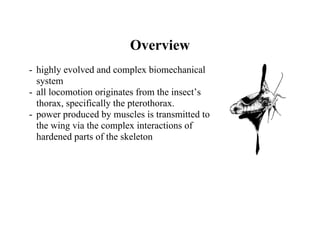
- highly evolved and complex biomechanical
  system
- all locomotion originates from the insect’s
  thorax, specifically the pterothorax.
- power produced by muscles is transmitted to
  the wing via the complex interactions of
  hardened parts of the skeleton
Pterothorax
The pterothorax can be divided into the
- tergum (back)
- pleura (sides)
- sternum (belly)

The wing is elevated or
depressed by deformation of the
tergum
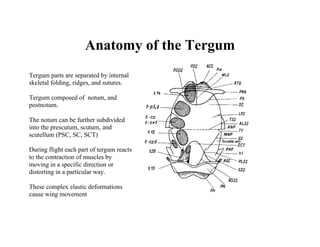
Anatomy of the Tergum
Tergum parts are separated by internal
skeletal folding, ridges, and sutures.

Tergum composed of notum, and
postnotum.

The notum can be further subdivided
into the prescutum, scutum, and
scutellum (PSC, SC, SCT)

During flight each part of tergum reacts
to the contraction of muscles by
moving in a specific direction or
distorting in a particular way.

These complex elastic deformations
cause wing movement
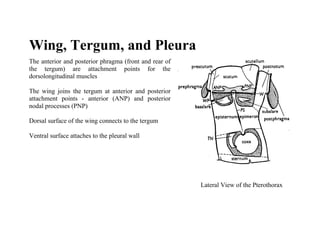
Wing, Tergum, and Pleura
The anterior and posterior phragma (front and rear of
the tergum) are attachment points for the
dorsolongitudinal muscles

The wing joins the tergum at anterior and posterior
attachment points - anterior (ANP) and posterior
nodal processes (PNP)

Dorsal surface of the wing connects to the tergum

Ventral surface attaches to the pleural wall


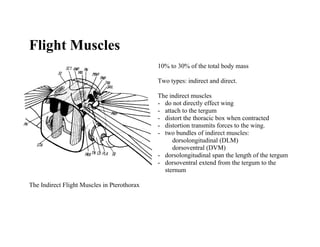
                                                        Lateral View of the Pterothorax
Flight Muscles
                                             10% to 30% of the total body mass

                                             Two types: indirect and direct.

                                             The indirect muscles
                                             - do not directly effect wing
                                             - attach to the tergum
                                             - distort the thoracic box when contracted
                                             - distortion transmits forces to the wing.
                                             - two bundles of indirect muscles:
                                                  dorsolongitudinal (DLM)
                                                  dorsoventral (DVM)
                                             - dorsolongitudinal span the length of the tergum
                                             - dorsoventral extend from the tergum to the
                                               sternum

The Indirect Flight Muscles in Pterothorax
Direct Muscles and Ligaments
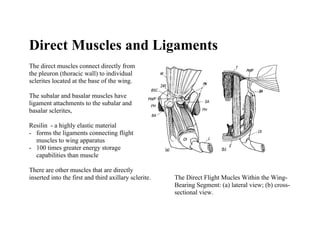
The direct muscles connect directly from
the pleuron (thoracic wall) to individual
sclerites located at the base of the wing.

The subalar and basalar muscles have
ligament attachments to the subalar and
basalar sclerites,

Resilin - a highly elastic material
- forms the ligaments connecting flight
  muscles to wing apparatus
- 100 times greater energy storage
  capabilities than muscle

There are other muscles that are directly
inserted into the first and third axillary sclerite.   The Direct Flight Mucles Within the Wing-
                                                       Bearing Segment: (a) lateral view; (b) cross-
                                                       sectional view.
More Evolved Insects
Diptera (flies) and Hymenoptera (wasps)

• the indirect muscles occupy the greatest volume of the pterothorax and function as the primary
  source of power for the wingstroke.
• contraction of the dorsolongitudinal muscles causes severe arching of the notum which depresses
  the wing
• contraction of the dorsoventral muscles causes opposite motion of notum.
• direct muscles are important in controlling the wingbeat


Primitive Insects
Orthoptera (locusts), Coleoptera (beetles), and Odonata (dragonflies)

• direct muscles are responsible for developing the needed power for the up and down strokes
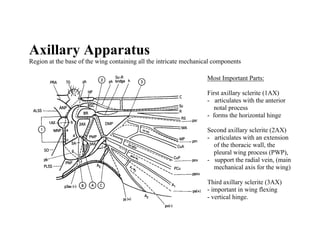
Axillary Apparatus
Region at the base of the wing containing all the intricate mechanical components

                                                                    Most Important Parts:

                                                                    First axillary sclerite (1AX)
                                                                    - articulates with the anterior
                                                                       notal process
                                                                    - forms the horizontal hinge

                                                                    Second axillary sclerite (2AX)
                                                                    - articulates with an extension
                                                                      of the thoracic wall, the
                                                                      pleural wing process (PWP),
                                                                    - support the radial vein, (main
                                                                      mechanical axis for the wing)

                                                                    Third axillary sclerite (3AX)
                                                                    - important in wing flexing
                                                                    - vertical hinge.
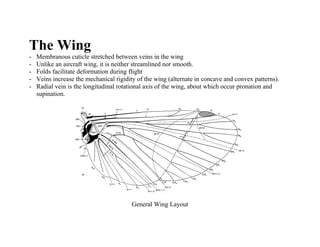
The Wing
-   Membranous cuticle stretched between veins in the wing
-   Unlike an aircraft wing, it is neither streamlined nor smooth.
-   Folds facilitate deformation during flight
-   Veins increase the mechanical rigidity of the wing (alternate in concave and convex patterns).
-   Radial vein is the longitudinal rotational axis of the wing, about which occur pronation and
    supination.


                                        General Wing Layout
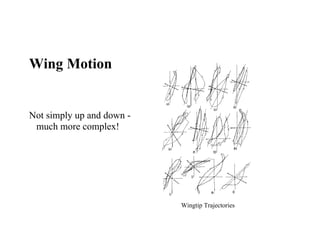
Wing Motion


Not simply up and down -
 much more complex!


                           Wingtip Trajectories
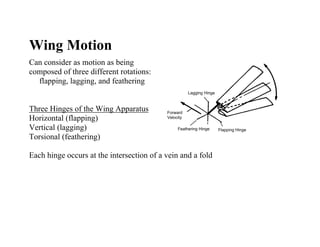
Wing Motion
Can consider as motion as being
composed of three different rotations:
  flapping, lagging, and feathering
                                                      Lagging Hinge


Three Hinges of the Wing Apparatus         Forward
Horizontal (flapping)                      Velocity

Vertical (lagging)                              Feathering Hinge      Flapping Hinge
Torsional (feathering)

Each hinge occurs at the intersection of a vein and a fold
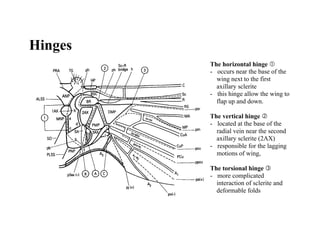
Hinges
         The horizontal hinge •
         - occurs near the base of the
           wing next to the first
           axillary sclerite
         - this hinge allow the wing to
           flap up and down.

         The vertical hinge ‚
         - located at the base of the
           radial vein near the second
           axillary sclerite (2AX)
         - responsible for the lagging
           motions of wing,

         The torsional hinge ƒ
         - more complicated
           interaction of sclerite and
           deformable folds
Four Phases of Wing Motion
1.   depression and turning forward
2.   turning backward and beginning supination
3.   elevation and end of supination
4.   pronation
Flight Variables
- wingbeat frequency: the frequency of oscillation of the wing
  during a stroke

- stroke angle: the full angular displacement of the wing during a
  complete stroke

- stroke plane angle: the angle between the stroke plane and the
  vertical axis
- body angle: the angle the between the longitudinal body axis
  and the flight path
Bi-Motor Type Flight
Dragonflies (Odonata)

-   extreme functionality of the two wing pairs (two motors)
-   complete independence of each of the four wings
-   high maneuverability
-   gliding and high-speed flight
-   low wingbeat frequency (25-30 Hz)
-   low stroke amplitude (~ 30°)
High-Frequency Type Flight
Hymenoptera (bees and wasps) and Diptera (flies and mosquitoes)

-   high wingbeat frequency (>100 Hz),
-   low -medium stroke amplitude
-   high speed flight
-   enhanced maneuverability
-   variable stroke plane angle - hover
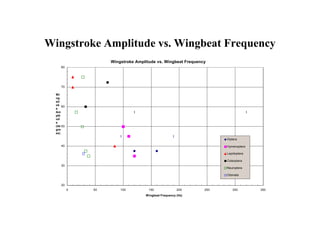
Wingstroke Amplitude vs. Wingbeat Frequency
                    Wingstroke Amplitude vs. Wingbeat Frequency
     80


     70

  Wi
  ng
  str
  ok 60
  e
  Am
  plit
  ud
  e
  (de 50
  gre
  es)

                                                                    Diptera

     40                                                             Hymenoptera

                                                                    Lepidoptera

                                                                    Coleoptera
     30
                                                                    Neuroptera

                                                                    Odonata


     20
           0   50       100          150              200     250      300        350
                                   Wingbeat Frequency (Hz)
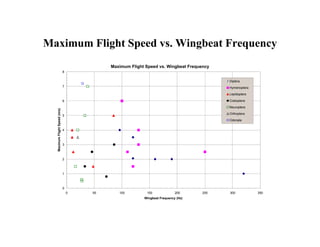
Maximum Flight Speed vs. Wingbeat Frequency
                                            Maximum Flight Speed vs. Wingbeat Frequency
                               8

                                                                                          Diptera
                               7                                                          Hymenoptera

                                                                                          Lepidoptera

                               6                                                          Coleoptera

                                                                                          Neuroptera
  Maximum Flight Speed (m/s)


                                                                                          Orthoptera
                               5
                                                                                          Odonata


                               4


                               3


                               2


                               1


                               0
                                   0   50      100         150              200     250   300           350
                                                          Wingbeat Frequency (Hz)
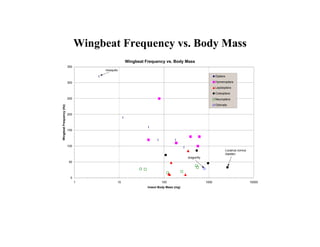
Wingbeat Frequency vs. Body Mass
                                                 Wingbeat Frequency vs. Body Mass
                          350
                                     mosquito

                                                                                                      Diptera

                          300                                                                         Hymenoptera
                                                                                                      Lepidoptera
                                                                                                      Coleoptera
                          250                                                                         Neuroptera
                                                                                                      Odonata
Wingbeat Frequency (Hz)


                          200


                          150


                          100
                                                                                                                Lucanus corvus
                                                                                                                (beetle)
                                                                                   dragonfly
                          50


                           0
                                1           10                     100                         1000                              10000
                                                           Insect Body Mass (mg)
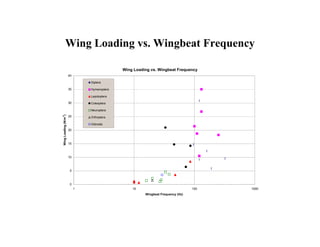
Wing Loading vs. Wingbeat Frequency

                                             Wing Loading vs. Wingbeat Frequency
                      40

                               Diptera

                      35       Hymenoptera

                               Lepidoptera

                      30       Coleoptera

                               Neuroptera
Wing Loading (N/m )


                      25
2


                               Orthoptera

                               Odonata
                      20


                      15


                      10


                       5


                       0
                           1                     10                              100   1000
                                                       Wingbeat Frequency (Hz)
Flight of Insects

Flight of Insects

  • 1.
    Insect Flight Mechanisms: Anatomyand Kinematics Carl R. Knospe Associate Professor Mechanical and Aerospace Engineering University of Virginia Fall 1998
  • 2.
    Overview - highly evolvedand complex biomechanical system - all locomotion originates from the insect’s thorax, specifically the pterothorax. - power produced by muscles is transmitted to the wing via the complex interactions of hardened parts of the skeleton
  • 3.
    Pterothorax The pterothorax canbe divided into the - tergum (back) - pleura (sides) - sternum (belly) The wing is elevated or depressed by deformation of the tergum
  • 4.
    Anatomy of theTergum Tergum parts are separated by internal skeletal folding, ridges, and sutures. Tergum composed of notum, and postnotum. The notum can be further subdivided into the prescutum, scutum, and scutellum (PSC, SC, SCT) During flight each part of tergum reacts to the contraction of muscles by moving in a specific direction or distorting in a particular way. These complex elastic deformations cause wing movement
  • 5.
    Wing, Tergum, andPleura The anterior and posterior phragma (front and rear of the tergum) are attachment points for the dorsolongitudinal muscles The wing joins the tergum at anterior and posterior attachment points - anterior (ANP) and posterior nodal processes (PNP) Dorsal surface of the wing connects to the tergum Ventral surface attaches to the pleural wall Lateral View of the Pterothorax
  • 6.
    Flight Muscles 10% to 30% of the total body mass Two types: indirect and direct. The indirect muscles - do not directly effect wing - attach to the tergum - distort the thoracic box when contracted - distortion transmits forces to the wing. - two bundles of indirect muscles: dorsolongitudinal (DLM) dorsoventral (DVM) - dorsolongitudinal span the length of the tergum - dorsoventral extend from the tergum to the sternum The Indirect Flight Muscles in Pterothorax
  • 7.
    Direct Muscles andLigaments The direct muscles connect directly from the pleuron (thoracic wall) to individual sclerites located at the base of the wing. The subalar and basalar muscles have ligament attachments to the subalar and basalar sclerites, Resilin - a highly elastic material - forms the ligaments connecting flight muscles to wing apparatus - 100 times greater energy storage capabilities than muscle There are other muscles that are directly inserted into the first and third axillary sclerite. The Direct Flight Mucles Within the Wing- Bearing Segment: (a) lateral view; (b) cross- sectional view.
  • 8.
    More Evolved Insects Diptera(flies) and Hymenoptera (wasps) • the indirect muscles occupy the greatest volume of the pterothorax and function as the primary source of power for the wingstroke. • contraction of the dorsolongitudinal muscles causes severe arching of the notum which depresses the wing • contraction of the dorsoventral muscles causes opposite motion of notum. • direct muscles are important in controlling the wingbeat Primitive Insects Orthoptera (locusts), Coleoptera (beetles), and Odonata (dragonflies) • direct muscles are responsible for developing the needed power for the up and down strokes
  • 9.
    Axillary Apparatus Region atthe base of the wing containing all the intricate mechanical components Most Important Parts: First axillary sclerite (1AX) - articulates with the anterior notal process - forms the horizontal hinge Second axillary sclerite (2AX) - articulates with an extension of the thoracic wall, the pleural wing process (PWP), - support the radial vein, (main mechanical axis for the wing) Third axillary sclerite (3AX) - important in wing flexing - vertical hinge.
  • 10.
    The Wing - Membranous cuticle stretched between veins in the wing - Unlike an aircraft wing, it is neither streamlined nor smooth. - Folds facilitate deformation during flight - Veins increase the mechanical rigidity of the wing (alternate in concave and convex patterns). - Radial vein is the longitudinal rotational axis of the wing, about which occur pronation and supination. General Wing Layout
  • 11.
    Wing Motion Not simplyup and down - much more complex! Wingtip Trajectories
  • 12.
    Wing Motion Can consideras motion as being composed of three different rotations: flapping, lagging, and feathering Lagging Hinge Three Hinges of the Wing Apparatus Forward Horizontal (flapping) Velocity Vertical (lagging) Feathering Hinge Flapping Hinge Torsional (feathering) Each hinge occurs at the intersection of a vein and a fold
  • 13.
    Hinges The horizontal hinge • - occurs near the base of the wing next to the first axillary sclerite - this hinge allow the wing to flap up and down. The vertical hinge ‚ - located at the base of the radial vein near the second axillary sclerite (2AX) - responsible for the lagging motions of wing, The torsional hinge ƒ - more complicated interaction of sclerite and deformable folds
  • 14.
    Four Phases ofWing Motion 1. depression and turning forward 2. turning backward and beginning supination 3. elevation and end of supination 4. pronation
  • 15.
    Flight Variables - wingbeatfrequency: the frequency of oscillation of the wing during a stroke - stroke angle: the full angular displacement of the wing during a complete stroke - stroke plane angle: the angle between the stroke plane and the vertical axis - body angle: the angle the between the longitudinal body axis and the flight path
  • 16.
    Bi-Motor Type Flight Dragonflies(Odonata) - extreme functionality of the two wing pairs (two motors) - complete independence of each of the four wings - high maneuverability - gliding and high-speed flight - low wingbeat frequency (25-30 Hz) - low stroke amplitude (~ 30°)
  • 17.
    High-Frequency Type Flight Hymenoptera(bees and wasps) and Diptera (flies and mosquitoes) - high wingbeat frequency (>100 Hz), - low -medium stroke amplitude - high speed flight - enhanced maneuverability - variable stroke plane angle - hover
  • 18.
    Wingstroke Amplitude vs.Wingbeat Frequency Wingstroke Amplitude vs. Wingbeat Frequency 80 70 Wi ng str ok 60 e Am plit ud e (de 50 gre es) Diptera 40 Hymenoptera Lepidoptera Coleoptera 30 Neuroptera Odonata 20 0 50 100 150 200 250 300 350 Wingbeat Frequency (Hz)
  • 19.
    Maximum Flight Speedvs. Wingbeat Frequency Maximum Flight Speed vs. Wingbeat Frequency 8 Diptera 7 Hymenoptera Lepidoptera 6 Coleoptera Neuroptera Maximum Flight Speed (m/s) Orthoptera 5 Odonata 4 3 2 1 0 0 50 100 150 200 250 300 350 Wingbeat Frequency (Hz)
  • 20.
    Wingbeat Frequency vs.Body Mass Wingbeat Frequency vs. Body Mass 350 mosquito Diptera 300 Hymenoptera Lepidoptera Coleoptera 250 Neuroptera Odonata Wingbeat Frequency (Hz) 200 150 100 Lucanus corvus (beetle) dragonfly 50 0 1 10 100 1000 10000 Insect Body Mass (mg)
  • 21.
    Wing Loading vs.Wingbeat Frequency Wing Loading vs. Wingbeat Frequency 40 Diptera 35 Hymenoptera Lepidoptera 30 Coleoptera Neuroptera Wing Loading (N/m ) 25 2 Orthoptera Odonata 20 15 10 5 0 1 10 100 1000 Wingbeat Frequency (Hz)