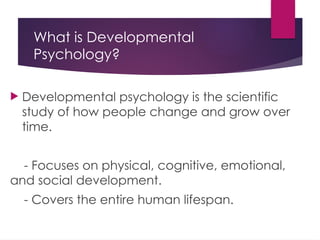
What is Developmental
Psychology?
Developmental psychology is the scientific
study of how people change and grow over
time.
- Focuses on physical, cognitive, emotional,
and social development.
- Covers the entire human lifespan.
3.
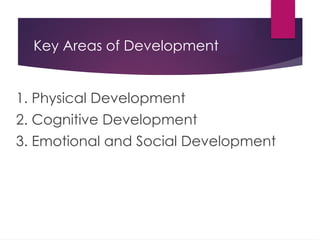
Key Areas ofDevelopment
1. Physical Development
2. Cognitive Development
3. Emotional and Social Development
4.
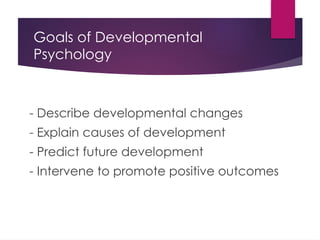
Goals of Developmental
Psychology
-Describe developmental changes
- Explain causes of development
- Predict future development
- Intervene to promote positive outcomes
5.
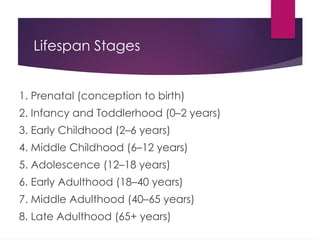
Lifespan Stages
1. Prenatal(conception to birth)
2. Infancy and Toddlerhood (0–2 years)
3. Early Childhood (2–6 years)
4. Middle Childhood (6–12 years)
5. Adolescence (12–18 years)
6. Early Adulthood (18–40 years)
7. Middle Adulthood (40–65 years)
8. Late Adulthood (65+ years)
6.
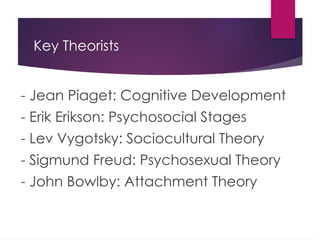
Key Theorists
- JeanPiaget: Cognitive Development
- Erik Erikson: Psychosocial Stages
- Lev Vygotsky: Sociocultural Theory
- Sigmund Freud: Psychosexual Theory
- John Bowlby: Attachment Theory
7.
- refers tohow a person perceives, thinks,
and gains understanding of their world
through interaction and experience.
Cognitive Development
8.
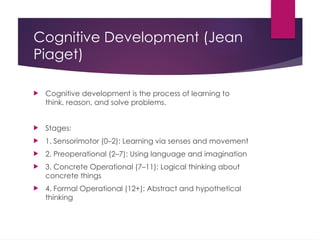
Cognitive Development (Jean
Piaget)
Cognitive development is the process of learning to
think, reason, and solve problems.
Stages:
1. Sensorimotor (0–2): Learning via senses and movement
2. Preoperational (2–7): Using language and imagination
3. Concrete Operational (7–11): Logical thinking about
concrete things
4. Formal Operational (12+): Abstract and hypothetical
thinking
9.
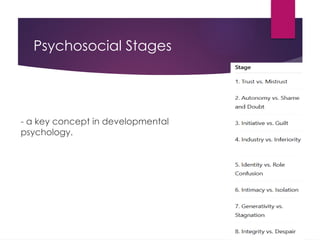
- a keyconcept in developmental
psychology.
Psychosocial Stages
10.
Psychosocial Stages (Erik
Erikson)
Development through 8 stages, each with a unique
challenge:
1. Trust vs. Mistrust
2. Autonomy vs. Shame
3. Initiative vs. Guilt
4. Industry vs. Inferiority
5. Identity vs. Role Confusion
6. Intimacy vs. Isolation
7. Generativity vs. Stagnation
8. Integrity vs. Despair
11.
Sociocultural Theory
Vygotsky believedthat a child’s
development is deeply rooted in social
interactions and the cultural context in
which they live. Learning is inherently a
social process.
12.
Sociocultural Theory (Lev
Vygotsky)
Cognitive development is shaped by social
interaction and culture.
Key Concepts:
• MKO: More Knowledgeable Other
• ZPD: Zone of Proximal Development
• Scaffolding: Temporary learning support
13.
Psychosexual Theory
Freud’s theorysuggests that personality
develops through a series of childhood
stages during which the pleasure-
seeking energies of the id become
focused on certain erogenous zones.
Each stage involves conflicts that must
be resolved for healthy psychological
development.
14.
Psychosexual Theory (Sigmund
Freud)
Personality develops through 5 stages of libido
focus:
1. Oral (0–1): Mouth
2. Anal (1–3): Toilet training
3. Phallic (3–6): Gender awareness
4. Latency (6–12): Focus on learning
5. Genital (12+): Mature relationships
Fixation may affect adult behavior.
15.
Attachment Theory
Attachment theoryexplains how early
relationships with caregivers shape a child’s
social, emotional, and cognitive development.
It focuses on the bond between the infant and
the primary caregiver (usually the mother),
which serves as the foundation for future
relationships.
16.
Attachment Theory (Bowlby&
Ainsworth)
Emotional bonds with caregivers shape future relationships.
Attachment Types:
1. Secure
2. Avoidant
3. Ambivalent
4. Disorganized
Early secure bonds lead to better emotional health and
trust.
17.
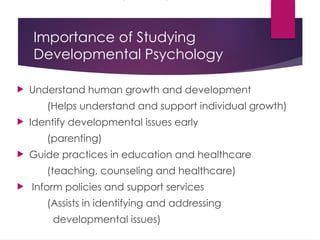
Importance of Studying
DevelopmentalPsychology
Understand human growth and development
(Helps understand and support individual growth)
Identify developmental issues early
(parenting)
Guide practices in education and healthcare
(teaching, counseling and healthcare)
Inform policies and support services
(Assists in identifying and addressing
developmental issues)