MEDICAL MIRROR
Presented by
Mounica.J
14204127
CONTENTS
 Introduction
 Design
 Working
 Demonstration
 Interaction
 Advantages
 Conclusion
 References
INTRODUCTION
 Digital medical devices promise to transform the future of
medicine because of their ability to produce exquisitely detailed
individual philosological data.
 Current techniques for physiological monitoring typically
require users to starp on bulky sensors, chest straps or stickly
electrodes.
 A new mirror interface for real-time,contact-free measurements
of heart rate with out the need for external sensors so called as
magical mirror. It is used to provide a natural user interface.
DESIGN
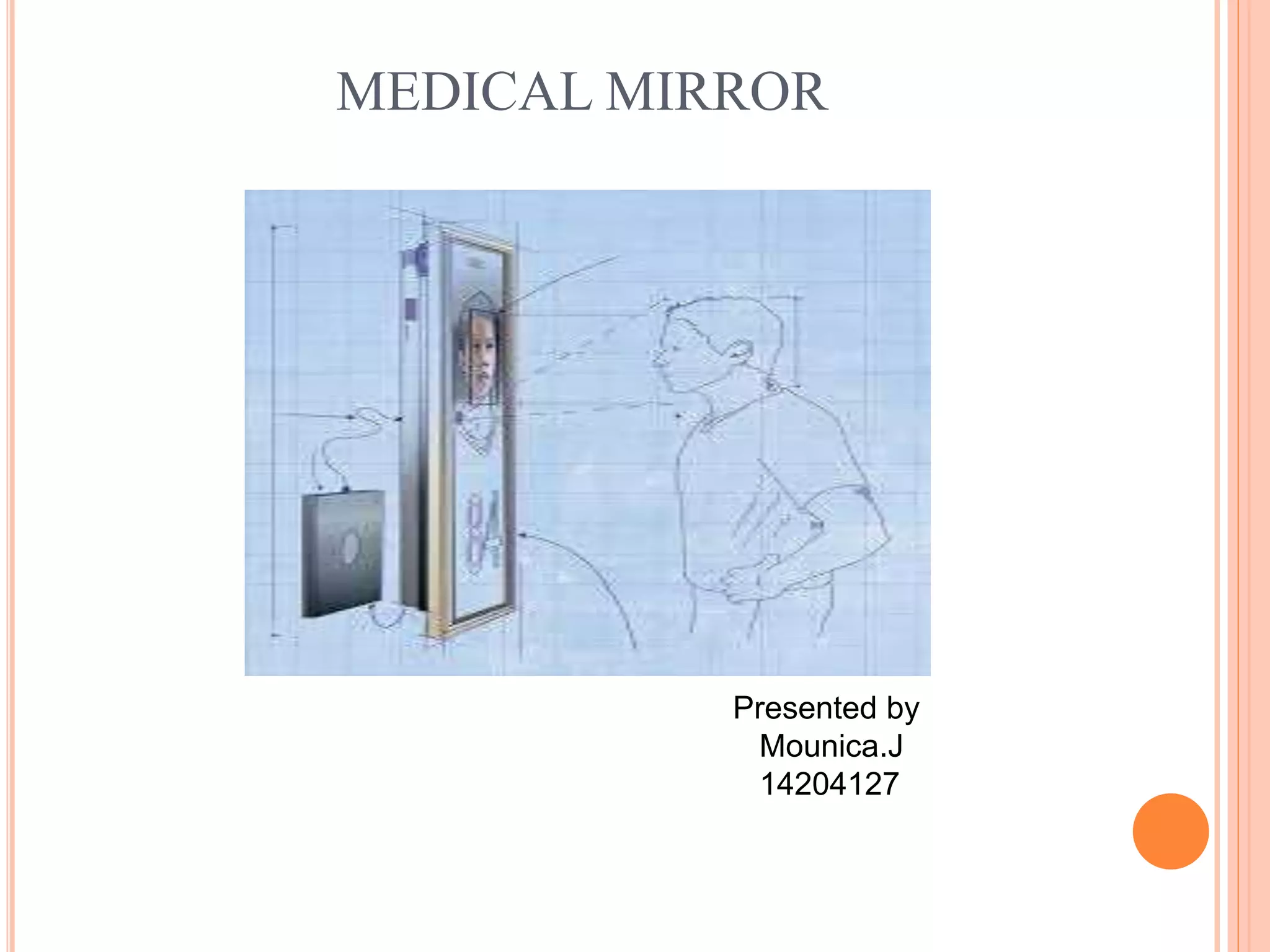
 An LCD monitor with a built-in webcam is used to provide an
interface display.
 A two way mirror was fitted on to the frame to present a
reflective surface for the users in normal lighting conditions.
 The user is visible to the web cam and the LCD monitor can be
used to project information on to the surface of the mirror .
 The monitor and webcam are connected to a laptop running
the analysis software in real-time.
HOW DOES THIS TECHNOLOGY WORKS??
 It uses light to measure the information from our body.
 Every time your heart beats, the blood in your vessels
increase slighty.
 Blood absorbs light and so this increase absorbs more
mono light, decreasing the amount of light being
transmitted or reflected by our body.
 In this case we’re just using the ambient light around
you:sunlight, roomlight or any thing that’s illuminating
your environment.
 The camera then measures the mono light being reflected
off you, in this case, your face.
DEMONSTRATION OF TECHNOLOGY
WORKING
 An automated face tracker detects the largest face with in the
video feed from the webcam and locoliges the measurement
region of intrest (ROI) for each video frame.
 It uses light to measure the information from your body.
 The raw RGB signals are decomposed into three independent
components using independent component analysis.
 The power spectrum of the component containg the strongest
blood volume pulse signal is then computed.
 The user’s heart rate is identified as the frequency that
corresponds to the highest power of the spectrum with in a
operational frequency band(45-240bpm).
DEMONSTRATION OF MEDICAL MIRROR WORKING
INTERACTION
 A single user will be able to interact with the mirror at a time.
 When looking in to the mirror , the user will see a box appear
around his/her face and a timer will be displayed on the top
corner of the box.
 User’s will be asked to stay relatively as the timer counts
down.
 User’s heart rate will be displayed on the mirror, allowing
simultaneously visualization of his/her physical appearance
and physiological state.
 The heart rate measurement will be updated continuosly until
the user looks away.
ADVANTAGES
 The medical mirror fits seamlessy into the ambient home
environment.
 Blending the data collection process into the course of our
daily routines.
 This interface is intended to provide a convenient means for
people to track their daily health with minimal effort.
 You could also use it on a phone or laptop or any device
that has a camera.
CONCLUSION
 This project illustrates an innovative approach to pervasive
health monitoring based on state of the art technology.
 The Medical Mirror fits seamlessly into the ambient home
environment, blending the data collection process into the
course of our daily routines.
 This interface is intended to provide a convenient means for
people to track their daily health with minimal effort.
REFERENCES
 POH, M.-Z., MCDUFF, D.J. AND PICARD, R.W. 2010. Non-contact, Automated
Cardiac Pulse Measurements Using Video Imaging and Blind Source Separation.
Optics Express, vol. 18, no. 10, 10762-10774.
 S. Cook, M. Togni, M. C. Schaub, P. Wenaweser, and O. M. Hess, "High heart rate:
a cardiovascular risk factor?" Eur. Heart J. 27 (20), 2387-2393 (2006).
 I. Pavlidis, J. Dowdall, N. Sun, C. Puri, J. Fei, and M. Garbey, "Interacting with
human physiology," Comput. Vis. Image Underst. 108 (1-2), 150-170 (2007).
 M. Garbey, N. Sun, A. Merla, and I. Pavlidis, "Contact-free measurement of cardiac
pulse based on the analysis of thermal imagery," IEEE Trans. Biomed. Eng. 54 (8),
1418-1426 (2007).
medical mirror

medical mirror

  • 1.
  • 2.
    CONTENTS  Introduction  Design Working  Demonstration  Interaction  Advantages  Conclusion  References
  • 3.
    INTRODUCTION  Digital medicaldevices promise to transform the future of medicine because of their ability to produce exquisitely detailed individual philosological data.  Current techniques for physiological monitoring typically require users to starp on bulky sensors, chest straps or stickly electrodes.  A new mirror interface for real-time,contact-free measurements of heart rate with out the need for external sensors so called as magical mirror. It is used to provide a natural user interface.
  • 4.
    DESIGN  An LCDmonitor with a built-in webcam is used to provide an interface display.  A two way mirror was fitted on to the frame to present a reflective surface for the users in normal lighting conditions.  The user is visible to the web cam and the LCD monitor can be used to project information on to the surface of the mirror .  The monitor and webcam are connected to a laptop running the analysis software in real-time.
  • 6.
    HOW DOES THISTECHNOLOGY WORKS??  It uses light to measure the information from our body.  Every time your heart beats, the blood in your vessels increase slighty.  Blood absorbs light and so this increase absorbs more mono light, decreasing the amount of light being transmitted or reflected by our body.  In this case we’re just using the ambient light around you:sunlight, roomlight or any thing that’s illuminating your environment.  The camera then measures the mono light being reflected off you, in this case, your face.
  • 7.
  • 8.
    WORKING  An automatedface tracker detects the largest face with in the video feed from the webcam and locoliges the measurement region of intrest (ROI) for each video frame.  It uses light to measure the information from your body.  The raw RGB signals are decomposed into three independent components using independent component analysis.  The power spectrum of the component containg the strongest blood volume pulse signal is then computed.  The user’s heart rate is identified as the frequency that corresponds to the highest power of the spectrum with in a operational frequency band(45-240bpm).
  • 9.
  • 10.
    INTERACTION  A singleuser will be able to interact with the mirror at a time.  When looking in to the mirror , the user will see a box appear around his/her face and a timer will be displayed on the top corner of the box.  User’s will be asked to stay relatively as the timer counts down.  User’s heart rate will be displayed on the mirror, allowing simultaneously visualization of his/her physical appearance and physiological state.  The heart rate measurement will be updated continuosly until the user looks away.
  • 11.
    ADVANTAGES  The medicalmirror fits seamlessy into the ambient home environment.  Blending the data collection process into the course of our daily routines.  This interface is intended to provide a convenient means for people to track their daily health with minimal effort.  You could also use it on a phone or laptop or any device that has a camera.
  • 12.
    CONCLUSION  This projectillustrates an innovative approach to pervasive health monitoring based on state of the art technology.  The Medical Mirror fits seamlessly into the ambient home environment, blending the data collection process into the course of our daily routines.  This interface is intended to provide a convenient means for people to track their daily health with minimal effort.
  • 13.
    REFERENCES  POH, M.-Z.,MCDUFF, D.J. AND PICARD, R.W. 2010. Non-contact, Automated Cardiac Pulse Measurements Using Video Imaging and Blind Source Separation. Optics Express, vol. 18, no. 10, 10762-10774.  S. Cook, M. Togni, M. C. Schaub, P. Wenaweser, and O. M. Hess, "High heart rate: a cardiovascular risk factor?" Eur. Heart J. 27 (20), 2387-2393 (2006).  I. Pavlidis, J. Dowdall, N. Sun, C. Puri, J. Fei, and M. Garbey, "Interacting with human physiology," Comput. Vis. Image Underst. 108 (1-2), 150-170 (2007).  M. Garbey, N. Sun, A. Merla, and I. Pavlidis, "Contact-free measurement of cardiac pulse based on the analysis of thermal imagery," IEEE Trans. Biomed. Eng. 54 (8), 1418-1426 (2007).