Radiation and the Universe
b.Radioactivity
Mr S Thompson
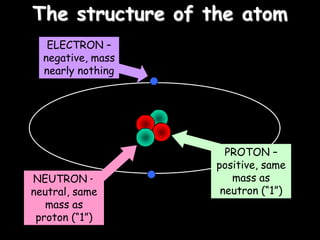
The structure of the atom
ELECTRON –
negative, mass
nearly nothing
PROTON –
positive, same
mass as
neutron (“1”)
NEUTRON –
neutral, same
mass as
proton (“1”)
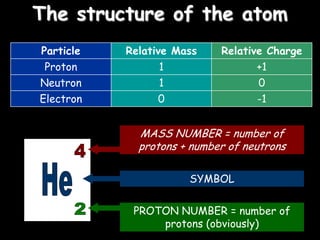
The structure of the atom
Particle Relative Mass Relative Charge
Proton 1 +1
Neutron 1 0
Electron 0 -1
MASS NUMBER = number of
protons + number of neutrons
SYMBOL
PROTON NUMBER = number of
protons (obviously)
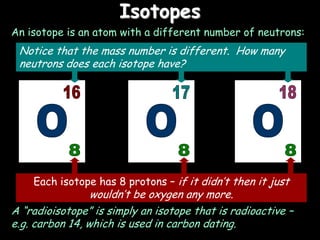
Isotopes
An isotope is an atom with a different number of neutrons:
Each isotope has 8 protons – if it didn’t then it just
wouldn’t be oxygen any more.
Notice that the mass number is different. How many
neutrons does each isotope have?
A “radioisotope” is simply an isotope that is radioactive –
e.g. carbon 14, which is used in carbon dating.
Introduction to Radioactivity
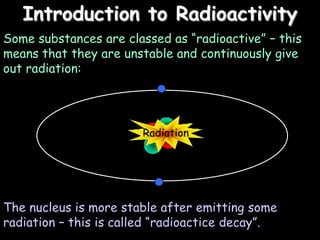
Some substances are classed as “radioactive” – this
means that they are unstable and continuously give
out radiation:
Radiation
The nucleus is more stable after emitting some
radiation – this is called “radioactice decay”.
Types of radiation
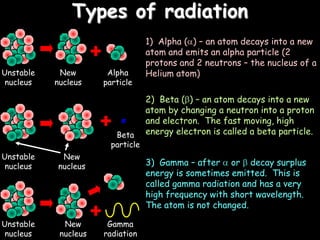
1) Alpha ( ) – an atom decays into a new
atom and emits an alpha particle (2
protons and 2 neutrons – the nucleus of a
Helium atom)
2) Beta ( ) – an atom decays into a new
atom by changing a neutron into a proton
and electron. The fast moving, high
energy electron is called a beta particle.
3) Gamma – after or decay surplus
energy is sometimes emitted. This is
called gamma radiation and has a very
high frequency with short wavelength.
The atom is not changed.
Unstable
nucleus
Unstable
nucleus
Unstable
nucleus
New
nucleus
New
nucleus
New
nucleus
Alpha
particle
Beta
particle
Gamma
radiation
Ionisation
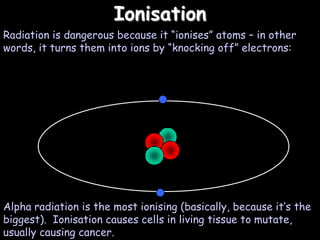
Radiation is dangerous because it “ionises” atoms – in other
words, it turns them into ions by “knocking off” electrons:
Alpha radiation is the most ionising (basically, because it’s the
biggest). Ionisation causes cells in living tissue to mutate,
usually causing cancer.
Blocking Radiation
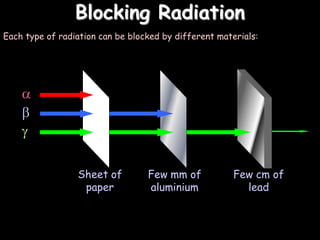
Each type of radiation can be blocked by different materials:
Sheet of
paper
Few mm of
aluminium
Few cm of
lead
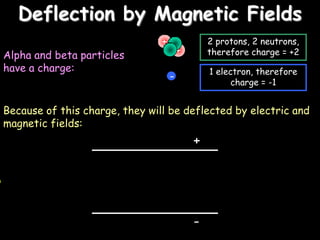
Deflection by Magnetic Fields
Alpha and beta particles
have a charge:
+
+
-
2 protons, 2 neutrons,
therefore charge = +2
1 electron, therefore
charge = -1
Because of this charge, they will be deflected by electric and
magnetic fields:
+
-
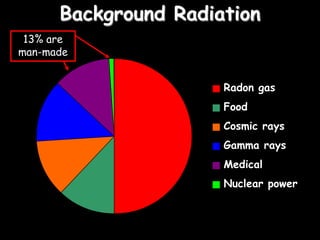
Background Radiation
Radon gas
Food
Cosmic rays
Gamma rays
Medical
Nuclear power
13% are
man-made
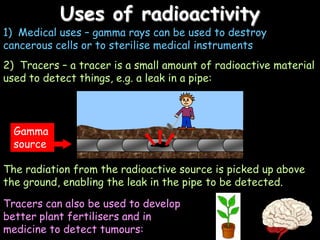
Uses of radioactivity
1) Medical uses – gamma rays can be used to destroy
cancerous cells or to sterilise medical instruments
2) Tracers – a tracer is a small amount of radioactive material
used to detect things, e.g. a leak in a pipe:
Gamma
source
Tracers can also be used to develop
better plant fertilisers and in
medicine to detect tumours:
The radiation from the radioactive source is picked up above
the ground, enabling the leak in the pipe to be detected.
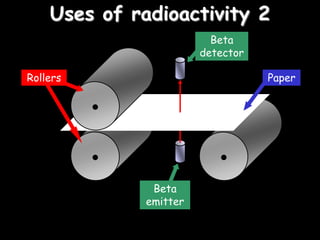
Uses of radioactivity 2
Rollers
Beta
emitter
Beta
detector
Paper
Dangers of radioactivity
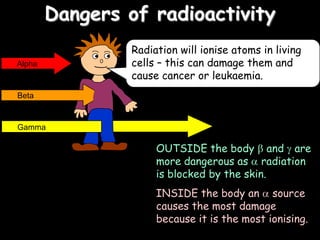
OUTSIDE the body and are
more dangerous as radiation
is blocked by the skin.
INSIDE the body an source
causes the most damage
because it is the most ionising.
Alpha
Beta
Radiation will ionise atoms in living
cells – this can damage them and
cause cancer or leukaemia.
Gamma
Half life
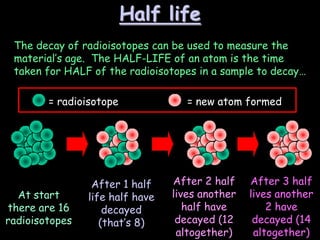
The decay of radioisotopes can be used to measure the
material’s age. The HALF-LIFE of an atom is the time
taken for HALF of the radioisotopes in a sample to decay…
At start
there are 16
radioisotopes
After 1 half
life half have
decayed
(that’s 8)
After 3 half
lives another
2 have
decayed (14
altogether)
After 2 half
lives another
half have
decayed (12
altogether)
= radioisotope = new atom formed
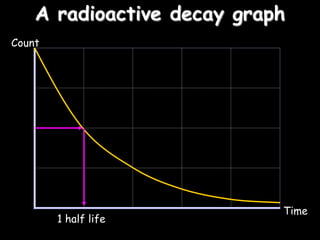
A radioactive decay graph
Time
Count
1 half life
Dating materials using half-lives
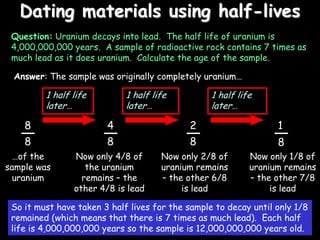
Question: Uranium decays into lead. The half life of uranium is
4,000,000,000 years. A sample of radioactive rock contains 7 times as
much lead as it does uranium. Calculate the age of the sample.
8
8
Answer: The sample was originally completely uranium…
…of the
sample was
uranium
4
8
2
8
1
8
Now only 4/8 of
the uranium
remains – the
other 4/8 is lead
Now only 2/8 of
uranium remains
– the other 6/8
is lead
Now only 1/8 of
uranium remains
– the other 7/8
is lead
So it must have taken 3 half lives for the sample to decay until only 1/8
remained (which means that there is 7 times as much lead). Each half
life is 4,000,000,000 years so the sample is 12,000,000,000 years old.
1 half life
later…
1 half life
later…
1 half life
later…
An exam question…
Potassium decays into argon. The half life of potassium is
1.3 billion years. A sample of rock from Mars is found to
contain three argon atoms for every atom of potassium.
How old is the rock?
(3 marks)
The rock must be 2 half lives old – 2.6 billion years
Evidence about the origins of
the universe…
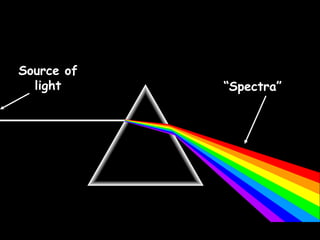
Source of
light “Spectra”
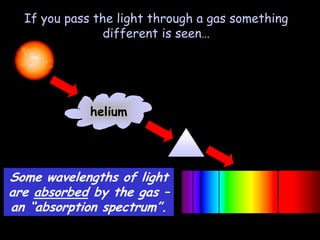
If you pass the light through a gas something
different is seen…
helium
Some wavelengths of light
are absorbed by the gas –
an “absorption spectrum”.
After
helium
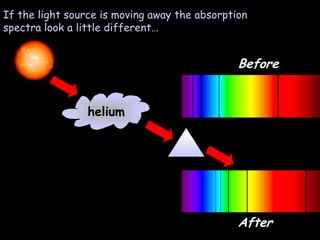
If the light source is moving away the absorption
spectra look a little different…
helium
Before
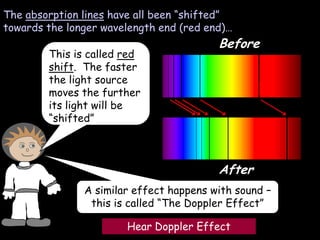
The absorption lines have all been “shifted”
towards the longer wavelength end (red end)…
After
Before
A similar effect happens with sound –
this is called “The Doppler Effect”
Hear Doppler Effect
This is called red
shift. The faster
the light source
moves the further
its light will be
“shifted”
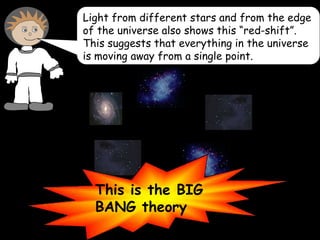
Light from different stars and from the edge
of the universe also shows this “red-shift”.
This suggests that everything in the universe
is moving away from a single point.
This is the BIG
BANG theory
Red shift summary
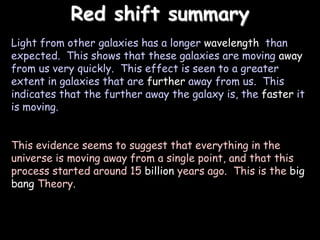
Light from other galaxies has a longer wavelength than
expected. This shows that these galaxies are moving away
from us very quickly. This effect is seen to a greater
extent in galaxies that are further away from us. This
indicates that the further away the galaxy is, the faster it
is moving.
This evidence seems to suggest that everything in the
universe is moving away from a single point, and that this
process started around 15 billion years ago. This is the big
bang Theory.
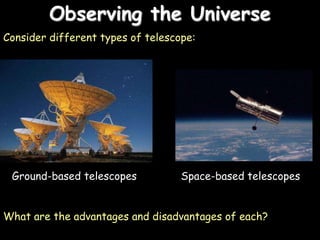
Observing the Universe
Consider different types of telescope:
Ground-based telescopes Space-based telescopes
What are the advantages and disadvantages of each?

P1b:Radioactivity SJT

  • 1.
    Radiation and theUniverse b.Radioactivity Mr S Thompson
  • 2.
    The structure ofthe atom ELECTRON – negative, mass nearly nothing PROTON – positive, same mass as neutron (“1”) NEUTRON – neutral, same mass as proton (“1”)
  • 3.
    The structure ofthe atom Particle Relative Mass Relative Charge Proton 1 +1 Neutron 1 0 Electron 0 -1 MASS NUMBER = number of protons + number of neutrons SYMBOL PROTON NUMBER = number of protons (obviously)
  • 4.
    Isotopes An isotope isan atom with a different number of neutrons: Each isotope has 8 protons – if it didn’t then it just wouldn’t be oxygen any more. Notice that the mass number is different. How many neutrons does each isotope have? A “radioisotope” is simply an isotope that is radioactive – e.g. carbon 14, which is used in carbon dating.
  • 5.
    Introduction to Radioactivity Somesubstances are classed as “radioactive” – this means that they are unstable and continuously give out radiation: Radiation The nucleus is more stable after emitting some radiation – this is called “radioactice decay”.
  • 6.
    Types of radiation 1)Alpha ( ) – an atom decays into a new atom and emits an alpha particle (2 protons and 2 neutrons – the nucleus of a Helium atom) 2) Beta ( ) – an atom decays into a new atom by changing a neutron into a proton and electron. The fast moving, high energy electron is called a beta particle. 3) Gamma – after or decay surplus energy is sometimes emitted. This is called gamma radiation and has a very high frequency with short wavelength. The atom is not changed. Unstable nucleus Unstable nucleus Unstable nucleus New nucleus New nucleus New nucleus Alpha particle Beta particle Gamma radiation
  • 7.
    Ionisation Radiation is dangerousbecause it “ionises” atoms – in other words, it turns them into ions by “knocking off” electrons: Alpha radiation is the most ionising (basically, because it’s the biggest). Ionisation causes cells in living tissue to mutate, usually causing cancer.
  • 8.
    Blocking Radiation Each typeof radiation can be blocked by different materials: Sheet of paper Few mm of aluminium Few cm of lead
  • 9.
    Deflection by MagneticFields Alpha and beta particles have a charge: + + - 2 protons, 2 neutrons, therefore charge = +2 1 electron, therefore charge = -1 Because of this charge, they will be deflected by electric and magnetic fields: + -
  • 10.
    Background Radiation Radon gas Food Cosmicrays Gamma rays Medical Nuclear power 13% are man-made
  • 11.
    Uses of radioactivity 1)Medical uses – gamma rays can be used to destroy cancerous cells or to sterilise medical instruments 2) Tracers – a tracer is a small amount of radioactive material used to detect things, e.g. a leak in a pipe: Gamma source Tracers can also be used to develop better plant fertilisers and in medicine to detect tumours: The radiation from the radioactive source is picked up above the ground, enabling the leak in the pipe to be detected.
  • 12.
    Uses of radioactivity2 Rollers Beta emitter Beta detector Paper
  • 13.
    Dangers of radioactivity OUTSIDEthe body and are more dangerous as radiation is blocked by the skin. INSIDE the body an source causes the most damage because it is the most ionising. Alpha Beta Radiation will ionise atoms in living cells – this can damage them and cause cancer or leukaemia. Gamma
  • 14.
    Half life The decayof radioisotopes can be used to measure the material’s age. The HALF-LIFE of an atom is the time taken for HALF of the radioisotopes in a sample to decay… At start there are 16 radioisotopes After 1 half life half have decayed (that’s 8) After 3 half lives another 2 have decayed (14 altogether) After 2 half lives another half have decayed (12 altogether) = radioisotope = new atom formed
  • 15.
    A radioactive decaygraph Time Count 1 half life
  • 16.
    Dating materials usinghalf-lives Question: Uranium decays into lead. The half life of uranium is 4,000,000,000 years. A sample of radioactive rock contains 7 times as much lead as it does uranium. Calculate the age of the sample. 8 8 Answer: The sample was originally completely uranium… …of the sample was uranium 4 8 2 8 1 8 Now only 4/8 of the uranium remains – the other 4/8 is lead Now only 2/8 of uranium remains – the other 6/8 is lead Now only 1/8 of uranium remains – the other 7/8 is lead So it must have taken 3 half lives for the sample to decay until only 1/8 remained (which means that there is 7 times as much lead). Each half life is 4,000,000,000 years so the sample is 12,000,000,000 years old. 1 half life later… 1 half life later… 1 half life later…
  • 17.
    An exam question… Potassiumdecays into argon. The half life of potassium is 1.3 billion years. A sample of rock from Mars is found to contain three argon atoms for every atom of potassium. How old is the rock? (3 marks) The rock must be 2 half lives old – 2.6 billion years
  • 18.
    Evidence about theorigins of the universe…
  • 19.
  • 20.
    If you passthe light through a gas something different is seen… helium Some wavelengths of light are absorbed by the gas – an “absorption spectrum”.
  • 21.
    After helium If the lightsource is moving away the absorption spectra look a little different… helium Before
  • 22.
    The absorption lineshave all been “shifted” towards the longer wavelength end (red end)… After Before A similar effect happens with sound – this is called “The Doppler Effect” Hear Doppler Effect This is called red shift. The faster the light source moves the further its light will be “shifted”
  • 23.
    Light from differentstars and from the edge of the universe also shows this “red-shift”. This suggests that everything in the universe is moving away from a single point. This is the BIG BANG theory
  • 24.
    Red shift summary Lightfrom other galaxies has a longer wavelength than expected. This shows that these galaxies are moving away from us very quickly. This effect is seen to a greater extent in galaxies that are further away from us. This indicates that the further away the galaxy is, the faster it is moving. This evidence seems to suggest that everything in the universe is moving away from a single point, and that this process started around 15 billion years ago. This is the big bang Theory.
  • 25.
    Observing the Universe Considerdifferent types of telescope: Ground-based telescopes Space-based telescopes What are the advantages and disadvantages of each?