PHYSICS – Total Internal Reflection and
Lenses
LEARNING
OBJECTIVES
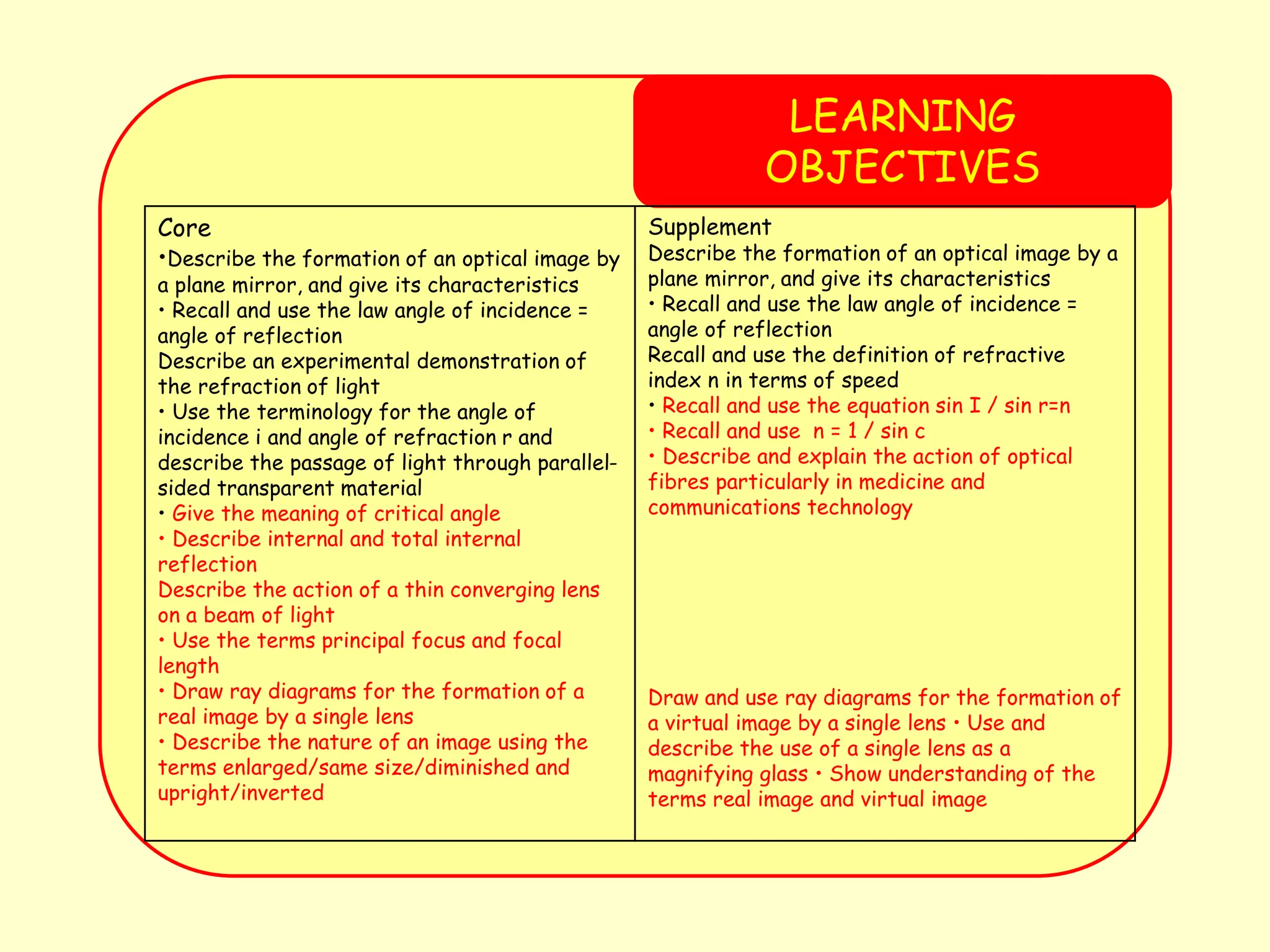
Core
•Describe the formation of an optical image by
a plane mirror, and give its characteristics
• Recall and use the law angle of incidence =
angle of reflection
Describe an experimental demonstration of
the refraction of light
• Use the terminology for the angle of
incidence i and angle of refraction r and
describe the passage of light through parallel-
sided transparent material
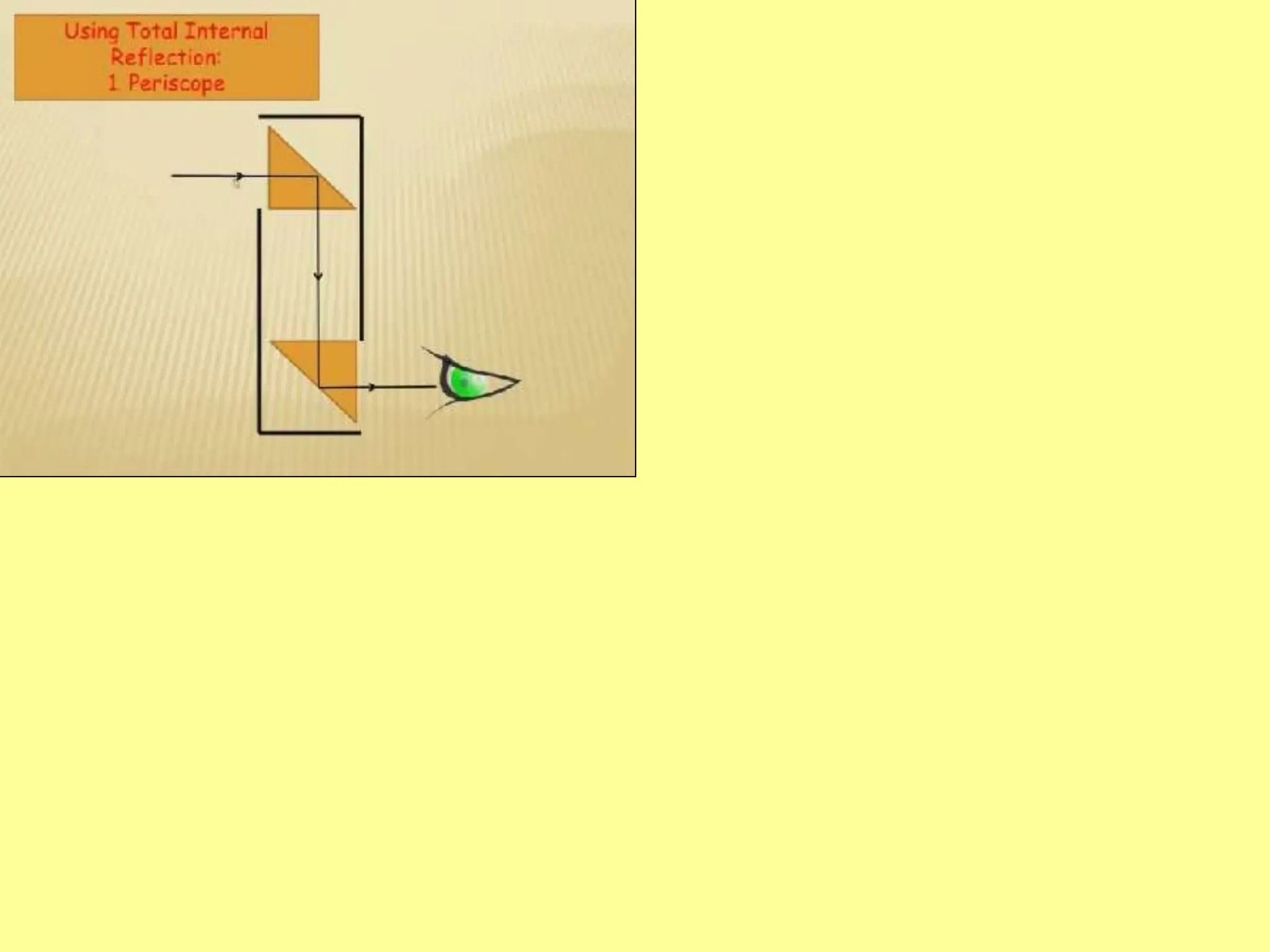
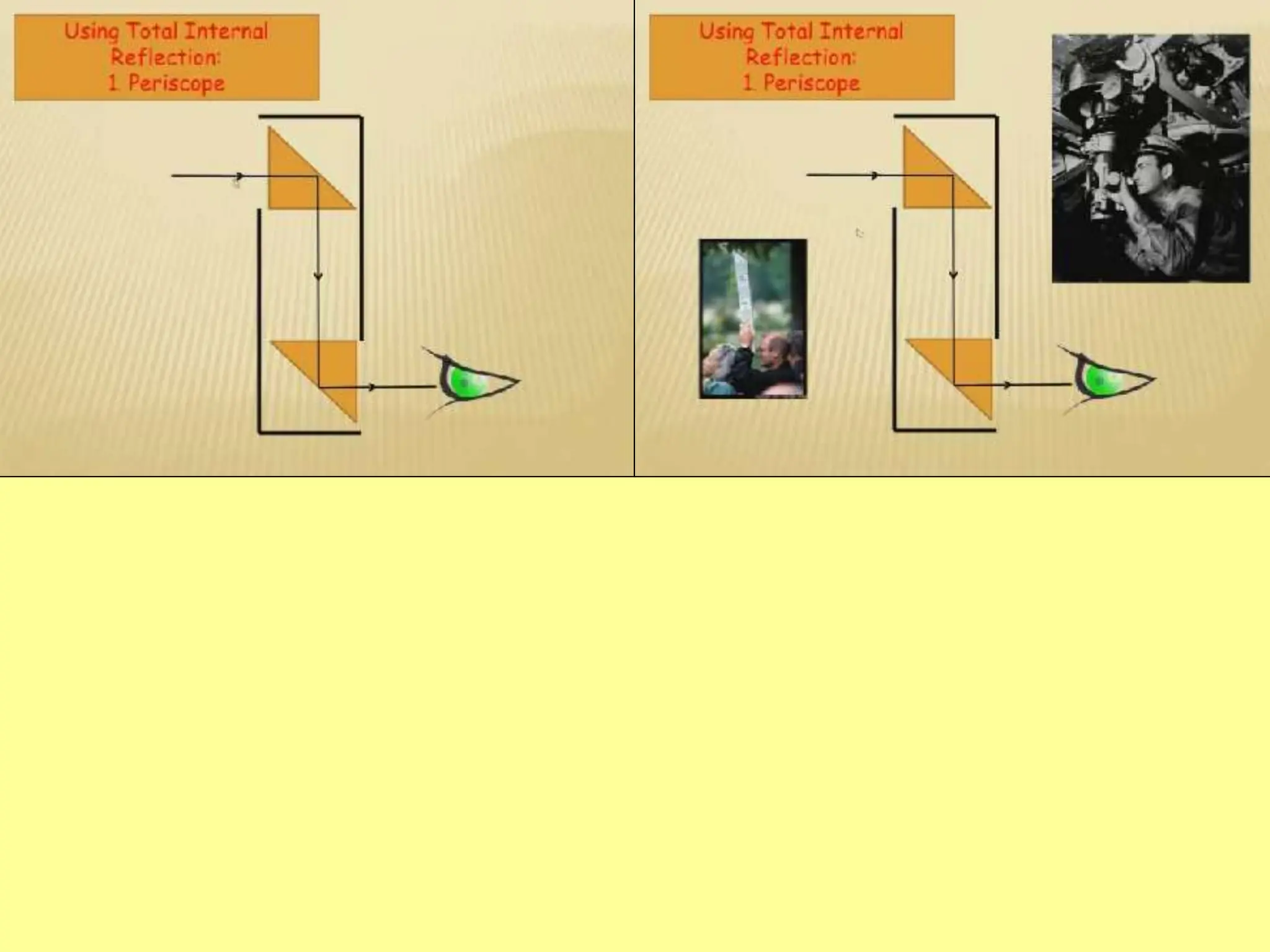
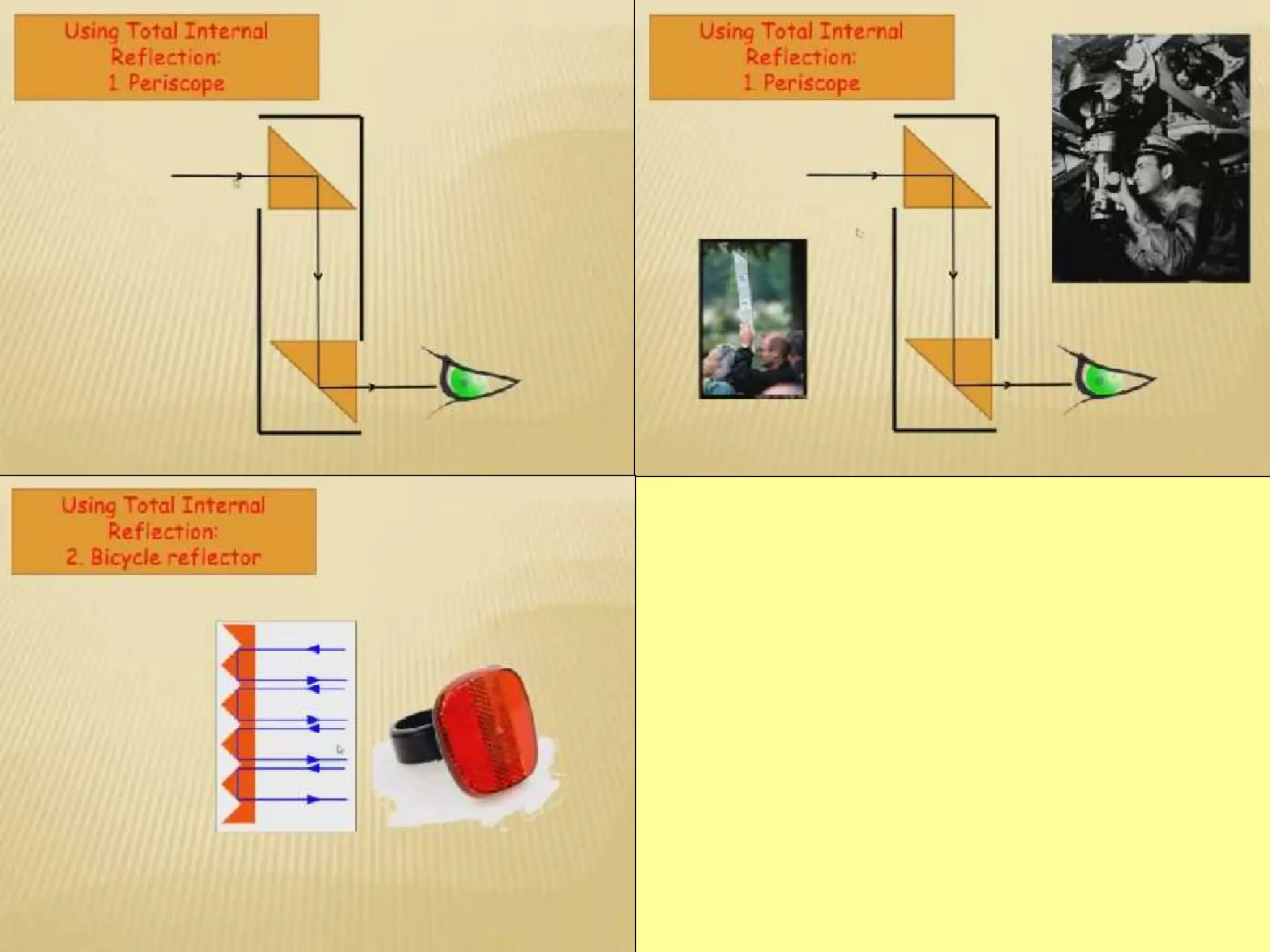
• Give the meaning of critical angle
• Describe internal and total internal
reflection
Describe the action of a thin converging lens
on a beam of light
• Use the terms principal focus and focal
length
• Draw ray diagrams for the formation of a
real image by a single lens
• Describe the nature of an image using the
terms enlarged/same size/diminished and
upright/inverted
Supplement
Describe the formation of an optical image by a
plane mirror, and give its characteristics
• Recall and use the law angle of incidence =
angle of reflection
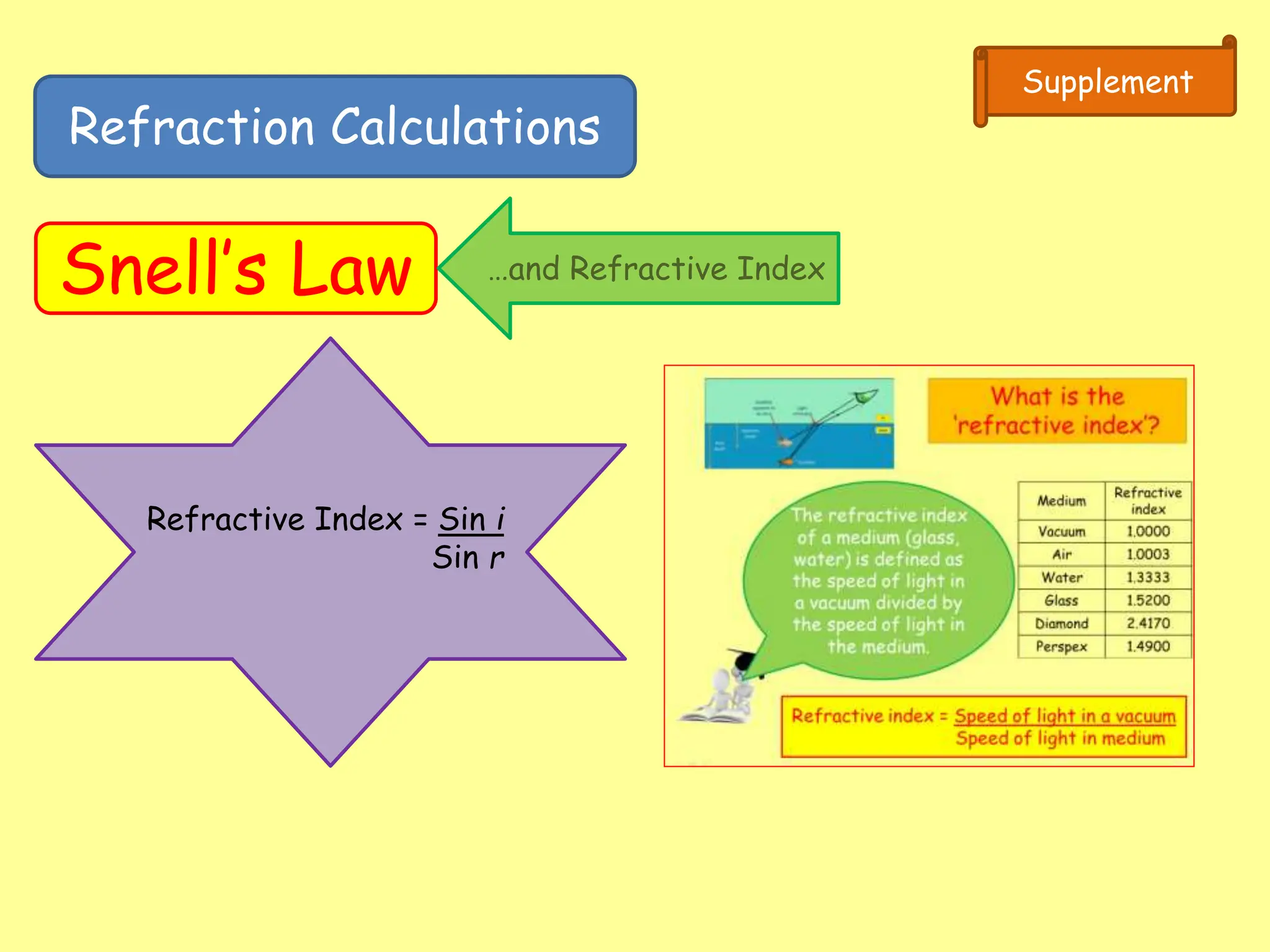
Recall and use the definition of refractive
index n in terms of speed
• Recall and use the equation sin I / sin r=n
• Recall and use n = 1 / sin c
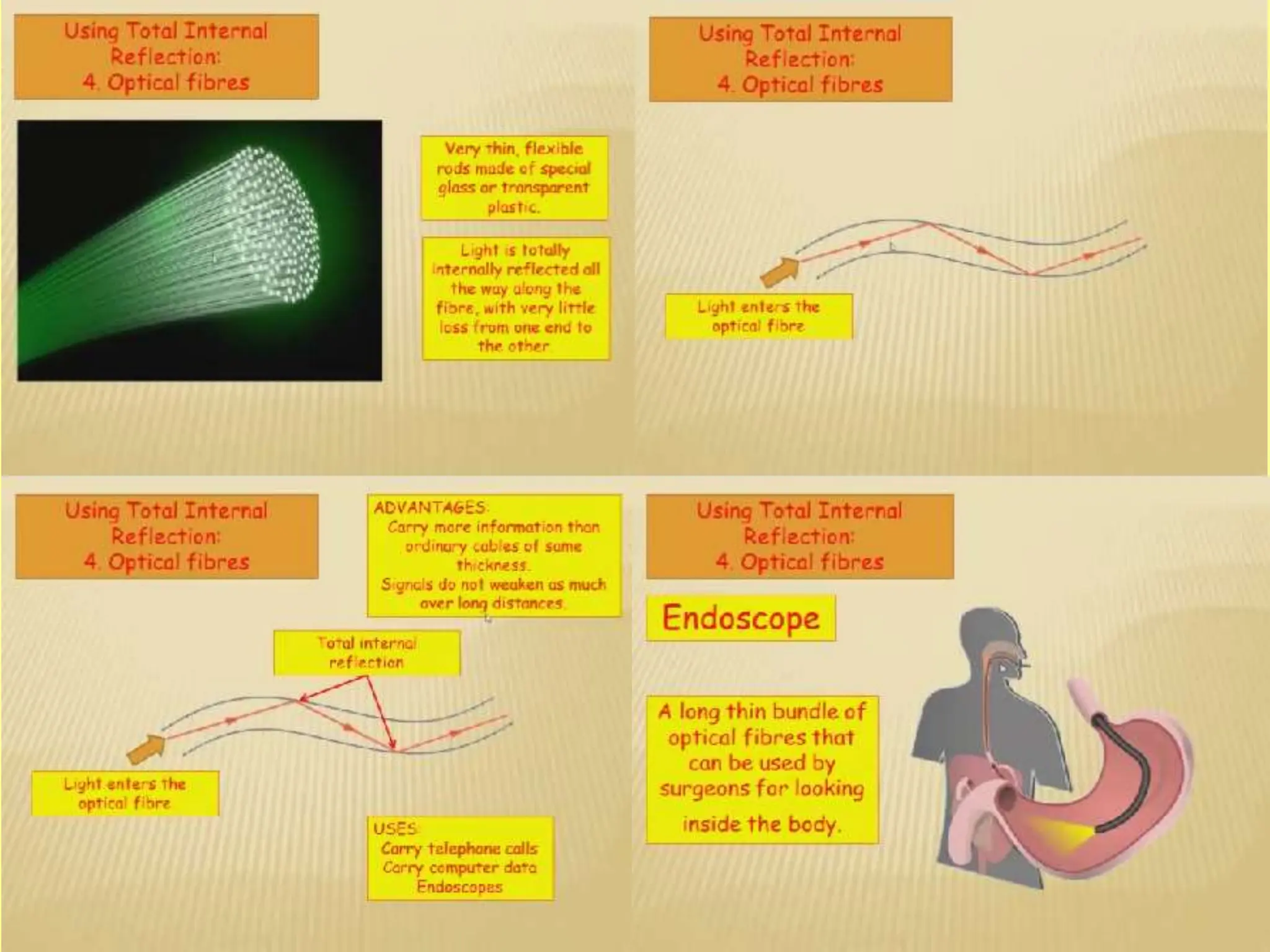
• Describe and explain the action of optical
fibres particularly in medicine and
communications technology
Draw and use ray diagrams for the formation of
a virtual image by a single lens • Use and
describe the use of a single lens as a
magnifying glass • Show understanding of the
terms real image and virtual image
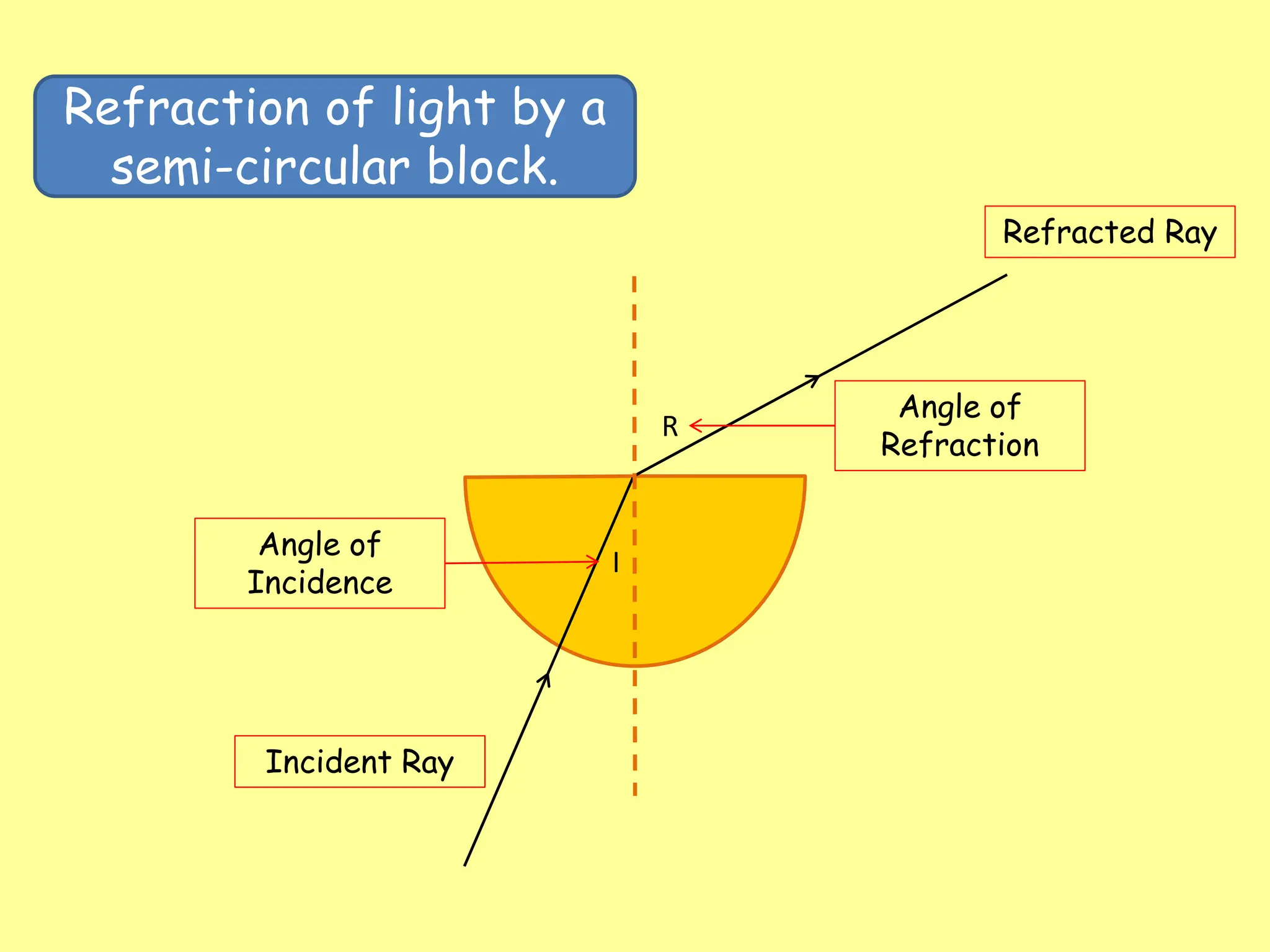
Refraction of light by a
semi-circular block.
Incident Ray
Refracted Ray
I
R
Angle of
Incidence
Angle of
Refraction
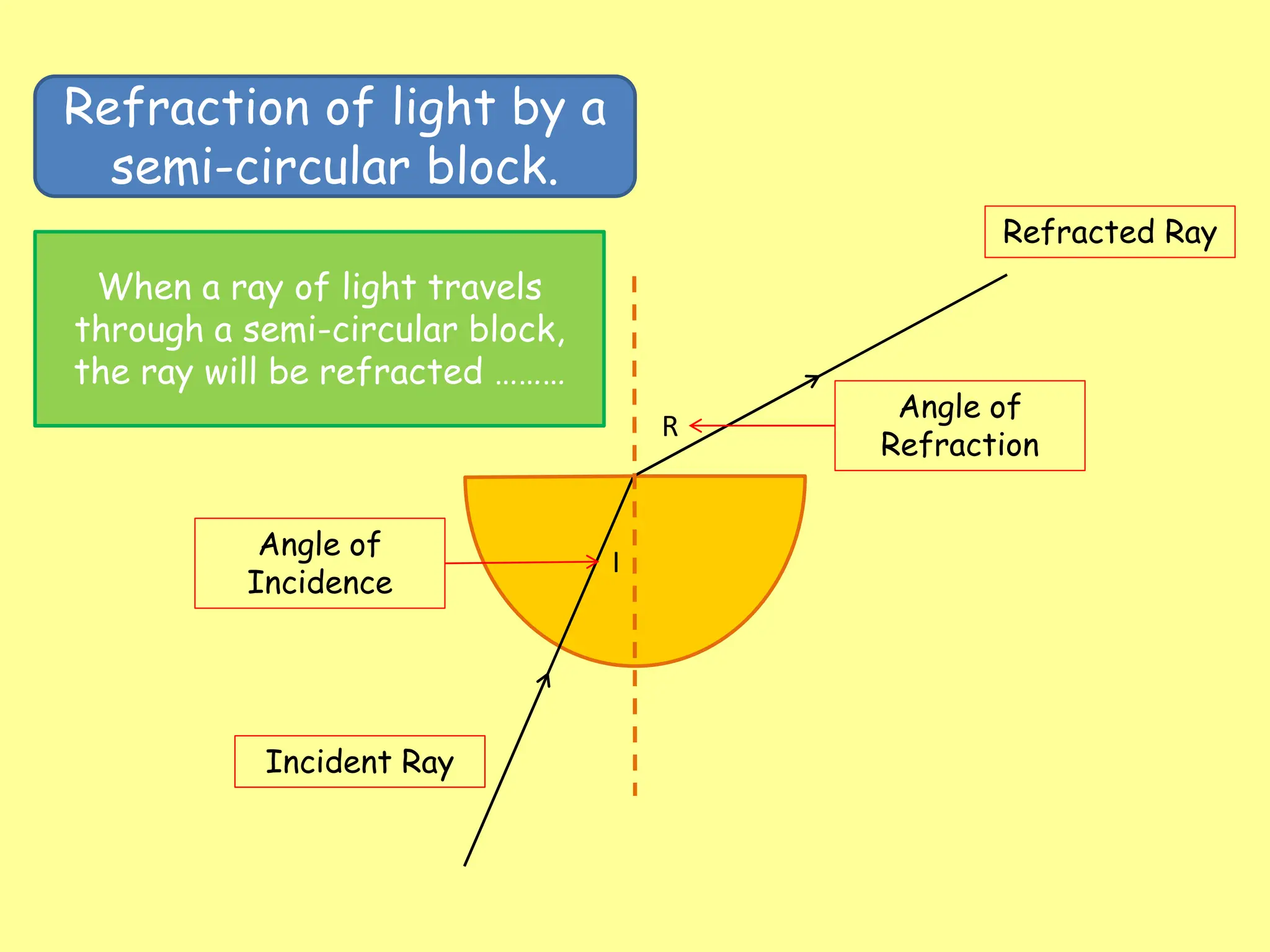
Refraction of light by a
semi-circular block.
Incident Ray
Refracted Ray
I
R
Angle of
Incidence
Angle of
Refraction
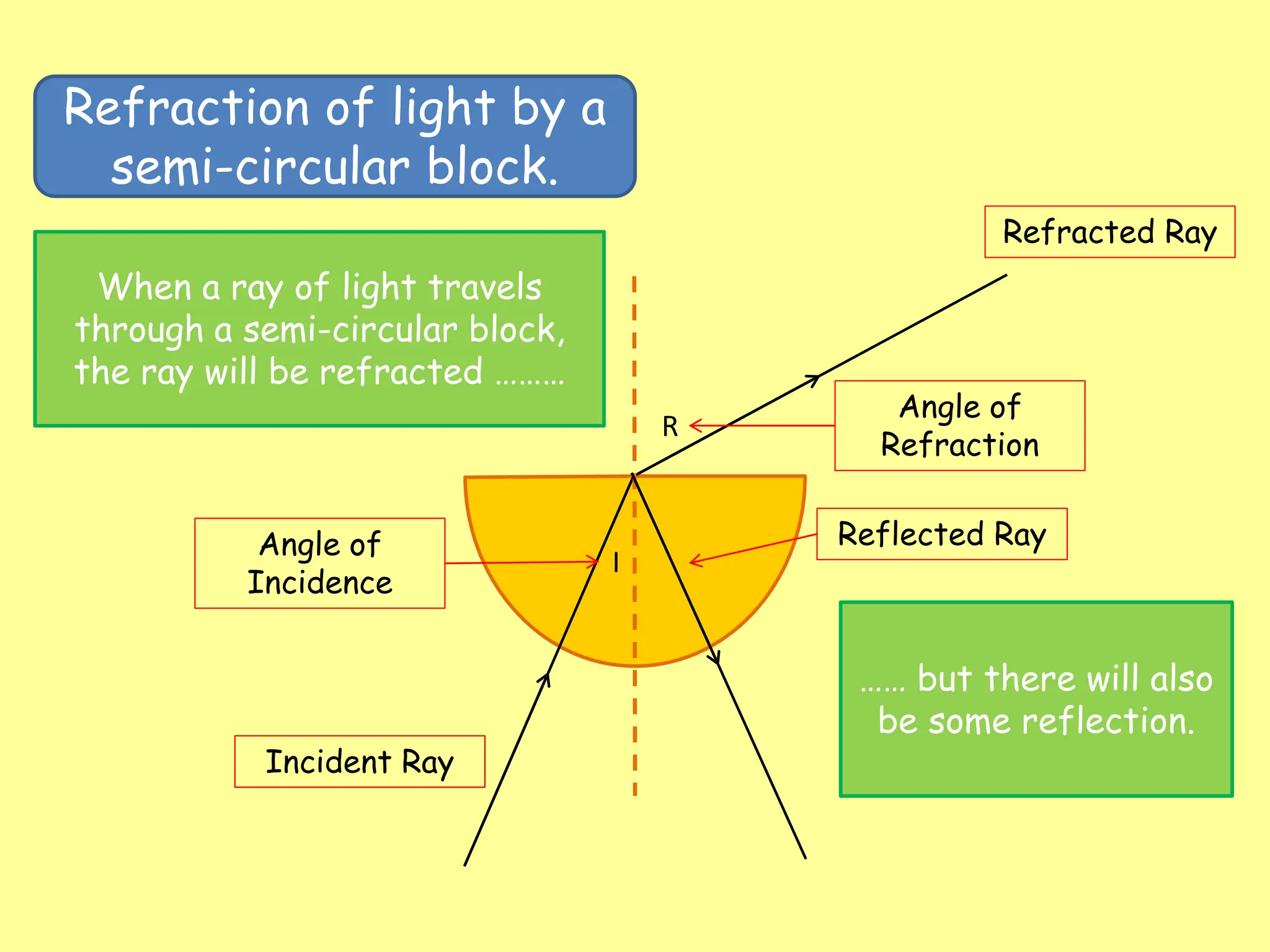
When a ray of light travels
through a semi-circular block,
the ray will be refracted ………
Refraction of light by a
semi-circular block.
Incident Ray
Refracted Ray
I
R
Angle of
Incidence
Angle of
Refraction
When a ray of light travels
through a semi-circular block,
the ray will be refracted ………
Reflected Ray
…… but there will also
be some reflection.
Refraction of light by a
semi-circular block.
Incident Ray
Refracted Ray
Reflected Ray
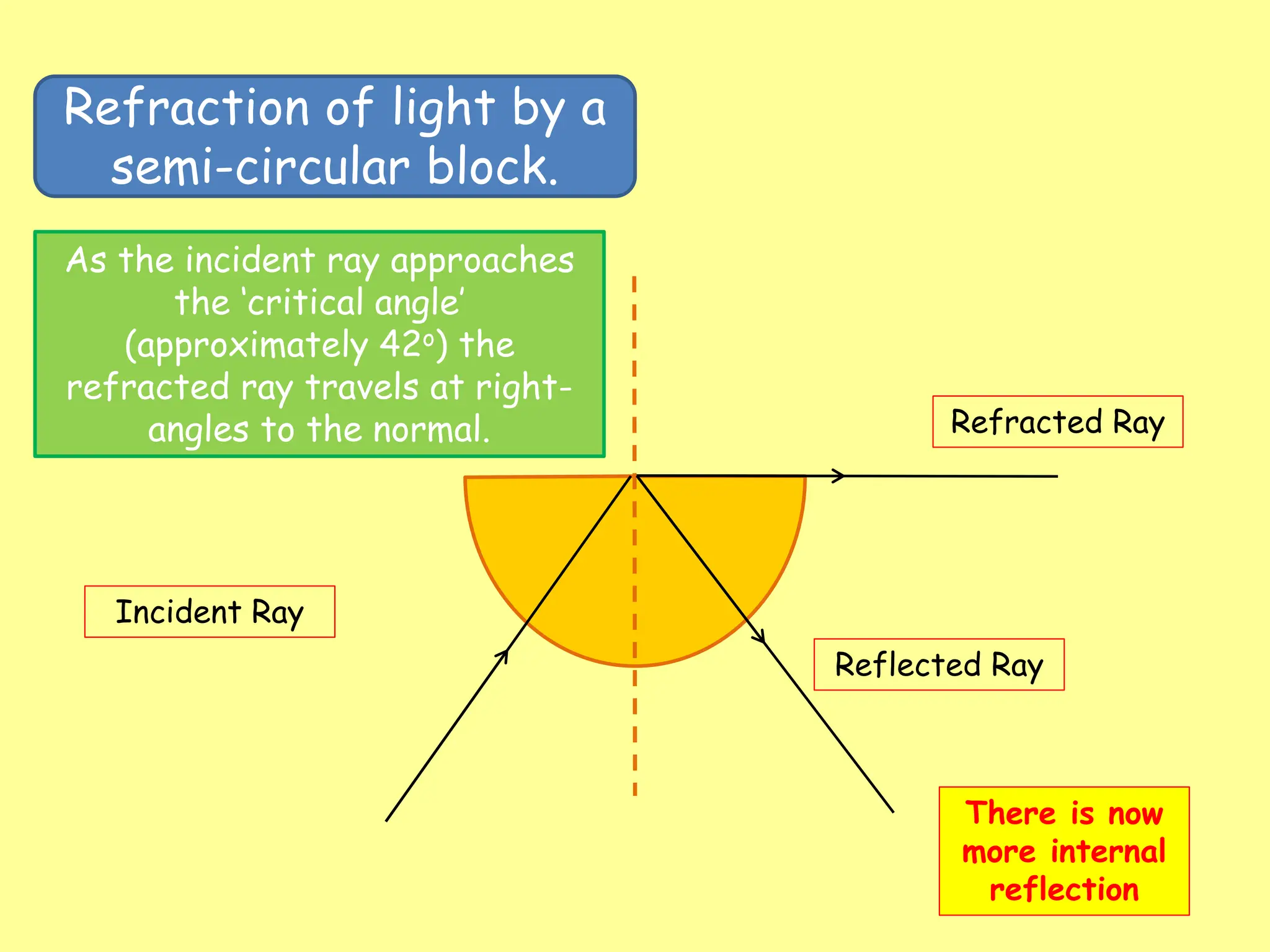
As the incident ray approaches
the ‘critical angle’
(approximately 42o) the
refracted ray travels at right-
angles to the normal.
There is now
more internal
reflection
Refraction of light by a
semi-circular block.
Incident Ray Reflected Ray
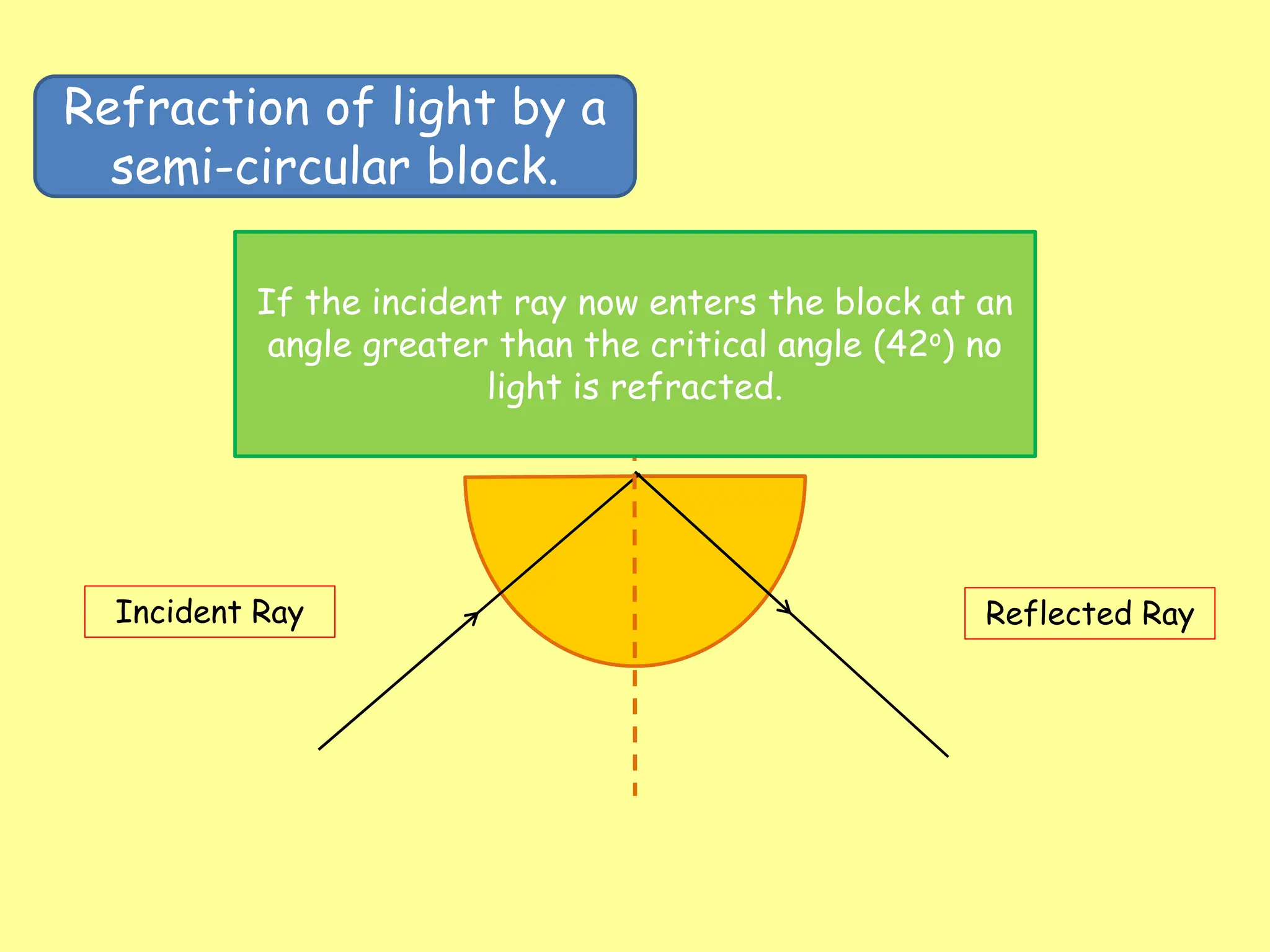
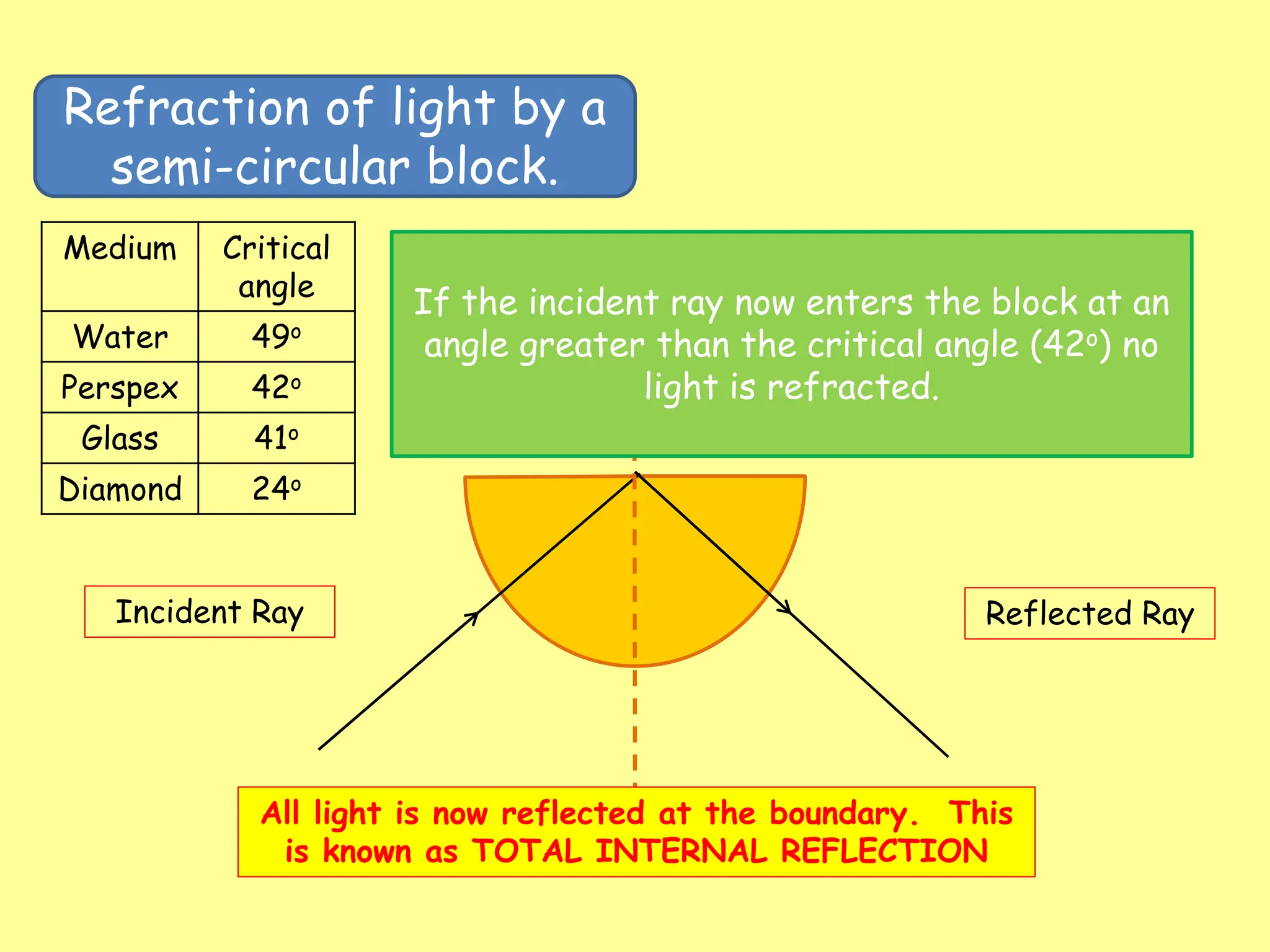
If the incident ray now enters the block at an
angle greater than the critical angle (42o) no
light is refracted.
Refraction of light by a
semi-circular block.
Incident Ray Reflected Ray
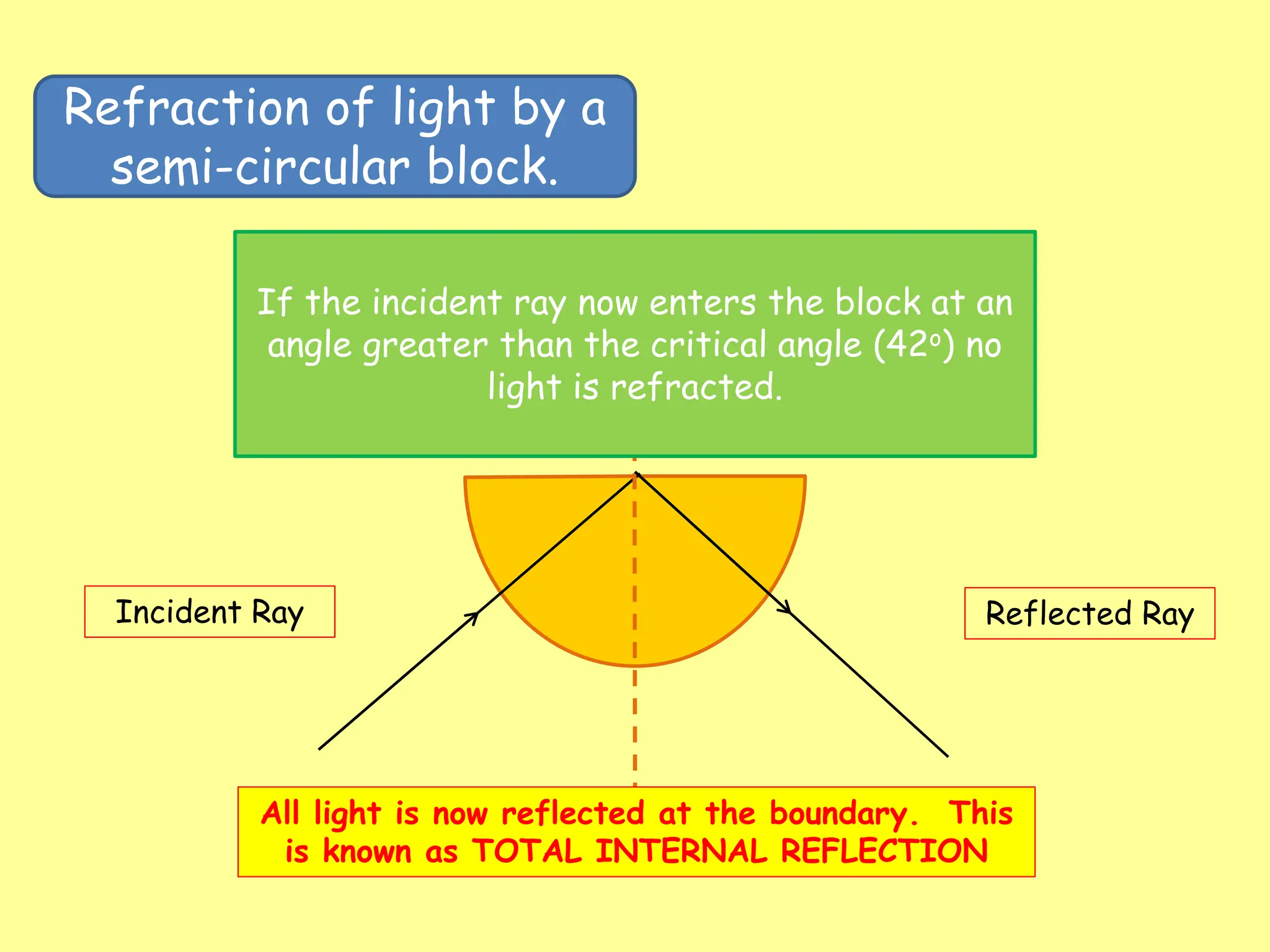
If the incident ray now enters the block at an
angle greater than the critical angle (42o) no
light is refracted.
All light is now reflected at the boundary. This
is known as TOTAL INTERNAL REFLECTION
Refraction of light by a
semi-circular block.
Incident Ray Reflected Ray
If the incident ray now enters the block at an
angle greater than the critical angle (42o) no
light is refracted.
All light is now reflected at the boundary. This
is known as TOTAL INTERNAL REFLECTION
Medium Critical
angle
Water 49o
Perspex 42o
Glass 41o
Diamond 24o
Refraction Calculations
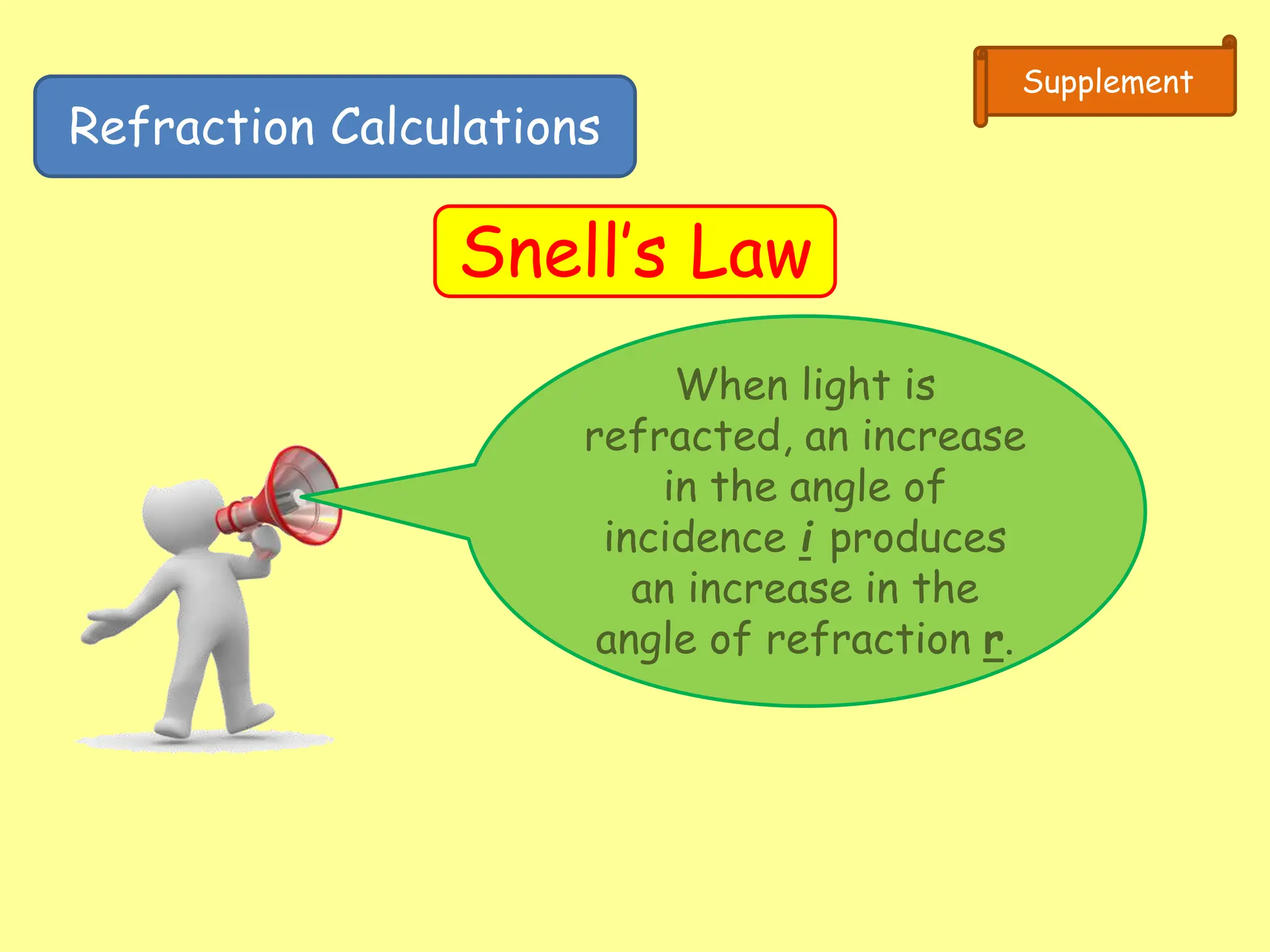
Snell’s Law
When light is
refracted, an increase
in the angle of
incidence i produces
an increase in the
angle of refraction r.
Supplement
Refraction Calculations
Snell’s Law
When light is
refracted, an increase
in the angle of
incidence i produces
an increase in the
angle of refraction r.
Supplement
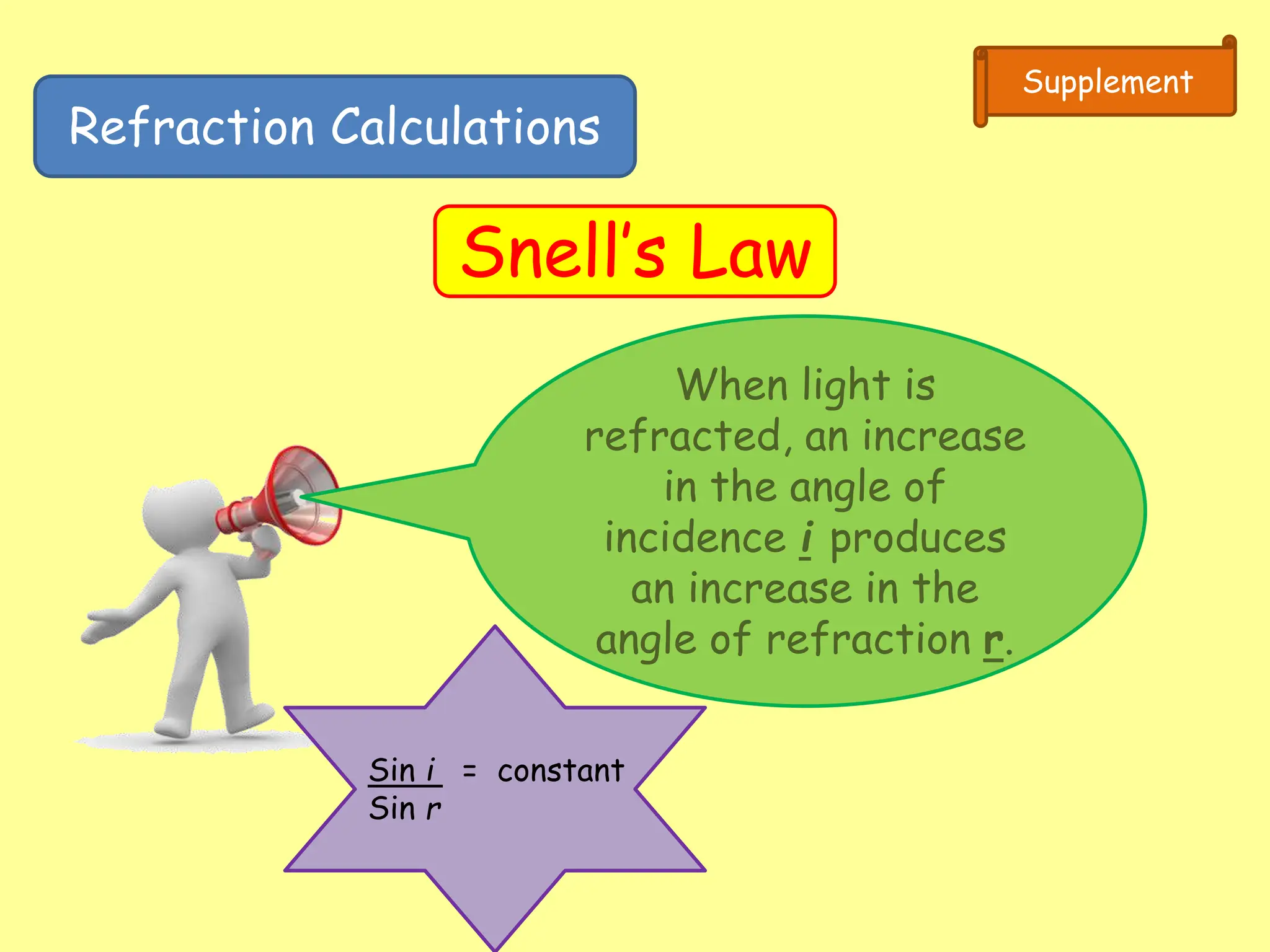
Sin i = constant
Sin r
Refraction Calculations
Snell’s Law
Supplement
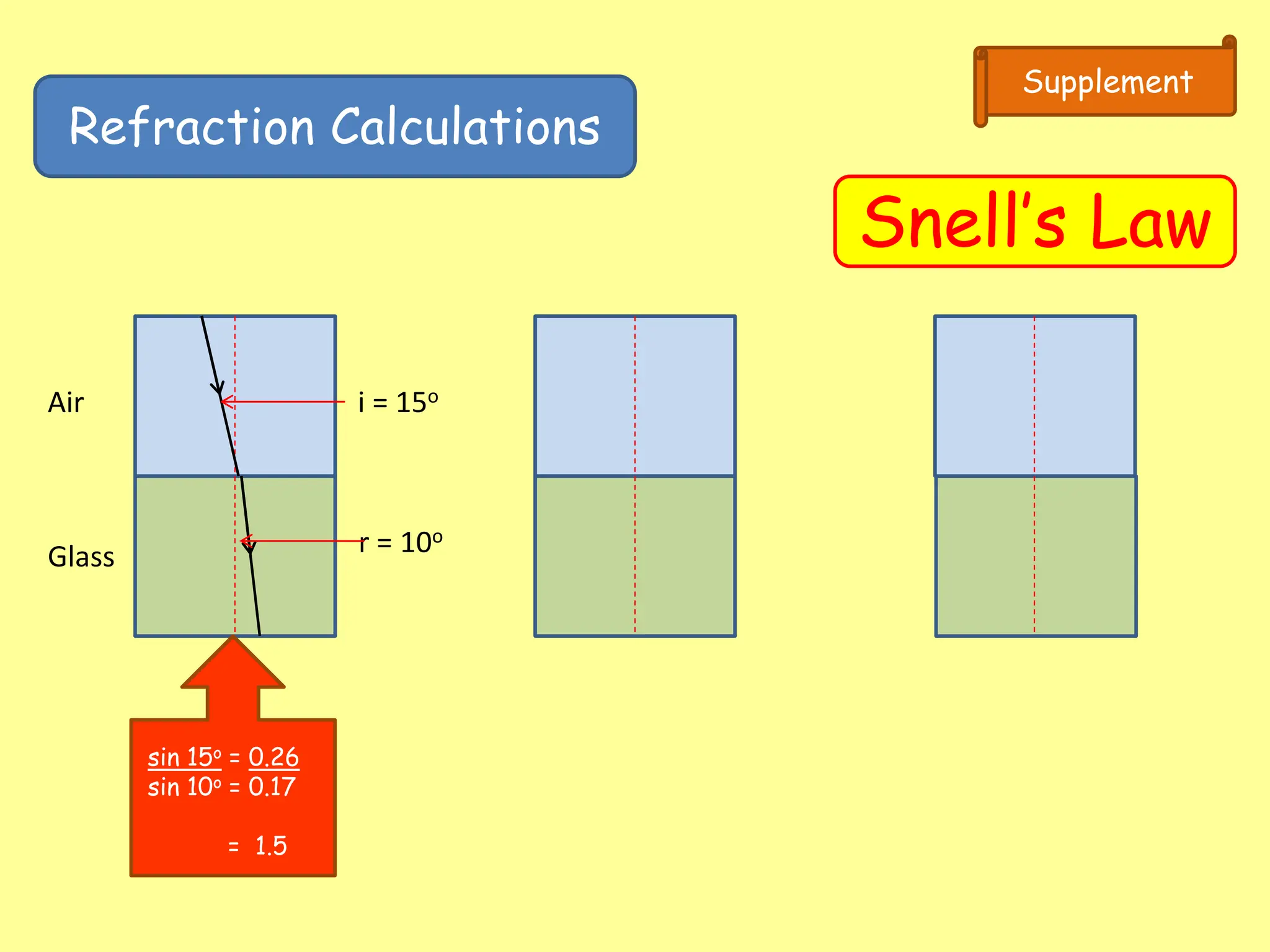
Air
Glass
i = 15o
r = 10o
sin 15o = 0.26
sin 10o = 0.17
= 1.5
Refraction Calculations
Snell’s Law
Supplement
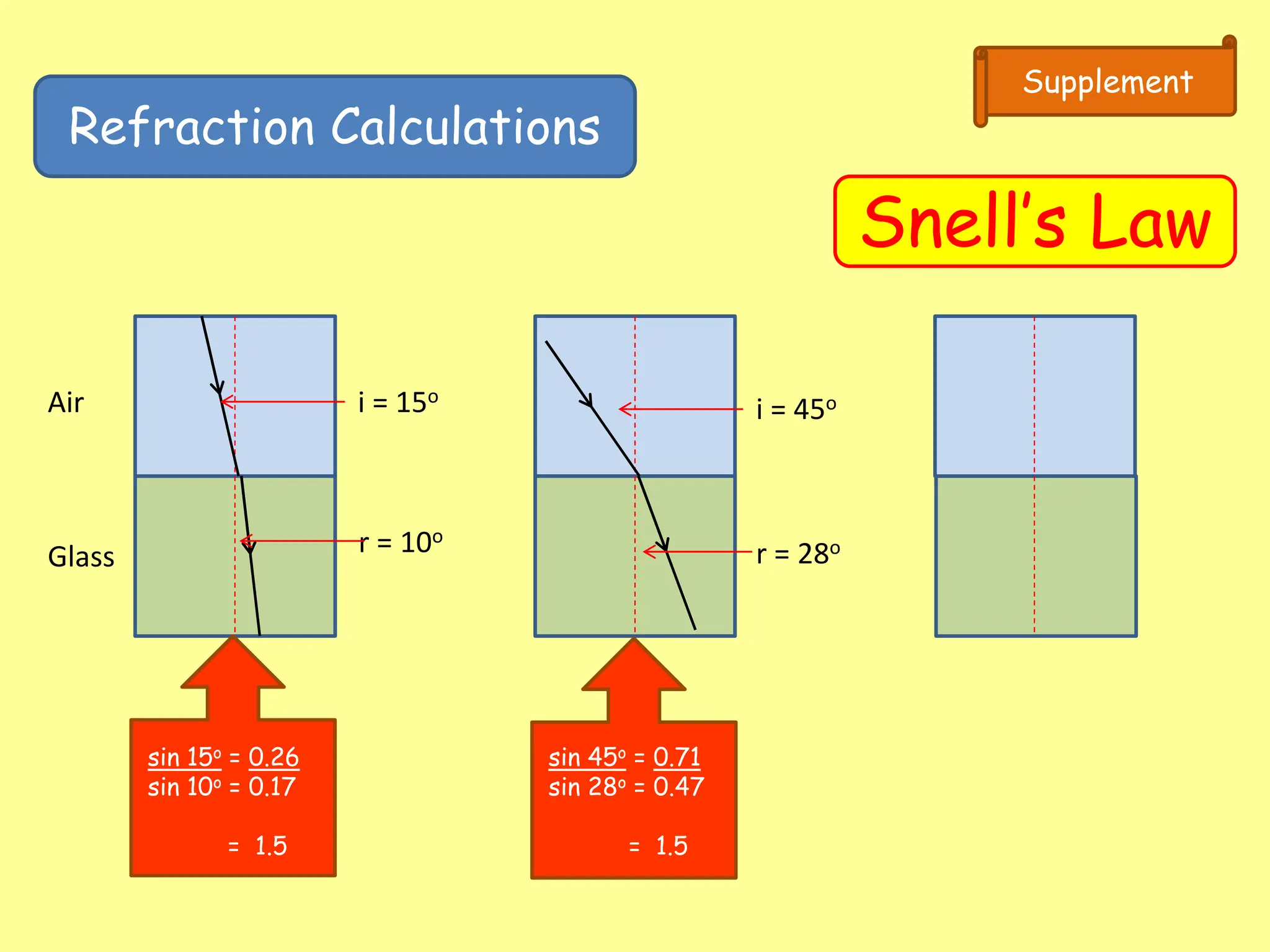
Air
Glass
i = 15o
r = 10o
sin 15o = 0.26
sin 10o = 0.17
= 1.5
i = 45o
r = 28o
sin 45o = 0.71
sin 28o = 0.47
= 1.5
Refraction Calculations
Snell’s Law
Supplement
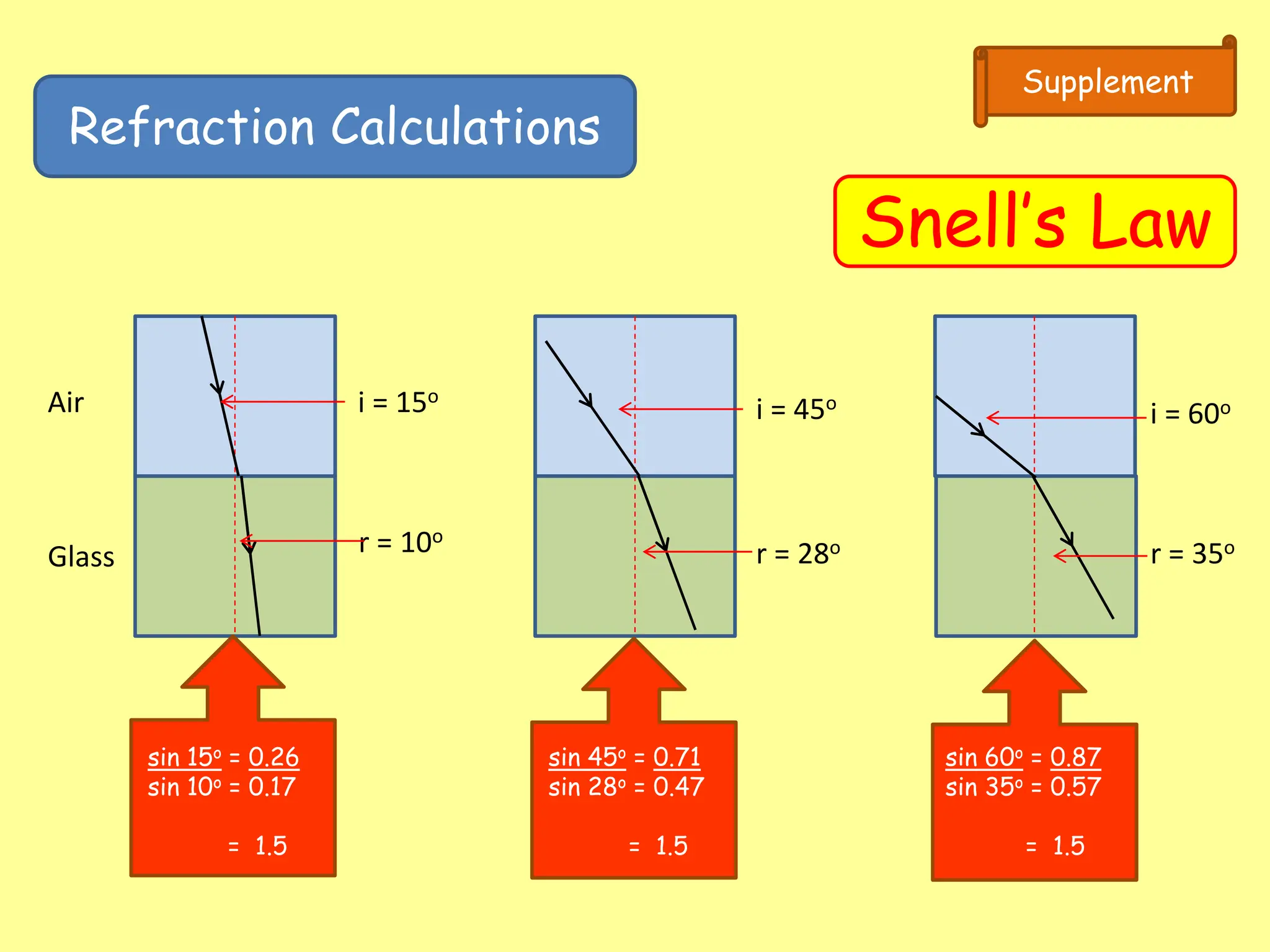
Air
Glass
i = 15o
r = 10o
sin 15o = 0.26
sin 10o = 0.17
= 1.5
i = 45o
r = 28o
sin 45o = 0.71
sin 28o = 0.47
= 1.5
i = 60o
r = 35o
sin 60o = 0.87
sin 35o = 0.57
= 1.5
Refraction Calculations
Snell’s Law
Supplement
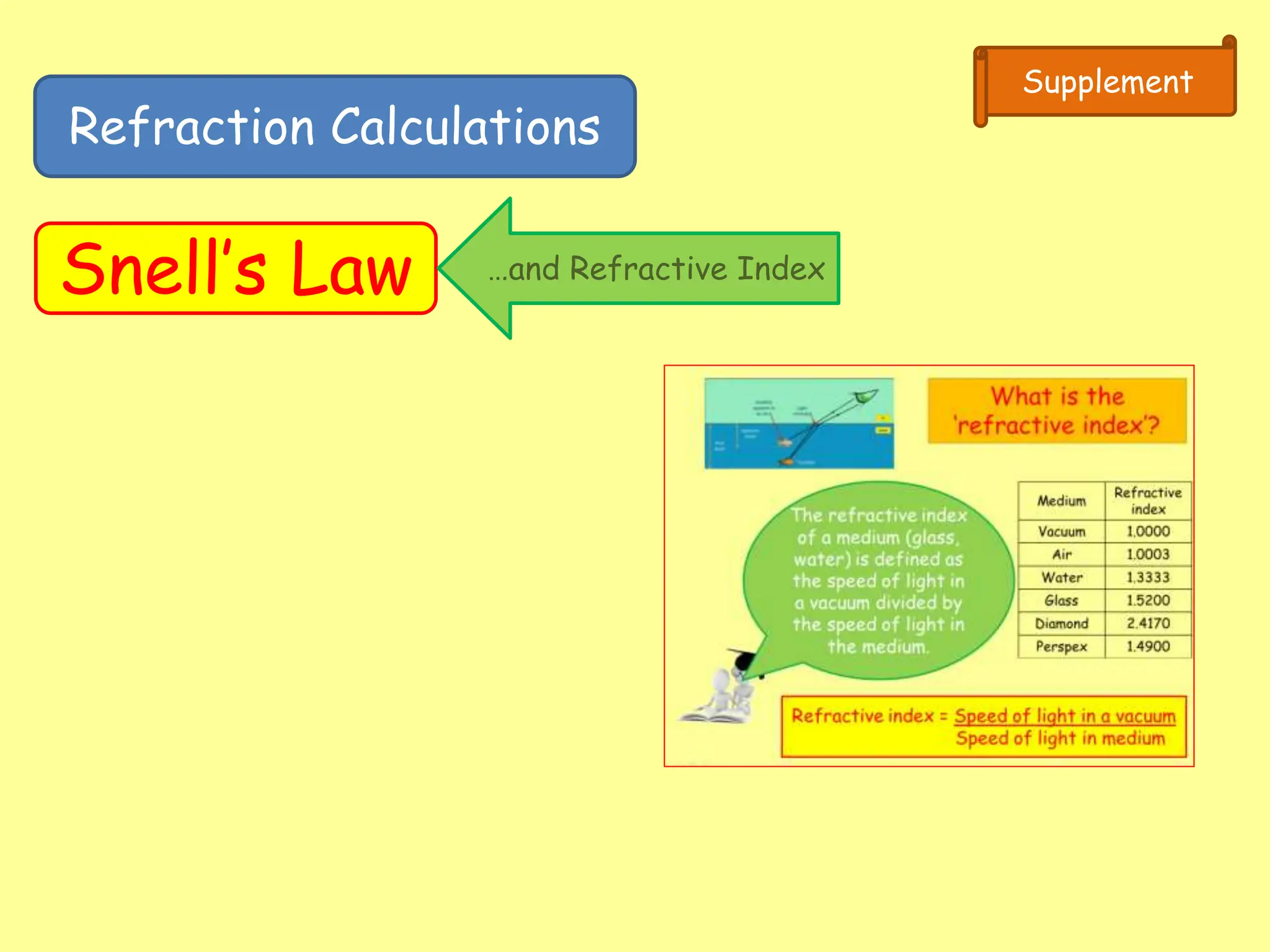
…and Refractive Index
Refraction Calculations
Snell’s Law
Supplement
…and Refractive Index
Refractive Index = Sin i
Sin r
Refraction Calculations
Snell’s Law
Supplement
…and Refractive Index
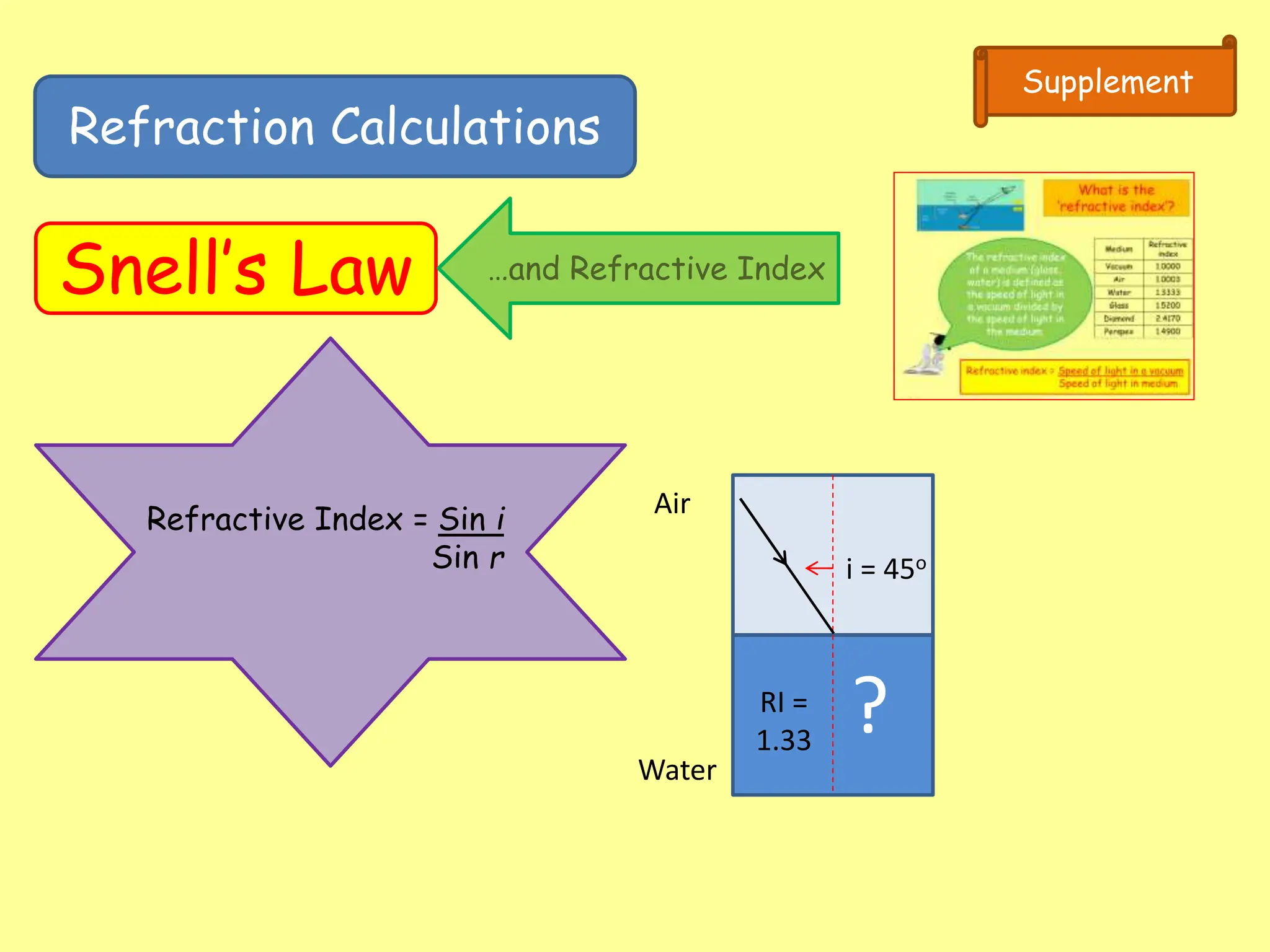
Refractive Index = Sin i
Sin r
Air
Water
i = 45o
RI =
1.33
?
Refraction Calculations
Snell’s Law
Supplement
…and Refractive Index
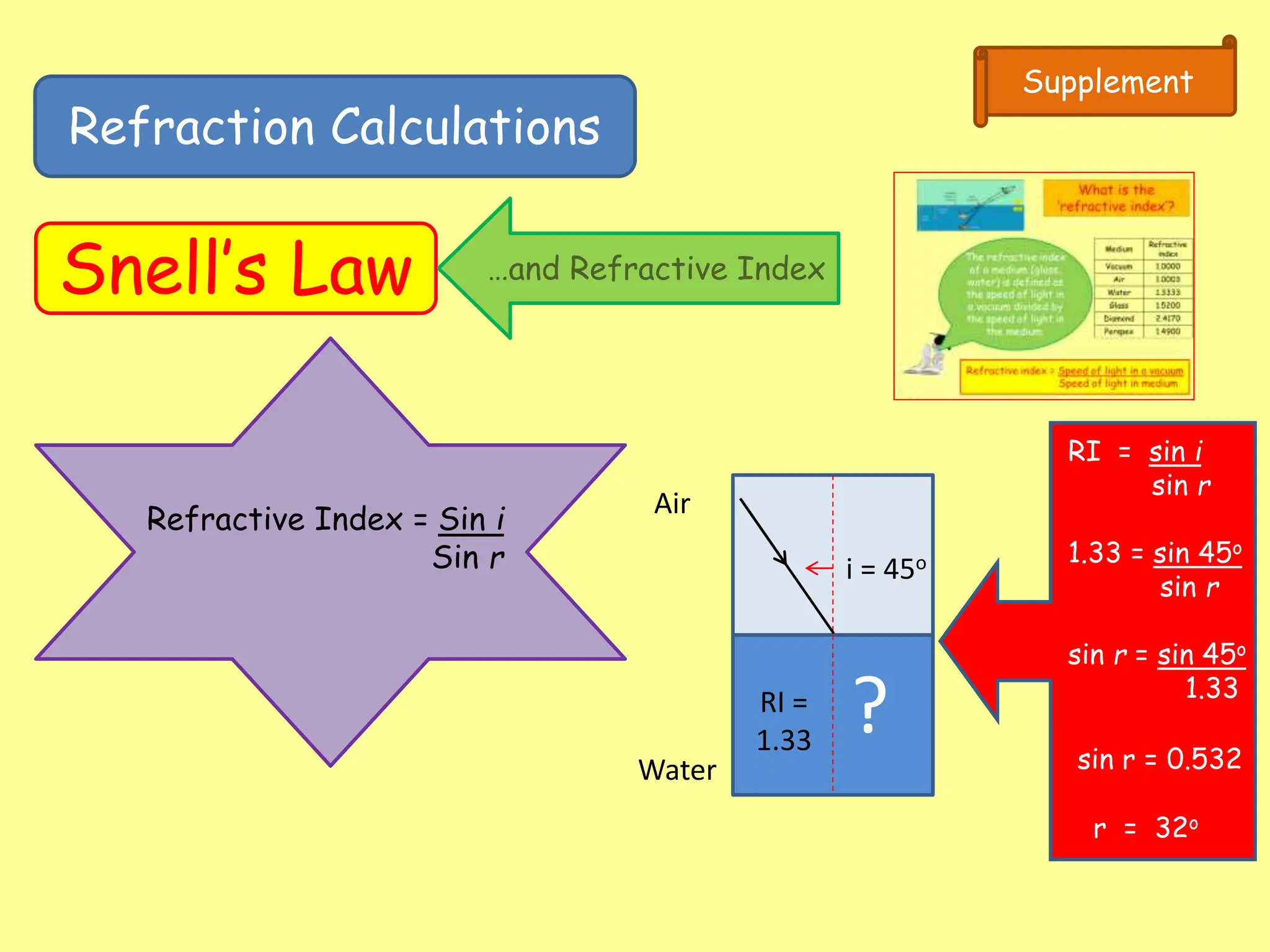
Refractive Index = Sin i
Sin r
Air
Water
i = 45o
RI =
1.33
?
RI = sin i
sin r
1.33 = sin 45o
sin r
sin r = sin 45o
1.33
sin r = 0.532
r = 32o
Refraction Calculations
Snell’s Law
Supplement
…and Refractive Index …and Critical Angles!
Refraction Calculations
Snell’s Law
Supplement
…and Refractive Index …and Critical Angles!
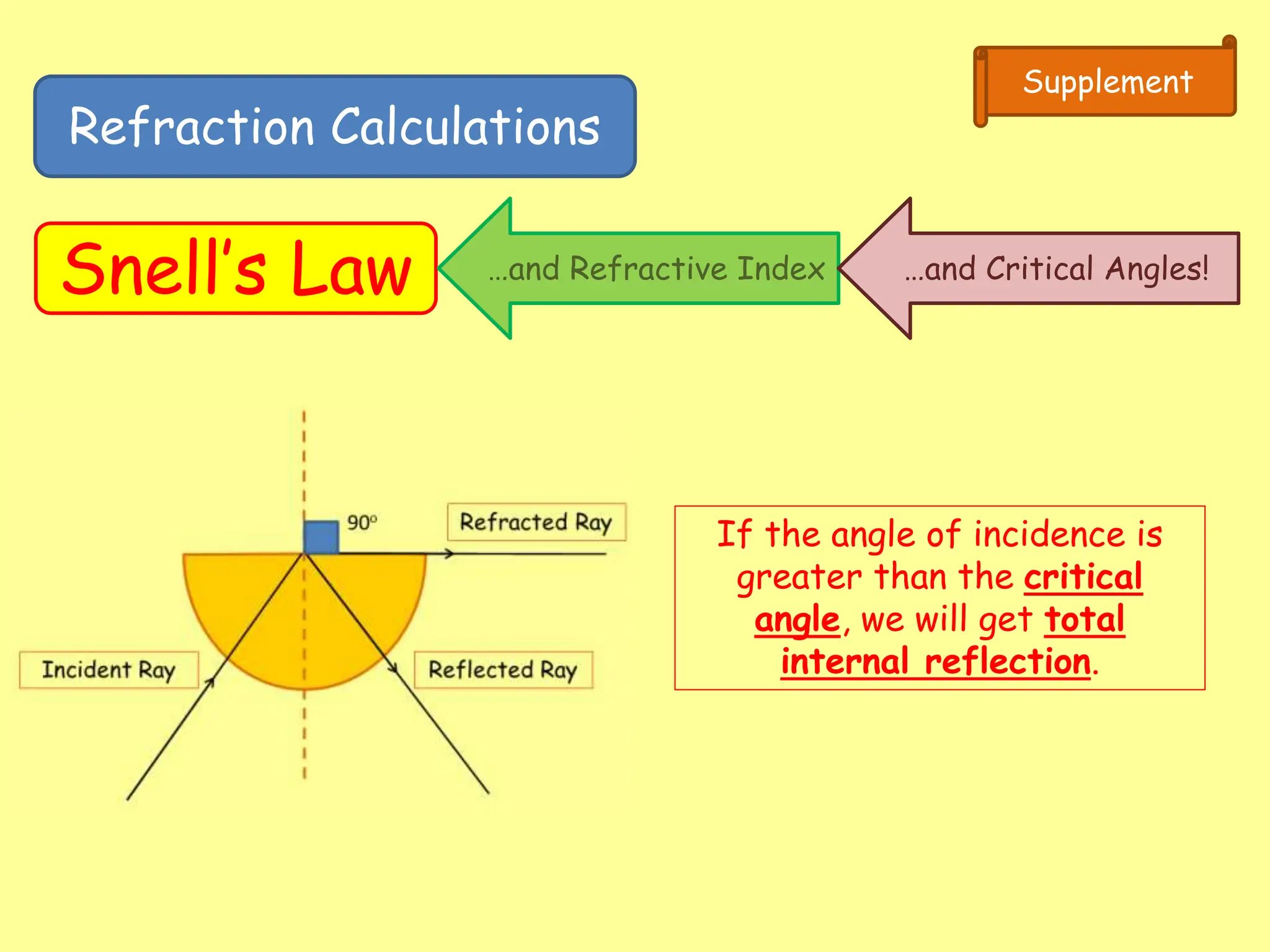
If the angle of incidence is
greater than the critical
angle, we will get total
internal reflection.
Refraction Calculations
Snell’s Law
Supplement
…and Refractive Index …and Critical Angles!
Incident Ray
Refracted Ray
Critical angle
c
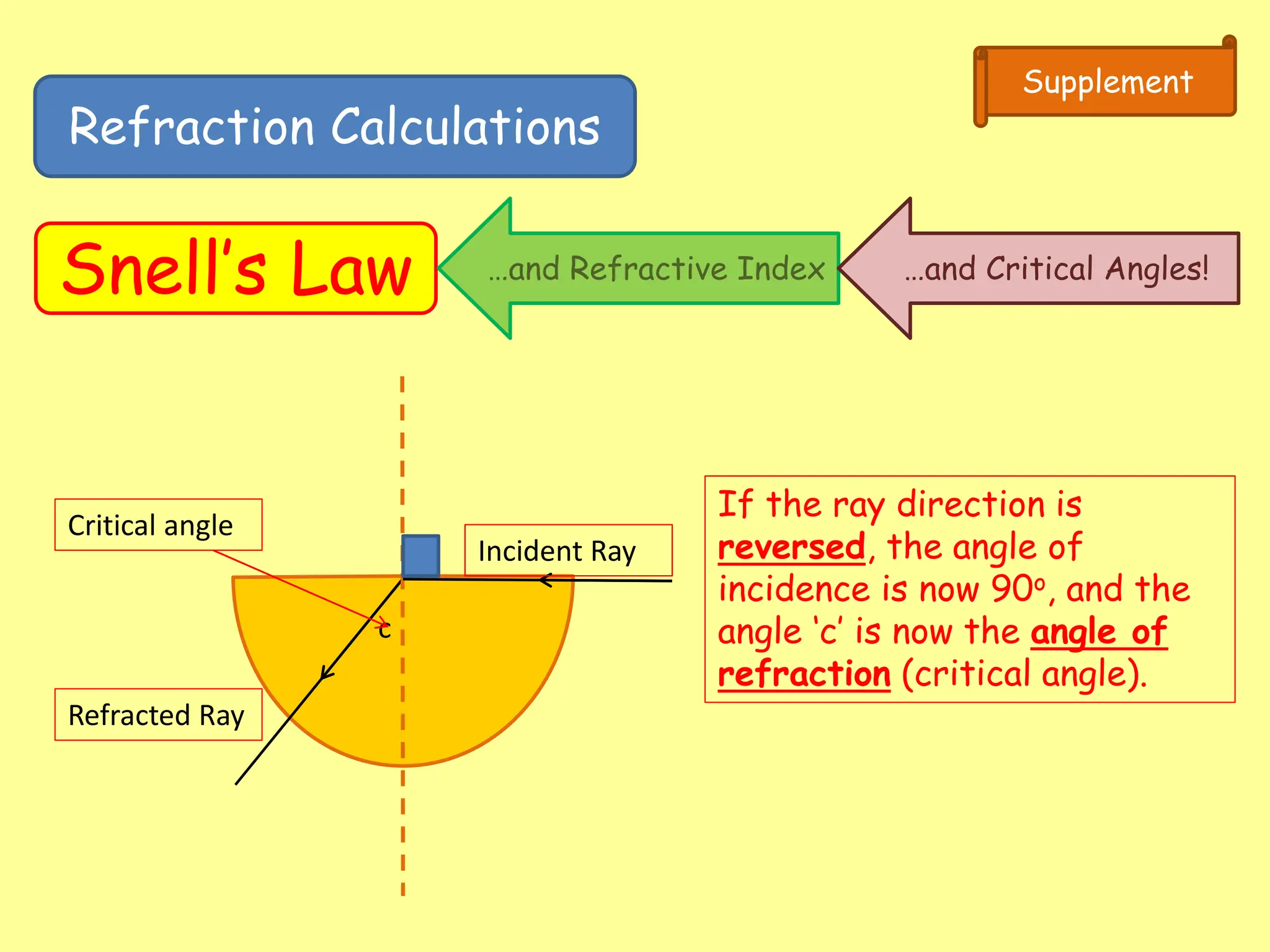
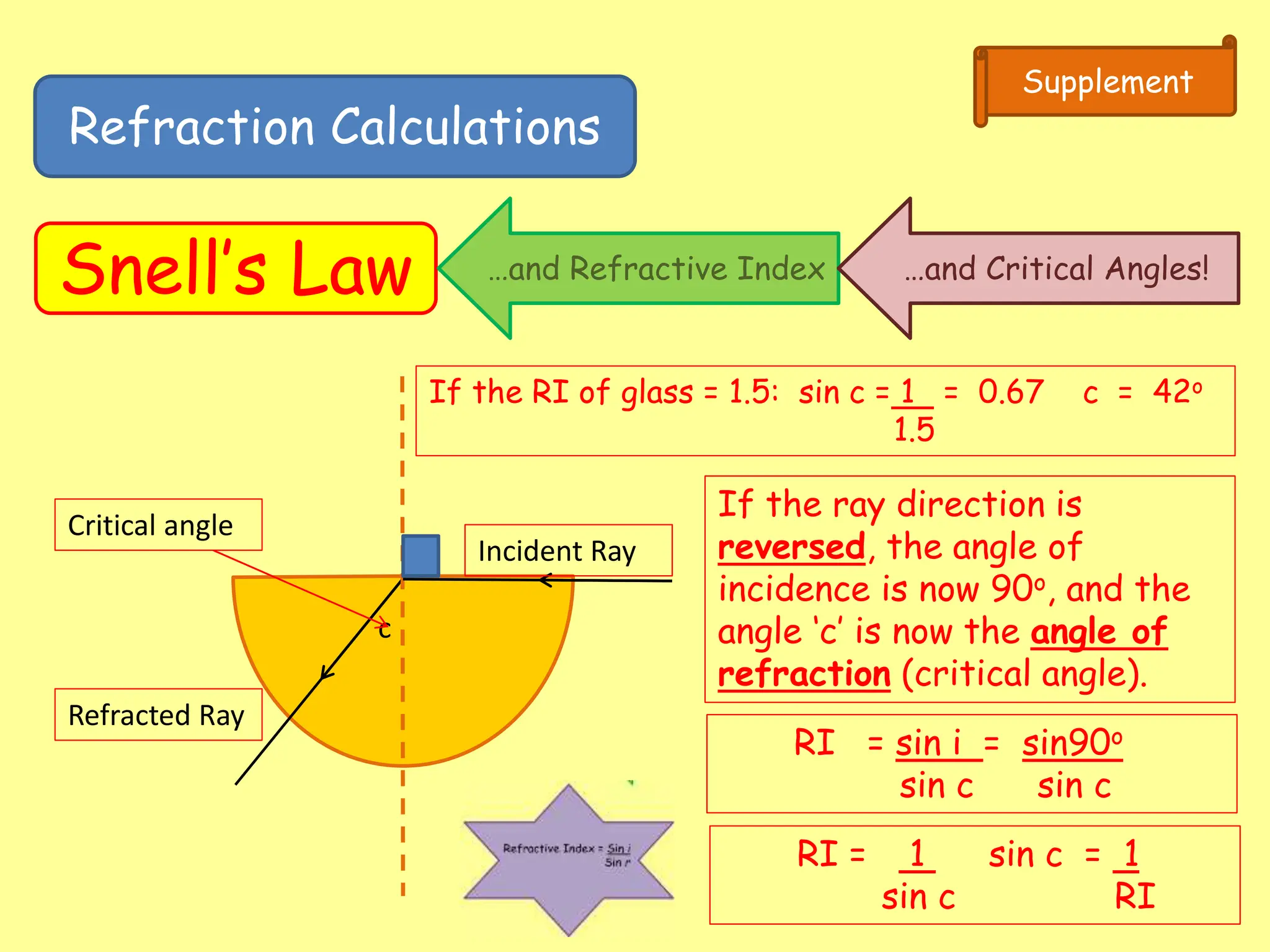
If the ray direction is
reversed, the angle of
incidence is now 90o, and the
angle ‘c’ is now the angle of
refraction (critical angle).
Refraction Calculations
Snell’s Law
Supplement
…and Refractive Index …and Critical Angles!
Incident Ray
Refracted Ray
Critical angle
c
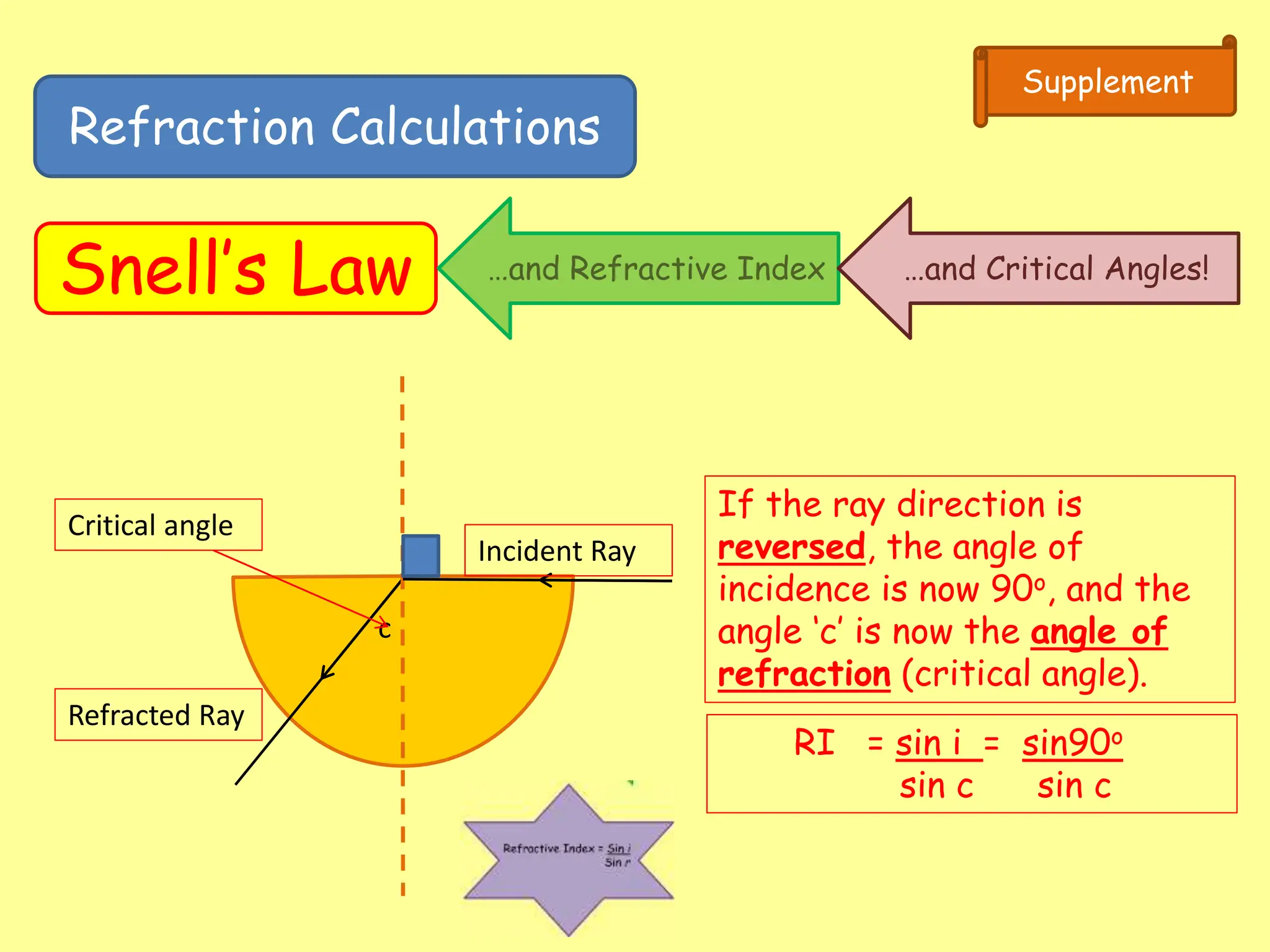
If the ray direction is
reversed, the angle of
incidence is now 90o, and the
angle ‘c’ is now the angle of
refraction (critical angle).
RI = sin i = sin90o
sin c sin c
Refraction Calculations
Snell’s Law
Supplement
…and Refractive Index …and Critical Angles!
Incident Ray
Refracted Ray
Critical angle
c
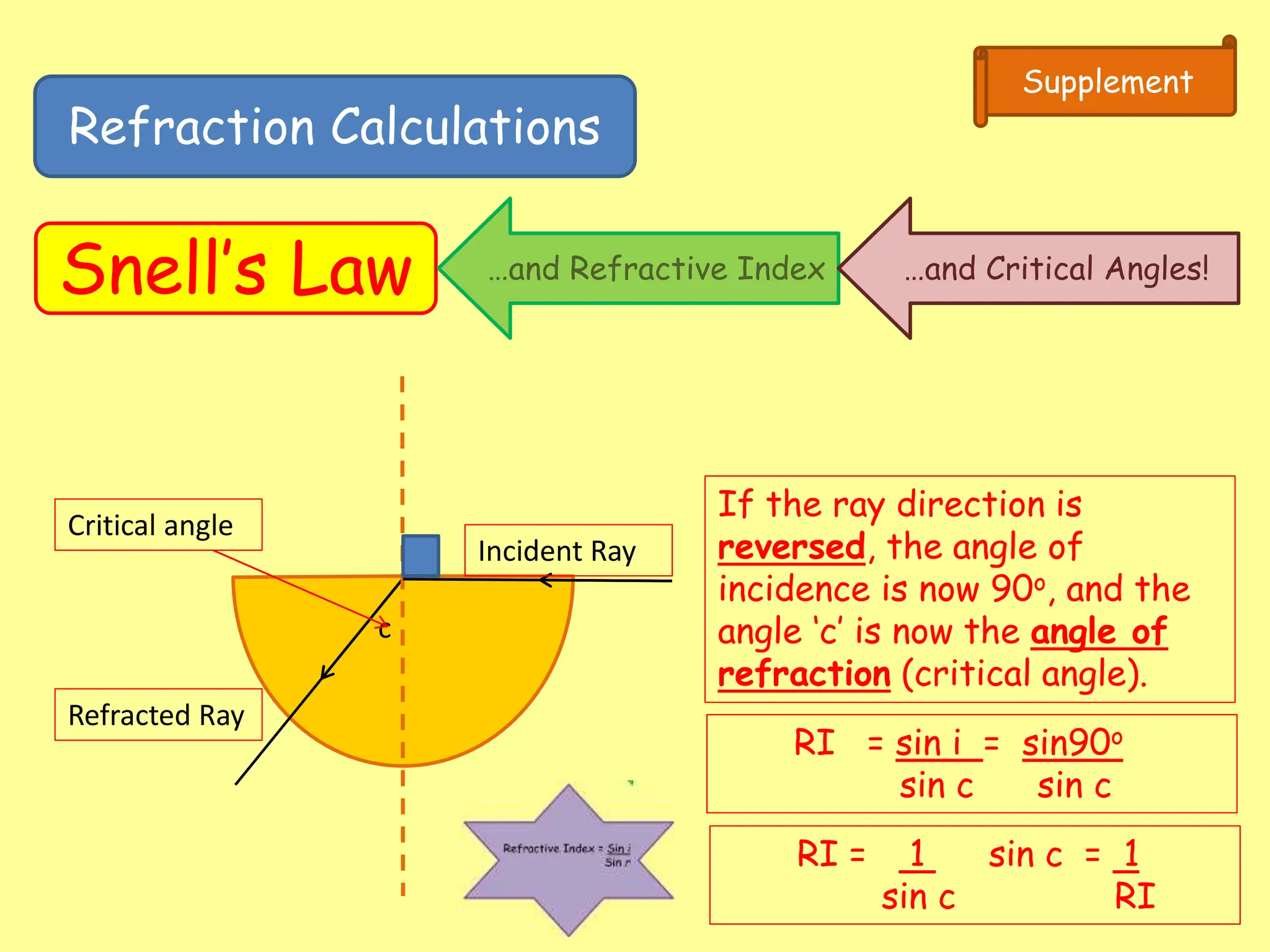
If the ray direction is
reversed, the angle of
incidence is now 90o, and the
angle ‘c’ is now the angle of
refraction (critical angle).
RI = sin i = sin90o
sin c sin c
RI = 1 sin c = 1
sin c RI
Refraction Calculations
Snell’s Law
Supplement
…and Refractive Index …and Critical Angles!
Incident Ray
Refracted Ray
Critical angle
c
If the ray direction is
reversed, the angle of
incidence is now 90o, and the
angle ‘c’ is now the angle of
refraction (critical angle).
RI = sin i = sin90o
sin c sin c
RI = 1 sin c = 1
sin c RI
If the RI of glass = 1.5: sin c = 1 = 0.67 c = 42o
1.5
Refraction Calculations
Snell’s Law
Supplement
…and Refractive Index …and Critical Angles!
Incident Ray
Critical angle
c
If the RI of glass = 1.5: sin c = 1 = 0.67 c = 42o
1.5
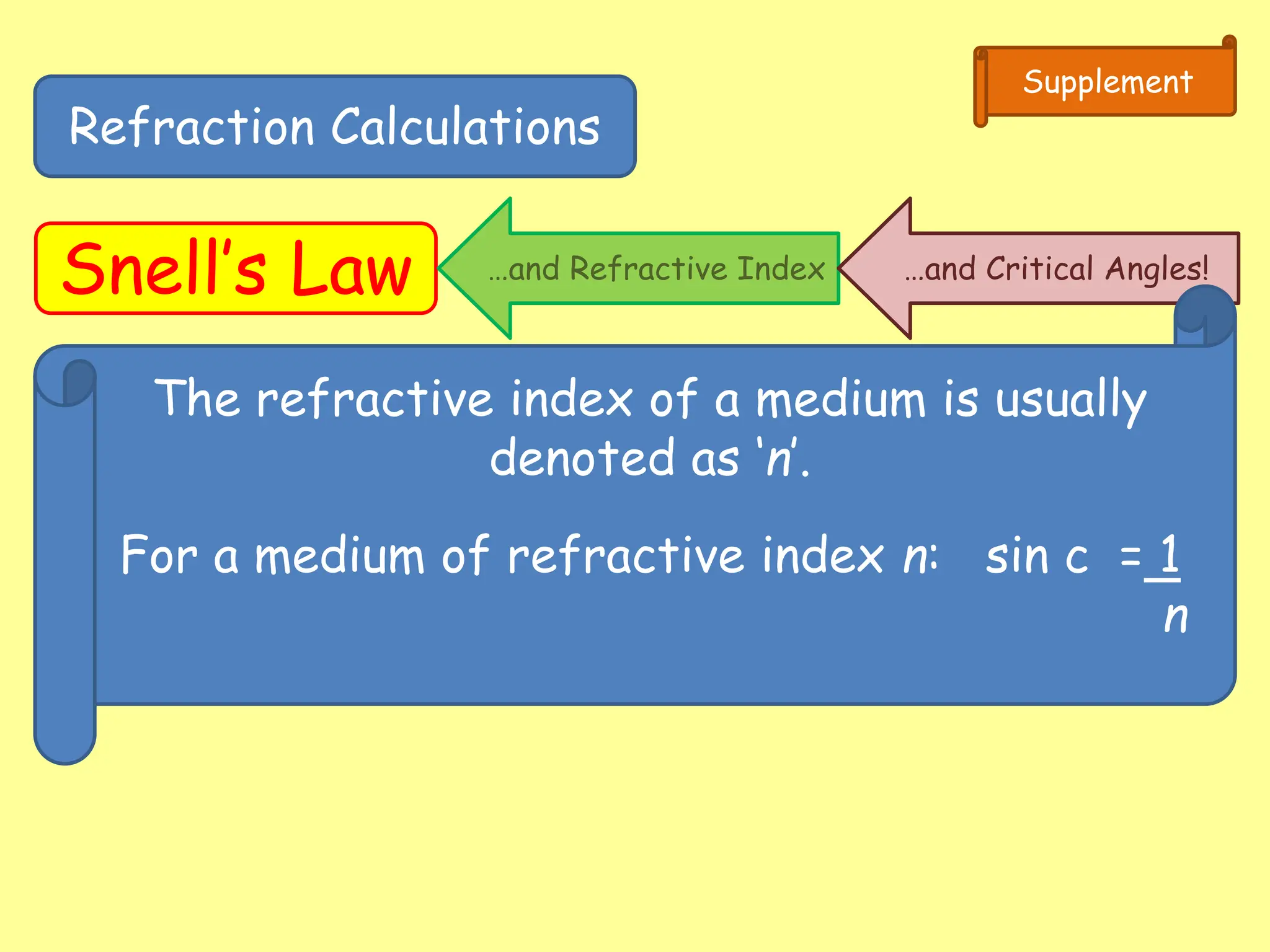
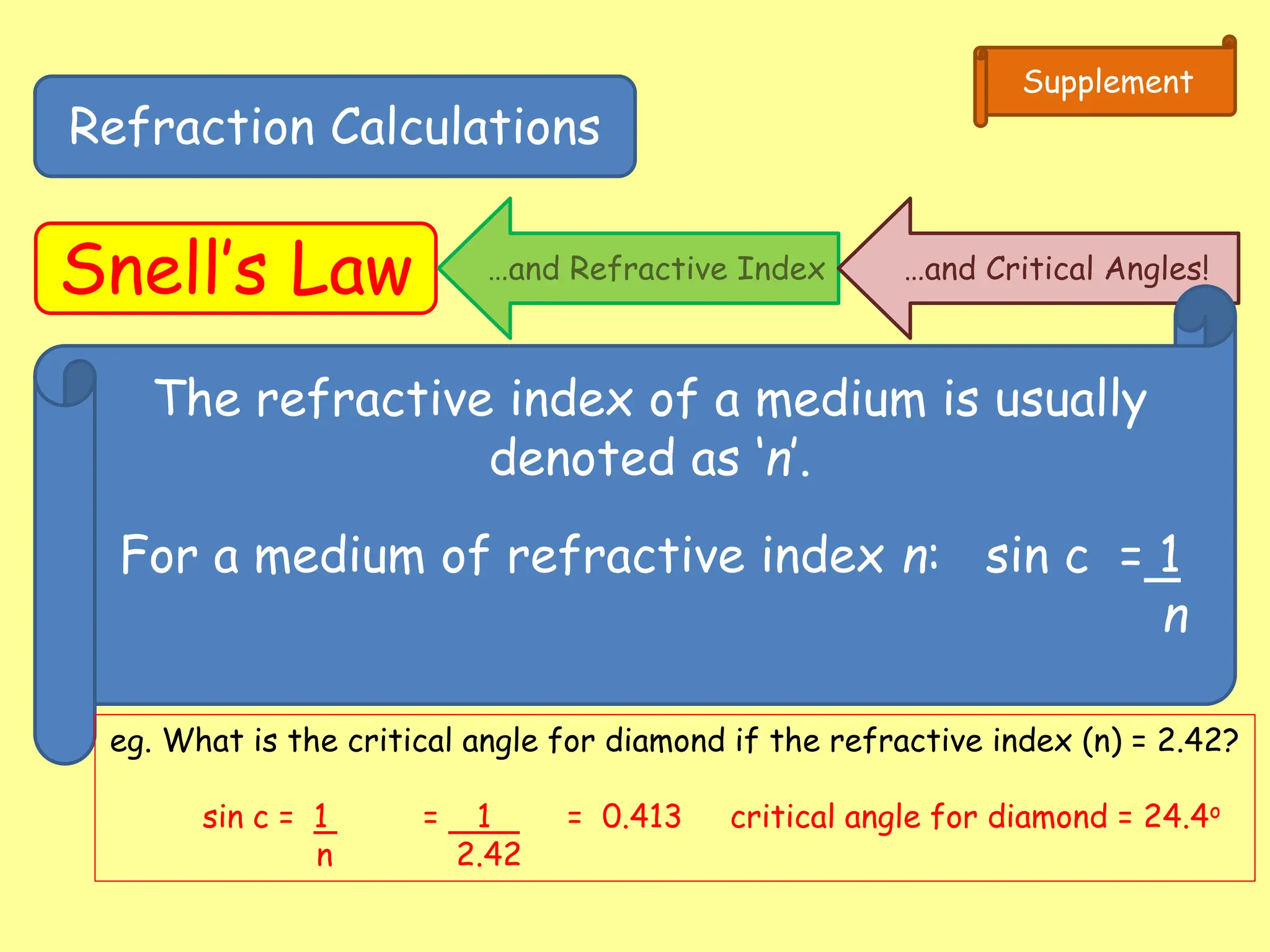
The refractive index of a medium is usually
denoted as ‘n’.
For a medium of refractive index n: sin c = 1
n
Refraction Calculations
Snell’s Law
Supplement
…and Refractive Index …and Critical Angles!
Incident Ray
Critical angle
c
If the RI of glass = 1.5: sin c = 1 = 0.67 c = 42o
1.5
The refractive index of a medium is usually
denoted as ‘n’.
For a medium of refractive index n: sin c = 1
n
eg. What is the critical angle for diamond if the refractive index (n) = 2.42?
sin c = 1 = 1 = 0.413 critical angle for diamond = 24.4o
n 2.42
LEARNING
OBJECTIVES
Core
•Describe the formation of an optical image by
a plane mirror, and give its characteristics
• Recall and use the law angle of incidence =
angle of reflection
Describe an experimental demonstration of
the refraction of light
• Use the terminology for the angle of
incidence i and angle of refraction r and
describe the passage of light through parallel-
sided transparent material
• Give the meaning of critical angle
• Describe internal and total internal
reflection
Describe the action of a thin converging lens
on a beam of light
• Use the terms principal focus and focal
length
• Draw ray diagrams for the formation of a
real image by a single lens
• Describe the nature of an image using the
terms enlarged/same size/diminished and
upright/inverted
Supplement
Describe the formation of an optical image by a
plane mirror, and give its characteristics
• Recall and use the law angle of incidence =
angle of reflection
Recall and use the definition of refractive
index n in terms of speed
• Recall and use the equation sin I / sin r=n
• Recall and use n = 1 / sin c
• Describe and explain the action of optical
fibres particularly in medicine and
communications technology
Draw and use ray diagrams for the formation of
a virtual image by a single lens • Use and
describe the use of a single lens as a
magnifying glass • Show understanding of the
terms real image and virtual image
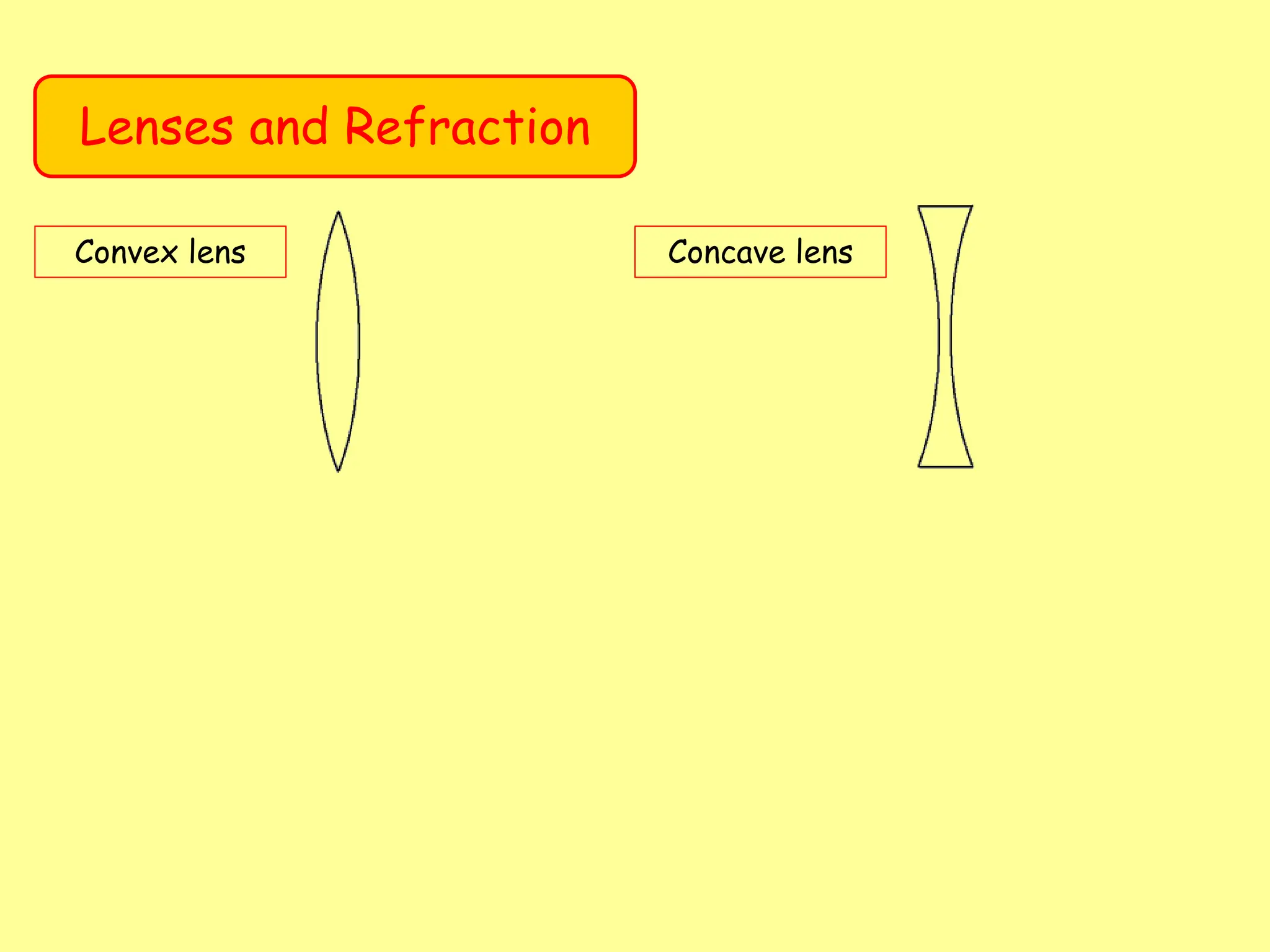
Lenses and Refraction
Convex lens Concave lens
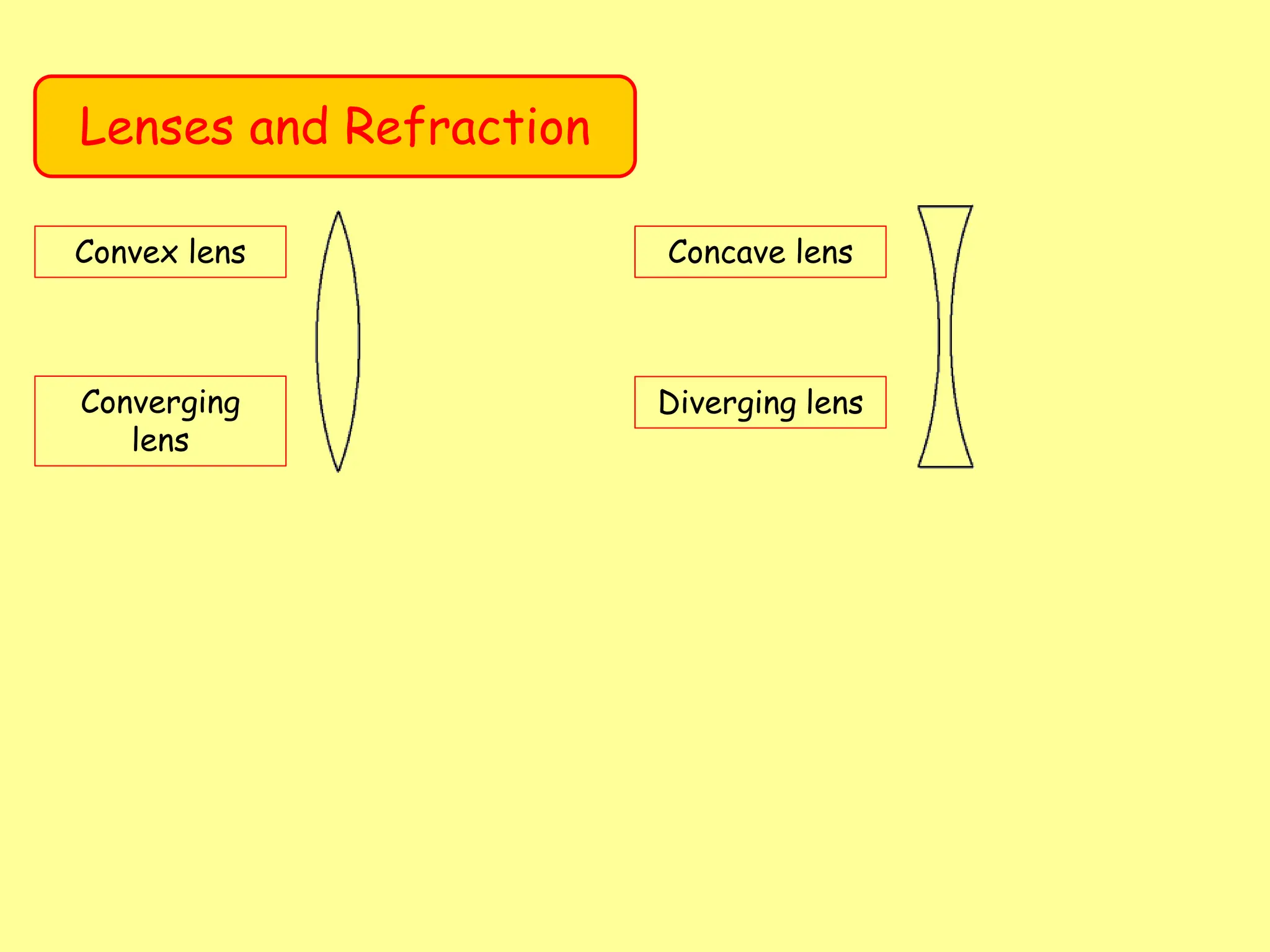
Lenses and Refraction
Convex lens Concave lens
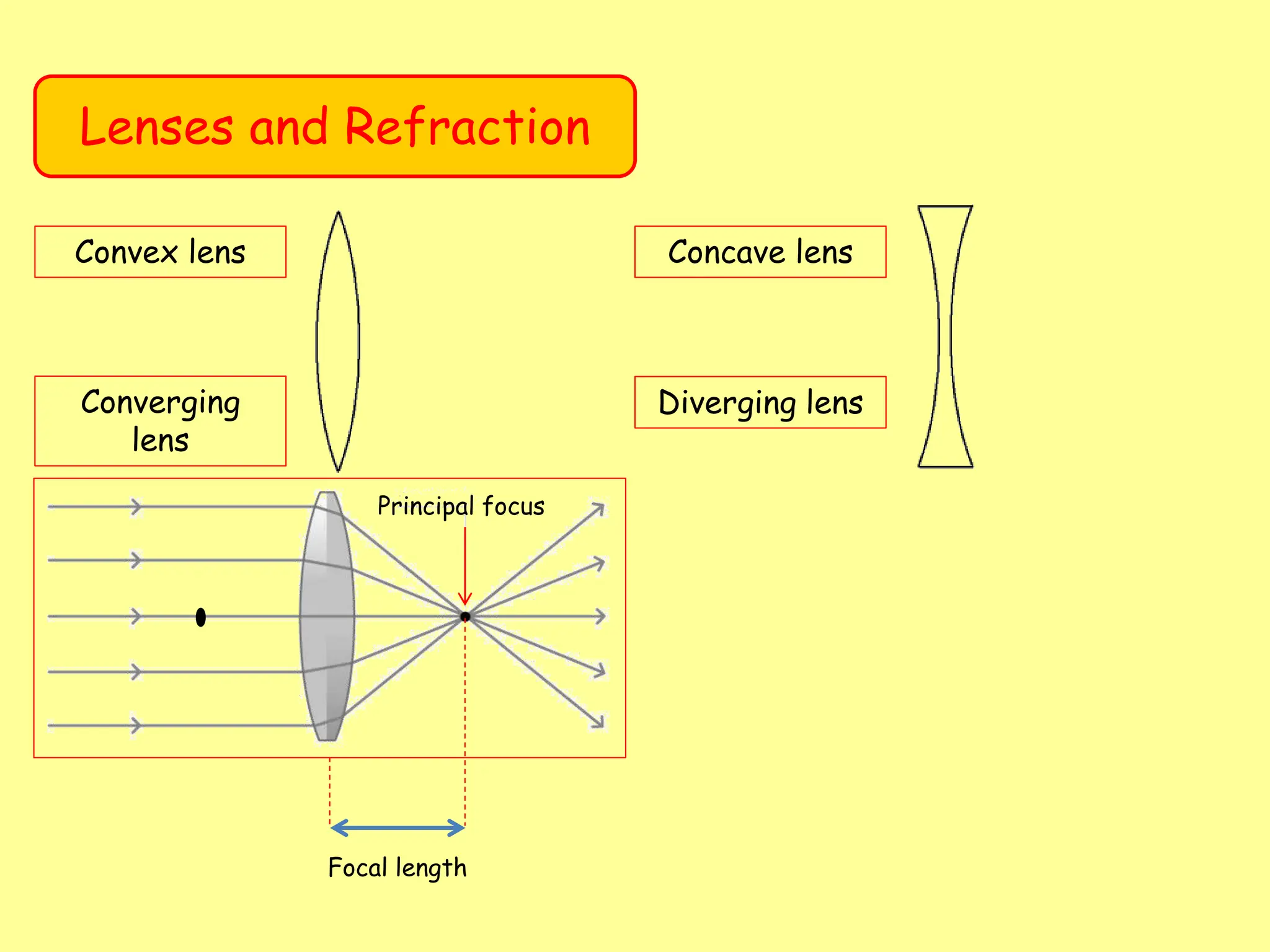
Converging
lens
Diverging lens
Lenses and Refraction
Convex lens Concave lens
Converging
lens
Diverging lens
Principal focus
Focal length
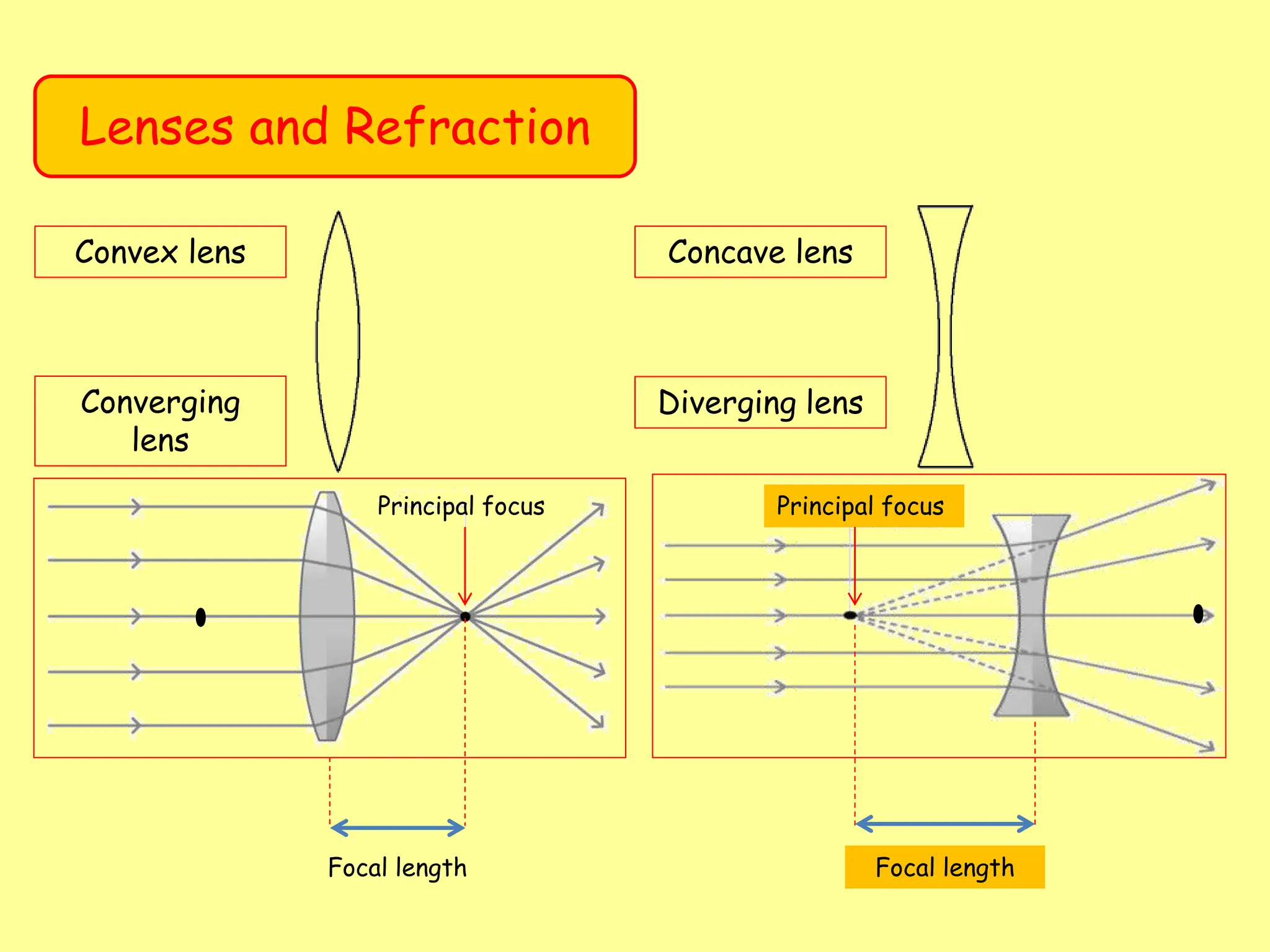
Lenses and Refraction
Convex lens Concave lens
Converging
lens
Diverging lens
Principal focus
Focal length
Principal focus
Focal length
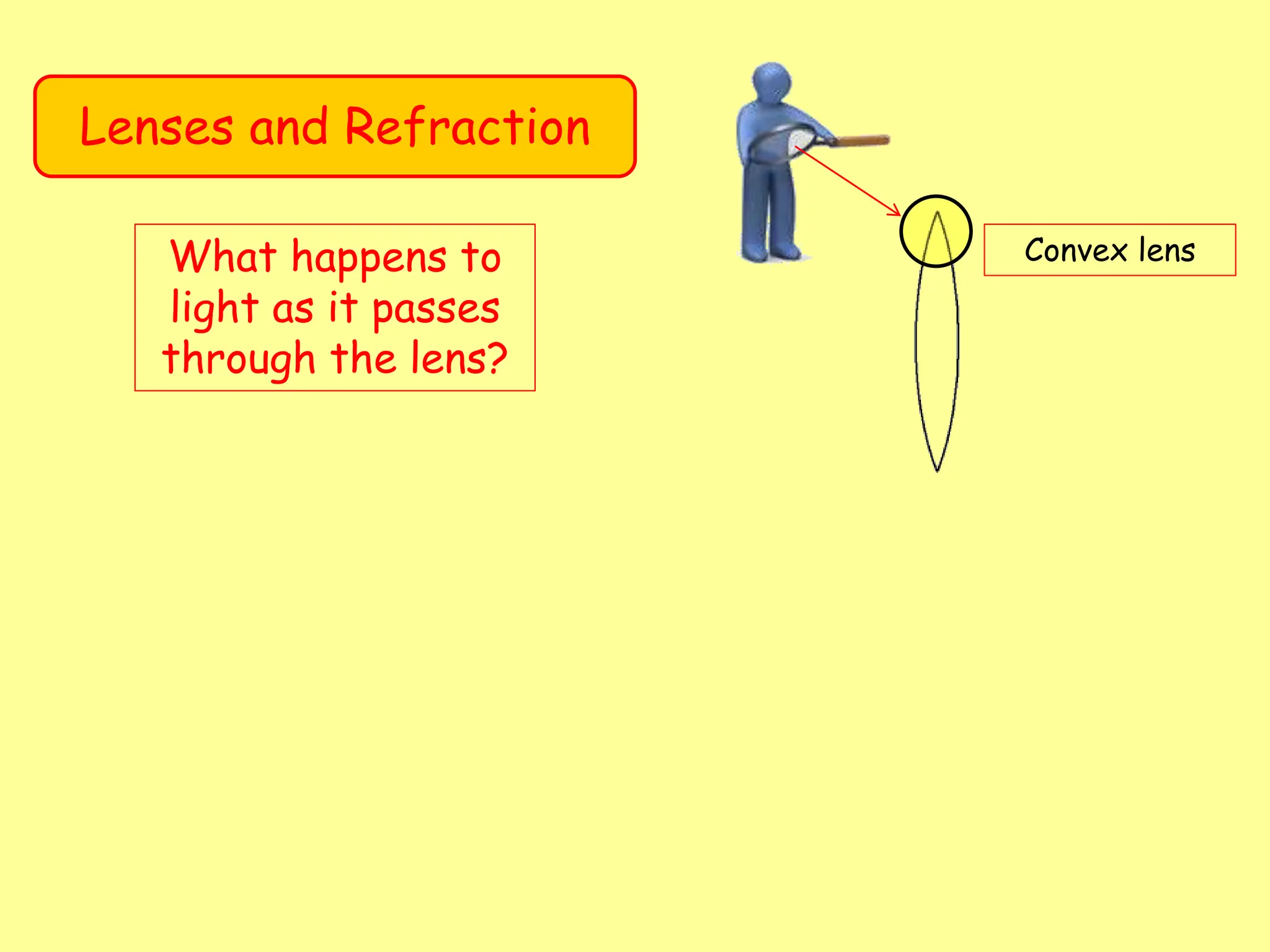
Lenses and Refraction
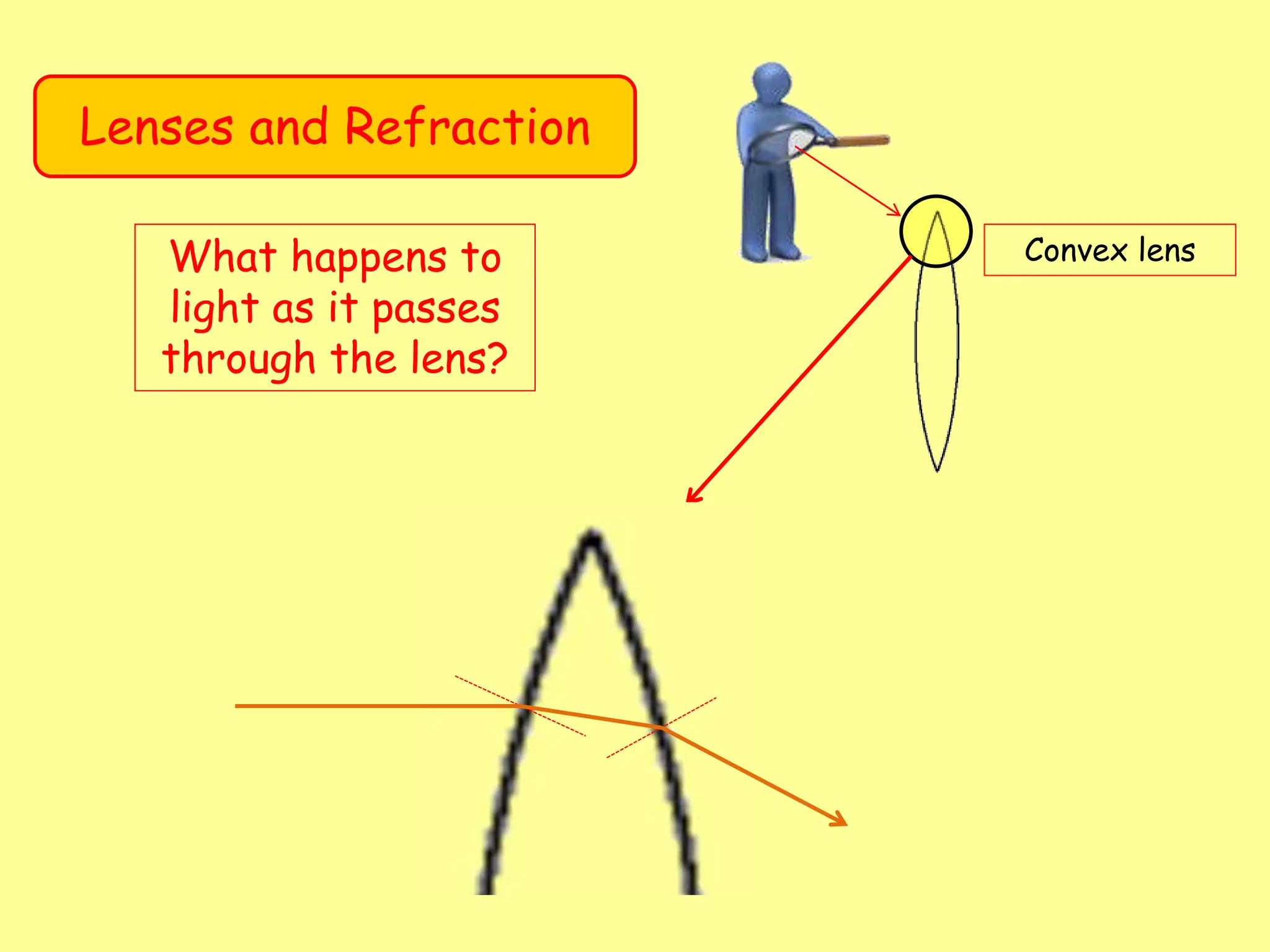
Convex lens
What happens to
light as it passes
through the lens?
Lenses and Refraction
Convex lens
What happens to
light as it passes
through the lens?
Lenses and Refraction
Convex lens
What happens to
light as it passes
through the lens?
Lenses and Refraction
Convex lens
What happens to
light as it passes
through the lens?
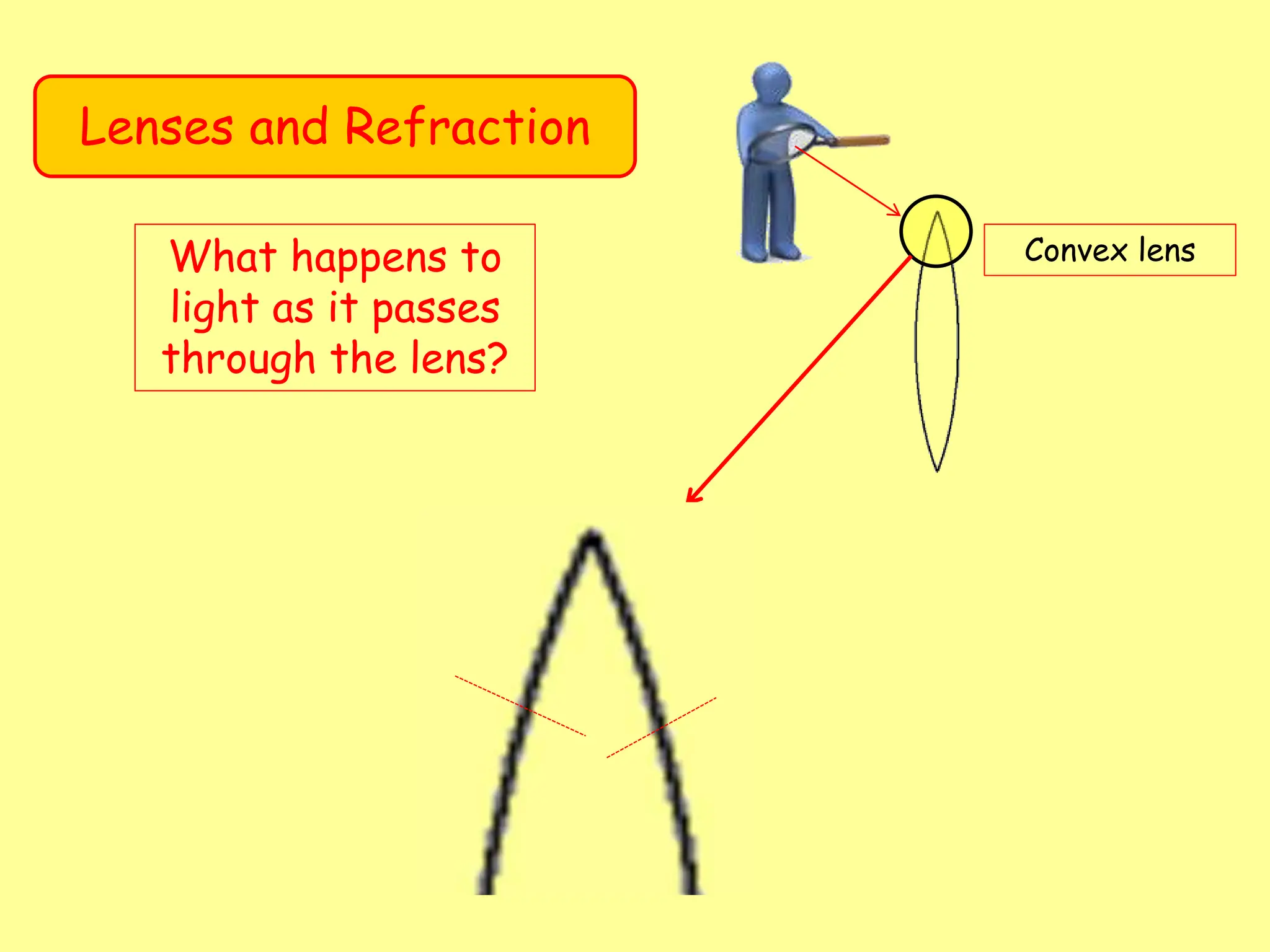
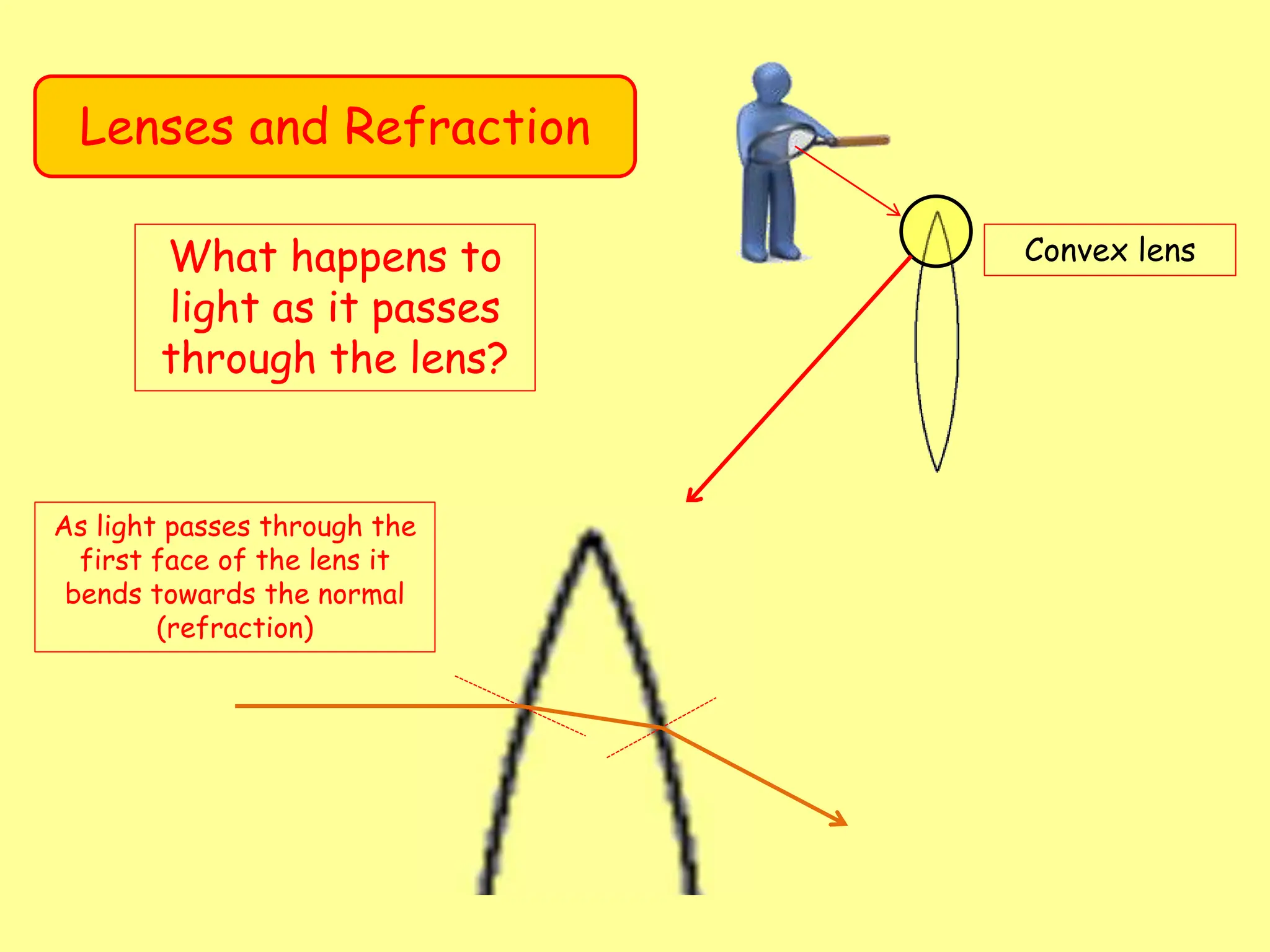
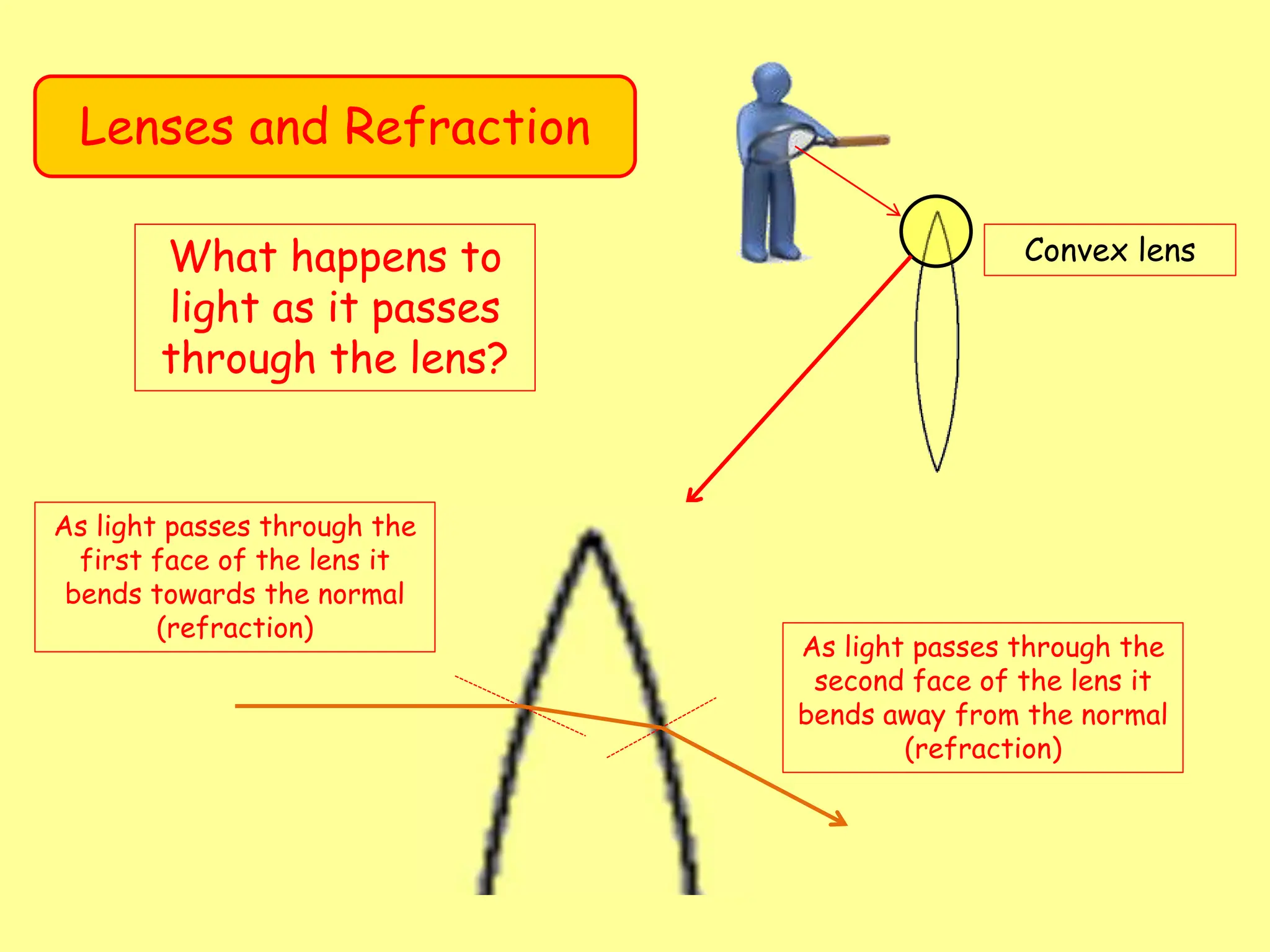
As light passes through the
first face of the lens it
bends towards the normal
(refraction)
Lenses and Refraction
Convex lens
What happens to
light as it passes
through the lens?
As light passes through the
first face of the lens it
bends towards the normal
(refraction)
As light passes through the
second face of the lens it
bends away from the normal
(refraction)
Lenses and Refraction
Convex lens
What happens to
light as it passes
through the lens?
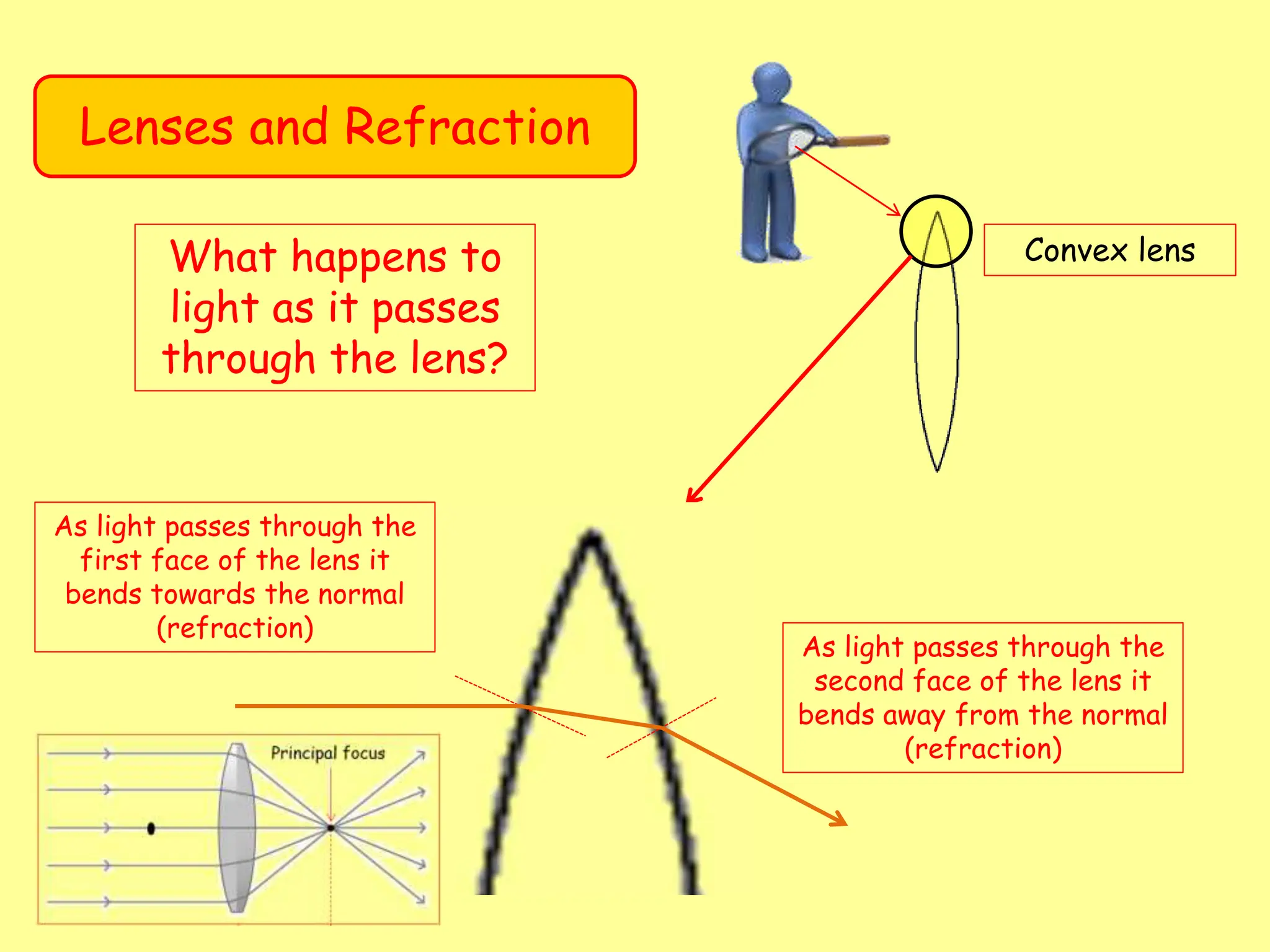
As light passes through the
first face of the lens it
bends towards the normal
(refraction)
As light passes through the
second face of the lens it
bends away from the normal
(refraction)
Lenses and Images
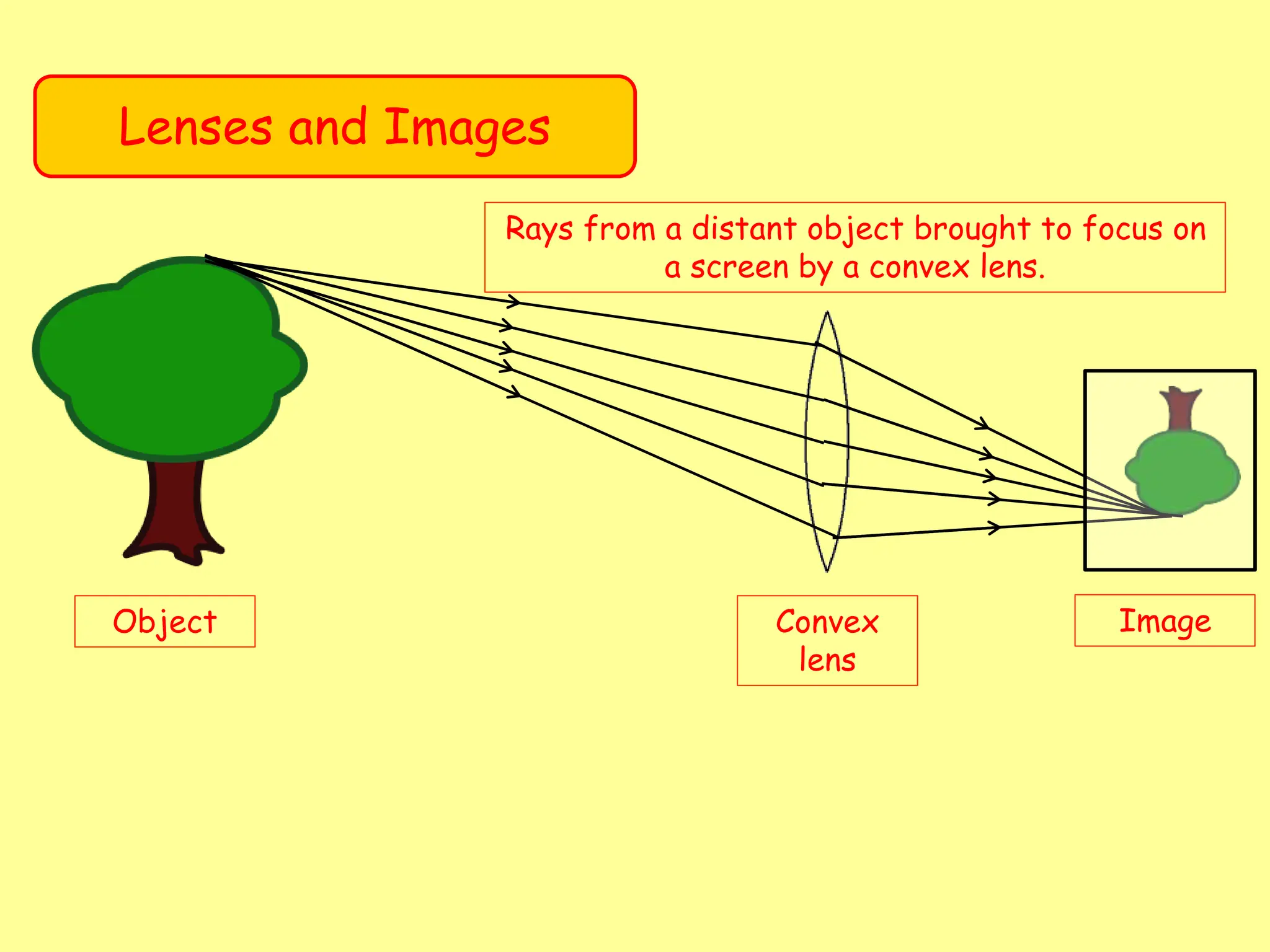
Object Convex
lens
Image
Rays from a distant object brought to focus on
a screen by a convex lens.
Lenses and Images
Object Convex
lens
Image
Rays from a distant object brought to focus on
a screen by a convex lens.
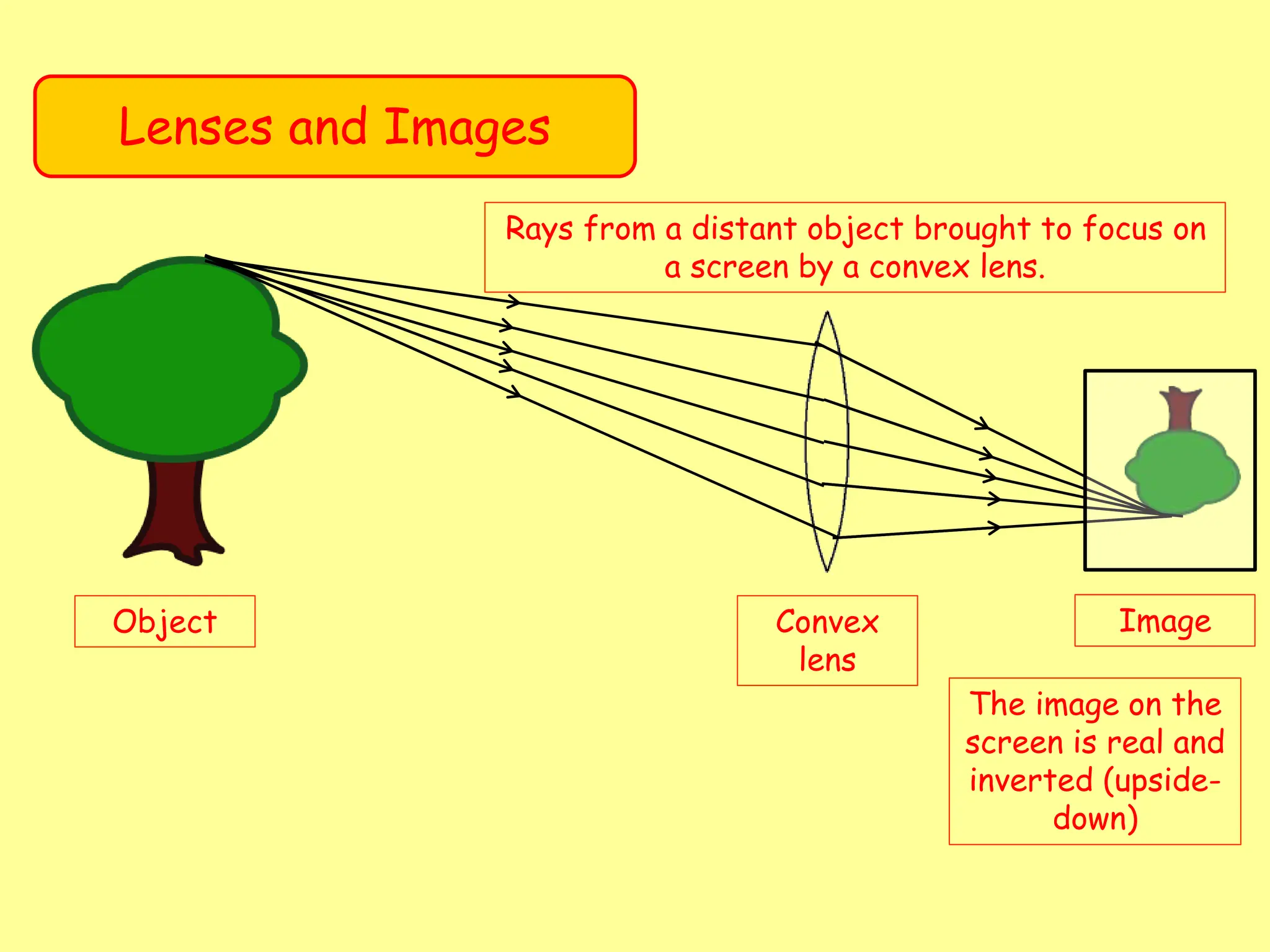
The image on the
screen is real and
inverted (upside-
down)
Lenses and Images
Object Convex
lens
Image
Rays from a distant object brought to focus on
a screen by a convex lens.
The image on the
screen is real and
inverted (upside-
down)
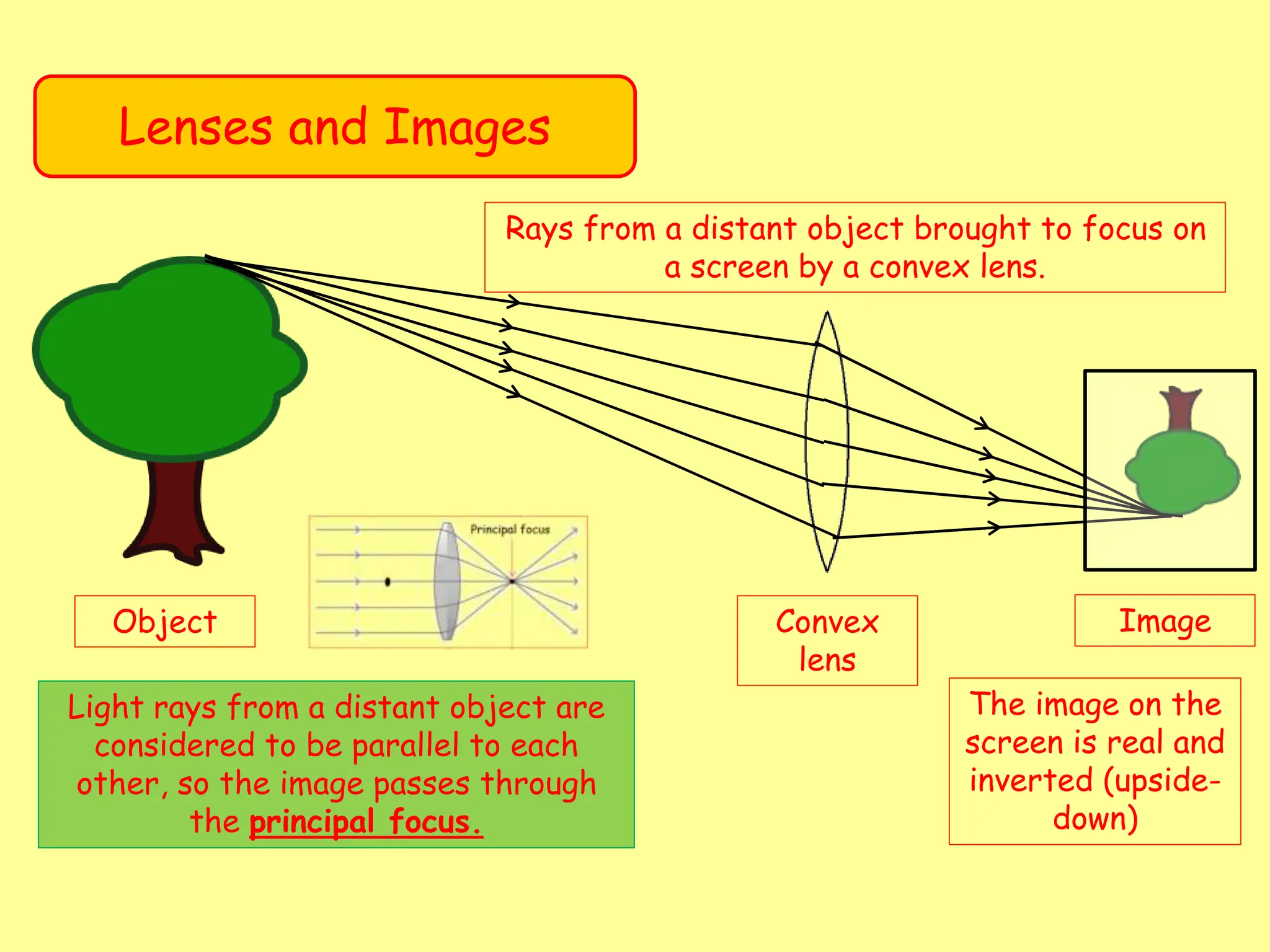
Light rays from a distant object are
considered to be parallel to each
other, so the image passes through
the principal focus.
Lenses and Ray Diagrams
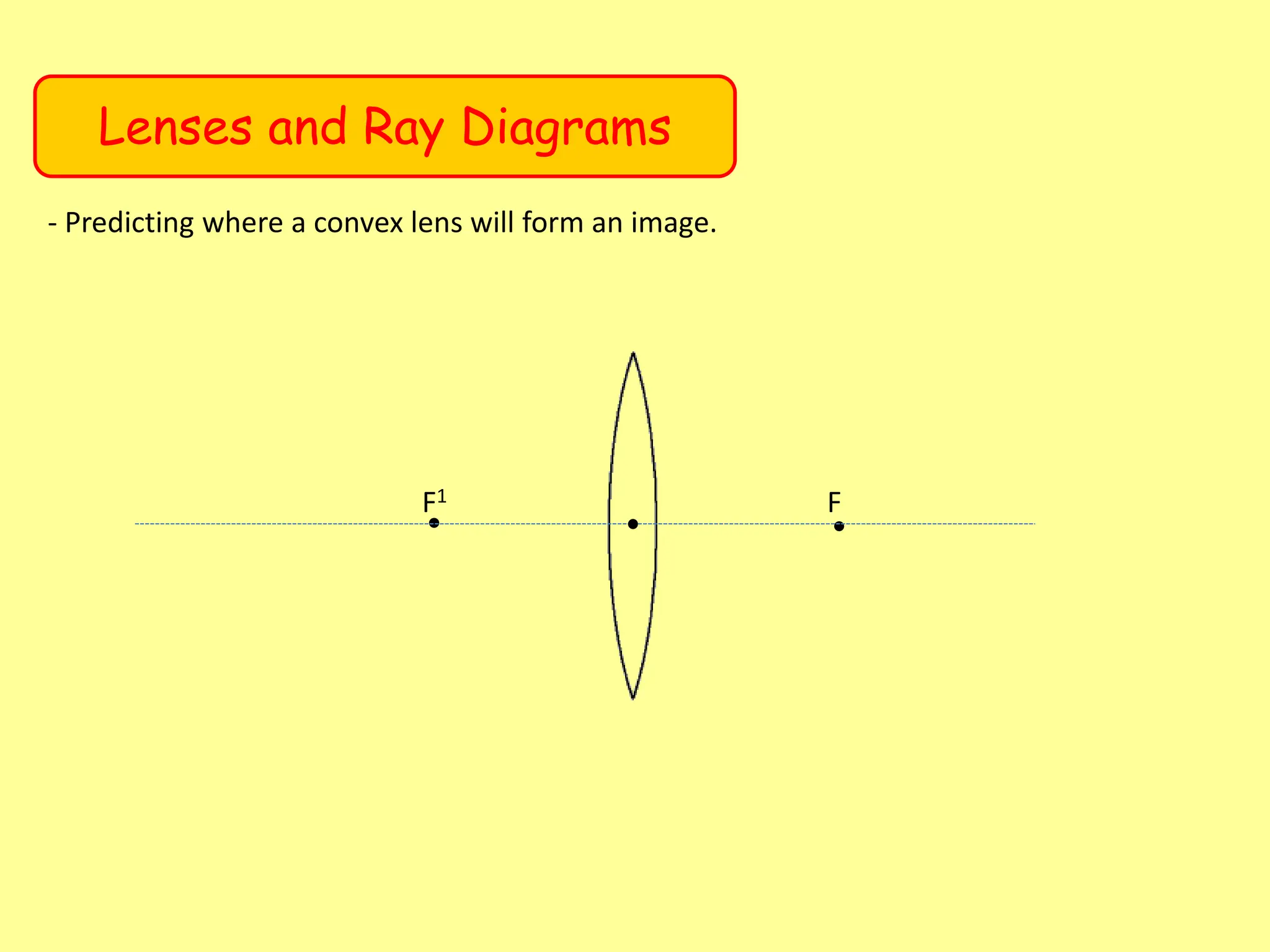
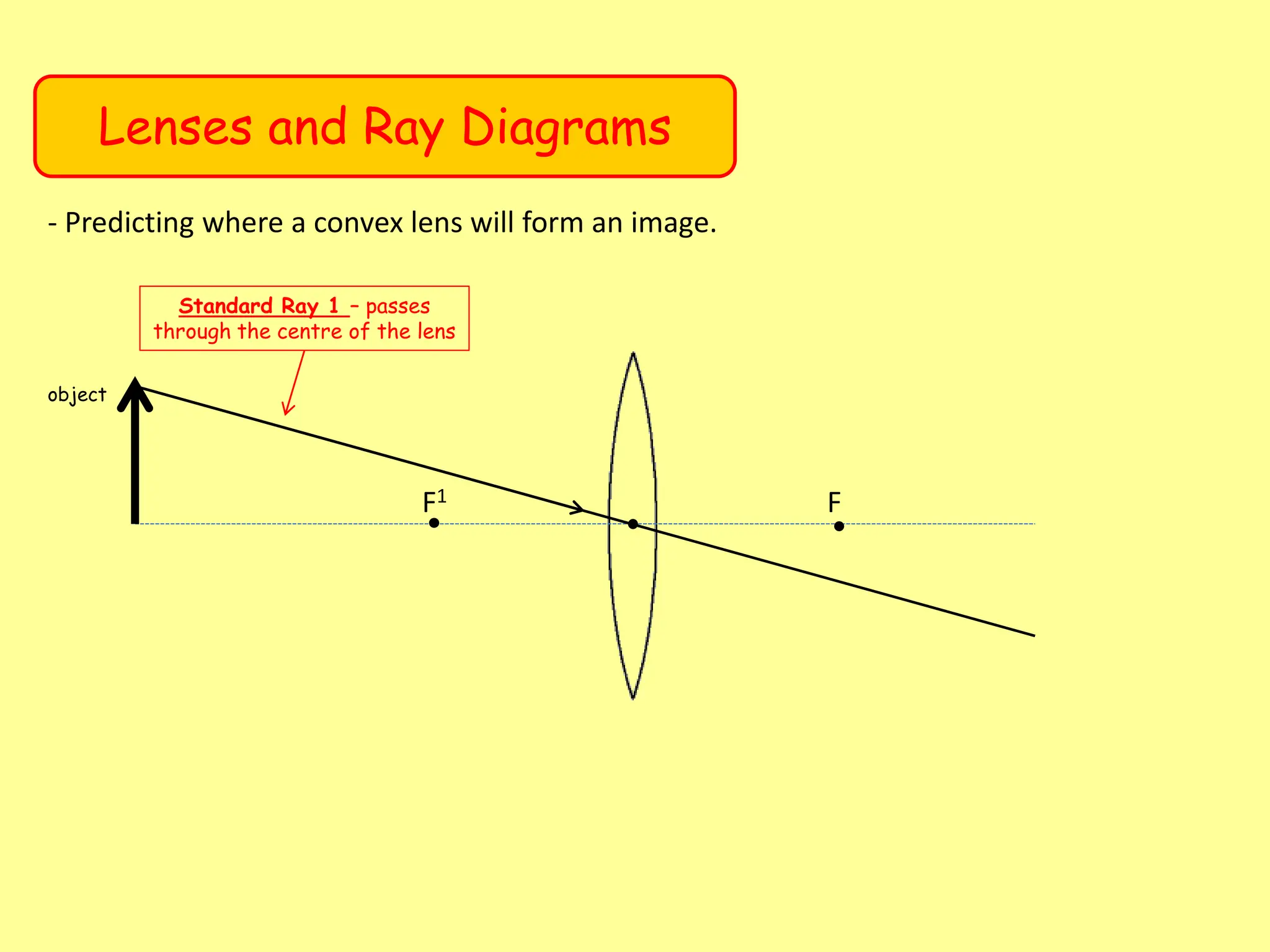
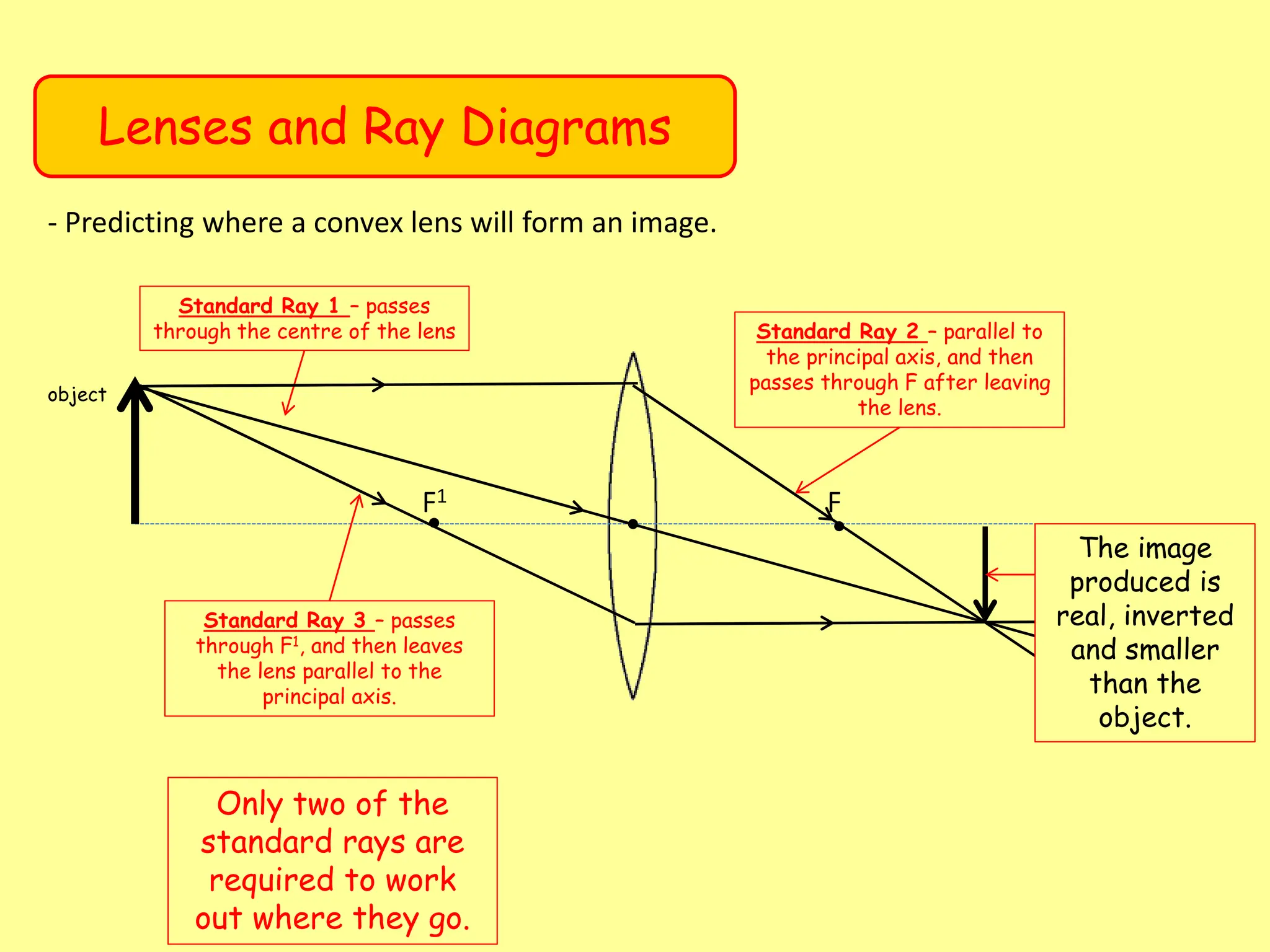
- Predicting where a convex lens will form an image.
F1 F
Lenses and Ray Diagrams
- Predicting where a convex lens will form an image.
F1 F
Standard Ray 1 – passes
through the centre of the lens
object
Lenses and Ray Diagrams
- Predicting where a convex lens will form an image.
F1 F
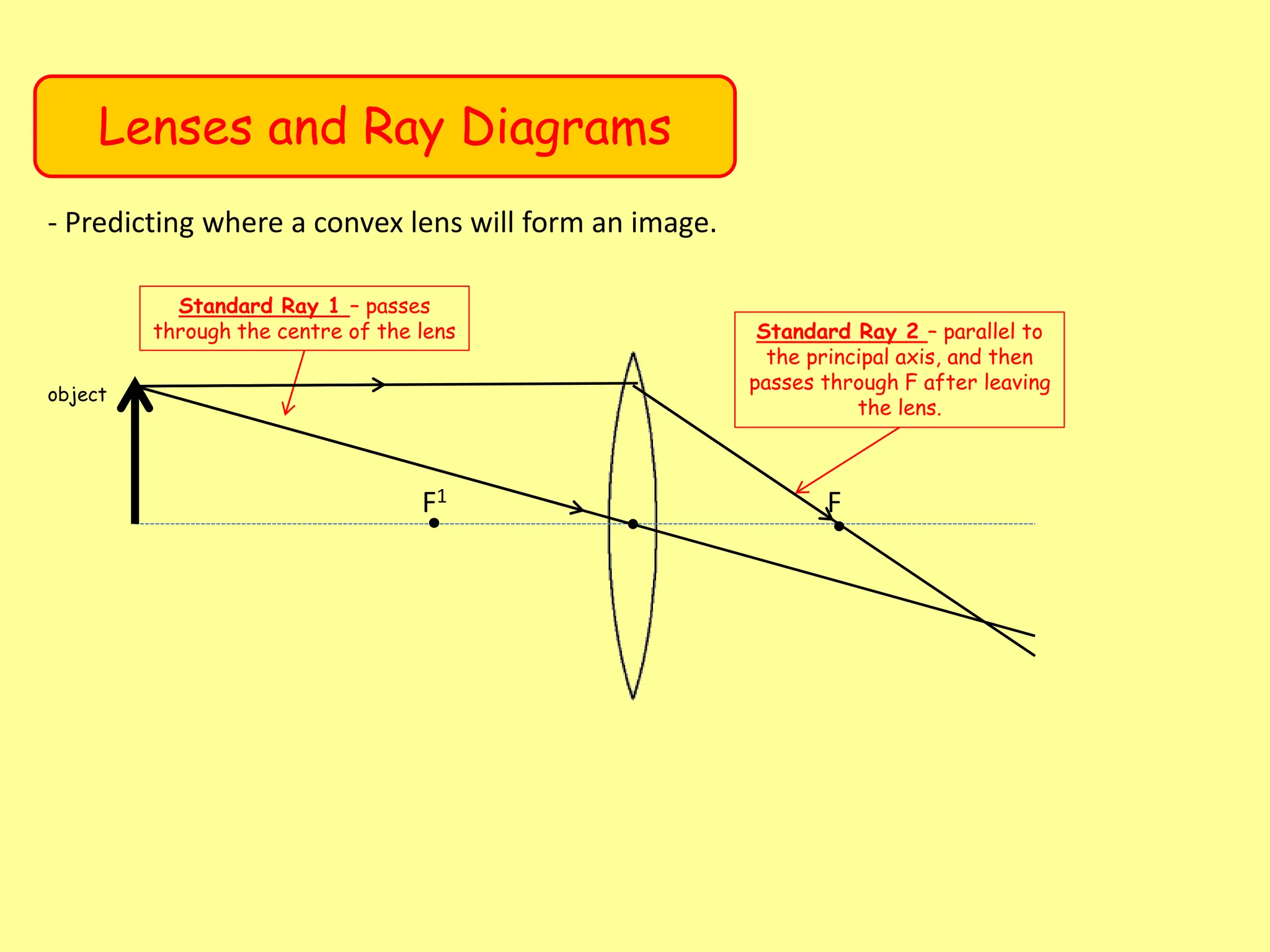
Standard Ray 1 – passes
through the centre of the lens Standard Ray 2 – parallel to
the principal axis, and then
passes through F after leaving
the lens.
object
Lenses and Ray Diagrams
- Predicting where a convex lens will form an image.
F1 F
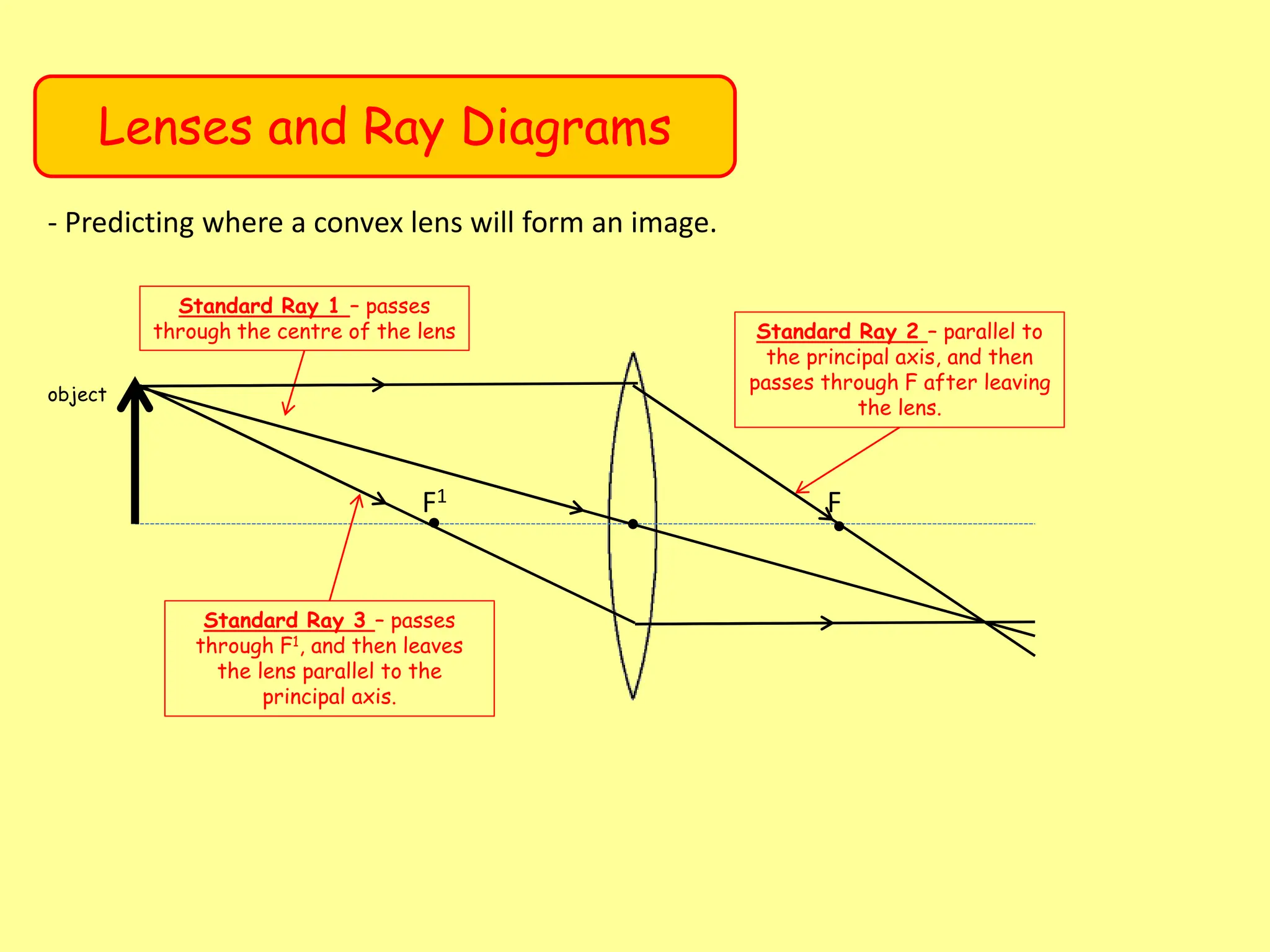
Standard Ray 1 – passes
through the centre of the lens Standard Ray 2 – parallel to
the principal axis, and then
passes through F after leaving
the lens.
Standard Ray 3 – passes
through F1, and then leaves
the lens parallel to the
principal axis.
object
Lenses and Ray Diagrams
- Predicting where a convex lens will form an image.
F1 F
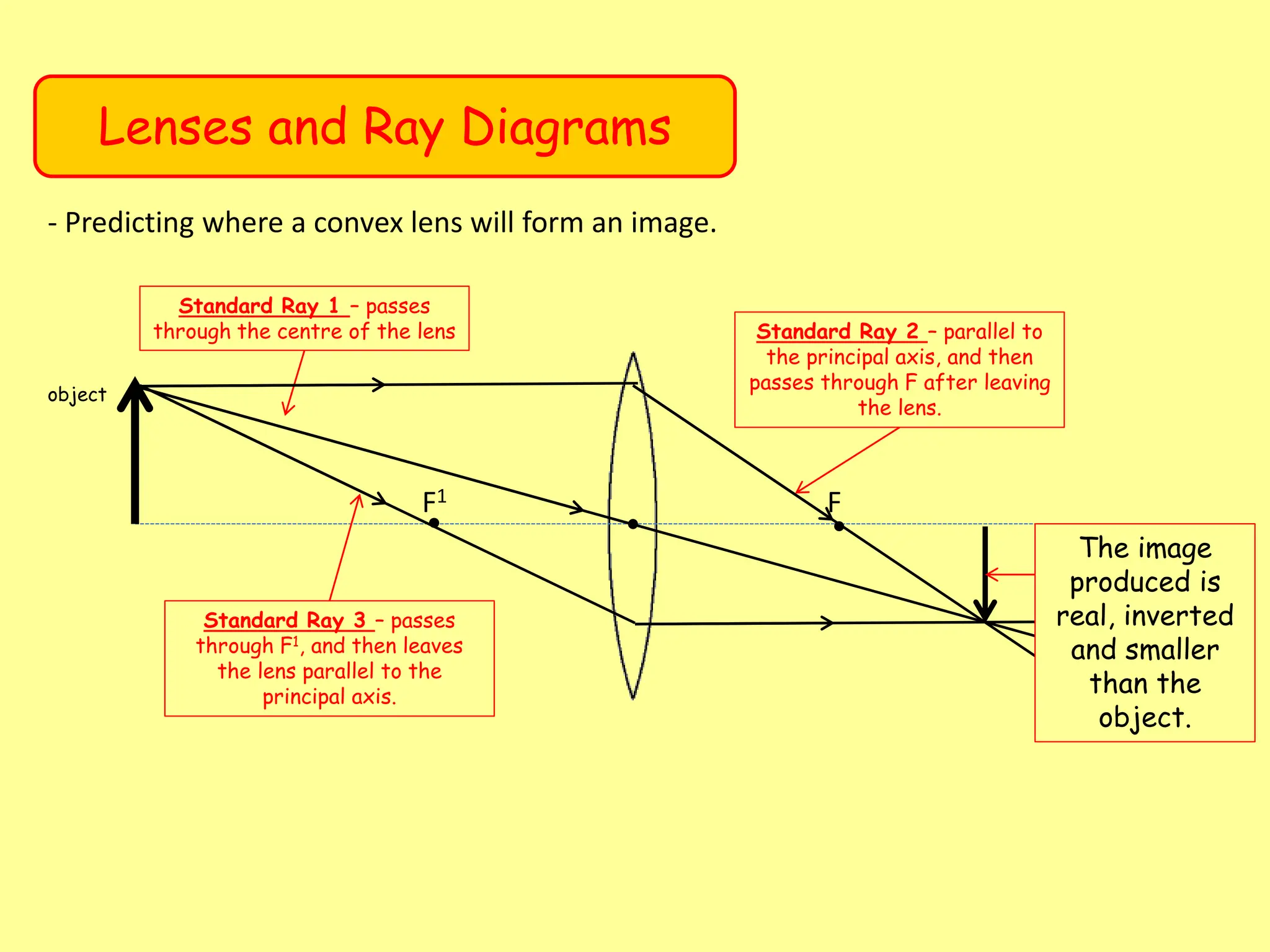
Standard Ray 1 – passes
through the centre of the lens Standard Ray 2 – parallel to
the principal axis, and then
passes through F after leaving
the lens.
Standard Ray 3 – passes
through F1, and then leaves
the lens parallel to the
principal axis.
The image
produced is
real, inverted
and smaller
than the
object.
object
Lenses and Ray Diagrams
- Predicting where a convex lens will form an image.
F1 F
Standard Ray 1 – passes
through the centre of the lens Standard Ray 2 – parallel to
the principal axis, and then
passes through F after leaving
the lens.
Standard Ray 3 – passes
through F1, and then leaves
the lens parallel to the
principal axis.
The image
produced is
real, inverted
and smaller
than the
object.
object
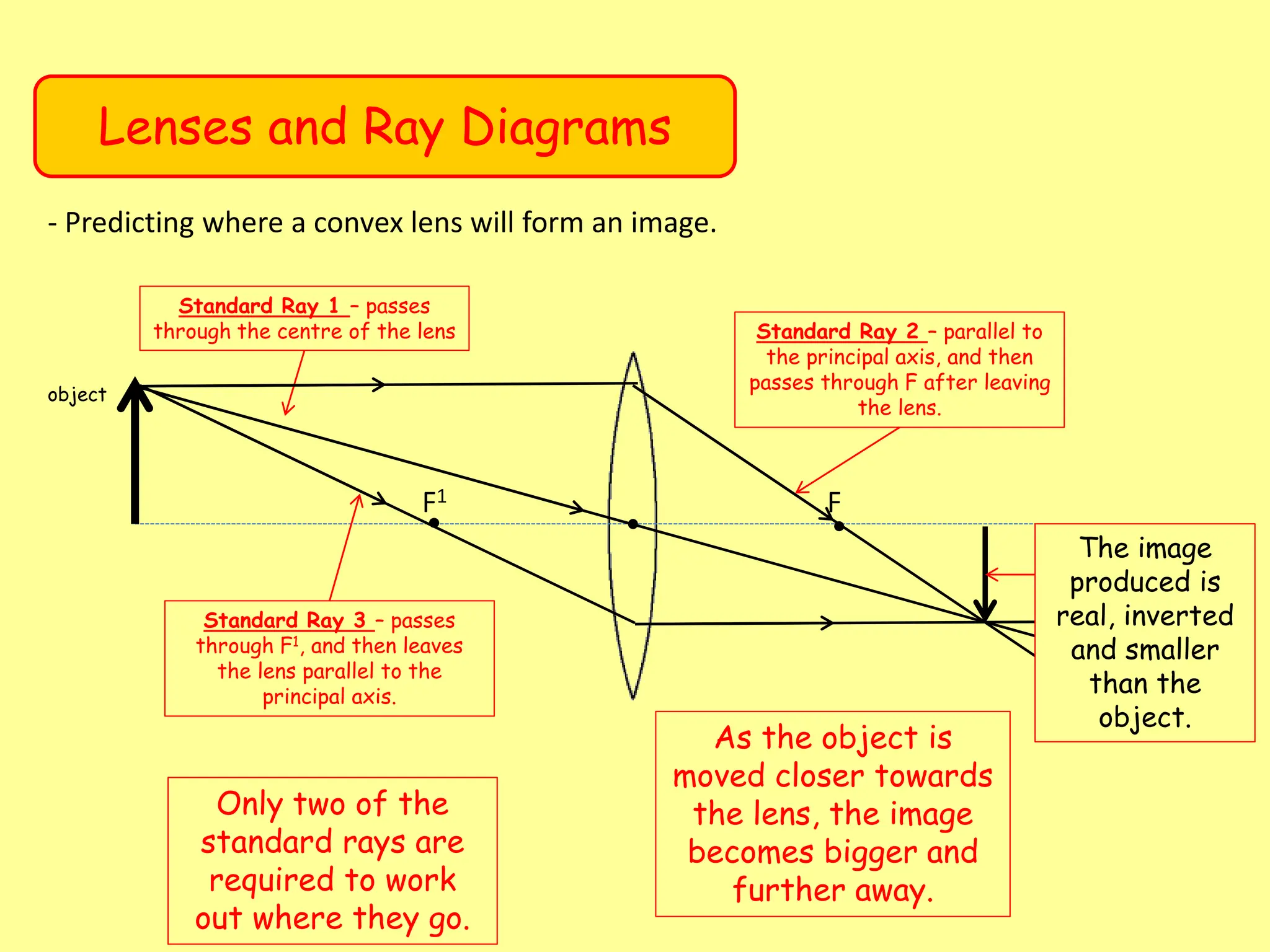
Only two of the
standard rays are
required to work
out where they go.
Lenses and Ray Diagrams
- Predicting where a convex lens will form an image.
F1 F
Standard Ray 1 – passes
through the centre of the lens Standard Ray 2 – parallel to
the principal axis, and then
passes through F after leaving
the lens.
Standard Ray 3 – passes
through F1, and then leaves
the lens parallel to the
principal axis.
The image
produced is
real, inverted
and smaller
than the
object.
object
Only two of the
standard rays are
required to work
out where they go.
As the object is
moved closer towards
the lens, the image
becomes bigger and
further away.
Uses of Convex Lenses
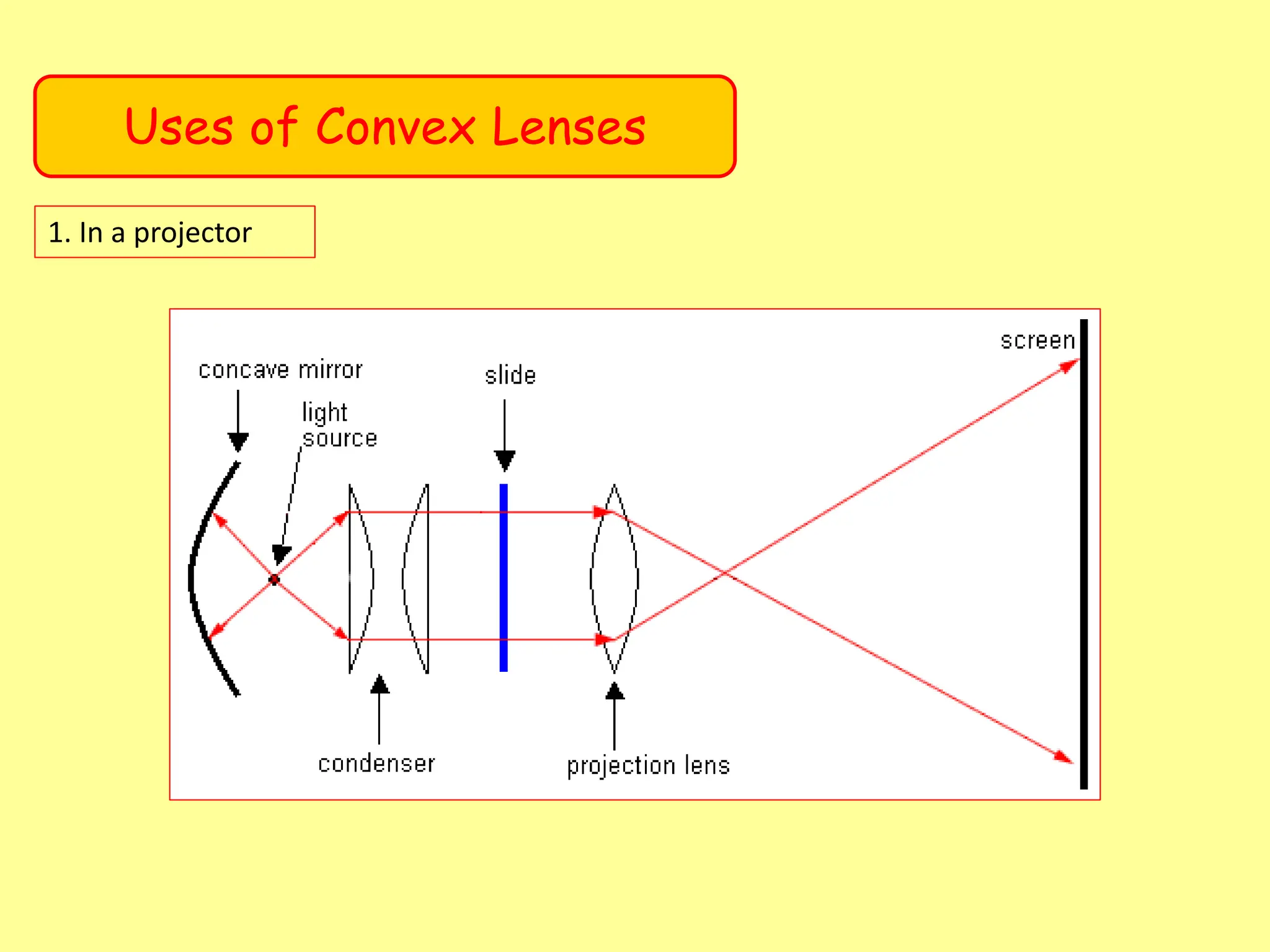
1. In a projector
Uses of Convex Lenses
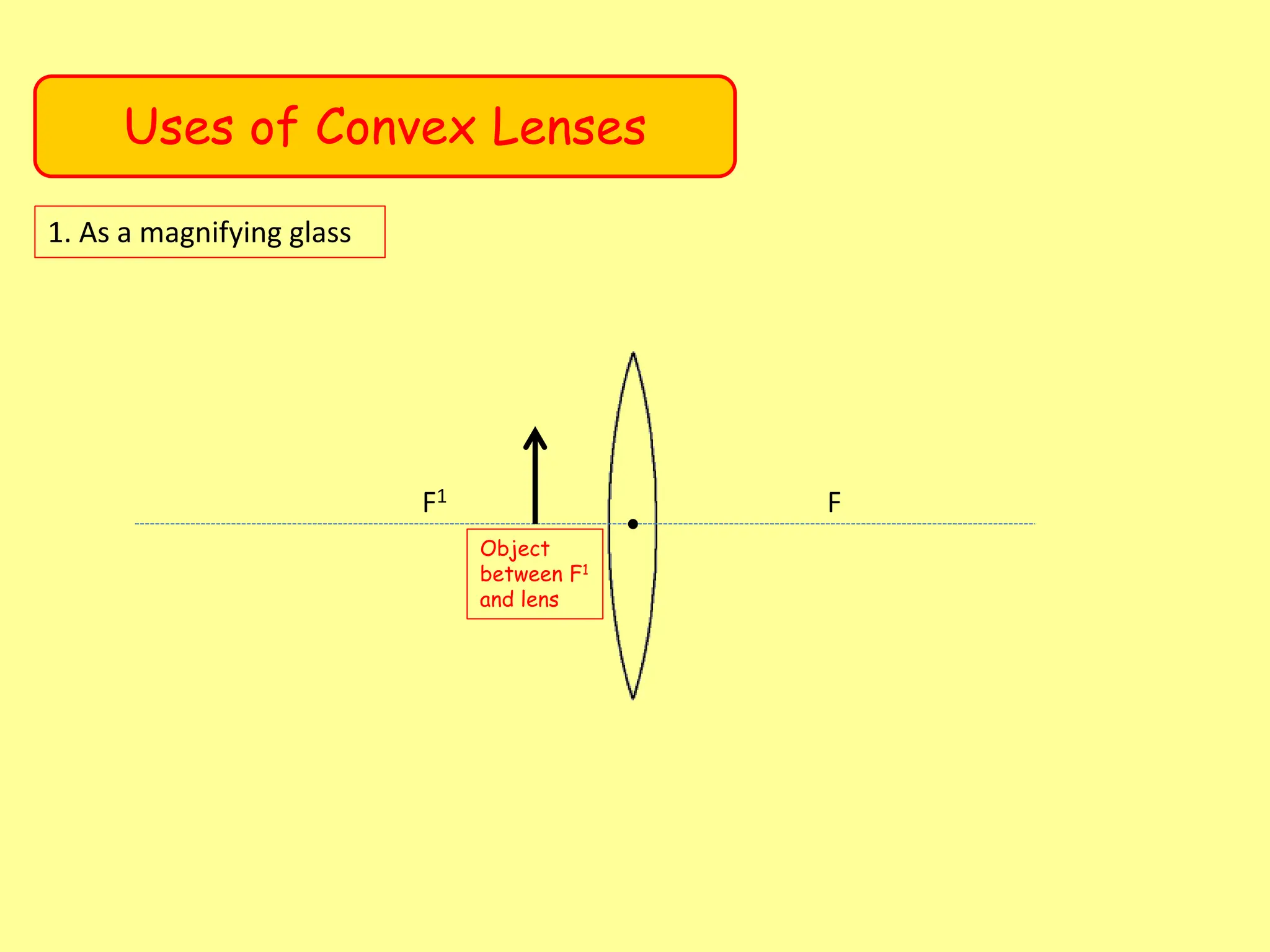
1. As a magnifying glass
F1 F
Object
between F1
and lens
Uses of Convex Lenses
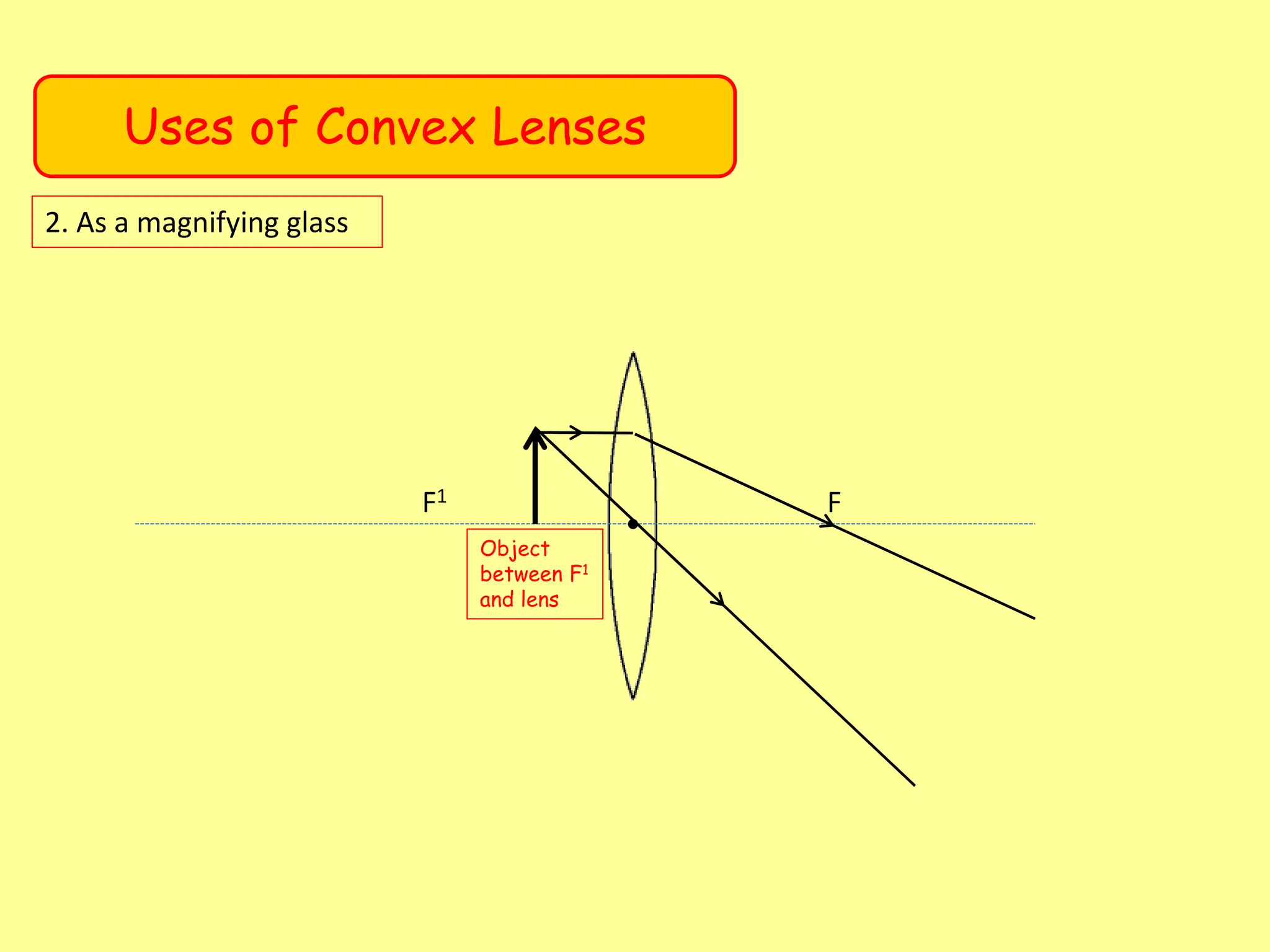
2. As a magnifying glass
F1 F
Object
between F1
and lens
Uses of Convex Lenses
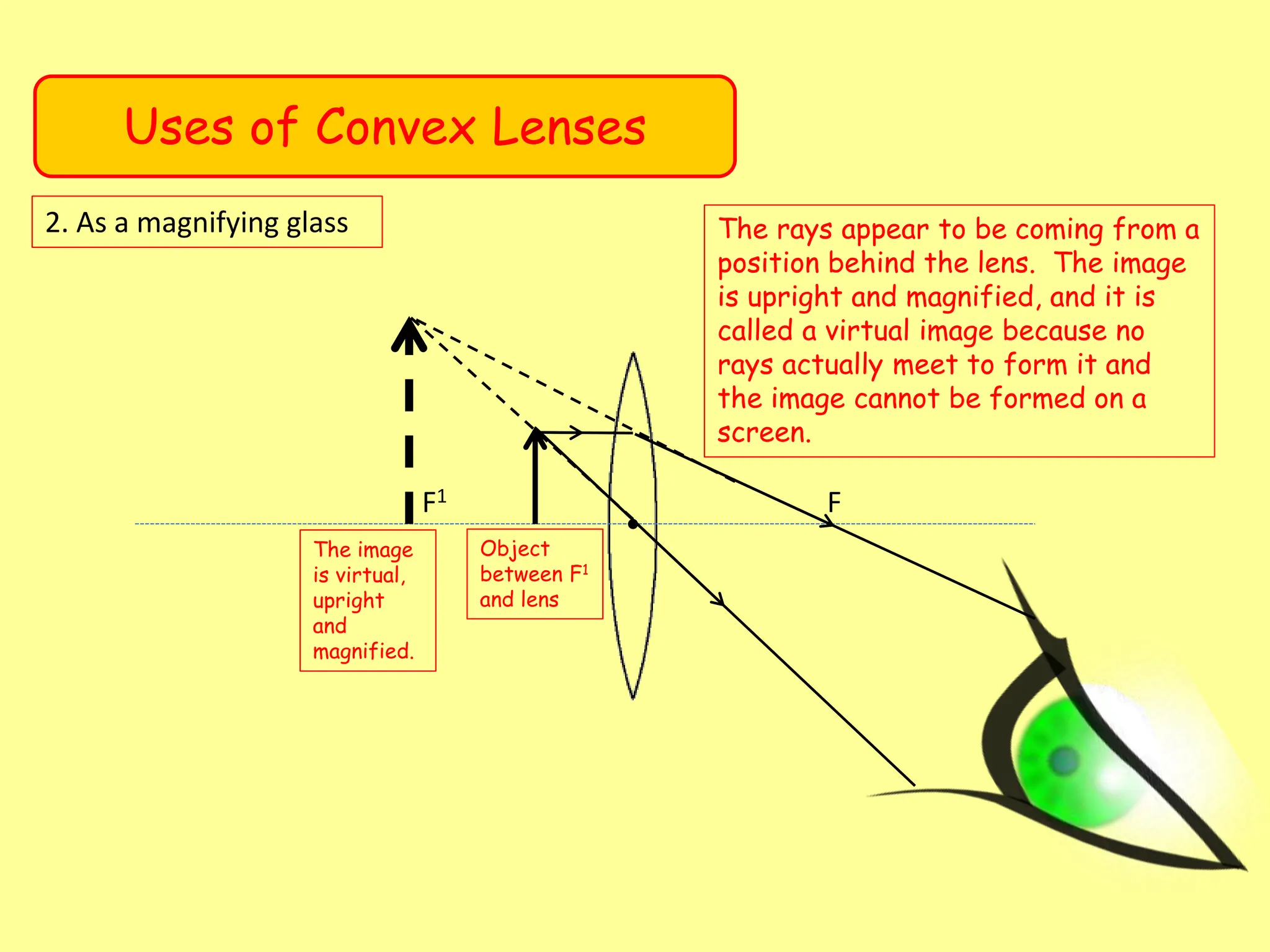
2. As a magnifying glass
F1 F
Object
between F1
and lens
The image
is virtual,
upright
and
magnified.
The rays appear to be coming from a
position behind the lens. The image
is upright and magnified, and it is
called a virtual image because no
rays actually meet to form it and
the image cannot be formed on a
screen.
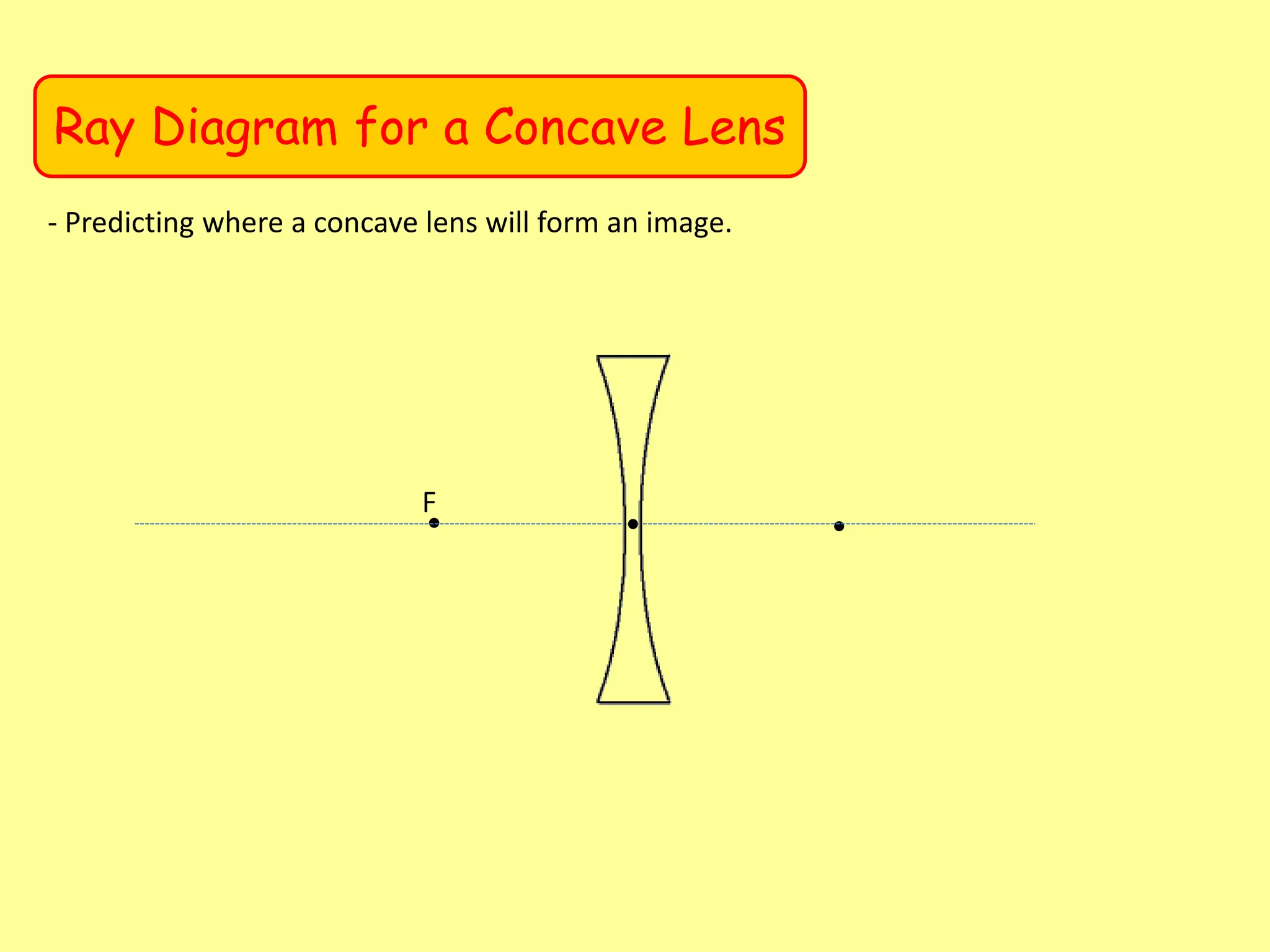
Ray Diagram for a Concave Lens
- Predicting where a concave lens will form an image.
F
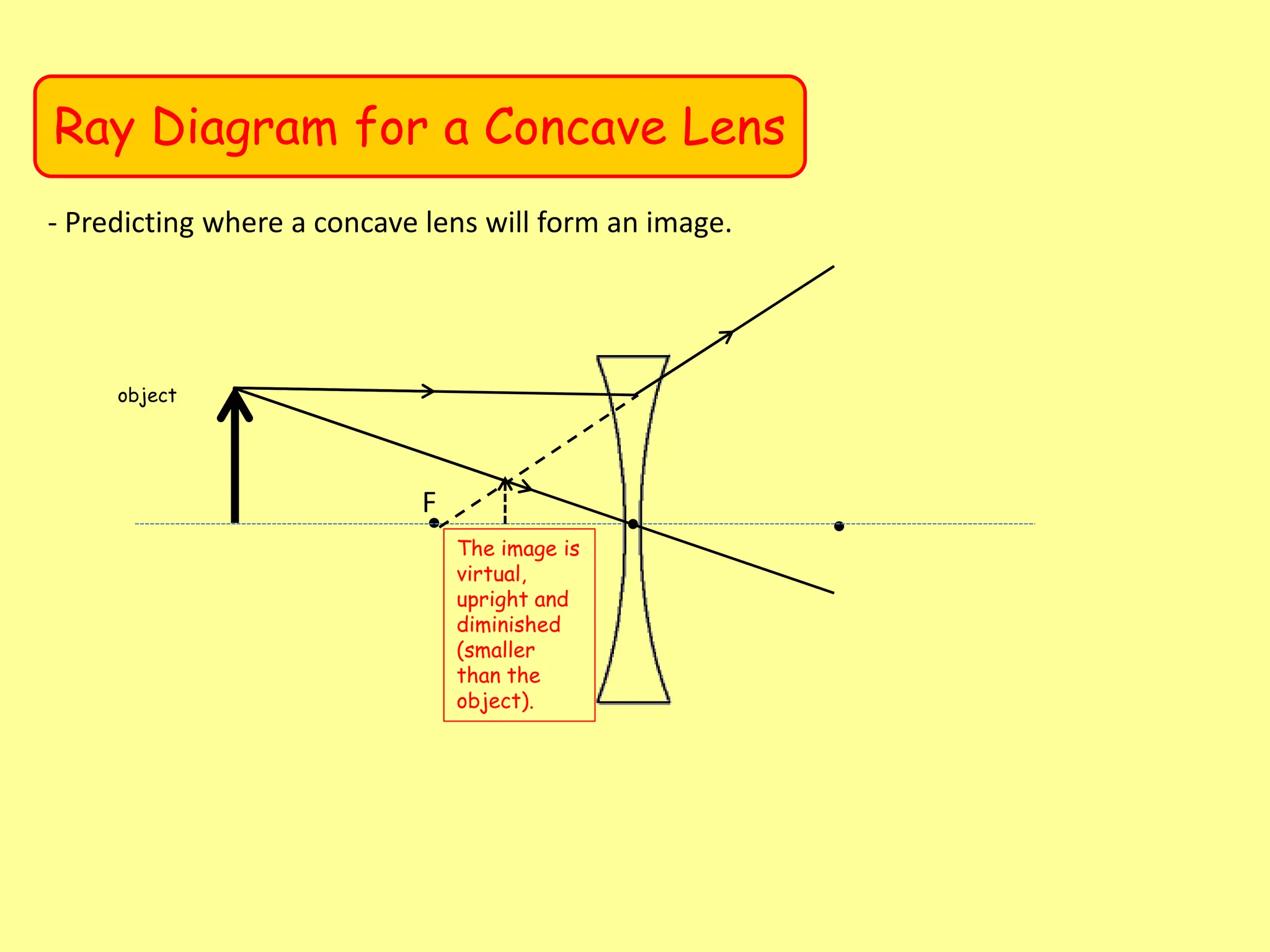
Ray Diagram for a Concave Lens
- Predicting where a concave lens will form an image.
F
object
The image is
virtual,
upright and
diminished
(smaller
than the
object).
LEARNING
OBJECTIVES
Core
•Describe the formation of an optical image by
a plane mirror, and give its characteristics
• Recall and use the law angle of incidence =
angle of reflection
Describe an experimental demonstration of
the refraction of light
• Use the terminology for the angle of
incidence i and angle of refraction r and
describe the passage of light through parallel-
sided transparent material
• Give the meaning of critical angle
• Describe internal and total internal
reflection
Describe the action of a thin converging lens
on a beam of light
• Use the terms principal focus and focal
length
• Draw ray diagrams for the formation of a
real image by a single lens
• Describe the nature of an image using the
terms enlarged/same size/diminished and
upright/inverted
Supplement
Describe the formation of an optical image by a
plane mirror, and give its characteristics
• Recall and use the law angle of incidence =
angle of reflection
Recall and use the definition of refractive
index n in terms of speed
• Recall and use the equation sin I / sin r=n
• Recall and use n = 1 / sin c
• Describe and explain the action of optical
fibres particularly in medicine and
communications technology
Draw and use ray diagrams for the formation of
a virtual image by a single lens • Use and
describe the use of a single lens as a
magnifying glass • Show understanding of the
terms real image and virtual image
PHYSICS – Total Internal Reflection and
Lenses
Physics 19 - Total Internal Reflection and Lenses.pptx

Physics 19 - Total Internal Reflection and Lenses.pptx

  • 1.
    PHYSICS – TotalInternal Reflection and Lenses
  • 2.
    LEARNING OBJECTIVES Core •Describe the formationof an optical image by a plane mirror, and give its characteristics • Recall and use the law angle of incidence = angle of reflection Describe an experimental demonstration of the refraction of light • Use the terminology for the angle of incidence i and angle of refraction r and describe the passage of light through parallel- sided transparent material • Give the meaning of critical angle • Describe internal and total internal reflection Describe the action of a thin converging lens on a beam of light • Use the terms principal focus and focal length • Draw ray diagrams for the formation of a real image by a single lens • Describe the nature of an image using the terms enlarged/same size/diminished and upright/inverted Supplement Describe the formation of an optical image by a plane mirror, and give its characteristics • Recall and use the law angle of incidence = angle of reflection Recall and use the definition of refractive index n in terms of speed • Recall and use the equation sin I / sin r=n • Recall and use n = 1 / sin c • Describe and explain the action of optical fibres particularly in medicine and communications technology Draw and use ray diagrams for the formation of a virtual image by a single lens • Use and describe the use of a single lens as a magnifying glass • Show understanding of the terms real image and virtual image
  • 3.
    Refraction of lightby a semi-circular block. Incident Ray Refracted Ray I R Angle of Incidence Angle of Refraction
  • 4.
    Refraction of lightby a semi-circular block. Incident Ray Refracted Ray I R Angle of Incidence Angle of Refraction When a ray of light travels through a semi-circular block, the ray will be refracted ………
  • 5.
    Refraction of lightby a semi-circular block. Incident Ray Refracted Ray I R Angle of Incidence Angle of Refraction When a ray of light travels through a semi-circular block, the ray will be refracted ……… Reflected Ray …… but there will also be some reflection.
  • 6.
    Refraction of lightby a semi-circular block. Incident Ray Refracted Ray Reflected Ray As the incident ray approaches the ‘critical angle’ (approximately 42o) the refracted ray travels at right- angles to the normal. There is now more internal reflection
  • 7.
    Refraction of lightby a semi-circular block. Incident Ray Reflected Ray If the incident ray now enters the block at an angle greater than the critical angle (42o) no light is refracted.
  • 8.
    Refraction of lightby a semi-circular block. Incident Ray Reflected Ray If the incident ray now enters the block at an angle greater than the critical angle (42o) no light is refracted. All light is now reflected at the boundary. This is known as TOTAL INTERNAL REFLECTION
  • 9.
    Refraction of lightby a semi-circular block. Incident Ray Reflected Ray If the incident ray now enters the block at an angle greater than the critical angle (42o) no light is refracted. All light is now reflected at the boundary. This is known as TOTAL INTERNAL REFLECTION Medium Critical angle Water 49o Perspex 42o Glass 41o Diamond 24o
  • 22.
  • 23.
    Refraction Calculations Snell’s Law Whenlight is refracted, an increase in the angle of incidence i produces an increase in the angle of refraction r. Supplement
  • 24.
    Refraction Calculations Snell’s Law Whenlight is refracted, an increase in the angle of incidence i produces an increase in the angle of refraction r. Supplement Sin i = constant Sin r
  • 25.
    Refraction Calculations Snell’s Law Supplement Air Glass i= 15o r = 10o sin 15o = 0.26 sin 10o = 0.17 = 1.5
  • 26.
    Refraction Calculations Snell’s Law Supplement Air Glass i= 15o r = 10o sin 15o = 0.26 sin 10o = 0.17 = 1.5 i = 45o r = 28o sin 45o = 0.71 sin 28o = 0.47 = 1.5
  • 27.
    Refraction Calculations Snell’s Law Supplement Air Glass i= 15o r = 10o sin 15o = 0.26 sin 10o = 0.17 = 1.5 i = 45o r = 28o sin 45o = 0.71 sin 28o = 0.47 = 1.5 i = 60o r = 35o sin 60o = 0.87 sin 35o = 0.57 = 1.5
  • 28.
  • 29.
    Refraction Calculations Snell’s Law Supplement …andRefractive Index Refractive Index = Sin i Sin r
  • 30.
    Refraction Calculations Snell’s Law Supplement …andRefractive Index Refractive Index = Sin i Sin r Air Water i = 45o RI = 1.33 ?
  • 31.
    Refraction Calculations Snell’s Law Supplement …andRefractive Index Refractive Index = Sin i Sin r Air Water i = 45o RI = 1.33 ? RI = sin i sin r 1.33 = sin 45o sin r sin r = sin 45o 1.33 sin r = 0.532 r = 32o
  • 32.
    Refraction Calculations Snell’s Law Supplement …andRefractive Index …and Critical Angles!
  • 33.
    Refraction Calculations Snell’s Law Supplement …andRefractive Index …and Critical Angles! If the angle of incidence is greater than the critical angle, we will get total internal reflection.
  • 34.
    Refraction Calculations Snell’s Law Supplement …andRefractive Index …and Critical Angles! Incident Ray Refracted Ray Critical angle c If the ray direction is reversed, the angle of incidence is now 90o, and the angle ‘c’ is now the angle of refraction (critical angle).
  • 35.
    Refraction Calculations Snell’s Law Supplement …andRefractive Index …and Critical Angles! Incident Ray Refracted Ray Critical angle c If the ray direction is reversed, the angle of incidence is now 90o, and the angle ‘c’ is now the angle of refraction (critical angle). RI = sin i = sin90o sin c sin c
  • 36.
    Refraction Calculations Snell’s Law Supplement …andRefractive Index …and Critical Angles! Incident Ray Refracted Ray Critical angle c If the ray direction is reversed, the angle of incidence is now 90o, and the angle ‘c’ is now the angle of refraction (critical angle). RI = sin i = sin90o sin c sin c RI = 1 sin c = 1 sin c RI
  • 37.
    Refraction Calculations Snell’s Law Supplement …andRefractive Index …and Critical Angles! Incident Ray Refracted Ray Critical angle c If the ray direction is reversed, the angle of incidence is now 90o, and the angle ‘c’ is now the angle of refraction (critical angle). RI = sin i = sin90o sin c sin c RI = 1 sin c = 1 sin c RI If the RI of glass = 1.5: sin c = 1 = 0.67 c = 42o 1.5
  • 38.
    Refraction Calculations Snell’s Law Supplement …andRefractive Index …and Critical Angles! Incident Ray Critical angle c If the RI of glass = 1.5: sin c = 1 = 0.67 c = 42o 1.5 The refractive index of a medium is usually denoted as ‘n’. For a medium of refractive index n: sin c = 1 n
  • 39.
    Refraction Calculations Snell’s Law Supplement …andRefractive Index …and Critical Angles! Incident Ray Critical angle c If the RI of glass = 1.5: sin c = 1 = 0.67 c = 42o 1.5 The refractive index of a medium is usually denoted as ‘n’. For a medium of refractive index n: sin c = 1 n eg. What is the critical angle for diamond if the refractive index (n) = 2.42? sin c = 1 = 1 = 0.413 critical angle for diamond = 24.4o n 2.42
  • 40.
    LEARNING OBJECTIVES Core •Describe the formationof an optical image by a plane mirror, and give its characteristics • Recall and use the law angle of incidence = angle of reflection Describe an experimental demonstration of the refraction of light • Use the terminology for the angle of incidence i and angle of refraction r and describe the passage of light through parallel- sided transparent material • Give the meaning of critical angle • Describe internal and total internal reflection Describe the action of a thin converging lens on a beam of light • Use the terms principal focus and focal length • Draw ray diagrams for the formation of a real image by a single lens • Describe the nature of an image using the terms enlarged/same size/diminished and upright/inverted Supplement Describe the formation of an optical image by a plane mirror, and give its characteristics • Recall and use the law angle of incidence = angle of reflection Recall and use the definition of refractive index n in terms of speed • Recall and use the equation sin I / sin r=n • Recall and use n = 1 / sin c • Describe and explain the action of optical fibres particularly in medicine and communications technology Draw and use ray diagrams for the formation of a virtual image by a single lens • Use and describe the use of a single lens as a magnifying glass • Show understanding of the terms real image and virtual image
  • 41.
  • 42.
    Lenses and Refraction Convexlens Concave lens Converging lens Diverging lens
  • 43.
    Lenses and Refraction Convexlens Concave lens Converging lens Diverging lens Principal focus Focal length
  • 44.
    Lenses and Refraction Convexlens Concave lens Converging lens Diverging lens Principal focus Focal length Principal focus Focal length
  • 45.
    Lenses and Refraction Convexlens What happens to light as it passes through the lens?
  • 46.
    Lenses and Refraction Convexlens What happens to light as it passes through the lens?
  • 47.
    Lenses and Refraction Convexlens What happens to light as it passes through the lens?
  • 48.
    Lenses and Refraction Convexlens What happens to light as it passes through the lens? As light passes through the first face of the lens it bends towards the normal (refraction)
  • 49.
    Lenses and Refraction Convexlens What happens to light as it passes through the lens? As light passes through the first face of the lens it bends towards the normal (refraction) As light passes through the second face of the lens it bends away from the normal (refraction)
  • 50.
    Lenses and Refraction Convexlens What happens to light as it passes through the lens? As light passes through the first face of the lens it bends towards the normal (refraction) As light passes through the second face of the lens it bends away from the normal (refraction)
  • 51.
    Lenses and Images ObjectConvex lens Image Rays from a distant object brought to focus on a screen by a convex lens.
  • 52.
    Lenses and Images ObjectConvex lens Image Rays from a distant object brought to focus on a screen by a convex lens. The image on the screen is real and inverted (upside- down)
  • 53.
    Lenses and Images ObjectConvex lens Image Rays from a distant object brought to focus on a screen by a convex lens. The image on the screen is real and inverted (upside- down) Light rays from a distant object are considered to be parallel to each other, so the image passes through the principal focus.
  • 54.
    Lenses and RayDiagrams - Predicting where a convex lens will form an image. F1 F
  • 55.
    Lenses and RayDiagrams - Predicting where a convex lens will form an image. F1 F Standard Ray 1 – passes through the centre of the lens object
  • 56.
    Lenses and RayDiagrams - Predicting where a convex lens will form an image. F1 F Standard Ray 1 – passes through the centre of the lens Standard Ray 2 – parallel to the principal axis, and then passes through F after leaving the lens. object
  • 57.
    Lenses and RayDiagrams - Predicting where a convex lens will form an image. F1 F Standard Ray 1 – passes through the centre of the lens Standard Ray 2 – parallel to the principal axis, and then passes through F after leaving the lens. Standard Ray 3 – passes through F1, and then leaves the lens parallel to the principal axis. object
  • 58.
    Lenses and RayDiagrams - Predicting where a convex lens will form an image. F1 F Standard Ray 1 – passes through the centre of the lens Standard Ray 2 – parallel to the principal axis, and then passes through F after leaving the lens. Standard Ray 3 – passes through F1, and then leaves the lens parallel to the principal axis. The image produced is real, inverted and smaller than the object. object
  • 59.
    Lenses and RayDiagrams - Predicting where a convex lens will form an image. F1 F Standard Ray 1 – passes through the centre of the lens Standard Ray 2 – parallel to the principal axis, and then passes through F after leaving the lens. Standard Ray 3 – passes through F1, and then leaves the lens parallel to the principal axis. The image produced is real, inverted and smaller than the object. object Only two of the standard rays are required to work out where they go.
  • 60.
    Lenses and RayDiagrams - Predicting where a convex lens will form an image. F1 F Standard Ray 1 – passes through the centre of the lens Standard Ray 2 – parallel to the principal axis, and then passes through F after leaving the lens. Standard Ray 3 – passes through F1, and then leaves the lens parallel to the principal axis. The image produced is real, inverted and smaller than the object. object Only two of the standard rays are required to work out where they go. As the object is moved closer towards the lens, the image becomes bigger and further away.
  • 61.
    Uses of ConvexLenses 1. In a projector
  • 62.
    Uses of ConvexLenses 1. As a magnifying glass F1 F Object between F1 and lens
  • 63.
    Uses of ConvexLenses 2. As a magnifying glass F1 F Object between F1 and lens
  • 64.
    Uses of ConvexLenses 2. As a magnifying glass F1 F Object between F1 and lens The image is virtual, upright and magnified. The rays appear to be coming from a position behind the lens. The image is upright and magnified, and it is called a virtual image because no rays actually meet to form it and the image cannot be formed on a screen.
  • 65.
    Ray Diagram fora Concave Lens - Predicting where a concave lens will form an image. F
  • 66.
    Ray Diagram fora Concave Lens - Predicting where a concave lens will form an image. F object The image is virtual, upright and diminished (smaller than the object).
  • 67.
    LEARNING OBJECTIVES Core •Describe the formationof an optical image by a plane mirror, and give its characteristics • Recall and use the law angle of incidence = angle of reflection Describe an experimental demonstration of the refraction of light • Use the terminology for the angle of incidence i and angle of refraction r and describe the passage of light through parallel- sided transparent material • Give the meaning of critical angle • Describe internal and total internal reflection Describe the action of a thin converging lens on a beam of light • Use the terms principal focus and focal length • Draw ray diagrams for the formation of a real image by a single lens • Describe the nature of an image using the terms enlarged/same size/diminished and upright/inverted Supplement Describe the formation of an optical image by a plane mirror, and give its characteristics • Recall and use the law angle of incidence = angle of reflection Recall and use the definition of refractive index n in terms of speed • Recall and use the equation sin I / sin r=n • Recall and use n = 1 / sin c • Describe and explain the action of optical fibres particularly in medicine and communications technology Draw and use ray diagrams for the formation of a virtual image by a single lens • Use and describe the use of a single lens as a magnifying glass • Show understanding of the terms real image and virtual image
  • 68.
    PHYSICS – TotalInternal Reflection and Lenses