INTRODUCTION
0 1 23 4 5 6
1
2
3
4
5
6
Natural Numbers (N)
Counting numbers are known as natural numbers. N = {1, 2, 3, 4, ……….}
Whole Numbers (W)
All natural numbers together with 0 form whole numbers. W = {0, 1, 2, 3, 4, ……….}
Integers (I or Z)
All natural numbers, 0 and the negatives of natural numbers form the collection of integers.
Z = {, …….4, 3, 2, 1, 0, 1, 2, 3, 4, ……}
Rational Numbers (Q)
The number of the form
p
q , where p and q are integers and q 0 and
p
q is in the lowest form i.e., p and q
have no common factor, is called a rational number.
i.e., All integers and fractions are rational numbers. The set of rational numbers is denoted by Q. A rational
numbers is said to be positive if its numerator and denominator are either both positive or both negative.
E.g. 2/3, 0, 1, 3/4 etc.
IRRATIONAL NUMBERS, REAL NUMBERS AND THEIR DECIMAL
EXPANSIONS
Irrational Numbers
The number which cannot be expressed in the form
p
q , where p and q are integers and q 0 and
p
q is in
the lowest form i.e., p and q have no common factor, is called an Irrational Number.
E.g. 2, 3, , 5,1.02002000200002......
etc.
Note: Decimal representation is non-terminating and non-repeating.
2.
2
Class IX: NumberSystem Mathematics
Real Numbers
The collectionofrationaland irrationalnumbers are called realnumbers and is denotedbyR.
0 1 2 3 4 5 6
1
2
3
4
5
6
Negative side Positive side
A real number can be represented as a point on a line. This line is called real line or number line.
Note: (i) Terminating Decimal : Every fraction p/q can be expressed as a decimal. If the
decimal expression of p/q terminates i.e. comes to an end then the decimal so
obtained is called terminating decimal.
(ii) Adecimal number in which a digit or a set of digits repeats regularly, over a constant
period is called a recurring decimal or periodic decimal.
Example: 2.33….. = 2. 3 ; 8.6232323…….. = 8.623
(iii) A decimal fraction in which all the figure or digits occur repeatedly is called pure
recurring decimal.
Example: 2.3333... , 17.444... etc.
(iv) A decimal number in which some of the digits do not recur is called a mixed
recurring.
(v) A decimal number in which there is no any regular pattern of repetition of digits
after decimal point is called a non-recurring decimal.
Example: 3.143678..., 2.767834... etc.
(vi) A number which can neither be expressed as a terminating decimal nor as a repeating
decimal is called an irrational number.
Example: 2 = 1.4142135 ... , 3 = 1.7320508 ... .
(vii)If a + b is an irrational number then a - b is called its conjugate irrational
number or conjugate.
OPERATION ON IRRATIONAL NUMBERS
(i)
1/n
n n n
x. y xy or xy
(ii)
1/n
n
n
n
x x x
or
y y
y
(iii) n m m/n
x x
(iv)
1/mn
m n
n mn m
x x x or x
(v)
1/m 1/mn
a a/m an/mn an
x x x x
3.
Class IX: NumberSystem Mathematics
3
LAWS OF EXPONENTS FOR REAL NUMBERS
(i) am
. an
= am + n
(ii) (am
)n
= amn
(iii)
m
m n
n
a
a ,m n
a
(iv) am
.bm
= (ab)m
(v) a0
= 1
(vi) n
n
1
a
a
(vii) 1/n
n
a a
EUCLID’S DIVISION LEMMA AND ALGORITHM
Euclid’s Division Lemma
For any two given positive integers ‘a’ and ‘b’, there exist unique integers ‘q’ and ‘r’ such that a = bq + r,
0 r < b. ‘a’ and ‘b’ are called dividend and divisor respectively, ‘q’ and ‘r’ are called quotient and remainder
respectively. Thus, dividend = (divisor quotient) + remainder.
Remark: (i) The above lemma is a restatement of long division process
(ii) ‘q’ or ‘r’ can also be zero.
H.C.F. of two numbers a and b by Euclid’s Division Algorithm
Step 1: Apply theAlgorithm to a and b.
a = bq + r1
(0 r1
< b)
Step 2: If 1
r 0
, then b is the HCF of a and b.
Step 3: If 1
r 0
, then apply the Algorithm to divisor b and remainder r1
.
1 2
b rs r
Step 4: Continue the process till the remainder become zero.
Here the last divisor will be the HCF of a and b.
THE FUNDAMENTAL THEOREM OF ARITHMETIC
Theorem : Every composite number can be expressed (factorized) as a product of primes, and this
factorization is unique, apart from the order in which the prime factors occur.
REVISITING RATIONAL, IRRATIONAL NUMBERS AND THEIR DECIMAL
EXPANSION
Theorem 1: Let
p
x
q
be a rational number, such that the prime factorization of q is of the form 2n
5m
,
where n, m are non-negative integers. Then x has a decimal expansion which terminates.
Theorem 2 : Let
p
x
q
be a rational number, such that the prime factorization of q is not of the form
2n
5m
, where n, m are non-negative integers. Then x has a decimal expansion which is
non-terminating repeating (recurring).
4.
4
Class IX: NumberSystem Mathematics
SOLVED EXAMPLES
Example 1: Express 0.47 is the form
p
q , where p and q are integers and q 0
Solution: Let x = 0.47
x = 0.4777 ... (1)
Multiplied (1) by 10
10x = 4.777... (2)
Now (2) multiplied by 10 again
100x = 47.777 .. (3)
Subtract (2) from (3)
90x 43
x =
43
90
43
0.47
90
.
Example 2: Prove that 2 is not a rational numbers.
Solution: We shall prove this by the method of contradiction.
If possible, let us assume that 2 is a rational number, then
2 =
p
q , where p and q are integers having no common factor other than 1 and q 0.
2
2
p
2
q
(squaring both the side) 2q2
= p2
... (1)
p2
is even integer
p is an even integer
(If p is not even. Then p = 2m + 1, m Z, p2
= (2m + 1)2
= 4m2
+ 4m + 1, which is odd, thus
is a contradiction of the fact that p2
is even)
p = 2m where m is an integer p2
= 4m2
.... (2)
from (1) and (2), 2q2
= 4m2
q2
= 2m2
q2
is an even integer q is an even integer
So both p and q are even integers and therefore have a common factor 2. But this contradicts
the fact that p and q have no common factors other than 1.
Hence, 2 is not a rational number, it is irrational.
Example 3: Simplify:
n 1 n
n 2 n 2
16 2 4 2
16 2 2 2
.
Solution:
n 1 n
n 2 n 2
16 2 4 2
16 2 2 2
=
4 n 1 2 n
4 n 2 n 2
2 2 2 2
2 2 2 2
=
n 5 n 2
n 6 n 3
2 2
2 2
=
n 5 n 2
n 5 n 2
2 2
2.2 2.2
=
1
2
.
Example 4: Write the rationalizing factor of the following and then rationalize:
(a) 27 (b) 3
16
5.
Class IX: NumberSystem Mathematics
5
Solution (a) 27 3 3
1/2
3 3
Rationalizing factor =
1
1
1/2
2
3 3 3
2
3 3 3 3 3 3 3 9,
which is a rational number.
.
(b) 1/3
3 3
3
16 2 2 2 2 2 2 2.2
1/3
3
2 2
Rationalizing factor of
1
1
2/3
3 3
2 2 2
Now, 1/3 2/3
2.2 2 2 2 4
, which is a rational number.
.
Hence,
1/3
2/3 2 3
2 2 4
which is the rationalizing factor.
.
Example 5: Prove that :
1 1 1 1 1
5
3 8 8 7 7 6 6 5 5 2
Solution: Rationalizing the denominator of each term on the left hand side, we have
L.H.S. =
1 3 8 1 8 7 1 7 6
3 8 3 8 8 7 8 7 7 6 7 6
1 6 5 1 5 2
6 5 6 5 5 2 5 2
2 2 2 2 2 2 2 2 2
2
3 8 8 7 7 6 6 5 5 2
3 8 8 7 7 6 6 5 5 2
=
3 8 8 7 7 6 6 5 5 2
9 8 8 7 7 6 6 5 5 4
=
3 8 8 7 7 6 6 5 5 2
3 8 8 7 7 6 6 5 5 2 3 2 5
IMPORTANT DEFINITIONS
A number is called a rational number, if it can be written in the form p/q, where p and q are
integers and 0
q .
A number which cannot be expressed in the form p/q (where, p and q are integers and
0
q ) is called an irrational number.
.
All rational numbers and all irrational numbers together make the collection of real numbers.
Decimal expansion of a rational number is either terminating or non-terminating recurring, while
the decimal expansion of an irrational number is non-terminating non-recurring.
If r is a rational number and s is an irrational number, then r + s and r – s are irrationals.
Further, if r is a non-zero rational, then rs and
r
s
are irrationals.
6.
6
Class IX: NumberSystem Mathematics
1. A rationalnumber between 2 and 3 is
(a) 1.5 (b)
2 3
2
(c)
2 3
2
(d) 1.8
2. Whichofthefollowing is irrational
(a) 0.14 (b) 0.1416
(c) 0.1416 (d) 0.4014001400014…..
3. If
7 5
7 5
7 5
7 5
=
7 5
a
11
, then a
(a) 0 (b) 1 (c) 2 (d) 3
4. What is the value of
8 13
2 2
5 5
(a)
1
2
(b) 1 (c)
3
2
(d)
5
5
2
5. Whichofthefollowing willchange into a terminating decimal?
(a)
7
12
(b)
5
44
(c)
13
125
(d)
2
9
6. If
3 2
x
3 2
and y =
3 2
3 2
, find the value of 2 2
x y
(a) 96 (b) 98 (c) 10 (d) 2 2
7. Which ofthe following is equalto x
(a)
12 5
7 7
x x
(b) 4 1/3
12
(x ) (c)
2
3 3
( x ) (d)
12 7
7 12
x x
8. If a 5 2 6
and
1
b
a
, then 2 2
a b
(a) 49 (b) 98 (c) 100 (d) 102
9.
1
3
2
0
2
1
9 3 5
81
(a) 15 (b) 0 (c) 12 (d) 1
10. If 3 3 3
2 189 3 875 7 56
is simplified, then the resultant answer is
(a) 3
8 7 (b) 3
6 7 (c) 3
7 7 (d) 3
9 7
7.
Class IX: NumberSystem Mathematics
7
LEVEL - I
1. The product of any two irrational numbers is:
(a) always an irrational number (b) always a rational number
(c) always an integer (d) sometimes rational, sometimes irrational
2. The decimal expansion of the number 2 is:
(a) a finite decimal (b) 1.41421
(c) non-terminating recurring (d) non-terminating recurring
3. Which of the following is irrational?
(a)
4
9
(b)
12
3
(c) 7 (d) 81
4. The value of 23.43 is in the form of
p
q , is
(a)
232
99
(b)
2320
99
(c)
232
9
(d)
2320
9
5. The value of 1.999... in the form ,
p
q
where p and q are integers and 0
q , is
(a)
19
10
(b)
1999
1000
(c) 2 (d)
1
9
6. The number obtained on rationalising the denominator
1
7 2
is
(a)
7 2
3
(b)
7 2
3
(c)
7 2
5
(d)
7 2
45
7.
1
9 8
is equal to
(a)
1
3 2 2
2
(b)
1
3 2 2
(c) 3 2 2
(d) 3 2 2
8. The value of
32 48
8 12
is equal to
(a) 2 (b) 2 (c) 4 (d) 8
9. If 2 1.4142,
then
2 1
2 1
is equal to
(a) 2.4142 (b) 5.8282 (c) 0.4142 (d) 0.1718
10. 4 2
2
2 equals
(a)
1
6
2
(b)
6
2
(c)
1
4
2 (d) 26
8.
8
Class IX: NumberSystem Mathematics
11. The product 3 4 12
2 2 32
equals
(a) 2 (b) 2 (c) 12
2 (d) 12
32
12. If 2 3 2 3
,
xy a yz b
and 2 3
zx c
then 3
z equals :
(a)
4
2
bc
a
(b)
4
2
b c
a
(c)
4 4
2
b c
a
(d)
4
2
ab
c
13. If
2
2 9 1
3 81
x x
, then x is:
(a)
1
4,
2
(b)
1
2,
4
(c) 2, 1 (d) Both (a) and (b)
14. If 7 6
A and 6 5
B , then
(a) A > B (b) A = B (c) A < B (d)
A B
15. The value of
1
5 2 6
is
(a) 2 (b) –1 (c) 3 2
(d) 1
16. The value of expression
0 1
1 3 1
3
(0.6) (0.1)
3 3 1
2 2 3
is
(a)
3
2
(b)
2
3
(c)
3
2
(d)
9
4
17. The decimal expansion of the rational number 2
33
2 .5
will terminate after
(a) one decimal place (b) two decimal place
(c) three decimal place (d) more than 3 decimal places
18. For some integer m, every even integer is of the form
(a) m (b) m + 1 (c) 2m (d) 2m + 1
19. For some integer q, every odd integer is of the form
(a) q (b) q + 1 (c) 2q (d) 2q + 1
20. n2
– 1 is divisible by 8, if n is
(a) an integer (b) a natural number (c) an odd integer (d) an even integer
21. The product of a non-zero rational and an irrational number is
(a) always irrational (b) always rational (c) rational or irrational (d) none
22 If
6
3 2 3
3 2 2 3
a then a is
(a) –2 (b) +2 (c) 3 (d) –3
9.
Class IX: NumberSystem Mathematics
9
23. Value of
1
3 4
1 1
3 3
5 8 27
is
(a) 2 (b) 5 (c) 3 (d) 4
24. Value of
3
2
4
(256)
is
(a)
1
2
(b) 2 (c) 3 (d)
1
3
25. Value of
1
3 3 3 2
(1 2 3 )
is
(a) 2 (b) 3 (c) 5 (d) 6
LEVEL - II
26. The value of
1 1
1 1 1 1
a a
a b a b
is
(a)
2
2 2
b
b a
(b)
2
2 2
a
2b a
(c)
2
2 2
2a
b a
(d)
2
2 2
2b
b a
27. If
1
x
2 3
, then the value of 3 2
x 2x 7x 5
is
(a) 1 (b) 2 (c) 3 (d) 4
28. If
2 5
a
2 5
and
2 5
b
2 5
, then the value of 2 2
a b
is
(a) 144 5 (b) 144 5
(c) 5 (d) 144
29. The value of
2n 3 n 2
n 1 2/3
7 (49)
((343) )
is equal to
(a) 39
(b) 42
(c) 44
(d) 45
30. Value of
1 1 1
1 2 2 3 3 4
+
1
4 5
+
1 1
5 6 6 7
+
1 1
7 8 8 9
(a) 2 (b) 3 (c) 4 (d) 5
31. Find the value of
160 160 160 160 160 160
2 7 7 12 17 12 17 22 22 27 27 32
(a) 17 (b) 15 (c) 13 (d) 11
32. Radhica has two ribbons which are 80 cm and 96 cm long. She has to cut them into equal pieces to
make bows. What is the length of the longest piece of ribbon that she can cut, so that no ribbon is
wasted?
(a) 16 (b) 15 (c) 14 (d) 13
10.
10
Class IX: NumberSystem Mathematics
33. ln a problem involving division, the divisor is eight times the quotient and four times the remainder. If
the remainder be 12, then the dividend is
(a) 400 (b) 342 (c) 300 (d) 450
34. If 3 3 3 3
1 2 3 ... 10
= 3025 then 4 + 32 + 108 + … + 4000 is equal to
(a) 1200 (b) 12100 (c) 12200 (d) 12400
35. If 3 3
x 4 2 1
, then the value of 2 3
3 3 1
x x x
is
(a) 1 (b) 0 (c) 1 (d) 3
3 3
36. If 60a
= 3 and 60b
= 5, then the value of
1 a b
2 1 b
12
is
(a) 60 (b) 3 (c) 2 (d) 5
37. If
7 5
x
7 5
, then the value of
2017
2
x 12x 1
is
(a) 1 (b) 0 (c) 1
(d)
1
8
38. If N = 1 + 11 + 111 + ….. + 1111111111
The sum of digits of N is in the form of ab. Average of a and b is
(a) 3 (b) 4 (c) 6 (d) 5
39. The value of 3 3
20 14 2 20 14 2
is
(a) 2 2
(b) 2 2
(c) 4 (d) 4
40. (Oddeven + evenodd) + even is always:
(a) either even or odd (b) even (c) odd (d) None of these
41. X, Y, Z are distinct integers, X and Y are even and ‘Z’ is odd. Also ‘Y’ is a negative number and X
and Z are positive: Which of these is not true?
(a) (X - Y)3
Z2
is even (b) (X + Z)
2
Y is negative and even
(c) (X + Y + Z)
3
Y
3
is odd (d) (X - Z)
2
Y
2
is even
42. If ax = b, by = c, cz = a, then find the value of xyz
(a) 0 (b) 1 (c) 2 (d) None of these
43. If N is a natural number, then how many values of ‘N’ are possible such that
2
15 13 36
N N
N
is
also a natural number
(a) 8 (b) 9 (c) 10 (d) 6
44. Find the values of x and y such that the number 56129137X51Y is divisible by 88
(a) 2, 2 (b) 4, 2 (c) 4, 4 (d) none of these
11.
Class IX: NumberSystem Mathematics
11
45. Find the value of
1 1 2 1 1 2
1 1 1 1
3 3 3 3 3 3
2 2 2 2
(a b )(a b ) (a b )(a a b b )
(a) 1 (b) a (c) 2a (d) b
46. Find the value of
2 9
3
3
3 2
1 3 4 2
4 16 x x
9 16 x 2 3
(a) 1 (b) 2 (c) 3 (d) None of these
47. What is the remainder when 784 is divided by 2402?
(a) 1 (b) 6 (c) 2401 (d) None of these
48. What is the remainder in
643
2
?
96
(a) 32 (b) 95 (c) 1 (d) None of these
49. What are the last two digits of x,
if x = (113 + 123 + 133 + 143)(573 – 553)
(a) 00 (b) 30 (c) 40 (d) 55
50. Find the remainder if 3040 is divided by 17
(a) 16 (b) 1 (c) 4 (d) 17
51. x = remainder when (1! + 2! + 3! + … 100!) is divided by 15. Find x
(a) 3 (b) 4 (c) 5 (d) 9
52. What is the remainder when 7413 – 4113 + 7513 – 4213 is divided by 66?
(a) 2 (b) 0 (c) 1 (d) 65
53. What is the remainder when 82361 + 83361 + 84361 + 85361 + 86361 is divided by 7?
(a) 2 (b) 0 (c) 5 (d) None of these
54. 3324 – 1724 is atleast divisible by
(a) 450 (b) 800 (c) 40,000 (d) 250
55. Find the unit digit of 269 × 368 × 767
(a) 2 (b) 3 (c) 6 (d) None of these
56. Find the unit digit of
8
9
12
23
7
(a) 7 (b) 9 (c) 1 (d) 3
57. What is the right most non-zero digit of the number N where N = (6! + 7! + 8! + 9! + 10!)131!?
(a) 2 (b) 3 (c) 4 (d) 6
58. What is the unit’s digit of
1781 + 2781 + 3781 + …… + 9781
(a) 1 (b) 3 (c) 5 (d) 7
59. How many zeroes are there at the end of 200!
(a) 48 (b) 49 (c) 24 (d) None of these
12.
12
Class IX: NumberSystem Mathematics
60. (3x – 2y) : (2x + 3y) = 5 : 6 then one of the values of
2
3 3
3 3
x y
x y
is:
(a)
1
25
(b) 5 (c)
1
5
(d) 25
MULTIPLE CORRECT ANSWER TYPE
This section contains multiple choice questions. Each question has 4 choices (A), (B), (C), (D), out
of which ONE or MORE is correct. Choose the correct options.
61. Which is not the rationalizing factor of 1 + 2 3
?
(a) 1 + 2 3
(b) 2 (c) 4 (d) 1 2 3
62. Evaluate
2
3
1
64
(a) 4 (b) 16 (c) 32 (d) 4
1
2
63.
n 3 n
(2n 2)
2 2(2 )
2
when simplified is
(a) 1 - 2(2n
) (b) 2n+3
-
1
4
(c) n 1
3
2 (d) n 2
6
2
64. Which of the following is not the value of b in
3 1
a b 3
3 1
(a) 2 (b) –1 (c) –3 (d) 4
65. Which of the following is equal to
5 2 5 2
5 2 5 2
(a) 8 5 (b) 8 5
(c) 5 2 (d) 320
MATRIX MATCH TYPE
66. Match the column
Column I Column II
(A) Integer (p) positive integer
(B) Zero (q) Irrational number
(C) natural number (r) whole number
(D) sum of a rational and irrational number (s) rational number
(a) (A- p), (B - r), (C - q), (D – s) (b) (A- s), (B - r), (C - p), (D – q)
(c) (A- r), (B - s), (C - p), (D – q) (d) (A- s), (B - q), (C - p), (D – r)
13.
Class IX: NumberSystem Mathematics
13
67. Match the column
Column I Column II
(A)
1
2 3
(p) 2
(B) 641/2
(q) 561/2
(C) 161/4
(r) 8
(D) 71/2
81/2
(s) 2 - 3
(a) (A- p), (B - r), (C - q), (D – s) (b) (A- s), (B - q), (C - p), (D – r)
(c) (A- r), (B - s), (C - p), (D – q) (d) (A- s), (B - r), (C - p), (D – q)
68. Match the column
Column - I Column - II
(A) If
3
2
x , the value of
1 1
1 1 1 1
x x
x x
(p)
9
4
(B) If
x
x x
x x x
, then the value of x is (q)
4
3
(C) If
5 1 5 1
,
5 1 5 1
a b
then the value of
2 2
2 2
a ab b
a ab b
(r)
1
8
(D) For what value of ‘a’ is
2
1
4
x x a
a perfect square (s)
7
3
(a) (A- s), (B - p), (C - q), (D – r) (b) (A- p), (B - q), (C - r), (D – s)
(c) (A- r), (B - s), (C - p), (D – q) (d) (A- r), (B - s), (C - p), (D – q)
69. Match the column
Column - I Column - II
(A) If 3 2 2
x , then the value of
6 4 2
3
1
x x x
x
is (p) 2
(B) Value of
1
x
x
when 3 2 2
x (q) 1.4
(C) Value of
1 1
2 2
1 1
3 4
(6.25) (0.0144) 1
(0.027) (81)
is (r) 4
(D) Value of 2 2 2 ...
is (s) 204
(a) (A- s), (B - p), (C - q), (D – r) (b) (A- p), (B - q), (C - r), (D – s)
(c) (A- r), (B - s), (C - p), (D – q) (d) (A- r), (B - s), (C - p), (D – q)
14.
14
Class IX: NumberSystem Mathematics
70. Match the column
Column - I Column - II
(A) Value of
3 3
3 2 2 3 2 2
(p) 330
(B) Value of
1 1
2 3 5 2 3 5
is (q) 7
(C) Value of
2 2 2 2 2
6 7 8 9 10
7 4 3 4 2 3
is (r)
1
2
(D) 11 112 343
n , then the value of n is (s) 198
(a) (A- s), (B - p), (C - q), (D – r) (b) (A- s), (B - r), (C - p), (D – q)
(c) (A- p), (B - q), (C - r), (D – s) (d) (A- r), (B - s), (C - p), (D – q)
INTEGER ANSWER TYPE
The answer to each of the questions is a single-digit integer, ranging from 0 to 9.
71. Express 0.99999 ….. in the form
p
q ,
72. Evaluate 255
260
- 297
´ 218
.
73. If 25x-1
= 52x-1
- 100, find the value of x.
74. If
2 n
n 2 n/2
3m 3
9 3 3 27 1
3 2 27
then the value of m - n.
75. Find the value of x, if 5x-3
.32x-8
= 225.
76. If 272n – 1
= (243)3
, then find the value of n
77. Find the value of 3 3 8 7 4 3
78. Find the value of
2 2
3 3 3 3 3
3.5 2.5 3.5 8.75 2.5
79. Evaluate:
1/2
9/4 2
2
4 2.2
8
2 2
80. Find the value of ‘a’ of 3 3/2 2
5 5 5 5 5a
16
Class IX: NumberSystem Mathematics
HINTS AND SOLUTION
EXERCISE (Single Correct Type)
LEVEL - II
31. (b)
1 1 1 1 1 1 1 1
32 ..... 32 15
2 7 7 12 27 32 2 32
32. (a) HCF of 80 & 96 is 16
33. (c) Let quotient = x.
According to question,
Devisor = 8x, Remainder = 2x (Given, R = 2x or, 2x = 12, so, x = 6)
Dividend = Divisor × Quotient + Remainder
= 8x × x + 2x = 8 × 6 × 6 + 2 × 6 = 300
34. (b) 4(1 + 23
+ 33
+ …. + 103
) = 4 3025 = 12100
35. (a) 3 3
x 4 2 1
3 3
3 3
2 1 x 2 1
x = 3
1
2 1
3
1
2 1
x
We can find 2
x and 3
x with the help of x.
3 3
2
1
4 2 2 1
x
3 3
3
1
1 3 4 3 2
x
2 3
3 3 3
1
x x x
36. (c) a
60 3
, b
60 5
, a b
60 15
b
60
12
60
1 b
60 12
1 b
a
60
4
60
1 a b
60 4
1 b
60 12
1
1 b
12 60
1 a b
1 a b 1/2
1 a b
2
2 1 b
12 60 60 2
38. (d) Arrange the numbers in column and add them.
The sum is 1234567900.
sum of digits = 37.
Average of a and b is (10/2) = 5.
17.
Class IX: NumberSystem Mathematics
17
40. (c) Oddeven + evenodd = odd + even = odd
41. (c) (X – Y)3
Z2
= even = true
(X + Z)
2
Y = even = true
(X + Y + Z)
3
Y
3
= odd = false
(X – Y)
2
Y = even = true.
42. (b) b = c1/y = ax
1
xy
c a
1
z
xy
c c
1
z
xy
xyz = 1.
43. (b)
2
15N 13N 36
2
36
N
should be integer. Therefore, ‘N’ should be a factor of 36. Therefore ‘9’ factors of 36.
44. (d) 56129137x51y is divisibleby 88
Therefore Y = 2
5 + 1 + 9 + 3 + X +1 = 6 + 2 + 1 + 7 + 5 + Y
19 + X = 21 + Y
Y = 2, there X = 4.
47. (c)
84 4 21 21
7 (7 ) (2402 1)
2402 2402 2402
= (–1)21
or 2401.
48. (a)
643 5 638 638 638
5
2 2 2 2 (3 1)
96 3 3
2 3
= (–1)368 = 1
Hence the remainder is 1 × 32 = 32.
49. (a) The last two digits of
113 + 123 + 133 + 143 is
31 + 28 + 97 + 44 = 00.
50. (d)
40 40 40 80 4 20 20
30 (34 4) ( 4) 2 (2 ) (17 1)
17 17 17 17 17 17
= 1.
51. (a) All the number from 5! will be divisible by 15.
1! 2! 3! 4!
15
33
15
Remainder is 3.
52. (b) 7413 – 4113 and 7513 – 4213 is divisible by 33.
We know that 7413 – 4113 + 7613 – 4213 is even also divisible by 33.
Also divisible by 66.
18.
18
Class IX: NumberSystem Mathematics
53. (b) 83361 + 85361 is divisible by 7.
84361 is also divisible by 7.
82361 + 86361 is divisible by 7.
Remainder is zero.
54. (b) 3324 – 1224
= (3312 – 1712)(3312 + 1712)
= (336 – 176)(336 + 176)(3312 + 1712)
= (333 – 173)(333 + 173)(336 + 176)(3312 + 1712)
= (33 – 17)(332 × 33 × 17 + 172)(33 + 17)
(332 – 33 × 17 + 172)(336 + 176)(3312 + 1712)
It is atleast divisible by (33 – 17)(33 + 17)
= 16 × 50
= 800.
55. (c) Unit digit of 269 × 368 × 767 will be
2 × 1 × 3 = 6.
56. (a)
8
9
12 even 2
23 23 23
7 7 7
= 7529
Unit digit is 7.
57. (d) N = (6! + 7! + 8! + 9! + 10!)131
We will calculate the first non zero digit of 6!, 7!, 8!, 9! and 10!.
For 6! = 20(Last two digits)
7! = 40 “
8! = 20 “
9! = 80 “
10! = 00 “
(2 + 4 + 2 + 8)131!
= (16)1316
= 6.
58. (c) 1781 + 2781 + … 9781
1 + 2 + 3 + … 9 = 45
Unit digit is 5.
59. (b) = 40 + 8 + 1 = 49.
19.
19
Polynomials
An expression ofthe form of a0xn
+ a1xn–1
+ a2xn–2
+ .... + an = f (x), where a0, a1, a2, ..., an are real
numbers, n is non-negative integer and a0 0, is called polynomial of degree n.
For example: (i) f (x) = x – 3 is a polynomial of degree 1.
(ii) g(x) = x2
+ 3x + 7 is a polynomial of degree 2 and so on.
Note-1: In the above definition a0, a1, a2, ...., an are known as the co-efficients of the polynomial.
Note-2: If all ai’s are integers then f (x) is called polynomial with integral co-efficients.
Note-3: Every non-zero real number is a polynomial of degree zero and it is called theconstant polynomial.
Note-4: The constant polynomial 0 is called the zero polynomial. Its degree is not defined.
Note-5: A polynomial of degree 1 is called a linear polynomial, e.g., x + 2, 4x + 3, y – 2 etc.
Note-6: A polynomial of degree 2 is called a quadratic polynomial, e.g., x2
+ 2, 4x2
+ 3x, y2
– 2y + 4
etc.
Note-7: A polynomial of degree 3 is called a cubic polynomial, e.g., x3
+ 2, 4x3
+ 3x2
, y3
– 2y + 3,
x3
+ 3x2
+ 3x + 1 etc.
Zero of a Polynomial
If g(x) is a polynomial and if k is any constant then value obtained by replacing x by k in g (x) is called the
value of g(x) at x = k. But when g (k) becomes 0 i.e., g (k) = 0, then k is called the zero of the
polynomial g (x) e.g., x = 2 is the zero of the polynomial g (x) = x2
– 3x + 2, because
g (2) = (2)2
– 3 × 2 + 2 = 4 – 6 + 2 = 0
Geometrical meaning of zeroes of a polynomial
The zeroes of a polynomial are the x coordinates of the points where the graph of y = p(x) intersects the
x-axis, where p(x) is the given polynomial.
Factor
A polynomial g(x) is called a factor of a polynomial f (x) if there is a polynomial h(x) such that
f (x) = g(x)·h(x).
20.
20
Class IX: PolynomialMathematics
Remainder Theorem: If a polynomial P(x) is divided by (x – a), then remainder is P(a).
For example: If f (x) = x2
– 5x + 7 and we want to find the remainder when f (x) is divided by (x – 1),
then remainder is f (1) = 12
– 5 ·1 + 7 = 3
Note: If remainder P(a) = 0 for any polynomial P(x) then a is called zero of the polynomial P(x).
Factor Theorem
If p(x) is a polynomial of degree n 1 and a is any real number, then:
(a) x – a is a factor of p(x), if p(a) = 0.
(b) p (a) = 0, if x – a is a factor of p (x)..
For example: Let f (x) = x2
– 5x + 6 or f (x) = (x – 2)(x – 3).
(x – 2) as well as (x – 3) both are factors of f (x).
Note: In the above definition g(x) is also called divisor of f (x). Generally we use term divisor.
Division Algorithm for Polynomials
If p(x) and g(x) are any two polynomials with g(x) 0, then we can find polynomials q(x) and r (x) such that
p(x) = g (x) × q (x) + r(x), where r (x) = 0 or degree of r (x) < degree of g (x).
Factorization of the polynomial ax2
+ bx + c by splitting the middle term:
Let x + p and x + q be two linear factors of the polynomial ax2
+ bx + c
x2
+ bx + c = (x + p) (x + q)
x2
+ bx + c = x2
+ (p + q)x + pq
Now, comparing the coefficients of like power (exponent) of x on both sides, we get
b = p + q, c = pq
To factorize the given quadratic polynomial, we have to find two numbers p and q such that p + q = b and
pq = c.
Algebraic Identities
Identity: An identity is a statement that two expressions are equal for all values of the letters involved.
Example: 7x = 5x + 2x is an identity
(i) Since the expression 7x and 5x + 2x are equal for all values of x.
(ii) The sides of this identity are 7x and 5x + 2x, 7x being the left hand side and 5x + 2x, the right hand side.
(i) (a + b)2
= a2
+ 2ab + b2
(ii) (a – b)2
= a2
– 2ab + b2
(iii) a2
– b2
= (a + b) (a – b)
21.
21
Class IX: PolynomialMathematics
(iv) (x + a) (x + b) = x2
+ (a + b)x + ab
(v) (a + b + c)2
= a2
+ b2
+ c2
+ 2ab + 2bc + 2ca
(vi) (a – b – c)2
= a2
+ b2
+ c2
– 2ab + 2bc – 2ca
(vii) (a + b)3
= a3
+ 3a2
b + 3ab2
+ b3
= a3
+ 3ab(a + b) + b3
(viii) (a – b)3
= a3
– 3a2
b + 3ab2
– b3
= a3
– 3ab(a – b) – b3
(ix) a3
+ b3
= (a + b) (a2
– ab + b2
)
(x) a3
– b3
= (a – b) (a2
+ ab + b2
)
(xi) a3
+ b3
+ c3
– 3ab = (a + b + c) (a2
+ b2
+ c2
– ab – bc – ca)
(xii) If a + b + c = 0, then a3
+ b3
+ c3
= 3abc.
Some more Identities :
(i) (a + b)2 + (a – b)2 = 2(a2 + b2)
(ii) (a + b)2 – (a – b)2 = 4ab
Graph of Polynomials
In algebraic or in set theoretic language the graph of a polynomial f(x) is the collection (or set) of all points
(x, y), where y = f(x). In geometrical or in graphical language the graph of a polynomial f(x) is a smooth free
hand curve passing through points (x1, y1), (x2, y2), (x3, y3), ..... etc. y1, y2, y3, ..... are the values of the
polynomial f(x) at x1, x2, x3, ..... respectively.
Graph of a Linear Polynomial
Consider a linear polynomial f(x) = ax + b, a 0 Graph of y = ax + b is a straight line. That is why
f(x) = (ax + b) is called a linear polynomial. Since two points determine a straight line, so only two points need
to plotted to draw the line y = ax + b. The line represented by y = ax + b crosses the
x-axis at exactly one point, namely – ,0
b
a
.
ZEROES OF POLYNOMIAL AND ITS GEOMETRICAL REPRESENTATION
Geometrical Representation of the Zeroes of A Linear Polynomial
A linear polynomial p(x) = ax + b, a 0
, has exactly one zero and it is a straight line. In the graph it intersects
x-coordinate at only one point. We observe the graph, the line intersects x-axis at x = –2.
22.
22
Class IX: PolynomialMathematics
Geometrical Representation Of the Zeroes of A Quadratic Polynomial
In fact for any quadratic polynomial ax2
+ bx + c, a 0
, has two zeroes. The graph of the corresponding
polynomial either opens upwards or downwards depends on a > 0, a < 0. The shape of the curve is
called parabola.
Case – I:
We observe that (2,–2) are the zeroes of the quadratic polynomial in the first graph and (0.5,3.5) in
the second graph., where the graphs intersect the x-axis at these two points.
Case – II:
Here the graph touches the x-axis at only one point(two coincident points).Therefore the quadratic
polynomial has only one zero.
If we observe the graphs, the first graph touches x-axis at x = –2 and the second graph at x=1.These
are the zeroes of the polynomial.
Case – III:
The graph is either completely above the x-axis or completely below the x- axis. So it does not cut
the x-axis at any point. In this the quadratic polynomial ax2
+ bx + c has no zeroes.
23.
23
Class IX: PolynomialMathematics
Geometrical Representation of the Zeroes of A Cubic Polynomial
The graph cuts the x-axis at three points. So y = x³ – 3x² + 2, has 3 real roots.
Note: In general, given polynomial p(x) of degree n has atmost n zeroes.
Relationship Between Zeros And Coefficients of A Quadratic Polynomial :
Let and be the zeros of a quadratic polynomial f(x) = ax2
= bx + c. By factor theorem (x – ) and (x –
) are the factors of f(x).
f(x) = k(x – a) (x – b) are the factors of f(x)
ax2
+ bx + c = k{x2
– (+ )x+ }
ax2
+ bx + c = kx2
– k (+ x + k
Comparing the co-efficients of x2
, x and constant terms on both sides, we get
a = k, b = – k (+ and k
+ = –
b
a
and =
c
a
+ =
Co-efficient
Co-efficientof 2
x
–
x and = 2
Constant term
Co-efficientof x
Hence,
Sum of the zeros = –
b
a
= 2
Co-efficient term
–
Co-efficientof x
Product of the zeros =
c
a
= 2
Constant term
Co-efficientof x
Remarks:
If and are the zeros of a quadratic polynomial f(x). The, the polynomial f(x) is given by
f(x) = k{x2
– (+ )x + }
or f(x) = k{x2
– (sum of the zeros)x + Product of the zeros}
Cubic Polynomial
If , , are the zeroes of the polynomial ax3
+ bx2
+ cx + d, then
Sum of the zeroes =
2
3
(coefficient of x )
coefficient of x
; =
b
a
24.
24
Class IX: PolynomialMathematics
Sum of product of zeroes taken two at a time = 3
coefficient of x
coefficient of x ; =
c
a
Product of the zeroes = 3
(constant term )
coefficient of x
; =
d
a
Value of a Polynomial
The value of a polynomial f(x) at x = is obtained by substituting x = in the given polynomial and is denoted
by f()
For example: If f(x) = 2x3
– 13x2
+ 17x + 12 then its value at x = 1 is
f(1) = 2(1)3
– 13(1)2
+ 17(1) + 12 = 2 – 13 + 17 + 12 = 18
Note: A real number ‘a’ is a zero of a polynomial f(x), if f(a) = 0, Here ‘a’ is called a root of the
equation f(x) = 0.
SOLVED EXAMPLES
Example 1: Factorize 6x2
+ 17x + 5 by splitting the middle term, and by using the factor Theorem.
Solution: I : By splitting middle term
If we can find two numbers p and q such that p + q = 17 and pq = 30, then we can
get the factors.
Now, let us see for pairs of factors of 30. Some are 1 and 30, 2 and 15, 3 and 10, 5
and 6 of these pairs, 2 and 15 will give up p + q = 17.
6x2
+ 17x + 5 = 6x2
+ (2 + 15)x + 5= 6x2
+ 2x + 15x + 5 = 2x(3x + 1) + 5(3x + 1)
Hence, 6x2
+ 17x + 5 = (3x + 1) (2x +5 )
II: Using the factor theorem
6x2
+ 17x + 5
2 17 5
p(x) 6 x x
6 6
If a and b are the zeroes of p(x), then
6x2
+ 17x + 5 = 6(x – a) (x – b)
ab = 5/6
Let us look at some possibilities for a and b.
They could be
1 5 1 5 1 5 1 5 5 5
( , )( , ) , , , , ,
, , , , ,1 , 1
2 3 2 3 3 2 3 2 6 6
a b b a
Now, 2 17 5
p x x x
6 6
2
1 1 17 1 5 1 17 5
p
2 2 6 2 6 4 12 6
1 17 5
0
4 12 6
But
2
1 1 17 1 5
p
3 3 6 3 6
1 17 5 2 17 15 17 17 0
0
9 18 6 18 18 18
25.
25
Class IX: PolynomialMathematics
1
x
3
is a factor of p(x)
Similarly, by trial and error method, wecan find that
5
x
2
is a factor of p(x).
Hence,
2 1 5
6x 17x 5 6 x x
3 2
3x 1 2x 5
6 (3x 1)(2x 5)
3 2
.
Example 2: Factorize the polynomial 2y3
+ y2
2y 1
Solution : Let P(y) = 2y3
+ y2
- 2y - 1
2
3 2
3 2
2
2
2 3 1
1 2 2 1
2 2
3 2
3 3
1
1
0
y y
y y y y
y y
y y
y y
y
y
then P(1) = 2(1)3
+ (1)2
- 2(1) - 1 = 2 + 1 - 2 - 1 = 0
(y - 1) is a factor of polynomial P(y) .
Divide P(y) by (y - 1) using long division method.
Hence, 2y3
+ y2
- 2y - 1 = (y - 1)(2y2
+ 3y + 1)
= (y - 1)[2y2
+ (2 + 1)y + 1]
(by splitting the terms)
= (y - 1)(y + 1)(2y + 1)
Example 3: If x + 1 and x – 1are factors of 3
f x x 2ax b,
then find
the value of 2a + 3b.
Solution:
3
p 1 0 1 2a 1 b 0 1 2a b 0
2a b 1
… (1)
3
p 1 0 1 2a 1 b 0 2a b 1
… (2)
Solving (1) and (2), we get
1
a ,b 0
2
1
2a 3b 2 3 0 1
2
Example 4: If (x – 1), (x + 2) and (x – 2) are factors of x3
+ ax2
+ bx + c, then find the value of
a + b + c.
Solution:
2
3
p 1 0 1 a 1 b 1 c 0 a b c 1
… (1)
3 2
p 2 0 2 a 2 b 2 c 0 4a 2b c 8
… (2)
3 2
p 2 0 2 a 2 b 2 c 0 4a 2b c 8
… (3)
Solving (1), (2) and (3), we get a = 2, b = –1, c = –2
a + b + c = 2 – 1 – 2 = –1
Example 5: If f(x) = 2x3
+ ax2
+ bx – 6, where a and b are constants, when f(x) is divided by (2x – 1)
the remainder is –5, when f(x) is divided by (x + 2) the remainder is zero, then find the
values of a and b.
Solution:
3 2
1 1 1 1
f 5 2 a b 6 5
2 2 2 2
1 a b
1 1 a 2b 4 a 2b 3
4 4 2
… (1)
3 2
f 2 0 2 2 a 2 b 2 6 0 16 4a 2b 6 0
4a 2b 22 2a b 11
… (2)
Solving (1) and (2), we get a = 5, b = –1
26.
26
Class IX: PolynomialMathematics
Example 6: If and are the zeros of the quadratic polynomial 2
f x kx 4x 4
such that
2 2
24,
find the values of k.
Solution: Given 2
f x kx 4x 4
2 2
24
so,
4
k
,
4
k
2 2 2
2
2
4 4
24 2
k k
2
16 8
24
k k
2
16 8
24
k k
2
24k 8k 16 0
3k2
+ k – 2 = 0
(k + 1)(3k – 2) = 0
k = 1,
2
3
Example 7 : If , are the zeros of the polynomial 2
f x 2x 5x k
satisfying the relation
2 2 21
4
, then find the value of k.
Solution: Given 2
f x 2x 5x k
5
2
,
k
2
,
2 2 21
4
2 21
2
4
2 21
4
2
5 k 21
2 2 4
25 k 21
4 2 4
k = 2
Example 8: Find the zeros of the polynomial 3 2
f x x 5x 16x 80,
if its two zeros are equal in
magnitude but opposite in sign.
Solution: Let , , be the zeros of polynomial f(x)
Then,
2
3
Coefficient of x
Sum of the zeros
Coefficient of x
5
1
= 5
3
Constant term
Product of the zeros
Coefficient of x
80
1
2
80
2
5 80
2
= 16 = 4
Hence, the zeroes are 4, 4 and 5.
27.
27
Class IX: PolynomialMathematics
Example 9: If the roots of the equation 1
x x
be equal in magnitude but opposite in sign,
then find + .
Solution: Given equation is 1
x x
can be rewritten as
x2
– 2( + )x + 3 = 0
Let roots be and
+ () = 2( + )
0 = 2( + )
+ = 0
Example 10: If the zero of the polynomial x3
– 3x2
+ x +1 are (a-b), a and (a+b), find the value of
a and b ?
Solution: As (a – b), a, (a + b) are zeroes of the polynomial x3
– 3x2
+ x +1
So, a – b + a + a + b = -(-3)/1 = 3
3a = 3
a = 1
Also, (a – b) a(a + b) = -1
(1 – b) (1 + b) = -1
1 – b2
= -1
b2
= 2
b = 2
28.
28
Class IX: PolynomialMathematics
SUBJECTIVE QUESTIONS
1. Without actually calculating cubes find the value of 3 3 3
(25) ( 17) ( 8)
.
2. For what value of k, 3
2 2
y ky k
is exactly divisible by (y + 1)?
3. Factorize:
(i)
3
3
1
2
x
(ii) 2 2 2
2 8 2 2 4 2 8
x y z xy yz xz
.
(iii) 3 2
27 125 135 225
a a a
.
(iv) 2
6 3 47 5 3
a a
.
(v) 2 4
(2 1) 9
a b
.
(vi) 3 3
24 3 125
x y
.
(vii) 3 2
( ) 3 ( )
x x y x y x y
.
(viii)
2 4
2 4
1 1 1 1
a a a a
a a a a
(ix) 2
7 2 14 2
x x
(x) 3 2
13 32 20
x x x
.
(xi) Evaluate x3
+ 13x2
– 22x – 8 when x = –15.
4. (i) If
1
7
x
x
then the value of
3 1
x
x
.
(ii) If
2
2
1
14
x
x
. Find
3
3
1
x
x
.
5. (i) What must be subtracted from 5 4 2
3 2 2,
x x x
so that the result is exactly divisible
by 2
1?
x x
(ii) What must be added to 4 3 2
2 2 2 1
x x x x , so that the result is exactly divisible by
x2
+ 2x – 3 ?
6. (i) If 1, 1
x y z xy yz zx
and 1
xyz find the value of 3 3 3
x y z
.
(ii) If a + b + c = 9 and ab + bc + ca = 26, find a2
+ b2
+ c2
.
7. Give possible expressions for the length and breadth of the rectangle whose area is given by
4a2
+ 4a – 3.
29.
29
Class IX: PolynomialMathematics
8. Use remainder theorem to find remainder when p(x) is divided by q(x) in the following questions:
(a) 9 4
( ) 5 1, ( ) 1
p x x x q x x
.
(b)
3 2 1
( ) 4 12 11 5, ( )
2
p x x x x q x x
.
(c) 3 2
( ) 6 2 4, ( ) 1 3
p x x x x q x x
.
(d) 3 2
( ) 3 3 1
p x x x x
1
( )
2
q x x
.
9. Factorise:
(a) 2 2
2 2 6 3
a ab b
.
(b) 2
3( 2 ) 5( 2 ) 2
x y x y
.
(c) 3 3 3
125( ) (5 3 ) (3 5 )
x y y z z x
.
(d) 3 2
3 9 5
x x x
.
10. (a) Using suitable identify, evaluate (104)2..
(b) If
1
3
x
x
then find the value of
3
3
1
x
x
.
(c) If 3
x is a factor of the polynomial 2
3
ax bx
and 2 3
a b
. Find the values
of a and b.
(d) Divide the polynomial 4 3
3 4 3 1
x x x
by x – 1. Write quotient and remainder.
.
LEVEL - II
1. If ( 2)
y and
1
2
y
are factors of 2
5 ,
my y n
show the m = n.
2. (i) If x a
is factor of 4 2 2 3 2
2 2 3 2 2 3,
x a x x a a
find the value of a.
(ii) If x a
is factor of 4 3 2
5 5 2 3 5
x ax x a , find the value of a2
.
3. If
2 2
2 2
p q p q
x
p q p q
and 0
q , then prove that 2
0
qx px q
.
4. (i) If 9
a b c
and 2 2 2
35,
a b c
find the value of 3 3 3
3
a b c abc.
(ii) If 1
p q r
and 1
pq qr pr
and 1
pqr , find the value of 3 3 3
p q r
.
5. If the polynomial 3 2
2 9 15
x x x p
when divided by x – 2 leaves (–p) as remainder.
.
Find the value of p.
6. (i) Determine whether x – 3 is a factor of x3
– 3x2
+ 6x – 18.
(ii) Determine whether x + 5 is a factor of 3x3
– x2
+ 6x + 200.
(iii) Determine whether x3
– 5x2
+ 3x + 1 is divisible by x – 1.
(iv) Find the value of b if x + b is a factor of x3
– b2
x + x + 2.
(v) For what value of ‘p’ is the expression, 2x3
+ 3x2
+ 7x – 2p divisible by x + 1?
(vi) If x – 2 is a factor of x3
– 2bx2
+ bx – 1, then find the value of b.
30.
30
Class IX: PolynomialMathematics
7. (i) If the expressions px4
– 3x3
+ 20 and 4x2
+ 7x – p when divided by x – 2 leaves then same
remainders, then find the value of p.
(ii) When a polynomial f (x) is divided by (x – 2) and (x – 5), the respective remainders are
17 and 11. What is the remainder when it is divided by (x – 2) (x – 5)?
(iii) When a polynomial f (x) is divided by x – 3 and x + 6, the respective remainders are 7 and 22.
What is the remainder when f (x) is divided by (x – 3) (x + 6)?
8. Factorize:
(i) a (b – c)3
+ b (c – a)3
+ c (a – b)3
.
(ii) (a + b + c)3
– (b + c – a)3
– (c + a – b)3
– (a + b – c)3
.
(iii) a(b – c)2
+ b(c – a)2
+ c( a – b)2
+ 8a b c.
9. Without actual division, prove that 4 3 2
2 2 2 3
a a a a
is exactly divisible by 2
2 3.
a a
10. If x + 1 and x – 1 are factors of 3 2
2 ,
mx x x n
find the value of m and n.
11. Prove that:: 2 2 3 2 2 3 2 2 3
( ) ( ) ( ) 3( )( )( )( )( )( )
a b b c c a a b b c c a a b b c c a
.
12. Verify that
3 3 3 1
3 ( )
2
x y z xyz x y z
2 2 2
[( ) ( ) ( ) ]
x y y z z x
and hence find the value
of 3 3 2
27 ( 14) ( 13)
.
13. If 4 4 3 2
4 3 2 1 0
(3 1) ,
x a x a x a x a x a
then find the value of 4 3 2 1 0
3 9 27 81
a a a a a
.
14. (i) Find the zero’s of the polynomial: 2 2
( ) ( 2) ( 2)
p x x x
.
(ii) Show that p – 1 is a factor of p10
– 1 and also of p11
– 1.
(iii) For what value of m is x5
– 2mx2
+ 16 divisible by x + 2?
(iv) If x + 2a is a factor of x5
– 4a2
x3
+ 2x + 2a + 3, find a.
(v) Find the value of m, so that 2x – 1 be a factor of 8x4
+ 4x3
– 16x2
+ 10x + m.
(vi) Without finding the cubes, factorise:
3 3 3
( 2 ) (2 3 ) (3 )
x y y z z x
.
15. (i) If the polynomials 3 2
4 3 4
az z z
and 3
4
z z a
leave the same remainder when divided
by z – 3, find the value of a.
(ii) The polynomial 4 3 2
( ) 2 3 3 7
p x x x x ax a
, when divided by x + 1 leaves the remainder
19. Find the value of a. Also find the remainder, when p(x) is divided by x + 2.
(iii) If a, b, c are all non-zero and a + b + c = 0, prove that
2 2 2
3
a b c
bc ca ab
.
(iv) If a + b + c = 5 and ab + bc + ca = 10, then prove that a3
+ b3
+ c3
– 3abc = –25.
(v) Prove that 3 3 3 3
( ) 3( )( )( )
a b c a b c a b b c c a
31.
31
Class IX: PolynomialMathematics
LEVEL - I
1. The polynomial 3
2 5
x x
is
(a) an equation (b) a trinomial (c) a binomial (d) a monomial
2. –2 is:
(a) bionomial (b) not a polynomial
(c) constant polynomial (d) polynomial of degree one
3. The coefficient of x3
in the polynomial 2 3
5 2 7 4
x x x
is:
(a) 5 (b) 2 (c) 4 (d) –4
4. The co-efficient of x2
in the polynomial
4 3 2
1
( ) 4 2 7
3
p x x x x
is:
(a) 2 (b) –4 (c) –2 (d) 4
5. The co-efficient of x3
in the polynomial
4 3 5
( ) 6 3
3
p x x x
is:
(a) 3 3 (b) 3
(c)
1
3
(d) 3
6. The degree of polynomial ( ) 4
p x is:
(a) 1 (b) 0 (c) 4 (d) not defined
7. The degree of the polynomial 3 2
( 2)( 11)
y y
is:
(a) 2 (b) 3 (c) 0 (d) 5
8. Degree of the polynomial 3
2 5 3 4
x x x
is:
(a) 3 (b)
1
2
(c) 1 (d) none of these
9. Given a polynomial 4 2
( ) 6,
p t t t then p(–1) is:
(a) 6 (b) 9 (c) 3 (d) –1
10. Zero of the polynomial p(x), where ( ) 1, 0
p x ax a
is:
(a) 1 (b) –a (c) 0 (d)
1
a
11. Which of the following is a zero of the polynomial 2
5 6
x x
.
(a) 3 (b) –3 (c) 5 (d) 6
32.
32
Class IX: PolynomialMathematics
12. Which of the following polynomials has (x + 1) as a factor?
(i) 3 2
1
x x x
(ii) 4 3 2
1
x x x x
(iii) 4 3 2
3 3 1
x x x x
(iv) 3 2
(2 2) 2
x x x
(a) (i) (b) (iii) (c) (ii) and (iv) (d) (i) and (ii)
13. If (x – 1) is a factor of 2
2 1,
kx x
then value of k is:
(a) 1 (b) 2 1
(c) 2 1
(d) 2 1
14. Factors of 2
11 18
x x
are:
(a) ( 9)( 2)
x x
(b) ( 9)( 2)
x x
(c) ( 9)( 2)
x x
(d) ( 9)( 2)
x x
15. Expansion 3
( )
x y
is:
(a) 3 3 2 2
3 3
x y x y xy
(b) 3 3 2 2
3 3
x y x y xy
(c) 3 3 2 2
3 3
x y x y xy
(d) 3 3 2 2
3 3
x y x y xy
16. Which identity, do we use to factorise
2
2
?
100
y
x
(a) 2 2 2
( ) 2
a b a b ab
(b) 2 2 2
( ) 2
a b a b ab
(c) 2 3 2 2 3
( ) 3 3
a b a a b ab b
(d) 2 2
( )( )
a b a b a b
17. Volume of a cuboid is 3x2
–27. Then possible dimensions are:
(a) 3, 3, 3 (b) 3, (x – 3), (x + 3) (c) 3, x2
, 27x (d) 3, x2
, – 27x.
18. If
2 1 1
49 7 7 ,
2 2
x b x x
then the value of b is
(a) 0 (b)
1
2
(c)
1
4
(d)
1
2
19. If 0,
a b c
then 3 3 3
a b c
is equal to
(a) 0 (b) abc (c) 3abc (d) 2abc
20. One of the factors of (25x2
– 1) + (1 + 5x)2
is
(a) 5 + x (b) 5 – x (c) 5x + 1 (d) 10x
21. The factorisation of 4x2
+ 8x + 3 is
(a) (x + 1) (x + 3) (b) (2x + 1) (2x + 3) (c) (2x + 2) (2x + 5) (d) (2x – 1) (2x – 3)
22. If 1( , 0)
x y
x y
y x
, the value of x3
– y3
is
(a) 1 (b) –1 (c) 0 (d)
1
2
33.
33
Class IX: PolynomialMathematics
23. Zero of the zero polynomial is
(a) 0 (b) 1 (c) Any real number (d) Not defined
24. If x + 1 is a factor of the polynomial 2x2
+ kx, then the value of k is
(a) –3 (b) 4 (c) 2 (d) –2
25. If x51
+ 51 is divided by x + 1, the remainder is
(a) 0 (b) 1 (c) 49 (d) 50
26. One of the zero’s of the polynomial 2x2
+ 7x – 4 is
(a) 2 (b)
1
2
(c)
1
2
(d) –2
27. If p(x) = x + 3, then p(x) + p(–x) is equal to
(a) 3 (b) 2x (c) 0 (d) 6
28. The co-efficient of x in the expansion of (x + 3)3
is
(a) 1 (b) 9 (c) 18 (d) 27
29. If x and y betwo positivereal numbers such that x > 3y, x2
+ 9y2
= 369 and xy = 60, then the value
of x – 3y is
(a) 3 (b) 5 (c) 4 (d) 2
30. The values of l and m so that lx4
+ mx3
+ 2x2
+ 4 is exactly divisible by x2
– x – 2, is respectively
(a)
5
2
,
7
2
(b)
5 7
,
2 2
(c)
5 7
,
2 2
(d)
5 7
,
2 2
LEVEL - II
31. If 3 2
f x x ax bx 3,
wherea and b areconstants, when f(x) is divided by (x +2 ) the remainder
is 7, when f(x) is divided by (x – 1) the remainder is 4, then the values of 3a – b is
(a) 4 (b) –6 (c) 8 (d) –6
32. If ax2
+ bx + c is exactly divisible by (x – 1) (x – 2) and leaves remainder 6 when divided by (x + 1),
then the values of a, b and c are respectively
(a) 1,3,2 (b) 1, 3,2
(c) 1, 3, 2
(d) 1,3, 2
33. The factor of
2 2
8 a 1 2 a 1 b 2 15 b 2
is/are
(a)
2a 3b 8 4a 5b 6
(b)
2a 3b 8 4a 5b 6
(c)
2a 3b 8 4a 5b 6
(d)
2a 3b 8 4a 5b 6
34. If the product of the roots of the equation (a + 1)x2
+ (2a + 3)x + (3a + 4) = 0 is 2, then the sum of
roots is
(a) 1 (b) – 1 (c) 2 (d) – 2
34.
34
Class IX: PolynomialMathematics
35. If , are the roots of the equation ax2
+ bx + c = 0, then
a b a b
is equal to
(a)
2
a
(b)
2
b
(c)
2
c
(d)
2
a
36. If , are the roots of the equation ax2
+ bx + c = 0, = 3 and a, b, c are in A.P. then + is
equal to
(a) – 4 (b) – 1 (c) 4 (d) – 2
37. If P(x + 2) = 2x3
4x2
+ 2x + 3, then the remainder when P(x) is divided by (x – 3) is
(a) 3 (b) 1 (c) 2 (d) 0
38. ‘a’ is a real number such that a3
+ 4a – 8 = 0. The value of a7
+ 64a2
is
(a) 180 (b) 164 (c) 256 (d) 128
39. The remainder when x2017
is divided by (x2
– 1) is
(a) x (b) x + 1 (c) x (d) 1
40. If x =
2
2 2
20172016
20172015 20172017 2
, then the value of 11
x 2017
is
(a) 31 (b) 30 (c) 32 (d) 33
41. When f(x) is divided by (x – 1) and (x – 2), it leaves remainder 5 and 7 respectively. What is the
remainder when f(x) is divided by (x – 1)(x – 2)?
(a) 2x + 3 (b) x – 3 (c) 2x – 3 (d) x + 3
42. If p(x) = ax9
+ bx5
+ cx – 11, where a, b, c are constants and p(1042) = 32 then p(1042) is
equal to
(a) 10 (b) 12 (c) 10 (d) 32
43. If a, b are positive and a + b = 1 the minimum value of a4
+ b4
is
(a)
1
4
(b)
1
6
(c)
1
8
(d)
1
16
44. Let f(x) be a polynomial of degree 1. If f(10) – f(5) = 15, then f(20) – f(5) is equal to
(a) 45 (b) 55 (c) 65 (d) 75
45. The expression x2
+ px + 2 with p greater than zero has its minimum value when
(a) x = p (b) x = p (c) x = p/2 (d) x = p/2
46. If , and are the zeroes of the polynomial f(x) = x3
3x2
7x + 21, then the value of
14 7α 22 11β 114 57γ
209
is
(a) 21 (b) 63 (c) 62 (d) 60
47. 8 4 4 8
a 33a b 108b
on factorization gives
(a)
4 4 2 2
a 3b a 6 b a 6b a 6 b
(b)
4 4 2 2
a 3b a 6b a 6b a 6b
(c)
4 4 2 2
a 3b a 6 b a 6b a 6 b
(d)
4 4 2 2
a 3b a 6 b a 6b a 6 b
35.
35
Class IX: PolynomialMathematics
48. If
x ........
x 1
x
16
, then the value of ‘x’ is
(a) 128
1
2
(b) 56
1
2 (c) 48
1
2
(d) 32
1
2
49. 4 4
a b
can be factorized as
(a)
a b 2 ab a b 2 ab
(b)
a b 2ab a b 2ab
(c)
2 2
a b 2 ab 2ab a b 2 ab 2ab
(d)
2 2
a b 2 ab 2ab a b 2 ab 2ab
50. If 1/3 1/3
x 7 7
, then the value of 3
7x 21x
is
(a)
50
7
(b)
150
7
(c) 50 (d) 100
MULTIPLE CORRECT ANSWER TYPE
This section contains multiple choice questions. Each question has 4 choices (a), (b), (c), (d), out of
which ONE or MORE is correct. Choose the correct options.
51. If
a
x
2
, then which of the following is not the value of 4x2 + 8x + 18 is/are
(a) a2
+ 2a + 8 (B) a2
+ 3a + 18 (c) a2
+ 4a + 18 (d) a2
+ 5a + 18
52. The polynomial x3 + ax2 + bx + 6 has x – 2 as a factor and leaves a remainder 3 when divided by
x – 3. Then the values of ‘a’ and ‘b’ are
(a) a = –4 (b) a = 3 (c) b = 1 (d) b = 3
53. The factors of the expression a (x + y + z) + bx + by + bz is/are
(a) ax + ay + az (b) bx + by + bz (c) x + y + z (d) a + b
54. If
1
x
x
= 7, then which of the following is not the value of x3
+ 3
1
x
is/are
(a) 318 (b) 325 (c) 343 (d) 1296
MATRIX MATCH TYPE
Question contains statements given in two columns, which have to be matched. The statements in
Column I are labeled A, B, C and D, while the statements in Column II are labeled p, q, r, s and t. Any
given statement in Column I can have correct matching with ONE OR MORE statements(s) in
Column II.
36.
36
Class IX: PolynomialMathematics
55. Column II gives the degree of polynomials given in column I match them correctly
Column I Column II
(A) 2 - y2
- y3
+ 2y8
(p) 2
(B) 2 (q) 1
(C) 5x - 7 (r) 0
(D) 4 – x2
(s) 8
(a) (A-s), (B-r), (C-q), (D-p) (b) (A-q), B-p), (C-s), (D-r)
(c) (A-s), (B-r), (C-p), (D-q) (d) (A-r), B-s), (C-q), (D-p)
56. Column II gives value of k for polynomials given in column I when it is divided x - 1 match them
correctly.
Column I Column II
(A) kx2
- 3x + k (p) -2
(B) x2
+ x + k (q) 3/2
(C) 2x2
+ kx + 2 (r) 2 - 1
(D) kx2
- 2 x + 1 (s) -(2 + 2 )
(a) (A-s), (B-r), (C-q), (D-p) (b)(A-q), B-p), (C-s), (D-r)
(c) (A-s), (B-r), (C-p), (D-q) (d) (A-r), B-s), (C-q), (D-p)
57. Column II gives remainder when x3
+ 3x2
+ 3x + 1 is divided by expression given in column I, match
them correctly
Column I Column II
(A) x + 1 (p) 27/8
(B) x (q) -27/8
(C) x -
1
2
(r) 1
(D) 5 + 2x (s) 0
(A) (A-s), (B-r), (C-q), (D-p) (B)(A-q), B-p), (C-s), (D-r)
(C) (A-s), (B-r), (C-p), (D-q) (D) (A-r), B-s), (C-q), (D-p)
58. Match the column
Column - I Column - II
(A) Value of
2 2
(0.337 0.126) (0.337 0.126)
0.337 0.126
(p) 2.60
(B) Value of
3
2
(2.3) 0.027
(2.3) 0.69 0.09
(q) 4
(C) Value of
3 3 3
2 2 2
(1.5) (4.7) (3.8) 3 1.5 4.7 3.8
(1.5) (4.7) (3.8) 1.5 4.7 4.7 3.8 3.8 1.5
(r) 10
(D) If 2
2 1
2 1 4
p
p p
, then the value of
1
p
p
is (s) 10
(a) (A- s), (B - p), (C - q), (D – r) (b) (A- p), (B - q), (C - r), (D – s)
(c) (A- q), (B - p), (C - s), (D – r) (d) (A- r), (B - s), (C - p), (D – q)
37.
37
Class IX: PolynomialMathematics
59. Column - I Column - II
(A) If a2
+ b2
+ c2
= 2(a – b – c) – 3 then the value of 4a – 3b + 5c is (p)
7
8
(B) If
2
2 3,
x
x
then the value of
3
3
1
2
x
x
is (q) 2
(C) If a3
– b3
= 56 and a – b = 2 then value of (a2
+ b2
) is (r)
2
3
(D) If (a2
+b2
)3
= (a3
+ b3
)2
then the value of
a b
b a
(s) 20
(a) (A- q), (B - p), (C - s), (D – r) (b) (A- p), (B - q), (C - r), (D – s)
(c) (A- p), (B - q), (C - s), (D – r) (d) (A- r), (B - s), (C - p), (D – q)
INTEGER TYPE
The answer to each of the questions is a single-digit integer, ranging from 0 to 9.
60. The polynomials kx3
+ 3x2
– 3 and 2x3
– 5x + k are divided by (x – 4) then leave the same remainder
in each case, then the value of k is
61. If f(x) = 3x4
+ 2x3
–
2
x x 2
3 9 27
is divided by g(x) =
2
x
3
, then the remainder is
62. If A = – 8x2
– 6x + 10, then its value when ‘x’ =
1
2
is
63. Degree of the polynomial
1
2
x5
+ 3x4
+ 2x3
+ 3x2
is
64. If the polynomials ax3
+ 4x2
+ 3x – 4 and x3
– 4x + a leave the same remainder when divided by
(x – 3), then the value of ‘–a’ is
65. If , are the zeroes of 2x2
+ 3x + 10, then find the value of .
66. If the polynomial 4 3 2
( ) 2 3
f x x x x ax b
is divisible by (x – 1) and (x + 1) then find the
value of (a – b).
67. Find the H.C.F. of (x2
– xy + 2y2
) and (2x2
– xy – y2
)
68. If polynomials 2x3
+ ax2
+ 3x – 5 and x3
+ x2
– 2x + a are divided by (x – 2), the same remainder are
obtained. Find the value of (–a)
69. If a + b + c = 0 then find the value of
2 2 2
2
a b c
a bc
70. If 1 2
x , then find the value of
3
1
x
x
.
38.
38
Class IX: PolynomialMathematics
NTSE QUESTIONS (PREVIOUS YEARS)
1. If , and are the three zeroes of the polynomial p(x) = x3
– 64x – 14, what is the value of
3
+ 3
+ 3
?
(a) 36 (b) 40 (c) 42 (d) 64
2. What is the remainder when the polynomial
p(x) = x200
– 2x199
+ x50
– 2x49
+ x2
+ x + 1 is divided by (x – 1)(x – 2)?
(a) 1 (b) 7 (c) 2x + 1 (d) 6x – 5
3. One set of factors of 81a4
+ (x – 2a)(x – 5a)(x – 11a) is
(a) x2
– 13ax + 31a2
(b) x2
+ 13a + 31a2
(c) x2
+ 18a – 31a2
(d) x2
– 18a + 31a2
4. The value of
2 2
2014 2020 2014 4028 3 2015
2011 2013 2016 2017
is
(a) 2014 (b) 2015 (c) 2016 (d) 2017
5. Let p(x) = x2
+ bx + c where b and are integers. If p(x) is a factor of both x4
+ 6x2
+ 25 and
3x4
+ 4x2
+ 28x+ 5 what is P(1)?
(a) 0 (b) 1 (c) 2 (d) 4
6. The coefficient of x7
in the polynomial expansion of (1 + 2x – x2
)4
is
(a) – 8 (b) 12 (c) 6 (d) – 12
7. Factors of polynomial : x2
+ 15x – 3250 will be …………
(a) (x – 50)(x + 35) (b) (x – 65)(x + 50)
(c) (x – 50)(x – 35) (d) (x + 65)(x – 50)
8. The value of the following
2 2 2
2 2 2
(0.44) (0.06) (0.024)
(0.044) (0.006) (0.0024)
is :
(a) 0.100 (b) 0.01 (c) 100 (d) 1
9. If one of the zeroes of the cubic polynomial x3
+ ax2
+ bx + c is 1, then the product of the other two
zeroes is
(a) a – b – 1 (b) b – a – 1 (c) 1 – a + b (d) 1 + a – b
10. If a2
+ b2
+ 2c2
– 4a + 2c – 2bc + 5 = 0 then the possible value of a + b – c
(a) 1 (b) 2 (c) –1 (d) –2
11. The value of
4 4 4 4 4
4 4 4 4 4
10 324 22 324 34 324 46 324 58 324
4 324 16 324 28 324 40 324 52 324
is
(a) 324 (b) 400 (c) 373 (d) 1024
12. If xy + yz + zx = 0, then the value of 2 2 2
1 1 1
x yz y zx z xy
(a) 3 (b) 0 (c) 1 (d) x + y + z
39.
39
Class IX: PolynomialMathematics
SUBJECTIVE QUESTIONS
LEVEL - I
1. 3400 2. 3
3. (i)
3 2
27 27 9
1
8 4
x x x
x
, (ii) 2
( 2 2 2 )
x y z , (iii) (3 – 5a)3
,
(iv) (3 3 1)(2 5 3)
a a , (v) 2 2
(2 3 1)(2 3 1)
a b a b
(vi) 2 2
(2 3 5 )(12 10 3 25 )
x y x xy y , (vii) 2 2
( )( )
x x y x y xy , (viii)
8
8
1
a
a
(ix) 2
( 7 2)
x , (x) ( 1)( 2)( 10)
x x x , (xi) –128
4. (i) 322, (ii) 4048 5. (i) (–6x – 6), (ii) (4x – 2)
6. (i) 1, (ii) 29 7. (2a + 3) and (2a – 1) 8. (a) –3, (b) –2, (c)
143
27
, (d)
27
8
9. (a) ( 2 3 )
a b , (b) ( 2 1)(3 6 2)
x y x y , (c) 15( )(5 3 )(3 5 )
x y y z z x
(d) 2
( 1) ( 5)
x x
10. (a) 10816, (b) 0, (c) a = 2, 3
b , Quotient = 3x3
– x2
– x – 4, Remainder = –5
LEVEL - II
2. (i) a = 1, (ii) 25 4. (i) 108, (ii) 1 5. – 5
6. (i) No, (ii) No, (iii) Yes, (iv) b = 2, (v) p = –3, (vi)
7
6
b
7. (i) p = 2, (ii) –2x + 21, (iii)
5
12
3
x
8. (i) ( )( )( )( )
a b b c c a a b c , (ii) 24abc, (iii) ( )( )( )
a b b c c a
10. m = 2, n = –1 13. 0
14. (i) 2, – 2, (iii) m = –2, (iv)
3
2
a , (v) m = –2, (vi) 3( 2 )(2 3 )(3 )
x y y z z x
15. (i) a = –1, (ii) a = 5, 62
EXERCISE (Single Correct Type)
LEVEL - I
1. (b) 2. (c) 3. (d) 4. (c) 5. (b)
6. (b) 7. (d) 8. (a) 9. (a) 10. (d)
11. (a) 12. (a) 13. (c) 14. (d) 15. (c)
16. (d) 17. (b) 18. (c) 19. (c) 20. (c)
21. (b) 22. (c) 23. (d) 24. (c) 25. (d)
26. (b) 27. (d) 28. (d) 29. (a) 30. (a)
41
Introduction
The word ‘geometry’is derived from the greak words ‘geo’ means ‘earth’ and ‘metron’ means ‘measuring’.
Geometry appears to have originated from the need for measuring land. This branch of mathematics was
studied in various forms in every ancient civilisation, be it in Egypt, Babylonia, China, India, Greece, The
Incas, etc.
Euclid’s definition
1. A point is that which has no part.
2. A line is breadthless length.
3. The end of a line are points.
4. A straight line is a line which lies evenly with the points on itself.
5. A surface is that which has length and breadth only.
6. The edges of a surface are lines.
7. A plane surface is a surface which lies evenly with the straight lines on itself.
Euclid’s Axioms
1. Things which are equal to the same thing are equal to one another.
2. If equals are added to equals, the wholes are equal.
3. If equals are subtracted from equals, the remainders are equal.
4. Things which coincide with one another are equal to one another.
5. The whole is greater than the part.
6. Things which are double of the same things are equal to one another.
7. Things which are halves of the same things are equal to one another.
Euclid’s postulates
1. A straight line may be drawn from any one point to any other point.
OR
Given two distinct points, there is a unique line that passes through them.
2. A terminated line can be produced indefinitely.
3. A circle can be drawn with any centre and any radius.
4. All right angles are equal to one another.
42.
42
Class IX: Euclid’sGeometry Mathematics
Postulate 5 :
A
B
C D
P
Q
1
2
If a straight line falling on two straight lines make the interior angles on
the same side of it taken together less than two right angles, then the
two straight lines, if produced indefinitely, meet on that side on which
the sum of angles is less than two right angles.
For example: the line PQ in figure falls on lines AB and CD such that the sum of the interior angles 1 and
2 is less than 180º on the left side of PQ. Therefore, the lines AB and CD will eventually intersect on the left
side of PQ.
Theorem 1: Two distinct lines cannot have more than one point in common.
Proof: Let m and l be two given different lines.
Let these intersect at two distinct points, say, P and Q.
This implies that both the lines l and m pass through two distinct points P and Q.
But according to the first postulates of Euclid, i.e., a straight line may be drawn from any
one point to any other point. We infer that lines l and m are one and the same line. But l and
m are two different lines. Which is contradiction to our supposition that l and m intersects at
two different points and therefore, the two lines can not intersect at two different points.
43.
Class IX: Euclid’sGeometry Mathematics
43
1. Define the following terms:
(a) Collinear points (b) Concurrent lines
(c) Points of intersection (d) Parallel lines
2. AOC and BOC are complementary angles.
If AOC = (x + 10°) and BOC = 2(x + 5°), then find x.
3. In figure we have: AC = XD, C is the mid point of AB and D is the mid-point of XY. Using an
Euclid’s axiom, show that AB = XY.
4. In the given figure, we have AB = BC, BX = BY. Show that AX = CY.
5. In the given figure, we have X and Y are the mid-points of AB and BC respectively and AX = CY.
Show that AB = BC.
6. In the given figure name the following:
(a) five rays.
(b) five line segments.
(c) two pairs of non-intersecting line segments.
A, B, C, D and E are collinear points.
44.
44
Class IX: Euclid’sGeometry Mathematics
7. In the figure, we have AC = DC, CB = CE. Show that AB = DE.
8. Look at the figure. Show that length AH > Sum of lengths of AB + BC + CD.
9. In the figure, we have X and Y are the mid-points of AC and BC and AX = CY. Show
that AC = BC.
10. In the figure, we have
1
BX AB
2
1
BY BC
2
and AB = BC. Show that
BX = BY
11. In the figure, we have 1 2, 2 3.
Show that 1 3
.
12. In the figure, we have 1 3
and 2 4
. Show that A C
.
45.
Class IX: Euclid’sGeometry Mathematics
45
13. In the figure, we have ABC ACB, 3= 4
. Show that 1= 2
.
14. In the figure, of
1 1
OX = XY,PX = XZ
2 2
and OX = PX, show that XY = XZ.
15. In the figure:
i) AB = BC, M is the mid-point of AB and N is the mid-point of BC. show that AM = NC.
ii) BM = BN, M is the mid-point of AB and N is the mid-point of BC. Show that AB = BC.
16. Read the following statement:
An equilateral triangle is a polygon made up of three line segments out of which two line
segments are equal to the third one and all its angles are 60° each.
Define the terms used in this definition which you feel necessary. Are there any undefined
terms in this? Can you justify that all sides and all angles are equal in a equilateral triangle.
17. Study the following statement:
“Two intersecting lines cannot be perpendicular to the same line.”
Check whether it is an equivalent version to the Euclid’s fifth postulate.
[Hint: Identify the two intersecting lines l and m and the line n in the above statement].
18. Read the following statements which are taken as axioms:
i) If a transversal intersects two parallel lines, then, corresponding angles are not necessarily
equal.
ii) If a transversal intersect two parallel lines, then alternate interior angles are equal. Is this
system of axioms consistent? Justify your answer.
46.
46
Class IX: Euclid’sGeometry Mathematics
19. Read the following two statements which are taken as axioms:
i) If two lines intersect each other, then the vertically opposite angles are not equal.
ii) If a ray stands on a line, then the sum of two adjacent angles so formed is equal to 180°.
In this system of axioms consistent? Justify your answer.
20. Read the following axioms:
i) Things which are equal to the same thing are equal to one another.
ii) If equals are added to equals, the wholes are equal.
iii) Things which are double of the same thing are equal to one another.
Check whether the given system of axioms is consistent or inconsistent.
1. If B lies between A and C, AC = 15 cm and BC = 9 cm. Then the value of AB2
is
(a) 30 cm2
(b) 36 cm2
(c) 20 cm2
(d) 26 cm2
2. P lies in the interior of BAC. If BAC = 70° and BAP = 42°, then the value of PAC is
(a) 20 (b) 30 (c) 28 (d) 18
3. Which of the following needs a proof?
(a) Postulate (b)Axiom (c) Definition (d) Theorem
4. Number of planes passing through three non-collinear points is
(a) 3 (b) 1 (c) 2 (d) Infinitely many
5. Which of the following is a true statement?
(a) A line has a definite length.
(b) A ray has two end points
(c) A point always determines a unique line.
(d) Three lines are concurrent when they have only one point in common.
6. Which is true?
(a) A line segment AB when extended in both directions is called ray AB
.
(b) Ray AB rayBA
.
(c) Ray AB
has one end point A.
(d) Ray AB
has two end points A and B.
7. Which is false?
(a) Two circles are equal only when their radii are equal.
(b) A figure formed by line segments is called a rectilinear figure.
(c) Only one line can pass through a single point.
(d) A terminated line can be produced indefinitely on both sides.
47.
Class IX: Euclid’sGeometry Mathematics
47
8. A point C is the mid – point of the line segment AB, if
I. AC = AB
II. C is the interior point of AB.
III. AC = CB and C is the interior point AB.
The given statement is true only when
(a) I holds (b) II holds (c) III holds (d) none holds
9. Let us define a statement as the sentence which can be judged to be true or false.
Which of the following is not a statement?
(a) 3 5 7
(b) Kunal is a tall boy.
(c) The sum of the angles of a triangle is 90 .
(d) The angles opposite to equal sides of a triangle are equal.
10. “Lines are parallel if they do not intersect” is stated in the form of
(a) an axiom (b) a definition (c) a postulate (d) a proof
11. If AC = XD, C is the mid-point of AB and D is the mid-point of XY, then
(a) AB = XY (b) AB XY (c)AB < XY (d) AB > XY
12. Number of lines passing through a given point
(a) 2 (b) 3 (c)10 (d) un countable
13. Which of these statements are correct?
(a) Every line has a definite length
(b) Every line segment has a definite length
(c) Length of the line AB
is not same as Length of line BA
.
(d) Ray AB
is the same as ray BA
14. Euclid’s second axiom is:
(a) The things which are equal to the same thing are equal to one another.
(b) The equals be added to equals, the whole are equals.
(c) If equals be subtracted from equals, the remainders are equals.
(d) Things which coincide with one another are equal to one another.
15. Euclid’s fifth postulate is:
(a) The whole is greater than the part.
(b) A circle may be described with any centre and any radius.
(c) All right angles are equal to one another.
(d) If a straight line falling on two straight lines makes the interior angles on the same side of
it taken together less than two right angles, then the two straight lines it produced indefinitely,
meet on that side on which the sum of angles is less than two right angles.
16. The things which are double of the same thing are:
(a) equal (b) unequal
(c) halves of the same thing (d) double of the same thing
17. Axioms are assumed:
(a) Universal truths in all branches of mathematics
(b) Universal truths specific to geometry
(c) theorems
(d) definitions
48.
48
Class IX: Euclid’sGeometry Mathematics
18. John is of the same age as Mohan. Ram is also of the same age as Mohan. State the Euclid’s
axioms that illustrates the relative ages of John and Ram.
(a) First Axiom (b) Second Axiom (c) Third Axiom (d) Fourth Axiom
MATRIX MATCH TYPE QUESTIONS
19. Column II gives postulate number by Euclid for statement in Column I match them correct.
Column I Column II
(A) Postulated 1 (p) A terminated line can be produced
indefintely.
(B) Postulated 2 (q) All right angles are equal to one
another.
(C) Postulated 3 (r) A straight line may be drawn from
any one point to any other point.
(D) Postulated 4 (s) A circle can be drawn with any centre
and any radius.
(a) (A-s), (B-r), (C-q), (D-p) (b) (A-r), (B-p), (C-s), (D-q)
(c) (A-s), (B-r), (C-p), (D-q) (d) (A-r), B-s), (C-q), (D-p)
20. Match them correctly
Column I Column II
(A) Only one line can pass through
a ….
(p) One point
(B) Infinite number of line can pass
through ……
(q) Two point
(C) Two distinct lines cannot have
more than ……. in common
(r) Same side
(D) For line segment …… are
required.
(s) Opposite side
(a) (A-s), (B-r), (C-q), (D-p) (b)(A-q), B-p), (C-s), (D-r)
(c) (A-q), (B-p), (C-p), (D-q) (d) (A-r), B-s), (C-q), (D-p)
EXERCISE (Single Correct Type)
1. (b) 2. (c) 3. (d) 4. (b) 5. (d)
6. (c) 7. (c) 8. (c) 9. (b) 10. (c)
11. (a) 12. (d) 13. (b) 14. (b) 15. (d)
16. (a) 17. (a) 18. (a)
MATRIX MATCH
19. (B) 20. (c)
49.
49
DEFINITION OF SOMEBASIC TERMS
Ray
We consider a line and distinct points A, B and C on it as shown in fig. (i)
Fig.(i)
Now the part of the line which has only one end point at A and contains the point C is called ray AC as
shown in fig.. The ray AB and the ray AC have only one common point and are parts of the same line. The
two rays are called opposite rays. The symbol AB
is also used for depicting the ray AB. Thus, in the fig(i).
, the rays AB and AC are opposite to each other.
Collinear Points and Non-Collinear Points
Three or more points which lie on the same line are called collinear points
In the above figure the points A,B, C, D, E, P and Q are collinear points because they all lie on same line .
Fig.(ii)
In fig. (ii), we observe that the points A, B, C, E and P are collinear but the points A, B, C, E, P and Q are not
collinear.
50.
Class IX: Linesand Angles Mathematics
50
Thus, there can be three or more points which may not be collinear. The points which are not collinear and
called non-collinear points.
Intersecting Lines
Two lines which are distinct and have a common point are
called intersecting lines. The common point is called the
point of intersection of two lines.
We can observe in fig. the intersection point of two intersecting lines is a unique point.
Non-Intersecting or Parallel Lines
Two distinct lines which are not intersecting are called non-
intersecting lines or parallel lines.
In fig., the lines l and m do not intersect and hence the lines l and m are parallel to each other.
Concurrent Lines
Three or more lines are concurrent if they all pass through a unique point.
In fig. the lines l, m, n, p, q and t are concurrent lines because all these lines pass through one and only one
point.
ANGLES AND PAIRS OF ANGLES
An angle is made when two rays are drawn with same end point. It is the measure of the extent to which the
two rays are away from each other. The two rays, making the angle are called the arms of the angle and the
common end point is called the vertex of the angle.
In the given figure two rays AB and AC originate from the same end point A.
This can be denoted by BAC and read as, the angle BAC. The common end point A of the two rays
forming the angle BAC is called the vertex of the angle. Also, the rays AB and AC are called the arms of
the angle BAC. The angle BAC can also be denoted as A.
51.
Class IX: Linesand Angles Mathematics
51
In fig., BAC, CAD and BAD are made with same vertex A. If we need to write these angles in short
form, we can use the symbols 1, 2 and 3 respectively.
Measurement of Angles
One of the most commonly used unit for the measurement of an angle is one degree measurement and is
denoted as 1°.
Acute Angles
An angle which measures between 0° and 90 is called an Acute angle. Shown in fig.
m (BAC) = x° and 0° < x° < 90°
Interior and Exterior of an angle
An AOB divides the plane of the paper into 3 parts:
a) The part consisting of all those points which lie inside the angle called the
interior of the angle.
e.g., X, Y, Z
b) The part consisting of all those points which lie on the boundary of the angle. e.g.: M, N
c) The part consisting of all those points which lie outside the angle called the exterior of the angle.
e.g., E, F, G.
Right Angle
An angle which measures exactly equal to one right angle or 90° is called
a right angle. Shown in Fig.
m(BAC) = 90°
Therefore, the angle BAC is right angle. Also, we can say AC AB.
52.
Class IX: Linesand Angles Mathematics
52
Obtuse Angles
An angle which measures between 90° and 180° is called
an obtuse angle.
In figure.
m (BAC) is an obtuse angle.
For example, if m (BAC) = 105°, then the angle BAC is an obtuse angle.
Straight Angles
An angle which measures exactly equal to 180° is called a straight
angle.
In fig. the rays AB and AC both originate from the same end point
A. Also AB an AC are in one line and are opposite to each other.
The angle BAC drawn in fig. measures equal to two right angles
i.e., 180° and hence it is a straight angle.
Reflex angles
An angle which measures between 180° and 360° is called a reflex
angle. In figure.
the reflex BAC = x° and180° < x° < 360°
Complementary Angles
Two angles are said to be complementary if the sum of their measures in degrees is 90°.
Supplementary Angles
Two angles are said to be supplementary if the sum of their measures in degrees is 180°.
Adjacent Angles
Two angles having same vertex and a common arm are said to be adjacent angles
if their non-common arms (i.e. other than the common arm) are on the opposite
side of the common arm.
In figure angles BAC and CAD are adjacent angles.
Linear Pairs of Angles
Two adjacent angles makea linear pair of angles, if the non common
arms of these angles are two opposite rays (with same end point).
In figure the angles BAC and CAD forms a linear pair of angles
because the non-common arms AB and AD of the two angles are
two opposite rays. Moreover, BAC + DAC = 180°.
53.
Class IX: Linesand Angles Mathematics
53
Linear Pair Axiom
If a ray stands on a line, then the sum of the pair of adjacent angles
so formed is 180°. In other words, we can say that, the two angles
form a linear pair of angles.
The above axiom can be stated in the reverse way as below:
Axiom
If the sum of two adjacent angles is 180°, then the non-common
arms of the angles form a line.
In figure, angles BAC and CAD are adjacent angles such that,
BAC + CAD = 180°
Then, we have
BAD = 180°
Thus, BAD is straight angle.
Therefore, AB and AD are in one line
The axioms are called linear pair axioms. The two axioms are reverses of each other.
Vertically opposite Angles
Two angle having same vertex are said to form a pair of vertically
opposite angles, if their arms form two pair of opposite rays.
In figure BAC and BAC are pairs of vertically opposite angles.
Similarly, we find that CAB and BAC is another pair of vertically opposite angles.
If two lines intersect each other, then the vertically
opposite angles are equal.
If AB and CD intersect each other at O then, AOC = BOD
and AOD = BOC
i.e., two pairs of vertically opposite equal angles.
LINES AND A TRANSVERSAL
A line intersecting two or more than two distinct lines at
distinct points is called a transversal.
Transversal EF intersects line AB and CD at point P and
Q respectively.
The angles made by the transversal EF with the lines AB
and CD are labeled as 1, 2, 3, 4, 5, 6, 7 and
8 as shown in figure.
54.
Class IX: Linesand Angles Mathematics
54
Here 1, 2, 7 and 8 are called exterior angle whereas, 3, 4, 5 and 6 are called
interior angles.
Corresponding angles
In the above figure,the pairs of corresponding angles are :
(i) 1 and 5 (ii) 2 and 6 (iii) 3 and 7 (iv) 4 and 8
Alternate Interior Angles
In the above figure, the pairs of alternate interior angles are:
(i) 3 and 5 (ii) 4 and 6.
Here, in each pair, the two angles are on the opposite sides of the transversal and also one angle lies below
the line AB and the other lies above the line CD.
Alternate exterior angles
In the above figure, the pairs of alternate exterior angles are:
(i) 1 and 7 (ii) 2 and 8.
Consecutive interior angles
A pair of interior angles on the same side of the transversal are called consecutive interior angles. In the
above figure, pairs of consecutive interior angles are:
(i) 3 and 6 (ii) 4 and 5
These angles, in pairs are also called pair of co-interior angles.
Properties of corresponding angles
Two very important properties relating to the corresponding angles are stated below as axioms.
Axiom (corresponding angles axiom)
If a transversal intersects two parallel lines, then each pair of corresponding angles is equal.
Axiom (converse of corresponding angles axiom)
If a transversal intersects two lines such that a pair of corresponding angles is equal, then the two lines are
parallel to each other.
Properties of alternate angles
If a transversal interests two parallel lines, then each pair
of alternate interior angles is equal.
If transversal EF intersects two parallel lines AB and CD
at points P and Q respectively as shown in figure. Then
angle APQ is equal to angle PQD and angle BPQ is equal
to angle PQC
55.
Class IX: Linesand Angles Mathematics
55
(Converse of the Above Result)
If a transversal intersects two lines such that a pair of alternate
interior angles is equal, then the two lines are parallel.
If transversal EF intersects two lines AB and CD at points P and
Q respectively such that
BPQ = CQP
Then, AB || CD
Properties of consecutive interior angles
If a transversal intersects two parallel lines, then each pair
of interior angles on the same side of the transversal
(i.e., consecutive interior angles) is supplementary.
Transversal EF intersects two parallel lines AB and CD at
points P and Q respectively.
Then, APQ + CQP = 1800
and BPQ + DQP = 1800
If a transversal intersects two lines such that a pair
of interior angles on the same side of the transversal
is supplementary, then the two lines are parallel.
If transversal EF intersects lines AB and CD at points P and Q respectively such that
APQ + CQP = 1800
(i.e., APQ and CQP is a pair of interior angles on the same side of the transversal EF and the angles are
supplementary)
Then, AB || CD
Lines parallel to the same line
Lines which are parallel to the same line are parallel
to each other.
If transversal t intersects lines l, m and n at points P, Q and
R respectively.
Also, m || l and n || l.
Then m || n.
ANGLE SUM PROPERTY OF A TRIANGLE
The sum of the three interior angles of a triangle is 1800
.
In ABC, BAC and ACB are three angles of the triangle.
56.
Class IX: Linesand Angles Mathematics
56
Then BAC + ABC + ACB = 1800
If a side of a triangle is produced, then the exterior angle so formed is equal to the sum of the two
interior opposite angles.
In a triangle ABC, the side BC is produced upto the point D as shown in figure.
Then, ACD = BAC + ABC.
Parallel Lines
i) Two lines which are parallel to a given line are parallel to each other.
ii) The distance between the parallel lines is always the same.
iii) Two lines perpendicular to a given line are parallel to each other.
iv) All coplanar lines perpendicular to a given line are parallel to each other.
v) In the given figure, the transversal n intersect the two lines l and m at P and Q. PQ is the intercepted
part of the line.
57.
Class IX: Linesand Angles Mathematics
57
vi) Three lines are intersected by a transversal, two intercepts are formed.
vii) Three lines are intersected by two transversals two sets of intercepts are formed
KL and LM,PQ and QR are the intercepts.
viii) If a system of parallel lines makes equal intercepts on a transversal, then the system makes equal
intercepts on any number of transversals drawn to them
If transversal l makes equal intercepts on the parallel lines a, b and c i.e, PQ = QR
If transversal m also makes equal intercepts on the parallel lines a, b and c i.e., TS = SU
ix) Consider a system of three parallel lines l, m and n such that the distance between l and m is equal
to the distance between m and n.
(a)
58.
Class IX: Linesand Angles Mathematics
58
l || m || n, transversal p is intersected by l, m and n at right angles at A, B and C.
(b)
l and m are two transversals such that AB BC DE EF,
then
AB DE
BC EF
c) If a system of parallel lines makes equal intercepts on a transversal, then the distance between
consecutive lines is the same
d) In a system of equidistant parallel lines, intercepts made in any number of perpendicular
transversals are equal.
Intercept Theorem
If three parallel lines make equal intercepts on one transversal then they
make equal intercepts on any other transversal as well. Any number of
parallel lines which are equidistant from one another make equal intercepts
on all transversals drawn to them. When three or more parallel lines are
intersected by two transversals they make intercepts on them which are in
proportion.
If AC = x cm and CE = y cm, then AC : CE or
AC x
CE y
BD : DF or
BD x
DF y
POLYGON
Introduction
i) A plane figure bounded by three or more line segments is called a polygon.
ii) The line segments which bound the polygon are called its sides.
iii) The point of intersection of two consecutive sides of a polygon is called a vertex.
iv) The number of vertices of a polygon is equal to the number of its sides.
59.
Class IX: Linesand Angles Mathematics
59
Types of Polygons: Polygons are named according to the number of their sides.
Number of sides 3 4 5 6
Name of the polygon Triangle Quadrilateral Pentagon Hexagon
Number of sides 7 8 9 10
Name of the polygon Heptagon Octagon Nonagon Decagon
A polygon of n-sides is called n-gon. Thus, a polygon of 15 sides is a 15-gon.
Diagonal of a Polygon
A line segment joining any two nonconsecutive vertices of a polygon is called its diagonal.
E D
C
B
A
Thus, in the above figure, ABCDE is a polygon and each of the line segments AC,
AD, BD, BE and CE is a diagonal of the polygon.
Let us now have a look at the formula to find the number of diagonals in the polygon with n-sides.
The number of diagonals of the polygon with n-sides is given by the formula
n n 3
2
.
Interior and Exterior Angles
An angle formed by two consecutive sides of a polygon is called an interior
angle or simply an angle of the polygon.
Thus, in the adjoining figure, each of the angles 1, 2, 3, 4 and 5 is
an interior angle of the pentagon ABCDE.
60.
Class IX: Linesand Angles Mathematics
60
On producing a side of a polygon, an exterior angle is formed.
In the above figure, side AB of the pentagon ABCDE has been produced to P, to form an exterior angle,
marked as 6.
Clearly, an exterior angle and the adjacent interior angle together form a linear pair.
Thus, in a polygon, we have: Exterior angle + Adjacent interior angle = 180°
Convex Polygon
If each angle of a polygon is less than 180°, then it is called a convex polygon.
In the above figure, ABCDEF is a convex hexagon.
Concave Polygon
If at least one angle of a polygon is a reflex angle (i.e., more than 180°),
then it is called a concave polygon.
In the above figure, ABCDEFG is a concave heptagon.
However, we shall be dealing with convex polygons only and by a polygon,
we shall mean only convex polygon.
Regular Polygon
A polygon having all sides equal and all angles equal is called a regular polygon.
In a regular polygon,
i) all sides equal
ii) all interior angles equal
iii) all exterior angles equal
Sum of the interior angles of a polygon of n sides
Observe the following polygons carefully:
What do you notice?
A quadrilateral can be divided into 2 triangles;
a pentagon into 3 triangles and a hexagon into
4 triangles. Thus, we conclude that a polygon of n sides can be divided into (n – 2) triangles
Since the sum of the angles of a triangle is 180°, so we have:
Sum of the interior angles of the polygon = (n – 2) × 180° = (n – 2) × 2 × 90° = (2n – 4) rt. Angles
Sum of the interior angles of a polygon of n sides = (2n – 4) rt. Angles
SUM OF THE EXTERIOR ANGLES OF A POLYGON OF n SIDES:
We know that the exterior angles and the adjacent interior angles of a polygon form a linear pair. Thus, we
have:
61.
Class IX: Linesand Angles Mathematics
61
Sum of all exterior angles + Sum of all interior angles = n × 180° = (2n) rt. angles
But, sum of all interior angles = (2n – 4) rt. angles
Sum of all exterior angles = (2n) rt. angles – (2n – 4) rt. angles
= [ 2n – (2n – 4)] rt. angles = 4 rt. angles = 360°
Sum of all the exterior angle of a polygon is 360o
Important facts
From the above two results, we may derive the following.
For a regular polygon of n sides, we have:
i) Each interior angles =
( 2) 180
n
n
ii) Each exterior angles =
o
360
n
iii) Number of sides, n =
o
360
each exterior angle
iv) Exterior angle = 180o
– (interior angle)
v) Sum of all the interior angles of a polygon of n sides = (n – 2) × 180°, (n 3).
vi) Number of sides of polygon
360
180 each interior angle
.
vii) Sum of all the exterior angles formed by producing the sides of polygon = 360°.
SOLVED EXAMPLES
Example 1: In fig., ray OC stands on the lineAB, ray OL and ray OM are angle bisectors of AOC and
BOC, respectively. Prove that LOM = 90°
Solutions : In figure, we have
AOC + BOC = 180° …(i)
Now, ray OL bisects AOC, therefore, LOC =
1
AOC
2
similarly, MOC =
1
2
BOC
LOM =
1
2
{AOC + BOC}
1
= ×180°
2
= 90° [by (i)]
Therefore, LOM = 90°
62.
Class IX: Linesand Angles Mathematics
62
Example 2: In fig. lines AB and CD intersect each other at point O. It is given that, a : b = 1 : 3. Find
BOC, BOD and reflex POD.
Solutions: AOC + AOD = 180°
(a°+20°) + (b° + 40°) = 180°
a° + b° = 120°
a + b = 120o
.
Also, we are given that,
a : b = 1 : 3
Therefore,
1
a = ×120 = 30
4
and
3
b = ×120 = 90°
4
.
Then, AOD = AOQ + QOD
b 40
=90° + 40° = 130°
BOC = AOD (vertically opposite angles)
BOC = 130°
BOD = AOC (vertically opposite angles)
= a° + 20° =30° + 20° = 50°
BOD = 50°
Now, POD = a° + 90° + 40° =160°
Then, reflex POD =360° – POD
=360° – 160° =200°
Reflex POD = 200°
Example 3: In figure, if AB || DE, ABC = 550
and CDE = 1600
, then find BCD.
Solution: ABY = XYC = 55o
(corresponding angles)
XYC + CYE = 180o
(linear pair)
So, CYE = 125o
Similarly YZC = 20o
In DYCZ
Y + C + Z = 180o
BCD = 35o
63.
Class IX: Linesand Angles Mathematics
63
Example 4: In figure, if AB || CD, BEG = 650
and EFC = 800
, then find x and y.
Solution: x + y = 80° [exterior angle theorem
y = 65o
[alternate interior angles]
x = 150
Example 5: Find each of the interior angles of a regular Octagon.
Solution: Each of the interior angle of a regular polygon of ‘n’ =
2n - 4
rt.
n
angles.
For an Octagon n = 8
Each interior angles =
2×8 - 4 3
= rt.
8 2
angle =
o
3
×90 = 135
2
.
64.
Class IX: Linesand Angles Mathematics
64
LEVEL - I
1. For what value of x + y in figure, will ABC be a line? Justify your answer.
2. Can a triangle have all angles less than 60°? Give reason for your answer.
3. Can a triangle have two obtuse angles?
4. How many triangles can be drawn having its angles as 45°, 64° and 72°. Give reason for your
answer.
5. How many triangles can be drawn having its angles as 53°, 64° and 63° ? Give reason for your
answer.
6. In figure, find the value of x for which the lines l and m are parallel.
7. In figure OD is a bisector of AOC, OE is the bisector of BOC and OD OE.
Show that
the points A, O and B are collinear.
8. In figure 1 =60° and 6 = 120°. Show that the lines m and n are parallel.
65.
Class IX: Linesand Angles Mathematics
65
9. AP and BQ are the bisectors of the two alternate interior angles formed by the intersection of
a transversal t with parallel lines l and m in figure. Show that AP || BQ.
10. If in figure bisectors AP and BQ of the alternate interior angles are parallel, then show
that l || m.
11. In figure BA || ED and BC || EF. Show that ABC = DEF.
12. In figure AB || ED and BC || EF. Show that ABC + DEF =180°.
13. In figure DE || QR and AP and BP are bisectors of EAB and RBA, respectively.
Find APB.
66.
Class IX: Linesand Angles Mathematics
66
14. The angles of a triangle are in the ratio 2 : 3 : 4. Find the angles of the triangle.
15. A triangle ABC is right angled at A. L is a point on BC such that AL BC.
Prove that
BAL = ACB.
16. Two lines are respectively perpendicular to two parallel lines. Show that they are parallel to
each other.
17. In the given figure, if AB || CD, EF CD and GED = 126°, find AGE, GEF and FGE.
18. In the given figure, AD AB,
AD || BC. If BDC = 32° and x : y = 11 : 19, then find DCE.
19. In the given figure, ABCD and BPQ are lines. BP = BC and DQ || CP. Prove that
(a) CP = CD (b) DP bisects CDQ
20. ABCDE is a regular pentagon. Find each angle of BDE.
21. If two lines intersect, prove that the vertically opposite angles are equal.
22. Prove that the sum of the three angles of a triangle is 180°.
23. If an angle is 10° more than its complement, then find it.
24. The supplement of an angle is one fifth of itself. Determine the angle and its supplement.
25. If two times the measure of one angle is three times the other which is complement of first angle,
find the angles.
67.
Class IX: Linesand Angles Mathematics
67
26. In the given figure, m || n, then the find the a.
27. In the given figure, EF || DQ and AB || CD. If FEB = 64°, PDC = 27° then, find PDQ, AED
and DEF.
28. In the given figure, PT QR
and PS bisects QPR. If Q = 65° and R = 33°, find TPS.
LEVEL - II
1. In the given figure, determine P Q R S T
.
2. In the figure given below, if PQ || RS and PXM = 50° and MYS = 120°, find the value of x.
68.
Class IX: Linesand Angles Mathematics
68
3. In the given figure, AB = AC. D is a point on AC and E onAB such that AD = ED = EC = BC. Prove
that (i) A : B = 1 : 3 and (ii) AED = BCE.
4. Prove that sum of three angles of a triangle is 180°. Using this result, find value of x and all the three
angles of a triangle, if it is given that three angles of triangle are (2x – 7)°, (x + 25)° and (3x + 12)°
respectively.
5. Bisectors of interior B and exterior ACD of a ABC intersect at the point T. Prove that
1
BTC BAC
2
.
6. A transversal intersects two parallel lines. Prove that the bisectors of any pair of corresponding
angles so formed are parallel.
7. Prove that through a given point, we can draw only one perpendicular to a given line.
8. Prove the two lines that are respectively perpendicular to two intersecting lines intersect
each other.
9. Prove that a triangle must have atleast two acute angles.
10. In figure Q > R, PAis the bisector of QPR and PM QR.
Prove that
1
APM ( Q R)
2
11. In figure m and n are two plane mirrors perpendicular to each other. Show that incident ray
CA is parallel to reflected ray BD.
69.
Class IX: Linesand Angles Mathematics
69
12. Bisectors of angles B and C of a triangle ABC intersect each other at the point O. Prove that
1
BOC 90 A
2
.
13. The sides BC, CA and AB of a ABC are produced in order, forming exterior angles ACD,
BAE and CBF. Show that ACD + BAE + CBF = 360°.
14. The measures of angles of a hexagon are x°, (x – 5)°, (x – 5)°, (2x – 5)°, (2x – 5)°, (2x +20)°. Find
the value of x.
15. In figure, BD AC,
DBC = 46° and CAE = 35°, then find x and y.
16. Find ADC from the given figure.
17. POQ is a straight line OT bisects POR, OS bisects QOR. Show that SOT is a right angle.
18. If OA bisects POQ and OB is opposite of OA, then show that POB = QOB.
70.
Class IX: Linesand Angles Mathematics
70
19. If the sides of an angle are respectively parallel to the sides of another angle, then prove that these
angles are either equal or supplementary.
20. If in the given figure. TU || SR and TR || SV, then final a and b.
21. ABCD is a square. P is a point inside the square such that PAB = PBA = 15°. Prove that PDC
is equilateral triangle.
71.
Class IX: Linesand Angles Mathematics
71
LEVEL - I
1. Value of x in the figure below is
(a) 80° (b) 40° (c) 160° (d) 20°
2. In the given figure, a pair of adjacent angles is:
(a) COA and BOA (b) COA and BOC
(c) AOB and BOC (d) AOC and BOA
3. In the given figures, which pair of angles represent a linear pair?
(a) figure (i) and (iii) (b) figure (iii) and (iv) (c) figure (ii) and (v) (d) figures (i), (ii) & (v)
4. In figure if x : y = 1 : 4, then values of x and y are respectively.
(a) 36° and 144° (b) 18° and 72° (c) 144° and 36° (d) 72° and 18°
5. In the given figure, value of x is
(a) 50° (b) 60° (c) 40° (d) 55°
72.
Class IX: Linesand Angles Mathematics
72
6. In thegiven figure, POR is a linethen QOR is
(a) 16° (b) 40° (c) 80° (d) 20°
7. In the given figure, the value of x is
(a) 20° (b) 30° (c) 40° (d) 50°
8. In the given figure, find the value of x.
(a) 50° (b) 90° (c) 60° (d) 80°
9. If two complementary angles are in the ratio 13 : 5, then the angles are
(a) 65°, 35° (b) 65°, 25° (c) 13°, 5° (d) 25°, 65°
10. Diagonals of a rhombus ABCD intersect each other at O, then, what are the measurements of
vertically opposite angles AOB and COD?
(a) ABO = CDO (b) ADO = BCO (c) 60°, 60° (d) 90°, 90°
11. Diagonals of a rectangle ABCD intersect at O. If AOB = 70°, then DCO is
(a) 70° (b) 110° (c) 35° (d) 55°
12. If AB = x + 3, BC = 2x and AC = 4x – 5, then for what value of ‘x’, B lies on AC?
(a) 8 (b) 5 (c) 2 (d) 3
13. In the given figures, which pair of angles from adjacent complementary angles?
(a) (i) (b) (iii) (c) (ii) and (iv) (d) (i) and (iii)
73.
Class IX: Linesand Angles Mathematics
73
14. In the given figure, 1 = 2 then the measurements of 3 and 4 are
(a) 58°, 61° (b) 61°, 61° (c) 119°, 61° (d) 119°, 119°
15. In the given figure, ABCD is a rectangle in which APB = 100°. The value of x is
(a) 40° (b) 50° (c) 60° (d) 70°
16. In the given figure, AB || CD the value of x is
(a) 45° (b) 60° (c) 90° (d) 105°
17. In the figure, AB || ED, the value of x is
(a) 26° (b) 36° (c) 62° (d) 54°
18. In the given figure, PQ || RS and ACS = 127°, BAC is
(a) 53° (b) 77° (c) 50° (d) 107°
19. In the given figure, AB || DE, then measure of ACD is
(a) 43° (b) 40° (c) 83° (d) 97°
74.
Class IX: Linesand Angles Mathematics
74
20. In figure, if AB || CD, CD || EF and y : z = 3 : 7, x = ?
A B
C D
E F
x
y
z
(a) 112 º (b) 116 º (c) 96 º (d) 126 º
MULTIPLE CORRECT ANSWER TYPE
This section contains multiple choice questions. Each question has 4 choices (A), (B), (C), (D), out
of which ONE or MORE is correct. Choose the correct options.
21. In the figure, angle a and b are
a b
40º
30º
(a) a = 290° (b) b = 70º (c) a = 105° (d) b = 45°
22. In the figure, angle a and b are
(a) a = 50° (b) a = 70º (c) b = 100º (d) b = 45º
23. Which are not the value of x?
3x
8x x
(a) 270 º (b) 15 º (c) 70 º (d) 45 º
24. Which are not the value of x?
104º 25º
x
(a) 141 º (b) 70 º (c) 105 º (d) 45 º.
75.
Class IX: Linesand Angles Mathematics
75
25. In the given figure AB || CD and CD || EF. Also, EA AB. If BEF = 55°, then the values of x, y
and z is
B x
y
55°
A
C E
z
F
D
(a) x = y = 125º (b) z = 35º (c) x = y = 120º (d) z = 130º.
MATRIX MATCH TYPE
Question contains statements given in two columns, which have to be matched. The statements in
Column I are labeled A, B, C and D, while the statements in Column II are labeled p, q, r, s and t. Any
given statement in Column I can have correct matching with ONE OR MORE statements(s) in
Column II.
26. Match them correctly
a
m
d
x o
u
g
c
y
Column - I Column - II
(A)angles m and y (p) alternate exterior pair
(B) angles a and d (q) alternate interior pair
(C) angles d and u (r) corresponding pair
(D)anlges c and g (s) vertical pair
(a) (A - p), (B - r), (C - q), (D - s) (b) (A - q), (B - p), (C - r), (D - s)
(c) (A - p), (B - q), (C - r), (D - p) (d) (A - r), (B - p), (C - q), (D - s)
27. For the figure shown, Match column–I and II correctly
76.
Class IX: Linesand Angles Mathematics
76
Column - I Column - II
(A)corresponding angles (p) 1 and 5
(B) alternate interior angles (q) 4 and 6
(C) alternate exterior (r) 1 and 7
(D)interior angles on same side of the (s) 4 and 5
transversal
(a) (A - p), (B - q), (C - r), (D - s) (b) (A - q), (B - p), (C - r), (D - s)
(c) (A - s), (B - q), (C - p), (D - r) (d) (A - p), (B - s), (C - q), (D - r)
28. In the figure, the value of angles are
a
30º
285º
b c
f
e
d
Column - I Column - II
(A)c = (p) 30°
(B) d = (q) 45°
(C) e = (r) 105°
(D)f = (s) 70°
(a) (A - q), (B - q), (C - r), (D - s) (b) (A - r), (B - q), (C - p), (D - s)
(c) (A - q), (B - p), (C - q), (D - r) (d) (A - s), (B - q), (C - p), (D - r)
INTEGER TYPE
The answer to each of the questions is a single-digit integer, ranging from 0 to 9.
29. An angle is 14º more than its complementary angle, if angle is (13k)° then k is
30. In twelve hours beginning from past mid-night, the minute hand and hour hand will overlap (5k + 1)
times, then k is
31. In the given figure OP || RS. If PQR is 15K then the value of K is
110°
130°
Q
S
Q P
R
O
32. Angles of measures 10k and 8 k are a pair of complementary angle, then value of k is
77.
Class IX: Linesand Angles Mathematics
77
33. Angles of measure 13 k - 2 and 7 k + 2 are a pair of supplementary angles, then the value of k is
34. In given figure, AB || CD. Then, find the value of
1
( 1 2)
3
35. In given figure, AB || CD. Then, find the value of x/140
78.
Class IX: Linesand Angles Mathematics
78
LEVEL - I
1. If x + y = 180°, then ABD and DBC will form a line.
2. No, the sum of angles of a triangle must be 180°
3. No
4. Here sum of angles = 181° so triangle can’t be formed as the sum angles of a triangle
must be 180°.
5. Infinite as the sum of angles of triangle is 180°. Triangles shall be similar with sides of different
lengths.
6. x = 136° 13. APB = 90° 14. 40°, 60°, 80°
17. AGE = 126°, GEF = 36°, FGE = 54° 18. x = 33°, y = 57°, DCE = 65°
20. 108° 23. 50° 24. 150°, 30° 25. 54° 26. 35°
27. PDQ = 89°, AED = 27°, DEF = 89° 28. 16°
LEVEL - II
1. 180° 2. x = 270° 3. Hint: ECD = 2A
4. x = 25° 14. x = 80° 15. x = 55°, y = 79° 16. x = 135°
20. a = 115°, b = 40°
EXERCISE (Single Correct Type)
1. (b) 2. (c) 3. (d) 4. (a) 5. (c)
6. (a) 7. (b) 8. (a) 9. (b) 10. (d)
11. (d) 12. (a) 13. (a) 14. (d) 15. (b)
16. (a) 17. (a) 18. (b) 19. (c) 20. (d)
MULTIPLE CORRECTANSWER TYPE
21. (a), (b) 22. (a), (c) 23. (a), (c), (d) 24. (b), (c), (d) 25. (a), (b)
MATRIX MATCH TYPE
26. (c) 27. (a) 28. (c)
INTEGER TYPE
29. 4 30. 2 31. 4 32. 5 33. 9
34. 5 35. 1
79.
79
Introduction
We have studiedabout triangles and their different properties in our previous classes. We know that a closed
geometrical figure formed by three intersecting lines is called a triangle. Tri means three, So, a triangle has
three sides, three angles and three vertices.
e.g. In figure, ABC is a triangle i.e. in ABC, AB, BC and AC are three sides, A, B and C are three
angles and A, B and C are its three vertices.
A
B C
Congruence of triangles
Congruent means equal in all the respect or geometrical figures whose shapes and sizes are same. Let ABC
and DEF be two triangles in which AB = DE, BC = EF, AC = DF and A = D, B = E, C = F
respectively. Then, ABC DEF
“CPCT” means corresponding parts of congruent triangles.
Criteria for Congruence of Triangles
Side-angle-Side
I. (SAS) Congruence rule: Two triangles are congruent if two sides and the included angle of one
triangle are equal to the corresponding sides and the included angle of the other triangle.
A
B C
D
E F
If in ABC and DEF; AB = DE, AC = DF and BAC = EDF
Then, ABC DEF
. It is called SAS congruence rule i.e. side-angle-side.
80.
Class IX: TrianglesMathematics
80
II. Angle-Side-Angle (ASA) Congruence rule: Two triangles are congruent if two angles and the
included side of one triangle are equal to two corresponding angles and the included side of other
triangle.
Given:
A
B C
Fig.1
D
E F
ABC and DEF are two triangles in which
B = E, C = F and BC = EF
To Prove: ABC DEF
Proof: Case – (i)
Let AB = DE [Assumed]
B = E [Given]
and BC = EF [Given]
ABC DEF
[By SAS rule]
Case – (ii) A
B C
D
E F
P
Let if possible AB > DE.
Let P be a point on AB such that PB = DE
Now, In PBC and DEF, we have
PB = DE [By construction]
B = E [Given]
and BC = EF [Given]
PBC DEF
[By SAS rule]
PCB DFC
, PCB = DFE [By CPCT]
But it is given that ACB = DFE
ACB = PCB which is not possible.
i.e. it is only possible if P coincides with A
BA = ED
Hence, ABC DEF
[by SAS rule]
Case – (iii)
If AB < DE, we can choose a point M on DE such that ME = AB and repeating the arguments as
given in case (ii), we can conclude that AB = DE and, hence, ABC DEF
Now, two triangles are congruent if any two pairs of angles and one pair of corresponding sides are
equal. We may call it as Angle-Angle-Side (AAS).
i.e. Angle-Side-Angle(ASA) congruence rule may be called Angle-Angle-Side (AAS)
congruence rule.
81.
Class IX: TrianglesMathematics
81
III Side-Side-Side(SSS) congruence rule:
A
B C
D
E F
If three sides of one triangle are equal to the three
sides of another triangle, then the two triangles
are congruent.
If in ABC and DEF, AB = DE, BC = EF and AC = DF
Then, ABC DEF
[It is called SSS congruence rule i.e. side-side-side].
IV Right angle-Hypotenuse-Side (RHS) congruence rule: If in two right triangles the hypotenuse
and one side of one triangle are equal to the hypotenuse and one side of the other triangle, then the
two triangles are congruent.
If ABC and DEF are two right triangles in which
A
B C
D
E F
B = E = 90o
, AC = DF and AB = DE
then, ABC DEF
.
Theorem: Angles opposite to equal sides of an isosceles triangle are equal.
Given: ABC is an isosceles triangle i.e. AB = AC A
B C
D
Construction: AD bisector of A is drawn at BC i.e. BAD = CAD
Proof: In BAD and CAD, we have
AB = AC [Given]
BAD = CAD [By construction]
and AD = AD [Common]
BAD CAD
[By SAS rule]
Hence, B = C [By CPCT] Proved.
Converse of Theorem: The sides opposite to equal angles of a triangle are equal:
In ABC if B = C
A
B C
Then, AB = AC
Inequalities in a triangle
Theorem: If two sides of a triangle are unequal, the angle opposite to the
longer side is larger (or greater)
Let ABC be a triangle in which AC > AB and AC > BC.
A
B C
Then, B > C and B > A
The side opposite to the largest angle is the longest.
82.
Class IX: TrianglesMathematics
82
Theorem: The sum of the lengths of any two sides of a triangle is greater
than the length of third side
Let ABC be a triangle and AB, BC and AC are its corresponding sides.
A
B C
Then, AB + BC > AC, AB + AC > BC and AC + BC > AB.
SOLVED EXAMPLES
Example 1: ABC is a triangle in which altitudes BE and CF to sides AC and AB are equal. Show that
(i) ABE ACF
(ii) AB = AC; i.e. ABC is an isosceles triangle.
Given:
A
B C
F E
In ABC altitudes BE = CF
To prove: (i) ABE ACF
(ii) AB = AC ; i.e. ABC is an isosceles triangle.
Solution: (i) In ABE and ACF, we have
BE = CF [Given]
AEB = AFC = 90o
[ BE and CF are altitudes: Given]
and A = A [Common]
ABE ACF
[By AAS congruence rule]
AB = AC [By CPCT]
Hence, ABC is an isosceles triangle.
Example 2: In figure, ABCD is a quadrilateral such that AB = AD and AC is bisector of the angle A of
the quadrilateral. Show that ABC ADC and BC = DC.
A
B
C
D
Solution: For ABC and ADC, we have AB = AD
BAC = DAC
AC = AC. Therefore, by SAS criteria, we have ABC ADC
Also, we have corresponding parts of the two triangle equal and it gives
BC = DC.
Example 3: In given figure, AB = AC, E is mid-point of AB and F is mid-point of AC. Show that
BF = CE.
A
E F
B C
83.
Class IX: TrianglesMathematics
83
Solution: In ABC, AB = AC. (Given)
E and F are respectively the mid-points of the sides AB and AC.
Now,
1
BE = AB
2
and
1
CF = AC
2
We know that halves of the equal sides are equal.
Therefore, BE = CF. ….(1)
Now, for ABF and ACE, we have AB = AC (Given)
BAF = CAE (Each = A)
BE = CF (By 1)
Thus, we conclude that
ABF ACE
(SAS congruence criteria)
Therefore, BF = CE. (By CPCT)
Example 4: In given figure, AB > AC, PB and PC are bisectors of B and C respectively. Show that
PB > PC.
A
B
P
C
Solution: In ABC, AB > AC C > B
1 1
C > B
2 2
PCB > PBC
1 1
PCB = C and PBC = B
2 2
as PB and PC are bisectors of B and C
In PBC, PCB > PBC PB > PC
Example 5: In given figure, D is a point on the side BC of ABC such that AD = AC. Show that
AB > AD.
Solution: In ADC, AD = AC
ADC = ACD ... (1) (Angles opposite to equal sides are equal)
84.
Class IX: TrianglesMathematics
84
Now, ADC > ABD ... (2)
An exterior angle of a triangle is
greater than an opposite interior angle
From (1) and (2) ACD > ABD
i.e., ACD > ABC i.e., in DABC,
C > B AB > AC AB > AD (AC = AD)
Example 6: Show that the perimeter of a triangle is greater than the sum of the lengths of the three
altitudes of the triangle.
Solution: In ABC, AD, BE and CF are three altitudes.
In right angled DABD, AB is hypotenuse.
AB > AD ….(1)
Similarly, in right angled DABC and DCFA, we have
BC > BE ….(2) and
CA > CF ….(3)
Adding (1), (2), (3) AB + BC + CA > AD + BE + CF
i.e., Perimeter of ABC > (AD + BE + CF).
Example 7: AD is an altitude of an isosceles triangle ABC in which AB = AC. Show that
(i) AD bisects BC (ii) AD bisects A
Given: ABC is an isosceles triangle in which AB = AC and AD is an altitude, i.e.
ADC = 90o
To prove:
(i) AD bisects BC (ii) AD bisects A
A
B C
D
Solution: AD is an altitude from vertex A on BC
ADB = ADC = 90o
(i) Now, in right ADB and ADC ,
we have ADB = ADC = 90o
[Given] and AD = AD [Common]
ADB ADC
[By RHS congruence rule]
BD = CD [By CPCT]
Hence, AD bisects BC. Proved.
(ii) ADB ADC
[By proof]
BAD = CAD [By CPCT]. Hence, AD bisects A.Proved.
85.
Class IX: TrianglesMathematics
85
Example 8: BE and CF are two equal altitudes of a triangle ABC.
Prove that the triangle ABC is isosceles.
Given:
A
B C
E
F
BE and CF are two equal altitudes of a triangle ABC, i.e.,
BE = CF
and AEB = AFC = 90o
To prove:
ABC is isosceles.
Solution: In ABE and ACF, we have
BE = CF [Given]
AEB = AFC = 90o
[Given] and A = A [Common]
ABE ACF
[By AAS congruence rule]
AB = AC [By CPCT]. Hence, DABC is isosceles. Proved.
Example 9: Show that in a right angled triangle, the hypotenuse is the
longest side.
Given:
A
B C
ABC is a right angled triangle in which B = 90o
,
i.e., B > A and B > C.
To prove:
AC is the longest side.
Solution: B > A [Given] and B > C
AC > AB [The side opposite to the largest angle is the longest]
and AC > BC. Hence, hypotenuse (AC) of right angled triangle ABC is the longest side.
Example 10: ABC is a right angled triangle in which A = 90o
and AB
= AC. Find B and C.
Given:
C
A B
ABC is a right angled triangle in which A = 90o
and
AB = AC.
To find: B and C
Solution: In right angled triangle ABC, we have
AB = AC [Given]
B = C
[Angles opposite to equal sides of a triangle are equal] ....(i)
Now, A + B + C = 180o
[Angles sum property of a D]
90o
+ B + B = 180o
[From (i)
B = C]
2B = 180o
– 90o
2B = 90o
B =
o
o
90
= 45
2
Hence, B = C = 45o
86.
Class IX: TrianglesMathematics
86
SUBJECTIVE QUESTIONS (LEVEL - I)
1. In figure D and E are points on side BC of ABC such that BD = CE and AD = AE. Show that
ABD ACE.
2. CDE is an equilateral triangle formed on a side CD of a square ABCD. Show that
ADE BCE.
3. In figure, BA AC,
DE DF,
such that BA = DE and BF = EC. Show that ABC DEF.
.
4. Q is a point on the side SR of a PSR such that PQ = PR. Prove that PS > PQ.
5. S is any point on side QR of a PQR. Show that: PQ + QR + RP > 2PS.
6. D is any point on side AC of a ABC with AB = AC. Show that CD < BD.
7. In figure l || m and M is the mid point of a line segment AB. Show that M is also the mid-point
of any line segment CD, having its end points on l and m, respectively.
87.
Class IX: TrianglesMathematics
87
8. Bisectors of the angles B and C of an isosceles triangle with AB = AC intersect each other at
O. BO is produced to a point M. Prove that MOC = ABC.
9. Bisectors of the angles B and C of isosceles triangle ABC with AB = AC intersect each other
at O. Show that external angle adjacent to ABC is equal to BOC.
10. In figure AD is bisector of BAC. Prove that AB > BD.
11. In the figure below, ABC is a triangle in which AB = AC. X and Yare points onAB andAC such that
AX = AY. Prove that ABY ACX
.
12. In the given figure, AB = CD and AD = BC. Prove that ADC CBA.
13. In the given figure, LM = MN, QM = MR, ML PQ
and MN PR
. Prove that PQ = PR.
14. In the given figure, BC = CE and 1 = 2. Prove that GCB DCE
.
88.
Class IX: TrianglesMathematics
88
15. In the given figure, D and E are points on the base BC of ABC such that BD = CE, AD = AE and
ADE = AED. Prove that ABE ACD
.
16. In the figure, ABC is an isosceles triangle in which altitudes BE and CF are drawn to equal sides AC
and AB respectively. Show that these altitudes are equal.
17. A point O is taken inside an equilateral four sided figure ABCD such that its distances from the
angular points D and B are equal. Show that AO and OC are in one and the same straight line.
18. In the given figure, PR > PQ and PS bisects QPR, prove that PSR > PSQ.
19. In the given figure A = C and AB = BC. Prove that ABD CBE
.
20. In figure, it is given that AX = AB = BX and AC = CY = YA. Prove that CAX = YAB
and CX = BY.
89.
Class IX: TrianglesMathematics
89
21. ABCD is a quadrilateral in which AD = BC and DAB = CBA. Prove that ABD BAC
.
22. In the given figure, triangles PQC and PRC are such that QC = PR and PQ = CR. Prove that
PCQ = CPR.
23. In the given figure, AD is bisector of BAC and CPD = BPD. Prove that CAP BAP
.
24. In the given figure, equilateral ABD and ACE are drawn on the sides of a ABC. Prove that
CD = BE.
25. In the given figure, AB = BC and ABO = CBO, then prove that DAB = ECB.
90.
Class IX: TrianglesMathematics
90
LEVEL - II
1. In the given figure, AB = AD, AC = AE and BAD = EAC, the prove that BC = DE.
2. PQR is given and the sides QP and RP have been produced to S and T such that PQ = PS and
PR = PT. Prove that the segment QR || ST.
3. In the given figure, T and M are two points inside a parallelogram PQRS such that PT = MR and
PT || MR. Then prove that,
(a) PTR RMP
(b) RT || PM and RT = PM
4. The bisectors of the base angles Q and R of an equilateral triangle PQR meet at S. ST and SM are
drawn parallel to the sides PQ and PR. Then show that QT = TM = MR.
5. In the given figure, AD is the median of ABC. Prove that AB + BC + AC > 2AD.
6. In the given figure, D is any point on BC. Prove that
1
AD (AB BC CA)
2
.
91.
Class IX: TrianglesMathematics
91
7. In given figure, AB > AC. Show that AB > AD.
8. In the given figure AB and CD are respectively the smallest and longest sides of a quadrilateral
ABCD. Show that A > C and B > D.
9. In the given figure, if AD is the bisector of BAC then prove that:
(a) AB > BD (b) AC > CD
10. Prove that the sum of the lengths of any two sides of a triangle is greater than twice the length of
median drawn to the third side.
11. Prove that angles opposite to equal sides of a triangle are equal. Using this result, prove the following:
ABC and DBC are two isosceles triangles drawn on same base BC such that AB = AC and DB =
DC. Prove that ABD = ACD.
12. In the figure, PQR is a triangle and S is any point in its interior, show that SQ + SR < PQ + PR.
92.
Class IX: TrianglesMathematics
92
13. Prove that the difference of the lengths of any two sides of a triangle is less than its third side.
14. In figure, T is a point on side QR of PQR and S is a point such that RT = ST. Prove that
PQ + PR > QS.
S
Q
T
R P
15. In figure, AC > AB and D is the point on AC such that AB = AD. Prove that BC > CD.
A
B C
D
93.
Class IX: TrianglesMathematics
93
1. In two triangles, ABC and PQR, A = 30°, B = 70°, P = 70°, Q = 80° and AB = RP, then
(a) ABC PQR
(b) ABC QRP
(c) ABC RPQ
(d) ABC RQP
2. In two triangles ABC and DEF, AB = DE, BC = DF and AC = EF, then
(a) ABC DEF
(b) ABC EFD
(c) ABC FDE
(d) None of these
3. If ABC is congruent to DEF by SSS congruence rule, then:
(a) C < F (b) B < E
(c) A < D (d) A = D, B = E, C = F
4. In the given figure, the congruency rule used in proving ACB ADB
is
(a) ASA (b) SAS (c) AAS (d) RHS
5. In a triangle PQR, QPR = 80° and PQ = PR, then R and Q are
(a) 80°, 70° (b) 80°, 80° (c) 70°, 80° (d) 50°, 50°
6. In the given figure, find PM
(a) 3 cm (b) 5 cm (c) 4 cm (d) 2 cm
7. In the given figure, AD is the median then BAD is
(a) 35° (b) 70° (c) 110° (d) 55°
94.
Class IX: TrianglesMathematics
94
8. In the given figure, x and y are
(a) x = 70°, y = 37° (b) x = 37°, y =70° (c) Both (a) and (b) (d) None of these
9. In ABC and DEF, AB = FD, A = D. The two triangles will be congruent by SAS axiom if:
(a) BC = DE (b) AC = EF (c) BC = EF (d) AC = DE
10. x and y are exterior angles of a ABC, at the points B and C respectively. Also B > C, then
relation between x and y is
(a) x > y (b) x = y (c) x < y (d) None of these
11. In a quadrilateral ABCD, AB = 2 cm, BC = 3 cm, CD = 5 cm and AD = 4 cm, then relation between
B and D is
(a) B > D (b) B < D (c) B = D (d) None of these
12. Given two right angled triangles ABC and PRQ, such that A= 20°, Q = 20° and AC = QP. Write
the correspondence if triangles are congruent.
(a) ABC PQR
(b) ABC PRQ
(c) ABC RQP
(d) ABC QRP
13. ABC is an isosceles triangle with AB = AC. Altitudes are drawn to the sides AB and AC from
vertices C and B. One altitude CF is found to be 4 cm. If BC = 5 cm. Find EC, where BE is altitude
to side AC.
(a) 4 cm (b) 5 cm (c) 3 cm (d) None of these
14. If AB = QR, BC = PR and CA = PQ, then
(a) ABC PQR
(b) CBA PRQ
(c) BAC RPQ
(d) PQR BCA
15. In ABC, AB = AC and B = 50°. Then C is equal to
(a) 40° (b) 50° (c) 80° (d) 130°
16. In ABC, BC = AB and B = 80°. Then C is equal to
(a) 80° (b) 40° (c) 50° (d) 100°
17. In PQR, R = P and QR = 4 cm and PR = 5 cm. Then the length of PQ is
(a) 4 cm (b) 5 cm (c) 2 cm (d) 2.5 cm
18. D is a point on the side BC of ABC such that AD bisects BAC. Then
(a) BD = CD (b) BA > BD (c) BD > BA (d) CD > CA
19. It is given that ABC FDE and AB = 5 cm, B = 40° and A = 80°. Then which of the
following is true?
(a) DF = 5 cm, F = 60° (b) DF = 5 cm, E = 60°
(c) DE = 5 cm, E = 60° (d) DE = 5 cm, D = 40°
20. Two sides of a triangle are of lengths 5 cm and 1.5 cm. The length of the third side of the
triangle cannot be
(a) 3.6 cm (b) 4.1 cm (c) 3.8 cm (d) 3.4 cm
95.
Class IX: TrianglesMathematics
95
MULTIPLE CORRECT ANSWER TYPE
This section contains multiple choice questions. Each question has 4 choices (A), (B), (C), (D), out
of which ONE or MORE is correct. Choose the correct options.
21. In ABC, B = 45º, C = 55º and bisector of A meets BC at a point D. Find ADC.
(a) 75º (b) 180° - 95° (c) 85º (d) 105°
22. ABC is a triangle in which A = 72º, the internal bisectors of angles B and C meet in O. Find the
magnitude of BOC.
(A) 36º (b) 90° + A/2 (c) 126º (d) 44º.
23. The angles of a triangle are (x – 40º), (x – 20)º and
1
-10
2
x
. Then which is not the value of x.
(a) 50º (b) 45º (c) 75º (d) 44°
24. In figure, AB = AC, CH = CB and HK || BC. If CAX is 140º, then HCK is
(a) 40º
A
B C
X
K
H
140º
(b) 15º
(c) 45º
(d) /6
MATRIX MATCH TYPE
Question contains statements given in two columns, which have to be matched. The statements in
Column I are labeled A, B, C and D, while the statements in Column II are labeled p, q, r, s and t. Any
given statement in Column I can have correct matching with ONE OR MORE statements(s) in
Column II.
25. In right triangle ABC, right angled at C, M is the mid-point of hypotenuse AB. C is joined to M and
produced to a point D such that DM = CM. Point D is joined to point B (figure), match them
correctly.
D A
B C
M
Column I Column II
(A) AMC (p) congruent to BMD
(B) DBC (q) a right angle
(C) DBC (r) congruent to ACB
(D) CM (s) (1/2) AB
(a) (A- p), (B- q), (C- r), (D - s) (b) (A - q), (B - p), (C - s), (D - r)
(c) (A - s), (B - r), (C - p), (D - q) (d) (A - r), (B - s), (C- q), (D - p)
96.
Class IX: TrianglesMathematics
96
26. ABC and DBC are two isosceles triangle on the same base BC and vertices A and D are on the
same side of BC (figure). If AD is extended to intersect BC at P. Match them correctly.
A
B C
P
D
Column I Column II
(A) ABD (p) congruent ACD
(B) ABP (q) congruent ACP
(C) AP bisects (r) A
(D) AP is the perpendicular bisector (s) BC
(a) (A - q), (B - p), (C - s), (D - r) (b) (A- p), (B- q), (C- r), (D - s)
(c) (A - s), (B - r), (C - p), (D - q) (d) (A - r), (B - s), (C- q), (D - p)
INTEGER TYPE
The answer to each of the questions is a single-digit integer, ranging from 0 to 9.
27. In a ABC, if 2 A = 3 B = 6 C, if C = 5k then the value of k is
28. In figure sides QP and RQ of PQR are produced to point S and T respectively. If SPR = 135º
and PQT = 110º, if PRQ = 13k then the value of k is
135º
110º
S
P
R
Q
T
29. In figure, AD and BE are medians of ABC and BE || DF. If the value of CF is equal to k/4 AC,
then the value of k is
A
B
E
F
D C
97.
Class IX: TrianglesMathematics
97
30. In the given figure, AB = AC and PB = PC, then find the value of
ABP
ACP
A
B C
P
99
Introduction
We have alreadystudied how to locate a point on a number line. We also know how to find the position of a
point on the number line. In this chapter, we shall study to locate a point on a plane and to find the position of
a point on the plane.
Co–ordinate Geometry
It is the branch of Mathematics in which geometric problems are solved through algebra by using the
coordinate system. So it is known as coordinate geometry.
Cartesian System
XX and YYtwo number lines are taken such that XX is horizontal and YYis vertical and they are crossing
each other at their zeroes or origin. The horizontal line XX is called X–axis and the vertical lineYYis called
Y–axis. The point on which XX and YY intersect each other is called origin and is denoted by O. The
positive numbers lie on the directions OX and OY are called the positive directions of the x–axis and
y–axis, respectively. Similarly, OX and OY are called the negative directions of the X–axis and theY–axis,
respectively.
–6
–5
–4
–3
–2
–1
1
2
3
4
5
6
–6 –5 –4 –3 –2 –1 0 1 2 3 4 5 6
X-axis
X
Negative Positive
X-axis
Y
Y-axis
X-axis
Quadrant II
(–,+)
Quadrant III
(–,–)
Quadrant IV
(+,–)
Quadrant I
(+,+)
Positive Y-axis
Negative Y-axis
The axes divide the plane into four parts and each part is called quadrant. In anticlockwise they are called
quadrant–I, quadrant–II, quadrant–III and quadrant–IV. Hence, the plane consists of the axes and these
quadrants. So, this plane is called cartesian plane, or the coordinate plane or the XY–plane. The axes are
called the coordinate axes.
100.
Class IX: Co-ordinateGeometry Mathematics
100
X–coordinate
The X–coordinate of a point is its perpendicular distance from Y–axis measured along the X–axis. The
X–coordinate is also called the abscissa.
Y–coordinate :
The Y–coordinate of a point is its perpendicular distance from X–axis. The Y–coordinate is also called
ordinate.
Note: (i) In quadrant I (+, +) both X–coordinate and Y–coordinate are positive.
(ii) In quadrant II (–, +) X–coordinate is negative where as Y–coordinate is positive.
(iii) In quadrant III (–, –) both X–coordinate and Y–coordinate are negative.
(iv) In quadrant IV (+, –) X–coordinate is positive where as Y–coordinate is negative.
(v) The coordinates of origin are (0, 0) i.e. X–coordinate is zero as well as Y–coordinate
is also zero.
Distance Formula
The distance between any two points in the plane is the length of the line segment joining them.
The distance between two points p(x1
, y1
) and Q(x2
, y2
) is given by
2 2
2 1 2 1
PQ = x x + y y
i.e.
2 2
PQ = Differenceof abscissae + Differenceof ordinates
Now, we have to find the distance between two points P(x1
, y1
) and Q(x2
, y2
). PR and QS perpendiculars
have been drawn to the x–axis. A perpendicular from the point P on QS is also drawn which meets at T in
figure.
OR = x1
, OS = x2 Y-axis Q (x , y )
2 2
P (x , y )
1 1 T
S
R
O
X X-axis
Y
RS = x2
– x1
PT = x2
– x1
[ RS = PT]
Again, PR = y1
, QS = y2
QT = y2
– y1
Now, in right PTQ
, we have
2 2 2
PQ PT QT
[By Pythagoras Theorem]
PQ2
=
2 2
2 1 2 1
x x y y
Hence, PQ =
2 2
2 1 2 1
x x y y
It is called distance formula.
The distance is always non–negative, so we take only the positive square root.
101.
Class IX: Co-ordinateGeometry Mathematics
101
Note: (i) The distance of a point P(x, y) from the origin O(0,0) is given by
2 2
OP x y
(ii) We can also write :
2 2
1 2 1 2
PQ x x y y
SOLVED EXAMPLES
Example 1: In which quadrant do the following points lie?
(i) (4, 2) (ii) (–3, 5) (iii) (–2, –5) (iv) (4, –2)
Solution: (i) In the point (4, 2) abscissa and ordinate both are positive, so it lies in the first quadrant.
(ii) In the point (–3, 5) abscissa is negative and ordinate is positive, so, it lies in the second
quadrant.
(iii) The point (–2, –5) lies in the third quadrant.
(iv) The point (4, –2) lies in the fourth quadrant.
Example 2: Find a point on X–axis which is equidistant from A(2, –5) and B(–2, 9).
Solution: We know that a point on x–axis is of the form (x, 0). So, Let P(x, 0) be the point equidistant
from A(2, –5) and B(–2, 9).
Then, PA = PB
2 2
x 2 + 0 + 5
=
2 2
x + 2 + 0 9
2 2
x 2 + 5
=
2 2
x + 2 + 9
[Squaring both sides]
x2
– 4x + 4 + 25 = x2
+ 4x + 4 + 81
–4x – 4x = 85 – 29
–8x = 56
x = –7
Hence, the required point is (–7, 0).
Example 3: Show that the points (1, –1), (5, 2) and (9, 5) are collinear.
Solution: Let A(1, –1), B(5, 2) and C(9, 5) be the given points. Then, we have
AB =
2 2
5 1 + 2 +1
= 16 + 9 = 25 = 5
BC =
2 2
5 9 + 2 5
= 16 + 9
= 25 = 5
And AC =
2 2
1 9 + 1 5
102.
Class IX: Co-ordinateGeometry Mathematics
102
= 64 + 36 = 100 = 10
Now, it is clear that AC = AB + BC
Hence, A, B, C are collinear points.
Example 4: Prove that the point (–2, –1), (–1, 1), (5, –2) and (4, –4) are the vertices of a rectangle.
Solution : Let P(–2, –1), Q(–1, 1), R(5, –2) and S(4, –4) be the given points
Now, 2 2
PQ = [ 2 ( 1)] + [ 1 1]
2 2
= ( 1) + ( 2) = 5
2 2
QR = [5 ( 1)] +[ 2 1]
2 2
= (6) + ( 3) = 45
2 2
RS = [4 5] + [ 4 ( 2)]
2 2
= ( 1) + ( 2) = 5
2 2
SP = [4 2 ] + [ 4 ( 1)]
2 2
= (6) + ( 3) = 45
PQ = RS and QR = SP
Hence, the opposite sides are equal.
Again, diagonal 2 2
PR = [5 ( 2)] + [ 2 ( 1)]
2 2
= (7) + ( 1) = 50
2 2
QS = [4 ( 1)] +[ 4 1]
2 2
= (5) + ( 5) = 50
Hence the diagonals are equal.
Hence the given point P, Q, R, S are the vertices of rectangle.
103.
Class IX: Co-ordinateGeometry Mathematics
103
SUBJECTIVE QUESTIONS (LEVEL - I)
1. Plot the points (x, y) given by the following table:
x 2 4 –3 –2 3 0
y 4 2 0 5 –3 0
2. Plot the following points and check whether they are collinear or not:
(i) (1, 3), (–1, –1),(–2, –3) (ii) (1, 1), (2, –3), (–1, –2)
(iii) (0, 0), (2, 2), (5, 5)
3. Without plotting the points indicate the quadrant in which they will lie, if
(i) ordinate is 5 and abscissa is –3 (ii) abscissa is –5 and ordinate is –3
(iii) abscissa is –5 and ordinate is 3 (iv) ordinate is 5 and abscissa is 3
4. In given figure, LM is a line parallel to the y-axis at a distance of 3 units
(i) What are the coordinates of the points P, R and Q?
(ii) What is the difference between the abscissa of the points L and M?
5. In which quadrant or on which axis each of the following points lie?
(–3, 5), (4, –1), (2, 0), (2, 2), (–3, –6)
6. Which of the following points lie on y-axis?
A(1, 1), B (1, 0), C (0, 1), D (0, 0), E (0, –1), F (–1, 0), G (0, 5), H(–7, 0), I(3, 3)
7. Plot the points (x, y) given by the following table. Use scale 1 cm = 0.25 units.
x 1.25 0.25 1.5 –1.75
y –0.5 1 1.5 –0.25
8. A point lies on the x-axis at a distance of 7 units from the y-axis. What are its coordinates?
What will be the coordinates if it lies on y-axis at a distance of –7 units from x-axis.
104.
Class IX: Co-ordinateGeometry Mathematics
104
9. Find the coordinates of the point
(i) which lies on x and y axes both
(ii) whose ordinate is –4 and which lies on y-axis
(iii) whose abscissa is 5 and which lies on x-axis
10. (a) Plot the points A(0, 4), B(–3, 0), C (0, –4),D (3, 0).
(b) Name the figure obtained by joining the points A, B, C and D.
(c) Also, name the quadrants in which sides AB and AD lie.
11. In which quadrant or on which axis the given points lie?
(a) (–2, 4) (b) (3, –1) (c) (–1, 0) (d) (1, 2)
(e) (–3, –5) (f) (0, 3) (g) (0, –4) (h) (5, 0)
Verify your answer by locating them on the Cartesian plane.
12. See the given figure and write the following:
(a) The coordinate of B.
(b) The coordinate of C.
(c) The point identified by the coordinates (–2, –3).
(d) The point identified by the coordinates (3, –3).
(e) The abscissa of the point D.
(f) The ordinate of the point H.
(g) The coordinates of the point L.
(h) The coordinates of the point M.
13. Plot the following points on a graph paper.
(a) (3, 4) (b) (–2, 3) (c) (–1, –2) (d) (5, –1)
(e) (5, 0) (f) (–5, 0) (g) (0, 5) (h) (0, –8)
14. Plot the points A(–2, 3), B (–2, 0),C(2, 0) and D(2, 6) on the graph paper. Join them consecutively
and find the lengths of AC and AD.
15. In which quadrant will the points lie (a) the ordinate is 3 and abscissa is –4, (b) the abscissa is –5 and
ordinate is –3, (c) the ordinate is 4 and abscissa is 5?
105.
Class IX: Co-ordinateGeometry Mathematics
105
LEVEL - II
1. Find the area of the triangle whose vertices are (0, 4), (0, 0) and (2, 0) by plotting them on graph.
2. Write the coordinate of a point.
(a) above x-axis lying on y-axis at a distance of 3 units from origin.
(b) below x-axis and on y-axis at a distance of 8 units from origin.
(c) right of origin and on x-axis at a distnace of 2 units.
3. Points A (5, 3), B (–2, 3) and D(5, –4) are three vertices of a square ABCD. Plot these points
on a graph paper and hence find the coordinates of the vertex C.
4. Write the coordinates of the vertices of a rectangle whose length and breadth are 5 and 3 units
respectively, one vertex at the origin, the longer side lies on the x-axis and one of the vertices
lies in the third quadrant.
5. Plot the points P (1, 0), Q (4, 0) and S(1, 3). Find the coordinates of the point R such that
PQRS is a square.
6. From the figure answer the following:
(i) Write the points whose abscissa is 0
(ii) Write the points whose ordinate is 0
(iii) Write the points whose abscissa is –5.
7. Plot the points A (1, –1) and B (4, 5)
(i) Draw a line segment joining these
points. Write the coordinates of a
point on this line segment between
the points A and B
(ii) Extend this line segment and write the coordinates of a point on this line which lies outside
the line segment AB.
8. Write two solutions for the equation y + x = 6.
9. Find the equation of a line, parallel to x-axis, at a distance of 2 units below x-axis.
10. Plot the points (5, 4), (0, 0) and (5, 0). Join the points and find the area of the figure.
106.
Class IX: Co-ordinateGeometry Mathematics
106
1. Points (1, –1), (2, –2), (4, –5), (–3, –4)
(a) lie in II quadrant (b) lie in III quadrant
(c) lie in IV quadrant (d) do not lie in the same quadrant
2. If y coordinate of a point is zero, then this point always lies
(a) in I quadrant (b) in II quadrant (c) on x-axis (d) on y-axis
3. On plotting the points O (0, 0), A (3, 0), B(3, 4), C (0, 4) and joining OA, AB, BC and CO
which of the following figure is obtained?
(a) Square (b) Rectangle (c) Trapezium (d) Rhombus
4. If P (–1, 1), Q (3, –4), R (1, –1), S (–2, –3) and T (–4, 4) are plotted on the graph paper, then
the point(s) in the fourth quadrant are
(a) P and T (b) Q and R (c) Only S (d) P and R
5. If the coordinates of the two points are P(–2, 3) and Q(–3, 5), then (abscissa of P) –
(abscissa of Q) is
(a) –5 (b) 1 (c) –1 (d) –2
6. If P(5, 1), Q(8, 0), R (0, 4), S (0, 5) and O (0, 0) are plotted on the graph paper, then the
point(s) on the x-axis are
(a) P and R (b) R and S (c) Only Q (d) Q and O
7. Abscissa of a point is positive in
(a) I and II quadrants (b) I and IV quadrants
(c) I quadrant only (d) II quadrant only
8. The points whose abscissa and ordinate have different signs
will lie in
(a) I and II quadrants (b) II and quadrants
(c) I and III quadrants (d) II and IV quadrants
9. Which of the points P(0, 3), Q(1, 0), R (0, –1), S(–5, 0), T (1, 2) do not lie on the x-axis?
(a) P and R only (b) Q and S only (c) P, R and T (d) Q, S and T
10. The point which lies on y-axis at a distance of 5 units in the negative direction of y-axis is
(a) (0, 5) (b) (5, 0) (c) (0, –5) (d) (–5, 0)
11. The distance of the point (–3, 5) from x-axis in
(a) –3 units (b) 5 units (c) 3 units (d) –5 units
12. The distance of the point (–1, –6) from y-axis is
(a) –1 unit (b) –6 units (c) 1 unit (d) 6 unit
107.
Class IX: Co-ordinateGeometry Mathematics
107
13. The point (3, –4) lies in the quadrant
(a) 1st (b) IInd (c) IIIrd (d) IVth
14. The abscissa of a point is –7 and the ordinate in 2, then the point is
(a) (2, –7) (b) (–7, 2) (c) (–2, 7) (d) (7, –2)
15. The vertical line drawn to determine the position of a point in the Cartesian plane is
(a) origin (b) x-axis (c) y-axis (d) xy-plane
16. In which quadrant do the following points lie?
(a) (3, 2) (b) (–2, 1) (c) (–1, –3) (d) (5, –1)
17. Point (–3, 5) lies in the
(a) first quadrant (b) second quadrant (c) third quadrant (d) fourth quadrant
18. Signs of the abscissa and ordinate of a point in the second quadrant are respectively:
(a) –, + (b) –, – (c) –, + (d) +, –
19. Abscissa of all the points on the x-axis is
(a) 0 (b) 1 (c) 2 (d) any number
20. A point whose both the coordinates are negative will lie in
(a) I quadrant (b) II quadrant (c) III quadrant (d) IV quadrant
21. Points (1, –1), (2, –2), (4, –5), (–3, –4)
(a) lie in II quadrant (b) lie in III quadrant
(c) lie in IV quadrant (d) do not lie in the same quadrant
22. The points (–5, 2) and (2, –5) lie in the
(a) same quadrant (b) II and III quadrants, respectively
(c) II and IV quadrants, respectively (d) IV and II quadrants, respectively
23. If the perpendicular distance of a point P from the x-axis is 5 units and the foot of the perpendicular
lies on the negative direction of x-axis, then the point P has
(a) x coordinate = –5 (b) y coordinate = 5 only
(c) y coordinate =–5 only (d) y coordinate = 5 or – 5
24. On plotting the points O(0, 0), A(3, 0), B(3, 4), C(0, 4) and joining OA,AB, BC and CO which of the
following figure is obtained?
(a) square (b) rectangle (c) trapezium (d) rhombus
25. If the coordinates of the two points are P(–2, 3) and Q(–3, 5), then (ordinate of P)
– (ordinate of Q) is
(a) –5 (b) 1 (c) –1 (d) –2
108.
Class IX: Co-ordinateGeometry Mathematics
108
26. In figure, coordinates of P are
(a) (–4, 2) (b) (–2, 4) (c) (4,–2) (d) (2, –4)
27. In figure, the point identified by the coordinates (–5, 3) is
(a) T (b) R (c) L (d) S
28. The point which lies on y-axis at a distnace of 5 units in the negative direction of y-axis is
(a) (0, 5) (b) (5, 0) (c) (0, –5) (d) (–5, 0)
29. The co-ordinates of a point are (x, y).If the point lies in the 2nd quadrant, then:
(a) x > 0, y > 0 (b) x < 0, y > 0 (c) x < 0, y < 0 (d) x > 0, y < 0
30. If perpendicular distance of a point P from the x-axis be 3 units along the negative direction of
the y-axis then the point P has
(a) x-coordinates = – 3 (b) y – coordinate = – 3 (c) y – coordinate = 3 (d) none of these
MULTIPLE CORRECT ANSWER TYPE
This section contains multiple choice questions. Each question has 4 choices (A), (B), (C), (D), out
of which ONE or MORE is correct. Choose the correct options.
31. If A(5, 3), B(11, –5) and P(12, y) are the vertices of a right triangle right angled at P, then y =
(a) 2 (b) –2 (c) -4 (d) 4
32. If (x, 2), (–3, –4) and (7, –5) are collinear, then x =
(a) 60 (b) 63 (c) –63 (d) 32
(–7)
109.
Class IX: Co-ordinateGeometry Mathematics
109
33. If the distance between the points
P 11, 2
and
Q a,1 is 5 units. Then the value of a
(a) 12 (b) 14 (c) 15 (d) 7
34. If the points (1, 2), (–5, 6) and (a, –2) are collinear, then a is not equal to
(a) –3 (b) 7 (c) 2 (d) – 2
35. The distance between the points (a, 0) and (0, b) is
(a) a2
+ b2
(b) a + b (c) a2
– b2
(d) 2 2
a + b
36. If points (t, 2t), (–2, 6) and (3, 1) are collinear, then t =
(a) 3/4 (b) 4/3 (c) 5/3 (d) 3/5
37. If x is a positive integer such that the distance between P(x,2) and Q(3, –6) is 10 units, then x will be
(a) 3 (b) –3 (c) 9 (d) –9
38. Find the area of the circle whose centre is
3,2
and
2,5 is a point on the circle.
(a) 34 sq.units (b) 17 sq. units (c) sq. units (d) 3units
39. Find the area of square whose one pair of the opposite vertices are
3,4 and (5, 6).
(a) 12 sq. units (b) 8 sq. units (c) 6 sq. units d) 4 sq. units
40. A point is at a distance of 3 units from the x-axis and 5 units from the y=axis. Which of the following
may be the co-ordinates of the point ?
(a) (5, 3) (b) (-5, 3) (c) (-5,-3) (d) (3, 5)
41. The point (2,7) is at a distance of _____ units from the y-axis.
(a) 2 (b) 7 (c) 2 + 7 (d) 7 – 2
MATRIX MATCH TYPE
Question contains statements given in two columns, which have to be matched. The statements in
Column I are labeled A, B, C and D, while the statements in Column II are labeled p, q, r, s and t. Any
given statement in Column I can have correct matching with ONE OR MORE statements(s) in
Column II.
42. Column II given quadrant for points given in column I, match them correctly.
Column I Column II
(A) 4, 4 (p) I quadrant
(B) –3, 7 (q) II quadrant
(C) 2, –3 (r) III quadrant
(D) –1, –3 (s) IV quadrant
(a) (A - q), (B - r), (C - p), (D - s) (b) (A - r), (B - q), (C - p), (D - s)
(c) (A - p), (B - q), (C - s), (D - r) (d) (A - s), (B - q), (C - r), (D - p)
43. Column II gives distance between two points given in column I, match them correctly.
Column I Column II
(A) (–6, 7) and (–1, –5) (p) 4 5
(B) (a, 0) and (0, b) (q) 2 5
(C) (0, –1) and (8, 3) (r) 13
(D) (–2, 3) and (0, –1) (s) 2 2
a b
(a) (A - r), (B - p), (C - q), (D - s) (b) (A - r), (B - s), (C - p), (D - q)
(c) (A - p), (B - q), (C - r), (D - s) (d) (A - q), (B - r), (C - q), (D - s)
110.
Class IX: Co-ordinateGeometry Mathematics
110
INTEGER TYPE
The answer to each of the questions is a single-digit integer, ranging from 0 to 9.
44. If points (1, 2), (–5, 6) and (a, –2) are collinear, then a =
45. The three points (0, 0),
3, 3 and (3, a) form an equilateral triangle, then a2
=
46. If the distance between the points (4, p) and (1, 0) is 5, then what is the value of p if p is a positive
integer.
47. If the points A (1, –1), B(5, 2) and C(k, 5) are collinear, then find the value of k.
48. A line segment is of length 10 units. If the coordinates of its one end are
(2, –3) and the abscissa of the other end is 10, then what will be the ordinate in first quadrant.
49. What is the distance of the point (2, 5) from x-axis?
50. What is the distance of the point (0, 1) from the origin?
LEVEL - II
1. 4 sq. unit
EXERCISE (Single CorrectAnswerType)
1. (d) 2. (c) 3. (b) 4. (b) 5. (b)
6. (d) 7. (b) 8. (d) 9. (c) 10. (c)
11. (b) 12. (c) 13. (d) 14. (b) 15. (c)
16. (a), I, (b) II, (c) III, (d) IV 17. (b) 18. (c) 19. (d)
20. (c) 21. (d) 22. (c) 23. (d) 24. (b)
25. (d) 26. (b) 27. (c) 28. (c) 29. (b)
30. (b)
MULTIPLE CORRECTANSWER TYPE
31. (a), (c) 32. (c),(d) 33. (c), (d) 34. (a),(c),(d) 35. (d)
36. (b) 37. (b),(d) 38. (a) 39. (d) 40. (a),(b), (c)
41. (a)
MATRIX MATCH TYPE
42. (c) 43. (b)
INTEGER TYPE
44. 7 45. 3 46. (4) 47. 9 48. 3
49. 5 50. 1
111.
111
Some Definitions:
1. Perimeter:Perimeter of a plane figure is the measure of
the length of its boundary. Perimeter of plane figure
= AB + BC + CD + DE + EA.
A
B
C
D
E
2. Area: Area of a plane figure is the measure of the region
enclosed by it. Area of plane figure = shaded region
ABCDE.
A
B
C
D
E
Perimeter & Area of Different Plane figures:
1. Triangle: Let ABC has sides a, b, c.
(i) The perimeter of a triangle is = a + b + c
generally it is denoted by 2s.
then 2s = (a + b + c).
and s =
2
1
(a + b + c)
s is called semi-perimeter of triangle.
(ii) Area of ABC =
2
1
Base × height
Area of triangle =
2
1
× BC × AD
Area of triangle in terms of semi-perimeter = )
)(
(
)
( c
s
b
s
a
s
s
This called Heron’s formula:
2. Right Angled Triangle: B is right angle.
then (i) Perimeter = a + b + c
A
B
C
a
b
c
(ii) Area =
2
1
× a × b
3. Isosceles Triangle
Let ABC
be an isosceles triangle in which AB = AC = a and BC = x. Let AD BC
then,
(i) Perimeter = AB + BC + AC = 2a + x
A
a a
B
D
C
(ii) Area =
1
2
× Base × Height =
2
2
1 x
x a
2 4
112.
Class IX: Heron’sFormula Mathematics
112
4. Equilateral triangle: Sides of Equilateral ABC are ‘a’.
(i) Perimeter = 3a.
(ii) Area =
4
3
a2
.
A
a
a a
B C
5. Rectangle: Rectangle ABCD has its length ‘l’ and breadth ‘b’, then:
(i) Perimeter = 2 (l + b)
B
C
l
l
b b
A
D
(ii) Area = l × b
(iii) Length of diagonal = 2 2
l b
6. Square: Square ABCD has sides ‘a’ unit then:
(i) Perimeter = 4 a
B
C
a
a
a a
A
D
(ii) Area = a2
(iii) Length of diagonal = 2
a
7. Parallelogram :
Let a parallelogram ABCD with adjacent sides a and b with diagonal d.
Let DE AB
and DE = h, then
(i) perimeter = 2 (sum of adjacent sides) C
D
A B
h
d
E
b
a
= 2 (a + b)
(ii) area = base × height = a × h
(iii) if s =
a b d
2
then
area of parallelogram = 2 s(s a)(s b)(s d)
8. Rhombus: If d1 & d2 are the diagonals of rhombus ABCD then:
(i) Perimeter = 4 × side = 2. 2
2
2
1 d
d
B
C
d1
d2
A
D
(ii) Area =
2
1
d1 × d2
and the sides of rhombus are
2
2
2
2
1 d
d
9. Trapezium: For a trapezium || sides are a & b units and length
between them is h unit.
Area =
2
1
h (a + b)
B
C
a
b
h
A
D
To find the area of a Quadrilateral, convert it into two
triangles.
113.
Class IX: Heron’sFormula Mathematics
113
10. Quadrilaterals:
(i) Let ABCD be a quadrilateral in which length of diagonals = AC = d
Let DE AC
and BF AC
such that
DE = h1 and BF = h2
F
h1
E B
C
D
A
h2
So, area of quadrilateral = 1 2
1
×d ×(h + h )
2
(ii) Let ABCD be a cyclic quadrilateral with sides a, b, c and d, then,
area of cyclic quadrilateral
a
b
c
d
D
C
B
A
= (s a)(s b)(s c)(s d)
, where
a + b + c + d
S
2
SOLVED EXAMPLES
Example 1: The lengths of the sides of a triangle are in the ratio 3 : 4 : 5 and its perimeter is 144 cm.
Find
(i) the area of the triangle, and
(ii) the height corresponding to the longest side
Solution: (i) Let the sides of the triangle are 3x, 4x and 5x cm then
Perimeter = 3x + 4x + 5x
144 = 12 x x =
144
12
x = 12 cm
then, sides of the triangle will be a = 3 × 12 = 36 cm
b = 4 × 12 = 48 cm and c = 5 × 12 = 60 cm
C
4
8
c
m
3
6
c
m
A
60 cm
B
h
D
We have
36 48 60 144
72cm
2 2 2
a b c
s
Using Heron’s formula, area of ABC
= s(s a)(s b)(s c)
= 72(72 36)(72 48)(72 60) 72 36 24 12
= 2
(12 12)(12 12)(6 6) 12 12 6 864 cm
Hence, area of given triangle is 864 cm2.
(ii) Let the height corresponding to the longest side is ‘h’ then
area of ABC
=
1
2
× Base × Height
1
864 60
2
h
864
30
h
h = 28.8 cm. Hence, the height corresponding to the longest side is 28.8 cm.
114.
Class IX: Heron’sFormula Mathematics
114
Example 2: Find the area of a trapezium whose parallel sides are 55 cm, 40 cm and non parallel sides
are 20 cm, 25 cm.
Solution: Let ABCD be the given tapezium with AB||DC then
AB = 55 cm, CD = 40 cm
h
25 cm
20 cm
15 cm
F
B
E
A
40 cm
40 cm
D C
20 cm
AD = 20 cm and BC = 25 cm
We draw CE || DA and complete the parallelogram AECD.
Then CE = 20 cm and
AE = 40 cm.
Also, BE = AB – AE
BE = (55 – 40) cm
BE = 15 cm
Let CF AB
such that CF = h cm
Now, in a = 20 cm, b = 25 cm and c = 15 cm
2
a b c
s
20 25 15 60
30cm
2 2
By Heron’s formula, we have
area of BCE ( )( )( )
s s a s b s c
= 30 (30 20) (30 25) (30 15)
= 30 10 5 15
= 10 3 10 5 5 3
= 10 × 3 × 5 = 150 cm2 .
Also, area of
1
BCE = Base Height
2
150 =
1
15
2
h
h = 20 cm
Now area of trapezium =
1
2
× (sum of parallel sides) × height
=
2
1
(40 55) 20 95 10 950 cm
2
Hence, area of given trapezium is 950 cm2.
Example 3: In given figure, OABC is a rhombus whose three vertices lie on a circle and the forth vertex
is O which is centre of the circle. If the area of rhombus is 2
72 3 cm , find the radius of
the circle.
Solution: Given, a circle with centre O and rhombus OABC, then
OA = AB = BC = OC
p
O
A
C
B
If radius of the circle is r then
OA = OB = r
OA = OB = AB = r
Hence OAB is an equilateral triangle.
area of rhombus OABC = 2 (area of OAB)
2 2
3
72 3 2 144 12 cm.
4
r r r
115.
Class IX: Heron’sFormula Mathematics
115
Example 4: A trapezium with its parallel sides in the ratio 15:4 is cut off from a rectangle whose sides
measure 114m and 8m respectively. The area of trapezium is
5
12
of the area of the rectangle.
Find the lengths of the parallel sides of the trapezium.
Solution: Let ABCD be a rectangle whose sides measure 114 m and 8 m and let PQRS is the
trapezium which is cut off from rectangle ABCD such that its parallel sides PQ and RS are
in the ratio 15:4.
Let PQ = 15x and RS = 4x
Now it is given that,
Area of trapezium PQRS
=
5
12
× (Area of rectangle ABCD)
1
2
(PQ + RS) × BC =
5
AB BC
2
1 5
(15 4 ) 8 114 8
2 12
x x
S R
4x
114 m
A B
P Q
15 x
114 m
C
D
8 m
1 5
19 19
2 2
x
x = 5 cm
PQ = 15x = 15 × 5 = 75 cm
and RS = 4 x = 4 × 5 = 20 cm
Hence, parallel sides of trapezium are of lengths 75 cm and 20 cm.
Example 5: The diagonals of a rhombus are 112 cm and 66 cm. Find the length of a side and hence find
the area of the rhombus, also find the perimeter of the rhombus.
Solution: Let ABCD be the rhombus whose each side is equal to ‘a’ and with diagonal
AC= 112 cm
and BD = 66 cm
Which intersect each other at point O. Since diagonals of a rhombus bisect each other at
right angle.
OA = 56 cm, OB = 33 cm and AOB 90
.
In right triangle OAB by Pythagoras theorem.
AB2 = OA2 + OB2
a2 = (56)2 + (33)2 a2 = 3136 + 1089
C
D
A B
56 cm
O
P
a
33
cm
33
cm
56 cm
Q
a
a2 = 4225 a = 65 cm
Hence, perimeter of rhombus
ABCD = 4a
= 4 × 65 = 260 cm
Area of rhombus ABCD =
2
1 2
1 1
112 66 3696 cm
2 2
d d
116.
Class IX: Heron’sFormula Mathematics
116
SUBJECTIVE QUESTIONS (LEVEL - I)
1. Find the cost of laying grass in a triangular field of sides 50 m, 65 m and 65 m at the rate of
`7 per m2
.
2. The triangular side walls of a flyover have been used for advertisements. The sides of the
walls are 13m, 14 m and 15 m. The advertisements yield an earning of `2,000 per m2
a year.
A company hired one of its walls for 6 months. How much rent did it pay?
3. From a point in the interior of an equilateral triangle, perpendiculars are drawn on the three
sides. The lengths of the perpendiculars are 14 cm, 10 cm and 6 cm. Find the area of the
triangle.
4. The perimeter of an isosceles triangle is 32 cm. The ratio of the equal side to its base is 3 : 2.
Find the area of the triangle.
5. Find the area of a parallelogram given in figure. Also find the length of the altitude from vertex
A on the side DC.
6. A field in the form of a parallelogram has sides 60 m and 40 m and one of its diagonals is 80 m
long. Find the area of the parallelogram.
7. The perimeter of a triangular field is 420 m and its sides are in the ratio 6 : 7 : 8. Find the area
of the triangular field.
8. The sides of a quadrilateralABCD are 6 cm, 8 cm, 12 cm and 14 cm (taken in order) respectively,
and the angle between the first two sides is a right angle. Find its area.
9. A rhombus shaped sheet with perimeter 40 cm and one diagonal 12 cm, is painted on both
sides at the rate of `5 per m2
. Find the cost of painting.
117.
Class IX: Heron’sFormula Mathematics
117
10. Find the area of the trapezium PQRS with height PQ given in figure.
11. Find the area of a triangle whose sides are 13 cm, 14 cm and 15 cm.
12. In a ABC, AB = 30 cm, BC = 26 cm and AC = 28 cm. Find the area of ABC and its
altitude on AC.
13. The perimeter of a triangular field is 270 cm and its sides are in the ratio 25 : 17 : 12. Find its area.
14. The perimeter of a triangular field is 240 cm. If two of its sides are 78 cm and 50 cm, find the length
of perpendicular on the sides of length 50 cm from the opposite vertex.
15. Find the area of a quadrilateral PQRS in which PQ = 6 cm, QR = 8 cm, RS = 8 cm, PS = 10 cm and
PR = 10 cm.
16. The semi-perimeter of a triangle is 96 cm and its sides are in the ratio of 3 : 4 : 5. Find the area of
triangle.
17. Two parallel sides of a trapezium are 120 cm and 154 cm and other sides are 50 cm and 52 cm. Find
the area of trapezium.
18. A rhombus sheet, whose perimeter is 32 m and whose one diagonal is 10 m long, is painted on both
sides at the rate of `5 per m2
. Find the cost of painting.
19. The area of a trapezium is 475 cm2
and the height is 19 cm. Find the lengths of its two parallel sides
if one side is 4 cm greater than the other.
20. The perimeter of an isosceles triangle is 14 cm and the ratio of lateral side to the base is 5 : 4. Find
the area of the triangle.
LEVEL - II
1. An umbrella is made by stitching 10 triangular pieces of cloth of two different colours (see fig.), each
piece measuring 20 cm, 50 cm and 50 cm. How much cloth of each colour is required
for the umbrella?
118.
Class IX: Heron’sFormula Mathematics
118
2. A kite is made of three different shades marked as I, II and III as shown in figure. How much paper
of each shade has been used in it?
3. A triangle and a parallelogram have the same base and the same area. If the sides of the triangle are
26 cm, 28 cm and 30 cm, and the parallelogram stands on the base 28 cm, find the height of the
parallelogram.
4. A rhombus shaped field has green grass for 18 cows to graze. If each side of the rhombus is 30 m
and its longer diagonal is 48 m, how much area of grass field will each cow be getting?
5. Apark is in the shape of a quadrilateral ABCD has C = 90°, AB = 9m, BC = 12 m, CD = 5 m and
AD = 8 m. How much area does it occupy.
6. Two identical circle with same inside design as shown in figure are to be made at the entrance. The
identical triangular leaves are to be painted red and the remaining area green. Find the total area to
be painted red?
7. ABCD is an isosceles trapezium whose parallel sides AD and BC measure 10 cm and 25 cm
respectively and AB = DC = 15 cm. Find the area of trapezium.
119.
Class IX: Heron’sFormula Mathematics
119
8. How much paper of each shade is needed to make a kite given in figure, in which ABCD is a square
with diagonal 44 cm?
9. In the given figure AB = 14 cm, radius of incircle of ABC is 4 cm. AF = 6 cm, AE = 6 cm and
BD = 8 cm. Find AC and BC.
10. In triangle ABC, AB = 12 cm, AC = 7 cm and BC = 10 cm. If sides AB and AC are doubled while
BC remains the same, then find the area of triangle.
11. The ratio of lengths of each equal side and third side of an isosceles triangle is 3 : 4. If the area
of the triangle is 18 5 sq. units, then find the length of the third side.
12. The perimeter of a triangle is 50 cm. One side of a triangle is 4 cm longer than the smaller side and
the third side is 6 cm less than twice the smaller side. Find the area of the triangle.
13. A field is in the shape of a trapezium having parallel sides 90 m and 30 m. These sides meet the third
side at right angle. The length of the fourth side is 100 m. If it costs `4 to plough 1 m2
of the field, find
the total cost of ploughing the field.
14. The perimeter of a triangle is 50 cm. One side of a triangle is 4 cm longer than the smaller side
and the third side is 6 cm less than twice the smaller side. Find the area of the triangle.
120.
Class IX: Heron’sFormula Mathematics
120
15. The area of a trapezium is 475 cm2
and the height is 19 cm. Find the length of its two parallel
sides if one side is 4 cm greater than the other.
16. A rectangular plot is given for constructing a house, having a measurement of 40 m long and
15 m in the front. According to the laws, a minimum of 3 m, wide space should be left in the
front and back each and 2 m wide space on each of other sides. Find the largest area where
house can be constructed.
17. The sides of a triangle are in the ratio of
1 1 1
: :
3 4 5
and its perimeter is 94 cm. Find the length of
the smallest side of the triangle.
18. In figure, ABC has sides AB = 7.5 cm, AC = 6.5 cm and BC = 7 cm. On base BC a parallelogram
DBCE of same area as that of ABC is constructed. Find the height DF of the parallelogram.
19. The dimensions of a rectangle ABCD are 51 cm × 25 cm. A trapezium PQCD with its parallel
sides QC and PD in the ratio 9 : 8, is cut off from the rectangle as shown in the figure. If the
area of the trapezium PQCD is
5
th
6
part of the area of the rectangle, find the lengths
QC and PD.
20. A design is made on a rectangular tile of dimensions 50 cm × 70 cm as shown in figure. The
design shows 8 triangles, each of sides 26 cm, 17 cm and 25 cm. Find the total area of the
design and the remaining area of the tile.
121.
Class IX: Heron’sFormula Mathematics
121
1. An isosceles right triangle has area 8 cm2
. The length of its hypotenuse is
(a) 32 cm (b) 16 cm (c) 48 cm (d) 24 cm
2. The perimeter of an equilateral triangle is 60 m. Then area is
(a) 2
10 3 m (b) 2
15 3 m (c) 2
20 3 m (d) 2
100 3 m
3. The sides of a triangle are 56 cm, 60 cm and 52 cm long. Then area of the triangle is
(a) 1322 cm2
(b) 1311 cm2
(c) 1344 cm2
(d) 1392 cm2
4. The length of each side of an equilateral triangle having an area of 9 3 cm2
is
(a) 8 cm (b) 36 cm (c) 4 cm (d) 6 cm
5. The area of an isosceles triangle having base 2 cm and the length of one of the equal sides 4 cm, is
(a) 2
15 cm (b)
2
15
cm
2
(c) 2
2 15 cm (d) 2
4 15 cm
6. Atriangular colourful scenery is made in a wall with sides 50 cm, 50 cm and 80 cm. Agolden thread
is to tie from the vertex so as to reach the side 80 cm. How much length of golden thread is required?
(a) 40 cm (b) 80 cm (c) 50 cm (d) 30 cm
7. In a classroom, teacher’s position is at A. She looked 30° towards left from the straight position and
pointed out student B to answer a question. Then she looked 30° right to the straight position and
asked student C to answer a questions. Between A and B; A and C and B and C three students are
sitting at equal distances, a triangle thus formed is
(a) a scalene triangle (b) an isosceles triangle
(c) an equilateral triangle (d) a right angled triangle
8. A gardener has to put double fence all round a triangular path with sides 120 m, 80 m and 60 cm. In
the middle of each sides, there is a gate of width 10 m. Find the length of the wire needed for the
fencing.
(a) 250 m (b) 490 m (c) 230 m (d) 460 m
9. A traffic signal board is equilateral in shape, with words ‘SCHOOL AHEAD’ with on it. The
perimeter of the board is 180 cm, then the area of the sign board is
(a) 2826 cm2
(b) 1413 cm2
(c) 2
900 3 cm (d) 2
100 3 cm
122.
Class IX: Heron’sFormula Mathematics
122
10. In a family with two sons, a father has a field in the form of a right angled triangle with sides 18 m
and 40 m. He wants to give independent charge to his sons, so he divided the field in the ratio 2 : 1 :1,
the bigger part he kept for himself and divided remaining equally among the sons, find the total area
distributed to the sons.
(a) 360 m2
(b) 90 m2
(c) 180 m2
(d) 200 m2
11. An umbrella is made by stitching 8 triangular piece of cloth of two different colours. Each piece
measuring 20 cm, 50 cm, 50 cm. How much cloth of each colour is required?
(a) 2
800 6 cm (b) 2
1000 6 cm (c) 2
1600 6 cm (d) 2
500 6 cm
12. The area of an equilateral triangle is 2
16 3 m . Its perimeter (in metres) is
(a) 12 (b) 48 (c) 24 (d) 306
13. The area of an equilateral triangle with side 2 3 cm is
(a) 5.196 cm2
(b) 0.866 cm2
(c) 3.496 cm2
(d) 1.732 cm2
14. The sides of a triangle are 35 cm, 54 cm and 61 cm, respectively. The length of its longest
altitude
(a) 16 5 cm (b) 10 5 cm (c) 24 5 cm (d) 28 cm
15. The area of an equilateral triangle is ‘x’ and its perimeter is ‘y’, then which one of the folloiwng
is correct.
(a) y4
= 432 x2
(b) y4
= 216 x2
(c) y2
= 432 x2
(d) None of thee
MULTIPLE CORRECT ANSWER TYPE
This section contains multiple choice questions. Each question has 4 choices (A), (B), (C), (D), out
of which ONE or MORE is correct. Choose the correct options.
16. The area of a right angled triangle is ‘A’ sq. units and one of the sides containing the right angleis ‘a’
unit. The length of the perpendicular to the hypotenuse is –
(a) 4 2
2A
units
4A
a
a
(b)
2
4
2A
units
4A
1
a
a
(c) (A2
– a2
) units (d)
2 4A
A
a
a
units.
123.
Class IX: Heron’sFormula Mathematics
123
17. The edges of a triangular board are 6 cm, 8 cm and 10 cm. The cost of painting it at the rate
of 9 paise per cm2
is
(a) `2.00 (b) `2.16 (c) `2.48 (d) `3.00
18. For a cyclic quadrilateral whose sides are given by a, b, c, and d. Then area will not be equal to
(a) ( )( )( )( )
s a s b s c s d
(b) ( )( )( )( )
s s a s b s c s d
(c)
( )( )
( )( )
s a s c
s b s d
(d)
( )( )
( )( )
s s a s c
s b s d
19. Heron’s formula is applicable to find the area of
(a) Isosceles triangle (B) Equilateral triangle (c) Scalene triangle (d) circle
20. For an isosceles right – angled triangle having each of equal sides ‘a’, we have
I. Area =
2
1
2
a II. Perimeter =
2 2 a
III. Hypotenuse = 2a
Which of the following is true?
(a) I only (b) II only (c) I and II (d) I and III
MATRIX MATCH TYPE
Question contains statements given in two columns, which have to be matched. The statements in Column
I are labeled A, B, C and D, while the statements in Column II are labeled p, q, r, s and t. Any given
statement in Column I can have correct matching with ONE OR MORE statements(s) in Column II.
21. For the figure shown match Column II with Column I.
A
B C
D
9m
28m
15m
40m
Column - I Column - II
(A) Area of ABC (p) 41
(B) Area of ACD (q) 126
(C) Total area (r) 306
(D) AC (s) 180
(a) (A - r), (B - p), (C - q), (D - s) (b) (A - r), (B - r), (C - q), (D - p)
(c) (A - s), (B - q), (C - r), (D - p) (d) (A - q), (B - r), (C - p), (D - s)
124.
Class IX: Heron’sFormula Mathematics
124
22. For the figure shown match Column II with Column I.
A B
C
D
100m
160m
100m
100m
100m
Column - I Column - II
(A) Semi-perimeter of DABD (p) 160
(B) area of DABD (q) 60
(C) area of DBCD (r) 4800
(D) Perpendicular distance on BD from C (s) 180
(a) (A - p), (B - q), (C - r), (D - s) (b) (A - s), (B - r), (C - r), (D - q)
(c) (A - q), (B - s), (C - r), (D - p) (d) (A - s), (B - q), (C - r), (D - p)
INTEGER TYPE
The answer to each of the questions is a single-digit integer, ranging from 0 to 9.
23. Twotriangleshavetheir sidesmeasuring5cm, 6cmand 9cm,and9cm, 7.5cmand13.5cmrespectively.
Their areas are in the ratio 2K : 9. What is the value of K
24. If medians BE and CF of a triangleABC intersect at G, then the ratio of area of quadrilateral AFGE
to the area of the triangle ABC is k : 4. What is the value of k
25. Area of the trapezium, whose parallel sides are 13 cm and 11 cm and the distance between them is
2 cm, will be 8 K. Where K is an integer then k is
26. The sides of a triangular field are 65 m, 156 m and 169 m.Aparallelogram having base as the longest
side of triangle has same area then height of the parallelogram will be 6 k, what is the value of k.
27. The sumof lengths of diagonals of a square is 144 cm, then its perimeter is 16 2 k, what is the value
of k.
28. Thesidesofaquadrilateral,takeninorderare5,12,14and15metresrespectively,andtheanglecontained
by the first two sides is a right angle. If k is the sum of the digits of the area of quadrilateral then,
what is the value of k?
29. Two parallel side of a trapezium are 60 cm and 77 cm and other sides are 25 cm and 26 cm. If k is
the sum of the digits of the distance between the parallel sides then, what is the value of k?
30. From a point within an equilateral triangle, perpendiculars are drawn to its sides. Thelengths of these
perpendiculars are 6m, 7m and 8m. If the area of the triangle is of the form abc k , then what is
the vlaue of k?
125.
Class IX: Heron’sFormula Mathematics
125
SUBJECTIVE QUESSTIONS
LEVEL - I
1. `10,500 2. `84,000 3. 2
300 3 cm 4. 2
32 2 cm
5. 180 cm2
6. 2
600 15 cm 7. 2
2100 15 cm 8. 2
24( 6 1) cm
9. `960 10. 114 m2
11. 84 cm2
12. 336 cm2
, 24 cm
13. 2250 cm2
14. 1869.33 cm2
, 74.77 cm 15. 65.66 cm2
16. 2
1152 14 cm 17. 6576 cm2
18. `624.499=`624.50 (approx.)
19. 23 cm, 27 cm 20. 2
2 21 cm
LEVEL - II
1. 2
1000 6 cm 2. 11.61 (approx) 3. 12 cm 5. 65.4 cm2
(Use 35 5.9
)
6. 1512 cm2
7. 2
227.06 cm (approx)
8. Yellow : 484 cm2
, Red: 242 cm2
, Green: 373.04 m2
9. x = 7, AC = 13 cm, BC = 15 cm 11. 12 units 12. 2
20 3 cm
13. 374 cm2
15. 23 cm, 27 cm 17. 24 cm
18. 3 cm 19. 45 cm, 40 cm 20. 1632 cm2
, `1,868
EXERCISE (Single CorrectAnswerType)
1. (a) 2. (d) 3. (c) 4. (d) 5. (a)
6. (d) 7. (a) 8. (d) 9. (c) 10. (c)
11. (a) 12. (c) 13. (a) 14. (c) 15. (a)
MULTIPLE CORRECTANSWER TYPE
16. (a) 17. (b) 18. (b), (c), (d) 19. (a), (b), (c) 20. (c)
MATRIX MATCH TYPE
21. (c) 22. (b)
INTEGER TYPE
23. 2 24. 1 25. 3 26. 5 27. 9
28. 6 29. 6 30. 3
126.
126
Angle
An angle isthought of as traced out by the rotation of a line (called the revolving line) from the initial position
OX to a terminal poisiton OP.
P
X
O
(Initial side)
(Terminal side)
Then O is the vertex, OX is called the initial side and OP is called the terminal side of the angle.
Convention of sign of Angles
It is cutomary to regard the angle traced out by a counter-clockwise rotation as positive and one traced out
by a clockwise rotation as negative. The angle is indicated by using an arrow, starting from the initial line and
ending at the terminal line.
Quadrants
Let XOX and YOY be two mutually perpendicular lines in any plane. These lines divide the plane into four
regions called quadrants, numbered counter-clockwise. Thus the quadrants XOY, YOX, XOY and YOX are
respectively called the first quadrant, the second quadrant, the third quadrant and the fourth quadrant.
127.
Class IX: TrigonometryMathematics
127
Units of measurement of angles:
For measurement of angles, there are three systems :
(i) The sexagesimal (English) system,
(ii) The centesimal (French) system,
(iii) The radian (or) circular measure
The Sexagesimal system
In this system unit of measurement of an angle is ‘degree’.
Degree – In this system one complete rotation is divided into 360 equal parts. Each parts is called
‘a degree’, denoted as 1°.
Minute – A degree is further divided into 60 equal parts and each part is called one minute,
denoted as 1 .
Second – A minute is further divided into 60 equal parts and each part is called one second,
denoted as 1 .
NOTE: (i) 1° = 60' or 1' =
0
1
60
(ii) 1' = 60" or 1" =
'
1
60
(iii) In this system, one right angle = 90°.
Circular system – In this system unit of measurement of an angle is ‘radian’.
Radian – ‘The angle subtended by an arc of length equal to the radius of the circle at its centre
is called one radian, denoted as 1c.
Relation between degrees and radians:
The angle which is subtended by an arc of length 2r at the centre is 2c
.
In this way, the circumference of the circle subtends at the centre, an angle whose measure is 360°, then we
get c
2 = 360° i.e., one complete angle = c
2 and c
= 180° i.e., one straight angle = c
and
c
2
= 90° i.e., one right angle =
c
2
.
Approximate values of 1c
and 1°:
We know that c
= 180°.
128.
Class IX: TrigonometryMathematics
128
Also 180° = c
; 1 =
c
180
; c
1 =
180
(where = 3.1415….)
1° = 0.01745c
1c
= 57°17' 45" (Approximately)
NOTE: (i) A radian is a measure of an angle. Hence it is different from the radius of the
circle.
(ii) Measure of an angle is a real number.
(iii) When no unit of measurement is specified for an angle, it is assumed as radian.
(iv) The formula connecting the three systems can be stated as follows:
D
90
= g
G
100
= c
C
/ 2
, where D denotes degrees, G denotes grades and C denotes
radians.
(v) From sector,
(a) Length of the arc r
(where is in radians).
(b) Area of the sector (A) =
1
r
2
1
A (r )r
2
( = r )
A =
2
1
r
2
where is measured in radians.
TRIGONOMETRICAL RATIOS
sinθ ,cosθ , tanθ
P B P
H H B
cosecθ , secθ , cotθ
H H B
P B P
129.
Class IX: TrigonometryMathematics
129
REMEMBER
sin cos tan
P B P Pandit Badri Prasad
H H B Hari Hari Bol
cosec sec cos
P Perpendicular (AC)
B Base (BC)
H Hypotenuse (AB)
Thus, sin cosec = 1
cos sec = 1
tan cot = 1
and sinθ
tanθ
cosθ
cosθ
cotθ
sinθ
Note: Trigonometric Identity
sin2 + cos2 = 1
sec2 – tan2 = 1
cosec2 – cot2 = 1
Value of T-Ratios
Angle = 0 = 30° = 45° = 60° = 90° = 180°
sin
1
2
1
2
3
2
cos
3
2
1
2
1
2
–
tan
1
3
3
cosec 2
2
3
sec
2
3
2 –
cot 3
1
3
Complementary relations: Two angles are said to be complementary if their sum is 90°, i.e., A and B are
complementary to each other if A + B = 90°.
Now
sin(90° – ) = cos cos(90° – ) = sin
sec (90° – ) = cosec cosec(90° – ) = sec
tan(90° – ) = cot cot (90° – ) = tan
130.
Class IX: TrigonometryMathematics
130
SOLVED EXAMPLES
Example 1: In a ABC
, B 90
and AB = 8 cm, BC = 6 cm and AC = 10 cm, then find the
following values:
(i) sinA (ii) cosA
(iii) sin2
A + cos2
A (iv) tanA
(v) sec2
A – tan2
A
Solution: (i) sinA =
Opp.
Hyp. =
BC
AC
=
6
10
=
3
5
sinA =
3
5
(ii) cosA =
Adj.
Hyp. =
AB
AC
=
8
10
cosA =
4
5
(iii) sin2
A + cos2
A =
2 2
6 8
10 10
=
36 64
100 100
=
36 64
100
=
100
100
= 1
(iv) tanA =
Opp.
Adj. =
BC
AB
=
6
8
tanA =
3
4
(v) sec2
A – tan2
A =
2
10
8
–
2
6
8
=
100 36
64 64
=
100 36
64
=
64
64
= 1
Example 2: If
3
sin
5
, find tan , ' '
is acute.
Solution: Given that
3
sin
5
. From identity, 2 2
cos 1 sin
2
2 2
3 9 25 9 16 4
cos 1 1 cos cos
5 25 25 25 5
Since is acute,
4
cos
5
sin 3 / 5 3
tan
cos 4 / 5 4
3
tan
4
Example 3: Prove that 2 2 2 2
tan sin tan .sin
.
Solution: L.H.S. = 2 2
tan sin
=
2
2
2
sin
sin
cos
=
2
2
1
sin 1
cos
=
2
2
2
1 cos
sin
cos
=
2
2
2
sin
(1 cos )
cos
= 2 2
tan sin
= R.H.S.
Example 4: Given that x = sec tan
, y sec tan
. Establish a relation between x and y by
eliminating ' '
.
Solution: Given that x =sec tan
, y sec tan
.
xy = (sec tan )(sec tan )
= 2 2
sec tan 1
xy = 1
131.
Class IX: TrigonometryMathematics
131
Example 5: If a xcos ysin
and b xsin ycos
obtain a relation in x and y by
eliminating ' '
.
Solution: Given that a xcos ysin
Squaring both sides, we get a2
= 2
(xcos ysin )
= 2 2 2 2
x cos y sin 2xcos .ysin
[ (a + b)2
= a2
+ b2
+ 2ab]
a2
= 2 2 2 2
x cos y sin 2xysin cos
… (i)
and b xsin ycos
Squaring both sides, we get
b2
= 2
(xsin ycos )
= 2 2 2 2
x sin y cos 2xsin .ycos
[ (a – b)2
= a2
+ b2
– 2ab]
b2
= 2 2 2 2
x sin y cos 2xysin cos
… (ii)
(i) + (ii) a2
+ b2
= x2
+ y2
132.
Class IX: TrigonometryMathematics
132
1. In circular measure, the value of the angle 15° is:
(a)
16
c
(b)
8
c
(c)
4
c
(d)
12
c
2.
3
5
radians is equal to:
(a) 100° (b) 120° (c) 108° (d) 180°
3. If 0
2
and sec2
+ tan2
= 7, then is
(a)
5
radian
12
(b) radian
3
(c) radian
5
(d) radian
6
4. If the sum and difference of two angles are
22
9
radian and 36° respectively, then the value of
smaller angle in degree taking the value of as
22
7
is:
(a) 52° (b) 60° (c) 56° (d) 48°
5. If cosec 39° = x, the value of
2 2
2 2 2
1 1
sin 39 tan 51
cosec 51 sin 51 sec 39
is
(a) 2
1
x (b) 2
1 x
(c) 2
1
x (d) 2
1 x
6. The value of tan4° tan43° tan47° tan86° is
(a) 2 (b) 3 (c) 1 (d) 4
7. If
tan cot
2. (0 90 ),
tan cot
then the value of sin is
(a)
2
3
(b)
3
2
(c)
1
2
(d) 1
8. The value of tan1° tan2° tan3° .... tan89° is
(a) 1 (b) 0 (c) 3 (d)
1
3
9. If be an acute angle and 7 sin2
+ 3 cos2
= 4, then the value of tan is
(a) 3 (b)
1
3
(c) 1 (d) 0
10. The value of (tan35° tan45° tan55°) is
(a)
1
2
(b) 2 (c) 0 (d) 1
11. The value of (sin2
25° + sin2
65°) is
(a)
3
2
(b) 1 (c) 0 (d)
2
3
133.
Class IX: TrigonometryMathematics
133
12. The value of
2
2
1
cosec 18
cot 72
is:
(a)
1
3
(b)
2
3
(c)
1
2
(d) 1
13. If
3
tan
4
and is acute then cosec.
(a)
4
5
(b)
5
3
(c) 2 (d)
1
2
14. If
7
cosec cot ,
2
the value of cosec is:
(a)
47
28
(b)
51
28
(c)
53
28
(d)
49
28
15. If be acute angle and
15
cos
17
then the value of cot(90° – ) is
(a)
2 5
15
(b)
8
15
(c)
2
15
(d)
8 2
17
16. If sec + tan = 2, then the value of sec is:
(a)
4
5
(b) 5 (c) 5/4 (d) 2
17. Find the value of 1 – 2 sin2
+ sin4
.
(a) sin2
(b) cos4
(c) cosec4
(d) sec4
18. If tan + cot = 2 then the value of is:
(a) 45° (b) 60° (c) 90° (d) 30°
19. The value of sin2
65° + sin2
25° + cos2
35° + cos2
55° is
(a) 0 (b) 1 (c) 2 (d)
1
2
20. If
3
sin
5
, then the value of
tan cos
cot cosec
is equal to
(a)
29
60
(b)
31
60
(c)
34
60
(d)
37
60
21. If tan ,
a
b
then
sin cos
sin cos
a b
a b
is equal to
(a)
2 2
2 2
a b
a b
(b)
2 2
2 2
a b
a b
(c)
a b
a b
(d)
a b
a b
134.
Class IX: TrigonometryMathematics
134
22. If 8 tan x = 15, then sin x – cos x is equal to
(a)
8
17
(b)
17
17
(c)
1
17
(d)
7
17
23. If
3
tan ,
4
then cos2
– sin2
=
(a)
7
25
(b) 1 (c)
7
25
(d)
4
25
24. If tan2
45° – cos2
30° = x sin 45° cos 45°, then x =
(a) 2 (b) – 2 (c)
1
2
(d)
1
2
25. If
2 2
2 2
2 2
cos 30 sec 45
tan 60 tan 30 ,
8 cos 45 sin 60
x ec
then x =
(a) 1 (b) –1 (c) 2 (d) 0
26. If x tan 45° cos 60° = sin 60° cot 60°, then x is equal to
(a) 1 (b) 3 (c)
1
2
(d)
1
2
27. The value of tan 1° tan 2° tan 3°….. tan 89° is
(a) 1 (b) –1 (c) 0 (d) None of these
28. 2
2 tan 30
1 tan 30
is equal to
(a) sin 60° (b) cos 60° (c) tan 60° (d) sin 30°
29. If sec + tan = x, then tan =
(a)
2
1
x
x
(b)
2
1
x
x
(c)
2
1
2
x
x
(d)
2
1
2
x
x
30.
1 cos
1 cos
is equal to
(a) cosec + cot (b) cosec – cot (c) cosec2
+ cot2
(d) cosec2
– cot2
MULTIPLE CORRECT ANSWER TYPE
This section contains multiple choice questions. Each question has 4 choices (A), (B), (C), (D), out
of which ONE or MORE is correct. Choose the correct options.
31. If
4
tan
3
, then
(a)
4
sin
5
(b)
3
cos
5
(c)
5
cot
3
(d)
5
cosec
4
32. Which of the following is true?
(a) 2 2 2 2
tan sin tan sin
q q q q
- = (b) 2 2 2 2
sec cosec sec cosec
q q q q
= +
(c) 2 2 2 2
cosec cot cosec cot
q q q q
+ = (d) 2 2 2
tan cos sec
q q q
- =
135.
Class IX: TrigonometryMathematics
135
33. sin is equal to
(a) 2
1 cos
(b)
1
cosec (c) cos (d) tan cos
34. tan (90° – ) is equal to
(a) sin (b) cot (c) cos cosec (d) tan
MATRIX MATCH TYPE
Question contains statements given in two columns, which have to be matched. The statements in
Column I are labeled A, B, C and D, while the statements in Column II are labeled p, q, r, s and t. Any
given statement in Column I can have correct matching with ONE OR MORE statements(s) in
Column II.
35. If
7
sin
25
A then match the column
Column I Column II
(A)cos A (p) 24/25
(B) tan A (q) 7/24
(C) cosecA (r) 25/7
(D)secA (s) 25/24
(a) (A - p), (B - q), (C - r), (D - s) (b) (A - q), (B - r), (C - s), (D - p)
(c) (A - r), (B - q), (C - s), (D - p) (d) (A - p), (B - q), (C - s), (D - r)
36. If cosecA 2
then match the column
Column I Column II
(A)tanA (p)
1
2
(B) sinA (q) 1
(C) cosA (r) 2
(D)
1 sinA
tanA 1 cosA
(s) 2
(a) (A - p), (B - q), (C - r), (D - s) (b) (A - q), (B - p), (C - p), (D - r)
(c) (A - p), (B - q), (C - s), (D - r) (d) (A - p), (B - q), (C - q), (D - r)
37. Match the column
Column I Column II
(A)sec (90° – A) (p) tan A
(B) cot (90° – A) (q) cosec A
(C) tan (90° – A) (r) sin A
(D)cos (90° – A) (s) cot A
(a) (A - q), (B - p), (C - s), (D - r) (b) (A - p), (B - q), (C - s), (D - r)
(c) (A - p), (B - q), (C - r), (D - s) (d) (A - r), (B - s), (C - p), (D - q)
136.
Class IX: TrigonometryMathematics
136
INTEGER ANSWERS TYPE
The answer to each of the questions is a single-digit integer, ranging from 0 to 9.
38. If sinx + sin2
x = 1, then the value of cos12
x + 3cos10
x + 3cos8
x + cos6
x – 1 is equal to
39. The value of
2 2 2 2 2 2
1 1
(sin 7 cos 7 ) (sin 30 cos 30 ) (sin 7 sin 83 )
2 2
is equal to
40. (1 tan sec )(1 cot cosec )
?
138
DEFINITION
For a positivereal number ‘a’and a rational number m, let am = b where b is a real number. In other words,
the mth
power of base a is b. Another way of stating the same result is logarithm of b to base a is m.
Symbolically loga b = m, where b > 0; ‘log’ is the abbreviation of the word ‘logarithm‘ loga b = m, b = am.
Hence the logarithm of a number is the power to which the base should be raised to get the number.
Thus, we have
log2
16 = 4 since 24 = 16
log3
27 = 3 since 33 = 27
log5
625 = 4 since 54 = 625
log6
1 = 0 since 60 = 1
Again 9 = 3 i.e., 91/2 = 3 log9
3 = 1/2
3
27 3
(27)1/3 = 3
i.e., log27
3 = 1/3
Laws of Logarithms
In the following discussion, we shall take logarithms to any base ‘a’ (a > 0 and a 1).
I. First law
Prove that loga mn = loga m + logan
Proof: Let loga m = x and loga n = y
m = ax
and n = ay
mn = ax . ay = ax + y
ax + y = mn
loga (mn) = x + y = loga m + loga n
i.e., Logarithm of the product of two numbers = Sum of their logarithms
II. Second law
Prove that loga a a
m
log m log n
n
Proof: Let loga m = x, m = ax
Let loga n = y n = ay
x
x y
y
m a
a
n a
a a a
m
log x y log m log n
n
logarithm of a quotient = logarithm of numerator – logarithm of denominator:
139.
Class IX: LogarithmsMathematics
139
III. Third law
Prove that loga mn = n loga m
Let loga m = x m = ax
n
n x nx
m a a
n
a a
log m nx nlog m
IV. Prove that logarithm of 1 with respect to any base = 0
Proof: Let a be any base
a0 = 1 loga 1 = 0
V. Prove that logarithm of base itself = 1
Proof: Let a be any base
a1 = a
loga a = 1
VI. Prove that logb
a =
a
1
log b
Let log
b
a = x
a =bx
Taking logarithms of both sides with respect to base ‘a’
x
a a a
log a log b xlog b
a
1 xlog b
a
1
x
log b
b
a
1
log a
log b
VII. Prove that loga b =
c
c
log b
log a
Proof: Let loga b = x b = ax
Taking logarithms of both sides with respect to base c.
x
c c c
log b log a xlog a
i.e., c c
x log a log b
c
c
log b
x
log a
i.e.,
c
a
c
log b
log b
log a
140.
Class IX: LogarithmsMathematics
140
Common Logarithm
Logarithms to base 10 are called common logarithms. When the logarithm of a number is written as the sum
of a positive decimal fraction and a certain positive or negative integral, the integral part is called the
characteristic and the decimal part is called the mantissa. If the characteristic is negative, we usually
write ‘–‘ above the integral part
3.6452 stands for 3 0.6452
Rules for Finding the Characteristic of a Number
(i) The characteristic of a number greater than 1
10º = 1 log101 = 0
101 = 10 log10 10 = 1
102 = 100 log10 100 = 2
103 = 1000 10
log 1000 = 3
85.36 is a number between 10 and 100 (i.e.,) 10 < 85.36 < 100
log10 10 < log10 85.36 < log10 100
1 < log10 85.36 < 2
the log10 85.36 lies between 1 and 2
Log10 85.36 = 1 +f where f is fractional decimal part (Here the characteristic is one less than the
number of digits in the integral part i.e., 85)
log10 100 < log10 952.25 < log10 1000
i.e., 2 < log10 952.25 < 3.
the log10 952.25 lies between 2 and 3
log 952.25 = 2 + f1 where f1 is the fractional decimal part
(ii) The characteristic of the logarithm of a number less than 1
10º = 1
log10 1 = 0
1 1
10 0.1
10
log10 0.1 = –1
2
2
1 1
10 0.01
10 100
log10 0.01=–2
3
3
1 1
10 0.001
10 1000
log10 0.001 = – 3
0.01 < 0.08 < 0.1
log10 0.01 < log10 0.08 < log10 0.1
141.
Class IX: AnswersMathematics
141
– 2 < log10 0.08 < – 1
log10 0.08 lies between – 2 and – 1
log100.08 =–2 + f where f is fractional decimal part
Characteristic – 2 = – (1 + 1)= – (number of zeros after decimal part + 1)
0.001 < 0.008 < 0.01
log10 0.001 < log10 0.008 < log10 0.01
– 3 < log10 0.008 < – 2
log10 0.008 = – 3 + f, where f is the fractional decimal part
characteristic of log10 0.008 = – 3 = –(2 + 1)
= –(number of zeros after decimal place + 1)
If a number is less than 1, count the number of zeros after the decimal place.
If the number of zeros after the decimal point is n, then the characteristic of the logarithm of
the number = –(n + 1)
Natural Logarithms
In theoretical investigation, thebasethat is usually employed is ‘e’, which is nearly equal to 2.71828. Logarithms
to the base ‘e’ are called natural logarithms. loge x is usually denoted by ln x.
It may be noted that 10
log e 0.4343
and e
10
1
log 10
log e
= 2.303
Use of Logarithm Tables
The use of tables of common logarithms
E.g. Find the logarithm of 768.9.
The characteristic is 2 since the integral part of the given number consists of 3 digits. To get the mantissa
look down the first column of the table till 76 is reached and find the number corresponding to the row 76 and
the column 8. It is found to be 8854. In the same row find the number corresponding to the mean difference
column 9. It is 5 Adding these two numbers together, we get 8859. So, the mantissa is 0.8859.
Hence log10
768.9 = 2.8859
The use of tables of anti – logarithms
E.g. : Find the number whose logarithm is 1.4376.
In the anti–logarithm table find the number corresponding to the row 43 and the column 7. It is found to
be 2735. In the same row, find the number corresponding to the mean difference column 6. It is 4. Adding
these two numbers together, we get 2739.
Hence the required number is 27.39
( the characteristic is 1)
142.
Class IX: LogarithmsMathematics
142
PROPERTIES OF LOGARITHM
1. loga 1 = 0
2. loga a = 1
3. log x
a a x
4. loga x
a x
5. log log 1
a x
x a
6. log ( ) log log
a a a
xy x y
7. log log log
a a a
x
x y
y
8. log log
m
a a
x m x
9.
1
log log
n a
a
x x
n
10. log ( ) log
n
m
a
a
m
x x
n
11. log log log log
a x y a
x y b b
SOLVED EXAMPLES
Example 1: Find the value of 2
1
log
4
Solution: Let 2
1
log
4
= x
x 2
2
1 1
2 2
4 2
x 2
2 2
x 2
Example 2: Find thevalue oflog2
32
Solution: Let 2
log 32 x
x 5
2 32 2
x = 5
Example 3: Find the value of
5
log 0.04
Solution: Let log5
(0.04) = x
x 4 1
5 0.04
100 25
x 2
2
1
5 5
5
x = 2
Example 4: If x
1
log 6 2,
4
find thevalue ofx.
Solution: x
1
log 6 2
4
2
2 5
x
2
5 1
x 2
2 2
143.
Class IX: LogarithmsMathematics
143
1.
1 2
log
36 3
a
find a
(a) 36 (b)
1
36
(c) 216 (d) 81
2. Solve for x, log4
(log8
64) = log5
x.
(a) 5 (b) 3 5 (c) 15 (d)
1
5
3. Find the value of 3 3
log 5 log 2
2 5
.
(a)
1
2
(b)
3
2
(c) 1 (d) 0
4. If log10
x + log10
5 = 2, find the value of x
(a) 10 (b) 20 (c) 5 (d) 1
5. Solve for x, 3 3
log (log ) 2
x
(a) 2 3 (b) 3 3 (c) 3 (d) None of these
6. log(x + 3) + log (x + 5) = log 35, solve for x
(a) 2 (b) 4 (c) 3 (d) 1
7. If log10
6 = 0.7782, find the value of log10
36.
(a) 0.3891 (b) 1.5564 (c) 0.7782 (d) 3.1128
8. Find the value of 2 2
4 4
3 5
log 5 log 3
.
(a) 5 (b) 3 (c) 4 (d) 2
9. Find the value of log3
27 + log2
4 – log5
25
(a) 0 (b) 1 (c) 2 (d) 3
10. If x = 1 + loga
bc, y = 1 + logb
ca and z = 1 + logc
ab, then which of the following option holds true?
(a) xyz xy yz zx
(b) 2
xyz x yz
(c)
2zx
xyz
x y
(d)
xz
xyz
xy yz
11. Find the value of x, in logx
2 logx/16
2 = logx/64
2
(a) 2 (b)
1
2
(c) 8 (d) 7
12. If log(x – 1) + log(x + 1) = 3 log 2, then x is equal to:
(a) ± 1 (b) 4 (c) ± 3 (d) None of these
13. Iflog 27 = 1.431, thenthe value oflog 9 is:
(a) 0.934 (b) 0.945 (c) 0.954 (d) 0.958
144.
Class IX: LogarithmsMathematics
144
14. The value of 2 3
5 5 5 5
log 5 log 5 log 5 ... log 5n
(a) n (b) n2
– 1 (c)
( 1) /
2
n n
(d) None of these
15. The value of 5
1
log 25
4
25
is
(a)
1
5
(b)
1
25
(c) – 25 (d) None of these
16.
3 3 3
log log log
a b c
bc ac ab
is equal to:
(a) 1 (b) log abc (c) abc (d) none of these
17.
1 1 1
(log ) 1 (log ) 1 (log ) 1
a b c
bc ac ab
is equal to:
(a) 1 (b) 2 (c) 0 (d) abc
18. Whichofthe following statements isnot correct?
(a) log10
10 = 1 (b) log (2 + 3) = log (2 x 3)
(c) log10
1 = 0 (d) log (1 + 2 + 3) = log 1 + log 2 + log 3
19. If
1 1
log log log 2 log( )
2 2
x y x y
then:
(a) x + y = 0 (b) x = y (c) x = 2, y = 0 (d) x = log y
20. The value of 10 10 10 10
16 25 81
log 2 16log 12log 7log
15 24 80
is
(a) 0 (b) 1 (c) 2 (d) 3
21. The value 5 5
log 5
(a) 3/2 (b) 0 (c) 5 (d) 2/3
22. The value of 3
2log 4
3
(a) 9/4 (b) 1/ 4 (c) 16 (d) 81
23. If
log125
log25 = x, then the value of x is
(a) 5 (b) 3/2 (c) 100 (d) 10
24. If 10
log x y
, then 2
1000
log x is
(a) 5y / 3 (b) y / 3 (c) 2y / 3 (d) None of these
25. If 7
log 2 m
, then 49
log 28 is
(a)
m 1
2
(b) 3m (c)
m
2
(d)
2m 1
2
145.
Class IX: LogarithmsMathematics
145
26. The solution of the equation
2
log log x 2
4 logx logx
+1 is
(a) x 1
(b) x 4
(c) x e
(d) 2
x e
27. The value of 9 27
log 27 log 9
.
(b) 3 (b) 1/3 (c) 5/6 (d)
8
9
28. If 3 3 3
log x log y 2 log 2
and
3
log x y
2 then
(a) x 1
(b) y 1
(c) x 3
(d) y 4
29. The value of 5 2 3 2
log log log log 512 is
(a) 0 (b) 5
log 2 (c) 5 (d) 3
30. The value of x satisfying
2 1/2
log 3x 2 log x
is
(a) 1 (b) 2 (c) 1/2 (d) 2
log 3
EXERCISE (Single Correct Type)
1. (c) 2. (a) 3. (d) 4. (b) 5. (b)
6. (a) 7. (b) 8. (c) 9. (d) 10. (a)
11. (a) 12. (c) 13. (c) 14. (d) 15. (a)
16. (b) 17. (a) 18. (b) 19. (b) 20. (b)
21. (d) 22. (c) 23. (b) 24. (c) 25. (d)
26. (c) 27. (c) 28. (c) 29. (a) 30. (a)


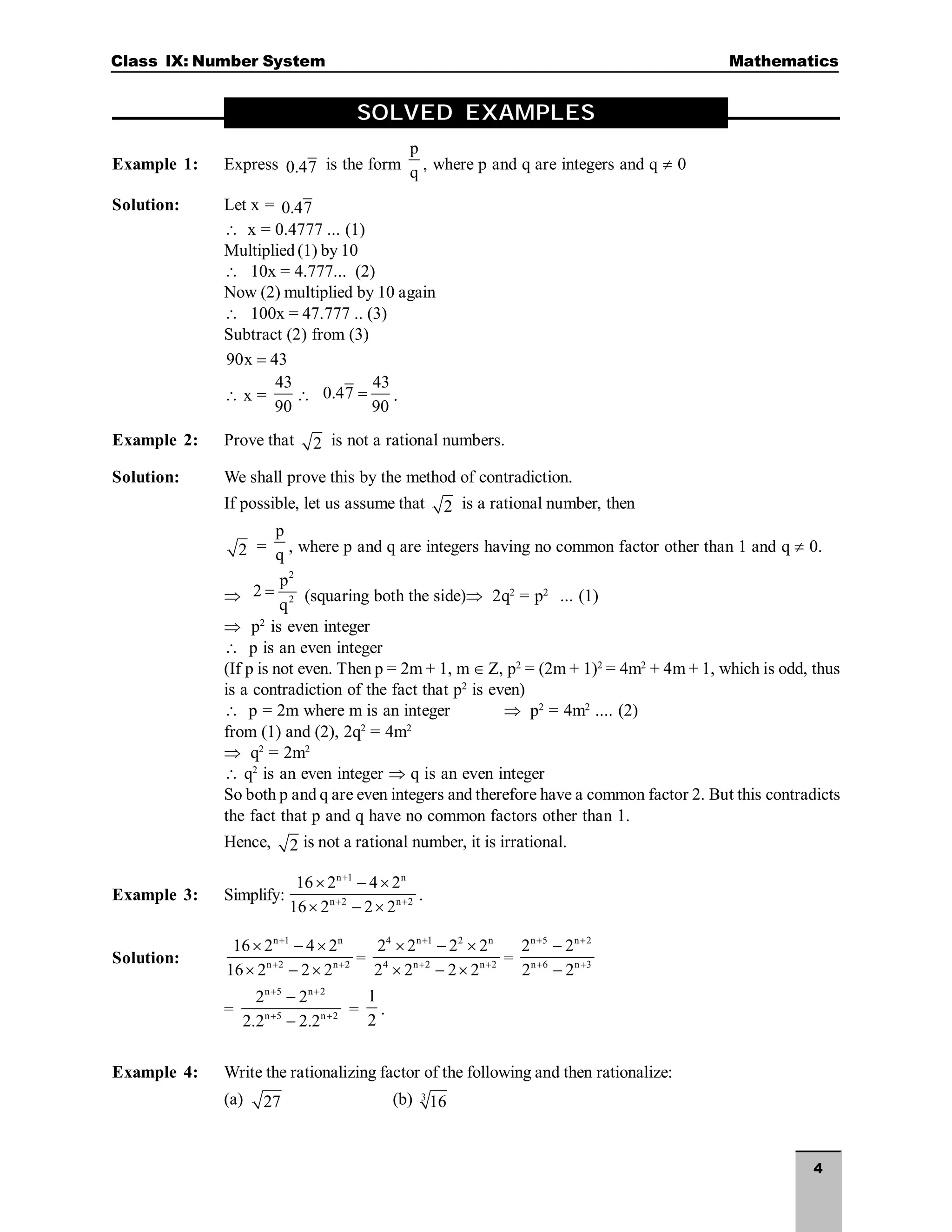


![25
Class IX: Polynomial Mathematics
1
x
3
is a factor of p(x)
Similarly, by trial and error method, wecan find that
5
x
2
is a factor of p(x).
Hence,
2 1 5
6x 17x 5 6 x x
3 2
3x 1 2x 5
6 (3x 1)(2x 5)
3 2
.
Example 2: Factorize the polynomial 2y3
+ y2
2y 1
Solution : Let P(y) = 2y3
+ y2
- 2y - 1
2
3 2
3 2
2
2
2 3 1
1 2 2 1
2 2
3 2
3 3
1
1
0
y y
y y y y
y y
y y
y y
y
y
then P(1) = 2(1)3
+ (1)2
- 2(1) - 1 = 2 + 1 - 2 - 1 = 0
(y - 1) is a factor of polynomial P(y) .
Divide P(y) by (y - 1) using long division method.
Hence, 2y3
+ y2
- 2y - 1 = (y - 1)(2y2
+ 3y + 1)
= (y - 1)[2y2
+ (2 + 1)y + 1]
(by splitting the terms)
= (y - 1)(y + 1)(2y + 1)
Example 3: If x + 1 and x – 1are factors of 3
f x x 2ax b,
then find
the value of 2a + 3b.
Solution:
3
p 1 0 1 2a 1 b 0 1 2a b 0
2a b 1
… (1)
3
p 1 0 1 2a 1 b 0 2a b 1
… (2)
Solving (1) and (2), we get
1
a ,b 0
2
1
2a 3b 2 3 0 1
2
Example 4: If (x – 1), (x + 2) and (x – 2) are factors of x3
+ ax2
+ bx + c, then find the value of
a + b + c.
Solution:
2
3
p 1 0 1 a 1 b 1 c 0 a b c 1
… (1)
3 2
p 2 0 2 a 2 b 2 c 0 4a 2b c 8
… (2)
3 2
p 2 0 2 a 2 b 2 c 0 4a 2b c 8
… (3)
Solving (1), (2) and (3), we get a = 2, b = –1, c = –2
a + b + c = 2 – 1 – 2 = –1
Example 5: If f(x) = 2x3
+ ax2
+ bx – 6, where a and b are constants, when f(x) is divided by (2x – 1)
the remainder is –5, when f(x) is divided by (x + 2) the remainder is zero, then find the
values of a and b.
Solution:
3 2
1 1 1 1
f 5 2 a b 6 5
2 2 2 2
1 a b
1 1 a 2b 4 a 2b 3
4 4 2
… (1)
3 2
f 2 0 2 2 a 2 b 2 6 0 16 4a 2b 6 0
4a 2b 22 2a b 11
… (2)
Solving (1) and (2), we get a = 5, b = –1](https://image.slidesharecdn.com/sp1maths-250715040529-bd322333/75/SP_1_Maths-pdf-for-thent-class-jee-neet-25-2048.jpg)


![30
Class IX: Polynomial Mathematics
7. (i) If the expressions px4
– 3x3
+ 20 and 4x2
+ 7x – p when divided by x – 2 leaves then same
remainders, then find the value of p.
(ii) When a polynomial f (x) is divided by (x – 2) and (x – 5), the respective remainders are
17 and 11. What is the remainder when it is divided by (x – 2) (x – 5)?
(iii) When a polynomial f (x) is divided by x – 3 and x + 6, the respective remainders are 7 and 22.
What is the remainder when f (x) is divided by (x – 3) (x + 6)?
8. Factorize:
(i) a (b – c)3
+ b (c – a)3
+ c (a – b)3
.
(ii) (a + b + c)3
– (b + c – a)3
– (c + a – b)3
– (a + b – c)3
.
(iii) a(b – c)2
+ b(c – a)2
+ c( a – b)2
+ 8a b c.
9. Without actual division, prove that 4 3 2
2 2 2 3
a a a a
is exactly divisible by 2
2 3.
a a
10. If x + 1 and x – 1 are factors of 3 2
2 ,
mx x x n
find the value of m and n.
11. Prove that:: 2 2 3 2 2 3 2 2 3
( ) ( ) ( ) 3( )( )( )( )( )( )
a b b c c a a b b c c a a b b c c a
.
12. Verify that
3 3 3 1
3 ( )
2
x y z xyz x y z
2 2 2
[( ) ( ) ( ) ]
x y y z z x
and hence find the value
of 3 3 2
27 ( 14) ( 13)
.
13. If 4 4 3 2
4 3 2 1 0
(3 1) ,
x a x a x a x a x a
then find the value of 4 3 2 1 0
3 9 27 81
a a a a a
.
14. (i) Find the zero’s of the polynomial: 2 2
( ) ( 2) ( 2)
p x x x
.
(ii) Show that p – 1 is a factor of p10
– 1 and also of p11
– 1.
(iii) For what value of m is x5
– 2mx2
+ 16 divisible by x + 2?
(iv) If x + 2a is a factor of x5
– 4a2
x3
+ 2x + 2a + 3, find a.
(v) Find the value of m, so that 2x – 1 be a factor of 8x4
+ 4x3
– 16x2
+ 10x + m.
(vi) Without finding the cubes, factorise:
3 3 3
( 2 ) (2 3 ) (3 )
x y y z z x
.
15. (i) If the polynomials 3 2
4 3 4
az z z
and 3
4
z z a
leave the same remainder when divided
by z – 3, find the value of a.
(ii) The polynomial 4 3 2
( ) 2 3 3 7
p x x x x ax a
, when divided by x + 1 leaves the remainder
19. Find the value of a. Also find the remainder, when p(x) is divided by x + 2.
(iii) If a, b, c are all non-zero and a + b + c = 0, prove that
2 2 2
3
a b c
bc ca ab
.
(iv) If a + b + c = 5 and ab + bc + ca = 10, then prove that a3
+ b3
+ c3
– 3abc = –25.
(v) Prove that 3 3 3 3
( ) 3( )( )( )
a b c a b c a b b c c a
](https://image.slidesharecdn.com/sp1maths-250715040529-bd322333/75/SP_1_Maths-pdf-for-thent-class-jee-neet-30-2048.jpg)


![Class IX: Euclid’s Geometry Mathematics
45
13. In the figure, we have ABC ACB, 3= 4
. Show that 1= 2
.
14. In the figure, of
1 1
OX = XY,PX = XZ
2 2
and OX = PX, show that XY = XZ.
15. In the figure:
i) AB = BC, M is the mid-point of AB and N is the mid-point of BC. show that AM = NC.
ii) BM = BN, M is the mid-point of AB and N is the mid-point of BC. Show that AB = BC.
16. Read the following statement:
An equilateral triangle is a polygon made up of three line segments out of which two line
segments are equal to the third one and all its angles are 60° each.
Define the terms used in this definition which you feel necessary. Are there any undefined
terms in this? Can you justify that all sides and all angles are equal in a equilateral triangle.
17. Study the following statement:
“Two intersecting lines cannot be perpendicular to the same line.”
Check whether it is an equivalent version to the Euclid’s fifth postulate.
[Hint: Identify the two intersecting lines l and m and the line n in the above statement].
18. Read the following statements which are taken as axioms:
i) If a transversal intersects two parallel lines, then, corresponding angles are not necessarily
equal.
ii) If a transversal intersect two parallel lines, then alternate interior angles are equal. Is this
system of axioms consistent? Justify your answer.](https://image.slidesharecdn.com/sp1maths-250715040529-bd322333/75/SP_1_Maths-pdf-for-thent-class-jee-neet-45-2048.jpg)


![Class IX: Lines and Angles Mathematics
61
Sum of all exterior angles + Sum of all interior angles = n × 180° = (2n) rt. angles
But, sum of all interior angles = (2n – 4) rt. angles
Sum of all exterior angles = (2n) rt. angles – (2n – 4) rt. angles
= [ 2n – (2n – 4)] rt. angles = 4 rt. angles = 360°
Sum of all the exterior angle of a polygon is 360o
Important facts
From the above two results, we may derive the following.
For a regular polygon of n sides, we have:
i) Each interior angles =
( 2) 180
n
n
ii) Each exterior angles =
o
360
n
iii) Number of sides, n =
o
360
each exterior angle
iv) Exterior angle = 180o
– (interior angle)
v) Sum of all the interior angles of a polygon of n sides = (n – 2) × 180°, (n 3).
vi) Number of sides of polygon
360
180 each interior angle
.
vii) Sum of all the exterior angles formed by producing the sides of polygon = 360°.
SOLVED EXAMPLES
Example 1: In fig., ray OC stands on the lineAB, ray OL and ray OM are angle bisectors of AOC and
BOC, respectively. Prove that LOM = 90°
Solutions : In figure, we have
AOC + BOC = 180° …(i)
Now, ray OL bisects AOC, therefore, LOC =
1
AOC
2
similarly, MOC =
1
2
BOC
LOM =
1
2
{AOC + BOC}
1
= ×180°
2
= 90° [by (i)]
Therefore, LOM = 90°](https://image.slidesharecdn.com/sp1maths-250715040529-bd322333/75/SP_1_Maths-pdf-for-thent-class-jee-neet-61-2048.jpg)

![Class IX: Lines and Angles Mathematics
63
Example 4: In figure, if AB || CD, BEG = 650
and EFC = 800
, then find x and y.
Solution: x + y = 80° [exterior angle theorem
y = 65o
[alternate interior angles]
x = 150
Example 5: Find each of the interior angles of a regular Octagon.
Solution: Each of the interior angle of a regular polygon of ‘n’ =
2n - 4
rt.
n
angles.
For an Octagon n = 8
Each interior angles =
2×8 - 4 3
= rt.
8 2
angle =
o
3
×90 = 135
2
.
](https://image.slidesharecdn.com/sp1maths-250715040529-bd322333/75/SP_1_Maths-pdf-for-thent-class-jee-neet-63-2048.jpg)


![Class IX: Triangles Mathematics
80
II. Angle-Side-Angle (ASA) Congruence rule: Two triangles are congruent if two angles and the
included side of one triangle are equal to two corresponding angles and the included side of other
triangle.
Given:
A
B C
Fig.1
D
E F
ABC and DEF are two triangles in which
B = E, C = F and BC = EF
To Prove: ABC DEF
Proof: Case – (i)
Let AB = DE [Assumed]
B = E [Given]
and BC = EF [Given]
ABC DEF
[By SAS rule]
Case – (ii) A
B C
D
E F
P
Let if possible AB > DE.
Let P be a point on AB such that PB = DE
Now, In PBC and DEF, we have
PB = DE [By construction]
B = E [Given]
and BC = EF [Given]
PBC DEF
[By SAS rule]
PCB DFC
, PCB = DFE [By CPCT]
But it is given that ACB = DFE
ACB = PCB which is not possible.
i.e. it is only possible if P coincides with A
BA = ED
Hence, ABC DEF
[by SAS rule]
Case – (iii)
If AB < DE, we can choose a point M on DE such that ME = AB and repeating the arguments as
given in case (ii), we can conclude that AB = DE and, hence, ABC DEF
Now, two triangles are congruent if any two pairs of angles and one pair of corresponding sides are
equal. We may call it as Angle-Angle-Side (AAS).
i.e. Angle-Side-Angle(ASA) congruence rule may be called Angle-Angle-Side (AAS)
congruence rule.](https://image.slidesharecdn.com/sp1maths-250715040529-bd322333/75/SP_1_Maths-pdf-for-thent-class-jee-neet-80-2048.jpg)
![Class IX: Triangles Mathematics
81
III Side-Side-Side(SSS) congruence rule:
A
B C
D
E F
If three sides of one triangle are equal to the three
sides of another triangle, then the two triangles
are congruent.
If in ABC and DEF, AB = DE, BC = EF and AC = DF
Then, ABC DEF
[It is called SSS congruence rule i.e. side-side-side].
IV Right angle-Hypotenuse-Side (RHS) congruence rule: If in two right triangles the hypotenuse
and one side of one triangle are equal to the hypotenuse and one side of the other triangle, then the
two triangles are congruent.
If ABC and DEF are two right triangles in which
A
B C
D
E F
B = E = 90o
, AC = DF and AB = DE
then, ABC DEF
.
Theorem: Angles opposite to equal sides of an isosceles triangle are equal.
Given: ABC is an isosceles triangle i.e. AB = AC A
B C
D
Construction: AD bisector of A is drawn at BC i.e. BAD = CAD
Proof: In BAD and CAD, we have
AB = AC [Given]
BAD = CAD [By construction]
and AD = AD [Common]
BAD CAD
[By SAS rule]
Hence, B = C [By CPCT] Proved.
Converse of Theorem: The sides opposite to equal angles of a triangle are equal:
In ABC if B = C
A
B C
Then, AB = AC
Inequalities in a triangle
Theorem: If two sides of a triangle are unequal, the angle opposite to the
longer side is larger (or greater)
Let ABC be a triangle in which AC > AB and AC > BC.
A
B C
Then, B > C and B > A
The side opposite to the largest angle is the longest.](https://image.slidesharecdn.com/sp1maths-250715040529-bd322333/75/SP_1_Maths-pdf-for-thent-class-jee-neet-81-2048.jpg)
![Class IX: Triangles Mathematics
82
Theorem: The sum of the lengths of any two sides of a triangle is greater
than the length of third side
Let ABC be a triangle and AB, BC and AC are its corresponding sides.
A
B C
Then, AB + BC > AC, AB + AC > BC and AC + BC > AB.
SOLVED EXAMPLES
Example 1: ABC is a triangle in which altitudes BE and CF to sides AC and AB are equal. Show that
(i) ABE ACF
(ii) AB = AC; i.e. ABC is an isosceles triangle.
Given:
A
B C
F E
In ABC altitudes BE = CF
To prove: (i) ABE ACF
(ii) AB = AC ; i.e. ABC is an isosceles triangle.
Solution: (i) In ABE and ACF, we have
BE = CF [Given]
AEB = AFC = 90o
[ BE and CF are altitudes: Given]
and A = A [Common]
ABE ACF
[By AAS congruence rule]
AB = AC [By CPCT]
Hence, ABC is an isosceles triangle.
Example 2: In figure, ABCD is a quadrilateral such that AB = AD and AC is bisector of the angle A of
the quadrilateral. Show that ABC ADC and BC = DC.
A
B
C
D
Solution: For ABC and ADC, we have AB = AD
BAC = DAC
AC = AC. Therefore, by SAS criteria, we have ABC ADC
Also, we have corresponding parts of the two triangle equal and it gives
BC = DC.
Example 3: In given figure, AB = AC, E is mid-point of AB and F is mid-point of AC. Show that
BF = CE.
A
E F
B C](https://image.slidesharecdn.com/sp1maths-250715040529-bd322333/75/SP_1_Maths-pdf-for-thent-class-jee-neet-82-2048.jpg)

![Class IX: Triangles Mathematics
84
Now, ADC > ABD ... (2)
An exterior angle of a triangle is
greater than an opposite interior angle
From (1) and (2) ACD > ABD
i.e., ACD > ABC i.e., in DABC,
C > B AB > AC AB > AD (AC = AD)
Example 6: Show that the perimeter of a triangle is greater than the sum of the lengths of the three
altitudes of the triangle.
Solution: In ABC, AD, BE and CF are three altitudes.
In right angled DABD, AB is hypotenuse.
AB > AD ….(1)
Similarly, in right angled DABC and DCFA, we have
BC > BE ….(2) and
CA > CF ….(3)
Adding (1), (2), (3) AB + BC + CA > AD + BE + CF
i.e., Perimeter of ABC > (AD + BE + CF).
Example 7: AD is an altitude of an isosceles triangle ABC in which AB = AC. Show that
(i) AD bisects BC (ii) AD bisects A
Given: ABC is an isosceles triangle in which AB = AC and AD is an altitude, i.e.
ADC = 90o
To prove:
(i) AD bisects BC (ii) AD bisects A
A
B C
D
Solution: AD is an altitude from vertex A on BC
ADB = ADC = 90o
(i) Now, in right ADB and ADC ,
we have ADB = ADC = 90o
[Given] and AD = AD [Common]
ADB ADC
[By RHS congruence rule]
BD = CD [By CPCT]
Hence, AD bisects BC. Proved.
(ii) ADB ADC
[By proof]
BAD = CAD [By CPCT]. Hence, AD bisects A.Proved.](https://image.slidesharecdn.com/sp1maths-250715040529-bd322333/75/SP_1_Maths-pdf-for-thent-class-jee-neet-84-2048.jpg)
![Class IX: Triangles Mathematics
85
Example 8: BE and CF are two equal altitudes of a triangle ABC.
Prove that the triangle ABC is isosceles.
Given:
A
B C
E
F
BE and CF are two equal altitudes of a triangle ABC, i.e.,
BE = CF
and AEB = AFC = 90o
To prove:
ABC is isosceles.
Solution: In ABE and ACF, we have
BE = CF [Given]
AEB = AFC = 90o
[Given] and A = A [Common]
ABE ACF
[By AAS congruence rule]
AB = AC [By CPCT]. Hence, DABC is isosceles. Proved.
Example 9: Show that in a right angled triangle, the hypotenuse is the
longest side.
Given:
A
B C
ABC is a right angled triangle in which B = 90o
,
i.e., B > A and B > C.
To prove:
AC is the longest side.
Solution: B > A [Given] and B > C
AC > AB [The side opposite to the largest angle is the longest]
and AC > BC. Hence, hypotenuse (AC) of right angled triangle ABC is the longest side.
Example 10: ABC is a right angled triangle in which A = 90o
and AB
= AC. Find B and C.
Given:
C
A B
ABC is a right angled triangle in which A = 90o
and
AB = AC.
To find: B and C
Solution: In right angled triangle ABC, we have
AB = AC [Given]
B = C
[Angles opposite to equal sides of a triangle are equal] ....(i)
Now, A + B + C = 180o
[Angles sum property of a D]
90o
+ B + B = 180o
[From (i)
B = C]
2B = 180o
– 90o
2B = 90o
B =
o
o
90
= 45
2
Hence, B = C = 45o](https://image.slidesharecdn.com/sp1maths-250715040529-bd322333/75/SP_1_Maths-pdf-for-thent-class-jee-neet-85-2048.jpg)


![Class IX: Co-ordinate Geometry Mathematics
100
X–coordinate
The X–coordinate of a point is its perpendicular distance from Y–axis measured along the X–axis. The
X–coordinate is also called the abscissa.
Y–coordinate :
The Y–coordinate of a point is its perpendicular distance from X–axis. The Y–coordinate is also called
ordinate.
Note: (i) In quadrant I (+, +) both X–coordinate and Y–coordinate are positive.
(ii) In quadrant II (–, +) X–coordinate is negative where as Y–coordinate is positive.
(iii) In quadrant III (–, –) both X–coordinate and Y–coordinate are negative.
(iv) In quadrant IV (+, –) X–coordinate is positive where as Y–coordinate is negative.
(v) The coordinates of origin are (0, 0) i.e. X–coordinate is zero as well as Y–coordinate
is also zero.
Distance Formula
The distance between any two points in the plane is the length of the line segment joining them.
The distance between two points p(x1
, y1
) and Q(x2
, y2
) is given by
2 2
2 1 2 1
PQ = x x + y y
i.e.
2 2
PQ = Differenceof abscissae + Differenceof ordinates
Now, we have to find the distance between two points P(x1
, y1
) and Q(x2
, y2
). PR and QS perpendiculars
have been drawn to the x–axis. A perpendicular from the point P on QS is also drawn which meets at T in
figure.
OR = x1
, OS = x2 Y-axis Q (x , y )
2 2
P (x , y )
1 1 T
S
R
O
X X-axis
Y
RS = x2
– x1
PT = x2
– x1
[ RS = PT]
Again, PR = y1
, QS = y2
QT = y2
– y1
Now, in right PTQ
, we have
2 2 2
PQ PT QT
[By Pythagoras Theorem]
PQ2
=
2 2
2 1 2 1
x x y y
Hence, PQ =
2 2
2 1 2 1
x x y y
It is called distance formula.
The distance is always non–negative, so we take only the positive square root.](https://image.slidesharecdn.com/sp1maths-250715040529-bd322333/75/SP_1_Maths-pdf-for-thent-class-jee-neet-100-2048.jpg)
![Class IX: Co-ordinate Geometry Mathematics
101
Note: (i) The distance of a point P(x, y) from the origin O(0,0) is given by
2 2
OP x y
(ii) We can also write :
2 2
1 2 1 2
PQ x x y y
SOLVED EXAMPLES
Example 1: In which quadrant do the following points lie?
(i) (4, 2) (ii) (–3, 5) (iii) (–2, –5) (iv) (4, –2)
Solution: (i) In the point (4, 2) abscissa and ordinate both are positive, so it lies in the first quadrant.
(ii) In the point (–3, 5) abscissa is negative and ordinate is positive, so, it lies in the second
quadrant.
(iii) The point (–2, –5) lies in the third quadrant.
(iv) The point (4, –2) lies in the fourth quadrant.
Example 2: Find a point on X–axis which is equidistant from A(2, –5) and B(–2, 9).
Solution: We know that a point on x–axis is of the form (x, 0). So, Let P(x, 0) be the point equidistant
from A(2, –5) and B(–2, 9).
Then, PA = PB
2 2
x 2 + 0 + 5
=
2 2
x + 2 + 0 9
2 2
x 2 + 5
=
2 2
x + 2 + 9
[Squaring both sides]
x2
– 4x + 4 + 25 = x2
+ 4x + 4 + 81
–4x – 4x = 85 – 29
–8x = 56
x = –7
Hence, the required point is (–7, 0).
Example 3: Show that the points (1, –1), (5, 2) and (9, 5) are collinear.
Solution: Let A(1, –1), B(5, 2) and C(9, 5) be the given points. Then, we have
AB =
2 2
5 1 + 2 +1
= 16 + 9 = 25 = 5
BC =
2 2
5 9 + 2 5
= 16 + 9
= 25 = 5
And AC =
2 2
1 9 + 1 5
](https://image.slidesharecdn.com/sp1maths-250715040529-bd322333/75/SP_1_Maths-pdf-for-thent-class-jee-neet-101-2048.jpg)
![Class IX: Co-ordinate Geometry Mathematics
102
= 64 + 36 = 100 = 10
Now, it is clear that AC = AB + BC
Hence, A, B, C are collinear points.
Example 4: Prove that the point (–2, –1), (–1, 1), (5, –2) and (4, –4) are the vertices of a rectangle.
Solution : Let P(–2, –1), Q(–1, 1), R(5, –2) and S(4, –4) be the given points
Now, 2 2
PQ = [ 2 ( 1)] + [ 1 1]
2 2
= ( 1) + ( 2) = 5
2 2
QR = [5 ( 1)] +[ 2 1]
2 2
= (6) + ( 3) = 45
2 2
RS = [4 5] + [ 4 ( 2)]
2 2
= ( 1) + ( 2) = 5
2 2
SP = [4 2 ] + [ 4 ( 1)]
2 2
= (6) + ( 3) = 45
PQ = RS and QR = SP
Hence, the opposite sides are equal.
Again, diagonal 2 2
PR = [5 ( 2)] + [ 2 ( 1)]
2 2
= (7) + ( 1) = 50
2 2
QS = [4 ( 1)] +[ 4 1]
2 2
= (5) + ( 5) = 50
Hence the diagonals are equal.
Hence the given point P, Q, R, S are the vertices of rectangle.
](https://image.slidesharecdn.com/sp1maths-250715040529-bd322333/75/SP_1_Maths-pdf-for-thent-class-jee-neet-102-2048.jpg)


![Class IX: Trigonometry Mathematics
131
Example 5: If a xcos ysin
and b xsin ycos
obtain a relation in x and y by
eliminating ' '
.
Solution: Given that a xcos ysin
Squaring both sides, we get a2
= 2
(xcos ysin )
= 2 2 2 2
x cos y sin 2xcos .ysin
[ (a + b)2
= a2
+ b2
+ 2ab]
a2
= 2 2 2 2
x cos y sin 2xysin cos
… (i)
and b xsin ycos
Squaring both sides, we get
b2
= 2
(xsin ycos )
= 2 2 2 2
x sin y cos 2xsin .ycos
[ (a – b)2
= a2
+ b2
– 2ab]
b2
= 2 2 2 2
x sin y cos 2xysin cos
… (ii)
(i) + (ii) a2
+ b2
= x2
+ y2
](https://image.slidesharecdn.com/sp1maths-250715040529-bd322333/75/SP_1_Maths-pdf-for-thent-class-jee-neet-131-2048.jpg)


![[L1] NUMBER SYSTEM (6).pdf](https://cdn.slidesharecdn.com/ss_thumbnails/l1numbersystem6-230416180344-8e8d0862-thumbnail.jpg?width=640&height=640&fit=bounds)


