PR BABILITY
C L A S S 10
Presentation by,
Manjunatha.P.N.
Indira college of education, Tumkur.
Theory of probability
Developed by Russian Mathematician
A.N. Kolmogorov in 1933
Approaches to Theory of probability
1.Statsistical approach
2.Classical approach
PROBABILITY
Probability is a measure of uncertainty
of various phenomenon.
We can find the probability on the basis of
observations and collected data. This is
called statistical approach of probability.
Define Random Experiment.
An experiment is called random
experiment if it satisfies the following two
conditions:
(i) It has more than one possible outcome.
(ii) It is not possible to predict the outcome
in advance.
Define Sample Space.
The set of all possible outcomes of a
random Experiment is called as Sample
space. It is denoted by S.
Define Sample points:
Elements of sample space are referred as
Sample points.
Define Event.
A subset of the sample space is called an
Event.
Impossible Event:
The empty set is called as Impossible
Event.
Sure Event:
The whole sample space is called as Sure
Event.
Types of Events:
Simple Event:
If an event E has only one sample
point of a sample space, it is called a
simple (or elementary) event.
Compound Event:
If an event has more than one sample
point, it is called a Compound event.
Types of Events:
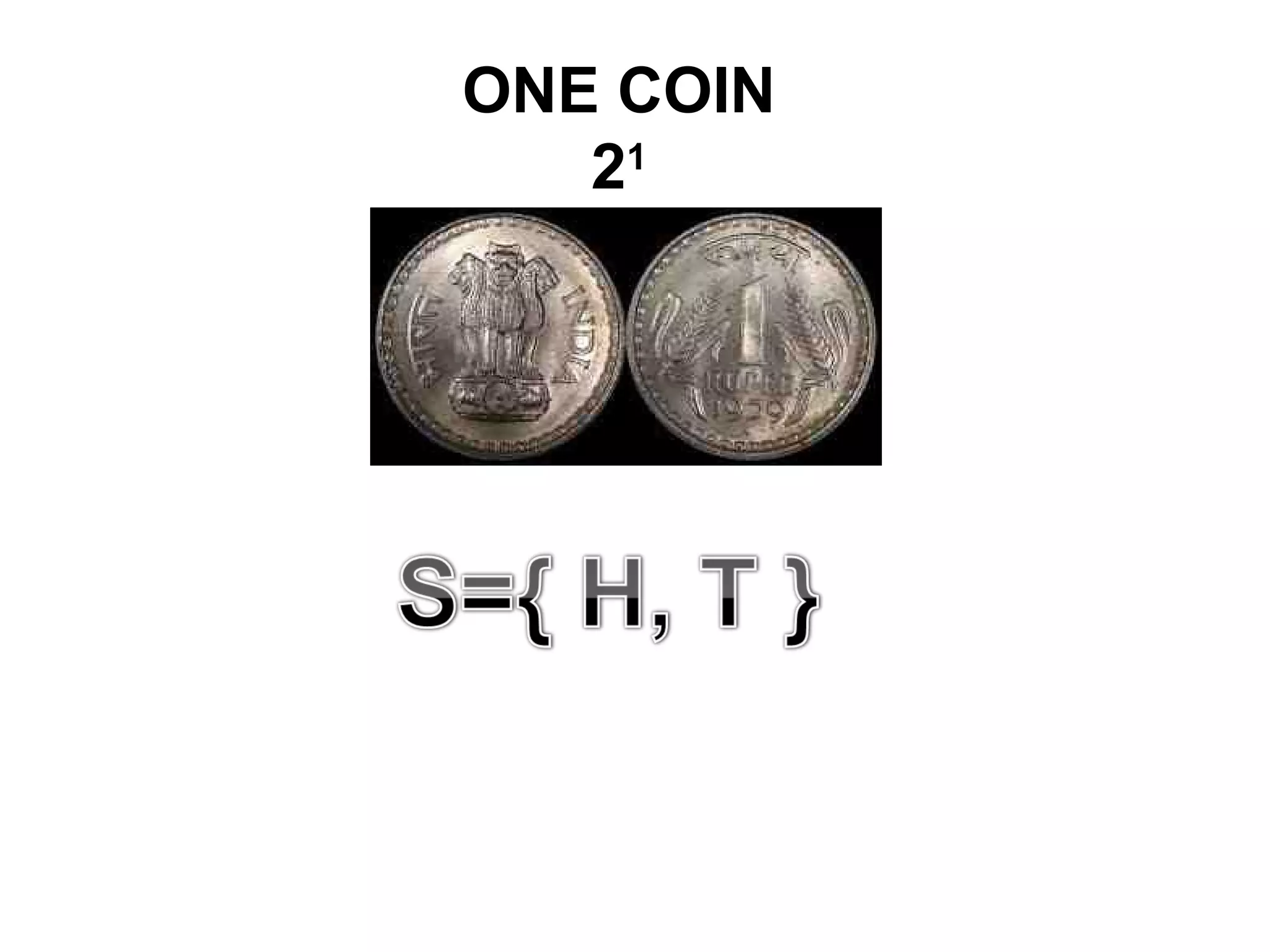
ONE COIN
21
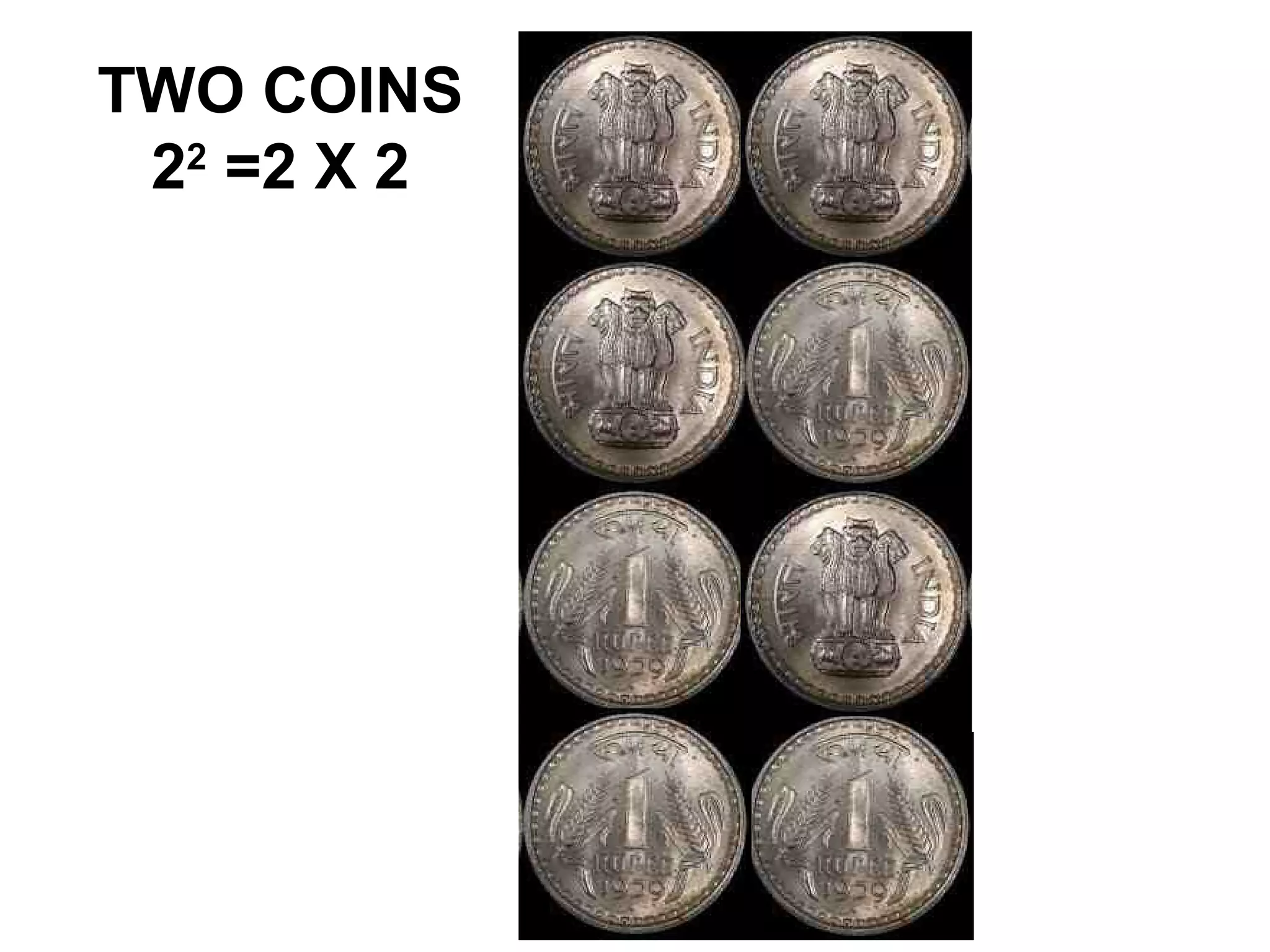
TWO COINS
22
=2 X 2
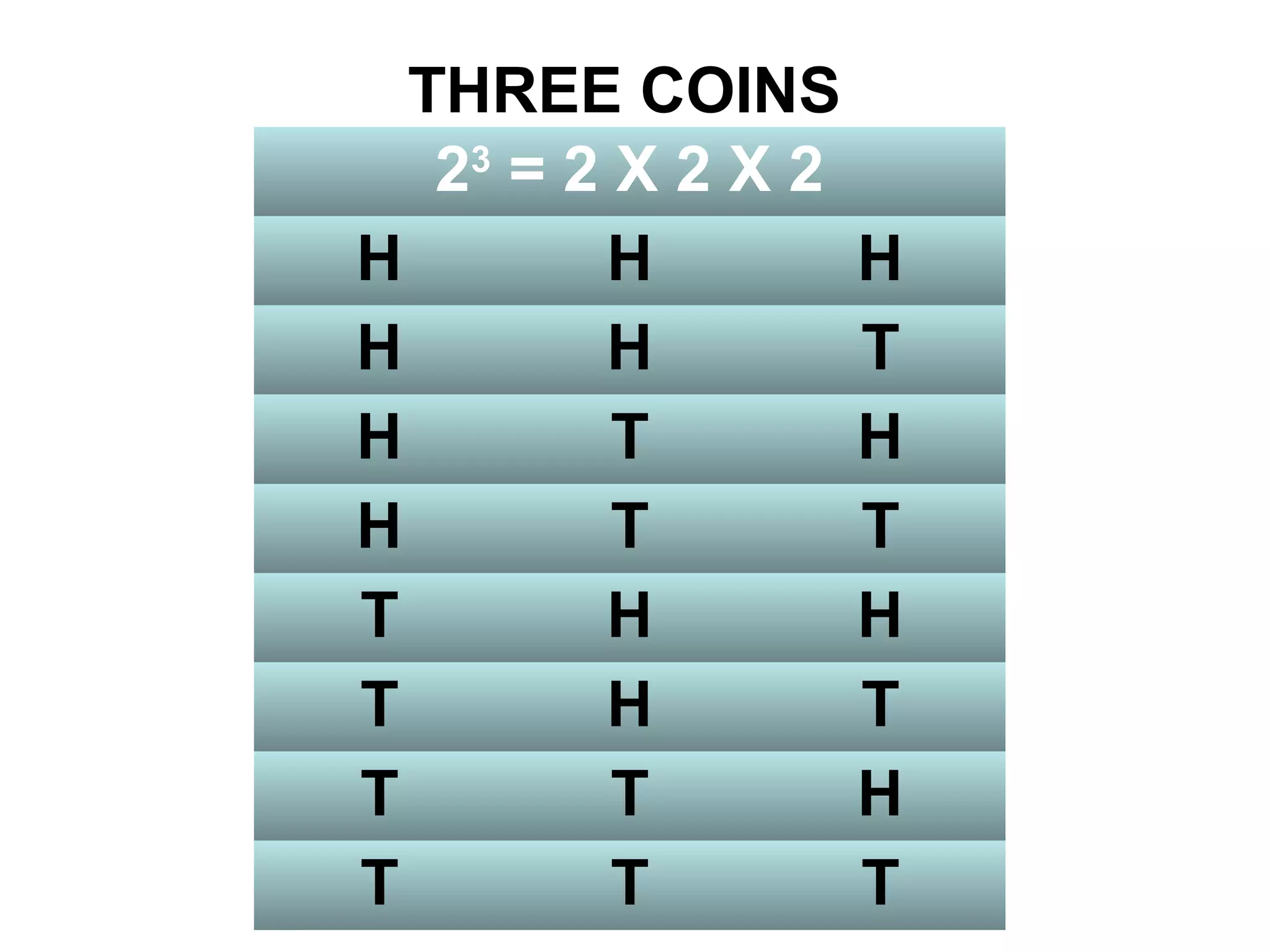
THREE COINS
23
= 2 X 2 X 2
H H H
H H T
H T H
H T T
T H H
T H T
T T H
T T T
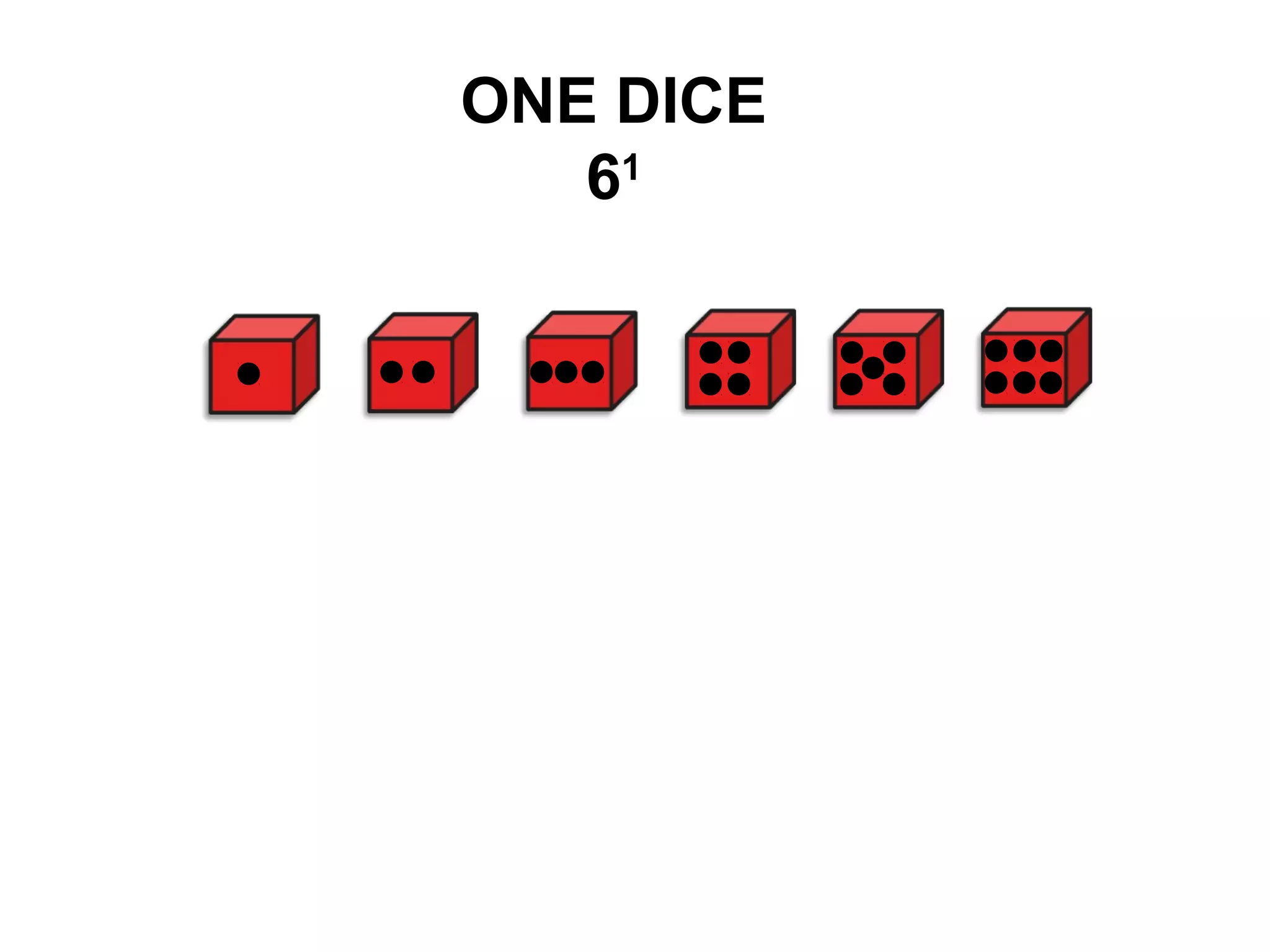
ONE DICE
61
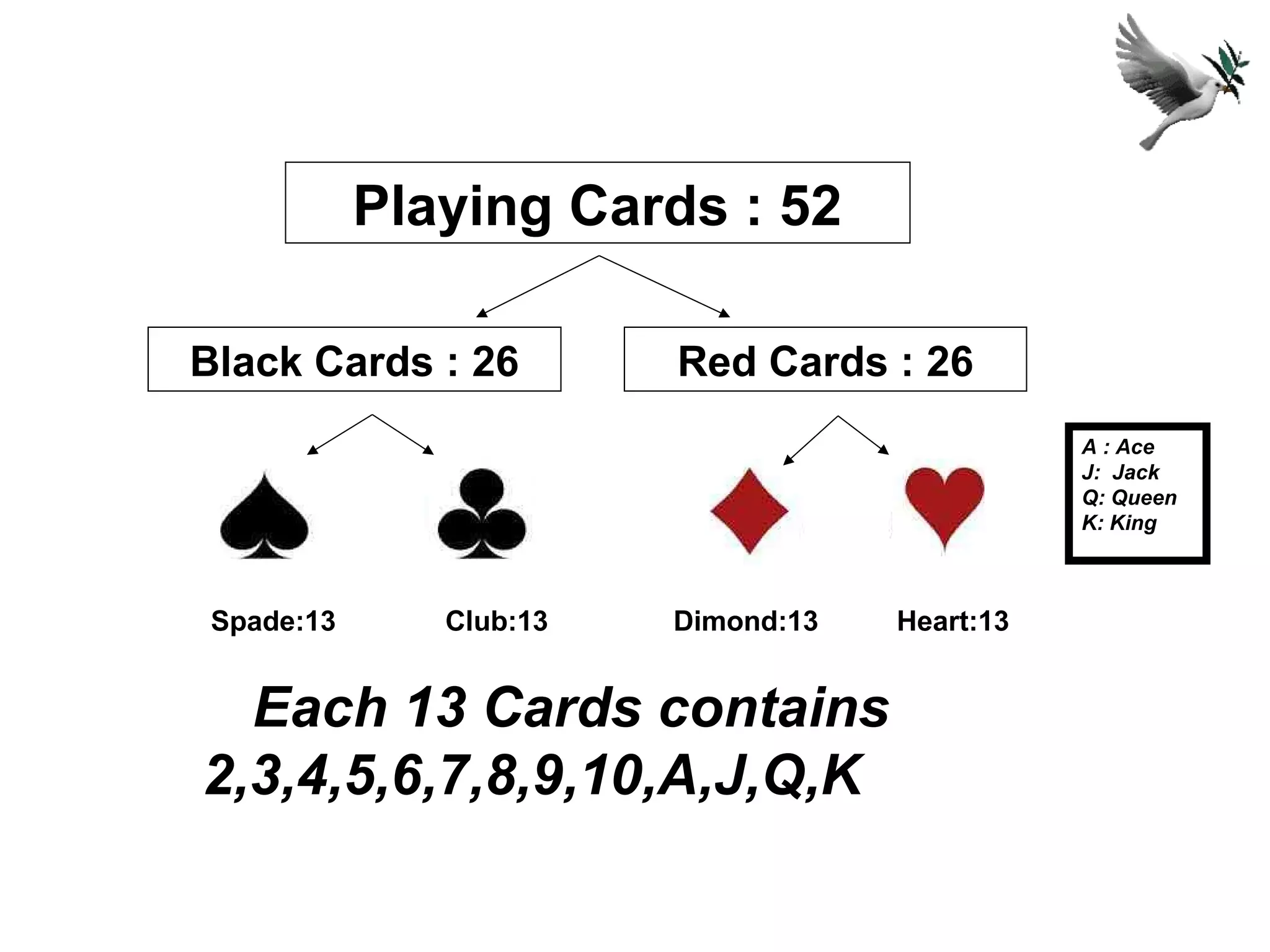
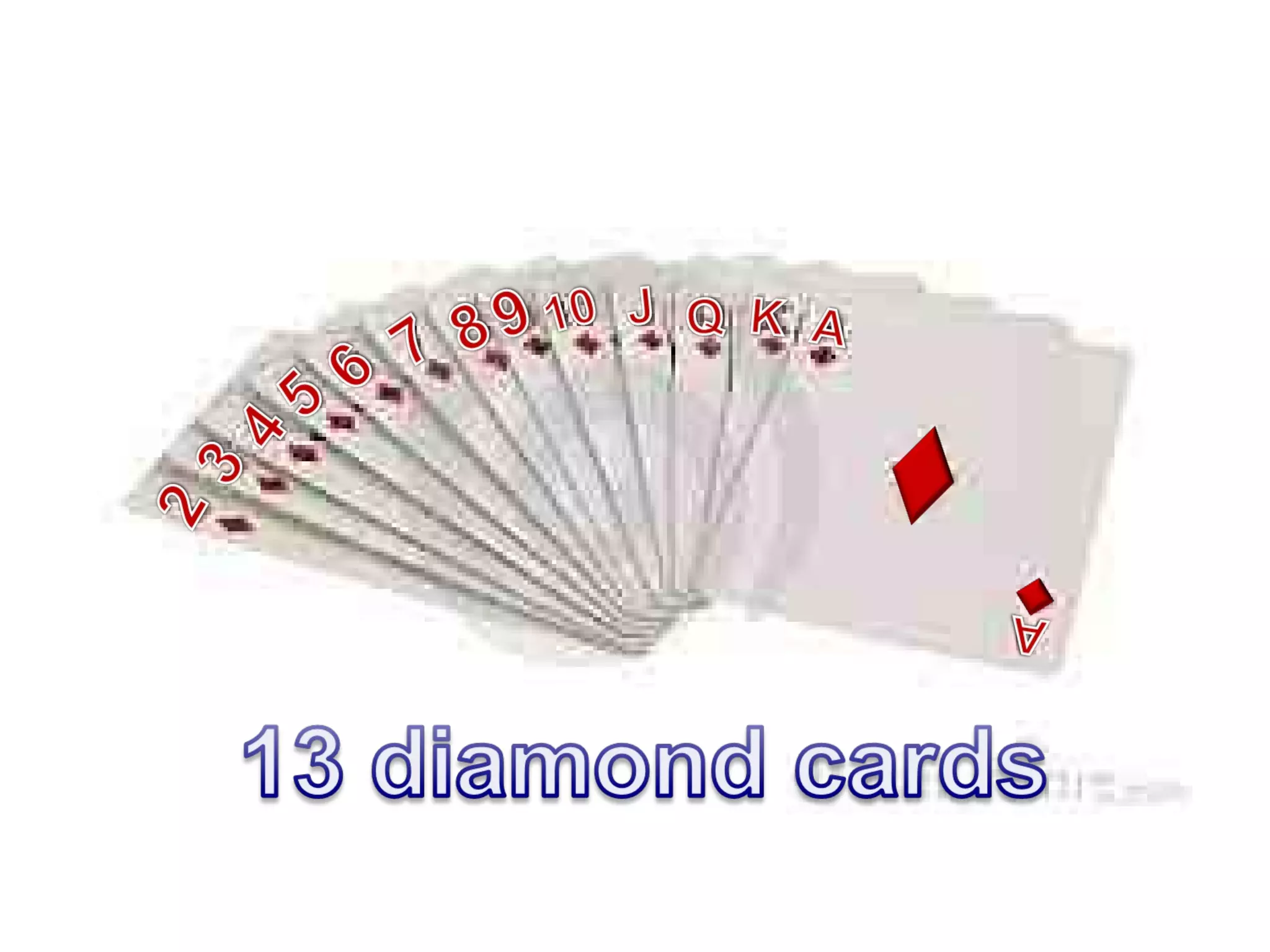
Playing Cards : 52
Black Cards : 26 Red Cards : 26
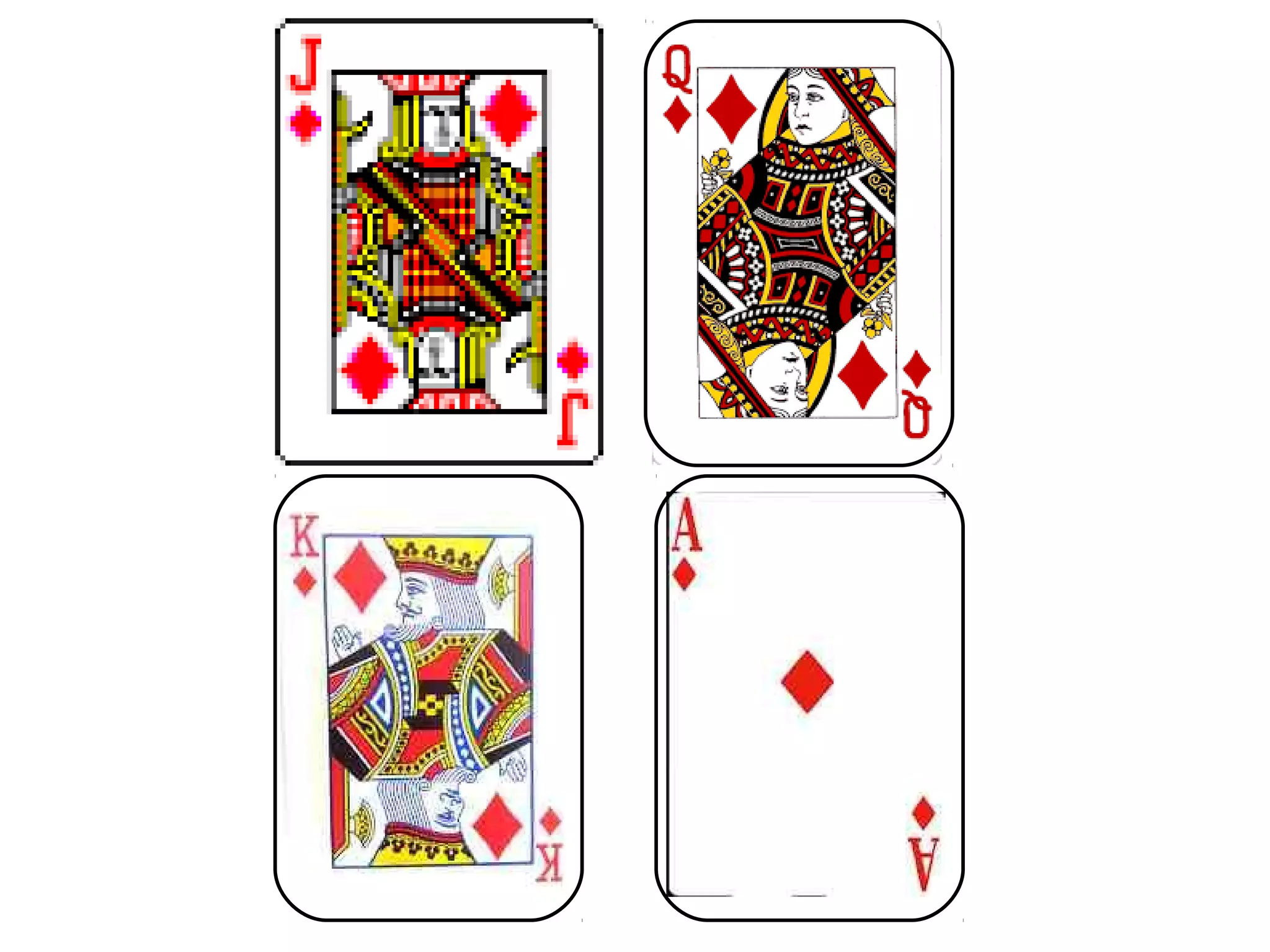
A : Ace
J: Jack
Q: Queen
K: King
Spade:13 Club:13 Dimond:13 Heart:13
Each 13 Cards contains
2,3,4,5,6,7,8,9,10,A,J,Q,K
PROBLEMS
In each of the following describe the sample space for the
indicated experiment.
1.A coin is tossed one time.
2.A coin is tossed two times.
3.A coin is tossed three times.
4.A coin is tossed four times.
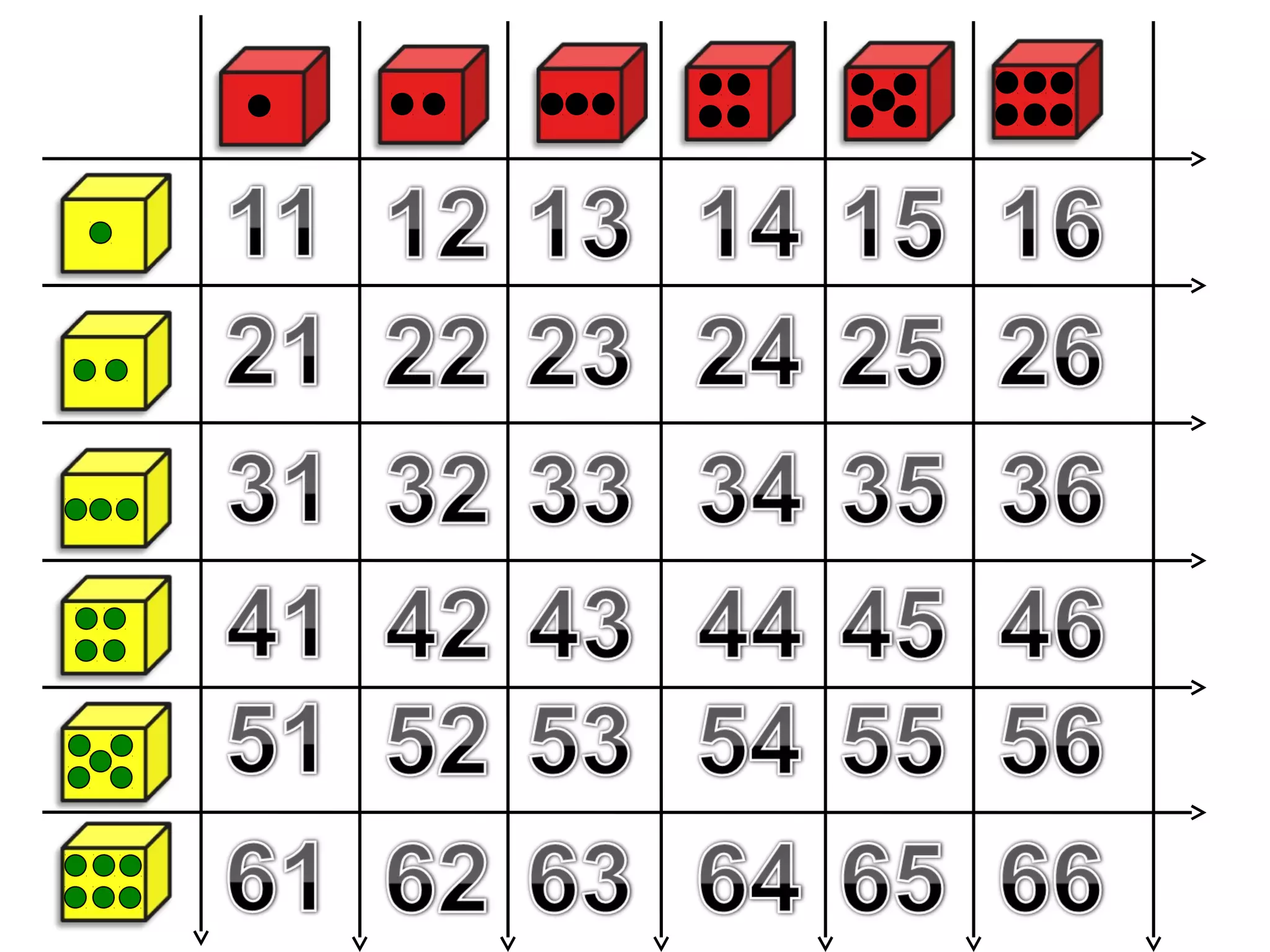
5.A die is thrown one time.
6.A die is thrown two times.
7.A coin is tossed and a die is thrown.
8.A coin is tossed and then a die is rolled only in case a
head is shown on the coin.
2
Faces
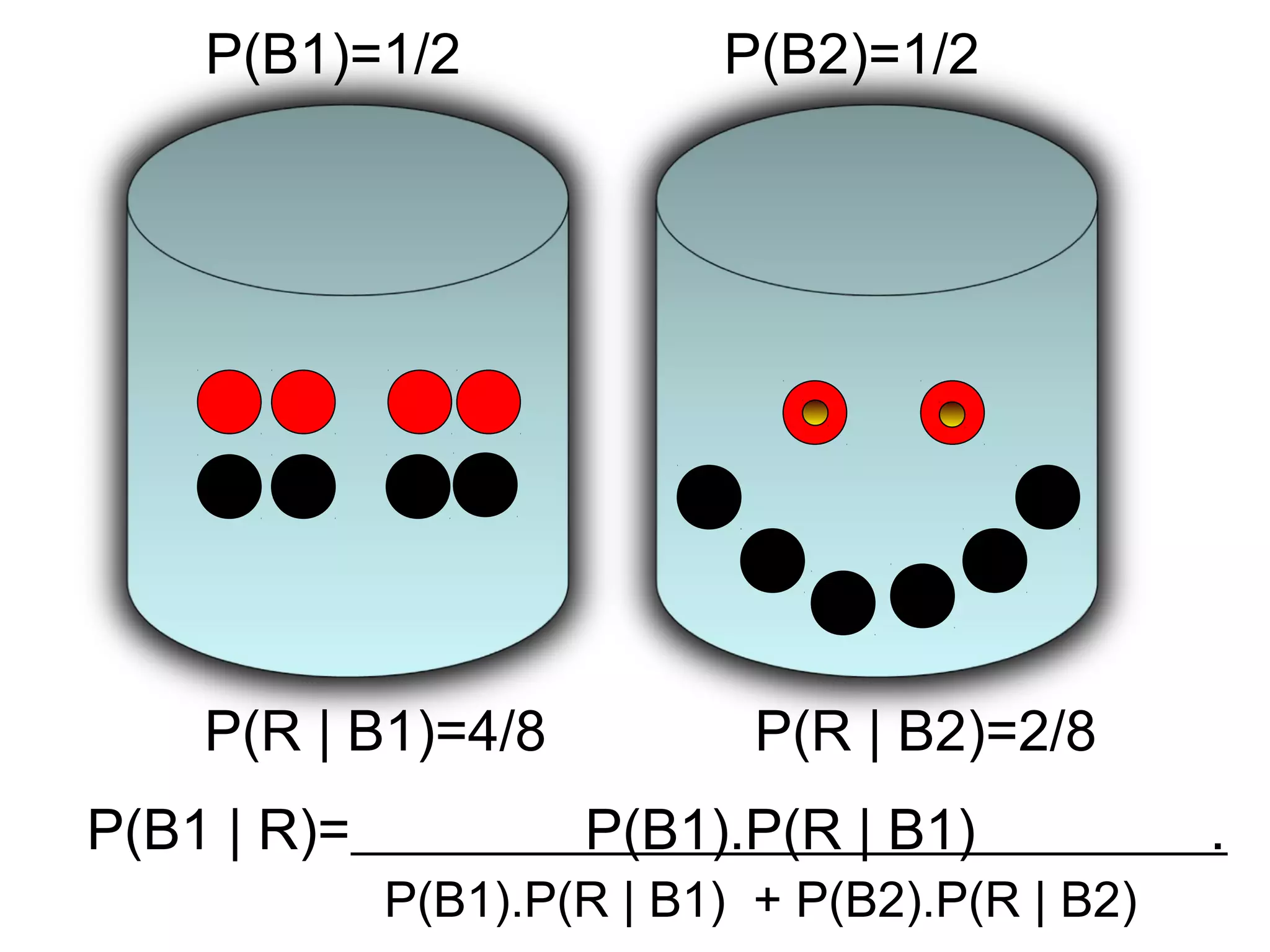
A bag contains 4 red and 4 black balls.
Another bag contains 2 red and 6 black
balls. One of the two bags is selected
at random and a ball is drawn from the
Bag which is found to be red. Find the
Probability that the ball is drawn from
The first bag.
P(B1)=1/2 P(B2)=1/2
P(R | B1)=4/8 P(R | B2)=2/8
P(B1 | R)= P(B1).P(R | B1) .
P(B1).P(R | B1) + P(B2).P(R | B2)
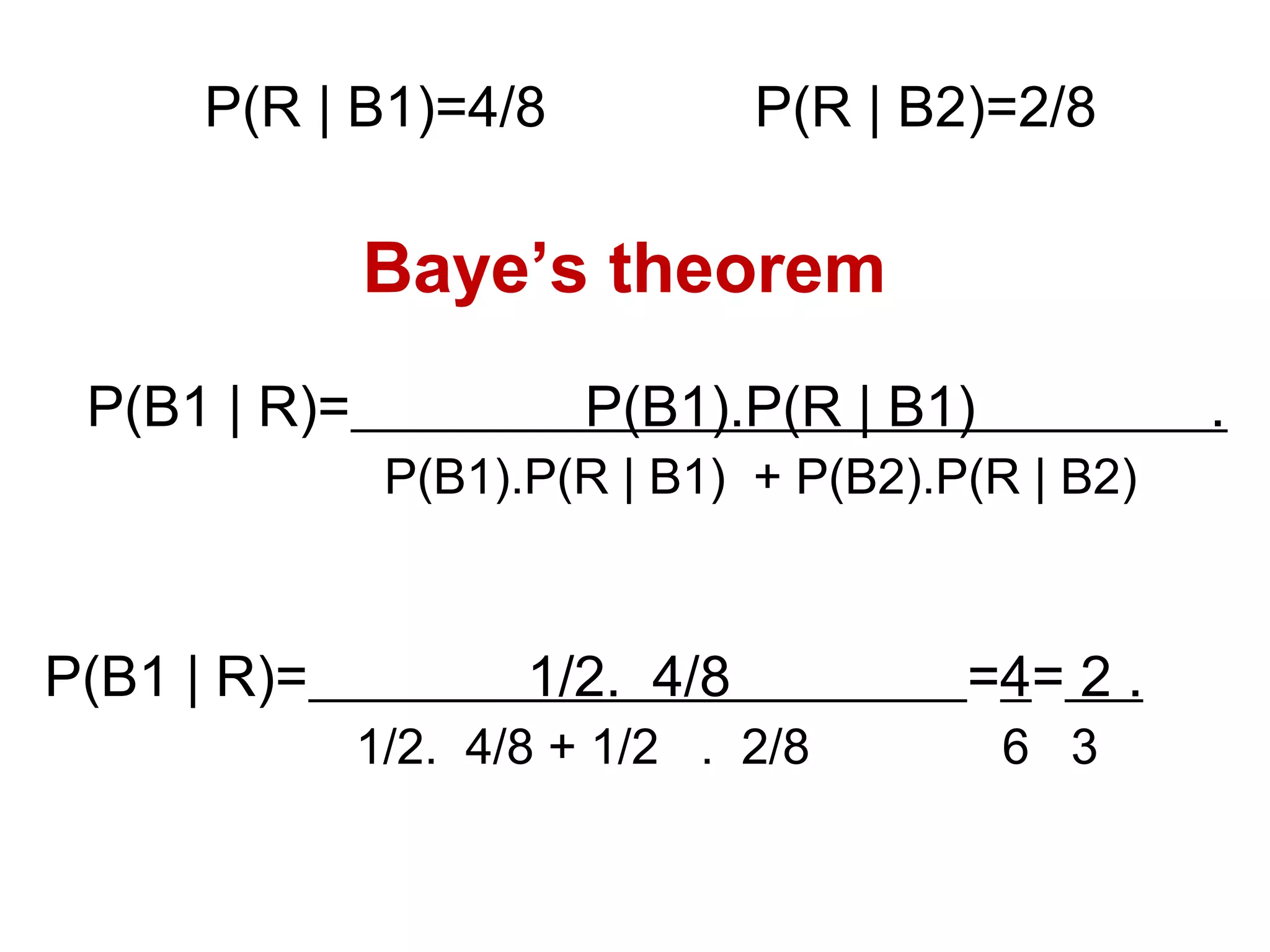
P(R | B1)=4/8 P(R | B2)=2/8
P(B1 | R)= P(B1).P(R | B1) .
P(B1).P(R | B1) + P(B2).P(R | B2)
P(B1 | R)= 1/2. 4/8 =4= 2 .
1/2. 4/8 + 1/2 . 2/8 6 3
Baye’s theorem
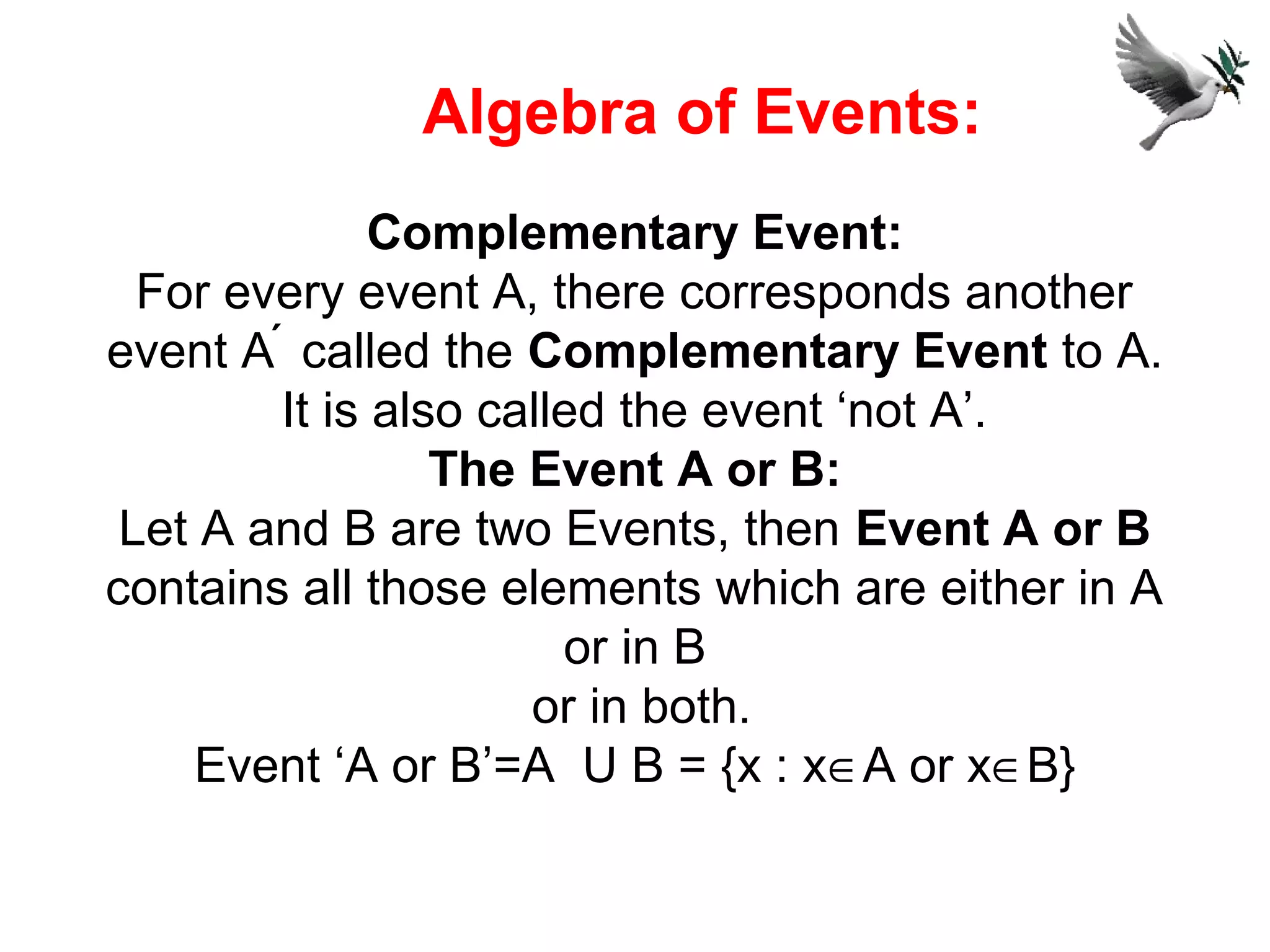
Complementary Event:
For every event A, there corresponds another
event A  called the Complementary Event to A.
It is also called the event ‘not A’.
The Event A or B:
Let A and B are two Events, then Event A or B
contains all those elements which are either in A
or in B
or in both.
Event ‘A or B’=A U B = {x : x∈A or x∈B}
Algebra of Events:
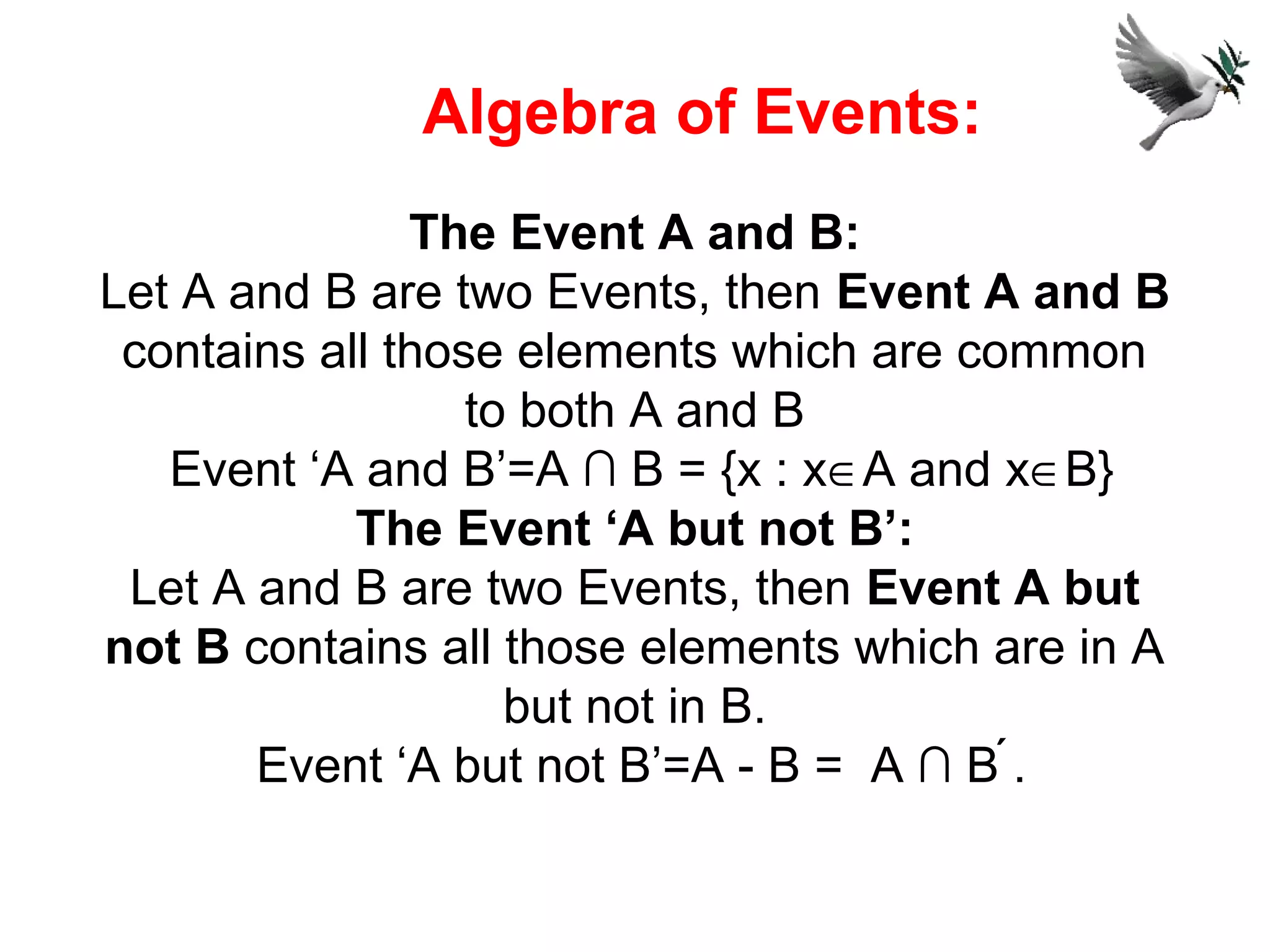
The Event A and B:
Let A and B are two Events, then Event A and B
contains all those elements which are common
to both A and B
Event ‘A and B’=A ∩ B = {x : x∈A and x∈B}
The Event ‘A but not B’:
Let A and B are two Events, then Event A but
not B contains all those elements which are in A
but not in B.
Event ‘A but not B’=A - B = A ∩ B .
Algebra of Events:
Two events A and B are called mutually
exclusive events if the occurrence of any
one of them excludes the occurrence of
the other event.
ie. Events A and B are said to be Mutually
Exclusive Events if A ∩ B=φ.
MUTUALLY EXCUSIVE EVENTS
Events E1, E2, ..., En are said to be exhaustive if
atleast one of them necessarily occurs whenever
the experiment is performed.
ie. Events A and B are said to be Exhaustive
Events if A U B=S.
Or
Events E1,E2,E3,…..En are Exhaustive Events if
E1 U E2 U E3 U ……U En =S.
EXHAUSTIVE EVENTS
PRESENTED BY
P.N.Manjunath

Probability 10th class

  • 1.
    PR BABILITY C LA S S 10 Presentation by, Manjunatha.P.N. Indira college of education, Tumkur.
  • 2.
    Theory of probability Developedby Russian Mathematician A.N. Kolmogorov in 1933 Approaches to Theory of probability 1.Statsistical approach 2.Classical approach
  • 3.
    PROBABILITY Probability is ameasure of uncertainty of various phenomenon. We can find the probability on the basis of observations and collected data. This is called statistical approach of probability.
  • 4.
    Define Random Experiment. Anexperiment is called random experiment if it satisfies the following two conditions: (i) It has more than one possible outcome. (ii) It is not possible to predict the outcome in advance.
  • 5.
    Define Sample Space. Theset of all possible outcomes of a random Experiment is called as Sample space. It is denoted by S. Define Sample points: Elements of sample space are referred as Sample points. Define Event. A subset of the sample space is called an Event.
  • 6.
    Impossible Event: The emptyset is called as Impossible Event. Sure Event: The whole sample space is called as Sure Event. Types of Events:
  • 7.
    Simple Event: If anevent E has only one sample point of a sample space, it is called a simple (or elementary) event. Compound Event: If an event has more than one sample point, it is called a Compound event. Types of Events:
  • 8.
  • 9.
  • 10.
    THREE COINS 23 = 2X 2 X 2 H H H H H T H T H H T T T H H T H T T T H T T T
  • 11.
  • 13.
    Playing Cards :52 Black Cards : 26 Red Cards : 26 A : Ace J: Jack Q: Queen K: King Spade:13 Club:13 Dimond:13 Heart:13 Each 13 Cards contains 2,3,4,5,6,7,8,9,10,A,J,Q,K
  • 16.
    PROBLEMS In each ofthe following describe the sample space for the indicated experiment. 1.A coin is tossed one time. 2.A coin is tossed two times. 3.A coin is tossed three times. 4.A coin is tossed four times. 5.A die is thrown one time. 6.A die is thrown two times. 7.A coin is tossed and a die is thrown. 8.A coin is tossed and then a die is rolled only in case a head is shown on the coin. 2 Faces
  • 17.
    A bag contains4 red and 4 black balls. Another bag contains 2 red and 6 black balls. One of the two bags is selected at random and a ball is drawn from the Bag which is found to be red. Find the Probability that the ball is drawn from The first bag.
  • 18.
    P(B1)=1/2 P(B2)=1/2 P(R |B1)=4/8 P(R | B2)=2/8 P(B1 | R)= P(B1).P(R | B1) . P(B1).P(R | B1) + P(B2).P(R | B2)
  • 19.
    P(R | B1)=4/8P(R | B2)=2/8 P(B1 | R)= P(B1).P(R | B1) . P(B1).P(R | B1) + P(B2).P(R | B2) P(B1 | R)= 1/2. 4/8 =4= 2 . 1/2. 4/8 + 1/2 . 2/8 6 3 Baye’s theorem
  • 20.
    Complementary Event: For everyevent A, there corresponds another event A  called the Complementary Event to A. It is also called the event ‘not A’. The Event A or B: Let A and B are two Events, then Event A or B contains all those elements which are either in A or in B or in both. Event ‘A or B’=A U B = {x : x∈A or x∈B} Algebra of Events:
  • 21.
    The Event Aand B: Let A and B are two Events, then Event A and B contains all those elements which are common to both A and B Event ‘A and B’=A ∩ B = {x : x∈A and x∈B} The Event ‘A but not B’: Let A and B are two Events, then Event A but not B contains all those elements which are in A but not in B. Event ‘A but not B’=A - B = A ∩ B . Algebra of Events:
  • 22.
    Two events Aand B are called mutually exclusive events if the occurrence of any one of them excludes the occurrence of the other event. ie. Events A and B are said to be Mutually Exclusive Events if A ∩ B=φ. MUTUALLY EXCUSIVE EVENTS
  • 23.
    Events E1, E2,..., En are said to be exhaustive if atleast one of them necessarily occurs whenever the experiment is performed. ie. Events A and B are said to be Exhaustive Events if A U B=S. Or Events E1,E2,E3,…..En are Exhaustive Events if E1 U E2 U E3 U ……U En =S. EXHAUSTIVE EVENTS
  • 24.