MATHEMATICS
The term MATHEMATICS is derived from two
Greek words ‘manthanein’ which means
learning and ‘techne’ an art of technique.
Therefore mathematics means the art of
learning related to disciplines.
Mathematics is
defined as the
science of quantity,
measurement and
special relation.
The area of study is known as the history of mathematics
is primarily an investigation into the origin of discoveries
of mathematics and, to a lesser Extent, an investigation
into the mathematical methods notation of the past.
Chinese mathematics made early contributions including a
place value system.
The origins of mathematical thought lie in the concepts of
number and magnitude.
HISTORY OF MATHEMATICS
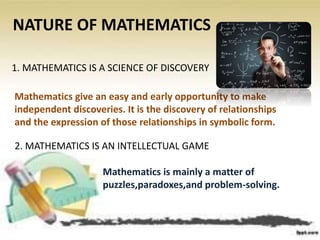
NATURE OF MATHEMATICS
1. MATHEMATICS IS A SCIENCE OF DISCOVERY
Mathematics give an easy and early opportunity to make
independent discoveries. It is the discovery of relationships
and the expression of those relationships in symbolic form.
2. MATHEMATICS IS AN INTELLECTUAL GAME
Mathematics is mainly a matter of
puzzles,paradoxes,and problem-solving.
3.MATHEMATICS IS A TOOL SUBJECT
Mathematics has its integrity, its beauty, its structure
and many other features that relate to Mathematics as
an end in itself.
4.MATHEMATICS INVOLVES AN INTUITIVE METHOD
The first step in the learning of any mathematical
subject is the development of Intuition. This
must come before rules are stated or formal
operations are introduced
4.MATHEMATICS HAS ITS OWN LANGUAGE AND SYMBOLS
The language for communication of mathematical ideas is
largely in terms of symbols and words which everybody cannot
understand.
5.MATHEMATICS IS AN ABSTRACT SCIENCE
Mathematical concepts are abstract in the sense that
they cannot be seen That they cannot be seen or felt
in the physical world.
6. MATHEMATICS IS LOGIC
Logic is an important factor in mathematics; it governs the
pattern of deductive proof through which mathematics is
developed.
7.MATHEMATICS DEALS WITH ART OF DRAWING CONCLUSIONS
In mathematics the conclusions are certain and definite.
Therefore the learner can Check the correct solutions.
NEEDS AND SIGNIFICANCE OF LEARNING
MATHEMATICS
• Mathematics learning helps to apply mathematical concepts
and theorems to new situations.
• Mathematics provides a clear understanding of laws of nature.
• Mathematics helps in clear understanding of the culture and
development of our civilization.
• Mathematics learning helps to think alternative methods of
solving problems
• Mathematics provides a frame work for solving problems
• Mathematics is a powerful tool in the hands of the learners
• Mathematics learning helps in a better understanding of the
world around us
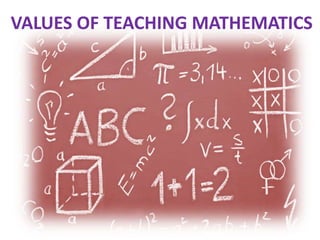
VALUES OF TEACHING MATHEMATICS
o Develops the power to generalize and classify
o Develops the habit of self study
o Helps students to assume responsibility for his own work
o Develops constructive imagination
o Cultivates the power of attention and concentration
o Inculcates habits of neatness and accuracy
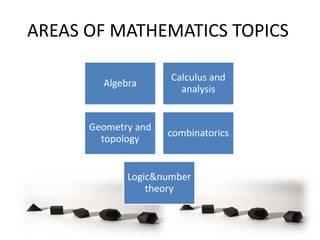
AREAS OF MATHEMATICS TOPICS
Algebra
Calculus and
analysis
Geometry and
topology
combinatorics
Logic&number
theory
MATHS IN DAILY LIFE
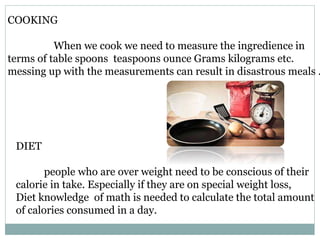
COOKING
When we cook we need to measure the ingredience in
terms of table spoons teaspoons ounce Grams kilograms etc.
messing up with the measurements can result in disastrous meals .
DIET
people who are over weight need to be conscious of their
calorie in take. Especially if they are on special weight loss,
Diet knowledge of math is needed to calculate the total amount
of calories consumed in a day.
BANKING
Banking is probably the one place where math is used more
than anywhere else. No one without basic knowledge about math
can’t do anything in a bank.
ARTS
Math is also used by artists while making paintings,
designing collages as well as during dance performances. In
all these cases the size of canvas, the size of the stage,etc play
a very important role and deciding all these aspects is literally
Impossible without the knowledge of math.
SHOPPING
This is probably the most common use of math in which we
make a list of things We need to guy as well as make payments
in the end.
GARDENING
For planning to sow seeds or count the number of plants,
everything requires numbers. All tasks carried out inside a
garden require proper measurements
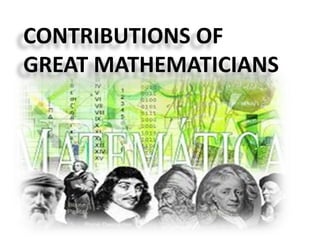
CONTRIBUTIONS OF
GREAT MATHEMATICIANS
CONTRIBUTION OF EUCLID TO MATHEMATICS
 He is credited with the well known proof of the Pythagorean
theorem
 He solved unresolved problems related to irrational numbers
 He proved what is generally known as Euclid's secondary theorem
that prime numbers are infinite
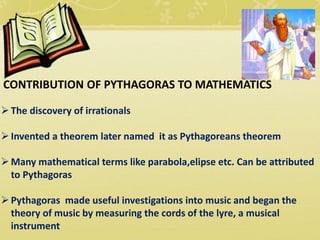
CONTRIBUTION OF PYTHAGORAS TO MATHEMATICS
The discovery of irrationals
Invented a theorem later named it as Pythagoreans theorem
Many mathematical terms like parabola,elipse etc. Can be attributed
to Pythagoras
Pythagoras made useful investigations into music and began the
theory of music by measuring the cords of the lyre, a musical
instrument
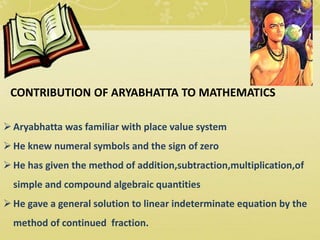
CONTRIBUTION OF ARYABHATTA TO MATHEMATICS
Aryabhatta was familiar with place value system
He knew numeral symbols and the sign of zero
He has given the method of addition,subtraction,multiplication,of
simple and compound algebraic quantities
He gave a general solution to linear indeterminate equation by the
method of continued fraction.
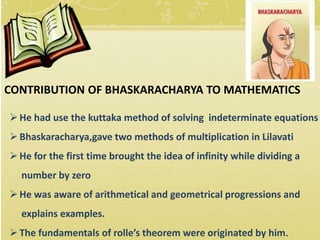
CONTRIBUTION OF BHASKARACHARYA TO MATHEMATICS
He had use the kuttaka method of solving indeterminate equations
Bhaskaracharya,gave two methods of multiplication in Lilavati
He for the first time brought the idea of infinity while dividing a
number by zero
He was aware of arithmetical and geometrical progressions and
explains examples.
The fundamentals of rolle’s theorem were originated by him.
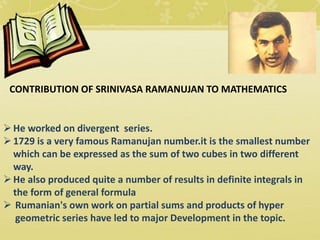
CONTRIBUTION OF SRINIVASA RAMANUJAN TO MATHEMATICS
He worked on divergent series.
1729 is a very famous Ramanujan number.it is the smallest number
which can be expressed as the sum of two cubes in two different
way.
He also produced quite a number of results in definite integrals in
the form of general formula
 Rumanian's own work on partial sums and products of hyper
geometric series have led to major Development in the topic.
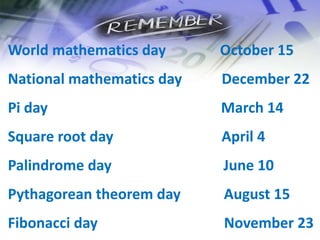
World mathematics day October 15
National mathematics day December 22
Pi day March 14
Square root day April 4
Palindrome day June 10
Pythagorean theorem day August 15
Fibonacci day November 23
MATHEMATICS

MATHEMATICS

  • 1.
  • 2.
    The term MATHEMATICSis derived from two Greek words ‘manthanein’ which means learning and ‘techne’ an art of technique. Therefore mathematics means the art of learning related to disciplines. Mathematics is defined as the science of quantity, measurement and special relation.
  • 3.
    The area ofstudy is known as the history of mathematics is primarily an investigation into the origin of discoveries of mathematics and, to a lesser Extent, an investigation into the mathematical methods notation of the past. Chinese mathematics made early contributions including a place value system. The origins of mathematical thought lie in the concepts of number and magnitude. HISTORY OF MATHEMATICS
  • 4.
    NATURE OF MATHEMATICS 1.MATHEMATICS IS A SCIENCE OF DISCOVERY Mathematics give an easy and early opportunity to make independent discoveries. It is the discovery of relationships and the expression of those relationships in symbolic form. 2. MATHEMATICS IS AN INTELLECTUAL GAME Mathematics is mainly a matter of puzzles,paradoxes,and problem-solving.
  • 5.
    3.MATHEMATICS IS ATOOL SUBJECT Mathematics has its integrity, its beauty, its structure and many other features that relate to Mathematics as an end in itself. 4.MATHEMATICS INVOLVES AN INTUITIVE METHOD The first step in the learning of any mathematical subject is the development of Intuition. This must come before rules are stated or formal operations are introduced
  • 6.
    4.MATHEMATICS HAS ITSOWN LANGUAGE AND SYMBOLS The language for communication of mathematical ideas is largely in terms of symbols and words which everybody cannot understand. 5.MATHEMATICS IS AN ABSTRACT SCIENCE Mathematical concepts are abstract in the sense that they cannot be seen That they cannot be seen or felt in the physical world.
  • 7.
    6. MATHEMATICS ISLOGIC Logic is an important factor in mathematics; it governs the pattern of deductive proof through which mathematics is developed. 7.MATHEMATICS DEALS WITH ART OF DRAWING CONCLUSIONS In mathematics the conclusions are certain and definite. Therefore the learner can Check the correct solutions.
  • 8.
    NEEDS AND SIGNIFICANCEOF LEARNING MATHEMATICS
  • 9.
    • Mathematics learninghelps to apply mathematical concepts and theorems to new situations. • Mathematics provides a clear understanding of laws of nature. • Mathematics helps in clear understanding of the culture and development of our civilization. • Mathematics learning helps to think alternative methods of solving problems • Mathematics provides a frame work for solving problems • Mathematics is a powerful tool in the hands of the learners • Mathematics learning helps in a better understanding of the world around us
  • 10.
    VALUES OF TEACHINGMATHEMATICS
  • 11.
    o Develops thepower to generalize and classify o Develops the habit of self study o Helps students to assume responsibility for his own work o Develops constructive imagination o Cultivates the power of attention and concentration o Inculcates habits of neatness and accuracy
  • 12.
    AREAS OF MATHEMATICSTOPICS Algebra Calculus and analysis Geometry and topology combinatorics Logic&number theory
  • 13.
  • 14.
    COOKING When we cookwe need to measure the ingredience in terms of table spoons teaspoons ounce Grams kilograms etc. messing up with the measurements can result in disastrous meals . DIET people who are over weight need to be conscious of their calorie in take. Especially if they are on special weight loss, Diet knowledge of math is needed to calculate the total amount of calories consumed in a day.
  • 15.
    BANKING Banking is probablythe one place where math is used more than anywhere else. No one without basic knowledge about math can’t do anything in a bank. ARTS Math is also used by artists while making paintings, designing collages as well as during dance performances. In all these cases the size of canvas, the size of the stage,etc play a very important role and deciding all these aspects is literally Impossible without the knowledge of math.
  • 16.
    SHOPPING This is probablythe most common use of math in which we make a list of things We need to guy as well as make payments in the end. GARDENING For planning to sow seeds or count the number of plants, everything requires numbers. All tasks carried out inside a garden require proper measurements
  • 17.
  • 18.
    CONTRIBUTION OF EUCLIDTO MATHEMATICS  He is credited with the well known proof of the Pythagorean theorem  He solved unresolved problems related to irrational numbers  He proved what is generally known as Euclid's secondary theorem that prime numbers are infinite
  • 19.
    CONTRIBUTION OF PYTHAGORASTO MATHEMATICS The discovery of irrationals Invented a theorem later named it as Pythagoreans theorem Many mathematical terms like parabola,elipse etc. Can be attributed to Pythagoras Pythagoras made useful investigations into music and began the theory of music by measuring the cords of the lyre, a musical instrument
  • 20.
    CONTRIBUTION OF ARYABHATTATO MATHEMATICS Aryabhatta was familiar with place value system He knew numeral symbols and the sign of zero He has given the method of addition,subtraction,multiplication,of simple and compound algebraic quantities He gave a general solution to linear indeterminate equation by the method of continued fraction.
  • 21.
    CONTRIBUTION OF BHASKARACHARYATO MATHEMATICS He had use the kuttaka method of solving indeterminate equations Bhaskaracharya,gave two methods of multiplication in Lilavati He for the first time brought the idea of infinity while dividing a number by zero He was aware of arithmetical and geometrical progressions and explains examples. The fundamentals of rolle’s theorem were originated by him.
  • 22.
    CONTRIBUTION OF SRINIVASARAMANUJAN TO MATHEMATICS He worked on divergent series. 1729 is a very famous Ramanujan number.it is the smallest number which can be expressed as the sum of two cubes in two different way. He also produced quite a number of results in definite integrals in the form of general formula  Rumanian's own work on partial sums and products of hyper geometric series have led to major Development in the topic.
  • 23.
    World mathematics dayOctober 15 National mathematics day December 22 Pi day March 14 Square root day April 4 Palindrome day June 10 Pythagorean theorem day August 15 Fibonacci day November 23