REAL NUMBERS
Made By-: Jai Hans
Class -: IX
Section-: B
Roll No-:4
Admission No-: 3077
Real Numbers
• Real Numbers are every number.
• Therefore, any number that you can
find on the number line.
• Real Numbers are the compilation of
all types of numbers.
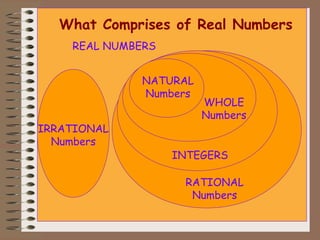
WHOLE
Numbers
REAL NUMBERS
IRRATIONAL
Numbers
NATURAL
Numbers
RATIONAL
Numbers
INTEGERS
What Comprises of Real Numbers
Natural Numbers
•All counting numbers
which start from 1
are natural numbers.  
•They have only
positive value
numbers.
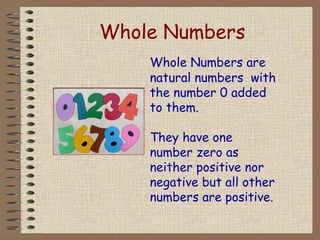
Whole Numbers
Whole Numbers are
natural numbers with
the number 0 added
to them.
They have one
number zero as
neither positive nor
negative but all other
numbers are positive.
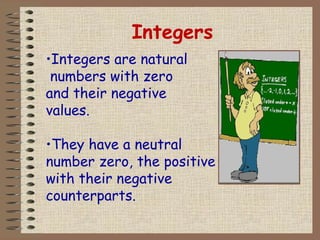
Integers
•Integers are natural
numbers with zero
and their negative
values.
•They have a neutral
number zero, the positive numbers
with their negative
counterparts.
Rational Numbers
Rational numbers are those numbers
which cannot be written as integers.
They are written as integer divided
by another integer and the denominator
is not zero and both numbers do not
have common factors.
Rational numbers have either ending or
non-terminating repeating decimal
expansions
Between every 2 rational numbers, we
will find 2more
rational numbers.
Rational numbers can be called fractions.
Irrational Numbers
• A number which cannot be
written as an integer upon integer
where the denominator is zero
and both integers are co-primes
are irrational numbers.
• They are non –terminating non-
repeating decimal expansions.
• The roots of prime number are
irrational.
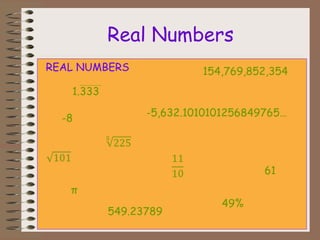
Real Numbers
REAL NUMBERS
-8
-5,632.1010101256849765…
61
49%
π
549.23789
154,769,852,354
1.333
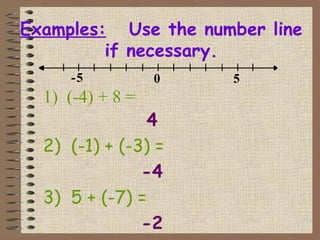
Examples: Use the number line
if necessary.
4
2) (-1) + (-3) =
-4
3) 5 + (-7) =
-2
0 5-5
1) (-4) + 8 =
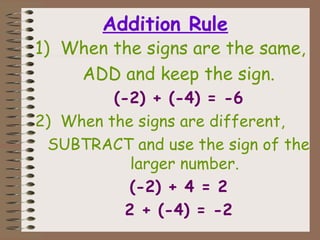
Addition Rule
1) When the signs are the same,
ADD and keep the sign.
(-2) + (-4) = -6
2) When the signs are different,
SUBTRACT and use the sign of the
larger number.
(-2) + 4 = 2
2 + (-4) = -2
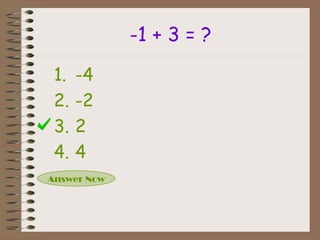
-1 + 3 = ?
1. -4
2. -2
3. 2
4. 4
Answer Now
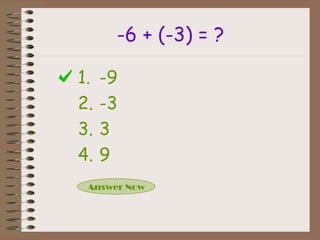
-6 + (-3) = ?
1. -9
2. -3
3. 3
4. 9
Answer Now
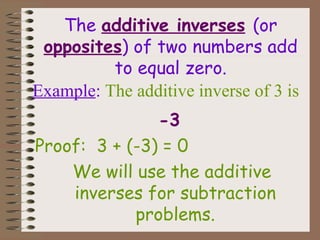
The additive inverses (or
opposites) of two numbers add
to equal zero.
-3
Proof: 3 + (-3) = 0
We will use the additive
inverses for subtraction
problems.
Example: The additive inverse of 3 is
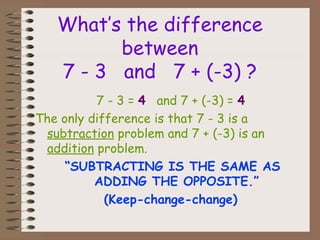
What’s the difference
between
7 - 3 and 7 + (-3) ?
7 - 3 = 4 and 7 + (-3) = 4
The only difference is that 7 - 3 is a
subtraction problem and 7 + (-3) is an
addition problem.
“SUBTRACTING IS THE SAME AS
ADDING THE OPPOSITE.”
(Keep-change-change)
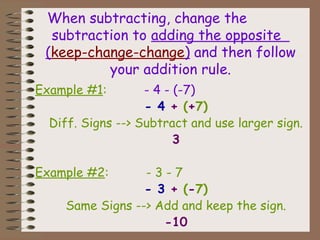
When subtracting, change the
subtraction to adding the opposite
(keep-change-change) and then follow
your addition rule.
Example #1: - 4 - (-7)
- 4 + (+7)
Diff. Signs --> Subtract and use larger sign.
3
Example #2: - 3 - 7
- 3 + (-7)
Same Signs --> Add and keep the sign.
-10
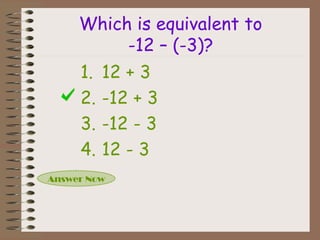
Which is equivalent to
-12 – (-3)?
Answer Now
1. 12 + 3
2. -12 + 3
3. -12 - 3
4. 12 - 3
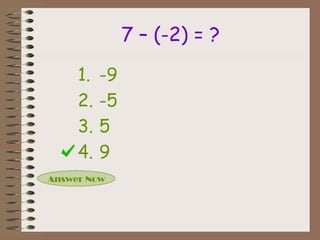
7 – (-2) = ?
Answer Now
1. -9
2. -5
3. 5
4. 9
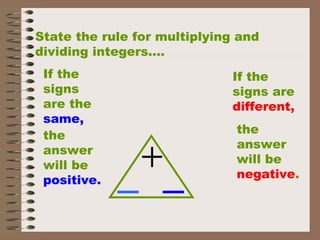
State the rule for multiplying and
dividing integers….
If the
signs
are the
same,
If the
signs are
different,
+
the
answer
will be
positive.
the
answer
will be
negative.
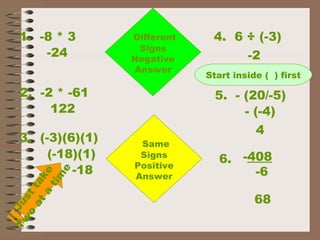
1. -8 * 3 What’s
The
Rule?
Different
Signs
Negative
Answer
-24
2. -2 * -61
Same
Signs
Positive
Answer
122
3. (-3)(6)(1)
Justtake
Tw
o
ata
tim
e
(-18)(1)
-18
4. 6 ÷ (-3)
-2
5. - (20/-5)
- (-4)
4
6.
68
Start inside ( ) first
-408
-6
Real Numbers class 9

Real Numbers class 9

  • 1.
    REAL NUMBERS Made By-:Jai Hans Class -: IX Section-: B Roll No-:4 Admission No-: 3077
  • 2.
    Real Numbers • RealNumbers are every number. • Therefore, any number that you can find on the number line. • Real Numbers are the compilation of all types of numbers.
  • 3.
  • 4.
    Natural Numbers •All countingnumbers which start from 1 are natural numbers.   •They have only positive value numbers.
  • 5.
    Whole Numbers Whole Numbersare natural numbers with the number 0 added to them. They have one number zero as neither positive nor negative but all other numbers are positive.
  • 6.
    Integers •Integers are natural numberswith zero and their negative values. •They have a neutral number zero, the positive numbers with their negative counterparts.
  • 7.
    Rational Numbers Rational numbersare those numbers which cannot be written as integers. They are written as integer divided by another integer and the denominator is not zero and both numbers do not have common factors. Rational numbers have either ending or non-terminating repeating decimal expansions Between every 2 rational numbers, we will find 2more rational numbers. Rational numbers can be called fractions.
  • 8.
    Irrational Numbers • Anumber which cannot be written as an integer upon integer where the denominator is zero and both integers are co-primes are irrational numbers. • They are non –terminating non- repeating decimal expansions. • The roots of prime number are irrational.
  • 9.
  • 10.
    Examples: Use thenumber line if necessary. 4 2) (-1) + (-3) = -4 3) 5 + (-7) = -2 0 5-5 1) (-4) + 8 =
  • 11.
    Addition Rule 1) Whenthe signs are the same, ADD and keep the sign. (-2) + (-4) = -6 2) When the signs are different, SUBTRACT and use the sign of the larger number. (-2) + 4 = 2 2 + (-4) = -2
  • 12.
    -1 + 3= ? 1. -4 2. -2 3. 2 4. 4 Answer Now
  • 13.
    -6 + (-3)= ? 1. -9 2. -3 3. 3 4. 9 Answer Now
  • 14.
    The additive inverses(or opposites) of two numbers add to equal zero. -3 Proof: 3 + (-3) = 0 We will use the additive inverses for subtraction problems. Example: The additive inverse of 3 is
  • 15.
    What’s the difference between 7- 3 and 7 + (-3) ? 7 - 3 = 4 and 7 + (-3) = 4 The only difference is that 7 - 3 is a subtraction problem and 7 + (-3) is an addition problem. “SUBTRACTING IS THE SAME AS ADDING THE OPPOSITE.” (Keep-change-change)
  • 16.
    When subtracting, changethe subtraction to adding the opposite (keep-change-change) and then follow your addition rule. Example #1: - 4 - (-7) - 4 + (+7) Diff. Signs --> Subtract and use larger sign. 3 Example #2: - 3 - 7 - 3 + (-7) Same Signs --> Add and keep the sign. -10
  • 17.
    Which is equivalentto -12 – (-3)? Answer Now 1. 12 + 3 2. -12 + 3 3. -12 - 3 4. 12 - 3
  • 18.
    7 – (-2)= ? Answer Now 1. -9 2. -5 3. 5 4. 9
  • 19.
    State the rulefor multiplying and dividing integers…. If the signs are the same, If the signs are different, + the answer will be positive. the answer will be negative.
  • 20.
    1. -8 *3 What’s The Rule? Different Signs Negative Answer -24 2. -2 * -61 Same Signs Positive Answer 122 3. (-3)(6)(1) Justtake Tw o ata tim e (-18)(1) -18 4. 6 ÷ (-3) -2 5. - (20/-5) - (-4) 4 6. 68 Start inside ( ) first -408 -6