Reactors
Batch Reactor
Type of Reactor Characteristics
Simple Batch Reactor is charged via two holes in the top of the
tank; while reaction is carried out, nothing else is put
in or taken out until the reaction is done; tank easily
heated or cooled by jacket
Kinds of Phases Present Usage Advantages Disadvantages
1. Gas phase
2. Liquid phase
3. Liquid Solid
1. Small scale production
2. Intermediate or one
shot production
3. Pharmaceutical
4. Fermentation
1. High conversion per
unit volume for one pass
2. Flexibility of operation-
same reactor can produce
one product one time and
a different product the
next
3. Easy to clean
1. High operating cost
2. Product quality more
variable than with
continuous operation
http://www.umich.edu/~elements/5e/asyLearn/bits/batch/index.htm
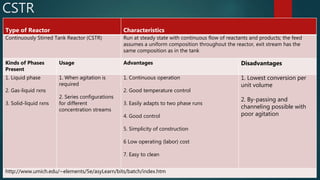
CSTR
Type of Reactor Characteristics
Continuously Stirred Tank Reactor (CSTR) Run at steady state with continuous flow of reactants and products; the feed
assumes a uniform composition throughout the reactor, exit stream has the
same composition as in the tank
Kinds of Phases
Present
Usage Advantages Disadvantages
1. Liquid phase
2. Gas-liquid rxns
3. Solid-liquid rxns
1. When agitation is
required
2. Series configurations
for different
concentration streams
1. Continuous operation
2. Good temperature control
3. Easily adapts to two phase runs
4. Good control
5. Simplicity of construction
6 Low operating (labor) cost
7. Easy to clean
1. Lowest conversion per
unit volume
2. By-passing and
channeling possible with
poor agitation
http://www.umich.edu/~elements/5e/asyLearn/bits/batch/index.htm
PFR
Type of Reactor Characteristics
Continuously Stirred Tank Reactor (CSTR) Arranged as one long reactor or many short reactors in a tube bank ; no radial
variation in reaction rate (concentration); concentration changes with length
down the reactor
Kinds of Phases
Present
Usage Advantages Disadvantages
1. Primarily Gas
Phase
1. Large Scale
2. Fast Reactions
3. Homogeneous
Reactions
4. Heterogeneous
Reactions
5. Continuous
Production
6. High Temperature
1. High Conversion per Unit Volume
2. Low operating (labor) cost)
3. Continuous Operation
4. Good heat transfer
1. Undesired thermal
gradients may exist
2. Poor temperature
control
3. Shutdown and cleaning
may be expensive
http://www.umich.edu/~elements/5e/asyLearn/bits/batch/index.htm
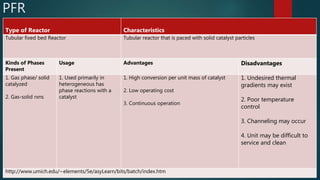
PFR
Type of Reactor Characteristics
Tubular fixed bed Reactor Tubular reactor that is paced with solid catalyst particles
Kinds of Phases
Present
Usage Advantages Disadvantages
1. Gas phase/ solid
catalyzed
2. Gas-solid rxns
1. Used primarily in
heterogeneous has
phase reactions with a
catalyst
1. High conversion per unit mass of catalyst
2. Low operating cost
3. Continuous operation
1. Undesired thermal
gradients may exist
2. Poor temperature
control
3. Channeling may occur
4. Unit may be difficult to
service and clean
http://www.umich.edu/~elements/5e/asyLearn/bits/batch/index.htm
Reactors

Reactors

  • 1.
  • 2.
    Batch Reactor Type ofReactor Characteristics Simple Batch Reactor is charged via two holes in the top of the tank; while reaction is carried out, nothing else is put in or taken out until the reaction is done; tank easily heated or cooled by jacket Kinds of Phases Present Usage Advantages Disadvantages 1. Gas phase 2. Liquid phase 3. Liquid Solid 1. Small scale production 2. Intermediate or one shot production 3. Pharmaceutical 4. Fermentation 1. High conversion per unit volume for one pass 2. Flexibility of operation- same reactor can produce one product one time and a different product the next 3. Easy to clean 1. High operating cost 2. Product quality more variable than with continuous operation http://www.umich.edu/~elements/5e/asyLearn/bits/batch/index.htm
  • 3.
    CSTR Type of ReactorCharacteristics Continuously Stirred Tank Reactor (CSTR) Run at steady state with continuous flow of reactants and products; the feed assumes a uniform composition throughout the reactor, exit stream has the same composition as in the tank Kinds of Phases Present Usage Advantages Disadvantages 1. Liquid phase 2. Gas-liquid rxns 3. Solid-liquid rxns 1. When agitation is required 2. Series configurations for different concentration streams 1. Continuous operation 2. Good temperature control 3. Easily adapts to two phase runs 4. Good control 5. Simplicity of construction 6 Low operating (labor) cost 7. Easy to clean 1. Lowest conversion per unit volume 2. By-passing and channeling possible with poor agitation http://www.umich.edu/~elements/5e/asyLearn/bits/batch/index.htm
  • 4.
    PFR Type of ReactorCharacteristics Continuously Stirred Tank Reactor (CSTR) Arranged as one long reactor or many short reactors in a tube bank ; no radial variation in reaction rate (concentration); concentration changes with length down the reactor Kinds of Phases Present Usage Advantages Disadvantages 1. Primarily Gas Phase 1. Large Scale 2. Fast Reactions 3. Homogeneous Reactions 4. Heterogeneous Reactions 5. Continuous Production 6. High Temperature 1. High Conversion per Unit Volume 2. Low operating (labor) cost) 3. Continuous Operation 4. Good heat transfer 1. Undesired thermal gradients may exist 2. Poor temperature control 3. Shutdown and cleaning may be expensive http://www.umich.edu/~elements/5e/asyLearn/bits/batch/index.htm
  • 5.
    PFR Type of ReactorCharacteristics Tubular fixed bed Reactor Tubular reactor that is paced with solid catalyst particles Kinds of Phases Present Usage Advantages Disadvantages 1. Gas phase/ solid catalyzed 2. Gas-solid rxns 1. Used primarily in heterogeneous has phase reactions with a catalyst 1. High conversion per unit mass of catalyst 2. Low operating cost 3. Continuous operation 1. Undesired thermal gradients may exist 2. Poor temperature control 3. Channeling may occur 4. Unit may be difficult to service and clean http://www.umich.edu/~elements/5e/asyLearn/bits/batch/index.htm