CHE333
Simultaneous Heat & Mass Transfer
Operations
Lecture 1: Introduction,
Humidification
Dr. Imran Hassan
Assistant professor, CUI Lahore.
1
2
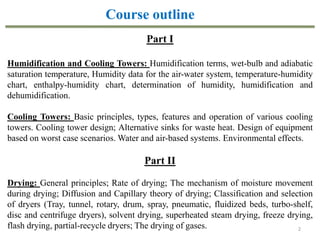
Part I
Humidification and Cooling Towers: Humidification terms, wet-bulb and adiabatic
saturation temperature, Humidity data for the air-water system, temperature-humidity
chart, enthalpy-humidity chart, determination of humidity, humidification and
dehumidification.
Cooling Towers: Basic principles, types, features and operation of various cooling
towers. Cooling tower design; Alternative sinks for waste heat. Design of equipment
based on worst case scenarios. Water and air-based systems. Environmental effects.
Part II
Drying: General principles; Rate of drying; The mechanism of moisture movement
during drying; Diffusion and Capillary theory of drying; Classification and selection
of dryers (Tray, tunnel, rotary, drum, spray, pneumatic, fluidized beds, turbo-shelf,
disc and centrifuge dryers), solvent drying, superheated steam drying, freeze drying,
flash drying, partial-recycle dryers; The drying of gases.
Course outline
3
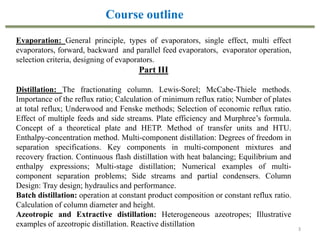
Evaporation: General principle, types of evaporators, single effect, multi effect
evaporators, forward, backward and parallel feed evaporators, evaporator operation,
selection criteria, designing of evaporators.
Part III
Distillation: The fractionating column. Lewis-Sorel; McCabe-Thiele methods.
Importance of the reflux ratio; Calculation of minimum reflux ratio; Number of plates
at total reflux; Underwood and Fenske methods; Selection of economic reflux ratio.
Effect of multiple feeds and side streams. Plate efficiency and Murphree’s formula.
Concept of a theoretical plate and HETP. Method of transfer units and HTU.
Enthalpy-concentration method. Multi-component distillation: Degrees of freedom in
separation specifications. Key components in multi-component mixtures and
recovery fraction. Continuous flash distillation with heat balancing; Equilibrium and
enthalpy expressions; Multi-stage distillation; Numerical examples of multi-
component separation problems; Side streams and partial condensers. Column
Design: Tray design; hydraulics and performance.
Batch distillation: operation at constant product composition or constant reflux ratio.
Calculation of column diameter and height.
Azeotropic and Extractive distillation: Heterogeneous azeotropes; Illustrative
examples of azeotropic distillation. Reactive distillation
Course outline
4
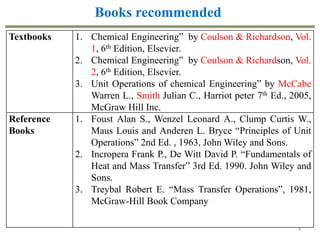
Textbooks 1. Chemical Engineering” by Coulson & Richardson, Vol.
1, 6th Edition, Elsevier.
2. Chemical Engineering” by Coulson & Richardson, Vol.
2, 6th Edition, Elsevier.
3. Unit Operations of chemical Engineering” by McCabe
Warren L., Smith Julian C., Harriot peter 7th Ed., 2005,
McGraw Hill Inc.
Reference
Books
1. Foust Alan S., Wenzel Leonard A., Clump Curtis W.,
Maus Louis and Anderen L. Bryce “Principles of Unit
Operations” 2nd Ed. , 1963, John Wiley and Sons.
2. Incropera Frank P., De Witt David P. “Fundamentals of
Heat and Mass Transfer” 3rd Ed. 1990. John Wiley and
Sons.
3. Treybal Robert E. “Mass Transfer Operations”, 1981,
McGraw-Hill Book Company
Books recommended
5
Course Learning Objectives
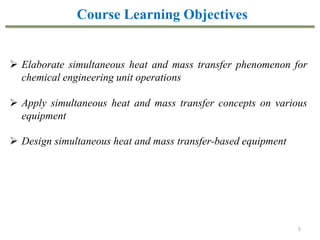
 Elaborate simultaneous heat and mass transfer phenomenon for
chemical engineering unit operations
 Apply simultaneous heat and mass transfer concepts on various
equipment
 Design simultaneous heat and mass transfer-based equipment
Assessments
6
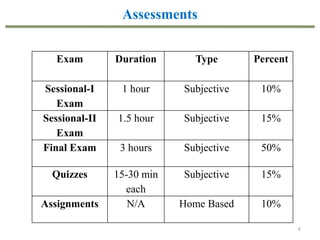
Exam Duration Type Percent
Sessional-I
Exam
1 hour Subjective 10%
Sessional-II
Exam
1.5 hour Subjective 15%
Final Exam 3 hours Subjective 50%
Quizzes 15-30 min
each
Subjective 15%
Assignments N/A Home Based 10%
7
Performance Evaluation
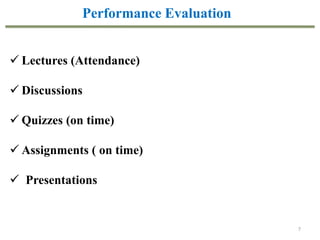
 Lectures (Attendance)
 Discussions
 Quizzes (on time)
 Assignments ( on time)
 Presentations
8
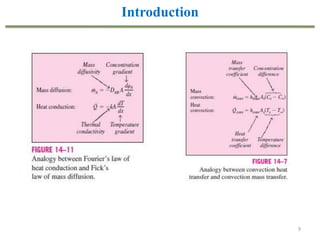
Introduction
9
Introduction
10
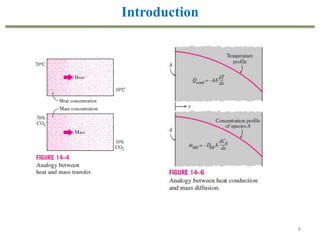
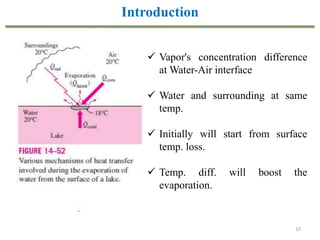
 Vapor's concentration difference
at Water-Air interface
 Water and surrounding at same
temp.
 Initially will start from surface
temp. loss.
 Temp. diff. will boost the
evaporation.
Introduction
11
Introduction
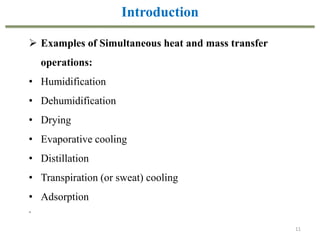
 Examples of Simultaneous heat and mass transfer
operations:
• Humidification
• Dehumidification
• Drying
• Evaporative cooling
• Distillation
• Transpiration (or sweat) cooling
• Adsorption
.
12
HUMIDIFICATION TERMS
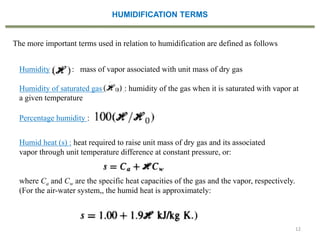
The more important terms used in relation to humidification are defined as follows
Humidity : mass of vapor associated with unit mass of dry gas
Humidity of saturated gas :: humidity of the gas when it is saturated with vapor at
a given temperature
Percentage humidity :
Humid heat (s) : heat required to raise unit mass of dry gas and its associated
vapor through unit temperature difference at constant pressure, or:
where Ca and Cw are the specific heat capacities of the gas and the vapor, respectively.
(For the air-water system,, the humid heat is approximately:
13
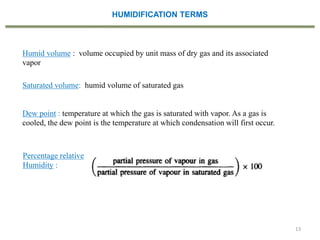
Humid volume : volume occupied by unit mass of dry gas and its associated
vapor
Saturated volume: humid volume of saturated gas
Dew point : temperature at which the gas is saturated with vapor. As a gas is
cooled, the dew point is the temperature at which condensation will first occur.
Percentage relative
Humidity :
HUMIDIFICATION TERMS
14
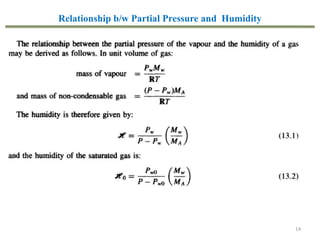
Relationship b/w Partial Pressure and Humidity
15
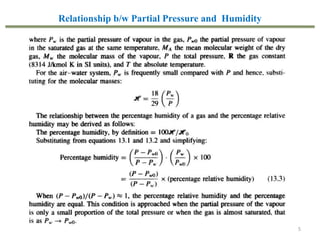
Relationship b/w Partial Pressure and Humidity
16
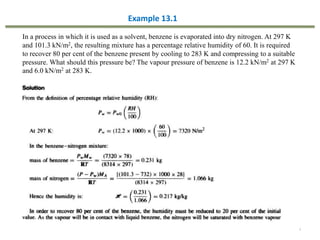
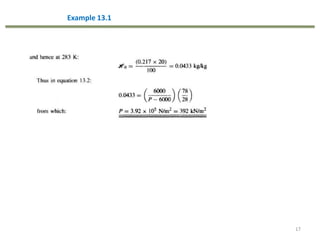
Example 13.1
In a process in which it is used as a solvent, benzene is evaporated into dry nitrogen. At 297 K
and 101.3 kN/m2, the resulting mixture has a percentage relative humidity of 60. It is required
to recover 80 per cent of the benzene present by cooling to 283 K and compressing to a suitable
pressure. What should this pressure be? The vapour pressure of benzene is 12.2 kN/m2 at 297 K
and 6.0 kN/m2 at 283 K.
17
Example 13.1
18
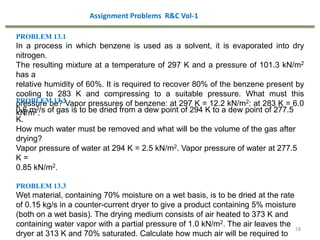
PROBLEM 13.1
In a process in which benzene is used as a solvent, it is evaporated into dry
nitrogen.
The resulting mixture at a temperature of 297 K and a pressure of 101.3 kN/m2
has a
relative humidity of 60%. It is required to recover 80% of the benzene present by
cooling to 283 K and compressing to a suitable pressure. What must this
pressure be? Vapor pressures of benzene: at 297 K = 12.2 kN/m2: at 283 K = 6.0
kN/m2.
PROBLEM 13.2
0.6 m3/s of gas is to be dried from a dew point of 294 K to a dew point of 277.5
K.
How much water must be removed and what will be the volume of the gas after
drying?
Vapor pressure of water at 294 K = 2.5 kN/m2. Vapor pressure of water at 277.5
K =
0.85 kN/m2.
PROBLEM 13.3
Wet material, containing 70% moisture on a wet basis, is to be dried at the rate
of 0.15 kg/s in a counter-current dryer to give a product containing 5% moisture
(both on a wet basis). The drying medium consists of air heated to 373 K and
containing water vapor with a partial pressure of 1.0 kN/m2. The air leaves the
dryer at 313 K and 70% saturated. Calculate how much air will be required to
Assignment Problems R&C Vol-1
19
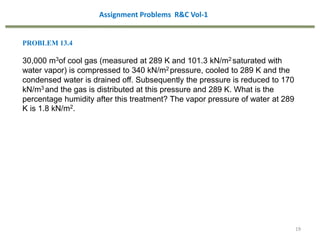
PROBLEM 13.4
30,000 m3of cool gas (measured at 289 K and 101.3 kN/m2 saturated with
water vapor) is compressed to 340 kN/m2 pressure, cooled to 289 K and the
condensed water is drained off. Subsequently the pressure is reduced to 170
kN/m3 and the gas is distributed at this pressure and 289 K. What is the
percentage humidity after this treatment? The vapor pressure of water at 289
K is 1.8 kN/m2.
Assignment Problems R&C Vol-1

1.Humidification-Lec. 1.pptx

  • 1.
    CHE333 Simultaneous Heat &Mass Transfer Operations Lecture 1: Introduction, Humidification Dr. Imran Hassan Assistant professor, CUI Lahore. 1
  • 2.
    2 Part I Humidification andCooling Towers: Humidification terms, wet-bulb and adiabatic saturation temperature, Humidity data for the air-water system, temperature-humidity chart, enthalpy-humidity chart, determination of humidity, humidification and dehumidification. Cooling Towers: Basic principles, types, features and operation of various cooling towers. Cooling tower design; Alternative sinks for waste heat. Design of equipment based on worst case scenarios. Water and air-based systems. Environmental effects. Part II Drying: General principles; Rate of drying; The mechanism of moisture movement during drying; Diffusion and Capillary theory of drying; Classification and selection of dryers (Tray, tunnel, rotary, drum, spray, pneumatic, fluidized beds, turbo-shelf, disc and centrifuge dryers), solvent drying, superheated steam drying, freeze drying, flash drying, partial-recycle dryers; The drying of gases. Course outline
  • 3.
    3 Evaporation: General principle,types of evaporators, single effect, multi effect evaporators, forward, backward and parallel feed evaporators, evaporator operation, selection criteria, designing of evaporators. Part III Distillation: The fractionating column. Lewis-Sorel; McCabe-Thiele methods. Importance of the reflux ratio; Calculation of minimum reflux ratio; Number of plates at total reflux; Underwood and Fenske methods; Selection of economic reflux ratio. Effect of multiple feeds and side streams. Plate efficiency and Murphree’s formula. Concept of a theoretical plate and HETP. Method of transfer units and HTU. Enthalpy-concentration method. Multi-component distillation: Degrees of freedom in separation specifications. Key components in multi-component mixtures and recovery fraction. Continuous flash distillation with heat balancing; Equilibrium and enthalpy expressions; Multi-stage distillation; Numerical examples of multi- component separation problems; Side streams and partial condensers. Column Design: Tray design; hydraulics and performance. Batch distillation: operation at constant product composition or constant reflux ratio. Calculation of column diameter and height. Azeotropic and Extractive distillation: Heterogeneous azeotropes; Illustrative examples of azeotropic distillation. Reactive distillation Course outline
  • 4.
    4 Textbooks 1. ChemicalEngineering” by Coulson & Richardson, Vol. 1, 6th Edition, Elsevier. 2. Chemical Engineering” by Coulson & Richardson, Vol. 2, 6th Edition, Elsevier. 3. Unit Operations of chemical Engineering” by McCabe Warren L., Smith Julian C., Harriot peter 7th Ed., 2005, McGraw Hill Inc. Reference Books 1. Foust Alan S., Wenzel Leonard A., Clump Curtis W., Maus Louis and Anderen L. Bryce “Principles of Unit Operations” 2nd Ed. , 1963, John Wiley and Sons. 2. Incropera Frank P., De Witt David P. “Fundamentals of Heat and Mass Transfer” 3rd Ed. 1990. John Wiley and Sons. 3. Treybal Robert E. “Mass Transfer Operations”, 1981, McGraw-Hill Book Company Books recommended
  • 5.
    5 Course Learning Objectives Elaborate simultaneous heat and mass transfer phenomenon for chemical engineering unit operations  Apply simultaneous heat and mass transfer concepts on various equipment  Design simultaneous heat and mass transfer-based equipment
  • 6.
    Assessments 6 Exam Duration TypePercent Sessional-I Exam 1 hour Subjective 10% Sessional-II Exam 1.5 hour Subjective 15% Final Exam 3 hours Subjective 50% Quizzes 15-30 min each Subjective 15% Assignments N/A Home Based 10%
  • 7.
    7 Performance Evaluation  Lectures(Attendance)  Discussions  Quizzes (on time)  Assignments ( on time)  Presentations
  • 8.
  • 9.
  • 10.
    10  Vapor's concentrationdifference at Water-Air interface  Water and surrounding at same temp.  Initially will start from surface temp. loss.  Temp. diff. will boost the evaporation. Introduction
  • 11.
    11 Introduction  Examples ofSimultaneous heat and mass transfer operations: • Humidification • Dehumidification • Drying • Evaporative cooling • Distillation • Transpiration (or sweat) cooling • Adsorption .
  • 12.
    12 HUMIDIFICATION TERMS The moreimportant terms used in relation to humidification are defined as follows Humidity : mass of vapor associated with unit mass of dry gas Humidity of saturated gas :: humidity of the gas when it is saturated with vapor at a given temperature Percentage humidity : Humid heat (s) : heat required to raise unit mass of dry gas and its associated vapor through unit temperature difference at constant pressure, or: where Ca and Cw are the specific heat capacities of the gas and the vapor, respectively. (For the air-water system,, the humid heat is approximately:
  • 13.
    13 Humid volume :volume occupied by unit mass of dry gas and its associated vapor Saturated volume: humid volume of saturated gas Dew point : temperature at which the gas is saturated with vapor. As a gas is cooled, the dew point is the temperature at which condensation will first occur. Percentage relative Humidity : HUMIDIFICATION TERMS
  • 14.
    14 Relationship b/w PartialPressure and Humidity
  • 15.
    15 Relationship b/w PartialPressure and Humidity
  • 16.
    16 Example 13.1 In aprocess in which it is used as a solvent, benzene is evaporated into dry nitrogen. At 297 K and 101.3 kN/m2, the resulting mixture has a percentage relative humidity of 60. It is required to recover 80 per cent of the benzene present by cooling to 283 K and compressing to a suitable pressure. What should this pressure be? The vapour pressure of benzene is 12.2 kN/m2 at 297 K and 6.0 kN/m2 at 283 K.
  • 17.
  • 18.
    18 PROBLEM 13.1 In aprocess in which benzene is used as a solvent, it is evaporated into dry nitrogen. The resulting mixture at a temperature of 297 K and a pressure of 101.3 kN/m2 has a relative humidity of 60%. It is required to recover 80% of the benzene present by cooling to 283 K and compressing to a suitable pressure. What must this pressure be? Vapor pressures of benzene: at 297 K = 12.2 kN/m2: at 283 K = 6.0 kN/m2. PROBLEM 13.2 0.6 m3/s of gas is to be dried from a dew point of 294 K to a dew point of 277.5 K. How much water must be removed and what will be the volume of the gas after drying? Vapor pressure of water at 294 K = 2.5 kN/m2. Vapor pressure of water at 277.5 K = 0.85 kN/m2. PROBLEM 13.3 Wet material, containing 70% moisture on a wet basis, is to be dried at the rate of 0.15 kg/s in a counter-current dryer to give a product containing 5% moisture (both on a wet basis). The drying medium consists of air heated to 373 K and containing water vapor with a partial pressure of 1.0 kN/m2. The air leaves the dryer at 313 K and 70% saturated. Calculate how much air will be required to Assignment Problems R&C Vol-1
  • 19.
    19 PROBLEM 13.4 30,000 m3ofcool gas (measured at 289 K and 101.3 kN/m2 saturated with water vapor) is compressed to 340 kN/m2 pressure, cooled to 289 K and the condensed water is drained off. Subsequently the pressure is reduced to 170 kN/m3 and the gas is distributed at this pressure and 289 K. What is the percentage humidity after this treatment? The vapor pressure of water at 289 K is 1.8 kN/m2. Assignment Problems R&C Vol-1