International Research Journal of Engineering and Technology (IRJET) e-ISSN: 2395 -0056
Volume: 03 Issue: 02 | Feb-2016 www.irjet.net p-ISSN: 2395-0072
© 2016, IRJET | Impact Factor value: 4.45 | ISO 9001:2008 Certified Journal | Page 1674
NONLINEAR CURRENT CONTROLLER FOR A SINGLE PHASE GRID
CONNECTED PHOTOVOLTAIC SYSTEM
Dhanashri P. Dhande 1, Prof. A. P. Chaudhari2, Prof. N. S. Wani3
1 Student (ME), Electrical Engineering , SSGB COET BHUSAWAL, MAHARASTRA,INDIA.
2 Assistant professor, Electrical Engineering, SSGB COET BHUSAWAL, MAHARASTRA,INDIA.
3 Assistant professor, Electrical Engineering, SSGB COET BHUSAWAL, MAHARASTRA,INDIA.
---------------------------------------------------------------------***---------------------------------------------------------------------
Abstract –This paper givesanewnonlinearcurrentcontrol
method for a single-phase grid-connected photovoltaic (PV)
system. Partial feedback linearizationis usedfordesigningthe
controller, which linearizes the system partially and to make
possible the controller design scheme for reduced-order PV
systems. The reference current is calculated from the
maximum power pointtrackingsystem(MPPT). Thesuggested
current control approach introduces the internal dynamics
and the stability of the internal dynamics is a key requirement
for the implementation of the controller to analyze the
stability of internal dynamics of a PV system. Based on the
tracking of grid current to the reference current, the
performance of the controller is evaluated by considering the
changes in environmental conditions. A large system
comparable to a practical system is simulated under different
operating conditions such as at a standard atmospheric
conditions, change in atmospheric condition and faults on
different parts of the system and compared with conventional
controllers, which ensures the suitability of the proposed
controller in a real system. The experimental validation of the
proposed control scheme is also presented in this paper.
Key Words: Grid Connected PV (Photovoltaic) system,
MPPT, Current Controller.
1.INTRODUCTION
In the field of power sector one of the major concerns in
these days is day-by- day increase inpowerdemand.But, the
quantity and availability of conventional energy sources are
not enough to meet up the current day’s power demand.
While thinking about the future availability of conventional
sources of power generation, it becomesveryimportantthat
the renewable energy sources must be utilized along with
source of conventional energy generation systems to fulfill
the requirement of the energydemand.Inordertoovercome
current day’s energy crisis, one renewable method is to
extract power from the incoming sun radiation called Solar
Energy, which is globally free for everyone. Solar radiation
is widely available on the surface of earth as well as inspace,
so that we can harvest it and convert it into other form of
energy and properly utilize it efficiently. Power generating
unit may fed power into the grid or it may beusedin isolated
systems. Utility location, load center, available grid
connectivity decides its energy usage. Thus, where the
availability of grids connection is very difficult or costly, the
solar energy can supply power to those areas. The most
important two advantages of solar power are that its fuel
cost is absolutely zero and solar power generationduring its
operation does not produce any greenhouse gases. Easy
carry-in of the power generating unit is another advantage
that is we can use it whenever wherever small power
generation is required. In the last few years the power
conversion mechanisms for solar energy has been
significantly reduced to compact size. Thenewresearchesin
the field of power electronics and material science have
greatly helped engineers to develop such systems. So that
very small but effective and powerful systems that have
capability to meet high electric power demand has been
developed. For every country, day by day power density
demand is increasing. Photovoltaic power generation is
capable of mitigating voltage fluctuation very effectively by
setting the system for the use of multiple input and
converter units. But in solar power generation system, due
to its high installation cost and the low efficiency of the solar
cells, this power generatingsystemscanhardlyparticipatein
the competitive power markets as a main renewable source
of power generation.
1.1 System Development
The overall system consists of solar panel that generates
power according to the irradiation levels. The MPPT
algorithm calculates the duty cycle for the converter
corresponding to the maximum power point. There will be
one maximum power point for a particular irradiation. Most
of electrical power applications are based on using solar
energy, as it is basically unlimited and generally on hand
energy resource. However, the output power induced in the
photovoltaic modules depends on solar irradiance and
temperature of the solar cells. This makes the extraction of
maximum power a complex task. The efficiency of the PV
generation depends on maximum power extraction of PV
system. Therefore, to maximize the efficiency of the
renewable energy system, it is necessary to track the
maximum power point of the PV array. The PV array has a
single in service point that cansupplymaximumpowertothe
International Research Journal of Engineering and Technology (IRJET) e-ISSN: 2395 -0056
Volume: 03 Issue: 02 | Feb-2016 www.irjet.net p-ISSN: 2395-0072
© 2016, IRJET | Impact Factor value: 4.45 | ISO 9001:2008 Certified Journal | Page 1675
load. This point is called the maximum power point (MPP).
The locus of this point has a nonlinear distinction with solar
irradiance and the cell temperature.Thus,inordertooperate
the PV array at its MPP, the PV system must contain a
maximum power point tracking (MPPT) controller
1.2 MPPT
Maximum power point tracking (MPPT) is the method of
tracking maximum output power from a solar panel. Several
MPPT algorithms are available nowadays. The MPPT
algorithm used in this particular work is non linear current
control. Pm is the maximum power thatcanbeobtainedfrom
a particular panel. The aim of a MPPT algorithm is to track
Pm by making Vpv to VM or Ipv to IM.
1.3 PV System Module
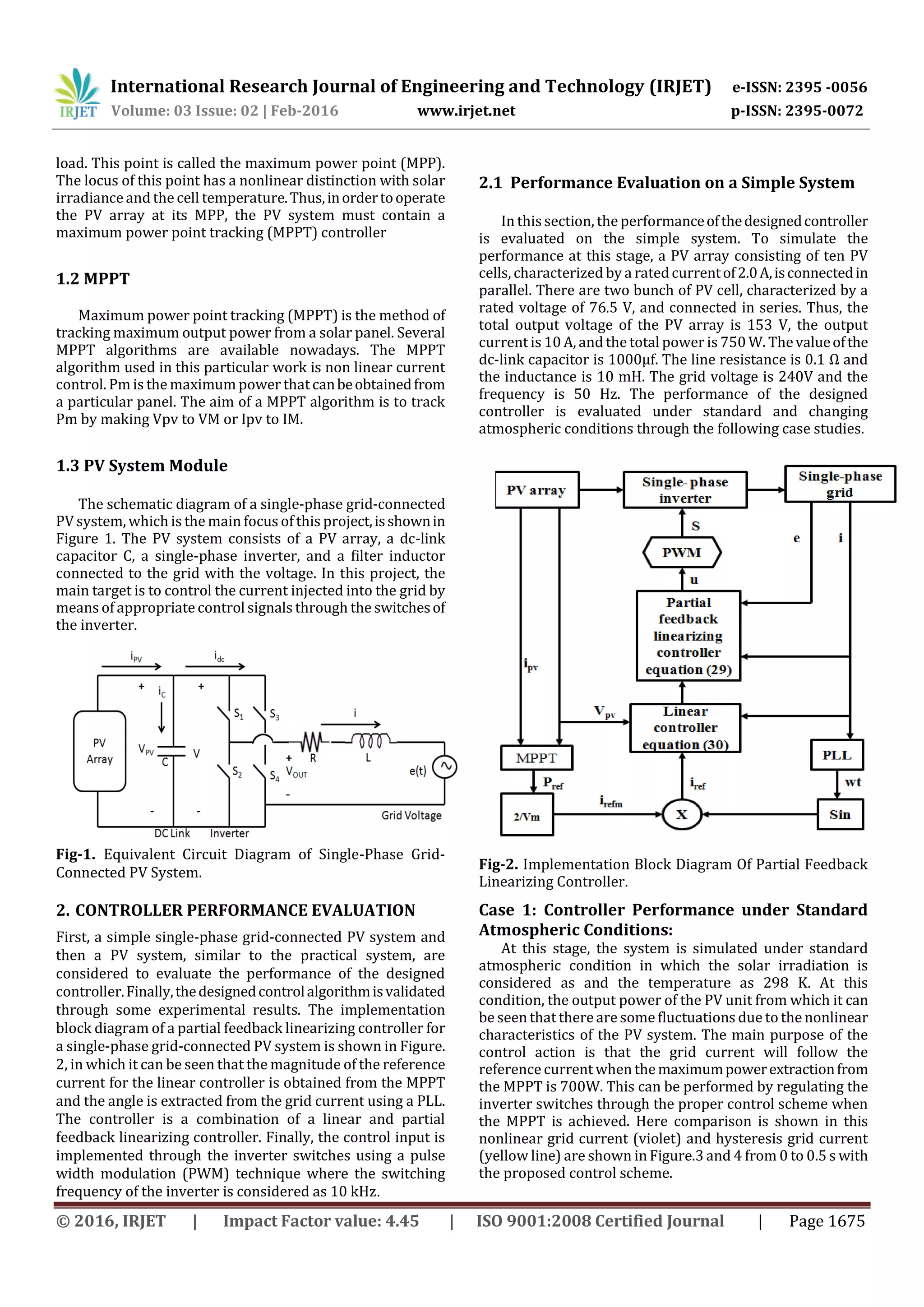
The schematic diagram of a single-phase grid-connected
PV system, which is the main focus of this project,isshownin
Figure 1. The PV system consists of a PV array, a dc-link
capacitor C, a single-phase inverter, and a filter inductor
connected to the grid with the voltage. In this project, the
main target is to control the current injected into the grid by
means of appropriatecontrol signals through the switchesof
the inverter.
Fig-1. Equivalent Circuit Diagram of Single-Phase Grid-
Connected PV System.
2. CONTROLLER PERFORMANCE EVALUATION
First, a simple single-phase grid-connected PV system and
then a PV system, similar to the practical system, are
considered to evaluate the performance of the designed
controller.Finally,thedesignedcontrolalgorithmisvalidated
through some experimental results. The implementation
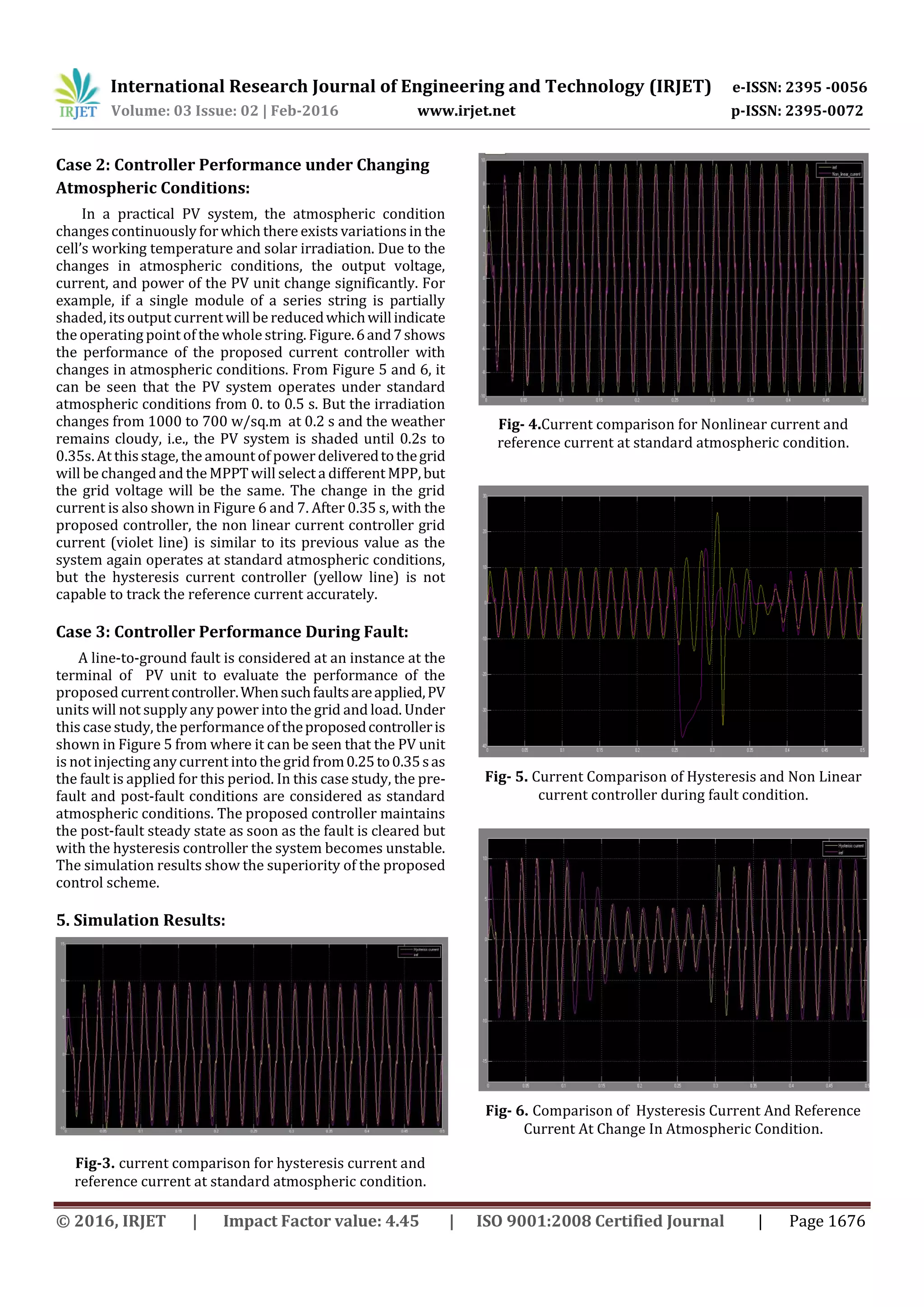
block diagram of a partial feedback linearizing controller for
a single-phase grid-connected PV system is shown in Figure.
2, in which it can be seen that the magnitude of the reference
current for the linear controller is obtained from the MPPT
and the angle is extracted from the grid current using a PLL.
The controller is a combination of a linear and partial
feedback linearizing controller. Finally, the control input is
implemented through the inverter switches using a pulse
width modulation (PWM) technique where the switching
frequency of the inverter is considered as 10 kHz.
2.1 Performance Evaluation on a Simple System
In thissection, the performanceofthedesignedcontroller
is evaluated on the simple system. To simulate the
performance at this stage, a PV array consisting of ten PV
cells, characterized by a ratedcurrentof2.0A,isconnectedin
parallel. There are two bunch of PV cell, characterized by a
rated voltage of 76.5 V, and connected in series. Thus, the
total output voltage of the PV array is 153 V, the output
current is 10 A, and the total power is 750 W. Thevalueofthe
dc-link capacitor is 1000μf. The line resistance is 0.1 Ω and
the inductance is 10 mH. The grid voltage is 240V and the
frequency is 50 Hz. The performance of the designed
controller is evaluated under standard and changing
atmospheric conditions through the following case studies.
Fig-2. Implementation Block Diagram Of Partial Feedback
Linearizing Controller.
Case 1: Controller Performance under Standard
Atmospheric Conditions:
At this stage, the system is simulated under standard
atmospheric condition in which the solar irradiation is
considered as and the temperature as 298 K. At this
condition, the output power of the PV unit from which it can
be seen that there are somefluctuations due to the nonlinear
characteristics of the PV system. The main purpose of the
control action is that the grid current will follow the
reference current when themaximumpowerextractionfrom
the MPPT is 700W. This can be performed by regulating the
inverter switches through the proper control scheme when
the MPPT is achieved. Here comparison is shown in this
nonlinear grid current (violet) and hysteresis grid current
(yellow line) are shown in Figure.3 and 4 from 0 to 0.5 s with
the proposed control scheme.
International Research Journal of Engineering and Technology (IRJET) e-ISSN: 2395 -0056
Volume: 03 Issue: 02 | Feb-2016 www.irjet.net p-ISSN: 2395-0072
© 2016, IRJET | Impact Factor value: 4.45 | ISO 9001:2008 Certified Journal | Page 1676
Case 2: Controller Performance under Changing
Atmospheric Conditions:
In a practical PV system, the atmospheric condition
changescontinuously for which there exists variations in the
cell’s working temperature and solar irradiation. Due to the
changes in atmospheric conditions, the output voltage,
current, and power of the PV unit change significantly. For
example, if a single module of a series string is partially
shaded, its output current will be reducedwhichwillindicate
the operating point of the whole string. Figure.6and7shows
the performance of the proposed current controller with
changes in atmospheric conditions. From Figure 5 and 6, it
can be seen that the PV system operates under standard
atmospheric conditions from 0. to 0.5 s. But the irradiation
changes from 1000 to 700 w/sq.m at 0.2 s and the weather
remains cloudy, i.e., the PV system is shaded until 0.2s to
0.35s. At thisstage, the amount of power deliveredtothegrid
will be changedand the MPPT will select a different MPP,but
the grid voltage will be the same. The change in the grid
current is also shown in Figure 6 and 7. After 0.35 s, with the
proposed controller, the non linear current controller grid
current (violet line) is similar to its previous value as the
system again operates at standard atmospheric conditions,
but the hysteresis current controller (yellow line) is not
capable to track the reference current accurately.
Case 3: Controller Performance During Fault:
A line-to-ground fault is considered at an instance at the
terminal of PV unit to evaluate the performance of the
proposed currentcontroller.Whensuchfaultsareapplied,PV
units will not supply any power into the grid and load. Under
this case study, the performance of theproposedcontrolleris
shown in Figure 5 from where it can be seen that the PV unit
is not injecting anycurrent into the grid from0.25to0.35sas
the fault is applied for this period. In this case study, the pre-
fault and post-fault conditions are considered as standard
atmospheric conditions. The proposed controller maintains
the post-fault steady state as soon as the fault is cleared but
with the hysteresis controller the system becomes unstable.
The simulation results show the superiority of the proposed
control scheme.
5. Simulation Results:
Fig-3. current comparison for hysteresis current and
reference current at standard atmospheric condition.
Fig- 4.Current comparison for Nonlinear current and
reference current at standard atmospheric condition.
Fig- 5. Current Comparison of Hysteresis and Non Linear
current controller during fault condition.
Fig- 6. Comparison of Hysteresis Current And Reference
Current At Change In Atmospheric Condition.
International Research Journal of Engineering and Technology (IRJET) e-ISSN: 2395 -0056
Volume: 03 Issue: 02 | Feb-2016 www.irjet.net p-ISSN: 2395-0072
© 2016, IRJET | Impact Factor value: 4.45 | ISO 9001:2008 Certified Journal | Page 1677
Fig- 7. Comparison of Nonlinear Current And Reference
Current At Change In Atmospheric Condition.
3. CONCLUSIONS
A partial feedback linearizing nonlinear current control
scheme was presented to improvethedynamic performance
of a single-phase grid-connected PV system with changes in
atmospheric conditions, variations in load conditions, and
faults on different parts of the system. All the possible
nonlinearities are very well canceled by the proposed
controller designed approachbytransformingthePVsystem
into a reduced order linear system with stable internal
dynamics. The injected current into grid is controlled to
ensure the operation of the PV system at the MPP. Future
work will deal with the extension oftheproposedmethod by
considering some mismatches within the PV model and
implementation on a laboratory-based system. A review on
various current control techniques/schemes has been
discussed here & it is found that nonlinear current control
scheme, presented & validated using MATLAB simulation is
more efficient compared to hysteresis current control and
other controlling schemes under various conditions. The
project work is supported with results obtained in MATLAB
simulation through waveforms
ACKNOWLEDGEMENT
I would like to express my deepest appreciation to all those
who provided me the possibility to complete this paper. A
special gratitude to my guide, Prof A. P. Chaudhari , whose
contribution in stimulating suggestion and encouragement
helped me to coordinate my project in effective way.
REFERENCES
[1] M. A. Mahmud, , H. R. Pota, and M. J. Hossain, “Nonlinear
Current Control Scheme for a Single-Phase Grid-
Connected Photovoltaic System” IEEE TRANSACTIONS
ON SUSTAINABLE ENERGY, VOL. 5, NO. 1, JANUARY
2014.
[2] T. Kato, T. Inoue, and Y. Suzuoki, “Impact of Large-scale
Penetration of Photovoltaic Power Generation Systems
on Fluctuation Property of Electricity Load” 2010.
[3] I. Houssamo, F. Locment, and M. Sechilariu, “Maximum
power point tracking for photovoltaic power system:
Development and experimental comparison of two
algorithms,” Renew. Energy, vol. 35, no. 10, pp. 2381–
2387, Oct. 2010.
[4] Casadei, G. Grandi, and C. Rossi, “Single-phase single-
stage photovoltaic generation system based on a ripple
correlation control maximum power point tracking,”
IEEE Trans. Energy Convers., vol. 21, no. 2, pp. 562–568,
Jun. 2006.
[5] Sreekanth G, Narender Reddy N, Durga Prasad A,
Nagendrababu V “ A Mppt Algorithm Based Pv System
Connected To Single Phase Voltage Controlled Grid”
International Journal of Advancements in Research &
Technology, Volume 1, Issue 5, October-2012 1 ISSN
2278-7763.
[6] T. Esram and P. L. Chapman, “Comparison of
photovoltaic array maximum power point tracking
techniques,” IEEE Trans. Energy Convers., vol. 22, no. 2,
pp. 439–449, Jun. 2007.
[7] M. E. Ropp and S. Gonzalez, “Development of a
MATLAB/Simulink model of a single-phase grid-
connected photovoltaic system,” IEEE Trans. Energy
Convers., vol. 24, no. 1, pp. 195–202, Mar. 2009.
[8] B. D. Subudhi and R. Pradhan, “A comparative study on
maximum power point tracking techniques for
photovoltaic power systems,” IEEE Trans. Sustain.
Energy, vol. 4, no. 1, pp. 89–98, Jan. 2013.
[9] Mattia Ricco, Patrizio Manganiello, Eric Monmasson, ,
Giovanni Petrone, and Giovanni Spagnuolo, “FPGA-
Based Implementation of Dual Kalman Filter for PV
MPPT Applications” IEEE Transactions On Industrial
Informatics, 2015.
[10] J. Selvaraj and N. A. Rahim, “Multilevel inverter for grid-
connected PV system employing digital PI controller,”
IEEE Trans. Ind. Electron., vol. 56, no. 1, pp. 149–158,
Jan. 2009.
[11] P. P. Dash and M. Kazerani, “Dynamic modeling and
performance analysis of a grid-connected current-
source inverter-based photovoltaicsystem,”IEEETrans.
Sustain. Energy, vol. 2, no. 4, pp. 443–450, Oct. 2011.
[12] N. A. Rahim, J. Selvaraj, and C. C. Krismadinata,
“Hysteresis current control and sensorless MPPT for
grid-connected photovoltaic systems,” in Proc.IEEE Int.
Symp. Industrial Electronics, Vigo, Spain, 2007,pp.572–
577.
[13] A. Kotsopoulos, J. L. Duarte, and M. A. M. Hendrix, “A
predictive control scheme for DC voltageandACcurrent
in grid-connected photovoltaic inverterswithminimum
DC link capacitance,” in Proc. 27th Annu. Conf. IEEE
Industrial Electronics Society, Colorado, USA, 2001, pp.
1994–1999.
[14] E. Bianconi, J. Calvente, R. Giral,E.Mamarelis,G.Petrone,
A. Ramos-Paja, G. Spagnuolo, and M. Vitelli, “A fast
current-based MPPT technique employing slidingmode
control,” IEEE Trans. Ind. Electron., vol. 60, no. 3, pp.
1168–1178, Mar. 2013.
[15] T. L. Nguyen and K.-S. Low, “A global maximum power
point tracking scheme employing DIRECT search
International Research Journal of Engineering and Technology (IRJET) e-ISSN: 2395 -0056
Volume: 03 Issue: 02 | Feb-2016 www.irjet.net p-ISSN: 2395-0072
© 2016, IRJET | Impact Factor value: 4.45 | ISO 9001:2008 Certified Journal | Page 1678
algorithm for photovoltaic systems,” IEEE Trans. Ind.
Electron., vol. 57, no. 10, pp. 3456–3467, Oct. 2010.
[16] Arun Raj, Anu Gopinath “ Proportional plus Integral (PI)
Control for Maximum Power Point Tracking in
Photovoltaic Systems” International Research Journal of
Engineering and Technology (IRJET) Volume: 02 Issue: 06
| Sep-2015.
[17] Aurel Botezan, Ioan Vadan and Silviu stefanescu
“Hysteresis Current Control of the Single – Phase Active
Filter” Annals of university of Craiova ,Electrical
Engineering series, No 37,2013,ISSN 1842-4805.
[18] K Smriti Rao, Ravi Mishra “ Comparative study of P, PI
and PID controller for speed control ofVSI-fedinduction
motor” 2014 IJEDR | Volume 2, Issue 2 | ISSN: 2321-
9939.

Nonlinear Current Controller for a Single Phase Grid Connected Photovoltaic System

  • 1.
    International Research Journalof Engineering and Technology (IRJET) e-ISSN: 2395 -0056 Volume: 03 Issue: 02 | Feb-2016 www.irjet.net p-ISSN: 2395-0072 © 2016, IRJET | Impact Factor value: 4.45 | ISO 9001:2008 Certified Journal | Page 1674 NONLINEAR CURRENT CONTROLLER FOR A SINGLE PHASE GRID CONNECTED PHOTOVOLTAIC SYSTEM Dhanashri P. Dhande 1, Prof. A. P. Chaudhari2, Prof. N. S. Wani3 1 Student (ME), Electrical Engineering , SSGB COET BHUSAWAL, MAHARASTRA,INDIA. 2 Assistant professor, Electrical Engineering, SSGB COET BHUSAWAL, MAHARASTRA,INDIA. 3 Assistant professor, Electrical Engineering, SSGB COET BHUSAWAL, MAHARASTRA,INDIA. ---------------------------------------------------------------------***--------------------------------------------------------------------- Abstract –This paper givesanewnonlinearcurrentcontrol method for a single-phase grid-connected photovoltaic (PV) system. Partial feedback linearizationis usedfordesigningthe controller, which linearizes the system partially and to make possible the controller design scheme for reduced-order PV systems. The reference current is calculated from the maximum power pointtrackingsystem(MPPT). Thesuggested current control approach introduces the internal dynamics and the stability of the internal dynamics is a key requirement for the implementation of the controller to analyze the stability of internal dynamics of a PV system. Based on the tracking of grid current to the reference current, the performance of the controller is evaluated by considering the changes in environmental conditions. A large system comparable to a practical system is simulated under different operating conditions such as at a standard atmospheric conditions, change in atmospheric condition and faults on different parts of the system and compared with conventional controllers, which ensures the suitability of the proposed controller in a real system. The experimental validation of the proposed control scheme is also presented in this paper. Key Words: Grid Connected PV (Photovoltaic) system, MPPT, Current Controller. 1.INTRODUCTION In the field of power sector one of the major concerns in these days is day-by- day increase inpowerdemand.But, the quantity and availability of conventional energy sources are not enough to meet up the current day’s power demand. While thinking about the future availability of conventional sources of power generation, it becomesveryimportantthat the renewable energy sources must be utilized along with source of conventional energy generation systems to fulfill the requirement of the energydemand.Inordertoovercome current day’s energy crisis, one renewable method is to extract power from the incoming sun radiation called Solar Energy, which is globally free for everyone. Solar radiation is widely available on the surface of earth as well as inspace, so that we can harvest it and convert it into other form of energy and properly utilize it efficiently. Power generating unit may fed power into the grid or it may beusedin isolated systems. Utility location, load center, available grid connectivity decides its energy usage. Thus, where the availability of grids connection is very difficult or costly, the solar energy can supply power to those areas. The most important two advantages of solar power are that its fuel cost is absolutely zero and solar power generationduring its operation does not produce any greenhouse gases. Easy carry-in of the power generating unit is another advantage that is we can use it whenever wherever small power generation is required. In the last few years the power conversion mechanisms for solar energy has been significantly reduced to compact size. Thenewresearchesin the field of power electronics and material science have greatly helped engineers to develop such systems. So that very small but effective and powerful systems that have capability to meet high electric power demand has been developed. For every country, day by day power density demand is increasing. Photovoltaic power generation is capable of mitigating voltage fluctuation very effectively by setting the system for the use of multiple input and converter units. But in solar power generation system, due to its high installation cost and the low efficiency of the solar cells, this power generatingsystemscanhardlyparticipatein the competitive power markets as a main renewable source of power generation. 1.1 System Development The overall system consists of solar panel that generates power according to the irradiation levels. The MPPT algorithm calculates the duty cycle for the converter corresponding to the maximum power point. There will be one maximum power point for a particular irradiation. Most of electrical power applications are based on using solar energy, as it is basically unlimited and generally on hand energy resource. However, the output power induced in the photovoltaic modules depends on solar irradiance and temperature of the solar cells. This makes the extraction of maximum power a complex task. The efficiency of the PV generation depends on maximum power extraction of PV system. Therefore, to maximize the efficiency of the renewable energy system, it is necessary to track the maximum power point of the PV array. The PV array has a single in service point that cansupplymaximumpowertothe
  • 2.
    International Research Journalof Engineering and Technology (IRJET) e-ISSN: 2395 -0056 Volume: 03 Issue: 02 | Feb-2016 www.irjet.net p-ISSN: 2395-0072 © 2016, IRJET | Impact Factor value: 4.45 | ISO 9001:2008 Certified Journal | Page 1675 load. This point is called the maximum power point (MPP). The locus of this point has a nonlinear distinction with solar irradiance and the cell temperature.Thus,inordertooperate the PV array at its MPP, the PV system must contain a maximum power point tracking (MPPT) controller 1.2 MPPT Maximum power point tracking (MPPT) is the method of tracking maximum output power from a solar panel. Several MPPT algorithms are available nowadays. The MPPT algorithm used in this particular work is non linear current control. Pm is the maximum power thatcanbeobtainedfrom a particular panel. The aim of a MPPT algorithm is to track Pm by making Vpv to VM or Ipv to IM. 1.3 PV System Module The schematic diagram of a single-phase grid-connected PV system, which is the main focus of this project,isshownin Figure 1. The PV system consists of a PV array, a dc-link capacitor C, a single-phase inverter, and a filter inductor connected to the grid with the voltage. In this project, the main target is to control the current injected into the grid by means of appropriatecontrol signals through the switchesof the inverter. Fig-1. Equivalent Circuit Diagram of Single-Phase Grid- Connected PV System. 2. CONTROLLER PERFORMANCE EVALUATION First, a simple single-phase grid-connected PV system and then a PV system, similar to the practical system, are considered to evaluate the performance of the designed controller.Finally,thedesignedcontrolalgorithmisvalidated through some experimental results. The implementation block diagram of a partial feedback linearizing controller for a single-phase grid-connected PV system is shown in Figure. 2, in which it can be seen that the magnitude of the reference current for the linear controller is obtained from the MPPT and the angle is extracted from the grid current using a PLL. The controller is a combination of a linear and partial feedback linearizing controller. Finally, the control input is implemented through the inverter switches using a pulse width modulation (PWM) technique where the switching frequency of the inverter is considered as 10 kHz. 2.1 Performance Evaluation on a Simple System In thissection, the performanceofthedesignedcontroller is evaluated on the simple system. To simulate the performance at this stage, a PV array consisting of ten PV cells, characterized by a ratedcurrentof2.0A,isconnectedin parallel. There are two bunch of PV cell, characterized by a rated voltage of 76.5 V, and connected in series. Thus, the total output voltage of the PV array is 153 V, the output current is 10 A, and the total power is 750 W. Thevalueofthe dc-link capacitor is 1000μf. The line resistance is 0.1 Ω and the inductance is 10 mH. The grid voltage is 240V and the frequency is 50 Hz. The performance of the designed controller is evaluated under standard and changing atmospheric conditions through the following case studies. Fig-2. Implementation Block Diagram Of Partial Feedback Linearizing Controller. Case 1: Controller Performance under Standard Atmospheric Conditions: At this stage, the system is simulated under standard atmospheric condition in which the solar irradiation is considered as and the temperature as 298 K. At this condition, the output power of the PV unit from which it can be seen that there are somefluctuations due to the nonlinear characteristics of the PV system. The main purpose of the control action is that the grid current will follow the reference current when themaximumpowerextractionfrom the MPPT is 700W. This can be performed by regulating the inverter switches through the proper control scheme when the MPPT is achieved. Here comparison is shown in this nonlinear grid current (violet) and hysteresis grid current (yellow line) are shown in Figure.3 and 4 from 0 to 0.5 s with the proposed control scheme.
  • 3.
    International Research Journalof Engineering and Technology (IRJET) e-ISSN: 2395 -0056 Volume: 03 Issue: 02 | Feb-2016 www.irjet.net p-ISSN: 2395-0072 © 2016, IRJET | Impact Factor value: 4.45 | ISO 9001:2008 Certified Journal | Page 1676 Case 2: Controller Performance under Changing Atmospheric Conditions: In a practical PV system, the atmospheric condition changescontinuously for which there exists variations in the cell’s working temperature and solar irradiation. Due to the changes in atmospheric conditions, the output voltage, current, and power of the PV unit change significantly. For example, if a single module of a series string is partially shaded, its output current will be reducedwhichwillindicate the operating point of the whole string. Figure.6and7shows the performance of the proposed current controller with changes in atmospheric conditions. From Figure 5 and 6, it can be seen that the PV system operates under standard atmospheric conditions from 0. to 0.5 s. But the irradiation changes from 1000 to 700 w/sq.m at 0.2 s and the weather remains cloudy, i.e., the PV system is shaded until 0.2s to 0.35s. At thisstage, the amount of power deliveredtothegrid will be changedand the MPPT will select a different MPP,but the grid voltage will be the same. The change in the grid current is also shown in Figure 6 and 7. After 0.35 s, with the proposed controller, the non linear current controller grid current (violet line) is similar to its previous value as the system again operates at standard atmospheric conditions, but the hysteresis current controller (yellow line) is not capable to track the reference current accurately. Case 3: Controller Performance During Fault: A line-to-ground fault is considered at an instance at the terminal of PV unit to evaluate the performance of the proposed currentcontroller.Whensuchfaultsareapplied,PV units will not supply any power into the grid and load. Under this case study, the performance of theproposedcontrolleris shown in Figure 5 from where it can be seen that the PV unit is not injecting anycurrent into the grid from0.25to0.35sas the fault is applied for this period. In this case study, the pre- fault and post-fault conditions are considered as standard atmospheric conditions. The proposed controller maintains the post-fault steady state as soon as the fault is cleared but with the hysteresis controller the system becomes unstable. The simulation results show the superiority of the proposed control scheme. 5. Simulation Results: Fig-3. current comparison for hysteresis current and reference current at standard atmospheric condition. Fig- 4.Current comparison for Nonlinear current and reference current at standard atmospheric condition. Fig- 5. Current Comparison of Hysteresis and Non Linear current controller during fault condition. Fig- 6. Comparison of Hysteresis Current And Reference Current At Change In Atmospheric Condition.
  • 4.
    International Research Journalof Engineering and Technology (IRJET) e-ISSN: 2395 -0056 Volume: 03 Issue: 02 | Feb-2016 www.irjet.net p-ISSN: 2395-0072 © 2016, IRJET | Impact Factor value: 4.45 | ISO 9001:2008 Certified Journal | Page 1677 Fig- 7. Comparison of Nonlinear Current And Reference Current At Change In Atmospheric Condition. 3. CONCLUSIONS A partial feedback linearizing nonlinear current control scheme was presented to improvethedynamic performance of a single-phase grid-connected PV system with changes in atmospheric conditions, variations in load conditions, and faults on different parts of the system. All the possible nonlinearities are very well canceled by the proposed controller designed approachbytransformingthePVsystem into a reduced order linear system with stable internal dynamics. The injected current into grid is controlled to ensure the operation of the PV system at the MPP. Future work will deal with the extension oftheproposedmethod by considering some mismatches within the PV model and implementation on a laboratory-based system. A review on various current control techniques/schemes has been discussed here & it is found that nonlinear current control scheme, presented & validated using MATLAB simulation is more efficient compared to hysteresis current control and other controlling schemes under various conditions. The project work is supported with results obtained in MATLAB simulation through waveforms ACKNOWLEDGEMENT I would like to express my deepest appreciation to all those who provided me the possibility to complete this paper. A special gratitude to my guide, Prof A. P. Chaudhari , whose contribution in stimulating suggestion and encouragement helped me to coordinate my project in effective way. REFERENCES [1] M. A. Mahmud, , H. R. Pota, and M. J. Hossain, “Nonlinear Current Control Scheme for a Single-Phase Grid- Connected Photovoltaic System” IEEE TRANSACTIONS ON SUSTAINABLE ENERGY, VOL. 5, NO. 1, JANUARY 2014. [2] T. Kato, T. Inoue, and Y. Suzuoki, “Impact of Large-scale Penetration of Photovoltaic Power Generation Systems on Fluctuation Property of Electricity Load” 2010. [3] I. Houssamo, F. Locment, and M. Sechilariu, “Maximum power point tracking for photovoltaic power system: Development and experimental comparison of two algorithms,” Renew. Energy, vol. 35, no. 10, pp. 2381– 2387, Oct. 2010. [4] Casadei, G. Grandi, and C. Rossi, “Single-phase single- stage photovoltaic generation system based on a ripple correlation control maximum power point tracking,” IEEE Trans. Energy Convers., vol. 21, no. 2, pp. 562–568, Jun. 2006. [5] Sreekanth G, Narender Reddy N, Durga Prasad A, Nagendrababu V “ A Mppt Algorithm Based Pv System Connected To Single Phase Voltage Controlled Grid” International Journal of Advancements in Research & Technology, Volume 1, Issue 5, October-2012 1 ISSN 2278-7763. [6] T. Esram and P. L. Chapman, “Comparison of photovoltaic array maximum power point tracking techniques,” IEEE Trans. Energy Convers., vol. 22, no. 2, pp. 439–449, Jun. 2007. [7] M. E. Ropp and S. Gonzalez, “Development of a MATLAB/Simulink model of a single-phase grid- connected photovoltaic system,” IEEE Trans. Energy Convers., vol. 24, no. 1, pp. 195–202, Mar. 2009. [8] B. D. Subudhi and R. Pradhan, “A comparative study on maximum power point tracking techniques for photovoltaic power systems,” IEEE Trans. Sustain. Energy, vol. 4, no. 1, pp. 89–98, Jan. 2013. [9] Mattia Ricco, Patrizio Manganiello, Eric Monmasson, , Giovanni Petrone, and Giovanni Spagnuolo, “FPGA- Based Implementation of Dual Kalman Filter for PV MPPT Applications” IEEE Transactions On Industrial Informatics, 2015. [10] J. Selvaraj and N. A. Rahim, “Multilevel inverter for grid- connected PV system employing digital PI controller,” IEEE Trans. Ind. Electron., vol. 56, no. 1, pp. 149–158, Jan. 2009. [11] P. P. Dash and M. Kazerani, “Dynamic modeling and performance analysis of a grid-connected current- source inverter-based photovoltaicsystem,”IEEETrans. Sustain. Energy, vol. 2, no. 4, pp. 443–450, Oct. 2011. [12] N. A. Rahim, J. Selvaraj, and C. C. Krismadinata, “Hysteresis current control and sensorless MPPT for grid-connected photovoltaic systems,” in Proc.IEEE Int. Symp. Industrial Electronics, Vigo, Spain, 2007,pp.572– 577. [13] A. Kotsopoulos, J. L. Duarte, and M. A. M. Hendrix, “A predictive control scheme for DC voltageandACcurrent in grid-connected photovoltaic inverterswithminimum DC link capacitance,” in Proc. 27th Annu. Conf. IEEE Industrial Electronics Society, Colorado, USA, 2001, pp. 1994–1999. [14] E. Bianconi, J. Calvente, R. Giral,E.Mamarelis,G.Petrone, A. Ramos-Paja, G. Spagnuolo, and M. Vitelli, “A fast current-based MPPT technique employing slidingmode control,” IEEE Trans. Ind. Electron., vol. 60, no. 3, pp. 1168–1178, Mar. 2013. [15] T. L. Nguyen and K.-S. Low, “A global maximum power point tracking scheme employing DIRECT search
  • 5.
    International Research Journalof Engineering and Technology (IRJET) e-ISSN: 2395 -0056 Volume: 03 Issue: 02 | Feb-2016 www.irjet.net p-ISSN: 2395-0072 © 2016, IRJET | Impact Factor value: 4.45 | ISO 9001:2008 Certified Journal | Page 1678 algorithm for photovoltaic systems,” IEEE Trans. Ind. Electron., vol. 57, no. 10, pp. 3456–3467, Oct. 2010. [16] Arun Raj, Anu Gopinath “ Proportional plus Integral (PI) Control for Maximum Power Point Tracking in Photovoltaic Systems” International Research Journal of Engineering and Technology (IRJET) Volume: 02 Issue: 06 | Sep-2015. [17] Aurel Botezan, Ioan Vadan and Silviu stefanescu “Hysteresis Current Control of the Single – Phase Active Filter” Annals of university of Craiova ,Electrical Engineering series, No 37,2013,ISSN 1842-4805. [18] K Smriti Rao, Ravi Mishra “ Comparative study of P, PI and PID controller for speed control ofVSI-fedinduction motor” 2014 IJEDR | Volume 2, Issue 2 | ISSN: 2321- 9939.