






WELCOME TO OUR
PRESENTATION
PRESENTED TO
OUR RESPECTABLE TEACHER
DR MD ASHRAF ALI SIR
CHAIRMAN
DEPARTMENT OF PHARMACY
MAWLANA BHASHANI SCIENCE AND TECHNOLOGY UNIVERSITY
TANGAIL 1902, BANGLADESH
• Sabbir Ahmed (PHA-19021)
• Belayet Hossain (PHA-19028)
• Taherul Islam (PHA-19032)
Presented by Group (2)
PRESENTATION
TOPICS:
1.Inductive Effect
2.Bond Length
3.Bond Energy
4.Bond Angle
Course Name: Organic Pharmacy
Course Code: PHAR-1105
INDUCTIVE EFFECT
Inductive effect is defined as permanent displacement of shared election pair in carbon chain
towards more electronegative atom or group.
The inductive effect (I Effect) reffers to the polarity produced in a molecule as a result of higher
electronegativity of one atom compared to another.
Simply we can say,,
TYPES OF INDUCTIVE EFFECT
1. Negative Inductive Effect
2. Positive Inductive Effect
Here, we‘ll describe about this classification.
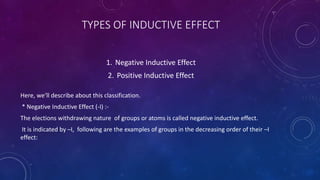
* Negative Inductive Effect (-I) :-
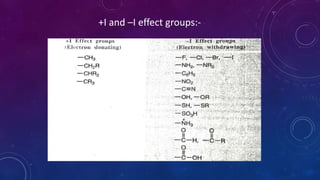
The elections withdrawing nature of groups or atoms is called negative inductive effect.
It is indicated by –I, following are the examples of groups in the decreasing order of their –I
effect:
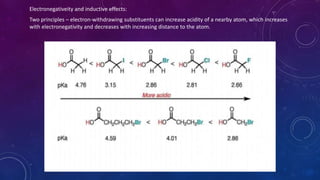
Electronegativeity and inductive effects:
Two principles – electron-withdrawing substituents can increase acidity of a nearby atom, which increases
with electronegativity and decreases with increasing distance to the atom.
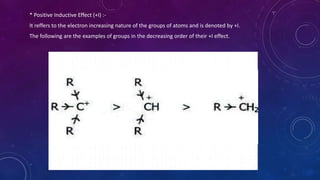
* Positive Inductive Effect (+I) :-
It reffers to the electron increasing nature of the groups of atoms and is denoted by +I.
The following are the examples of groups in the decreasing order of their +I effect.
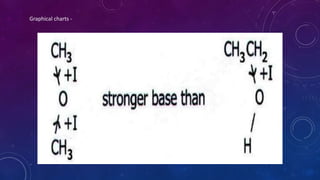
Graphical charts -
+I and –I effect groups:-
APPLICATION OF
INDUCTIVE EFFECT
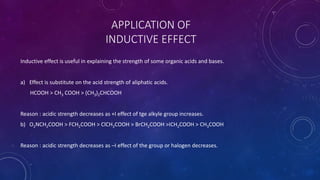
Inductive effect is useful in explaining the strength of some organic acids and bases.
a) Effect is substitute on the acid strength of aliphatic acids.
HCOOH > CH3 COOH > (CH3)2CHCOOH
Reason : acidic strength decreases as +I effect of tge alkyle group increases.
b) O2NCH2COOH > FCH2COOH > ClCH2COOH > BrCH2COOH >ICH2COOH > CH3COOH
Reason : acidic strength decreases as –I effect of the group or halogen decreases.
BOND LENGTH
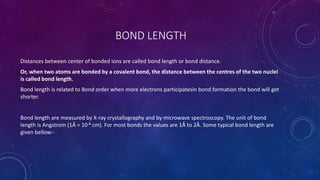
Distances between center of bonded ions are called bond length or bond distance.
Or, when two atoms are bonded by a covalent bond, the distance between the centres of the two nuclei
is called bond length.
Bond length is related to Bond order when more electrons participatesin bond formation the bond will get
shorter.
Bond length are measured by X-ray crystallography and by microwave spectroscopy. The unit of bond
length is Angstrom (1Å = 10-8 cm). For most bonds the values are 1Å to 2Å. Some typical bond length are
given bellow:-
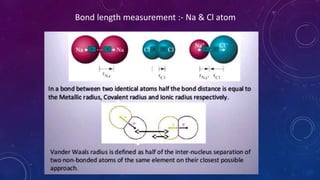
Bond length measurement :- Na & Cl atom
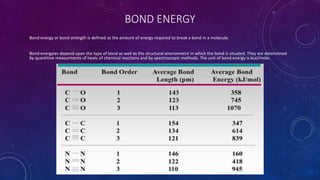
BOND ENERGY
Bond energy or bond strength is defined as the amount of energy required to break a bond in a molecule.
Bond energyies depend upon the type of bond as well as the structural environment in which the bond is situated. They are determined
by quantitive measurments of heats of chemical reactions and by spectroscopic methods. The unit of bond energy is kcal/mole.
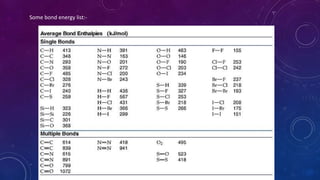
Some bond energy list:-
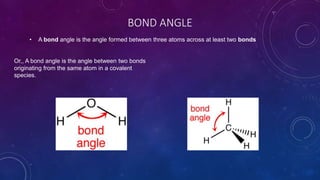
BOND ANGLE
• A bond angle is the angle formed between three atoms across at least two bonds
Or,, A bond angle is the angle between two bonds
originating from the same atom in a covalent
species.
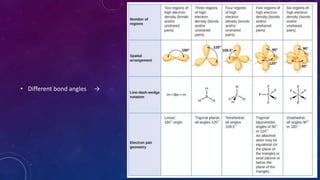
• Different bond angles →
VSEPR table →
• Sources
-Organic Chemistry by Bhal & Bhal
-Wikipedia.org
-Sldshare.net
THANK
YOU

Inductive effect

  • 1.
    WELCOME TO OUR PRESENTATION PRESENTEDTO OUR RESPECTABLE TEACHER DR MD ASHRAF ALI SIR CHAIRMAN DEPARTMENT OF PHARMACY MAWLANA BHASHANI SCIENCE AND TECHNOLOGY UNIVERSITY TANGAIL 1902, BANGLADESH
  • 2.
    • Sabbir Ahmed(PHA-19021) • Belayet Hossain (PHA-19028) • Taherul Islam (PHA-19032) Presented by Group (2) PRESENTATION
  • 3.
    TOPICS: 1.Inductive Effect 2.Bond Length 3.BondEnergy 4.Bond Angle Course Name: Organic Pharmacy Course Code: PHAR-1105
  • 4.
    INDUCTIVE EFFECT Inductive effectis defined as permanent displacement of shared election pair in carbon chain towards more electronegative atom or group. The inductive effect (I Effect) reffers to the polarity produced in a molecule as a result of higher electronegativity of one atom compared to another. Simply we can say,,
  • 5.
    TYPES OF INDUCTIVEEFFECT 1. Negative Inductive Effect 2. Positive Inductive Effect Here, we‘ll describe about this classification. * Negative Inductive Effect (-I) :- The elections withdrawing nature of groups or atoms is called negative inductive effect. It is indicated by –I, following are the examples of groups in the decreasing order of their –I effect:
  • 6.
    Electronegativeity and inductiveeffects: Two principles – electron-withdrawing substituents can increase acidity of a nearby atom, which increases with electronegativity and decreases with increasing distance to the atom.
  • 7.
    * Positive InductiveEffect (+I) :- It reffers to the electron increasing nature of the groups of atoms and is denoted by +I. The following are the examples of groups in the decreasing order of their +I effect.
  • 8.
  • 9.
    +I and –Ieffect groups:-
  • 10.
    APPLICATION OF INDUCTIVE EFFECT Inductiveeffect is useful in explaining the strength of some organic acids and bases. a) Effect is substitute on the acid strength of aliphatic acids. HCOOH > CH3 COOH > (CH3)2CHCOOH Reason : acidic strength decreases as +I effect of tge alkyle group increases. b) O2NCH2COOH > FCH2COOH > ClCH2COOH > BrCH2COOH >ICH2COOH > CH3COOH Reason : acidic strength decreases as –I effect of the group or halogen decreases.
  • 11.
    BOND LENGTH Distances betweencenter of bonded ions are called bond length or bond distance. Or, when two atoms are bonded by a covalent bond, the distance between the centres of the two nuclei is called bond length. Bond length is related to Bond order when more electrons participatesin bond formation the bond will get shorter. Bond length are measured by X-ray crystallography and by microwave spectroscopy. The unit of bond length is Angstrom (1Å = 10-8 cm). For most bonds the values are 1Å to 2Å. Some typical bond length are given bellow:-
  • 12.
    Bond length measurement:- Na & Cl atom
  • 13.
    BOND ENERGY Bond energyor bond strength is defined as the amount of energy required to break a bond in a molecule. Bond energyies depend upon the type of bond as well as the structural environment in which the bond is situated. They are determined by quantitive measurments of heats of chemical reactions and by spectroscopic methods. The unit of bond energy is kcal/mole.
  • 14.
  • 15.
    BOND ANGLE • Abond angle is the angle formed between three atoms across at least two bonds Or,, A bond angle is the angle between two bonds originating from the same atom in a covalent species.
  • 16.
  • 17.
  • 18.
    • Sources -Organic Chemistryby Bhal & Bhal -Wikipedia.org -Sldshare.net
  • 19.