
THE TUG TEST
THE TUG TEST

• Timed Up and Go (TUG) Test is a timed test of
standing and walking that is a predictor of falls risk.
• It is s gait-speed test used to assess a person's
mobility and requires both static and dynamic
balance.
• It is very simple to perform and involves very little
equipment.
• It takes very little time.
• Data collection is very simple.
HOW TO PERFORM THE TUG

1.

Begin the test with the subject sitting correctly (hips all of the way to the
back of the seat) in a chair with arm rests.

2.

The subject is allowed to use the arm rests during the sit – stand and
stand – sit movements.

3.

Place a piece of tape or other marker on the floor 3 meters away from the
chair so that it is easily seen by the subject.

4.

Tell them “On the word GO you will stand up, walk to the line on the
floor, turn around and walk back to the chair and sit down. Walk at your
regular pace.”
HOW TO MEASURE

5.

Start timing on the word “GO” and stop timing when the subject is
seated again correctly in the chair with their back resting on the back of
the chair.

6.

The subject wears their regular footwear, may use any gait aid that they
normally use during ambulation, but may not be assisted by another
person.

7.

There is no time limit.

8.

They may stop and rest (but not sit down) if they need to.
HOW TO MEASURE

1.

Normal healthy elderly usually complete the task in ten seconds or less.
Very frail or weak elderly with poor mobility may take 2 minutes or more.

2.

The subject should be given a practice trial that is not timed before
testing.
WHAT THE NUMBERS MEAN

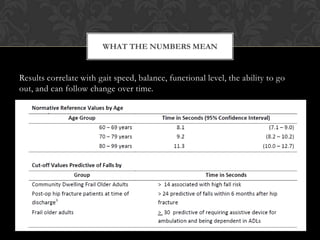
Results correlate with gait speed, balance, functional level, the ability to go
out, and can follow change over time.
REFERENCES

1.
2.
3.
4.
5.
6.

Bohannon RW. Reference values for the Timed Up and Go Test: A Descriptive MetaAnalysis. Journal of Geriatric Physical Therapy, 2006;29(2):64-8.
Shumway-Cook A, Brauer S, Woollacott M. Predicting the probability for falls in
community-dwelling older adults using the timed up & go test. Phys Ther.
2000;80:896-903.
Kristensen MT, Foss NB, Kehlet H. Timed "Up and Go" Test as a predictor of falls
within 6 months after hip fracture surgery. Phys Ther. 2007.87(1):24-30.
Bischoff HA, Stahelin HB, et al. Identifying a cut-off point for normal mobility: A
comparison study of the timed "up and go" test in community-dwelling and
institutionalized elderly women. Age and Ageing. 2003;32:315-320.
Boulgarides LK, McGinty SM, et al. Use of clinical and impairment-based tests to
predict falls by community-dwelling older adults. Phys Ther. 2003;83:328-339.
Podsiadlo D, Richardson S. The timed “up & go": A test of basic functional mobility
for frail elderly persons. JAGS. 1991;39:142-148.

The TUG test (Timed Up and Go) to predict falls risk

  • 1.
  • 2.
    THE TUG TEST •Timed Up and Go (TUG) Test is a timed test of standing and walking that is a predictor of falls risk. • It is s gait-speed test used to assess a person's mobility and requires both static and dynamic balance. • It is very simple to perform and involves very little equipment. • It takes very little time. • Data collection is very simple.
  • 3.
    HOW TO PERFORMTHE TUG 1. Begin the test with the subject sitting correctly (hips all of the way to the back of the seat) in a chair with arm rests. 2. The subject is allowed to use the arm rests during the sit – stand and stand – sit movements. 3. Place a piece of tape or other marker on the floor 3 meters away from the chair so that it is easily seen by the subject. 4. Tell them “On the word GO you will stand up, walk to the line on the floor, turn around and walk back to the chair and sit down. Walk at your regular pace.”
  • 4.
    HOW TO MEASURE 5. Starttiming on the word “GO” and stop timing when the subject is seated again correctly in the chair with their back resting on the back of the chair. 6. The subject wears their regular footwear, may use any gait aid that they normally use during ambulation, but may not be assisted by another person. 7. There is no time limit. 8. They may stop and rest (but not sit down) if they need to.
  • 5.
    HOW TO MEASURE 1. Normalhealthy elderly usually complete the task in ten seconds or less. Very frail or weak elderly with poor mobility may take 2 minutes or more. 2. The subject should be given a practice trial that is not timed before testing.
  • 6.
    WHAT THE NUMBERSMEAN Results correlate with gait speed, balance, functional level, the ability to go out, and can follow change over time.
  • 7.
    REFERENCES 1. 2. 3. 4. 5. 6. Bohannon RW. Referencevalues for the Timed Up and Go Test: A Descriptive MetaAnalysis. Journal of Geriatric Physical Therapy, 2006;29(2):64-8. Shumway-Cook A, Brauer S, Woollacott M. Predicting the probability for falls in community-dwelling older adults using the timed up & go test. Phys Ther. 2000;80:896-903. Kristensen MT, Foss NB, Kehlet H. Timed "Up and Go" Test as a predictor of falls within 6 months after hip fracture surgery. Phys Ther. 2007.87(1):24-30. Bischoff HA, Stahelin HB, et al. Identifying a cut-off point for normal mobility: A comparison study of the timed "up and go" test in community-dwelling and institutionalized elderly women. Age and Ageing. 2003;32:315-320. Boulgarides LK, McGinty SM, et al. Use of clinical and impairment-based tests to predict falls by community-dwelling older adults. Phys Ther. 2003;83:328-339. Podsiadlo D, Richardson S. The timed “up & go": A test of basic functional mobility for frail elderly persons. JAGS. 1991;39:142-148.