REACHING NEW FRONTIERS
IN SEISMIC INTERPRETATION
UTILIZING DEEP LEARNING COMPUTER VISION TECHNOLOGY
TRAINING OF YOUR GEOSCIENTIST, BUT
WHAT ABOUT TRAINING YOUR DATA?
The current excitement about Artificial Intelligence (AI) stems, in great part, from
groundbreaking advances involving what are known as Convolutional Neural Networks (CNN).
This machine learning technique promises dramatic improvements in things like computer
vision, speech recognition, and natural language processing.
You probably have heard of it by its more layperson-friendly name: "Deep Learning."
TRAINING OF YOUR GEOSCIENTIST, BUT
WHAT ABOUT TRAINING YOUR DATA?
You have Terabytes upon Terabytes of various seismic data, either in its raw, amplitude or
derivative formats. Most of the time it lies there idle, and waiting for the geoscientist to log in
and take it into use.
Why not let the data work when it is not used by the geoscientist, and outside working hours
for the poor geoscientist being home an getting a well deserved sleep?
The data can in the meantime do its exercise and training and get ready for the geoscientist
logging in and begin his/her work with a more intelligent data set than last time.
A dataset which now can tell the geoscientist much more, and reveal much more, making it
possible to make the next discovery of hydrocarbons with larger chance of success at a much
lower cost and less time efforts.
SEISMIC FACIES IDENTIFICATION WITH USE OF
IMAGE RECOGNITION PLATFORMS
The rapid rise of computer vision technology and the increasing number of companies
developing image recognition platforms are enormous.
Until recently, computer vision technology has been used primarily for detecting and
recognizing faces in photos. While facial recognition remains a popular use of this
technology, there has been a rapid rise in the use of computer vision for automatic photo
tagging and classification.
This increase is largely due to recent advances in artificial intelligence (AI), specifically
the use of convolutional neural networks (CNNs) to improve computer vision methods.
So far, this technology has not won any major terrain within the Oil and Gas Industry.
SEISMIC FACIES IDENTIFICATION
A HIGHLY SUBJECTIVE AND TIME CONSUMING TASK
Stratigraphic interpretation of seismic data is a time consuming and highly subjective
methodology where the result is highly dependent upon the operators skills, training and
mostly experience to recognize depositional environments and their associated geometrical
attitude and occurrence.
Combine this with varying quality of the data foundation, seismic data quality and type, there
are many ways this could go wrong.
The task at hand is to identify geometric patterns in the data, generate image captions/
descriptions
SEISMIC FACIES IDENTIFICATION
WITH USE OF CNN
Why not use computer vision algorithms to analyze digitized images of seismic data (original or
attribute versions, does not matter). The algorithms could be trained to detect and understand visual
similarities in seismic facies pattern and automatically classify these based on style, occurrence etc.
Utilize Convolutional Neural Networks (CNN) that are able to learn complex visual concepts using
massive amounts of data,, could save time and efforts, but not only that; create a more objective
analysis of the data.
The use of machine learning and image processing algorithms to analyze, recognize and understand
visual content could prove to be a ground breaking way to analyze large amount of data, both in
Supervised Neural Networks (SNN), but also as Unsupervised Neural Networks (UNN), like the CNN.
The computer gets trained to find patterns within the data with the use of deep learning-based
computer vision technology to analyze, recognize and understand the content of an image.
SEISMIC FACIES IDENTIFICATION
WITH USE OF COMPUTER VISION TECHNOLOGY
The concept of CNN has been around since the 1940s, it is only within the last few years that the use
of CNNs has really taken off.
CNNs are being used to significantly improve computer vision, speech recognition, natural language
processing and other related technologies.
Companies are doing amazing research in the field of artificial intelligence, and democratizing
breakthroughs in AI.
With so many advances in deep learning-based computer vision technology happening just within the
last few years, it will be exciting to see how we can use this field of computer vision in the not-too-
distant future within Seismic Stratigraphy applications.
SEISMIC STRATIGRAPHY
WHAT AND HOW
Seismic Stratigraphy is basically a geologic approach to the stratigraphic interpretation of
seismic data.
Seismic reflections allow the direct application of
geologic concepts based on physical stratigraphy.
Primary seismic reflections are generated by physical surface in
the rocks, consisting mainly of strata surface and unconformities with velocity-density contrasts.
Therefore, possible to identify primary seismic reflections parallel strata surface and
unconformities.
A seismic section is a record of chronostratigraphic (time-stratigraphic) depositional and
structural patterns and not a record of the time-transgressive lithostratigraphy (rock-stratigraphy)
SEISMIC STRATIGRAPHIC INTERPRETATION
IS A MAJOR PATTERN RECOGNITION EFFORT
It is possible to make the following types of stratigraphic interpretation from the geometry of seismic
reflections correlation patterns:
• geologic time correlations
• definition of genetic depositional units
• thickness and depositional environment of genetic units
• paleo bathymetry
• burial history
• relief and topography on unconformities
• paleogeography and geologic history
SEISMIC STRATIGRAPHIC INTERPRETATION
PROCEDURE
To accomplish these geologic objectives you follow three step interpretational procedure:
• seismic sequence analysis
• seismic facies analysis
• analysis of relative changes of sea-level
Seismic sequence analysis is based on the identification of stratigraphic units composed of a relatively
conformable succession of genetically related strata termed depositional sequence
The upper and lower boundaries of depositional sequences are unconformities or their correlative
conformities.
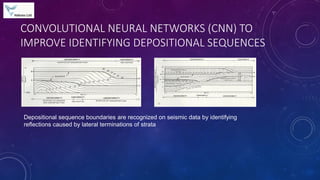
CONVOLUTIONAL NEURAL NETWORKS (CNN) TO
IMPROVE IDENTIFYING DEPOSITIONAL SEQUENCES
Depositional sequence boundaries are recognized on seismic data by identifying
reflections caused by lateral terminations of strata
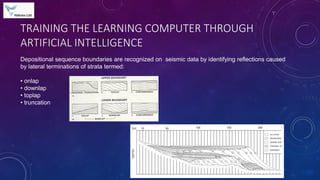
TRAINING THE LEARNING COMPUTER THROUGH
ARTIFICIAL INTELLIGENCE
Depositional sequence boundaries are recognized on seismic data by identifying reflections caused
by lateral terminations of strata termed:
• onlap
• downlap
• toplap
• truncation
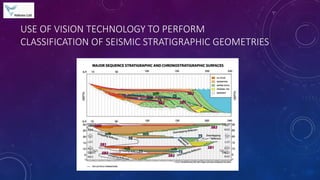
USE OF VISION TECHNOLOGY TO PERFORM
CLASSIFICATION OF SEISMIC STRATIGRAPHIC GEOMETRIES
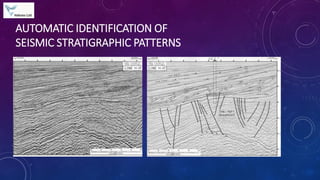
AUTOMATIC IDENTIFICATION OF
SEISMIC STRATIGRAPHIC PATTERNS
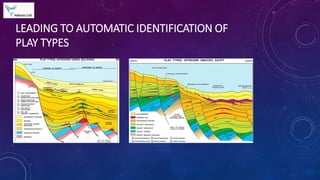
LEADING TO AUTOMATIC IDENTIFICATION OF
PLAY TYPES
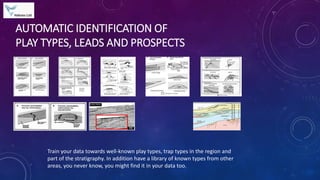
AUTOMATIC IDENTIFICATION OF
PLAY TYPES, LEADS AND PROSPECTS
Train your data towards well-known play types, trap types in the region and
part of the stratigraphy. In addition have a library of known types from other
areas, you never know, you might find it in your data too.
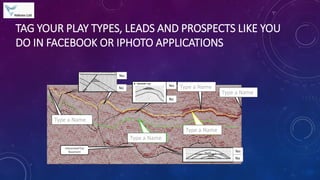
TAG YOUR PLAY TYPES, LEADS AND PROSPECTS LIKE YOU
DO IN FACEBOOK OR IPHOTO APPLICATIONS
Yes
No
Yes
No
Type a Name
Type a Name
Yes
No
Type a Name
Type a Name
Type a Name

Reaching New frontiers in Seismic interpretation

  • 1.
    REACHING NEW FRONTIERS INSEISMIC INTERPRETATION UTILIZING DEEP LEARNING COMPUTER VISION TECHNOLOGY
  • 2.
    TRAINING OF YOURGEOSCIENTIST, BUT WHAT ABOUT TRAINING YOUR DATA? The current excitement about Artificial Intelligence (AI) stems, in great part, from groundbreaking advances involving what are known as Convolutional Neural Networks (CNN). This machine learning technique promises dramatic improvements in things like computer vision, speech recognition, and natural language processing. You probably have heard of it by its more layperson-friendly name: "Deep Learning."
  • 3.
    TRAINING OF YOURGEOSCIENTIST, BUT WHAT ABOUT TRAINING YOUR DATA? You have Terabytes upon Terabytes of various seismic data, either in its raw, amplitude or derivative formats. Most of the time it lies there idle, and waiting for the geoscientist to log in and take it into use. Why not let the data work when it is not used by the geoscientist, and outside working hours for the poor geoscientist being home an getting a well deserved sleep? The data can in the meantime do its exercise and training and get ready for the geoscientist logging in and begin his/her work with a more intelligent data set than last time. A dataset which now can tell the geoscientist much more, and reveal much more, making it possible to make the next discovery of hydrocarbons with larger chance of success at a much lower cost and less time efforts.
  • 4.
    SEISMIC FACIES IDENTIFICATIONWITH USE OF IMAGE RECOGNITION PLATFORMS The rapid rise of computer vision technology and the increasing number of companies developing image recognition platforms are enormous. Until recently, computer vision technology has been used primarily for detecting and recognizing faces in photos. While facial recognition remains a popular use of this technology, there has been a rapid rise in the use of computer vision for automatic photo tagging and classification. This increase is largely due to recent advances in artificial intelligence (AI), specifically the use of convolutional neural networks (CNNs) to improve computer vision methods. So far, this technology has not won any major terrain within the Oil and Gas Industry.
  • 5.
    SEISMIC FACIES IDENTIFICATION AHIGHLY SUBJECTIVE AND TIME CONSUMING TASK Stratigraphic interpretation of seismic data is a time consuming and highly subjective methodology where the result is highly dependent upon the operators skills, training and mostly experience to recognize depositional environments and their associated geometrical attitude and occurrence. Combine this with varying quality of the data foundation, seismic data quality and type, there are many ways this could go wrong. The task at hand is to identify geometric patterns in the data, generate image captions/ descriptions
  • 6.
    SEISMIC FACIES IDENTIFICATION WITHUSE OF CNN Why not use computer vision algorithms to analyze digitized images of seismic data (original or attribute versions, does not matter). The algorithms could be trained to detect and understand visual similarities in seismic facies pattern and automatically classify these based on style, occurrence etc. Utilize Convolutional Neural Networks (CNN) that are able to learn complex visual concepts using massive amounts of data,, could save time and efforts, but not only that; create a more objective analysis of the data. The use of machine learning and image processing algorithms to analyze, recognize and understand visual content could prove to be a ground breaking way to analyze large amount of data, both in Supervised Neural Networks (SNN), but also as Unsupervised Neural Networks (UNN), like the CNN. The computer gets trained to find patterns within the data with the use of deep learning-based computer vision technology to analyze, recognize and understand the content of an image.
  • 7.
    SEISMIC FACIES IDENTIFICATION WITHUSE OF COMPUTER VISION TECHNOLOGY The concept of CNN has been around since the 1940s, it is only within the last few years that the use of CNNs has really taken off. CNNs are being used to significantly improve computer vision, speech recognition, natural language processing and other related technologies. Companies are doing amazing research in the field of artificial intelligence, and democratizing breakthroughs in AI. With so many advances in deep learning-based computer vision technology happening just within the last few years, it will be exciting to see how we can use this field of computer vision in the not-too- distant future within Seismic Stratigraphy applications.
  • 8.
    SEISMIC STRATIGRAPHY WHAT ANDHOW Seismic Stratigraphy is basically a geologic approach to the stratigraphic interpretation of seismic data. Seismic reflections allow the direct application of geologic concepts based on physical stratigraphy. Primary seismic reflections are generated by physical surface in the rocks, consisting mainly of strata surface and unconformities with velocity-density contrasts. Therefore, possible to identify primary seismic reflections parallel strata surface and unconformities. A seismic section is a record of chronostratigraphic (time-stratigraphic) depositional and structural patterns and not a record of the time-transgressive lithostratigraphy (rock-stratigraphy)
  • 9.
    SEISMIC STRATIGRAPHIC INTERPRETATION ISA MAJOR PATTERN RECOGNITION EFFORT It is possible to make the following types of stratigraphic interpretation from the geometry of seismic reflections correlation patterns: • geologic time correlations • definition of genetic depositional units • thickness and depositional environment of genetic units • paleo bathymetry • burial history • relief and topography on unconformities • paleogeography and geologic history
  • 10.
    SEISMIC STRATIGRAPHIC INTERPRETATION PROCEDURE Toaccomplish these geologic objectives you follow three step interpretational procedure: • seismic sequence analysis • seismic facies analysis • analysis of relative changes of sea-level Seismic sequence analysis is based on the identification of stratigraphic units composed of a relatively conformable succession of genetically related strata termed depositional sequence The upper and lower boundaries of depositional sequences are unconformities or their correlative conformities.
  • 11.
    CONVOLUTIONAL NEURAL NETWORKS(CNN) TO IMPROVE IDENTIFYING DEPOSITIONAL SEQUENCES Depositional sequence boundaries are recognized on seismic data by identifying reflections caused by lateral terminations of strata
  • 12.
    TRAINING THE LEARNINGCOMPUTER THROUGH ARTIFICIAL INTELLIGENCE Depositional sequence boundaries are recognized on seismic data by identifying reflections caused by lateral terminations of strata termed: • onlap • downlap • toplap • truncation
  • 13.
    USE OF VISIONTECHNOLOGY TO PERFORM CLASSIFICATION OF SEISMIC STRATIGRAPHIC GEOMETRIES
  • 14.
  • 15.
    LEADING TO AUTOMATICIDENTIFICATION OF PLAY TYPES
  • 16.
    AUTOMATIC IDENTIFICATION OF PLAYTYPES, LEADS AND PROSPECTS Train your data towards well-known play types, trap types in the region and part of the stratigraphy. In addition have a library of known types from other areas, you never know, you might find it in your data too.
  • 17.
    TAG YOUR PLAYTYPES, LEADS AND PROSPECTS LIKE YOU DO IN FACEBOOK OR IPHOTO APPLICATIONS Yes No Yes No Type a Name Type a Name Yes No Type a Name Type a Name Type a Name