Presented by
P. SAI SAHITHI
(Reg. No. 14421S0303)
1
A REVIEW ON FAST DISSOLVING ORAL THIN FILMS
Under the esteemed guidance of
Dr. J. Sundaraseelan
M.Pharm., Ph.D.
Professor and Head
Department of Pharmaceutics
JAWAHARLAL NEHRU TECHNOLOGICAL UNIVERSITY
ANANTAPUR
SRI PADMAVATHI SCHOOL OF PHARMACY
(Affiliated to J.N.T.U.A)
Mohan gardens, Vaishnavi Nagar, Tiruchanoor, Tirupati -517 503
MARCH-2015
CONTENTS:
- Introduction
- Special Features
- Overview of oral mucosa
- Comparison between fast dissolving tablets and films
- Mechanism
- Classification
- Properties
- Advantages
- Disadvantages
- Formulation
- Manufacturing methods
- Evaluation
- Conclusion
- References
2
INTRODUCTION:
These are the solid dosage form which is a thin
polymeric strip incorporating and delivering
pharmaceutical active ingredients and once
placed in the mouth dissolves in the short
period of time without drinking water or
chewing.
These are also called as
• Oral thin films
• Buccal films/strips
• Oral strips. 3
C ADHESIVE LAYER
INTERMEDIATE LAYER
BACKING LAYER
Contains API
Or
Adhesion purpose only
Contains API
Drug dissolution
Or
Shielded between layers
Permanent
Or
Dissolvable
4
SPECIAL FEATURES:
• Thin elegant film
• Available in various sizes and shapes
• Less fragile when compared to ODT
• Excellent mucoadhesion
• Dosage accuracy
• Rapid release
• Can be administered without water
• Most acceptable dosage form for
dysphagic patients
5
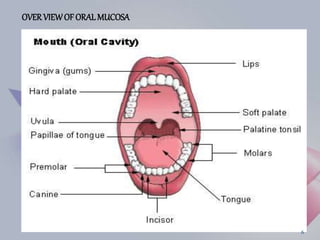
OVERVIEWOF ORAL MUCOSA
6
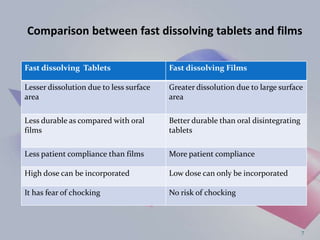
Comparison between fast dissolving tablets and films
Fast dissolving Tablets Fast dissolving Films
Lesser dissolution due to less surface
area
Greater dissolution due to large surface
area
Less durable as compared with oral
films
Better durable than oral disintegrating
tablets
Less patient compliance than films More patient compliance
High dose can be incorporated Low dose can only be incorporated
It has fear of chocking No risk of chocking
7
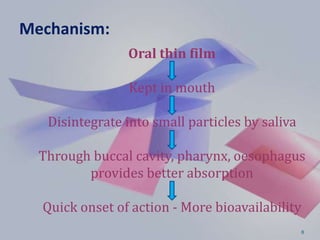
Mechanism:
Oral thin film
Kept in mouth
Disintegrate into small particles by saliva
Through buccal cavity, pharynx, oesophagus
provides better absorption
Quick onset of action - More bioavailability
8
CLASSIFICATION OF ORAL THIN FILMS
Oral fast dissolving films are divided into three
sub types along with their properties.
1. Flash release
2. Mucoadhesive melt away wafers
3. Mucoadhesive sustained release
wafers
9
PROPERTIES FLASH RELEASE
MUCO-ADHESIVE
MELT AWAY
WAFERS
MUCO-ADHESIVE
SUSTAINED
WAFERS
Area(cm2) 2-8 2-7 2-4
Thickness 20-70 50-500 50-250
Structure Single layer
system
Single or
multilayer
Multilayer
system
Excipients Soluble
hydrophilic
polymer
Soluble
hydrophilic
polymer
Low/non-soluble
polymer
Drug phase Solid solution Solid solution or
suspended
solution
Suspension
and/or solid
solution
Dissolution 60 sec Few min Max 8-10 hrs
Application Tongue Gingival or buccal
region
Gingival (other
region in oral
cavity)
PROPERTIES OF FILMS:
10
ADVANTAGES:
1. Improved oral absorption
2. Faster onset of action
3. Minimized first – pass effect
4. Improved bio availability
5. Accurate dosing
6. No special training is required for administration
7. Reduced gastrointestinal irritation
DISADVANTAGES:
1. High dose can't be incorporated
2. Drug unstable in buccal pH can’t be administrated
3. Need special packing has they must be protected from
water
4. Eating and drinking may be restricted.
11
FORMULATION:
A typical composition contains the following drug
Drug - 5% to 30% w/w
Water soluble polymer - 45% w/w
Plasticizers - 0 to 20%
Surfactants - quantity sufficient
Sweetening agents - 3 – 6%w/w
Saliva stimulating agent - 2 – 6%w/w
Colouring agents - quantity sufficient
Flavouring agents - quantity sufficient
12
ACTIVE PHARMACEUTICAL INGRIDIENTS:(APIs):
Varieties of APIs can delivery through FDOTF. It is always
useful to have micronized APIs which will improves the texture of
the film and also for better dissolution and uniformity in the
FDOTF.
Eg: Rofecoxib, Ethothyline, Mesylate, Ontasetron, Caffeeine
HYDROPHILLIC POLYMERS :
They impart the desired properties in to the film mainly
hydrophilic polymers are used in the preparation, as the film
dissolves rapidly in oral cavity.
Robustness of the film depends on type and the amount of
polymer used
Eg: Pullulan, Sodium Alginate, Pectin, Hydroxy propyl cellulose, HPMC
PLASTICIZERS:
Helps to increase the flexibility of the film and reduces the
brittleness of the film.
Eg: Glycerol, Propylene Glycol, Diethyl and Dibutyl phthalate,
Castor oil
13
SURFACTANTS:
Used as wetting or dispersing agent.
Eg: Benzathonium chloride, tweens,sodium lauryl sulphate,polaxamer 407
SALIVA STIMULATING AGENTS:
Used to increase the production of saliva that would aid in faster
disintegration of the film.
Eg: Citric acid, Mallic acid, Lactic Acid
SWEETNING AGENTS:
Generally sweeteners are used for the taste masking of bitter drugs.
Eg: Xylose, Ribose, Maltose, Dextrose, Fructose, Calcuim saccharine salt
FLAVOURING AGENTS:
The acceptance of the oral disintegrating films depends on the
flavouring agent. The selection of flavour is dependent of the type of drug in
corporated in the formulation.
Eg: Peach, Vanilla, Wall nut, Chacolate, Mint, Rasberry, Peppermint oil,
Spearmint oil, cinnamon oil
14
MANUFACTURING METHODS
These are the various methods:
 Solvent casting
 Semisolid casting
 Hot-melt extrusion
 Rolling Solvent casting
15
Solvent Casting Method
In this method firstly water soluble ingredients
are mixed in water to form a viscous solution.
API and remaining ingredients are dissolved in smaller
Amount of solution.
Both the solutions are combined by using high shear
Process.
Vacuum is used to remove the air entrapped
The solution formed is then cast as a film and pour
The solution in a glass mould and allow the solution
To dry in oven at 45 – 50˚C.
Then cut in to pieces of desired size
16
SEMI SOLID CASTING METHOD
This method is preferred when acid insoluble polymers are used in the
preparation of oral fast dissolving film.
Firstly solution of water soluble polymers is prepared
This solution is added to the solution of acid insoluble polymer
Plasticizer is added in appropriate amount so that a gel mask is formed
It is then casted in to the films or ribbons by using heat control drums.
The thickness of the film is about 0.038cm
Acid insoluble polymer and film forming polymer are used in the ratio of 1:417
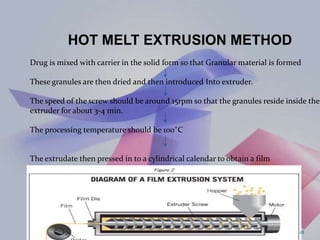
HOT MELT EXTRUSION METHOD
Drug is mixed with carrier in the solid form so that Granular material is formed
These granules are then dried and then introduced Into extruder.
The speed of the screw should be around 15rpm so that the granules reside inside the
extruder for about 3-4 min.
The processing temperature should be 100˚C
The extrudate then pressed in to a cylindrical calendar to obtain a film
18
ROLLING METHOD
In this method firstly solutions or suspension of the drug is
prepared
Either water or mixture of water and alcohol are mainly used
Suspension or solution containing drug is rolled on the
carrier
Films are dried on the rollers and cut in to desired shapes
and sizes 19
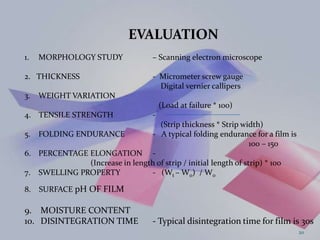
EVALUATION
1. MORPHOLOGY STUDY – Scanning electron microscope
2. THICKNESS - Micrometer screw gauge
Digital vernier callipers
3. WEIGHT VARIATION
(Load at failure * 100)
4. TENSILE STRENGTH -
(Strip thickness * Strip width)
5. FOLDING ENDURANCE - A typical folding endurance for a film is
100 – 150
6. PERCENTAGE ELONGATION -
(Increase in length of strip / initial length of strip) * 100
7. SWELLING PROPERTY - (Wt – W0) / W0
8. SURFACE pH OF FILM
9. MOISTURE CONTENT
10. DISINTEGRATION TIME - Typical disintegration time for film is 30s
20
CONCLUSION
The brief review on oral films concludes with the note that they are
considered as a most promising and important drug delivery system
because of their rapid disintegration include dissolution properties
especially with pediatrics and geriatrics patients. Even though most
of the formulations today are developed as ODTs, oral films has
gained more popularity because of their easy portability, improved
patient compliance and easy of administration. They can be applied
by both oral and buccal routes. apart from being used as
medicament films(local anesthetic ,vitamins supplements and cold
allergy remedies).they can also be used for refreshing the
breath.This techonology is growing in fast pece challenging most of
the pharmaceutical companies to develop oral films for a wide
range of active pharmaceutical ingredients.
21
REFERENCES
1)Samita gauri, GAURAV KUMAR. Fast dissolving drug deleviry and its technologies
www.the pharmajounral.com.
2)Rathi varun, senthil v.Hans ritu.A brief review on oral film technology. IJRAP 2011,2(4)
1138-1147.
3)shinde Pramod, Salunkhe vijay Buccal film:An innovative dosage form designated to
improve patient compliance. international journal of pharmaceutical and chemica
sciences.vol 1 (4) oct-dec 2012.
4)M.D.Nehal siddiqui,Garima Garg ,A review on “ A novel approach in oral fast dissolving
drug delivery system and their patents”.Advances in biological research 5 (6):291-
303,2011.
5)Venkata anupama M,R.Shireesh Kiran,P.Dileep,A review on oral thin fast dissolving films
recent trends of dosage form for quick release.Int J pharm Bio Sci 2014 Oct; 5(4)(P) 54-67.
6)Aggrwal Jyoti,Singh Gurpreet,Rana A.C.Fast dissolving films:A novel approach to ora
drug delivery.IRJP 2011, 2 (12), 67-74.
7)Parul Saini,Anoop Kumar,Pankaj Sharma,”FAST DISINTEGRATIG ORAL FILMS;A RECENT
TREND OF DRUG DELIVERY.”Int.J. Drug dev,& Res.,Oct-Dec 2012.4(4):80-94.
8)Alka Tomar,Kiran Sharma,Nitesh S Chauhan,”Formulation and evaluation of fast
dissolving oral film of dicyclomine as potential route of buccal delivery” Int.J. Drug Dev,&
Res .,April-June 2012,4(2):408-417.
9)Bhupinder Bhyan, Sarita Jangra, Mandeep Kaur, Orally fast dissolving films:Innovation in
formulation and techonology. IJPSR vol-9,2,july-Aug 2011,Article-009. 22
THANK YOU
23

fast disintegrating oral thin films

  • 1.
    Presented by P. SAISAHITHI (Reg. No. 14421S0303) 1 A REVIEW ON FAST DISSOLVING ORAL THIN FILMS Under the esteemed guidance of Dr. J. Sundaraseelan M.Pharm., Ph.D. Professor and Head Department of Pharmaceutics JAWAHARLAL NEHRU TECHNOLOGICAL UNIVERSITY ANANTAPUR SRI PADMAVATHI SCHOOL OF PHARMACY (Affiliated to J.N.T.U.A) Mohan gardens, Vaishnavi Nagar, Tiruchanoor, Tirupati -517 503 MARCH-2015
  • 2.
    CONTENTS: - Introduction - SpecialFeatures - Overview of oral mucosa - Comparison between fast dissolving tablets and films - Mechanism - Classification - Properties - Advantages - Disadvantages - Formulation - Manufacturing methods - Evaluation - Conclusion - References 2
  • 3.
    INTRODUCTION: These are thesolid dosage form which is a thin polymeric strip incorporating and delivering pharmaceutical active ingredients and once placed in the mouth dissolves in the short period of time without drinking water or chewing. These are also called as • Oral thin films • Buccal films/strips • Oral strips. 3
  • 4.
    C ADHESIVE LAYER INTERMEDIATELAYER BACKING LAYER Contains API Or Adhesion purpose only Contains API Drug dissolution Or Shielded between layers Permanent Or Dissolvable 4
  • 5.
    SPECIAL FEATURES: • Thinelegant film • Available in various sizes and shapes • Less fragile when compared to ODT • Excellent mucoadhesion • Dosage accuracy • Rapid release • Can be administered without water • Most acceptable dosage form for dysphagic patients 5
  • 6.
  • 7.
    Comparison between fastdissolving tablets and films Fast dissolving Tablets Fast dissolving Films Lesser dissolution due to less surface area Greater dissolution due to large surface area Less durable as compared with oral films Better durable than oral disintegrating tablets Less patient compliance than films More patient compliance High dose can be incorporated Low dose can only be incorporated It has fear of chocking No risk of chocking 7
  • 8.
    Mechanism: Oral thin film Keptin mouth Disintegrate into small particles by saliva Through buccal cavity, pharynx, oesophagus provides better absorption Quick onset of action - More bioavailability 8
  • 9.
    CLASSIFICATION OF ORALTHIN FILMS Oral fast dissolving films are divided into three sub types along with their properties. 1. Flash release 2. Mucoadhesive melt away wafers 3. Mucoadhesive sustained release wafers 9
  • 10.
    PROPERTIES FLASH RELEASE MUCO-ADHESIVE MELTAWAY WAFERS MUCO-ADHESIVE SUSTAINED WAFERS Area(cm2) 2-8 2-7 2-4 Thickness 20-70 50-500 50-250 Structure Single layer system Single or multilayer Multilayer system Excipients Soluble hydrophilic polymer Soluble hydrophilic polymer Low/non-soluble polymer Drug phase Solid solution Solid solution or suspended solution Suspension and/or solid solution Dissolution 60 sec Few min Max 8-10 hrs Application Tongue Gingival or buccal region Gingival (other region in oral cavity) PROPERTIES OF FILMS: 10
  • 11.
    ADVANTAGES: 1. Improved oralabsorption 2. Faster onset of action 3. Minimized first – pass effect 4. Improved bio availability 5. Accurate dosing 6. No special training is required for administration 7. Reduced gastrointestinal irritation DISADVANTAGES: 1. High dose can't be incorporated 2. Drug unstable in buccal pH can’t be administrated 3. Need special packing has they must be protected from water 4. Eating and drinking may be restricted. 11
  • 12.
    FORMULATION: A typical compositioncontains the following drug Drug - 5% to 30% w/w Water soluble polymer - 45% w/w Plasticizers - 0 to 20% Surfactants - quantity sufficient Sweetening agents - 3 – 6%w/w Saliva stimulating agent - 2 – 6%w/w Colouring agents - quantity sufficient Flavouring agents - quantity sufficient 12
  • 13.
    ACTIVE PHARMACEUTICAL INGRIDIENTS:(APIs): Varietiesof APIs can delivery through FDOTF. It is always useful to have micronized APIs which will improves the texture of the film and also for better dissolution and uniformity in the FDOTF. Eg: Rofecoxib, Ethothyline, Mesylate, Ontasetron, Caffeeine HYDROPHILLIC POLYMERS : They impart the desired properties in to the film mainly hydrophilic polymers are used in the preparation, as the film dissolves rapidly in oral cavity. Robustness of the film depends on type and the amount of polymer used Eg: Pullulan, Sodium Alginate, Pectin, Hydroxy propyl cellulose, HPMC PLASTICIZERS: Helps to increase the flexibility of the film and reduces the brittleness of the film. Eg: Glycerol, Propylene Glycol, Diethyl and Dibutyl phthalate, Castor oil 13
  • 14.
    SURFACTANTS: Used as wettingor dispersing agent. Eg: Benzathonium chloride, tweens,sodium lauryl sulphate,polaxamer 407 SALIVA STIMULATING AGENTS: Used to increase the production of saliva that would aid in faster disintegration of the film. Eg: Citric acid, Mallic acid, Lactic Acid SWEETNING AGENTS: Generally sweeteners are used for the taste masking of bitter drugs. Eg: Xylose, Ribose, Maltose, Dextrose, Fructose, Calcuim saccharine salt FLAVOURING AGENTS: The acceptance of the oral disintegrating films depends on the flavouring agent. The selection of flavour is dependent of the type of drug in corporated in the formulation. Eg: Peach, Vanilla, Wall nut, Chacolate, Mint, Rasberry, Peppermint oil, Spearmint oil, cinnamon oil 14
  • 15.
    MANUFACTURING METHODS These arethe various methods:  Solvent casting  Semisolid casting  Hot-melt extrusion  Rolling Solvent casting 15
  • 16.
    Solvent Casting Method Inthis method firstly water soluble ingredients are mixed in water to form a viscous solution. API and remaining ingredients are dissolved in smaller Amount of solution. Both the solutions are combined by using high shear Process. Vacuum is used to remove the air entrapped The solution formed is then cast as a film and pour The solution in a glass mould and allow the solution To dry in oven at 45 – 50˚C. Then cut in to pieces of desired size 16
  • 17.
    SEMI SOLID CASTINGMETHOD This method is preferred when acid insoluble polymers are used in the preparation of oral fast dissolving film. Firstly solution of water soluble polymers is prepared This solution is added to the solution of acid insoluble polymer Plasticizer is added in appropriate amount so that a gel mask is formed It is then casted in to the films or ribbons by using heat control drums. The thickness of the film is about 0.038cm Acid insoluble polymer and film forming polymer are used in the ratio of 1:417
  • 18.
    HOT MELT EXTRUSIONMETHOD Drug is mixed with carrier in the solid form so that Granular material is formed These granules are then dried and then introduced Into extruder. The speed of the screw should be around 15rpm so that the granules reside inside the extruder for about 3-4 min. The processing temperature should be 100˚C The extrudate then pressed in to a cylindrical calendar to obtain a film 18
  • 19.
    ROLLING METHOD In thismethod firstly solutions or suspension of the drug is prepared Either water or mixture of water and alcohol are mainly used Suspension or solution containing drug is rolled on the carrier Films are dried on the rollers and cut in to desired shapes and sizes 19
  • 20.
    EVALUATION 1. MORPHOLOGY STUDY– Scanning electron microscope 2. THICKNESS - Micrometer screw gauge Digital vernier callipers 3. WEIGHT VARIATION (Load at failure * 100) 4. TENSILE STRENGTH - (Strip thickness * Strip width) 5. FOLDING ENDURANCE - A typical folding endurance for a film is 100 – 150 6. PERCENTAGE ELONGATION - (Increase in length of strip / initial length of strip) * 100 7. SWELLING PROPERTY - (Wt – W0) / W0 8. SURFACE pH OF FILM 9. MOISTURE CONTENT 10. DISINTEGRATION TIME - Typical disintegration time for film is 30s 20
  • 21.
    CONCLUSION The brief reviewon oral films concludes with the note that they are considered as a most promising and important drug delivery system because of their rapid disintegration include dissolution properties especially with pediatrics and geriatrics patients. Even though most of the formulations today are developed as ODTs, oral films has gained more popularity because of their easy portability, improved patient compliance and easy of administration. They can be applied by both oral and buccal routes. apart from being used as medicament films(local anesthetic ,vitamins supplements and cold allergy remedies).they can also be used for refreshing the breath.This techonology is growing in fast pece challenging most of the pharmaceutical companies to develop oral films for a wide range of active pharmaceutical ingredients. 21
  • 22.
    REFERENCES 1)Samita gauri, GAURAVKUMAR. Fast dissolving drug deleviry and its technologies www.the pharmajounral.com. 2)Rathi varun, senthil v.Hans ritu.A brief review on oral film technology. IJRAP 2011,2(4) 1138-1147. 3)shinde Pramod, Salunkhe vijay Buccal film:An innovative dosage form designated to improve patient compliance. international journal of pharmaceutical and chemica sciences.vol 1 (4) oct-dec 2012. 4)M.D.Nehal siddiqui,Garima Garg ,A review on “ A novel approach in oral fast dissolving drug delivery system and their patents”.Advances in biological research 5 (6):291- 303,2011. 5)Venkata anupama M,R.Shireesh Kiran,P.Dileep,A review on oral thin fast dissolving films recent trends of dosage form for quick release.Int J pharm Bio Sci 2014 Oct; 5(4)(P) 54-67. 6)Aggrwal Jyoti,Singh Gurpreet,Rana A.C.Fast dissolving films:A novel approach to ora drug delivery.IRJP 2011, 2 (12), 67-74. 7)Parul Saini,Anoop Kumar,Pankaj Sharma,”FAST DISINTEGRATIG ORAL FILMS;A RECENT TREND OF DRUG DELIVERY.”Int.J. Drug dev,& Res.,Oct-Dec 2012.4(4):80-94. 8)Alka Tomar,Kiran Sharma,Nitesh S Chauhan,”Formulation and evaluation of fast dissolving oral film of dicyclomine as potential route of buccal delivery” Int.J. Drug Dev,& Res .,April-June 2012,4(2):408-417. 9)Bhupinder Bhyan, Sarita Jangra, Mandeep Kaur, Orally fast dissolving films:Innovation in formulation and techonology. IJPSR vol-9,2,july-Aug 2011,Article-009. 22
  • 23.