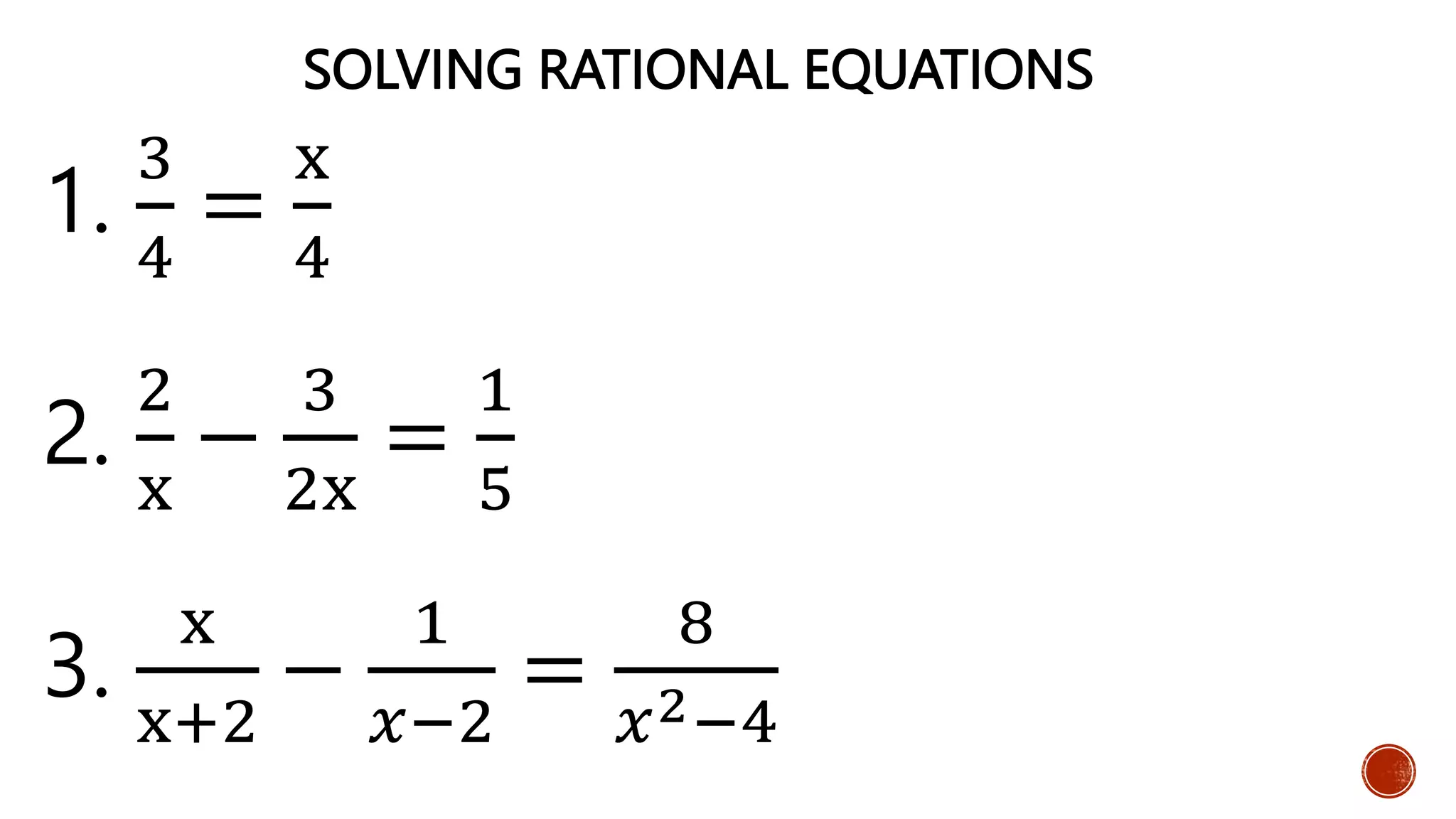
This document defines and provides examples of rational expressions, equations, and inequalities. A rational expression is a ratio of two polynomial expressions. Rational expressions are not considered polynomials if the variables have negative exponents, are inside radical symbols, or have fractional exponents. Rational equations and inequalities involve rational expressions and use equal or inequality symbols. A rational function is an expression of the form f(x) = p(x)/q(x) where p(x) and q(x) are polynomials and q(x) is not equal to zero. Examples of rational equations, inequalities, and functions are provided.
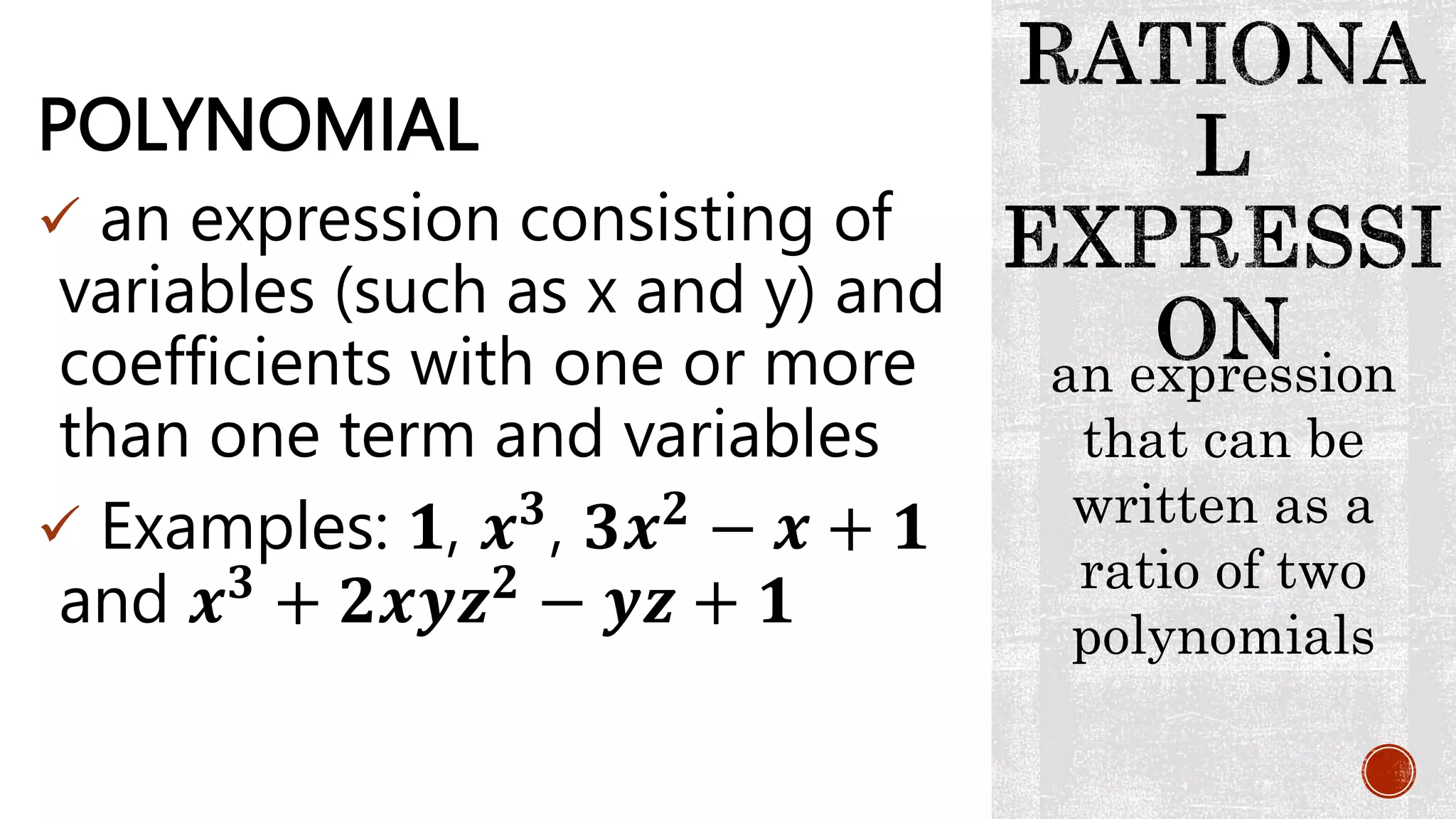
POLYNOMIAL
an expressionconsisting of
variables (such as x and y) and
coefficients with one or more
than one term and variables
Examples: 𝟏, 𝒙𝟑
, 𝟑𝒙𝟐
− 𝒙 + 𝟏
and 𝒙𝟑
+ 𝟐𝒙𝒚𝒛𝟐
− 𝒚𝒛 + 𝟏
an expression
that can be
written as a
ratio of two
polynomials
3.
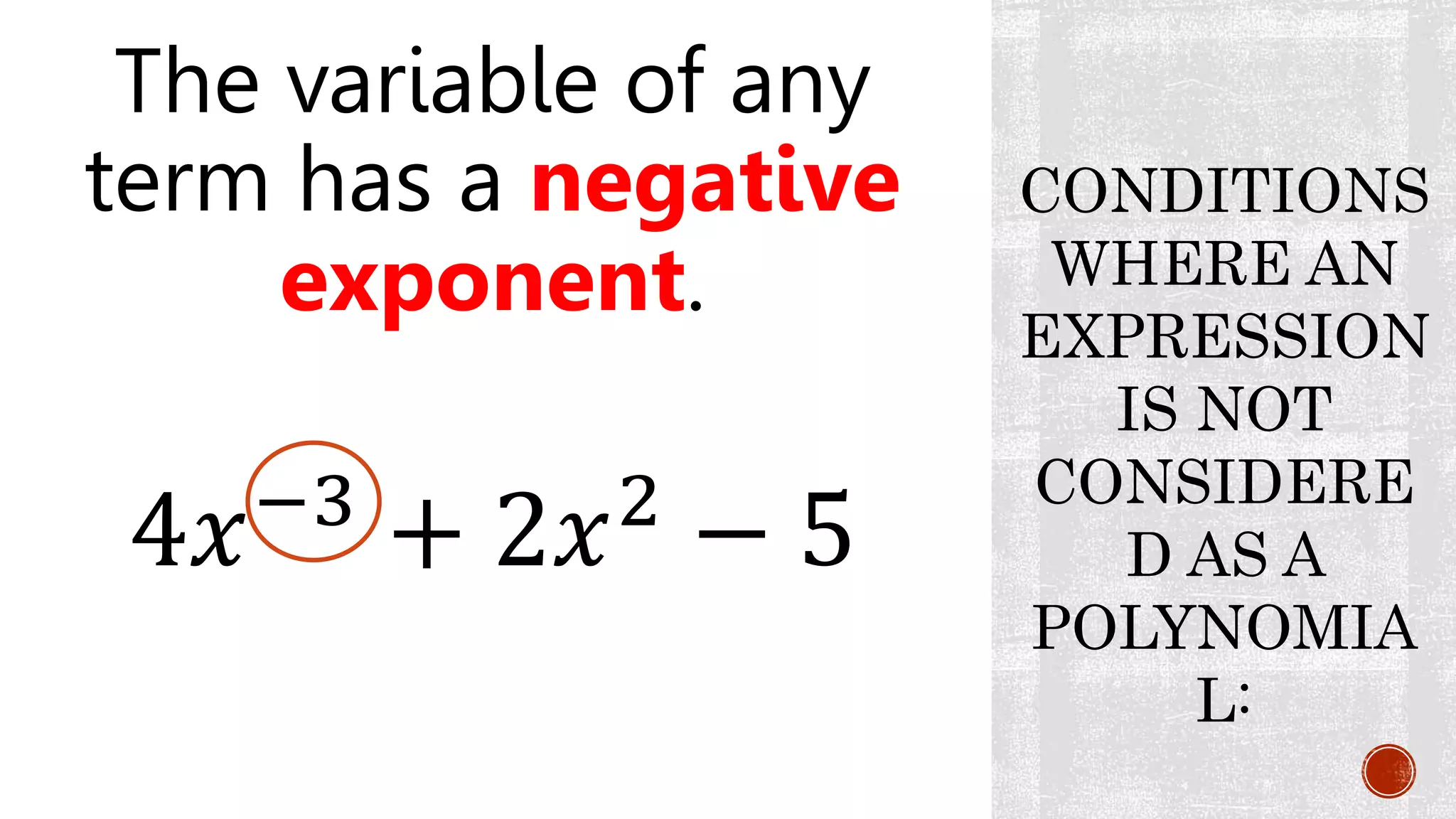
The variable ofany
term has a negative
exponent.
CONDITIONS
WHERE AN
EXPRESSION
IS NOT
CONSIDERE
D AS A
POLYNOMIA
L:
4𝑥−3
+ 2𝑥2
− 5
4.
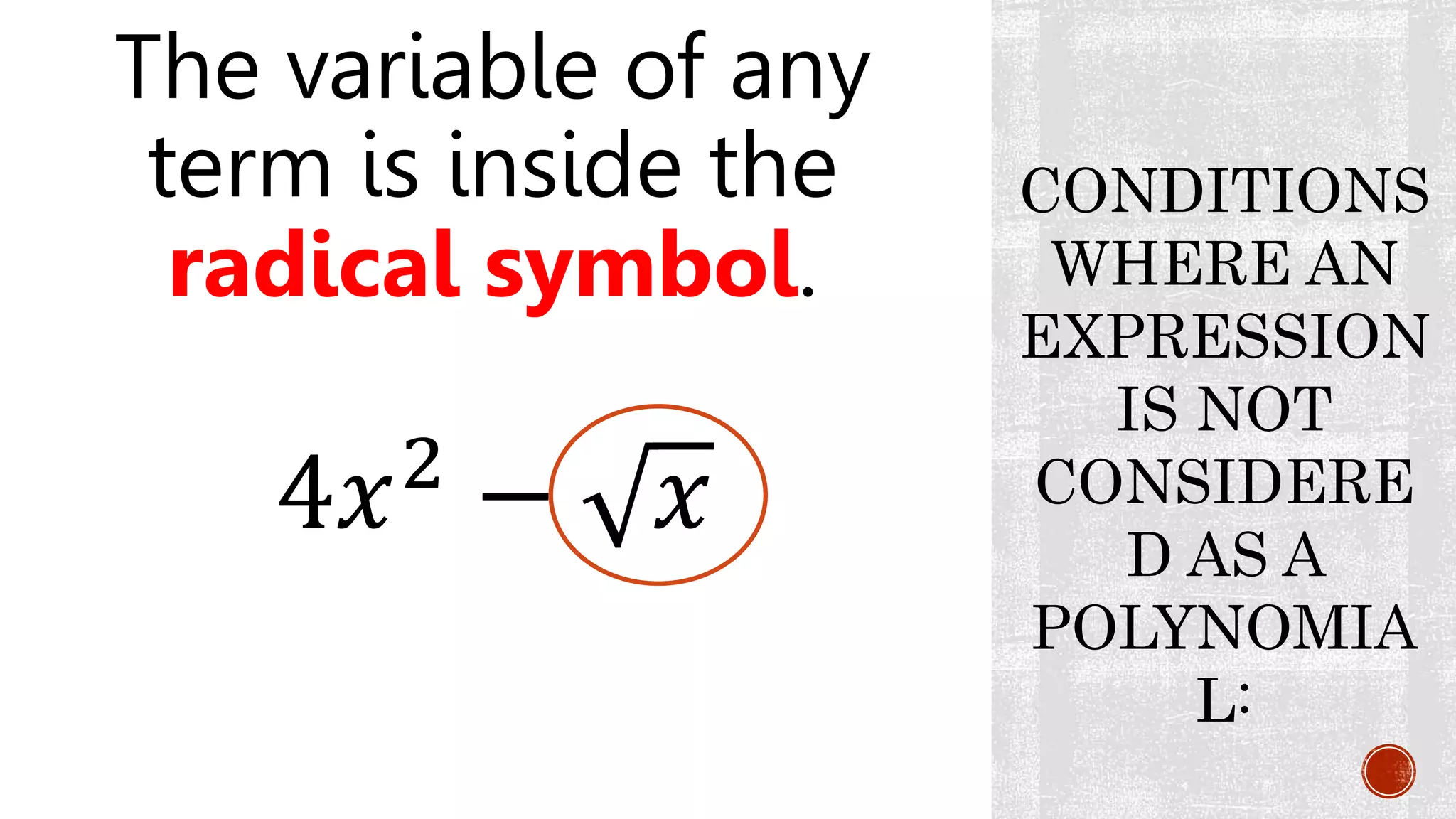
The variable ofany
term is inside the
radical symbol.
CONDITIONS
WHERE AN
EXPRESSION
IS NOT
CONSIDERE
D AS A
POLYNOMIA
L:
4𝑥2
− 𝑥
5.
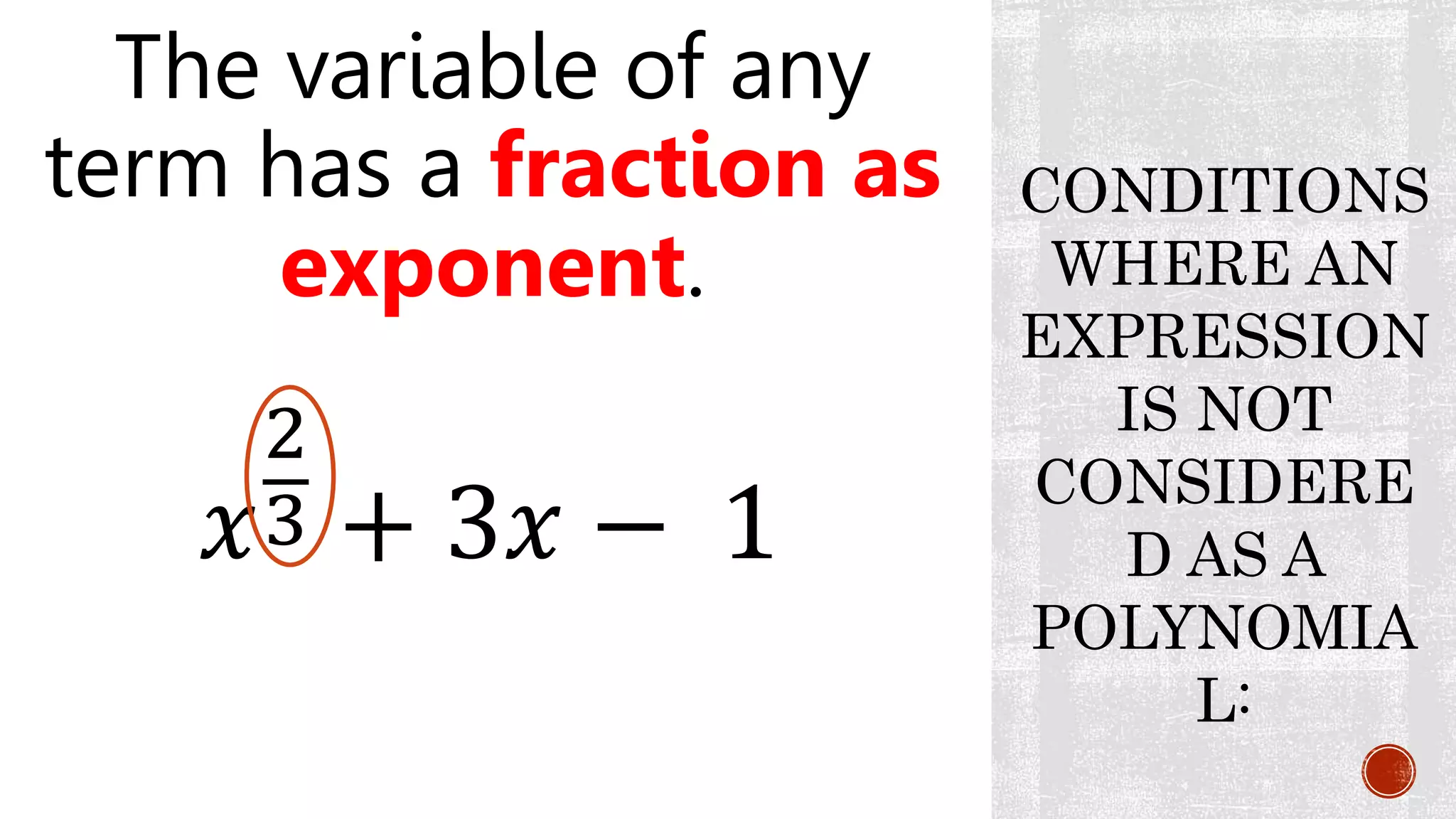
The variable ofany
term has a fraction as
exponent.
CONDITIONS
WHERE AN
EXPRESSION
IS NOT
CONSIDERE
D AS A
POLYNOMIA
L:
𝑥
2
3 + 3𝑥 − 1
6.
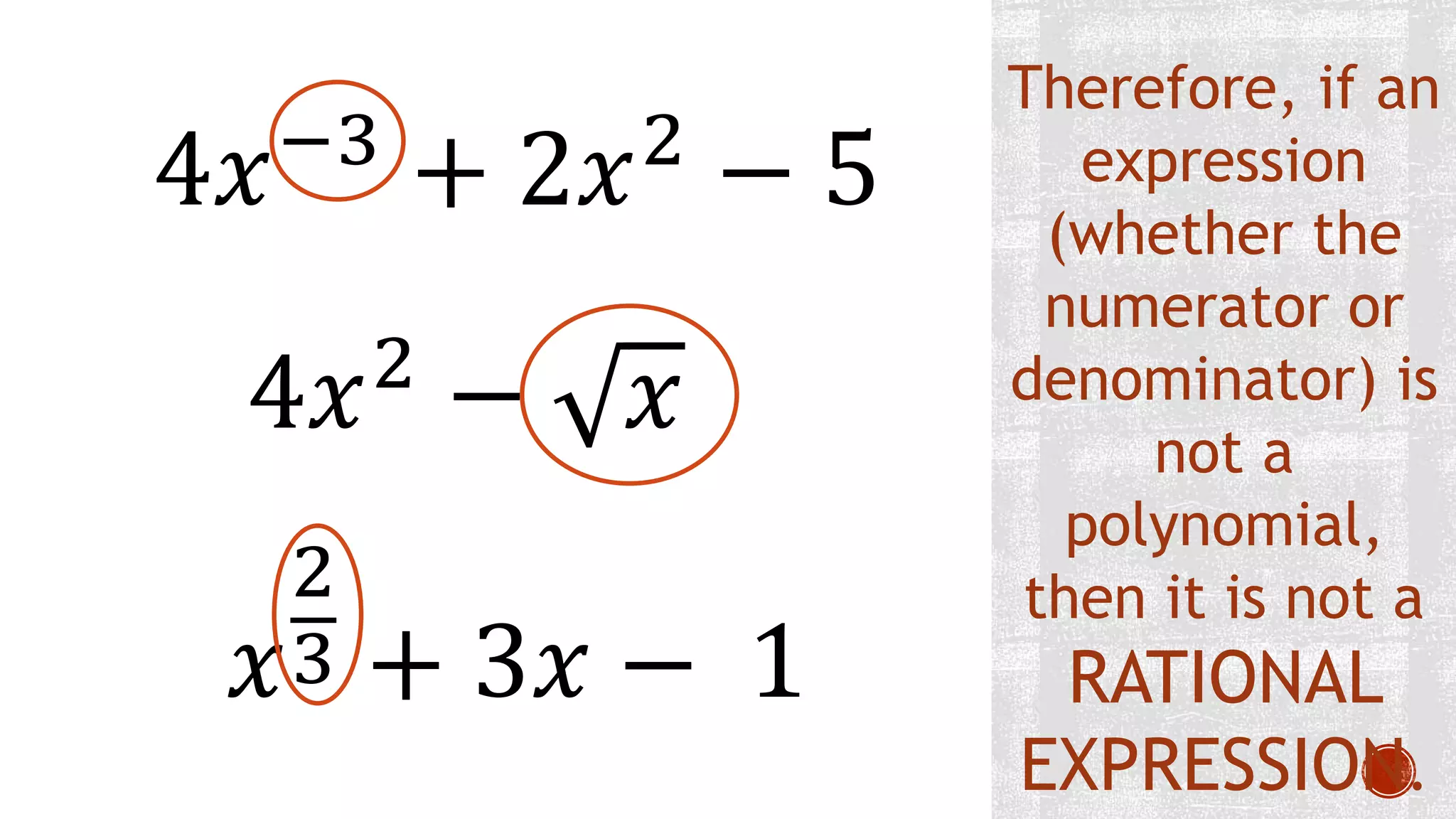
Therefore, if an
expression
(whetherthe
numerator or
denominator) is
not a
polynomial,
then it is not a
RATIONAL
EXPRESSION.
4𝑥−3
+ 2𝑥2
− 5
4𝑥2
− 𝑥
𝑥
2
3 + 3𝑥 − 1
7.
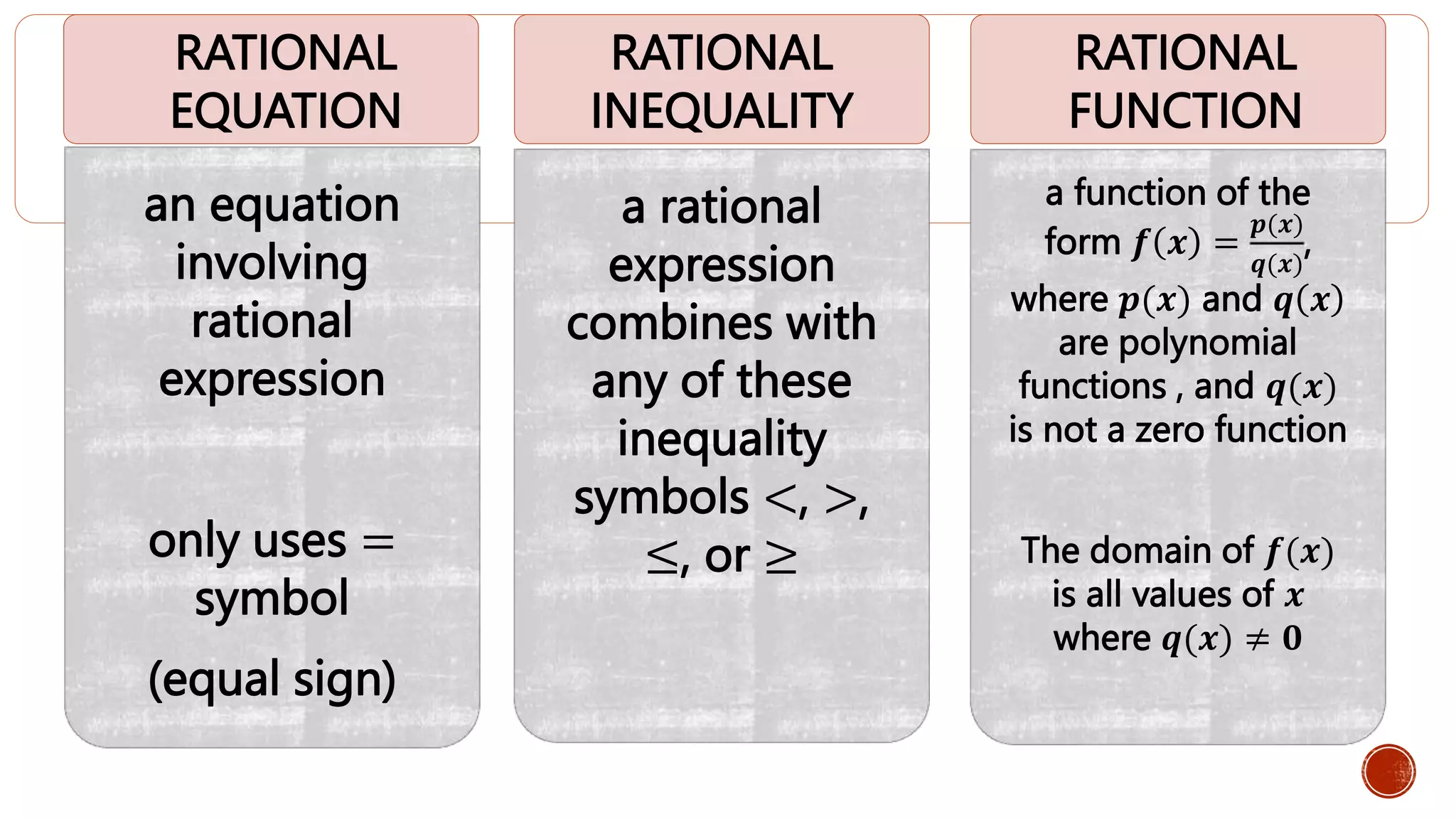
an equation
involving
rational
expression
only uses=
symbol
(equal sign)
a rational
expression
combines with
any of these
inequality
symbols <, >,
≤, or ≥
a function of the
form 𝒇 𝒙 =
𝒑(𝒙)
𝒒(𝒙)
,
where 𝒑(𝒙) and 𝒒 𝒙
are polynomial
functions , and 𝒒(𝒙)
is not a zero function
The domain of 𝒇(𝒙)
is all values of 𝒙
where 𝒒(𝒙) ≠ 𝟎
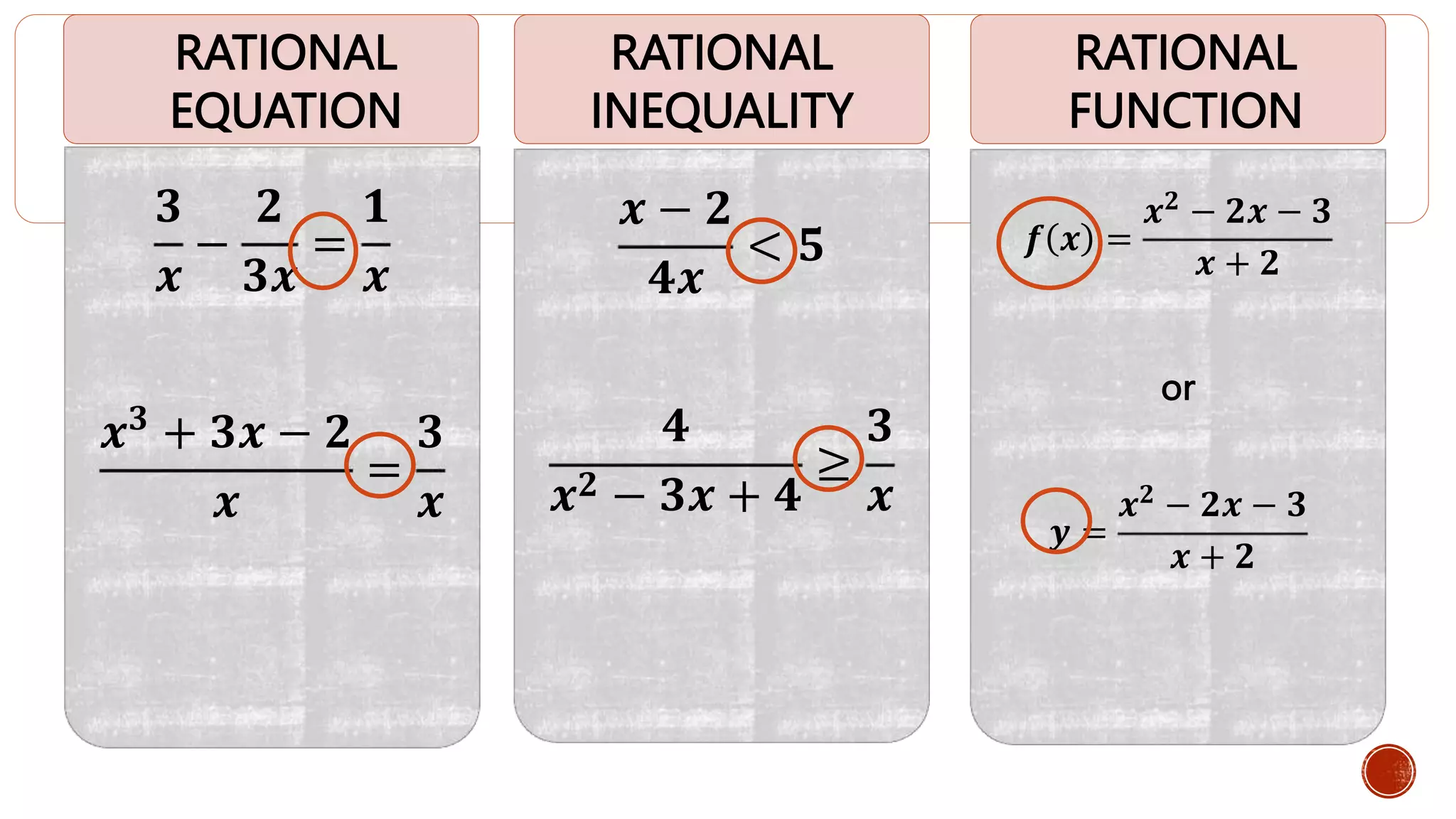
RATIONAL
EQUATION
RATIONAL
INEQUALITY
RATIONAL
FUNCTION