LESSON OBJECTIVES:
 Graph systems of linear equations in two
variables using slope and y-intercept and x-
and y-intercepts methods.
 Categorize a given system of linear
equations in two variables has graphs that
are parallel, intersecting, and coinciding.
USING SLOPE AND Y-INTERCEPT
1. First, determine the slope and the
y-intercept of the two equations.
2. Then, graph the equation using the
slope and y-intercept in one
rectangular coordinate plane.
EXAMPLE:
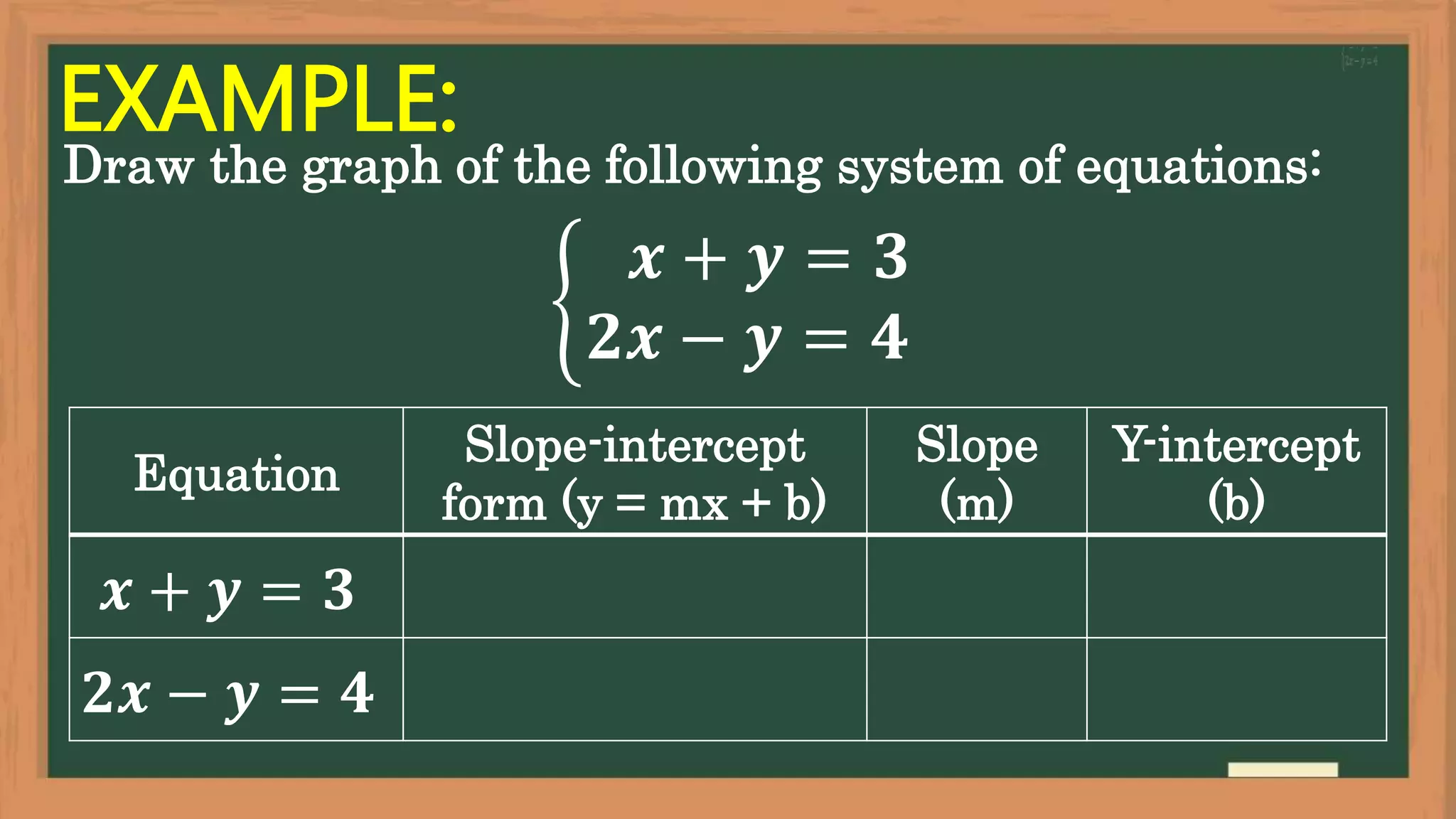
Draw the graph of the following system of equations:
𝒙 + 𝒚 = 𝟑
𝟐𝒙 − 𝒚 = 𝟒
Equation
Slope-intercept
form (y = mx + b)
Slope
(m)
Y-intercept
(b)
𝒙 + 𝒚 = 𝟑
𝟐𝒙 − 𝒚 = 𝟒
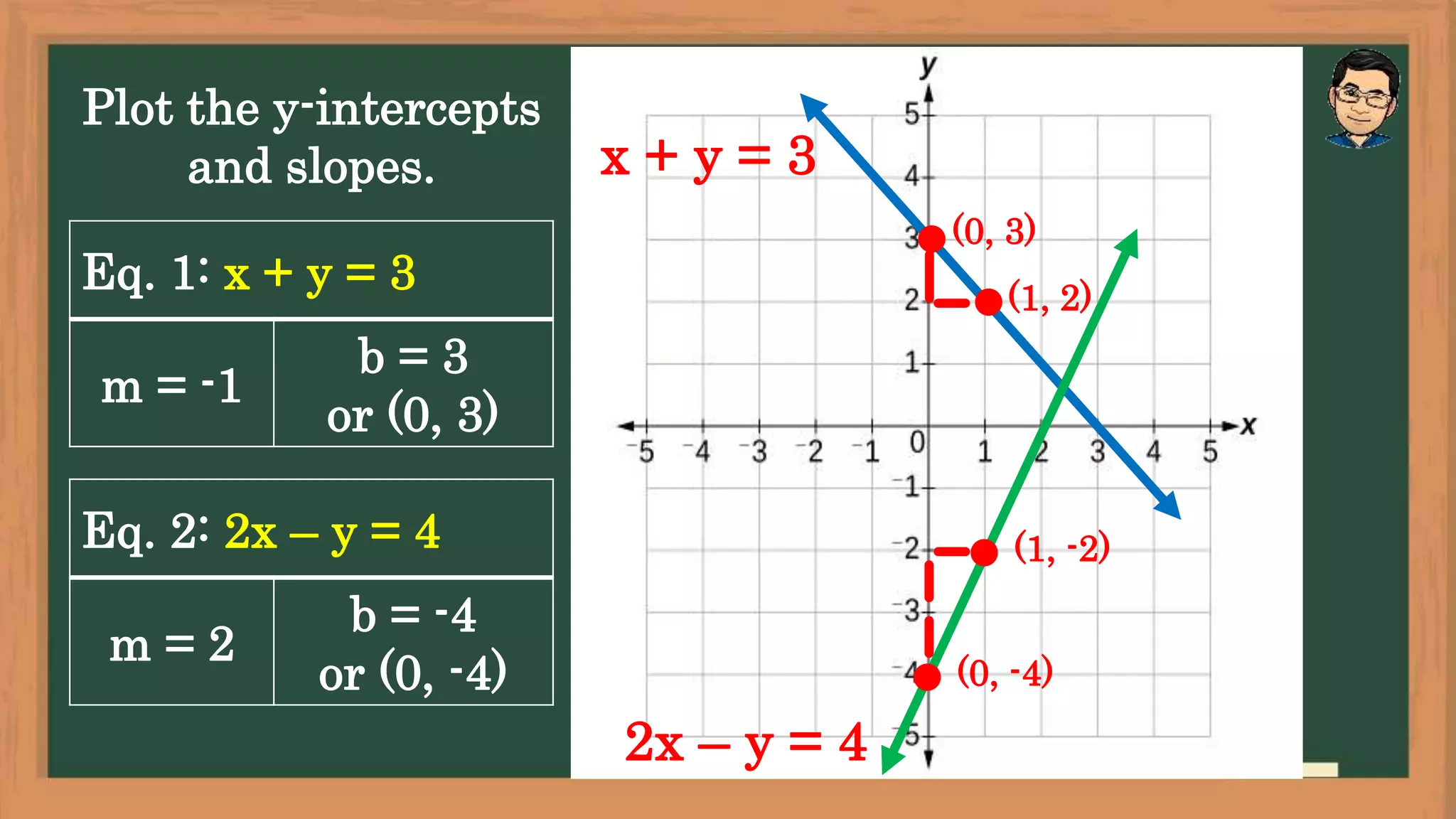
Plot the y-intercepts
and slopes.
Eq. 1: x + y = 3
m = -1
b = 3
or (0, 3)
Eq. 2: 2x – y = 4
m = 2
b = -4
or (0, -4)
(0, 3)
(1, 2)
x + y = 3
(0, -4)
(1, -2)
2x – y = 4
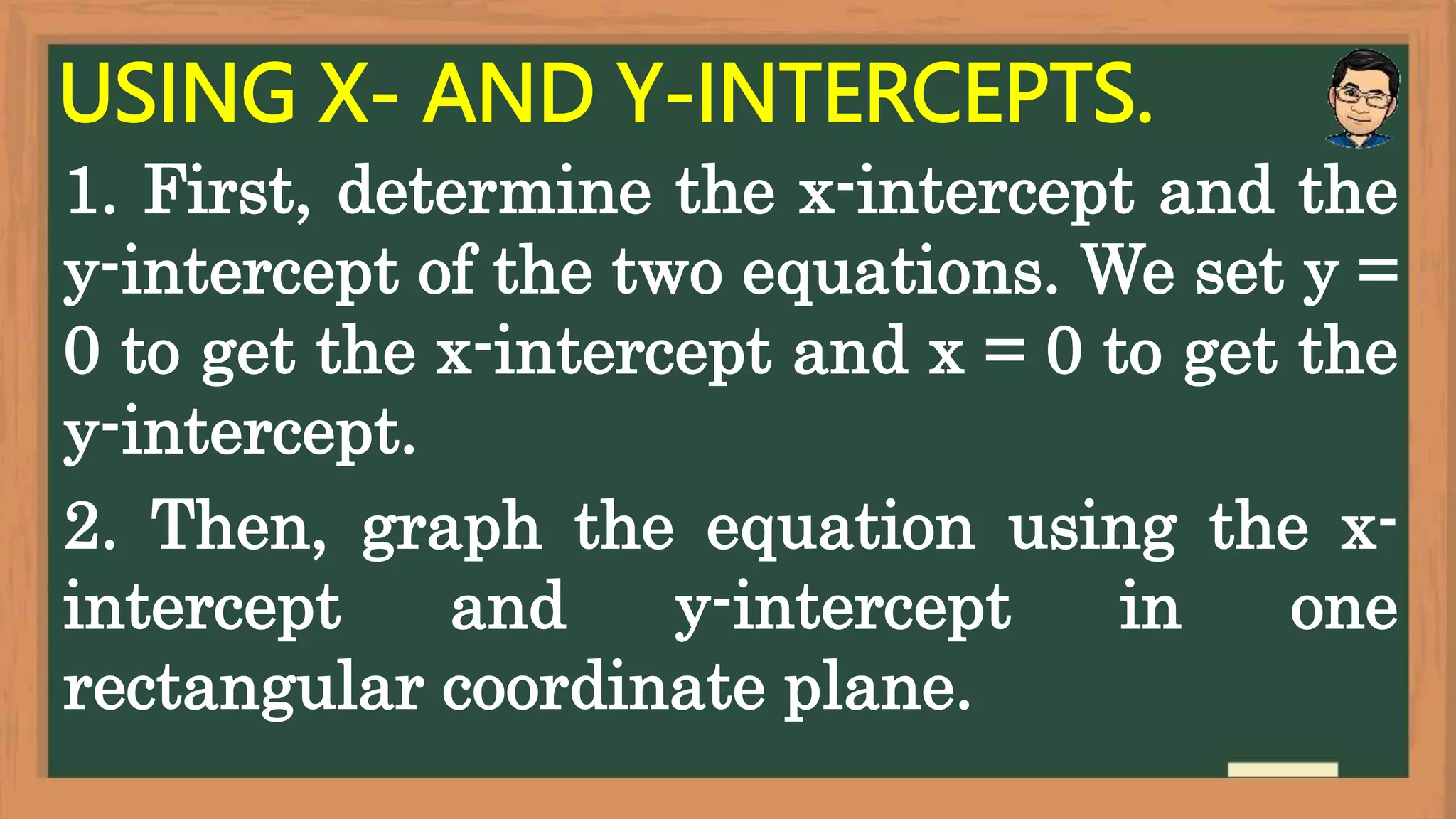
USING X- AND Y-INTERCEPTS.
1. First, determine the x-intercept and the
y-intercept of the two equations. We set y =
0 to get the x-intercept and x = 0 to get the
y-intercept.
2. Then, graph the equation using the x-
intercept and y-intercept in one
rectangular coordinate plane.
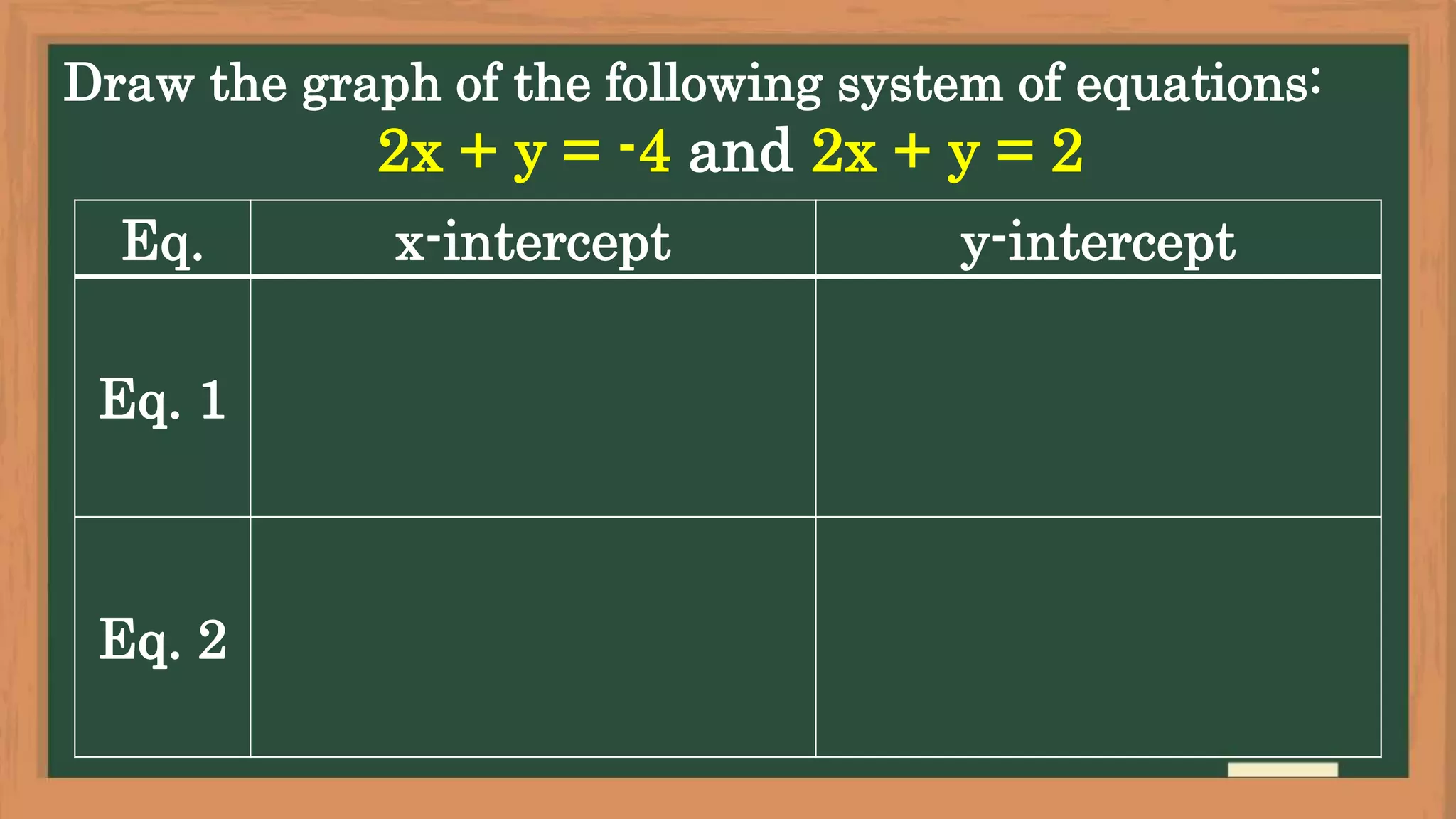
Draw the graph of the following system of equations:
2x + y = -4 and 2x + y = 2
Eq. x-intercept y-intercept
Eq. 1
Eq. 2
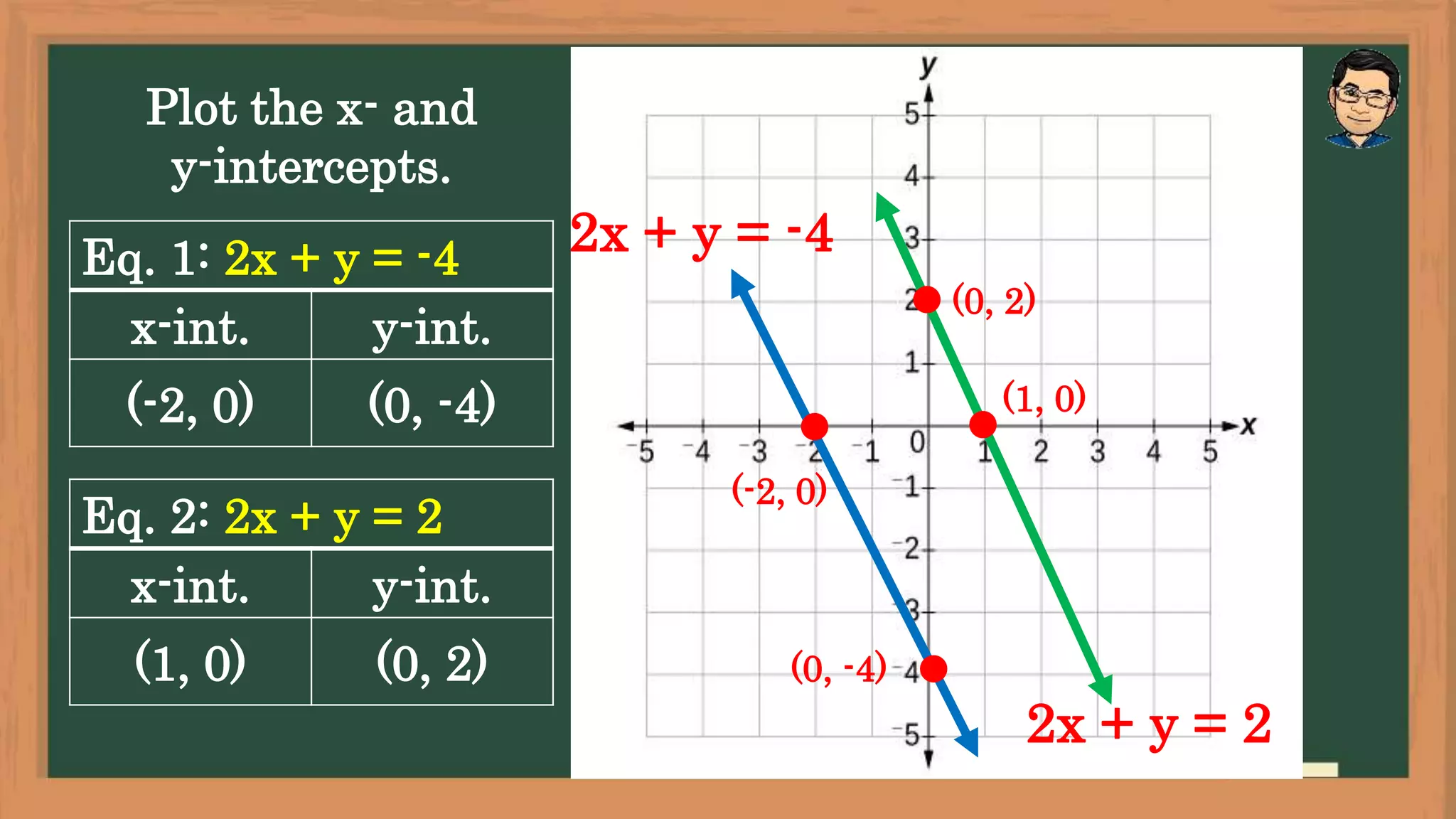
Plot the x- and
y-intercepts.
Eq. 1: 2x + y = -4
x-int. y-int.
(-2, 0) (0, -4)
Eq. 2: 2x + y = 2
x-int. y-int.
(1, 0) (0, 2)
(-2, 0)
(0, 2)
2x + y = 2
(0, -4)
(1, 0)
2x + y = -4
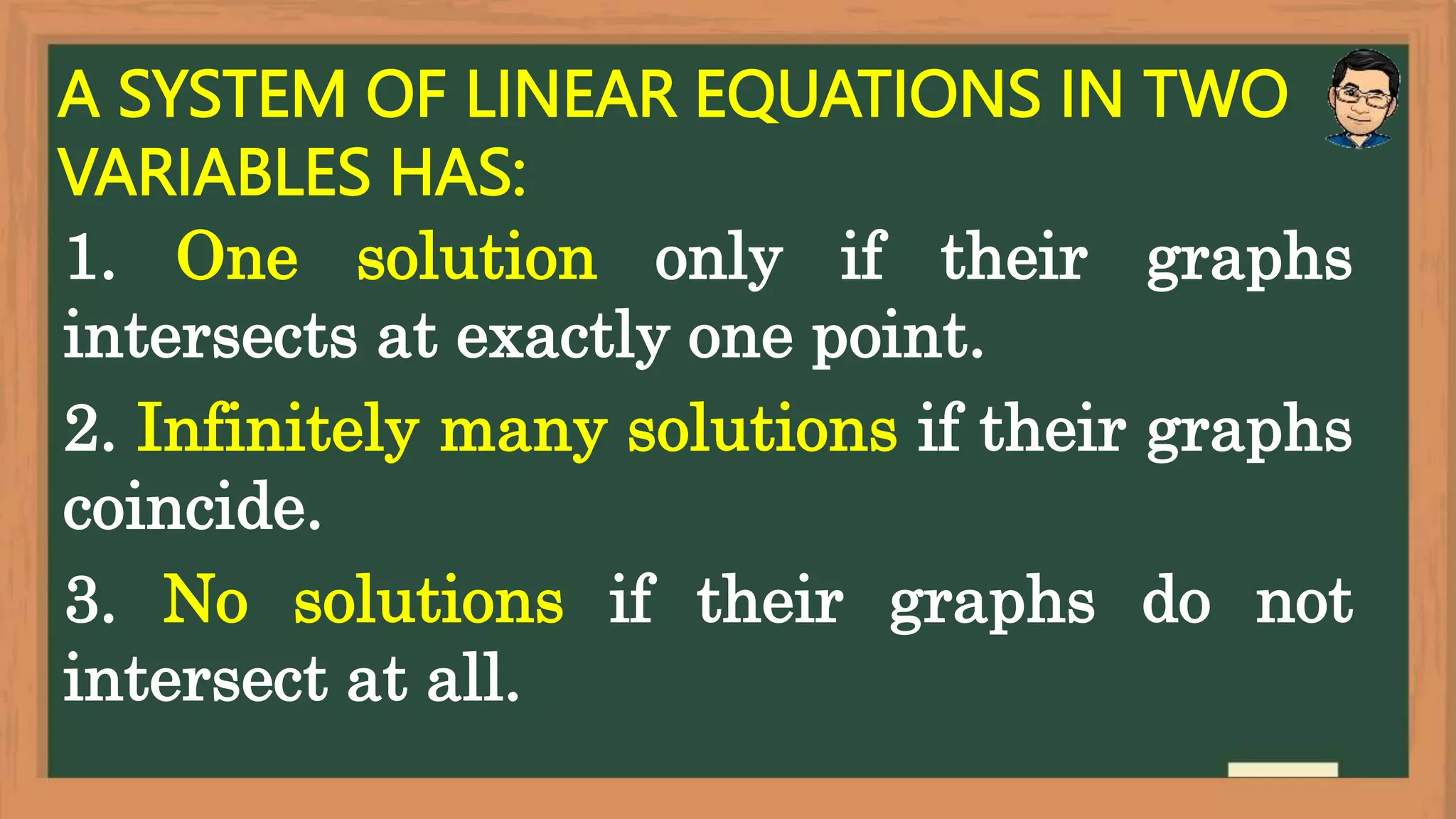
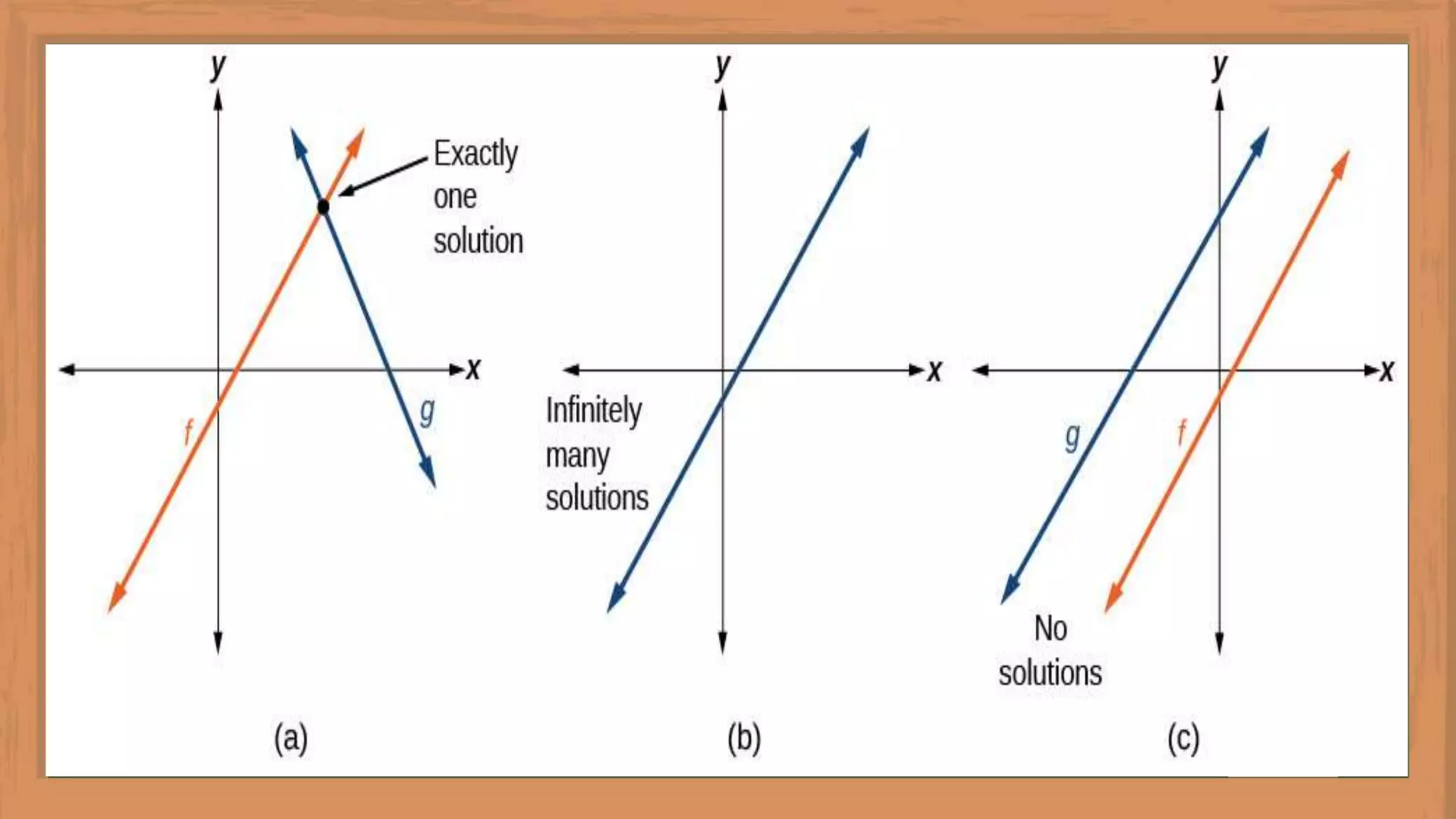
A SYSTEM OF LINEAR EQUATIONS IN TWO
VARIABLES HAS:
1. One solution only if their graphs
intersects at exactly one point.
2. Infinitely many solutions if their graphs
coincide.
3. No solutions if their graphs do not
intersect at all.
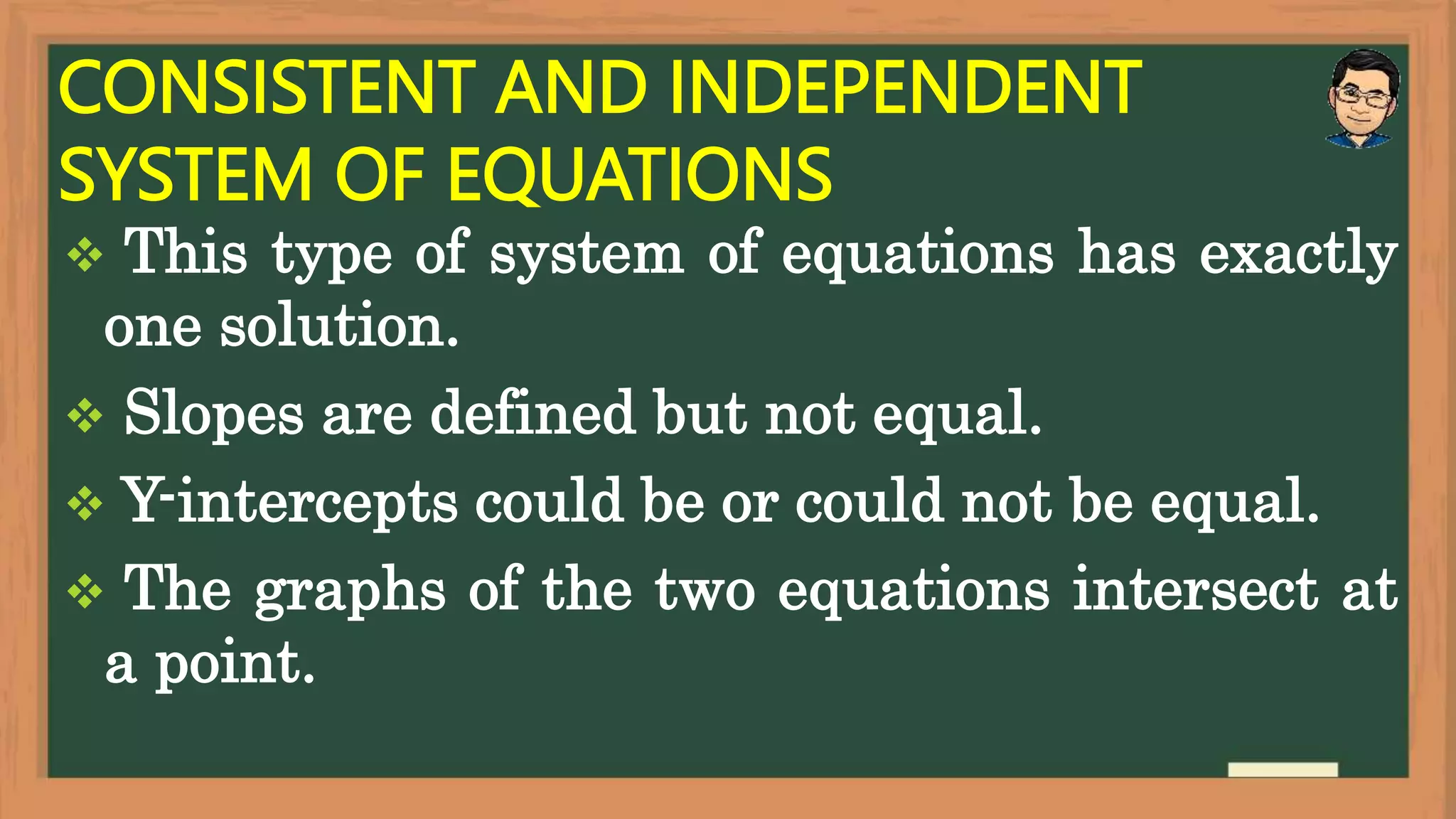
CONSISTENT AND INDEPENDENT
SYSTEM OF EQUATIONS
 This type of system of equations has exactly
one solution.
 Slopes are defined but not equal.
 Y-intercepts could be or could not be equal.
 The graphs of the two equations intersect at
a point.
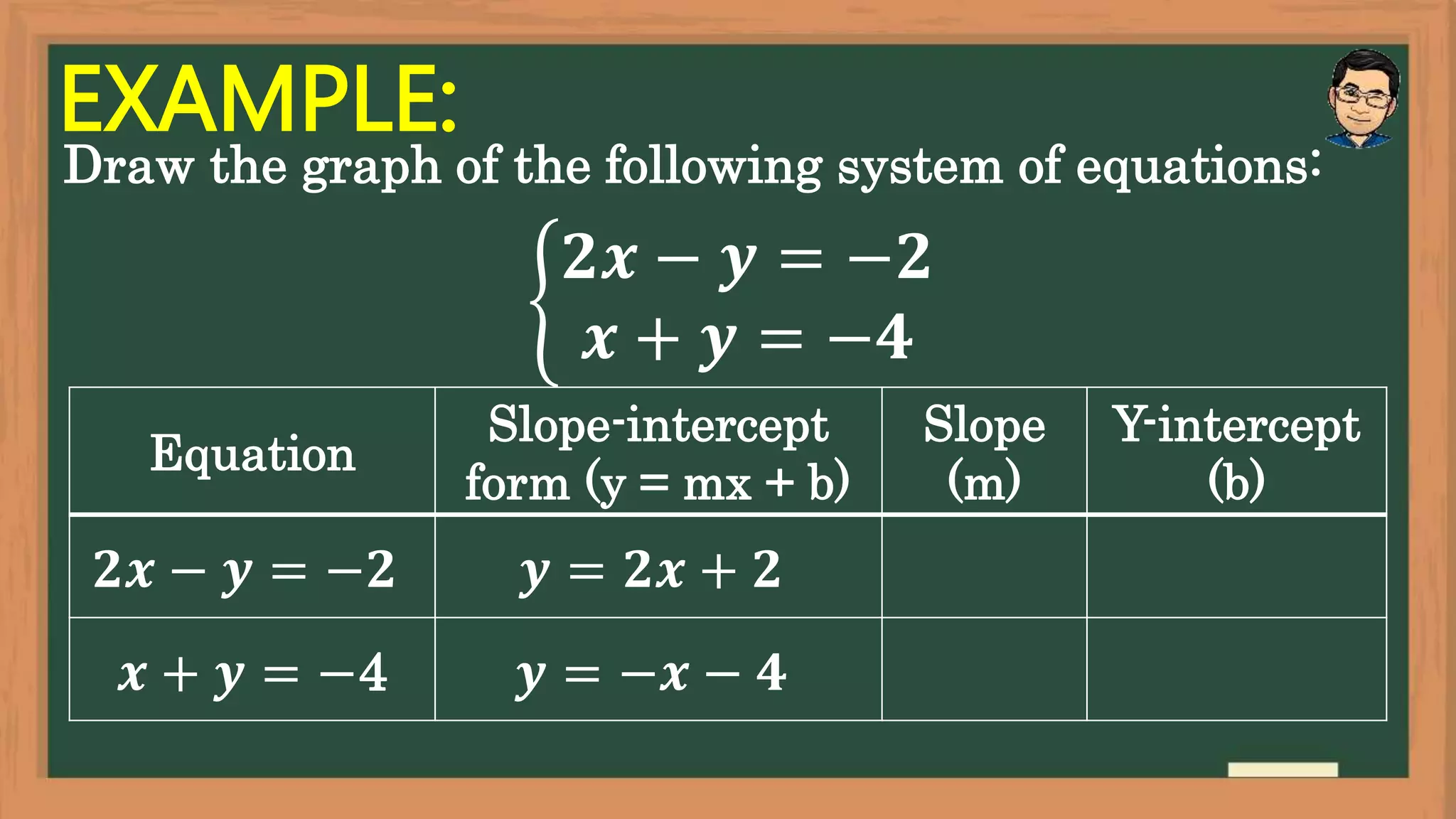
EXAMPLE:
Draw the graph of the following system of equations:
𝟐𝒙 − 𝒚 = −𝟐
𝒙 + 𝒚 = −𝟒
Equation
Slope-intercept
form (y = mx + b)
Slope
(m)
Y-intercept
(b)
𝟐𝒙 − 𝒚 = −𝟐 𝒚 = 𝟐𝒙 + 𝟐
𝒙 + 𝒚 = −4 𝒚 = −𝒙 − 𝟒
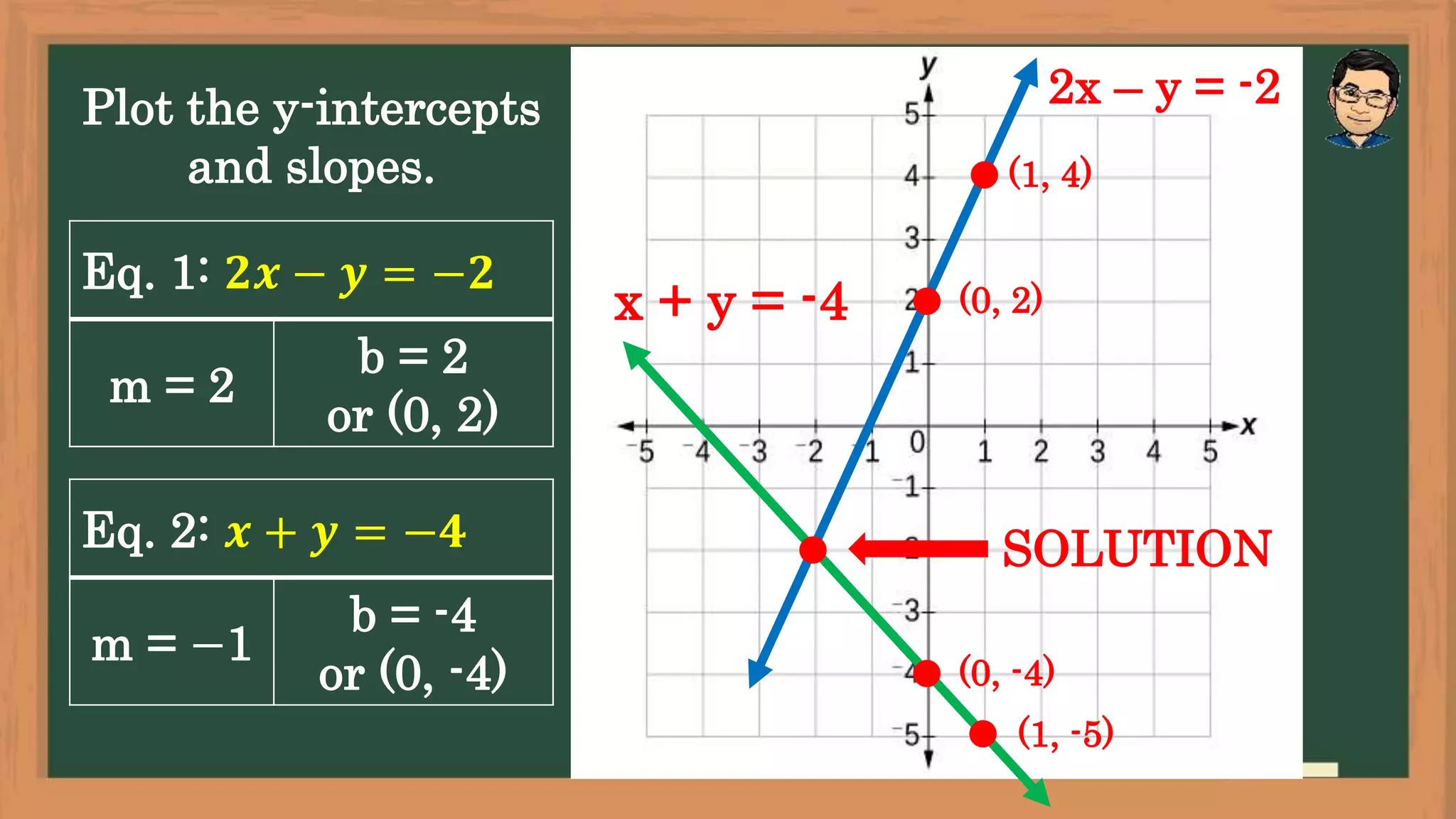
Plot the y-intercepts
and slopes.
Eq. 1: 𝟐𝒙 − 𝒚 = −𝟐
m = 2
b = 2
or (0, 2)
Eq. 2: 𝒙 + 𝒚 = −𝟒
m = −1
b = -4
or (0, -4)
(0, 2)
(1, 4)
2x – y = -2
(1, -5)
(0, -4)
x + y = -4
SOLUTION
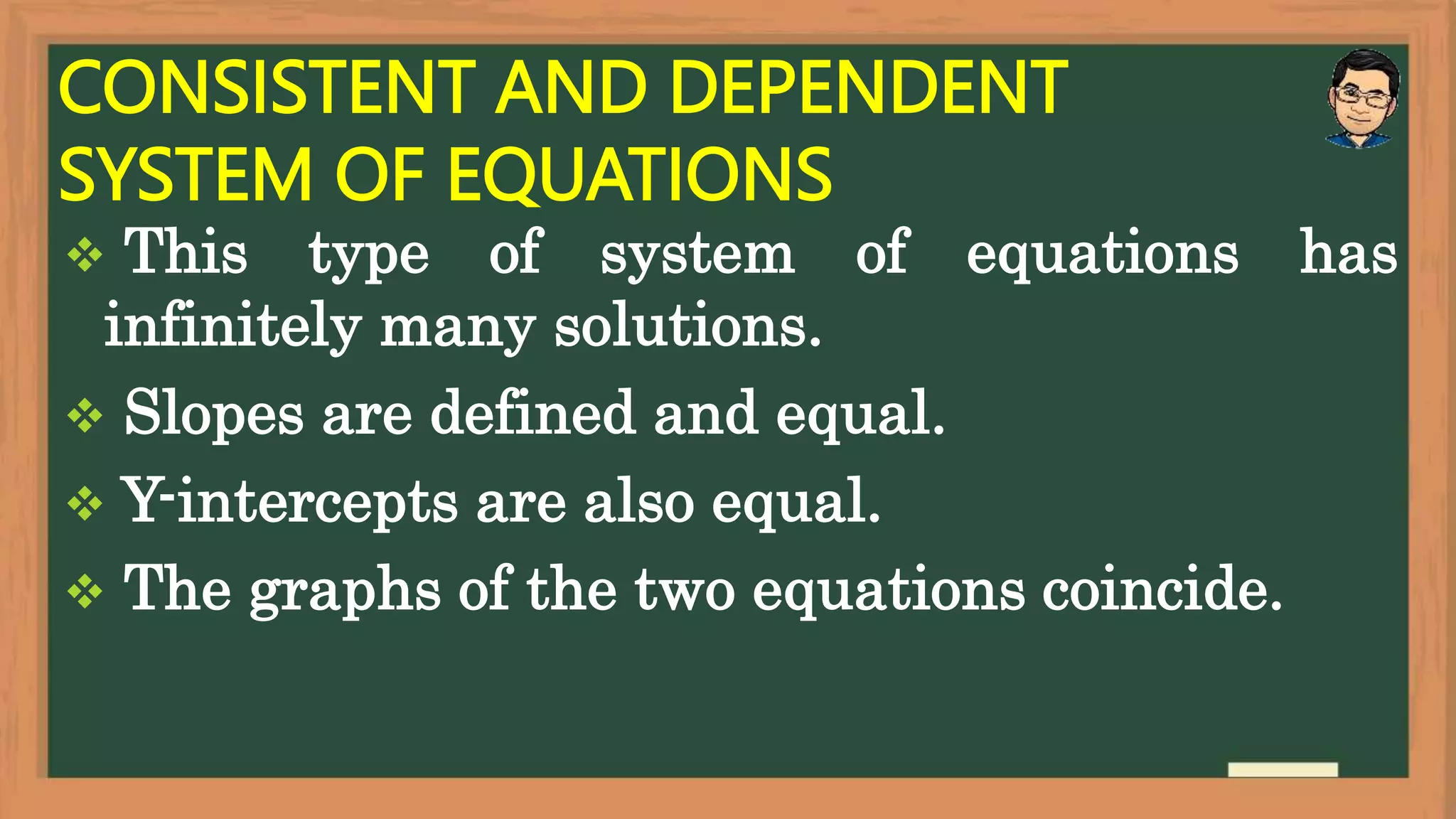
CONSISTENT AND DEPENDENT
SYSTEM OF EQUATIONS
 This type of system of equations has
infinitely many solutions.
 Slopes are defined and equal.
 Y-intercepts are also equal.
 The graphs of the two equations coincide.
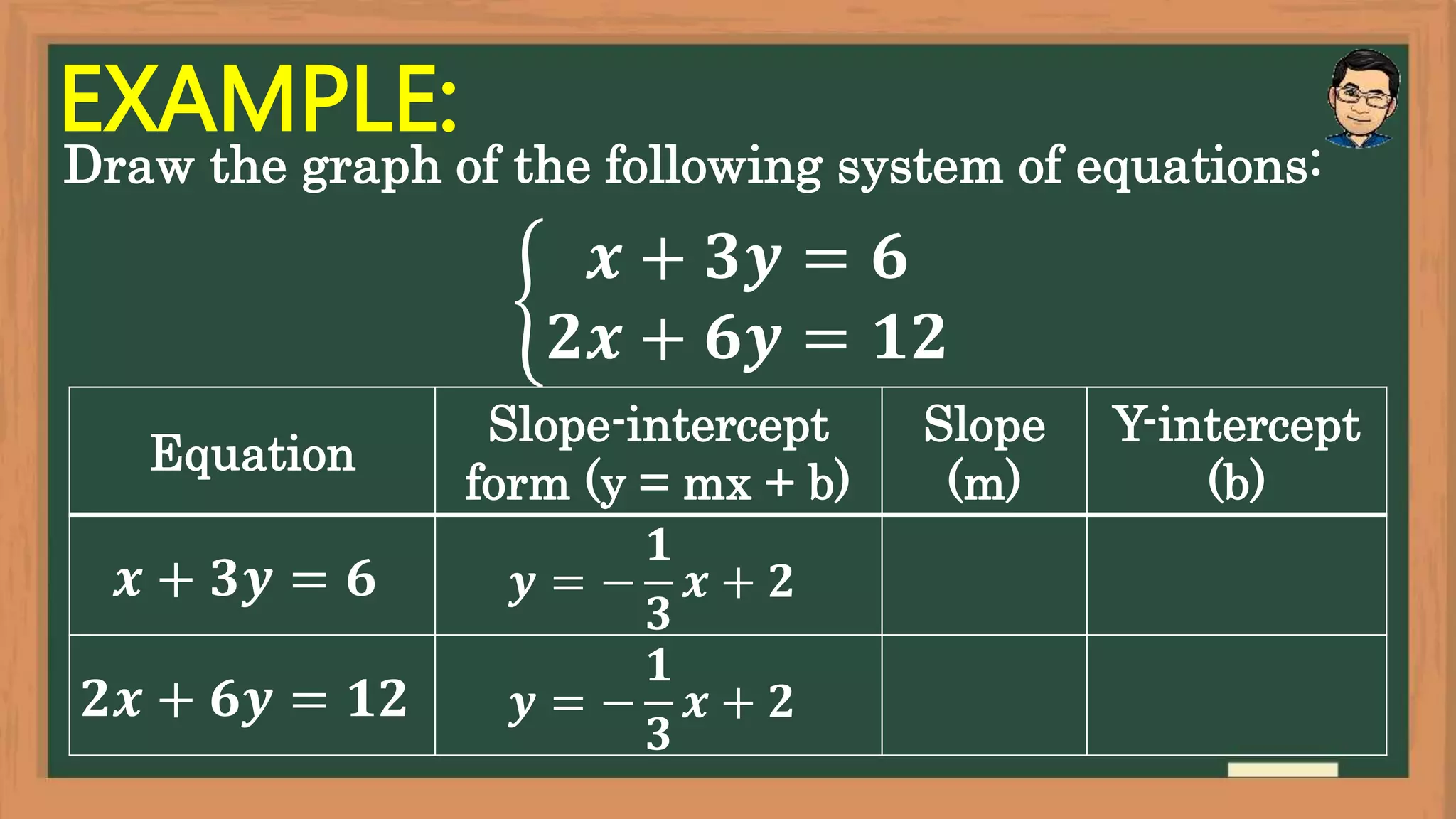
EXAMPLE:
Draw the graph of the following system of equations:
𝒙 + 𝟑𝒚 = 𝟔
𝟐𝒙 + 𝟔𝒚 = 𝟏𝟐
Equation
Slope-intercept
form (y = mx + b)
Slope
(m)
Y-intercept
(b)
𝒙 + 𝟑𝒚 = 𝟔 𝒚 = −
𝟏
𝟑
𝒙 + 𝟐
𝟐𝒙 + 𝟔𝒚 = 𝟏𝟐 𝒚 = −
𝟏
𝟑
𝒙 + 𝟐
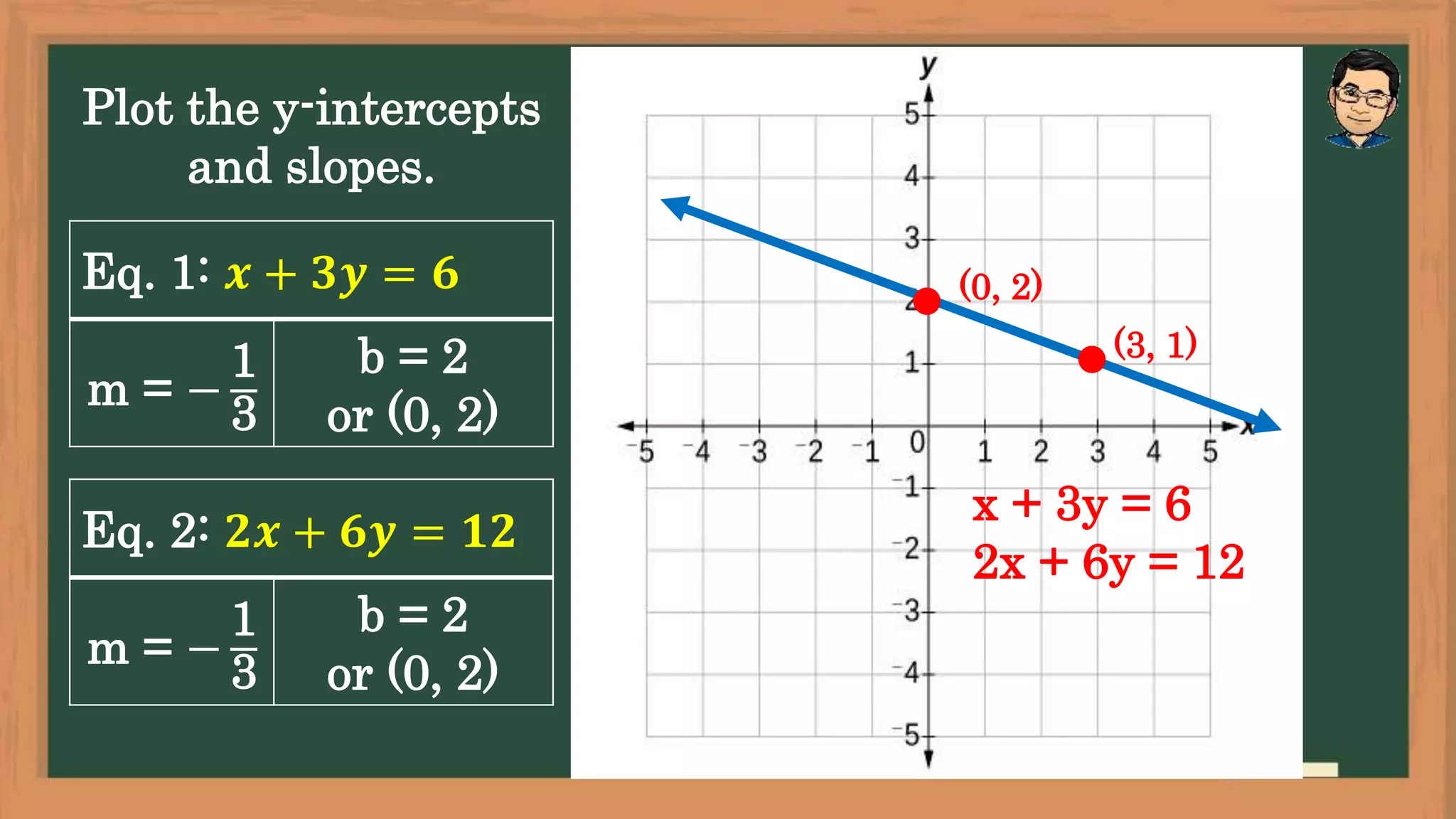
Plot the y-intercepts
and slopes.
Eq. 1: 𝒙 + 𝟑𝒚 = 𝟔
m = −
1
3
b = 2
or (0, 2)
Eq. 2: 𝟐𝒙 + 𝟔𝒚 = 𝟏𝟐
m = −
1
3
b = 2
or (0, 2)
(0, 2)
(3, 1)
x + 3y = 6
2x + 6y = 12
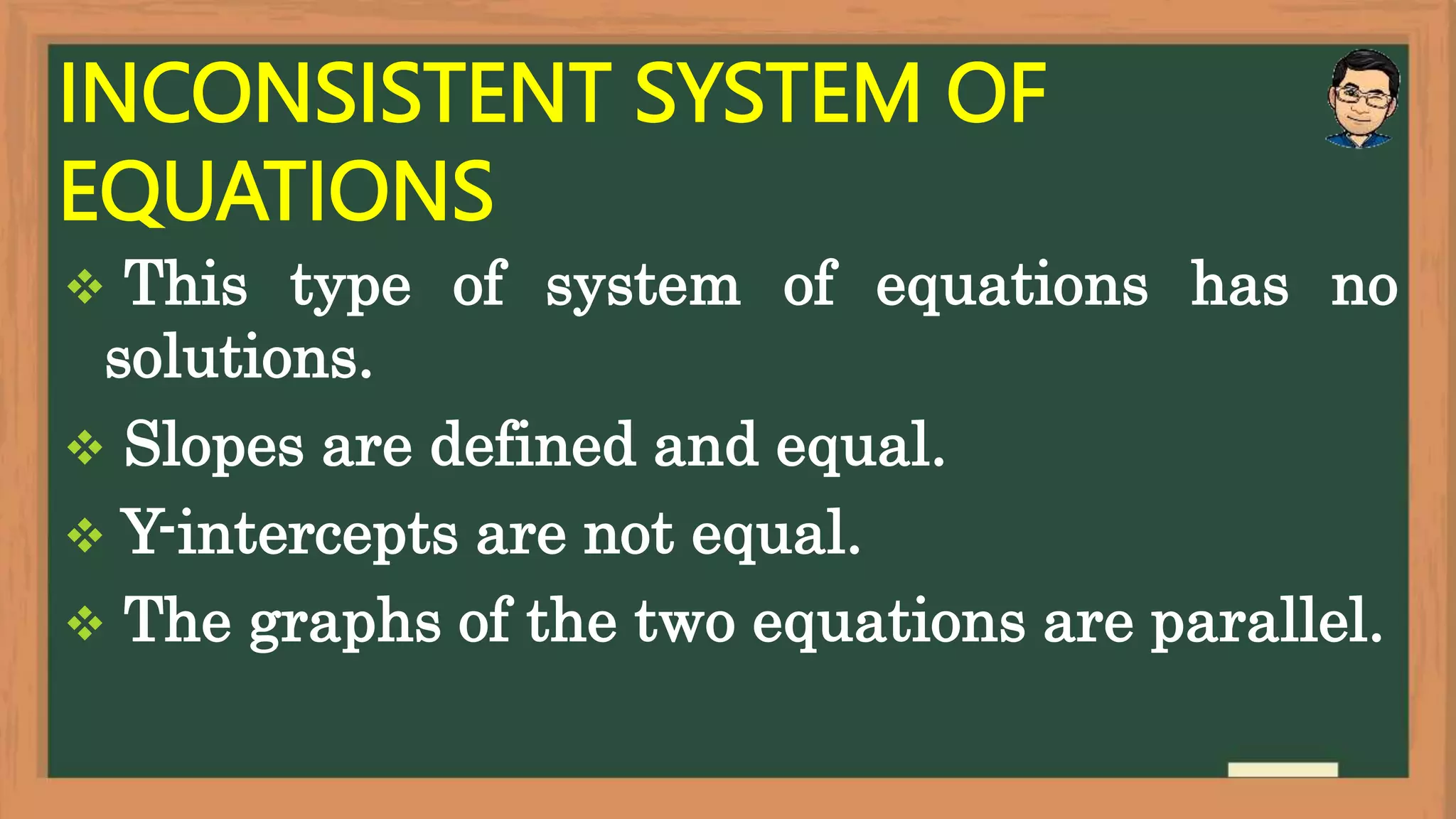
INCONSISTENT SYSTEM OF
EQUATIONS
 This type of system of equations has no
solutions.
 Slopes are defined and equal.
 Y-intercepts are not equal.
 The graphs of the two equations are parallel.
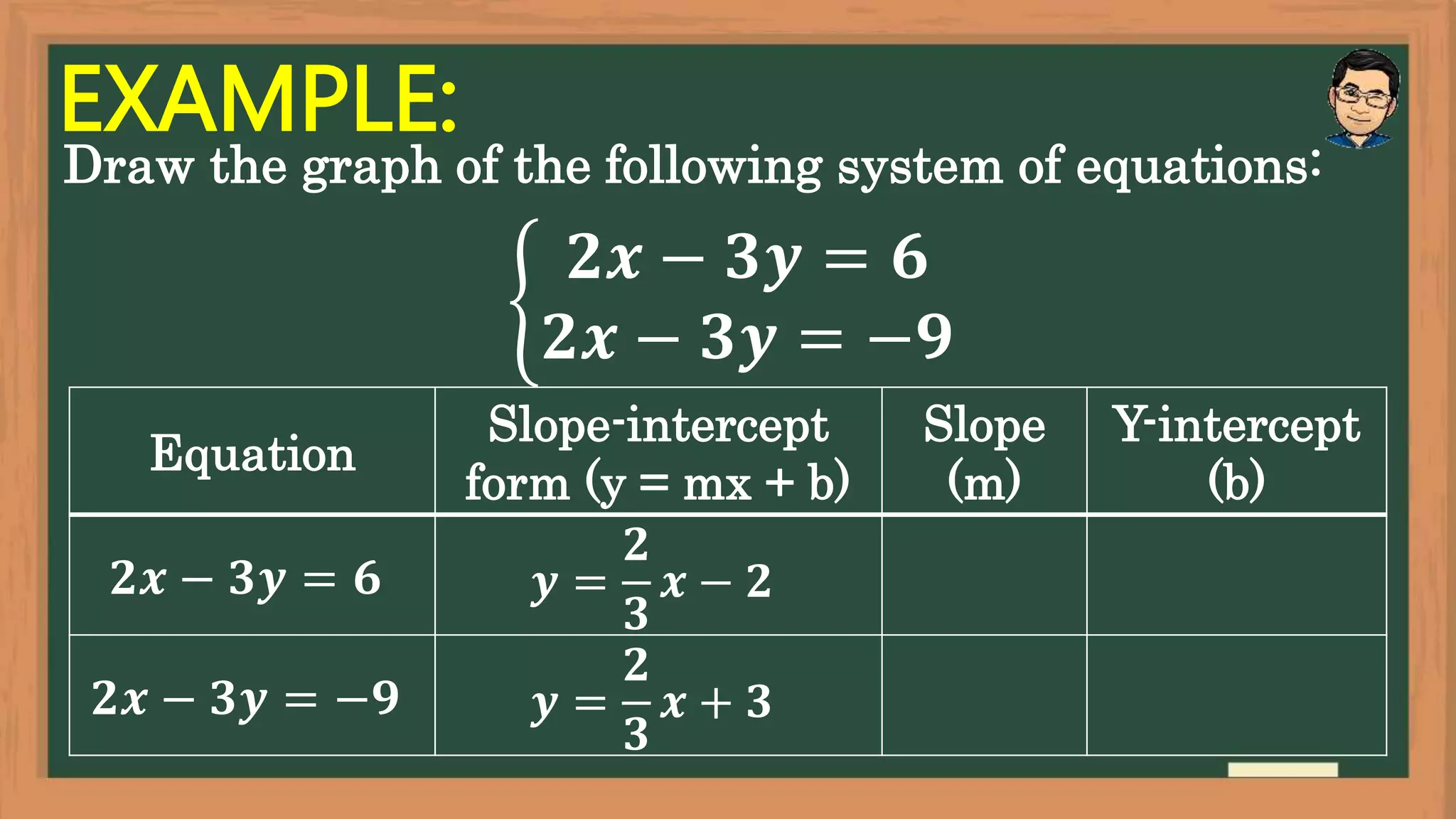
EXAMPLE:
Draw the graph of the following system of equations:
𝟐𝒙 − 𝟑𝒚 = 𝟔
𝟐𝒙 − 𝟑𝒚 = −𝟗
Equation
Slope-intercept
form (y = mx + b)
Slope
(m)
Y-intercept
(b)
𝟐𝒙 − 𝟑𝒚 = 𝟔 𝒚 =
𝟐
𝟑
𝒙 − 𝟐
𝟐𝒙 − 𝟑𝒚 = −𝟗 𝒚 =
𝟐
𝟑
𝒙 + 𝟑
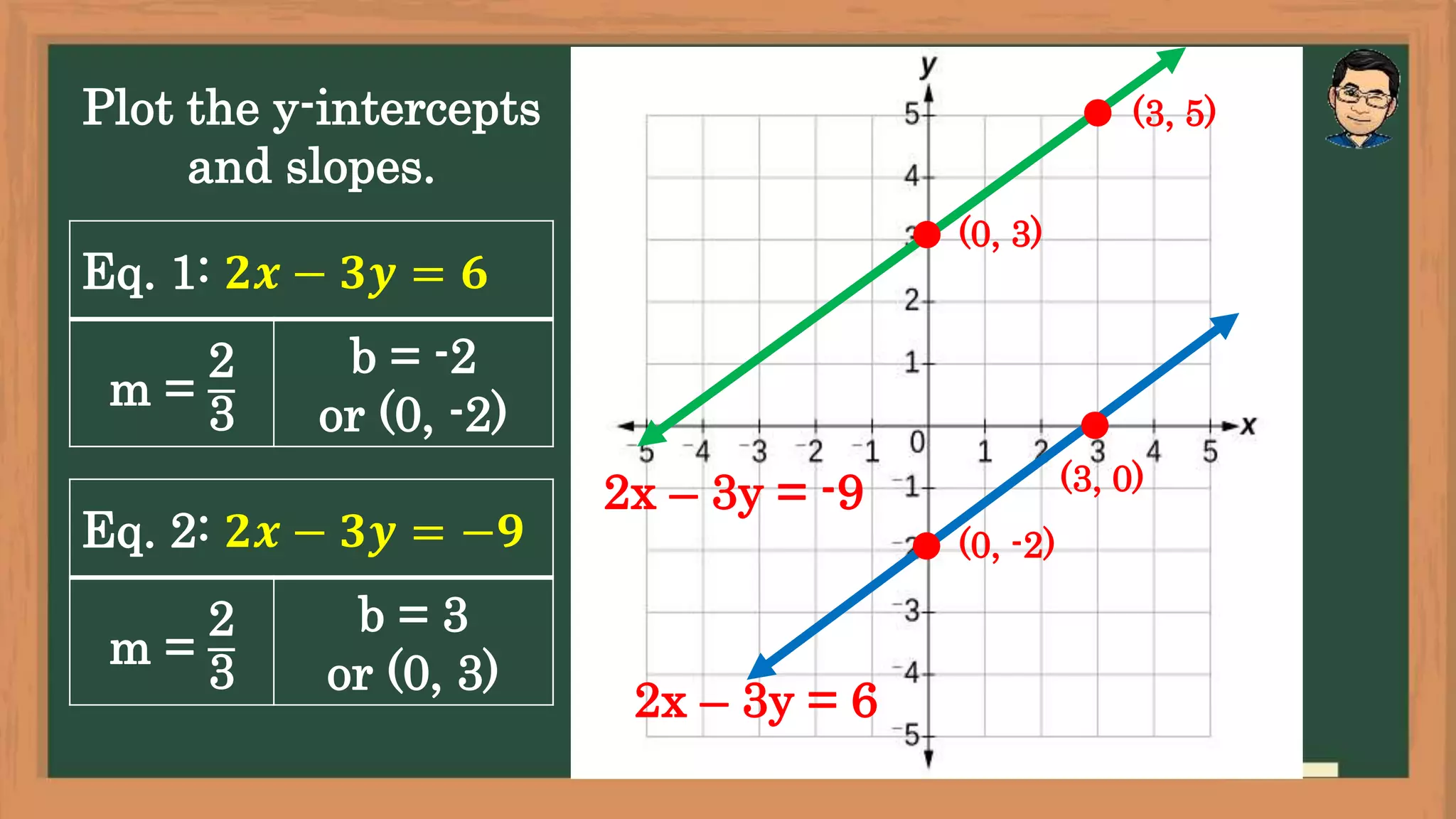
Plot the y-intercepts
and slopes.
Eq. 1: 𝟐𝒙 − 𝟑𝒚 = 𝟔
m =
2
3
b = -2
or (0, -2)
Eq. 2: 𝟐𝒙 − 𝟑𝒚 = −𝟗
m =
2
3
b = 3
or (0, 3)
(0, -2)
(3, 0)
2x – 3y = 6
(3, 5)
(0, 3)
2x – 3y = -9
WHAT’S NEXT???
Solve system of linear
equations algebraically by
substitution method.

21 - GRAPHS THE SYSTEMS OF LINEAR EQUATIONS IN TWO VARIABLES.pptx

  • 2.
    LESSON OBJECTIVES:  Graphsystems of linear equations in two variables using slope and y-intercept and x- and y-intercepts methods.  Categorize a given system of linear equations in two variables has graphs that are parallel, intersecting, and coinciding.
  • 3.
    USING SLOPE ANDY-INTERCEPT 1. First, determine the slope and the y-intercept of the two equations. 2. Then, graph the equation using the slope and y-intercept in one rectangular coordinate plane.
  • 4.
    EXAMPLE: Draw the graphof the following system of equations: 𝒙 + 𝒚 = 𝟑 𝟐𝒙 − 𝒚 = 𝟒 Equation Slope-intercept form (y = mx + b) Slope (m) Y-intercept (b) 𝒙 + 𝒚 = 𝟑 𝟐𝒙 − 𝒚 = 𝟒
  • 5.
    Plot the y-intercepts andslopes. Eq. 1: x + y = 3 m = -1 b = 3 or (0, 3) Eq. 2: 2x – y = 4 m = 2 b = -4 or (0, -4) (0, 3) (1, 2) x + y = 3 (0, -4) (1, -2) 2x – y = 4
  • 6.
    USING X- ANDY-INTERCEPTS. 1. First, determine the x-intercept and the y-intercept of the two equations. We set y = 0 to get the x-intercept and x = 0 to get the y-intercept. 2. Then, graph the equation using the x- intercept and y-intercept in one rectangular coordinate plane.
  • 7.
    Draw the graphof the following system of equations: 2x + y = -4 and 2x + y = 2 Eq. x-intercept y-intercept Eq. 1 Eq. 2
  • 8.
    Plot the x-and y-intercepts. Eq. 1: 2x + y = -4 x-int. y-int. (-2, 0) (0, -4) Eq. 2: 2x + y = 2 x-int. y-int. (1, 0) (0, 2) (-2, 0) (0, 2) 2x + y = 2 (0, -4) (1, 0) 2x + y = -4
  • 9.
    A SYSTEM OFLINEAR EQUATIONS IN TWO VARIABLES HAS: 1. One solution only if their graphs intersects at exactly one point. 2. Infinitely many solutions if their graphs coincide. 3. No solutions if their graphs do not intersect at all.
  • 11.
    CONSISTENT AND INDEPENDENT SYSTEMOF EQUATIONS  This type of system of equations has exactly one solution.  Slopes are defined but not equal.  Y-intercepts could be or could not be equal.  The graphs of the two equations intersect at a point.
  • 12.
    EXAMPLE: Draw the graphof the following system of equations: 𝟐𝒙 − 𝒚 = −𝟐 𝒙 + 𝒚 = −𝟒 Equation Slope-intercept form (y = mx + b) Slope (m) Y-intercept (b) 𝟐𝒙 − 𝒚 = −𝟐 𝒚 = 𝟐𝒙 + 𝟐 𝒙 + 𝒚 = −4 𝒚 = −𝒙 − 𝟒
  • 13.
    Plot the y-intercepts andslopes. Eq. 1: 𝟐𝒙 − 𝒚 = −𝟐 m = 2 b = 2 or (0, 2) Eq. 2: 𝒙 + 𝒚 = −𝟒 m = −1 b = -4 or (0, -4) (0, 2) (1, 4) 2x – y = -2 (1, -5) (0, -4) x + y = -4 SOLUTION
  • 14.
    CONSISTENT AND DEPENDENT SYSTEMOF EQUATIONS  This type of system of equations has infinitely many solutions.  Slopes are defined and equal.  Y-intercepts are also equal.  The graphs of the two equations coincide.
  • 15.
    EXAMPLE: Draw the graphof the following system of equations: 𝒙 + 𝟑𝒚 = 𝟔 𝟐𝒙 + 𝟔𝒚 = 𝟏𝟐 Equation Slope-intercept form (y = mx + b) Slope (m) Y-intercept (b) 𝒙 + 𝟑𝒚 = 𝟔 𝒚 = − 𝟏 𝟑 𝒙 + 𝟐 𝟐𝒙 + 𝟔𝒚 = 𝟏𝟐 𝒚 = − 𝟏 𝟑 𝒙 + 𝟐
  • 16.
    Plot the y-intercepts andslopes. Eq. 1: 𝒙 + 𝟑𝒚 = 𝟔 m = − 1 3 b = 2 or (0, 2) Eq. 2: 𝟐𝒙 + 𝟔𝒚 = 𝟏𝟐 m = − 1 3 b = 2 or (0, 2) (0, 2) (3, 1) x + 3y = 6 2x + 6y = 12
  • 17.
    INCONSISTENT SYSTEM OF EQUATIONS This type of system of equations has no solutions.  Slopes are defined and equal.  Y-intercepts are not equal.  The graphs of the two equations are parallel.
  • 18.
    EXAMPLE: Draw the graphof the following system of equations: 𝟐𝒙 − 𝟑𝒚 = 𝟔 𝟐𝒙 − 𝟑𝒚 = −𝟗 Equation Slope-intercept form (y = mx + b) Slope (m) Y-intercept (b) 𝟐𝒙 − 𝟑𝒚 = 𝟔 𝒚 = 𝟐 𝟑 𝒙 − 𝟐 𝟐𝒙 − 𝟑𝒚 = −𝟗 𝒚 = 𝟐 𝟑 𝒙 + 𝟑
  • 19.
    Plot the y-intercepts andslopes. Eq. 1: 𝟐𝒙 − 𝟑𝒚 = 𝟔 m = 2 3 b = -2 or (0, -2) Eq. 2: 𝟐𝒙 − 𝟑𝒚 = −𝟗 m = 2 3 b = 3 or (0, 3) (0, -2) (3, 0) 2x – 3y = 6 (3, 5) (0, 3) 2x – 3y = -9
  • 20.
    WHAT’S NEXT??? Solve systemof linear equations algebraically by substitution method.