JAMES PATRICK T
. CABALLERO
Subject Teacher
CREATIVE
WRITING
WHAT ISTHE DIFFERENCE
BETWEEN CREATIVE AND
TECHNICAL WRITING?
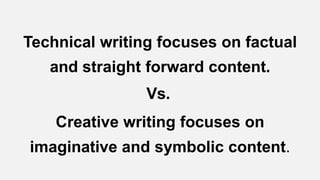
Technical writing focuses on factual
and straight forward content.
Vs.
Creative writing focuses on
imaginative and symbolic content.
WHAT DO WE MEAN IF
YOU SAY IMAGINATIVE
AND FACTUAL?
I M A G I N A T I V E
• To be imaginative is to be inventive and
original. If you enjoy coming up with
stories, writing songs, or just thinking about
things in new ways, you're an imaginative
person.
• relating to, or characterized by imagination
FA C T U A L
• relating to, or characterized by facts
• of the nature of fact
• real
• actual
• containing facts.
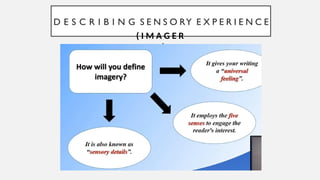
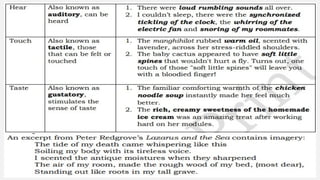
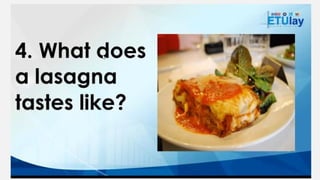
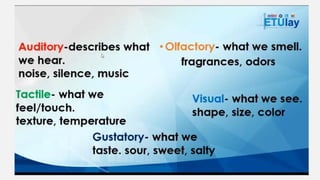
D E S C R I B I N G S E N S O RY E X P E R I E N C E
( I M A G E R
Y )
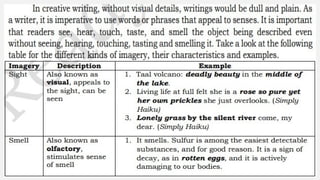
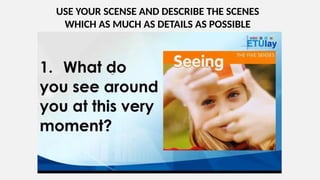
USE YOUR SCENSE AND DESCRIBE THE SCENES
WHICH AS MUCH AS DETAILS AS POSSIBLE
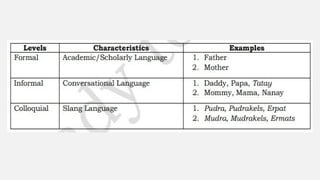
• refers to language and word choice of the writer.
It shows the level of formality of a text which
helps in shaping the perception and view of the
readers. There are three levels of diction: formal,
informal, and colloquial.
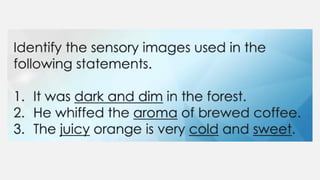
USING APPROPRIATE DICTION
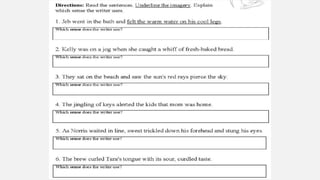
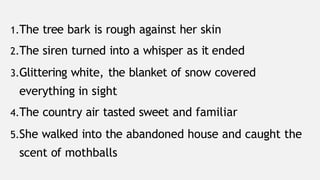
1.The tree bark is rough against her skin
2.The siren turned into a whisper as it ended
3.Glittering white, the blanket of snow covered
everything in sight
4.The country air tasted sweet and familiar
5.She walked into the abandoned house and caught the
scent of mothballs
• A figure of speech is a phrase that has an
implied meaning and should not be taken
at face value. This means that the real
meaning of such a phrase differs from
its literal meaning.
F I G U R E S S P E E C H / F I G U R A T IV E L A N G U A G E
U S I N G F I G U R A T I V E L A N G U A G E
• Writers use figures of speech and figurative language in
order to create more impact on the readers’
interpretation and comprehension of a text. They
create figurative images which makes reading
more pleasurable and more engaging. Figures of
speech are particular techniques while figurative
language refers to the language that contains the
technique. In illustration: if figurative language
is a dance routine, figures of speech are the various
moves that make up the routine.
• (figurative language that compares two unlike objects by
using the words “like,” “than,” or “as”). Authors use similes
to compare two things in an interesting way that puts a
clearer image in the reader’s head.
S I M I L E
E X A M P L E S O F S I M I L E
S
• The snow is like a blanket.
• The bread is as hard as nails.”
• The river is as dry as a bone.”
• The bread was as thin as paper.
• She was as pretty as a picture.
• She was as blind as a bat.
• He was as white as a ghost.
• He was as big as a wale
1. Linda ate a mountain of ice cream.
2. Bobbie made 100 spitballs and had to throw them all in the trashcan.
3. The headlights were as blinding as the sun.
4. Ginger worked a million hours in her room on Saturday morning.
5. The hanging beach towel flapped in the wind like waves on the ocean.
6. Brent’s neck was as long as a giraffe’s.
7. Sarah’s silky skirt swayed in the breeze.
8. Hank’s hands were rough like sandpaper.
9. Martha sewed miles of fabric to make the dress.
10.John’s hands were like a giant trap waiting for the ball.
IDENTIFY THE S I M I L E
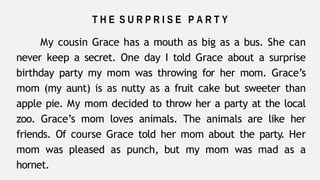
T H E S U R P R I S E P A R T Y
My cousin Grace has a mouth as big as a bus. She can
never keep a secret. One day I told Grace about a surprise
birthday party my mom was throwing for her mom. Grace’s
mom (my aunt) is as nutty as a fruit cake but sweeter than
apple pie. My mom decided to throw her a party at the local
zoo. Grace’s mom loves animals. The animals are like her
friends. Of course Grace told her mom about the party. Her
mom was pleased as punch, but my mom was mad as a
hornet.
HOW DID I IDENTIFY A SIMILE IN THE
STORY AND HOW DID I KNOW THE REAL
MEANING?
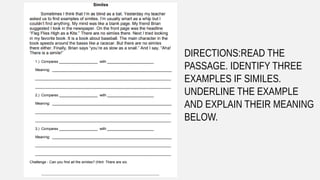
DIRECTIONS:READ THE
PASSAGE. IDENTIFY THREE
EXAMPLES IF SIMILES.
UNDERLINE THE EXAMPLE
AND EXPLAIN THEIR MEANING
BELOW.

Quarter 1, Creative Writing, Module 1, Week 1.pptx

  • 1.
    JAMES PATRICK T .CABALLERO Subject Teacher CREATIVE WRITING
  • 2.
    WHAT ISTHE DIFFERENCE BETWEENCREATIVE AND TECHNICAL WRITING?
  • 3.
    Technical writing focuseson factual and straight forward content. Vs. Creative writing focuses on imaginative and symbolic content.
  • 4.
    WHAT DO WEMEAN IF YOU SAY IMAGINATIVE AND FACTUAL?
  • 5.
    I M AG I N A T I V E • To be imaginative is to be inventive and original. If you enjoy coming up with stories, writing songs, or just thinking about things in new ways, you're an imaginative person. • relating to, or characterized by imagination
  • 6.
    FA C TU A L • relating to, or characterized by facts • of the nature of fact • real • actual • containing facts.
  • 7.
    D E SC R I B I N G S E N S O RY E X P E R I E N C E ( I M A G E R Y )
  • 11.
    USE YOUR SCENSEAND DESCRIBE THE SCENES WHICH AS MUCH AS DETAILS AS POSSIBLE
  • 18.
    • refers tolanguage and word choice of the writer. It shows the level of formality of a text which helps in shaping the perception and view of the readers. There are three levels of diction: formal, informal, and colloquial. USING APPROPRIATE DICTION
  • 20.
    1.The tree barkis rough against her skin 2.The siren turned into a whisper as it ended 3.Glittering white, the blanket of snow covered everything in sight 4.The country air tasted sweet and familiar 5.She walked into the abandoned house and caught the scent of mothballs
  • 21.
    • A figureof speech is a phrase that has an implied meaning and should not be taken at face value. This means that the real meaning of such a phrase differs from its literal meaning. F I G U R E S S P E E C H / F I G U R A T IV E L A N G U A G E
  • 22.
    U S IN G F I G U R A T I V E L A N G U A G E • Writers use figures of speech and figurative language in order to create more impact on the readers’ interpretation and comprehension of a text. They create figurative images which makes reading more pleasurable and more engaging. Figures of speech are particular techniques while figurative language refers to the language that contains the technique. In illustration: if figurative language is a dance routine, figures of speech are the various moves that make up the routine.
  • 23.
    • (figurative languagethat compares two unlike objects by using the words “like,” “than,” or “as”). Authors use similes to compare two things in an interesting way that puts a clearer image in the reader’s head. S I M I L E
  • 24.
    E X AM P L E S O F S I M I L E S • The snow is like a blanket. • The bread is as hard as nails.” • The river is as dry as a bone.” • The bread was as thin as paper. • She was as pretty as a picture. • She was as blind as a bat. • He was as white as a ghost. • He was as big as a wale
  • 25.
    1. Linda atea mountain of ice cream. 2. Bobbie made 100 spitballs and had to throw them all in the trashcan. 3. The headlights were as blinding as the sun. 4. Ginger worked a million hours in her room on Saturday morning. 5. The hanging beach towel flapped in the wind like waves on the ocean. 6. Brent’s neck was as long as a giraffe’s. 7. Sarah’s silky skirt swayed in the breeze. 8. Hank’s hands were rough like sandpaper. 9. Martha sewed miles of fabric to make the dress. 10.John’s hands were like a giant trap waiting for the ball. IDENTIFY THE S I M I L E
  • 26.
    T H ES U R P R I S E P A R T Y My cousin Grace has a mouth as big as a bus. She can never keep a secret. One day I told Grace about a surprise birthday party my mom was throwing for her mom. Grace’s mom (my aunt) is as nutty as a fruit cake but sweeter than apple pie. My mom decided to throw her a party at the local zoo. Grace’s mom loves animals. The animals are like her friends. Of course Grace told her mom about the party. Her mom was pleased as punch, but my mom was mad as a hornet.
  • 27.
    HOW DID IIDENTIFY A SIMILE IN THE STORY AND HOW DID I KNOW THE REAL MEANING?
  • 28.
    DIRECTIONS:READ THE PASSAGE. IDENTIFYTHREE EXAMPLES IF SIMILES. UNDERLINE THE EXAMPLE AND EXPLAIN THEIR MEANING BELOW.