




Submitted by-
Shabir Ahmed
BBA (V sem)
Financial statement Ratio Analysis
of
Reliance Infrastructure Limited
Contents
 Introduction
 RATIO ANALYSIS
 STEPS IN RATIO ANALYSIS
 NATURE OF RATIO ANALYSIS
 FUNCTIONAL CLASSIFICATION
 DATA ANALYSIS
CURRENT RATIO
QUICK RATIO
PROPRIETOR RATIO
Debt Equity Ratio
Gross Profit Ratio
Net Profit Ratio
Return On Net Worth
Return On Investment
Interest Coverage Ratio
 Finding and conclusion
Introduction
 Reliance Infrastructure Limited (formerly Reliance Energy
Limited) is a part of the Reliance Anil Dhirubhai Ambani Group,
India’s second largest business house.
 Reliance Infrastructure companies distribute more than 25
billion units of electricity to over 25 million consumers across an
area that spans over 1,24,300 sq kms and includes India’s two
premier cities, Mumbai and Delhi. The Company generates over
940 MW of electricity through its power stations located in
Maharashtra, Andhra Pradesh, Kerala, Karnataka and Goa.
RATIO ANALYSIS
 FINANCIAL ANALYSIS
Financial analysis is the process of identifying the
financial strengths and weaknesses of the firm and
establishing relationship between the items of the balance
sheet and profit & loss account. Financial ratio analysis is
the calculation and comparison of ratios, which are derived
from the information in a company’s financial statements.
RATIO ANALYSIS
The term “Ratio” refers to the numerical and
quantitative relationship between two items or
variables. This relationship can be exposed as
 Percentages
 Fractions
 Proportion of numbers
STEPS IN RATIO ANALYSIS
 The first task of the financial analysis is to select the information
relevant to the decision under consideration from the statements and
calculates appropriate ratios.
 To compare the calculated ratios with the ratios of the same firm
relating to the pas6t or with the industry ratios. It facilitates in
assessing success or failure of the firm.
 Third step is to interpretation, drawing of inferences and report writing
conclusions are drawn after comparison in the shape of report or
recommended courses of action.
NATURE OF RATIO ANALYSIS
 Ratio analysis is a technique of analysis and interpretation
of financial statements. It is the process of establishing and
interpreting various ratios for helping in making certain
decisions. It is only a means of understanding of financial
strengths and weaknesses of a firm.
IN THE VIEW OF FUNCTIONAL CLASSIFICATION THE
RATIOS ARE
 Liquidity ratio
 Leverage ratio
 Activity ratio
 Profitability ratio
DATA ANALYSIS
CURRENT RATIO:
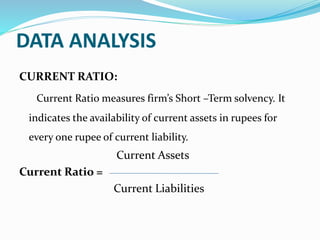
Current Ratio measures firm’s Short –Term solvency. It
indicates the availability of current assets in rupees for
every one rupee of current liability.
Current Assets
Current Ratio =
Current Liabilities
Current ratio
Year Current Assets Current Liabilities Ratio
2012-13
12967.91 3130.66 4.14
2013-14
9021.46 3377.81 2.67
2014-15
8803.63 5421.75 1.62
Continue…….
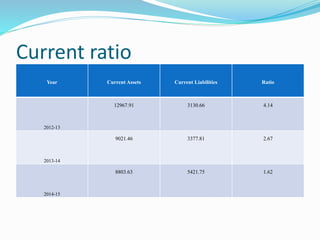
ANALYSIS AND INTERPRETATION:
 From the above table, it shows the decline trend during F.Y. 2012 to F.Y.2014.
 It was high in F.Y.2012 at 4.14 times which further reduced to 1.62 times in F.Y.
2014 which is lower than standard i.e. 2:1.
 In F.Y. 2012 the ratio was high due to the high Cash & Bank balance
which further reduced to 2.67 times in F.Y. 2013. In F.Y.2014 the ratio was very
low because of increase in Current Liability.
 The continuous decrease in Current Ratio is not good for company’s
financial health. So company has to take necessary action to improve current
ratio.
QUICK RATIO:
 Quick ratio is a test of liquidity than the current ratio.
The term liquidity refers to the ability of a firm to pay
its short-term obligations as & when they become due.
Quick Assets
Quick Ratio=
Quick Liabilities
Continue…..
Year Quick Asset Current Liabilities Ratio
2012
12675.22 3130.66 4.05
2013
8721.17 3377.81 2.59
2014
8362.95 5421.75 1.54
Continue…..
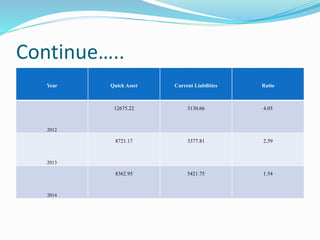
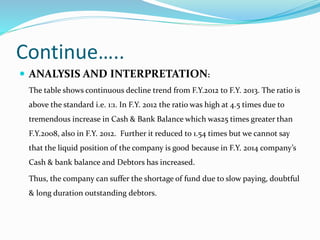
 ANALYSIS AND INTERPRETATION:
The table shows continuous decline trend from F.Y.2012 to F.Y. 2013. The ratio is
above the standard i.e. 1:1. In F.Y. 2012 the ratio was high at 4.5 times due to
tremendous increase in Cash & Bank Balance which was25 times greater than
F.Y.2008, also in F.Y. 2012. Further it reduced to 1.54 times but we cannot say
that the liquid position of the company is good because in F.Y. 2014 company’s
Cash & bank balance and Debtors has increased.
Thus, the company can suffer the shortage of fund due to slow paying, doubtful
& long duration outstanding debtors.
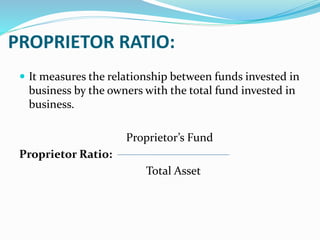
PROPRIETOR RATIO:
 It measures the relationship between funds invested in
business by the owners with the total fund invested in
business.
Proprietor’s Fund
Proprietor Ratio:
Total Asset
Continue…….
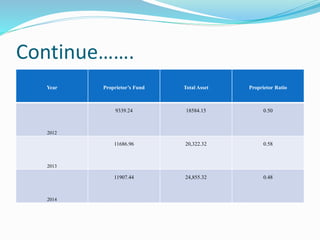
Year Proprietor’s Fund Total Asset Proprietor Ratio
2012
9339.24 18584.15 0.50
2013
11686.96 20,322.32 0.58
2014
11907.44 24,855.32 0.48
Continue…….
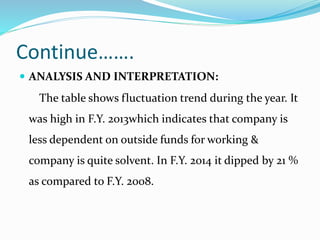
 ANALYSIS AND INTERPRETATION:
The table shows fluctuation trend during the year. It
was high in F.Y. 2013which indicates that company is
less dependent on outside funds for working &
company is quite solvent. In F.Y. 2014 it dipped by 21 %
as compared to F.Y. 2008.
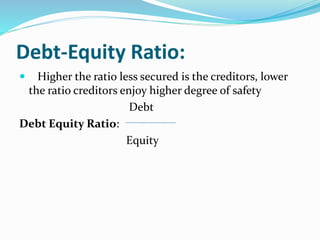
Debt-Equity Ratio:
 Higher the ratio less secured is the creditors, lower
the ratio creditors enjoy higher degree of safety
Debt
Debt Equity Ratio:
Equity
Continue……
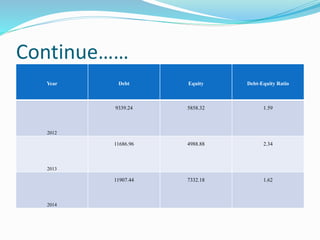
Year Debt Equity Debt-Equity Ratio
2012
9339.24 5858.32 1.59
2013
11686.96 4988.88 2.34
2014
11907.44 7332.18 1.62
continue
ANALYSIS AND INTERPRETATION:
 At early stage i.e. in F.Y. 2012 it was low at 1.59 times which further
increased to 2.34 times in F.Y. 2013 and later on it further decreased
to 1.62 times.
 The low ratio indicates that lenders contribution is lower
than owner’s contribution. But in FY 2013 the lenders contribution
is higher than owner’s contribution which indicates that Creditors
are less secured than shareholders of the company.
Gross Profit Ratio
It shows the operating efficiency of the business. It measures
the efficiency of production as well as pricing.
Gross Profit
 Gross Profit Ratio = X100
Sales
Continue……
Year G/P Net Sales
Gross Profit Ratio
%
2012
872.37 3610.95 24.16
2013
1151.70 4419.87 26.06
2014
1193.43 7183.10 16.61
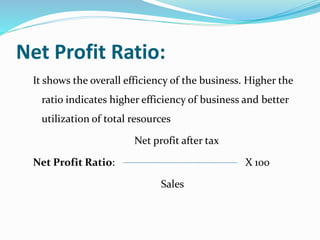
Net Profit Ratio:
It shows the overall efficiency of the business. Higher the
ratio indicates higher efficiency of business and better
utilization of total resources
Net profit after tax
Net Profit Ratio: X 100
Sales
Continue………
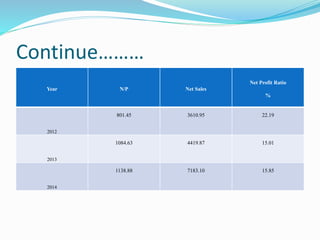
Year N/P Net Sales
Net Profit Ratio
%
2012
801.45 3610.95 22.19
2013
1084.63 4419.87 15.01
2014
1138.88 7183.10 15.85
Continue……
Continue……..
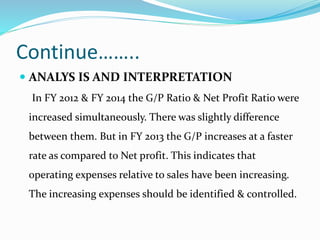
 ANALYS IS AND INTERPRETATION
In FY 2012 & FY 2014 the G/P Ratio & Net Profit Ratio were
increased simultaneously. There was slightly difference
between them. But in FY 2013 the G/P increases at a faster
rate as compared to Net profit. This indicates that
operating expenses relative to sales have been increasing.
The increasing expenses should be identified & controlled.
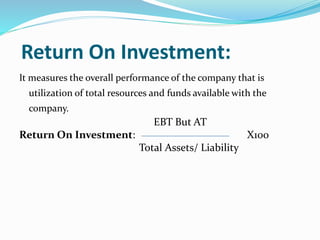
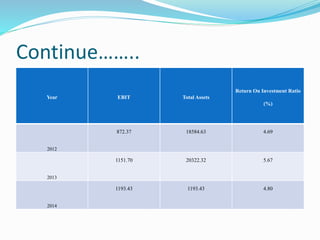
Return On Investment:
It measures the overall performance of the company that is
utilization of total resources and funds available with the
company.
EBT But AT
Return On Investment: X100
Total Assets/ Liability
Continue……..
Year EBIT Total Assets
Return On Investment Ratio
(%)
2012
872.37 18584.63 4.69
2013
1151.70 20322.32 5.67
2014
1193.43 1193.43 4.80
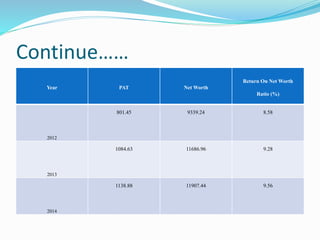
Return On Net Worth
It measures the productivity of shareholders funds.
Higher the ratio indicates better utilization of
shareholders funds or higher productivity of owner’s
funds
Net Profit After Tax
Return On Net Worth: X100
Equity Shareholder Fund
Continue……
Year PAT Net Worth
Return On Net Worth
Ratio (%)
2012
801.45 9339.24 8.58
2013
1084.63 11686.96 9.28
2014
1138.88 11907.44 9.56
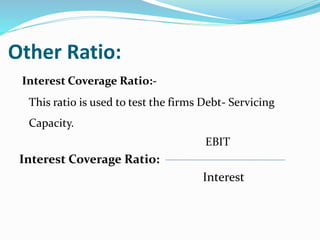
Other Ratio:
Interest Coverage Ratio:-
This ratio is used to test the firms Debt- Servicing
Capacity.
EBIT
Interest Coverage Ratio:
Interest
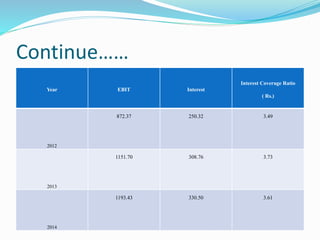
Continue……
Year EBIT Interest
Interest Coverage Ratio
( Rs.)
2012
872.37 250.32 3.49
2013
1151.70 308.76 3.73
2014
1193.43 330.50 3.61
Continue…….
ANALYSIS AND INTERPRETATION:
The Interest Coverage Ratio shows the number of times the interest charges
are covered by funds that are ordinary available for their payment.
The above chart shows relative constant fluctuation because it was Rs.3.49 in
FY 2012 which further increased to Rs.3.73 in FY 2013 & 3.61 in FY 2014.
Too high ratio indicates the firm is very conservative in using debt & that is
not using credit to best advantage of shareholder. In R-INFRA the ratio is high
in FY 2013 i.e. Rs. 3.73 crores.
FINDINGS
 There is continuous decrease in Current Ratio. Thus, it is
necessary to take corrective actions.
 The company can suffer the shortage of fund due to slow
paying, doubtful & long duration outstanding debtors.
 The lenders contribution is higher than owner’s
contribution which indicates that Creditors are less
secured than shareholders of the company.
 The operating expenses relative to sales have been
increasing.
Continue………
 Proprietary ratio of the company fluctuates during the
period of study. It shows the change in the value of
reserves and surplus in the form of shareholders’ fund.
 R-INRA is far better in covering its fixed cost with the
interest coverage ratio.
 The overall financial condition of R-INFRA is good.
CONCLUSION
The R-INFRA’s overall position is at a good position. Particularly the
current year’s position is well due to raise in the profit level from the
last year position. It is better for the organization to diversify the funds
to different sectors in the present market scenario.
Thank you

financial ststement ratio analysis

  • 1.
  • 2.
    Financial statement RatioAnalysis of Reliance Infrastructure Limited
  • 3.
    Contents  Introduction  RATIOANALYSIS  STEPS IN RATIO ANALYSIS  NATURE OF RATIO ANALYSIS  FUNCTIONAL CLASSIFICATION  DATA ANALYSIS CURRENT RATIO QUICK RATIO PROPRIETOR RATIO Debt Equity Ratio Gross Profit Ratio Net Profit Ratio Return On Net Worth Return On Investment Interest Coverage Ratio  Finding and conclusion
  • 4.
    Introduction  Reliance InfrastructureLimited (formerly Reliance Energy Limited) is a part of the Reliance Anil Dhirubhai Ambani Group, India’s second largest business house.  Reliance Infrastructure companies distribute more than 25 billion units of electricity to over 25 million consumers across an area that spans over 1,24,300 sq kms and includes India’s two premier cities, Mumbai and Delhi. The Company generates over 940 MW of electricity through its power stations located in Maharashtra, Andhra Pradesh, Kerala, Karnataka and Goa.
  • 5.
    RATIO ANALYSIS  FINANCIALANALYSIS Financial analysis is the process of identifying the financial strengths and weaknesses of the firm and establishing relationship between the items of the balance sheet and profit & loss account. Financial ratio analysis is the calculation and comparison of ratios, which are derived from the information in a company’s financial statements.
  • 6.
    RATIO ANALYSIS The term“Ratio” refers to the numerical and quantitative relationship between two items or variables. This relationship can be exposed as  Percentages  Fractions  Proportion of numbers
  • 7.
    STEPS IN RATIOANALYSIS  The first task of the financial analysis is to select the information relevant to the decision under consideration from the statements and calculates appropriate ratios.  To compare the calculated ratios with the ratios of the same firm relating to the pas6t or with the industry ratios. It facilitates in assessing success or failure of the firm.  Third step is to interpretation, drawing of inferences and report writing conclusions are drawn after comparison in the shape of report or recommended courses of action.
  • 8.
    NATURE OF RATIOANALYSIS  Ratio analysis is a technique of analysis and interpretation of financial statements. It is the process of establishing and interpreting various ratios for helping in making certain decisions. It is only a means of understanding of financial strengths and weaknesses of a firm.
  • 9.
    IN THE VIEWOF FUNCTIONAL CLASSIFICATION THE RATIOS ARE  Liquidity ratio  Leverage ratio  Activity ratio  Profitability ratio
  • 10.
    DATA ANALYSIS CURRENT RATIO: CurrentRatio measures firm’s Short –Term solvency. It indicates the availability of current assets in rupees for every one rupee of current liability. Current Assets Current Ratio = Current Liabilities
  • 11.
    Current ratio Year CurrentAssets Current Liabilities Ratio 2012-13 12967.91 3130.66 4.14 2013-14 9021.46 3377.81 2.67 2014-15 8803.63 5421.75 1.62
  • 12.
    Continue……. ANALYSIS AND INTERPRETATION: From the above table, it shows the decline trend during F.Y. 2012 to F.Y.2014.  It was high in F.Y.2012 at 4.14 times which further reduced to 1.62 times in F.Y. 2014 which is lower than standard i.e. 2:1.  In F.Y. 2012 the ratio was high due to the high Cash & Bank balance which further reduced to 2.67 times in F.Y. 2013. In F.Y.2014 the ratio was very low because of increase in Current Liability.  The continuous decrease in Current Ratio is not good for company’s financial health. So company has to take necessary action to improve current ratio.
  • 13.
    QUICK RATIO:  Quickratio is a test of liquidity than the current ratio. The term liquidity refers to the ability of a firm to pay its short-term obligations as & when they become due. Quick Assets Quick Ratio= Quick Liabilities
  • 14.
    Continue….. Year Quick AssetCurrent Liabilities Ratio 2012 12675.22 3130.66 4.05 2013 8721.17 3377.81 2.59 2014 8362.95 5421.75 1.54
  • 15.
    Continue…..  ANALYSIS ANDINTERPRETATION: The table shows continuous decline trend from F.Y.2012 to F.Y. 2013. The ratio is above the standard i.e. 1:1. In F.Y. 2012 the ratio was high at 4.5 times due to tremendous increase in Cash & Bank Balance which was25 times greater than F.Y.2008, also in F.Y. 2012. Further it reduced to 1.54 times but we cannot say that the liquid position of the company is good because in F.Y. 2014 company’s Cash & bank balance and Debtors has increased. Thus, the company can suffer the shortage of fund due to slow paying, doubtful & long duration outstanding debtors.
  • 16.
    PROPRIETOR RATIO:  Itmeasures the relationship between funds invested in business by the owners with the total fund invested in business. Proprietor’s Fund Proprietor Ratio: Total Asset
  • 17.
    Continue……. Year Proprietor’s FundTotal Asset Proprietor Ratio 2012 9339.24 18584.15 0.50 2013 11686.96 20,322.32 0.58 2014 11907.44 24,855.32 0.48
  • 18.
    Continue…….  ANALYSIS ANDINTERPRETATION: The table shows fluctuation trend during the year. It was high in F.Y. 2013which indicates that company is less dependent on outside funds for working & company is quite solvent. In F.Y. 2014 it dipped by 21 % as compared to F.Y. 2008.
  • 19.
    Debt-Equity Ratio:  Higherthe ratio less secured is the creditors, lower the ratio creditors enjoy higher degree of safety Debt Debt Equity Ratio: Equity
  • 20.
    Continue…… Year Debt EquityDebt-Equity Ratio 2012 9339.24 5858.32 1.59 2013 11686.96 4988.88 2.34 2014 11907.44 7332.18 1.62
  • 21.
    continue ANALYSIS AND INTERPRETATION: At early stage i.e. in F.Y. 2012 it was low at 1.59 times which further increased to 2.34 times in F.Y. 2013 and later on it further decreased to 1.62 times.  The low ratio indicates that lenders contribution is lower than owner’s contribution. But in FY 2013 the lenders contribution is higher than owner’s contribution which indicates that Creditors are less secured than shareholders of the company.
  • 22.
    Gross Profit Ratio Itshows the operating efficiency of the business. It measures the efficiency of production as well as pricing. Gross Profit  Gross Profit Ratio = X100 Sales
  • 23.
    Continue…… Year G/P NetSales Gross Profit Ratio % 2012 872.37 3610.95 24.16 2013 1151.70 4419.87 26.06 2014 1193.43 7183.10 16.61
  • 24.
    Net Profit Ratio: Itshows the overall efficiency of the business. Higher the ratio indicates higher efficiency of business and better utilization of total resources Net profit after tax Net Profit Ratio: X 100 Sales
  • 25.
    Continue……… Year N/P NetSales Net Profit Ratio % 2012 801.45 3610.95 22.19 2013 1084.63 4419.87 15.01 2014 1138.88 7183.10 15.85
  • 26.
  • 27.
    Continue……..  ANALYS ISAND INTERPRETATION In FY 2012 & FY 2014 the G/P Ratio & Net Profit Ratio were increased simultaneously. There was slightly difference between them. But in FY 2013 the G/P increases at a faster rate as compared to Net profit. This indicates that operating expenses relative to sales have been increasing. The increasing expenses should be identified & controlled.
  • 28.
    Return On Investment: Itmeasures the overall performance of the company that is utilization of total resources and funds available with the company. EBT But AT Return On Investment: X100 Total Assets/ Liability
  • 29.
    Continue…….. Year EBIT TotalAssets Return On Investment Ratio (%) 2012 872.37 18584.63 4.69 2013 1151.70 20322.32 5.67 2014 1193.43 1193.43 4.80
  • 30.
    Return On NetWorth It measures the productivity of shareholders funds. Higher the ratio indicates better utilization of shareholders funds or higher productivity of owner’s funds Net Profit After Tax Return On Net Worth: X100 Equity Shareholder Fund
  • 31.
    Continue…… Year PAT NetWorth Return On Net Worth Ratio (%) 2012 801.45 9339.24 8.58 2013 1084.63 11686.96 9.28 2014 1138.88 11907.44 9.56
  • 32.
    Other Ratio: Interest CoverageRatio:- This ratio is used to test the firms Debt- Servicing Capacity. EBIT Interest Coverage Ratio: Interest
  • 33.
    Continue…… Year EBIT Interest InterestCoverage Ratio ( Rs.) 2012 872.37 250.32 3.49 2013 1151.70 308.76 3.73 2014 1193.43 330.50 3.61
  • 34.
    Continue……. ANALYSIS AND INTERPRETATION: TheInterest Coverage Ratio shows the number of times the interest charges are covered by funds that are ordinary available for their payment. The above chart shows relative constant fluctuation because it was Rs.3.49 in FY 2012 which further increased to Rs.3.73 in FY 2013 & 3.61 in FY 2014. Too high ratio indicates the firm is very conservative in using debt & that is not using credit to best advantage of shareholder. In R-INFRA the ratio is high in FY 2013 i.e. Rs. 3.73 crores.
  • 35.
    FINDINGS  There iscontinuous decrease in Current Ratio. Thus, it is necessary to take corrective actions.  The company can suffer the shortage of fund due to slow paying, doubtful & long duration outstanding debtors.  The lenders contribution is higher than owner’s contribution which indicates that Creditors are less secured than shareholders of the company.  The operating expenses relative to sales have been increasing.
  • 36.
    Continue………  Proprietary ratioof the company fluctuates during the period of study. It shows the change in the value of reserves and surplus in the form of shareholders’ fund.  R-INRA is far better in covering its fixed cost with the interest coverage ratio.  The overall financial condition of R-INFRA is good.
  • 37.
    CONCLUSION The R-INFRA’s overallposition is at a good position. Particularly the current year’s position is well due to raise in the profit level from the last year position. It is better for the organization to diversify the funds to different sectors in the present market scenario.
  • 38.