RATIO ANALYSIS
GROUP 5
MEANING
 Mathematical relationship between two items
 Expressed in quantitative form
 Defined as:
“relationships expressed in quantitative terms,
between figures which have cause and effect
relationships or which are connected with each
other in some manner or the other”
STEPS
 Selection of relevant information
 Comparison of calculated ratio
 interpretation and reporting
ADVANTAGES
1. Forecasting
2. Managerial control
3. Facilitates communication
4. Measuring efficiency
5. Inter firm comparisons
LIMITATIONS
1. Practical knowledge
2. Inter-relationships
3. Accuracy of financial information
4. Consistency of preparation of financial
statements
5. Time log
CLASSIFICATION
 Classification of ratios by statements
 Classification by users
 Classification based on relative importance.
 Classification of ratios by purpose/function.
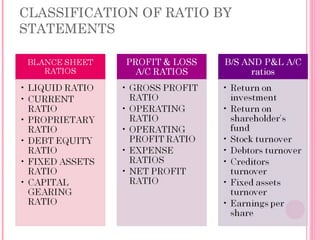
CLASSIFICATION OF RATIO BY
STATEMENTS
CLASSIFICATION BY USERS
CLASSIFICATION BY RELATIVE
IMPORTANCE
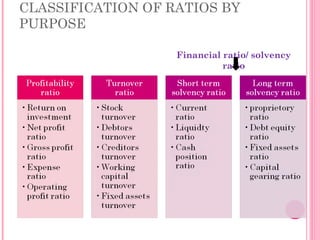
CLASSIFICATION OF RATIOS BY
PURPOSE
Financial ratio/ solvency
ratio
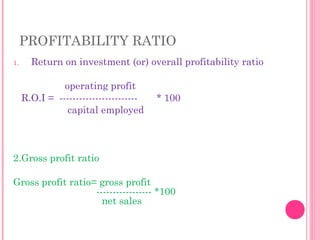
PROFITABILITY RATIO
1. Return on investment (or) overall profitability ratio
operating profit
R.O.I = ------------------------ * 100
capital employed
2.Gross profit ratio
Gross profit ratio= gross profit
----------------- *100
net sales
3. operating ratio
=cost of sales + operating expenses
---------------------------------------------*100
net sales
4.Operating profit ratio
Operating profit ratio= operating profit
----------------------- * 100
sales
5. Expenses ratio
1.Administrative expenses ratio:
Admistrative expenses
------------------------------ *100
net sales
2.Selling and distribution expenses ratio:
selling and distribution expenses
-------------------------------------------- * 100
net sales
3.Financial expenses ratio:
financial expenses
---------------------------------- * 100
net sales
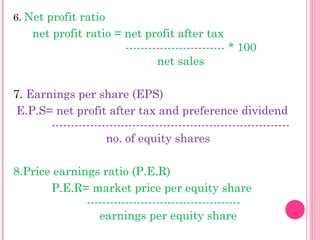
6. Net profit ratio
net profit ratio = net profit after tax
-------------------------- * 100
net sales
7. Earnings per share (EPS)
E.P.S= net profit after tax and preference dividend
--------------------------------------------------------------
no. of equity shares
8.Price earnings ratio (P.E.R)
P.E.R= market price per equity share
----------------------------------------
earnings per equity share
9.
Pay out ratio = dividend per equity share
----------------------------------- * 100
earnings per equity share
Retained earning ratio=
retained earning per equity share
-------------------------------------------- * 100
earning per equity share
10. Interest cover or fixed charges over
Interest or fixed charges cover
= profit before interest and tax
---------------------------------------
fixed interest charges
11. Dividend yield ratio
Dividend yield= dividend per share
--------------------------------- * 100
market price per share
TURNOVER RATIOS OR ACTIVITY
RATIOS
1.Inventory turnover ratio:
stock turnover ratio= cost of goods sold
------------------------
average inventory
2.Inventory turnover period:
stock turnover period= days/months in a year
------------------------------
inventory turnover ratio
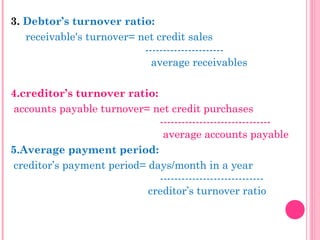
3. Debtor’s turnover ratio:
receivable's turnover= net credit sales
----------------------
average receivables
4.creditor’s turnover ratio:
accounts payable turnover= net credit purchases
-------------------------------
average accounts payable
5.Average payment period:
creditor’s payment period= days/month in a year
-----------------------------
creditor’s turnover ratio
6. Working capital turnover ratio
= cost of sales/sale
-------------------------
net working capital
7.Fixed turnover ratio
= cost of goods sold (or) sales
-------------------------------------
net fixed assets
9. Capital turnover ratio:
capital turnover ratio= sales (or) cost of sales
-----------------------------
capital employed
SOLVENCY OR FINANCIAL RATIOS
Short term solvency ratios
1.Current ratio= current assets
-----------------------------
current liabilities
2. Liquid ratio= liquid or quick assets
-----------------------------
current liabilities
3.Cash position ratio
=cash & bank balance + marketable security
----------------------------------------------------------
current liabilities
Long term solvency ratio
1. Fixed assets ratio= fixed assets
----------------
long term funds
2. Debt equity ratio= total long term debt
--------------------------- (or)
shareholder’s fund
= external equities
-----------------------
internal equities
3 Proprietary ratio. = shareholder’s fund
----------------------------
total tangible assets
4. Capital gearing ratio:
= long term loss + debentured + pref. capital
---------------------------------------------------------
equity shareholder’s fund
Overall solvency ratio
Solvency ratio= total debt
----------------
total tangible assets
THANK YOU

Ratio analysis

  • 1.
  • 2.
    MEANING  Mathematical relationshipbetween two items  Expressed in quantitative form  Defined as: “relationships expressed in quantitative terms, between figures which have cause and effect relationships or which are connected with each other in some manner or the other”
  • 3.
    STEPS  Selection ofrelevant information  Comparison of calculated ratio  interpretation and reporting
  • 4.
    ADVANTAGES 1. Forecasting 2. Managerialcontrol 3. Facilitates communication 4. Measuring efficiency 5. Inter firm comparisons
  • 5.
    LIMITATIONS 1. Practical knowledge 2.Inter-relationships 3. Accuracy of financial information 4. Consistency of preparation of financial statements 5. Time log
  • 6.
    CLASSIFICATION  Classification ofratios by statements  Classification by users  Classification based on relative importance.  Classification of ratios by purpose/function.
  • 7.
  • 8.
  • 9.
  • 10.
    CLASSIFICATION OF RATIOSBY PURPOSE Financial ratio/ solvency ratio
  • 11.
    PROFITABILITY RATIO 1. Returnon investment (or) overall profitability ratio operating profit R.O.I = ------------------------ * 100 capital employed 2.Gross profit ratio Gross profit ratio= gross profit ----------------- *100 net sales
  • 12.
    3. operating ratio =costof sales + operating expenses ---------------------------------------------*100 net sales 4.Operating profit ratio Operating profit ratio= operating profit ----------------------- * 100 sales
  • 13.
    5. Expenses ratio 1.Administrativeexpenses ratio: Admistrative expenses ------------------------------ *100 net sales 2.Selling and distribution expenses ratio: selling and distribution expenses -------------------------------------------- * 100 net sales 3.Financial expenses ratio: financial expenses ---------------------------------- * 100 net sales
  • 14.
    6. Net profitratio net profit ratio = net profit after tax -------------------------- * 100 net sales 7. Earnings per share (EPS) E.P.S= net profit after tax and preference dividend -------------------------------------------------------------- no. of equity shares 8.Price earnings ratio (P.E.R) P.E.R= market price per equity share ---------------------------------------- earnings per equity share
  • 15.
    9. Pay out ratio= dividend per equity share ----------------------------------- * 100 earnings per equity share Retained earning ratio= retained earning per equity share -------------------------------------------- * 100 earning per equity share
  • 16.
    10. Interest coveror fixed charges over Interest or fixed charges cover = profit before interest and tax --------------------------------------- fixed interest charges 11. Dividend yield ratio Dividend yield= dividend per share --------------------------------- * 100 market price per share
  • 17.
    TURNOVER RATIOS ORACTIVITY RATIOS 1.Inventory turnover ratio: stock turnover ratio= cost of goods sold ------------------------ average inventory 2.Inventory turnover period: stock turnover period= days/months in a year ------------------------------ inventory turnover ratio
  • 18.
    3. Debtor’s turnoverratio: receivable's turnover= net credit sales ---------------------- average receivables 4.creditor’s turnover ratio: accounts payable turnover= net credit purchases ------------------------------- average accounts payable 5.Average payment period: creditor’s payment period= days/month in a year ----------------------------- creditor’s turnover ratio
  • 19.
    6. Working capitalturnover ratio = cost of sales/sale ------------------------- net working capital 7.Fixed turnover ratio = cost of goods sold (or) sales ------------------------------------- net fixed assets 9. Capital turnover ratio: capital turnover ratio= sales (or) cost of sales ----------------------------- capital employed
  • 20.
    SOLVENCY OR FINANCIALRATIOS Short term solvency ratios 1.Current ratio= current assets ----------------------------- current liabilities 2. Liquid ratio= liquid or quick assets ----------------------------- current liabilities 3.Cash position ratio =cash & bank balance + marketable security ---------------------------------------------------------- current liabilities
  • 21.
    Long term solvencyratio 1. Fixed assets ratio= fixed assets ---------------- long term funds 2. Debt equity ratio= total long term debt --------------------------- (or) shareholder’s fund = external equities ----------------------- internal equities 3 Proprietary ratio. = shareholder’s fund ---------------------------- total tangible assets
  • 22.
    4. Capital gearingratio: = long term loss + debentured + pref. capital --------------------------------------------------------- equity shareholder’s fund Overall solvency ratio Solvency ratio= total debt ---------------- total tangible assets
  • 23.