Direct marketing and direct selling
By:
Shwetanshu Gupta
MBA-49-2013
Direct marketing:
▪ Direct marketing is the use of consumer direct channels to reach and deliver
goods and services to consumers without using marketing middlemen.
▪ It helps the companies to opening dialogue directly between themselves & the end
consumers of their products.
▪ It is targeted at individual users rather than through intermediaries.
▪ Company markets through various advertising media that interact directly with
consumers, generally encouraging the consumer to make a direct response.
Cont’d
▪ In other words, direct marketing consists of direct communications with carefully
targeted consumers to obtain an immediate response.
▪ However, the ultimate purpose of direct marketing is to establish and manage
direct long term relationships with customers by capturing personal information
in a database.
▪ Marketer send birthday cards, information materials and small premiums to
certain customers.
Advantages
To Businesses:
▪ Direct marketing can help sales to grow when used along with sales promotions
and advertising campaigns.
▪ It is also useful for small businesses through guest books, visitors lists, and lists of
enquiries. These operations rely on repeat business.
▪ Direct marketing builds relationships; it is an important tool in customer
relationship management (CRM).
▪ It helps to measure response to campaigns to decide which media is most
profitable.
▪ It helps to find cost effective approach of media.
To consumers:
▪ Home shopping can be fun, convenient & hassle free.
▪ Buyers get good services from the company like toll free numbers for purchasing
or ordering goods.
▪ It provides quick delivery of goods to the consumers.
▪ It saves time and introduces consumer to a larger selection of merchandise.
▪ Consumer can do comparative shopping by browsing through mail catalogs and
online shopping services.
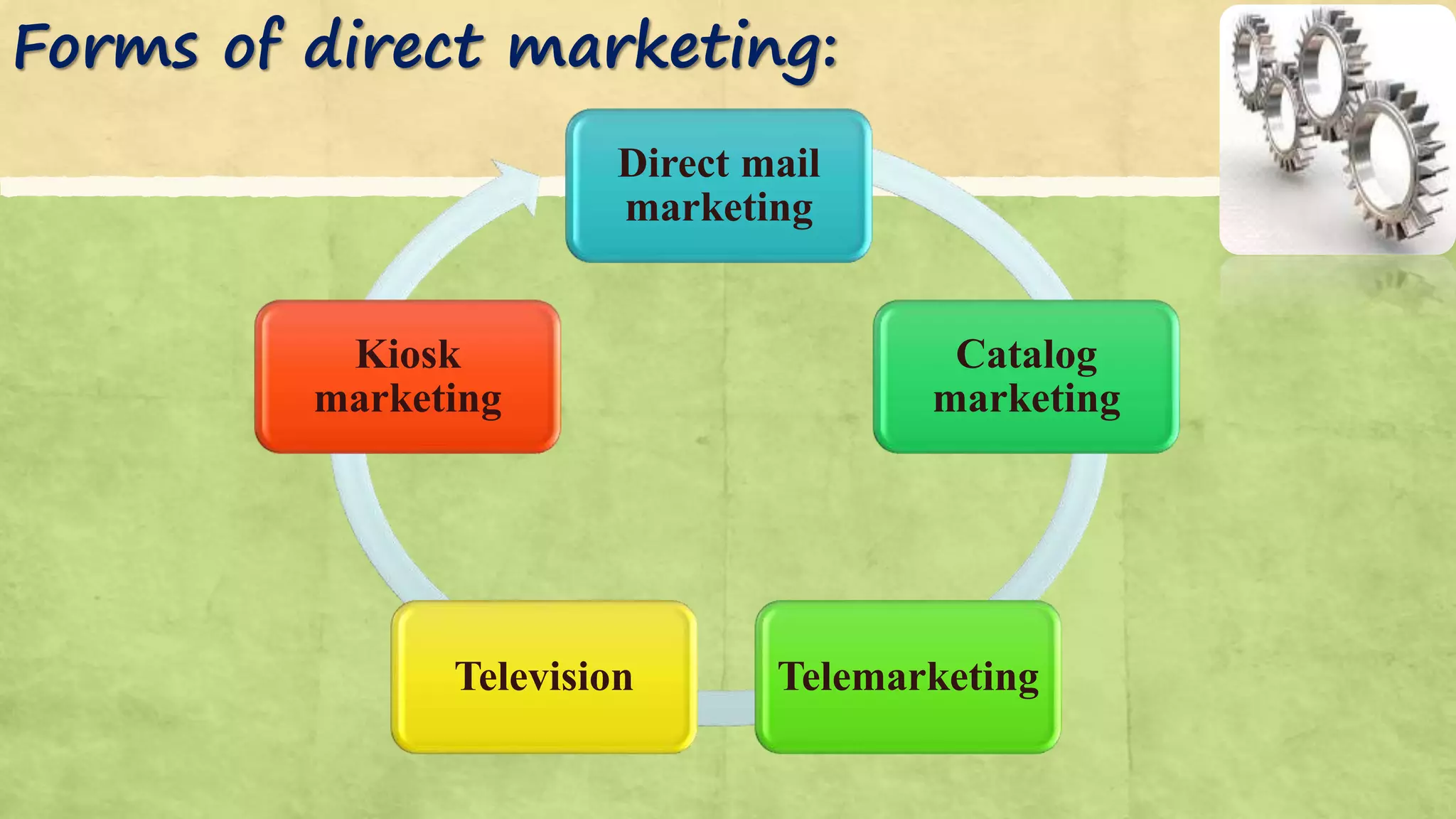
Forms of direct marketing:
Direct mail
marketing
Catalog
marketing
TelemarketingTelevision
Kiosk
marketing
Direct mail marketing:
▪ It involves sending an offer, announcement , reminder or other item to a person
through mail
▪ Marketers send out millions of mail pieces each year, using highly selective
mailing lists.
▪ It is a popular medium as it permits target market selectivity, can be personalized,
is flexible.
▪ Cost involved is very high than the mass media but the people reached are better
prospects.
Catalog marketing:
In this type of marketing seller prepares catalogues of merchandise or products and sells
directly to customers.
Catalogues are generally in printed form but can also be distributed in the form of CDs .
To reduce printing and distribution costs catalogues are being increasingly made online.
Products from various companies or vendors may be combined into a single catalogue to
provide a one point shop for customer looking out for a particular type of product
Telemarketing:
▪ Telemarketing is the use of telephone and call centers to attract prospects , sell to existing
customers and provide service by taking orders and answering questions.
▪ Companies use call centers for inbound telemarketing- receiving calls from customers and
outbound marketing- initiating calls to prospects and customers.
▪ Effective telemarketing depends on choosing the right telemarketer , training them well &
providing performance incentives.
▪ Advantages: Likely to replace more expensive field-sales call.
▪ Reduces amount of personal selling effort.
▪ Reduce field-force travelling calls.
▪ Telemarketing pioneer.
▪ It offers more than a thousand products backed by a 24*7 call
center.
▪ Diversified its operations by opening an online store.
 Cosmetic company L’Oreal India has a toll free number on
which it offers expert advice about looking good.
Direct response marketing
Television:
▪ Direct marketing via television (commonly referred to as DRTV) has two basic
forms:
long form (usually half-hour or hour-long segments that explain a product in
detail and are commonly referred to as infomercials) & short form, which refers to
typical 30-second or 60-second commercials that ask viewers for an immediate
response (typically to call a phone number on screen or go to a website).
▪ Infomercials promote products that are complicated or technologically advanced,
or require a great deal of explanation.
Company promotes the concept of home shopping by a way of media and
television advertisements of various products by showing their features, use and
advantages.
A toll free number is flashed on the television screen when infomercials are
screened.
The consumer can call the number for the demonstration and delivery of the
product.
Kiosk- A small, temporary, stand-alone booth used in high-foot-traffic areas for
marketing purposes.
 A kiosk will usually be manned by one or two individuals who help attract
attention to the booth to get new customers.
Kiosks are machines kept in shopping malls and other such places by
organizations to spread the information and generate orders from customers who
visit such Free standing, semi-permanent display or retail outlet, within a large
retail establishment or a shopping mall
Kiosk marketing :
 Ambi Pur , a perfume company dealing in room fresheners organized a kiosk marketing
campaign in the Nirmal lifestyle, Mumbai.
 Attracted a lot of parents who came in with their children and stopped by the kiosk & got
information about the co.
 The objective of the campaign was to create awareness about the product among the target
consumers, mainly the households.
Disadvantages :
Irritation Unfairness
Deception
and fraud
Invasion
of privacy
Direct selling:
Traditional selling
Direct selling
It is the sale of a consumer
product or service, person-to-
person, away from a fixed retail
location.
Direct sellers are not employees
of the company but are
independent contractors, also
referred to as consultants or
distributors who market & sell the
products or services of a company
in return for a commission on
those sales.
▪ In this era of competition no company can rely on single direct marketing form.
▪ So companies use one of the form of direct marketing or a combination of these
marketing forms in order to stand out of the rest.
▪ For example :AVON
Conclusion :
Direct marketing and direct selling

Direct marketing and direct selling

  • 1.
    Direct marketing anddirect selling By: Shwetanshu Gupta MBA-49-2013
  • 2.
    Direct marketing: ▪ Directmarketing is the use of consumer direct channels to reach and deliver goods and services to consumers without using marketing middlemen. ▪ It helps the companies to opening dialogue directly between themselves & the end consumers of their products. ▪ It is targeted at individual users rather than through intermediaries. ▪ Company markets through various advertising media that interact directly with consumers, generally encouraging the consumer to make a direct response.
  • 3.
    Cont’d ▪ In otherwords, direct marketing consists of direct communications with carefully targeted consumers to obtain an immediate response. ▪ However, the ultimate purpose of direct marketing is to establish and manage direct long term relationships with customers by capturing personal information in a database. ▪ Marketer send birthday cards, information materials and small premiums to certain customers.
  • 4.
    Advantages To Businesses: ▪ Directmarketing can help sales to grow when used along with sales promotions and advertising campaigns. ▪ It is also useful for small businesses through guest books, visitors lists, and lists of enquiries. These operations rely on repeat business. ▪ Direct marketing builds relationships; it is an important tool in customer relationship management (CRM). ▪ It helps to measure response to campaigns to decide which media is most profitable. ▪ It helps to find cost effective approach of media.
  • 5.
    To consumers: ▪ Homeshopping can be fun, convenient & hassle free. ▪ Buyers get good services from the company like toll free numbers for purchasing or ordering goods. ▪ It provides quick delivery of goods to the consumers. ▪ It saves time and introduces consumer to a larger selection of merchandise. ▪ Consumer can do comparative shopping by browsing through mail catalogs and online shopping services.
  • 6.
    Forms of directmarketing: Direct mail marketing Catalog marketing TelemarketingTelevision Kiosk marketing
  • 7.
    Direct mail marketing: ▪It involves sending an offer, announcement , reminder or other item to a person through mail ▪ Marketers send out millions of mail pieces each year, using highly selective mailing lists. ▪ It is a popular medium as it permits target market selectivity, can be personalized, is flexible. ▪ Cost involved is very high than the mass media but the people reached are better prospects.
  • 8.
    Catalog marketing: In thistype of marketing seller prepares catalogues of merchandise or products and sells directly to customers. Catalogues are generally in printed form but can also be distributed in the form of CDs . To reduce printing and distribution costs catalogues are being increasingly made online. Products from various companies or vendors may be combined into a single catalogue to provide a one point shop for customer looking out for a particular type of product
  • 10.
    Telemarketing: ▪ Telemarketing isthe use of telephone and call centers to attract prospects , sell to existing customers and provide service by taking orders and answering questions. ▪ Companies use call centers for inbound telemarketing- receiving calls from customers and outbound marketing- initiating calls to prospects and customers. ▪ Effective telemarketing depends on choosing the right telemarketer , training them well & providing performance incentives. ▪ Advantages: Likely to replace more expensive field-sales call. ▪ Reduces amount of personal selling effort. ▪ Reduce field-force travelling calls.
  • 11.
    ▪ Telemarketing pioneer. ▪It offers more than a thousand products backed by a 24*7 call center. ▪ Diversified its operations by opening an online store.  Cosmetic company L’Oreal India has a toll free number on which it offers expert advice about looking good.
  • 12.
    Direct response marketing Television: ▪Direct marketing via television (commonly referred to as DRTV) has two basic forms: long form (usually half-hour or hour-long segments that explain a product in detail and are commonly referred to as infomercials) & short form, which refers to typical 30-second or 60-second commercials that ask viewers for an immediate response (typically to call a phone number on screen or go to a website). ▪ Infomercials promote products that are complicated or technologically advanced, or require a great deal of explanation.
  • 13.
    Company promotes theconcept of home shopping by a way of media and television advertisements of various products by showing their features, use and advantages. A toll free number is flashed on the television screen when infomercials are screened. The consumer can call the number for the demonstration and delivery of the product.
  • 14.
    Kiosk- A small,temporary, stand-alone booth used in high-foot-traffic areas for marketing purposes.  A kiosk will usually be manned by one or two individuals who help attract attention to the booth to get new customers. Kiosks are machines kept in shopping malls and other such places by organizations to spread the information and generate orders from customers who visit such Free standing, semi-permanent display or retail outlet, within a large retail establishment or a shopping mall Kiosk marketing :
  • 15.
     Ambi Pur, a perfume company dealing in room fresheners organized a kiosk marketing campaign in the Nirmal lifestyle, Mumbai.  Attracted a lot of parents who came in with their children and stopped by the kiosk & got information about the co.  The objective of the campaign was to create awareness about the product among the target consumers, mainly the households.
  • 16.
  • 17.
    Direct selling: Traditional selling Directselling It is the sale of a consumer product or service, person-to- person, away from a fixed retail location. Direct sellers are not employees of the company but are independent contractors, also referred to as consultants or distributors who market & sell the products or services of a company in return for a commission on those sales.
  • 19.
    ▪ In thisera of competition no company can rely on single direct marketing form. ▪ So companies use one of the form of direct marketing or a combination of these marketing forms in order to stand out of the rest. ▪ For example :AVON Conclusion :