MANJUNATHA S V M.Com., B.Ed., NET., KSET.
Assistant Professor,
Department of Commerce
Sri Sai Vishwa Tutorials Chintamani
Mobile No.: 9986658577/9986647774
RATIO ANALYSIS
Sub: Management Accounting
Meaning of Ratio
Ratio is simply one number expressed in
terms of another number. In other words, a ratio
express mathematical relationship between one
an.
It is expressed as a proportion or a fraction or
in percentage or in terms of number of times.
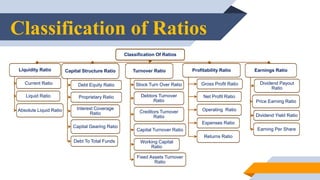
Classification of Ratios
Classification Of Ratios
Liquidity Ratio
Current Ratio
Liquid Ratio
Absolute Liquid Ratio
Capital Structure Ratio
Debt Equity Ratio
Proprietary Ratio
Interest Coverage
Ratio
Capital Gearing Ratio
Debt To Total Funds
Turnover Ratio
Stock Turn Over Ratio
Debtors Turnover
Ratio
Creditors Turnover
Ratio
Capital Turnover Ratio
Working Capital
Ratio
Fixed Assets Turnover
Ratio
Profitability Ratio
Gross Profit Ratio
Net Profit Ratio
Operating Ratio
Expenses Ratio
Returns Ratio
Earnings Ratio
Dividend Payout
Ratio
Price Earning Ratio
Dividend Yield Ratio
Earning Per Share
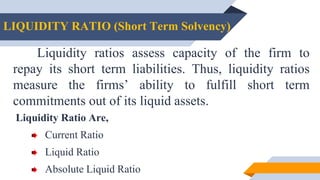
LIQUIDITY RATIO (Short Term Solvency)
Liquidity ratios assess capacity of the firm to
repay its short term liabilities. Thus, liquidity ratios
measure the firms’ ability to fulfill short term
commitments out of its liquid assets.
Liquidity Ratio Are,
Current Ratio
Liquid Ratio
Absolute Liquid Ratio
CURRENT RATIO
Current ratio is a relationship between
current assets and current liabilities of a firm
for a particular period.
Significance of current ratio:
 It indicates the amount of current assets available for repayment
of current liabilities. Higher the ratio, the greater is the short
term solvency of a firm and vice a versa.
 If the ratio is very high it means the current assets are lying idle.
 Very low ratio means the short term solvency of the firm is not
good.
Thus, the ideal current ratio of a company is 2 : 1 i.e. to
repay current liabilities, there should be twice current assets.
QUICK / ACID TEST / LIQUID RATIO
Quick ratio establishes a relationship between
quick assets and quick liabilities.
It is a measure of the extent to which liquid
resources are immediately available to meet current
obligations.
Significance of Liquid Ratio
A quick ratio of 1 : 1 is considered
good / favorable for a company. The low
ratio indicates that the firm is in serious
financial difficulties.
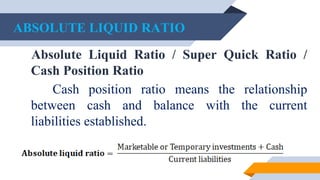
ABSOLUTE LIQUID RATIO
Absolute Liquid Ratio / Super Quick Ratio /
Cash Position Ratio
Cash position ratio means the relationship
between cash and balance with the current
liabilities established.
CAPITAL STRUCTURE RATIO /
GEARING RATIO / SOLVENCY RATIOS
The ratios which are measures the relative
of lenders and proprietors in a business
organization.
These are ratios indicate the long term
solvency position of an organization.
CAPITAL STRUCTURE RATIO Are,
SolvencyRatios Debt Equity Ratio
Proprietary Ratio
Interest Coverage Ratio
Capital Gearing Ratio
Debt To Total Funds
DEBT-EQ-RATIO
It is a relationship between long term Debts and
share holders fund.
Debt-Eq.-Ratio Significance
 Excessive liabilities tend to cause insolvency.
 The ratio indicates the extent to which the
firm depends upon outsiders for its existence.
 The ratio provides a margin of safety to the
creditors.
PROPRIETARY RATIO
It is a relationship between share holders
funds and total assets. this is a variant of Debt
equity ratio.
Proprietary Ratio Significance
 This ratio focuses the attention on the general financial strength of the
business enterprise.
 The ratio is of particular importance to the creditors who can find out the
proportion of shareholders funds in the total assets employed in the
business.
 A high proprietary ratio will indicate a relatively little danger to the
creditor’s etc., in the event of forced reorganization or winding up of the
company. A low proprietary ratio indicates greater risk to the creditors
since in the event of losses a part of their money may be lost besides loss
to the properties of the business.
INTEREST COVERAGE RATIO
It is the ratio indicates whether the business earns
sufficient profit to pay periodically the interest charges.
CAPITAL GEARING RATIO
Capital gearing ratio indicates the relationship
between sources of financing which carries fixed
obligation (fixed interest bearing loans, fixed dividend
bearing preference shares) and equity shares holders’
fund.
DEBT TO TOTAL FUNDS RATIO
This ratio shows relationship between
Debts and total funds employed in the
business.
TURNOVER / ACTIVITY / VELOCITY
RATIO
Activity ratios measure the efficiency or
effectiveness with which a firm manages its
resources.
These ratios are expressed as ‘times’ and
should always be more than one.
Turnover Ratio Are,
TurnoverRatio
Stock Turn Over Ratio
Debtors Turnover Ratio
Creditors Turnover Ratio
Capital Turnover Ratio
Working Capital Ratio
Fixed Assets Turnover Ratio
STOCK TURNOVER RATIO
Stock turnover ratio is a ratio between cost of goods
sold and the average stock or inventory.
It evaluates the efficiency with which a firm is able
to manage its inventory.
The level of inventory should neither be too high
nor too low.
Stock Turnover Ratio Significance
▰ The inventory turnover ratio signifies the liquidity of
the inventory.
▰ A high inventory turnover ratio indicates brisk sales.
▰ If the sales are quick such as a position would not arise
unless the stocks consists of unsalable items.
▰ A low inventory turnover ratio results in blocking of
funds in inventory becoming obsolete or deteriorating
in quality.
DEBTORS TURNOVER RATIO
This ratio establishes a relationship between net
credit sales and average account receivables i.e.
average trade debtors and bill receivables.
Debtors turnover ratio is an indication of the speed
with which a company collects its debts.
DEBT COLLECTION PERIOD
This period refers to an average period for which the credit
sales remain unpaid and measures the quality of debtors.
Quality of debtors means payment made by debtors within
the permissible credit period.
It indicates the rapidity at which the money is collected
from debtors.
CREDITORS TURNOVER RATIO
It is a ratio between net credit purchases and average
account payables (i.e. creditors and Bill payables).
This ratio helps in finding out how much time the firm
is likely to take in repaying the trade creditors.
DEBT PAYMENT PERIOD
This period shows an average period for
which the credit purchases remain unpaid or the
average credit period actually availed
FIXED ASSETS TURNOVER RATIO
This ratio indicates the efficiency with the firm utilizing its
investments in fixed assets such as plant and machinery, land
and building etc.
Generally a high ratio indicates efficient utilization of fixed
assets in generating sales and a low ratio may signify that the
firm has an excessive investment in fixed assets.
CAPITAL TURNOVER RATIO
It is the relationship between cost of
sales (sales) and the total capital
employed.
WORKING CAPITAL TURNOVER RATIO
This ratio indicates the efficiency or
inefficiency in the utilization of working capital
in making sales.
PROFITABILITY RATIO
Profitability
Ratio
Gross Profit Ratio
Net Profit Ratio
Operating Ratio
Expenses Ratio
Returns Ratio
GRASS PROFIT RATIO
The ratio expresses the relationship
between gross profit and sales. The ratio is
usually expressed in percentage.
NET PROFIT RATIO
It is the relationship between the net
profit and net sales and expressed in
percentage.
OPERATING RATIO
This ratio explains the relationship between cost
of goods sold and operating expenses on the one hand
and net sales on the other.
EXPENSES RATIO
The ratios Which present the relationship
that exists between each item or group of
expenses and the net sales
RETURNS RATIOS ARE
▰ Return on investments (ROI), and
▰ Return on equity (ROE).
RETURN ON INVESTMENTS (ROI)
It is ascertained by comparing profit earned and
capital (funds) employed to earn it.
It measures the overall profitability.
RETURN ON EQUITY
RETURN ON EQUITY / RETURN ON SHARE HOLDERS
/ PROPRIETORS “FUNDS”
This ratio shows the relationship between net profit and
owners’ equity.
It indicates the extent of profits available to equity share
holders. High ratio yields high profit or dividends and vice
versa
EARNINGS RATIO
EarningsRatio
Dividend Payout Ratio
Price Earning Ratio
Dividend Yield Ratio
Earning Per Share
DIVIDEND PAY-OUT RATIO
It indicates the percentage of equity share
earnings distributed as dividends to equity share
holders. It indicates the rate of dividend paid for
each share. A high ratio is good yield and vice
versa
PRICE EARNINGS RATIO
This is the market price of shares
expressed as multiple of earnings per share
(EPS). It helps to decide to invest or not to
invest in a company.
DIVIDEND YIELD RATIO
This ratio shows relationship between
dividend per equity share and market price per
equity share. Indicates the rate of dividend paid
for each share. A high ratio is good yield and
vice versa
EARNINGS PER SHARE
This ratio measures the earnings per
equity share i.e. it measures the
profitability of the firm on a per share
basis.
“
Thank You

Ratio analysis

  • 1.
    MANJUNATHA S VM.Com., B.Ed., NET., KSET. Assistant Professor, Department of Commerce Sri Sai Vishwa Tutorials Chintamani Mobile No.: 9986658577/9986647774
  • 2.
  • 3.
    Meaning of Ratio Ratiois simply one number expressed in terms of another number. In other words, a ratio express mathematical relationship between one an. It is expressed as a proportion or a fraction or in percentage or in terms of number of times.
  • 4.
    Classification of Ratios ClassificationOf Ratios Liquidity Ratio Current Ratio Liquid Ratio Absolute Liquid Ratio Capital Structure Ratio Debt Equity Ratio Proprietary Ratio Interest Coverage Ratio Capital Gearing Ratio Debt To Total Funds Turnover Ratio Stock Turn Over Ratio Debtors Turnover Ratio Creditors Turnover Ratio Capital Turnover Ratio Working Capital Ratio Fixed Assets Turnover Ratio Profitability Ratio Gross Profit Ratio Net Profit Ratio Operating Ratio Expenses Ratio Returns Ratio Earnings Ratio Dividend Payout Ratio Price Earning Ratio Dividend Yield Ratio Earning Per Share
  • 5.
    LIQUIDITY RATIO (ShortTerm Solvency) Liquidity ratios assess capacity of the firm to repay its short term liabilities. Thus, liquidity ratios measure the firms’ ability to fulfill short term commitments out of its liquid assets. Liquidity Ratio Are, Current Ratio Liquid Ratio Absolute Liquid Ratio
  • 6.
    CURRENT RATIO Current ratiois a relationship between current assets and current liabilities of a firm for a particular period.
  • 7.
    Significance of currentratio:  It indicates the amount of current assets available for repayment of current liabilities. Higher the ratio, the greater is the short term solvency of a firm and vice a versa.  If the ratio is very high it means the current assets are lying idle.  Very low ratio means the short term solvency of the firm is not good. Thus, the ideal current ratio of a company is 2 : 1 i.e. to repay current liabilities, there should be twice current assets.
  • 8.
    QUICK / ACIDTEST / LIQUID RATIO Quick ratio establishes a relationship between quick assets and quick liabilities. It is a measure of the extent to which liquid resources are immediately available to meet current obligations.
  • 9.
    Significance of LiquidRatio A quick ratio of 1 : 1 is considered good / favorable for a company. The low ratio indicates that the firm is in serious financial difficulties.
  • 10.
    ABSOLUTE LIQUID RATIO AbsoluteLiquid Ratio / Super Quick Ratio / Cash Position Ratio Cash position ratio means the relationship between cash and balance with the current liabilities established.
  • 11.
    CAPITAL STRUCTURE RATIO/ GEARING RATIO / SOLVENCY RATIOS The ratios which are measures the relative of lenders and proprietors in a business organization. These are ratios indicate the long term solvency position of an organization.
  • 12.
    CAPITAL STRUCTURE RATIOAre, SolvencyRatios Debt Equity Ratio Proprietary Ratio Interest Coverage Ratio Capital Gearing Ratio Debt To Total Funds
  • 13.
    DEBT-EQ-RATIO It is arelationship between long term Debts and share holders fund.
  • 14.
    Debt-Eq.-Ratio Significance  Excessiveliabilities tend to cause insolvency.  The ratio indicates the extent to which the firm depends upon outsiders for its existence.  The ratio provides a margin of safety to the creditors.
  • 15.
    PROPRIETARY RATIO It isa relationship between share holders funds and total assets. this is a variant of Debt equity ratio.
  • 16.
    Proprietary Ratio Significance This ratio focuses the attention on the general financial strength of the business enterprise.  The ratio is of particular importance to the creditors who can find out the proportion of shareholders funds in the total assets employed in the business.  A high proprietary ratio will indicate a relatively little danger to the creditor’s etc., in the event of forced reorganization or winding up of the company. A low proprietary ratio indicates greater risk to the creditors since in the event of losses a part of their money may be lost besides loss to the properties of the business.
  • 17.
    INTEREST COVERAGE RATIO Itis the ratio indicates whether the business earns sufficient profit to pay periodically the interest charges.
  • 18.
    CAPITAL GEARING RATIO Capitalgearing ratio indicates the relationship between sources of financing which carries fixed obligation (fixed interest bearing loans, fixed dividend bearing preference shares) and equity shares holders’ fund.
  • 19.
    DEBT TO TOTALFUNDS RATIO This ratio shows relationship between Debts and total funds employed in the business.
  • 20.
    TURNOVER / ACTIVITY/ VELOCITY RATIO Activity ratios measure the efficiency or effectiveness with which a firm manages its resources. These ratios are expressed as ‘times’ and should always be more than one.
  • 21.
    Turnover Ratio Are, TurnoverRatio StockTurn Over Ratio Debtors Turnover Ratio Creditors Turnover Ratio Capital Turnover Ratio Working Capital Ratio Fixed Assets Turnover Ratio
  • 22.
    STOCK TURNOVER RATIO Stockturnover ratio is a ratio between cost of goods sold and the average stock or inventory. It evaluates the efficiency with which a firm is able to manage its inventory. The level of inventory should neither be too high nor too low.
  • 23.
    Stock Turnover RatioSignificance ▰ The inventory turnover ratio signifies the liquidity of the inventory. ▰ A high inventory turnover ratio indicates brisk sales. ▰ If the sales are quick such as a position would not arise unless the stocks consists of unsalable items. ▰ A low inventory turnover ratio results in blocking of funds in inventory becoming obsolete or deteriorating in quality.
  • 24.
    DEBTORS TURNOVER RATIO Thisratio establishes a relationship between net credit sales and average account receivables i.e. average trade debtors and bill receivables. Debtors turnover ratio is an indication of the speed with which a company collects its debts.
  • 25.
    DEBT COLLECTION PERIOD Thisperiod refers to an average period for which the credit sales remain unpaid and measures the quality of debtors. Quality of debtors means payment made by debtors within the permissible credit period. It indicates the rapidity at which the money is collected from debtors.
  • 26.
    CREDITORS TURNOVER RATIO Itis a ratio between net credit purchases and average account payables (i.e. creditors and Bill payables). This ratio helps in finding out how much time the firm is likely to take in repaying the trade creditors.
  • 27.
    DEBT PAYMENT PERIOD Thisperiod shows an average period for which the credit purchases remain unpaid or the average credit period actually availed
  • 28.
    FIXED ASSETS TURNOVERRATIO This ratio indicates the efficiency with the firm utilizing its investments in fixed assets such as plant and machinery, land and building etc. Generally a high ratio indicates efficient utilization of fixed assets in generating sales and a low ratio may signify that the firm has an excessive investment in fixed assets.
  • 29.
    CAPITAL TURNOVER RATIO Itis the relationship between cost of sales (sales) and the total capital employed.
  • 30.
    WORKING CAPITAL TURNOVERRATIO This ratio indicates the efficiency or inefficiency in the utilization of working capital in making sales.
  • 31.
    PROFITABILITY RATIO Profitability Ratio Gross ProfitRatio Net Profit Ratio Operating Ratio Expenses Ratio Returns Ratio
  • 32.
    GRASS PROFIT RATIO Theratio expresses the relationship between gross profit and sales. The ratio is usually expressed in percentage.
  • 33.
    NET PROFIT RATIO Itis the relationship between the net profit and net sales and expressed in percentage.
  • 34.
    OPERATING RATIO This ratioexplains the relationship between cost of goods sold and operating expenses on the one hand and net sales on the other.
  • 35.
    EXPENSES RATIO The ratiosWhich present the relationship that exists between each item or group of expenses and the net sales
  • 36.
    RETURNS RATIOS ARE ▰Return on investments (ROI), and ▰ Return on equity (ROE). RETURN ON INVESTMENTS (ROI) It is ascertained by comparing profit earned and capital (funds) employed to earn it. It measures the overall profitability.
  • 37.
    RETURN ON EQUITY RETURNON EQUITY / RETURN ON SHARE HOLDERS / PROPRIETORS “FUNDS” This ratio shows the relationship between net profit and owners’ equity. It indicates the extent of profits available to equity share holders. High ratio yields high profit or dividends and vice versa
  • 38.
    EARNINGS RATIO EarningsRatio Dividend PayoutRatio Price Earning Ratio Dividend Yield Ratio Earning Per Share
  • 39.
    DIVIDEND PAY-OUT RATIO Itindicates the percentage of equity share earnings distributed as dividends to equity share holders. It indicates the rate of dividend paid for each share. A high ratio is good yield and vice versa
  • 40.
    PRICE EARNINGS RATIO Thisis the market price of shares expressed as multiple of earnings per share (EPS). It helps to decide to invest or not to invest in a company.
  • 41.
    DIVIDEND YIELD RATIO Thisratio shows relationship between dividend per equity share and market price per equity share. Indicates the rate of dividend paid for each share. A high ratio is good yield and vice versa
  • 42.
    EARNINGS PER SHARE Thisratio measures the earnings per equity share i.e. it measures the profitability of the firm on a per share basis.
  • 43.