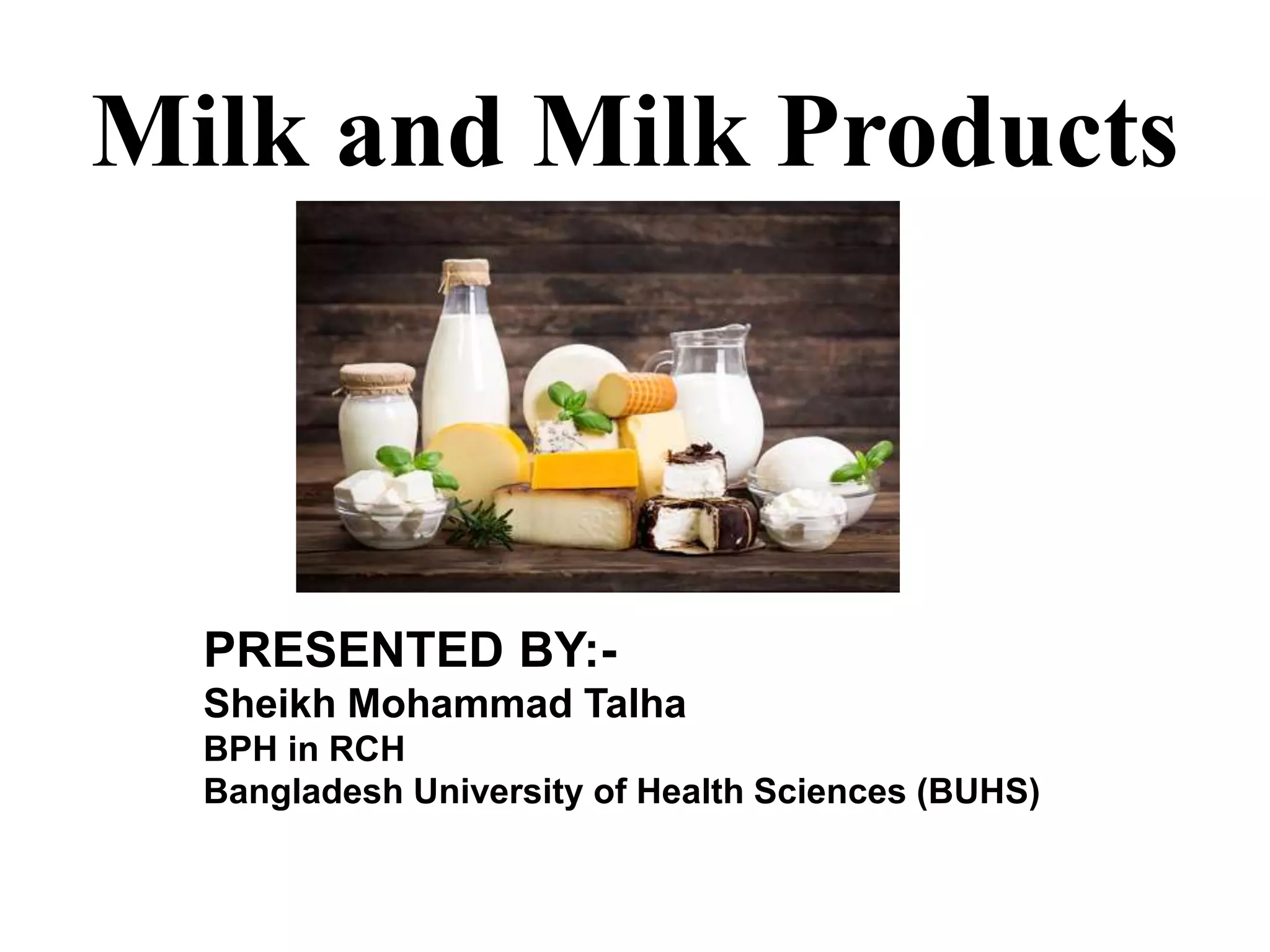
Milk and Milk Products
PRESENTED BY:-
Sheikh Mohammad Talha
BPH in RCH
Bangladesh University of Health Sciences (BUHS)
Introduction
 Milk is a white liquid
produced by the
mammary glands of
mammals.
 Primary source of
nutrition for young
mammals before they are
able to digest other types
of food.
 Throughout the world, there
are than 6 billion consumers
of milk and milk products.
COMPOSITION OF MILK
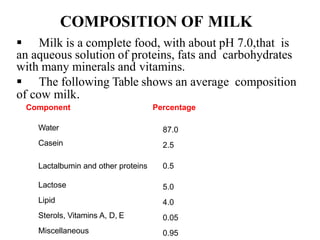
 Milk is a complete food, with about pH 7.0,that is
an aqueous solution of proteins, fats and carbohydrates
with many minerals and vitamins.
 The following Table shows an average composition
of cow milk.
Component Percentage
Water
Casein
87.0
2.5
Lactalbumin and other proteins 0.5
Lactose
Lipid
Sterols, Vitamins A, D, E
Miscellaneous
5.0
4.0
0.05
0.95
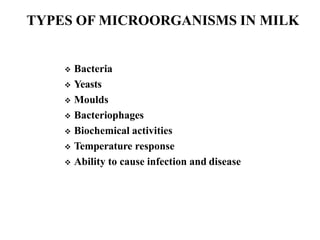
TYPES OF MICROORGANISMS IN MILK
 Bacteria
 Yeasts
 Moulds
 Bacteriophages
 Biochemical activities
 Temperature response
 Ability to cause infection and disease
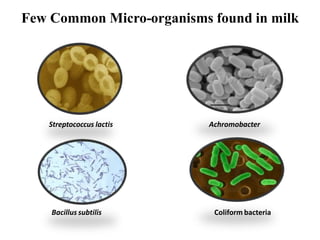
Few Common Micro-organisms found in milk
Streptococcus lactis Achromobacter
Bacillus subtilis Coliform bacteria
 Brucella species
 Campylobactere jejuni
 Coxiella bruneti
 Escherichia coli
 Listeria monocytogenes
 Mycobacterium bovis
 Mycobacterium paratuberculosis
 Salmonella species
 E.coli
MICROORGANISMS OF CONCERN
Factors that influence survival and
growth of Microorganisms
Intrinsic
• Nutrient availability
• pH
• Water availability
Extrinsic
• Temperature
• Atmosphere
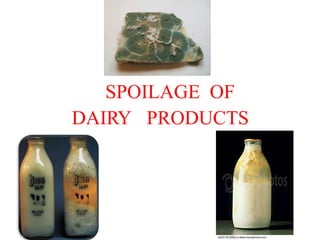
SPOILAGE OF
DAIRY PRODUCTS
SPOILAGE OF MILKAND DAIRY PRODUCTS
Highly perishable food because:
 pH b/w 6.3-6.5
 High Moisture
 Rich Nutrients (lactose sugar, butterfat, citrate and
nitrogenous compounds)
 Composition: Protein-3.2%, Carbohydrate 4.8%, Fats
3.9%, minerals-0.9%
 Free aa: Casein and Lactalbumin-rich N-source
 Lactose sugar-simple, fermentable
 Milk fat hydrolysed by microbial lipases.
SPOILAGE OF MILK AND DAIRY PRODUCTS
 Changes in Milk Fat
 Alkali Production
 Color Changes
 Yellow milk (Ps. Synxantha, Flavobacterium)
 Red milk (Serratia marcesans, Torula glutinis)
 Brown milk (Ps. putrfaciens)
 Blue milk (Ps. syncyannea)
 Flavor Changes
 Sour or acid flavor: Clean acid flavor, Aromatic acid flavor,
Sharp acid flavor
 Bitter flavor- Proteolysis of casein (Bacillus sp., Clostridium)
 Burnt/Caramel flavor (burnt milk flavor-S. lactis var.
maltigenes)
 Gas production: accompanied by acid formation- mainly by coliform
bacteria, Clostridium and gas-forming Bacillus sp.- yield H2 and CO2.
 Acid formers killed at pasteurization temps.- however spores of
clostridium and bacillus may survive and cause spoilage of pasteurized
milk.
 Proteolysis: hydrolysis of milk proteins by m/o accompanied by
production of bitter flavor (due to peptide released).
 Proteolysis is favored by –storage at low temps, destruction of lactics
and other acid formers by heat, destruction of formed acid in milk by
molds and yeasts
 Eg: Micrococcus, Akaligenes, Pseudomonas, Proteus, Flavobacterium

(non sporeformer s);
Bacillus and Clostridium sp (spore formers).
SPOILAGE OF MILK AND MILK PRODUCTS
Spoilage type Oraganisms involved Signs of spoilage
Souring Lactobacillus sp.
Streptococcus sp.
Sour milk,Curd
formation
Sweet curdling Bacillus sp.
Proteus sp.
Micrococcus sp.
Alkaline pH Curd
formation
Gas production Clastoridium sp.
coliform bacteria
Explosion of curds
Ropiness Alcaligenes
sp.,Klebsiella
sp.,Enterobacter sp.
Stringy or slimy milk
Red rot Serratia marcescens Red colaration
Gray rot clotridium sp. Gray colaration, Foul
smell
Dairy mould Penicilium
sp.,Geotrichum sp.
Mouldy appearance
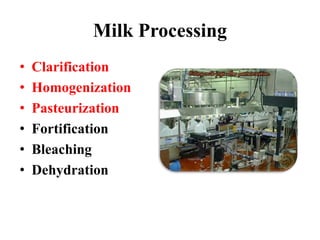
Milk Processing
• Clarification
• Homogenization
• Pasteurization
• Fortification
• Bleaching
• Dehydration
1. Clarification and Clearing
 Clarification: removal of small particles
- straw, hair etc. from milk; 2 lb/2,642 gal
- based on density
 “Bactofugation”: Centrifugal separation of microorganisms from milk:
– Bacteria and particularly spores have higher density than milk
– Two-stage centrifugation can reduce spore loads up to>99%
– Optimal temperature for clarification is 55-60ºC
 Microfiltration
– Micro-filter membranes of 1.4 m or less can lead to reductionof
bacteria
– and spores up to 99.5-99.99%.
2. Homogenization
• Function : to prevent creaming, or the rising of fat to the
top of the container of milk.
• The process of homogenization permanently emulsifies the
fine fat globules by a method that pumps milk under high
pressure [2000–2500 lb/in2 (psi)] through small mesh orifices
of a homogenizer.
• Homogenization mechanically increases the number &
reduces the size of the fat globules. The size is reduced to
1/10 of their original size.
• Resulting in the milk that maintains more uniform
composition with improved body and texture, a whiter
appearance, richer flavor, & more digestible curd.
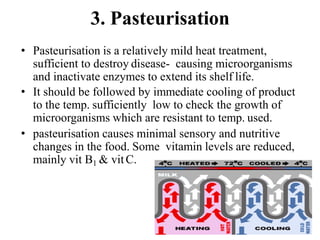
3. Pasteurisation
• Pasteurisation is a relatively mild heat treatment,
sufficient to destroy disease- causing microorganisms
and inactivate enzymes to extend its shelf life.
• It should be followed by immediate cooling of product
to the temp. sufficiently low to check the growth of
microorganisms which are resistant to temp. used.
• pasteurisation causes minimal sensory and nutritive
changes in the food. Some vitamin levels are reduced,
mainly vit B1 & vitC.
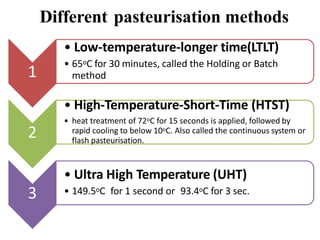
Different pasteurisation methods
1
• Low-temperature-longer time(LTLT)
• 65oC for 30 minutes, called the Holding or Batch
method
2
• High-Temperature-Short-Time (HTST)
• heat treatment of 72oC for 15 seconds is applied, followed by
rapid cooling to below 10oC. Also called the continuous system or
flash pasteurisation.
3
• Ultra High Temperature (UHT)
• 149.5oC for 1 second or 93.4oC for 3 sec.
4. Fortification
• The addition of fat-soluble vitamins A and D to whole
milk is optional but must for Low-fat milk & non-fat
milk (usually before pasteurization) to carry
– 2000 IU or 140 retinol equivalents (RE) vitamin A per quart.
– Vitamin D to reach levels of 400 IU’s per quart is optional
• but routinely practiced. Evaporated milks must be fortified.
• To increase the viscosity and appearance, as well as the
nutritive value of low-fat milk, (MSNF) may be added to
milk. This addition allows milk to reach a 10% MSNF
(versus 8.25% usually present), and it will state “protein
fortified” or “fortified with protein” on the label.
5. Bleaching
• Bleaching carotenoid or chlorophyll pigments in milk
may be desirable.
• The FDA allows benzoyl peroxide or a blend of it with
potassium alum, calcium sulphate, or magnesium
carbonate to be used as a bleaching agent in milk.
• The weight of benzoyl peroxide must not exceed
0.002% of the weight of the milk, and the potassium
alum, calcium sulphate, and magnesium carbonate,
individually or 246 Proteins combined, must not be
more than six times the weight of the benzoyl
peroxide.
• Vitamin A or its precursors may be destroyed in the
bleaching process; therefore, sufficient vit A is added into
the milk, or in the case of cheese- making to the curd.
6. Dehydration
• Spray Drying
• Pasteurized milk is first concentrated in
• an evaporator to approximately 50% milk solids. The resulting
concentrated milk is then
• sprayed into a heated chamber where the water almost instantly
evaporates, leaving fine particles of powdered milk solids.
• Spray Drying
• Pasteurized milk is first concentrated in
• an evaporator to approximately 50% milk solids. The resulting
concentrated milk is then
• sprayed into a heated chamber where the water almost instantly
evaporates, leaving fine particles of powdered milk solids.
• Spray Drying
• Pasteurized milk is first concentrated in
• an evaporator to approximately 50% milk solids. The resulting
concentrated milk is then
• sprayed into a heated chamber where the water almost instantly
evaporates, leaving fine particles of powdered milk solids.
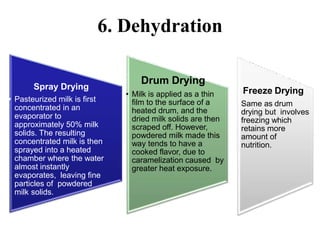
Spray Drying
• Pasteurized milk is first
concentrated in an
evaporator to
approximately 50% milk
solids. The resulting
concentrated milk is then
sprayed into a heated
chamber where the water
almost instantly
evaporates, leaving fine
particles of powdered
milk solids.
Drum Drying
• Milk is applied as a thin
film to the surface of a
heated drum, and the
dried milk solids are then
scraped off. However,
powdered milk made this
way tends to have a
cooked flavor, due to
caramelization caused by
greater heat exposure.
Freeze Drying
Same as drum
drying but involves
freezing which
retains more
amount of
nutrition.
Any Questions..?

Milk & Milk product

  • 1.
    Milk and MilkProducts PRESENTED BY:- Sheikh Mohammad Talha BPH in RCH Bangladesh University of Health Sciences (BUHS)
  • 2.
    Introduction  Milk isa white liquid produced by the mammary glands of mammals.  Primary source of nutrition for young mammals before they are able to digest other types of food.  Throughout the world, there are than 6 billion consumers of milk and milk products.
  • 3.
    COMPOSITION OF MILK Milk is a complete food, with about pH 7.0,that is an aqueous solution of proteins, fats and carbohydrates with many minerals and vitamins.  The following Table shows an average composition of cow milk. Component Percentage Water Casein 87.0 2.5 Lactalbumin and other proteins 0.5 Lactose Lipid Sterols, Vitamins A, D, E Miscellaneous 5.0 4.0 0.05 0.95
  • 4.
    TYPES OF MICROORGANISMSIN MILK  Bacteria  Yeasts  Moulds  Bacteriophages  Biochemical activities  Temperature response  Ability to cause infection and disease
  • 5.
    Few Common Micro-organismsfound in milk Streptococcus lactis Achromobacter Bacillus subtilis Coliform bacteria
  • 6.
     Brucella species Campylobactere jejuni  Coxiella bruneti  Escherichia coli  Listeria monocytogenes  Mycobacterium bovis  Mycobacterium paratuberculosis  Salmonella species  E.coli MICROORGANISMS OF CONCERN
  • 7.
    Factors that influencesurvival and growth of Microorganisms Intrinsic • Nutrient availability • pH • Water availability Extrinsic • Temperature • Atmosphere
  • 8.
  • 9.
    SPOILAGE OF MILKANDDAIRY PRODUCTS Highly perishable food because:  pH b/w 6.3-6.5  High Moisture  Rich Nutrients (lactose sugar, butterfat, citrate and nitrogenous compounds)  Composition: Protein-3.2%, Carbohydrate 4.8%, Fats 3.9%, minerals-0.9%  Free aa: Casein and Lactalbumin-rich N-source  Lactose sugar-simple, fermentable  Milk fat hydrolysed by microbial lipases.
  • 10.
    SPOILAGE OF MILKAND DAIRY PRODUCTS  Changes in Milk Fat  Alkali Production  Color Changes  Yellow milk (Ps. Synxantha, Flavobacterium)  Red milk (Serratia marcesans, Torula glutinis)  Brown milk (Ps. putrfaciens)  Blue milk (Ps. syncyannea)  Flavor Changes  Sour or acid flavor: Clean acid flavor, Aromatic acid flavor, Sharp acid flavor  Bitter flavor- Proteolysis of casein (Bacillus sp., Clostridium)  Burnt/Caramel flavor (burnt milk flavor-S. lactis var. maltigenes)
  • 11.
     Gas production:accompanied by acid formation- mainly by coliform bacteria, Clostridium and gas-forming Bacillus sp.- yield H2 and CO2.  Acid formers killed at pasteurization temps.- however spores of clostridium and bacillus may survive and cause spoilage of pasteurized milk.  Proteolysis: hydrolysis of milk proteins by m/o accompanied by production of bitter flavor (due to peptide released).  Proteolysis is favored by –storage at low temps, destruction of lactics and other acid formers by heat, destruction of formed acid in milk by molds and yeasts  Eg: Micrococcus, Akaligenes, Pseudomonas, Proteus, Flavobacterium  (non sporeformer s); Bacillus and Clostridium sp (spore formers).
  • 12.
    SPOILAGE OF MILKAND MILK PRODUCTS Spoilage type Oraganisms involved Signs of spoilage Souring Lactobacillus sp. Streptococcus sp. Sour milk,Curd formation Sweet curdling Bacillus sp. Proteus sp. Micrococcus sp. Alkaline pH Curd formation Gas production Clastoridium sp. coliform bacteria Explosion of curds Ropiness Alcaligenes sp.,Klebsiella sp.,Enterobacter sp. Stringy or slimy milk Red rot Serratia marcescens Red colaration Gray rot clotridium sp. Gray colaration, Foul smell Dairy mould Penicilium sp.,Geotrichum sp. Mouldy appearance
  • 13.
    Milk Processing • Clarification •Homogenization • Pasteurization • Fortification • Bleaching • Dehydration
  • 14.
    1. Clarification andClearing  Clarification: removal of small particles - straw, hair etc. from milk; 2 lb/2,642 gal - based on density  “Bactofugation”: Centrifugal separation of microorganisms from milk: – Bacteria and particularly spores have higher density than milk – Two-stage centrifugation can reduce spore loads up to>99% – Optimal temperature for clarification is 55-60ºC  Microfiltration – Micro-filter membranes of 1.4 m or less can lead to reductionof bacteria – and spores up to 99.5-99.99%.
  • 15.
    2. Homogenization • Function: to prevent creaming, or the rising of fat to the top of the container of milk. • The process of homogenization permanently emulsifies the fine fat globules by a method that pumps milk under high pressure [2000–2500 lb/in2 (psi)] through small mesh orifices of a homogenizer. • Homogenization mechanically increases the number & reduces the size of the fat globules. The size is reduced to 1/10 of their original size. • Resulting in the milk that maintains more uniform composition with improved body and texture, a whiter appearance, richer flavor, & more digestible curd.
  • 16.
    3. Pasteurisation • Pasteurisationis a relatively mild heat treatment, sufficient to destroy disease- causing microorganisms and inactivate enzymes to extend its shelf life. • It should be followed by immediate cooling of product to the temp. sufficiently low to check the growth of microorganisms which are resistant to temp. used. • pasteurisation causes minimal sensory and nutritive changes in the food. Some vitamin levels are reduced, mainly vit B1 & vitC.
  • 17.
    Different pasteurisation methods 1 •Low-temperature-longer time(LTLT) • 65oC for 30 minutes, called the Holding or Batch method 2 • High-Temperature-Short-Time (HTST) • heat treatment of 72oC for 15 seconds is applied, followed by rapid cooling to below 10oC. Also called the continuous system or flash pasteurisation. 3 • Ultra High Temperature (UHT) • 149.5oC for 1 second or 93.4oC for 3 sec.
  • 18.
    4. Fortification • Theaddition of fat-soluble vitamins A and D to whole milk is optional but must for Low-fat milk & non-fat milk (usually before pasteurization) to carry – 2000 IU or 140 retinol equivalents (RE) vitamin A per quart. – Vitamin D to reach levels of 400 IU’s per quart is optional • but routinely practiced. Evaporated milks must be fortified. • To increase the viscosity and appearance, as well as the nutritive value of low-fat milk, (MSNF) may be added to milk. This addition allows milk to reach a 10% MSNF (versus 8.25% usually present), and it will state “protein fortified” or “fortified with protein” on the label.
  • 19.
    5. Bleaching • Bleachingcarotenoid or chlorophyll pigments in milk may be desirable. • The FDA allows benzoyl peroxide or a blend of it with potassium alum, calcium sulphate, or magnesium carbonate to be used as a bleaching agent in milk. • The weight of benzoyl peroxide must not exceed 0.002% of the weight of the milk, and the potassium alum, calcium sulphate, and magnesium carbonate, individually or 246 Proteins combined, must not be more than six times the weight of the benzoyl peroxide. • Vitamin A or its precursors may be destroyed in the bleaching process; therefore, sufficient vit A is added into the milk, or in the case of cheese- making to the curd.
  • 20.
    6. Dehydration • SprayDrying • Pasteurized milk is first concentrated in • an evaporator to approximately 50% milk solids. The resulting concentrated milk is then • sprayed into a heated chamber where the water almost instantly evaporates, leaving fine particles of powdered milk solids. • Spray Drying • Pasteurized milk is first concentrated in • an evaporator to approximately 50% milk solids. The resulting concentrated milk is then • sprayed into a heated chamber where the water almost instantly evaporates, leaving fine particles of powdered milk solids. • Spray Drying • Pasteurized milk is first concentrated in • an evaporator to approximately 50% milk solids. The resulting concentrated milk is then • sprayed into a heated chamber where the water almost instantly evaporates, leaving fine particles of powdered milk solids. Spray Drying • Pasteurized milk is first concentrated in an evaporator to approximately 50% milk solids. The resulting concentrated milk is then sprayed into a heated chamber where the water almost instantly evaporates, leaving fine particles of powdered milk solids. Drum Drying • Milk is applied as a thin film to the surface of a heated drum, and the dried milk solids are then scraped off. However, powdered milk made this way tends to have a cooked flavor, due to caramelization caused by greater heat exposure. Freeze Drying Same as drum drying but involves freezing which retains more amount of nutrition.
  • 22.