
rapid eLearning 1


              Photo Credit: http://www.flickr.com/photos/25691430@N04/4347819911/
                                    CC: http://creativecommons.org/licenses/by-sa/2.0/
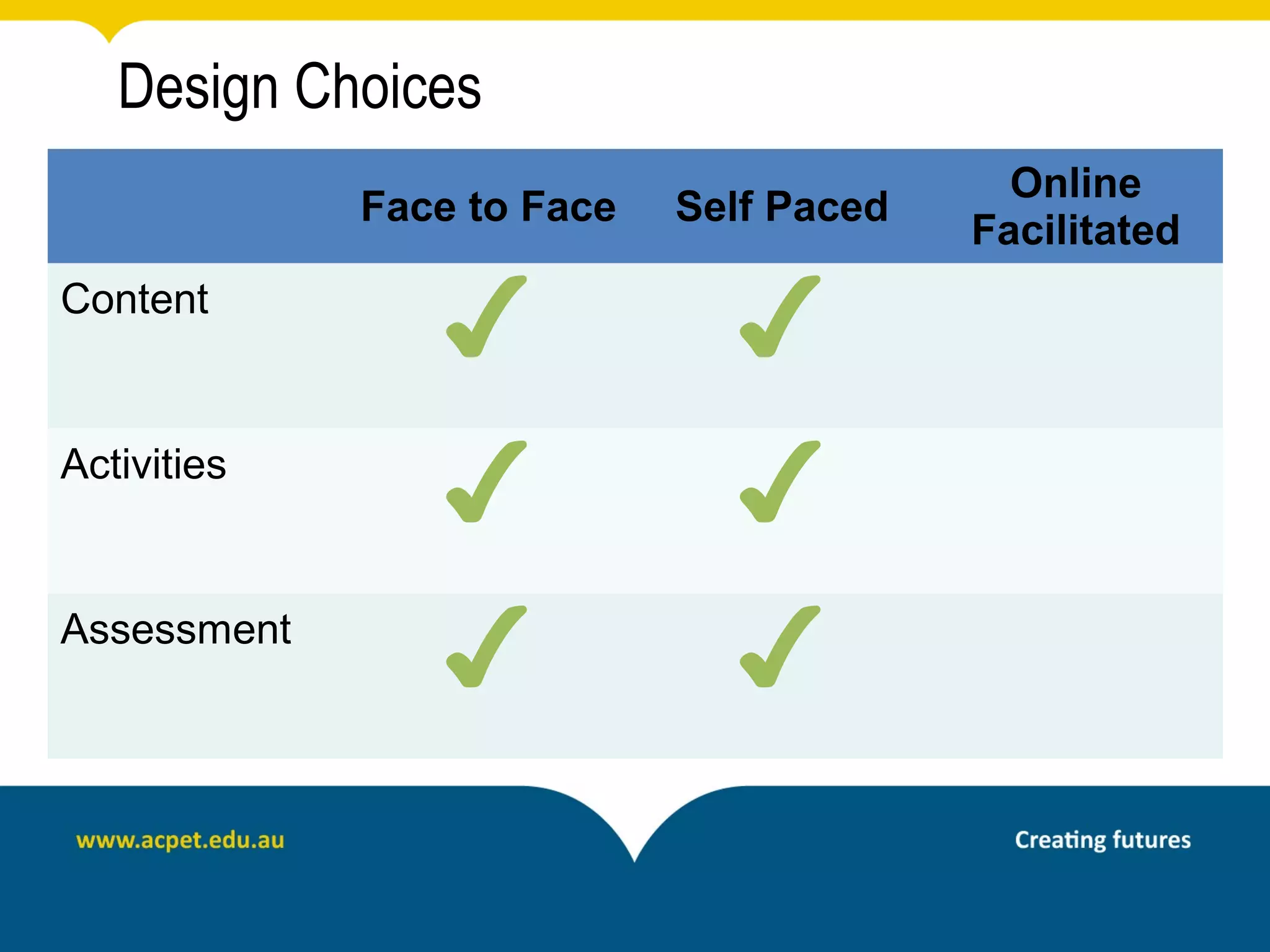
Design Choices
                                           Online
             Face to Face   Self Paced
                                         Facilitated
Content
                ✔             ✔
Activities
                ✔             ✔
Assessment
                ✔             ✔
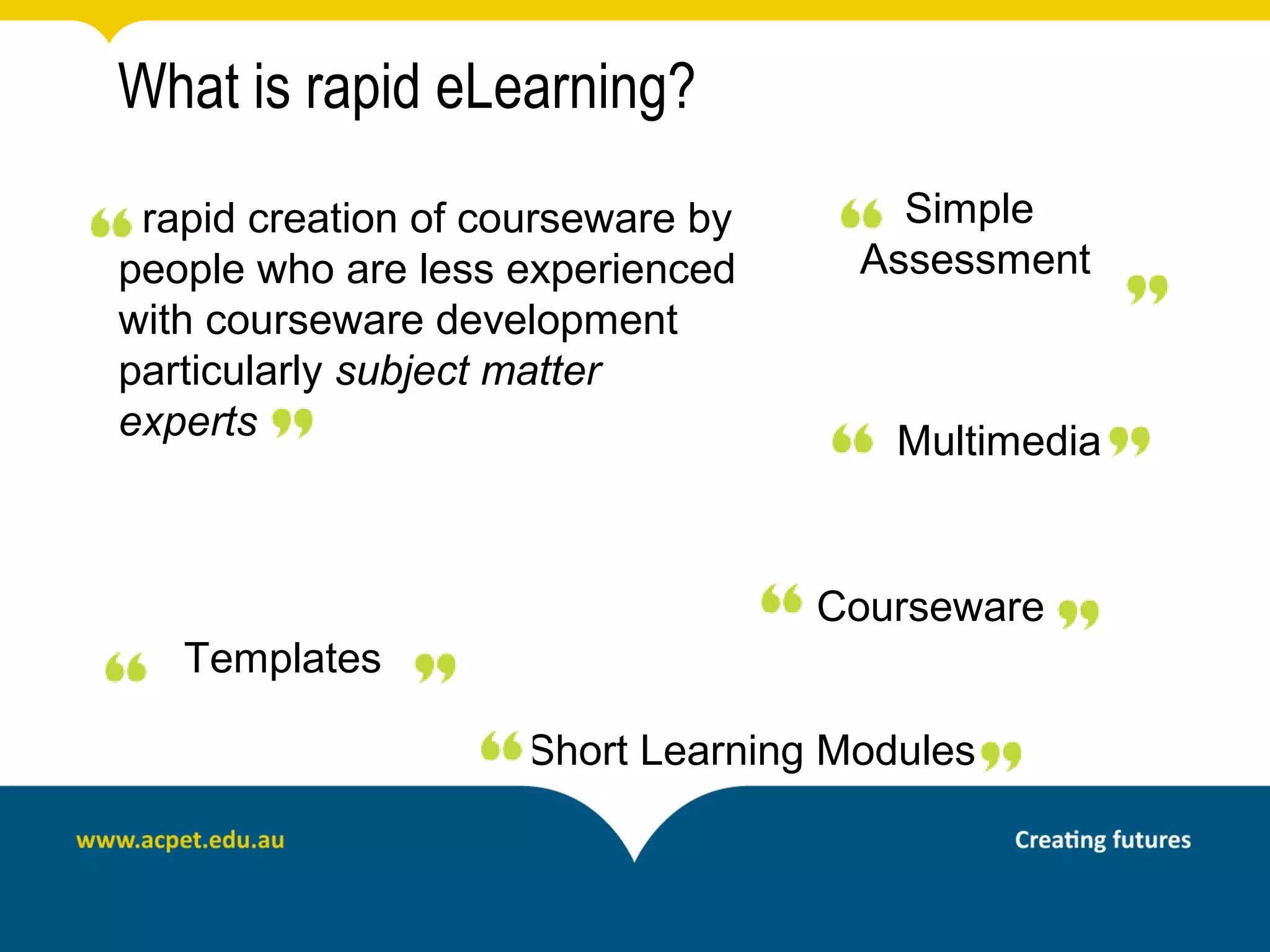
What is rapid eLearning?
 rapid creation of courseware by       Simple
people who are less experienced      Assessment
with courseware development
particularly subject matter
experts                                Multimedia


                                   Courseware
   Templates

                     Short Learning Modules
But what is the biggest challenge?
Self Pace Best Practice

Give learners something to do with the content. Even if your
course is info heavy, provide opportunities to apply learning to
workplace context in the role they will occupy.

When presenting a problem, “content” can be provided in a
variety of forms using video, audio and some text.

This gives more depth to typical “quiz” based assessment
which test memory rather than understanding, problem
solving and consequences of on the job of decision making.
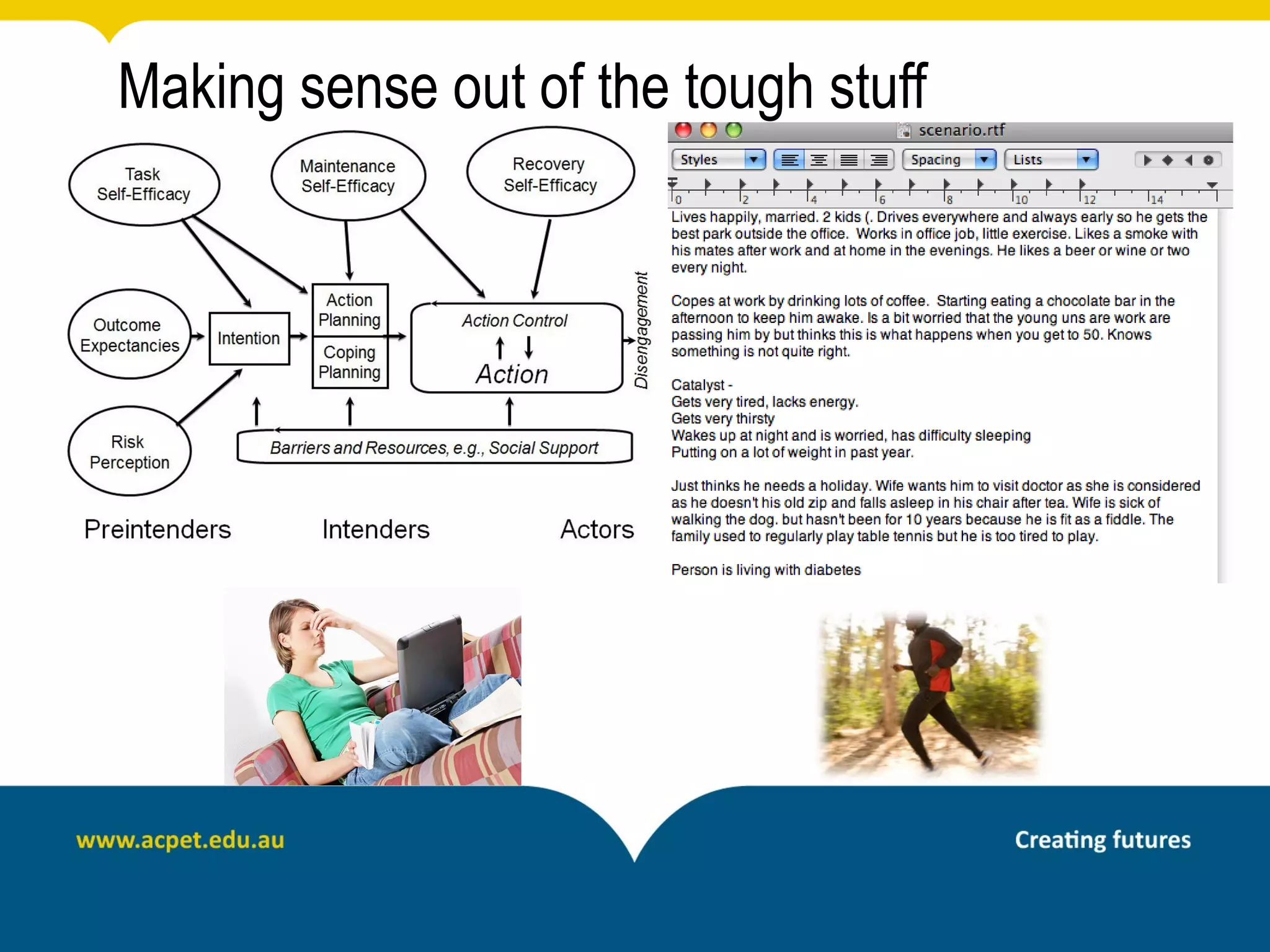
Making sense out of the tough stuff
Story based self paced content

Character faces a challenge/journey
Show not tell
Make learners justify their choices. Challenge their
assumptions and make them think deeply about the
material.
Contextual feedback will help learners see where they
went wrong
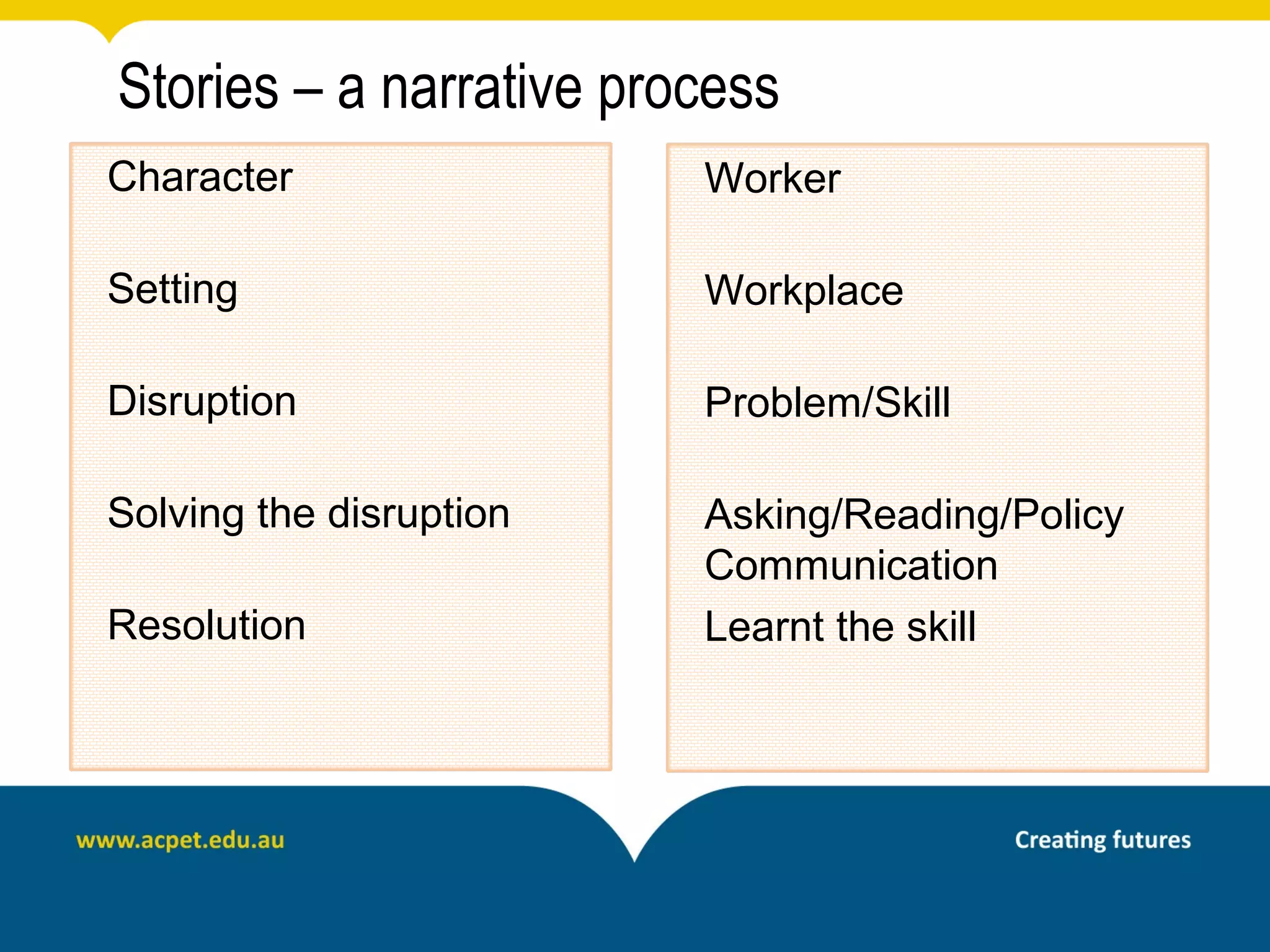
Stories – a narrative process
Character                Worker

Setting                  Workplace

Disruption               Problem/Skill

Solving the disruption   Asking/Reading/Policy
                         Communication
Resolution               Learnt the skill
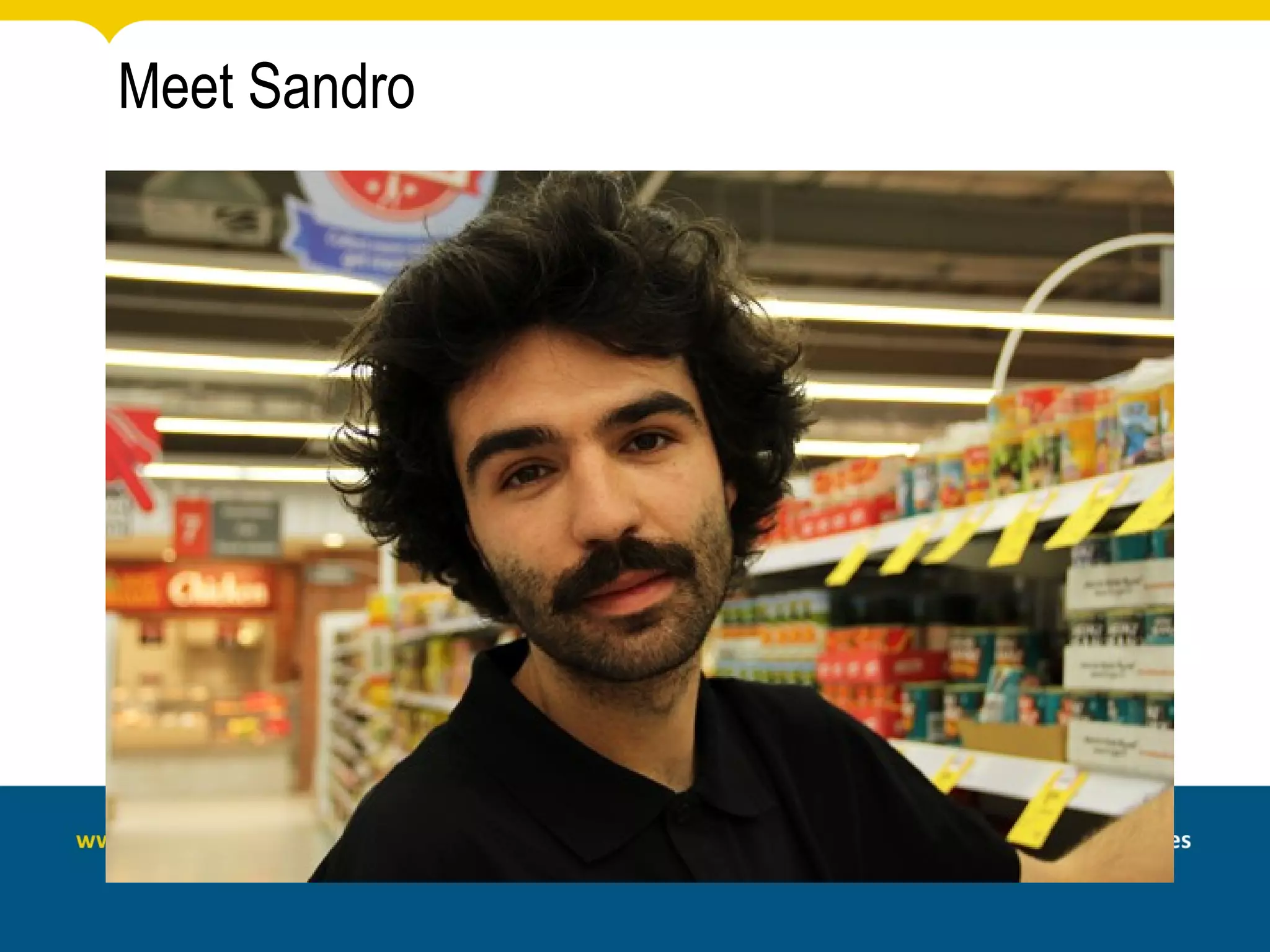
Meet Sandro
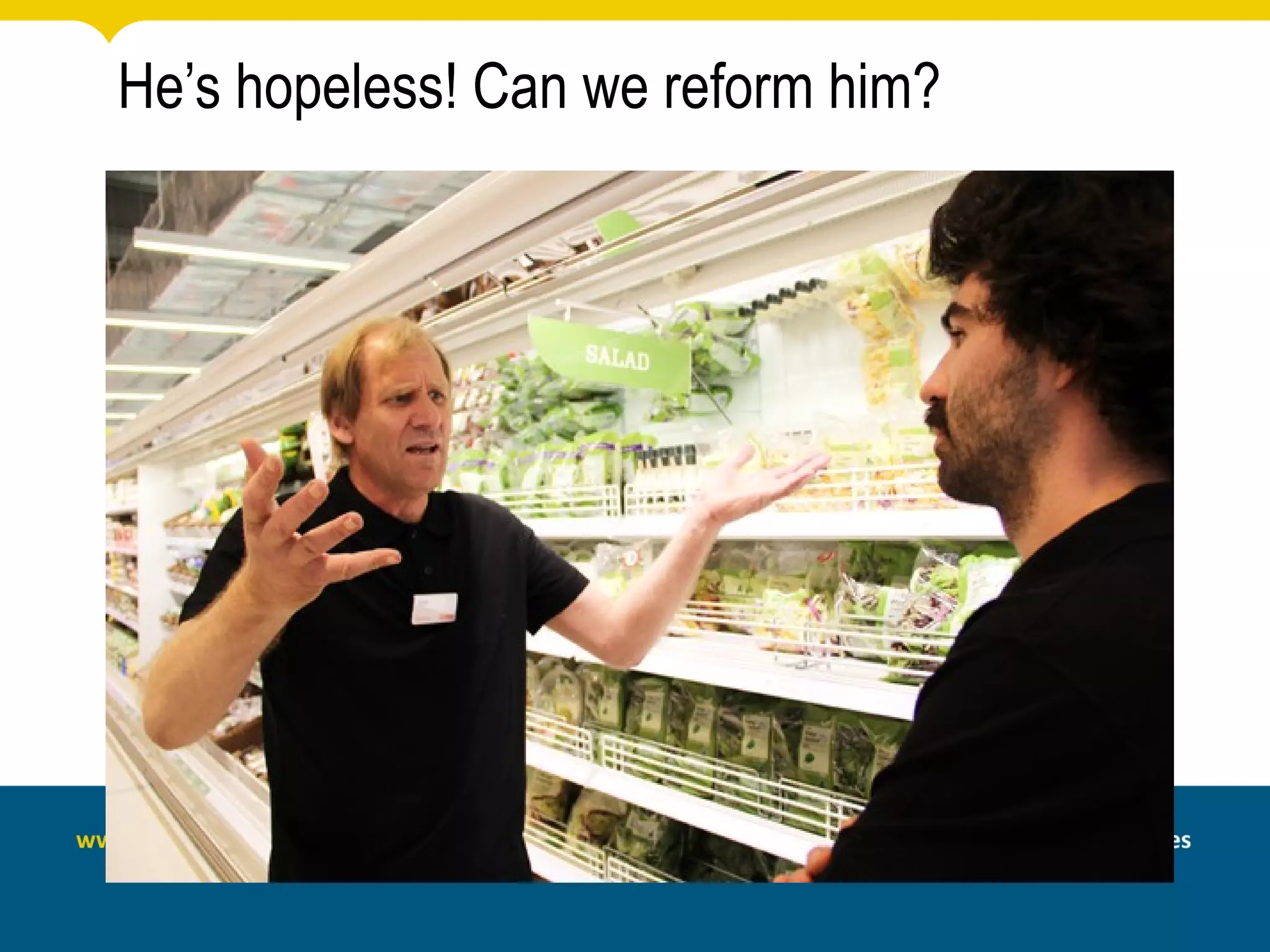
He’s hopeless! Can we reform him?
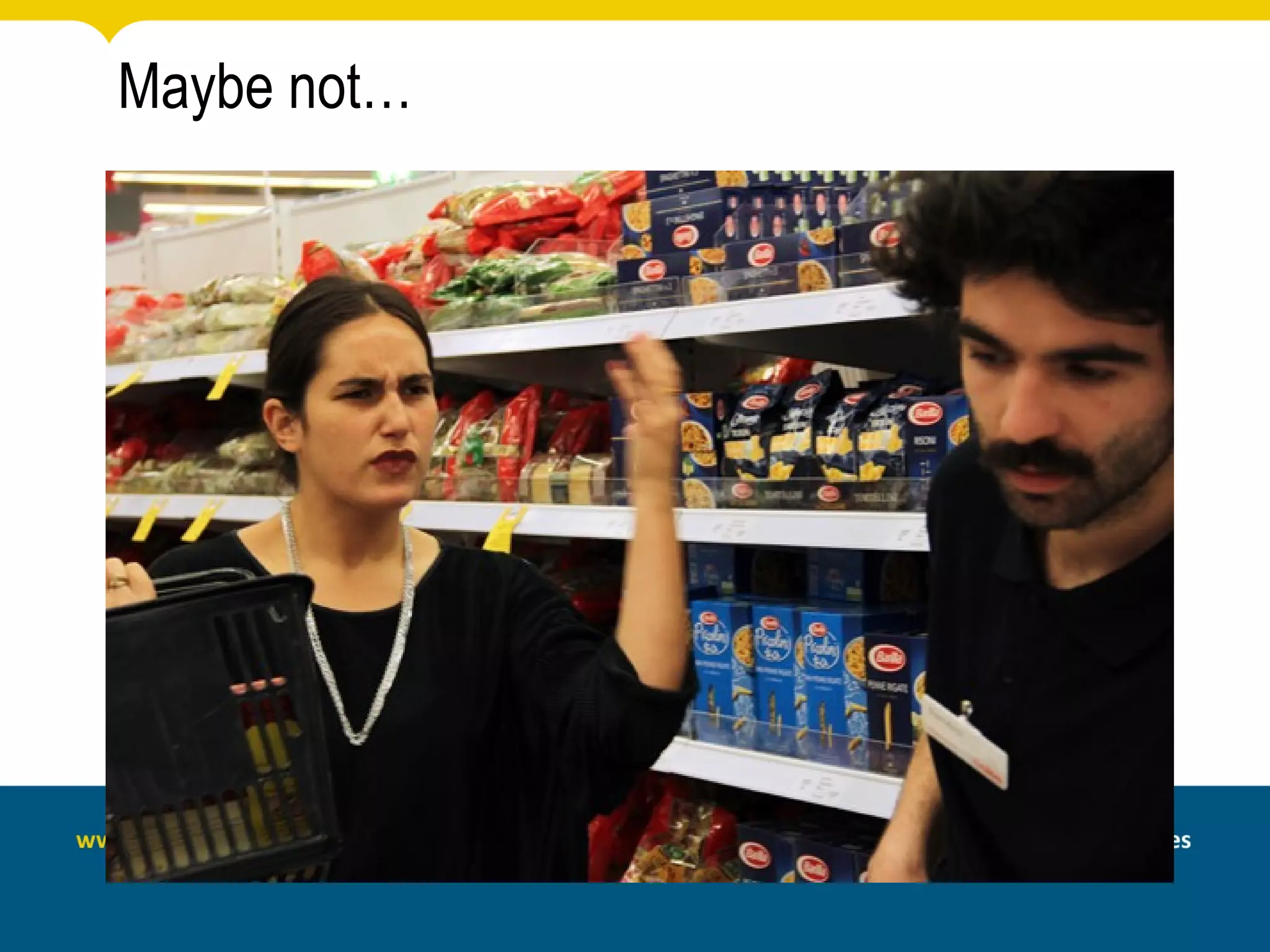
Maybe not…
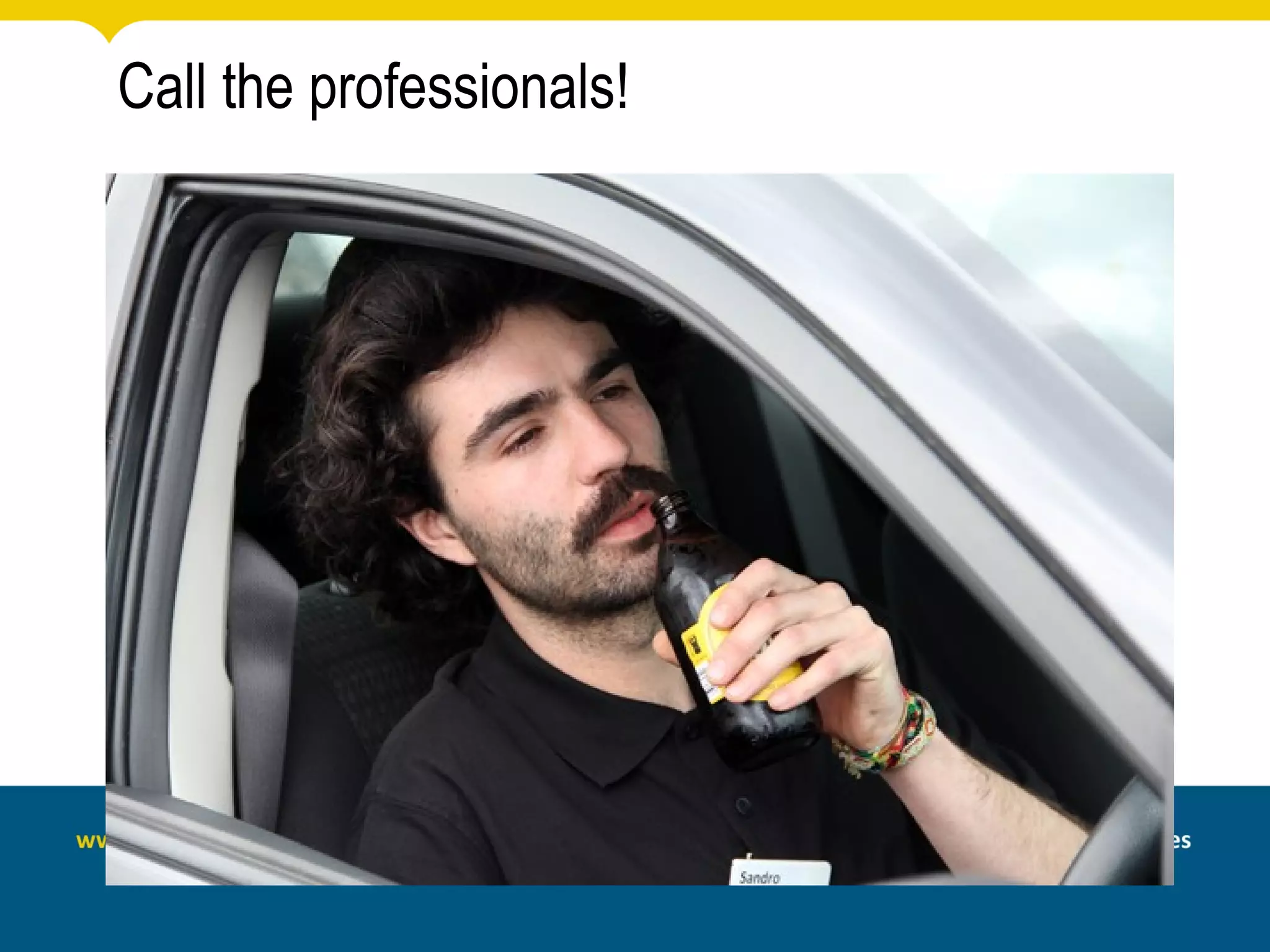
Call the professionals!
Self Paced Content Examples


                        Photo Credit: http://www.flickr.com/photos/43716015@N00/5381002934/
                                                   http://creativecommons.org/licenses/by-nc/2.0/
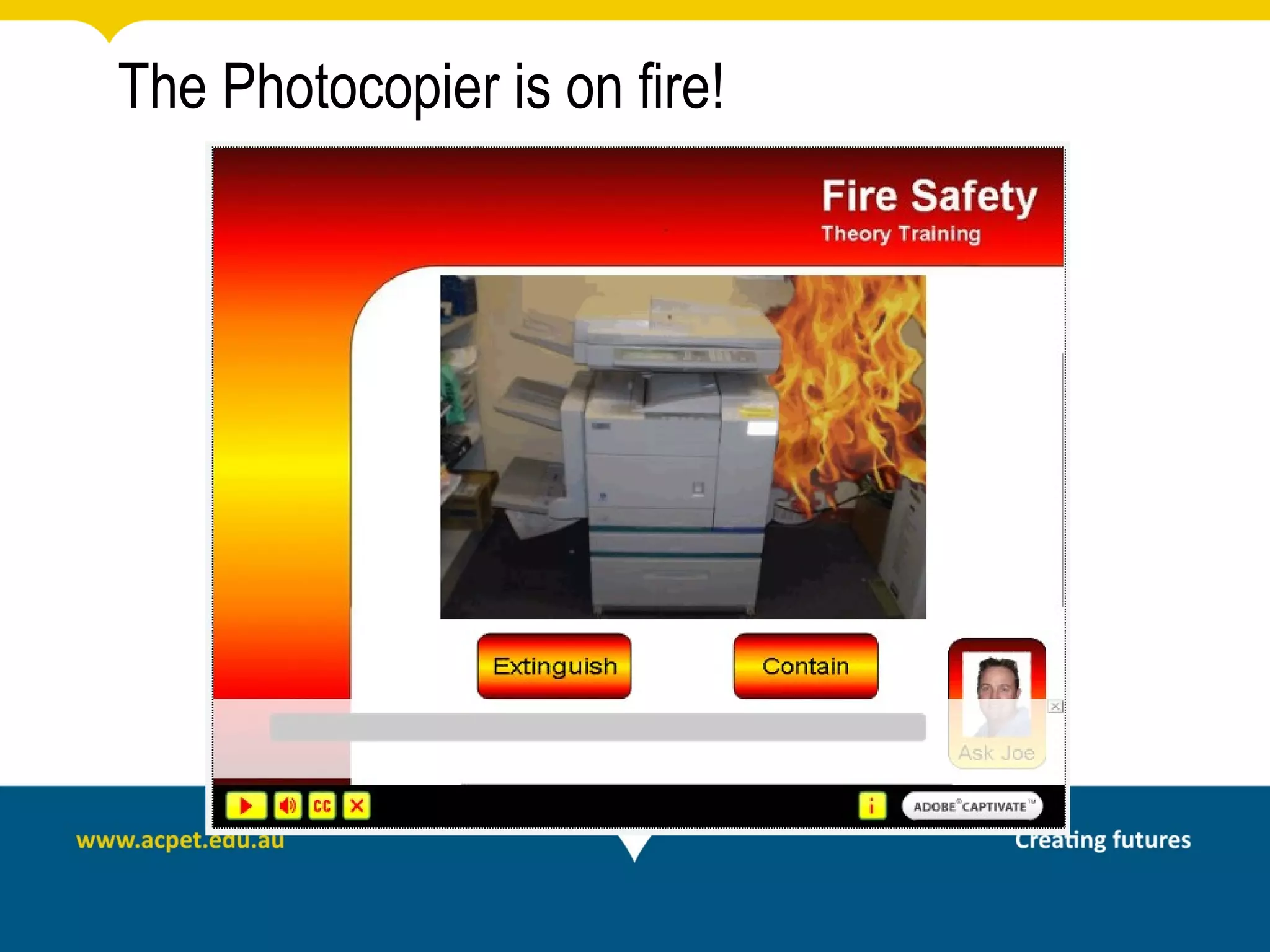
The Photocopier is on fire!
Council Community Video
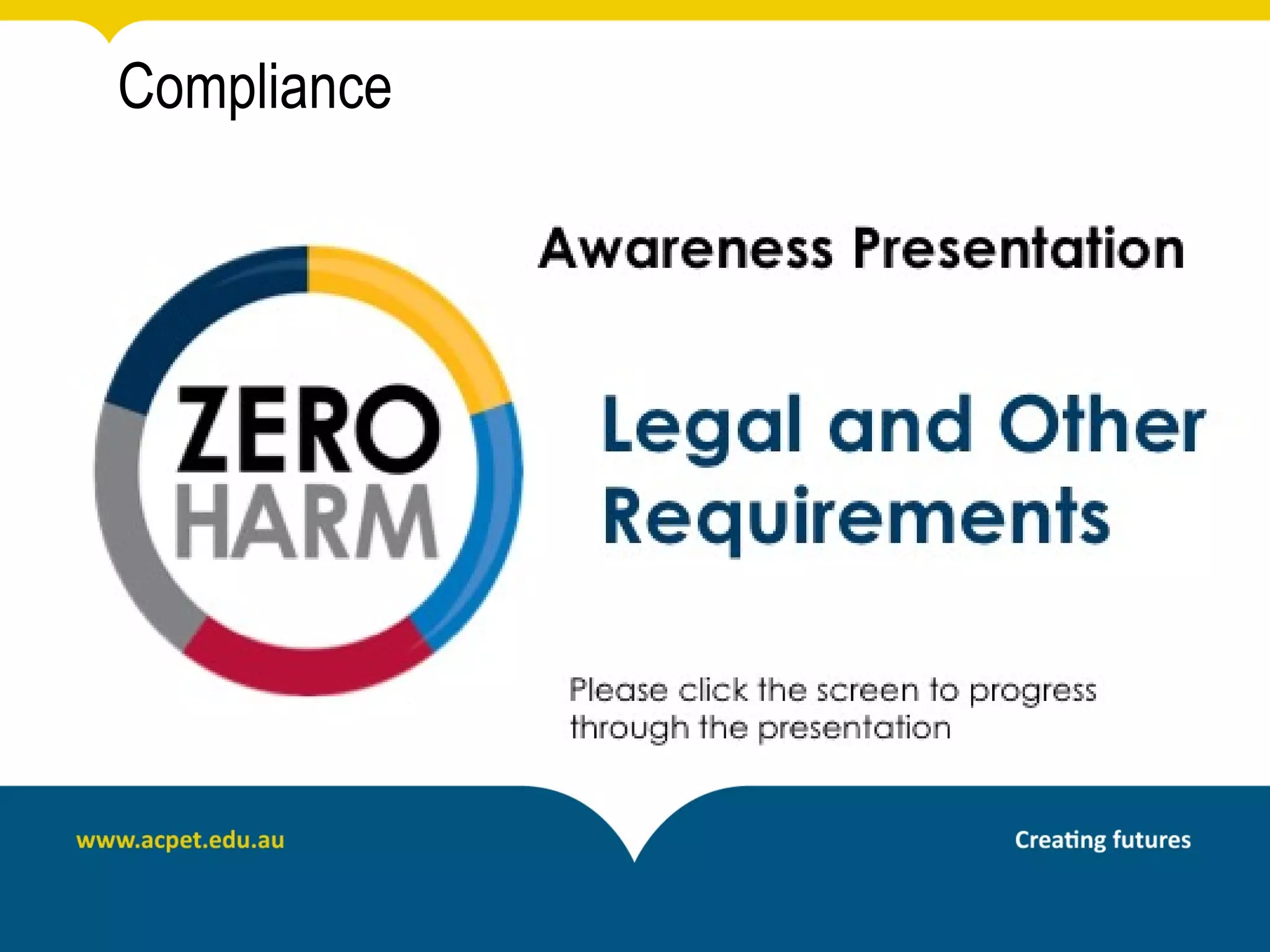
Compliance
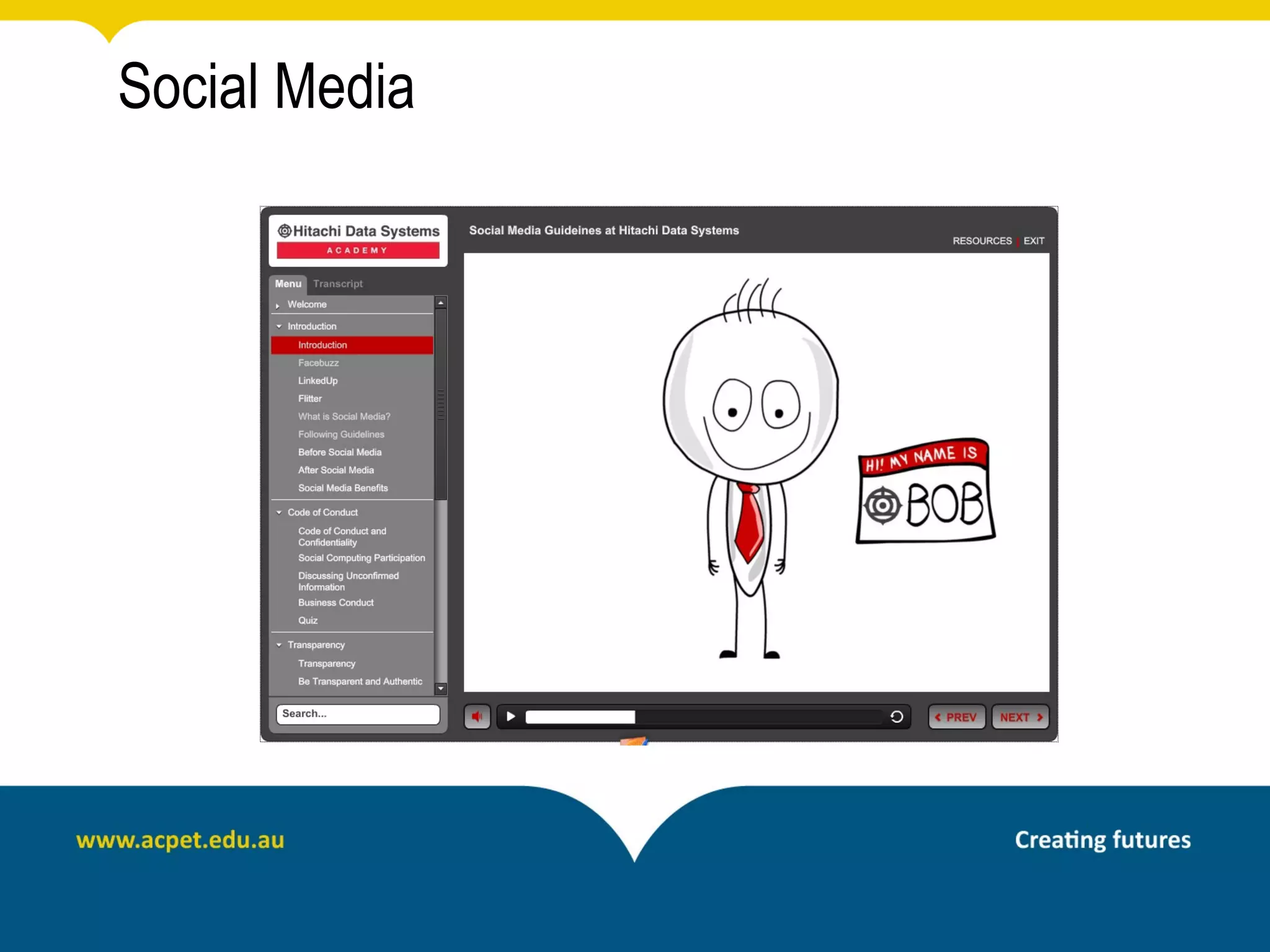
Social Media
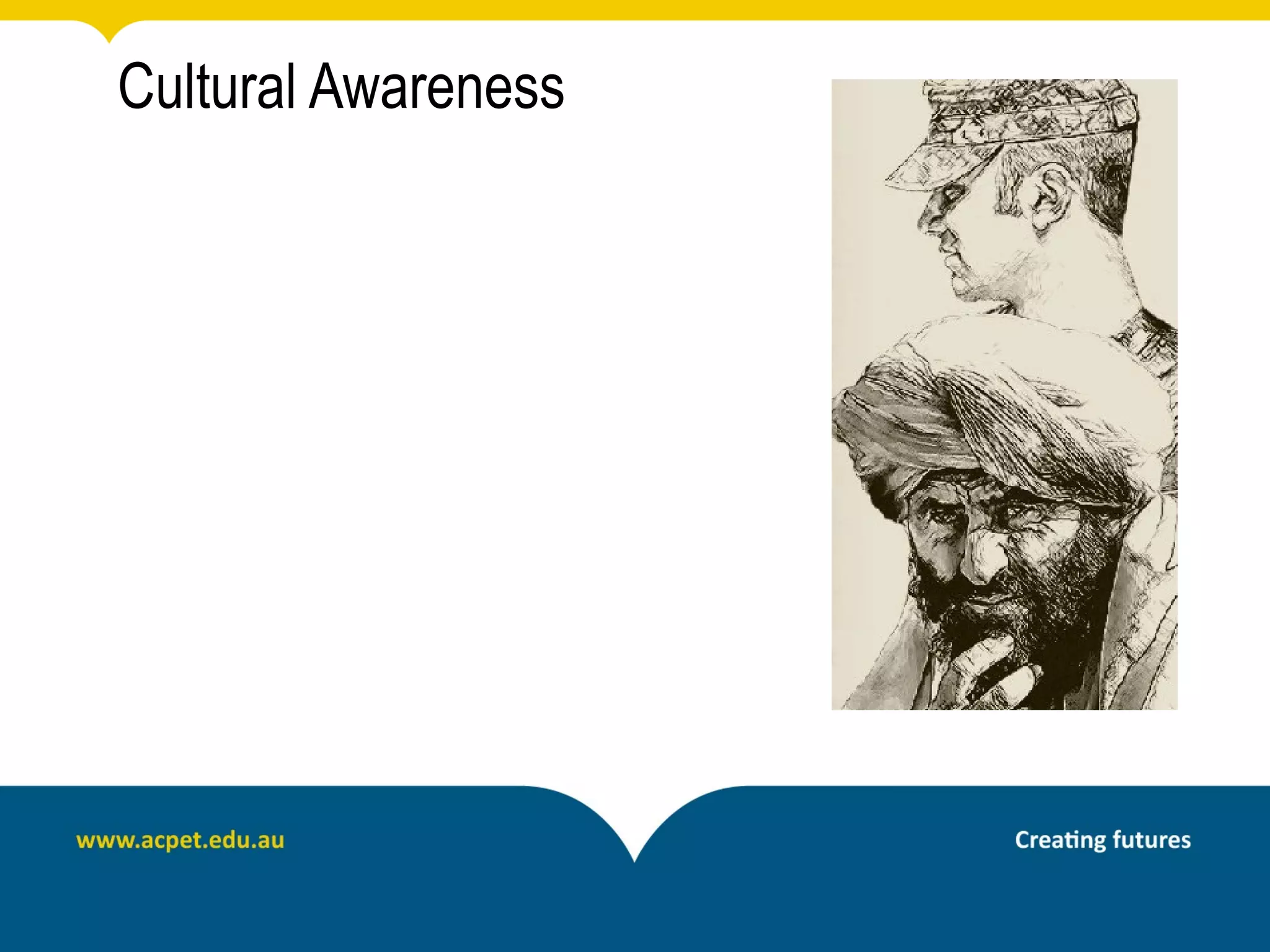
Cultural Awareness
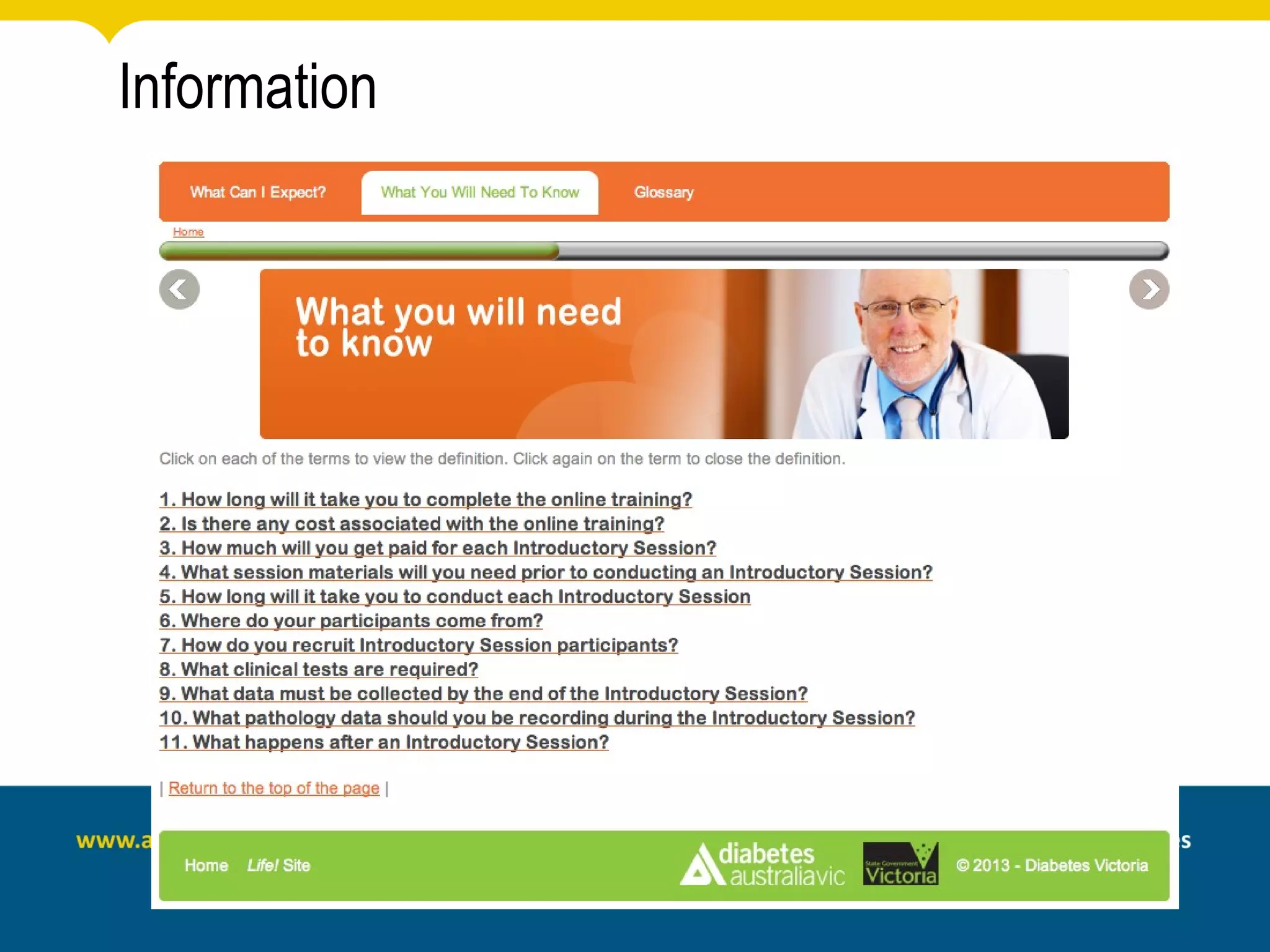
Information
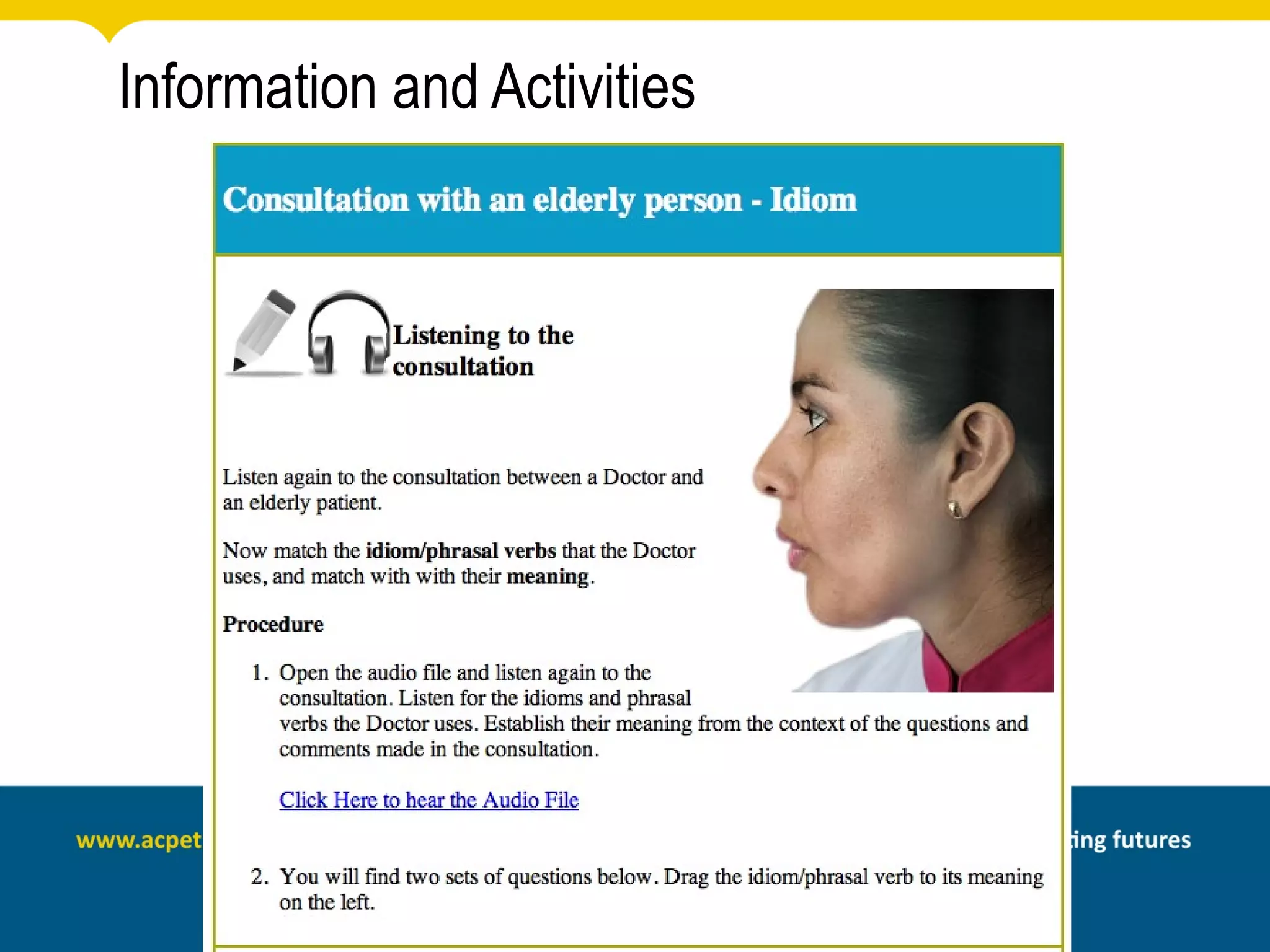
Information and Activities
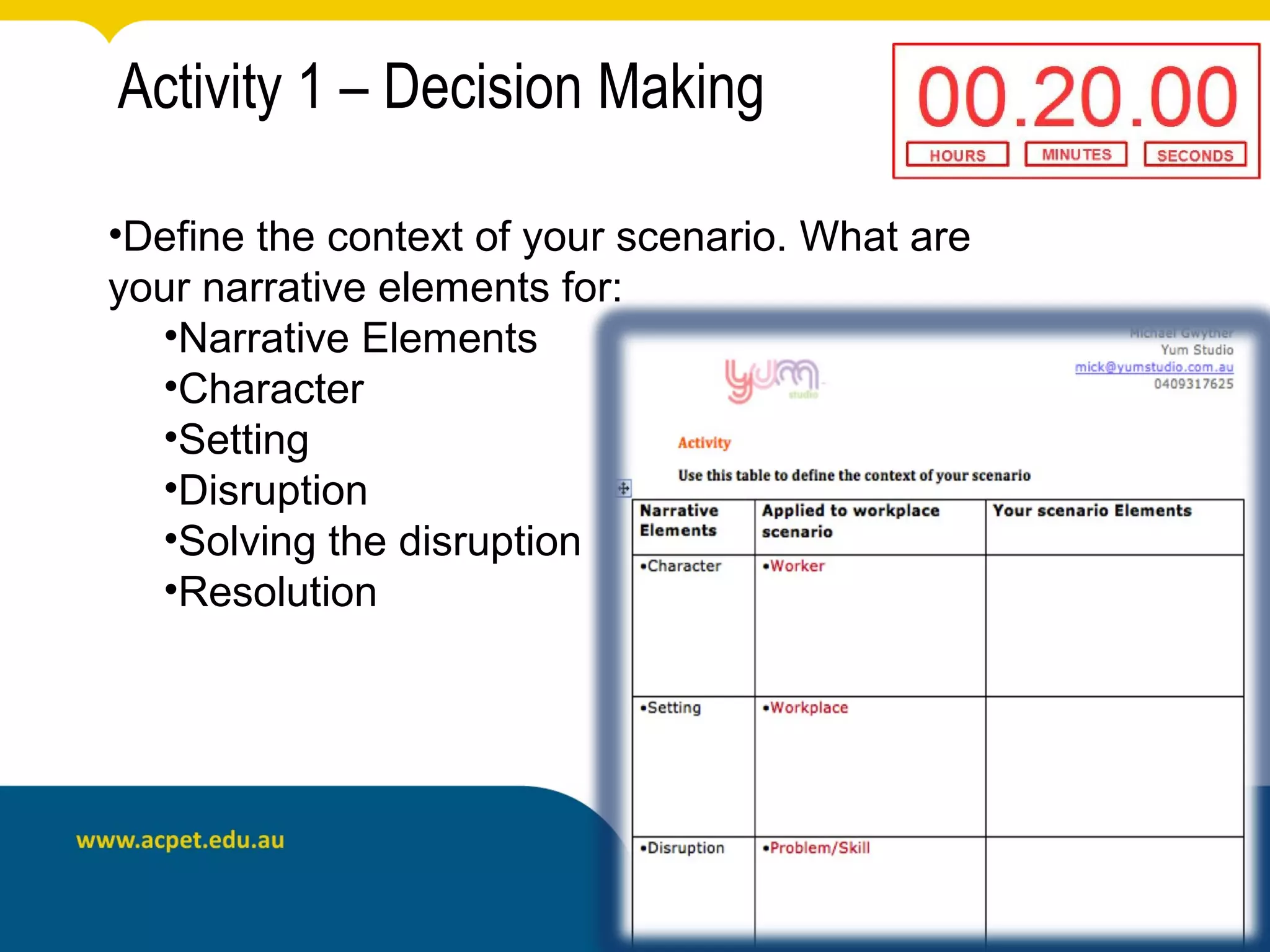
Activity 1 – Decision Making

•Define the context of your scenario. What are
your narrative elements for:
  •Narrative Elements
  •Character
  •Setting
  •Disruption
  •Solving the disruption
  •Resolution
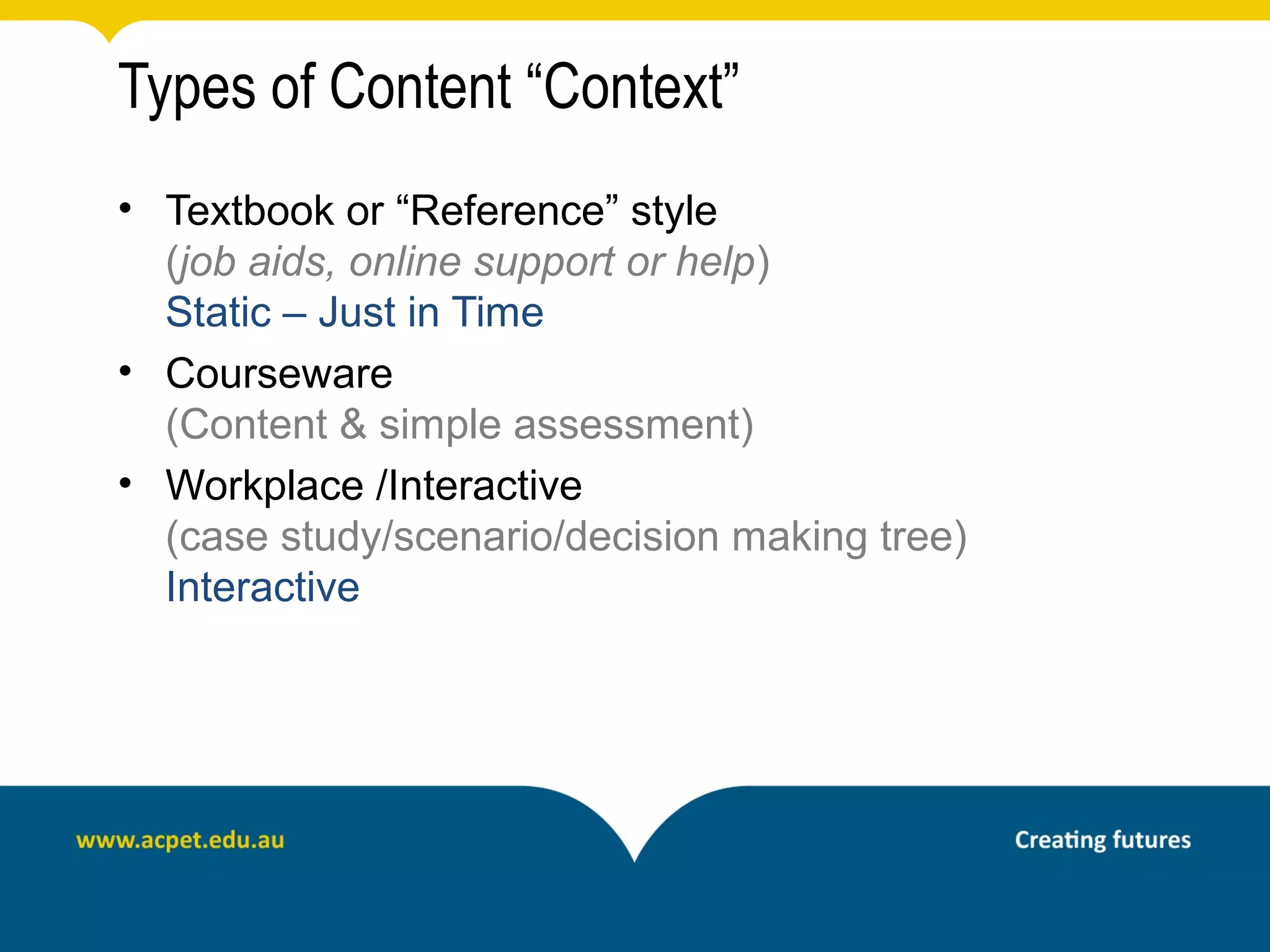
Types of Content “Context”
• Textbook or “Reference” style
  (job aids, online support or help)
  Static – Just in Time
• Courseware
  (Content & simple assessment)
• Workplace /Interactive
  (case study/scenario/decision making tree)
  Interactive
Types of Activities
Information
Demonstration
Case Study
Scenario
Decision Making Tree
Knowledge checking
Problem based Learning
Self Paced Content examples
Compliance testing
Communication scenarios
Application of policy & procedure decision making trees
Course Content
Assessment tasks and associated guided
readings/resources/multimedia
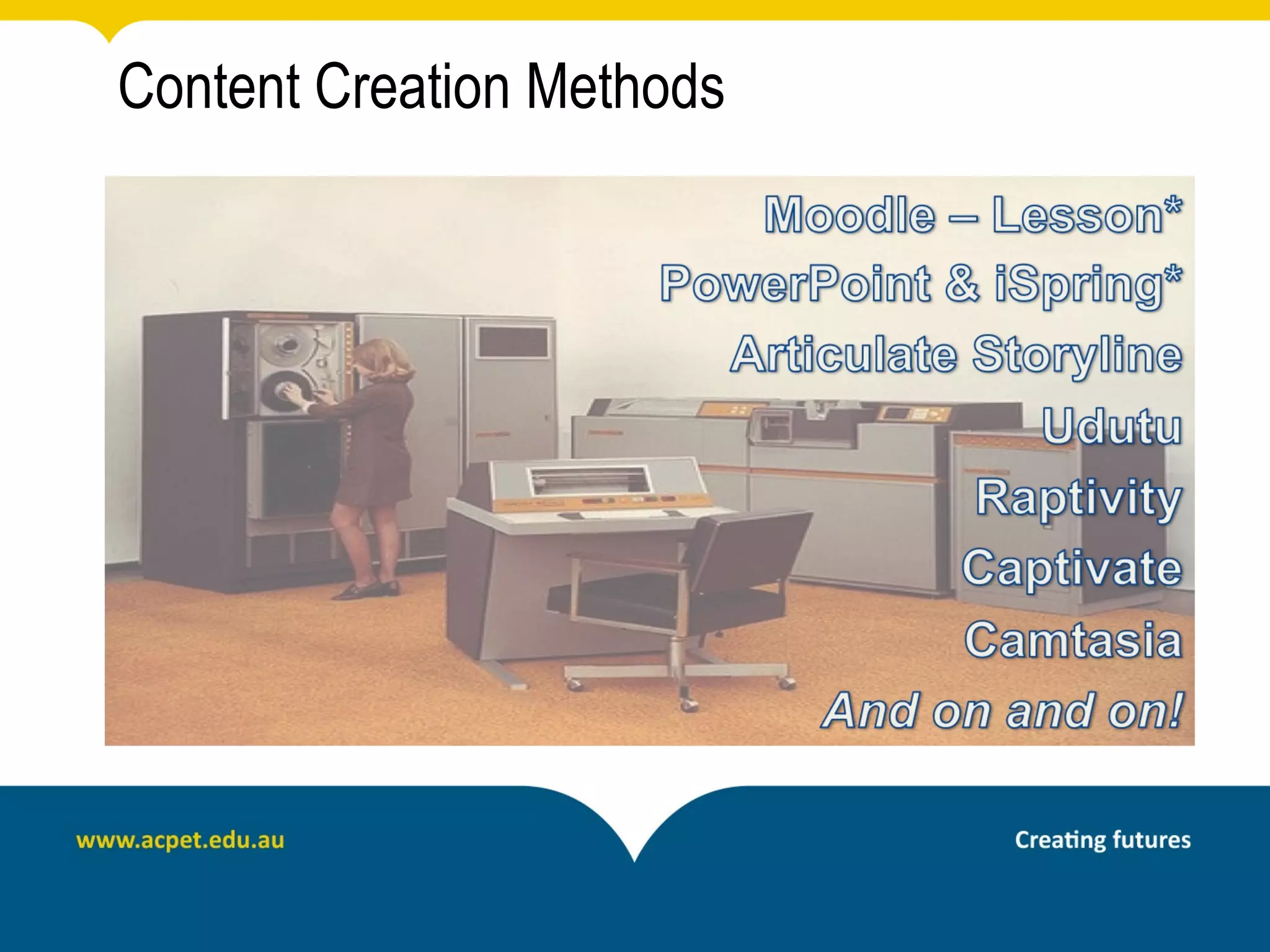
Content Creation Methods
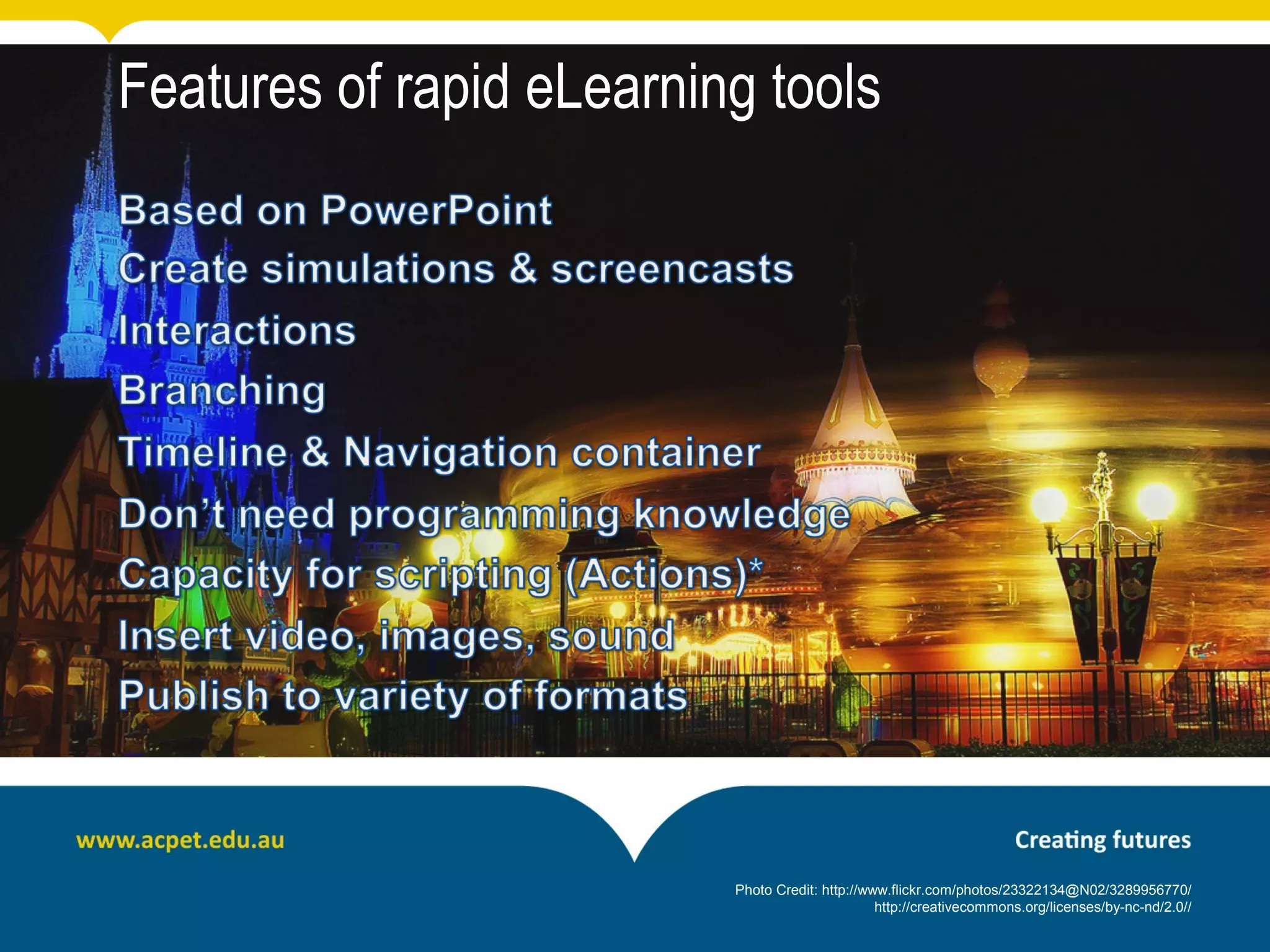
Features of rapid eLearning tools


                          Photo Credit: http://www.flickr.com/photos/23322134@N02/3289956770/
                                                 http://creativecommons.org/licenses/by-nc-nd/2.0//
Assessment

Quizzes
Decision
making Trees
Short answer
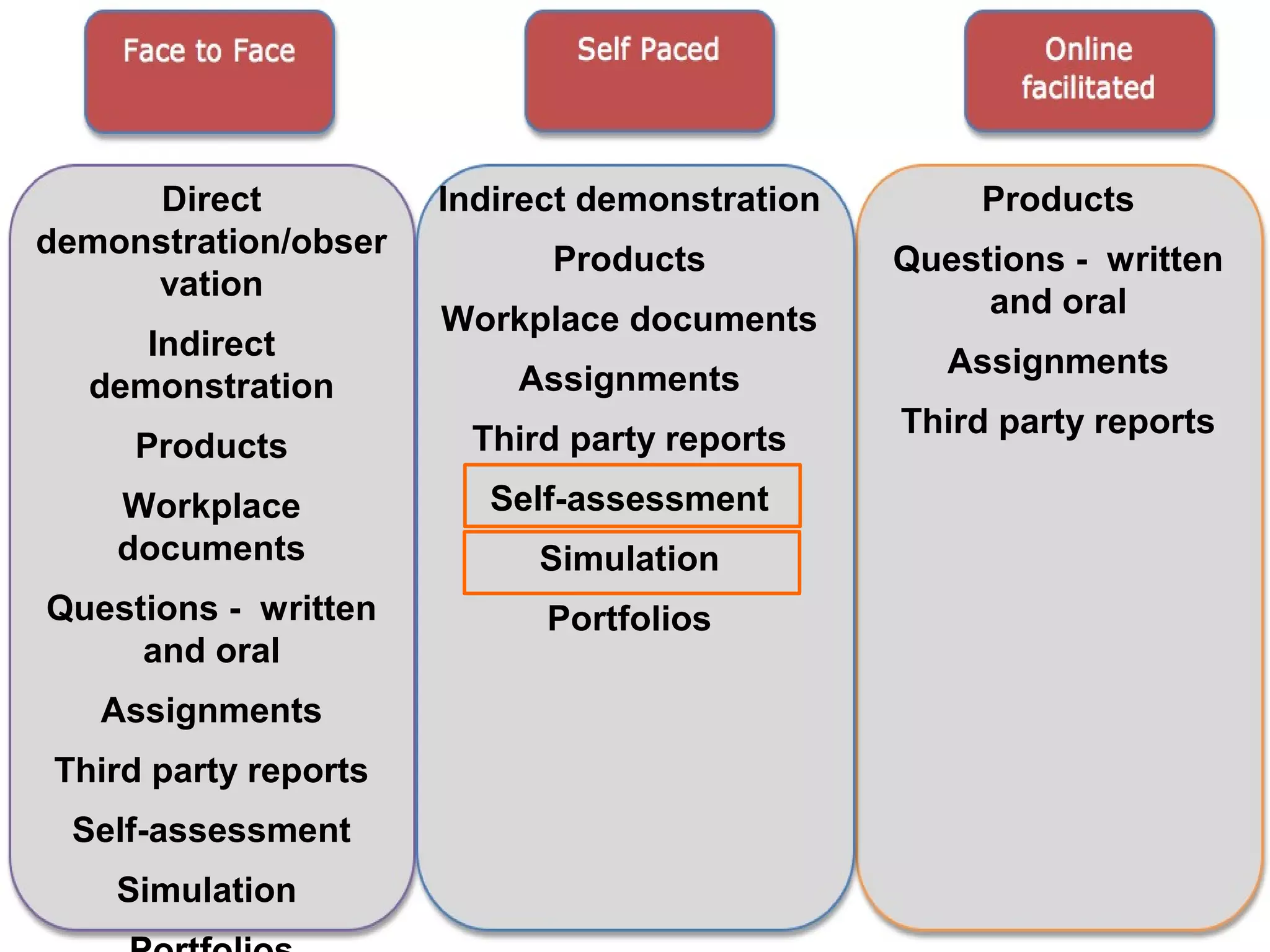
Assessment
      Direct          Indirect demonstration        Products
demonstration/obser         Products           Questions - written
     vation                                         and oral
                      Workplace documents
     Indirect
                          Assignments             Assignments
  demonstration
                       Third party reports     Third party reports
     Products
    Workplace           Self-assessment
    documents              Simulation
Questions - written         Portfolios
     and oral
   Assignments
Third party reports
 Self-assessment
    Simulation
What to do with this darn content?

•Run off computer in training room
•Add to your intranet
•Burn to CD or USB
•Upload to your LMS either via
   •SCORM (zip) or,
   •File (and link to the
   first page.)
Output of rapid eLearning tools
Flash
HTML
HTML5
Word
SCORM
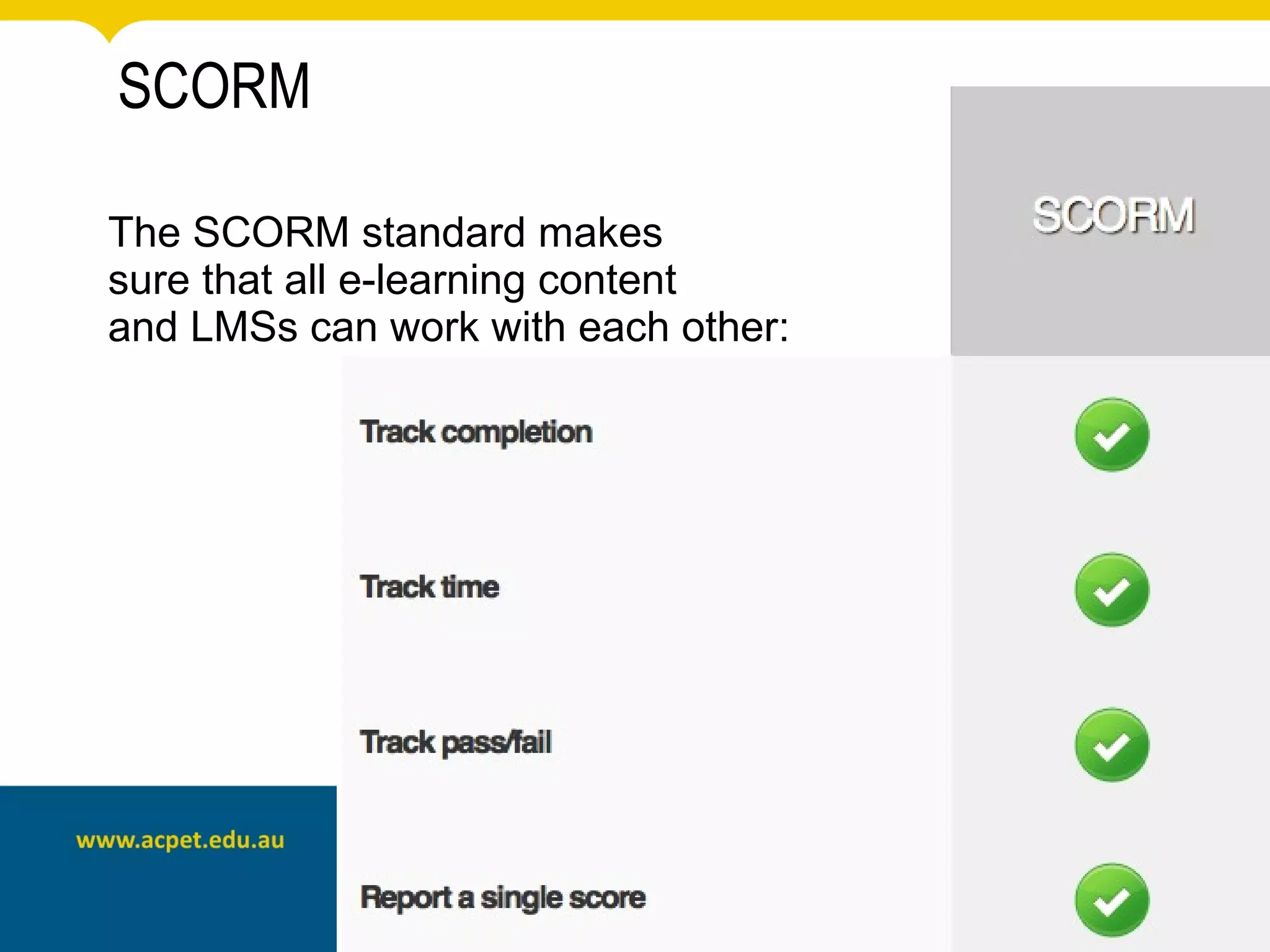
SCORM

The SCORM standard makes
sure that all e-learning content
and LMSs can work with each other:
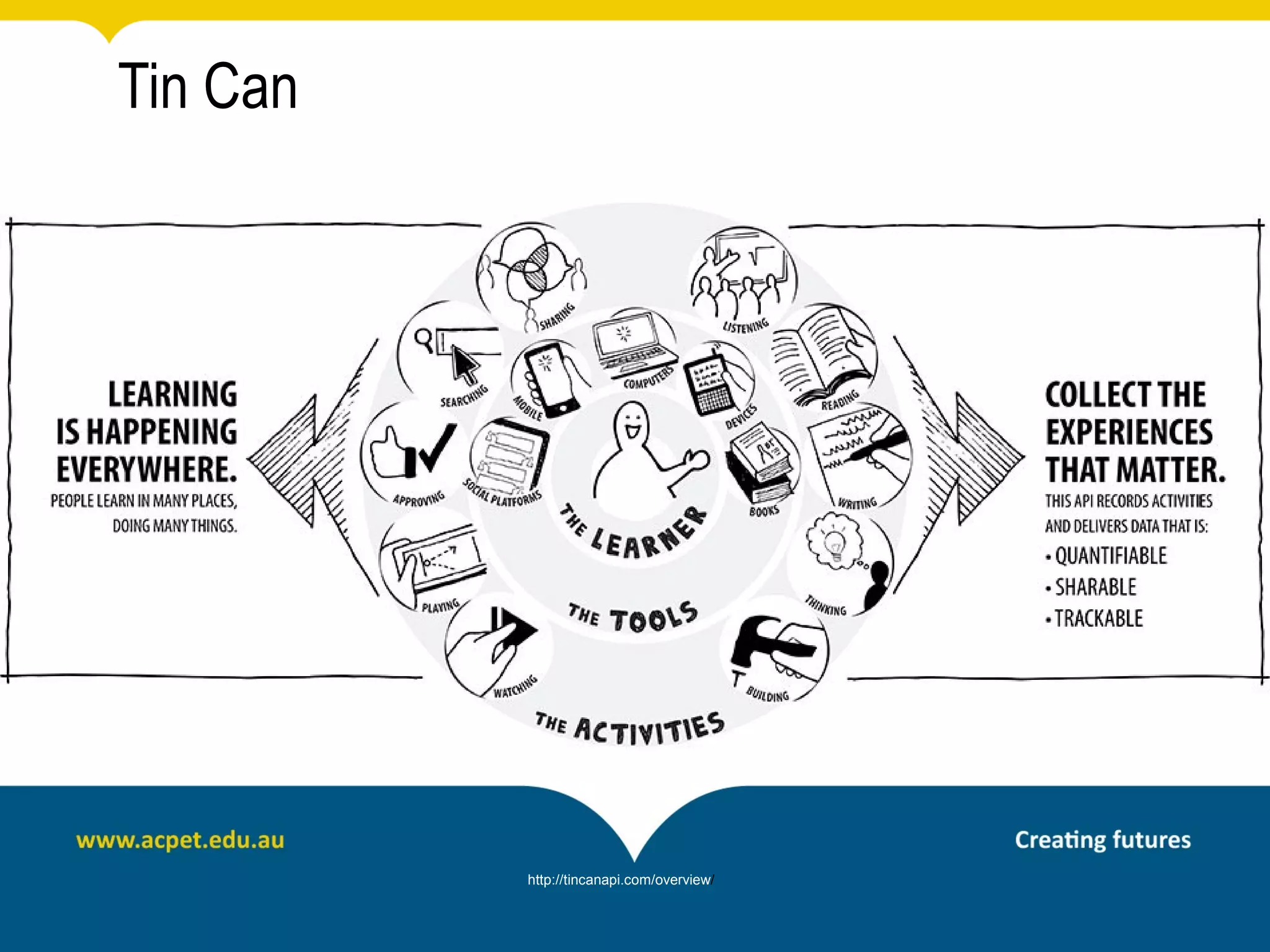
Tin Can


          http://tincanapi.com/overview/
What is your itch?


                     Photo Credit: http://www.flickr.com/photos/7149027@N07/6066027411
                                          CC: http://creativecommons.org/licenses/by-nd/2.0/
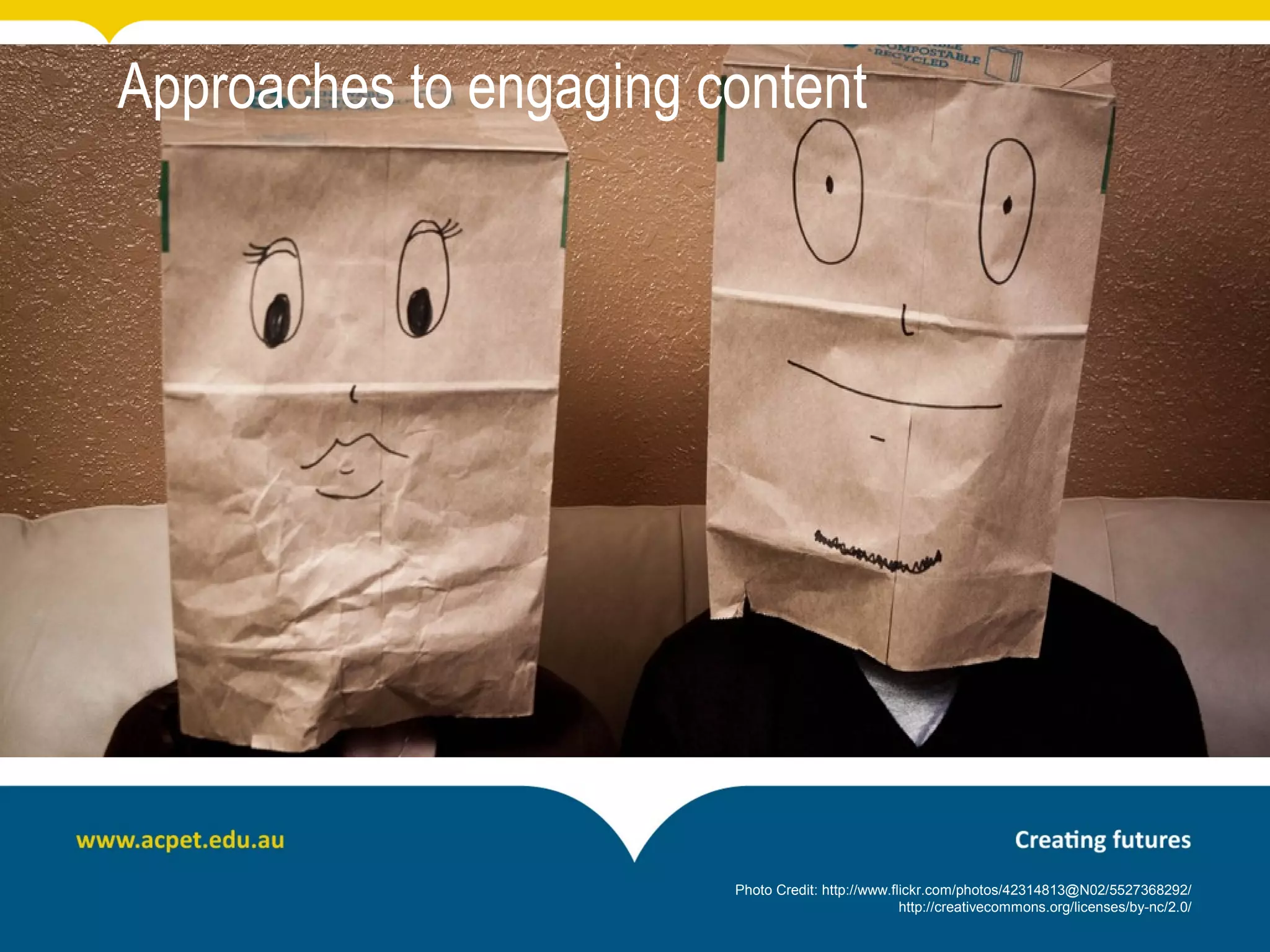
Approaches to engaging content


                        Photo Credit: http://www.flickr.com/photos/42314813@N02/5527368292/
                                                   http://creativecommons.org/licenses/by-nc/2.0/
Onscreen Text
•   What information is best presented as on-screen
    text?
•   How much is too much? Remember, learners
    typically only scan the on-screen text.
Storyboarding
•   A course outline or storyboard will help you to
    organize both the course content and your thoughts
    on interactivity.
          • Onscreen Text
          • Audio Scripting
          • Interactions/Quizzes
          • Graphics/Images
          • Video
          • References & Weblinks
          • Development Notes
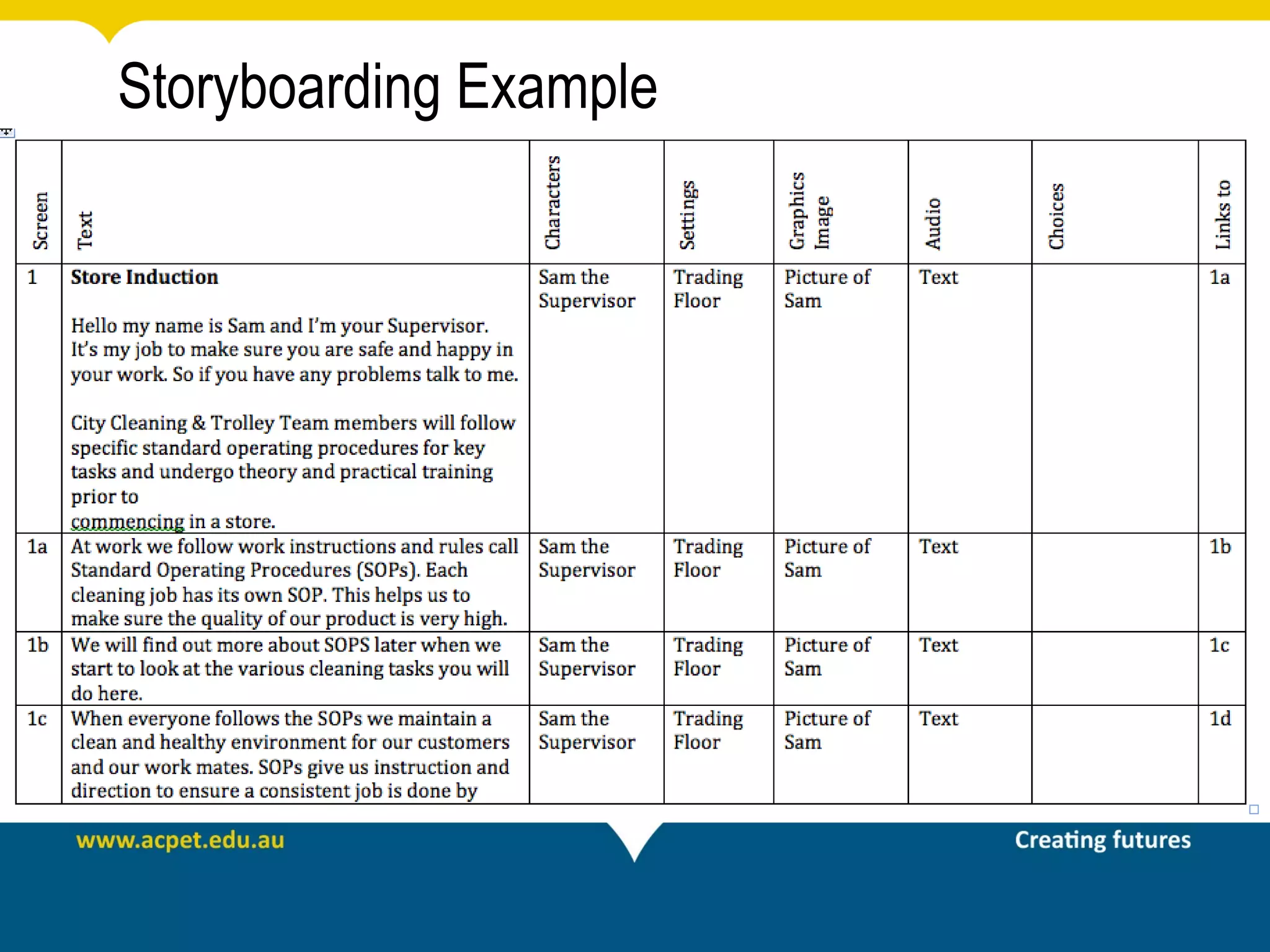
Storyboarding Example
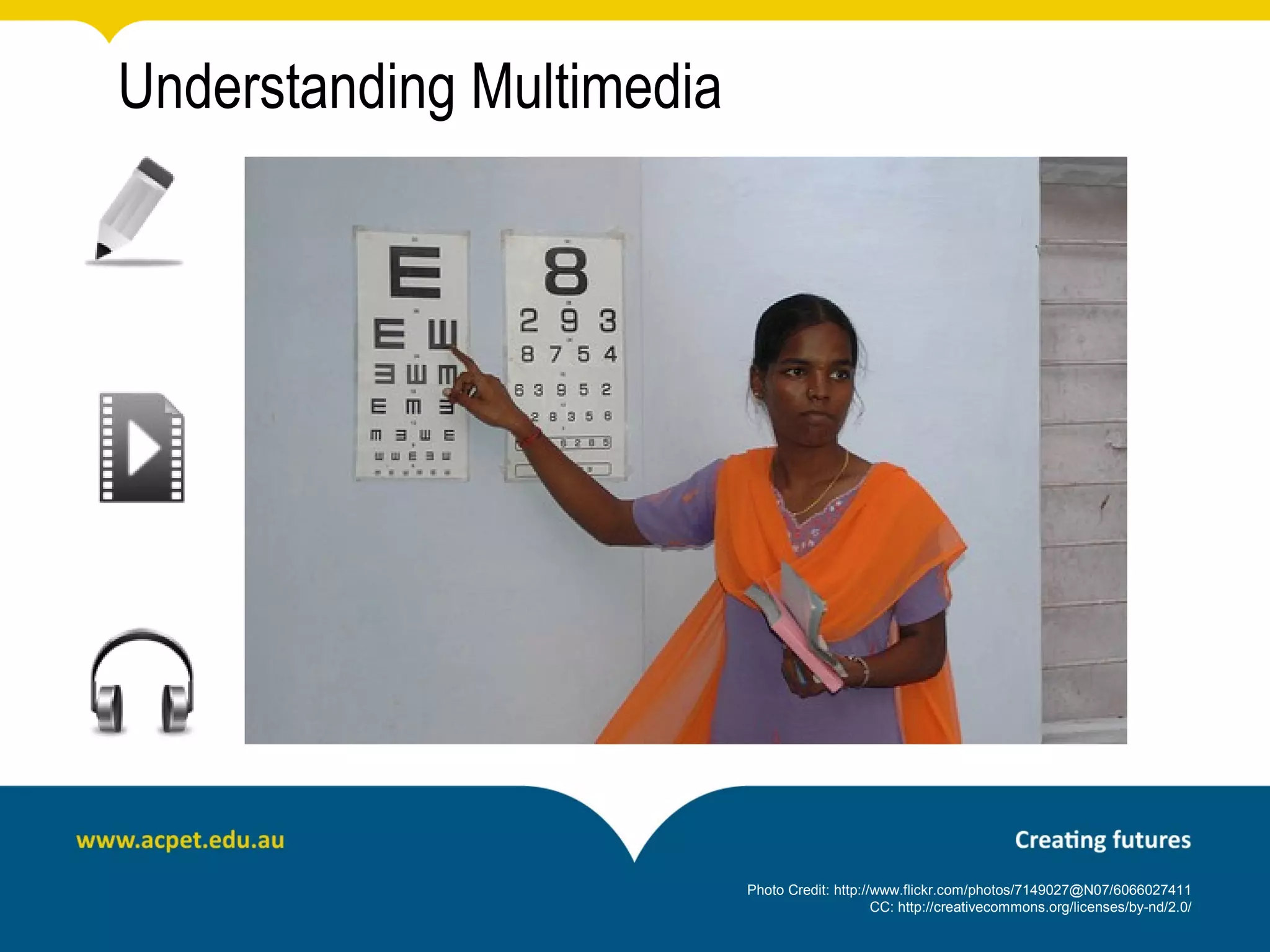
Understanding Multimedia


                           Photo Credit: http://www.flickr.com/photos/7149027@N07/6066027411
                                                CC: http://creativecommons.org/licenses/by-nd/2.0/
Integrating Audio

Quality
Compression
Control the Environment
Professional voices V Amateurs
Music & Sound Effects
Pros & Cons of “Script Reading”
WAV & MP3
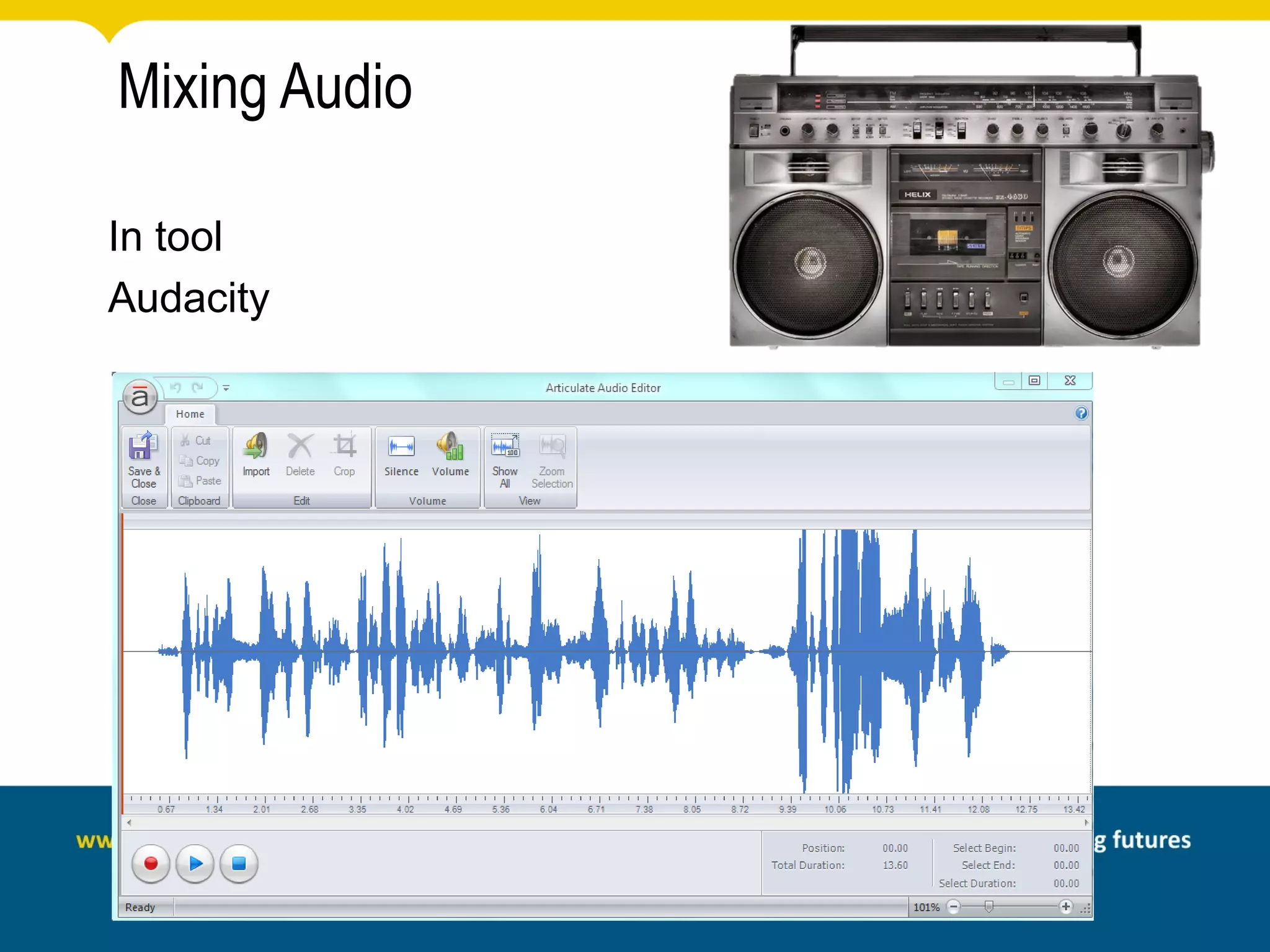
Mixing Audio

In tool
Audacity
Stock Music & FX


http://www.freesound.org/
http://opsound.org/
http://librivox.org/
http://www.opensourcemusic.com/
http://ccmixter.org/
http://www.flashkit.com/loops/
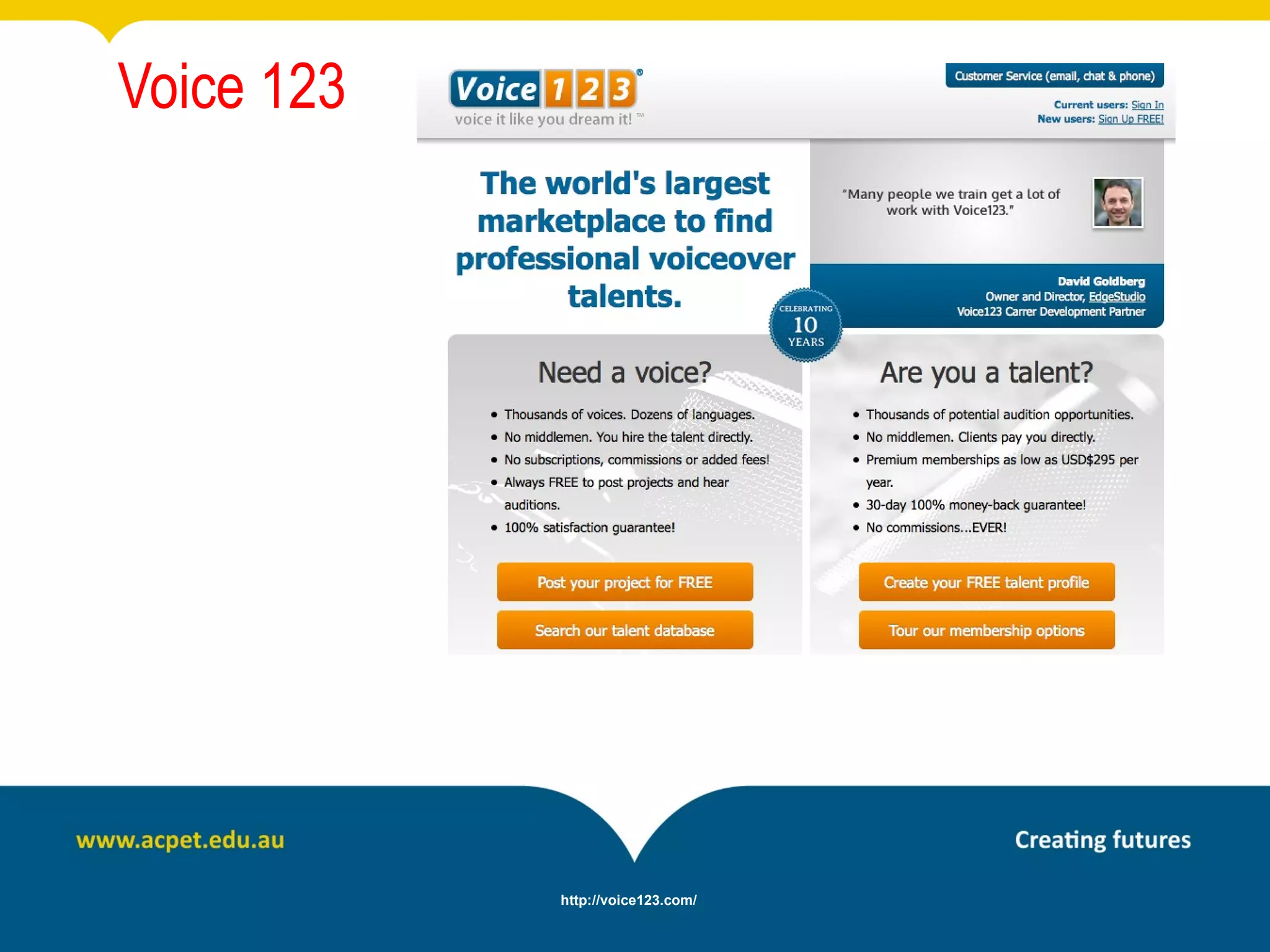
Voice 123


            http://voice123.com/
Integrating Video

Bandwidth
Short
Do record demos but not your F2F class
Lighting & Background
Quality
Camera (Smartphones & Tablets)
Use a Voiceover
Rule of Thirds
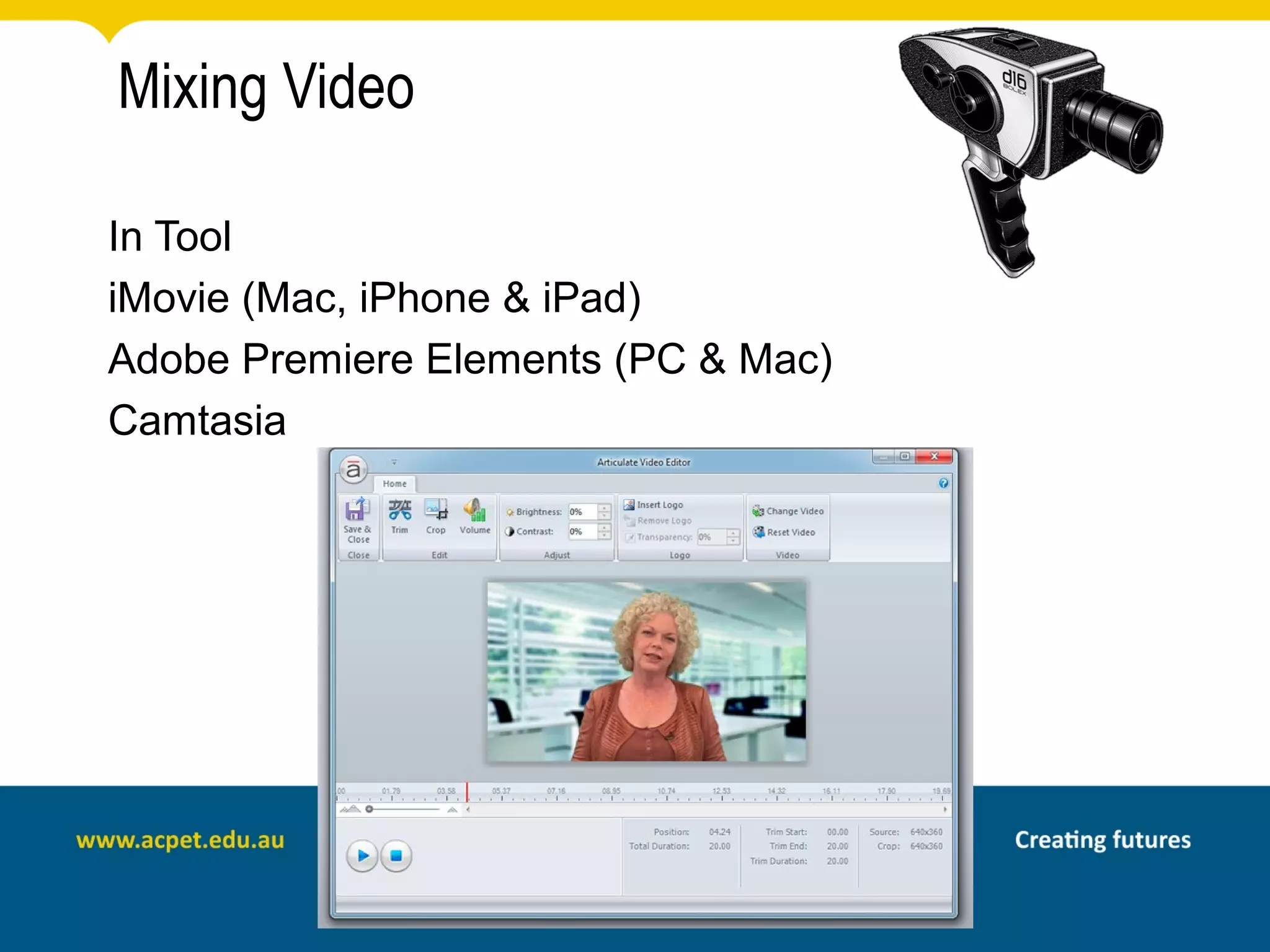
Mixing Video

In Tool
iMovie (Mac, iPhone & iPad)
Adobe Premiere Elements (PC & Mac)
Camtasia
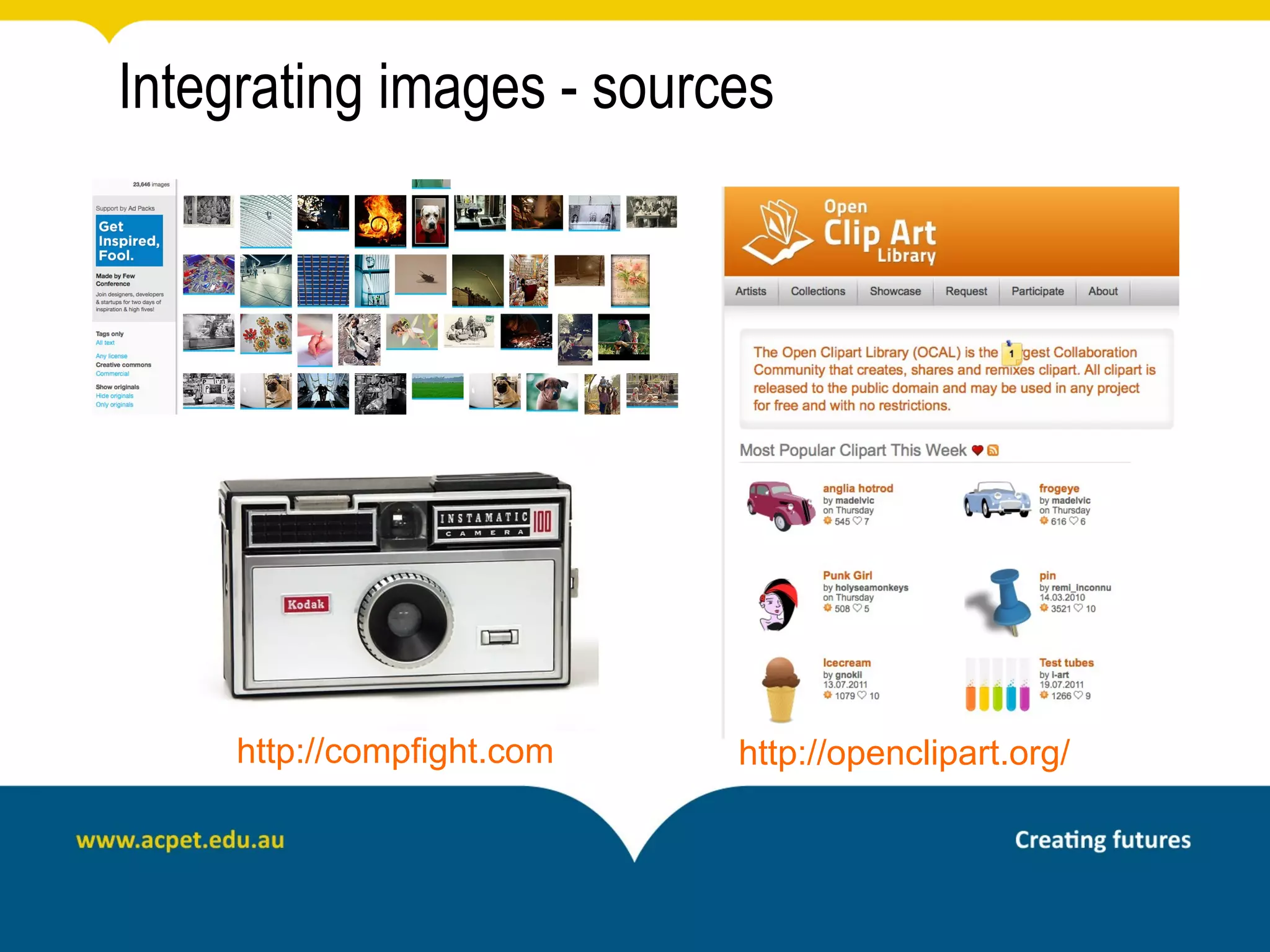
Integrating images - sources


     http://compfight.com   http://openclipart.org/
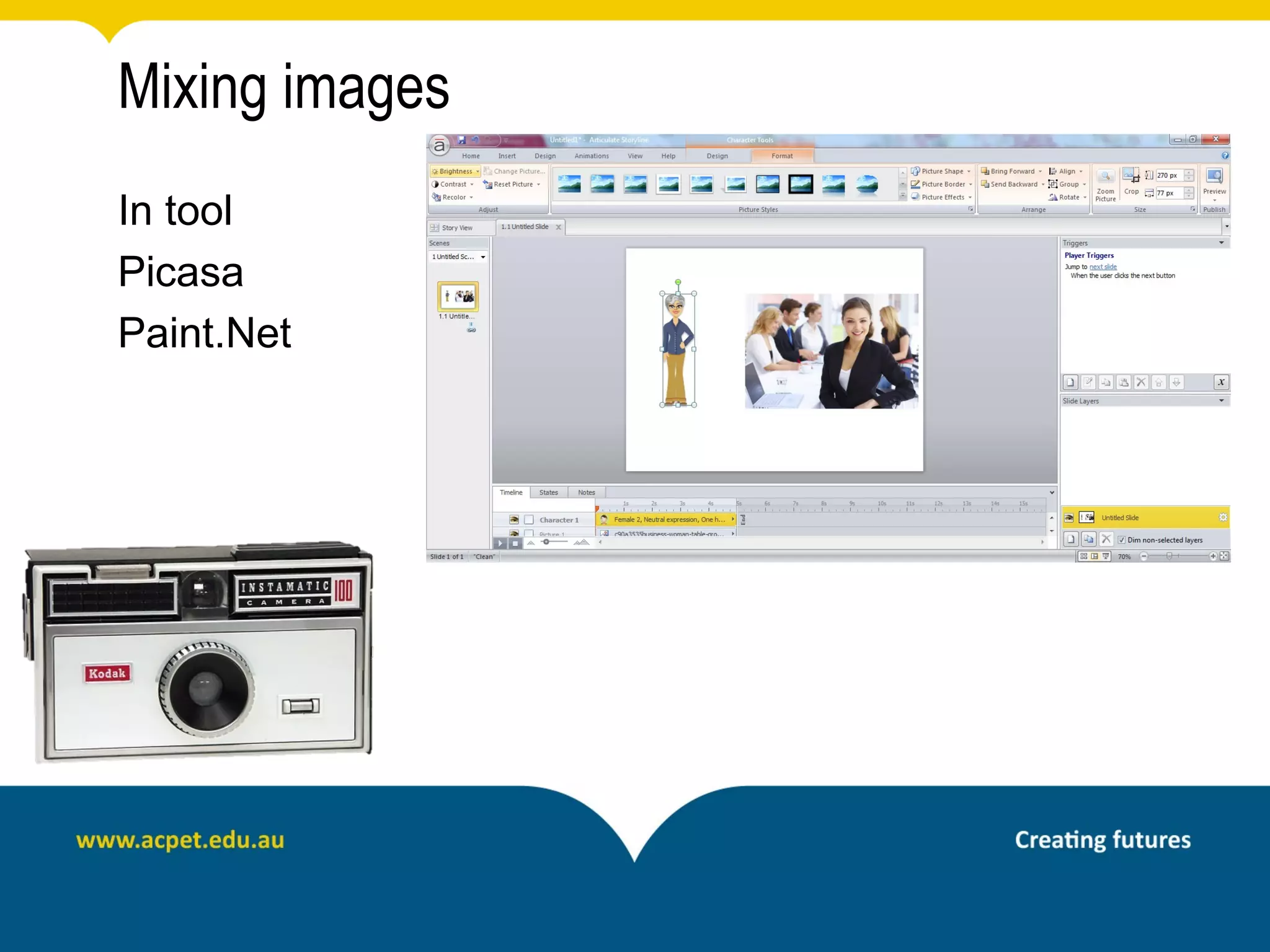
Mixing images
In tool
Picasa
Paint.Net
Creative Commons


Creative Commons is a nonprofit that
offers flexible copyright management
tools for creative work.
Offering your work under a Creative
Commons license does not mean
giving up your copyright. It means
offering some of your rights to any
taker, and only on certain conditions.
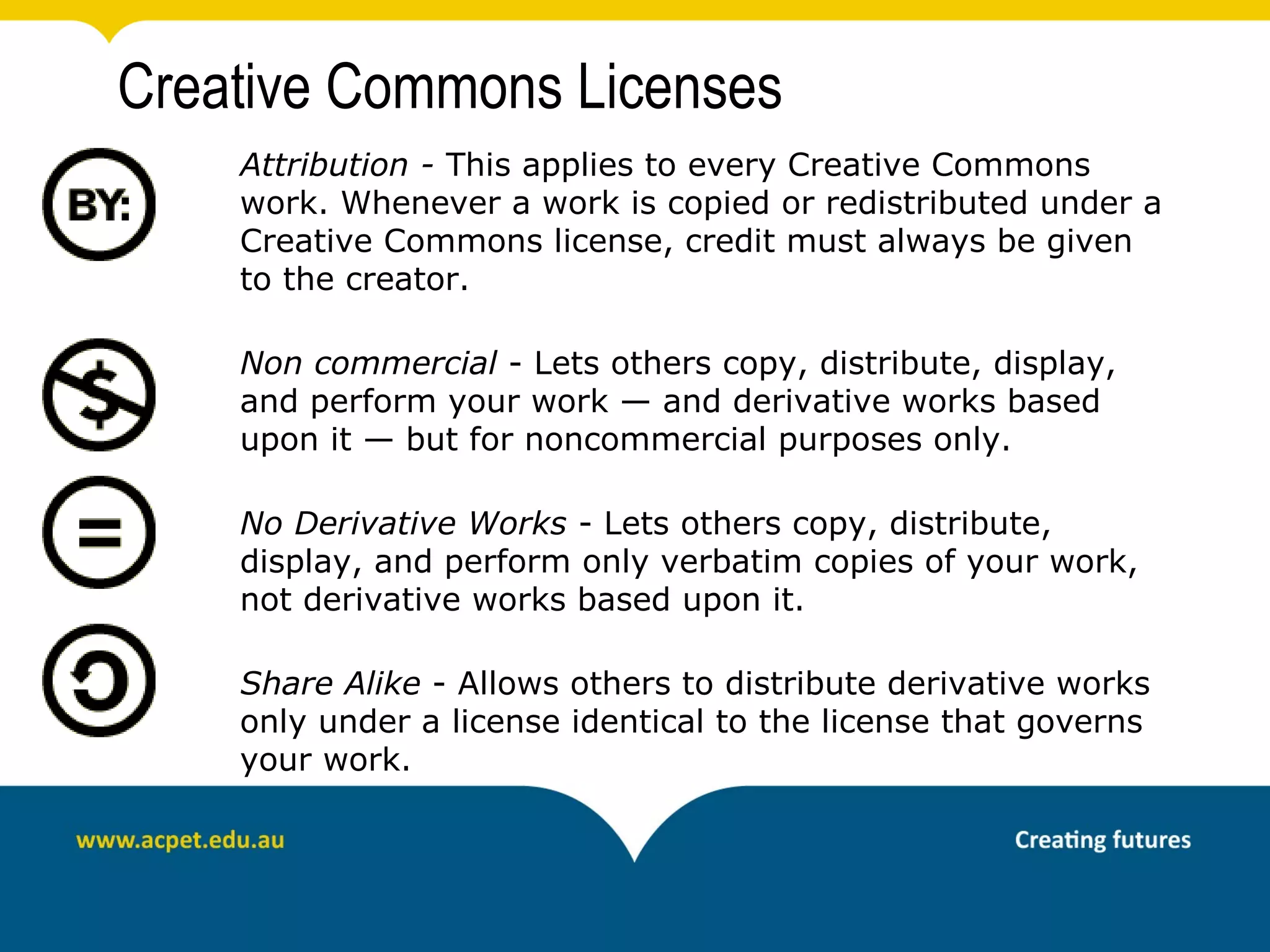
Creative Commons Licenses
    Attribution - This applies to every Creative Commons
    work. Whenever a work is copied or redistributed under a
    Creative Commons license, credit must always be given
    to the creator.

    Non commercial - Lets others copy, distribute, display,
    and perform your work — and derivative works based
    upon it — but for noncommercial purposes only.

    No Derivative Works - Lets others copy, distribute,
    display, and perform only verbatim copies of your work,
    not derivative works based upon it.

    Share Alike - Allows others to distribute derivative works
    only under a license identical to the license that governs
    your work.
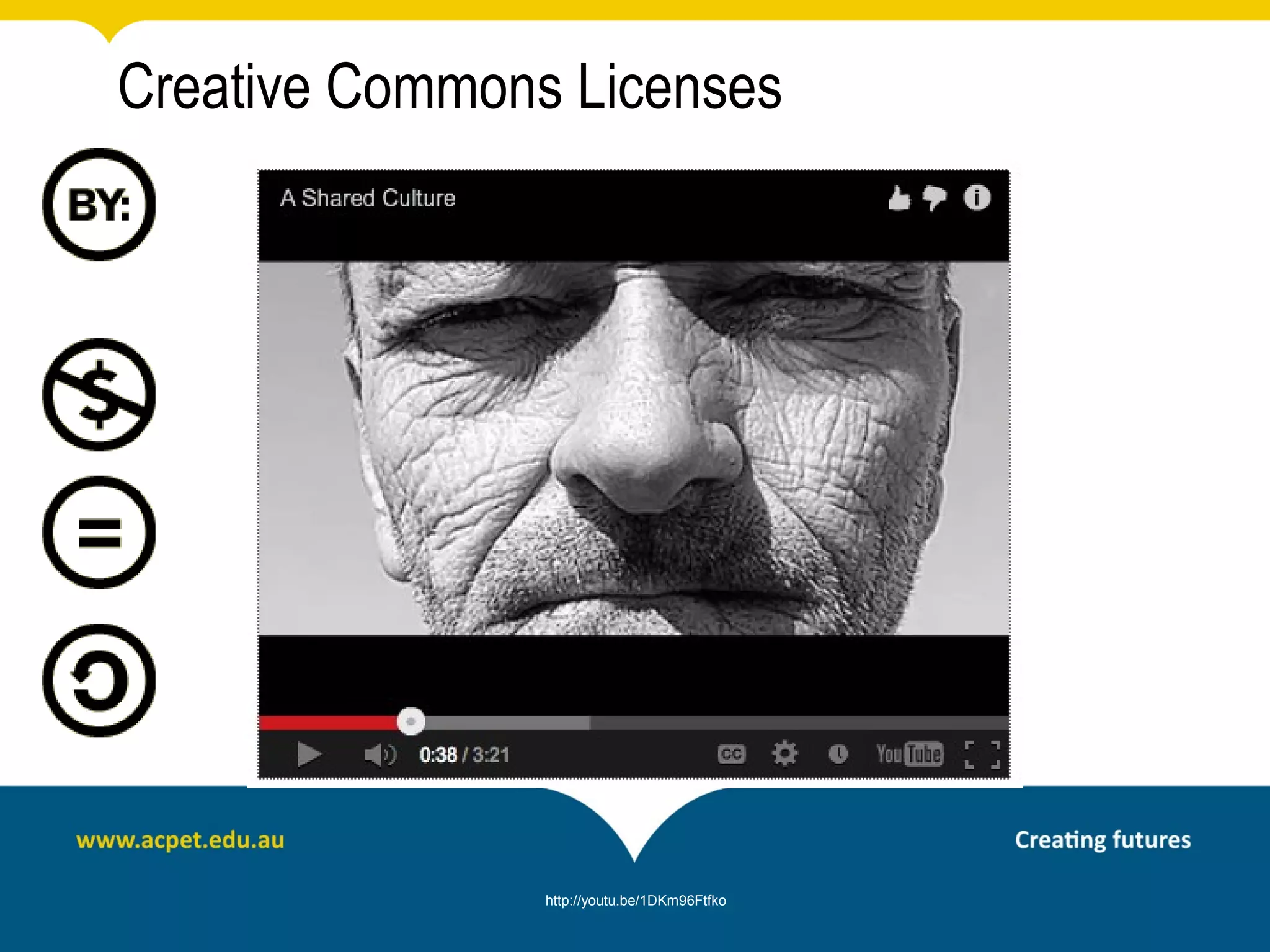
Creative Commons Licenses


                http://youtu.be/1DKm96Ftfko
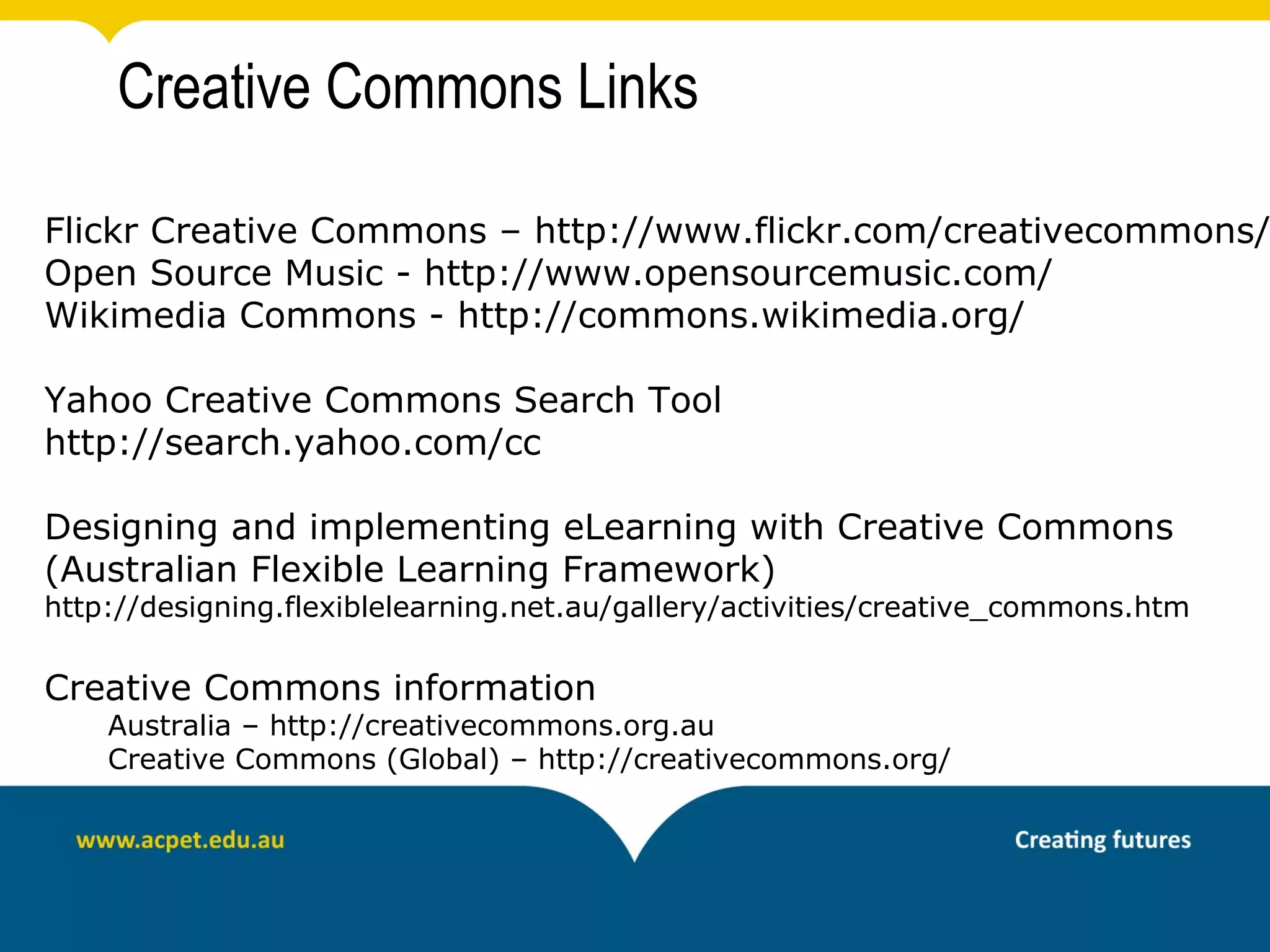
Creative Commons Links

Flickr Creative Commons – http://www.flickr.com/creativecommons/
Open Source Music - http://www.opensourcemusic.com/
Wikimedia Commons - http://commons.wikimedia.org/

Yahoo Creative Commons Search Tool
http://search.yahoo.com/cc

Designing and implementing eLearning with Creative Commons
(Australian Flexible Learning Framework)
http://designing.flexiblelearning.net.au/gallery/activities/creative_commons.htm

Creative Commons information
    Australia – http://creativecommons.org.au
    Creative Commons (Global) – http://creativecommons.org/
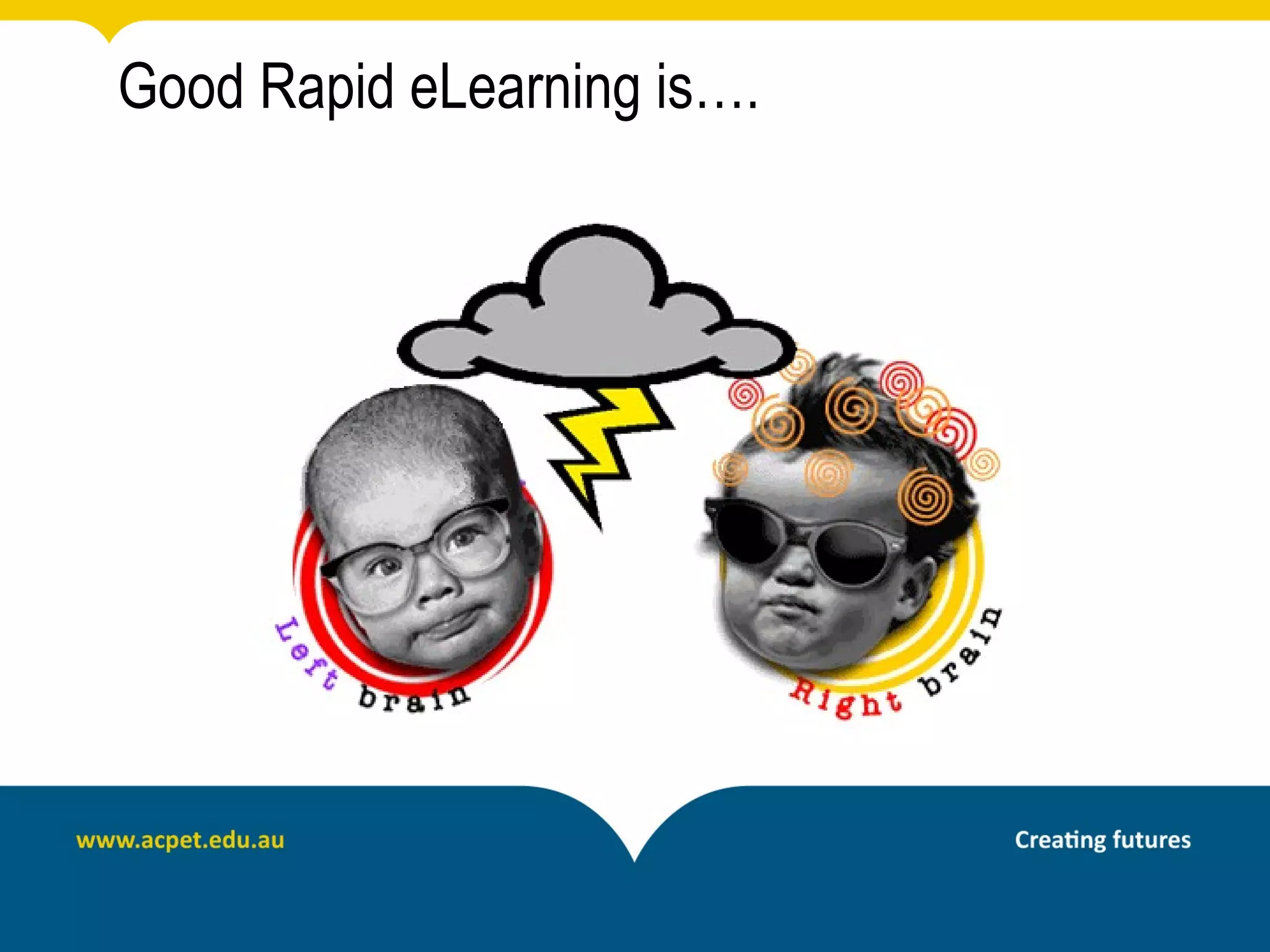
Good Rapid eLearning is….
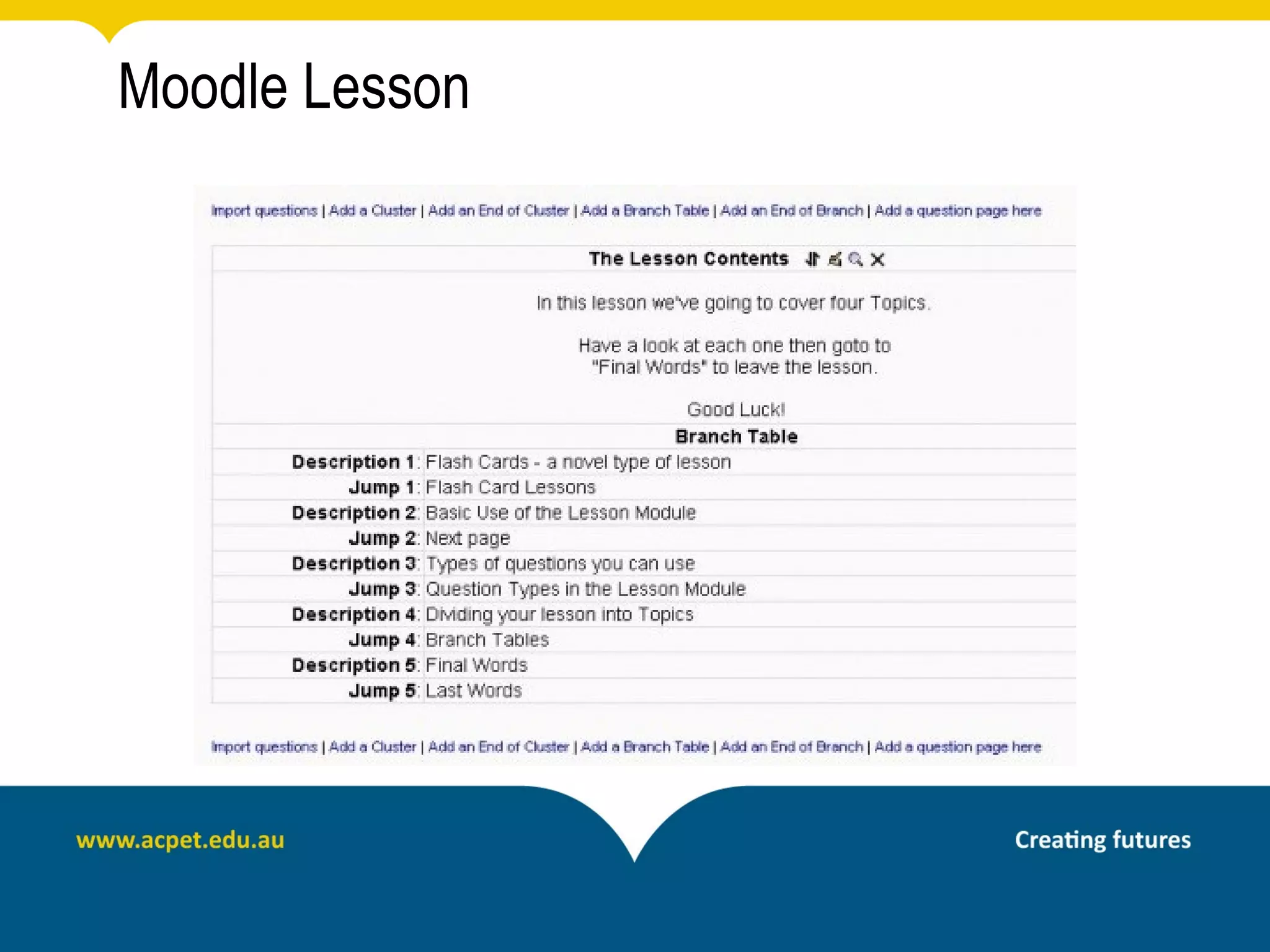
Moodle Lesson
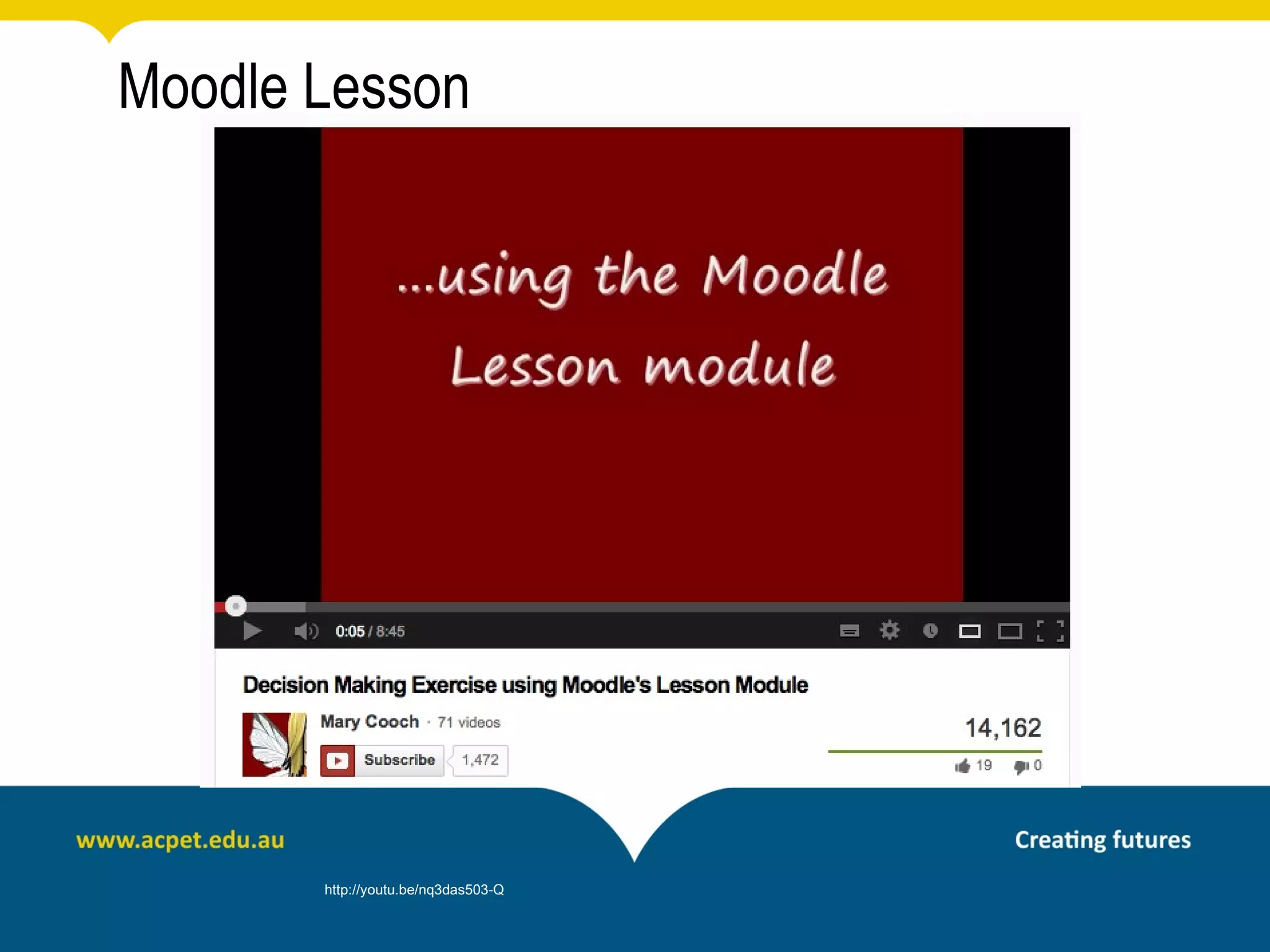
Moodle Lesson


       http://youtu.be/nq3das503-Q
Activity

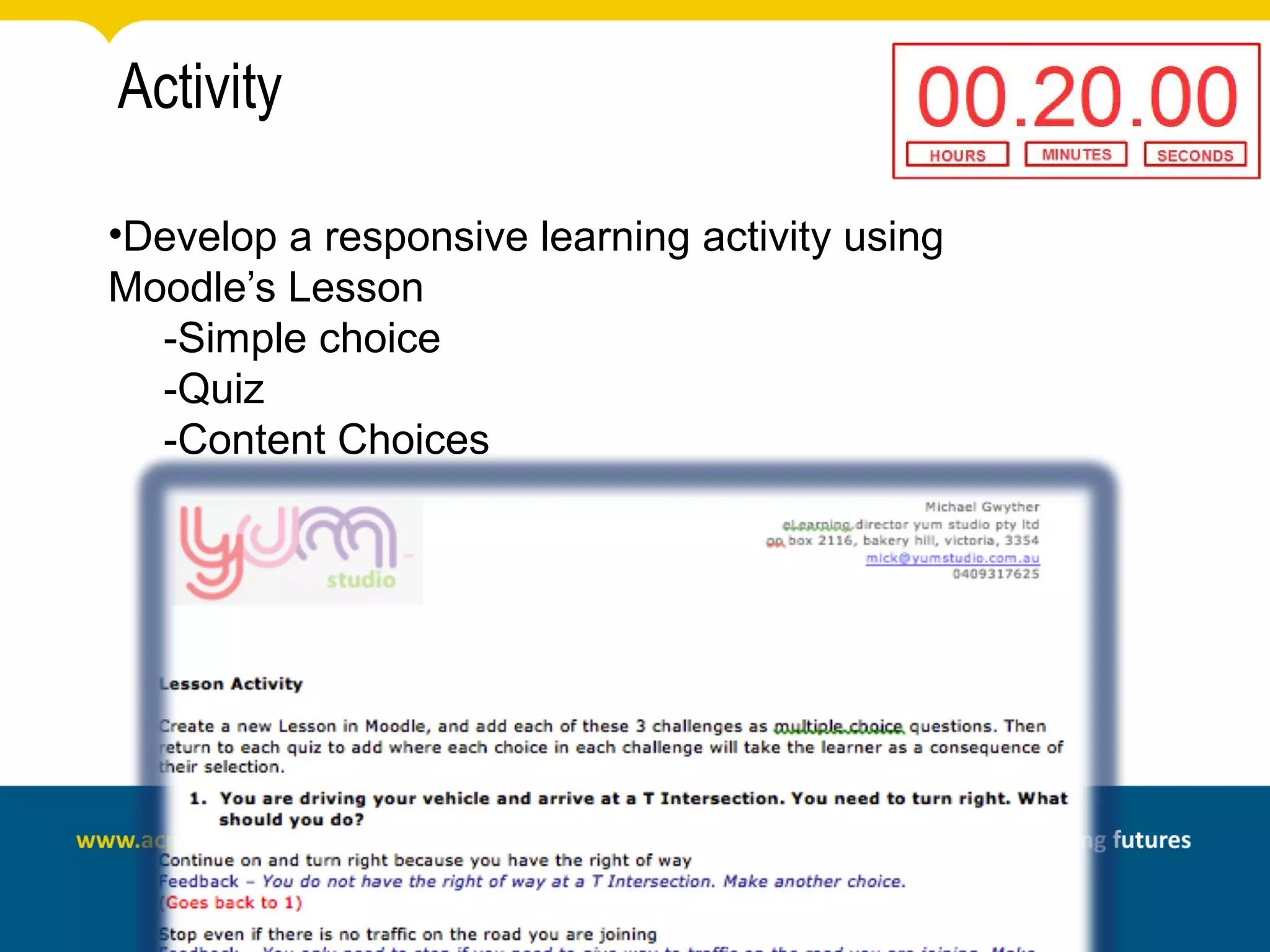
•Develop a responsive learning activity using
Moodle’s Lesson
  -Simple choice
  -Quiz
  -Content Choices
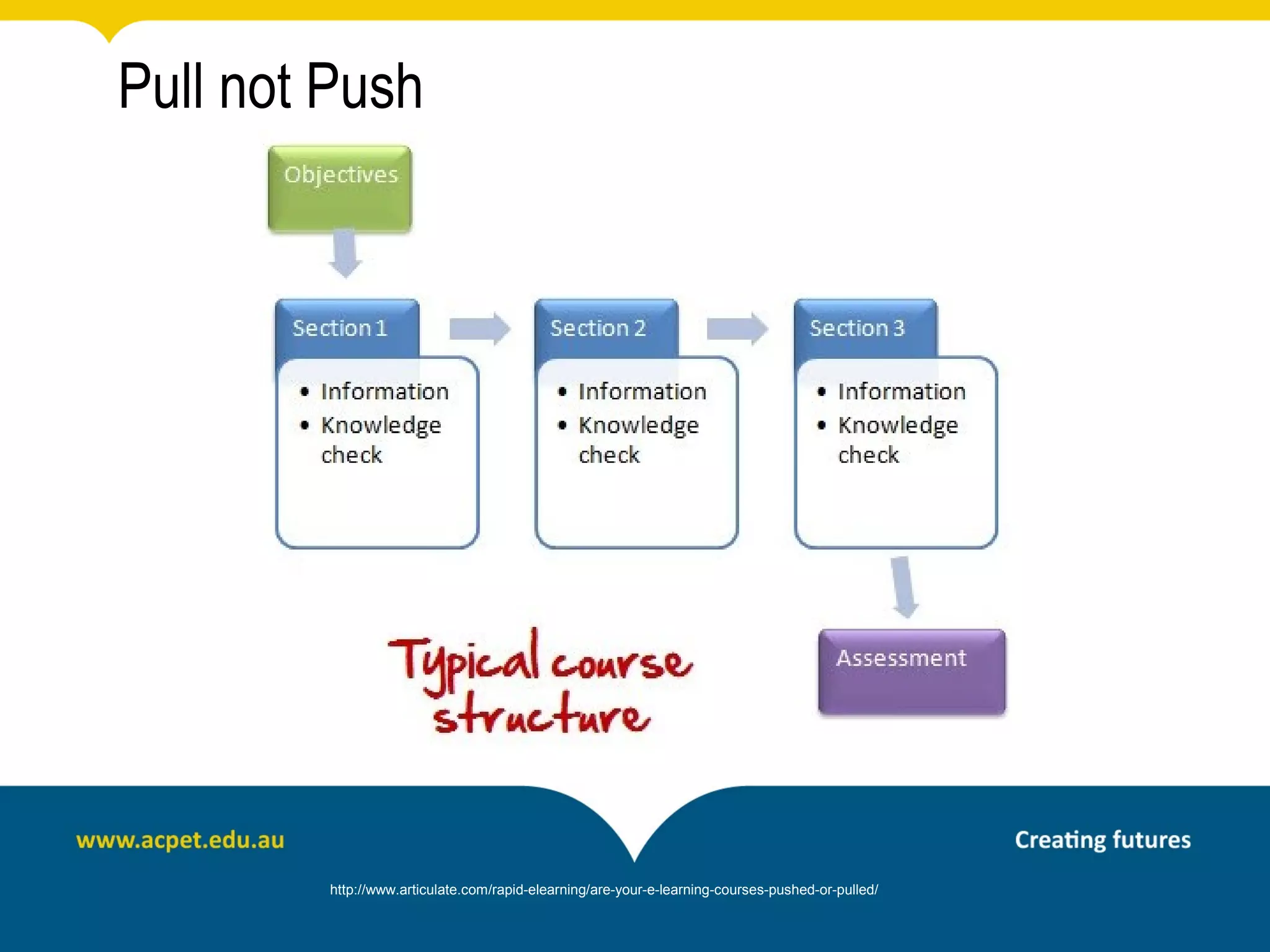
Pull not Push


         http://www.articulate.com/rapid-elearning/are-your-e-learning-courses-pushed-or-pulled/
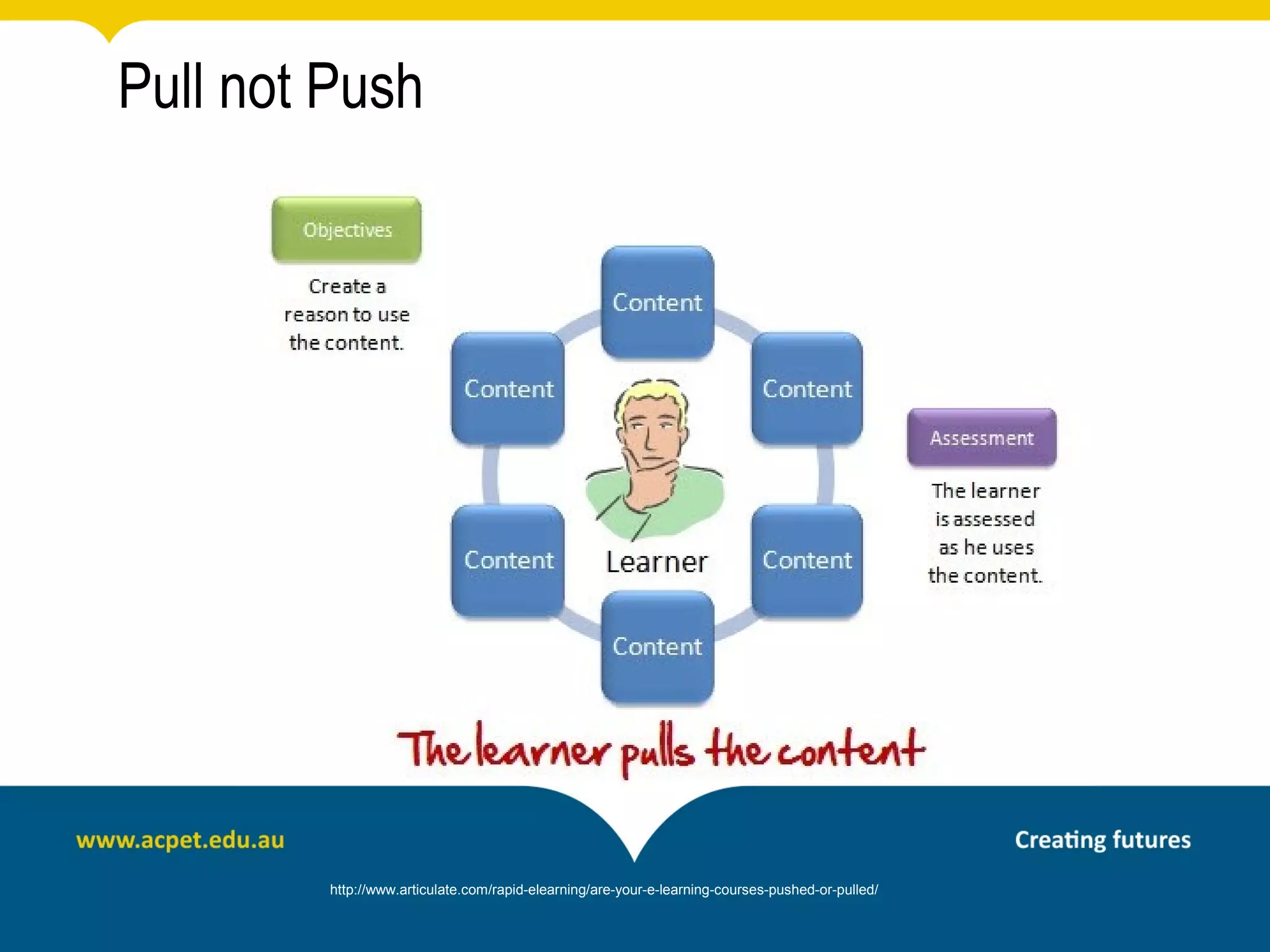
Pull not Push


         http://www.articulate.com/rapid-elearning/are-your-e-learning-courses-pushed-or-pulled/
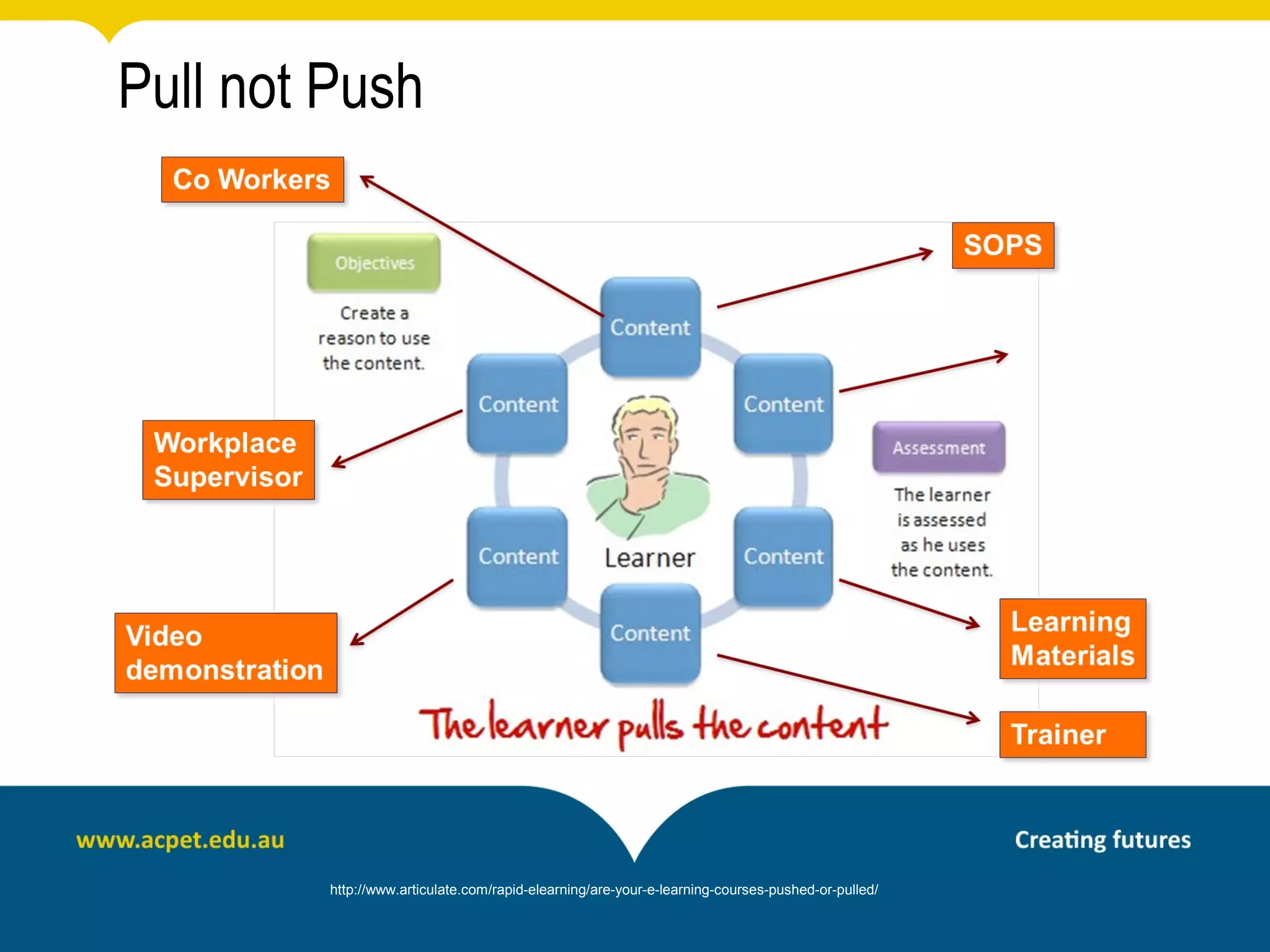
Pull not Push


         http://www.articulate.com/rapid-elearning/are-your-e-learning-courses-pushed-or-pulled/
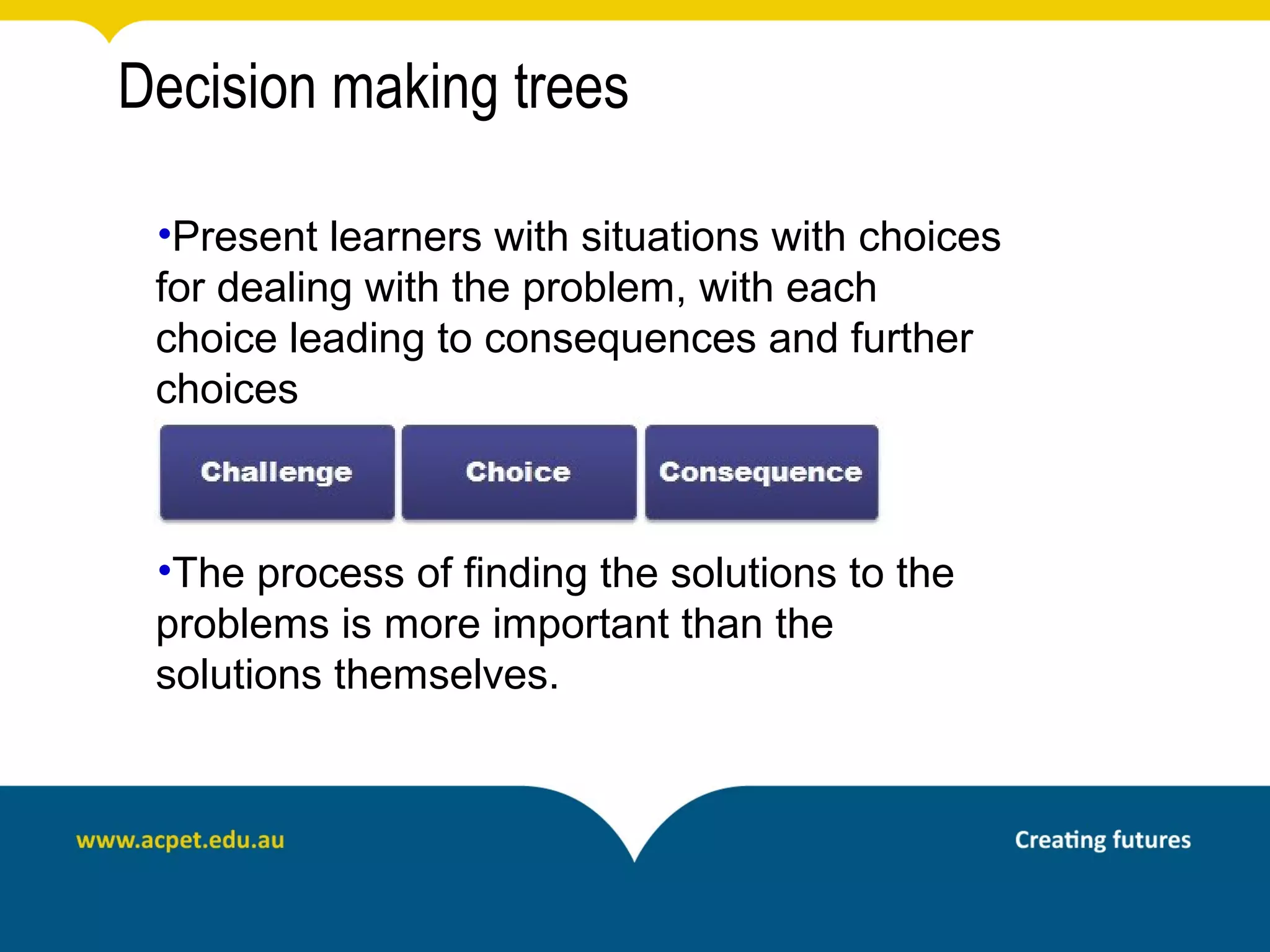
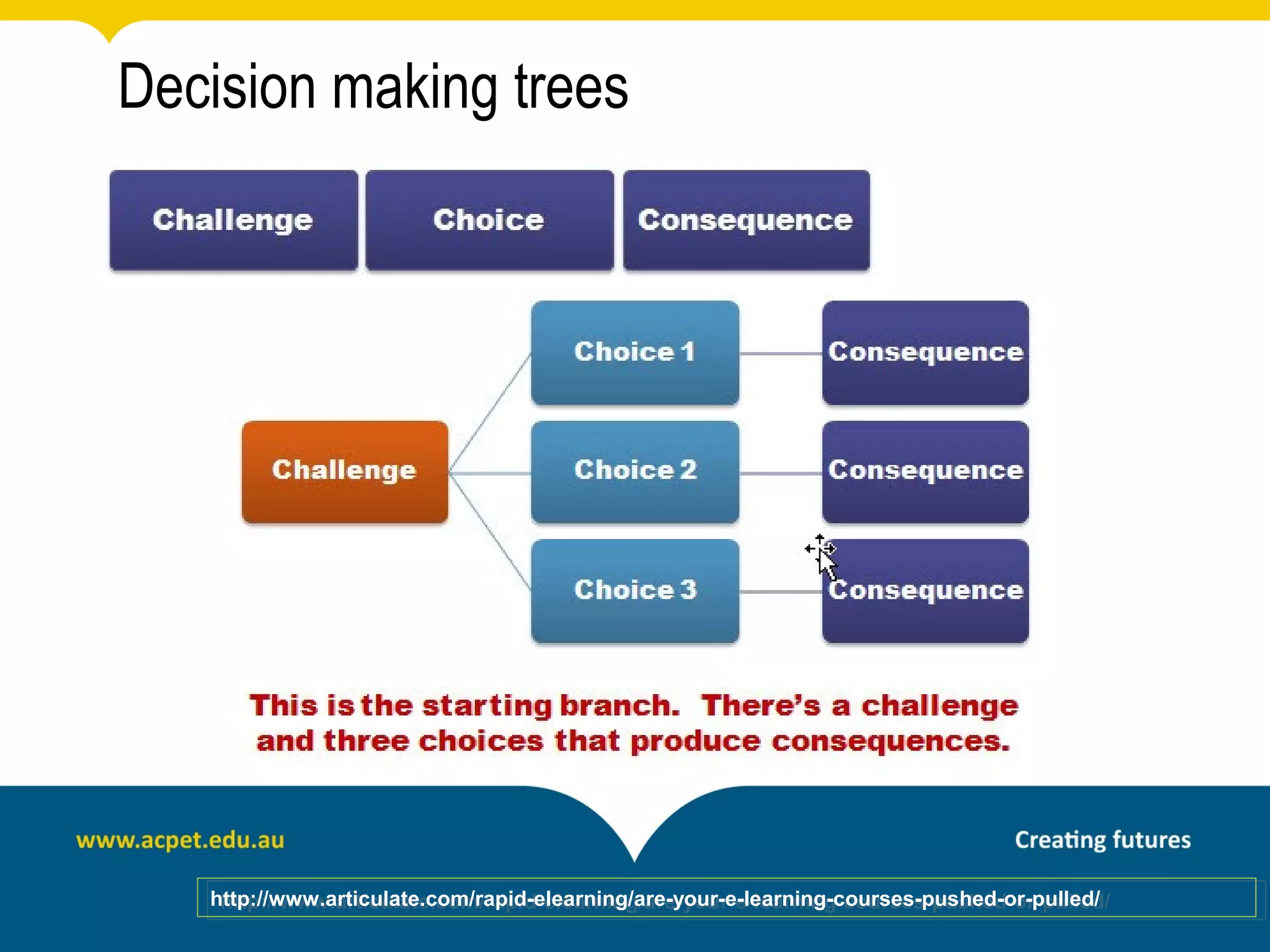
Decision making trees

 •Present learners with situations with choices
 for dealing with the problem, with each
 choice leading to consequences and further
 choices


 •The process of finding the solutions to the
 problems is more important than the
 solutions themselves.
Decision making trees


   http://www.articulate.com/rapid-elearning/are-your-e-learning-courses-pushed-or-pulled/
    http://www.articulate.com/rapid-elearning/are-your-e-learning-courses-pushed-or-pulled/
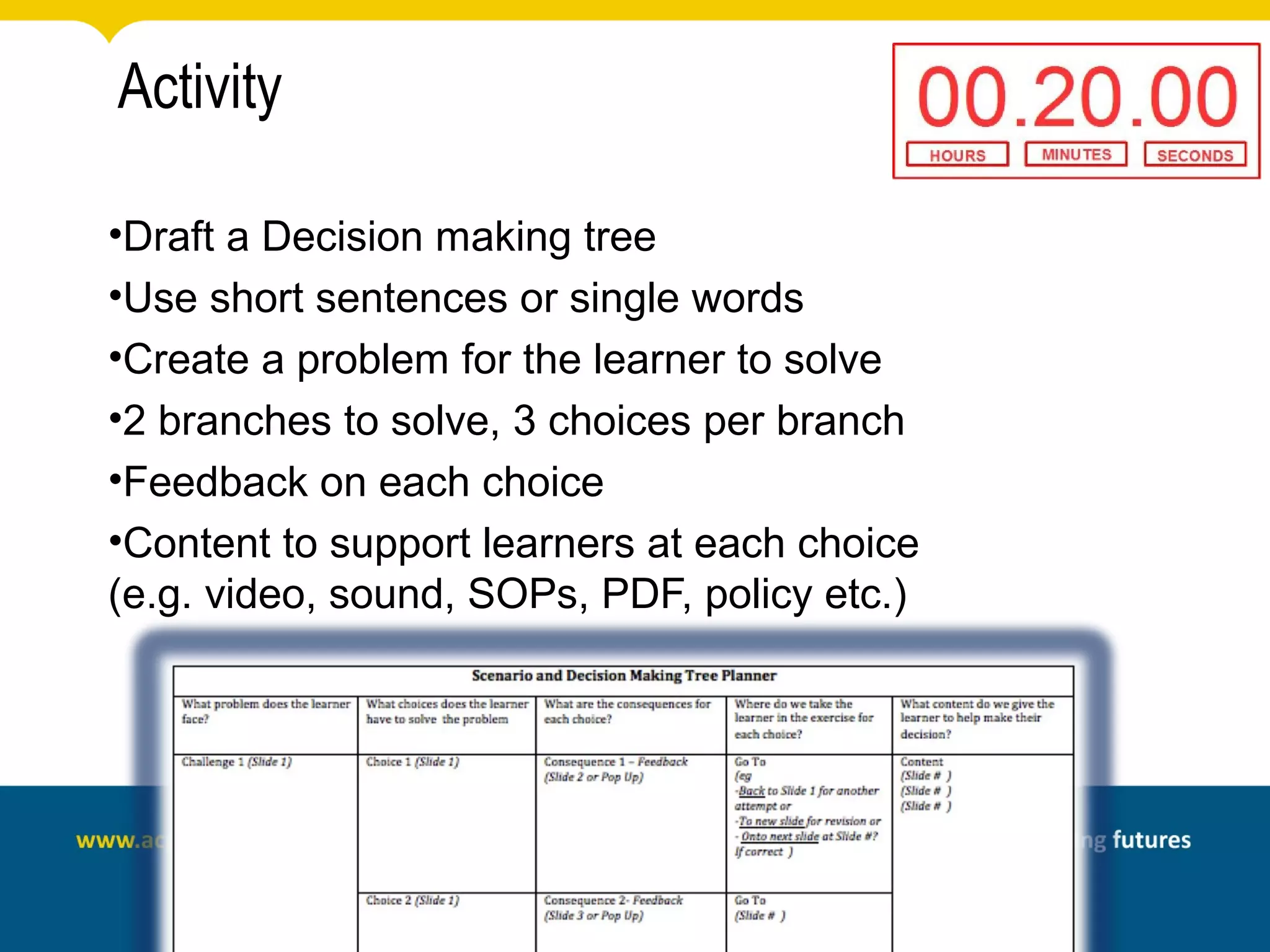
Activity

•Draft a Decision making tree
•Use short sentences or single words
•Create a problem for the learner to solve
•2 branches to solve, 3 choices per branch
•Feedback on each choice
•Content to support learners at each choice
(e.g. video, sound, SOPs, PDF, policy etc.)
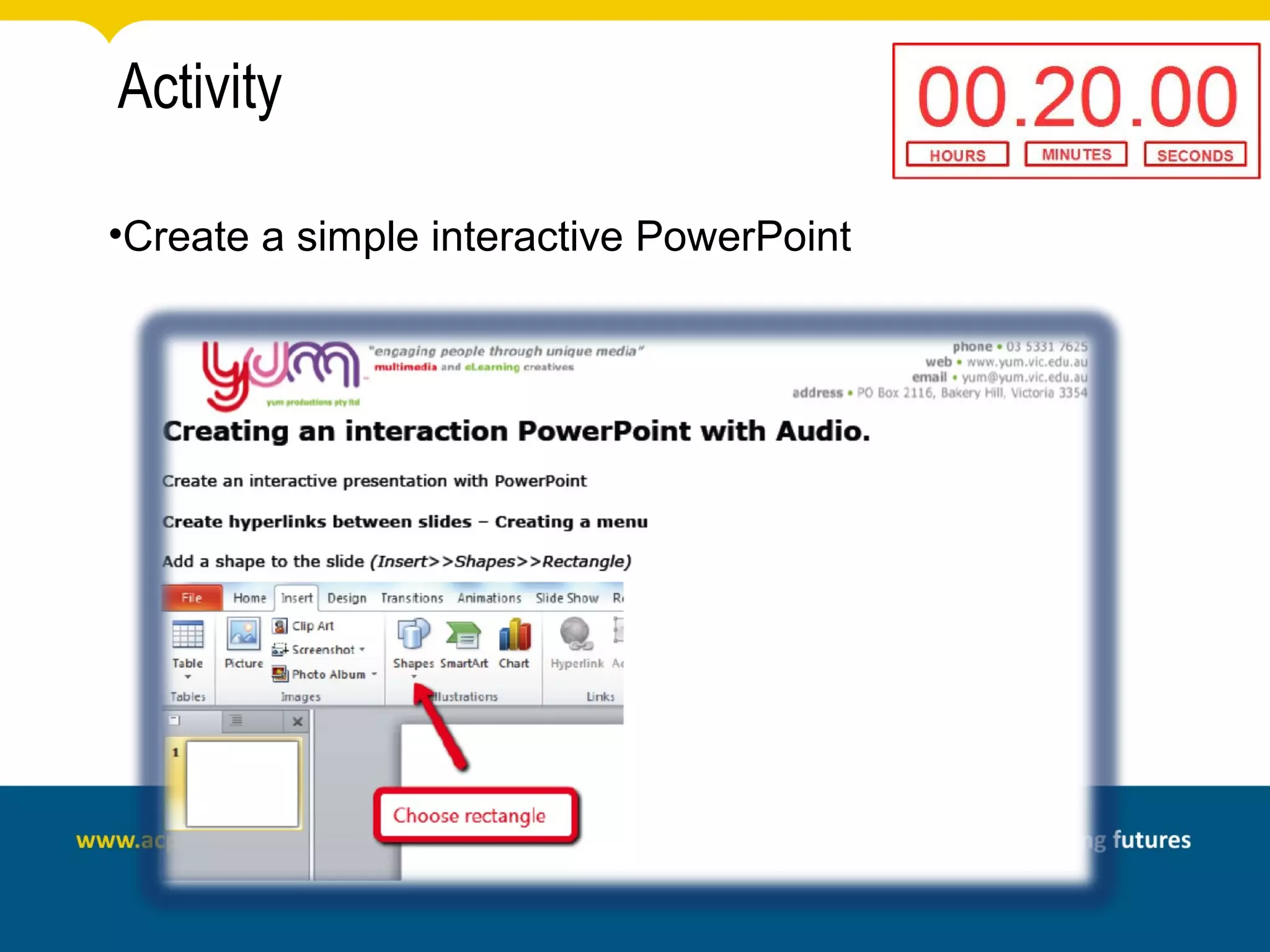
Activity

•Create a simple interactive PowerPoint
PowerPoint, iSpring & simple interactivity


                       Photo Credit: http://www.flickr.com/photos/68278595@N00/776111271/
                       CC http://creativecommons.org/licenses/by-nc-sa/2.0/
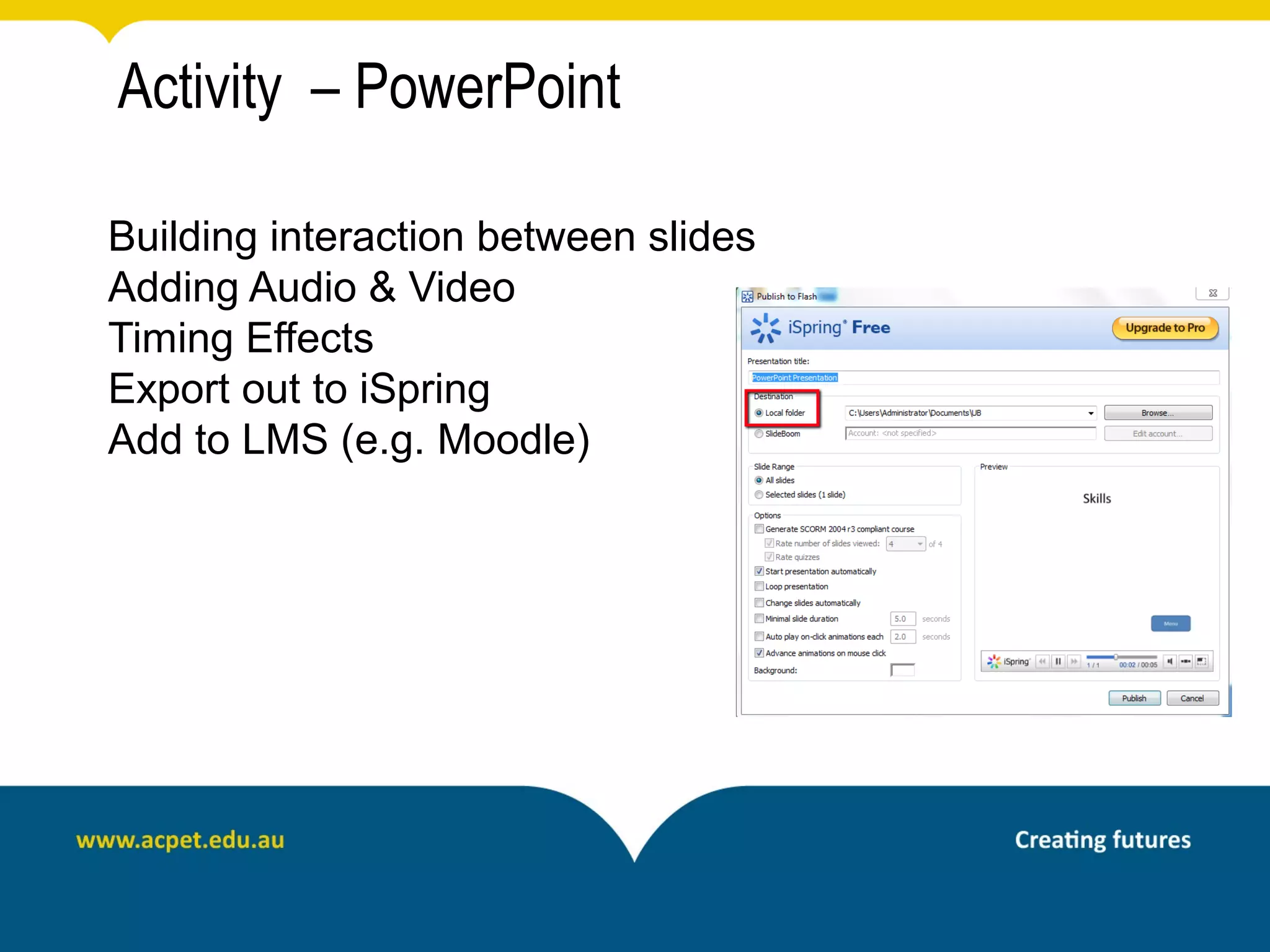
Activity – PowerPoint

Building interaction between slides
Adding Audio & Video
Timing Effects
Export out to iSpring
Add to LMS (e.g. Moodle)
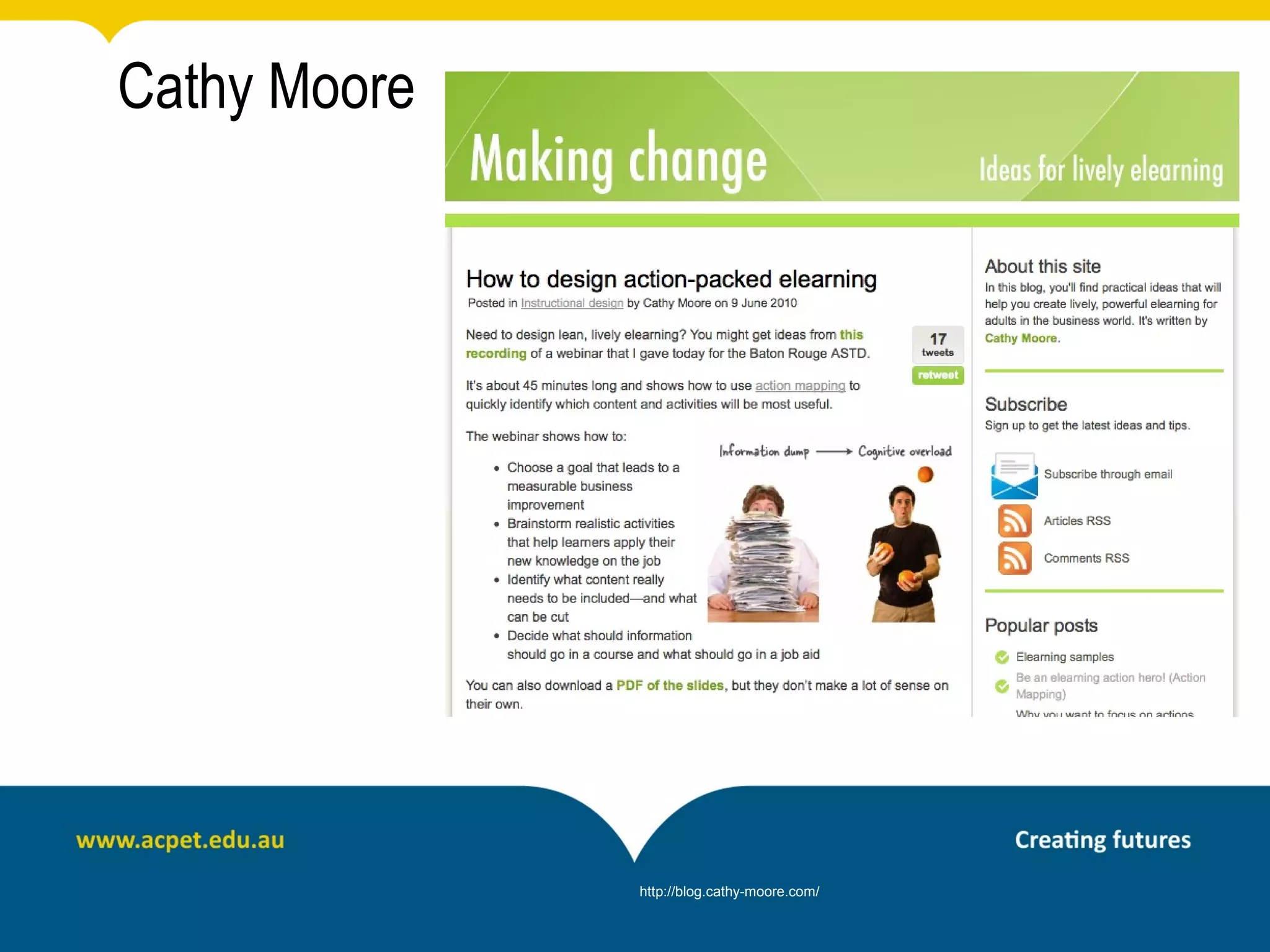
Cathy Moore


              http://blog.cathy-moore.com/
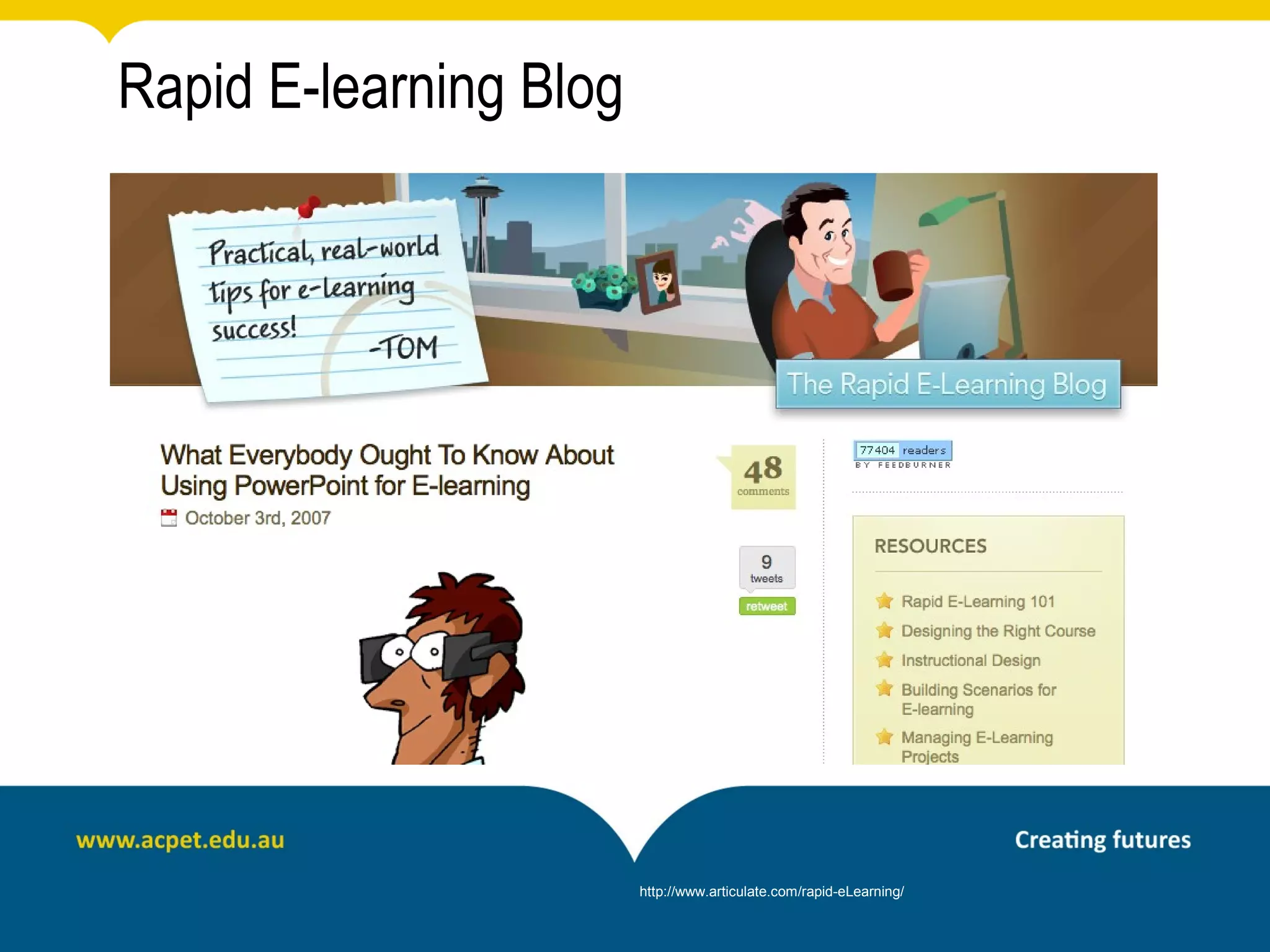
Rapid E-learning Blog


                        http://www.articulate.com/rapid-eLearning/
Thank you

Rapid eLearning

  • 1.
    rapid eLearning 1 Photo Credit: http://www.flickr.com/photos/25691430@N04/4347819911/ CC: http://creativecommons.org/licenses/by-sa/2.0/
  • 2.
    Design Choices Online Face to Face Self Paced Facilitated Content ✔ ✔ Activities ✔ ✔ Assessment ✔ ✔
  • 3.
    What is rapideLearning? rapid creation of courseware by Simple people who are less experienced Assessment with courseware development particularly subject matter experts Multimedia Courseware Templates Short Learning Modules
  • 4.
    But what isthe biggest challenge?
  • 5.
    Self Pace BestPractice Give learners something to do with the content. Even if your course is info heavy, provide opportunities to apply learning to workplace context in the role they will occupy. When presenting a problem, “content” can be provided in a variety of forms using video, audio and some text. This gives more depth to typical “quiz” based assessment which test memory rather than understanding, problem solving and consequences of on the job of decision making.
  • 6.
    Making sense outof the tough stuff
  • 7.
    Story based selfpaced content Character faces a challenge/journey Show not tell Make learners justify their choices. Challenge their assumptions and make them think deeply about the material. Contextual feedback will help learners see where they went wrong
  • 8.
    Stories – anarrative process Character Worker Setting Workplace Disruption Problem/Skill Solving the disruption Asking/Reading/Policy Communication Resolution Learnt the skill
  • 9.
  • 10.
    He’s hopeless! Canwe reform him?
  • 11.
  • 12.
  • 13.
    Self Paced ContentExamples Photo Credit: http://www.flickr.com/photos/43716015@N00/5381002934/ http://creativecommons.org/licenses/by-nc/2.0/
  • 14.
  • 15.
  • 16.
  • 17.
  • 18.
  • 19.
  • 20.
  • 21.
    Activity 1 –Decision Making •Define the context of your scenario. What are your narrative elements for: •Narrative Elements •Character •Setting •Disruption •Solving the disruption •Resolution
  • 22.
    Types of Content“Context” • Textbook or “Reference” style (job aids, online support or help) Static – Just in Time • Courseware (Content & simple assessment) • Workplace /Interactive (case study/scenario/decision making tree) Interactive
  • 23.
    Types of Activities Information Demonstration CaseStudy Scenario Decision Making Tree Knowledge checking Problem based Learning
  • 24.
    Self Paced Contentexamples Compliance testing Communication scenarios Application of policy & procedure decision making trees Course Content Assessment tasks and associated guided readings/resources/multimedia
  • 25.
  • 26.
    Features of rapideLearning tools Photo Credit: http://www.flickr.com/photos/23322134@N02/3289956770/ http://creativecommons.org/licenses/by-nc-nd/2.0//
  • 27.
  • 28.
    Assessment Direct Indirect demonstration Products demonstration/obser Products Questions - written vation and oral Workplace documents Indirect Assignments Assignments demonstration Third party reports Third party reports Products Workplace Self-assessment documents Simulation Questions - written Portfolios and oral Assignments Third party reports Self-assessment Simulation
  • 29.
    What to dowith this darn content? •Run off computer in training room •Add to your intranet •Burn to CD or USB •Upload to your LMS either via •SCORM (zip) or, •File (and link to the first page.)
  • 30.
    Output of rapideLearning tools Flash HTML HTML5 Word SCORM
  • 31.
    SCORM The SCORM standardmakes sure that all e-learning content and LMSs can work with each other:
  • 32.
    Tin Can http://tincanapi.com/overview/
  • 33.
    What is youritch? Photo Credit: http://www.flickr.com/photos/7149027@N07/6066027411 CC: http://creativecommons.org/licenses/by-nd/2.0/
  • 34.
    Approaches to engagingcontent Photo Credit: http://www.flickr.com/photos/42314813@N02/5527368292/ http://creativecommons.org/licenses/by-nc/2.0/
  • 35.
    Onscreen Text • What information is best presented as on-screen text? • How much is too much? Remember, learners typically only scan the on-screen text.
  • 36.
    Storyboarding • A course outline or storyboard will help you to organize both the course content and your thoughts on interactivity. • Onscreen Text • Audio Scripting • Interactions/Quizzes • Graphics/Images • Video • References & Weblinks • Development Notes
  • 37.
  • 38.
    Understanding Multimedia Photo Credit: http://www.flickr.com/photos/7149027@N07/6066027411 CC: http://creativecommons.org/licenses/by-nd/2.0/
  • 39.
    Integrating Audio Quality Compression Control theEnvironment Professional voices V Amateurs Music & Sound Effects Pros & Cons of “Script Reading” WAV & MP3
  • 40.
  • 41.
    Stock Music &FX http://www.freesound.org/ http://opsound.org/ http://librivox.org/ http://www.opensourcemusic.com/ http://ccmixter.org/ http://www.flashkit.com/loops/
  • 42.
    Voice 123 http://voice123.com/
  • 43.
    Integrating Video Bandwidth Short Do recorddemos but not your F2F class Lighting & Background Quality Camera (Smartphones & Tablets) Use a Voiceover Rule of Thirds
  • 44.
    Mixing Video In Tool iMovie(Mac, iPhone & iPad) Adobe Premiere Elements (PC & Mac) Camtasia
  • 45.
    Integrating images -sources http://compfight.com http://openclipart.org/
  • 46.
  • 47.
    Creative Commons Creative Commonsis a nonprofit that offers flexible copyright management tools for creative work. Offering your work under a Creative Commons license does not mean giving up your copyright. It means offering some of your rights to any taker, and only on certain conditions.
  • 48.
    Creative Commons Licenses Attribution - This applies to every Creative Commons work. Whenever a work is copied or redistributed under a Creative Commons license, credit must always be given to the creator. Non commercial - Lets others copy, distribute, display, and perform your work — and derivative works based upon it — but for noncommercial purposes only. No Derivative Works - Lets others copy, distribute, display, and perform only verbatim copies of your work, not derivative works based upon it. Share Alike - Allows others to distribute derivative works only under a license identical to the license that governs your work.
  • 49.
    Creative Commons Licenses http://youtu.be/1DKm96Ftfko
  • 50.
    Creative Commons Links FlickrCreative Commons – http://www.flickr.com/creativecommons/ Open Source Music - http://www.opensourcemusic.com/ Wikimedia Commons - http://commons.wikimedia.org/ Yahoo Creative Commons Search Tool http://search.yahoo.com/cc Designing and implementing eLearning with Creative Commons (Australian Flexible Learning Framework) http://designing.flexiblelearning.net.au/gallery/activities/creative_commons.htm Creative Commons information Australia – http://creativecommons.org.au Creative Commons (Global) – http://creativecommons.org/
  • 51.
  • 52.
  • 53.
    Moodle Lesson http://youtu.be/nq3das503-Q
  • 54.
    Activity •Develop a responsivelearning activity using Moodle’s Lesson -Simple choice -Quiz -Content Choices
  • 55.
    Pull not Push http://www.articulate.com/rapid-elearning/are-your-e-learning-courses-pushed-or-pulled/
  • 56.
    Pull not Push http://www.articulate.com/rapid-elearning/are-your-e-learning-courses-pushed-or-pulled/
  • 57.
    Pull not Push http://www.articulate.com/rapid-elearning/are-your-e-learning-courses-pushed-or-pulled/
  • 58.
    Decision making trees •Present learners with situations with choices for dealing with the problem, with each choice leading to consequences and further choices •The process of finding the solutions to the problems is more important than the solutions themselves.
  • 59.
    Decision making trees http://www.articulate.com/rapid-elearning/are-your-e-learning-courses-pushed-or-pulled/ http://www.articulate.com/rapid-elearning/are-your-e-learning-courses-pushed-or-pulled/
  • 60.
    Activity •Draft a Decisionmaking tree •Use short sentences or single words •Create a problem for the learner to solve •2 branches to solve, 3 choices per branch •Feedback on each choice •Content to support learners at each choice (e.g. video, sound, SOPs, PDF, policy etc.)
  • 61.
    Activity •Create a simpleinteractive PowerPoint
  • 62.
    PowerPoint, iSpring &simple interactivity Photo Credit: http://www.flickr.com/photos/68278595@N00/776111271/ CC http://creativecommons.org/licenses/by-nc-sa/2.0/
  • 63.
    Activity – PowerPoint Buildinginteraction between slides Adding Audio & Video Timing Effects Export out to iSpring Add to LMS (e.g. Moodle)
  • 64.
    Cathy Moore http://blog.cathy-moore.com/
  • 65.
    Rapid E-learning Blog http://www.articulate.com/rapid-eLearning/
  • 66.

Editor's Notes

  • #4 The Rapid E-Learning category is defined by the following criteria… * Courseware which can be developed in less than three weeks * Subject Matter Experts (SMEs) act as the primary resource for development * A well-known tool (e.g. PowerPoint) or user-friendly templates form the starting point for courseware * Simple assessment, feedback and tracking are usually provided * Media elements which enhance learning but do not create technology barriers may be included (e.g. voice) * Learning modules can be taken in one hour or less, often in less than 30 minutes. Synchronous (scheduled or live) and asynchronous (self-paced) models may be utilized. Jennifer De Vries http://www.bluestreaklearning.com/
  • #5 What is the biggest challenge in creating content?
  • #6 Keeping content brief, visual and relatable
  • #7 Keeping content brief, visual and relatable
  • #23 "Reference" is static content - meaning no interaction other than allowing the user to link from page-to-page and to search. It is asynchronous. It is normally a series of web pages, but can be PDF or other document types. It can be created using Wiki software, a content management system, web editing software or even Microsoft Word stored as HTML. It's designed to provide either real-time support for work tasks or near real-time support for look up. Often they are designed based around particular job functions and tasks to provide good on-the-job support. Reference includes "job aids" or "online support" or "online help" or various other things. Each of these other terms in slightly more specific than "reference" as they generally imply a bit more about the specific structure of the content. Thus, "reference" to me is a good umbrella term. Courseware implies pages of course content (information, multimedia) broken up with quizzes, case studies or scenarios. Usually takes a neutral tone. "Rapid Content Creation" or "Just-in-Time.” Workplace – we are either given a role in a workplace scenario and led through case studies by a workplace mentor or supervisor either passively or actively engaged in workplace scenarios or decision making trees.) http://elearningtech.blogspot.com.au/2006/05/shift-in-eLearning-from-pure.html Information Demonstration Case Study Scenario Decision Making Tree Knowledge checking Problem based Learning
  • #24 "Reference" is static content - meaning no interaction other than allowing the user to link from page-to-page and to search. It is asynchronous. It is normally a series of web pages, but can be PDF or other document types. It can be created using Wiki software, a content management system, web editing software or even Microsoft Word stored as HTML. It's designed to provide either real-time support for work tasks or near real-time support for look up. Often they are designed based around particular job functions and tasks to provide good on-the-job support. Reference includes "job aids" or "online support" or "online help" or various other things. Each of these other terms in slightly more specific than "reference" as they generally imply a bit more about the specific structure of the content. Thus, "reference" to me is a good umbrella term. Courseware implies pages of course content (information, multimedia) broken up with quizzes, case studies or scenarios. Usually takes a neutral tone. "Rapid Content Creation" or "Just-in-Time.” Workplace – we are either given a role in a workplace scenario and led through case studies by a workplace mentor or supervisor either passively or actively engaged in workplace scenarios or decision making trees.) http://elearningtech.blogspot.com.au/2006/05/shift-in-eLearning-from-pure.html Information Demonstration Case Study Scenario Decision Making Tree Knowledge checking Problem based Learning
  • #28 Quizzes may be scored, enabling direct marking automatically into the Learner Management System’s grading.
  • #32 http://tincanapi.com/scorm-vs-the-tin-can-api/
  • #33 Previous specifications were difficult and had limitations (see Tin Can vs SCORM), but the Tin Can API is simple and flexible. It lifts many of the older restrictions. Mobile learning, simulations, virtual worlds, serious games, real-world activities, experiential learning, social learning, offline learning, and collaborative learning are just some of the things that can now be recognized and communicated well with the Tin Can API. It’s important to know that we don’t own the Tin Can API. ADL is the steward of the specification. We just know this space so well that ADL asked us to help develop it. The Tin Can API is community-driven, and free to implement. How does the Tin Can API work? People learn from interactions with other people, content, and beyond. These actions can happen anywhere and signal an event where learning could occur. All of these can be recorded with the Tin Can API. When an activity needs to be recorded, the application sends secure statements in the form of “Noun, verb, object” or “I did this” to a Learning Record Store (LRS.) Learning Record Stores record all of the statements made. An LRS can share these statements with other LRSs. An LRS can exist on its own, or inside an LMS. The freedoms of the Tin Can API Statement freedom:  the structure of “statements” using nouns, verbs and objects lets you us record almost any activity. Think: “I did this.” History freedom:  the Tin Can API allows LRSs to talk to each other. LRSs can share data and transcripts with one another, and your experiences can follow you from one LRS (or organization) to another. Learners can even have their own “personal data lockers” with their personal learning information inside them. Device freedom:  any enabled device can send Tin Can API statements (mobile phones, simulations, games, a CPR dummy, the list goes on). A constant network connection isn’t necessary — occasional connectivity is fine. Workflow freedom:  tracking learning events doesn’t have to start or end in an LMS, it can start wherever the learner is and on whatever device they choose to use. Your content isn’t tied to an LMS.
  • #34 You’ll find a card by your side “ Write down the one biggest thing you would like to understand by the end of today” Take a minute or two to complete
  • #36 1. Writing On-Screen Text Summary: Most readers only skim online text so keep it lively and relative to the learner. Don’t kill the learner with continuous bullet points. Comment: True, learners don’t read all of the text. This is why it’s so important to add nice visual design to your course. You need to “draw” learners in and help them “want” to engage with your course. You should also think about chunking content. 2. Writing Audio Scripts Summary: Find that “hook” that sparks the learner’s imagination. The sounds of words and cadence of phrases in the script is important. Be sure to choose your voice talent carefully. Comment: You also need to find a balance between what content should be narrated and what content you should let the learner read. Also, there are many times when the learner can read faster than the audio narration. How will you handle this? Can a learner turn off the audio? Can they advance to the next section when the audio narration is still playing? 3. Writing Video Scripts Summary: Remember that video is for showing, not telling. Comment: Video should be used to demonstrate key concepts in the learning. Here is a sample video tutorial we have built to demonstrate how to add a Glossary to an Articulate Skin. 4. Technical Writing Summary: Technical writing can be dull and dry…so find a way to inject creativity into your course. Comment: Scenarios can be a great way to spice this up. Start off with a problem and then show the steps to fix it. 5. Writing Stories Summary: Storytelling incorporates facts and concepts learned, and should contain characters that the learners can identify with. Comment: When building a course with various stories to tie them all together. Always focus on the same characters throughout the entire course…this allows the learners to keep building on concepts already learned. 6. Writing Test Questions Summary: All test questions must correspond to the learning objectives in the course. Give yourself enough time to write effective test questions. Comment: Many instructional design models have you write the test question very early in your design process. The problem is that many of us build the entire course and then say “oops, I forgot to create the test.” Then we hurry and create some questions and throw them out there. 7. Writing Glossary Definitions Summary: The 4 tips for writing glossary definitions are: 1) every word counts, 2) remove extraneous words, 3) use a consistent style for every definition, and 4) let someone else edit them. 8. Writing Interactions Summary: Interactions can be a powerful learning tool…but they must be well written with good instructions. 9. Writing Microcopy Summary: Microcopy is the little instructions and phrases used in eLearning and should not be an afterthought. Comment: I like to add text to my image treatments as well. Any image can be combined with text. 10. Copywriting Summary: Copywriting is the use of persuasive language to entice someone to take your training. Most copywriters follow the AIDA formula when writing copy.
  • #37 Why is it important to create a course outline or storyboard before building an eLearning course? A course outline or storyboard will help you to organize both the course content and your thoughts on interactivity (audio, video, graphics, interactions, etc.). Here are a few things to consider when building your storyboard: On-Screen text What information is best presented as on-screen text? How much is too much? Remember, learners typically only scan the on-screen text. Audio Scripting Will or should you use audio in your course? If you decide to use it, be consistent throughout the course. If using audio, will you also include written scripting for the leaner to read? Can the learner advance through the course even if the audio is still playing? Do the learners have audio capabilities? Will they use headsets/earbuds? Do they have speakers for their computers? Interactions/Quizzes Will you add interactions/quizzes to your course? Interactions/quizzes should support the learning process and not distract from it. Use interactions to reinforce learning content. Graphics/Images Do not use gratuitous images. The images in your course must support the story you are telling. Most learners only scan over the text so your graphics need to help tell the story. Can the text be combined into the image? Video Is video a good delivery method for the content being presented? What information is best presented in video format? Do you have the time and budget for video? Can your network handle video? Course Test Is a course test required? If so, plan for the test in the storyboard process. This allows you to build test questions when you build the course objectives. The course test should not be an afterthought once the course is created. Printable Reference Materials Does the learner need printable reference materials to refer to while completing the training or after the training? Maybe offer a training recap. Website Links Can you link the learner off to a website to learn more about the topic? Development Notes Include additional development/design notes.
  • #38 Why is it important to create a course outline or storyboard before building an eLearning course? A course outline or storyboard will help you to organize both the course content and your thoughts on interactivity (audio, video, graphics, interactions, etc.). Here are a few things to consider when building your storyboard: On-Screen text What information is best presented as on-screen text? How much is too much? Remember, learners typically only scan the on-screen text. Audio Scripting Will or should you use audio in your course? If you decide to use it, be consistent throughout the course. If using audio, will you also include written scripting for the leaner to read? Can the learner advance through the course even if the audio is still playing? Do the learners have audio capabilities? Will they use headsets/earbuds? Do they have speakers for their computers? Interactions/Quizzes Will you add interactions/quizzes to your course? Interactions/quizzes should support the learning process and not distract from it. Use interactions to reinforce learning content. Graphics/Images Do not use gratuitous images. The images in your course must support the story you are telling. Most learners only scan over the text so your graphics need to help tell the story. Can the text be combined into the image? Video Is video a good delivery method for the content being presented? What information is best presented in video format? Do you have the time and budget for video? Can your network handle video? Course Test Is a course test required? If so, plan for the test in the storyboard process. This allows you to build test questions when you build the course objectives. The course test should not be an afterthought once the course is created. Printable Reference Materials Does the learner need printable reference materials to refer to while completing the training or after the training? Maybe offer a training recap. Website Links Can you link the learner off to a website to learn more about the topic? Development Notes Include additional development/design notes.
  • #40 Quizzes may be scored, enabling
  • #41 Quizzes may be scored, enabling
  • #42 Also Sound Cloud for Music
  • #43 You submit a script and have narrators bid for your work, and they in turn will post samples in response. You simply hire your choice online, and the turnaround time is usually only a few days. You get a very professional final product that can save you dozens of hours at a very competitive price.
  • #52 Brainstorm Activity – What are some good principles of rapid eLearning: Suggested List
  • #53 The lesson module presents a series of HTML pages to the student who is usually asked to make some sort of choice underneath the content area. The choice will send them to a specific page in the Lesson. In a Lesson page's simplest form, the student can select a continue button at the bottom of the page, which will send them to the next page in the Lesson. There are 2 basic Lesson page types that the student will see: question pages and content pages. There are also several advanced navigational pages which can meet more specialized needs of the Teacher. The Lesson module was designed to be adaptive and to use a student's choices to create a self directed lesson. The main difference between a Lesson and other activity modules available in Moodle comes from its adaptive ability. With this tool, each choice the students makes can show a different teacher response/comment and send the student to a different page in the lesson. Thus with planning, the Lesson module can customize the presentation of content and questions to each student with no further action required by the teacher.
  • #54 The lesson module presents a series of HTML pages to the student who is usually asked to make some sort of choice underneath the content area. The choice will send them to a specific page in the Lesson. In a Lesson page's simplest form, the student can select a continue button at the bottom of the page, which will send them to the next page in the Lesson. There are 2 basic Lesson page types that the student will see: question pages and content pages. There are also several advanced navigational pages which can meet more specialized needs of the Teacher. The Lesson module was designed to be adaptive and to use a student's choices to create a self directed lesson. The main difference between a Lesson and other activity modules available in Moodle comes from its adaptive ability. With this tool, each choice the students makes can show a different teacher response/comment and send the student to a different page in the lesson. Thus with planning, the Lesson module can customize the presentation of content and questions to each student with no further action required by the teacher.