
RAPID APPLICATION
DEVELOPMENT (RAD)
APPLICATIONS
WHAT IS RAD?
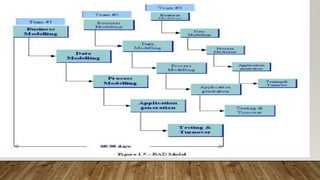
• RAD model is Rapid Application Development model. It is a type of incremental model
( the incremental build model is a method of software development where the product
is designed, implemented and tested. Incrementally until the product is finished .it
involves both development and maintenance). In RAD model the components or
functions are developed in parallel as if they were mini projects. The developments are
time boxed, delivered and then assembled into a working prototype. This can quickly
give the customer something to see and use and to provide feedback regarding the
delivery and their requirements.
• RAD( RAPID APPLICATION DEVELOPMENT)
• It is a type of incremental model
• RAD model used to delivery software early to users
• RAD model devotes less time on planning and more time on development
• Knowledge gathered from the development is used as feed back for requirements and design
• RAD uses a combination of Joint Application Development (JAD) techniques and CASE tools to
convert user needs to designs
• System developers and users work together
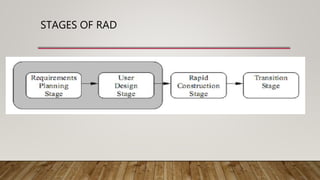
1. Requirements planning phase – combines elements of the system planning and systems analysis phases of
the Systems Development Life Cycle (SDLC). Users, managers, and IT staff members discuss and agree on
business needs, project scope, constraints, and system requirements. It ends when the team agrees on the key
issues and obtains management authorization to continue.
2. User design phase – during this phase, users interact with systems analysts and develop models and
prototypes that represent all system processes, inputs, and outputs. The RAD groups or subgroups typically
use a combination of Joint Application Development (JAD) techniques and CASE tools to translate user needs
into working models. User Design is a continuous interactive process that allows users to understand, modify,
and eventually approve a working model of the system that meets their needs.
3. Construction phase – focuses on program and application development task similar to the SDLC. In RAD,
however, users continue to participate and can still suggest changes or improvements as actual screens or
reports are developed. Its tasks are programming and application development, coding, unit-integration and
system testing.
4. Cutover phase – resembles the final tasks in the SDLC implementation phase, including data conversion,
testing, changeover to the new system, and user training. Compared with traditional methods, the entire
process is compressed. As a result, the new system is built, delivered, and placed in operation much sooner
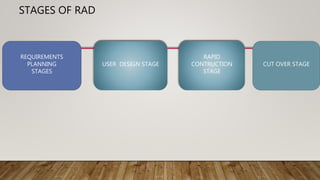
METHODOLOGIES / STAGES
REQUIREMENTS
PLANNING
STAGES
USER DESIGN STAGE
RAPID
CONTRUCTION
STAGE
CUT OVER STAGE
STAGES OF RAD
•RAD should be used when there is a need to create a system that can be modularized in
2-3 months of time.
•It should be used if there’s high availability of designers for modeling and the budget is
high enough to afford their cost along with the cost of automated code generating tools.
•RAD SDLC model should be chosen only if resources with high business knowledge are
available and there is a need to produce the system in a short span of time (2-3 months).
WHEN TO USE THE RAD
•Reduced development time.
•Increases reusability of components
•Quick initial reviews occur
•Encourages customer feedback
•Integration from very beginning solves a lot of integration
issues.
ADVANTAGES OF THE RAD MODEL:
DISADVANTAGES OF RAD MODEL:
• Depends on strong team and individual performances for identifying business
requirements.
• Only system that can be modularized can be built using RAD
• Requires highly skilled developers/designers.
• High dependency on modeling skills
• Inapplicable to cheaper projects as cost of modeling and automated code
generation is very high.
STAGES OF RAD
When to use RAD model:
RAD should be used when there is a need to create a system that
can be modularized in 2-3 months of time.
• It should be used if there’s high availability of designers for
modeling and the budget is high enough to afford their cost along
with the cost of automated code generating tools.
• RAD SLDC model should be chosen only if resources with high
business knowledge are available and there is a need to produce
the system in a short span of time (2-3 months).

Rapid application development

  • 1.
  • 2.
    WHAT IS RAD? •RAD model is Rapid Application Development model. It is a type of incremental model ( the incremental build model is a method of software development where the product is designed, implemented and tested. Incrementally until the product is finished .it involves both development and maintenance). In RAD model the components or functions are developed in parallel as if they were mini projects. The developments are time boxed, delivered and then assembled into a working prototype. This can quickly give the customer something to see and use and to provide feedback regarding the delivery and their requirements. • RAD( RAPID APPLICATION DEVELOPMENT)
  • 3.
    • It isa type of incremental model • RAD model used to delivery software early to users • RAD model devotes less time on planning and more time on development • Knowledge gathered from the development is used as feed back for requirements and design • RAD uses a combination of Joint Application Development (JAD) techniques and CASE tools to convert user needs to designs • System developers and users work together
  • 4.
    1. Requirements planningphase – combines elements of the system planning and systems analysis phases of the Systems Development Life Cycle (SDLC). Users, managers, and IT staff members discuss and agree on business needs, project scope, constraints, and system requirements. It ends when the team agrees on the key issues and obtains management authorization to continue. 2. User design phase – during this phase, users interact with systems analysts and develop models and prototypes that represent all system processes, inputs, and outputs. The RAD groups or subgroups typically use a combination of Joint Application Development (JAD) techniques and CASE tools to translate user needs into working models. User Design is a continuous interactive process that allows users to understand, modify, and eventually approve a working model of the system that meets their needs. 3. Construction phase – focuses on program and application development task similar to the SDLC. In RAD, however, users continue to participate and can still suggest changes or improvements as actual screens or reports are developed. Its tasks are programming and application development, coding, unit-integration and system testing. 4. Cutover phase – resembles the final tasks in the SDLC implementation phase, including data conversion, testing, changeover to the new system, and user training. Compared with traditional methods, the entire process is compressed. As a result, the new system is built, delivered, and placed in operation much sooner METHODOLOGIES / STAGES
  • 6.
  • 7.
    •RAD should beused when there is a need to create a system that can be modularized in 2-3 months of time. •It should be used if there’s high availability of designers for modeling and the budget is high enough to afford their cost along with the cost of automated code generating tools. •RAD SDLC model should be chosen only if resources with high business knowledge are available and there is a need to produce the system in a short span of time (2-3 months). WHEN TO USE THE RAD
  • 8.
    •Reduced development time. •Increasesreusability of components •Quick initial reviews occur •Encourages customer feedback •Integration from very beginning solves a lot of integration issues. ADVANTAGES OF THE RAD MODEL:
  • 9.
    DISADVANTAGES OF RADMODEL: • Depends on strong team and individual performances for identifying business requirements. • Only system that can be modularized can be built using RAD • Requires highly skilled developers/designers. • High dependency on modeling skills • Inapplicable to cheaper projects as cost of modeling and automated code generation is very high.
  • 11.
  • 12.
    When to useRAD model: RAD should be used when there is a need to create a system that can be modularized in 2-3 months of time. • It should be used if there’s high availability of designers for modeling and the budget is high enough to afford their cost along with the cost of automated code generating tools. • RAD SLDC model should be chosen only if resources with high business knowledge are available and there is a need to produce the system in a short span of time (2-3 months).