LCGs
MLCG
Mixed LCG
Fibonacci
MWC,AWC,SWB
MRG
Finite Fields
Combined generators
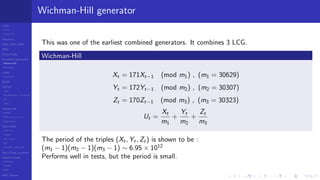
Wichman-Hill
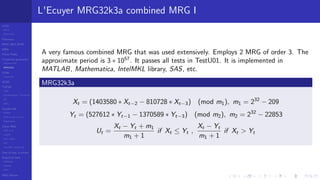
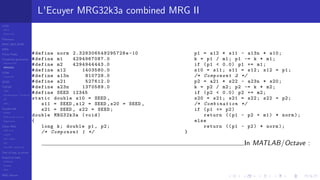
MRG32k3a
LFSR
Tausworthe
GFSR
TGFSR
T800
Equidistribution, Tempering
MT
WELL
Parallel RN
SPRNG
PRN as easy as 1,2,3
RngStreams
Other RNG
KISS et al.
xorshift
Num recipes
GSL
Intel MKL statistic lib
Test of hyp, p-values
Empirical tests
DieHarder
TestU01
NIST
RNG failures
Random Numbers
Pseudo Random Number Generators
Roberto Innocente
SISSA, Trieste
for the joint ICTP/SISSA MHPC.it master course
April, 2018 - Edition 2.1
LCGs
MLCG
Mixed LCG
Fibonacci
MWC,AWC,SWB
MRG
Finite Fields
Combined generators
Wichman-Hill
MRG32k3a
LFSR
Tausworthe
GFSR
TGFSR
T800
Equidistribution, Tempering
MT
WELL
Parallel RN
SPRNG
PRN as easy as 1,2,3
RngStreams
Other RNG
KISS et al.
xorshift
Num recipes
GSL
Intel MKL statistic lib
Test of hyp, p-values
Empirical tests
DieHarder
TestU01
NIST
RNG failures
Outline
1 LCGs
MLCG
Mixed LCG
2 Fibonacci
3 MWC,AWC,SWB
4 MRG
5 Finite Fields
6 Combined generators
Wichman-Hill
MRG32k3a
7 LFSR
Tausworthe
8 GFSR
9 TGFSR
T800
Equidistribution, Tempering
MT
10 Parallel RN
SPRNG
PRN as easy as 1,2,3
RngStreams
11 Other RNG
KISS et al.
xorshift
Num recipes
GSL
Intel MKL statistic lib
12 Test of hyp, p-values
13 Empirical tests
DieHarder
TestU01
NIST
14 RNG failures
LCGs
MLCG
Mixed LCG
Fibonacci
MWC,AWC,SWB
MRG
Finite Fields
Combined generators
Wichman-Hill
MRG32k3a
LFSR
Tausworthe
GFSR
TGFSR
T800
Equidistribution, Tempering
MT
WELL
Parallel RN
SPRNG
PRN as easy as 1,2,3
RngStreams
Other RNG
KISS et al.
xorshift
Num recipes
GSL
Intel MKL statistic lib
Test of hyp, p-values
Empirical tests
DieHarder
TestU01
NIST
RNG failures
Where it all began ?
At the end of 1700 George Leclerc, Comte de Buffon
tried to compute π with random experiments.
LCGs
MLCG
Mixed LCG
Fibonacci
MWC,AWC,SWB
MRG
Finite Fields
Combined generators
Wichman-Hill
MRG32k3a
LFSR
Tausworthe
GFSR
TGFSR
T800
Equidistribution, Tempering
MT
WELL
Parallel RN
SPRNG
PRN as easy as 1,2,3
RngStreams
Other RNG
KISS et al.
xorshift
Num recipes
GSL
Intel MKL statistic lib
Test of hyp, p-values
Empirical tests
DieHarder
TestU01
NIST
RNG failures
George-Louis Leclerc, Comte de Buffon, 1777 :
Montecarlo method ante-litteram
A needle of length 1 is thrown over a lined paper with lines every 1 unit . The probability
that it hits a line can be computed as :
Shaded Portion Area =
π
θ=0
sin(θ)
2
dθ = −
cos(θ)
2
π
0
= 1
Prob =
Shaded Portion Area
Area of rectangle
=
1
π/2
→ π =
2
Prob
LCGs
MLCG
Mixed LCG
Fibonacci
MWC,AWC,SWB
MRG
Finite Fields
Combined generators
Wichman-Hill
MRG32k3a
LFSR
Tausworthe
GFSR
TGFSR
T800
Equidistribution, Tempering
MT
WELL
Parallel RN
SPRNG
PRN as easy as 1,2,3
RngStreams
Other RNG
KISS et al.
xorshift
Num recipes
GSL
Intel MKL statistic lib
Test of hyp, p-values
Empirical tests
DieHarder
TestU01
NIST
RNG failures
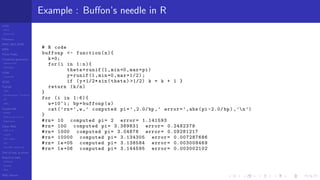
Example : Buffon’s needle in R
# R code
buffonp <- function(n){
k=0;
for(i in 1:n){
theta=runif (1,min=0,max=pi)
y=runif (1,min=0,max =1/2);
if (y+1/2* sin(theta) >1/2) k = k + 1 }
return (k/n)
}
for (i in 1:6){
w=10^i; bp=buffonp(w)
cat(’rn=’,w,’ computed pi=’,2.0/bp ,’ error=’,abs(pi -2.0/ bp) ,’n’)
}
#rn= 10 computed pi= 2 error= 1.141593
#rn= 100 computed pi= 3.389831 error= 0.2482379
#rn= 1000 computed pi= 3.04878 error= 0.09281217
#rn= 10000 computed pi= 3.134305 error= 0.007287686
#rn= 1e+05 computed pi= 3.138584 error= 0.003008469
#rn= 1e+06 computed pi= 3.144595 error= 0.003002102
LCGs
MLCG
Mixed LCG
Fibonacci
MWC,AWC,SWB
MRG
Finite Fields
Combined generators
Wichman-Hill
MRG32k3a
LFSR
Tausworthe
GFSR
TGFSR
T800
Equidistribution, Tempering
MT
WELL
Parallel RN
SPRNG
PRN as easy as 1,2,3
RngStreams
Other RNG
KISS et al.
xorshift
Num recipes
GSL
Intel MKL statistic lib
Test of hyp, p-values
Empirical tests
DieHarder
TestU01
NIST
RNG failures
RNG, TRNG, PRNG I
TRNG (True Random Number Generators)
noise based e.g from atmospheric noise https://www.random.org/
free running oscillator (FRO) : simplest and cheapest way
chaos based
quantum based e.g. Geiger counters, fluctuations of vacuum https://qrng.anu.edu.au/
PRNG (Pseudo Random Number Generators) or simply RNG
algorithmic
We want to be able to produce RN fast, in a cheap way, we need repeatability : we need
algorithmic RNG !!.
There is a subclass of PRNG that will not be covered here and it is the class of
cryptographically robust PRNG. These require the special quality of unpredictability that
is computationally expensive and is never shown by the efficient PRNG we need for
simulations.
LCGs
MLCG
Mixed LCG
Fibonacci
MWC,AWC,SWB
MRG
Finite Fields
Combined generators
Wichman-Hill
MRG32k3a
LFSR
Tausworthe
GFSR
TGFSR
T800
Equidistribution, Tempering
MT
WELL
Parallel RN
SPRNG
PRN as easy as 1,2,3
RngStreams
Other RNG
KISS et al.
xorshift
Num recipes
GSL
Intel MKL statistic lib
Test of hyp, p-values
Empirical tests
DieHarder
TestU01
NIST
RNG failures
Divide and conquer
Generation of Random Numbers is usually splitted into :
1 Generation of uniformly distributed integers xi in [0 . . . (m − 1)]
2 Mapping of integers in [0 . . . (m − 1)] to uniformly distributed reals in U(0, 1) using
ui = xi
m . In many cases the 1st step is allowed to produce 0 while usually we want the
2nd
step not to produce it. Therefore often is used ui = xi +1
m+1 .
3 Mapping of uniformly distributed reals in U (0, 1) to the wanted CDF (Cumulative
Distribution Function) F(x) using most of the time its inverse F−1
(x)
This is the reason why we will center our discussion about uniform random numbers on
(0, 1): ∼ U (0, 1).
LCGs
MLCG
Mixed LCG
Fibonacci
MWC,AWC,SWB
MRG
Finite Fields
Combined generators
Wichman-Hill
MRG32k3a
LFSR
Tausworthe
GFSR
TGFSR
T800
Equidistribution, Tempering
MT
WELL
Parallel RN
SPRNG
PRN as easy as 1,2,3
RngStreams
Other RNG
KISS et al.
xorshift
Num recipes
GSL
Intel MKL statistic lib
Test of hyp, p-values
Empirical tests
DieHarder
TestU01
NIST
RNG failures
How to map a uniform variate or deviate ∼ U (0, 1)
in a differently distributed variate? I
We say that a sequence of numbers is a sample from a cumulative distribution function F,
if they are a realization of a rv with CDF F. If F is the uniform distribution over (0, 1) then
we call the samples from F uniform deviates/variates and we write ∼ U (0, 1).
Theorem : inversion
Suppose U ∼ U (0, 1) and F to be a continuos strictly increasing cumulative distribution
function (CDF). Then F−1
(U) is a sample from F .
Transform to a Normal deviate :
Box-Muller transform is more efficient:
1 generate U1 ∼ U (0, 1) and U2 ∼ U (0, 1)
2 θ = 2πU2 , ρ =
√
−2 log U1
3 Z1 = ρ cos θ is a normal variate
LCGs
MLCG
Mixed LCG
Fibonacci
MWC,AWC,SWB
MRG
Finite Fields
Combined generators
Wichman-Hill
MRG32k3a
LFSR
Tausworthe
GFSR
TGFSR
T800
Equidistribution, Tempering
MT
WELL
Parallel RN
SPRNG
PRN as easy as 1,2,3
RngStreams
Other RNG
KISS et al.
xorshift
Num recipes
GSL
Intel MKL statistic lib
Test of hyp, p-values
Empirical tests
DieHarder
TestU01
NIST
RNG failures
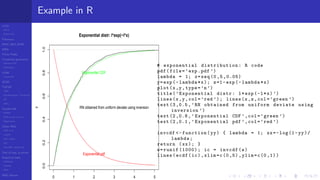
Example in R
0 1 2 3 4 5
0.00.20.40.60.81.0
y Exponential distr: l*exp(−l*x)
RN obtained from uniform deviate using inversion
Exponential CDF
Exponential pdf
# exponential distribution : R code
pdf(file=’exp.pdf ’)
lambda = 1; x=seq (0 ,5 ,0.05)
y=exp(-lambda*x); z=1-exp(-lambda*x)
plot(x,y,type=’n’)
title(’Exponential distr: l*exp(-l*x) ’)
lines(x,y,col=’red ’); lines(x,z,col=’green ’)
text (3,0.5,’RN obtained from uniform deviate using
inversion ’)
text (2,0.8,’ Exponential CDF ’,col=’green ’)
text (2,0.1,’ Exponential pdf ’,col=’red ’)
invcdf <-function(yy) { lambda = 1; xx=-log(1-yy)/
lambda;
return (xx); }
w=runif (1000); ic = invcdf(w)
lines(ecdf(ic),xlim=c(0 ,5),ylim=c(0 ,1))
LCGs
MLCG
Mixed LCG
Fibonacci
MWC,AWC,SWB
MRG
Finite Fields
Combined generators
Wichman-Hill
MRG32k3a
LFSR
Tausworthe
GFSR
TGFSR
T800
Equidistribution, Tempering
MT
WELL
Parallel RN
SPRNG
PRN as easy as 1,2,3
RngStreams
Other RNG
KISS et al.
xorshift
Num recipes
GSL
Intel MKL statistic lib
Test of hyp, p-values
Empirical tests
DieHarder
TestU01
NIST
RNG failures
Qualities of Good RNG
Good Theoretical Basis
Long Period
”pass” Empirical Tests
Efficient
Repeatable
Portable
LCGs
MLCG
Mixed LCG
Fibonacci
MWC,AWC,SWB
MRG
Finite Fields
Combined generators
Wichman-Hill
MRG32k3a
LFSR
Tausworthe
GFSR
TGFSR
T800
Equidistribution, Tempering
MT
WELL
Parallel RN
SPRNG
PRN as easy as 1,2,3
RngStreams
Other RNG
KISS et al.
xorshift
Num recipes
GSL
Intel MKL statistic lib
Test of hyp, p-values
Empirical tests
DieHarder
TestU01
NIST
RNG failures
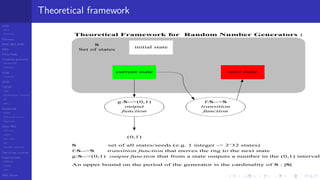
Theoretical framework
s0=initial state
current state next state
S
Set of states
Theoretical Framework for Random Number Generators :
initial stateinitial state
current statecurrent state next statenext state
g:S-->(0,1)
output
function
f:S-->S
transition
function
(0,1)
S set of all states/seeds (e.g. 1 integer -> 2ˆ32 states)
f:S-->S transition function that moves the rng to the next state
g:S-->(0,1) output function that from a state outputs a number in the (0,1) interval
An upper bound on the period of the generator is the cardinality of S : |S|
LCGs
MLCG
Mixed LCG
Fibonacci
MWC,AWC,SWB
MRG
Finite Fields
Combined generators
Wichman-Hill
MRG32k3a
LFSR
Tausworthe
GFSR
TGFSR
T800
Equidistribution, Tempering
MT
WELL
Parallel RN
SPRNG
PRN as easy as 1,2,3
RngStreams
Other RNG
KISS et al.
xorshift
Num recipes
GSL
Intel MKL statistic lib
Test of hyp, p-values
Empirical tests
DieHarder
TestU01
NIST
RNG failures
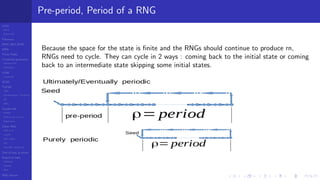
Pre-period, Period of a RNG
Because the space for the state is finite and the RNGs should continue to produce rn,
RNGs need to cycle. They can cycle in 2 ways : coming back to the initial state or coming
back to an intermediate state skipping some initial states.
LCGs
MLCG
Mixed LCG
Fibonacci
MWC,AWC,SWB
MRG
Finite Fields
Combined generators
Wichman-Hill
MRG32k3a
LFSR
Tausworthe
GFSR
TGFSR
T800
Equidistribution, Tempering
MT
WELL
Parallel RN
SPRNG
PRN as easy as 1,2,3
RngStreams
Other RNG
KISS et al.
xorshift
Num recipes
GSL
Intel MKL statistic lib
Test of hyp, p-values
Empirical tests
DieHarder
TestU01
NIST
RNG failures
History of field based on scholars leaders
Von Neumann was maybe the first to devise an algorithm : the middlesquare method. A
few leaders in the field during more than 75 years of electronic computing were in
succession :
Donald Knuth
George Marsaglia
Pierre L'Ecuyer
Makoto Matsumoto
LCGs
MLCG
Mixed LCG
Fibonacci
MWC,AWC,SWB
MRG
Finite Fields
Combined generators
Wichman-Hill
MRG32k3a
LFSR
Tausworthe
GFSR
TGFSR
T800
Equidistribution, Tempering
MT
WELL
Parallel RN
SPRNG
PRN as easy as 1,2,3
RngStreams
Other RNG
KISS et al.
xorshift
Num recipes
GSL
Intel MKL statistic lib
Test of hyp, p-values
Empirical tests
DieHarder
TestU01
NIST
RNG failures
Donald Knuth
born 1938, PhD at Caltech, worked at Stanford, now Professor
Emeritus at Stanford
Writer of the first bible of algorithms. 3 and now 4 books
nick-named TAOCP: The art of computer programming.
Creator of TEX and METAFONT and the Computer Modern family
of fonts. Writer of the 5 books about them : Computer and
typesetting: A,B,C,D,E
Volume 2 of The Art Of Computer Programming : Seminumerical
Algorithms(1998) dedicates the 189 pages of chapter 3 to Random
Numbers. In it there is also the description of a battery of rng tests.
LCGs
MLCG
Mixed LCG
Fibonacci
MWC,AWC,SWB
MRG
Finite Fields
Combined generators
Wichman-Hill
MRG32k3a
LFSR
Tausworthe
GFSR
TGFSR
T800
Equidistribution, Tempering
MT
WELL
Parallel RN
SPRNG
PRN as easy as 1,2,3
RngStreams
Other RNG
KISS et al.
xorshift
Num recipes
GSL
Intel MKL statistic lib
Test of hyp, p-values
Empirical tests
DieHarder
TestU01
NIST
RNG failures
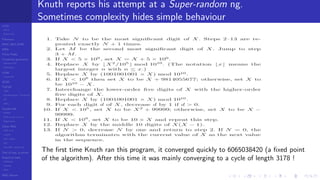
Knuth reports his attempt at a Super-random ng.
Sometimes complexity hides simple behaviour
The first time Knuth ran this program, it converged quickly to 6065038420 (a fixed point
of the algorithm). After this time it was mainly converging to a cycle of length 3178 !
LCGs
MLCG
Mixed LCG
Fibonacci
MWC,AWC,SWB
MRG
Finite Fields
Combined generators
Wichman-Hill
MRG32k3a
LFSR
Tausworthe
GFSR
TGFSR
T800
Equidistribution, Tempering
MT
WELL
Parallel RN
SPRNG
PRN as easy as 1,2,3
RngStreams
Other RNG
KISS et al.
xorshift
Num recipes
GSL
Intel MKL statistic lib
Test of hyp, p-values
Empirical tests
DieHarder
TestU01
NIST
RNG failures
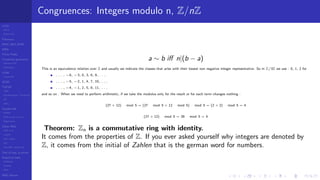
Congruences: Integers modulo n, Z/nZ
a ∼ b iff n|(b − a)
This is an equivalence relation over Z and usually we indicate the classes that arise with their lowest non negative integer representative. So in Z/3Z we use : 0, 1, 2 for
. . . , −6, −3, 0, 3, 6, 9, . . .
. . . , −5, −2, 1, 4, 7, 10, . . .
. . . , −4, −1, 2, 5, 8, 11, . . .
and so on . When we need to perform arithmetic, if we take the modulus only for the result or for each term changes nothing :
(27 + 12) mod 5 = (27 mod 5 + 12 mod 5) mod 5 = (2 + 2) mod 5 = 4
(27 + 12) mod 5 = 39 mod 5 = 4
Theorem: Zn is a commutative ring with identity.
It comes from the properties of Z. If you ever asked yourself why integers are denoted by
Z, it comes from the initial of Zahlen that is the german word for numbers.
LCGs
MLCG
Mixed LCG
Fibonacci
MWC,AWC,SWB
MRG
Finite Fields
Combined generators
Wichman-Hill
MRG32k3a
LFSR
Tausworthe
GFSR
TGFSR
T800
Equidistribution, Tempering
MT
WELL
Parallel RN
SPRNG
PRN as easy as 1,2,3
RngStreams
Other RNG
KISS et al.
xorshift
Num recipes
GSL
Intel MKL statistic lib
Test of hyp, p-values
Empirical tests
DieHarder
TestU01
NIST
RNG failures
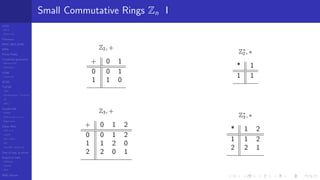
Small Commutative Rings Zn I
Z2, +
+ 0 1
0 0 1
1 1 0
Z∗
2 , ∗
* 1
1 1
Z3, +
+ 0 1 2
0 0 1 2
1 1 2 0
2 2 0 1
Z∗
3 , ∗
* 1 2
1 1 2
2 2 1
LCGs
MLCG
Mixed LCG
Fibonacci
MWC,AWC,SWB
MRG
Finite Fields
Combined generators
Wichman-Hill
MRG32k3a
LFSR
Tausworthe
GFSR
TGFSR
T800
Equidistribution, Tempering
MT
WELL
Parallel RN
SPRNG
PRN as easy as 1,2,3
RngStreams
Other RNG
KISS et al.
xorshift
Num recipes
GSL
Intel MKL statistic lib
Test of hyp, p-values
Empirical tests
DieHarder
TestU01
NIST
RNG failures
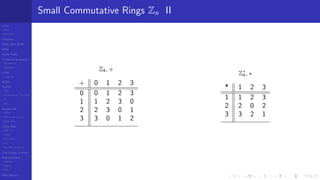
Small Commutative Rings Zn II
Z4, +
+ 0 1 2 3
0 0 1 2 3
1 1 2 3 0
2 2 3 0 1
3 3 0 1 2
Z∗
4 , ∗
* 1 2 3
1 1 2 3
2 2 0 2
3 3 2 1
LCGs
MLCG
Mixed LCG
Fibonacci
MWC,AWC,SWB
MRG
Finite Fields
Combined generators
Wichman-Hill
MRG32k3a
LFSR
Tausworthe
GFSR
TGFSR
T800
Equidistribution, Tempering
MT
WELL
Parallel RN
SPRNG
PRN as easy as 1,2,3
RngStreams
Other RNG
KISS et al.
xorshift
Num recipes
GSL
Intel MKL statistic lib
Test of hyp, p-values
Empirical tests
DieHarder
TestU01
NIST
RNG failures
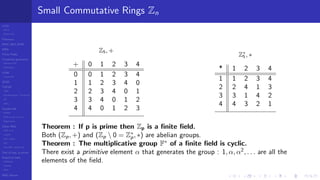
Small Commutative Rings Zn
Z5, +
+ 0 1 2 3 4
0 0 1 2 3 4
1 1 2 3 4 0
2 2 3 4 0 1
3 3 4 0 1 2
4 4 0 1 2 3
Z∗
5 , ∗
* 1 2 3 4
1 1 2 3 4
2 2 4 1 3
3 3 1 4 2
4 4 3 2 1
Theorem : If p is prime then Zp is a finite field.
Both (Zp, +) and (Zp  0 = Z∗
p, ∗) are abelian groups.
Theorem : The multiplicative group F∗
of a finite field is cyclic.
There exist a primitive element α that generates the group : 1, α, α2
, . . . are all the
elements of the field.
LCGs
MLCG
Mixed LCG
Fibonacci
MWC,AWC,SWB
MRG
Finite Fields
Combined generators
Wichman-Hill
MRG32k3a
LFSR
Tausworthe
GFSR
TGFSR
T800
Equidistribution, Tempering
MT
WELL
Parallel RN
SPRNG
PRN as easy as 1,2,3
RngStreams
Other RNG
KISS et al.
xorshift
Num recipes
GSL
Intel MKL statistic lib
Test of hyp, p-values
Empirical tests
DieHarder
TestU01
NIST
RNG failures
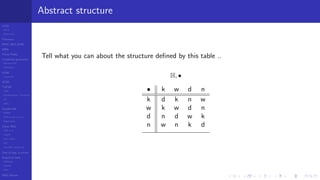
Abstract structure
Tell what you can about the structure defined by this table ..
H, •
• k w d n
k d k n w
w k w d n
d n d w k
n w n k d
LCGs
MLCG
Mixed LCG
Fibonacci
MWC,AWC,SWB
MRG
Finite Fields
Combined generators
Wichman-Hill
MRG32k3a
LFSR
Tausworthe
GFSR
TGFSR
T800
Equidistribution, Tempering
MT
WELL
Parallel RN
SPRNG
PRN as easy as 1,2,3
RngStreams
Other RNG
KISS et al.
xorshift
Num recipes
GSL
Intel MKL statistic lib
Test of hyp, p-values
Empirical tests
DieHarder
TestU01
NIST
RNG failures
Linear Congruential Generators or LCG I
LCG notation
xn+1 ≡ (a ∗ xn + c) (mod m)
will be indicated by LCG(m, a, c, x0). m is called the modulus, a the multiplier, c the
increment, x0 the starting value or seed. We use c like Knuth does and we set b = a − 1
for convenience.
Introduced by Lehmer in 1949 [14] . Sometimes when c = 0 they are called Multiplicative
LCG or MLCG and denoted by MLCG(m, a). When c = 0 Mixed Linear Congruential.
Lehmer generator is u0 = 0, un+1 ≡ (23 ∗ un) (mod 108
+ 1)
ANSIC LCG(231
, 1103515245, 12345, 12345)
MINSTD LCG(231−1
, 75
, 0, 1)
RANDU LCG(231
, 216
, 0, 1)
APPLE LCG(235
, 513
, 0, 1)
Super-duper LCG(232
, 69069, 0, 1)
NAG LCG(259
, 1313
, 0, 232
+ 1)
DRAND48 LCG(248
, 25214903917, 11,
LCGs
MLCG
Mixed LCG
Fibonacci
MWC,AWC,SWB
MRG
Finite Fields
Combined generators
Wichman-Hill
MRG32k3a
LFSR
Tausworthe
GFSR
TGFSR
T800
Equidistribution, Tempering
MT
WELL
Parallel RN
SPRNG
PRN as easy as 1,2,3
RngStreams
Other RNG
KISS et al.
xorshift
Num recipes
GSL
Intel MKL statistic lib
Test of hyp, p-values
Empirical tests
DieHarder
TestU01
NIST
RNG failures
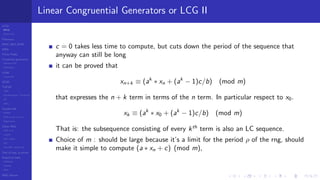
Linear Congruential Generators or LCG II
c = 0 takes less time to compute, but cuts down the period of the sequence that
anyway can still be long
it can be proved that
xn+k ≡ (ak
∗ xn + (ak
− 1)c/b) (mod m)
that expresses the n + k term in terms of the n term. In particular respect to x0.
xk ≡ (ak
∗ x0 + (ak
− 1)c/b) (mod m)
That is: the subsequence consisting of every kth
term is also an LC sequence.
Choice of m : should be large because it’s a limit for the period ρ of the rng, should
make it simple to compute (a ∗ xn + c) (mod m),
LCGs
MLCG
Mixed LCG
Fibonacci
MWC,AWC,SWB
MRG
Finite Fields
Combined generators
Wichman-Hill
MRG32k3a
LFSR
Tausworthe
GFSR
TGFSR
T800
Equidistribution, Tempering
MT
WELL
Parallel RN
SPRNG
PRN as easy as 1,2,3
RngStreams
Other RNG
KISS et al.
xorshift
Num recipes
GSL
Intel MKL statistic lib
Test of hyp, p-values
Empirical tests
DieHarder
TestU01
NIST
RNG failures
Linear Congruential Generators or LCG III
MLCG(m, a) :
If m is prime and a is a primitive root of m and x0 = 0 then the sequences {xn} are
periodic with period length ρ = m − 1 and the generator is called a full period MLCG.
If m = 2w
then the maximal period is ρ = 2w−2
= m/4 and is attained in particular when
a ≡ 5 (mod 8).
[17] We want a large m to make the grid of RN finer. But we need to keep m not larger
than a computer word so that we can do operations efficiently. Therefore we choose
m ≤ 232
for 32-bit processors or m ≤ 264
for 64-bit processor. The theory is nicer if m is
prime or is a power of 2 like 2w
. Common choices:
32-bit proc 64-bit proc
Prime 2k
Prime 2k
m = 231
− 1 m = 232
m = 248
− 59 m = 264
m = 263
− 25
m = 264
− 59
LCGs
MLCG
Mixed LCG
Fibonacci
MWC,AWC,SWB
MRG
Finite Fields
Combined generators
Wichman-Hill
MRG32k3a
LFSR
Tausworthe
GFSR
TGFSR
T800
Equidistribution, Tempering
MT
WELL
Parallel RN
SPRNG
PRN as easy as 1,2,3
RngStreams
Other RNG
KISS et al.
xorshift
Num recipes
GSL
Intel MKL statistic lib
Test of hyp, p-values
Empirical tests
DieHarder
TestU01
NIST
RNG failures
Linear Congruential Generators or LCG IV
LCG(m, a, c, x0) :
An LCG has full period m if and only if :
1 The GCD(Greatest Common Divisor) of m and c is 1.
2 if q is a prime that divides m then q divides (a − 1).
3 if 4 divides m, then 4 divides (a − 1)
(Hull-Dobell Theorem)
A lot of work has been done on these generators especially to give multipliers that provide
as little as possible of Marsaglia’s effect. You can’t use them without reading [17] that for
common word sizes computes the highest prime smaller than the largest integer and gives
good multipliers .
LCGs
MLCG
Mixed LCG
Fibonacci
MWC,AWC,SWB
MRG
Finite Fields
Combined generators
Wichman-Hill
MRG32k3a
LFSR
Tausworthe
GFSR
TGFSR
T800
Equidistribution, Tempering
MT
WELL
Parallel RN
SPRNG
PRN as easy as 1,2,3
RngStreams
Other RNG
KISS et al.
xorshift
Num recipes
GSL
Intel MKL statistic lib
Test of hyp, p-values
Empirical tests
DieHarder
TestU01
NIST
RNG failures
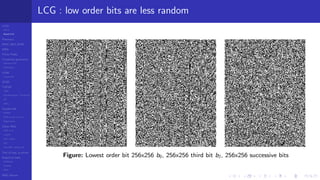
LCG : low order bits are less random
Figure: Lowest order bit 256x256 b0, 256x256 third bit b2, 256x256 successive bits
LCGs
MLCG
Mixed LCG
Fibonacci
MWC,AWC,SWB
MRG
Finite Fields
Combined generators
Wichman-Hill
MRG32k3a
LFSR
Tausworthe
GFSR
TGFSR
T800
Equidistribution, Tempering
MT
WELL
Parallel RN
SPRNG
PRN as easy as 1,2,3
RngStreams
Other RNG
KISS et al.
xorshift
Num recipes
GSL
Intel MKL statistic lib
Test of hyp, p-values
Empirical tests
DieHarder
TestU01
NIST
RNG failures
George Marsaglia
born 1924, † 2011, PhD Ohio State, then University of Florida,
University of Washington
discovered what is called Marsaglia’s effect. The successive n-tuples
generated by Linear Congruential Generators (LCG) lie on a small
number of equally spaced hyperplanes in n-dimensional space.
developed the diehard statistical tests for rng, 1996
developed many of the well known methods for generating rn :
multiply-with-carry, subtract with borrow, xorshift , KISS93,
KISS99, . . .
LCGs
MLCG
Mixed LCG
Fibonacci
MWC,AWC,SWB
MRG
Finite Fields
Combined generators
Wichman-Hill
MRG32k3a
LFSR
Tausworthe
GFSR
TGFSR
T800
Equidistribution, Tempering
MT
WELL
Parallel RN
SPRNG
PRN as easy as 1,2,3
RngStreams
Other RNG
KISS et al.
xorshift
Num recipes
GSL
Intel MKL statistic lib
Test of hyp, p-values
Empirical tests
DieHarder
TestU01
NIST
RNG failures
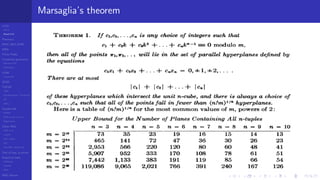
Marsaglia’s theorem
LCGs
MLCG
Mixed LCG
Fibonacci
MWC,AWC,SWB
MRG
Finite Fields
Combined generators
Wichman-Hill
MRG32k3a
LFSR
Tausworthe
GFSR
TGFSR
T800
Equidistribution, Tempering
MT
WELL
Parallel RN
SPRNG
PRN as easy as 1,2,3
RngStreams
Other RNG
KISS et al.
xorshift
Num recipes
GSL
Intel MKL statistic lib
Test of hyp, p-values
Empirical tests
DieHarder
TestU01
NIST
RNG failures
Lattice structure of LCG generators
Marsaglia's effect. Successive t-uples obtained from an LCG generator fall on, at most,
(t!m)1/t
parallel hyperplanes, where m is the modulus used in the LCG(marsaglia1968) :
q
q
q q
q
q
q
q
q
q
q
q
q
q
q
q
q
q
q q
q
q
q
q
q
q
q
q
q
q
q
q
q
q
q q
q
q
q
q
q
q
q
q
q
q
q
q
q
q
q q
q
q
q
q
q
q
q
q
q
q
q
q
q
q
qq
q
q
q
q
q
q
q
q
q
q
q
q
q
q
qq
q
q
q
q
q
q
q
q
q
q
q
q
q
q
q q
q
q
q
q
q
q
q
q
q
q
q
q
q
q
q q
q
q
q
q
q
q
q
q
q
q
q
q
q
q
q q
q
q
q
q
q
q
q
q
q
q
q
q
q
q
q q
q
q
q
q
q
q
q
q
q
q
q
q
q
q
q q
q
q
q
q
q
q
q
q
q
q
q
q
q
q
q q
q
q
q
q
q
q
q
q
q
q
q
q
q
q
q q
q
q
q
q
q
q
q
q
q
q
q
q
q
q
q q
q
q
q
q
q
q
q
q
q
q
q
q
q
q
q q
q
q
q
q
q
q
q
q
q
q
q
q
q
q
q q
q
q
q
q
q
q
q
q
q
q
q
q
q
q
q q
q
q
q
q
q
q
q
q
q
q
q
q
q
q
q q
q
q
q
q
q
q
q
q
q
q
q
q
q
q
q q
q
q
q
q
q
q
q
q
q
q
q
q
q
q
q q
q
q
q
q
q
q
q
q
q
q
q
q
q
q
q q
q
q
q
q
q
q
q
q
q
q
q
q
q
q
q q
q
q
q
q
q
q
q
q
q
q
q
q
q
q
q q
q
q
q
q
q
q
q
q
q
q
q
q
q
q
q q
q
q
q
q
q
q
q
q
q
q
q
q
q
q
q q
q
q
q
q
q
q
q
q
q
q
q
q
q
q
qq
q
q
q
q
q
q
q
q
q
q
q
q
q
q
qq
q
q
q
q
q
q
q
q
q
q
q
q
q
q
q q
q
q
q
q
q
q
q
q
q
q
q
q
q
q
q q
q
q
q
q
q
q
q
q
q
q
q
q
q
q
q q
q
q
q
q
q
q
q
q
q
q
q
q
q
q
q q
q
q
q
q
q
q
q
q
q
q
q
q
q
q
q q
q
q
q
q
q
q
q
q
q
q
q
q
q
q
q q
q
q
q
q
q
q
q
q
q
q
q
q
q
q
q q
q
q
q
q
q
q
q
q
q
q
q
q
q
q
q q
q
q
q
q
q
q
q
q
q
q
q
q
q
q
q q
q
q
q
q
q
q
q
q
q
q
q
q
q
q
q q
q
q
q
q
q
q
q
q
q
q
q
q
q
q
q q
q
q
q
q
q
q
q
q
q
q
q
q
q
q
q q
q
q
q
q
q
q
q
q
q
q
q
q
q
q
q q
q
q
q
q
q
q
q
q
q
q
q
q
q
q
q q
q
q
q
q
q
q
q
q
q
q
q
q
q
q
q q
q
q
q
q
q
q
q
q
q
q
q
q
q
q
q q
q
q
q
q
q
q
q
q
q
q
q
q
q
q
q q
q
q
q
q
q
q
q
q
q
q
q
q
q
q
q q
q
q
q
q
q
q
q
q
q
q
q
q
q
q
q q
q
q
q
q
q
q
q
q
q
q
q
q
q
q
qq
q
q
q
q
q
q
q
q
q
q
q
q
q
q
qq
q
q
q
q
q
q
q
q
q
q
q
q
q
q
q q
q
q
q
q
q
q
q
q
q
q
q
q
q
q
q q
q
q
q
q
q
q
q
q
q
q
q
q
q
q
q q
q
q
q
q
q
q
q
q
q
q
q
q
q
q
q q
q
q
q
q
q
q
q
q
q
q
q
q
q
q
q q
q
q
q
q
q
q
q
q
q
q
q
q
q
q
q q
q
q
q
q
q
q
q
q
q
q
q
q
q
q
q q
q
q
q
q
q
q
q
q
q
q
q
q
q
q
q q
q
q
q
q
q
q
q
q
q
q
q
q
q
q
q q
q
q
q
q
q
q
q
q
q
q
q
q
q
q
q q
q
q
q
q
q
q
q
q
q
q
q
q
q
q
q q
q
q
q
q
q
q
q
q
q
q
q
q
q
q
q q
q
q
q
q
q
q
q
q
q
q
q
q
q
q
q q
q
q
q
q
q
q
q
q
q
q
q
q
q
q
q q
q
q
q
q
q
q
q
q
q
q
q
q
q
q
q q
q
q
q
q
q
q
q
q
q
q
q
q
q
q
q q
q
q
q
q
q
q
q
q
q
q
q
q
q
q
q q
q
q
q
q
q
q
q
q
q
q
q
q
q
q
q q
q
q
q
q
q
q
q
q
q
q
q
q
q
q
q q
q
q
q
q
q
q
q
q
q
q
q
q
q
q
q q
q
q
q
q
q
q
q
q
q
q
q
q
q
q
qq
q
q
q
q
q
q
q
q
q
q
q
q
q
q
qq
q
q
q
q
q
q
q
q
q
q
q
q
q
q
q q
q
q
q
q
q
q
q
q
q
q
q
q
q
q
q q
q
q
q
q
q
q
q
q
q
q
q
q
q
q
q q
q
q
q
q
q
q
q
q
q
q
q
q
q
q
q q
q
q
q
q
q
q
q
q
q
q
q
q
q
q
q q
q
q
q
q
q
q
q
q
q
q
q
q
q
q
q q
q
q
q
q
q
q
q
q
q
q
q
q
q
q
q q
q
q
q
q
q
q
q
q
q
q
q
q
q
q
q q
q
q
q
q
q
q
q
q
q
q
q
q
q
q
q q
q
q
q
q
q
q
q
q
q
q
q
q
q
q
q q
q
q
q
q
q
q
q
q
q
q
q
q
q
q
q q
q
q
q
q
q
q
q
q
q
q
q
q
q
q
q q
q
q
q
q
q
q
q
q
q
q
q
q
q
q
q q
q
q
q
q
q
q
q
q
q
q
q
q
q
q
q q
q
q
q
q
q
q
q
q
q
q
q
q
q
q
q q
q
q
q
q
q
q
q
q
q
q
q
q
q
q
q q
q
q
q
q
q
q
q
q
q
q
q
q
q
q
q q
q
q
q
q
q
q
q
q
q
q
q
q
q
q
q q
q
q
q
q
q
q
q
q
q
q
q
q
q
q
q q
q
q
q
q
q
q
q
q
q
q
q
q
q
q
qq
q
q
q
q
q
q
q
q
q
q
q
q
q
q
qq
q
q
q
q
q
q
q
q
q
q
q
q
q
q
q q
q
q
q
q
q
q
q
q
q
q
q
q
q
q
q q
q
q
q
q
q
q
q
q
q
q
q
q
q
q
q q
q
q
q
q
q
q
q
q
q
q
q
q
q
q
q q
q
q
q
q
q
q
q
q
q
q
q
q
q
q
q q
q
q
q
q
q
q
q
q
q
q
q
q
q
q
q q
q
q
q
q
q
q
q
q
q
q
q
q
q
q
q q
q
q
q
q
q
q
q
q
q
q
q
q
q
q
q q
q
q
q
q
q
q
q
q
q
q
q
q
q
q
q q
q
q
q
q
q
q
q
q
q
q
q
q
q
q
q q
q
q
q
q
q
q
q
q
q
q
q
q
q
q
q q
q
q
q
q
q
q
q
q
q
q
q
q
q
q
q q
q
q
q
q
q
q
q
q
q
q
q
q
q
q
q q
q
q
q
q
q
q
q
q
q
q
q
q
q
q
q q
q
q
q
q
q
q
q
q
q
q
q
q
q
q
q q
q
q
q
q
q
q
q
q
q
q
q
q
q
q
q q
q
q
q
q
q
q
q
q
q
q
q
q
q
q
q q
q
q
q
q
q
q
q
q
q
q
q
q
q
q
q q
q
q
q
q
q
q
q
q
q
q
q
q
q
q
q q
q
q
q
q
q
q
q
q
q
q
q
q
q
q
qq
q
q
q
q
q
q
q
q
q
q
q
q
q
q
qq
q
q
q
q
q
q
q
q
q
q
q
q
q
q
q q
q
q
q
q
q
q
q
q
q
q
q
q
q
q
q q
q
q
q
q
q
q
q
q
q
q
q
q
q
q
q q
q
q
q
q
q
q
q
q
q
q
q
q
q
q
q q
q
q
q
q
q
q
q
q
q
q
q
q
q
q
q q
q
q
q
q
q
q
q
q
q
q
q
q
q
q
q q
q
q
q
q
q
q
q
q
q
q
q
q
q
q
q q
q
q
q
q
q
q
q
q
q
q
q
q
q
q
q q
q
q
q
q
q
q
q
q
q
q
q
q
q
q
q q
q
q
q
q
q
q
q
q
q
q
q
q
q
q
q q
q
q
q
q
q
q
q
q
q
q
q
q
q
q
q q
q
q
q
q
q
q
q
q
q
q
q
q
q
q
q q
q
q
q
q
q
q
q
q
q
q
q
q
q
q
q q
q
q
q
q
q
q
q
q
q
q
q
q
q
q
q q
q
q
q
q
q
q
q
q
q
q
q
q
q
q
q q
q
q
q
q
q
q
q
q
q
q
q
q
q
q
q q
q
q
q
q
q
q
q
q
q
q
q
q
q
q
q q
q
q
q
q
q
q
q
q
q
q
q
q
q
q
q q
q
q
q
q
q
q
q
q
q
q
q
q
q
q
q q
q
q
q
q
q
q
q
q
q
q
q
q
q
q
q q
q
q
q
q
q
q
q
q
q
q
q
q
q
q
qq
q
q
q
q
q
q
q
q
q
q
q
q
q
q
qq
q
q
q
q
q
q
q
q
q
q
q
q
q
q
q q
q
q
q
q
q
q
q
q
q
q
q
q
q
q
q q
q
q
q
q
q
q
q
q
q
q
q
q
q
q
q q
q
q
q
q
q
q
q
q
q
q
q
q
q
q
q q
q
q
q
q
q
q
q
q
q
q
q
q
q
q
q q
q
q
q
q
q
q
q
q
q
q
q
q
q
q
q q
q
q
q
q
q
q
q
q
q
q
q
q
q
q
q q
q
q
q
q
q
q
q
q
q
q
q
q
q
q
q q
q
q
q
q
q
q
q
q
q
q
q
q
q
q
q q
q
q
q
q
q
q
q
q
q
q
q
q
q
q
q q
q
q
q
q
q
q
q
q
q
q
q
q
q
q
q q
q
q
q
q
q
q
q
q
q
q
q
q
q
q
q q
q
q
q
q
q
q
q
q
q
q
q
q
q
q
q q
q
q
q
q
q
q
q
q
q
q
q
q
q
q
q q
q
q
q
q
q
q
q
q
q
q
q
q
q
q
q q
q
q
q
q
q
q
q
q
q
q
q
q
q
q
q q
q
q
q
q
q
q
q
q
q
q
q
q
q
q
q q
q
q
q
q
q
q
q
q
q
q
q
q
q
q
q q
q
q
q
q
q
q
q
q
q
q
q
q
q
q
q q
q
q
q
q
q
q
q
q
q
q
q
q
q
q
qq
q
q
q
q
q
q
q
q
q
q
q
q
q
q
qq
q
q
q
q
q
q
q
q
q
q
q
q
q
q
q q
q
q
q
q
q
q
q
q
q
q
q
q
q
q
q q
q
q
q
q
q
q
q
q
q
q
q
q
q
q
q q
q
q
q
q
q
q
q
q
q
q
q
q
q
q
q q
q
q
q
q
q
q
q
q
q
q
q
q
q
q
q q
q
q
q
q
q
q
q
q
q
q
q
q
q
q
q q
q
q
q
q
q
q
q
q
q
q
q
q
q
q
q q
q
q
q
q
q
q
q
q
q
q
q
q
q
q
q q
q
q
q
q
q
q
q
q
q
q
q
q
q
q
q q
q
q
q
q
q
q
q
q
q
q
q
q
q
q
q q
q
q
q
q
q
q
q
q
q
q
q
q
q
q
q q
q
q
q
q
q
q
q
q
q
q
q
q
q
q
q q
q
q
q
q
q
q
q
q
q
q
q
q
q
q
q q
q
q
q
q
q
q
q
q
q
q
q
q
q
q
q q
q
q
q
q
q
q
q
q
q
q
q
q
q
q
q q
q
q
q
q
q
q
q
q
q
q
q
q
q
q
q q
q
q
q
q
q
q
q
q
q
q
q
q
q
q
q q
q
q
q
q
q
q
q
q
q
q
q
q
q
q
q q
q
q
q
q
q
q
q
q
q
q
q
q
q
q
q q
q
q
q
q
q
q
q
q
q
q
q
q
q
q
qq
q
q
q
q
q
q
q
q
q
q
q
q
q
q
qq
q
q
q
q
q
q
q
q
q
q
q
q
q
q
q q
q
q
q
q
q
q
q
q
q
q
q
q
q
q
q q
q
q
q
q
q
q
q
q
q
q
q
q
q
q
q q
q
q
q
q
q
q
q
q
q
q
q
q
q
q
q q
q
q
q
q
q
q
q
q
q
q
q
q
q
q
q q
q
q
q
q
q
q
q
q
q
q
q
q
q
q
q q
q
q
q
q
q
q
q
q
q
q
q
q
q
q
q q
q
q
q
q
q
q
q
q
q
q
q
q
q
q
q q
q
q
q
q
q
q
q
q
q
q
q
q
q
q
q q
q
q
q
q
q
q
q
q
q
q
q
q
q
q
q q
q
q
q
q
q
q
q
q
q
q
q
q
q
q
q q
q
q
q
q
q
q
q
q
q
q
q
q
q
q
q q
q
q
q
q
q
q
q
q
q
q
q
q
q
q
q q
q
q
q
q
q
q
q
q
q
q
q
q
q
q
q q
q
q
q
q
q
q
q
q
q
q
q
q
q
q
q q
q
q
q
q
q
q
q
q
q
q
q
q
q
q
q q
q
q
q
q
q
q
q
q
q
q
q
q
q
q
q q
q
q
q
q
q
q
q
q
q
q
q
q
q
q
q q
q
q
q
q
q
q
q
q
q
q
q
q
q
q
q q
q
q
q
q
q
q
q
q
q
q
q
q
q
q
q q
q
q
q
q
q
q
q
q
q
q
q
q
q
q
qq
q
q
q
q
q
q
q
q
q
q
q
q
q
q
qq
q
q
q
q
q
q
q
q
q
q
q
q
q
q
q q
q
q
q
q
q
q
q
q
q
q
q
q
q
q
q q
q
q
q
q
q
q
q
q
q
q
q
q
q
q
q q
q
q
q
q
q
q
q
q
q
q
q
q
q
q
q q
q
q
q
q
q
q
q
q
q
q
q
q
q
q
q q
q
q
q
q
q
q
q
q
q
q
q
q
q
q
q q
q
q
q
q
q
q
q
q
q
q
q
q
q
q
q q
q
q
q
q
q
q
q
q
q
q
q
q
q
q
q q
q
q
q
q
q
q
q
q
q
q
q
q
q
q
q q
q
q
q
q
q
q
q
q
q
q
q
q
q
q
q q
q
q
q
q
q
q
q
q
q
q
q
q
q
q
q q
q
q
q
q
q
q
q
q
q
q
q
q
q
q
q q
q
q
q
q
q
q
q
q
q
q
q
q
q
q
q q
q
q
q
q
q
q
q
q
q
q
q
q
q
q
q q
q
q
q
q
q
q
q
q
q
q
q
q
q
q
q q
q
q
q
q
q
q
q
q
q
q
q
q
q
q
q q
q
q
q
q
q
q
q
q
q
q
q
q
q
q
q q
q
q
q
q
q
q
q
q
q
q
q
q
q
q
q q
q
q
q
q
q
q
q
q
q
q
q
q
q
q
q q
q
q
q
q
q
q
q
q
q
q
q
q
q
q
qq
q
q
q
q
q
q
q
q
q
q
q
q
q
q
qq
q
q
q
q
q
q
q
q
q
q
q
q
q
q
q q
q
q
q
q
q
q
q
q
q
q
q
q
q
q
q q
q
q
q
q
q
q
q
q
q
q
q
q
q
q
q q
q
q
q
q
q
q
q
q
q
q
q
q
q
q
q q
q
q
q
q
q
q
q
q
q
q
q
q
q
q
q q
q
q
q
q
q
q
q
q
q
q
q
q
q
q
q q
q
q
q
q
q
q
q
q
q
q
q
q
q
q
q q
q
q
q
q
q
q
q
q
q
q
q
q
q
q
q q
q
q
q
q
q
q
q
q
q
q
q
q
q
q
q q
q
q
q
q
q
q
q
q
q
q
q
q
q
q
q q
q
q
q
q
q
q
q
q
q
q
q
q
q
q
q q
q
q
q
q
q
q
q
q
q
q
q
q
q
q
q q
q
q
q
q
q
q
q
q
q
q
q
q
q
q
q q
q
q
q
q
q
q
q
q
q
q
q
q
q
q
q q
q
q
q
q
q
q
q
q
q
q
q
q
q
q
q q
q
q
q
q
q
q
q
q
q
q
q
q
q
q
q q
q
q
q
q
q
q
q
q
q
q
q
q
q
q
q q
q
q
q
q
q
q
q
q
q
q
q
q
q
q
q q
q
q
q
q
q
q
q
q
q
q
q
q
q
q
q q
q
q
q
q
q
q
q
q
q
q
q
q
q
q
qq
q
q
q
q
q
q
q
q
q
q
q
q
q
q
qq
q
q
q
q
q
q
q
q
q
q
q
q
q
q
q q
q
q
q
q
q
q
q
q
q
q
q
q
q
q
q q
q
q
q
q
q
q
q
q
q
q
q
q
q
q
q q
q
q
q
q
q
q
q
q
q
q
q
q
q
q
q q
q
q
q
q
q
q
q
q
q
q
q
q
q
q
q q
q
q
q
q
q
q
q
q
q
q
q
q
q
q
q q
q
q
q
q
q
q
q
q
q
q
q
q
q
q
q q
q
q
q
q
q
q
q
q
q
q
q
q
q
q
q q
q
q
q
q
q
q
q
q
q
q
q
q
q
q
q q
q
q
q
q
q
q
q
q
q
q
q
q
q
q
q q
q
q
q
q
q
q
q
q
q
q
q
q
q
q
q q
q
q
q
q
q
q
q
q
q
q
q
q
q
q
q q
q
q
q
q
q
q
q
q
q
q
q
q
q
q
q q
q
q
q
q
q
q
q
q
q
q
q
q
q
q
q q
q
q
q
q
q
q
q
q
q
q
q
q
q
q
q q
q
q
q
q
q
q
q
q
q
q
q
q
q
q
q q
q
q
q
q
q
q
q
q
q
q
q
q
q
q
q q
q
q
q
q
q
q
q
q
q
q
q
q
q
q
q q
q
q
q
q
q
q
q
q
q
q
q
q
q
q
q q
q
q
q
q
q
q
q
q
q
q
q
q
q
q
q q
q
q
q
q
q
q
q
q
q
q
q
q
q
q
qq
q
q
q
q
q
q
q
q
q
q
q
q
q
q
qq
q
q
q
q
q
q
q
q
q
q
q
q
q
q
q q
q
q
q
q
q
q
q
q
q
q
q
q
q
q
q q
q
q
q
q
q
q
q
q
q
q
q
q
q
q
q q
q
q
q
q
q
q
q
q
q
q
q
q
q
q
q q
q
q
q
q
q
q
q
q
q
q
q
q
q
q
q q
q
q
q
q
q
q
q
q
q
q
q
q
q
q
q q
q
q
q
q
q
q
q
q
q
q
q
q
q
q
q q
q
q
q
q
q
q
q
q
q
q
q
q
q
q
q q
q
q
q
q
q
q
q
q
q
q
q
q
q
q
q q
q
q
q
q
q
q
q
q
q
q
q
q
q
q
q q
q
q
q
q
q
q
q
q
q
q
q
q
q
q
q q
q
q
q
q
q
q
q
q
q
q
q
q
q
q
q q
q
q
q
q
q
q
q
q
q
q
q
q
q
q
q q
q
q
q
q
q
q
q
q
q
q
q
q
q
q
q q
q
q
q
q
q
q
q
q
q
q
q
q
q
q
q q
q
q
q
q
q
q
q
q
q
q
q
q
q
q
q q
q
q
q
q
q
q
q
q
q
q
q
q
q
q
q q
q
q
q
q
q
q
q
q
q
q
q
q
q
q
q q
q
q
q
q
q
q
q
q
q
q
q
q
q
q
q q
q
q
q
q
q
q
q
q
q
q
q
q
q
q
qq
q
q
q
q
q
q
q
q
q
q
q
q
q
q
qq
q
q
q
q
q
q
q
q
q
q
q
q
q
q
q q
q
q
q
q
q
q
q
q
q
q
q
q
q
q
q q
q
q
q
q
q
q
q
q
q
q
q
q
q
q
q q
q
q
q
q
q
q
q
q
q
q
q
q
q
q
q q
q
q
q
q
q
q
q
q
q
q
q
q
q
q
q q
q
q
q
q
q
q
q
q
q
q
q
q
q
q
q q
q
q
q
q
q
q
q
q
q
q
q
q
q
q
q q
q
q
q
q
q
q
q
q
q
q
q
q
q
q
q q
q
q
q
q
q
q
q
q
q
q
q
q
q
q
q q
q
q
q
q
q
q
q
q
q
q
q
q
q
q
q q
q
q
q
q
q
q
q
q
q
q
q
q
q
q
q q
q
q
q
q
q
q
q
q
q
q
q
q
q
q
q q
q
q
q
q
q
q
q
q
q
q
q
q
q
q
q q
q
q
q
q
q
q
q
q
q
q
q
q
q
q
q q
q
q
q
q
q
q
q
q
q
q
q
q
q
q
q q
q
q
q
q
q
q
q
q
q
q
q
q
q
q
q q
q
q
q
q
q
q
q
q
q
q
q
q
q
q
q q
q
q
q
q
q
q
q
q
q
q
q
q
q
q
q q
q
q
q
q
q
q
q
q
q
q
q
q
q
q
q q
q
q
q
q
q
q
q
q
q
q
q
q
q
q
qq
q
q
q
q
q
q
q
q
q
q
q
q
q
q
qq
q
q
q
q
q
q
q
q
q
q
q
q
q
q
q q
q
q
q
q
q
q
q
q
q
q
q
q
q
q
q q
q
q
q
q
q
q
q
q
q
q
q
q
q
q
q q
q
q
q
q
q
q
q
q
q
q
q
q
q
q
q q
q
q
q
q
q
q
q
q
q
q
q
q
q
q
q q
q
q
q
q
q
q
q
q
q
q
q
q
q
q
q q
q
q
q
q
q
q
q
q
q
q
q
q
q
q
q q
q
q
q
q
q
q
q
q
q
q
q
q
q
q
q q
q
q
q
q
q
q
q
q
q
q
q
q
q
q
q q
q
q
q
q
0 10000 20000 30000 40000 50000 60000
0100002000030000400005000060000
y[seq(1, n − (n%%2), 2)]
y[seq(2,n−(n%%2),2)]
2D Lattice structure of (31*x) %% (2^16)
0 10000 20000 30000 40000 50000 60000 70000
010000200003000040000500006000070000
0
10000
20000
30000
40000
50000
60000
70000
y[seq(1, n − (n%%3), 3)]
y[seq(2,n−(n%%3),3)]
y[seq(3,n−(n%%3),3)]
qq q
q qq
q q
qq q
qq q
q q
q qq
qqq
qq
qqq
qq q
qq qq
qq q
qq qq
qq qq
q qq
qq q
qq qq
qq q
qq q
q q
qq qq
qq qq
q qq
qq q
qq q
q q
qq qq
qq q
qq qq
q qq
qq qq
q q
qq qq
qq qq
q q
qq q
q qq
qqqq
qqqq
qqq
q q
qq qq
q qq
q q
q q
qq q
qq q
qq qq
qq qq
q qq
qq qq
qq qq
qq qq
q q
q qq
q qq
qq qq
q qq
qq qq
qq qq
qq q
qq q
q q
qq qq
qq qq
qq qq
qq qq
q qq
qqqq
qqq
qqqq
qq qq
qq qq
qq qq
q q
q qq
q q
q q
qq q
q qq
q q
q qq
q qq
qq qq
q qq
qq q
qq qq
q qq
q qq
qq qq
qq q
qq qq
qq qq
qq q
q qq
qq qq
qq q
qq qq
qq qq
qqq
qqqq
qqqq
q qq
qq qq
qq qq
q qq
qq q
qq qq
qq qq
q qq
qq qq
q qq
qq q
qq qq
q qq
qq qq
q q
qq qq
qq q
qq qq
q qq
qq q
q qq
q qq
q qq
qq qq
qq qq
qq qq
q qq
q q
qqqq
qqqq
qqq
q qq
q q
q qq
qq qq
q q
qq qq
qq q
qq qq
qq qq
q qq
qq q
qq qq
qq q
qq q
q q
qq q
qq qq
qq q
qq q
qq q
qq q
q qq
qq q
q qq
q qq
qq qq
q q
q qq
qq
qq
qqq
q qq
qq qq
qq qq
q q
q q
qq q
qq qq
q q
qq qq
qq qq
q qq
qq q
qq qq
qq qq
qq q
q q
qq qq
q qq
q qq
qq q
qq q
q qq
qq qq
qq q
qq q
q qq
qq q
q qq
qqqq
qqqq
qq
qq qq
qq qq
qq q
qq qq
qq qq
q qq
qq qq
q qq
q qq
q q
qq q
qq q
qq qq
q qq
q qq
qq qq
qq qq
qq qq
q q
q qq
q qq
qq qq
qq qq
qq q
qq qq
qq q
qq q
q q
qqqq
qqq
qqqq
qq qq
q qq
qq qq
qq q
qq
qq
qq qq
qq qq
q qq
q q
qq qq
qq qq
q q
qq qq
q qq
q q
q qq
q qq
qq qq
q qq
qq qq
qq qq
qq qq
q qq
qq qq
qq q
q qq
q qq
qq qq
qqq
qqqq
qqq
qq qq
qq qq
qq qq
qq q
q qq
q q
q
qq
qq qq
q q
qq q
qq qq
qq qq
qq qq
qq qq
q qq
qq qq
qq q
q qq
qq qq
qq q
qq qq
qq q
qq qq
q qq
qq q
q qq
q q
q qq
qqqq
qqqq
qqq
q qq
q q
qq q
qq q
q q
q qq
q q
q q
qq
q
qq q
qq qq
qq q
qq qq
qq qq
q qq
qq q
qq qq
qq q
qq q
q q
qq qq
qq qq
qq qq
qq q
qq q
q q
qq qq
qq q
qqqq
qqq
qqqq
q q
q qq
q qq
q q
qq q
q qq
qq qq
qq qq
qq q
q q
qq qq
qq qq
q q
q q
qq qq
qq q
qq q
qq qq
qq qq
qq q
qq qq
qq qq
q q
q qq
q qq
qq qq
q qq
qq qq
qqqq
qqq
qqq
qq q
qq qq
qq qq
qq qq
qq qq
q qq
qq qq
qq q
qq qq
qq qq
qq qq
qq qq
q q
q qq
q q
q q
qq q
qq qq
q q
q qq
q qq
qq qq
q qq
q q
qq qq
q qq
qq qq
qq qq
qqq
qqqq
qqqq
qq q
q qq
qq qq
qq q
qq qq
qq qq
q qq
qq qq
qq q
q qq
qq qq
qq qq
q qq
qq q
qq qq
qq qq
q qq
qq qq
q qq
qq q
qq qq
q qq
qq qq
q q
qq qq
qq q
qq qq
q qq
qqqq
qq
qqq
q qq
qq qq
qq qq
qq qq
q qq
q q
qq qq
qq qq
qq q
q qq
q q
q qq
qq qq
q q
qq qq
qq qq
qq qq
qq qq
q qq
qq q
qq qq
qq q
qq q
q q
qq q
qq qq
qq q
qq q
qqq
qqq
qqq
qq q
q qq
q qq
qq qq
q q
q qq
q q
q q
qq q
q qq
qq qq
qq qq
q q
q q
qq q
qq qq
qq q
qq qq
qq qq
q qq
qq q
qq qq
qq qq
qq q
q q
qq qq
qq qq
q qq
qqq
qqq
qqq
qq qq
qq q
qq q
q qq
qq q
q q
qq qq
qq qq
q q
qq qq
q qq
qq q
qq qq
qq qq
q qq
qq qq
q qq
q qq
q q
qq q
qq q
qq qq
q qq
q qq
qq qq
qq qq
qq qq
q q
qqq
qqq
qqqq
q qq
qq q
qq qq
qq q
qq q
q q
qq qq
qq q
qq qq
qq qq
q qq
qq qq
qq q
qq qq
qq qq
qq qq
qq qq
q q
qq qq
qq qq
q q
qq qq
q qq
q q
q qq
q qq
qq qq
q qq
qqq
qqqq
qqqq
q qq
qq qq
qq q
q qq
qq qq
qq qq
q qq
qq qq
qq q
qq qq
qq qq
q qq
qq q
q qq
q q
qq qq
qq qq
q qq
qq q
qq qq
qq qq
q qq
qq qq
q qq
qq q
qq q
q qq
qq qq
qqq
qqqq
qqq
qq qq
q qq
qq q
q qq
q qq
q qq
qq qq
qq qq
qq q
q qq
q q
qq qq
qq q
q q
q qq
q q
q q
qq q
qq q
qq qq
qq q
qq qq
qq qq
q qq
qq q
qq qq
qq q
qq q
qq
qqq
qqqq
qq qq
qq q
qq q
q q
q qq
qq q
qq qq
q qq
qq qq
q q
q qq
q q
q q
qq q
q qq
qq qq
qq qq
qq q
q q
qq qq
qq qq
q q
q q
qq qq
q q
qq q
qq qq
qq qq
qqq
qqq
qqqq
q qq
q qq
q qq
qq q
q qq
qq qq
qq qq
qq q
qq q
qq q
q qq
qq qq
qq qq
q qq
q qq
qq qq
qq q
qq qq
qq qq
q qq
qq qq
q qq
q qq
q q
q q
qq q
qq qq
q q
qqq
qqqq
qqqq
q qq
q q
qq qq
q qq
qq qq
qq qq
qq q
qq qq
qq q
qq q
q q
qq qq
qq q
qq qq
qq qq
q qq
qq qq
qq q
qq qq
qq qq
qq qq
q qq
qq q
qq qq
qq qq
q qq
qq qq
q qq
qq
qqqq
qqq
qq qq
q q
qq qq
qq q
qq qq
q qq
qq qq
q q
q qq
q qq
qq qq
qq qq
qq qq
qq q
qq q
qq qq
qq qq
qq q
q qq
q q
q qq
qq qq
q q
qq qq
qq qq
qq qq
qq qq
q qq
qqqq
qqqq
qqq
qq qq
q q
qq q
qq qq
qq q
qq q
qq q
qq q
q qq
q q
q qq
q qq
qq qq
q q
q qq
q q
q q
qq q
q q
q qq
qq q
q q
q q
qq q
qq qq
qq q
qq qq
qq qq
qqq
qqq
qqqq
qq q
qq q
q q
qq qq
qq qq
q qq
qq q
qq q
q qq
qq qq
qq q
qq q
q qq
qq q
q q
qq qq
qq qq
q q
qq q
q qq
qq qq
qq qq
qq q
q q
qq qq
q qq
q qq
q q
qqq
qqq
qqqq
q qq
q qq
qq qq
qq qq
qq qq
q q
q qq
q qq
qq qq
q qq
qq qq
qq qq
qq q
qq q
q q
qq qq
qq q
qq qq
qq qq
q qq
qq qq
qq q
qq qq
qq qq
qq qq
qq qq
q q
qq qq
qq
qq
qqq
q qq
q q
q qq
q qq
qq qq
q qq
qq q
qq qq
q qq
q qq
qq qq
qq q
q qq
qq qq
qq q
q qq
qq qq
qq q
qq qq
qq qq
q qq
qq q
q qq
q q
qq qq
qq qq
q qq
qq q
qqqq
qqqq
qqq
qq qq
q qq
qq q
qq q
q qq
qq qq
q q
qq qq
qq q
qq qq
q qq
qq q
q qq
q qq
q qq
qq qq
qq qq
qq qq
q qq
q q
qq qq
qq q
qq q
q qq
q q
q q
qq q
qq q
qqqq
qqq
qqqq
qq qq
q qq
qq q
qq qq
qq q
qq q
q q
qq q
qq qq
qq q
qq q
qq q
qq q
q qq
qq q
qq qq
q qq
qq qq
q q
q qq
q q
q q
qq q
q qq
qq qq
qq qq
qq q
q q
qqqq
qqqq
qq
qq qq
qq qq
q q
qq q
qq qq
qq qq
qq q
q q
qq qq
q qq
q qq
q q
qq q
q qq
qq qq
qq qq
qq q
q q
qq q
q qq
qq qq
qq qq
q qq
qq qq
qq qq
qq q
qq qq
qq qq
qqq
qqqq
qqq
q qq
q q
qq q
qq q
qq qq
q qq
q qq
qq qq
qq qq
q qq
q q
q qq
q qq
qq qq
qq qq
qq q
qq qq
qq q
qq q
q q
qq qq
qq q
qq qq
qq qq
q qq
qq qq
qq q
qq qq
qqqq
qqqq
qqq
q q
qq qq
qq qq
q q
qq qq
q qq
q q
q qq
q qq
qq qq
q qq
qq qq
qq q
qq qq
q qq
qq qq
qq q
q qq
q qq
qq qq
qq qq
qq qq
qq q
qq qq
qq qq
qq qq
qq q
q qq
qq
qqq
qqqq
q q
qq qq
qq qq
qq qq
qq qq
qq qq
q qq
qq qq
qq q
qq qq
q qq
qq q
qq qq
qq q
qq q
q qq
qq q
q qq
q q
q qq
q qq
qq qq
3D Lattice structure of (31*x) %% (2^16)
LCGs
MLCG
Mixed LCG
Fibonacci
MWC,AWC,SWB
MRG
Finite Fields
Combined generators
Wichman-Hill
MRG32k3a
LFSR
Tausworthe
GFSR
TGFSR
T800
Equidistribution, Tempering
MT
WELL
Parallel RN
SPRNG
PRN as easy as 1,2,3
RngStreams
Other RNG
KISS et al.
xorshift
Num recipes
GSL
Intel MKL statistic lib
Test of hyp, p-values
Empirical tests
DieHarder
TestU01
NIST
RNG failures
Figure: from l'Ecuyer 1988,
MLCG : m = 2e
, c = 0
LCGs
MLCG
Mixed LCG
Fibonacci
MWC,AWC,SWB
MRG
Finite Fields
Combined generators
Wichman-Hill
MRG32k3a
LFSR
Tausworthe
GFSR
TGFSR
T800
Equidistribution, Tempering
MT
WELL
Parallel RN
SPRNG
PRN as easy as 1,2,3
RngStreams
Other RNG
KISS et al.
xorshift
Num recipes
GSL
Intel MKL statistic lib
Test of hyp, p-values
Empirical tests
DieHarder
TestU01
NIST
RNG failures
Figure: from l'Ecuyer 1988,
LCG : m = 2e
,c odd
LCGs
MLCG
Mixed LCG
Fibonacci
MWC,AWC,SWB
MRG
Finite Fields
Combined generators
Wichman-Hill
MRG32k3a
LFSR
Tausworthe
GFSR
TGFSR
T800
Equidistribution, Tempering
MT
WELL
Parallel RN
SPRNG
PRN as easy as 1,2,3
RngStreams
Other RNG
KISS et al.
xorshift
Num recipes
GSL
Intel MKL statistic lib
Test of hyp, p-values
Empirical tests
DieHarder
TestU01
NIST
RNG failures
Figure: l'Ecuyer 1988, LCG :
m prime
LCGs
MLCG
Mixed LCG
Fibonacci
MWC,AWC,SWB
MRG
Finite Fields
Combined generators
Wichman-Hill
MRG32k3a
LFSR
Tausworthe
GFSR
TGFSR
T800
Equidistribution, Tempering
MT
WELL
Parallel RN
SPRNG
PRN as easy as 1,2,3
RngStreams
Other RNG
KISS et al.
xorshift
Num recipes
GSL
Intel MKL statistic lib
Test of hyp, p-values
Empirical tests
DieHarder
TestU01
NIST
RNG failures
Points with at least 2 coords equal are skipped
If we use these generators in 2 dim the diagonal points where (x = y) are skipped because
the generators produce only once every possible outcome. These are the excluded points in
a 20x20x20 lattice :
20
15
y
10
5
0
z
5 10 15 20
0
5
10
15
20
x
0
LCGs
MLCG
Mixed LCG
Fibonacci
MWC,AWC,SWB
MRG
Finite Fields
Combined generators
Wichman-Hill
MRG32k3a
LFSR
Tausworthe
GFSR
TGFSR
T800
Equidistribution, Tempering
MT
WELL
Parallel RN
SPRNG
PRN as easy as 1,2,3
RngStreams
Other RNG
KISS et al.
xorshift
Num recipes
GSL
Intel MKL statistic lib
Test of hyp, p-values
Empirical tests
DieHarder
TestU01
NIST
RNG failures
Minimal Standard MINSTD Park-Miller rng(1988)
75
= 16807, 231
− 1 = 2147483647
MINSTD
xn ≡ 16807 ∗ xn−1 (mod 231
− 1) , LCG(75
, 0, 231
− 1)
Stephen K. Park; Keith W. Miller (1988).
Random Number Generators: Good Ones Are Hard To Find
Given the dynamic nature of the area, it is difficult for nonspecialists to make
decisions about what generator to use. ”Give me something I can understand,
implement and port... it needn’t be state-of-the-art, just make sure it’s
reasonably good and efficient.” Our article and the associated minimal standard
generator was an attempt to respond to this request. Five years later, we see no
need to alter our response other than to suggest the use of the multiplier a =
48271 in place of 16807.
LCGs
MLCG
Mixed LCG
Fibonacci
MWC,AWC,SWB
MRG
Finite Fields
Combined generators
Wichman-Hill
MRG32k3a
LFSR
Tausworthe
GFSR
TGFSR
T800
Equidistribution, Tempering
MT
WELL
Parallel RN
SPRNG
PRN as easy as 1,2,3
RngStreams
Other RNG
KISS et al.
xorshift
Num recipes
GSL
Intel MKL statistic lib
Test of hyp, p-values
Empirical tests
DieHarder
TestU01
NIST
RNG failures
Fibonacci, Lagged Fibonacci(Marsaglia 1983) I
Probably you know the Fibonacci's sequence : an attempt made by Leonardo Fibonacci
(aka il Pisano, born in Pisa ∼ 1175, † ∼ 1245) to model the growth of a population of
rabbits xn = xn−1 + xn−2.
Why not to generate rn based on a longer previous history ?
Fibonacci
Xn = Xn−1 Xn−2 (mod m) , denoted F(1, 2, )
has poor distribution qualities.
Lagged Fibonacci
Xn = Xn−k Xn−l (mod m) , denoted F(k, l, )
LCGs
MLCG
Mixed LCG
Fibonacci
MWC,AWC,SWB
MRG
Finite Fields
Combined generators
Wichman-Hill
MRG32k3a
LFSR
Tausworthe
GFSR
TGFSR
T800
Equidistribution, Tempering
MT
WELL
Parallel RN
SPRNG
PRN as easy as 1,2,3
RngStreams
Other RNG
KISS et al.
xorshift
Num recipes
GSL
Intel MKL statistic lib
Test of hyp, p-values
Empirical tests
DieHarder
TestU01
NIST
RNG failures
Fibonacci, Lagged Fibonacci(Marsaglia 1983) II
is a generic operator from +, −, ∗, ⊕. ⊕ is the XOR binary operator. k , l are called lags
. Lags larger then 16 produce good rng. k = 24, l = 55 was studied extensively, like
30, 127. They were used extensively, but in the ' 90 it was discovered that they fail a
famous test of randomness (but a workaround exists). The one proposed by Marsaglia is
xn ≡ xn−5 + xn−17 (mod 2k
). Period of this lagged Fibonacci is 2k
∗ (217
− 1), quite longer
than LCGs. State is an array of 17 integers.
For a prime m and some choices of k, l, properly choosing an initial vector gives a sequence
with a period of mk
− 1, Parker [35].
LCGs
MLCG
Mixed LCG
Fibonacci
MWC,AWC,SWB
MRG
Finite Fields
Combined generators
Wichman-Hill
MRG32k3a
LFSR
Tausworthe
GFSR
TGFSR
T800
Equidistribution, Tempering
MT
WELL
Parallel RN
SPRNG
PRN as easy as 1,2,3
RngStreams
Other RNG
KISS et al.
xorshift
Num recipes
GSL
Intel MKL statistic lib
Test of hyp, p-values
Empirical tests
DieHarder
TestU01
NIST
RNG failures
Knuth-TAOCP-2002
32-bit integer using lagged Fibonacci with subtraction, F(100, 37, −). State 100 integers,
400 bytes. Period ∼ 2129
Knuth-TAOCP-2002
xj = (xj−100 − xj−37) (mod 230
)
LCGs
MLCG
Mixed LCG
Fibonacci
MWC,AWC,SWB
MRG
Finite Fields
Combined generators
Wichman-Hill
MRG32k3a
LFSR
Tausworthe
GFSR
TGFSR
T800
Equidistribution, Tempering
MT
WELL
Parallel RN
SPRNG
PRN as easy as 1,2,3
RngStreams
Other RNG
KISS et al.
xorshift
Num recipes
GSL
Intel MKL statistic lib
Test of hyp, p-values
Empirical tests
DieHarder
TestU01
NIST
RNG failures
Multiply With Carry : MWC, Marsaglia
Concatenates 2 16-bit multiplies with carry (period ∼ 260
) :
MWC:
Initial values: z0 = 362436069 , w0 = 521288629
zn ≡ 36969 ∗ (zn−1&(216
− 1)) + zn−1 >> 16
wn ≡ 18000 ∗ (wn−1&(216
− 1)) + wn−1 >> 16
output = (zn << 16) + wn
LCGs
MLCG
Mixed LCG
Fibonacci
MWC,AWC,SWB
MRG
Finite Fields
Combined generators
Wichman-Hill
MRG32k3a
LFSR
Tausworthe
GFSR
TGFSR
T800
Equidistribution, Tempering
MT
WELL
Parallel RN
SPRNG
PRN as easy as 1,2,3
RngStreams
Other RNG
KISS et al.
xorshift
Num recipes
GSL
Intel MKL statistic lib
Test of hyp, p-values
Empirical tests
DieHarder
TestU01
NIST
RNG failures
Add With Carry AWC , Subtract With Borrow SWB
(Marsaglia and Zaman 1991) I
AWC
x[i] = (x[i-r] + x[i-s]+c[i -1]) % m;
c[i] = (x[i-r]+x[i-s]+c[i -1])/m;
Initial state : S[0..k − 1] contains k initial integers (x0, . . . , xk−1) and c = c0,
k = max(r, s). Today considered not good.
SWB
/* Global static v a r i a b l e s :*/
static UL z=362436069 ,w=521288629 , jsr =123456789 ,
jcong =380116160;
static UL a=224466889 ,b=7584631 ,t[256] ,x=0,y=0,
bro;
static unsigned char c=0;
#define SWB (c++, bro=(x<y),t[c]=(x=t[UC (c+34)])-(y=t[UC (c+19)]+bro))
Marsaglia, Zaman [16]
LCGs
MLCG
Mixed LCG
Fibonacci
MWC,AWC,SWB
MRG
Finite Fields
Combined generators
Wichman-Hill
MRG32k3a
LFSR
Tausworthe
GFSR
TGFSR
T800
Equidistribution, Tempering
MT
WELL
Parallel RN
SPRNG
PRN as easy as 1,2,3
RngStreams
Other RNG
KISS et al.
xorshift
Num recipes
GSL
Intel MKL statistic lib
Test of hyp, p-values
Empirical tests
DieHarder
TestU01
NIST
RNG failures
Add With Carry AWC , Subtract With Borrow SWB
(Marsaglia and Zaman 1991) II
The period of the AWC generator is :
ρ = ϕ(mr
− ms
+ 1)
where ϕ() is the Euler totient function ,
ϕ(n) = number of integers relatively prime with n
and r = 30, s = 6, m = 264
, therefore :
ρ = ϕ(264·30
− 264·6
+ 1) ≈ 264·30
− 264·6
≈ 10578
Crandall [10]
LCGs
MLCG
Mixed LCG
Fibonacci
MWC,AWC,SWB
MRG
Finite Fields
Combined generators
Wichman-Hill
MRG32k3a
LFSR
Tausworthe
GFSR
TGFSR
T800
Equidistribution, Tempering
MT
WELL
Parallel RN
SPRNG
PRN as easy as 1,2,3
RngStreams
Other RNG
KISS et al.
xorshift
Num recipes
GSL
Intel MKL statistic lib
Test of hyp, p-values
Empirical tests
DieHarder
TestU01
NIST
RNG failures
Multiple Recursive Generator : MRG I
MRG:
xi = a1xi−1 + . . . + ak xi−k (mod m) , i ≥ k
where m and k are positive integers called modulus and order and the coefficients
a1, . . . , ak are in Zm. The state at step i is si = (xi−k+1, . . . , xi )T
(a vector of length k).
The initial state s0 is required to be different from all 0. When m = p is a prime number
the ring Zp is a finite field and it is possible to choose the aj in such a way that the period
reaches ρ = pk
− 1 (Knuth, 1998). This maximal period is achieved iff the characteristic
polynomial of the recurrence P(z) = zk
− a1zk−1
− . . . − ak is a primitive polynomial.
Alanen and Knuth gave 3 conditions for verifying the primitivity of P(z). In addition, a
maximum-period MRG is known to be equidistributed up to k-dimensions : every t-uple of
Zp appears exactly pk−t
times over the entire period pk
− 1, except the all-zeroes t-uple
that apeears one time less.(See Niederreiter[9])
LCGs
MLCG
Mixed LCG
Fibonacci
MWC,AWC,SWB
MRG
Finite Fields
Combined generators
Wichman-Hill
MRG32k3a
LFSR
Tausworthe
GFSR
TGFSR
T800
Equidistribution, Tempering
MT
WELL
Parallel RN
SPRNG
PRN as easy as 1,2,3
RngStreams
Other RNG
KISS et al.
xorshift
Num recipes
GSL
Intel MKL statistic lib
Test of hyp, p-values
Empirical tests
DieHarder
TestU01
NIST
RNG failures
Matrix Congruential Generators I
An MRG can be implemented as a matrix multiplicative congurential generator, which
is a generator with state St = Xt ∈ {0, . . . , m − 1}k
for some modulus m and transition :
Xt = AXt−1 (mod m), t = 1, 2, . . .
The output is often taken to be :
Ut =
Xt
m
where A is an invertible k × k matrix and Xt is a k × 1 vector.
LCGs
MLCG
Mixed LCG
Fibonacci
MWC,AWC,SWB
MRG
Finite Fields
Combined generators
Wichman-Hill
MRG32k3a
LFSR
Tausworthe
GFSR
TGFSR
T800
Equidistribution, Tempering
MT
WELL
Parallel RN
SPRNG
PRN as easy as 1,2,3
RngStreams
Other RNG
KISS et al.
xorshift
Num recipes
GSL
Intel MKL statistic lib
Test of hyp, p-values
Empirical tests
DieHarder
TestU01
NIST
RNG failures
Long Polynomial Division
Long Polynomial division is very important in finite fields :
−
2x3
+ 3x2
+ x − 1 x2
+ 1 Divisor
2x3
+ 2x 2x + 3 Quotient
−
3x2
− x − 1
3x2
+ + 3
− x − 4 Remainder
LCGs
MLCG
Mixed LCG
Fibonacci
MWC,AWC,SWB
MRG
Finite Fields
Combined generators
Wichman-Hill
MRG32k3a
LFSR
Tausworthe
GFSR
TGFSR
T800
Equidistribution, Tempering
MT
WELL
Parallel RN
SPRNG
PRN as easy as 1,2,3
RngStreams
Other RNG
KISS et al.
xorshift
Num recipes
GSL
Intel MKL statistic lib
Test of hyp, p-values
Empirical tests
DieHarder
TestU01
NIST
RNG failures
Finite fields of prime power order Fpn
There are no fields of order 6 because 6 = 2 ∗ 3. We have instead finite fields of order
4 = 22
, 8 = 23
, 9 = 32
, 16 = 24
, 27 = 33
. For any prime p and integer n, we have a finite
field of order pn
. Theorem : All finite fields of the same order are isomorphic.
. . .
Theorem : For every prime p and integer n there is a finite field of order pn
.
We have already seen the Zp fields, all the remaining fields are isomorphic to the
polynomials with coefficients in Zp modulo an irreducible polynomial of order n.
LCGs
MLCG
Mixed LCG
Fibonacci
MWC,AWC,SWB
MRG
Finite Fields
Combined generators
Wichman-Hill
MRG32k3a
LFSR
Tausworthe
GFSR
TGFSR
T800
Equidistribution, Tempering
MT
WELL
Parallel RN
SPRNG
PRN as easy as 1,2,3
RngStreams
Other RNG
KISS et al.
xorshift
Num recipes
GSL
Intel MKL statistic lib
Test of hyp, p-values
Empirical tests
DieHarder
TestU01
NIST
RNG failures
F4 = GF(22
), Finite fields of not prime characteristic
Polynomials over Z2 modulo x2
+ x + 1.
F4, +
+ 0 1 x x+1
0 0 1 x x+1
1 1 0 x+1 x
x x x+1 0 1
x+1 x+1 x 1 0
F4, ∗
* 1 x x+1
1 1 x x+1
x x x+1 1
x+1 x+1 1 x
(x + 1) ∗ (x + 1) = x2
+ x + x + 1 = x2
+ 1 mod (x2
+ x + 1) = −x = x
LCGs
MLCG
Mixed LCG
Fibonacci
MWC,AWC,SWB
MRG
Finite Fields
Combined generators
Wichman-Hill
MRG32k3a
LFSR
Tausworthe
GFSR
TGFSR
T800
Equidistribution, Tempering
MT
WELL
Parallel RN
SPRNG
PRN as easy as 1,2,3
RngStreams
Other RNG
KISS et al.
xorshift
Num recipes
GSL
Intel MKL statistic lib
Test of hyp, p-values
Empirical tests
DieHarder
TestU01
NIST
RNG failures
Bijection between integers and polynomials over Zp
anxn
+ an−1xn−1
+ . . . a1x + a0
Every ai can take all values in Zp, therefore a p-digit can represent one of the ai , and n + 1
p-digits can represent all the pn+1
polynomials of order n or less over Zp.
For instance let’s take Z3 and see what poly the number 14 represents. If we write 14 in
base 3 we get 1123 = 1 ∗ 32
+ 1 ∗ 3 + 2. Therefore it represents the polynomial over Z3 :
x2
+ x + 2
LCGs
MLCG
Mixed LCG
Fibonacci
MWC,AWC,SWB
MRG
Finite Fields
Combined generators
Wichman-Hill
MRG32k3a
LFSR
Tausworthe
GFSR
TGFSR
T800
Equidistribution, Tempering
MT
WELL
Parallel RN
SPRNG
PRN as easy as 1,2,3
RngStreams
Other RNG
KISS et al.
xorshift
Num recipes
GSL
Intel MKL statistic lib
Test of hyp, p-values
Empirical tests
DieHarder
TestU01
NIST
RNG failures
Number Theory (hors d'oeuvre) : Mersenne primes I
Mersenne numbers are those integers of the form 2k
− 1. Mersenne primes are those
mersenne numbers that are primes. A basic theorem says that if 2k
− 1 is prime then also
k is prime. Since 1997 all newfound mersenne primes were discovered thru the Great
Internet Mersenne Prime Search (
https://en.wikipedia.org/wiki/Great_Internet_Mersenne_Prime_Search) In
maxima you find some with (memory hog) :
for k:1 thru 20000 step 2 do
if primep(k) then if primep (2^k -1) then print(k);
LCGs
MLCG
Mixed LCG
Fibonacci
MWC,AWC,SWB
MRG
Finite Fields
Combined generators
Wichman-Hill
MRG32k3a
LFSR
Tausworthe
GFSR
TGFSR
T800
Equidistribution, Tempering
MT
WELL
Parallel RN
SPRNG
PRN as easy as 1,2,3
RngStreams
Other RNG
KISS et al.
xorshift
Num recipes
GSL
Intel MKL statistic lib
Test of hyp, p-values
Empirical tests
DieHarder
TestU01
NIST
RNG failures
Number Theory (hors d'oeuvre) : Mersenne primes II
LCGs
MLCG
Mixed LCG
Fibonacci
MWC,AWC,SWB
MRG
Finite Fields
Combined generators
Wichman-Hill
MRG32k3a
LFSR
Tausworthe
GFSR
TGFSR
T800
Equidistribution, Tempering
MT
WELL
Parallel RN
SPRNG
PRN as easy as 1,2,3
RngStreams
Other RNG
KISS et al.
xorshift
Num recipes
GSL
Intel MKL statistic lib
Test of hyp, p-values
Empirical tests
DieHarder
TestU01
NIST
RNG failures
Number Theory : modular arithmetic :
ring Z/nZ and finite fields Zp I
Integers modulo m or congruence classes form a commutative ring.
If p is prime then Zp is a finite field also called Galois field GF.
If gcd(a, m) = 1 the least positive h for which ah
≡ 1 (mod m) is called the multiplicative
order of a modulo m.
if p is prime and gcd(g, p) = 1 and the multiplicative order of g modulo p is (p − 1) then
g is called a primitive root. ( p − 1 is the max multiplicative order of g according to
Fermat’s little theorem).
We said for every prime p, Zp is a finite field. Are those the only finite fields ? No. All finite
fields have cardinality pn
and finite fields with same cardinality are isomorphic. Exponents
of the non prime fields of order pn
are the remainder classes of polynomials over Zp (with
coefficients in Zp) modulus a monic irreducible polynomial of degree n over Zp . For every
n there is always at least one. A notation for a generic finite field is Fpn or GF(pn
).
Irreducible polynomials over finite fields Are those polynomials that cannot be factored
into non trivial polynomials over the same field.
(Crandall, Pomerance, 2005) [10]
Theorem : If f (x) is a polynomial in Fp[x] of positive degree k, the following statements
are equivalent :
LCGs
MLCG
Mixed LCG
Fibonacci
MWC,AWC,SWB
MRG
Finite Fields
Combined generators
Wichman-Hill
MRG32k3a
LFSR
Tausworthe
GFSR
TGFSR
T800
Equidistribution, Tempering
MT
WELL
Parallel RN
SPRNG
PRN as easy as 1,2,3
RngStreams
Other RNG
KISS et al.
xorshift
Num recipes
GSL
Intel MKL statistic lib
Test of hyp, p-values
Empirical tests
DieHarder
TestU01
NIST
RNG failures
Number Theory : modular arithmetic :
ring Z/nZ and finite fields Zp II
1 f (x) is irreducible;
2 gcd(f (x), xpj
− x) = 1 for each j = 1, 2, . . . , k/2
3 xpk
≡ x (mod f (x)) and gcd(f (x), xpk/q
− x) = 1 for each prime q | k.
Algorithm 2.2.9 (Crandall): is f (x) irreducible over Fp ?
[initialize]
g(x) = x
[Testing loop]
for p:1 thru floor(k/2) {
g(x) : g(x)^p mod f(x);
d(x) : gcd(f(x),g(x)-x);
if d(x) != 1) return(NO);
}
return(YES);
Primitive polynomials are those that have a root that is a primitive root, that is, its
powers generate all the elements of the finite field. AN irreducible polynomial F(x) of
degree m over GF(p) where p is prime is a primitive polynomial if the smallest integer such
that F(x)|xn
− 1 is n = pm
− 1.
In the case of trinomials over GF(2) the test is simple. For every r that is the exponent of
a Mersenne prime 2r
− 1 a trinomial of degree r is primitive iff it is irreducible.
LCGs
MLCG
Mixed LCG
Fibonacci
MWC,AWC,SWB
MRG
Finite Fields
Combined generators
Wichman-Hill
MRG32k3a
LFSR
Tausworthe
GFSR
TGFSR
T800
Equidistribution, Tempering
MT
WELL
Parallel RN
SPRNG
PRN as easy as 1,2,3
RngStreams
Other RNG
KISS et al.
xorshift
Num recipes
GSL
Intel MKL statistic lib
Test of hyp, p-values
Empirical tests
DieHarder
TestU01
NIST
RNG failures
Packages for Computations in Finite Fields
Maxima : a symbolic algebra package Descendant of the famous MIT Macsyma, now
in the public domain. An all round CAS but not efficient as others.
GAP Groups,Algorithms and Programming started at the beginning of the ’90 at
RWTH Aachen, last distribution came from Colorado State.
Magma probably today one of the top for professional activity in the field, maintained
by University of Sidney, but quite expensive
Axiom
sagemath
plus of course the main CAS systems : Mathematica, Maple, MATLAB, . . .
LCGs
MLCG
Mixed LCG
Fibonacci
MWC,AWC,SWB
MRG
Finite Fields
Combined generators
Wichman-Hill
MRG32k3a
LFSR
Tausworthe
GFSR
TGFSR
T800
Equidistribution, Tempering
MT
WELL
Parallel RN
SPRNG
PRN as easy as 1,2,3
RngStreams
Other RNG
KISS et al.
xorshift
Num recipes
GSL
Intel MKL statistic lib
Test of hyp, p-values
Empirical tests
DieHarder
TestU01
NIST
RNG failures
An escape : Maxima, package gf for finite fields computations I
F.Caruso, et. al.Finite fields Computations in Maxima
gf_set_data (p,m(x) );
gf_set_data (3,x^3+x^2+1);
a:2*x^3+x^2+1;
b:x^2 -1;
gf_add(a,b);
gf_mult(a,b);
gf_inv(b);
gf_div(a,b);
gf_mul(a,gf_inv(a) );
gf_exp(a,2);
make_list(gf_random (),i,1 ,4);
mat:genmatrix(lambda ([i,j], gen_random ())
,3,3);
gf_irreducible_p ();
gf_primitive_poly_p ();
gf_primitive ();
gf_index(a);
gf_p2n(a);
gf_n2p ();
gf_logs (3);
gf_powers (2);
LCGs
MLCG
Mixed LCG
Fibonacci
MWC,AWC,SWB
MRG
Finite Fields
Combined generators
Wichman-Hill
MRG32k3a
LFSR
Tausworthe
GFSR
TGFSR
T800
Equidistribution, Tempering
MT
WELL
Parallel RN
SPRNG
PRN as easy as 1,2,3
RngStreams
Other RNG
KISS et al.
xorshift
Num recipes
GSL
Intel MKL statistic lib
Test of hyp, p-values
Empirical tests
DieHarder
TestU01
NIST
RNG failures
Combined generators I
They were a great advance in the RNG arena. Here the heuristic is that combining
generators maybe of not so good quality for today standard and shuffling, adding or
selecting could make a better generator. One class that was thoroughly studied was that of
Combined MRG. In some cases the theory can predict the period.
Methods used:
Add rn from 2 or more generators. If xi and yi are sequences in [0..(m − 1)] then
xi + yi (mod ()m) is also a sequence in [0..(m − 1)].
XOR rn from 2 or more generators (Santa, Vazirani 1984)
Shuffle with a rn generator xi the output from another rn generator yi (Marsaglia, Bray
1964) (e.g. keep last 100 items from sequence yi use xi to choose from this buffer.
LCGs
MLCG
Mixed LCG
Fibonacci
MWC,AWC,SWB
MRG
Finite Fields
Combined generators
Wichman-Hill
MRG32k3a
LFSR
Tausworthe
GFSR
TGFSR
T800
Equidistribution, Tempering
MT
WELL
Parallel RN
SPRNG
PRN as easy as 1,2,3
RngStreams
Other RNG
KISS et al.
xorshift
Num recipes
GSL
Intel MKL statistic lib
Test of hyp, p-values
Empirical tests
DieHarder
TestU01
NIST
RNG failures
Combined LCG I
Proposition If the wi are L independent discrete rv such that wi is uniform between 0 and
d − 1:
P(wi = n) =
1
d
then
W =
L
j=1
wi (mod d)
is uniform over 0 . . . (d − 1).
Proposition if we have a family of L generators where the generator j has period pj and
evolves according to the transition function
sj,i = fj (sj,i−1)
then the period of the sequence si = (s1,i , . . . , sL,i ) where s0 = (s1,0, . . . , sL,0) is a given
seed is the least common multiple of p1, . . . , pL.
LCGs
MLCG
Mixed LCG
Fibonacci
MWC,AWC,SWB
MRG
Finite Fields
Combined generators
Wichman-Hill
MRG32k3a
LFSR
Tausworthe
GFSR
TGFSR
T800
Equidistribution, Tempering
MT
WELL
Parallel RN
SPRNG
PRN as easy as 1,2,3
RngStreams
Other RNG
KISS et al.
xorshift
Num recipes
GSL
Intel MKL statistic lib
Test of hyp, p-values
Empirical tests
DieHarder
TestU01
NIST
RNG failures
Combined MRG I
An MRG of order m is defined by :
xn = a1xn−1 + . . . + ak xn−k
un = xn/m
wherem and k are positive integers and each ai belongs to Zm. This recurrence has
maximal period length mk
− 1 attained iff m is prime and the characteristic polynomial
P(z) = zk − a1zk−1
. . . − ak is primitive. The last condition to avoid too many
computations can often be achieved with only 2 non zero coefficients like ar and ak with
1 <= r < k. If we have L MRGs ∀l | 0 ≤ l < L − 1 :
xl,n = al,1xl,n + . . . + al,k xl,n−k (mod ml )
with ml distinct primes and the recurrences have order k and period mk
l − 1, let dl be
arbitrary integers each prime with ml for each l, define :
wn =
L
l=1
dl
xl,n
ml
(mod 1)
LCGs
MLCG
Mixed LCG
Fibonacci
MWC,AWC,SWB
MRG
Finite Fields
Combined generators
Wichman-Hill
MRG32k3a
LFSR
Tausworthe
GFSR
TGFSR
T800
Equidistribution, Tempering
MT
WELL
Parallel RN
SPRNG
PRN as easy as 1,2,3
RngStreams
Other RNG
KISS et al.
xorshift
Num recipes
GSL
Intel MKL statistic lib
Test of hyp, p-values
Empirical tests
DieHarder
TestU01
NIST
RNG failures
Combined MRG II
zn =
L
l=1
dl xl,n (mod m1)
un = zn/m1
then wn is exactly equivalent to an MRG with modulus m = m1m2 . . . mL. (L'Ecuyer 1998).
LCGs
MLCG
Mixed LCG
Fibonacci
MWC,AWC,SWB
MRG
Finite Fields
Combined generators
Wichman-Hill
MRG32k3a
LFSR
Tausworthe
GFSR
TGFSR
T800
Equidistribution, Tempering
MT
WELL
Parallel RN
SPRNG
PRN as easy as 1,2,3
RngStreams
Other RNG
KISS et al.
xorshift
Num recipes
GSL
Intel MKL statistic lib
Test of hyp, p-values
Empirical tests
DieHarder
TestU01
NIST
RNG failures
Wichman-Hill generator
This was one of the earliest combined generators. It combines 3 LCG.
Wichman-Hill
Xt = 171Xt−1 (mod m1) , (m1 = 30629)
Yt = 172Yt−1 (mod m2) , (m2 = 30307)
Zt = 170Zt−1 (mod m3) , (m3 = 30323)
Ut =
Xt
m1
+
Yt
m2
+
Zt
m3
The period of the triples (Xt, Yt, Zt) is shown to be :
(m1 − 1)(m2 − 1)(m3 − 1) ∼ 6.95 × 10¹²
Performs well in tests, but the period is small.
LCGs
MLCG
Mixed LCG
Fibonacci
MWC,AWC,SWB
MRG
Finite Fields
Combined generators
Wichman-Hill
MRG32k3a
LFSR
Tausworthe
GFSR
TGFSR
T800
Equidistribution, Tempering
MT
WELL
Parallel RN
SPRNG
PRN as easy as 1,2,3
RngStreams
Other RNG
KISS et al.
xorshift
Num recipes
GSL
Intel MKL statistic lib
Test of hyp, p-values
Empirical tests
DieHarder
TestU01
NIST
RNG failures
L'Ecuyer MRG32k3a combined MRG I
A very famous combined MRG that was used extensively. Employs 2 MRG of order 3. The
approximate period is 3 ∗ 1057
. It passes all tests in TestU01. It is implemented in
MATLAB, Mathematica, IntelMKL library, SAS, etc.
MRG32k3a
Xt = (1403580 ∗ Xt−2 − 810728 ∗ Xt−3) (mod m1), m1 = 232
− 209
Yt = (527612 ∗ Yt−1 − 1370589 ∗ Yt−3) (mod m2), m2 = 232
− 22853
Ut =
Xt − Yt + m1
m1 + 1
if Xt ≤ Yt ,
Xt − Yt
m1 + 1
if Xt > Yt
LCGs
MLCG
Mixed LCG
Fibonacci
MWC,AWC,SWB
MRG
Finite Fields
Combined generators
Wichman-Hill
MRG32k3a
LFSR
Tausworthe
GFSR
TGFSR
T800
Equidistribution, Tempering
MT
WELL
Parallel RN
SPRNG
PRN as easy as 1,2,3
RngStreams
Other RNG
KISS et al.
xorshift
Num recipes
GSL
Intel MKL statistic lib
Test of hyp, p-values
Empirical tests
DieHarder
TestU01
NIST
RNG failures
L'Ecuyer MRG32k3a combined MRG II
#define norm 2.328306549295728e-10
#define m1 4294967087.0
#define m2 4294944443.0
#define a12 1403580.0
#define a13n 810728.0
#define a21 527612.0
#define a23n 1370589.0
#define SEED 12345
static double s10 = SEED ,
s11 = SEED ,s12 = SEED ,s20 = SEED ,
s21 = SEED , s22 = SEED;
double MRG32k3a (void)
{
long k; double p1 , p2;
/* Component 1 */
p1 = a12 * s11 - a13n * s10;
k = p1 / m1; p1 -= k * m1;
if (p1 < 0.0) p1 += m1;
s10 = s11; s11 = s12; s12 = p1;
/* Component 2 */
p2 = a21 * s22 - a23n * s20;
k = p2 / m2; p2 -= k * m2;
if (p2 < 0.0) p2 += m2;
s20 = s21; s21 = s22; s22 = p2;
/* Combination */
if (p1 <= p2)
return ((p1 - p2 + m1) * norm);
else
return ((p1 - p2) * norm);
}
In MATLAB/Octave :
LCGs
MLCG
Mixed LCG
Fibonacci
MWC,AWC,SWB
MRG
Finite Fields
Combined generators
Wichman-Hill
MRG32k3a
LFSR
Tausworthe
GFSR
TGFSR
T800
Equidistribution, Tempering
MT
WELL
Parallel RN
SPRNG
PRN as easy as 1,2,3
RngStreams
Other RNG
KISS et al.
xorshift
Num recipes
GSL
Intel MKL statistic lib
Test of hyp, p-values
Empirical tests
DieHarder
TestU01
NIST
RNG failures
L'Ecuyer MRG32k3a combined MRG III
m1 =2^32 -209; M2 =2^32 -22853;
ax2p =1403580; ax3n =810728;
ay1p =527612; ay3n =1370589;
X=[12345 12345 12345] % initial X
Y=[12345 12345 12345] % initial Y
N=100; % compute N rn
U=zeros (1,N);
for t:1:N
Xt=mod(ax2p*X(2)-ax3n*X(3) ,m1);
Yt=mod(ay1p*Y(1)-ay3n*Y(3) ,m2);
if Xt <= Yt
U(t)=(Xt -Yt+m1)/(m1 +1);
else
U(t)=(Xt -Yt)/(m1+1);
end
X(2:3)=X(1:2);X(1)=Xt;Y(2:3)=Y(1:2);Y(1)=Yt;
end
LCGs
MLCG
Mixed LCG
Fibonacci
MWC,AWC,SWB
MRG
Finite Fields
Combined generators
Wichman-Hill
MRG32k3a
LFSR
Tausworthe
GFSR
TGFSR
T800
Equidistribution, Tempering
MT
WELL
Parallel RN
SPRNG
PRN as easy as 1,2,3
RngStreams
Other RNG
KISS et al.
xorshift
Num recipes
GSL
Intel MKL statistic lib
Test of hyp, p-values
Empirical tests
DieHarder
TestU01
NIST
RNG failures
Fourier DFT (spectral) test
Coveyou [33].
This test is now also in the NIST test library SP800-22.
The sequence of 0 and 1 is changed to -1 and 1
The DFT is applied to discover peaks in this sequence
The Fourier coefficients : Sj (X)
n−1
j=0 are produced :
Sj =
n−1
k=0
xk cos
2πkj
n
− i
n−1
k=0
xk sin
2πkj
n
cj (X) =
n−1
k=0
xk cos
2πkj
m
, sj (X) =
n−1
k=0
xk sin
2πkj
m
LCGs
MLCG
Mixed LCG
Fibonacci
MWC,AWC,SWB
MRG
Finite Fields
Combined generators
Wichman-Hill
MRG32k3a
LFSR
Tausworthe
GFSR
TGFSR
T800
Equidistribution, Tempering
MT
WELL
Parallel RN
SPRNG
PRN as easy as 1,2,3
RngStreams
Other RNG
KISS et al.
xorshift
Num recipes
GSL
Intel MKL statistic lib
Test of hyp, p-values
Empirical tests
DieHarder
TestU01
NIST
RNG failures
Spectral test I
Knuth says: all good rng pass this test, all bad fail it : it is a very important test. Usually
the set of overlapping vectors :
Ls = {(xn, xn+1, . . . , xn+s−1) | n ≥ 0}
is considered. This set exhibits a lattice structure for many pseudorandom number
generators such as LCG, multiple recursive, lagged-Fibonacci, add-with-carry,
subtract-with-borrow, combined LCG, combined MRG. The test measures the maximal
distance ds between adjacent parallel hyperplanes that cover all vectors xn.
http://random.mat.sbg.ac.at/tests/theory/spectral/
An algorithm is based on the dual lattice derived from Ls. The maximal distance is equal
to one over the shortest vector in the dual lattice.
LCGs
MLCG
Mixed LCG
Fibonacci
MWC,AWC,SWB
MRG
Finite Fields
Combined generators
Wichman-Hill
MRG32k3a
LFSR
Tausworthe
GFSR
TGFSR
T800
Equidistribution, Tempering
MT
WELL
Parallel RN
SPRNG
PRN as easy as 1,2,3
RngStreams
Other RNG
KISS et al.
xorshift
Num recipes
GSL
Intel MKL statistic lib
Test of hyp, p-values
Empirical tests
DieHarder
TestU01
NIST
RNG failures
Pierre L'Ecuyer
University of Montreal, Canada
developed together with R.Simard TestU01 : a C library that
performs empirical randomness tests, 2007
developed the famous combined generator MRG32k3a
developed with F.O. Panneton
WELL (Well Equidistributed Long-period Linear rng : one of the
rising stars among rng)
LCGs
MLCG
Mixed LCG
Fibonacci
MWC,AWC,SWB
MRG
Finite Fields
Combined generators
Wichman-Hill
MRG32k3a
LFSR
Tausworthe
GFSR
TGFSR
T800
Equidistribution, Tempering
MT
WELL
Parallel RN
SPRNG
PRN as easy as 1,2,3
RngStreams
Other RNG
KISS et al.
xorshift
Num recipes
GSL
Intel MKL statistic lib
Test of hyp, p-values
Empirical tests
DieHarder
TestU01
NIST
RNG failures
Linear Feedback Shift Register LFSR I
Differently from the others this is a random bit generator and not a random integer or
float generator. The theory of this sequence generator has its roots in error correcting
codes and cryptography (in particular streaming ciphers). It was devised thinking about an
easy hardware implemention of it so that it can be very fast and efficient.
Golomb [12] is the standard reference for this generator.
It can easily be implemented in hardware as a sequence of flip-flops that at every clock
push their content to the element on the right. An input is provided by a feedback
connection based on a linear function (usually an XOR that on F2 is the same as an add
operation) on some bits of the register (the rightmost bit should be used , otherwise the
LFSR is called singular and is not of interest).
LCGs
MLCG
Mixed LCG
Fibonacci
MWC,AWC,SWB
MRG
Finite Fields
Combined generators
Wichman-Hill
MRG32k3a
LFSR
Tausworthe
GFSR
TGFSR
T800
Equidistribution, Tempering
MT
WELL
Parallel RN
SPRNG
PRN as easy as 1,2,3
RngStreams
Other RNG
KISS et al.
xorshift
Num recipes
GSL
Intel MKL statistic lib
Test of hyp, p-values
Empirical tests
DieHarder
TestU01
NIST
RNG failures
Linear Feedback Shift Register LFSR II
1 0110
Shift Register
Serial
Output
Serial
Input
1 0110
Serial
Output
f()
Linear Feedback Shift Register LFSR
…….
A common function used for the feedback is the
adddition in the finite field F2 (= XOR) between some
of the bits in the register (called taps).
The LFSR is connected with a polynomial in F2 with all
the powers of x xored for the feedback. For instance
x x^2 x^3 x^4 x^5
1 0110
Serial
Output
x x^2 x^3 x^4 x^5
XOR
P( x)=1+ x
3
+ x
5
, LFSR(5,1+x
3
+x
5
)
How you indicate a LFSR ? With
LFSR(L,poly). Eg. LFSR(4, 1 + x + x4
)
Theorem : Let P(x) be a connection
polynomial of degree L over F2[x]:
If P(x) is irreducible over F2 then for
each nonzero seed produces an output
sequence with period the least N such
that P(x) divides 1 + xN
.
If P(x) is a primitive polynomial then
each seed produces an output
sequence of maximal length 2L
− 1.
LCGs
MLCG
Mixed LCG
Fibonacci
MWC,AWC,SWB
MRG
Finite Fields
Combined generators
Wichman-Hill
MRG32k3a
LFSR
Tausworthe
GFSR
TGFSR
T800
Equidistribution, Tempering
MT
WELL
Parallel RN
SPRNG
PRN as easy as 1,2,3
RngStreams
Other RNG
KISS et al.
xorshift
Num recipes
GSL
Intel MKL statistic lib
Test of hyp, p-values
Empirical tests
DieHarder
TestU01
NIST
RNG failures
Linear Feedback Shift Register LFSR III
/* C loop for a LFSR */
unsigned istate = 0xffffffffu;
unsigned lfsr = istate;
unsigned lsb;
/* x^32+x^7+x^5+x^3+x^2+x+1 is a primitive polynomial over GF(2) */
unsigned mask = 0xEA000001u; /* taps positions */
unsigned pc; /* population count */
do {
lsb = lfsr & 1;
lfsr >>= 1; /* Shift register */
pc = __builtin_popcount (lfsr & mask);
if ( pc & 1) { /* the same as a parity bit on the taps */
lfsr |= 0x80000000u;
}
} while (1);
If the hw has no support for population count :
LCGs
MLCG
Mixed LCG
Fibonacci
MWC,AWC,SWB
MRG
Finite Fields
Combined generators
Wichman-Hill
MRG32k3a
LFSR
Tausworthe
GFSR
TGFSR
T800
Equidistribution, Tempering
MT
WELL
Parallel RN
SPRNG
PRN as easy as 1,2,3
RngStreams
Other RNG
KISS et al.
xorshift
Num recipes
GSL
Intel MKL statistic lib
Test of hyp, p-values
Empirical tests
DieHarder
TestU01
NIST
RNG failures
Linear Feedback Shift Register LFSR IV
/* i f the hw has no support f o r popcnt op */
const i n t popcnt8 [ 2 5 6 ] = {
0 , 1 , 1 , 2 , 1 , 2 , 2 , 3 , 1 , 2 , 2 , 3 , 2 , 3 , 3 , 4 ,
1 , 2 , 2 , 3 , 2 , 3 , 3 , 4 , 2 , 3 , 3 , 4 , 3 , 4 , 4 , 5 ,
1 , 2 , 2 , 3 , 2 , 3 , 3 , 4 , 2 , 3 , 3 , 4 , 3 , 4 , 4 , 5 ,
2 , 3 , 3 , 4 , 3 , 4 , 4 , 5 , 3 , 4 , 4 , 5 , 4 , 5 , 5 , 6 ,
1 , 2 , 2 , 3 , 2 , 3 , 3 , 4 , 2 , 3 , 3 , 4 , 3 , 4 , 4 , 5 ,
2 , 3 , 3 , 4 , 3 , 4 , 4 , 5 , 3 , 4 , 4 , 5 , 4 , 5 , 5 , 6 ,
2 , 3 , 3 , 4 , 3 , 4 , 4 , 5 , 3 , 4 , 4 , 5 , 4 , 5 , 5 , 6 ,
3 , 4 , 4 , 5 , 4 , 5 , 5 , 6 , 4 , 5 , 5 , 6 , 5 , 6 , 6 , 7 ,
1 , 2 , 2 , 3 , 2 , 3 , 3 , 4 , 2 , 3 , 3 , 4 , 3 , 4 , 4 , 5 ,
2 , 3 , 3 , 4 , 3 , 4 , 4 , 5 , 3 , 4 , 4 , 5 , 4 , 5 , 5 , 6 ,
2 , 3 , 3 , 4 , 3 , 4 , 4 , 5 , 3 , 4 , 4 , 5 , 4 , 5 , 5 , 6 ,
3 , 4 , 4 , 5 , 4 , 5 , 5 , 6 , 4 , 5 , 5 , 6 , 5 , 6 , 6 , 7 ,
2 , 3 , 3 , 4 , 3 , 4 , 4 , 5 , 3 , 4 , 4 , 5 , 4 , 5 , 5 , 6 ,
3 , 4 , 4 , 5 , 4 , 5 , 5 , 6 , 4 , 5 , 5 , 6 , 5 , 6 , 6 , 7 ,
3 , 4 , 4 , 5 , 4 , 5 , 5 , 6 , 4 , 5 , 5 , 6 , 5 , 6 , 6 , 7 ,
4 , 5 , 5 , 6 , 5 , 6 , 6 , 7 , 5 , 6 , 6 , 7 , 6 , 7 , 7 , 8
};
r e t u r n popcnt8 [ ( b32 >> 24) & 0xFF ] +
popcnt8 [ ( b32 >> 16) & 0xFF ] +
popcnt8 [ ( b32 >> 8) & 0xFF ] +
popcnt8 [ b32 & 0xFF ] ;
LCGs
MLCG
Mixed LCG
Fibonacci
MWC,AWC,SWB
MRG
Finite Fields
Combined generators
Wichman-Hill
MRG32k3a
LFSR
Tausworthe
GFSR
TGFSR
T800
Equidistribution, Tempering
MT
WELL
Parallel RN
SPRNG
PRN as easy as 1,2,3
RngStreams
Other RNG
KISS et al.
xorshift
Num recipes
GSL
Intel MKL statistic lib
Test of hyp, p-values
Empirical tests
DieHarder
TestU01
NIST
RNG failures
Primitive trinomials over F2 I
Irreducible/Primitive
trinomials xm
+ xk
+ 1 over
F2.
Handbook of Applied
Cryptography, Menezes (
[13] )
LCGs
MLCG
Mixed LCG
Fibonacci
MWC,AWC,SWB
MRG
Finite Fields
Combined generators
Wichman-Hill
MRG32k3a
LFSR
Tausworthe
GFSR
TGFSR
T800
Equidistribution, Tempering
MT
WELL
Parallel RN
SPRNG
PRN as easy as 1,2,3
RngStreams
Other RNG
KISS et al.
xorshift
Num recipes
GSL
Intel MKL statistic lib
Test of hyp, p-values
Empirical tests
DieHarder
TestU01
NIST
RNG failures
LFSR are ubiquitous : GSM A5/1 encryption I
GSM uses 3 different LFSR xored between them to encode your phone calls. Every 4.615
ms 114 bits produced by the xored LFSRs are xored with the data and transmitted :
Variable clocking using a majority voting
scheme.
Two or three of the yellow boxes will present the same bit value, only those
will clock the shift register.
LFSR1:LFSR(19, x19 + x18 + x17 + x14 + 1)
LFSR2:LFSR(22, x22 + x21 + 1)
LFSR3:LFSR(23, x23 + x22 + x21 + x8 + 1)
In the GPRS/EDGE modes A5/3 (KASUMI=MISTY) is used instead ( 384
bits at a time).
Pic on the left taken from wikipedia
LCGs
MLCG
Mixed LCG
Fibonacci
MWC,AWC,SWB
MRG
Finite Fields
Combined generators
Wichman-Hill
MRG32k3a
LFSR
Tausworthe
GFSR
TGFSR
T800
Equidistribution, Tempering
MT
WELL
Parallel RN
SPRNG
PRN as easy as 1,2,3
RngStreams
Other RNG
KISS et al.
xorshift
Num recipes
GSL
Intel MKL statistic lib
Test of hyp, p-values
Empirical tests
DieHarder
TestU01
NIST
RNG failures
RNG based on Linear recurrences on F2 I
General framework introduced by Niederreiter and then L'Ecuyer. It comprises most of the
methods. F2 is the finite field with two elements, 0 and 1. General framework :
xi = Axi−1 (transition function)
yi = Bxi (output function)
ui = yi,l−12−l
= .yi,0yi,1yi,2 . . .
where xi = (xi,0, xi,1, . . . , xi,k−1)T
∈ Fk
2 and yi = (yi,0, yi,1, . . . , yi,w−1)T
∈ Fw
2 . A is a
k × k transformation matrix and B a w × k output matrix.
The characteristic polynomial of the matrix A can be written:
P(z) = det(A − zI) = zk
− a1zk−1
− a2zk−2
− . . . − ak−1z − ak
Both xi and yi obey the same recurrence
xi,j = a1xi−1,j + . . . + ak xi−k,j mod2
The period of this sequence is full = 2k
− 1 if P(z) is a primitive polynomial over F2.
More the matrices are sparse, more efficient is the computation to get a rn, but this against
the fact that if the matrix don’t mix enough the state, the resultant generator will have
poor statistical qualities.
LCGs
MLCG
Mixed LCG
Fibonacci
MWC,AWC,SWB
MRG
Finite Fields
Combined generators
Wichman-Hill
MRG32k3a
LFSR
Tausworthe
GFSR
TGFSR
T800
Equidistribution, Tempering
MT
WELL
Parallel RN
SPRNG
PRN as easy as 1,2,3
RngStreams
Other RNG
KISS et al.
xorshift
Num recipes
GSL
Intel MKL statistic lib
Test of hyp, p-values
Empirical tests
DieHarder
TestU01
NIST
RNG failures
Tausworthe generator (1965) I
You can get random integers or floats from an LFSR random bit generator:
run an LFSR generator l times and get l bits from it and consider them as the binary
fraction of a float in (0, 1) or an integer [0..(2l
− 1)].
x = (b0, . . . , bl−1)T
produced by a LFSR ( usually based on a trinomial)
bi = bi−p ⊕ bi−p+q
are taken to represent the fraction of a float or an integer with l bits ( l-wise decimation
of the sequence of bi ). If l is relatively prime with 2p
− 1 (the period of the LFSR), also
the period of the l-tuples will be 2p
− 1. The blocks xi satisfy the same recurrence of the
sequence of bits bi :
xi = xi−p ⊕ xi−p+q
and are connected with the trinomial
xp
+ xr
+ 1
where r = p − q. The initial state is a sequence of p bits.
LCGs
MLCG
Mixed LCG
Fibonacci
MWC,AWC,SWB
MRG
Finite Fields
Combined generators
Wichman-Hill
MRG32k3a
LFSR
Tausworthe
GFSR
TGFSR
T800
Equidistribution, Tempering
MT
WELL
Parallel RN
SPRNG
PRN as easy as 1,2,3
RngStreams
Other RNG
KISS et al.
xorshift
Num recipes
GSL
Intel MKL statistic lib
Test of hyp, p-values
Empirical tests
DieHarder
TestU01
NIST
RNG failures
Tausworthe generator (1965) II
Tausworthe (1965)
An RNG built on this is sometimes indicated as R(r, p)
xn = 0.bnl bnl+1bnl+2 . . . bnl+(l−1)
Un =
l−1
j=0
bnl+j 2−j−1
This method is, of course, inefficient.
LCGs
MLCG
Mixed LCG
Fibonacci
MWC,AWC,SWB
MRG
Finite Fields
Combined generators
Wichman-Hill
MRG32k3a
LFSR
Tausworthe
GFSR
TGFSR
T800
Equidistribution, Tempering
MT
WELL
Parallel RN
SPRNG
PRN as easy as 1,2,3
RngStreams
Other RNG
KISS et al.
xorshift
Num recipes
GSL
Intel MKL statistic lib
Test of hyp, p-values
Empirical tests
DieHarder
TestU01
NIST
RNG failures
Generalized feedback shift register GFSR, (Lewis and Payne 1973)
I
A better way is to use the LFSR in parallel over a word of w bits. In this case the seed is
made of p words. It generates random integers in 0..(2w
− 1). ( [31] )
GFSR (Lewis, Payne) :
xn = xn−p ⊕ xn−p+q
It has period (2p
− 1) when p, q are chosen according to a primitive polynomial as we have
seen for the LFSR. In fact this is the implementation of the same LFSR for each bit of the
computer word. But the initial values ( p integers) should be chosen carefully to avoid
pitfalls. The original generator of Lewis and Payne was quite slow to initialize the n seeds
because to be sure that the matrix of the rows of the n × p words had no linear
dependence it was initializing each of the rows with the same LFSR delayed for each row.
Then Arvillias and Maritsas and later Collings and Tezuka made the initialization less
LCGs
MLCG
Mixed LCG
Fibonacci
MWC,AWC,SWB
MRG
Finite Fields
Combined generators
Wichman-Hill
MRG32k3a
LFSR
Tausworthe
GFSR
TGFSR
T800
Equidistribution, Tempering
MT
WELL
Parallel RN
SPRNG
PRN as easy as 1,2,3
RngStreams
Other RNG
KISS et al.
xorshift
Num recipes
GSL
Intel MKL statistic lib
Test of hyp, p-values
Empirical tests
DieHarder
TestU01
NIST
RNG failures
Generalized feedback shift register GFSR, (Lewis and Payne 1973)
II
problematic. GFSR based on trinomials suffer of a gross flaw discovered by Schmid [32] in
1995. The generator proposed by Lewis and Payne is based on the polynomial :
x98
+ x27
+ 1
with a delay of 9000 bits between each column initialization.
See next picture.
LCGs
MLCG
Mixed LCG
Fibonacci
MWC,AWC,SWB
MRG
Finite Fields
Combined generators
Wichman-Hill
MRG32k3a
LFSR
Tausworthe
GFSR
TGFSR
T800
Equidistribution, Tempering
MT
WELL
Parallel RN
SPRNG
PRN as easy as 1,2,3
RngStreams
Other RNG
KISS et al.
xorshift
Num recipes
GSL
Intel MKL statistic lib
Test of hyp, p-values
Empirical tests
DieHarder
TestU01
NIST
RNG failures
Generalized feedback shift register GFSR, (Lewis and Payne 1973)
III
w
...
...
2
1
k-p
w
...
...
2
1
k-p+q
w
...
...
2
1
k
LCGs
MLCG
Mixed LCG
Fibonacci
MWC,AWC,SWB
MRG
Finite Fields
Combined generators
Wichman-Hill
MRG32k3a
LFSR
Tausworthe
GFSR
TGFSR
T800
Equidistribution, Tempering
MT
WELL
Parallel RN
SPRNG
PRN as easy as 1,2,3
RngStreams
Other RNG
KISS et al.
xorshift
Num recipes
GSL
Intel MKL statistic lib
Test of hyp, p-values
Empirical tests
DieHarder
TestU01
NIST
RNG failures
Kirkpatrick-Stoll R(250,103) (1981) [34]
It is famous because one of the authors is the physicist of the simulated annealing. It is a
GFSR initialized by an LCG :
Xn = Xn−103 ⊕ Xn−250
Still present in libraries, used for a long time by many physicists. Flaws found by
Ferrenberg [25] and Schmid [32].
LCGs
MLCG
Mixed LCG
Fibonacci
MWC,AWC,SWB
MRG
Finite Fields
Combined generators
Wichman-Hill
MRG32k3a
LFSR
Tausworthe
GFSR
TGFSR
T800
Equidistribution, Tempering
MT
WELL
Parallel RN
SPRNG
PRN as easy as 1,2,3
RngStreams
Other RNG
KISS et al.
xorshift
Num recipes
GSL
Intel MKL statistic lib
Test of hyp, p-values
Empirical tests
DieHarder
TestU01
NIST
RNG failures
Characteristic polynomial of a matrix A I
A.x = λx
In the eigenvalues/eigenvectors problems you have to find the set of couples (λi , xi) such
that the action of the array on them preserves the direction of the vectors (it is just a
dilation).
λx − A.x = λIx − Ax = (λI − A) .x = 0
Then in principle to solve the problem you just need to find when the matrix (λI − A) is
singular. Only in that case the product can be 0 with x different from the zero vector. This
matrix is of the form :




λ − a11 a12 . . .
a21 λ − a22 a23 . . .
· · ·
. . . λ − an1




LCGs
MLCG
Mixed LCG
Fibonacci
MWC,AWC,SWB
MRG
Finite Fields
Combined generators
Wichman-Hill
MRG32k3a
LFSR
Tausworthe
GFSR
TGFSR
T800
Equidistribution, Tempering
MT
WELL
Parallel RN
SPRNG
PRN as easy as 1,2,3
RngStreams
Other RNG
KISS et al.
xorshift
Num recipes
GSL
Intel MKL statistic lib
Test of hyp, p-values
Empirical tests
DieHarder
TestU01
NIST
RNG failures
Characteristic polynomial of a matrix A II
The matrix is singular when its determinant, a polynomial in λ ,called the characteristic
polynomial is = 0. You develop the determinant with e.g Laplace expansion and you get :
charpoly(A) = det (λI − A) = λn
+ cn−1λn−1
+ . . . + c0
In finite fields the characteristic polynomial of a matrix is important because if it is
primitive then many nice results follow.
LCGs
MLCG
Mixed LCG
Fibonacci
MWC,AWC,SWB
MRG
Finite Fields
Combined generators
Wichman-Hill
MRG32k3a
LFSR
Tausworthe
GFSR
TGFSR
T800
Equidistribution, Tempering
MT
WELL
Parallel RN
SPRNG
PRN as easy as 1,2,3
RngStreams
Other RNG
KISS et al.
xorshift
Num recipes
GSL
Intel MKL statistic lib
Test of hyp, p-values
Empirical tests
DieHarder
TestU01
NIST
RNG failures
In statistics vectors are row vectors and they multiply a matrix
from the left
In mathematics and physics a vector is a column vector and you multiply a vector by a
matrix this way A · v. In statistics, vectors are row vectors and you multiply a matrix this
way (A · v)T
= vT
· AT
:
x0 x1 x2 x3




a11 a21 a31 a41
a12 a22 a32 a42
a13 a23
a14 a24 a34




I’m pointing out this because if you read one of the many papers on RNG written by
statisticians maybe you would stare at this. The following RNGs authored by Matsumoto
will employ this convention like it is done in the original papers.
LCGs
MLCG
Mixed LCG
Fibonacci
MWC,AWC,SWB
MRG
Finite Fields
Combined generators
Wichman-Hill
MRG32k3a
LFSR
Tausworthe
GFSR
TGFSR
T800
Equidistribution, Tempering
MT
WELL
Parallel RN
SPRNG
PRN as easy as 1,2,3
RngStreams
Other RNG
KISS et al.
xorshift
Num recipes
GSL
Intel MKL statistic lib
Test of hyp, p-values
Empirical tests
DieHarder
TestU01
NIST
RNG failures
Makoto Matsumoto
born 1965, professor at the dept of Mathematics University of Hiroshima,
Japan
together with Kurita developer of the first Twisted GFSR : T800 , 1992
and Tempered Twisted GFSR TT800, 1994
together with Nishimura developed the Mersenne Twister (MT19937) ,
1998 (probably today the most used rng)
with Saito MTGP, a variant of the Mersenne Twister for GPUs, 2009,
with Saito TinyMT , a small size (2128
− 1)Mersenne Twister, , 2011
together with Saito developed SIMD-oriented Fast Mersenne Twister
(SFMT) , 2013
LCGs
MLCG
Mixed LCG
Fibonacci
MWC,AWC,SWB
MRG
Finite Fields
Combined generators
Wichman-Hill
MRG32k3a
LFSR
Tausworthe
GFSR
TGFSR
T800
Equidistribution, Tempering
MT
WELL
Parallel RN
SPRNG
PRN as easy as 1,2,3
RngStreams
Other RNG
KISS et al.
xorshift
Num recipes
GSL
Intel MKL statistic lib
Test of hyp, p-values
Empirical tests
DieHarder
TestU01
NIST
RNG failures
Twisted generalized feedback shift register TGFSR I
Matsumoto,Kurita [20], [21]
Pros of GFSR : fast generation of rn, sequence has arbitrarily long period, implementation
does not depend on word size.
Cons : selection of seeds its critical and good initialization is time consuming, period
2n
− 1 is quite smaller than the storage area would allow.
xl+n = xl+m ⊕ xl A , (l = 0, 1, . . .)
where A is a w × w matrix with 0, 1 components. With suitable choices of n, m, A the
TGFSR generator attains the maximal period of 2nw
− 1. Because it has maximal period it
is n − equidistributed. The trick is simply to update xl with a twist :
A =





0 1 0 . . . 0
0 0 1 . . . 0
...
...
...
...
...
a0 a1 a2 . . . aw−1





LCGs
MLCG
Mixed LCG
Fibonacci
MWC,AWC,SWB
MRG
Finite Fields
Combined generators
Wichman-Hill
MRG32k3a
LFSR
Tausworthe
GFSR
TGFSR
T800
Equidistribution, Tempering
MT
WELL
Parallel RN
SPRNG
PRN as easy as 1,2,3
RngStreams
Other RNG
KISS et al.
xorshift
Num recipes
GSL
Intel MKL statistic lib
Test of hyp, p-values
Empirical tests
DieHarder
TestU01
NIST
RNG failures
Twisted generalized feedback shift register TGFSR II
xl = (xl+m (mod n)) ⊕ shiftright(xl ) ⊕ (0 if LSB(xl = 0) else a)
Here Matsumoto and Kurita considered not just the 3 words of the recurrence, but all the
nw bits of the state.
(xl+n, xl+n−1, . . . , xl+1) = (xl+n−1, xl+n−2, . . . , xl ) · B
According to the general theory developed by Niederreiter [6], this generator has period
2nw
− 1 iff the characteristic polynomial ϕB (x) of B is primitive.
In this case the nw dimensional vector runs over all the 2nw
vectors except zero.
Matsumoto and Kurita showed that charpolyB (t) = charpolyA(tn
+ tm
) and therefore :
Theorem: Let ϕA(x) be the charpoly of A, the period of the sequence generated by
the TGFSR is 2nw
− 1 iff ϕA(tn
+ tm
) is primitive.
The parameters of T400 are w = 16, n = 25, m = 11, a = 0xA875. The parameters of
T800 are w = 32, n = 25, m = 7, a = 0x8EBFD028.
LCGs
MLCG
Mixed LCG
Fibonacci
MWC,AWC,SWB
MRG
Finite Fields
Combined generators
Wichman-Hill
MRG32k3a
LFSR
Tausworthe
GFSR
TGFSR
T800
Equidistribution, Tempering
MT
WELL
Parallel RN
SPRNG
PRN as easy as 1,2,3
RngStreams
Other RNG
KISS et al.
xorshift
Num recipes
GSL
Intel MKL statistic lib
Test of hyp, p-values
Empirical tests
DieHarder
TestU01
NIST
RNG failures
Equidistribution
We have seen that some generators have problems to be used in multidimensional contexts
(e.g. LCGs). They miss many points in space because they can’t repeat an output without
incurring a loop. The TGFSRs for the way in which they are built instead assure us that
they will present all different sequences of n · 2w
bit integers except the one that is all 0.
So we say that the TGFSR T800 is 25-equidistributed (up to 25 dimensions). If we take in
succession 25 integer from T800 as a 25-tuple and we put it in a 25 dimensional space,
they fill all the points with integer coordinates.
LCGs
MLCG
Mixed LCG
Fibonacci
MWC,AWC,SWB
MRG
Finite Fields
Combined generators
Wichman-Hill
MRG32k3a
LFSR
Tausworthe
GFSR
TGFSR
T800
Equidistribution, Tempering
MT
WELL
Parallel RN
SPRNG
PRN as easy as 1,2,3
RngStreams
Other RNG
KISS et al.
xorshift
Num recipes
GSL
Intel MKL statistic lib
Test of hyp, p-values
Empirical tests
DieHarder
TestU01
NIST
RNG failures
Tempering I
The first TGFSR proposed was weak on some statistical tests despite the solid theoretical
foundations on which it was laying. So, after half a year, Matsumoto and Kurita proposed
a modification that later was used also by many other such generators. In particular even if
it was assured genetically the 25-equidistribution it was weak for k-distributions over the
order of the recurrence. The TGFSRs in which tempering was applied are prefixed with a T
: TT400, TT800. The parameters for TT800 are : w = 32, n = 25, m = 7, a =
0x8EBFD028, s = 7, b = 0x2B5B2500, t = 15, c = 0xDB8B0000 .
They found that with an appropriate choice of s, t, b, c the following shuffling of the bits of
x could attain almost the bound for maximal equidistribution for most of the TGFSR they
checked :
y = x ⊕ ((x << s)&b)
z = y ⊕ ((y << t)&c)
For the TT800 the order of equidistribution to 2-bit becomes 400, to 3 − bits250 and to
4 − bits it is 200. The following program can perform the TT800 tempering on the
unformatted integer stream presented on stdin :
LCGs
MLCG
Mixed LCG
Fibonacci
MWC,AWC,SWB
MRG
Finite Fields
Combined generators
Wichman-Hill
MRG32k3a
LFSR
Tausworthe
GFSR
TGFSR
T800
Equidistribution, Tempering
MT
WELL
Parallel RN
SPRNG
PRN as easy as 1,2,3
RngStreams
Other RNG
KISS et al.
xorshift
Num recipes
GSL
Intel MKL statistic lib
Test of hyp, p-values
Empirical tests
DieHarder
TestU01
NIST
RNG failures
Tempering II
#include <stdio.h>
#include <unistd.h>
int main(int argc , char* argv [])
{
unsigned int x,y,z;
int s = 7, t=15;
unsigned int a = 0x8ebfd028 ,b = 0x2b5b2500 ,c = 0xdb8b0000;
while (1) {
if (read (0,&x ,4) != 4) _exit (1);
y = x ^ ((x<<s) & b);
z = y ^ ((y<<t)& c);
write (1,&z,4);
}
}
LCGs
MLCG
Mixed LCG
Fibonacci
MWC,AWC,SWB
MRG
Finite Fields
Combined generators
Wichman-Hill
MRG32k3a
LFSR
Tausworthe
GFSR
TGFSR
T800
Equidistribution, Tempering
MT
WELL
Parallel RN
SPRNG
PRN as easy as 1,2,3
RngStreams
Other RNG
KISS et al.
xorshift
Num recipes
GSL
Intel MKL statistic lib
Test of hyp, p-values
Empirical tests
DieHarder
TestU01
NIST
RNG failures
Multiple Recursive Matrix Method (MRMM)
(Niederreiter 1993,1995) I
Let p be a prime, Ai be w × w bits matrices and zi be w bits row vectors(words) over the
field Zp :
zn+k =
k−1
h=0
zn+h.Ah = zn.A0 + zn+1.A1 + . . . zn+k−1.Ak−1
Theorem : The period of the sequence zi over Zw
p is pkw
− 1 iff the polynomial
det xk
Iw −
k−1
h=0
xh
Ah
of degree kw is a primitive polynomial over Zp.
This method generalizes many other methods :
if k = w = 1 this is simply a MLCG zn+1 = zna0 mod p
LCGs
MLCG
Mixed LCG
Fibonacci
MWC,AWC,SWB
MRG
Finite Fields
Combined generators
Wichman-Hill
MRG32k3a
LFSR
Tausworthe
GFSR
TGFSR
T800
Equidistribution, Tempering
MT
WELL
Parallel RN
SPRNG
PRN as easy as 1,2,3
RngStreams
Other RNG
KISS et al.
xorshift
Num recipes
GSL
Intel MKL statistic lib
Test of hyp, p-values
Empirical tests
DieHarder
TestU01
NIST
RNG failures
Multiple Recursive Matrix Method (MRMM)
(Niederreiter 1993,1995) II
k ≥ 2, w = 1 Multiplicative Recursive Generator(MRG)
zn+1 = zna0 + zn+1a1 + · · · + zn+k−1ak−1 mod p
k ≥ 2, w ≥ 2 Ai = ai Iw GFSR
p = 2, w = 32, k = 98, q = 27 Lewis,Payne based on
primitive polynomial x98
+ x27
+ 1
zn = zn−98 + zn−27 mod 232
, where zi here are 32 bits integers(period 298
)
k ≥ 2, w ≥ 2 A0 whatever, A1 . . . Ak1 = ai Iw TGFSR
p = 2, w = 32, k = 25, q = 11 Matsumoto, Kurita
x400
+ · · · + 1
LCGs
MLCG
Mixed LCG
Fibonacci
MWC,AWC,SWB
MRG
Finite Fields
Combined generators
Wichman-Hill
MRG32k3a
LFSR
Tausworthe
GFSR
TGFSR
T800
Equidistribution, Tempering
MT
WELL
Parallel RN
SPRNG
PRN as easy as 1,2,3
RngStreams
Other RNG
KISS et al.
xorshift
Num recipes
GSL
Intel MKL statistic lib
Test of hyp, p-values
Empirical tests
DieHarder
TestU01
NIST
RNG failures
Mersenne Twister MT (1998) I
The Mersenne Twister is a TGFSR like the Mastumoto, Kurita T800, TT800. Here the 2
advancements of Makumoto and Nishimura are :
they used an incomplete array of words p = nw − r, so that the number of bits can be
a Mersenne exponent (so that 2p
− 1 can be prime) and they don’t need to factor it
because it is prime (also today we can’t factor numbers larger than 22000
). In a
normal TGFSR instead nw can never be a prime.
they found a new way to test for primitivity in this case : the inversive-decimation
method.
Anyway it took them 2 weeks to find a primitive polynomial for MT19937.
Many different versions exist. Mostly used is the revised MT19937 in C :
http://www.math.sci.hiroshima-u.ac.jp/~m-mat/MT/MT2002/emt19937ar.html.
Developed by Matsumoto and Nishimura (1998), period 219937
− 1.
MT (linear recursion over F2) :
LCGs
MLCG
Mixed LCG
Fibonacci
MWC,AWC,SWB
MRG
Finite Fields
Combined generators
Wichman-Hill
MRG32k3a
LFSR
Tausworthe
GFSR
TGFSR
T800
Equidistribution, Tempering
MT
WELL
Parallel RN
SPRNG
PRN as easy as 1,2,3
RngStreams
Other RNG
KISS et al.
xorshift
Num recipes
GSL
Intel MKL statistic lib
Test of hyp, p-values
Empirical tests
DieHarder
TestU01
NIST
RNG failures
Mersenne Twister MT (1998) II
xk+n = xk+m ⊕ ((xu
k || xl
k+1)A)
n is the degree of recursion
A is a w × w matrix chosen to make simple the multiplication







0 1 0 0 . . . 0
0 0 1 0 . . . 0
...
...
...
...
... 0
0 0 0 0 . . . 1
aw−1 aw−2 aw−3 aw−4 . . . a0







k is 0, 1, 2, . . .
x0, x1 . . . , xn−1 are initial seeds
m is a middle index 1 ≤ m ≤ n
LCGs
MLCG
Mixed LCG
Fibonacci
MWC,AWC,SWB
MRG
Finite Fields
Combined generators
Wichman-Hill
MRG32k3a
LFSR
Tausworthe
GFSR
TGFSR
T800
Equidistribution, Tempering
MT
WELL
Parallel RN
SPRNG
PRN as easy as 1,2,3
RngStreams
Other RNG
KISS et al.
xorshift
Num recipes
GSL
Intel MKL statistic lib
Test of hyp, p-values
Empirical tests
DieHarder
TestU01
NIST
RNG failures
Mersenne Twister MT (1998) III
xl
k+1 are lower or rightmost r bits of xk+1
xu
k are upper or leftmost w − r bits of xk
⊕ is bitwise XOR
Illustration of state transition (from Jagannatam):
Parameter Value
n 624
w 32
r 31
m 397
LCGs
MLCG
Mixed LCG
Fibonacci
MWC,AWC,SWB
MRG
Finite Fields
Combined generators
Wichman-Hill
MRG32k3a
LFSR
Tausworthe
GFSR
TGFSR
T800
Equidistribution, Tempering
MT
WELL
Parallel RN
SPRNG
PRN as easy as 1,2,3
RngStreams
Other RNG
KISS et al.
xorshift
Num recipes
GSL
Intel MKL statistic lib
Test of hyp, p-values
Empirical tests
DieHarder
TestU01
NIST
RNG failures
Mersenne Twister MT (1998) IV
w
...
...
2
1
k-623
w
...
...
2
1
k-622
w
...
...
2
1
k-397
w
...
...
2
1
k
w ... ... 2 1 x A
LCGs
MLCG
Mixed LCG
Fibonacci
MWC,AWC,SWB
MRG
Finite Fields
Combined generators
Wichman-Hill
MRG32k3a
LFSR
Tausworthe
GFSR
TGFSR
T800
Equidistribution, Tempering
MT
WELL
Parallel RN
SPRNG
PRN as easy as 1,2,3
RngStreams
Other RNG
KISS et al.
xorshift
Num recipes
GSL
Intel MKL statistic lib
Test of hyp, p-values
Empirical tests
DieHarder
TestU01
NIST
RNG failures
MT other ... I
The MT19937 came with batteries included , that is, it was already tempered in a way
similar to the TT800 :
y = x ⊕ (x >> u)
y = y ⊕ ((y << s) AND b)
y = y ⊕ ((y << t) AND c)
z = y ⊕ (y >> l)
a = 0x9908B0DF, u = 11, s = 7, t = 15, b = 0x9D2C5680
c = EFC60000, l = 18
The following C code snippet performs the MT tempering on its stdin :
LCGs
MLCG
Mixed LCG
Fibonacci
MWC,AWC,SWB
MRG
Finite Fields
Combined generators
Wichman-Hill
MRG32k3a
LFSR
Tausworthe
GFSR
TGFSR
T800
Equidistribution, Tempering
MT
WELL
Parallel RN
SPRNG
PRN as easy as 1,2,3
RngStreams
Other RNG
KISS et al.
xorshift
Num recipes
GSL
Intel MKL statistic lib
Test of hyp, p-values
Empirical tests
DieHarder
TestU01
NIST
RNG failures
MT other ... II
#include <stdio.h>
#include <unistd.h>
int main(int argc , char* argv [])
{
unsigned int x,y,z;
int u = 11, s = 7, t=15, l = 18;
unsigned int a = 0x9908b0df ,b = 0x9d2c5680 ,c = 0xefc60000;
while (1) {
if (read (0,&x ,4) != 4) _exit (1);
y = x ^ (x>>u) ;
y = y ^ ((y<<s)& b);
y = y ^ ((y<<t)& c);
z = y ^ (y>>l) ;
write (1,&z,4);
}
}
LCGs
MLCG
Mixed LCG
Fibonacci
MWC,AWC,SWB
MRG
Finite Fields
Combined generators
Wichman-Hill
MRG32k3a
LFSR
Tausworthe
GFSR
TGFSR
T800
Equidistribution, Tempering
MT
WELL
Parallel RN
SPRNG
PRN as easy as 1,2,3
RngStreams
Other RNG
KISS et al.
xorshift
Num recipes
GSL
Intel MKL statistic lib
Test of hyp, p-values
Empirical tests
DieHarder
TestU01
NIST
RNG failures
MT other ... III
MT is a a representative of the Multiple Recursive Matrix Method of Niederreiter [7] :
xk+n = xk+m + xk+1
0 0
0 Ir
A + xk
Iw−r 0
0 0
A
A critic moved to MT is that it doesn’t mix enough the state and few bits set or many of
the bits set, require many million of cycles to move away from these kind of states.
This is due to the small number of terms in the associated polynomial ( 135 out of 19937).
WELL [26] for instance, uses almost half of the terms.
LCGs
MLCG
Mixed LCG
Fibonacci
MWC,AWC,SWB
MRG
Finite Fields
Combined generators
Wichman-Hill
MRG32k3a
LFSR
Tausworthe
GFSR
TGFSR
T800
Equidistribution, Tempering
MT
WELL
Parallel RN
SPRNG
PRN as easy as 1,2,3
RngStreams
Other RNG
KISS et al.
xorshift
Num recipes
GSL
Intel MKL statistic lib
Test of hyp, p-values
Empirical tests
DieHarder
TestU01
NIST
RNG failures
Mersenne twister : MT variants I
TinyMT (127 bits of state), 2 versions tinymt32 and tinymt64, first outputs 32 bits
unsigned integers or single floats, second 64 bits unsigned integers or double precision
floats, period only 2127−1
but very small state. State initialized by the function
TinyMTDC. Authors: M.Saito,M.Matsumoto
MTGP MT for Graphic Processors. (Saito, Matsumoto) 32 or 64 bit integers as output or
single precision or double precision floats. For the 32 bit periods of
211213
− 1, 223209
− 1, 244497
− 1. Cuda and OpenCL code. To provide the many parameters
used there is an MTGP Dynamic Creator routine (MTGPDC).
SFMT SIMD-oriented Fast MT.(2006 Saito, Matsumoto) is a LFSR that generates 128 bit
RN integer at each step. It uses 128 bit integers supported on modern CPU and SIMD.
Source in standard C, SSE@ instructions + C, AltiVec instructions + C. Periods
2607
− 1, 2216091
− 1.
LCGs
MLCG
Mixed LCG
Fibonacci
MWC,AWC,SWB
MRG
Finite Fields
Combined generators
Wichman-Hill
MRG32k3a
LFSR
Tausworthe
GFSR
TGFSR
T800
Equidistribution, Tempering
MT
WELL
Parallel RN
SPRNG
PRN as easy as 1,2,3
RngStreams
Other RNG
KISS et al.
xorshift
Num recipes
GSL
Intel MKL statistic lib
Test of hyp, p-values
Empirical tests
DieHarder
TestU01
NIST
RNG failures
Panneton, L'Ecuyer 2006 : WELL
Well Equidistributed Long-period Linear , 2006
Panneton, F. O.; l’Ecuyer, P. (2006).
”Improved long-period generators based on linear recurrences modulo 2” (PDF).
A TGFSR based on an incomplete array like MT.
It uses many more terms of the polynomial (50%) therefore should be faster to mix
extreme states.
ACM Transactions on Mathematical Software
http://www.iro.umontreal.ca/~panneton/WELLRNG.html
512, 1024, 19937, 44497 bits implementations readily available. Their implementations
makes a TGFSR become ME (Maximally Equidistributed) adding at the output a
Matsumoto-Kurita tempering of the output (TTGFSR : Tempered Twisted GFSR ).
Period of WELL19937 is 219937
− 1 and there is a version with period 244497
.
LCGs
MLCG
Mixed LCG
Fibonacci
MWC,AWC,SWB
MRG
Finite Fields
Combined generators
Wichman-Hill
MRG32k3a
LFSR
Tausworthe
GFSR
TGFSR
T800
Equidistribution, Tempering
MT
WELL
Parallel RN
SPRNG
PRN as easy as 1,2,3
RngStreams
Other RNG
KISS et al.
xorshift
Num recipes
GSL
Intel MKL statistic lib
Test of hyp, p-values
Empirical tests
DieHarder
TestU01
NIST
RNG failures
Primitive polynomials of Mersenne prime order I
Primitive polynomials over F2 of degree m wh
2m
− 1 is a mersenne prime.
Trinomials/pentanomials such that xm
+ xk
+
irreducible over F2.
LCGs
MLCG
Mixed LCG
Fibonacci
MWC,AWC,SWB
MRG
Finite Fields
Combined generators
Wichman-Hill
MRG32k3a
LFSR
Tausworthe
GFSR
TGFSR
T800
Equidistribution, Tempering
MT
WELL
Parallel RN
SPRNG
PRN as easy as 1,2,3
RngStreams
Other RNG
KISS et al.
xorshift
Num recipes
GSL
Intel MKL statistic lib
Test of hyp, p-values
Empirical tests
DieHarder
TestU01
NIST
RNG failures
Parallel random numbers I
From a rn generator x = (xn) , we can easily obtain parallel streams :
partitioning in j lagged subsequences : ω
(j)
k = (xkn+j )m≥0 , k ≥ 2 , 0 ≤ j < k (aka
leapfrog)
partitioning in consecutive blocks of length l : ψ
(k)
l = (xkl+n)l−1
n=0 , k ≥ 0 (aka
sequence splitting)
previous methods are good if the generator allows easily to skip-ahead like LCGs. It is
impractical for LFSR generators. For these you run the same LFSR with different
initial seeds on every processor. The initialization of the seeds tables can be done with
an LCG for instance.
LCGs
MLCG
Mixed LCG
Fibonacci
MWC,AWC,SWB
MRG
Finite Fields
Combined generators
Wichman-Hill
MRG32k3a
LFSR
Tausworthe
GFSR
TGFSR
T800
Equidistribution, Tempering
MT
WELL
Parallel RN
SPRNG
PRN as easy as 1,2,3
RngStreams
Other RNG
KISS et al.
xorshift
Num recipes
GSL
Intel MKL statistic lib
Test of hyp, p-values
Empirical tests
DieHarder
TestU01
NIST
RNG failures
SPRNG : Scalable Parallel
Random Number Generator library I
Developed at Florida State University (current version in C++/Fortran is 5.0) from
1999 to today by M.Mascagni et al.
Download it from http://www.sprng.org/Version5.0/sprng5.tar.bz2 and
tar xjf sprng5.tar.bz2
cd sprng5
./ configure
make
cd check
./ checksprng
./ timesprng
Based on the 5 generators :
1 Combined Multiple Recursive Generator (MRG)
zn = xn + yn ∗ 232 mod 264
yn = 107374182 ∗ yn−1 + 104480 ∗ yn−5 mod 2147483647
and x is the sequence produced by the 64 bit LCG.
2 48 bit LCG with Prime Addend
xn = axn−1 + p mod M , M = 248
3 64 bit LCG with Prime Addend
LCGs
MLCG
Mixed LCG
Fibonacci
MWC,AWC,SWB
MRG
Finite Fields
Combined generators
Wichman-Hill
MRG32k3a
LFSR
Tausworthe
GFSR
TGFSR
T800
Equidistribution, Tempering
MT
WELL
Parallel RN
SPRNG
PRN as easy as 1,2,3
RngStreams
Other RNG
KISS et al.
xorshift
Num recipes
GSL
Intel MKL statistic lib
Test of hyp, p-values
Empirical tests
DieHarder
TestU01
NIST
RNG failures
SPRNG : Scalable Parallel
Random Number Generator library II
4 Modified Lagged Fibonacci Generator
zn = xn XOR yn
where XOR is the exclusive-or operator and x and y are sequences obtained from Lagged
Fibonacci sequences of the following form:
xn = xn−k + xn−l mod M
yn = yn−k + yn−l mod M
5 Multiplicative Lagged Fibonacci Generator
xn = xn−k ∗ xn−l mod M
6 Prime Modulus LCG
xn = a ∗ xn−1 mod (261
− 1) where the multiplier a differs for each stream
How to use it ?
In a serial program :
1 define the macro SPRNG_DEFAULT to use the simple interface. In C #define SPRNG_DEFAULT 0
2 C users should include sprng_cpp.h, Fortran users sprng_f.h
3 If the user wants he can call an initialization function init_sprng. This function has 4
parameters:
stream number, total number of generators, seed, multiplier.
4 calling now sprng() will provide a double precision number in (0, 1)
In a parallel program :
LCGs
MLCG
Mixed LCG
Fibonacci
MWC,AWC,SWB
MRG
Finite Fields
Combined generators
Wichman-Hill
MRG32k3a
LFSR
Tausworthe
GFSR
TGFSR
T800
Equidistribution, Tempering
MT
WELL
Parallel RN
SPRNG
PRN as easy as 1,2,3
RngStreams
Other RNG
KISS et al.
xorshift
Num recipes
GSL
Intel MKL statistic lib
Test of hyp, p-values
Empirical tests
DieHarder
TestU01
NIST
RNG failures
SPRNG : Scalable Parallel
Random Number Generator library III
1 define the macro SPRNG_DEFAULT to use the simple interface #define SPRNG_DEFAULT 0
2 define the macro USE_MPI to instruct the generator to use MPI during initialization
3 C users should include sprng_cpp.h, Fortran users sprng_f.h
4 before calling any sprng function the user should call MPI_Init
LCGs
MLCG
Mixed LCG
Fibonacci
MWC,AWC,SWB
MRG
Finite Fields
Combined generators
Wichman-Hill
MRG32k3a
LFSR
Tausworthe
GFSR
TGFSR
T800
Equidistribution, Tempering
MT
WELL
Parallel RN
SPRNG
PRN as easy as 1,2,3
RngStreams
Other RNG
KISS et al.
xorshift
Num recipes
GSL
Intel MKL statistic lib
Test of hyp, p-values
Empirical tests
DieHarder
TestU01
NIST
RNG failures
Salmon,etc. Shaw Research(Anton) : Parallel Random Numbers:
As easy as 1,2,3 I
Counter based random numbers.
xn = bk (n)
Inherently parallel because there is no dependence between successive xn in the sequence.
bk is a keyed bijection with key k. They start from well known cryptographic ciperhs that
implement a keyed bijection : AES , Threefish. These are too slow for simulations. Then
they try to change the algorithms reducing the cryptographic strength and complexity.
What comes out they called: ARS, Threefry and Philox and they report very good
performance for them.
LCGs
MLCG
Mixed LCG
Fibonacci
MWC,AWC,SWB
MRG
Finite Fields
Combined generators
Wichman-Hill
MRG32k3a
LFSR
Tausworthe
GFSR
TGFSR
T800
Equidistribution, Tempering
MT
WELL
Parallel RN
SPRNG
PRN as easy as 1,2,3
RngStreams
Other RNG
KISS et al.
xorshift
Num recipes
GSL
Intel MKL statistic lib
Test of hyp, p-values
Empirical tests
DieHarder
TestU01
NIST
RNG failures
P.L' Ecuyer, R.Simard: RngStreams I
An object oriented Random-Number Generator. In C, C++, Java :
http://www.iro.umontreal.ca/~lecuyer/myftp/streams00/
http://statmath.wu.ac.at/software/RngStreams/
To install it :
wget http :// statmath.wu.ac.at/software/RngStreams/rngstreams -1.0.1. tar.gz
tar xz rngstreams -1.0.1. tar.gz
cd rngstreams -1.0.1
./ configure --prefix =/usr/local
make
make install
make check
LCGs
MLCG
Mixed LCG
Fibonacci
MWC,AWC,SWB
MRG
Finite Fields
Combined generators
Wichman-Hill
MRG32k3a
LFSR
Tausworthe
GFSR
TGFSR
T800
Equidistribution, Tempering
MT
WELL
Parallel RN
SPRNG
PRN as easy as 1,2,3
RngStreams
Other RNG
KISS et al.
xorshift
Num recipes
GSL
Intel MKL statistic lib
Test of hyp, p-values
Empirical tests
DieHarder
TestU01
NIST
RNG failures
Bad news :
most rng provided by languages and libraries are bad !
These were bad at a certain point in time :
C-library rand(), random() and drand48()
Java.util.Random
standard Perl rand
Python random()
Matlab’s rand
Mathematica SWB generator
ran0() and ran1() in the original Numerical recipes book
LCGs
MLCG
Mixed LCG
Fibonacci
MWC,AWC,SWB
MRG
Finite Fields
Combined generators
Wichman-Hill
MRG32k3a
LFSR
Tausworthe
GFSR
TGFSR
T800
Equidistribution, Tempering
MT
WELL
Parallel RN
SPRNG
PRN as easy as 1,2,3
RngStreams
Other RNG
KISS et al.
xorshift
Num recipes
GSL
Intel MKL statistic lib
Test of hyp, p-values
Empirical tests
DieHarder
TestU01
NIST
RNG failures
Good news: good rng can be simple I
KISS99 (proposed by G.Marsaglia) period ∼ 1043
:
static unsigned int x = 123456789 , y = 362436000 ,
z = 521288629 , c = 7654321;
unsigned int kiss ()
{
unsigned long long t, a = 698769069 ULL;
x = 69069*x+12345;
y ^= (y< <13) ; y ^= (y> >17); y ^= (y<<5);
t = a*z + c; c = (t> >32);
return x+y+(z=t);
}
In MATLAB/Octave :
% seeds : correct variable types are crucial
A=uint32 (12345); B=uint32 (65435); Y=12345; Z=uint32 (34221);
N=100; % compute N rn
U=zeros (1,N);
for t=1:N
% 2 MWC generators
A=36969* bitand(A,uint32 (65535))+bitshift(A, -16);
B=18000* bitand(B,uint32 (65535))+bitshift(B, -16);
% MWC : A and B are low and high 16 bits
X=bitshift(A ,16)+B;
LCGs
MLCG
Mixed LCG
Fibonacci
MWC,AWC,SWB
MRG
Finite Fields
Combined generators
Wichman-Hill
MRG32k3a
LFSR
Tausworthe
GFSR
TGFSR
T800
Equidistribution, Tempering
MT
WELL
Parallel RN
SPRNG
PRN as easy as 1,2,3
RngStreams
Other RNG
KISS et al.
xorshift
Num recipes
GSL
Intel MKL statistic lib
Test of hyp, p-values
Empirical tests
DieHarder
TestU01
NIST
RNG failures
Good news: good rng can be simple II
% CONG : LCG
Y=mod (69069*Y+1234567 ,4294967296);
% SHR3 : 2-shift register generator
Z=bitxor(Z,bitshift(Z ,17));
Z=bitxor(Z,bitshift(Z, -13));
Z=bitxor(Z,bitshift(Z,5));
% combine to form KISS99
KISS=mod(double(bitxor(X,uint32(Y)))+double(Z) ,4294967296);
U(t)=KISS /4294967296;
end
U(100)
LCGs
MLCG
Mixed LCG
Fibonacci
MWC,AWC,SWB
MRG
Finite Fields
Combined generators
Wichman-Hill
MRG32k3a
LFSR
Tausworthe
GFSR
TGFSR
T800
Equidistribution, Tempering
MT
WELL
Parallel RN
SPRNG
PRN as easy as 1,2,3
RngStreams
Other RNG
KISS et al.
xorshift
Num recipes
GSL
Intel MKL statistic lib
Test of hyp, p-values
Empirical tests
DieHarder
TestU01
NIST
RNG failures
Analysis of KISS99 I
A maxima script to show the working of KISS99 :
n:32;
u:[b31 ,b30 ,b29 ,b28 ,b27 ,b26 ,b25 ,b24 ,b23 ,b22 ,b21 ,b20 ,
b19 ,b18 ,b17 ,b16 ,b15 ,b14 ,b13 ,b12 ,b11 ,b10 ,
b09 ,b08 ,b07 ,b06 ,b05 ,b04 ,b03 ,b02 ,b01 ,b00 ];
y:transpose(u);
/* shif left */
shl:genmatrix(lambda ([i,j],if i = (j -1) then 1 else 0),n,n);
/* shif right */
shr:genmatrix(lambda ([i,j],if i = (j+1) then 1 else 0),n,n);
/* shif right k places */
shrn(k):= shr ^^k;
/* shif left k places */
shln(k):= shl ^^k;
/* In GF(2) XOR is the same as + */
y:y + shln (13) . y;
y:y + shrn (17) . y;
y:y + shln (5) . y;
LCGs
MLCG
Mixed LCG
Fibonacci
MWC,AWC,SWB
MRG
Finite Fields
Combined generators
Wichman-Hill
MRG32k3a
LFSR
Tausworthe
GFSR
TGFSR
T800
Equidistribution, Tempering
MT
WELL
Parallel RN
SPRNG
PRN as easy as 1,2,3
RngStreams
Other RNG
KISS et al.
xorshift
Num recipes
GSL
Intel MKL statistic lib
Test of hyp, p-values
Empirical tests
DieHarder
TestU01
NIST
RNG failures
Analysis of KISS99 II
[ b31 + b26 + b18 + b13 ]
[ b30 + b25 + b17 + b12 ]
[ b29 + b24 + b16 + b11 ]
[ b28 + b23 + b15 + b10 ]
[ b27 + b22 + b14 + b09 ]
[ b26 + b21 + b13 + b08 ]
[ b25 + b20 + b12 + b07 ]
[ b24 + b19 + b11 + b06 ]
[ b23 + b18 + b10 + b05 ]
[ b22 + b17 + b09 + b04 ]
[ b21 + b16 + b08 + b03 ]
[ b20 + b15 + b07 + b02 ]
[ b31 + b19 + b18 + b14 + b06 + b01 ]
[ b30 + b18 + b17 + b13 + b05 + b00 ]
[ b29 + b17 + b16 + b12 + b04 ]
[ b28 + b16 + b15 + b11 + b03 ]
[ b27 + b15 + b14 + b10 + b02 ]
[ b31 + b26 + b18 + b14 + b13 + b09 + b01 ]
[ b30 + b25 + b17 + b13 + b12 + b08 + b00 ]
[ b29 + b24 + b16 + b12 + b11 + b07 ]
[ b28 + b23 + b15 + b11 + b10 + b06 ]
[ b27 + b22 + b14 + b10 + b09 + b05 ]
[ b26 + b21 + b13 + b09 + b08 + b04 ]
[ b25 + b20 + b12 + b08 + b07 + b03 ]
[ b24 + b19 + b11 + b07 + b06 + b02 ]
LCGs
MLCG
Mixed LCG
Fibonacci
MWC,AWC,SWB
MRG
Finite Fields
Combined generators
Wichman-Hill
MRG32k3a
LFSR
Tausworthe
GFSR
TGFSR
T800
Equidistribution, Tempering
MT
WELL
Parallel RN
SPRNG
PRN as easy as 1,2,3
RngStreams
Other RNG
KISS et al.
xorshift
Num recipes
GSL
Intel MKL statistic lib
Test of hyp, p-values
Empirical tests
DieHarder
TestU01
NIST
RNG failures
Analysis of KISS99 III
[ b23 + b18 + b10 + b06 + b05 + b01 ]
[ b22 + b17 + b09 + b05 + b04 + b00 ]
[ b21 + b08 + b04 ]
[ b20 + b07 + b03 ]
[ b19 + b06 + b02 ]
[ b18 + b05 + b01 ]
[ b17 + b04 + b00 ]
LCGs
MLCG
Mixed LCG
Fibonacci
MWC,AWC,SWB
MRG
Finite Fields
Combined generators
Wichman-Hill
MRG32k3a
LFSR
Tausworthe
GFSR
TGFSR
T800
Equidistribution, Tempering
MT
WELL
Parallel RN
SPRNG
PRN as easy as 1,2,3
RngStreams
Other RNG
KISS et al.
xorshift
Num recipes
GSL
Intel MKL statistic lib
Test of hyp, p-values
Empirical tests
DieHarder
TestU01
NIST
RNG failures
KISS93 and other 6 random number gen by G.Marsaglia I
Main program in C :
#include <stdio.h>
int main(void){
int i; UL k;
settable (12345 ,65435 ,34221 ,12345 ,9983651 ,95746118);
for(i=1;i <1000001;i++){k=LFIB4 ;} printf("%un",k -1064612766U);
for(i=1;i <1000001;i++){k=SWB ;} printf("%un",k- 627749721U);
for(i=1;i <1000001;i++){k=KISS ;} printf("%un",k -1372460312 U);
for(i=1;i <1000001;i++){k=CONG ;} printf("%un",k -1529210297 U);
for(i=1;i <1000001;i++){k=SHR3 ;} printf("%un",k -2642725982 U);
for(i=1;i <1000001;i++){k=MWC ;} printf("%un",k- 904977562U);
for(i=1;i <1000001;i++){k=FIB ;} printf("%un",k -3519793928U);
}
The random number generators using macro definitions :
LCGs
MLCG
Mixed LCG
Fibonacci
MWC,AWC,SWB
MRG
Finite Fields
Combined generators
Wichman-Hill
MRG32k3a
LFSR
Tausworthe
GFSR
TGFSR
T800
Equidistribution, Tempering
MT
WELL
Parallel RN
SPRNG
PRN as easy as 1,2,3
RngStreams
Other RNG
KISS et al.
xorshift
Num recipes
GSL
Intel MKL statistic lib
Test of hyp, p-values
Empirical tests
DieHarder
TestU01
NIST
RNG failures
KISS93 and other 6 random number gen by G.Marsaglia II
#define znew (z=36969*(z&65535) +(z> >16))
#define wnew (w=18000*(w&65535) +(w> >16))
#define MWC ((znew < <16)+wnew)
#define SHR3 (jsr ^=(jsr < <17), jsr ^=(jsr > >13), jsr ^=(jsr <<5))
#define CONG (jcong =69069* jcong +1234567)
#define FIB ((b=a+b) ,(a=b-a))
#define KISS ((MWC^CONG)+SHR3)
#define LFIB4 (c++,t[c]=t[c]+t[UC(c+58) ]+t[UC(c+119) ]+t[UC(c+178) ])
#define SWB (c++,bro=(x<y),t[c]=(x=t[UC(c+34) ]) -(y=t[UC(c+19) ]+bro))
#define UNI (KISS *2.328306e -10)
#define VNI (( long) KISS)*4.656613e -10
#define UC (unsigned char) /*a cast operation */
typedef unsigned long UL;
/* Global static variables : */
static UL z=362436069 ,w=521288629 , jsr =123456789 , jcong =380116160;
static UL a=224466889 ,b=7584631 ,t[256] ,x=0,y=0,bro;
static unsigned char c=0;
/* Example procedure to set the table , using KISS: */
void settable(UL i1 ,UL i2 ,UL i3 ,UL i4 ,UL i5 , UL i6)
{ int i; z=i1; w=i2; jsr=i3; jcong=i4; a=i5; b=i6;
for(i=0;i <256;i=i+1) t[i]= KISS; }
LCGs
MLCG
Mixed LCG
Fibonacci
MWC,AWC,SWB
MRG
Finite Fields
Combined generators
Wichman-Hill
MRG32k3a
LFSR
Tausworthe
GFSR
TGFSR
T800
Equidistribution, Tempering
MT
WELL
Parallel RN
SPRNG
PRN as easy as 1,2,3
RngStreams
Other RNG
KISS et al.
xorshift
Num recipes
GSL
Intel MKL statistic lib
Test of hyp, p-values
Empirical tests
DieHarder
TestU01
NIST
RNG failures
KISS diagram
LCGs
MLCG
Mixed LCG
Fibonacci
MWC,AWC,SWB
MRG
Finite Fields
Combined generators
Wichman-Hill
MRG32k3a
LFSR
Tausworthe
GFSR
TGFSR
T800
Equidistribution, Tempering
MT
WELL
Parallel RN
SPRNG
PRN as easy as 1,2,3
RngStreams
Other RNG
KISS et al.
xorshift
Num recipes
GSL
Intel MKL statistic lib
Test of hyp, p-values
Empirical tests
DieHarder
TestU01
NIST
RNG failures
xorshift (Marsaglia 2003) I
The xorshift operation is to replace a w − bit word with the result of the xor of the word
itself with a shifted a places left or right version of it (0 < a < w ). In C :
x = x^(x<<a); or x = x^(x>>a);
Xorshifts are linear operations. The matrix with all ones on the superdiagonal produces a
left shift and is indicated bt L , therfore I + La
is a left xorshift matrix with a left shifts.
AT the same time the matrix R with all ones only on the main subdiagonal produces a
right shift and I + Ra
is a right xorshift matrix with a right shifts.
Therefore a xorshift rng is described by :
vi+1 = A · vi
where A is the product of xorshift matrices. It is a particular case of the Multiple Recursive
Matrix Method described by Niederreiter in 1995 [8] .
Marsaglia’s favourite was :
A = (I + L13
)(I + R17
)(I + L5
)
LCGs
MLCG
Mixed LCG
Fibonacci
MWC,AWC,SWB
MRG
Finite Fields
Combined generators
Wichman-Hill
MRG32k3a
LFSR
Tausworthe
GFSR
TGFSR
T800
Equidistribution, Tempering
MT
WELL
Parallel RN
SPRNG
PRN as easy as 1,2,3
RngStreams
Other RNG
KISS et al.
xorshift
Num recipes
GSL
Intel MKL statistic lib
Test of hyp, p-values
Empirical tests
DieHarder
TestU01
NIST
RNG failures
xorshift (Marsaglia 2003) II
Period 2k
− 1 with k = 32, 64, 96, 128, 160, 192. Produces integers ∈ [0 . . . 232
− 1], by
means of the XOR instruction. In C : y^(y<<a), in Fortran : IEOR(y,ishft(y,a)). To give an
idea of the power of this procedure, given 4 32 bits seeds x, y, z, w the sequence :
tmp =(x^(x< <15));
x=y;y=z;z=w;
return w=(w^(w> >21))^( tmp ^(tmp >>4));
provides 2128
− 1 random 32-bits integers that survive the diehard battery. We have a seed
set ∈ Zm
made up of m-tuples z = (x1, x2, . . . , xm) and a one-to-one function f () on Zm
.
The output of the rng is f (z), f 2
(z), f 3
(z), . . ..
LCGs
MLCG
Mixed LCG
Fibonacci
MWC,AWC,SWB
MRG
Finite Fields
Combined generators
Wichman-Hill
MRG32k3a
LFSR
Tausworthe
GFSR
TGFSR
T800
Equidistribution, Tempering
MT
WELL
Parallel RN
SPRNG
PRN as easy as 1,2,3
RngStreams
Other RNG
KISS et al.
xorshift
Num recipes
GSL
Intel MKL statistic lib
Test of hyp, p-values
Empirical tests
DieHarder
TestU01
NIST
RNG failures
Numerical Recipes RNG ! I
The authors(Chapter 7 has 100 pages about Random Numbers) claim this to be the
ultimate RNG : ”this is our suspenders-and-belt, full-body-armor, never any-doubt
generator”, but this time they don’t offer any reward to someone discovering that it is bad.
In the first edition of their book both ran0() and ran1() where flawed.
This to say that the field is mined and even very skilled people can easily stumble.
struct Ran
{ Ullong u,v,w;
Ran(Ullong j):v (4101842887655102017 LL),w(1){
u= j^ v;int64 ();v=u; int64 ();w=v;int64 ();}
inline Ullong int64 ()
{ u = u *2862933555777941757 LL +704602925438635308 LL;
v ^= v >>17; v &= v< <31; v ^= v>>8;
w = 4294957665U*(w&0 xffffffff)+(w> >32);
Ullong x=u^(u< <21);x ^=x> >35;x ^=x<<4; return (x+v)^w;
}
inline Doub doub (){return 5.42101086242752217 E^20* int64 ();}
inline Uint int32 (){ return (Uint) int64 ();}
};
LCGs
MLCG
Mixed LCG
Fibonacci
MWC,AWC,SWB
MRG
Finite Fields
Combined generators
Wichman-Hill
MRG32k3a
LFSR
Tausworthe
GFSR
TGFSR
T800
Equidistribution, Tempering
MT
WELL
Parallel RN
SPRNG
PRN as easy as 1,2,3
RngStreams
Other RNG
KISS et al.
xorshift
Num recipes
GSL
Intel MKL statistic lib
Test of hyp, p-values
Empirical tests
DieHarder
TestU01
NIST
RNG failures
GNU Scientific Library (GSL) I
It contains many RNGs. The functions are declared in gsl_rng.h.
gsl_rng * gsl_rng_alloc (const gsl_rng_type * T)
allocates the memory space for a generator of type T. E.g.
gsl_rng * r = gsl_rng_alloc (gsl_rng_taus);
void gsl_rng_set (const gsl_rng * r, unsigned long int s)
seeds the rng
void gsl_rng_free (gsl_rng * r)
frees the memory associated with generator r
unsigned long int gsl_rng_get (const gsl_rng * r)
gets a random integer from generator r
double gsl_rng_uniform (const gsl_rng * r)
gets a double uniformly distributed in [0, 1)
unsigned long int gsl_rng_uniform_int (const gsl_rng * r, unsigned long int n)
returns an integer between 0 and n − 1.
LCGs
MLCG
Mixed LCG
Fibonacci
MWC,AWC,SWB
MRG
Finite Fields
Combined generators
Wichman-Hill
MRG32k3a
LFSR
Tausworthe
GFSR
TGFSR
T800
Equidistribution, Tempering
MT
WELL
Parallel RN
SPRNG
PRN as easy as 1,2,3
RngStreams
Other RNG
KISS et al.
xorshift
Num recipes
GSL
Intel MKL statistic lib
Test of hyp, p-values
Empirical tests
DieHarder
TestU01
NIST
RNG failures
GNU Scientific Library (GSL) II
The library let’s you choose different generators and seeds using environment variables:
GSL_RNG_TYPE and GSL_RNG_SEED
#include <stdio.h>
#include <gsl/gsl_rng.h>
gsl_rng * r; /* global generator */
int main (void)
{
const gsl_rng_type * T;
gsl_rng_env_setup ();
T = gsl_rng_default ;
r = gsl_rng_alloc (T);
printf (" generator type: %sn", gsl_rng_name (r));
printf (" seed = %lun", gsl_rng_default_seed );
printf (" first value = %lun", gsl_rng_get (r));
gsl_rng_free (r);
return 0;
}
and
GSL_RNG_TYPE="taus" GSL_RNG_SEED=123 ./a.out
Generators/Algorithms :
LCGs
MLCG
Mixed LCG
Fibonacci
MWC,AWC,SWB
MRG
Finite Fields
Combined generators
Wichman-Hill
MRG32k3a
LFSR
Tausworthe
GFSR
TGFSR
T800
Equidistribution, Tempering
MT
WELL
Parallel RN
SPRNG
PRN as easy as 1,2,3
RngStreams
Other RNG
KISS et al.
xorshift
Num recipes
GSL
Intel MKL statistic lib
Test of hyp, p-values
Empirical tests
DieHarder
TestU01
NIST
RNG failures
GNU Scientific Library (GSL) III
gsl_rng_mt19937
mersenne twister
gsl_rng_ranlxs0,1,2
Luscher Ranlux
gsl_rng_cmrg
L’Ecuyer CMRG
gsl_rng_mrg
LEcuyer, Blouin and Coutre
gsl_rng_taus
Tausworthe generato by L’Ecuyer
gsl_rng_gfsr4
four taps GFSR (Ziff)
LCGs
MLCG
Mixed LCG
Fibonacci
MWC,AWC,SWB
MRG
Finite Fields
Combined generators
Wichman-Hill
MRG32k3a
LFSR
Tausworthe
GFSR
TGFSR
T800
Equidistribution, Tempering
MT
WELL
Parallel RN
SPRNG
PRN as easy as 1,2,3
RngStreams
Other RNG
KISS et al.
xorshift
Num recipes
GSL
Intel MKL statistic lib
Test of hyp, p-values
Empirical tests
DieHarder
TestU01
NIST
RNG failures
Intel MKL Vector Statistics I
The Intel MKL library includes many random number generators:
MCG31m1, R250,MRG32k3a, MCG59,WH,MT19937,SFMT19937, MT2203,SOBOL,NIEDERREITER,Philox4x32-10,ARS
And it can provide these RNGs already shaped for specific distributions :
Continuous: Uniform, Gaussian, Exponential, Laplace, Weibull, Cauchy, LogNormal
Discrete: Uniform, Bernoulli, Geometric, Binomial, Hypergeometric, Poisson, Negative Binomial.
The following url sends you to their documentation :
https://software.intel.com/en-us/mkl-vsnotes
LCGs
MLCG
Mixed LCG
Fibonacci
MWC,AWC,SWB
MRG
Finite Fields
Combined generators
Wichman-Hill
MRG32k3a
LFSR
Tausworthe
GFSR
TGFSR
T800
Equidistribution, Tempering
MT
WELL
Parallel RN
SPRNG
PRN as easy as 1,2,3
RngStreams
Other RNG
KISS et al.
xorshift
Num recipes
GSL
Intel MKL statistic lib
Test of hyp, p-values
Empirical tests
DieHarder
TestU01
NIST
RNG failures
Test of Hypothesis, p-Values I
1 Make an initial assumption that is usually called H0 (null hypothesis). An alternative
is called alternative hypothesis and is indicated by Ha
2 Collect evidence
3 Based on data collected reject or not reject the assumption (according if H0 is unlikely
or likely)
In the first Marsaglia’s implementation of the tests he used a confidence interval approach ,
e.g 5% − 95% . If the the result was outside the range the generator did’nt pass the test.
In fact it has been seen that now there are hundretdths of tests and most generators would
not pass some of them. Therefore in the rewriting RG Brown made the tests to report
instead a p-value giving the possibility to appreciate which test are absolutely not failable
and which can have a not so good result.
In the p-value approach, in the case H0 is true, the probability of observing a more
extreme statistic is computed. If the p-value is small, say less than α then it is unlikely, if
the p-value is large it is likely and the null hypothesis is not rejected.
LCGs
MLCG
Mixed LCG
Fibonacci
MWC,AWC,SWB
MRG
Finite Fields
Combined generators
Wichman-Hill
MRG32k3a
LFSR
Tausworthe
GFSR
TGFSR
T800
Equidistribution, Tempering
MT
WELL
Parallel RN
SPRNG
PRN as easy as 1,2,3
RngStreams
Other RNG
KISS et al.
xorshift
Num recipes
GSL
Intel MKL statistic lib
Test of hyp, p-values
Empirical tests
DieHarder
TestU01
NIST
RNG failures
Test of Hypothesis, p-Values II
In most of the tests for rng H0 is the hypothesis that the random numbers are uniform :
∼ U (0, 1). This is equivalent to say that for any t > 0 the t-uple (u0, u1, . . . , ut−1) is
uniformly distributed over [0, 1]t
. We have two kind of statistical test:
Single level tests
It observes the value of a statistic Y , say y and rejects H0 if the p-value
p = P[Y ≤ y | H0]
or
p = P[Y ≥ y | H0]
that is, the probability that an outcome, given H0, is more extreme than the value
measured is too much close to 0 or 1.
Two level tests
In a second order test one generates N independent copies of Y say Y1, Y2, . . . , YN
replicating the first order test.
LCGs
MLCG
Mixed LCG
Fibonacci
MWC,AWC,SWB
MRG
Finite Fields
Combined generators
Wichman-Hill
MRG32k3a
LFSR
Tausworthe
GFSR
TGFSR
T800
Equidistribution, Tempering
MT
WELL
Parallel RN
SPRNG
PRN as easy as 1,2,3
RngStreams
Other RNG
KISS et al.
xorshift
Num recipes
GSL
Intel MKL statistic lib
Test of hyp, p-values
Empirical tests
DieHarder
TestU01
NIST
RNG failures
Test of Hypothesis, p-Values III
Usually for most of the test the distribution of Y is either χ2
, normal or Poisson. In these 3
case their sum has the same distribution. That is if Y is χ2
with k degrees of freedom then
Y is χ2
with Nk degrees of freedom. (χ2
is the distribution of the sum of normal variates).
if Y is Poisson with k degrees of freedom and mean λ, then Y is Poisson with Nk deg of
freedom and mean λ, if Y is normal with mean µ and variance σ2
then Y is normal with
mean Nµ and variance N2
σ2
, etc.
E.g. If the statistic Y ∼ N (1/2, 1/sqrt(12 ∗ N)) should be normally distributed around
1/2 with sd = 1/sqrt(12)/sqrt(N) and we measure 0.45 then
LCGs
MLCG
Mixed LCG
Fibonacci
MWC,AWC,SWB
MRG
Finite Fields
Combined generators
Wichman-Hill
MRG32k3a
LFSR
Tausworthe
GFSR
TGFSR
T800
Equidistribution, Tempering
MT
WELL
Parallel RN
SPRNG
PRN as easy as 1,2,3
RngStreams
Other RNG
KISS et al.
xorshift
Num recipes
GSL
Intel MKL statistic lib
Test of hyp, p-values
Empirical tests
DieHarder
TestU01
NIST
RNG failures
Test of Hypothesis, p-Values IV
LCGs
MLCG
Mixed LCG
Fibonacci
MWC,AWC,SWB
MRG
Finite Fields
Combined generators
Wichman-Hill
MRG32k3a
LFSR
Tausworthe
GFSR
TGFSR
T800
Equidistribution, Tempering
MT
WELL
Parallel RN
SPRNG
PRN as easy as 1,2,3
RngStreams
Other RNG
KISS et al.
xorshift
Num recipes
GSL
Intel MKL statistic lib
Test of hyp, p-values
Empirical tests
DieHarder
TestU01
NIST
RNG failures
Test of Hypothesis, p-Values V
Code in R :
# hypothesis testing
xmi =0.2; xma =0.8; xl =0.45
x=seq(xmi ,xma ,0.01)
xmean =1/2;
N=30
sigma =1/ sqrt (12); stdev=sigma/sqrt(N)
plot(x,dnorm(x,m=xmean ,sd=stdev),type=’n’)
title(’Test of hypothesis: H0 ~ N(1/2 ,sd=sigma/sqrt(N)) ’)
str=bquote(H_0 ~ N(1/2 ,1/ sqrt (12*50)))
lines(x,dnorm(x,m=xmean ,sd=stdev),col=’red ’)
text (0.5 ,6.5 , ’H0 ~ N(1/2 ,sd=sigma/sqrt(N))’,col=’red ’)
xx=c(xmi -0.01 , seq(xmi ,xl ,0.01) ,xl)
yy=c(0, dnorm(seq(xmi ,xl ,0.01) ,m=xmean ,sd=stdev) ,0)
polygon(xx ,yy ,col=’skyblue ’)
LCGs
MLCG
Mixed LCG
Fibonacci
MWC,AWC,SWB
MRG
Finite Fields
Combined generators
Wichman-Hill
MRG32k3a
LFSR
Tausworthe
GFSR
TGFSR
T800
Equidistribution, Tempering
MT
WELL
Parallel RN
SPRNG
PRN as easy as 1,2,3
RngStreams
Other RNG
KISS et al.
xorshift
Num recipes
GSL
Intel MKL statistic lib
Test of hyp, p-values
Empirical tests
DieHarder
TestU01
NIST
RNG failures
Uniformity or goodness-of-fit tests I
Let H0 be the hypothesis that our RNG produces samples ∼ U (0, 1). For the continuous
uniform ditribution we know that the mean µ = 1/2 and the standard deviation is
s = 1/12. Let us produce some hundredths samples of some size n > 30and take their
mean. According to the Central Limit Theorem the sample mean is distributed like a
LCGs
MLCG
Mixed LCG
Fibonacci
MWC,AWC,SWB
MRG
Finite Fields
Combined generators
Wichman-Hill
MRG32k3a
LFSR
Tausworthe
GFSR
TGFSR
T800
Equidistribution, Tempering
MT
WELL
Parallel RN
SPRNG
PRN as easy as 1,2,3
RngStreams
Other RNG
KISS et al.
xorshift
Num recipes
GSL
Intel MKL statistic lib
Test of hyp, p-values
Empirical tests
DieHarder
TestU01
NIST
RNG failures
Uniformity or goodness-of-fit tests II
normal distribuition N (µ, sd = 1/12/sqrt(n)).
LCGs
MLCG
Mixed LCG
Fibonacci
MWC,AWC,SWB
MRG
Finite Fields
Combined generators
Wichman-Hill
MRG32k3a
LFSR
Tausworthe
GFSR
TGFSR
T800
Equidistribution, Tempering
MT
WELL
Parallel RN
SPRNG
PRN as easy as 1,2,3
RngStreams
Other RNG
KISS et al.
xorshift
Num recipes
GSL
Intel MKL statistic lib
Test of hyp, p-values
Empirical tests
DieHarder
TestU01
NIST
RNG failures
Uniformity or goodness-of-fit tests III
# R code
# central limit theorem
# average distr is normal(mu ,sd/sqrt(n))
nlim =1500; rlim =600
x=seq (0.4 ,0.6 ,.0005)
# m[] is an array or nlim means
m<-numeric(nlim)
for (i in (1: nlim)) { m[i]= mean(runif(rlim)) }
png(’clt -1.png ’)
hist(m,xlim=c(0.4 ,0.6) ,ylim=c(0 ,50) ,freq=FALSE ,
main=’Histogram of m vs. Normal pdf ’)
lines(x,dnorm(x,m=1/2 ,sd=sqrt (1/12)*sqrt (1/ rlim)))
# pause here
png(’clt -2.png ’)
plot.new ()
plot(ecdf(m),main=NULL ,col=’red ’)
title(main=’Empirical CDF of m vs Normal CDF ’)
lines(x,pnorm(x,m=1/2 ,sd=sqrt (1/12)*sqrt (1/ rlim)))
ks.test(m,pnorm ,mean =1/2 ,sd =1/ sqrt (12)/sqrt(rlim)
,alternative =c(" less "))
# E.G.: One -sample Kolmogorov -Smirnov test
#data: m
#D^- = 0.00813 , p-value = 0.8201
#alternative hypothesis: the CDF of x lies below the null hypothesis
LCGs
MLCG
Mixed LCG
Fibonacci
MWC,AWC,SWB
MRG
Finite Fields
Combined generators
Wichman-Hill
MRG32k3a
LFSR
Tausworthe
GFSR
TGFSR
T800
Equidistribution, Tempering
MT
WELL
Parallel RN
SPRNG
PRN as easy as 1,2,3
RngStreams
Other RNG
KISS et al.
xorshift
Num recipes
GSL
Intel MKL statistic lib
Test of hyp, p-values
Empirical tests
DieHarder
TestU01
NIST
RNG failures
Uniformity or goodness-of-fit tests IV
Kolmogorov-Smirnov K-S test
χ2
test
LCGs
MLCG
Mixed LCG
Fibonacci
MWC,AWC,SWB
MRG
Finite Fields
Combined generators
Wichman-Hill
MRG32k3a
LFSR
Tausworthe
GFSR
TGFSR
T800
Equidistribution, Tempering
MT
WELL
Parallel RN
SPRNG
PRN as easy as 1,2,3
RngStreams
Other RNG
KISS et al.
xorshift
Num recipes
GSL
Intel MKL statistic lib
Test of hyp, p-values
Empirical tests
DieHarder
TestU01
NIST
RNG failures
Using R: Kolmogorov-Smirnov I
Kolmogorov-Smirnov measures the maximal deviations between the expected theoretical
cumulative distribution function (CDF) and the empirical cumulative distribution
LCGs
MLCG
Mixed LCG
Fibonacci
MWC,AWC,SWB
MRG
Finite Fields
Combined generators
Wichman-Hill
MRG32k3a
LFSR
Tausworthe
GFSR
TGFSR
T800
Equidistribution, Tempering
MT
WELL
Parallel RN
SPRNG
PRN as easy as 1,2,3
RngStreams
Other RNG
KISS et al.
xorshift
Num recipes
GSL
Intel MKL statistic lib
Test of hyp, p-values
Empirical tests
DieHarder
TestU01
NIST
RNG failures
Using R: Kolmogorov-Smirnov II
function (ECDF) obtained from the data.
LCGs
MLCG
Mixed LCG
Fibonacci
MWC,AWC,SWB
MRG
Finite Fields
Combined generators
Wichman-Hill
MRG32k3a
LFSR
Tausworthe
GFSR
TGFSR
T800
Equidistribution, Tempering
MT
WELL
Parallel RN
SPRNG
PRN as easy as 1,2,3
RngStreams
Other RNG
KISS et al.
xorshift
Num recipes
GSL
Intel MKL statistic lib
Test of hyp, p-values
Empirical tests
DieHarder
TestU01
NIST
RNG failures
Using R: Kolmogorov-Smirnov III
How to compute a p-value from k-s test?
The exact formula for the distribution is :
P(k±
N ≤ s) =
s
√
N
0≤k≤
√
Ns
(−1)k N
k
√
Ns − k
N
k
1 +
√
N − k
N
N−k−1
For N ≥ 100 we can use :
P(k±
N ≤ s) = 1 − e
−2(s+ 1
6
√
N
)2
LCGs
MLCG
Mixed LCG
Fibonacci
MWC,AWC,SWB
MRG
Finite Fields
Combined generators
Wichman-Hill
MRG32k3a
LFSR
Tausworthe
GFSR
TGFSR
T800
Equidistribution, Tempering
MT
WELL
Parallel RN
SPRNG
PRN as easy as 1,2,3
RngStreams
Other RNG
KISS et al.
xorshift
Num recipes
GSL
Intel MKL statistic lib
Test of hyp, p-values
Empirical tests
DieHarder
TestU01
NIST
RNG failures
Statistical Tests I
First battery of tests described by Knuth in TAOCP in 1969, but no implementation
was made available for them
diehard tests by Marsaglia, 1996
https://wayback.archive.org/web/20160125103112/http://stat.fsu.edu/pub/diehard/
license status of these tests is not clear
DieHarder Robert G.Brown parameterized all diehard tests and put them under GPL.
In addition he included some re-programmed STS tests. The declared aim is to add all
STS tests and put them under GPL.
TestU01 by P.L'Ecuyer and R.Simard, implements most of Knuth tests. Code
copyrighted by P.L'Ecuyer (2007).
STS Statistical Test Suite for Random and Pseudorandom Number Generators for
Cryptography (National Institute of Standards and Technology), 2001/2010. Consist
of 16 tests. These tests were studied for non-deterministic generators. In the public
domain because made by a gov agency but the situation for the algorithms is not so
clear.
LCGs
MLCG
Mixed LCG
Fibonacci
MWC,AWC,SWB
MRG
Finite Fields
Combined generators
Wichman-Hill
MRG32k3a
LFSR
Tausworthe
GFSR
TGFSR
T800
Equidistribution, Tempering
MT
WELL
Parallel RN
SPRNG
PRN as easy as 1,2,3
RngStreams
Other RNG
KISS et al.
xorshift
Num recipes
GSL
Intel MKL statistic lib
Test of hyp, p-values
Empirical tests
DieHarder
TestU01
NIST
RNG failures
DieHarder R.G.Brown I
80 generators (diehard + NIST/STS + RGBrown + Knuth), 31 tests. Revised version :
https://github.com/seehuhn/dieharder In Ubuntu simply apt-get install dieharder.
dieharder -g -1 : list internal generators available ( 80)
dieharder -l : list available tests ( 31)
dieharder -a -g 13 : apply all tests to the generator 13 = mt19937
produce numbers with random_write and then analyze with cat fn |dieharder -a -g 201
cat /dev/urandom | dieharder -g 200 -a
The version that is now an Ubuntu package is very user-friendly and it allows to pipe rn to
it or simply to give it a file of rn (formatted or not) to digest.
RDieHarder: A DieHarder interface for R is now in the R library, developed by Dirk
Edelbuttel and Robert G.Brown. Very interesting.
Particular input streams can be provided as raw input (dieharder -g 200) on the stdin
with a loop like this:
LCGs
MLCG
Mixed LCG
Fibonacci
MWC,AWC,SWB
MRG
Finite Fields
Combined generators
Wichman-Hill
MRG32k3a
LFSR
Tausworthe
GFSR
TGFSR
T800
Equidistribution, Tempering
MT
WELL
Parallel RN
SPRNG
PRN as easy as 1,2,3
RngStreams
Other RNG
KISS et al.
xorshift
Num recipes
GSL
Intel MKL statistic lib
Test of hyp, p-values
Empirical tests
DieHarder
TestU01
NIST
RNG failures
DieHarder R.G.Brown II
#include <stdio.h>
#include <math.h>
#include <unistd.h>
int main(int argc ,char* argv []) {
unsigned int x = 0x37D1F345; /* 7^5 */
unsigned int m = 0x3FFFFFFF; /* 2^31 -1 */
/* park , miller MINSTD */
while (1) {
x = (48271 * x) % m;
write (1,& x, 4); }
}
or in a file in raw mode (dieharder -g 201) or in ASCII mode (dieharder -g 202) using
this format :
#====================================
# generator minstd seed = 3094471044
#====================================
type: d
count: 1000000
numbit: 32
1015873462
....
LCGs
MLCG
Mixed LCG
Fibonacci
MWC,AWC,SWB
MRG
Finite Fields
Combined generators
Wichman-Hill
MRG32k3a
LFSR
Tausworthe
GFSR
TGFSR
T800
Equidistribution, Tempering
MT
WELL
Parallel RN
SPRNG
PRN as easy as 1,2,3
RngStreams
Other RNG
KISS et al.
xorshift
Num recipes
GSL
Intel MKL statistic lib
Test of hyp, p-values
Empirical tests
DieHarder
TestU01
NIST
RNG failures
TestU01 , P.L'Ecuyer and R.Simard I
TestU01 contains over 200 predefined rng for test purposes (LCG, MRG, combined MRG,
lagged-Fibonacci, AWC, SWB, MWC LFSR, combined LFSR, GFSR, twisted GFSR, Mersenne
twisters, WELL, . . . ). It divides its tests for U(0, 1) variates in 3 batteries (SmallCrush, Crush[96
tests], BigCrush[106 tests]) of increasing time and complexity:
e.g. exec time respectively 14 sec(SmallCrash), 1 hour(Crush), 5.5 hours(BigCrush).
Small Crush battery of tests :
1 smrsa BirthdaySpacings
2 sknuth Collision
3 sknuth Gap
4 sknuth SimpPoker
5 sknuth CouponCollector
6 sknuth MaxOft
7 svaria WeightDistrib
8 smarsa MatrixRank
9 sstring HammingIndep
10 swalk RandomWalk1
It’s not so friendly to use as dieharder. It requires you to write some code. E.g. :
LCGs
MLCG
Mixed LCG
Fibonacci
MWC,AWC,SWB
MRG
Finite Fields
Combined generators
Wichman-Hill
MRG32k3a
LFSR
Tausworthe
GFSR
TGFSR
T800
Equidistribution, Tempering
MT
WELL
Parallel RN
SPRNG
PRN as easy as 1,2,3
RngStreams
Other RNG
KISS et al.
xorshift
Num recipes
GSL
Intel MKL statistic lib
Test of hyp, p-values
Empirical tests
DieHarder
TestU01
NIST
RNG failures
TestU01 , P.L'Ecuyer and R.Simard II
#include "ulcg.h"
#include "unif01.h"
#include "bbattery.h"
int main (void)
{
unif01_Gen *gen;
gen = ulcg_CreateLCG (2147483647 , 16807 , 0, 12345);
bbattery_SmallCrush (gen);
ulcg_DeleteGen (gen);
return 0;
}
generates an LCG and submits it to the SmallCrush battery of tests. To compile and link it
: gcc bat1.c -o bat1 -ltestu01 -lprobdist -lmylib -lm
LCGs
MLCG
Mixed LCG
Fibonacci
MWC,AWC,SWB
MRG
Finite Fields
Combined generators
Wichman-Hill
MRG32k3a
LFSR
Tausworthe
GFSR
TGFSR
T800
Equidistribution, Tempering
MT
WELL
Parallel RN
SPRNG
PRN as easy as 1,2,3
RngStreams
Other RNG
KISS et al.
xorshift
Num recipes
GSL
Intel MKL statistic lib
Test of hyp, p-values
Empirical tests
DieHarder
TestU01
NIST
RNG failures
NIST Statistical Test Suite - tests I
http://csrc.nist.gov/groups/ST/toolkit/rng/documentation_software.html Usage :
./assess <length_of_rn>
LCGs
MLCG
Mixed LCG
Fibonacci
MWC,AWC,SWB
MRG
Finite Fields
Combined generators
Wichman-Hill
MRG32k3a
LFSR
Tausworthe
GFSR
TGFSR
T800
Equidistribution, Tempering
MT
WELL
Parallel RN
SPRNG
PRN as easy as 1,2,3
RngStreams
Other RNG
KISS et al.
xorshift
Num recipes
GSL
Intel MKL statistic lib
Test of hyp, p-values
Empirical tests
DieHarder
TestU01
NIST
RNG failures
Principal tests I
LCG tend to fail run tests, Fibonacci fail the birthday spacing tests, and LFSR fail the
matrix rank test.
Marsaglia - Birthday Spacing.
m birthdays are extracted in year of n days. They are ordered and distances between
adjacents are computed. The distances repetitions should have a Poisson distribution
with λ = m3
/(4n)
Knuth - Collision Test
Balls are thrown into urns. A collision occurs when a ball falls in an urn that is already
occupied. (Chistiansen 1975,Knuth 1997)
Knuth - Poker test
Marsaglia - Matrix Rank
A random binary matrix Lxk is created generating [k/s] rn and taking s bits from each.
The test then computes the rank of the matrix. This is done for many matrices and
the empirical result is compared with the theoretical formulas for the rank of a
stochastic matrix. P[R = 0] = 2−Lk
, P[R = x] = . . .
Coveyou - Spectral tests
LCGs
MLCG
Mixed LCG
Fibonacci
MWC,AWC,SWB
MRG
Finite Fields
Combined generators
Wichman-Hill
MRG32k3a
LFSR
Tausworthe
GFSR
TGFSR
T800
Equidistribution, Tempering
MT
WELL
Parallel RN
SPRNG
PRN as easy as 1,2,3
RngStreams
Other RNG
KISS et al.
xorshift
Num recipes
GSL
Intel MKL statistic lib
Test of hyp, p-values
Empirical tests
DieHarder
TestU01
NIST
RNG failures
Principal tests II
Frequency test
Check the number of zeros in a sequence of random bits (Knuth 1997)
Knuth - Run Tests
count the number and length of sequences of non-decreasing numbers or those of
non-increasing numbers ( runs up and runs down).
Autocorrelation
Generates an n bits string and measures the autocorrelation between bits d apart :
Ad =
n−d
i=1
bi ⊕ bi+d
Under the hypothesis that the bi are uniform, Ad shoud have the binomial distribution
and so for large n − d
2Ad − (n − d)
√
n − d
should be a standard normal
Self avoiding Random Walk test
LCGs
MLCG
Mixed LCG
Fibonacci
MWC,AWC,SWB
MRG
Finite Fields
Combined generators
Wichman-Hill
MRG32k3a
LFSR
Tausworthe
GFSR
TGFSR
T800
Equidistribution, Tempering
MT
WELL
Parallel RN
SPRNG
PRN as easy as 1,2,3
RngStreams
Other RNG
KISS et al.
xorshift
Num recipes
GSL
Intel MKL statistic lib
Test of hyp, p-values
Empirical tests
DieHarder
TestU01
NIST
RNG failures
Ferrenberg(1992), Schmid (1995) : 2D Ising model, Blume-Capel
model I
A word of caution about use of RNG in large simulations. These generators that performed
relatively well on normal tests (at that time : 1992) were reported to fail a Monte Carlo
test of the 2D Ising model [25]. Some then proposed to use simulation with a theoretical
predictable outcome for testing RNG.
CONG
The linear congruential generator: LCG(16807, 0, 231
− 1)
2 SHR
2 shift register generators : F(250, 103, ⊕), F(1279, 1063, ⊕)
SWC
A subtract with carry generator: F(1279, 1063, −)
SWCW
LCGs
MLCG
Mixed LCG
Fibonacci
MWC,AWC,SWB
MRG
Finite Fields
Combined generators
Wichman-Hill
MRG32k3a
LFSR
Tausworthe
GFSR
TGFSR
T800
Equidistribution, Tempering
MT
WELL
Parallel RN
SPRNG
PRN as easy as 1,2,3
RngStreams
Other RNG
KISS et al.
xorshift
Num recipes
GSL
Intel MKL statistic lib
Test of hyp, p-values
Empirical tests
DieHarder
TestU01
NIST
RNG failures
Ferrenberg(1992), Schmid (1995) : 2D Ising model, Blume-Capel
model II
A combined subtract with carry and Weyl generator
Schmid [32] reports about large failures using GFSR for the tricritical Blume-Capel model
using single spin Metropolis update, due to strong triples correlation of the generator. They
found that the average of Xn · Xn−p · Xn−p+q for a GFSR is 20% lower than expected
(= 1/8).
LCGs
MLCG
Mixed LCG
Fibonacci
MWC,AWC,SWB
MRG
Finite Fields
Combined generators
Wichman-Hill
MRG32k3a
LFSR
Tausworthe
GFSR
TGFSR
T800
Equidistribution, Tempering
MT
WELL
Parallel RN
SPRNG
PRN as easy as 1,2,3
RngStreams
Other RNG
KISS et al.
xorshift
Num recipes
GSL
Intel MKL statistic lib
Test of hyp, p-values
Empirical tests
DieHarder
TestU01
NIST
RNG failures
Closing consideration
RNGs are a swamp in which is easy to become trapped.
To devise a RNG :
Choose an algorithm already studied and for which theory can predict the period
Consult publication about seed and parameters for it to get a good rng
Test it thouroughly with TestU01 and DieHarder.
The modern view about the algorithms is that today probably an LCG is not enough for
current simulations, but can be conviniently combined with one of the other algorithms like
SHR or LFSR.
The Mersenne twister is now considered by many the best rng around.
It can be it will be overtaken by WELL that was created by Panneton and L´Ecuyer to solve
some issues.
LCGs
MLCG
Mixed LCG
Fibonacci
MWC,AWC,SWB
MRG
Finite Fields
Combined generators
Wichman-Hill
MRG32k3a
LFSR
Tausworthe
GFSR
TGFSR
T800
Equidistribution, Tempering
MT
WELL
Parallel RN
SPRNG
PRN as easy as 1,2,3
RngStreams
Other RNG
KISS et al.
xorshift
Num recipes
GSL
Intel MKL statistic lib
Test of hyp, p-values
Empirical tests
DieHarder
TestU01
NIST
RNG failures
Lex aurea of RNG users
Never be first, never be last to use a RNG !
Paraphrased from pharmacology :
Never the first, never the last to prescribe a drug to patients !
LCGs
MLCG
Mixed LCG
Fibonacci
MWC,AWC,SWB
MRG
Finite Fields
Combined generators
Wichman-Hill
MRG32k3a
LFSR
Tausworthe
GFSR
TGFSR
T800
Equidistribution, Tempering
MT
WELL
Parallel RN
SPRNG
PRN as easy as 1,2,3
RngStreams
Other RNG
KISS et al.
xorshift
Num recipes
GSL
Intel MKL statistic lib
Test of hyp, p-values
Empirical tests
DieHarder
TestU01
NIST
RNG failures
Famous Quotes: Von Neumann, Knuth, Marsaglia, . . .
Von Neumann : Any one who considers arithmetical methods of producing random
digits is, of course, in a state of sin.
D.Knuth Random numbers should not be generated with a method chosen at random.
Marsaglia : Random numbers are like sex: Even if they are not very good, they are
still pretty good.
Robert Coveyou The generation of random numbers is too important to be left to
chance.
LCGs
MLCG
Mixed LCG
Fibonacci
MWC,AWC,SWB
MRG
Finite Fields
Combined generators
Wichman-Hill
MRG32k3a
LFSR
Tausworthe
GFSR
TGFSR
T800
Equidistribution, Tempering
MT
WELL
Parallel RN
SPRNG
PRN as easy as 1,2,3
RngStreams
Other RNG
KISS et al.
xorshift
Num recipes
GSL
Intel MKL statistic lib
Test of hyp, p-values
Empirical tests
DieHarder
TestU01
NIST
RNG failures
quasi-Monte Carlo
A side argument :
quasi-random numbers (or sub-random)
quasi-Monte Carlo
Uses instead of random numbers low discrepancy numbers (or quasi-random). Can
converge faster if function is smooth.
LCGs
MLCG
Mixed LCG
Fibonacci
MWC,AWC,SWB
MRG
Finite Fields
Combined generators
Wichman-Hill
MRG32k3a
LFSR
Tausworthe
GFSR
TGFSR
T800
Equidistribution, Tempering
MT
WELL
Parallel RN
SPRNG
PRN as easy as 1,2,3
RngStreams
Other RNG
KISS et al.
xorshift
Num recipes
GSL
Intel MKL statistic lib
Test of hyp, p-values
Empirical tests
DieHarder
TestU01
NIST
RNG failures
Exercise buffon
1 Pick a programming language and OS of your choice
2 Choose an available rng
3 Write a program to simulate the Buffon experiment (if you are able show it in graphic
mode)
4 Report on a small table the sample size and the results
LCGs
MLCG
Mixed LCG
Fibonacci
MWC,AWC,SWB
MRG
Finite Fields
Combined generators
Wichman-Hill
MRG32k3a
LFSR
Tausworthe
GFSR
TGFSR
T800
Equidistribution, Tempering
MT
WELL
Parallel RN
SPRNG
PRN as easy as 1,2,3
RngStreams
Other RNG
KISS et al.
xorshift
Num recipes
GSL
Intel MKL statistic lib
Test of hyp, p-values
Empirical tests
DieHarder
TestU01
NIST
RNG failures
Exercises
Transform a uniform variate into one uniform over [a, b]
Transform a uniform variate into an Exponential variate PDF λe−λx
, CDF 1 − e−λx
Using Box-Muller transform a uniform variate in a normal one
LCGs
MLCG
Mixed LCG
Fibonacci
MWC,AWC,SWB
MRG
Finite Fields
Combined generators
Wichman-Hill
MRG32k3a
LFSR
Tausworthe
GFSR
TGFSR
T800
Equidistribution, Tempering
MT
WELL
Parallel RN
SPRNG
PRN as easy as 1,2,3
RngStreams
Other RNG
KISS et al.
xorshift
Num recipes
GSL
Intel MKL statistic lib
Test of hyp, p-values
Empirical tests
DieHarder
TestU01
NIST
RNG failures
Exercise Knuth's Super-random
1 Pick a programming language and OS of your choice
2 Implement Knuth's Super-random
3 Report on the flaws you find generating rn
LCGs
MLCG
Mixed LCG
Fibonacci
MWC,AWC,SWB
MRG
Finite Fields
Combined generators
Wichman-Hill
MRG32k3a
LFSR
Tausworthe
GFSR
TGFSR
T800
Equidistribution, Tempering
MT
WELL
Parallel RN
SPRNG
PRN as easy as 1,2,3
RngStreams
Other RNG
KISS et al.
xorshift
Num recipes
GSL
Intel MKL statistic lib
Test of hyp, p-values
Empirical tests
DieHarder
TestU01
NIST
RNG failures
Exercise NR Ran
Ran.h
Implement Numerical Recipes Ran and test it with dieharder,
LCGs
MLCG
Mixed LCG
Fibonacci
MWC,AWC,SWB
MRG
Finite Fields
Combined generators
Wichman-Hill
MRG32k3a
LFSR
Tausworthe
GFSR
TGFSR
T800
Equidistribution, Tempering
MT
WELL
Parallel RN
SPRNG
PRN as easy as 1,2,3
RngStreams
Other RNG
KISS et al.
xorshift
Num recipes
GSL
Intel MKL statistic lib
Test of hyp, p-values
Empirical tests
DieHarder
TestU01
NIST
RNG failures
Exercise on MRG
Devise an MRG generator of maximum period and test it with dieharder. Report it.
LCGs
MLCG
Mixed LCG
Fibonacci
MWC,AWC,SWB
MRG
Finite Fields
Combined generators
Wichman-Hill
MRG32k3a
LFSR
Tausworthe
GFSR
TGFSR
T800
Equidistribution, Tempering
MT
WELL
Parallel RN
SPRNG
PRN as easy as 1,2,3
RngStreams
Other RNG
KISS et al.
xorshift
Num recipes
GSL
Intel MKL statistic lib
Test of hyp, p-values
Empirical tests
DieHarder
TestU01
NIST
RNG failures
Exercise sprng
1 Choose a OS and a language between C++ and Fortran
2 Install SPRNG as detailed in previous slides
3 Make a program to check the simple interface both in serial and in parallel mode
4 Make a program to check the full interface of SPRNG
LCGs
MLCG
Mixed LCG
Fibonacci
MWC,AWC,SWB
MRG
Finite Fields
Combined generators
Wichman-Hill
MRG32k3a
LFSR
Tausworthe
GFSR
TGFSR
T800
Equidistribution, Tempering
MT
WELL
Parallel RN
SPRNG
PRN as easy as 1,2,3
RngStreams
Other RNG
KISS et al.
xorshift
Num recipes
GSL
Intel MKL statistic lib
Test of hyp, p-values
Empirical tests
DieHarder
TestU01
NIST
RNG failures
Exercise kiss99
1 Pick a programming language and OS of your choice
2 Implement Marsaglia’s KISS99 rng
3 Report on the rn it generates
4 Test its randomness with DieHarder or TestU01
LCGs
MLCG
Mixed LCG
Fibonacci
MWC,AWC,SWB
MRG
Finite Fields
Combined generators
Wichman-Hill
MRG32k3a
LFSR
Tausworthe
GFSR
TGFSR
T800
Equidistribution, Tempering
MT
WELL
Parallel RN
SPRNG
PRN as easy as 1,2,3
RngStreams
Other RNG
KISS et al.
xorshift
Num recipes
GSL
Intel MKL statistic lib
Test of hyp, p-values
Empirical tests
DieHarder
TestU01
NIST
RNG failures
MLCG, LCG exercises
We know from theory how to produce a maximal period generator in these 2 cases, but we
should make an heuristic/ experimental search for the good ones.
implement Lehmer generator and run dieharder on its output
produce an MLCG of maximal period m − 1
produce an LCG of maximal period m
check both with dieharder, eventually change them
LCGs
MLCG
Mixed LCG
Fibonacci
MWC,AWC,SWB
MRG
Finite Fields
Combined generators
Wichman-Hill
MRG32k3a
LFSR
Tausworthe
GFSR
TGFSR
T800
Equidistribution, Tempering
MT
WELL
Parallel RN
SPRNG
PRN as easy as 1,2,3
RngStreams
Other RNG
KISS et al.
xorshift
Num recipes
GSL
Intel MKL statistic lib
Test of hyp, p-values
Empirical tests
DieHarder
TestU01
NIST
RNG failures
Docker container for the exercises
A docker container based on ubuntu with everything you need for the exercises and most
of the algorithms and tests cited can be run with :
docker run -it rinnocente/rng-docker-2018
LCGs
MLCG
Mixed LCG
Fibonacci
MWC,AWC,SWB
MRG
Finite Fields
Combined generators
Wichman-Hill
MRG32k3a
LFSR
Tausworthe
GFSR
TGFSR
T800
Equidistribution, Tempering
MT
WELL
Parallel RN
SPRNG
PRN as easy as 1,2,3
RngStreams
Other RNG
KISS et al.
xorshift
Num recipes
GSL
Intel MKL statistic lib
Test of hyp, p-values
Empirical tests
DieHarder
TestU01
NIST
RNG failures
References I
[1] Donald Knuth.
The Art of Computer Programming : vol 2. Seminumerical Algorithms
2nd ed, 1981.
[2] Donald Knuth.
The Art of Computer Programming : vol 2. Seminumerical Algorithms
4th ed, 1999.
[3] Press, Teukolsky, Vetterling, Flannery
Numerical Recipes - The Art of Scientific Computing
Cambridge University Press, 3e, 2007
[4] Gentle,J.E.
Random Number Generation and Monte Carlo methods
Springer, 2e, 2003
LCGs
MLCG
Mixed LCG
Fibonacci
MWC,AWC,SWB
MRG
Finite Fields
Combined generators
Wichman-Hill
MRG32k3a
LFSR
Tausworthe
GFSR
TGFSR
T800
Equidistribution, Tempering
MT
WELL
Parallel RN
SPRNG
PRN as easy as 1,2,3
RngStreams
Other RNG
KISS et al.
xorshift
Num recipes
GSL
Intel MKL statistic lib
Test of hyp, p-values
Empirical tests
DieHarder
TestU01
NIST
RNG failures
References II
[5] A.Rukhin, J. Soto, et al.
A Statistical Test Suite for Random and Pseudorandom Number Generators for
Cryptographic Applications
National Institute of Standards and Technology (D.Of Commerce)
April 2010.
[6] H.Niederreiter
Pseudorandom Vector Generation
Random Number Generation and Quasi-montecarlo methods
(CBMS-NSF regional conference series in applied mathematics 63), 1992
[7] H.Niederreiter
Factorization of polynomials and some linear-algebra problems over finite fields
Linear Algebra and its Applications
Volume 192, 1993
LCGs
MLCG
Mixed LCG
Fibonacci
MWC,AWC,SWB
MRG
Finite Fields
Combined generators
Wichman-Hill
MRG32k3a
LFSR
Tausworthe
GFSR
TGFSR
T800
Equidistribution, Tempering
MT
WELL
Parallel RN
SPRNG
PRN as easy as 1,2,3
RngStreams
Other RNG
KISS et al.
xorshift
Num recipes
GSL
Intel MKL statistic lib
Test of hyp, p-values
Empirical tests
DieHarder
TestU01
NIST
RNG failures
References III
[8] H.Niederreiter
The Multiple Recursive Matrix Method
Finite Fields and Their Applications
Vol 1,issue 1, 1995
[9] H.Niederreiter, A.Winterhof
Applied Number Theory
Springer, 2015
[10] Crandall R., Pomerance C.
Prime Numbers - A computational Perspective
Springer, 2015
[11] Solomon Wolf Golomb
Shift register sequences
Holden Day, 1967
LCGs
MLCG
Mixed LCG
Fibonacci
MWC,AWC,SWB
MRG
Finite Fields
Combined generators
Wichman-Hill
MRG32k3a
LFSR
Tausworthe
GFSR
TGFSR
T800
Equidistribution, Tempering
MT
WELL
Parallel RN
SPRNG
PRN as easy as 1,2,3
RngStreams
Other RNG
KISS et al.
xorshift
Num recipes
GSL
Intel MKL statistic lib
Test of hyp, p-values
Empirical tests
DieHarder
TestU01
NIST
RNG failures
References IV
[12] Solomon Wolf Golomb, Lloyd R. Welch, Richard M. Goldstein, Alfred W. Hales
Shift Register Sequences
Aegean Park Press, 1982
[13] Menezes, van Oorschot, Vanstone
CRC Handbook of Applied Cryptography
CRC Press, 1996
[14] Lehmer, D. H.
Mathematical methods in large-scale computing units
Proceedings of a Second Symposium on Large-Scale Digital Calculating Machinery:
141146. MR 0044899. 1949.
journal : Annals of the Computation Laboratory of Harvard University, Vol. 26 (1951)).
[15] G. Marsaglia.
Random numbers fall mainly in the planes.
PNAS, 61 (1): 2528. 1968.
LCGs
MLCG
Mixed LCG
Fibonacci
MWC,AWC,SWB
MRG
Finite Fields
Combined generators
Wichman-Hill
MRG32k3a
LFSR
Tausworthe
GFSR
TGFSR
T800
Equidistribution, Tempering
MT
WELL
Parallel RN
SPRNG
PRN as easy as 1,2,3
RngStreams
Other RNG
KISS et al.
xorshift
Num recipes
GSL
Intel MKL statistic lib
Test of hyp, p-values
Empirical tests
DieHarder
TestU01
NIST
RNG failures
References V
[16] A new class of Random Number generators (AWC,SWB)
G.Marsaglia, Zaman
The Annals of Applied Probability, 1991, n. 3
[17] Tables of Linear Conguential Generators of different sizes and good lattice structure
P. L'Ecuyer
Mathematics of Computation
Volume 68, Number 225, Januiary 1999
[18] Pierre L'Ecuyer , Richard Simard
TestU01: A Software Library in ANSI C for Empirical Testing of Random Number
Generators
ACM Transactions on Mathematical Software
33: 22. 2007.
LCGs
MLCG
Mixed LCG
Fibonacci
MWC,AWC,SWB
MRG
Finite Fields
Combined generators
Wichman-Hill
MRG32k3a
LFSR
Tausworthe
GFSR
TGFSR
T800
Equidistribution, Tempering
MT
WELL
Parallel RN
SPRNG
PRN as easy as 1,2,3
RngStreams
Other RNG
KISS et al.
xorshift
Num recipes
GSL
Intel MKL statistic lib
Test of hyp, p-values
Empirical tests
DieHarder
TestU01
NIST
RNG failures
References VI
[19] Pierre L'Ecuyer
Uniform random number generation.
Handbooks in Operations Research and Management Science
13:55-81, 2006
[20] Matsumoto, Kurita
Twisted GFSR Generators
ACM Transactions on Modeling and Computer Simulation
Year:1992 Month:7 Day:1 Volume:2 Issue:3
[21] Matsumoto, Kurita
Twisted GFSR Generators II
ACM Transactions on Modeling and Computer Simulation
Volume 4 issue 3 1994
LCGs
MLCG
Mixed LCG
Fibonacci
MWC,AWC,SWB
MRG
Finite Fields
Combined generators
Wichman-Hill
MRG32k3a
LFSR
Tausworthe
GFSR
TGFSR
T800
Equidistribution, Tempering
MT
WELL
Parallel RN
SPRNG
PRN as easy as 1,2,3
RngStreams
Other RNG
KISS et al.
xorshift
Num recipes
GSL
Intel MKL statistic lib
Test of hyp, p-values
Empirical tests
DieHarder
TestU01
NIST
RNG failures
References VII
[22] Matsumoto, M.; Nishimura, T.
Mersenne twister: a 623-dimensionally equidistributed uniform pseudo-random number
generator
ACM Transactions on Modeling and Computer Simulation
8 (1): 330. doi:10.1145/272991.272995. 1998.
[23] Mutsuo Saito, Makoto Matsumoto
A variant of mersenne twister suitable for graphic processors.
CoRR, abs/1005.4972, 2010
[24] Robert G. Brown
Dieharder: A random number test suite
http://www.phy.duke.edu/˜rgb/General/dieharder.php , 2009
[25] Alan M.Ferrenberg, D.P.Landau and Y.Joanna Wong
Monte Carlo simulations: Hidden errors from ”good” random number generators
Phys.Rev.Lett. 69,3382(1992)
LCGs
MLCG
Mixed LCG
Fibonacci
MWC,AWC,SWB
MRG
Finite Fields
Combined generators
Wichman-Hill
MRG32k3a
LFSR
Tausworthe
GFSR
TGFSR
T800
Equidistribution, Tempering
MT
WELL
Parallel RN
SPRNG
PRN as easy as 1,2,3
RngStreams
Other RNG
KISS et al.
xorshift
Num recipes
GSL
Intel MKL statistic lib
Test of hyp, p-values
Empirical tests
DieHarder
TestU01
NIST
RNG failures
References VIII
[26] Panneton, F. O., l'Ecuyer P.
Improved long-period generators based on linear recurrences modulo 2 (WELL)
ACM Transactions on Mathematical Software. 32 (1): 116.
doi:10.1145/1132973.1132974
[27] G. E. P. Box and Mervin E. Muller
A Note on the Generation of Random Normal Deviates
The Annals of Mathematical Statistics (1958)
Vol. 29, No. 2 pp. 610611
[28] S.Park, K.Miller
Random numbers generators : good ones are hard to find
Communications of the ACM CACM Volume 31 Issue 10, Oct. 1988 Pages 1192-1201
[29] Richard Brent
Search for primitive trinomials (mod 2)
http://maths-people.anu.edu.au/~brent/trinom.html , 2008
LCGs
MLCG
Mixed LCG
Fibonacci
MWC,AWC,SWB
MRG
Finite Fields
Combined generators
Wichman-Hill
MRG32k3a
LFSR
Tausworthe
GFSR
TGFSR
T800
Equidistribution, Tempering
MT
WELL
Parallel RN
SPRNG
PRN as easy as 1,2,3
RngStreams
Other RNG
KISS et al.
xorshift
Num recipes
GSL
Intel MKL statistic lib
Test of hyp, p-values
Empirical tests
DieHarder
TestU01
NIST
RNG failures
References IX
[30] Richard Brent, Paul Zimmermann
TWELVE NEW PRIMITIVE BINARY TRINOMIALS
https://arxiv.org/pdf/1605.09213.pdf
[31] Lewis, Payne
Generalized Feedback Shift Register Pseudorandom Number Algorithm
Journal of the ACM Volume 20 Issue 3, July 1973 Pages 456-468
[32] Errors in Monte Carlo simulations using shift register rand om number generators
F. Schmid and N.B. Wilding
https://arxiv.org/pdf/cond-mat/9512135.pdf
[33] Coveyou, M; R.Macpherson
Fourier Analysis of Uniform Random Number Generators
Journal of the Association for Computing Machinery
1967
LCGs
MLCG
Mixed LCG
Fibonacci
MWC,AWC,SWB
MRG
Finite Fields
Combined generators
Wichman-Hill
MRG32k3a
LFSR
Tausworthe
GFSR
TGFSR
T800
Equidistribution, Tempering
MT
WELL
Parallel RN
SPRNG
PRN as easy as 1,2,3
RngStreams
Other RNG
KISS et al.
xorshift
Num recipes
GSL
Intel MKL statistic lib
Test of hyp, p-values
Empirical tests
DieHarder
TestU01
NIST
RNG failures
References X
[34] Kirkpatrick, Stoll
A Very Fast Shift-Register Sequence Random Number Generator
Journal of Computational Physics 40
1981
[35] J.D.Parker
The period of the Fibonacci random number generator
Discrete Applied Mathematics 20
(1988), 145-164
North-Holland
LCGs
MLCG
Mixed LCG
Fibonacci
MWC,AWC,SWB
MRG
Finite Fields
Combined generators
Wichman-Hill
MRG32k3a
LFSR
Tausworthe
GFSR
TGFSR
T800
Equidistribution, Tempering
MT
WELL
Parallel RN
SPRNG
PRN as easy as 1,2,3
RngStreams
Other RNG
KISS et al.
xorshift
Num recipes
GSL
Intel MKL statistic lib
Test of hyp, p-values
Empirical tests
DieHarder
TestU01
NIST
RNG failures
E N D
E N D

Random Number Generators 2018

  • 1.
    LCGs MLCG Mixed LCG Fibonacci MWC,AWC,SWB MRG Finite Fields Combinedgenerators Wichman-Hill MRG32k3a LFSR Tausworthe GFSR TGFSR T800 Equidistribution, Tempering MT WELL Parallel RN SPRNG PRN as easy as 1,2,3 RngStreams Other RNG KISS et al. xorshift Num recipes GSL Intel MKL statistic lib Test of hyp, p-values Empirical tests DieHarder TestU01 NIST RNG failures Random Numbers Pseudo Random Number Generators Roberto Innocente SISSA, Trieste for the joint ICTP/SISSA MHPC.it master course April, 2018 - Edition 2.1
  • 2.
    LCGs MLCG Mixed LCG Fibonacci MWC,AWC,SWB MRG Finite Fields Combinedgenerators Wichman-Hill MRG32k3a LFSR Tausworthe GFSR TGFSR T800 Equidistribution, Tempering MT WELL Parallel RN SPRNG PRN as easy as 1,2,3 RngStreams Other RNG KISS et al. xorshift Num recipes GSL Intel MKL statistic lib Test of hyp, p-values Empirical tests DieHarder TestU01 NIST RNG failures Outline 1 LCGs MLCG Mixed LCG 2 Fibonacci 3 MWC,AWC,SWB 4 MRG 5 Finite Fields 6 Combined generators Wichman-Hill MRG32k3a 7 LFSR Tausworthe 8 GFSR 9 TGFSR T800 Equidistribution, Tempering MT 10 Parallel RN SPRNG PRN as easy as 1,2,3 RngStreams 11 Other RNG KISS et al. xorshift Num recipes GSL Intel MKL statistic lib 12 Test of hyp, p-values 13 Empirical tests DieHarder TestU01 NIST 14 RNG failures
  • 3.
    LCGs MLCG Mixed LCG Fibonacci MWC,AWC,SWB MRG Finite Fields Combinedgenerators Wichman-Hill MRG32k3a LFSR Tausworthe GFSR TGFSR T800 Equidistribution, Tempering MT WELL Parallel RN SPRNG PRN as easy as 1,2,3 RngStreams Other RNG KISS et al. xorshift Num recipes GSL Intel MKL statistic lib Test of hyp, p-values Empirical tests DieHarder TestU01 NIST RNG failures Where it all began ? At the end of 1700 George Leclerc, Comte de Buffon tried to compute π with random experiments.
  • 4.
    LCGs MLCG Mixed LCG Fibonacci MWC,AWC,SWB MRG Finite Fields Combinedgenerators Wichman-Hill MRG32k3a LFSR Tausworthe GFSR TGFSR T800 Equidistribution, Tempering MT WELL Parallel RN SPRNG PRN as easy as 1,2,3 RngStreams Other RNG KISS et al. xorshift Num recipes GSL Intel MKL statistic lib Test of hyp, p-values Empirical tests DieHarder TestU01 NIST RNG failures George-Louis Leclerc, Comte de Buffon, 1777 : Montecarlo method ante-litteram A needle of length 1 is thrown over a lined paper with lines every 1 unit . The probability that it hits a line can be computed as : Shaded Portion Area = π θ=0 sin(θ) 2 dθ = − cos(θ) 2 π 0 = 1 Prob = Shaded Portion Area Area of rectangle = 1 π/2 → π = 2 Prob
  • 5.
    LCGs MLCG Mixed LCG Fibonacci MWC,AWC,SWB MRG Finite Fields Combinedgenerators Wichman-Hill MRG32k3a LFSR Tausworthe GFSR TGFSR T800 Equidistribution, Tempering MT WELL Parallel RN SPRNG PRN as easy as 1,2,3 RngStreams Other RNG KISS et al. xorshift Num recipes GSL Intel MKL statistic lib Test of hyp, p-values Empirical tests DieHarder TestU01 NIST RNG failures Example : Buffon’s needle in R # R code buffonp <- function(n){ k=0; for(i in 1:n){ theta=runif (1,min=0,max=pi) y=runif (1,min=0,max =1/2); if (y+1/2* sin(theta) >1/2) k = k + 1 } return (k/n) } for (i in 1:6){ w=10^i; bp=buffonp(w) cat(’rn=’,w,’ computed pi=’,2.0/bp ,’ error=’,abs(pi -2.0/ bp) ,’n’) } #rn= 10 computed pi= 2 error= 1.141593 #rn= 100 computed pi= 3.389831 error= 0.2482379 #rn= 1000 computed pi= 3.04878 error= 0.09281217 #rn= 10000 computed pi= 3.134305 error= 0.007287686 #rn= 1e+05 computed pi= 3.138584 error= 0.003008469 #rn= 1e+06 computed pi= 3.144595 error= 0.003002102
  • 6.
    LCGs MLCG Mixed LCG Fibonacci MWC,AWC,SWB MRG Finite Fields Combinedgenerators Wichman-Hill MRG32k3a LFSR Tausworthe GFSR TGFSR T800 Equidistribution, Tempering MT WELL Parallel RN SPRNG PRN as easy as 1,2,3 RngStreams Other RNG KISS et al. xorshift Num recipes GSL Intel MKL statistic lib Test of hyp, p-values Empirical tests DieHarder TestU01 NIST RNG failures RNG, TRNG, PRNG I TRNG (True Random Number Generators) noise based e.g from atmospheric noise https://www.random.org/ free running oscillator (FRO) : simplest and cheapest way chaos based quantum based e.g. Geiger counters, fluctuations of vacuum https://qrng.anu.edu.au/ PRNG (Pseudo Random Number Generators) or simply RNG algorithmic We want to be able to produce RN fast, in a cheap way, we need repeatability : we need algorithmic RNG !!. There is a subclass of PRNG that will not be covered here and it is the class of cryptographically robust PRNG. These require the special quality of unpredictability that is computationally expensive and is never shown by the efficient PRNG we need for simulations.
  • 7.
    LCGs MLCG Mixed LCG Fibonacci MWC,AWC,SWB MRG Finite Fields Combinedgenerators Wichman-Hill MRG32k3a LFSR Tausworthe GFSR TGFSR T800 Equidistribution, Tempering MT WELL Parallel RN SPRNG PRN as easy as 1,2,3 RngStreams Other RNG KISS et al. xorshift Num recipes GSL Intel MKL statistic lib Test of hyp, p-values Empirical tests DieHarder TestU01 NIST RNG failures Divide and conquer Generation of Random Numbers is usually splitted into : 1 Generation of uniformly distributed integers xi in [0 . . . (m − 1)] 2 Mapping of integers in [0 . . . (m − 1)] to uniformly distributed reals in U(0, 1) using ui = xi m . In many cases the 1st step is allowed to produce 0 while usually we want the 2nd step not to produce it. Therefore often is used ui = xi +1 m+1 . 3 Mapping of uniformly distributed reals in U (0, 1) to the wanted CDF (Cumulative Distribution Function) F(x) using most of the time its inverse F−1 (x) This is the reason why we will center our discussion about uniform random numbers on (0, 1): ∼ U (0, 1).
  • 8.
    LCGs MLCG Mixed LCG Fibonacci MWC,AWC,SWB MRG Finite Fields Combinedgenerators Wichman-Hill MRG32k3a LFSR Tausworthe GFSR TGFSR T800 Equidistribution, Tempering MT WELL Parallel RN SPRNG PRN as easy as 1,2,3 RngStreams Other RNG KISS et al. xorshift Num recipes GSL Intel MKL statistic lib Test of hyp, p-values Empirical tests DieHarder TestU01 NIST RNG failures How to map a uniform variate or deviate ∼ U (0, 1) in a differently distributed variate? I We say that a sequence of numbers is a sample from a cumulative distribution function F, if they are a realization of a rv with CDF F. If F is the uniform distribution over (0, 1) then we call the samples from F uniform deviates/variates and we write ∼ U (0, 1). Theorem : inversion Suppose U ∼ U (0, 1) and F to be a continuos strictly increasing cumulative distribution function (CDF). Then F−1 (U) is a sample from F . Transform to a Normal deviate : Box-Muller transform is more efficient: 1 generate U1 ∼ U (0, 1) and U2 ∼ U (0, 1) 2 θ = 2πU2 , ρ = √ −2 log U1 3 Z1 = ρ cos θ is a normal variate
  • 9.
    LCGs MLCG Mixed LCG Fibonacci MWC,AWC,SWB MRG Finite Fields Combinedgenerators Wichman-Hill MRG32k3a LFSR Tausworthe GFSR TGFSR T800 Equidistribution, Tempering MT WELL Parallel RN SPRNG PRN as easy as 1,2,3 RngStreams Other RNG KISS et al. xorshift Num recipes GSL Intel MKL statistic lib Test of hyp, p-values Empirical tests DieHarder TestU01 NIST RNG failures Example in R 0 1 2 3 4 5 0.00.20.40.60.81.0 y Exponential distr: l*exp(−l*x) RN obtained from uniform deviate using inversion Exponential CDF Exponential pdf # exponential distribution : R code pdf(file=’exp.pdf ’) lambda = 1; x=seq (0 ,5 ,0.05) y=exp(-lambda*x); z=1-exp(-lambda*x) plot(x,y,type=’n’) title(’Exponential distr: l*exp(-l*x) ’) lines(x,y,col=’red ’); lines(x,z,col=’green ’) text (3,0.5,’RN obtained from uniform deviate using inversion ’) text (2,0.8,’ Exponential CDF ’,col=’green ’) text (2,0.1,’ Exponential pdf ’,col=’red ’) invcdf <-function(yy) { lambda = 1; xx=-log(1-yy)/ lambda; return (xx); } w=runif (1000); ic = invcdf(w) lines(ecdf(ic),xlim=c(0 ,5),ylim=c(0 ,1))
  • 10.
    LCGs MLCG Mixed LCG Fibonacci MWC,AWC,SWB MRG Finite Fields Combinedgenerators Wichman-Hill MRG32k3a LFSR Tausworthe GFSR TGFSR T800 Equidistribution, Tempering MT WELL Parallel RN SPRNG PRN as easy as 1,2,3 RngStreams Other RNG KISS et al. xorshift Num recipes GSL Intel MKL statistic lib Test of hyp, p-values Empirical tests DieHarder TestU01 NIST RNG failures Qualities of Good RNG Good Theoretical Basis Long Period ”pass” Empirical Tests Efficient Repeatable Portable
  • 11.
    LCGs MLCG Mixed LCG Fibonacci MWC,AWC,SWB MRG Finite Fields Combinedgenerators Wichman-Hill MRG32k3a LFSR Tausworthe GFSR TGFSR T800 Equidistribution, Tempering MT WELL Parallel RN SPRNG PRN as easy as 1,2,3 RngStreams Other RNG KISS et al. xorshift Num recipes GSL Intel MKL statistic lib Test of hyp, p-values Empirical tests DieHarder TestU01 NIST RNG failures Theoretical framework s0=initial state current state next state S Set of states Theoretical Framework for Random Number Generators : initial stateinitial state current statecurrent state next statenext state g:S-->(0,1) output function f:S-->S transition function (0,1) S set of all states/seeds (e.g. 1 integer -> 2ˆ32 states) f:S-->S transition function that moves the rng to the next state g:S-->(0,1) output function that from a state outputs a number in the (0,1) interval An upper bound on the period of the generator is the cardinality of S : |S|
  • 12.
    LCGs MLCG Mixed LCG Fibonacci MWC,AWC,SWB MRG Finite Fields Combinedgenerators Wichman-Hill MRG32k3a LFSR Tausworthe GFSR TGFSR T800 Equidistribution, Tempering MT WELL Parallel RN SPRNG PRN as easy as 1,2,3 RngStreams Other RNG KISS et al. xorshift Num recipes GSL Intel MKL statistic lib Test of hyp, p-values Empirical tests DieHarder TestU01 NIST RNG failures Pre-period, Period of a RNG Because the space for the state is finite and the RNGs should continue to produce rn, RNGs need to cycle. They can cycle in 2 ways : coming back to the initial state or coming back to an intermediate state skipping some initial states.
  • 13.
    LCGs MLCG Mixed LCG Fibonacci MWC,AWC,SWB MRG Finite Fields Combinedgenerators Wichman-Hill MRG32k3a LFSR Tausworthe GFSR TGFSR T800 Equidistribution, Tempering MT WELL Parallel RN SPRNG PRN as easy as 1,2,3 RngStreams Other RNG KISS et al. xorshift Num recipes GSL Intel MKL statistic lib Test of hyp, p-values Empirical tests DieHarder TestU01 NIST RNG failures History of field based on scholars leaders Von Neumann was maybe the first to devise an algorithm : the middlesquare method. A few leaders in the field during more than 75 years of electronic computing were in succession : Donald Knuth George Marsaglia Pierre L'Ecuyer Makoto Matsumoto
  • 14.
    LCGs MLCG Mixed LCG Fibonacci MWC,AWC,SWB MRG Finite Fields Combinedgenerators Wichman-Hill MRG32k3a LFSR Tausworthe GFSR TGFSR T800 Equidistribution, Tempering MT WELL Parallel RN SPRNG PRN as easy as 1,2,3 RngStreams Other RNG KISS et al. xorshift Num recipes GSL Intel MKL statistic lib Test of hyp, p-values Empirical tests DieHarder TestU01 NIST RNG failures Donald Knuth born 1938, PhD at Caltech, worked at Stanford, now Professor Emeritus at Stanford Writer of the first bible of algorithms. 3 and now 4 books nick-named TAOCP: The art of computer programming. Creator of TEX and METAFONT and the Computer Modern family of fonts. Writer of the 5 books about them : Computer and typesetting: A,B,C,D,E Volume 2 of The Art Of Computer Programming : Seminumerical Algorithms(1998) dedicates the 189 pages of chapter 3 to Random Numbers. In it there is also the description of a battery of rng tests.
  • 15.
    LCGs MLCG Mixed LCG Fibonacci MWC,AWC,SWB MRG Finite Fields Combinedgenerators Wichman-Hill MRG32k3a LFSR Tausworthe GFSR TGFSR T800 Equidistribution, Tempering MT WELL Parallel RN SPRNG PRN as easy as 1,2,3 RngStreams Other RNG KISS et al. xorshift Num recipes GSL Intel MKL statistic lib Test of hyp, p-values Empirical tests DieHarder TestU01 NIST RNG failures Knuth reports his attempt at a Super-random ng. Sometimes complexity hides simple behaviour The first time Knuth ran this program, it converged quickly to 6065038420 (a fixed point of the algorithm). After this time it was mainly converging to a cycle of length 3178 !
  • 16.
    LCGs MLCG Mixed LCG Fibonacci MWC,AWC,SWB MRG Finite Fields Combinedgenerators Wichman-Hill MRG32k3a LFSR Tausworthe GFSR TGFSR T800 Equidistribution, Tempering MT WELL Parallel RN SPRNG PRN as easy as 1,2,3 RngStreams Other RNG KISS et al. xorshift Num recipes GSL Intel MKL statistic lib Test of hyp, p-values Empirical tests DieHarder TestU01 NIST RNG failures Congruences: Integers modulo n, Z/nZ a ∼ b iff n|(b − a) This is an equivalence relation over Z and usually we indicate the classes that arise with their lowest non negative integer representative. So in Z/3Z we use : 0, 1, 2 for . . . , −6, −3, 0, 3, 6, 9, . . . . . . , −5, −2, 1, 4, 7, 10, . . . . . . , −4, −1, 2, 5, 8, 11, . . . and so on . When we need to perform arithmetic, if we take the modulus only for the result or for each term changes nothing : (27 + 12) mod 5 = (27 mod 5 + 12 mod 5) mod 5 = (2 + 2) mod 5 = 4 (27 + 12) mod 5 = 39 mod 5 = 4 Theorem: Zn is a commutative ring with identity. It comes from the properties of Z. If you ever asked yourself why integers are denoted by Z, it comes from the initial of Zahlen that is the german word for numbers.
  • 17.
    LCGs MLCG Mixed LCG Fibonacci MWC,AWC,SWB MRG Finite Fields Combinedgenerators Wichman-Hill MRG32k3a LFSR Tausworthe GFSR TGFSR T800 Equidistribution, Tempering MT WELL Parallel RN SPRNG PRN as easy as 1,2,3 RngStreams Other RNG KISS et al. xorshift Num recipes GSL Intel MKL statistic lib Test of hyp, p-values Empirical tests DieHarder TestU01 NIST RNG failures Small Commutative Rings Zn I Z2, + + 0 1 0 0 1 1 1 0 Z∗ 2 , ∗ * 1 1 1 Z3, + + 0 1 2 0 0 1 2 1 1 2 0 2 2 0 1 Z∗ 3 , ∗ * 1 2 1 1 2 2 2 1
  • 18.
    LCGs MLCG Mixed LCG Fibonacci MWC,AWC,SWB MRG Finite Fields Combinedgenerators Wichman-Hill MRG32k3a LFSR Tausworthe GFSR TGFSR T800 Equidistribution, Tempering MT WELL Parallel RN SPRNG PRN as easy as 1,2,3 RngStreams Other RNG KISS et al. xorshift Num recipes GSL Intel MKL statistic lib Test of hyp, p-values Empirical tests DieHarder TestU01 NIST RNG failures Small Commutative Rings Zn II Z4, + + 0 1 2 3 0 0 1 2 3 1 1 2 3 0 2 2 3 0 1 3 3 0 1 2 Z∗ 4 , ∗ * 1 2 3 1 1 2 3 2 2 0 2 3 3 2 1
  • 19.
    LCGs MLCG Mixed LCG Fibonacci MWC,AWC,SWB MRG Finite Fields Combinedgenerators Wichman-Hill MRG32k3a LFSR Tausworthe GFSR TGFSR T800 Equidistribution, Tempering MT WELL Parallel RN SPRNG PRN as easy as 1,2,3 RngStreams Other RNG KISS et al. xorshift Num recipes GSL Intel MKL statistic lib Test of hyp, p-values Empirical tests DieHarder TestU01 NIST RNG failures Small Commutative Rings Zn Z5, + + 0 1 2 3 4 0 0 1 2 3 4 1 1 2 3 4 0 2 2 3 4 0 1 3 3 4 0 1 2 4 4 0 1 2 3 Z∗ 5 , ∗ * 1 2 3 4 1 1 2 3 4 2 2 4 1 3 3 3 1 4 2 4 4 3 2 1 Theorem : If p is prime then Zp is a finite field. Both (Zp, +) and (Zp 0 = Z∗ p, ∗) are abelian groups. Theorem : The multiplicative group F∗ of a finite field is cyclic. There exist a primitive element α that generates the group : 1, α, α2 , . . . are all the elements of the field.
  • 20.
    LCGs MLCG Mixed LCG Fibonacci MWC,AWC,SWB MRG Finite Fields Combinedgenerators Wichman-Hill MRG32k3a LFSR Tausworthe GFSR TGFSR T800 Equidistribution, Tempering MT WELL Parallel RN SPRNG PRN as easy as 1,2,3 RngStreams Other RNG KISS et al. xorshift Num recipes GSL Intel MKL statistic lib Test of hyp, p-values Empirical tests DieHarder TestU01 NIST RNG failures Abstract structure Tell what you can about the structure defined by this table .. H, • • k w d n k d k n w w k w d n d n d w k n w n k d
  • 21.
    LCGs MLCG Mixed LCG Fibonacci MWC,AWC,SWB MRG Finite Fields Combinedgenerators Wichman-Hill MRG32k3a LFSR Tausworthe GFSR TGFSR T800 Equidistribution, Tempering MT WELL Parallel RN SPRNG PRN as easy as 1,2,3 RngStreams Other RNG KISS et al. xorshift Num recipes GSL Intel MKL statistic lib Test of hyp, p-values Empirical tests DieHarder TestU01 NIST RNG failures Linear Congruential Generators or LCG I LCG notation xn+1 ≡ (a ∗ xn + c) (mod m) will be indicated by LCG(m, a, c, x0). m is called the modulus, a the multiplier, c the increment, x0 the starting value or seed. We use c like Knuth does and we set b = a − 1 for convenience. Introduced by Lehmer in 1949 [14] . Sometimes when c = 0 they are called Multiplicative LCG or MLCG and denoted by MLCG(m, a). When c = 0 Mixed Linear Congruential. Lehmer generator is u0 = 0, un+1 ≡ (23 ∗ un) (mod 108 + 1) ANSIC LCG(231 , 1103515245, 12345, 12345) MINSTD LCG(231−1 , 75 , 0, 1) RANDU LCG(231 , 216 , 0, 1) APPLE LCG(235 , 513 , 0, 1) Super-duper LCG(232 , 69069, 0, 1) NAG LCG(259 , 1313 , 0, 232 + 1) DRAND48 LCG(248 , 25214903917, 11,
  • 22.
    LCGs MLCG Mixed LCG Fibonacci MWC,AWC,SWB MRG Finite Fields Combinedgenerators Wichman-Hill MRG32k3a LFSR Tausworthe GFSR TGFSR T800 Equidistribution, Tempering MT WELL Parallel RN SPRNG PRN as easy as 1,2,3 RngStreams Other RNG KISS et al. xorshift Num recipes GSL Intel MKL statistic lib Test of hyp, p-values Empirical tests DieHarder TestU01 NIST RNG failures Linear Congruential Generators or LCG II c = 0 takes less time to compute, but cuts down the period of the sequence that anyway can still be long it can be proved that xn+k ≡ (ak ∗ xn + (ak − 1)c/b) (mod m) that expresses the n + k term in terms of the n term. In particular respect to x0. xk ≡ (ak ∗ x0 + (ak − 1)c/b) (mod m) That is: the subsequence consisting of every kth term is also an LC sequence. Choice of m : should be large because it’s a limit for the period ρ of the rng, should make it simple to compute (a ∗ xn + c) (mod m),
  • 23.
    LCGs MLCG Mixed LCG Fibonacci MWC,AWC,SWB MRG Finite Fields Combinedgenerators Wichman-Hill MRG32k3a LFSR Tausworthe GFSR TGFSR T800 Equidistribution, Tempering MT WELL Parallel RN SPRNG PRN as easy as 1,2,3 RngStreams Other RNG KISS et al. xorshift Num recipes GSL Intel MKL statistic lib Test of hyp, p-values Empirical tests DieHarder TestU01 NIST RNG failures Linear Congruential Generators or LCG III MLCG(m, a) : If m is prime and a is a primitive root of m and x0 = 0 then the sequences {xn} are periodic with period length ρ = m − 1 and the generator is called a full period MLCG. If m = 2w then the maximal period is ρ = 2w−2 = m/4 and is attained in particular when a ≡ 5 (mod 8). [17] We want a large m to make the grid of RN finer. But we need to keep m not larger than a computer word so that we can do operations efficiently. Therefore we choose m ≤ 232 for 32-bit processors or m ≤ 264 for 64-bit processor. The theory is nicer if m is prime or is a power of 2 like 2w . Common choices: 32-bit proc 64-bit proc Prime 2k Prime 2k m = 231 − 1 m = 232 m = 248 − 59 m = 264 m = 263 − 25 m = 264 − 59
  • 24.
    LCGs MLCG Mixed LCG Fibonacci MWC,AWC,SWB MRG Finite Fields Combinedgenerators Wichman-Hill MRG32k3a LFSR Tausworthe GFSR TGFSR T800 Equidistribution, Tempering MT WELL Parallel RN SPRNG PRN as easy as 1,2,3 RngStreams Other RNG KISS et al. xorshift Num recipes GSL Intel MKL statistic lib Test of hyp, p-values Empirical tests DieHarder TestU01 NIST RNG failures Linear Congruential Generators or LCG IV LCG(m, a, c, x0) : An LCG has full period m if and only if : 1 The GCD(Greatest Common Divisor) of m and c is 1. 2 if q is a prime that divides m then q divides (a − 1). 3 if 4 divides m, then 4 divides (a − 1) (Hull-Dobell Theorem) A lot of work has been done on these generators especially to give multipliers that provide as little as possible of Marsaglia’s effect. You can’t use them without reading [17] that for common word sizes computes the highest prime smaller than the largest integer and gives good multipliers .
  • 25.
    LCGs MLCG Mixed LCG Fibonacci MWC,AWC,SWB MRG Finite Fields Combinedgenerators Wichman-Hill MRG32k3a LFSR Tausworthe GFSR TGFSR T800 Equidistribution, Tempering MT WELL Parallel RN SPRNG PRN as easy as 1,2,3 RngStreams Other RNG KISS et al. xorshift Num recipes GSL Intel MKL statistic lib Test of hyp, p-values Empirical tests DieHarder TestU01 NIST RNG failures LCG : low order bits are less random Figure: Lowest order bit 256x256 b0, 256x256 third bit b2, 256x256 successive bits
  • 26.
    LCGs MLCG Mixed LCG Fibonacci MWC,AWC,SWB MRG Finite Fields Combinedgenerators Wichman-Hill MRG32k3a LFSR Tausworthe GFSR TGFSR T800 Equidistribution, Tempering MT WELL Parallel RN SPRNG PRN as easy as 1,2,3 RngStreams Other RNG KISS et al. xorshift Num recipes GSL Intel MKL statistic lib Test of hyp, p-values Empirical tests DieHarder TestU01 NIST RNG failures George Marsaglia born 1924, † 2011, PhD Ohio State, then University of Florida, University of Washington discovered what is called Marsaglia’s effect. The successive n-tuples generated by Linear Congruential Generators (LCG) lie on a small number of equally spaced hyperplanes in n-dimensional space. developed the diehard statistical tests for rng, 1996 developed many of the well known methods for generating rn : multiply-with-carry, subtract with borrow, xorshift , KISS93, KISS99, . . .
  • 27.
    LCGs MLCG Mixed LCG Fibonacci MWC,AWC,SWB MRG Finite Fields Combinedgenerators Wichman-Hill MRG32k3a LFSR Tausworthe GFSR TGFSR T800 Equidistribution, Tempering MT WELL Parallel RN SPRNG PRN as easy as 1,2,3 RngStreams Other RNG KISS et al. xorshift Num recipes GSL Intel MKL statistic lib Test of hyp, p-values Empirical tests DieHarder TestU01 NIST RNG failures Marsaglia’s theorem
  • 28.
    LCGs MLCG Mixed LCG Fibonacci MWC,AWC,SWB MRG Finite Fields Combinedgenerators Wichman-Hill MRG32k3a LFSR Tausworthe GFSR TGFSR T800 Equidistribution, Tempering MT WELL Parallel RN SPRNG PRN as easy as 1,2,3 RngStreams Other RNG KISS et al. xorshift Num recipes GSL Intel MKL statistic lib Test of hyp, p-values Empirical tests DieHarder TestU01 NIST RNG failures Lattice structure of LCG generators Marsaglia's effect. Successive t-uples obtained from an LCG generator fall on, at most, (t!m)1/t parallel hyperplanes, where m is the modulus used in the LCG(marsaglia1968) : q q q q q q q q q q q q q q q q q q q q q q q q q q q q q q q q q q q q q q q q q q q q q q q q q q q q q q q q q q q q q q q q q q qq q q q q q q q q q q q q q q qq q q q q q q q q q q q q q q q q q q q q q q q q q q q q q q q q q q q q q q q q q q q q q q q q q q q q q q q q q q q q q q q q q q q q q q q q q q q q q q q q q q q q q q q q q q q q q q q q q q q q q q q q q q q q q q q q q q q q q q q q q q q q q q q q q q q q q q q q q q q q q q q q q q q q q q q q q q q q q q q q q q q q q q q q q q q q q q q q q q q q q q q q q q q q q q q q q q q q q q q q q q q q q q q q q q q q q q q q q q q q q q q q q q q q q q q q q q q q q q q q q q q q q q q q q q q q q q q q q q q q q q q q q q q q q q q q q q q q q q q q q q q q q q q q q q q q q q q q q q q q q q q q q q q q q q q q q q q q q q qq q q q q q q q q q q q q q q qq q q q q q q q q q q q q q q q q q q q q q q q q q q q q q q q q q q q q q q q q q q q q q q q q q q q q q q q q q q q q q q q q q q q q q q q q q q q q q q q q q q q q q q q q q q q q q q q q q q q q q q q q q q q q q q q q q q q q q q q q q q q q q q q q q q q q q q q q q q q q q q q q q q q q q q q q q q q q q q q q q q q q q q q q q q q q q q q q q q q q q q q q q q q q q q q q q q q q q q q q q q q q q q q q q q q q q q q q q q q q q q q q q q q q q q q q q q q q q q q q q q q q q q q q q q q q q q q q q q q q q q q q q q q q q q q q q q q q q q q q q q q q q q q q q q q q q q q q q q q q q q q q q q q q q q q q q q q q q q qq q q q q q q q q q q q q q q qq q q q q q q q q q q q q q q q q q q q q q q q q q q q q q q q q q q q q q q q q q q q q q q q q q q q q q q q q q q q q q q q q q q q q q q q q q q q q q q q q q q q q q q q q q q q q q q q q q q q q q q q q q q q q q q q q q q q q q q q q q q q q q q q q q q q q q q q q q q q q q q q q q q q q q q q q q q q q q q q q q q q q q q q q q q q q q q q q q q q q q q q q q q q q q q q q q q q q q q q q q q q q q q q q q q q q q q q q q q q q q q q q q q q q q q q q q q q q q q q q q q q q q q q q q q q q q q q q q q q q q q q q q q q q q q q q q q q q q q q q q q q q q q q q q q q q q q q q q q q q q q q q q q q q q q q q q q q q q q q q q q q q q q q q q q q q q q qq q q q q q q q q q q q q q q qq q q q q q q q q q q q q q q q q q q q q q q q q q q q q q q q q q q q q q q q q q q q q q q q q q q q q q q q q q q q q q q q q q q q q q q q q q q q q q q q q q q q q q q q q q q q q q q q q q q q q q q q q q q q q q q q q q q q q q q q q q q q q q q q q q q q q q q q q q q q q q q q q q q q q q q q q q q q q q q q q q q q q q q q q q q q q q q q q q q q q q q q q q q q q q q q q q q q q q q q q q q q q q q q q q q q q q q q q q q q q q q q q q q q q q q q q q q q q q q q q q q q q q q q q q q q q q q q q q q q q q q q q q q q q q q q q q q q q q q q q q q q q q q q q q q q q q q q q q q q q q q q q q q q q q q q q q q q q q q qq q q q q q q q q q q q q q q qq q q q q q q q q q q q q q q q q q q q q q q q q q q q q q q q q q q q q q q q q q q q q q q q q q q q q q q q q q q q q q q q q q q q q q q q q q q q q q q q q q q q q q q q q q q q q q q q q q q q q q q q q q q q q q q q q q q q q q q q q q q q q q q q q q q q q q q q q q q q q q q q q q q q q q q q q q q q q q q q q q q q q q q q q q q q q q q q q q q q q q q q q q q q q q q q q q q q q q q q q q q q q q q q q q q q q q q q q q q q q q q q q q q q q q q q q q q q q q q q q q q q q q q q q q q q q q q q q q q q q q q q q q q q q q q q q q q q q q q q q q q q q q q q q q q q q q q q q q q q q q q q q q q q q q q q q q q q q q q qq q q q q q q q q q q q q q q qq q q q q q q q q q q q q q q q q q q q q q q q q q q q q q q q q q q q q q q q q q q q q q q q q q q q q q q q q q q q q q q q q q q q q q q q q q q q q q q q q q q q q q q q q q q q q q q q q q q q q q q q q q q q q q q q q q q q q q q q q q q q q q q q q q q q q q q q q q q q q q q q q q q q q q q q q q q q q q q q q q q q q q q q q q q q q q q q q q q q q q q q q q q q q q q q q q q q q q q q q q q q q q q q q q q q q q q q q q q q q q q q q q q q q q q q q q q q q q q q q q q q q q q q q q q q q q q q q q q q q q q q q q q q q q q q q q q q q q q q q q q q q q q q q q q q q q q q q q q q q q q q q q q q q q q q q q q q q q q q q q q q q q q q q q q q q q q qq q q q q q q q q q q q q q q qq q q q q q q q q q q q q q q q q q q q q q q q q q q q q q q q q q q q q q q q q q q q q q q q q q q q q q q q q q q q q q q q q q q q q q q q q q q q q q q q q q q q q q q q q q q q q q q q q q q q q q q q q q q q q q q q q q q q q q q q q q q q q q q q q q q q q q q q q q q q q q q q q q q q q q q q q q q q q q q q q q q q q q q q q q q q q q q q q q q q q q q q q q q q q q q q q q q q q q q q q q q q q q q q q q q q q q q q q q q q q q q q q q q q q q q q q q q q q q q q q q q q q q q q q q q q q q q q q q q q q q q q q q q q q q q q q q q q q q q q q q q q q q q q q q q q q q q q q q q q q q q q q q q q q q q q q q q q q q q qq q q q q q q q q q q q q q q qq q q q q q q q q q q q q q q q q q q q q q q q q q q q q q q q q q q q q q q q q q q q q q q q q q q q q q q q q q q q q q q q q q q q q q q q q q q q q q q q q q q q q q q q q q q q q q q q q q q q q q q q q q q q q q q q q q q q q q q q q q q q q q q q q q q q q q q q q q q q q q q q q q q q q q q q q q q q q q q q q q q q q q q q q q q q q q q q q q q q q q q q q q q q q q q q q q q q q q q q q q q q q q q q q q q q q q q q q q q q q q q q q q q q q q q q q q q q q q q q q q q q q q q q q q q q q q q q q q q q q q q q q q q q q q q q q q q q q q q q q q q q q q q q q q q q q q q q q q q q q q q q q q q q q q q q q q q q q q q qq q q q q q q q q q q q q q q qq q q q q q q q q q q q q q q q q q q q q q q q q q q q q q q q q q q q q q q q q q q q q q q q q q q q q q q q q q q q q q q q q q q q q q q q q q q q q q q q q q q q q q q q q q q q q q q q q q q q q q q q q q q q q q q q q q q q q q q q q q q q q q q q q q q q q q q q q q q q q q q q q q q q q q q q q q q q q q q q q q q q q q q q q q q q q q q q q q q q q q q q q q q q q q q q q q q q q q q q q q q q q q q q q q q q q q q q q q q q q q q q q q q q q q q q q q q q q q q q q q q q q q q q q q q q q q q q q q q q q q q q q q q q q q q q q q q q q q q q q q q q q q q q q q q q q q q q q q q q q q q q q q q q q q q q q q q q q q q q q q q q q q q q q q q q q q q qq q q q q q q q q q q q q q q qq q q q q q q q q q q q q q q q q q q q q q q q q q q q q q q q q q q q q q q q q q q q q q q q q q q q q q q q q q q q q q q q q q q q q q q q q q q q q q q q q q q q q q q q q q q q q q q q q q q q q q q q q q q q q q q q q q q q q q q q q q q q q q q q q q q q q q q q q q q q q q q q q q q q q q q q q q q q q q q q q q q q q q q q q q q q q q q q q q q q q q q q q q q q q q q q q q q q q q q q q q q q q q q q q q q q q q q q q q q q q q q q q q q q q q q q q q q q q q q q q q q q q q q q q q q q q q q q q q q q q q q q q q q q q q q q q q q q q q q q q q q q q q q q q q q q q q q q q q q q q q q q q q q q q q q q q q q q q q q qq q q q q q q q q q q q q q q qq q q q q q q q q q q q q q q q q q q q q q q q q q q q q q q q q q q q q q q q q q q q q q q q q q q q q q q q q q q q q q q q q q q q q q q q q q q q q q q q q q q q q q q q q q q q q q q q q q q q q q q q q q q q q q q q q q q q q q q q q q q q q q q q q q q q q q q q q q q q q q q q q q q q q q q q q q q q q q q q q q q q q q q q q q q q q q q q q q q q q q q q q q q q q q q q q q q q q q q q q q q q q q q q q q q q q q q q q q q q q q q q q q q q q q q q q q q q q q q q q q q q q q q q q q q q q q q q q q q q q q q q q q q q q q q q q q q q q q q q q q q q q q q q q q q q q q q q q q q q q q q q q q q q q q q q q q q q q q q qq q q q q q q q q q q q q q q qq q q q q q q q q q q q q q q q q q q q q q q q q q q q q q q q q q q q q q q q q q q q q q q q q q q q q q q q q q q q q q q q q q q q q q q q q q q q q q q q q q q q q q q q q q q q q q q q q q q q q q q q q q q q q q q q q q q q q q q q q q q q q q q q q q q q q q q q q q q q q q q q q q q q q q q q q q q q q q q q q q q q q q q q q q q q q q q q q q q q q q q q q q q q q q q q q q q q q q q q q q q q q q q q q q q q q q q q q q q q q q q q q q q q q q q q q q q q q q q q q q q q q q q q q q q q q q q q q q q q q q q q q q q q q q q q q q q q q q q q q q q q q q q q q q q q q q q q q q q q q q q q q q q q q q q q q q q q q q q q q q q q q q q q q q q q q q q qq q q q q q q q q q q q q q q qq q q q q q q q q q q q q q q q q q q q q q q q q q q q q q q q q q q q q q q q q q q q q q q q q q q q q q q q q q q q q q q q q q q q q q q q q q q q q q q q q q q q q q q q q q q q q q q q q q q q q q q q q q q q q q q q q q q q q q q q q q q q q q q q q q q q q q q q q q q q q q q q q q q q q q q q q q q q q q q q q q q q q q q q q q q q q q q q q q q q q q q q q q q q q q q q q q q q q q q q q q q q q q q q q q q q q q q q q q q q q q q q q q q q q q q q q q q q q q q q q q q q q q q q q q q q q q q q q q q q q q q q q q q q q q q q q q q q q q q q q q q q q q q q q q q q q q q q q q q q q q q q q q q q q q q q q q q q q q q qq q q q q q q q q q q q q q q qq q q q q q q q q q q q q q q q q q q q q q q q q q q q q q q q q q q q q q q q q q q q q q q q q q q q q q q q q q q q q q q q q q q q q q q q q q q q q q q q q q q q q q q q q q q q q q q q q q q q q q q q q q q q q q q q q q q q q q q q q q q q q q q q q q q q q q q q q q q q q q q q q q q q q q q q q q q q q q q q q q q q q q q q q q q q q q q q q q q q q q q q q q q q q q q q q q q q q q q q q q q q q q q q q q q q q q q q q q q q q q q q q q q q q q q q q q q q q q q q q q q q q q q q q q q q q q q q q q q q q q q q q q q q q q q q q q q q q q q q q q q q q q q q q q q q q q q q q q q q q q q q q q q q q q q q q q q q q q q qq q q q q q q q q q q q q q q qq q q q q q q q q q q q q q q q q q q q q q q q q q q q q q q q q q q q q q q q q q q q q q q q q q q q q q q q q q q q q q q q q q q q q q q q q q q q q q q q q q q q q q q q q q q q q q q q q q q q q q q q q q q q q q q q q q q q q q q q q q q q q q q q q q q q q q q q q q q q q q q q q q q q q 0 10000 20000 30000 40000 50000 60000 0100002000030000400005000060000 y[seq(1, n − (n%%2), 2)] y[seq(2,n−(n%%2),2)] 2D Lattice structure of (31*x) %% (2^16) 0 10000 20000 30000 40000 50000 60000 70000 010000200003000040000500006000070000 0 10000 20000 30000 40000 50000 60000 70000 y[seq(1, n − (n%%3), 3)] y[seq(2,n−(n%%3),3)] y[seq(3,n−(n%%3),3)] qq q q qq q q qq q qq q q q q qq qqq qq qqq qq q qq qq qq q qq qq qq qq q qq qq q qq qq qq q qq q q q qq qq qq qq q qq qq q qq q q q qq qq qq q qq qq q qq qq qq q q qq qq qq qq q q qq q q qq qqqq qqqq qqq q q qq qq q qq q q q q qq q qq q qq qq qq qq q qq qq qq qq qq qq qq q q q qq q qq qq qq q qq qq qq qq qq qq q qq q q q qq qq qq qq qq qq qq qq q qq qqqq qqq qqqq qq qq qq qq qq qq q q q qq q q q q qq q q qq q q q qq q qq qq qq q qq qq q qq qq q qq q qq qq qq qq q qq qq qq qq qq q q qq qq qq qq q qq qq qq qq qqq qqqq qqqq q qq qq qq qq qq q qq qq q qq qq qq qq q qq qq qq q qq qq q qq qq q qq qq qq q q qq qq qq q qq qq q qq qq q q qq q qq q qq qq qq qq qq qq qq q qq q q qqqq qqqq qqq q qq q q q qq qq qq q q qq qq qq q qq qq qq qq q qq qq q qq qq qq q qq q q q qq q qq qq qq q qq q qq q qq q q qq qq q q qq q qq qq qq q q q qq qq qq qqq q qq qq qq qq qq q q q q qq q qq qq q q qq qq qq qq q qq qq q qq qq qq qq qq q q q qq qq q qq q qq qq q qq q q qq qq qq qq q qq q q qq qq q q qq qqqq qqqq qq qq qq qq qq qq q qq qq qq qq q qq qq qq q qq q qq q q qq q qq q qq qq q qq q qq qq qq qq qq qq qq q q q qq q qq qq qq qq qq qq q qq qq qq q qq q q q qqqq qqq qqqq qq qq q qq qq qq qq q qq qq qq qq qq qq q qq q q qq qq qq qq q q qq qq q qq q q q qq q qq qq qq q qq qq qq qq qq qq qq q qq qq qq qq q q qq q qq qq qq qqq qqqq qqq qq qq qq qq qq qq qq q q qq q q q qq qq qq q q qq q qq qq qq qq qq qq qq qq q qq qq qq qq q q qq qq qq qq q qq qq qq q qq qq q qq qq q q qq q q q qq qqqq qqqq qqq q qq q q qq q qq q q q q qq q q q q qq q qq q qq qq qq q qq qq qq qq q qq qq q qq qq qq q qq q q q qq qq qq qq qq qq qq q qq q q q qq qq qq q qqqq qqq qqqq q q q qq q qq q q qq q q qq qq qq qq qq qq q q q qq qq qq qq q q q q qq qq qq q qq q qq qq qq qq qq q qq qq qq qq q q q qq q qq qq qq q qq qq qq qqqq qqq qqq qq q qq qq qq qq qq qq qq qq q qq qq qq qq q qq qq qq qq qq qq qq qq q q q qq q q q q qq q qq qq q q q qq q qq qq qq q qq q q qq qq q qq qq qq qq qq qqq qqqq qqqq qq q q qq qq qq qq q qq qq qq qq q qq qq qq qq q q qq qq qq qq qq q qq qq q qq qq qq qq q qq qq qq q qq qq q qq qq q qq qq qq q q qq qq qq q qq qq q qq qqqq qq qqq q qq qq qq qq qq qq qq q qq q q qq qq qq qq qq q q qq q q q qq qq qq q q qq qq qq qq qq qq qq qq q qq qq q qq qq qq q qq q q q qq q qq qq qq q qq q qqq qqq qqq qq q q qq q qq qq qq q q q qq q q q q qq q q qq qq qq qq qq q q q q qq q qq qq qq q qq qq qq qq q qq qq q qq qq qq qq qq q q q qq qq qq qq q qq qqq qqq qqq qq qq qq q qq q q qq qq q q q qq qq qq qq q q qq qq q qq qq q qq qq qq qq q qq qq qq q qq q qq q q qq q qq q qq qq q qq q qq qq qq qq qq qq qq q q qqq qqq qqqq q qq qq q qq qq qq q qq q q q qq qq qq q qq qq qq qq q qq qq qq qq q qq qq qq qq qq qq qq qq q q qq qq qq qq q q qq qq q qq q q q qq q qq qq qq q qq qqq qqqq qqqq q qq qq qq qq q q qq qq qq qq qq q qq qq qq qq q qq qq qq qq q qq qq q q qq q q qq qq qq qq q qq qq q qq qq qq qq q qq qq qq q qq qq q qq q q qq qq qq qqq qqqq qqq qq qq q qq qq q q qq q qq q qq qq qq qq qq qq q q qq q q qq qq qq q q q q qq q q q q qq q qq q qq qq qq q qq qq qq qq q qq qq q qq qq qq q qq q qq qqq qqqq qq qq qq q qq q q q q qq qq q qq qq q qq qq qq q q q qq q q q q qq q q qq qq qq qq qq qq q q q qq qq qq qq q q q q qq qq q q qq q qq qq qq qq qqq qqq qqqq q qq q qq q qq qq q q qq qq qq qq qq qq q qq q qq q q qq qq qq qq qq q qq q qq qq qq qq q qq qq qq qq q qq qq qq q qq q qq q q q q qq q qq qq q q qqq qqqq qqqq q qq q q qq qq q qq qq qq qq qq qq q qq qq qq q qq q q q qq qq qq q qq qq qq qq q qq qq qq qq q qq qq qq qq qq qq q qq qq q qq qq qq qq q qq qq qq q qq qq qqqq qqq qq qq q q qq qq qq q qq qq q qq qq qq q q q qq q qq qq qq qq qq qq qq qq q qq q qq qq qq qq qq q q qq q q q qq qq qq q q qq qq qq qq qq qq qq qq q qq qqqq qqqq qqq qq qq q q qq q qq qq qq q qq q qq q qq q q qq q q q qq q qq qq qq q q q qq q q q q qq q q q q qq qq q q q q q qq q qq qq qq q qq qq qq qq qqq qqq qqqq qq q qq q q q qq qq qq qq q qq qq q qq q q qq qq qq qq q qq q q qq qq q q q qq qq qq qq q q qq q q qq qq qq qq qq qq q q q qq qq q qq q qq q q qqq qqq qqqq q qq q qq qq qq qq qq qq qq q q q qq q qq qq qq q qq qq qq qq qq qq q qq q q q qq qq qq q qq qq qq qq q qq qq qq qq q qq qq qq qq qq qq qq qq q q qq qq qq qq qqq q qq q q q qq q qq qq qq q qq qq q qq qq q qq q qq qq qq qq q q qq qq qq qq q q qq qq qq qq q qq qq qq qq q qq qq q q qq q q qq qq qq qq q qq qq q qqqq qqqq qqq qq qq q qq qq q qq q q qq qq qq q q qq qq qq q qq qq q qq qq q q qq q qq q qq qq qq qq qq qq qq q qq q q qq qq qq q qq q q qq q q q q qq q qq q qqqq qqq qqqq qq qq q qq qq q qq qq qq q qq q q q qq q qq qq qq q qq q qq q qq q q qq qq q qq qq q qq qq qq q q q qq q q q q qq q q qq qq qq qq qq qq q q q qqqq qqqq qq qq qq qq qq q q qq q qq qq qq qq qq q q q qq qq q qq q qq q q qq q q qq qq qq qq qq qq q q q qq q q qq qq qq qq qq q qq qq qq qq qq qq q qq qq qq qq qqq qqqq qqq q qq q q qq q qq q qq qq q qq q qq qq qq qq qq q qq q q q qq q qq qq qq qq qq qq q qq qq qq q qq q q q qq qq qq q qq qq qq qq q qq qq qq qq q qq qq qqqq qqqq qqq q q qq qq qq qq q q qq qq q qq q q q qq q qq qq qq q qq qq qq qq q qq qq q qq qq qq qq q q qq q qq qq qq qq qq qq qq qq q qq qq qq qq qq qq qq q q qq qq qqq qqqq q q qq qq qq qq qq qq qq qq qq qq q qq qq qq qq q qq qq q qq qq q qq qq qq q qq q q qq qq q q qq q q q qq q qq qq qq 3D Lattice structure of (31*x) %% (2^16)
  • 29.
    LCGs MLCG Mixed LCG Fibonacci MWC,AWC,SWB MRG Finite Fields Combinedgenerators Wichman-Hill MRG32k3a LFSR Tausworthe GFSR TGFSR T800 Equidistribution, Tempering MT WELL Parallel RN SPRNG PRN as easy as 1,2,3 RngStreams Other RNG KISS et al. xorshift Num recipes GSL Intel MKL statistic lib Test of hyp, p-values Empirical tests DieHarder TestU01 NIST RNG failures Figure: from l'Ecuyer 1988, MLCG : m = 2e , c = 0
  • 30.
    LCGs MLCG Mixed LCG Fibonacci MWC,AWC,SWB MRG Finite Fields Combinedgenerators Wichman-Hill MRG32k3a LFSR Tausworthe GFSR TGFSR T800 Equidistribution, Tempering MT WELL Parallel RN SPRNG PRN as easy as 1,2,3 RngStreams Other RNG KISS et al. xorshift Num recipes GSL Intel MKL statistic lib Test of hyp, p-values Empirical tests DieHarder TestU01 NIST RNG failures Figure: from l'Ecuyer 1988, LCG : m = 2e ,c odd
  • 31.
    LCGs MLCG Mixed LCG Fibonacci MWC,AWC,SWB MRG Finite Fields Combinedgenerators Wichman-Hill MRG32k3a LFSR Tausworthe GFSR TGFSR T800 Equidistribution, Tempering MT WELL Parallel RN SPRNG PRN as easy as 1,2,3 RngStreams Other RNG KISS et al. xorshift Num recipes GSL Intel MKL statistic lib Test of hyp, p-values Empirical tests DieHarder TestU01 NIST RNG failures Figure: l'Ecuyer 1988, LCG : m prime
  • 32.
    LCGs MLCG Mixed LCG Fibonacci MWC,AWC,SWB MRG Finite Fields Combinedgenerators Wichman-Hill MRG32k3a LFSR Tausworthe GFSR TGFSR T800 Equidistribution, Tempering MT WELL Parallel RN SPRNG PRN as easy as 1,2,3 RngStreams Other RNG KISS et al. xorshift Num recipes GSL Intel MKL statistic lib Test of hyp, p-values Empirical tests DieHarder TestU01 NIST RNG failures Points with at least 2 coords equal are skipped If we use these generators in 2 dim the diagonal points where (x = y) are skipped because the generators produce only once every possible outcome. These are the excluded points in a 20x20x20 lattice : 20 15 y 10 5 0 z 5 10 15 20 0 5 10 15 20 x 0
  • 33.
    LCGs MLCG Mixed LCG Fibonacci MWC,AWC,SWB MRG Finite Fields Combinedgenerators Wichman-Hill MRG32k3a LFSR Tausworthe GFSR TGFSR T800 Equidistribution, Tempering MT WELL Parallel RN SPRNG PRN as easy as 1,2,3 RngStreams Other RNG KISS et al. xorshift Num recipes GSL Intel MKL statistic lib Test of hyp, p-values Empirical tests DieHarder TestU01 NIST RNG failures Minimal Standard MINSTD Park-Miller rng(1988) 75 = 16807, 231 − 1 = 2147483647 MINSTD xn ≡ 16807 ∗ xn−1 (mod 231 − 1) , LCG(75 , 0, 231 − 1) Stephen K. Park; Keith W. Miller (1988). Random Number Generators: Good Ones Are Hard To Find Given the dynamic nature of the area, it is difficult for nonspecialists to make decisions about what generator to use. ”Give me something I can understand, implement and port... it needn’t be state-of-the-art, just make sure it’s reasonably good and efficient.” Our article and the associated minimal standard generator was an attempt to respond to this request. Five years later, we see no need to alter our response other than to suggest the use of the multiplier a = 48271 in place of 16807.
  • 34.
    LCGs MLCG Mixed LCG Fibonacci MWC,AWC,SWB MRG Finite Fields Combinedgenerators Wichman-Hill MRG32k3a LFSR Tausworthe GFSR TGFSR T800 Equidistribution, Tempering MT WELL Parallel RN SPRNG PRN as easy as 1,2,3 RngStreams Other RNG KISS et al. xorshift Num recipes GSL Intel MKL statistic lib Test of hyp, p-values Empirical tests DieHarder TestU01 NIST RNG failures Fibonacci, Lagged Fibonacci(Marsaglia 1983) I Probably you know the Fibonacci's sequence : an attempt made by Leonardo Fibonacci (aka il Pisano, born in Pisa ∼ 1175, † ∼ 1245) to model the growth of a population of rabbits xn = xn−1 + xn−2. Why not to generate rn based on a longer previous history ? Fibonacci Xn = Xn−1 Xn−2 (mod m) , denoted F(1, 2, ) has poor distribution qualities. Lagged Fibonacci Xn = Xn−k Xn−l (mod m) , denoted F(k, l, )
  • 35.
    LCGs MLCG Mixed LCG Fibonacci MWC,AWC,SWB MRG Finite Fields Combinedgenerators Wichman-Hill MRG32k3a LFSR Tausworthe GFSR TGFSR T800 Equidistribution, Tempering MT WELL Parallel RN SPRNG PRN as easy as 1,2,3 RngStreams Other RNG KISS et al. xorshift Num recipes GSL Intel MKL statistic lib Test of hyp, p-values Empirical tests DieHarder TestU01 NIST RNG failures Fibonacci, Lagged Fibonacci(Marsaglia 1983) II is a generic operator from +, −, ∗, ⊕. ⊕ is the XOR binary operator. k , l are called lags . Lags larger then 16 produce good rng. k = 24, l = 55 was studied extensively, like 30, 127. They were used extensively, but in the ' 90 it was discovered that they fail a famous test of randomness (but a workaround exists). The one proposed by Marsaglia is xn ≡ xn−5 + xn−17 (mod 2k ). Period of this lagged Fibonacci is 2k ∗ (217 − 1), quite longer than LCGs. State is an array of 17 integers. For a prime m and some choices of k, l, properly choosing an initial vector gives a sequence with a period of mk − 1, Parker [35].
  • 36.
    LCGs MLCG Mixed LCG Fibonacci MWC,AWC,SWB MRG Finite Fields Combinedgenerators Wichman-Hill MRG32k3a LFSR Tausworthe GFSR TGFSR T800 Equidistribution, Tempering MT WELL Parallel RN SPRNG PRN as easy as 1,2,3 RngStreams Other RNG KISS et al. xorshift Num recipes GSL Intel MKL statistic lib Test of hyp, p-values Empirical tests DieHarder TestU01 NIST RNG failures Knuth-TAOCP-2002 32-bit integer using lagged Fibonacci with subtraction, F(100, 37, −). State 100 integers, 400 bytes. Period ∼ 2129 Knuth-TAOCP-2002 xj = (xj−100 − xj−37) (mod 230 )
  • 37.
    LCGs MLCG Mixed LCG Fibonacci MWC,AWC,SWB MRG Finite Fields Combinedgenerators Wichman-Hill MRG32k3a LFSR Tausworthe GFSR TGFSR T800 Equidistribution, Tempering MT WELL Parallel RN SPRNG PRN as easy as 1,2,3 RngStreams Other RNG KISS et al. xorshift Num recipes GSL Intel MKL statistic lib Test of hyp, p-values Empirical tests DieHarder TestU01 NIST RNG failures Multiply With Carry : MWC, Marsaglia Concatenates 2 16-bit multiplies with carry (period ∼ 260 ) : MWC: Initial values: z0 = 362436069 , w0 = 521288629 zn ≡ 36969 ∗ (zn−1&(216 − 1)) + zn−1 >> 16 wn ≡ 18000 ∗ (wn−1&(216 − 1)) + wn−1 >> 16 output = (zn << 16) + wn
  • 38.
    LCGs MLCG Mixed LCG Fibonacci MWC,AWC,SWB MRG Finite Fields Combinedgenerators Wichman-Hill MRG32k3a LFSR Tausworthe GFSR TGFSR T800 Equidistribution, Tempering MT WELL Parallel RN SPRNG PRN as easy as 1,2,3 RngStreams Other RNG KISS et al. xorshift Num recipes GSL Intel MKL statistic lib Test of hyp, p-values Empirical tests DieHarder TestU01 NIST RNG failures Add With Carry AWC , Subtract With Borrow SWB (Marsaglia and Zaman 1991) I AWC x[i] = (x[i-r] + x[i-s]+c[i -1]) % m; c[i] = (x[i-r]+x[i-s]+c[i -1])/m; Initial state : S[0..k − 1] contains k initial integers (x0, . . . , xk−1) and c = c0, k = max(r, s). Today considered not good. SWB /* Global static v a r i a b l e s :*/ static UL z=362436069 ,w=521288629 , jsr =123456789 , jcong =380116160; static UL a=224466889 ,b=7584631 ,t[256] ,x=0,y=0, bro; static unsigned char c=0; #define SWB (c++, bro=(x<y),t[c]=(x=t[UC (c+34)])-(y=t[UC (c+19)]+bro)) Marsaglia, Zaman [16]
  • 39.
    LCGs MLCG Mixed LCG Fibonacci MWC,AWC,SWB MRG Finite Fields Combinedgenerators Wichman-Hill MRG32k3a LFSR Tausworthe GFSR TGFSR T800 Equidistribution, Tempering MT WELL Parallel RN SPRNG PRN as easy as 1,2,3 RngStreams Other RNG KISS et al. xorshift Num recipes GSL Intel MKL statistic lib Test of hyp, p-values Empirical tests DieHarder TestU01 NIST RNG failures Add With Carry AWC , Subtract With Borrow SWB (Marsaglia and Zaman 1991) II The period of the AWC generator is : ρ = ϕ(mr − ms + 1) where ϕ() is the Euler totient function , ϕ(n) = number of integers relatively prime with n and r = 30, s = 6, m = 264 , therefore : ρ = ϕ(264·30 − 264·6 + 1) ≈ 264·30 − 264·6 ≈ 10578 Crandall [10]
  • 40.
    LCGs MLCG Mixed LCG Fibonacci MWC,AWC,SWB MRG Finite Fields Combinedgenerators Wichman-Hill MRG32k3a LFSR Tausworthe GFSR TGFSR T800 Equidistribution, Tempering MT WELL Parallel RN SPRNG PRN as easy as 1,2,3 RngStreams Other RNG KISS et al. xorshift Num recipes GSL Intel MKL statistic lib Test of hyp, p-values Empirical tests DieHarder TestU01 NIST RNG failures Multiple Recursive Generator : MRG I MRG: xi = a1xi−1 + . . . + ak xi−k (mod m) , i ≥ k where m and k are positive integers called modulus and order and the coefficients a1, . . . , ak are in Zm. The state at step i is si = (xi−k+1, . . . , xi )T (a vector of length k). The initial state s0 is required to be different from all 0. When m = p is a prime number the ring Zp is a finite field and it is possible to choose the aj in such a way that the period reaches ρ = pk − 1 (Knuth, 1998). This maximal period is achieved iff the characteristic polynomial of the recurrence P(z) = zk − a1zk−1 − . . . − ak is a primitive polynomial. Alanen and Knuth gave 3 conditions for verifying the primitivity of P(z). In addition, a maximum-period MRG is known to be equidistributed up to k-dimensions : every t-uple of Zp appears exactly pk−t times over the entire period pk − 1, except the all-zeroes t-uple that apeears one time less.(See Niederreiter[9])
  • 41.
    LCGs MLCG Mixed LCG Fibonacci MWC,AWC,SWB MRG Finite Fields Combinedgenerators Wichman-Hill MRG32k3a LFSR Tausworthe GFSR TGFSR T800 Equidistribution, Tempering MT WELL Parallel RN SPRNG PRN as easy as 1,2,3 RngStreams Other RNG KISS et al. xorshift Num recipes GSL Intel MKL statistic lib Test of hyp, p-values Empirical tests DieHarder TestU01 NIST RNG failures Matrix Congruential Generators I An MRG can be implemented as a matrix multiplicative congurential generator, which is a generator with state St = Xt ∈ {0, . . . , m − 1}k for some modulus m and transition : Xt = AXt−1 (mod m), t = 1, 2, . . . The output is often taken to be : Ut = Xt m where A is an invertible k × k matrix and Xt is a k × 1 vector.
  • 42.
    LCGs MLCG Mixed LCG Fibonacci MWC,AWC,SWB MRG Finite Fields Combinedgenerators Wichman-Hill MRG32k3a LFSR Tausworthe GFSR TGFSR T800 Equidistribution, Tempering MT WELL Parallel RN SPRNG PRN as easy as 1,2,3 RngStreams Other RNG KISS et al. xorshift Num recipes GSL Intel MKL statistic lib Test of hyp, p-values Empirical tests DieHarder TestU01 NIST RNG failures Long Polynomial Division Long Polynomial division is very important in finite fields : − 2x3 + 3x2 + x − 1 x2 + 1 Divisor 2x3 + 2x 2x + 3 Quotient − 3x2 − x − 1 3x2 + + 3 − x − 4 Remainder
  • 43.
    LCGs MLCG Mixed LCG Fibonacci MWC,AWC,SWB MRG Finite Fields Combinedgenerators Wichman-Hill MRG32k3a LFSR Tausworthe GFSR TGFSR T800 Equidistribution, Tempering MT WELL Parallel RN SPRNG PRN as easy as 1,2,3 RngStreams Other RNG KISS et al. xorshift Num recipes GSL Intel MKL statistic lib Test of hyp, p-values Empirical tests DieHarder TestU01 NIST RNG failures Finite fields of prime power order Fpn There are no fields of order 6 because 6 = 2 ∗ 3. We have instead finite fields of order 4 = 22 , 8 = 23 , 9 = 32 , 16 = 24 , 27 = 33 . For any prime p and integer n, we have a finite field of order pn . Theorem : All finite fields of the same order are isomorphic. . . . Theorem : For every prime p and integer n there is a finite field of order pn . We have already seen the Zp fields, all the remaining fields are isomorphic to the polynomials with coefficients in Zp modulo an irreducible polynomial of order n.
  • 44.
    LCGs MLCG Mixed LCG Fibonacci MWC,AWC,SWB MRG Finite Fields Combinedgenerators Wichman-Hill MRG32k3a LFSR Tausworthe GFSR TGFSR T800 Equidistribution, Tempering MT WELL Parallel RN SPRNG PRN as easy as 1,2,3 RngStreams Other RNG KISS et al. xorshift Num recipes GSL Intel MKL statistic lib Test of hyp, p-values Empirical tests DieHarder TestU01 NIST RNG failures F4 = GF(22 ), Finite fields of not prime characteristic Polynomials over Z2 modulo x2 + x + 1. F4, + + 0 1 x x+1 0 0 1 x x+1 1 1 0 x+1 x x x x+1 0 1 x+1 x+1 x 1 0 F4, ∗ * 1 x x+1 1 1 x x+1 x x x+1 1 x+1 x+1 1 x (x + 1) ∗ (x + 1) = x2 + x + x + 1 = x2 + 1 mod (x2 + x + 1) = −x = x
  • 45.
    LCGs MLCG Mixed LCG Fibonacci MWC,AWC,SWB MRG Finite Fields Combinedgenerators Wichman-Hill MRG32k3a LFSR Tausworthe GFSR TGFSR T800 Equidistribution, Tempering MT WELL Parallel RN SPRNG PRN as easy as 1,2,3 RngStreams Other RNG KISS et al. xorshift Num recipes GSL Intel MKL statistic lib Test of hyp, p-values Empirical tests DieHarder TestU01 NIST RNG failures Bijection between integers and polynomials over Zp anxn + an−1xn−1 + . . . a1x + a0 Every ai can take all values in Zp, therefore a p-digit can represent one of the ai , and n + 1 p-digits can represent all the pn+1 polynomials of order n or less over Zp. For instance let’s take Z3 and see what poly the number 14 represents. If we write 14 in base 3 we get 1123 = 1 ∗ 32 + 1 ∗ 3 + 2. Therefore it represents the polynomial over Z3 : x2 + x + 2
  • 46.
    LCGs MLCG Mixed LCG Fibonacci MWC,AWC,SWB MRG Finite Fields Combinedgenerators Wichman-Hill MRG32k3a LFSR Tausworthe GFSR TGFSR T800 Equidistribution, Tempering MT WELL Parallel RN SPRNG PRN as easy as 1,2,3 RngStreams Other RNG KISS et al. xorshift Num recipes GSL Intel MKL statistic lib Test of hyp, p-values Empirical tests DieHarder TestU01 NIST RNG failures Number Theory (hors d'oeuvre) : Mersenne primes I Mersenne numbers are those integers of the form 2k − 1. Mersenne primes are those mersenne numbers that are primes. A basic theorem says that if 2k − 1 is prime then also k is prime. Since 1997 all newfound mersenne primes were discovered thru the Great Internet Mersenne Prime Search ( https://en.wikipedia.org/wiki/Great_Internet_Mersenne_Prime_Search) In maxima you find some with (memory hog) : for k:1 thru 20000 step 2 do if primep(k) then if primep (2^k -1) then print(k);
  • 47.
    LCGs MLCG Mixed LCG Fibonacci MWC,AWC,SWB MRG Finite Fields Combinedgenerators Wichman-Hill MRG32k3a LFSR Tausworthe GFSR TGFSR T800 Equidistribution, Tempering MT WELL Parallel RN SPRNG PRN as easy as 1,2,3 RngStreams Other RNG KISS et al. xorshift Num recipes GSL Intel MKL statistic lib Test of hyp, p-values Empirical tests DieHarder TestU01 NIST RNG failures Number Theory (hors d'oeuvre) : Mersenne primes II
  • 48.
    LCGs MLCG Mixed LCG Fibonacci MWC,AWC,SWB MRG Finite Fields Combinedgenerators Wichman-Hill MRG32k3a LFSR Tausworthe GFSR TGFSR T800 Equidistribution, Tempering MT WELL Parallel RN SPRNG PRN as easy as 1,2,3 RngStreams Other RNG KISS et al. xorshift Num recipes GSL Intel MKL statistic lib Test of hyp, p-values Empirical tests DieHarder TestU01 NIST RNG failures Number Theory : modular arithmetic : ring Z/nZ and finite fields Zp I Integers modulo m or congruence classes form a commutative ring. If p is prime then Zp is a finite field also called Galois field GF. If gcd(a, m) = 1 the least positive h for which ah ≡ 1 (mod m) is called the multiplicative order of a modulo m. if p is prime and gcd(g, p) = 1 and the multiplicative order of g modulo p is (p − 1) then g is called a primitive root. ( p − 1 is the max multiplicative order of g according to Fermat’s little theorem). We said for every prime p, Zp is a finite field. Are those the only finite fields ? No. All finite fields have cardinality pn and finite fields with same cardinality are isomorphic. Exponents of the non prime fields of order pn are the remainder classes of polynomials over Zp (with coefficients in Zp) modulus a monic irreducible polynomial of degree n over Zp . For every n there is always at least one. A notation for a generic finite field is Fpn or GF(pn ). Irreducible polynomials over finite fields Are those polynomials that cannot be factored into non trivial polynomials over the same field. (Crandall, Pomerance, 2005) [10] Theorem : If f (x) is a polynomial in Fp[x] of positive degree k, the following statements are equivalent :
  • 49.
    LCGs MLCG Mixed LCG Fibonacci MWC,AWC,SWB MRG Finite Fields Combinedgenerators Wichman-Hill MRG32k3a LFSR Tausworthe GFSR TGFSR T800 Equidistribution, Tempering MT WELL Parallel RN SPRNG PRN as easy as 1,2,3 RngStreams Other RNG KISS et al. xorshift Num recipes GSL Intel MKL statistic lib Test of hyp, p-values Empirical tests DieHarder TestU01 NIST RNG failures Number Theory : modular arithmetic : ring Z/nZ and finite fields Zp II 1 f (x) is irreducible; 2 gcd(f (x), xpj − x) = 1 for each j = 1, 2, . . . , k/2 3 xpk ≡ x (mod f (x)) and gcd(f (x), xpk/q − x) = 1 for each prime q | k. Algorithm 2.2.9 (Crandall): is f (x) irreducible over Fp ? [initialize] g(x) = x [Testing loop] for p:1 thru floor(k/2) { g(x) : g(x)^p mod f(x); d(x) : gcd(f(x),g(x)-x); if d(x) != 1) return(NO); } return(YES); Primitive polynomials are those that have a root that is a primitive root, that is, its powers generate all the elements of the finite field. AN irreducible polynomial F(x) of degree m over GF(p) where p is prime is a primitive polynomial if the smallest integer such that F(x)|xn − 1 is n = pm − 1. In the case of trinomials over GF(2) the test is simple. For every r that is the exponent of a Mersenne prime 2r − 1 a trinomial of degree r is primitive iff it is irreducible.
  • 50.
    LCGs MLCG Mixed LCG Fibonacci MWC,AWC,SWB MRG Finite Fields Combinedgenerators Wichman-Hill MRG32k3a LFSR Tausworthe GFSR TGFSR T800 Equidistribution, Tempering MT WELL Parallel RN SPRNG PRN as easy as 1,2,3 RngStreams Other RNG KISS et al. xorshift Num recipes GSL Intel MKL statistic lib Test of hyp, p-values Empirical tests DieHarder TestU01 NIST RNG failures Packages for Computations in Finite Fields Maxima : a symbolic algebra package Descendant of the famous MIT Macsyma, now in the public domain. An all round CAS but not efficient as others. GAP Groups,Algorithms and Programming started at the beginning of the ’90 at RWTH Aachen, last distribution came from Colorado State. Magma probably today one of the top for professional activity in the field, maintained by University of Sidney, but quite expensive Axiom sagemath plus of course the main CAS systems : Mathematica, Maple, MATLAB, . . .
  • 51.
    LCGs MLCG Mixed LCG Fibonacci MWC,AWC,SWB MRG Finite Fields Combinedgenerators Wichman-Hill MRG32k3a LFSR Tausworthe GFSR TGFSR T800 Equidistribution, Tempering MT WELL Parallel RN SPRNG PRN as easy as 1,2,3 RngStreams Other RNG KISS et al. xorshift Num recipes GSL Intel MKL statistic lib Test of hyp, p-values Empirical tests DieHarder TestU01 NIST RNG failures An escape : Maxima, package gf for finite fields computations I F.Caruso, et. al.Finite fields Computations in Maxima gf_set_data (p,m(x) ); gf_set_data (3,x^3+x^2+1); a:2*x^3+x^2+1; b:x^2 -1; gf_add(a,b); gf_mult(a,b); gf_inv(b); gf_div(a,b); gf_mul(a,gf_inv(a) ); gf_exp(a,2); make_list(gf_random (),i,1 ,4); mat:genmatrix(lambda ([i,j], gen_random ()) ,3,3); gf_irreducible_p (); gf_primitive_poly_p (); gf_primitive (); gf_index(a); gf_p2n(a); gf_n2p (); gf_logs (3); gf_powers (2);
  • 52.
    LCGs MLCG Mixed LCG Fibonacci MWC,AWC,SWB MRG Finite Fields Combinedgenerators Wichman-Hill MRG32k3a LFSR Tausworthe GFSR TGFSR T800 Equidistribution, Tempering MT WELL Parallel RN SPRNG PRN as easy as 1,2,3 RngStreams Other RNG KISS et al. xorshift Num recipes GSL Intel MKL statistic lib Test of hyp, p-values Empirical tests DieHarder TestU01 NIST RNG failures Combined generators I They were a great advance in the RNG arena. Here the heuristic is that combining generators maybe of not so good quality for today standard and shuffling, adding or selecting could make a better generator. One class that was thoroughly studied was that of Combined MRG. In some cases the theory can predict the period. Methods used: Add rn from 2 or more generators. If xi and yi are sequences in [0..(m − 1)] then xi + yi (mod ()m) is also a sequence in [0..(m − 1)]. XOR rn from 2 or more generators (Santa, Vazirani 1984) Shuffle with a rn generator xi the output from another rn generator yi (Marsaglia, Bray 1964) (e.g. keep last 100 items from sequence yi use xi to choose from this buffer.
  • 53.
    LCGs MLCG Mixed LCG Fibonacci MWC,AWC,SWB MRG Finite Fields Combinedgenerators Wichman-Hill MRG32k3a LFSR Tausworthe GFSR TGFSR T800 Equidistribution, Tempering MT WELL Parallel RN SPRNG PRN as easy as 1,2,3 RngStreams Other RNG KISS et al. xorshift Num recipes GSL Intel MKL statistic lib Test of hyp, p-values Empirical tests DieHarder TestU01 NIST RNG failures Combined LCG I Proposition If the wi are L independent discrete rv such that wi is uniform between 0 and d − 1: P(wi = n) = 1 d then W = L j=1 wi (mod d) is uniform over 0 . . . (d − 1). Proposition if we have a family of L generators where the generator j has period pj and evolves according to the transition function sj,i = fj (sj,i−1) then the period of the sequence si = (s1,i , . . . , sL,i ) where s0 = (s1,0, . . . , sL,0) is a given seed is the least common multiple of p1, . . . , pL.
  • 54.
    LCGs MLCG Mixed LCG Fibonacci MWC,AWC,SWB MRG Finite Fields Combinedgenerators Wichman-Hill MRG32k3a LFSR Tausworthe GFSR TGFSR T800 Equidistribution, Tempering MT WELL Parallel RN SPRNG PRN as easy as 1,2,3 RngStreams Other RNG KISS et al. xorshift Num recipes GSL Intel MKL statistic lib Test of hyp, p-values Empirical tests DieHarder TestU01 NIST RNG failures Combined MRG I An MRG of order m is defined by : xn = a1xn−1 + . . . + ak xn−k un = xn/m wherem and k are positive integers and each ai belongs to Zm. This recurrence has maximal period length mk − 1 attained iff m is prime and the characteristic polynomial P(z) = zk − a1zk−1 . . . − ak is primitive. The last condition to avoid too many computations can often be achieved with only 2 non zero coefficients like ar and ak with 1 <= r < k. If we have L MRGs ∀l | 0 ≤ l < L − 1 : xl,n = al,1xl,n + . . . + al,k xl,n−k (mod ml ) with ml distinct primes and the recurrences have order k and period mk l − 1, let dl be arbitrary integers each prime with ml for each l, define : wn = L l=1 dl xl,n ml (mod 1)
  • 55.
    LCGs MLCG Mixed LCG Fibonacci MWC,AWC,SWB MRG Finite Fields Combinedgenerators Wichman-Hill MRG32k3a LFSR Tausworthe GFSR TGFSR T800 Equidistribution, Tempering MT WELL Parallel RN SPRNG PRN as easy as 1,2,3 RngStreams Other RNG KISS et al. xorshift Num recipes GSL Intel MKL statistic lib Test of hyp, p-values Empirical tests DieHarder TestU01 NIST RNG failures Combined MRG II zn = L l=1 dl xl,n (mod m1) un = zn/m1 then wn is exactly equivalent to an MRG with modulus m = m1m2 . . . mL. (L'Ecuyer 1998).
  • 56.
    LCGs MLCG Mixed LCG Fibonacci MWC,AWC,SWB MRG Finite Fields Combinedgenerators Wichman-Hill MRG32k3a LFSR Tausworthe GFSR TGFSR T800 Equidistribution, Tempering MT WELL Parallel RN SPRNG PRN as easy as 1,2,3 RngStreams Other RNG KISS et al. xorshift Num recipes GSL Intel MKL statistic lib Test of hyp, p-values Empirical tests DieHarder TestU01 NIST RNG failures Wichman-Hill generator This was one of the earliest combined generators. It combines 3 LCG. Wichman-Hill Xt = 171Xt−1 (mod m1) , (m1 = 30629) Yt = 172Yt−1 (mod m2) , (m2 = 30307) Zt = 170Zt−1 (mod m3) , (m3 = 30323) Ut = Xt m1 + Yt m2 + Zt m3 The period of the triples (Xt, Yt, Zt) is shown to be : (m1 − 1)(m2 − 1)(m3 − 1) ∼ 6.95 × 10¹² Performs well in tests, but the period is small.
  • 57.
    LCGs MLCG Mixed LCG Fibonacci MWC,AWC,SWB MRG Finite Fields Combinedgenerators Wichman-Hill MRG32k3a LFSR Tausworthe GFSR TGFSR T800 Equidistribution, Tempering MT WELL Parallel RN SPRNG PRN as easy as 1,2,3 RngStreams Other RNG KISS et al. xorshift Num recipes GSL Intel MKL statistic lib Test of hyp, p-values Empirical tests DieHarder TestU01 NIST RNG failures L'Ecuyer MRG32k3a combined MRG I A very famous combined MRG that was used extensively. Employs 2 MRG of order 3. The approximate period is 3 ∗ 1057 . It passes all tests in TestU01. It is implemented in MATLAB, Mathematica, IntelMKL library, SAS, etc. MRG32k3a Xt = (1403580 ∗ Xt−2 − 810728 ∗ Xt−3) (mod m1), m1 = 232 − 209 Yt = (527612 ∗ Yt−1 − 1370589 ∗ Yt−3) (mod m2), m2 = 232 − 22853 Ut = Xt − Yt + m1 m1 + 1 if Xt ≤ Yt , Xt − Yt m1 + 1 if Xt > Yt
  • 58.
    LCGs MLCG Mixed LCG Fibonacci MWC,AWC,SWB MRG Finite Fields Combinedgenerators Wichman-Hill MRG32k3a LFSR Tausworthe GFSR TGFSR T800 Equidistribution, Tempering MT WELL Parallel RN SPRNG PRN as easy as 1,2,3 RngStreams Other RNG KISS et al. xorshift Num recipes GSL Intel MKL statistic lib Test of hyp, p-values Empirical tests DieHarder TestU01 NIST RNG failures L'Ecuyer MRG32k3a combined MRG II #define norm 2.328306549295728e-10 #define m1 4294967087.0 #define m2 4294944443.0 #define a12 1403580.0 #define a13n 810728.0 #define a21 527612.0 #define a23n 1370589.0 #define SEED 12345 static double s10 = SEED , s11 = SEED ,s12 = SEED ,s20 = SEED , s21 = SEED , s22 = SEED; double MRG32k3a (void) { long k; double p1 , p2; /* Component 1 */ p1 = a12 * s11 - a13n * s10; k = p1 / m1; p1 -= k * m1; if (p1 < 0.0) p1 += m1; s10 = s11; s11 = s12; s12 = p1; /* Component 2 */ p2 = a21 * s22 - a23n * s20; k = p2 / m2; p2 -= k * m2; if (p2 < 0.0) p2 += m2; s20 = s21; s21 = s22; s22 = p2; /* Combination */ if (p1 <= p2) return ((p1 - p2 + m1) * norm); else return ((p1 - p2) * norm); } In MATLAB/Octave :
  • 59.
    LCGs MLCG Mixed LCG Fibonacci MWC,AWC,SWB MRG Finite Fields Combinedgenerators Wichman-Hill MRG32k3a LFSR Tausworthe GFSR TGFSR T800 Equidistribution, Tempering MT WELL Parallel RN SPRNG PRN as easy as 1,2,3 RngStreams Other RNG KISS et al. xorshift Num recipes GSL Intel MKL statistic lib Test of hyp, p-values Empirical tests DieHarder TestU01 NIST RNG failures L'Ecuyer MRG32k3a combined MRG III m1 =2^32 -209; M2 =2^32 -22853; ax2p =1403580; ax3n =810728; ay1p =527612; ay3n =1370589; X=[12345 12345 12345] % initial X Y=[12345 12345 12345] % initial Y N=100; % compute N rn U=zeros (1,N); for t:1:N Xt=mod(ax2p*X(2)-ax3n*X(3) ,m1); Yt=mod(ay1p*Y(1)-ay3n*Y(3) ,m2); if Xt <= Yt U(t)=(Xt -Yt+m1)/(m1 +1); else U(t)=(Xt -Yt)/(m1+1); end X(2:3)=X(1:2);X(1)=Xt;Y(2:3)=Y(1:2);Y(1)=Yt; end
  • 60.
    LCGs MLCG Mixed LCG Fibonacci MWC,AWC,SWB MRG Finite Fields Combinedgenerators Wichman-Hill MRG32k3a LFSR Tausworthe GFSR TGFSR T800 Equidistribution, Tempering MT WELL Parallel RN SPRNG PRN as easy as 1,2,3 RngStreams Other RNG KISS et al. xorshift Num recipes GSL Intel MKL statistic lib Test of hyp, p-values Empirical tests DieHarder TestU01 NIST RNG failures Fourier DFT (spectral) test Coveyou [33]. This test is now also in the NIST test library SP800-22. The sequence of 0 and 1 is changed to -1 and 1 The DFT is applied to discover peaks in this sequence The Fourier coefficients : Sj (X) n−1 j=0 are produced : Sj = n−1 k=0 xk cos 2πkj n − i n−1 k=0 xk sin 2πkj n cj (X) = n−1 k=0 xk cos 2πkj m , sj (X) = n−1 k=0 xk sin 2πkj m
  • 61.
    LCGs MLCG Mixed LCG Fibonacci MWC,AWC,SWB MRG Finite Fields Combinedgenerators Wichman-Hill MRG32k3a LFSR Tausworthe GFSR TGFSR T800 Equidistribution, Tempering MT WELL Parallel RN SPRNG PRN as easy as 1,2,3 RngStreams Other RNG KISS et al. xorshift Num recipes GSL Intel MKL statistic lib Test of hyp, p-values Empirical tests DieHarder TestU01 NIST RNG failures Spectral test I Knuth says: all good rng pass this test, all bad fail it : it is a very important test. Usually the set of overlapping vectors : Ls = {(xn, xn+1, . . . , xn+s−1) | n ≥ 0} is considered. This set exhibits a lattice structure for many pseudorandom number generators such as LCG, multiple recursive, lagged-Fibonacci, add-with-carry, subtract-with-borrow, combined LCG, combined MRG. The test measures the maximal distance ds between adjacent parallel hyperplanes that cover all vectors xn. http://random.mat.sbg.ac.at/tests/theory/spectral/ An algorithm is based on the dual lattice derived from Ls. The maximal distance is equal to one over the shortest vector in the dual lattice.
  • 62.
    LCGs MLCG Mixed LCG Fibonacci MWC,AWC,SWB MRG Finite Fields Combinedgenerators Wichman-Hill MRG32k3a LFSR Tausworthe GFSR TGFSR T800 Equidistribution, Tempering MT WELL Parallel RN SPRNG PRN as easy as 1,2,3 RngStreams Other RNG KISS et al. xorshift Num recipes GSL Intel MKL statistic lib Test of hyp, p-values Empirical tests DieHarder TestU01 NIST RNG failures Pierre L'Ecuyer University of Montreal, Canada developed together with R.Simard TestU01 : a C library that performs empirical randomness tests, 2007 developed the famous combined generator MRG32k3a developed with F.O. Panneton WELL (Well Equidistributed Long-period Linear rng : one of the rising stars among rng)
  • 63.
    LCGs MLCG Mixed LCG Fibonacci MWC,AWC,SWB MRG Finite Fields Combinedgenerators Wichman-Hill MRG32k3a LFSR Tausworthe GFSR TGFSR T800 Equidistribution, Tempering MT WELL Parallel RN SPRNG PRN as easy as 1,2,3 RngStreams Other RNG KISS et al. xorshift Num recipes GSL Intel MKL statistic lib Test of hyp, p-values Empirical tests DieHarder TestU01 NIST RNG failures Linear Feedback Shift Register LFSR I Differently from the others this is a random bit generator and not a random integer or float generator. The theory of this sequence generator has its roots in error correcting codes and cryptography (in particular streaming ciphers). It was devised thinking about an easy hardware implemention of it so that it can be very fast and efficient. Golomb [12] is the standard reference for this generator. It can easily be implemented in hardware as a sequence of flip-flops that at every clock push their content to the element on the right. An input is provided by a feedback connection based on a linear function (usually an XOR that on F2 is the same as an add operation) on some bits of the register (the rightmost bit should be used , otherwise the LFSR is called singular and is not of interest).
  • 64.
    LCGs MLCG Mixed LCG Fibonacci MWC,AWC,SWB MRG Finite Fields Combinedgenerators Wichman-Hill MRG32k3a LFSR Tausworthe GFSR TGFSR T800 Equidistribution, Tempering MT WELL Parallel RN SPRNG PRN as easy as 1,2,3 RngStreams Other RNG KISS et al. xorshift Num recipes GSL Intel MKL statistic lib Test of hyp, p-values Empirical tests DieHarder TestU01 NIST RNG failures Linear Feedback Shift Register LFSR II 1 0110 Shift Register Serial Output Serial Input 1 0110 Serial Output f() Linear Feedback Shift Register LFSR ……. A common function used for the feedback is the adddition in the finite field F2 (= XOR) between some of the bits in the register (called taps). The LFSR is connected with a polynomial in F2 with all the powers of x xored for the feedback. For instance x x^2 x^3 x^4 x^5 1 0110 Serial Output x x^2 x^3 x^4 x^5 XOR P( x)=1+ x 3 + x 5 , LFSR(5,1+x 3 +x 5 ) How you indicate a LFSR ? With LFSR(L,poly). Eg. LFSR(4, 1 + x + x4 ) Theorem : Let P(x) be a connection polynomial of degree L over F2[x]: If P(x) is irreducible over F2 then for each nonzero seed produces an output sequence with period the least N such that P(x) divides 1 + xN . If P(x) is a primitive polynomial then each seed produces an output sequence of maximal length 2L − 1.
  • 65.
    LCGs MLCG Mixed LCG Fibonacci MWC,AWC,SWB MRG Finite Fields Combinedgenerators Wichman-Hill MRG32k3a LFSR Tausworthe GFSR TGFSR T800 Equidistribution, Tempering MT WELL Parallel RN SPRNG PRN as easy as 1,2,3 RngStreams Other RNG KISS et al. xorshift Num recipes GSL Intel MKL statistic lib Test of hyp, p-values Empirical tests DieHarder TestU01 NIST RNG failures Linear Feedback Shift Register LFSR III /* C loop for a LFSR */ unsigned istate = 0xffffffffu; unsigned lfsr = istate; unsigned lsb; /* x^32+x^7+x^5+x^3+x^2+x+1 is a primitive polynomial over GF(2) */ unsigned mask = 0xEA000001u; /* taps positions */ unsigned pc; /* population count */ do { lsb = lfsr & 1; lfsr >>= 1; /* Shift register */ pc = __builtin_popcount (lfsr & mask); if ( pc & 1) { /* the same as a parity bit on the taps */ lfsr |= 0x80000000u; } } while (1); If the hw has no support for population count :
  • 66.
    LCGs MLCG Mixed LCG Fibonacci MWC,AWC,SWB MRG Finite Fields Combinedgenerators Wichman-Hill MRG32k3a LFSR Tausworthe GFSR TGFSR T800 Equidistribution, Tempering MT WELL Parallel RN SPRNG PRN as easy as 1,2,3 RngStreams Other RNG KISS et al. xorshift Num recipes GSL Intel MKL statistic lib Test of hyp, p-values Empirical tests DieHarder TestU01 NIST RNG failures Linear Feedback Shift Register LFSR IV /* i f the hw has no support f o r popcnt op */ const i n t popcnt8 [ 2 5 6 ] = { 0 , 1 , 1 , 2 , 1 , 2 , 2 , 3 , 1 , 2 , 2 , 3 , 2 , 3 , 3 , 4 , 1 , 2 , 2 , 3 , 2 , 3 , 3 , 4 , 2 , 3 , 3 , 4 , 3 , 4 , 4 , 5 , 1 , 2 , 2 , 3 , 2 , 3 , 3 , 4 , 2 , 3 , 3 , 4 , 3 , 4 , 4 , 5 , 2 , 3 , 3 , 4 , 3 , 4 , 4 , 5 , 3 , 4 , 4 , 5 , 4 , 5 , 5 , 6 , 1 , 2 , 2 , 3 , 2 , 3 , 3 , 4 , 2 , 3 , 3 , 4 , 3 , 4 , 4 , 5 , 2 , 3 , 3 , 4 , 3 , 4 , 4 , 5 , 3 , 4 , 4 , 5 , 4 , 5 , 5 , 6 , 2 , 3 , 3 , 4 , 3 , 4 , 4 , 5 , 3 , 4 , 4 , 5 , 4 , 5 , 5 , 6 , 3 , 4 , 4 , 5 , 4 , 5 , 5 , 6 , 4 , 5 , 5 , 6 , 5 , 6 , 6 , 7 , 1 , 2 , 2 , 3 , 2 , 3 , 3 , 4 , 2 , 3 , 3 , 4 , 3 , 4 , 4 , 5 , 2 , 3 , 3 , 4 , 3 , 4 , 4 , 5 , 3 , 4 , 4 , 5 , 4 , 5 , 5 , 6 , 2 , 3 , 3 , 4 , 3 , 4 , 4 , 5 , 3 , 4 , 4 , 5 , 4 , 5 , 5 , 6 , 3 , 4 , 4 , 5 , 4 , 5 , 5 , 6 , 4 , 5 , 5 , 6 , 5 , 6 , 6 , 7 , 2 , 3 , 3 , 4 , 3 , 4 , 4 , 5 , 3 , 4 , 4 , 5 , 4 , 5 , 5 , 6 , 3 , 4 , 4 , 5 , 4 , 5 , 5 , 6 , 4 , 5 , 5 , 6 , 5 , 6 , 6 , 7 , 3 , 4 , 4 , 5 , 4 , 5 , 5 , 6 , 4 , 5 , 5 , 6 , 5 , 6 , 6 , 7 , 4 , 5 , 5 , 6 , 5 , 6 , 6 , 7 , 5 , 6 , 6 , 7 , 6 , 7 , 7 , 8 }; r e t u r n popcnt8 [ ( b32 >> 24) & 0xFF ] + popcnt8 [ ( b32 >> 16) & 0xFF ] + popcnt8 [ ( b32 >> 8) & 0xFF ] + popcnt8 [ b32 & 0xFF ] ;
  • 67.
    LCGs MLCG Mixed LCG Fibonacci MWC,AWC,SWB MRG Finite Fields Combinedgenerators Wichman-Hill MRG32k3a LFSR Tausworthe GFSR TGFSR T800 Equidistribution, Tempering MT WELL Parallel RN SPRNG PRN as easy as 1,2,3 RngStreams Other RNG KISS et al. xorshift Num recipes GSL Intel MKL statistic lib Test of hyp, p-values Empirical tests DieHarder TestU01 NIST RNG failures Primitive trinomials over F2 I Irreducible/Primitive trinomials xm + xk + 1 over F2. Handbook of Applied Cryptography, Menezes ( [13] )
  • 68.
    LCGs MLCG Mixed LCG Fibonacci MWC,AWC,SWB MRG Finite Fields Combinedgenerators Wichman-Hill MRG32k3a LFSR Tausworthe GFSR TGFSR T800 Equidistribution, Tempering MT WELL Parallel RN SPRNG PRN as easy as 1,2,3 RngStreams Other RNG KISS et al. xorshift Num recipes GSL Intel MKL statistic lib Test of hyp, p-values Empirical tests DieHarder TestU01 NIST RNG failures LFSR are ubiquitous : GSM A5/1 encryption I GSM uses 3 different LFSR xored between them to encode your phone calls. Every 4.615 ms 114 bits produced by the xored LFSRs are xored with the data and transmitted : Variable clocking using a majority voting scheme. Two or three of the yellow boxes will present the same bit value, only those will clock the shift register. LFSR1:LFSR(19, x19 + x18 + x17 + x14 + 1) LFSR2:LFSR(22, x22 + x21 + 1) LFSR3:LFSR(23, x23 + x22 + x21 + x8 + 1) In the GPRS/EDGE modes A5/3 (KASUMI=MISTY) is used instead ( 384 bits at a time). Pic on the left taken from wikipedia
  • 69.
    LCGs MLCG Mixed LCG Fibonacci MWC,AWC,SWB MRG Finite Fields Combinedgenerators Wichman-Hill MRG32k3a LFSR Tausworthe GFSR TGFSR T800 Equidistribution, Tempering MT WELL Parallel RN SPRNG PRN as easy as 1,2,3 RngStreams Other RNG KISS et al. xorshift Num recipes GSL Intel MKL statistic lib Test of hyp, p-values Empirical tests DieHarder TestU01 NIST RNG failures RNG based on Linear recurrences on F2 I General framework introduced by Niederreiter and then L'Ecuyer. It comprises most of the methods. F2 is the finite field with two elements, 0 and 1. General framework : xi = Axi−1 (transition function) yi = Bxi (output function) ui = yi,l−12−l = .yi,0yi,1yi,2 . . . where xi = (xi,0, xi,1, . . . , xi,k−1)T ∈ Fk 2 and yi = (yi,0, yi,1, . . . , yi,w−1)T ∈ Fw 2 . A is a k × k transformation matrix and B a w × k output matrix. The characteristic polynomial of the matrix A can be written: P(z) = det(A − zI) = zk − a1zk−1 − a2zk−2 − . . . − ak−1z − ak Both xi and yi obey the same recurrence xi,j = a1xi−1,j + . . . + ak xi−k,j mod2 The period of this sequence is full = 2k − 1 if P(z) is a primitive polynomial over F2. More the matrices are sparse, more efficient is the computation to get a rn, but this against the fact that if the matrix don’t mix enough the state, the resultant generator will have poor statistical qualities.
  • 70.
    LCGs MLCG Mixed LCG Fibonacci MWC,AWC,SWB MRG Finite Fields Combinedgenerators Wichman-Hill MRG32k3a LFSR Tausworthe GFSR TGFSR T800 Equidistribution, Tempering MT WELL Parallel RN SPRNG PRN as easy as 1,2,3 RngStreams Other RNG KISS et al. xorshift Num recipes GSL Intel MKL statistic lib Test of hyp, p-values Empirical tests DieHarder TestU01 NIST RNG failures Tausworthe generator (1965) I You can get random integers or floats from an LFSR random bit generator: run an LFSR generator l times and get l bits from it and consider them as the binary fraction of a float in (0, 1) or an integer [0..(2l − 1)]. x = (b0, . . . , bl−1)T produced by a LFSR ( usually based on a trinomial) bi = bi−p ⊕ bi−p+q are taken to represent the fraction of a float or an integer with l bits ( l-wise decimation of the sequence of bi ). If l is relatively prime with 2p − 1 (the period of the LFSR), also the period of the l-tuples will be 2p − 1. The blocks xi satisfy the same recurrence of the sequence of bits bi : xi = xi−p ⊕ xi−p+q and are connected with the trinomial xp + xr + 1 where r = p − q. The initial state is a sequence of p bits.
  • 71.
    LCGs MLCG Mixed LCG Fibonacci MWC,AWC,SWB MRG Finite Fields Combinedgenerators Wichman-Hill MRG32k3a LFSR Tausworthe GFSR TGFSR T800 Equidistribution, Tempering MT WELL Parallel RN SPRNG PRN as easy as 1,2,3 RngStreams Other RNG KISS et al. xorshift Num recipes GSL Intel MKL statistic lib Test of hyp, p-values Empirical tests DieHarder TestU01 NIST RNG failures Tausworthe generator (1965) II Tausworthe (1965) An RNG built on this is sometimes indicated as R(r, p) xn = 0.bnl bnl+1bnl+2 . . . bnl+(l−1) Un = l−1 j=0 bnl+j 2−j−1 This method is, of course, inefficient.
  • 72.
    LCGs MLCG Mixed LCG Fibonacci MWC,AWC,SWB MRG Finite Fields Combinedgenerators Wichman-Hill MRG32k3a LFSR Tausworthe GFSR TGFSR T800 Equidistribution, Tempering MT WELL Parallel RN SPRNG PRN as easy as 1,2,3 RngStreams Other RNG KISS et al. xorshift Num recipes GSL Intel MKL statistic lib Test of hyp, p-values Empirical tests DieHarder TestU01 NIST RNG failures Generalized feedback shift register GFSR, (Lewis and Payne 1973) I A better way is to use the LFSR in parallel over a word of w bits. In this case the seed is made of p words. It generates random integers in 0..(2w − 1). ( [31] ) GFSR (Lewis, Payne) : xn = xn−p ⊕ xn−p+q It has period (2p − 1) when p, q are chosen according to a primitive polynomial as we have seen for the LFSR. In fact this is the implementation of the same LFSR for each bit of the computer word. But the initial values ( p integers) should be chosen carefully to avoid pitfalls. The original generator of Lewis and Payne was quite slow to initialize the n seeds because to be sure that the matrix of the rows of the n × p words had no linear dependence it was initializing each of the rows with the same LFSR delayed for each row. Then Arvillias and Maritsas and later Collings and Tezuka made the initialization less
  • 73.
    LCGs MLCG Mixed LCG Fibonacci MWC,AWC,SWB MRG Finite Fields Combinedgenerators Wichman-Hill MRG32k3a LFSR Tausworthe GFSR TGFSR T800 Equidistribution, Tempering MT WELL Parallel RN SPRNG PRN as easy as 1,2,3 RngStreams Other RNG KISS et al. xorshift Num recipes GSL Intel MKL statistic lib Test of hyp, p-values Empirical tests DieHarder TestU01 NIST RNG failures Generalized feedback shift register GFSR, (Lewis and Payne 1973) II problematic. GFSR based on trinomials suffer of a gross flaw discovered by Schmid [32] in 1995. The generator proposed by Lewis and Payne is based on the polynomial : x98 + x27 + 1 with a delay of 9000 bits between each column initialization. See next picture.
  • 74.
    LCGs MLCG Mixed LCG Fibonacci MWC,AWC,SWB MRG Finite Fields Combinedgenerators Wichman-Hill MRG32k3a LFSR Tausworthe GFSR TGFSR T800 Equidistribution, Tempering MT WELL Parallel RN SPRNG PRN as easy as 1,2,3 RngStreams Other RNG KISS et al. xorshift Num recipes GSL Intel MKL statistic lib Test of hyp, p-values Empirical tests DieHarder TestU01 NIST RNG failures Generalized feedback shift register GFSR, (Lewis and Payne 1973) III w ... ... 2 1 k-p w ... ... 2 1 k-p+q w ... ... 2 1 k
  • 75.
    LCGs MLCG Mixed LCG Fibonacci MWC,AWC,SWB MRG Finite Fields Combinedgenerators Wichman-Hill MRG32k3a LFSR Tausworthe GFSR TGFSR T800 Equidistribution, Tempering MT WELL Parallel RN SPRNG PRN as easy as 1,2,3 RngStreams Other RNG KISS et al. xorshift Num recipes GSL Intel MKL statistic lib Test of hyp, p-values Empirical tests DieHarder TestU01 NIST RNG failures Kirkpatrick-Stoll R(250,103) (1981) [34] It is famous because one of the authors is the physicist of the simulated annealing. It is a GFSR initialized by an LCG : Xn = Xn−103 ⊕ Xn−250 Still present in libraries, used for a long time by many physicists. Flaws found by Ferrenberg [25] and Schmid [32].
  • 76.
    LCGs MLCG Mixed LCG Fibonacci MWC,AWC,SWB MRG Finite Fields Combinedgenerators Wichman-Hill MRG32k3a LFSR Tausworthe GFSR TGFSR T800 Equidistribution, Tempering MT WELL Parallel RN SPRNG PRN as easy as 1,2,3 RngStreams Other RNG KISS et al. xorshift Num recipes GSL Intel MKL statistic lib Test of hyp, p-values Empirical tests DieHarder TestU01 NIST RNG failures Characteristic polynomial of a matrix A I A.x = λx In the eigenvalues/eigenvectors problems you have to find the set of couples (λi , xi) such that the action of the array on them preserves the direction of the vectors (it is just a dilation). λx − A.x = λIx − Ax = (λI − A) .x = 0 Then in principle to solve the problem you just need to find when the matrix (λI − A) is singular. Only in that case the product can be 0 with x different from the zero vector. This matrix is of the form :     λ − a11 a12 . . . a21 λ − a22 a23 . . . · · · . . . λ − an1    
  • 77.
    LCGs MLCG Mixed LCG Fibonacci MWC,AWC,SWB MRG Finite Fields Combinedgenerators Wichman-Hill MRG32k3a LFSR Tausworthe GFSR TGFSR T800 Equidistribution, Tempering MT WELL Parallel RN SPRNG PRN as easy as 1,2,3 RngStreams Other RNG KISS et al. xorshift Num recipes GSL Intel MKL statistic lib Test of hyp, p-values Empirical tests DieHarder TestU01 NIST RNG failures Characteristic polynomial of a matrix A II The matrix is singular when its determinant, a polynomial in λ ,called the characteristic polynomial is = 0. You develop the determinant with e.g Laplace expansion and you get : charpoly(A) = det (λI − A) = λn + cn−1λn−1 + . . . + c0 In finite fields the characteristic polynomial of a matrix is important because if it is primitive then many nice results follow.
  • 78.
    LCGs MLCG Mixed LCG Fibonacci MWC,AWC,SWB MRG Finite Fields Combinedgenerators Wichman-Hill MRG32k3a LFSR Tausworthe GFSR TGFSR T800 Equidistribution, Tempering MT WELL Parallel RN SPRNG PRN as easy as 1,2,3 RngStreams Other RNG KISS et al. xorshift Num recipes GSL Intel MKL statistic lib Test of hyp, p-values Empirical tests DieHarder TestU01 NIST RNG failures In statistics vectors are row vectors and they multiply a matrix from the left In mathematics and physics a vector is a column vector and you multiply a vector by a matrix this way A · v. In statistics, vectors are row vectors and you multiply a matrix this way (A · v)T = vT · AT : x0 x1 x2 x3     a11 a21 a31 a41 a12 a22 a32 a42 a13 a23 a14 a24 a34     I’m pointing out this because if you read one of the many papers on RNG written by statisticians maybe you would stare at this. The following RNGs authored by Matsumoto will employ this convention like it is done in the original papers.
  • 79.
    LCGs MLCG Mixed LCG Fibonacci MWC,AWC,SWB MRG Finite Fields Combinedgenerators Wichman-Hill MRG32k3a LFSR Tausworthe GFSR TGFSR T800 Equidistribution, Tempering MT WELL Parallel RN SPRNG PRN as easy as 1,2,3 RngStreams Other RNG KISS et al. xorshift Num recipes GSL Intel MKL statistic lib Test of hyp, p-values Empirical tests DieHarder TestU01 NIST RNG failures Makoto Matsumoto born 1965, professor at the dept of Mathematics University of Hiroshima, Japan together with Kurita developer of the first Twisted GFSR : T800 , 1992 and Tempered Twisted GFSR TT800, 1994 together with Nishimura developed the Mersenne Twister (MT19937) , 1998 (probably today the most used rng) with Saito MTGP, a variant of the Mersenne Twister for GPUs, 2009, with Saito TinyMT , a small size (2128 − 1)Mersenne Twister, , 2011 together with Saito developed SIMD-oriented Fast Mersenne Twister (SFMT) , 2013
  • 80.
    LCGs MLCG Mixed LCG Fibonacci MWC,AWC,SWB MRG Finite Fields Combinedgenerators Wichman-Hill MRG32k3a LFSR Tausworthe GFSR TGFSR T800 Equidistribution, Tempering MT WELL Parallel RN SPRNG PRN as easy as 1,2,3 RngStreams Other RNG KISS et al. xorshift Num recipes GSL Intel MKL statistic lib Test of hyp, p-values Empirical tests DieHarder TestU01 NIST RNG failures Twisted generalized feedback shift register TGFSR I Matsumoto,Kurita [20], [21] Pros of GFSR : fast generation of rn, sequence has arbitrarily long period, implementation does not depend on word size. Cons : selection of seeds its critical and good initialization is time consuming, period 2n − 1 is quite smaller than the storage area would allow. xl+n = xl+m ⊕ xl A , (l = 0, 1, . . .) where A is a w × w matrix with 0, 1 components. With suitable choices of n, m, A the TGFSR generator attains the maximal period of 2nw − 1. Because it has maximal period it is n − equidistributed. The trick is simply to update xl with a twist : A =      0 1 0 . . . 0 0 0 1 . . . 0 ... ... ... ... ... a0 a1 a2 . . . aw−1     
  • 81.
    LCGs MLCG Mixed LCG Fibonacci MWC,AWC,SWB MRG Finite Fields Combinedgenerators Wichman-Hill MRG32k3a LFSR Tausworthe GFSR TGFSR T800 Equidistribution, Tempering MT WELL Parallel RN SPRNG PRN as easy as 1,2,3 RngStreams Other RNG KISS et al. xorshift Num recipes GSL Intel MKL statistic lib Test of hyp, p-values Empirical tests DieHarder TestU01 NIST RNG failures Twisted generalized feedback shift register TGFSR II xl = (xl+m (mod n)) ⊕ shiftright(xl ) ⊕ (0 if LSB(xl = 0) else a) Here Matsumoto and Kurita considered not just the 3 words of the recurrence, but all the nw bits of the state. (xl+n, xl+n−1, . . . , xl+1) = (xl+n−1, xl+n−2, . . . , xl ) · B According to the general theory developed by Niederreiter [6], this generator has period 2nw − 1 iff the characteristic polynomial ϕB (x) of B is primitive. In this case the nw dimensional vector runs over all the 2nw vectors except zero. Matsumoto and Kurita showed that charpolyB (t) = charpolyA(tn + tm ) and therefore : Theorem: Let ϕA(x) be the charpoly of A, the period of the sequence generated by the TGFSR is 2nw − 1 iff ϕA(tn + tm ) is primitive. The parameters of T400 are w = 16, n = 25, m = 11, a = 0xA875. The parameters of T800 are w = 32, n = 25, m = 7, a = 0x8EBFD028.
  • 82.
    LCGs MLCG Mixed LCG Fibonacci MWC,AWC,SWB MRG Finite Fields Combinedgenerators Wichman-Hill MRG32k3a LFSR Tausworthe GFSR TGFSR T800 Equidistribution, Tempering MT WELL Parallel RN SPRNG PRN as easy as 1,2,3 RngStreams Other RNG KISS et al. xorshift Num recipes GSL Intel MKL statistic lib Test of hyp, p-values Empirical tests DieHarder TestU01 NIST RNG failures Equidistribution We have seen that some generators have problems to be used in multidimensional contexts (e.g. LCGs). They miss many points in space because they can’t repeat an output without incurring a loop. The TGFSRs for the way in which they are built instead assure us that they will present all different sequences of n · 2w bit integers except the one that is all 0. So we say that the TGFSR T800 is 25-equidistributed (up to 25 dimensions). If we take in succession 25 integer from T800 as a 25-tuple and we put it in a 25 dimensional space, they fill all the points with integer coordinates.
  • 83.
    LCGs MLCG Mixed LCG Fibonacci MWC,AWC,SWB MRG Finite Fields Combinedgenerators Wichman-Hill MRG32k3a LFSR Tausworthe GFSR TGFSR T800 Equidistribution, Tempering MT WELL Parallel RN SPRNG PRN as easy as 1,2,3 RngStreams Other RNG KISS et al. xorshift Num recipes GSL Intel MKL statistic lib Test of hyp, p-values Empirical tests DieHarder TestU01 NIST RNG failures Tempering I The first TGFSR proposed was weak on some statistical tests despite the solid theoretical foundations on which it was laying. So, after half a year, Matsumoto and Kurita proposed a modification that later was used also by many other such generators. In particular even if it was assured genetically the 25-equidistribution it was weak for k-distributions over the order of the recurrence. The TGFSRs in which tempering was applied are prefixed with a T : TT400, TT800. The parameters for TT800 are : w = 32, n = 25, m = 7, a = 0x8EBFD028, s = 7, b = 0x2B5B2500, t = 15, c = 0xDB8B0000 . They found that with an appropriate choice of s, t, b, c the following shuffling of the bits of x could attain almost the bound for maximal equidistribution for most of the TGFSR they checked : y = x ⊕ ((x << s)&b) z = y ⊕ ((y << t)&c) For the TT800 the order of equidistribution to 2-bit becomes 400, to 3 − bits250 and to 4 − bits it is 200. The following program can perform the TT800 tempering on the unformatted integer stream presented on stdin :
  • 84.
    LCGs MLCG Mixed LCG Fibonacci MWC,AWC,SWB MRG Finite Fields Combinedgenerators Wichman-Hill MRG32k3a LFSR Tausworthe GFSR TGFSR T800 Equidistribution, Tempering MT WELL Parallel RN SPRNG PRN as easy as 1,2,3 RngStreams Other RNG KISS et al. xorshift Num recipes GSL Intel MKL statistic lib Test of hyp, p-values Empirical tests DieHarder TestU01 NIST RNG failures Tempering II #include <stdio.h> #include <unistd.h> int main(int argc , char* argv []) { unsigned int x,y,z; int s = 7, t=15; unsigned int a = 0x8ebfd028 ,b = 0x2b5b2500 ,c = 0xdb8b0000; while (1) { if (read (0,&x ,4) != 4) _exit (1); y = x ^ ((x<<s) & b); z = y ^ ((y<<t)& c); write (1,&z,4); } }
  • 85.
    LCGs MLCG Mixed LCG Fibonacci MWC,AWC,SWB MRG Finite Fields Combinedgenerators Wichman-Hill MRG32k3a LFSR Tausworthe GFSR TGFSR T800 Equidistribution, Tempering MT WELL Parallel RN SPRNG PRN as easy as 1,2,3 RngStreams Other RNG KISS et al. xorshift Num recipes GSL Intel MKL statistic lib Test of hyp, p-values Empirical tests DieHarder TestU01 NIST RNG failures Multiple Recursive Matrix Method (MRMM) (Niederreiter 1993,1995) I Let p be a prime, Ai be w × w bits matrices and zi be w bits row vectors(words) over the field Zp : zn+k = k−1 h=0 zn+h.Ah = zn.A0 + zn+1.A1 + . . . zn+k−1.Ak−1 Theorem : The period of the sequence zi over Zw p is pkw − 1 iff the polynomial det xk Iw − k−1 h=0 xh Ah of degree kw is a primitive polynomial over Zp. This method generalizes many other methods : if k = w = 1 this is simply a MLCG zn+1 = zna0 mod p
  • 86.
    LCGs MLCG Mixed LCG Fibonacci MWC,AWC,SWB MRG Finite Fields Combinedgenerators Wichman-Hill MRG32k3a LFSR Tausworthe GFSR TGFSR T800 Equidistribution, Tempering MT WELL Parallel RN SPRNG PRN as easy as 1,2,3 RngStreams Other RNG KISS et al. xorshift Num recipes GSL Intel MKL statistic lib Test of hyp, p-values Empirical tests DieHarder TestU01 NIST RNG failures Multiple Recursive Matrix Method (MRMM) (Niederreiter 1993,1995) II k ≥ 2, w = 1 Multiplicative Recursive Generator(MRG) zn+1 = zna0 + zn+1a1 + · · · + zn+k−1ak−1 mod p k ≥ 2, w ≥ 2 Ai = ai Iw GFSR p = 2, w = 32, k = 98, q = 27 Lewis,Payne based on primitive polynomial x98 + x27 + 1 zn = zn−98 + zn−27 mod 232 , where zi here are 32 bits integers(period 298 ) k ≥ 2, w ≥ 2 A0 whatever, A1 . . . Ak1 = ai Iw TGFSR p = 2, w = 32, k = 25, q = 11 Matsumoto, Kurita x400 + · · · + 1
  • 87.
    LCGs MLCG Mixed LCG Fibonacci MWC,AWC,SWB MRG Finite Fields Combinedgenerators Wichman-Hill MRG32k3a LFSR Tausworthe GFSR TGFSR T800 Equidistribution, Tempering MT WELL Parallel RN SPRNG PRN as easy as 1,2,3 RngStreams Other RNG KISS et al. xorshift Num recipes GSL Intel MKL statistic lib Test of hyp, p-values Empirical tests DieHarder TestU01 NIST RNG failures Mersenne Twister MT (1998) I The Mersenne Twister is a TGFSR like the Mastumoto, Kurita T800, TT800. Here the 2 advancements of Makumoto and Nishimura are : they used an incomplete array of words p = nw − r, so that the number of bits can be a Mersenne exponent (so that 2p − 1 can be prime) and they don’t need to factor it because it is prime (also today we can’t factor numbers larger than 22000 ). In a normal TGFSR instead nw can never be a prime. they found a new way to test for primitivity in this case : the inversive-decimation method. Anyway it took them 2 weeks to find a primitive polynomial for MT19937. Many different versions exist. Mostly used is the revised MT19937 in C : http://www.math.sci.hiroshima-u.ac.jp/~m-mat/MT/MT2002/emt19937ar.html. Developed by Matsumoto and Nishimura (1998), period 219937 − 1. MT (linear recursion over F2) :
  • 88.
    LCGs MLCG Mixed LCG Fibonacci MWC,AWC,SWB MRG Finite Fields Combinedgenerators Wichman-Hill MRG32k3a LFSR Tausworthe GFSR TGFSR T800 Equidistribution, Tempering MT WELL Parallel RN SPRNG PRN as easy as 1,2,3 RngStreams Other RNG KISS et al. xorshift Num recipes GSL Intel MKL statistic lib Test of hyp, p-values Empirical tests DieHarder TestU01 NIST RNG failures Mersenne Twister MT (1998) II xk+n = xk+m ⊕ ((xu k || xl k+1)A) n is the degree of recursion A is a w × w matrix chosen to make simple the multiplication        0 1 0 0 . . . 0 0 0 1 0 . . . 0 ... ... ... ... ... 0 0 0 0 0 . . . 1 aw−1 aw−2 aw−3 aw−4 . . . a0        k is 0, 1, 2, . . . x0, x1 . . . , xn−1 are initial seeds m is a middle index 1 ≤ m ≤ n
  • 89.
    LCGs MLCG Mixed LCG Fibonacci MWC,AWC,SWB MRG Finite Fields Combinedgenerators Wichman-Hill MRG32k3a LFSR Tausworthe GFSR TGFSR T800 Equidistribution, Tempering MT WELL Parallel RN SPRNG PRN as easy as 1,2,3 RngStreams Other RNG KISS et al. xorshift Num recipes GSL Intel MKL statistic lib Test of hyp, p-values Empirical tests DieHarder TestU01 NIST RNG failures Mersenne Twister MT (1998) III xl k+1 are lower or rightmost r bits of xk+1 xu k are upper or leftmost w − r bits of xk ⊕ is bitwise XOR Illustration of state transition (from Jagannatam): Parameter Value n 624 w 32 r 31 m 397
  • 90.
    LCGs MLCG Mixed LCG Fibonacci MWC,AWC,SWB MRG Finite Fields Combinedgenerators Wichman-Hill MRG32k3a LFSR Tausworthe GFSR TGFSR T800 Equidistribution, Tempering MT WELL Parallel RN SPRNG PRN as easy as 1,2,3 RngStreams Other RNG KISS et al. xorshift Num recipes GSL Intel MKL statistic lib Test of hyp, p-values Empirical tests DieHarder TestU01 NIST RNG failures Mersenne Twister MT (1998) IV w ... ... 2 1 k-623 w ... ... 2 1 k-622 w ... ... 2 1 k-397 w ... ... 2 1 k w ... ... 2 1 x A
  • 91.
    LCGs MLCG Mixed LCG Fibonacci MWC,AWC,SWB MRG Finite Fields Combinedgenerators Wichman-Hill MRG32k3a LFSR Tausworthe GFSR TGFSR T800 Equidistribution, Tempering MT WELL Parallel RN SPRNG PRN as easy as 1,2,3 RngStreams Other RNG KISS et al. xorshift Num recipes GSL Intel MKL statistic lib Test of hyp, p-values Empirical tests DieHarder TestU01 NIST RNG failures MT other ... I The MT19937 came with batteries included , that is, it was already tempered in a way similar to the TT800 : y = x ⊕ (x >> u) y = y ⊕ ((y << s) AND b) y = y ⊕ ((y << t) AND c) z = y ⊕ (y >> l) a = 0x9908B0DF, u = 11, s = 7, t = 15, b = 0x9D2C5680 c = EFC60000, l = 18 The following C code snippet performs the MT tempering on its stdin :
  • 92.
    LCGs MLCG Mixed LCG Fibonacci MWC,AWC,SWB MRG Finite Fields Combinedgenerators Wichman-Hill MRG32k3a LFSR Tausworthe GFSR TGFSR T800 Equidistribution, Tempering MT WELL Parallel RN SPRNG PRN as easy as 1,2,3 RngStreams Other RNG KISS et al. xorshift Num recipes GSL Intel MKL statistic lib Test of hyp, p-values Empirical tests DieHarder TestU01 NIST RNG failures MT other ... II #include <stdio.h> #include <unistd.h> int main(int argc , char* argv []) { unsigned int x,y,z; int u = 11, s = 7, t=15, l = 18; unsigned int a = 0x9908b0df ,b = 0x9d2c5680 ,c = 0xefc60000; while (1) { if (read (0,&x ,4) != 4) _exit (1); y = x ^ (x>>u) ; y = y ^ ((y<<s)& b); y = y ^ ((y<<t)& c); z = y ^ (y>>l) ; write (1,&z,4); } }
  • 93.
    LCGs MLCG Mixed LCG Fibonacci MWC,AWC,SWB MRG Finite Fields Combinedgenerators Wichman-Hill MRG32k3a LFSR Tausworthe GFSR TGFSR T800 Equidistribution, Tempering MT WELL Parallel RN SPRNG PRN as easy as 1,2,3 RngStreams Other RNG KISS et al. xorshift Num recipes GSL Intel MKL statistic lib Test of hyp, p-values Empirical tests DieHarder TestU01 NIST RNG failures MT other ... III MT is a a representative of the Multiple Recursive Matrix Method of Niederreiter [7] : xk+n = xk+m + xk+1 0 0 0 Ir A + xk Iw−r 0 0 0 A A critic moved to MT is that it doesn’t mix enough the state and few bits set or many of the bits set, require many million of cycles to move away from these kind of states. This is due to the small number of terms in the associated polynomial ( 135 out of 19937). WELL [26] for instance, uses almost half of the terms.
  • 94.
    LCGs MLCG Mixed LCG Fibonacci MWC,AWC,SWB MRG Finite Fields Combinedgenerators Wichman-Hill MRG32k3a LFSR Tausworthe GFSR TGFSR T800 Equidistribution, Tempering MT WELL Parallel RN SPRNG PRN as easy as 1,2,3 RngStreams Other RNG KISS et al. xorshift Num recipes GSL Intel MKL statistic lib Test of hyp, p-values Empirical tests DieHarder TestU01 NIST RNG failures Mersenne twister : MT variants I TinyMT (127 bits of state), 2 versions tinymt32 and tinymt64, first outputs 32 bits unsigned integers or single floats, second 64 bits unsigned integers or double precision floats, period only 2127−1 but very small state. State initialized by the function TinyMTDC. Authors: M.Saito,M.Matsumoto MTGP MT for Graphic Processors. (Saito, Matsumoto) 32 or 64 bit integers as output or single precision or double precision floats. For the 32 bit periods of 211213 − 1, 223209 − 1, 244497 − 1. Cuda and OpenCL code. To provide the many parameters used there is an MTGP Dynamic Creator routine (MTGPDC). SFMT SIMD-oriented Fast MT.(2006 Saito, Matsumoto) is a LFSR that generates 128 bit RN integer at each step. It uses 128 bit integers supported on modern CPU and SIMD. Source in standard C, SSE@ instructions + C, AltiVec instructions + C. Periods 2607 − 1, 2216091 − 1.
  • 95.
    LCGs MLCG Mixed LCG Fibonacci MWC,AWC,SWB MRG Finite Fields Combinedgenerators Wichman-Hill MRG32k3a LFSR Tausworthe GFSR TGFSR T800 Equidistribution, Tempering MT WELL Parallel RN SPRNG PRN as easy as 1,2,3 RngStreams Other RNG KISS et al. xorshift Num recipes GSL Intel MKL statistic lib Test of hyp, p-values Empirical tests DieHarder TestU01 NIST RNG failures Panneton, L'Ecuyer 2006 : WELL Well Equidistributed Long-period Linear , 2006 Panneton, F. O.; l’Ecuyer, P. (2006). ”Improved long-period generators based on linear recurrences modulo 2” (PDF). A TGFSR based on an incomplete array like MT. It uses many more terms of the polynomial (50%) therefore should be faster to mix extreme states. ACM Transactions on Mathematical Software http://www.iro.umontreal.ca/~panneton/WELLRNG.html 512, 1024, 19937, 44497 bits implementations readily available. Their implementations makes a TGFSR become ME (Maximally Equidistributed) adding at the output a Matsumoto-Kurita tempering of the output (TTGFSR : Tempered Twisted GFSR ). Period of WELL19937 is 219937 − 1 and there is a version with period 244497 .
  • 96.
    LCGs MLCG Mixed LCG Fibonacci MWC,AWC,SWB MRG Finite Fields Combinedgenerators Wichman-Hill MRG32k3a LFSR Tausworthe GFSR TGFSR T800 Equidistribution, Tempering MT WELL Parallel RN SPRNG PRN as easy as 1,2,3 RngStreams Other RNG KISS et al. xorshift Num recipes GSL Intel MKL statistic lib Test of hyp, p-values Empirical tests DieHarder TestU01 NIST RNG failures Primitive polynomials of Mersenne prime order I Primitive polynomials over F2 of degree m wh 2m − 1 is a mersenne prime. Trinomials/pentanomials such that xm + xk + irreducible over F2.
  • 97.
    LCGs MLCG Mixed LCG Fibonacci MWC,AWC,SWB MRG Finite Fields Combinedgenerators Wichman-Hill MRG32k3a LFSR Tausworthe GFSR TGFSR T800 Equidistribution, Tempering MT WELL Parallel RN SPRNG PRN as easy as 1,2,3 RngStreams Other RNG KISS et al. xorshift Num recipes GSL Intel MKL statistic lib Test of hyp, p-values Empirical tests DieHarder TestU01 NIST RNG failures Parallel random numbers I From a rn generator x = (xn) , we can easily obtain parallel streams : partitioning in j lagged subsequences : ω (j) k = (xkn+j )m≥0 , k ≥ 2 , 0 ≤ j < k (aka leapfrog) partitioning in consecutive blocks of length l : ψ (k) l = (xkl+n)l−1 n=0 , k ≥ 0 (aka sequence splitting) previous methods are good if the generator allows easily to skip-ahead like LCGs. It is impractical for LFSR generators. For these you run the same LFSR with different initial seeds on every processor. The initialization of the seeds tables can be done with an LCG for instance.
  • 98.
    LCGs MLCG Mixed LCG Fibonacci MWC,AWC,SWB MRG Finite Fields Combinedgenerators Wichman-Hill MRG32k3a LFSR Tausworthe GFSR TGFSR T800 Equidistribution, Tempering MT WELL Parallel RN SPRNG PRN as easy as 1,2,3 RngStreams Other RNG KISS et al. xorshift Num recipes GSL Intel MKL statistic lib Test of hyp, p-values Empirical tests DieHarder TestU01 NIST RNG failures SPRNG : Scalable Parallel Random Number Generator library I Developed at Florida State University (current version in C++/Fortran is 5.0) from 1999 to today by M.Mascagni et al. Download it from http://www.sprng.org/Version5.0/sprng5.tar.bz2 and tar xjf sprng5.tar.bz2 cd sprng5 ./ configure make cd check ./ checksprng ./ timesprng Based on the 5 generators : 1 Combined Multiple Recursive Generator (MRG) zn = xn + yn ∗ 232 mod 264 yn = 107374182 ∗ yn−1 + 104480 ∗ yn−5 mod 2147483647 and x is the sequence produced by the 64 bit LCG. 2 48 bit LCG with Prime Addend xn = axn−1 + p mod M , M = 248 3 64 bit LCG with Prime Addend
  • 99.
    LCGs MLCG Mixed LCG Fibonacci MWC,AWC,SWB MRG Finite Fields Combinedgenerators Wichman-Hill MRG32k3a LFSR Tausworthe GFSR TGFSR T800 Equidistribution, Tempering MT WELL Parallel RN SPRNG PRN as easy as 1,2,3 RngStreams Other RNG KISS et al. xorshift Num recipes GSL Intel MKL statistic lib Test of hyp, p-values Empirical tests DieHarder TestU01 NIST RNG failures SPRNG : Scalable Parallel Random Number Generator library II 4 Modified Lagged Fibonacci Generator zn = xn XOR yn where XOR is the exclusive-or operator and x and y are sequences obtained from Lagged Fibonacci sequences of the following form: xn = xn−k + xn−l mod M yn = yn−k + yn−l mod M 5 Multiplicative Lagged Fibonacci Generator xn = xn−k ∗ xn−l mod M 6 Prime Modulus LCG xn = a ∗ xn−1 mod (261 − 1) where the multiplier a differs for each stream How to use it ? In a serial program : 1 define the macro SPRNG_DEFAULT to use the simple interface. In C #define SPRNG_DEFAULT 0 2 C users should include sprng_cpp.h, Fortran users sprng_f.h 3 If the user wants he can call an initialization function init_sprng. This function has 4 parameters: stream number, total number of generators, seed, multiplier. 4 calling now sprng() will provide a double precision number in (0, 1) In a parallel program :
  • 100.
    LCGs MLCG Mixed LCG Fibonacci MWC,AWC,SWB MRG Finite Fields Combinedgenerators Wichman-Hill MRG32k3a LFSR Tausworthe GFSR TGFSR T800 Equidistribution, Tempering MT WELL Parallel RN SPRNG PRN as easy as 1,2,3 RngStreams Other RNG KISS et al. xorshift Num recipes GSL Intel MKL statistic lib Test of hyp, p-values Empirical tests DieHarder TestU01 NIST RNG failures SPRNG : Scalable Parallel Random Number Generator library III 1 define the macro SPRNG_DEFAULT to use the simple interface #define SPRNG_DEFAULT 0 2 define the macro USE_MPI to instruct the generator to use MPI during initialization 3 C users should include sprng_cpp.h, Fortran users sprng_f.h 4 before calling any sprng function the user should call MPI_Init
  • 101.
    LCGs MLCG Mixed LCG Fibonacci MWC,AWC,SWB MRG Finite Fields Combinedgenerators Wichman-Hill MRG32k3a LFSR Tausworthe GFSR TGFSR T800 Equidistribution, Tempering MT WELL Parallel RN SPRNG PRN as easy as 1,2,3 RngStreams Other RNG KISS et al. xorshift Num recipes GSL Intel MKL statistic lib Test of hyp, p-values Empirical tests DieHarder TestU01 NIST RNG failures Salmon,etc. Shaw Research(Anton) : Parallel Random Numbers: As easy as 1,2,3 I Counter based random numbers. xn = bk (n) Inherently parallel because there is no dependence between successive xn in the sequence. bk is a keyed bijection with key k. They start from well known cryptographic ciperhs that implement a keyed bijection : AES , Threefish. These are too slow for simulations. Then they try to change the algorithms reducing the cryptographic strength and complexity. What comes out they called: ARS, Threefry and Philox and they report very good performance for them.
  • 102.
    LCGs MLCG Mixed LCG Fibonacci MWC,AWC,SWB MRG Finite Fields Combinedgenerators Wichman-Hill MRG32k3a LFSR Tausworthe GFSR TGFSR T800 Equidistribution, Tempering MT WELL Parallel RN SPRNG PRN as easy as 1,2,3 RngStreams Other RNG KISS et al. xorshift Num recipes GSL Intel MKL statistic lib Test of hyp, p-values Empirical tests DieHarder TestU01 NIST RNG failures P.L' Ecuyer, R.Simard: RngStreams I An object oriented Random-Number Generator. In C, C++, Java : http://www.iro.umontreal.ca/~lecuyer/myftp/streams00/ http://statmath.wu.ac.at/software/RngStreams/ To install it : wget http :// statmath.wu.ac.at/software/RngStreams/rngstreams -1.0.1. tar.gz tar xz rngstreams -1.0.1. tar.gz cd rngstreams -1.0.1 ./ configure --prefix =/usr/local make make install make check
  • 103.
    LCGs MLCG Mixed LCG Fibonacci MWC,AWC,SWB MRG Finite Fields Combinedgenerators Wichman-Hill MRG32k3a LFSR Tausworthe GFSR TGFSR T800 Equidistribution, Tempering MT WELL Parallel RN SPRNG PRN as easy as 1,2,3 RngStreams Other RNG KISS et al. xorshift Num recipes GSL Intel MKL statistic lib Test of hyp, p-values Empirical tests DieHarder TestU01 NIST RNG failures Bad news : most rng provided by languages and libraries are bad ! These were bad at a certain point in time : C-library rand(), random() and drand48() Java.util.Random standard Perl rand Python random() Matlab’s rand Mathematica SWB generator ran0() and ran1() in the original Numerical recipes book
  • 104.
    LCGs MLCG Mixed LCG Fibonacci MWC,AWC,SWB MRG Finite Fields Combinedgenerators Wichman-Hill MRG32k3a LFSR Tausworthe GFSR TGFSR T800 Equidistribution, Tempering MT WELL Parallel RN SPRNG PRN as easy as 1,2,3 RngStreams Other RNG KISS et al. xorshift Num recipes GSL Intel MKL statistic lib Test of hyp, p-values Empirical tests DieHarder TestU01 NIST RNG failures Good news: good rng can be simple I KISS99 (proposed by G.Marsaglia) period ∼ 1043 : static unsigned int x = 123456789 , y = 362436000 , z = 521288629 , c = 7654321; unsigned int kiss () { unsigned long long t, a = 698769069 ULL; x = 69069*x+12345; y ^= (y< <13) ; y ^= (y> >17); y ^= (y<<5); t = a*z + c; c = (t> >32); return x+y+(z=t); } In MATLAB/Octave : % seeds : correct variable types are crucial A=uint32 (12345); B=uint32 (65435); Y=12345; Z=uint32 (34221); N=100; % compute N rn U=zeros (1,N); for t=1:N % 2 MWC generators A=36969* bitand(A,uint32 (65535))+bitshift(A, -16); B=18000* bitand(B,uint32 (65535))+bitshift(B, -16); % MWC : A and B are low and high 16 bits X=bitshift(A ,16)+B;
  • 105.
    LCGs MLCG Mixed LCG Fibonacci MWC,AWC,SWB MRG Finite Fields Combinedgenerators Wichman-Hill MRG32k3a LFSR Tausworthe GFSR TGFSR T800 Equidistribution, Tempering MT WELL Parallel RN SPRNG PRN as easy as 1,2,3 RngStreams Other RNG KISS et al. xorshift Num recipes GSL Intel MKL statistic lib Test of hyp, p-values Empirical tests DieHarder TestU01 NIST RNG failures Good news: good rng can be simple II % CONG : LCG Y=mod (69069*Y+1234567 ,4294967296); % SHR3 : 2-shift register generator Z=bitxor(Z,bitshift(Z ,17)); Z=bitxor(Z,bitshift(Z, -13)); Z=bitxor(Z,bitshift(Z,5)); % combine to form KISS99 KISS=mod(double(bitxor(X,uint32(Y)))+double(Z) ,4294967296); U(t)=KISS /4294967296; end U(100)
  • 106.
    LCGs MLCG Mixed LCG Fibonacci MWC,AWC,SWB MRG Finite Fields Combinedgenerators Wichman-Hill MRG32k3a LFSR Tausworthe GFSR TGFSR T800 Equidistribution, Tempering MT WELL Parallel RN SPRNG PRN as easy as 1,2,3 RngStreams Other RNG KISS et al. xorshift Num recipes GSL Intel MKL statistic lib Test of hyp, p-values Empirical tests DieHarder TestU01 NIST RNG failures Analysis of KISS99 I A maxima script to show the working of KISS99 : n:32; u:[b31 ,b30 ,b29 ,b28 ,b27 ,b26 ,b25 ,b24 ,b23 ,b22 ,b21 ,b20 , b19 ,b18 ,b17 ,b16 ,b15 ,b14 ,b13 ,b12 ,b11 ,b10 , b09 ,b08 ,b07 ,b06 ,b05 ,b04 ,b03 ,b02 ,b01 ,b00 ]; y:transpose(u); /* shif left */ shl:genmatrix(lambda ([i,j],if i = (j -1) then 1 else 0),n,n); /* shif right */ shr:genmatrix(lambda ([i,j],if i = (j+1) then 1 else 0),n,n); /* shif right k places */ shrn(k):= shr ^^k; /* shif left k places */ shln(k):= shl ^^k; /* In GF(2) XOR is the same as + */ y:y + shln (13) . y; y:y + shrn (17) . y; y:y + shln (5) . y;
  • 107.
    LCGs MLCG Mixed LCG Fibonacci MWC,AWC,SWB MRG Finite Fields Combinedgenerators Wichman-Hill MRG32k3a LFSR Tausworthe GFSR TGFSR T800 Equidistribution, Tempering MT WELL Parallel RN SPRNG PRN as easy as 1,2,3 RngStreams Other RNG KISS et al. xorshift Num recipes GSL Intel MKL statistic lib Test of hyp, p-values Empirical tests DieHarder TestU01 NIST RNG failures Analysis of KISS99 II [ b31 + b26 + b18 + b13 ] [ b30 + b25 + b17 + b12 ] [ b29 + b24 + b16 + b11 ] [ b28 + b23 + b15 + b10 ] [ b27 + b22 + b14 + b09 ] [ b26 + b21 + b13 + b08 ] [ b25 + b20 + b12 + b07 ] [ b24 + b19 + b11 + b06 ] [ b23 + b18 + b10 + b05 ] [ b22 + b17 + b09 + b04 ] [ b21 + b16 + b08 + b03 ] [ b20 + b15 + b07 + b02 ] [ b31 + b19 + b18 + b14 + b06 + b01 ] [ b30 + b18 + b17 + b13 + b05 + b00 ] [ b29 + b17 + b16 + b12 + b04 ] [ b28 + b16 + b15 + b11 + b03 ] [ b27 + b15 + b14 + b10 + b02 ] [ b31 + b26 + b18 + b14 + b13 + b09 + b01 ] [ b30 + b25 + b17 + b13 + b12 + b08 + b00 ] [ b29 + b24 + b16 + b12 + b11 + b07 ] [ b28 + b23 + b15 + b11 + b10 + b06 ] [ b27 + b22 + b14 + b10 + b09 + b05 ] [ b26 + b21 + b13 + b09 + b08 + b04 ] [ b25 + b20 + b12 + b08 + b07 + b03 ] [ b24 + b19 + b11 + b07 + b06 + b02 ]
  • 108.
    LCGs MLCG Mixed LCG Fibonacci MWC,AWC,SWB MRG Finite Fields Combinedgenerators Wichman-Hill MRG32k3a LFSR Tausworthe GFSR TGFSR T800 Equidistribution, Tempering MT WELL Parallel RN SPRNG PRN as easy as 1,2,3 RngStreams Other RNG KISS et al. xorshift Num recipes GSL Intel MKL statistic lib Test of hyp, p-values Empirical tests DieHarder TestU01 NIST RNG failures Analysis of KISS99 III [ b23 + b18 + b10 + b06 + b05 + b01 ] [ b22 + b17 + b09 + b05 + b04 + b00 ] [ b21 + b08 + b04 ] [ b20 + b07 + b03 ] [ b19 + b06 + b02 ] [ b18 + b05 + b01 ] [ b17 + b04 + b00 ]
  • 109.
    LCGs MLCG Mixed LCG Fibonacci MWC,AWC,SWB MRG Finite Fields Combinedgenerators Wichman-Hill MRG32k3a LFSR Tausworthe GFSR TGFSR T800 Equidistribution, Tempering MT WELL Parallel RN SPRNG PRN as easy as 1,2,3 RngStreams Other RNG KISS et al. xorshift Num recipes GSL Intel MKL statistic lib Test of hyp, p-values Empirical tests DieHarder TestU01 NIST RNG failures KISS93 and other 6 random number gen by G.Marsaglia I Main program in C : #include <stdio.h> int main(void){ int i; UL k; settable (12345 ,65435 ,34221 ,12345 ,9983651 ,95746118); for(i=1;i <1000001;i++){k=LFIB4 ;} printf("%un",k -1064612766U); for(i=1;i <1000001;i++){k=SWB ;} printf("%un",k- 627749721U); for(i=1;i <1000001;i++){k=KISS ;} printf("%un",k -1372460312 U); for(i=1;i <1000001;i++){k=CONG ;} printf("%un",k -1529210297 U); for(i=1;i <1000001;i++){k=SHR3 ;} printf("%un",k -2642725982 U); for(i=1;i <1000001;i++){k=MWC ;} printf("%un",k- 904977562U); for(i=1;i <1000001;i++){k=FIB ;} printf("%un",k -3519793928U); } The random number generators using macro definitions :
  • 110.
    LCGs MLCG Mixed LCG Fibonacci MWC,AWC,SWB MRG Finite Fields Combinedgenerators Wichman-Hill MRG32k3a LFSR Tausworthe GFSR TGFSR T800 Equidistribution, Tempering MT WELL Parallel RN SPRNG PRN as easy as 1,2,3 RngStreams Other RNG KISS et al. xorshift Num recipes GSL Intel MKL statistic lib Test of hyp, p-values Empirical tests DieHarder TestU01 NIST RNG failures KISS93 and other 6 random number gen by G.Marsaglia II #define znew (z=36969*(z&65535) +(z> >16)) #define wnew (w=18000*(w&65535) +(w> >16)) #define MWC ((znew < <16)+wnew) #define SHR3 (jsr ^=(jsr < <17), jsr ^=(jsr > >13), jsr ^=(jsr <<5)) #define CONG (jcong =69069* jcong +1234567) #define FIB ((b=a+b) ,(a=b-a)) #define KISS ((MWC^CONG)+SHR3) #define LFIB4 (c++,t[c]=t[c]+t[UC(c+58) ]+t[UC(c+119) ]+t[UC(c+178) ]) #define SWB (c++,bro=(x<y),t[c]=(x=t[UC(c+34) ]) -(y=t[UC(c+19) ]+bro)) #define UNI (KISS *2.328306e -10) #define VNI (( long) KISS)*4.656613e -10 #define UC (unsigned char) /*a cast operation */ typedef unsigned long UL; /* Global static variables : */ static UL z=362436069 ,w=521288629 , jsr =123456789 , jcong =380116160; static UL a=224466889 ,b=7584631 ,t[256] ,x=0,y=0,bro; static unsigned char c=0; /* Example procedure to set the table , using KISS: */ void settable(UL i1 ,UL i2 ,UL i3 ,UL i4 ,UL i5 , UL i6) { int i; z=i1; w=i2; jsr=i3; jcong=i4; a=i5; b=i6; for(i=0;i <256;i=i+1) t[i]= KISS; }
  • 111.
    LCGs MLCG Mixed LCG Fibonacci MWC,AWC,SWB MRG Finite Fields Combinedgenerators Wichman-Hill MRG32k3a LFSR Tausworthe GFSR TGFSR T800 Equidistribution, Tempering MT WELL Parallel RN SPRNG PRN as easy as 1,2,3 RngStreams Other RNG KISS et al. xorshift Num recipes GSL Intel MKL statistic lib Test of hyp, p-values Empirical tests DieHarder TestU01 NIST RNG failures KISS diagram
  • 112.
    LCGs MLCG Mixed LCG Fibonacci MWC,AWC,SWB MRG Finite Fields Combinedgenerators Wichman-Hill MRG32k3a LFSR Tausworthe GFSR TGFSR T800 Equidistribution, Tempering MT WELL Parallel RN SPRNG PRN as easy as 1,2,3 RngStreams Other RNG KISS et al. xorshift Num recipes GSL Intel MKL statistic lib Test of hyp, p-values Empirical tests DieHarder TestU01 NIST RNG failures xorshift (Marsaglia 2003) I The xorshift operation is to replace a w − bit word with the result of the xor of the word itself with a shifted a places left or right version of it (0 < a < w ). In C : x = x^(x<<a); or x = x^(x>>a); Xorshifts are linear operations. The matrix with all ones on the superdiagonal produces a left shift and is indicated bt L , therfore I + La is a left xorshift matrix with a left shifts. AT the same time the matrix R with all ones only on the main subdiagonal produces a right shift and I + Ra is a right xorshift matrix with a right shifts. Therefore a xorshift rng is described by : vi+1 = A · vi where A is the product of xorshift matrices. It is a particular case of the Multiple Recursive Matrix Method described by Niederreiter in 1995 [8] . Marsaglia’s favourite was : A = (I + L13 )(I + R17 )(I + L5 )
  • 113.
    LCGs MLCG Mixed LCG Fibonacci MWC,AWC,SWB MRG Finite Fields Combinedgenerators Wichman-Hill MRG32k3a LFSR Tausworthe GFSR TGFSR T800 Equidistribution, Tempering MT WELL Parallel RN SPRNG PRN as easy as 1,2,3 RngStreams Other RNG KISS et al. xorshift Num recipes GSL Intel MKL statistic lib Test of hyp, p-values Empirical tests DieHarder TestU01 NIST RNG failures xorshift (Marsaglia 2003) II Period 2k − 1 with k = 32, 64, 96, 128, 160, 192. Produces integers ∈ [0 . . . 232 − 1], by means of the XOR instruction. In C : y^(y<<a), in Fortran : IEOR(y,ishft(y,a)). To give an idea of the power of this procedure, given 4 32 bits seeds x, y, z, w the sequence : tmp =(x^(x< <15)); x=y;y=z;z=w; return w=(w^(w> >21))^( tmp ^(tmp >>4)); provides 2128 − 1 random 32-bits integers that survive the diehard battery. We have a seed set ∈ Zm made up of m-tuples z = (x1, x2, . . . , xm) and a one-to-one function f () on Zm . The output of the rng is f (z), f 2 (z), f 3 (z), . . ..
  • 114.
    LCGs MLCG Mixed LCG Fibonacci MWC,AWC,SWB MRG Finite Fields Combinedgenerators Wichman-Hill MRG32k3a LFSR Tausworthe GFSR TGFSR T800 Equidistribution, Tempering MT WELL Parallel RN SPRNG PRN as easy as 1,2,3 RngStreams Other RNG KISS et al. xorshift Num recipes GSL Intel MKL statistic lib Test of hyp, p-values Empirical tests DieHarder TestU01 NIST RNG failures Numerical Recipes RNG ! I The authors(Chapter 7 has 100 pages about Random Numbers) claim this to be the ultimate RNG : ”this is our suspenders-and-belt, full-body-armor, never any-doubt generator”, but this time they don’t offer any reward to someone discovering that it is bad. In the first edition of their book both ran0() and ran1() where flawed. This to say that the field is mined and even very skilled people can easily stumble. struct Ran { Ullong u,v,w; Ran(Ullong j):v (4101842887655102017 LL),w(1){ u= j^ v;int64 ();v=u; int64 ();w=v;int64 ();} inline Ullong int64 () { u = u *2862933555777941757 LL +704602925438635308 LL; v ^= v >>17; v &= v< <31; v ^= v>>8; w = 4294957665U*(w&0 xffffffff)+(w> >32); Ullong x=u^(u< <21);x ^=x> >35;x ^=x<<4; return (x+v)^w; } inline Doub doub (){return 5.42101086242752217 E^20* int64 ();} inline Uint int32 (){ return (Uint) int64 ();} };
  • 115.
    LCGs MLCG Mixed LCG Fibonacci MWC,AWC,SWB MRG Finite Fields Combinedgenerators Wichman-Hill MRG32k3a LFSR Tausworthe GFSR TGFSR T800 Equidistribution, Tempering MT WELL Parallel RN SPRNG PRN as easy as 1,2,3 RngStreams Other RNG KISS et al. xorshift Num recipes GSL Intel MKL statistic lib Test of hyp, p-values Empirical tests DieHarder TestU01 NIST RNG failures GNU Scientific Library (GSL) I It contains many RNGs. The functions are declared in gsl_rng.h. gsl_rng * gsl_rng_alloc (const gsl_rng_type * T) allocates the memory space for a generator of type T. E.g. gsl_rng * r = gsl_rng_alloc (gsl_rng_taus); void gsl_rng_set (const gsl_rng * r, unsigned long int s) seeds the rng void gsl_rng_free (gsl_rng * r) frees the memory associated with generator r unsigned long int gsl_rng_get (const gsl_rng * r) gets a random integer from generator r double gsl_rng_uniform (const gsl_rng * r) gets a double uniformly distributed in [0, 1) unsigned long int gsl_rng_uniform_int (const gsl_rng * r, unsigned long int n) returns an integer between 0 and n − 1.
  • 116.
    LCGs MLCG Mixed LCG Fibonacci MWC,AWC,SWB MRG Finite Fields Combinedgenerators Wichman-Hill MRG32k3a LFSR Tausworthe GFSR TGFSR T800 Equidistribution, Tempering MT WELL Parallel RN SPRNG PRN as easy as 1,2,3 RngStreams Other RNG KISS et al. xorshift Num recipes GSL Intel MKL statistic lib Test of hyp, p-values Empirical tests DieHarder TestU01 NIST RNG failures GNU Scientific Library (GSL) II The library let’s you choose different generators and seeds using environment variables: GSL_RNG_TYPE and GSL_RNG_SEED #include <stdio.h> #include <gsl/gsl_rng.h> gsl_rng * r; /* global generator */ int main (void) { const gsl_rng_type * T; gsl_rng_env_setup (); T = gsl_rng_default ; r = gsl_rng_alloc (T); printf (" generator type: %sn", gsl_rng_name (r)); printf (" seed = %lun", gsl_rng_default_seed ); printf (" first value = %lun", gsl_rng_get (r)); gsl_rng_free (r); return 0; } and GSL_RNG_TYPE="taus" GSL_RNG_SEED=123 ./a.out Generators/Algorithms :
  • 117.
    LCGs MLCG Mixed LCG Fibonacci MWC,AWC,SWB MRG Finite Fields Combinedgenerators Wichman-Hill MRG32k3a LFSR Tausworthe GFSR TGFSR T800 Equidistribution, Tempering MT WELL Parallel RN SPRNG PRN as easy as 1,2,3 RngStreams Other RNG KISS et al. xorshift Num recipes GSL Intel MKL statistic lib Test of hyp, p-values Empirical tests DieHarder TestU01 NIST RNG failures GNU Scientific Library (GSL) III gsl_rng_mt19937 mersenne twister gsl_rng_ranlxs0,1,2 Luscher Ranlux gsl_rng_cmrg L’Ecuyer CMRG gsl_rng_mrg LEcuyer, Blouin and Coutre gsl_rng_taus Tausworthe generato by L’Ecuyer gsl_rng_gfsr4 four taps GFSR (Ziff)
  • 118.
    LCGs MLCG Mixed LCG Fibonacci MWC,AWC,SWB MRG Finite Fields Combinedgenerators Wichman-Hill MRG32k3a LFSR Tausworthe GFSR TGFSR T800 Equidistribution, Tempering MT WELL Parallel RN SPRNG PRN as easy as 1,2,3 RngStreams Other RNG KISS et al. xorshift Num recipes GSL Intel MKL statistic lib Test of hyp, p-values Empirical tests DieHarder TestU01 NIST RNG failures Intel MKL Vector Statistics I The Intel MKL library includes many random number generators: MCG31m1, R250,MRG32k3a, MCG59,WH,MT19937,SFMT19937, MT2203,SOBOL,NIEDERREITER,Philox4x32-10,ARS And it can provide these RNGs already shaped for specific distributions : Continuous: Uniform, Gaussian, Exponential, Laplace, Weibull, Cauchy, LogNormal Discrete: Uniform, Bernoulli, Geometric, Binomial, Hypergeometric, Poisson, Negative Binomial. The following url sends you to their documentation : https://software.intel.com/en-us/mkl-vsnotes
  • 119.
    LCGs MLCG Mixed LCG Fibonacci MWC,AWC,SWB MRG Finite Fields Combinedgenerators Wichman-Hill MRG32k3a LFSR Tausworthe GFSR TGFSR T800 Equidistribution, Tempering MT WELL Parallel RN SPRNG PRN as easy as 1,2,3 RngStreams Other RNG KISS et al. xorshift Num recipes GSL Intel MKL statistic lib Test of hyp, p-values Empirical tests DieHarder TestU01 NIST RNG failures Test of Hypothesis, p-Values I 1 Make an initial assumption that is usually called H0 (null hypothesis). An alternative is called alternative hypothesis and is indicated by Ha 2 Collect evidence 3 Based on data collected reject or not reject the assumption (according if H0 is unlikely or likely) In the first Marsaglia’s implementation of the tests he used a confidence interval approach , e.g 5% − 95% . If the the result was outside the range the generator did’nt pass the test. In fact it has been seen that now there are hundretdths of tests and most generators would not pass some of them. Therefore in the rewriting RG Brown made the tests to report instead a p-value giving the possibility to appreciate which test are absolutely not failable and which can have a not so good result. In the p-value approach, in the case H0 is true, the probability of observing a more extreme statistic is computed. If the p-value is small, say less than α then it is unlikely, if the p-value is large it is likely and the null hypothesis is not rejected.
  • 120.
    LCGs MLCG Mixed LCG Fibonacci MWC,AWC,SWB MRG Finite Fields Combinedgenerators Wichman-Hill MRG32k3a LFSR Tausworthe GFSR TGFSR T800 Equidistribution, Tempering MT WELL Parallel RN SPRNG PRN as easy as 1,2,3 RngStreams Other RNG KISS et al. xorshift Num recipes GSL Intel MKL statistic lib Test of hyp, p-values Empirical tests DieHarder TestU01 NIST RNG failures Test of Hypothesis, p-Values II In most of the tests for rng H0 is the hypothesis that the random numbers are uniform : ∼ U (0, 1). This is equivalent to say that for any t > 0 the t-uple (u0, u1, . . . , ut−1) is uniformly distributed over [0, 1]t . We have two kind of statistical test: Single level tests It observes the value of a statistic Y , say y and rejects H0 if the p-value p = P[Y ≤ y | H0] or p = P[Y ≥ y | H0] that is, the probability that an outcome, given H0, is more extreme than the value measured is too much close to 0 or 1. Two level tests In a second order test one generates N independent copies of Y say Y1, Y2, . . . , YN replicating the first order test.
  • 121.
    LCGs MLCG Mixed LCG Fibonacci MWC,AWC,SWB MRG Finite Fields Combinedgenerators Wichman-Hill MRG32k3a LFSR Tausworthe GFSR TGFSR T800 Equidistribution, Tempering MT WELL Parallel RN SPRNG PRN as easy as 1,2,3 RngStreams Other RNG KISS et al. xorshift Num recipes GSL Intel MKL statistic lib Test of hyp, p-values Empirical tests DieHarder TestU01 NIST RNG failures Test of Hypothesis, p-Values III Usually for most of the test the distribution of Y is either χ2 , normal or Poisson. In these 3 case their sum has the same distribution. That is if Y is χ2 with k degrees of freedom then Y is χ2 with Nk degrees of freedom. (χ2 is the distribution of the sum of normal variates). if Y is Poisson with k degrees of freedom and mean λ, then Y is Poisson with Nk deg of freedom and mean λ, if Y is normal with mean µ and variance σ2 then Y is normal with mean Nµ and variance N2 σ2 , etc. E.g. If the statistic Y ∼ N (1/2, 1/sqrt(12 ∗ N)) should be normally distributed around 1/2 with sd = 1/sqrt(12)/sqrt(N) and we measure 0.45 then
  • 122.
    LCGs MLCG Mixed LCG Fibonacci MWC,AWC,SWB MRG Finite Fields Combinedgenerators Wichman-Hill MRG32k3a LFSR Tausworthe GFSR TGFSR T800 Equidistribution, Tempering MT WELL Parallel RN SPRNG PRN as easy as 1,2,3 RngStreams Other RNG KISS et al. xorshift Num recipes GSL Intel MKL statistic lib Test of hyp, p-values Empirical tests DieHarder TestU01 NIST RNG failures Test of Hypothesis, p-Values IV
  • 123.
    LCGs MLCG Mixed LCG Fibonacci MWC,AWC,SWB MRG Finite Fields Combinedgenerators Wichman-Hill MRG32k3a LFSR Tausworthe GFSR TGFSR T800 Equidistribution, Tempering MT WELL Parallel RN SPRNG PRN as easy as 1,2,3 RngStreams Other RNG KISS et al. xorshift Num recipes GSL Intel MKL statistic lib Test of hyp, p-values Empirical tests DieHarder TestU01 NIST RNG failures Test of Hypothesis, p-Values V Code in R : # hypothesis testing xmi =0.2; xma =0.8; xl =0.45 x=seq(xmi ,xma ,0.01) xmean =1/2; N=30 sigma =1/ sqrt (12); stdev=sigma/sqrt(N) plot(x,dnorm(x,m=xmean ,sd=stdev),type=’n’) title(’Test of hypothesis: H0 ~ N(1/2 ,sd=sigma/sqrt(N)) ’) str=bquote(H_0 ~ N(1/2 ,1/ sqrt (12*50))) lines(x,dnorm(x,m=xmean ,sd=stdev),col=’red ’) text (0.5 ,6.5 , ’H0 ~ N(1/2 ,sd=sigma/sqrt(N))’,col=’red ’) xx=c(xmi -0.01 , seq(xmi ,xl ,0.01) ,xl) yy=c(0, dnorm(seq(xmi ,xl ,0.01) ,m=xmean ,sd=stdev) ,0) polygon(xx ,yy ,col=’skyblue ’)
  • 124.
    LCGs MLCG Mixed LCG Fibonacci MWC,AWC,SWB MRG Finite Fields Combinedgenerators Wichman-Hill MRG32k3a LFSR Tausworthe GFSR TGFSR T800 Equidistribution, Tempering MT WELL Parallel RN SPRNG PRN as easy as 1,2,3 RngStreams Other RNG KISS et al. xorshift Num recipes GSL Intel MKL statistic lib Test of hyp, p-values Empirical tests DieHarder TestU01 NIST RNG failures Uniformity or goodness-of-fit tests I Let H0 be the hypothesis that our RNG produces samples ∼ U (0, 1). For the continuous uniform ditribution we know that the mean µ = 1/2 and the standard deviation is s = 1/12. Let us produce some hundredths samples of some size n > 30and take their mean. According to the Central Limit Theorem the sample mean is distributed like a
  • 125.
    LCGs MLCG Mixed LCG Fibonacci MWC,AWC,SWB MRG Finite Fields Combinedgenerators Wichman-Hill MRG32k3a LFSR Tausworthe GFSR TGFSR T800 Equidistribution, Tempering MT WELL Parallel RN SPRNG PRN as easy as 1,2,3 RngStreams Other RNG KISS et al. xorshift Num recipes GSL Intel MKL statistic lib Test of hyp, p-values Empirical tests DieHarder TestU01 NIST RNG failures Uniformity or goodness-of-fit tests II normal distribuition N (µ, sd = 1/12/sqrt(n)).
  • 126.
    LCGs MLCG Mixed LCG Fibonacci MWC,AWC,SWB MRG Finite Fields Combinedgenerators Wichman-Hill MRG32k3a LFSR Tausworthe GFSR TGFSR T800 Equidistribution, Tempering MT WELL Parallel RN SPRNG PRN as easy as 1,2,3 RngStreams Other RNG KISS et al. xorshift Num recipes GSL Intel MKL statistic lib Test of hyp, p-values Empirical tests DieHarder TestU01 NIST RNG failures Uniformity or goodness-of-fit tests III # R code # central limit theorem # average distr is normal(mu ,sd/sqrt(n)) nlim =1500; rlim =600 x=seq (0.4 ,0.6 ,.0005) # m[] is an array or nlim means m<-numeric(nlim) for (i in (1: nlim)) { m[i]= mean(runif(rlim)) } png(’clt -1.png ’) hist(m,xlim=c(0.4 ,0.6) ,ylim=c(0 ,50) ,freq=FALSE , main=’Histogram of m vs. Normal pdf ’) lines(x,dnorm(x,m=1/2 ,sd=sqrt (1/12)*sqrt (1/ rlim))) # pause here png(’clt -2.png ’) plot.new () plot(ecdf(m),main=NULL ,col=’red ’) title(main=’Empirical CDF of m vs Normal CDF ’) lines(x,pnorm(x,m=1/2 ,sd=sqrt (1/12)*sqrt (1/ rlim))) ks.test(m,pnorm ,mean =1/2 ,sd =1/ sqrt (12)/sqrt(rlim) ,alternative =c(" less ")) # E.G.: One -sample Kolmogorov -Smirnov test #data: m #D^- = 0.00813 , p-value = 0.8201 #alternative hypothesis: the CDF of x lies below the null hypothesis
  • 127.
    LCGs MLCG Mixed LCG Fibonacci MWC,AWC,SWB MRG Finite Fields Combinedgenerators Wichman-Hill MRG32k3a LFSR Tausworthe GFSR TGFSR T800 Equidistribution, Tempering MT WELL Parallel RN SPRNG PRN as easy as 1,2,3 RngStreams Other RNG KISS et al. xorshift Num recipes GSL Intel MKL statistic lib Test of hyp, p-values Empirical tests DieHarder TestU01 NIST RNG failures Uniformity or goodness-of-fit tests IV Kolmogorov-Smirnov K-S test χ2 test
  • 128.
    LCGs MLCG Mixed LCG Fibonacci MWC,AWC,SWB MRG Finite Fields Combinedgenerators Wichman-Hill MRG32k3a LFSR Tausworthe GFSR TGFSR T800 Equidistribution, Tempering MT WELL Parallel RN SPRNG PRN as easy as 1,2,3 RngStreams Other RNG KISS et al. xorshift Num recipes GSL Intel MKL statistic lib Test of hyp, p-values Empirical tests DieHarder TestU01 NIST RNG failures Using R: Kolmogorov-Smirnov I Kolmogorov-Smirnov measures the maximal deviations between the expected theoretical cumulative distribution function (CDF) and the empirical cumulative distribution
  • 129.
    LCGs MLCG Mixed LCG Fibonacci MWC,AWC,SWB MRG Finite Fields Combinedgenerators Wichman-Hill MRG32k3a LFSR Tausworthe GFSR TGFSR T800 Equidistribution, Tempering MT WELL Parallel RN SPRNG PRN as easy as 1,2,3 RngStreams Other RNG KISS et al. xorshift Num recipes GSL Intel MKL statistic lib Test of hyp, p-values Empirical tests DieHarder TestU01 NIST RNG failures Using R: Kolmogorov-Smirnov II function (ECDF) obtained from the data.
  • 130.
    LCGs MLCG Mixed LCG Fibonacci MWC,AWC,SWB MRG Finite Fields Combinedgenerators Wichman-Hill MRG32k3a LFSR Tausworthe GFSR TGFSR T800 Equidistribution, Tempering MT WELL Parallel RN SPRNG PRN as easy as 1,2,3 RngStreams Other RNG KISS et al. xorshift Num recipes GSL Intel MKL statistic lib Test of hyp, p-values Empirical tests DieHarder TestU01 NIST RNG failures Using R: Kolmogorov-Smirnov III How to compute a p-value from k-s test? The exact formula for the distribution is : P(k± N ≤ s) = s √ N 0≤k≤ √ Ns (−1)k N k √ Ns − k N k 1 + √ N − k N N−k−1 For N ≥ 100 we can use : P(k± N ≤ s) = 1 − e −2(s+ 1 6 √ N )2
  • 131.
    LCGs MLCG Mixed LCG Fibonacci MWC,AWC,SWB MRG Finite Fields Combinedgenerators Wichman-Hill MRG32k3a LFSR Tausworthe GFSR TGFSR T800 Equidistribution, Tempering MT WELL Parallel RN SPRNG PRN as easy as 1,2,3 RngStreams Other RNG KISS et al. xorshift Num recipes GSL Intel MKL statistic lib Test of hyp, p-values Empirical tests DieHarder TestU01 NIST RNG failures Statistical Tests I First battery of tests described by Knuth in TAOCP in 1969, but no implementation was made available for them diehard tests by Marsaglia, 1996 https://wayback.archive.org/web/20160125103112/http://stat.fsu.edu/pub/diehard/ license status of these tests is not clear DieHarder Robert G.Brown parameterized all diehard tests and put them under GPL. In addition he included some re-programmed STS tests. The declared aim is to add all STS tests and put them under GPL. TestU01 by P.L'Ecuyer and R.Simard, implements most of Knuth tests. Code copyrighted by P.L'Ecuyer (2007). STS Statistical Test Suite for Random and Pseudorandom Number Generators for Cryptography (National Institute of Standards and Technology), 2001/2010. Consist of 16 tests. These tests were studied for non-deterministic generators. In the public domain because made by a gov agency but the situation for the algorithms is not so clear.
  • 132.
    LCGs MLCG Mixed LCG Fibonacci MWC,AWC,SWB MRG Finite Fields Combinedgenerators Wichman-Hill MRG32k3a LFSR Tausworthe GFSR TGFSR T800 Equidistribution, Tempering MT WELL Parallel RN SPRNG PRN as easy as 1,2,3 RngStreams Other RNG KISS et al. xorshift Num recipes GSL Intel MKL statistic lib Test of hyp, p-values Empirical tests DieHarder TestU01 NIST RNG failures DieHarder R.G.Brown I 80 generators (diehard + NIST/STS + RGBrown + Knuth), 31 tests. Revised version : https://github.com/seehuhn/dieharder In Ubuntu simply apt-get install dieharder. dieharder -g -1 : list internal generators available ( 80) dieharder -l : list available tests ( 31) dieharder -a -g 13 : apply all tests to the generator 13 = mt19937 produce numbers with random_write and then analyze with cat fn |dieharder -a -g 201 cat /dev/urandom | dieharder -g 200 -a The version that is now an Ubuntu package is very user-friendly and it allows to pipe rn to it or simply to give it a file of rn (formatted or not) to digest. RDieHarder: A DieHarder interface for R is now in the R library, developed by Dirk Edelbuttel and Robert G.Brown. Very interesting. Particular input streams can be provided as raw input (dieharder -g 200) on the stdin with a loop like this:
  • 133.
    LCGs MLCG Mixed LCG Fibonacci MWC,AWC,SWB MRG Finite Fields Combinedgenerators Wichman-Hill MRG32k3a LFSR Tausworthe GFSR TGFSR T800 Equidistribution, Tempering MT WELL Parallel RN SPRNG PRN as easy as 1,2,3 RngStreams Other RNG KISS et al. xorshift Num recipes GSL Intel MKL statistic lib Test of hyp, p-values Empirical tests DieHarder TestU01 NIST RNG failures DieHarder R.G.Brown II #include <stdio.h> #include <math.h> #include <unistd.h> int main(int argc ,char* argv []) { unsigned int x = 0x37D1F345; /* 7^5 */ unsigned int m = 0x3FFFFFFF; /* 2^31 -1 */ /* park , miller MINSTD */ while (1) { x = (48271 * x) % m; write (1,& x, 4); } } or in a file in raw mode (dieharder -g 201) or in ASCII mode (dieharder -g 202) using this format : #==================================== # generator minstd seed = 3094471044 #==================================== type: d count: 1000000 numbit: 32 1015873462 ....
  • 134.
    LCGs MLCG Mixed LCG Fibonacci MWC,AWC,SWB MRG Finite Fields Combinedgenerators Wichman-Hill MRG32k3a LFSR Tausworthe GFSR TGFSR T800 Equidistribution, Tempering MT WELL Parallel RN SPRNG PRN as easy as 1,2,3 RngStreams Other RNG KISS et al. xorshift Num recipes GSL Intel MKL statistic lib Test of hyp, p-values Empirical tests DieHarder TestU01 NIST RNG failures TestU01 , P.L'Ecuyer and R.Simard I TestU01 contains over 200 predefined rng for test purposes (LCG, MRG, combined MRG, lagged-Fibonacci, AWC, SWB, MWC LFSR, combined LFSR, GFSR, twisted GFSR, Mersenne twisters, WELL, . . . ). It divides its tests for U(0, 1) variates in 3 batteries (SmallCrush, Crush[96 tests], BigCrush[106 tests]) of increasing time and complexity: e.g. exec time respectively 14 sec(SmallCrash), 1 hour(Crush), 5.5 hours(BigCrush). Small Crush battery of tests : 1 smrsa BirthdaySpacings 2 sknuth Collision 3 sknuth Gap 4 sknuth SimpPoker 5 sknuth CouponCollector 6 sknuth MaxOft 7 svaria WeightDistrib 8 smarsa MatrixRank 9 sstring HammingIndep 10 swalk RandomWalk1 It’s not so friendly to use as dieharder. It requires you to write some code. E.g. :
  • 135.
    LCGs MLCG Mixed LCG Fibonacci MWC,AWC,SWB MRG Finite Fields Combinedgenerators Wichman-Hill MRG32k3a LFSR Tausworthe GFSR TGFSR T800 Equidistribution, Tempering MT WELL Parallel RN SPRNG PRN as easy as 1,2,3 RngStreams Other RNG KISS et al. xorshift Num recipes GSL Intel MKL statistic lib Test of hyp, p-values Empirical tests DieHarder TestU01 NIST RNG failures TestU01 , P.L'Ecuyer and R.Simard II #include "ulcg.h" #include "unif01.h" #include "bbattery.h" int main (void) { unif01_Gen *gen; gen = ulcg_CreateLCG (2147483647 , 16807 , 0, 12345); bbattery_SmallCrush (gen); ulcg_DeleteGen (gen); return 0; } generates an LCG and submits it to the SmallCrush battery of tests. To compile and link it : gcc bat1.c -o bat1 -ltestu01 -lprobdist -lmylib -lm
  • 136.
    LCGs MLCG Mixed LCG Fibonacci MWC,AWC,SWB MRG Finite Fields Combinedgenerators Wichman-Hill MRG32k3a LFSR Tausworthe GFSR TGFSR T800 Equidistribution, Tempering MT WELL Parallel RN SPRNG PRN as easy as 1,2,3 RngStreams Other RNG KISS et al. xorshift Num recipes GSL Intel MKL statistic lib Test of hyp, p-values Empirical tests DieHarder TestU01 NIST RNG failures NIST Statistical Test Suite - tests I http://csrc.nist.gov/groups/ST/toolkit/rng/documentation_software.html Usage : ./assess <length_of_rn>
  • 137.
    LCGs MLCG Mixed LCG Fibonacci MWC,AWC,SWB MRG Finite Fields Combinedgenerators Wichman-Hill MRG32k3a LFSR Tausworthe GFSR TGFSR T800 Equidistribution, Tempering MT WELL Parallel RN SPRNG PRN as easy as 1,2,3 RngStreams Other RNG KISS et al. xorshift Num recipes GSL Intel MKL statistic lib Test of hyp, p-values Empirical tests DieHarder TestU01 NIST RNG failures Principal tests I LCG tend to fail run tests, Fibonacci fail the birthday spacing tests, and LFSR fail the matrix rank test. Marsaglia - Birthday Spacing. m birthdays are extracted in year of n days. They are ordered and distances between adjacents are computed. The distances repetitions should have a Poisson distribution with λ = m3 /(4n) Knuth - Collision Test Balls are thrown into urns. A collision occurs when a ball falls in an urn that is already occupied. (Chistiansen 1975,Knuth 1997) Knuth - Poker test Marsaglia - Matrix Rank A random binary matrix Lxk is created generating [k/s] rn and taking s bits from each. The test then computes the rank of the matrix. This is done for many matrices and the empirical result is compared with the theoretical formulas for the rank of a stochastic matrix. P[R = 0] = 2−Lk , P[R = x] = . . . Coveyou - Spectral tests
  • 138.
    LCGs MLCG Mixed LCG Fibonacci MWC,AWC,SWB MRG Finite Fields Combinedgenerators Wichman-Hill MRG32k3a LFSR Tausworthe GFSR TGFSR T800 Equidistribution, Tempering MT WELL Parallel RN SPRNG PRN as easy as 1,2,3 RngStreams Other RNG KISS et al. xorshift Num recipes GSL Intel MKL statistic lib Test of hyp, p-values Empirical tests DieHarder TestU01 NIST RNG failures Principal tests II Frequency test Check the number of zeros in a sequence of random bits (Knuth 1997) Knuth - Run Tests count the number and length of sequences of non-decreasing numbers or those of non-increasing numbers ( runs up and runs down). Autocorrelation Generates an n bits string and measures the autocorrelation between bits d apart : Ad = n−d i=1 bi ⊕ bi+d Under the hypothesis that the bi are uniform, Ad shoud have the binomial distribution and so for large n − d 2Ad − (n − d) √ n − d should be a standard normal Self avoiding Random Walk test
  • 139.
    LCGs MLCG Mixed LCG Fibonacci MWC,AWC,SWB MRG Finite Fields Combinedgenerators Wichman-Hill MRG32k3a LFSR Tausworthe GFSR TGFSR T800 Equidistribution, Tempering MT WELL Parallel RN SPRNG PRN as easy as 1,2,3 RngStreams Other RNG KISS et al. xorshift Num recipes GSL Intel MKL statistic lib Test of hyp, p-values Empirical tests DieHarder TestU01 NIST RNG failures Ferrenberg(1992), Schmid (1995) : 2D Ising model, Blume-Capel model I A word of caution about use of RNG in large simulations. These generators that performed relatively well on normal tests (at that time : 1992) were reported to fail a Monte Carlo test of the 2D Ising model [25]. Some then proposed to use simulation with a theoretical predictable outcome for testing RNG. CONG The linear congruential generator: LCG(16807, 0, 231 − 1) 2 SHR 2 shift register generators : F(250, 103, ⊕), F(1279, 1063, ⊕) SWC A subtract with carry generator: F(1279, 1063, −) SWCW
  • 140.
    LCGs MLCG Mixed LCG Fibonacci MWC,AWC,SWB MRG Finite Fields Combinedgenerators Wichman-Hill MRG32k3a LFSR Tausworthe GFSR TGFSR T800 Equidistribution, Tempering MT WELL Parallel RN SPRNG PRN as easy as 1,2,3 RngStreams Other RNG KISS et al. xorshift Num recipes GSL Intel MKL statistic lib Test of hyp, p-values Empirical tests DieHarder TestU01 NIST RNG failures Ferrenberg(1992), Schmid (1995) : 2D Ising model, Blume-Capel model II A combined subtract with carry and Weyl generator Schmid [32] reports about large failures using GFSR for the tricritical Blume-Capel model using single spin Metropolis update, due to strong triples correlation of the generator. They found that the average of Xn · Xn−p · Xn−p+q for a GFSR is 20% lower than expected (= 1/8).
  • 141.
    LCGs MLCG Mixed LCG Fibonacci MWC,AWC,SWB MRG Finite Fields Combinedgenerators Wichman-Hill MRG32k3a LFSR Tausworthe GFSR TGFSR T800 Equidistribution, Tempering MT WELL Parallel RN SPRNG PRN as easy as 1,2,3 RngStreams Other RNG KISS et al. xorshift Num recipes GSL Intel MKL statistic lib Test of hyp, p-values Empirical tests DieHarder TestU01 NIST RNG failures Closing consideration RNGs are a swamp in which is easy to become trapped. To devise a RNG : Choose an algorithm already studied and for which theory can predict the period Consult publication about seed and parameters for it to get a good rng Test it thouroughly with TestU01 and DieHarder. The modern view about the algorithms is that today probably an LCG is not enough for current simulations, but can be conviniently combined with one of the other algorithms like SHR or LFSR. The Mersenne twister is now considered by many the best rng around. It can be it will be overtaken by WELL that was created by Panneton and L´Ecuyer to solve some issues.
  • 142.
    LCGs MLCG Mixed LCG Fibonacci MWC,AWC,SWB MRG Finite Fields Combinedgenerators Wichman-Hill MRG32k3a LFSR Tausworthe GFSR TGFSR T800 Equidistribution, Tempering MT WELL Parallel RN SPRNG PRN as easy as 1,2,3 RngStreams Other RNG KISS et al. xorshift Num recipes GSL Intel MKL statistic lib Test of hyp, p-values Empirical tests DieHarder TestU01 NIST RNG failures Lex aurea of RNG users Never be first, never be last to use a RNG ! Paraphrased from pharmacology : Never the first, never the last to prescribe a drug to patients !
  • 143.
    LCGs MLCG Mixed LCG Fibonacci MWC,AWC,SWB MRG Finite Fields Combinedgenerators Wichman-Hill MRG32k3a LFSR Tausworthe GFSR TGFSR T800 Equidistribution, Tempering MT WELL Parallel RN SPRNG PRN as easy as 1,2,3 RngStreams Other RNG KISS et al. xorshift Num recipes GSL Intel MKL statistic lib Test of hyp, p-values Empirical tests DieHarder TestU01 NIST RNG failures Famous Quotes: Von Neumann, Knuth, Marsaglia, . . . Von Neumann : Any one who considers arithmetical methods of producing random digits is, of course, in a state of sin. D.Knuth Random numbers should not be generated with a method chosen at random. Marsaglia : Random numbers are like sex: Even if they are not very good, they are still pretty good. Robert Coveyou The generation of random numbers is too important to be left to chance.
  • 144.
    LCGs MLCG Mixed LCG Fibonacci MWC,AWC,SWB MRG Finite Fields Combinedgenerators Wichman-Hill MRG32k3a LFSR Tausworthe GFSR TGFSR T800 Equidistribution, Tempering MT WELL Parallel RN SPRNG PRN as easy as 1,2,3 RngStreams Other RNG KISS et al. xorshift Num recipes GSL Intel MKL statistic lib Test of hyp, p-values Empirical tests DieHarder TestU01 NIST RNG failures quasi-Monte Carlo A side argument : quasi-random numbers (or sub-random) quasi-Monte Carlo Uses instead of random numbers low discrepancy numbers (or quasi-random). Can converge faster if function is smooth.
  • 145.
    LCGs MLCG Mixed LCG Fibonacci MWC,AWC,SWB MRG Finite Fields Combinedgenerators Wichman-Hill MRG32k3a LFSR Tausworthe GFSR TGFSR T800 Equidistribution, Tempering MT WELL Parallel RN SPRNG PRN as easy as 1,2,3 RngStreams Other RNG KISS et al. xorshift Num recipes GSL Intel MKL statistic lib Test of hyp, p-values Empirical tests DieHarder TestU01 NIST RNG failures Exercise buffon 1 Pick a programming language and OS of your choice 2 Choose an available rng 3 Write a program to simulate the Buffon experiment (if you are able show it in graphic mode) 4 Report on a small table the sample size and the results
  • 146.
    LCGs MLCG Mixed LCG Fibonacci MWC,AWC,SWB MRG Finite Fields Combinedgenerators Wichman-Hill MRG32k3a LFSR Tausworthe GFSR TGFSR T800 Equidistribution, Tempering MT WELL Parallel RN SPRNG PRN as easy as 1,2,3 RngStreams Other RNG KISS et al. xorshift Num recipes GSL Intel MKL statistic lib Test of hyp, p-values Empirical tests DieHarder TestU01 NIST RNG failures Exercises Transform a uniform variate into one uniform over [a, b] Transform a uniform variate into an Exponential variate PDF λe−λx , CDF 1 − e−λx Using Box-Muller transform a uniform variate in a normal one
  • 147.
    LCGs MLCG Mixed LCG Fibonacci MWC,AWC,SWB MRG Finite Fields Combinedgenerators Wichman-Hill MRG32k3a LFSR Tausworthe GFSR TGFSR T800 Equidistribution, Tempering MT WELL Parallel RN SPRNG PRN as easy as 1,2,3 RngStreams Other RNG KISS et al. xorshift Num recipes GSL Intel MKL statistic lib Test of hyp, p-values Empirical tests DieHarder TestU01 NIST RNG failures Exercise Knuth's Super-random 1 Pick a programming language and OS of your choice 2 Implement Knuth's Super-random 3 Report on the flaws you find generating rn
  • 148.
    LCGs MLCG Mixed LCG Fibonacci MWC,AWC,SWB MRG Finite Fields Combinedgenerators Wichman-Hill MRG32k3a LFSR Tausworthe GFSR TGFSR T800 Equidistribution, Tempering MT WELL Parallel RN SPRNG PRN as easy as 1,2,3 RngStreams Other RNG KISS et al. xorshift Num recipes GSL Intel MKL statistic lib Test of hyp, p-values Empirical tests DieHarder TestU01 NIST RNG failures Exercise NR Ran Ran.h Implement Numerical Recipes Ran and test it with dieharder,
  • 149.
    LCGs MLCG Mixed LCG Fibonacci MWC,AWC,SWB MRG Finite Fields Combinedgenerators Wichman-Hill MRG32k3a LFSR Tausworthe GFSR TGFSR T800 Equidistribution, Tempering MT WELL Parallel RN SPRNG PRN as easy as 1,2,3 RngStreams Other RNG KISS et al. xorshift Num recipes GSL Intel MKL statistic lib Test of hyp, p-values Empirical tests DieHarder TestU01 NIST RNG failures Exercise on MRG Devise an MRG generator of maximum period and test it with dieharder. Report it.
  • 150.
    LCGs MLCG Mixed LCG Fibonacci MWC,AWC,SWB MRG Finite Fields Combinedgenerators Wichman-Hill MRG32k3a LFSR Tausworthe GFSR TGFSR T800 Equidistribution, Tempering MT WELL Parallel RN SPRNG PRN as easy as 1,2,3 RngStreams Other RNG KISS et al. xorshift Num recipes GSL Intel MKL statistic lib Test of hyp, p-values Empirical tests DieHarder TestU01 NIST RNG failures Exercise sprng 1 Choose a OS and a language between C++ and Fortran 2 Install SPRNG as detailed in previous slides 3 Make a program to check the simple interface both in serial and in parallel mode 4 Make a program to check the full interface of SPRNG
  • 151.
    LCGs MLCG Mixed LCG Fibonacci MWC,AWC,SWB MRG Finite Fields Combinedgenerators Wichman-Hill MRG32k3a LFSR Tausworthe GFSR TGFSR T800 Equidistribution, Tempering MT WELL Parallel RN SPRNG PRN as easy as 1,2,3 RngStreams Other RNG KISS et al. xorshift Num recipes GSL Intel MKL statistic lib Test of hyp, p-values Empirical tests DieHarder TestU01 NIST RNG failures Exercise kiss99 1 Pick a programming language and OS of your choice 2 Implement Marsaglia’s KISS99 rng 3 Report on the rn it generates 4 Test its randomness with DieHarder or TestU01
  • 152.
    LCGs MLCG Mixed LCG Fibonacci MWC,AWC,SWB MRG Finite Fields Combinedgenerators Wichman-Hill MRG32k3a LFSR Tausworthe GFSR TGFSR T800 Equidistribution, Tempering MT WELL Parallel RN SPRNG PRN as easy as 1,2,3 RngStreams Other RNG KISS et al. xorshift Num recipes GSL Intel MKL statistic lib Test of hyp, p-values Empirical tests DieHarder TestU01 NIST RNG failures MLCG, LCG exercises We know from theory how to produce a maximal period generator in these 2 cases, but we should make an heuristic/ experimental search for the good ones. implement Lehmer generator and run dieharder on its output produce an MLCG of maximal period m − 1 produce an LCG of maximal period m check both with dieharder, eventually change them
  • 153.
    LCGs MLCG Mixed LCG Fibonacci MWC,AWC,SWB MRG Finite Fields Combinedgenerators Wichman-Hill MRG32k3a LFSR Tausworthe GFSR TGFSR T800 Equidistribution, Tempering MT WELL Parallel RN SPRNG PRN as easy as 1,2,3 RngStreams Other RNG KISS et al. xorshift Num recipes GSL Intel MKL statistic lib Test of hyp, p-values Empirical tests DieHarder TestU01 NIST RNG failures Docker container for the exercises A docker container based on ubuntu with everything you need for the exercises and most of the algorithms and tests cited can be run with : docker run -it rinnocente/rng-docker-2018
  • 154.
    LCGs MLCG Mixed LCG Fibonacci MWC,AWC,SWB MRG Finite Fields Combinedgenerators Wichman-Hill MRG32k3a LFSR Tausworthe GFSR TGFSR T800 Equidistribution, Tempering MT WELL Parallel RN SPRNG PRN as easy as 1,2,3 RngStreams Other RNG KISS et al. xorshift Num recipes GSL Intel MKL statistic lib Test of hyp, p-values Empirical tests DieHarder TestU01 NIST RNG failures References I [1] Donald Knuth. The Art of Computer Programming : vol 2. Seminumerical Algorithms 2nd ed, 1981. [2] Donald Knuth. The Art of Computer Programming : vol 2. Seminumerical Algorithms 4th ed, 1999. [3] Press, Teukolsky, Vetterling, Flannery Numerical Recipes - The Art of Scientific Computing Cambridge University Press, 3e, 2007 [4] Gentle,J.E. Random Number Generation and Monte Carlo methods Springer, 2e, 2003
  • 155.
    LCGs MLCG Mixed LCG Fibonacci MWC,AWC,SWB MRG Finite Fields Combinedgenerators Wichman-Hill MRG32k3a LFSR Tausworthe GFSR TGFSR T800 Equidistribution, Tempering MT WELL Parallel RN SPRNG PRN as easy as 1,2,3 RngStreams Other RNG KISS et al. xorshift Num recipes GSL Intel MKL statistic lib Test of hyp, p-values Empirical tests DieHarder TestU01 NIST RNG failures References II [5] A.Rukhin, J. Soto, et al. A Statistical Test Suite for Random and Pseudorandom Number Generators for Cryptographic Applications National Institute of Standards and Technology (D.Of Commerce) April 2010. [6] H.Niederreiter Pseudorandom Vector Generation Random Number Generation and Quasi-montecarlo methods (CBMS-NSF regional conference series in applied mathematics 63), 1992 [7] H.Niederreiter Factorization of polynomials and some linear-algebra problems over finite fields Linear Algebra and its Applications Volume 192, 1993
  • 156.
    LCGs MLCG Mixed LCG Fibonacci MWC,AWC,SWB MRG Finite Fields Combinedgenerators Wichman-Hill MRG32k3a LFSR Tausworthe GFSR TGFSR T800 Equidistribution, Tempering MT WELL Parallel RN SPRNG PRN as easy as 1,2,3 RngStreams Other RNG KISS et al. xorshift Num recipes GSL Intel MKL statistic lib Test of hyp, p-values Empirical tests DieHarder TestU01 NIST RNG failures References III [8] H.Niederreiter The Multiple Recursive Matrix Method Finite Fields and Their Applications Vol 1,issue 1, 1995 [9] H.Niederreiter, A.Winterhof Applied Number Theory Springer, 2015 [10] Crandall R., Pomerance C. Prime Numbers - A computational Perspective Springer, 2015 [11] Solomon Wolf Golomb Shift register sequences Holden Day, 1967
  • 157.
    LCGs MLCG Mixed LCG Fibonacci MWC,AWC,SWB MRG Finite Fields Combinedgenerators Wichman-Hill MRG32k3a LFSR Tausworthe GFSR TGFSR T800 Equidistribution, Tempering MT WELL Parallel RN SPRNG PRN as easy as 1,2,3 RngStreams Other RNG KISS et al. xorshift Num recipes GSL Intel MKL statistic lib Test of hyp, p-values Empirical tests DieHarder TestU01 NIST RNG failures References IV [12] Solomon Wolf Golomb, Lloyd R. Welch, Richard M. Goldstein, Alfred W. Hales Shift Register Sequences Aegean Park Press, 1982 [13] Menezes, van Oorschot, Vanstone CRC Handbook of Applied Cryptography CRC Press, 1996 [14] Lehmer, D. H. Mathematical methods in large-scale computing units Proceedings of a Second Symposium on Large-Scale Digital Calculating Machinery: 141146. MR 0044899. 1949. journal : Annals of the Computation Laboratory of Harvard University, Vol. 26 (1951)). [15] G. Marsaglia. Random numbers fall mainly in the planes. PNAS, 61 (1): 2528. 1968.
  • 158.
    LCGs MLCG Mixed LCG Fibonacci MWC,AWC,SWB MRG Finite Fields Combinedgenerators Wichman-Hill MRG32k3a LFSR Tausworthe GFSR TGFSR T800 Equidistribution, Tempering MT WELL Parallel RN SPRNG PRN as easy as 1,2,3 RngStreams Other RNG KISS et al. xorshift Num recipes GSL Intel MKL statistic lib Test of hyp, p-values Empirical tests DieHarder TestU01 NIST RNG failures References V [16] A new class of Random Number generators (AWC,SWB) G.Marsaglia, Zaman The Annals of Applied Probability, 1991, n. 3 [17] Tables of Linear Conguential Generators of different sizes and good lattice structure P. L'Ecuyer Mathematics of Computation Volume 68, Number 225, Januiary 1999 [18] Pierre L'Ecuyer , Richard Simard TestU01: A Software Library in ANSI C for Empirical Testing of Random Number Generators ACM Transactions on Mathematical Software 33: 22. 2007.
  • 159.
    LCGs MLCG Mixed LCG Fibonacci MWC,AWC,SWB MRG Finite Fields Combinedgenerators Wichman-Hill MRG32k3a LFSR Tausworthe GFSR TGFSR T800 Equidistribution, Tempering MT WELL Parallel RN SPRNG PRN as easy as 1,2,3 RngStreams Other RNG KISS et al. xorshift Num recipes GSL Intel MKL statistic lib Test of hyp, p-values Empirical tests DieHarder TestU01 NIST RNG failures References VI [19] Pierre L'Ecuyer Uniform random number generation. Handbooks in Operations Research and Management Science 13:55-81, 2006 [20] Matsumoto, Kurita Twisted GFSR Generators ACM Transactions on Modeling and Computer Simulation Year:1992 Month:7 Day:1 Volume:2 Issue:3 [21] Matsumoto, Kurita Twisted GFSR Generators II ACM Transactions on Modeling and Computer Simulation Volume 4 issue 3 1994
  • 160.
    LCGs MLCG Mixed LCG Fibonacci MWC,AWC,SWB MRG Finite Fields Combinedgenerators Wichman-Hill MRG32k3a LFSR Tausworthe GFSR TGFSR T800 Equidistribution, Tempering MT WELL Parallel RN SPRNG PRN as easy as 1,2,3 RngStreams Other RNG KISS et al. xorshift Num recipes GSL Intel MKL statistic lib Test of hyp, p-values Empirical tests DieHarder TestU01 NIST RNG failures References VII [22] Matsumoto, M.; Nishimura, T. Mersenne twister: a 623-dimensionally equidistributed uniform pseudo-random number generator ACM Transactions on Modeling and Computer Simulation 8 (1): 330. doi:10.1145/272991.272995. 1998. [23] Mutsuo Saito, Makoto Matsumoto A variant of mersenne twister suitable for graphic processors. CoRR, abs/1005.4972, 2010 [24] Robert G. Brown Dieharder: A random number test suite http://www.phy.duke.edu/˜rgb/General/dieharder.php , 2009 [25] Alan M.Ferrenberg, D.P.Landau and Y.Joanna Wong Monte Carlo simulations: Hidden errors from ”good” random number generators Phys.Rev.Lett. 69,3382(1992)
  • 161.
    LCGs MLCG Mixed LCG Fibonacci MWC,AWC,SWB MRG Finite Fields Combinedgenerators Wichman-Hill MRG32k3a LFSR Tausworthe GFSR TGFSR T800 Equidistribution, Tempering MT WELL Parallel RN SPRNG PRN as easy as 1,2,3 RngStreams Other RNG KISS et al. xorshift Num recipes GSL Intel MKL statistic lib Test of hyp, p-values Empirical tests DieHarder TestU01 NIST RNG failures References VIII [26] Panneton, F. O., l'Ecuyer P. Improved long-period generators based on linear recurrences modulo 2 (WELL) ACM Transactions on Mathematical Software. 32 (1): 116. doi:10.1145/1132973.1132974 [27] G. E. P. Box and Mervin E. Muller A Note on the Generation of Random Normal Deviates The Annals of Mathematical Statistics (1958) Vol. 29, No. 2 pp. 610611 [28] S.Park, K.Miller Random numbers generators : good ones are hard to find Communications of the ACM CACM Volume 31 Issue 10, Oct. 1988 Pages 1192-1201 [29] Richard Brent Search for primitive trinomials (mod 2) http://maths-people.anu.edu.au/~brent/trinom.html , 2008
  • 162.
    LCGs MLCG Mixed LCG Fibonacci MWC,AWC,SWB MRG Finite Fields Combinedgenerators Wichman-Hill MRG32k3a LFSR Tausworthe GFSR TGFSR T800 Equidistribution, Tempering MT WELL Parallel RN SPRNG PRN as easy as 1,2,3 RngStreams Other RNG KISS et al. xorshift Num recipes GSL Intel MKL statistic lib Test of hyp, p-values Empirical tests DieHarder TestU01 NIST RNG failures References IX [30] Richard Brent, Paul Zimmermann TWELVE NEW PRIMITIVE BINARY TRINOMIALS https://arxiv.org/pdf/1605.09213.pdf [31] Lewis, Payne Generalized Feedback Shift Register Pseudorandom Number Algorithm Journal of the ACM Volume 20 Issue 3, July 1973 Pages 456-468 [32] Errors in Monte Carlo simulations using shift register rand om number generators F. Schmid and N.B. Wilding https://arxiv.org/pdf/cond-mat/9512135.pdf [33] Coveyou, M; R.Macpherson Fourier Analysis of Uniform Random Number Generators Journal of the Association for Computing Machinery 1967
  • 163.
    LCGs MLCG Mixed LCG Fibonacci MWC,AWC,SWB MRG Finite Fields Combinedgenerators Wichman-Hill MRG32k3a LFSR Tausworthe GFSR TGFSR T800 Equidistribution, Tempering MT WELL Parallel RN SPRNG PRN as easy as 1,2,3 RngStreams Other RNG KISS et al. xorshift Num recipes GSL Intel MKL statistic lib Test of hyp, p-values Empirical tests DieHarder TestU01 NIST RNG failures References X [34] Kirkpatrick, Stoll A Very Fast Shift-Register Sequence Random Number Generator Journal of Computational Physics 40 1981 [35] J.D.Parker The period of the Fibonacci random number generator Discrete Applied Mathematics 20 (1988), 145-164 North-Holland
  • 164.
    LCGs MLCG Mixed LCG Fibonacci MWC,AWC,SWB MRG Finite Fields Combinedgenerators Wichman-Hill MRG32k3a LFSR Tausworthe GFSR TGFSR T800 Equidistribution, Tempering MT WELL Parallel RN SPRNG PRN as easy as 1,2,3 RngStreams Other RNG KISS et al. xorshift Num recipes GSL Intel MKL statistic lib Test of hyp, p-values Empirical tests DieHarder TestU01 NIST RNG failures E N D E N D