Presentation on Pseudo Random-Number
Generation
Contents
• Pseudo-Random Numbers and their properties
• Generating Random Numbers
• Midsquare Method
• Linear Congruential Method
• Combined Linear Congruential Method
• Tests for Random Numbers
Pseudo-Random Numbers
• Approach: Arithmetically generation
(calculation) of random numbers
• “Pseudo”, because generating numbers using a
known method removes the potential for true
randomness.
• Goal: To produce a sequence of numbers in
[0,1] that simulates, or imitates, the ideal
properties of random numbers (RN).
Pseudo-Random Numbers
• Important properties of good random number
routines:
• Fast
• Portable to different computers
• Have sufficiently long cycle
• Replicable
• Verification and debugging
• Use identical stream of random numbers for different
systems
• Closely approximate the ideal statistical properties of
• uniformity and
• independence
Pseudo-Random Numbers:
Properties
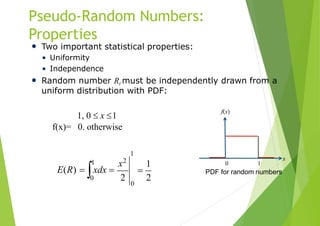
• Two important statistical properties:
• Uniformity
• Independence
• Random number Ri must be independently drawn from a
uniform distribution with PDF:
1
22
1
x2
0
1
0
E(R)  xdx  
0 1
PDF for random numbers
f(x)
x
1, 0  x 1
f(x)= 0. otherwise
Generation of Random Numbers
• Midsquare method
• Linear Congruential Method (LCM)
• Combined Linear Congruential Generators (CLCG)
• Random-Number Streams
Midsquare method
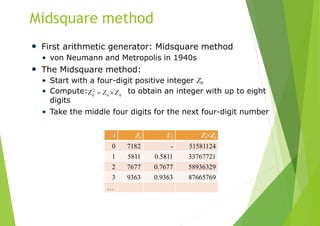
• First arithmetic generator: Midsquare method
• von Neumann and Metropolis in 1940s
• The Midsquare method:
• Start with a four-digit positive integer Z0
• Compute: to obtain an integer with up to eight
digits
• Take the middle four digits for the next four-digit number
2
0 0 0Z  Z Z
i Zi Ui Zi×Zi
0 7182 - 51581124
1 5811 0.5811 33767721
2 7677 0.7677 58936329
3 9363 0.9363 87665769
…
Midsquare method
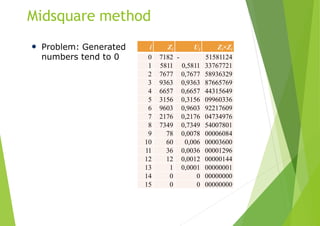
• Problem: Generated
numbers tend to 0
i Zi Ui Zi×Zi
0 7182 - 51581124
1 5811 0,5811 33767721
2 7677 0,7677 58936329
3 9363 0,9363 87665769
4 6657 0,6657 44315649
5 3156 0,3156 09960336
6 9603 0,9603 92217609
7 2176 0,2176 04734976
8 7349 0,7349 54007801
9 78 0,0078 00006084
10 60 0,006 00003600
11 36 0,0036 00001296
12 12 0,0012 00000144
13 1 0,0001 00000001
14 0 0 00000000
15 0 0 00000000
Linear Congruential Method
• To produce a sequence of integers X1, X2, … between 0 and
m-1 by following a recursive relationship:
Xi1  (aXi  c)mod m, i  0,1,2,...
• Assumption: m > 0 and a < m, c < m, X0 < m
• The selection of the values for a, c, m, and X0 drastically
affects the statistical properties and the cycle length
• The random integers Xi are being generated in [0, m-1]
The multiplier The increment The modulus
Linear Congruential Method
• Convert the integers Xi to random numbers
• Note:
• Xi  {0, 1, ...,m-1}
• Ri  [0,(m-1)/m]
, i 1,2,...R 
m
Xi
i
Linear Congruential Method:
Example
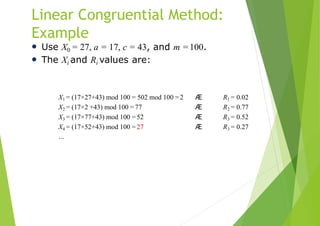
• Use X0 = 27, a = 17, c = 43, and m =100.
• The Xi and Ri values are:
X1 = (17×27+43) mod 100 = 502 mod 100 =2 Æ R1 = 0.02
X2 = (17×2 +43) mod 100 = 77 Æ R2 = 0.77
X3 = (17×77+43) mod 100 = 52 Æ R3 = 0.52
X4 = (17×52+43) mod 100 = 27
…
Æ R3 = 0.27
Linear Congruential Method:
Example
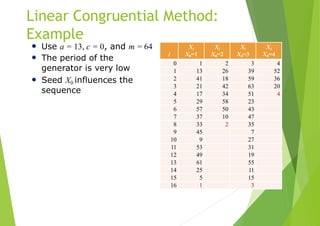
• Use a = 13, c = 0, and m = 64
• The period of the
generator is very low
• Seed X0 influences the
sequence
i
Xi
X0=1
Xi
X0=2
Xi
X0=3
Xi
X0=4
0 1 2 3 4
1 13 26 39 52
2 41 18 59 36
3 21 42 63 20
4 17 34 51 4
5 29 58 23
6 57 50 43
7 37 10 47
8 33 2 35
9 45 7
10 9 27
11 53 31
12 49 19
13 61 55
14 25 11
15 5 15
16 1 3
General Congruential
Generators
• Linear Congruential Generators are a special case of
generators defined by:
Xi 1  g(Xi , Xi1,…) mod m
• where g() is a function of previous Xi’s
• Xi  [0, m-1], Ri = Xi /m
• Quadratic congruential generator
• Defined by: g( X , X )  aX 2
 bX  c
i i1 i i1
• Multiple recursive generators
• Defined by: g(Xi , Xi1,…)  a1 Xi  a2 Xi1  ak Xik
• Fibonacci generator
• Defined by: Xi1g(Xi , Xi1)  Xi
Combined Linear Congruential
Generators• Reason: Longer period generator is needed because of the
increasing complexity of simulated systems.
• Approach: Combine two or more multiplicative congruential
generators.
• Let Xi,1, Xi,2, …, Xi,k be the i-th output from k different
multiplicative congruential generators.
• The j-th generator X•,j:
• has prime modulus mj, multiplier aj, and period mj -1
• produces integers Xi,j approx ~ Uniform on [0, mj – 1]
• Wi,j = Xi,j - 1 is approx ~ Uniform on integers on [0, mj -2]
 cj ) mod mjXi1, j  (aj Xi
Tests for Random Numbers
• When to use these tests:
• If a well-known simulation language or random-number generator is
used, it is probably unnecessary to test
• If the generator is not explicitly known or documented, e.g.,
spreadsheet programs, symbolic/numerical calculators, tests should
be applied to many sample numbers.
• Types of tests:
• Theoretical tests: evaluate the choices of m, a, and c without actually
generating any numbers
• Empirical tests: applied to actual sequences of numbers produced.
• Our emphasis.
Kolmogorov-Smirnov Test-
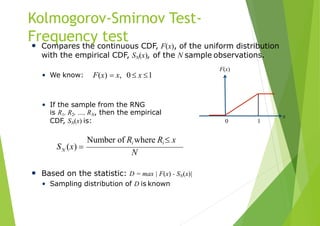
Frequency test• Compares the continuous CDF, F(x), of the uniform distribution
with the empirical CDF, SN(x), of the N sample observations.
• We know:
• If the sample from the RNG
is R1, R2, …, RN, then the empirical
CDF, SN(x) is:
• Based on the statistic: D = max | F(x) - SN(x)|
• Sampling distribution of D is known
F(x)  x, 0  x 1
Number of Ri where Ri  x
NNS (x) 
0 1
F(x)
x
Kolmogorov-Smirnov Test
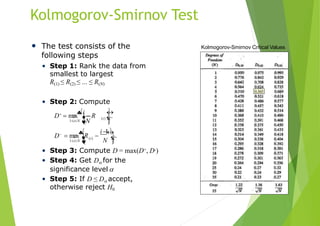
• The test consists of the
following steps
• Step 1: Rank the data from
smallest to largest
R(1) ≤ R(2) ≤ ... ≤ R(N)
• Step 2: Compute
• Step 3: Compute D = max(D+, D-)
• Step 4: Get D for the
significance level 
• Step 5: If D ≤ D accept,
otherwise reject H0
 N

i 1
D
 maxR 




N
D
 maxi
 R (i) 1iN
(i)
1iN

Kolmogorov-Smirnov Critical Values
Kolmogorov-Smirnov Test
6.18
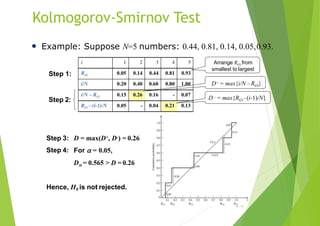
i/N 0.20 0.40 0.60 0.80 1.00
i/N – R(i) 0.15 0.26 0.16 - 0.07
R(i) –(i-1)/N 0.05 - 0.04 0.21 0.13
Step 2:
Step 3:
Step 4:
D = max(D+, D-) = 0.26
For  = 0.05,
D = 0.565 > D = 0.26
Hence, H0 is not rejected.
i 1 2 3 4 5 Arrange R(i) from
R(i) 0.05 0.14 0.44 0.81 0.93
smallest to largest
• Example: Suppose N=5 numbers: 0.44, 0.81, 0.14, 0.05,0.93.
Step 1:
D+ = max{i/N –R(i)}
D - = max{R(i) -(i-1)/N}
Chi-square Test- Frequency tests
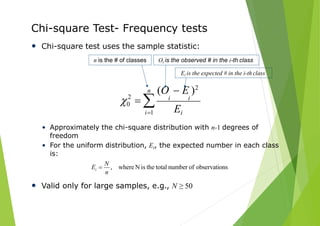
• Chi-square test uses the sample statistic:
• Approximately the chi-square distribution with n-1 degrees of
freedom
• For the uniform distribution, Ei, the expected number in each class
is:
• Valid only for large samples, e.g., N ≥ 50
i1
n
Ei
2
(O  E )2
i i
0  
n
iE 
N
, where N is the total number of observations
Ei is the expected # in the i-th class
Oi is the observed # in the i-th classn is the # of classes
Chi-square Test:
Example
Interval Upper Limit Oi Ei Oi-Ei (Oi-Ei)^2 (Oi-Ei)^2/Ei
1 0.1 10 10 0 0 0
2 0.2 9 10 -1 1 0.1
3 0.3 5 10 -5 25 2.5
4 0.4 6 10 -4 16 1.6
5 0.5 16 10 6 36 3.6
6 0.6 13 10 3 9 0.9
7 0.7 10 10 0 0 0
8 0.8 7 10 -3 9 0.9
9 0.9 10 10 0 0 0
10 1.0 14 10 4 16 1.6
Sum 100 100 0 0 11.2
• Example with 100 numbers from [0,1], =0.05
• 10 intervals
0.05,9•  2 = 16.9
• Accept, since
0• X2 =11.2 <  2
0.05,9
0X2 =11.2
n
Eii1
2
(O  E)2
i i
0 

Random number generation

  • 1.
    Presentation on PseudoRandom-Number Generation
  • 2.
    Contents • Pseudo-Random Numbersand their properties • Generating Random Numbers • Midsquare Method • Linear Congruential Method • Combined Linear Congruential Method • Tests for Random Numbers
  • 3.
    Pseudo-Random Numbers • Approach:Arithmetically generation (calculation) of random numbers • “Pseudo”, because generating numbers using a known method removes the potential for true randomness. • Goal: To produce a sequence of numbers in [0,1] that simulates, or imitates, the ideal properties of random numbers (RN).
  • 4.
    Pseudo-Random Numbers • Importantproperties of good random number routines: • Fast • Portable to different computers • Have sufficiently long cycle • Replicable • Verification and debugging • Use identical stream of random numbers for different systems • Closely approximate the ideal statistical properties of • uniformity and • independence
  • 5.
    Pseudo-Random Numbers: Properties • Twoimportant statistical properties: • Uniformity • Independence • Random number Ri must be independently drawn from a uniform distribution with PDF: 1 22 1 x2 0 1 0 E(R)  xdx   0 1 PDF for random numbers f(x) x 1, 0  x 1 f(x)= 0. otherwise
  • 6.
    Generation of RandomNumbers • Midsquare method • Linear Congruential Method (LCM) • Combined Linear Congruential Generators (CLCG) • Random-Number Streams
  • 7.
    Midsquare method • Firstarithmetic generator: Midsquare method • von Neumann and Metropolis in 1940s • The Midsquare method: • Start with a four-digit positive integer Z0 • Compute: to obtain an integer with up to eight digits • Take the middle four digits for the next four-digit number 2 0 0 0Z  Z Z i Zi Ui Zi×Zi 0 7182 - 51581124 1 5811 0.5811 33767721 2 7677 0.7677 58936329 3 9363 0.9363 87665769 …
  • 8.
    Midsquare method • Problem:Generated numbers tend to 0 i Zi Ui Zi×Zi 0 7182 - 51581124 1 5811 0,5811 33767721 2 7677 0,7677 58936329 3 9363 0,9363 87665769 4 6657 0,6657 44315649 5 3156 0,3156 09960336 6 9603 0,9603 92217609 7 2176 0,2176 04734976 8 7349 0,7349 54007801 9 78 0,0078 00006084 10 60 0,006 00003600 11 36 0,0036 00001296 12 12 0,0012 00000144 13 1 0,0001 00000001 14 0 0 00000000 15 0 0 00000000
  • 9.
    Linear Congruential Method •To produce a sequence of integers X1, X2, … between 0 and m-1 by following a recursive relationship: Xi1  (aXi  c)mod m, i  0,1,2,... • Assumption: m > 0 and a < m, c < m, X0 < m • The selection of the values for a, c, m, and X0 drastically affects the statistical properties and the cycle length • The random integers Xi are being generated in [0, m-1] The multiplier The increment The modulus
  • 10.
    Linear Congruential Method •Convert the integers Xi to random numbers • Note: • Xi  {0, 1, ...,m-1} • Ri  [0,(m-1)/m] , i 1,2,...R  m Xi i
  • 11.
    Linear Congruential Method: Example •Use X0 = 27, a = 17, c = 43, and m =100. • The Xi and Ri values are: X1 = (17×27+43) mod 100 = 502 mod 100 =2 Æ R1 = 0.02 X2 = (17×2 +43) mod 100 = 77 Æ R2 = 0.77 X3 = (17×77+43) mod 100 = 52 Æ R3 = 0.52 X4 = (17×52+43) mod 100 = 27 … Æ R3 = 0.27
  • 12.
    Linear Congruential Method: Example •Use a = 13, c = 0, and m = 64 • The period of the generator is very low • Seed X0 influences the sequence i Xi X0=1 Xi X0=2 Xi X0=3 Xi X0=4 0 1 2 3 4 1 13 26 39 52 2 41 18 59 36 3 21 42 63 20 4 17 34 51 4 5 29 58 23 6 57 50 43 7 37 10 47 8 33 2 35 9 45 7 10 9 27 11 53 31 12 49 19 13 61 55 14 25 11 15 5 15 16 1 3
  • 13.
    General Congruential Generators • LinearCongruential Generators are a special case of generators defined by: Xi 1  g(Xi , Xi1,…) mod m • where g() is a function of previous Xi’s • Xi  [0, m-1], Ri = Xi /m • Quadratic congruential generator • Defined by: g( X , X )  aX 2  bX  c i i1 i i1 • Multiple recursive generators • Defined by: g(Xi , Xi1,…)  a1 Xi  a2 Xi1  ak Xik • Fibonacci generator • Defined by: Xi1g(Xi , Xi1)  Xi
  • 14.
    Combined Linear Congruential Generators•Reason: Longer period generator is needed because of the increasing complexity of simulated systems. • Approach: Combine two or more multiplicative congruential generators. • Let Xi,1, Xi,2, …, Xi,k be the i-th output from k different multiplicative congruential generators. • The j-th generator X•,j: • has prime modulus mj, multiplier aj, and period mj -1 • produces integers Xi,j approx ~ Uniform on [0, mj – 1] • Wi,j = Xi,j - 1 is approx ~ Uniform on integers on [0, mj -2]  cj ) mod mjXi1, j  (aj Xi
  • 15.
    Tests for RandomNumbers • When to use these tests: • If a well-known simulation language or random-number generator is used, it is probably unnecessary to test • If the generator is not explicitly known or documented, e.g., spreadsheet programs, symbolic/numerical calculators, tests should be applied to many sample numbers. • Types of tests: • Theoretical tests: evaluate the choices of m, a, and c without actually generating any numbers • Empirical tests: applied to actual sequences of numbers produced. • Our emphasis.
  • 16.
    Kolmogorov-Smirnov Test- Frequency test•Compares the continuous CDF, F(x), of the uniform distribution with the empirical CDF, SN(x), of the N sample observations. • We know: • If the sample from the RNG is R1, R2, …, RN, then the empirical CDF, SN(x) is: • Based on the statistic: D = max | F(x) - SN(x)| • Sampling distribution of D is known F(x)  x, 0  x 1 Number of Ri where Ri  x NNS (x)  0 1 F(x) x
  • 17.
    Kolmogorov-Smirnov Test • Thetest consists of the following steps • Step 1: Rank the data from smallest to largest R(1) ≤ R(2) ≤ ... ≤ R(N) • Step 2: Compute • Step 3: Compute D = max(D+, D-) • Step 4: Get D for the significance level  • Step 5: If D ≤ D accept, otherwise reject H0  N  i 1 D  maxR      N D  maxi  R (i) 1iN (i) 1iN  Kolmogorov-Smirnov Critical Values
  • 18.
    Kolmogorov-Smirnov Test 6.18 i/N 0.200.40 0.60 0.80 1.00 i/N – R(i) 0.15 0.26 0.16 - 0.07 R(i) –(i-1)/N 0.05 - 0.04 0.21 0.13 Step 2: Step 3: Step 4: D = max(D+, D-) = 0.26 For  = 0.05, D = 0.565 > D = 0.26 Hence, H0 is not rejected. i 1 2 3 4 5 Arrange R(i) from R(i) 0.05 0.14 0.44 0.81 0.93 smallest to largest • Example: Suppose N=5 numbers: 0.44, 0.81, 0.14, 0.05,0.93. Step 1: D+ = max{i/N –R(i)} D - = max{R(i) -(i-1)/N}
  • 19.
    Chi-square Test- Frequencytests • Chi-square test uses the sample statistic: • Approximately the chi-square distribution with n-1 degrees of freedom • For the uniform distribution, Ei, the expected number in each class is: • Valid only for large samples, e.g., N ≥ 50 i1 n Ei 2 (O  E )2 i i 0   n iE  N , where N is the total number of observations Ei is the expected # in the i-th class Oi is the observed # in the i-th classn is the # of classes
  • 20.
    Chi-square Test: Example Interval UpperLimit Oi Ei Oi-Ei (Oi-Ei)^2 (Oi-Ei)^2/Ei 1 0.1 10 10 0 0 0 2 0.2 9 10 -1 1 0.1 3 0.3 5 10 -5 25 2.5 4 0.4 6 10 -4 16 1.6 5 0.5 16 10 6 36 3.6 6 0.6 13 10 3 9 0.9 7 0.7 10 10 0 0 0 8 0.8 7 10 -3 9 0.9 9 0.9 10 10 0 0 0 10 1.0 14 10 4 16 1.6 Sum 100 100 0 0 11.2 • Example with 100 numbers from [0,1], =0.05 • 10 intervals 0.05,9•  2 = 16.9 • Accept, since 0• X2 =11.2 <  2 0.05,9 0X2 =11.2 n Eii1 2 (O  E)2 i i 0 