Chapter 5: Unfolding
Keshab K. Parhi
Chap. 5 2
• Unfolding ≡ Parallel Processing
A B
2D
(1) (1)
A0àB0=> A2àB2=> A4àB4=>…..
A1àB1=> A3àB3=> A5àB5=>…..
2 nodes & 2 edges
T∞= (1+1)/2 = 1ut
2-unfolded
A0
B0
D
(1) (1)
A1
B1
D
(1) (1)
0,2,4,….
1,3,5,….
4 nodes & 4 edges
T∞= 2/2 = 1ut
T’
∞= 2ut
T’
∞= 2ut
• In a ‘J’ unfolded system each delay is J-slow => if input to a delay element
is the signal x(kJ + m), the output is x((k-1)J + m) = x(kJ + m – J).
Chap. 5 3
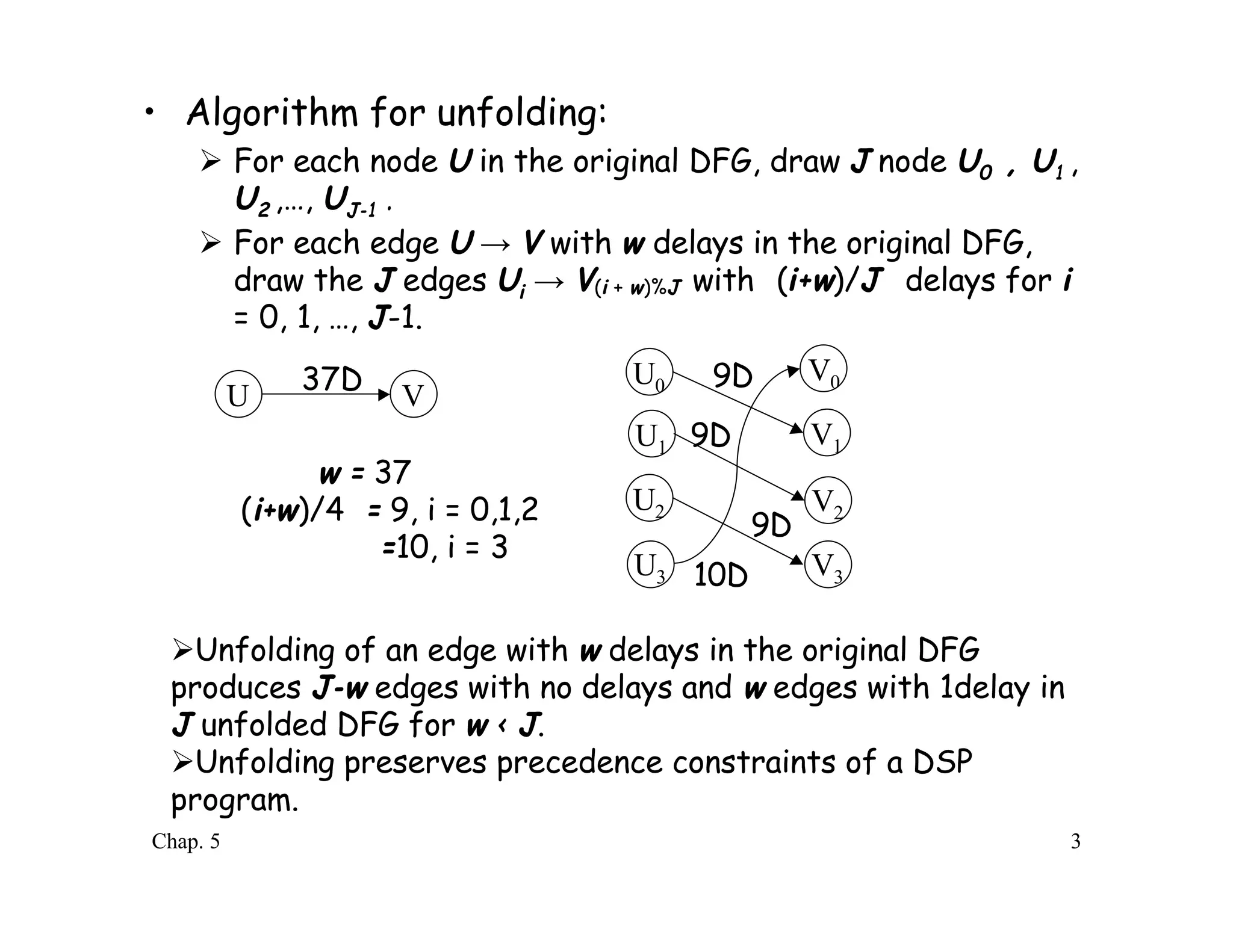
• Algorithm for unfolding:
Ø For each node U in the original DFG, draw J node U0 , U1 ,
U2 ,…, UJ-1 .
Ø For each edge U → V with w delays in the original DFG,
draw the J edges Ui → V(i + w)%J with (i+w)/J delays for i
= 0, 1, …, J-1.
U V
37D U0
U3
U2
U1
V3
V2
V1
V0
9D
9D
9D
10D
ØUnfolding of an edge with w delays in the original DFG
produces J-w edges with no delays and w edges with 1delay in
J unfolded DFG for w < J.
ØUnfolding preserves precedence constraints of a DSP
program.
w = 37
⇒(i+w)/4 = 9, i = 0,1,2
=10, i = 3
Chap. 5 4
Properties of unfolding :
Ø Unfolding preserves the number of delays in a DFG.
This can be stated as follows:
w/J + (w+1)/J + … + (w + J - 1)/J = w
Ø J-unfolding of a loop l with wl delays in the original DFG
leads to gcd(wl , J) loops in the unfolded DFG, and each
of these gcd(wl , J) loops contains wl/ gcd(wl , J) delays
and J/ gcd(wl , J) copies of each node that appears in l.
Ø Unfolding a DFG with iteration bound T∞ results in a J-
unfolded DFG with iteration bound JT∞ .
U
T
V
D
5D 6D
U0
U1
U2
V0
V1
V2
T0
T1
T2
2D
2D
2D
D
D 2D
2D
3-unfolded
DFG
Chap. 5 5
• Applications of Unfolding
ØSample Period Reduction
ØParallel Processing
• Sample Period Reduction
ØCase 1 : A node in the DFG having computation
time greater than T∞.
ØCase 2 : Iteration bound is not an integer.
ØCase 3 : Longest node computation is larger
than the iteration bound T∞, and T∞ is not an
integer.
Chap. 5 6
Case 1 :
ØThe original DFG cannot
have sample period equal to
the iteration bound
because a node computation
time is more than iteration
bound
Ø If the computation time of a node ‘U’, tu, is greater than the
iteration bound T∞, then tu/T ∞ - unfolding should be used.
Ø In the example, tu = 4, and T∞ = 3, so 4/3 - unfolding i.e., 2-
unfolding is used.
Chap. 5 7
• Case 2 :
ØThe original DFG cannot
have sample period equal
to the iteration bound
because the iteration
bound is not an integer.
ØIf a critical loop bound is of the form tl/wl where tl and wl
are mutually co-prime, then wl-unfolding should be used.
ØIn the example tl = 60 and wl = 45, then tl/wl should be
written as 4/3 and 3-unfolding should be used.
•Case 3 : In this case the minimum unfolding factor that allows
the iteration period to equal the iteration bound is the min
value of J such that JT∞ is an integer and is greater than the
longest node computation time.
Chap. 5 8
• Parallel Processing :
Ø Word- Level Parallel Processing
Ø Bit Level Parallel processing
vBit-serial processing
vBit-parallel processing
vDigit-serial processing
Chap. 5 9
• Bit-Level Parallel Processing
Bit-parallel
a0
a1
a2
a3
b0
b1
b2
b3
Bit-serial
a3 a2 a1 a0 b3 b2 b1 b0
Digit-Serial
(Digit-size = 2)
a2 a0
a3 a1
b2 b0
b3 b1
Bit-serial
adder
D
a3 a2 a1 a0
b3 b2 b1 b0
s3 s2 s1 s0
4l+1,2,3
4l+0
0
Chap. 5 10
• The following assumptions are made when
unfolding an edge U→V :
Ø The wordlength W is a multiple of the unfolding factor J,
i.e. W = W’J.
Ø All edges into and out of the switch have no delays.
• With the above two assumptions an edge U→V can
be unfolded as follows :
Ø Write the switching instance as
Wl + u = J( W’l + u/J ) + (u%J)
Ø Draw an edge with no delays in the unfolded graph from
the node Uu%J to the node Vu%J, which is switched at time
instance ( W’l + u/J ) .
Chap. 5 11
Example :
U V
12l + 1, 7, 9, 11
U0 V0
U1 V1
U2 V2
4l + 3
4l + 0,2
4l + 3
Unfolding by 3
To unfold the DFG by J=3, the switching instances are as follows
12l + 1 = 3(4l + 0) + 1
12l + 7 = 3(4l + 2) + 1
12l + 9 = 3(4l + 3) + 0
12l + 11 = 3(4l + 3) + 2
Chap. 5 12
• Unfolding a DFG containing an edge having a switch and a
positive number of delays is done by introducing a dummy
node.
A
B
C
2D
6l + 1, 5
6l + 0, 2, 3, 4
A
B
C
D
2D 6l + 1, 5
6l + 0, 2, 3, 4
Inserting
Dummy node
A0
A1
A2
D1
D0
D2
B2
B1
B0
C2
C1
C0
2l + 0
2l + 1
2l + 0
2l + 1
2l + 1
2l + 0
D
D
B0
A2
B1
B2
A0
C0
C1
C2
D 2l + 0
2l + 1
2l + 0
2l + 1
Chap. 5 13
• If the word-length, W, is not a multiple of the
unfolding factor, J, then expand the switching
instances with periodicity lcm(W,J)
• Example: Consider W=4, J=3. Then lcm(4,3) = 12.
For this case, 4l = 12l + {0,4,8), 4l+1 = 12l + {1,5,9},
4l+2 = 12l + {2,6,10}, 4l+3 = 12l + {3,7,11}. All new
switching instances are now multiples of J=3.

Unit 5 vsp

  • 1.
  • 2.
    Chap. 5 2 •Unfolding ≡ Parallel Processing A B 2D (1) (1) A0àB0=> A2àB2=> A4àB4=>….. A1àB1=> A3àB3=> A5àB5=>….. 2 nodes & 2 edges T∞= (1+1)/2 = 1ut 2-unfolded A0 B0 D (1) (1) A1 B1 D (1) (1) 0,2,4,…. 1,3,5,…. 4 nodes & 4 edges T∞= 2/2 = 1ut T’ ∞= 2ut T’ ∞= 2ut • In a ‘J’ unfolded system each delay is J-slow => if input to a delay element is the signal x(kJ + m), the output is x((k-1)J + m) = x(kJ + m – J).
  • 3.
    Chap. 5 3 •Algorithm for unfolding: Ø For each node U in the original DFG, draw J node U0 , U1 , U2 ,…, UJ-1 . Ø For each edge U → V with w delays in the original DFG, draw the J edges Ui → V(i + w)%J with (i+w)/J delays for i = 0, 1, …, J-1. U V 37D U0 U3 U2 U1 V3 V2 V1 V0 9D 9D 9D 10D ØUnfolding of an edge with w delays in the original DFG produces J-w edges with no delays and w edges with 1delay in J unfolded DFG for w < J. ØUnfolding preserves precedence constraints of a DSP program. w = 37 ⇒(i+w)/4 = 9, i = 0,1,2 =10, i = 3
  • 4.
    Chap. 5 4 Propertiesof unfolding : Ø Unfolding preserves the number of delays in a DFG. This can be stated as follows: w/J + (w+1)/J + … + (w + J - 1)/J = w Ø J-unfolding of a loop l with wl delays in the original DFG leads to gcd(wl , J) loops in the unfolded DFG, and each of these gcd(wl , J) loops contains wl/ gcd(wl , J) delays and J/ gcd(wl , J) copies of each node that appears in l. Ø Unfolding a DFG with iteration bound T∞ results in a J- unfolded DFG with iteration bound JT∞ . U T V D 5D 6D U0 U1 U2 V0 V1 V2 T0 T1 T2 2D 2D 2D D D 2D 2D 3-unfolded DFG
  • 5.
    Chap. 5 5 •Applications of Unfolding ØSample Period Reduction ØParallel Processing • Sample Period Reduction ØCase 1 : A node in the DFG having computation time greater than T∞. ØCase 2 : Iteration bound is not an integer. ØCase 3 : Longest node computation is larger than the iteration bound T∞, and T∞ is not an integer.
  • 6.
    Chap. 5 6 Case1 : ØThe original DFG cannot have sample period equal to the iteration bound because a node computation time is more than iteration bound Ø If the computation time of a node ‘U’, tu, is greater than the iteration bound T∞, then tu/T ∞ - unfolding should be used. Ø In the example, tu = 4, and T∞ = 3, so 4/3 - unfolding i.e., 2- unfolding is used.
  • 7.
    Chap. 5 7 •Case 2 : ØThe original DFG cannot have sample period equal to the iteration bound because the iteration bound is not an integer. ØIf a critical loop bound is of the form tl/wl where tl and wl are mutually co-prime, then wl-unfolding should be used. ØIn the example tl = 60 and wl = 45, then tl/wl should be written as 4/3 and 3-unfolding should be used. •Case 3 : In this case the minimum unfolding factor that allows the iteration period to equal the iteration bound is the min value of J such that JT∞ is an integer and is greater than the longest node computation time.
  • 8.
    Chap. 5 8 •Parallel Processing : Ø Word- Level Parallel Processing Ø Bit Level Parallel processing vBit-serial processing vBit-parallel processing vDigit-serial processing
  • 9.
    Chap. 5 9 •Bit-Level Parallel Processing Bit-parallel a0 a1 a2 a3 b0 b1 b2 b3 Bit-serial a3 a2 a1 a0 b3 b2 b1 b0 Digit-Serial (Digit-size = 2) a2 a0 a3 a1 b2 b0 b3 b1 Bit-serial adder D a3 a2 a1 a0 b3 b2 b1 b0 s3 s2 s1 s0 4l+1,2,3 4l+0 0
  • 10.
    Chap. 5 10 •The following assumptions are made when unfolding an edge U→V : Ø The wordlength W is a multiple of the unfolding factor J, i.e. W = W’J. Ø All edges into and out of the switch have no delays. • With the above two assumptions an edge U→V can be unfolded as follows : Ø Write the switching instance as Wl + u = J( W’l + u/J ) + (u%J) Ø Draw an edge with no delays in the unfolded graph from the node Uu%J to the node Vu%J, which is switched at time instance ( W’l + u/J ) .
  • 11.
    Chap. 5 11 Example: U V 12l + 1, 7, 9, 11 U0 V0 U1 V1 U2 V2 4l + 3 4l + 0,2 4l + 3 Unfolding by 3 To unfold the DFG by J=3, the switching instances are as follows 12l + 1 = 3(4l + 0) + 1 12l + 7 = 3(4l + 2) + 1 12l + 9 = 3(4l + 3) + 0 12l + 11 = 3(4l + 3) + 2
  • 12.
    Chap. 5 12 •Unfolding a DFG containing an edge having a switch and a positive number of delays is done by introducing a dummy node. A B C 2D 6l + 1, 5 6l + 0, 2, 3, 4 A B C D 2D 6l + 1, 5 6l + 0, 2, 3, 4 Inserting Dummy node A0 A1 A2 D1 D0 D2 B2 B1 B0 C2 C1 C0 2l + 0 2l + 1 2l + 0 2l + 1 2l + 1 2l + 0 D D B0 A2 B1 B2 A0 C0 C1 C2 D 2l + 0 2l + 1 2l + 0 2l + 1
  • 13.
    Chap. 5 13 •If the word-length, W, is not a multiple of the unfolding factor, J, then expand the switching instances with periodicity lcm(W,J) • Example: Consider W=4, J=3. Then lcm(4,3) = 12. For this case, 4l = 12l + {0,4,8), 4l+1 = 12l + {1,5,9}, 4l+2 = 12l + {2,6,10}, 4l+3 = 12l + {3,7,11}. All new switching instances are now multiples of J=3.