What is Fuzzy?
 Fuzzy means
 not clear, distinct or precise;

 not crisp (well defined);
 blurred (with unclear outline).
Sets Theory
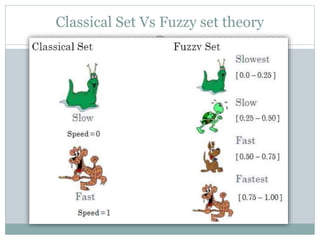
 Classical Set: An element either belongs

or does not belong to a sets that have
been defined.
 Fuzzy Set: An element belongs partially

or gradually to the sets that have been
defined.
Classical Set Vs Fuzzy set theory
Classical Set theory
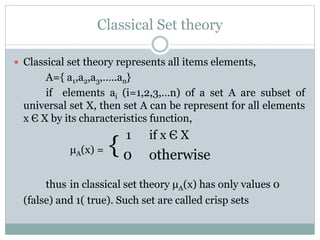
 Classical set theory represents all items elements,

A={ a1,a2,a3,…..an}
if elements ai (i=1,2,3,…n) of a set A are subset of
universal set X, then set A can be represent for all elements
x Є X by its characteristics function,

1

μA(x) =

{0

if x Є X

otherwise

thus in classical set theory μA(x) has only values 0
(false) and 1( true). Such set are called crisp sets
Fuzzy Set Theory
 Fuzzy set theory is an extension of classical set

theory where element have varying degrees of
membership. A logic based on the two truth values,
True and false, is sometimes inadequate when
describing human reasoning. Fuzzy logic uses the
whole interval between 0 and 1 to describe human
reasoning.
 A fuzzy set is any set that allows its members to have
different degree of membership, called membership
function, in the interval [0,1].
Definition
 A fuzzy set A, defines in the universal space X, is a function

defined in X which assumes values in range [0,1].
 A fuzzy set A is written as s set of pairs { x, A(x)} as

A= {{x, A(x)}}, x in the set X.

where x is element of universal space or set X and
A(x) is the value of function A for this element.
 Example: Set SMALL in set X consisting natural numbers

<= 5.
 Assume: SMALL(1)=1, SMALL(2)=1, SMALL(3)=0.9,

SMALL(4)=0.6, SMALL(5)=0.4
 Then set SMALL={ {1,1,},{2, 1},{3,0. 9},{4,0.6}, {5,0.4}}
Fuzzy V/s Crisp set
Yes


Is water colourless?

Crisp
No
Extremely
honest(1)
Very
honest(0.85)

Is Ram honest?

Fuzzy

Honest at
time (0.4)
Extremely
dishonest(0)
Fuzzy operations
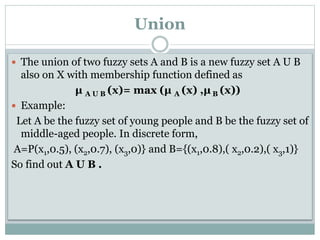
Union
 The union of two fuzzy sets A and B is a new fuzzy set A U B

also on X with membership function defined as
μ A U B (x)= max (μ A (x) ,μ B (x))
 Example:
Let A be the fuzzy set of young people and B be the fuzzy set of
middle-aged people. In discrete form,
A=P(x1,0.5), (x2,0.7), (x3,0)} and B={(x1,0.8),( x2,0.2),( x3,1)}
So find out A U B .
Use formula
μ A U B (x1)= max (μ A (x1) ,μ B (x1))
= max(0.5,0.8)
=0.8
μ A U B (x2)= max (μ A (x2) ,μ B (x2))
= max(0.7,0.2)
=0.7
μ A U B (x3)= max (μ A (x3) ,μ B (x3))
= max(0,1)
=1
So,
A U B= {(x1,0.8, x2,0.7, x3,1)}
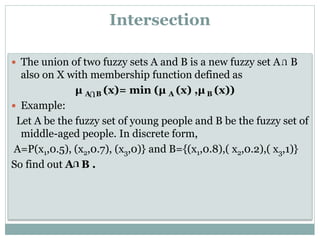
Intersection
U

 The union of two fuzzy sets A and B is a new fuzzy set A

B

also on X with membership function defined as
μ A B (x)= min (μ A (x) ,μ B (x))
 Example:
Let A be the fuzzy set of young people and B be the fuzzy set of
middle-aged people. In discrete form,
A=P(x1,0.5), (x2,0.7), (x3,0)} and B={(x1,0.8),( x2,0.2),( x3,1)}
So find out A B .
U

U
Use formula
μ A B (x1)= min (μ A (x1) ,μ B (x1))
= max(0.5,0.8)
=0.5
U

B (x2)=

U

μA

U

μA

min (μ A (x2) ,μ B (x2))
= max(0.7,0.2)
=0.2

B (x3)=

min (μ A (x3) ,μ B (x3))
= max(0,1)
=0

So,
A B= {(x1,0.5, x2,0.2, x3,0)}

U
Complement
 The complement of a fuzzy set A with membership function

defined as
μ A (x)= 1-μ A (x)
 Example:

Let A be the fuzzy set of young people complement “not
young” is defined as Ac. In discrete form, for x1, x2, x3
A=P(x1,0.5), (x2,0.7), (x3,0)}
So find out Ac.
Use formula
μ A (x1)= 1- μ A (x1 )
= 1-0.5
=0.5
μ A (x1)= 1- μ A (x1 )
= 1-0.7
=0.3
μ A (x1)= 1- μ A (x1 )
= 1-0
=1

So,
Ac= {(x1,0.5, x2,0.3, x3,1)}
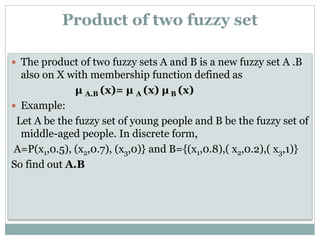
Product of two fuzzy set
 The product of two fuzzy sets A and B is a new fuzzy set A .B

also on X with membership function defined as
μ A.B (x)= μ A (x) μ B (x)
 Example:
Let A be the fuzzy set of young people and B be the fuzzy set of
middle-aged people. In discrete form,
A=P(x1,0.5), (x2,0.7), (x3,0)} and B={(x1,0.8),( x2,0.2),( x3,1)}
So find out A.B
Use formula
μ A .B (x1)= μ A (x1).μ B (x1)
= 0.5 . 0.8
=0.040
μ A .B (x2)= μ A (x2).μ B (x2)
= 0.7 . 0.2
=0.014
μ A .B (x3)= μ A (x3).μ B (x3)
=0 . 1
=0
So,
A .B= {(x1,0.040, x2,0.014, x3,0)}
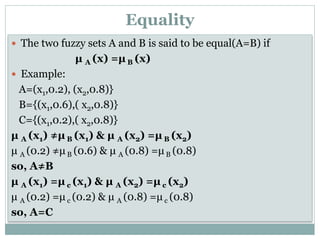
Equality
 The two fuzzy sets A and B is said to be equal(A=B) if

μ A (x) =μ B (x)
 Example:

A=(x1,0.2), (x2,0.8)}
B={(x1,0.6),( x2,0.8)}
C={(x1,0.2),( x2,0.8)}
μ A (x1) ≠μ B (x1) & μ A (x2) =μ B (x2)
μ A (0.2) ≠μ B (0.6) & μ A (0.8) =μ B (0.8)
so, A≠B
μ A (x1) =μ c (x1) & μ A (x2) =μ c (x2)
μ A (0.2) =μ c (0.2) & μ A (0.8) =μ c (0.8)
so, A=C
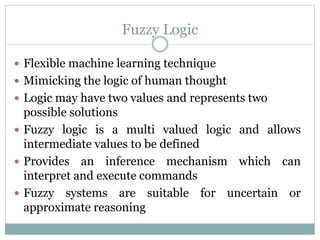
Fuzzy Logic
 Flexible machine learning technique
 Mimicking the logic of human thought
 Logic may have two values and represents two

possible solutions
 Fuzzy logic is a multi valued logic and allows
intermediate values to be defined
 Provides an inference mechanism which can
interpret and execute commands
 Fuzzy systems are suitable for uncertain or
approximate reasoning
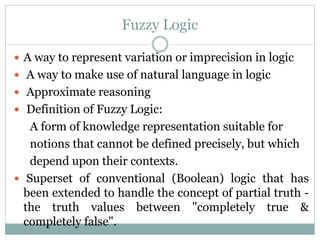
Fuzzy Logic
 A way to represent variation or imprecision in logic

 A way to make use of natural language in logic
 Approximate reasoning
 Definition of Fuzzy Logic:

A form of knowledge representation suitable for
notions that cannot be defined precisely, but which
depend upon their contexts.
 Superset of conventional (Boolean) logic that has
been extended to handle the concept of partial truth the truth values between "completely true &
completely false".
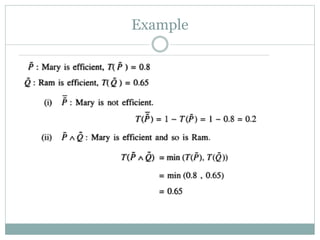
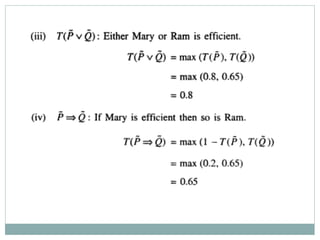
Fuzzy Propositions
A fuzzy proposition is a statement that drives a fuzzy
truth value.
 Fuzzy Connectives: Fuzzy connectives are used
to join simple fuzzy propositions to make
compound propositions. Examples of fuzzy
connectives are:
 Negation(-)
 Disjunction(v)
 Conjunction(^)
 Impication( )
Example
Fuzzy logic

Fuzzy logic

  • 2.
    What is Fuzzy? Fuzzy means  not clear, distinct or precise;  not crisp (well defined);  blurred (with unclear outline).
  • 3.
    Sets Theory  ClassicalSet: An element either belongs or does not belong to a sets that have been defined.  Fuzzy Set: An element belongs partially or gradually to the sets that have been defined.
  • 4.
    Classical Set VsFuzzy set theory
  • 5.
    Classical Set theory Classical set theory represents all items elements, A={ a1,a2,a3,…..an} if elements ai (i=1,2,3,…n) of a set A are subset of universal set X, then set A can be represent for all elements x Є X by its characteristics function, 1 μA(x) = {0 if x Є X otherwise thus in classical set theory μA(x) has only values 0 (false) and 1( true). Such set are called crisp sets
  • 6.
    Fuzzy Set Theory Fuzzy set theory is an extension of classical set theory where element have varying degrees of membership. A logic based on the two truth values, True and false, is sometimes inadequate when describing human reasoning. Fuzzy logic uses the whole interval between 0 and 1 to describe human reasoning.  A fuzzy set is any set that allows its members to have different degree of membership, called membership function, in the interval [0,1].
  • 7.
    Definition  A fuzzyset A, defines in the universal space X, is a function defined in X which assumes values in range [0,1].  A fuzzy set A is written as s set of pairs { x, A(x)} as A= {{x, A(x)}}, x in the set X. where x is element of universal space or set X and A(x) is the value of function A for this element.  Example: Set SMALL in set X consisting natural numbers <= 5.  Assume: SMALL(1)=1, SMALL(2)=1, SMALL(3)=0.9, SMALL(4)=0.6, SMALL(5)=0.4  Then set SMALL={ {1,1,},{2, 1},{3,0. 9},{4,0.6}, {5,0.4}}
  • 8.
    Fuzzy V/s Crispset Yes  Is water colourless? Crisp No Extremely honest(1) Very honest(0.85) Is Ram honest? Fuzzy Honest at time (0.4) Extremely dishonest(0)
  • 9.
  • 10.
    Union  The unionof two fuzzy sets A and B is a new fuzzy set A U B also on X with membership function defined as μ A U B (x)= max (μ A (x) ,μ B (x))  Example: Let A be the fuzzy set of young people and B be the fuzzy set of middle-aged people. In discrete form, A=P(x1,0.5), (x2,0.7), (x3,0)} and B={(x1,0.8),( x2,0.2),( x3,1)} So find out A U B .
  • 11.
    Use formula μ AU B (x1)= max (μ A (x1) ,μ B (x1)) = max(0.5,0.8) =0.8 μ A U B (x2)= max (μ A (x2) ,μ B (x2)) = max(0.7,0.2) =0.7 μ A U B (x3)= max (μ A (x3) ,μ B (x3)) = max(0,1) =1 So, A U B= {(x1,0.8, x2,0.7, x3,1)}
  • 12.
    Intersection U  The unionof two fuzzy sets A and B is a new fuzzy set A B also on X with membership function defined as μ A B (x)= min (μ A (x) ,μ B (x))  Example: Let A be the fuzzy set of young people and B be the fuzzy set of middle-aged people. In discrete form, A=P(x1,0.5), (x2,0.7), (x3,0)} and B={(x1,0.8),( x2,0.2),( x3,1)} So find out A B . U U
  • 13.
    Use formula μ AB (x1)= min (μ A (x1) ,μ B (x1)) = max(0.5,0.8) =0.5 U B (x2)= U μA U μA min (μ A (x2) ,μ B (x2)) = max(0.7,0.2) =0.2 B (x3)= min (μ A (x3) ,μ B (x3)) = max(0,1) =0 So, A B= {(x1,0.5, x2,0.2, x3,0)} U
  • 14.
    Complement  The complementof a fuzzy set A with membership function defined as μ A (x)= 1-μ A (x)  Example: Let A be the fuzzy set of young people complement “not young” is defined as Ac. In discrete form, for x1, x2, x3 A=P(x1,0.5), (x2,0.7), (x3,0)} So find out Ac.
  • 15.
    Use formula μ A(x1)= 1- μ A (x1 ) = 1-0.5 =0.5 μ A (x1)= 1- μ A (x1 ) = 1-0.7 =0.3 μ A (x1)= 1- μ A (x1 ) = 1-0 =1 So, Ac= {(x1,0.5, x2,0.3, x3,1)}
  • 16.
    Product of twofuzzy set  The product of two fuzzy sets A and B is a new fuzzy set A .B also on X with membership function defined as μ A.B (x)= μ A (x) μ B (x)  Example: Let A be the fuzzy set of young people and B be the fuzzy set of middle-aged people. In discrete form, A=P(x1,0.5), (x2,0.7), (x3,0)} and B={(x1,0.8),( x2,0.2),( x3,1)} So find out A.B
  • 17.
    Use formula μ A.B (x1)= μ A (x1).μ B (x1) = 0.5 . 0.8 =0.040 μ A .B (x2)= μ A (x2).μ B (x2) = 0.7 . 0.2 =0.014 μ A .B (x3)= μ A (x3).μ B (x3) =0 . 1 =0 So, A .B= {(x1,0.040, x2,0.014, x3,0)}
  • 18.
    Equality  The twofuzzy sets A and B is said to be equal(A=B) if μ A (x) =μ B (x)  Example: A=(x1,0.2), (x2,0.8)} B={(x1,0.6),( x2,0.8)} C={(x1,0.2),( x2,0.8)} μ A (x1) ≠μ B (x1) & μ A (x2) =μ B (x2) μ A (0.2) ≠μ B (0.6) & μ A (0.8) =μ B (0.8) so, A≠B μ A (x1) =μ c (x1) & μ A (x2) =μ c (x2) μ A (0.2) =μ c (0.2) & μ A (0.8) =μ c (0.8) so, A=C
  • 19.
    Fuzzy Logic  Flexiblemachine learning technique  Mimicking the logic of human thought  Logic may have two values and represents two possible solutions  Fuzzy logic is a multi valued logic and allows intermediate values to be defined  Provides an inference mechanism which can interpret and execute commands  Fuzzy systems are suitable for uncertain or approximate reasoning
  • 20.
    Fuzzy Logic  Away to represent variation or imprecision in logic  A way to make use of natural language in logic  Approximate reasoning  Definition of Fuzzy Logic: A form of knowledge representation suitable for notions that cannot be defined precisely, but which depend upon their contexts.  Superset of conventional (Boolean) logic that has been extended to handle the concept of partial truth the truth values between "completely true & completely false".
  • 21.
    Fuzzy Propositions A fuzzyproposition is a statement that drives a fuzzy truth value.  Fuzzy Connectives: Fuzzy connectives are used to join simple fuzzy propositions to make compound propositions. Examples of fuzzy connectives are:  Negation(-)  Disjunction(v)  Conjunction(^)  Impication( )
  • 23.