RAMPING
up
Tothe
Debate
Whatdo
weneedto
know
beforewe
start
1) What’s a resolution
2) What’s a contention
3) what’s evidence
SoFar...
1) How do we read a resolution?
2) How do we create
contentions? Benefit vs.
principle
3) What kinds of evidence are
there? How do we evaluate
evidence?
4) How do we prepare a
constructive?
5) How do we prepare for
crossfire?
6) What are the qualities of a
good public speaker?
Whatdo
we
need
toknow?
The benefits of American
drone strikes against
foreign targets outweigh
the harms.
See this
resolution
What do we
need to know?
The benefits of American
drone strikes against
foreign targets outweigh
the harms.
See this
resolution
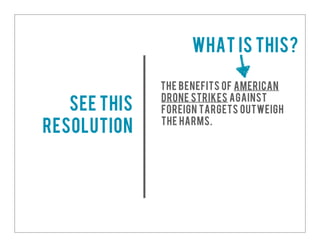
What is this?
The benefits of American
drone strikes against
foreign targets outweigh
the harms.
See this
resolution
Which foreign
targets?
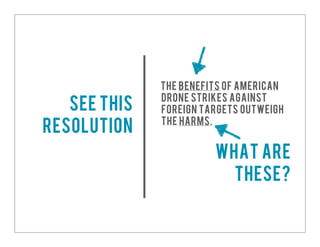
The benefits of American
drone strikes against
foreign targets outweigh
the harms.
See this
resolution
What are
these?
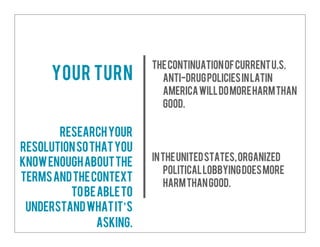
ThecontinuationofcurrentU.S.
anti-drugpoliciesinLatin
Americawilldomoreharmthan
good.
IntheUnitedStates,organized
politicallobbyingdoesmore
harmthangood.
Your turn
Researchyour
resolutionsothatyou
knowenoughaboutthe
termsandthecontext
tobeableto
understandwhatit’s
asking.
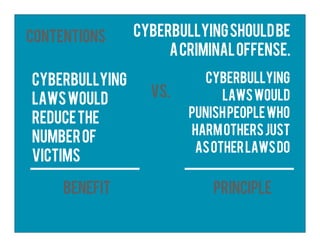
Contentions
BENEFIT PRINCIPLE
vs.
Cyberbullyingshouldbe
acriminaloffense.
Cyberbullying
Lawswould
reducethe
numberof
victims
Cyberbullying
Lawswould
punishpeoplewho
harmothersjust
asotherlawsdo
Contentions
BENEFIT PRINCIPLE
vs.
Cyberbullyingshouldbe
acriminaloffense.
Con? con?
`
Contentions
BENEFIT PRINCIPLE
vs.
itislegitimatetouseviolence
todefendprivateproperty
PRO? PRO?
`
Contentions
BENEFIT PRINCIPLE
vs.
itislegitimatetouseviolence
todefendprivateproperty
CON? CON?
EVIDENCE
HowdoIfindit?
Howdoevaluateit?
Howdoichooseit?
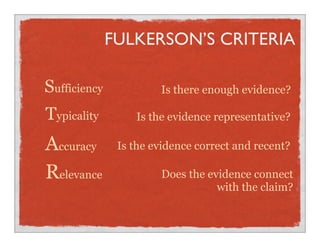
FULKERSON’S CRITERIA
Sufficiency
Accuracy
Relevance
Typicality
Is the evidence correct and recent?
Is the evidence representative?
Does the evidence connect
with the claim?
Is there enough evidence?
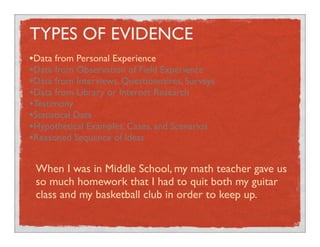
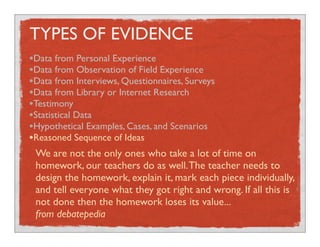
TYPES OF EVIDENCE
•Data from Personal Experience
•Data from Observation of Field Experience
•Data from Interviews, Questionnaires, Surveys
•Data from Library or Internet Research
•Testimony
•Statistical Data
•Hypothetical Examples, Cases, and Scenarios
•Reasoned Sequence of Ideas
When I was in Middle School, my math teacher gave us
so much homework that I had to quit both my guitar
class and my basketball club in order to keep up.
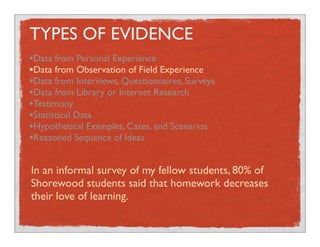
TYPES OF EVIDENCE
•Data from Personal Experience
•Data from Observation of Field Experience
•Data from Interviews, Questionnaires, Surveys
•Data from Library or Internet Research
•Testimony
•Statistical Data
•Hypothetical Examples, Cases, and Scenarios
•Reasoned Sequence of Ideas
In an informal survey of my fellow students, 80% of
Shorewood students said that homework decreases
their love of learning.
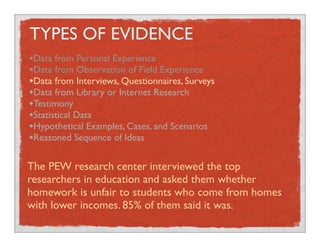
TYPES OF EVIDENCE
•Data from Personal Experience
•Data from Observation of Field Experience
•Data from Interviews, Questionnaires, Surveys
•Data from Library or Internet Research
•Testimony
•Statistical Data
•Hypothetical Examples, Cases, and Scenarios
•Reasoned Sequence of Ideas
The PEW research center interviewed the top
researchers in education and asked them whether
homework is unfair to students who come from homes
with lower incomes. 85% of them said it was.
TYPES OF EVIDENCE
•Data from Personal Experience
•Data from Observation of Field Experience
•Data from Interviews, Questionnaires, Surveys
•Data from Library or Internet Research
•Testimony
•Statistical Data
•Hypothetical Examples, Cases, and Scenarios
•Reasoned Sequence of Ideas
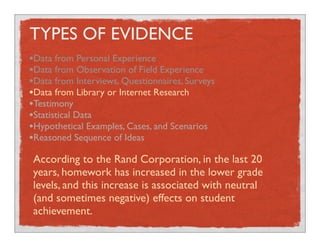
According to the Rand Corporation, in the last 20
years, homework has increased in the lower grade
levels, and this increase is associated with neutral
(and sometimes negative) effects on student
achievement.
TYPES OF EVIDENCE
•Data from Personal Experience
•Data from Observation of Field Experience
•Data from Interviews, Questionnaires, Surveys
•Data from Library or Internet Research
•Testimony
•Statistical Data
•Hypothetical Examples, Cases, and Scenarios
•Reasoned Sequence of Ideas
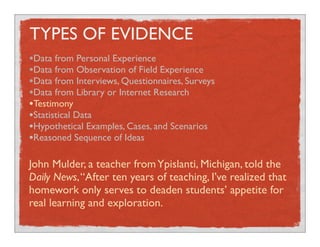
John Mulder, a teacher fromYpislanti, Michigan, told the
Daily News,“After ten years of teaching, I’ve realized that
homework only serves to deaden students’ appetite for
real learning and exploration.
TYPES OF EVIDENCE
•Data from Personal Experience
•Data from Observation of Field Experience
•Data from Interviews, Questionnaires, Surveys
•Data from Library or Internet Research
•Testimony
•Statistical Data
•Hypothetical Examples, Cases, and Scenarios
•Reasoned Sequence of Ideas
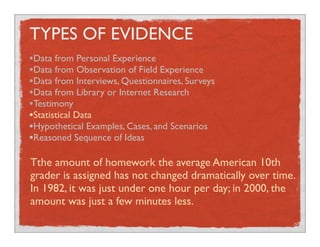
Tthe amount of homework the average American 10th
grader is assigned has not changed dramatically over time.
In 1982, it was just under one hour per day; in 2000, the
amount was just a few minutes less.
TYPES OF EVIDENCE
•Data from Personal Experience
•Data from Observation of Field Experience
•Data from Interviews, Questionnaires, Surveys
•Data from Library or Internet Research
•Testimony
•Statistical Data
•Hypothetical Examples, Cases, and Scenarios
•Reasoned Sequence of Ideas
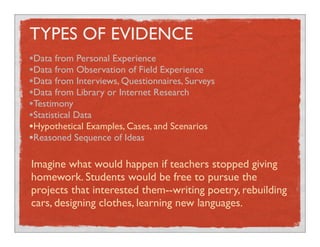
Imagine what would happen if teachers stopped giving
homework. Students would be free to pursue the
projects that interested them--writing poetry, rebuilding
cars, designing clothes, learning new languages.
TYPES OF EVIDENCE
•Data from Personal Experience
•Data from Observation of Field Experience
•Data from Interviews, Questionnaires, Surveys
•Data from Library or Internet Research
•Testimony
•Statistical Data
•Hypothetical Examples, Cases, and Scenarios
•Reasoned Sequence of Ideas
We are not the only ones who take a lot of time on
homework, our teachers do as well.The teacher needs to
design the homework, explain it, mark each piece individually,
and tell everyone what they got right and wrong. If all this is
not done then the homework loses its value...
from debatepedia
TYPES OF EVIDENCE
•Data from Personal Experience
•Data from Observation of Field Experience
•Data from Interviews, Questionnaires, Surveys
•Data from Library or Internet Research
•Testimony
•Statistical Data
•Hypothetical Examples, Cases, and Scenarios
•Reasoned Sequence of Ideas
MOSH PITS SHOULD BE
BANNED FROM ALL SEATTLE
Create three contentions and find one
piece of evidence to back them up .

Ramping up to the debate

  • 1.
  • 2.
    1) What’s aresolution 2) What’s a contention 3) what’s evidence SoFar...
  • 3.
    1) How dowe read a resolution? 2) How do we create contentions? Benefit vs. principle 3) What kinds of evidence are there? How do we evaluate evidence? 4) How do we prepare a constructive? 5) How do we prepare for crossfire? 6) What are the qualities of a good public speaker? Whatdo we need toknow?
  • 4.
    The benefits ofAmerican drone strikes against foreign targets outweigh the harms. See this resolution What do we need to know?
  • 5.
    The benefits ofAmerican drone strikes against foreign targets outweigh the harms. See this resolution What is this?
  • 6.
    The benefits ofAmerican drone strikes against foreign targets outweigh the harms. See this resolution Which foreign targets?
  • 7.
    The benefits ofAmerican drone strikes against foreign targets outweigh the harms. See this resolution What are these?
  • 8.
  • 9.
  • 10.
  • 11.
  • 12.
  • 13.
  • 14.
    FULKERSON’S CRITERIA Sufficiency Accuracy Relevance Typicality Is theevidence correct and recent? Is the evidence representative? Does the evidence connect with the claim? Is there enough evidence?
  • 15.
    TYPES OF EVIDENCE •Datafrom Personal Experience •Data from Observation of Field Experience •Data from Interviews, Questionnaires, Surveys •Data from Library or Internet Research •Testimony •Statistical Data •Hypothetical Examples, Cases, and Scenarios •Reasoned Sequence of Ideas When I was in Middle School, my math teacher gave us so much homework that I had to quit both my guitar class and my basketball club in order to keep up.
  • 16.
    TYPES OF EVIDENCE •Datafrom Personal Experience •Data from Observation of Field Experience •Data from Interviews, Questionnaires, Surveys •Data from Library or Internet Research •Testimony •Statistical Data •Hypothetical Examples, Cases, and Scenarios •Reasoned Sequence of Ideas In an informal survey of my fellow students, 80% of Shorewood students said that homework decreases their love of learning.
  • 17.
    TYPES OF EVIDENCE •Datafrom Personal Experience •Data from Observation of Field Experience •Data from Interviews, Questionnaires, Surveys •Data from Library or Internet Research •Testimony •Statistical Data •Hypothetical Examples, Cases, and Scenarios •Reasoned Sequence of Ideas The PEW research center interviewed the top researchers in education and asked them whether homework is unfair to students who come from homes with lower incomes. 85% of them said it was.
  • 18.
    TYPES OF EVIDENCE •Datafrom Personal Experience •Data from Observation of Field Experience •Data from Interviews, Questionnaires, Surveys •Data from Library or Internet Research •Testimony •Statistical Data •Hypothetical Examples, Cases, and Scenarios •Reasoned Sequence of Ideas According to the Rand Corporation, in the last 20 years, homework has increased in the lower grade levels, and this increase is associated with neutral (and sometimes negative) effects on student achievement.
  • 19.
    TYPES OF EVIDENCE •Datafrom Personal Experience •Data from Observation of Field Experience •Data from Interviews, Questionnaires, Surveys •Data from Library or Internet Research •Testimony •Statistical Data •Hypothetical Examples, Cases, and Scenarios •Reasoned Sequence of Ideas John Mulder, a teacher fromYpislanti, Michigan, told the Daily News,“After ten years of teaching, I’ve realized that homework only serves to deaden students’ appetite for real learning and exploration.
  • 20.
    TYPES OF EVIDENCE •Datafrom Personal Experience •Data from Observation of Field Experience •Data from Interviews, Questionnaires, Surveys •Data from Library or Internet Research •Testimony •Statistical Data •Hypothetical Examples, Cases, and Scenarios •Reasoned Sequence of Ideas Tthe amount of homework the average American 10th grader is assigned has not changed dramatically over time. In 1982, it was just under one hour per day; in 2000, the amount was just a few minutes less.
  • 21.
    TYPES OF EVIDENCE •Datafrom Personal Experience •Data from Observation of Field Experience •Data from Interviews, Questionnaires, Surveys •Data from Library or Internet Research •Testimony •Statistical Data •Hypothetical Examples, Cases, and Scenarios •Reasoned Sequence of Ideas Imagine what would happen if teachers stopped giving homework. Students would be free to pursue the projects that interested them--writing poetry, rebuilding cars, designing clothes, learning new languages.
  • 22.
    TYPES OF EVIDENCE •Datafrom Personal Experience •Data from Observation of Field Experience •Data from Interviews, Questionnaires, Surveys •Data from Library or Internet Research •Testimony •Statistical Data •Hypothetical Examples, Cases, and Scenarios •Reasoned Sequence of Ideas We are not the only ones who take a lot of time on homework, our teachers do as well.The teacher needs to design the homework, explain it, mark each piece individually, and tell everyone what they got right and wrong. If all this is not done then the homework loses its value... from debatepedia
  • 23.
    TYPES OF EVIDENCE •Datafrom Personal Experience •Data from Observation of Field Experience •Data from Interviews, Questionnaires, Surveys •Data from Library or Internet Research •Testimony •Statistical Data •Hypothetical Examples, Cases, and Scenarios •Reasoned Sequence of Ideas
  • 24.
    MOSH PITS SHOULDBE BANNED FROM ALL SEATTLE Create three contentions and find one piece of evidence to back them up .