Does the Internet harm
children’s health?
Dr Vera Slavtcheva-Petkova, University of Chester
Dr Monica Bulger, Dr Victoria Nash, Oxford
Internet Institute, University of Oxford
Contents
• Child protection and online harms: Academic
  and policy context

• Methods

• Scope, scale and operationalisation of health-
  related harms

• Conclusions
Academic context
• Growing body of research on level and character of
  Internet by under 18s, and nature of risks and
  opportunities experienced (e.g., Livingstone &
  Haddon, 2009; Schrock & Boyd, 2008)
• Research suggests that risks are greatest for those
  most vulnerable offline, and that overall, the
  opportunities of Internet use outweigh risks (e.g.
  Mitchell et al., 2010, Livingstone et al., 2011)
• Real lack of research which quantifies or analyses
  level of actual harm rather than potential risk.
Policy context
• Wide array of policy measures across Europe: hotlines
  for reporting child abuse images, industry codes of
  conduct regulating use of mobile content and services,
  and increasing provision of parental controls by ISPs.
• Much of this is result of self or co-regulation
• Possible and actual conflicts with other rights, e.g.
  freedom of expression, legal due process.
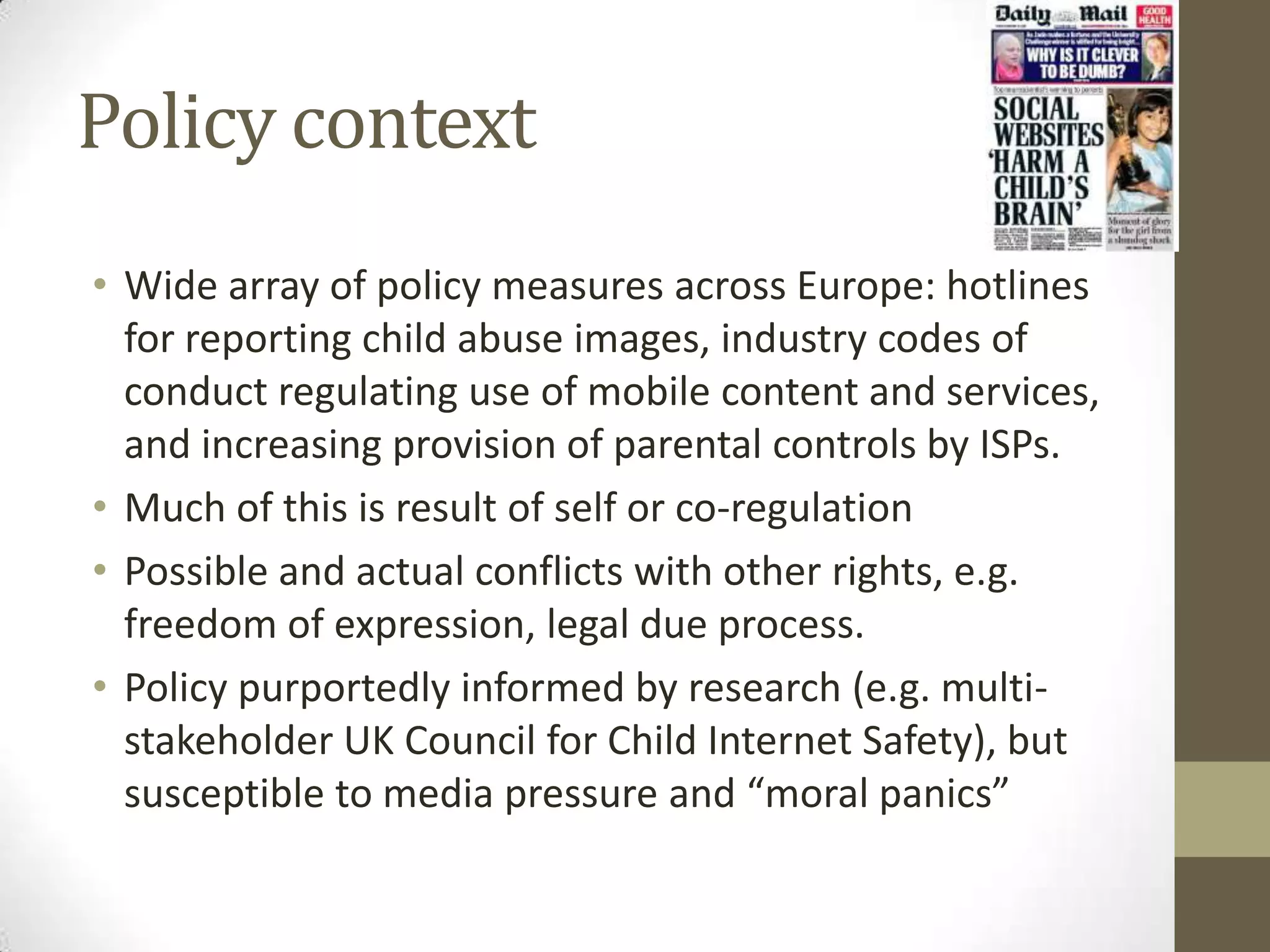
• Policy purportedly informed by research (e.g. multi-
  stakeholder UK Council for Child Internet Safety), but
  susceptible to media pressure and “moral panics”
Perceived risks vs. actual harms
      “While new discoveries almost always have both benefits and
disadvantages, breathless negative coverage of technology frightens
parents, prevents teenagers from learning responsible use, and fuels
 panics, resulting in misguided or unconstitutional legislation” (Marwick
                                  2008).
Our study
• Evidence on the extent of harms
  experienced by children as a result of
  online risks: A critical synthesis of research
• Funded by the Oxford University Press's
  Fell Fund
• A review of empirical studies of harms
  associated with young people’s (under
  18s) Internet use, published in English
  between 1997-2012 + interviews with key
  stakeholders
Methods
• Keywords: “harm AND Internet AND children”, “harm
  AND Internet AND adolescents”, “harm AND Internet
  AND minors”, “harm AND Internet AND teens” and
  “harm AND Internet AND teenagers”
• Categories for inclusion:
1. Empirical work
2. Published in peer-reviewed journal
3. Main focus of study was young people (aged under 18)
4. Addressed Internet use
5. Addressed incidents of harm related to online
    interactions
Methods
• Original search yielded over 4,000 publications
• After a first-pass review, corpus narrowed to 271
  studies.
• 271 were reviewed but only 148 articles were
  fully coded after strict application of the
  inclusion criteria.
• Coding framework adapted from the EU Kids
  Online public repository. It included 21 items,
  including details of method, target population,
  context and how and whether harm was
  operationalised.
Three categories of harms
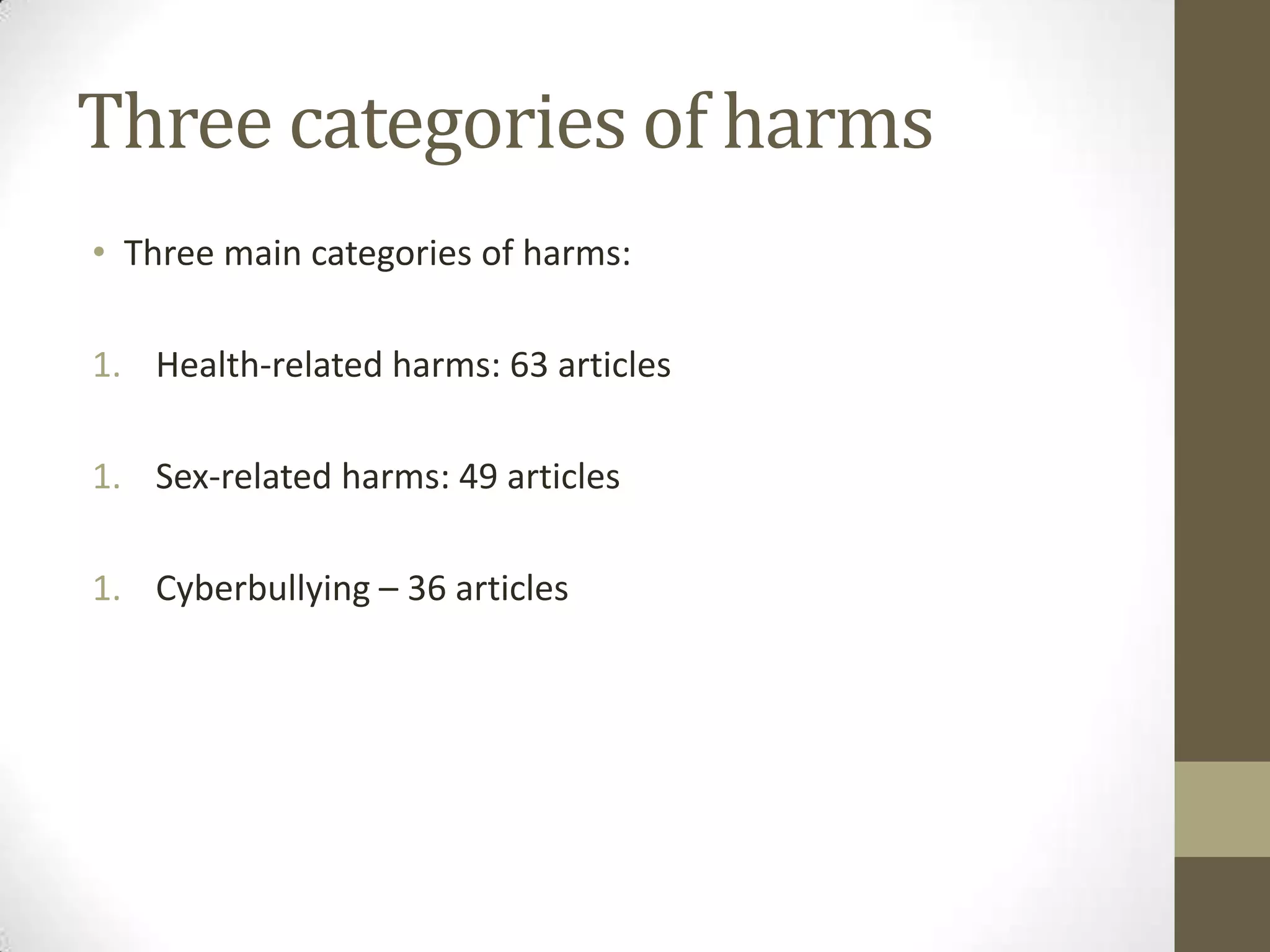
• Three main categories of harms:

1. Health-related harms: 63 articles

1. Sex-related harms: 49 articles

1. Cyberbullying – 36 articles
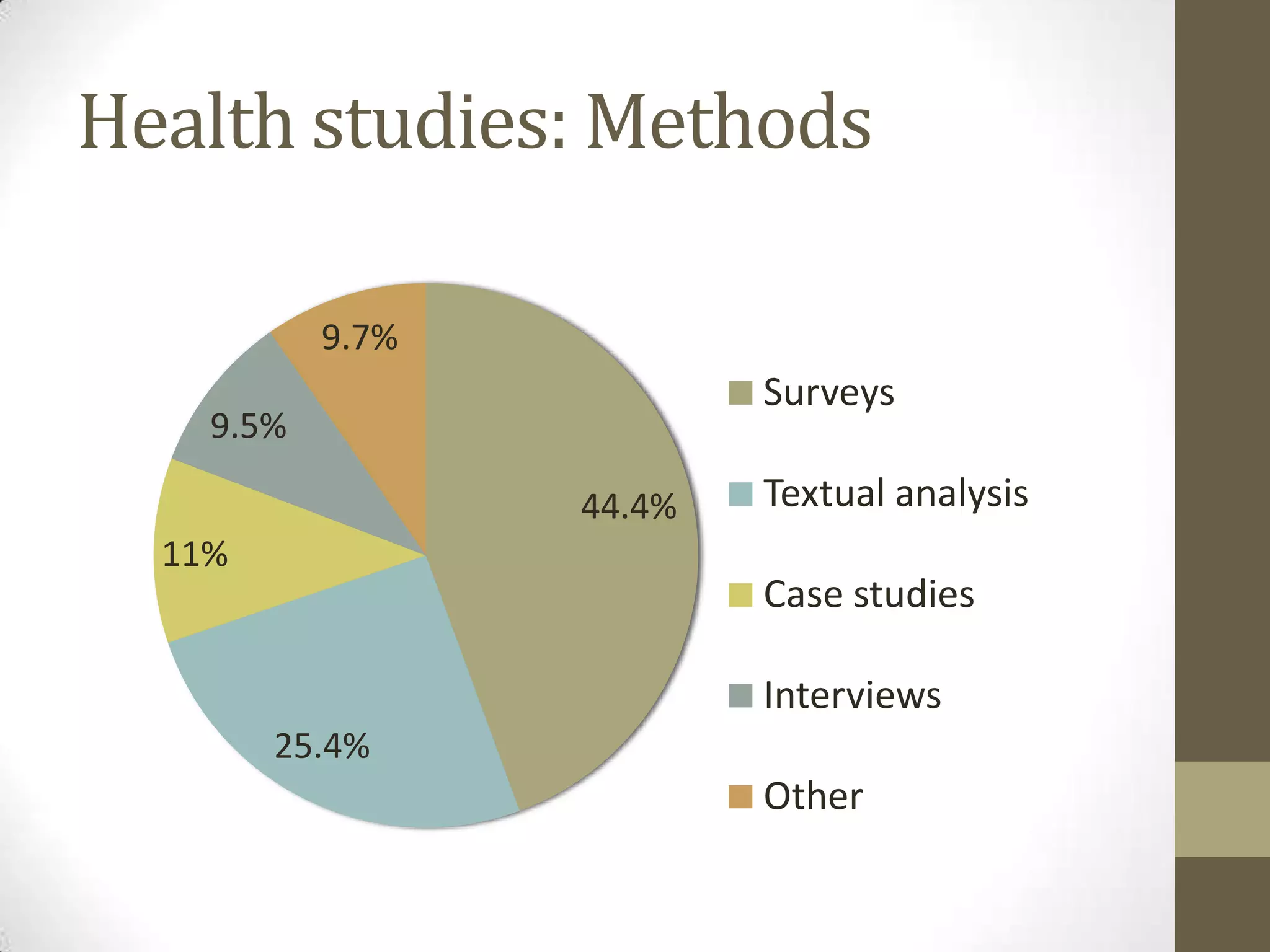
Health studies: Methods

           9.7%
                          Surveys
    9.5%

                  44.4%   Textual analysis
  11%
                          Case studies

                          Interviews
        25.4%
                          Other
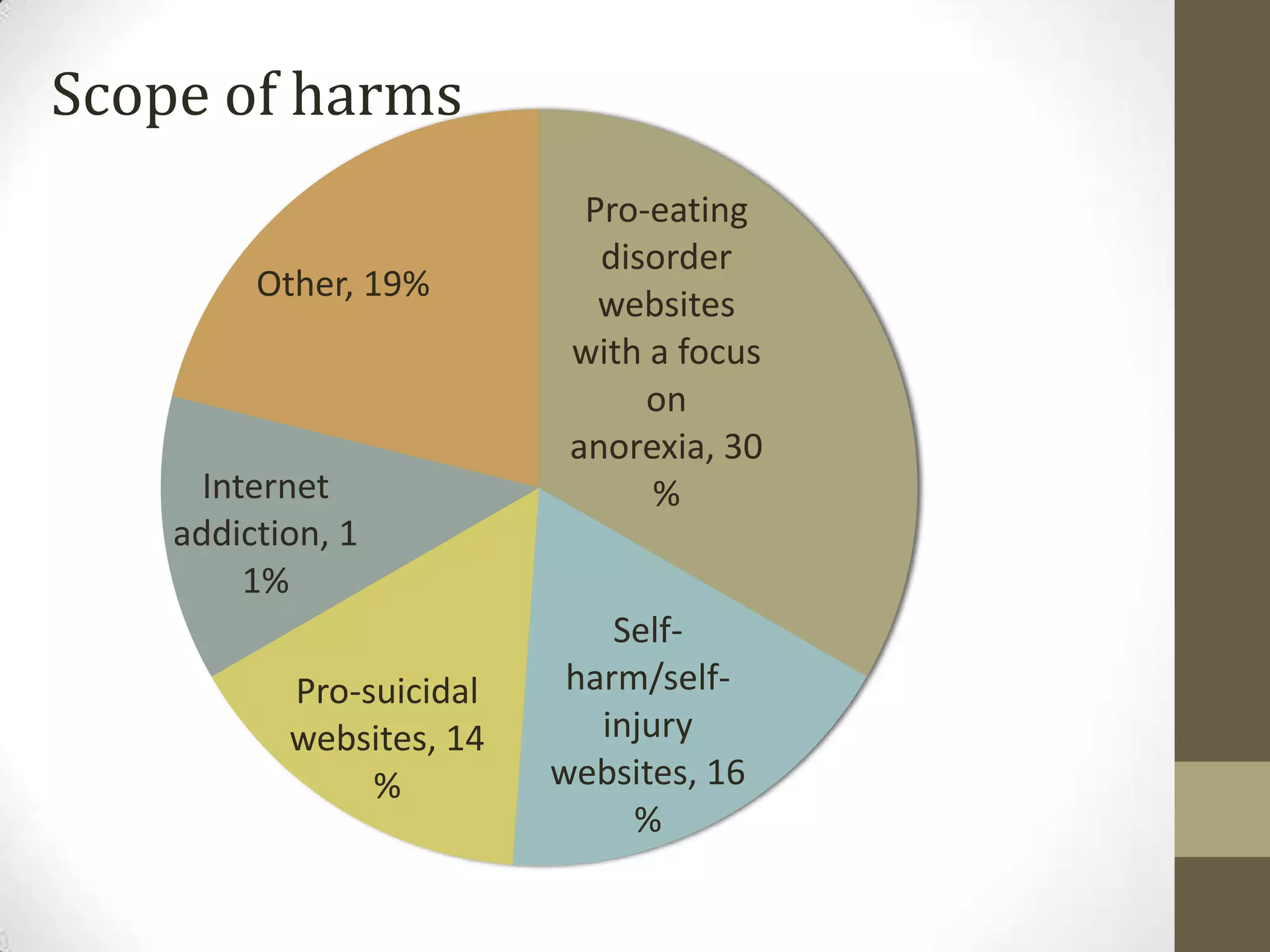
Scope of harms
                            Pro-eating
                             disorder
         Other, 19%
                             websites
                           with a focus
                                on
                           anorexia, 30
      Internet                  %
    addiction, 1
         1%
                              Self-
           Pro-suicidal    harm/self-
           websites, 14      injury
                %         websites, 16
                               %
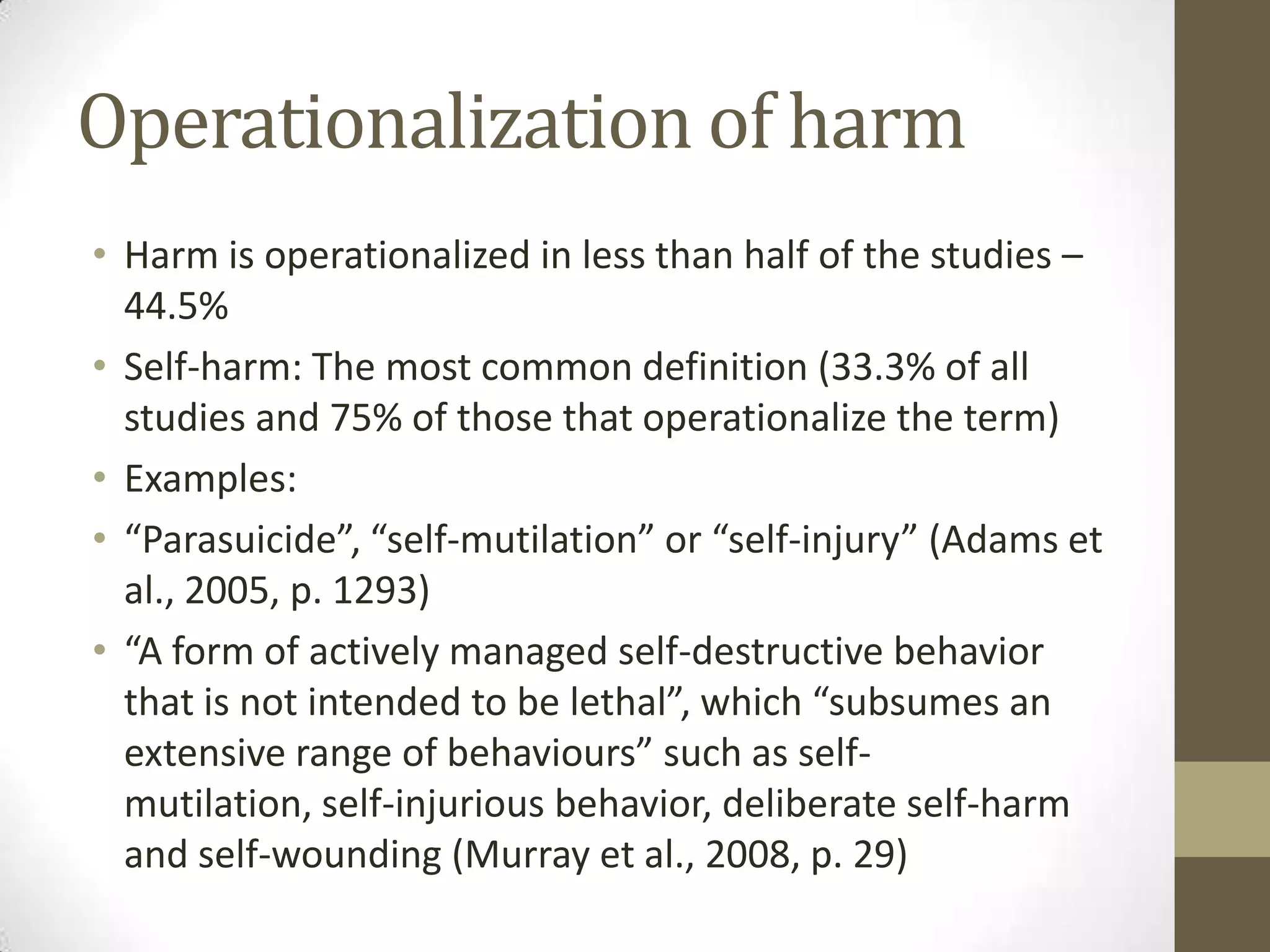
Operationalization of harm
• Harm is operationalized in less than half of the studies –
  44.5%
• Self-harm: The most common definition (33.3% of all
  studies and 75% of those that operationalize the term)
• Examples:
• “Parasuicide”, “self-mutilation” or “self-injury” (Adams et
  al., 2005, p. 1293)
• “A form of actively managed self-destructive behavior
  that is not intended to be lethal”, which “subsumes an
  extensive range of behaviours” such as self-
  mutilation, self-injurious behavior, deliberate self-harm
  and self-wounding (Murray et al., 2008, p. 29)
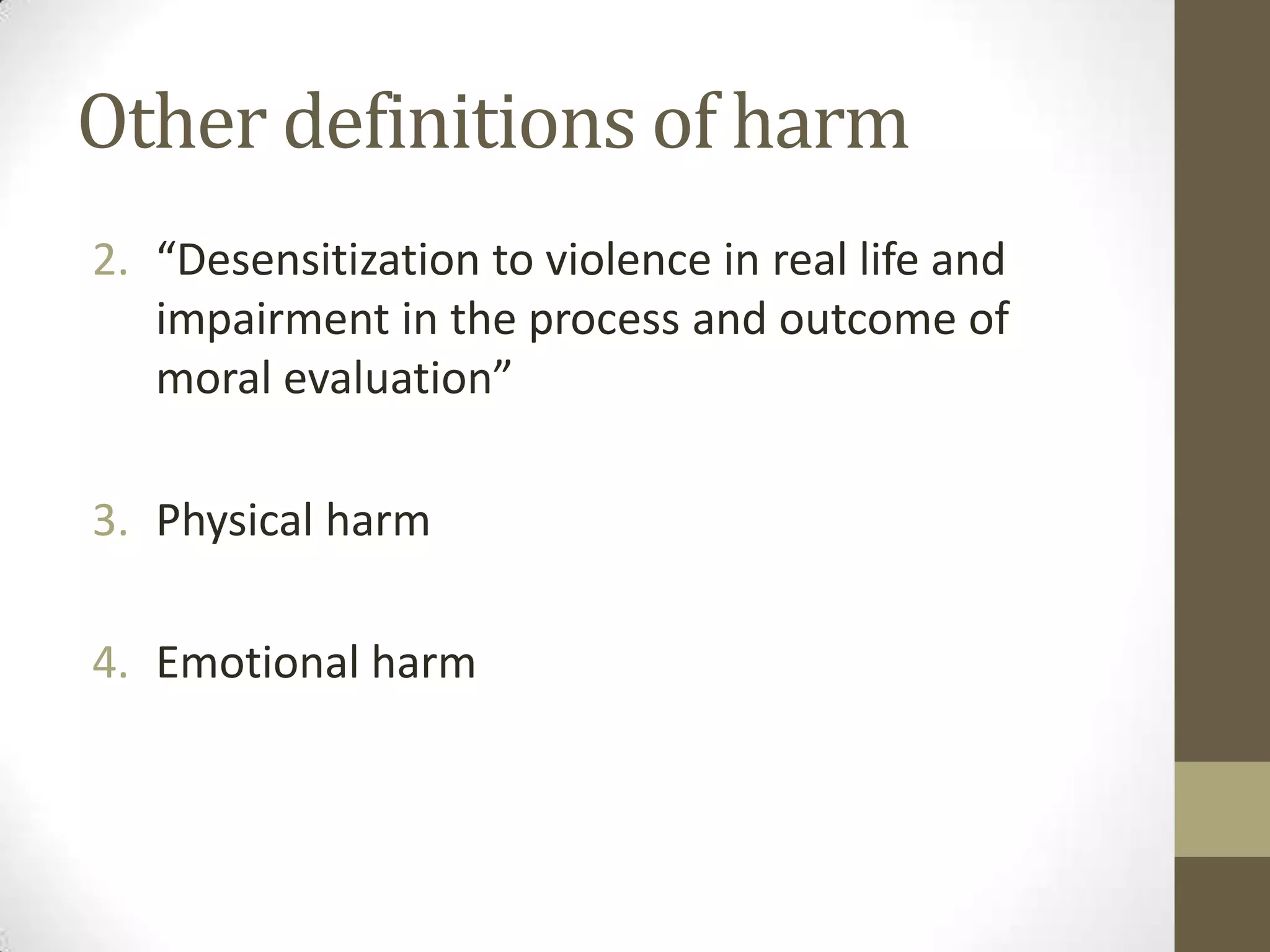
Other definitions of harm
2. “Desensitization to violence in real life and
   impairment in the process and outcome of
   moral evaluation”

3. Physical harm

4. Emotional harm
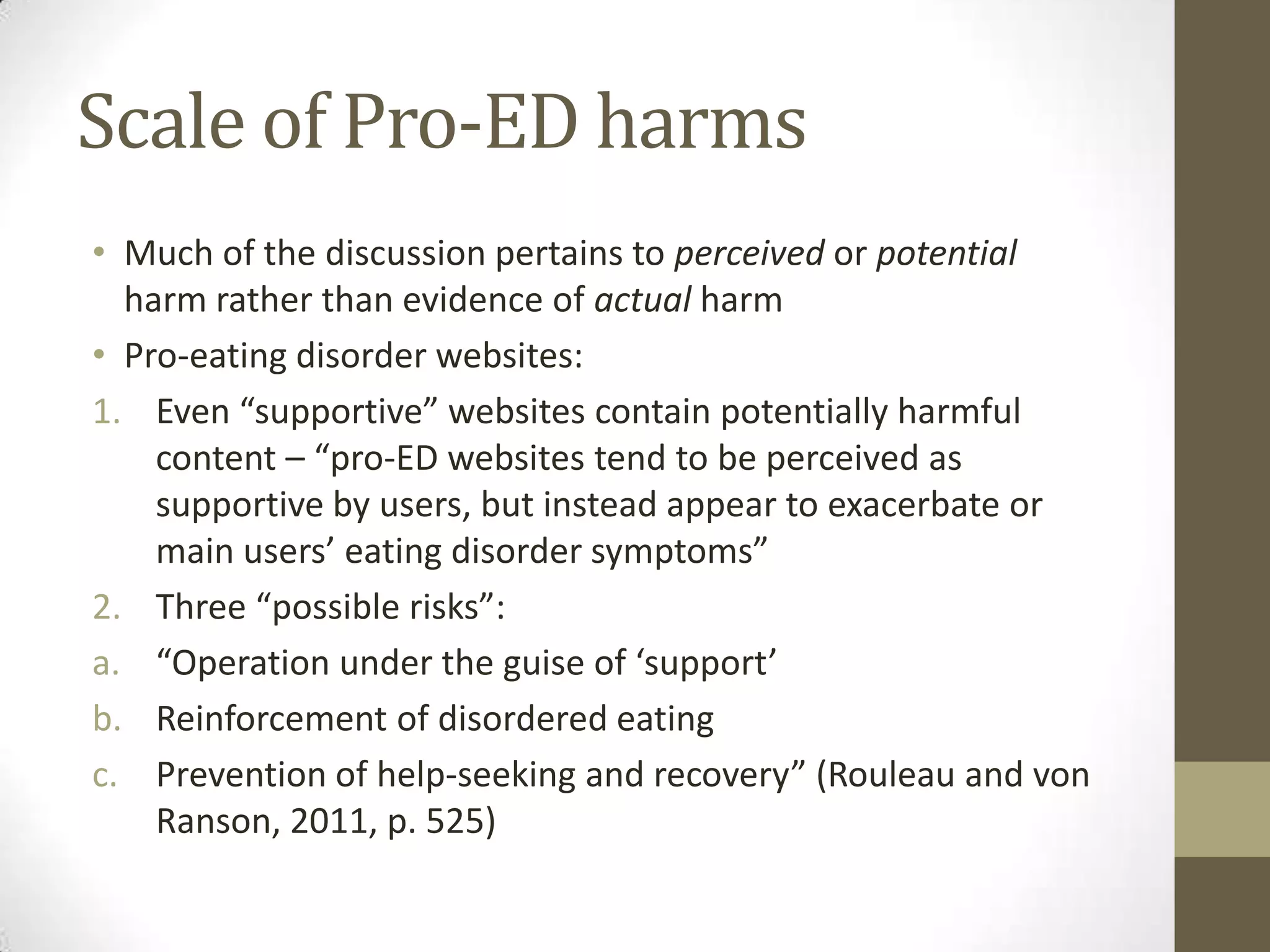
Scale of Pro-ED harms
• Much of the discussion pertains to perceived or potential
  harm rather than evidence of actual harm
• Pro-eating disorder websites:
1. Even “supportive” websites contain potentially harmful
    content – “pro-ED websites tend to be perceived as
    supportive by users, but instead appear to exacerbate or
    main users’ eating disorder symptoms”
2. Three “possible risks”:
a. “Operation under the guise of ‘support’
b. Reinforcement of disordered eating
c. Prevention of help-seeking and recovery” (Rouleau and von
    Ranson, 2011, p. 525)
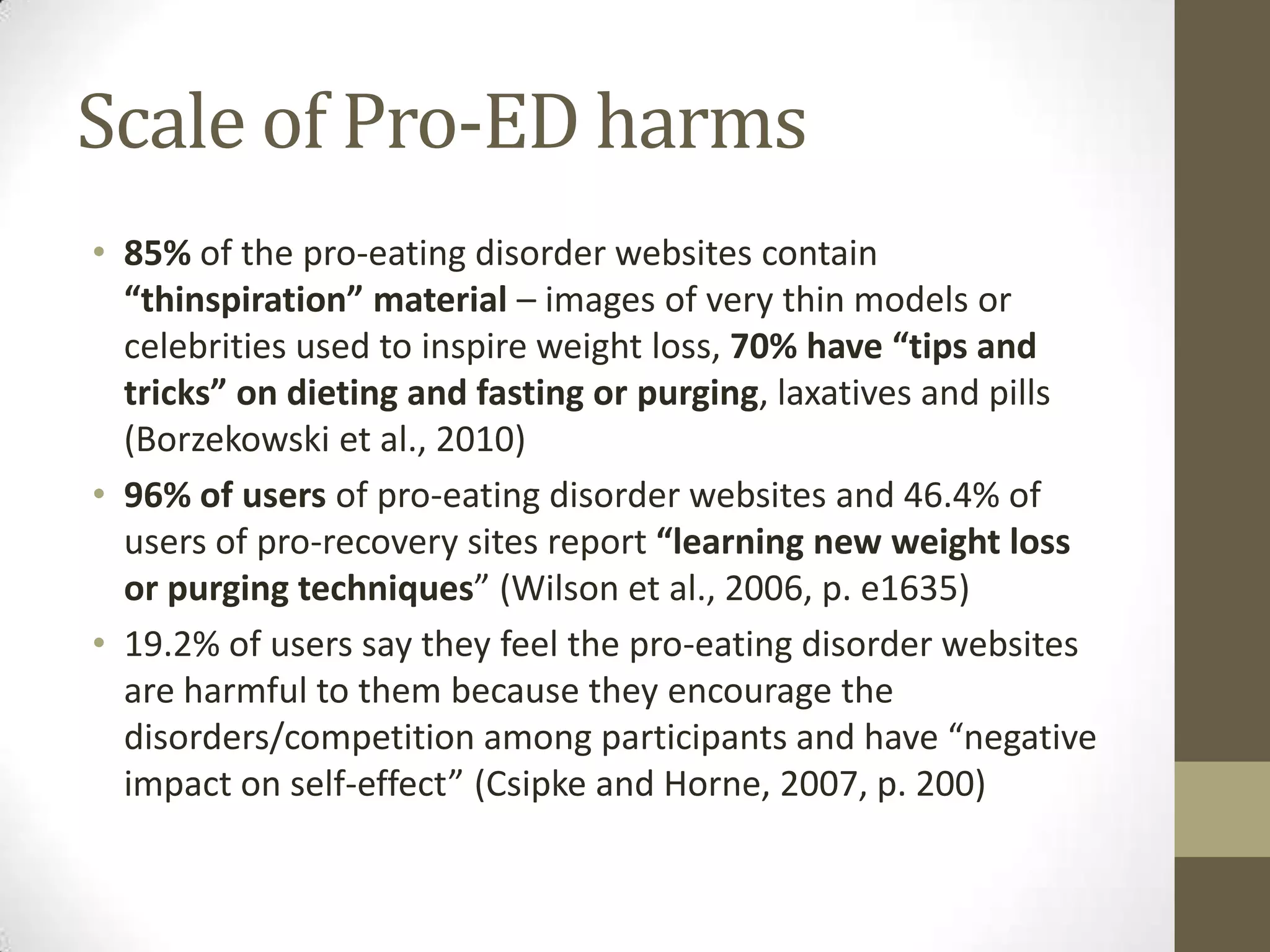
Scale of Pro-ED harms
• 85% of the pro-eating disorder websites contain
  “thinspiration” material – images of very thin models or
  celebrities used to inspire weight loss, 70% have “tips and
  tricks” on dieting and fasting or purging, laxatives and pills
  (Borzekowski et al., 2010)
• 96% of users of pro-eating disorder websites and 46.4% of
  users of pro-recovery sites report “learning new weight loss
  or purging techniques” (Wilson et al., 2006, p. e1635)
• 19.2% of users say they feel the pro-eating disorder websites
  are harmful to them because they encourage the
  disorders/competition among participants and have “negative
  impact on self-effect” (Csipke and Horne, 2007, p. 200)
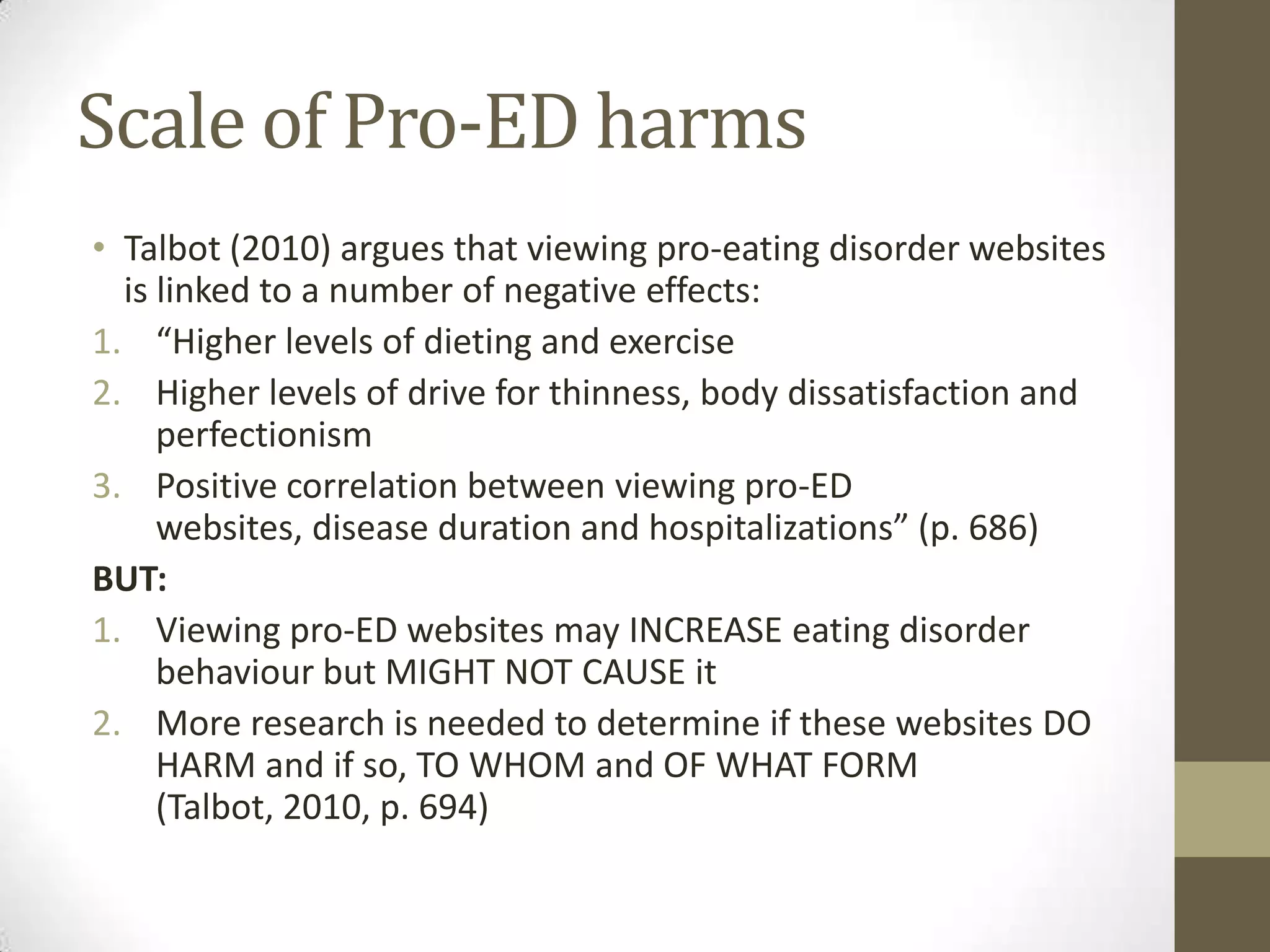
Scale of Pro-ED harms
• Talbot (2010) argues that viewing pro-eating disorder websites
  is linked to a number of negative effects:
1. “Higher levels of dieting and exercise
2. Higher levels of drive for thinness, body dissatisfaction and
     perfectionism
3. Positive correlation between viewing pro-ED
     websites, disease duration and hospitalizations” (p. 686)
BUT:
1. Viewing pro-ED websites may INCREASE eating disorder
     behaviour but MIGHT NOT CAUSE it
2. More research is needed to determine if these websites DO
     HARM and if so, TO WHOM and OF WHAT FORM
     (Talbot, 2010, p. 694)
Scale of self-harm
• A “normalizing” and a “pathologizing” discourse
  (Franzén & Gottzén, 2011, p. 279)
• Little evidence regarding the prevalence of self-
  injurious behavior and its relationship to use of self-
  harm websites or forums
• 80% of the users of self-harm message boards are
  found to be between 14 and 20 years old
  (Whitlock, Powers, & Eckenrode, 2006).
• The typical adolescent self-injurer is female, often
  with a history of abuse and an eating disorder, most
  commonly cutting her arms and legs and hiding it.
Scale: pro-suicidal sites
• Much more conclusive in the claims about harms
• A meta-study (Durkee et al., 2011) concludes
  that “pro-suicide websites and online suicide
  pacts” are “high-risk factors for facilitating
  suicidal behaviours, particularly among isolated
  and susceptible individuals” BUT some forums
  provide opportunities for people to meet others
  with similar experiences, “wherein their
  thoughts and feeling are not condemned nor
  lectured about” (p. 3944)
Scale of “Internet addiction”
• 35% of people with Problematic Internet experience
  are <18
• BUT “virtually all of the Internet problem behaviors”
  are “extensions of problem behaviors that pre-
  existed the advent of the Internet” (Mitchell, Becker-
  Blease, & Finkelhor, 2005, p. 506)
• The typical problematic Internet user is a teenager
  who spends most of his/her time on the
  computer, including at night. He/she is socially
  isolated and plays games 12-14 hours a day
• A counsellor: “It’s the same thing as with drug
  addicts” (Acier and Kern, 2011, p. 986)
Conclusions
• It seems indisputable that some children experience
  a variety of health harms as a result of using the
  Internet.
• Documented examples include young people
  assisted or encouraged in their suicide attempts
  after visiting pro-suicide forums and young girls
  encouraged to maintain or exacerbate their eating
  disorders or self-injurious behavior.
• Relatively low numbers – specific case studies based
  on interviews with health professionals and/or
  medical records
Conclusions
• Interesting textual analysis studies and surveys, suggesting
  high prevalence of potential harms and risks but little
  evidence on actual harms, especially in relation to low-risk
  children
• For example, whether and how are healthy children affected
  by using eating disorders websites – are they “harmed” by the
  pro-ED websites?
• Limitations of studies: reliance on surveys – they tell us a lot
  about risks and perceived harms but little about actual harms
• Limitations of our study: focus strictly on harms and studies
  that use the term, hence potentially relevant studies might
  have been omitted
Any questions?

• Dr Vera Slavtcheva-Petkova, v.petkova@chester.ac.uk

• Dr Monica Bulger, monica.bulger@oii.ox.ac.uk

• Dr Victoria Nash, victoria.nash@oii.ox.ac.uk

MeCCSA Presentation 2013

  • 1.
    Does the Internetharm children’s health? Dr Vera Slavtcheva-Petkova, University of Chester Dr Monica Bulger, Dr Victoria Nash, Oxford Internet Institute, University of Oxford
  • 2.
    Contents • Child protectionand online harms: Academic and policy context • Methods • Scope, scale and operationalisation of health- related harms • Conclusions
  • 3.
    Academic context • Growingbody of research on level and character of Internet by under 18s, and nature of risks and opportunities experienced (e.g., Livingstone & Haddon, 2009; Schrock & Boyd, 2008) • Research suggests that risks are greatest for those most vulnerable offline, and that overall, the opportunities of Internet use outweigh risks (e.g. Mitchell et al., 2010, Livingstone et al., 2011) • Real lack of research which quantifies or analyses level of actual harm rather than potential risk.
  • 4.
    Policy context • Widearray of policy measures across Europe: hotlines for reporting child abuse images, industry codes of conduct regulating use of mobile content and services, and increasing provision of parental controls by ISPs. • Much of this is result of self or co-regulation • Possible and actual conflicts with other rights, e.g. freedom of expression, legal due process. • Policy purportedly informed by research (e.g. multi- stakeholder UK Council for Child Internet Safety), but susceptible to media pressure and “moral panics”
  • 5.
    Perceived risks vs.actual harms “While new discoveries almost always have both benefits and disadvantages, breathless negative coverage of technology frightens parents, prevents teenagers from learning responsible use, and fuels panics, resulting in misguided or unconstitutional legislation” (Marwick 2008).
  • 6.
    Our study • Evidenceon the extent of harms experienced by children as a result of online risks: A critical synthesis of research • Funded by the Oxford University Press's Fell Fund • A review of empirical studies of harms associated with young people’s (under 18s) Internet use, published in English between 1997-2012 + interviews with key stakeholders
  • 7.
    Methods • Keywords: “harmAND Internet AND children”, “harm AND Internet AND adolescents”, “harm AND Internet AND minors”, “harm AND Internet AND teens” and “harm AND Internet AND teenagers” • Categories for inclusion: 1. Empirical work 2. Published in peer-reviewed journal 3. Main focus of study was young people (aged under 18) 4. Addressed Internet use 5. Addressed incidents of harm related to online interactions
  • 8.
    Methods • Original searchyielded over 4,000 publications • After a first-pass review, corpus narrowed to 271 studies. • 271 were reviewed but only 148 articles were fully coded after strict application of the inclusion criteria. • Coding framework adapted from the EU Kids Online public repository. It included 21 items, including details of method, target population, context and how and whether harm was operationalised.
  • 9.
    Three categories ofharms • Three main categories of harms: 1. Health-related harms: 63 articles 1. Sex-related harms: 49 articles 1. Cyberbullying – 36 articles
  • 10.
    Health studies: Methods 9.7% Surveys 9.5% 44.4% Textual analysis 11% Case studies Interviews 25.4% Other
  • 11.
    Scope of harms Pro-eating disorder Other, 19% websites with a focus on anorexia, 30 Internet % addiction, 1 1% Self- Pro-suicidal harm/self- websites, 14 injury % websites, 16 %
  • 12.
    Operationalization of harm •Harm is operationalized in less than half of the studies – 44.5% • Self-harm: The most common definition (33.3% of all studies and 75% of those that operationalize the term) • Examples: • “Parasuicide”, “self-mutilation” or “self-injury” (Adams et al., 2005, p. 1293) • “A form of actively managed self-destructive behavior that is not intended to be lethal”, which “subsumes an extensive range of behaviours” such as self- mutilation, self-injurious behavior, deliberate self-harm and self-wounding (Murray et al., 2008, p. 29)
  • 13.
    Other definitions ofharm 2. “Desensitization to violence in real life and impairment in the process and outcome of moral evaluation” 3. Physical harm 4. Emotional harm
  • 14.
    Scale of Pro-EDharms • Much of the discussion pertains to perceived or potential harm rather than evidence of actual harm • Pro-eating disorder websites: 1. Even “supportive” websites contain potentially harmful content – “pro-ED websites tend to be perceived as supportive by users, but instead appear to exacerbate or main users’ eating disorder symptoms” 2. Three “possible risks”: a. “Operation under the guise of ‘support’ b. Reinforcement of disordered eating c. Prevention of help-seeking and recovery” (Rouleau and von Ranson, 2011, p. 525)
  • 15.
    Scale of Pro-EDharms • 85% of the pro-eating disorder websites contain “thinspiration” material – images of very thin models or celebrities used to inspire weight loss, 70% have “tips and tricks” on dieting and fasting or purging, laxatives and pills (Borzekowski et al., 2010) • 96% of users of pro-eating disorder websites and 46.4% of users of pro-recovery sites report “learning new weight loss or purging techniques” (Wilson et al., 2006, p. e1635) • 19.2% of users say they feel the pro-eating disorder websites are harmful to them because they encourage the disorders/competition among participants and have “negative impact on self-effect” (Csipke and Horne, 2007, p. 200)
  • 16.
    Scale of Pro-EDharms • Talbot (2010) argues that viewing pro-eating disorder websites is linked to a number of negative effects: 1. “Higher levels of dieting and exercise 2. Higher levels of drive for thinness, body dissatisfaction and perfectionism 3. Positive correlation between viewing pro-ED websites, disease duration and hospitalizations” (p. 686) BUT: 1. Viewing pro-ED websites may INCREASE eating disorder behaviour but MIGHT NOT CAUSE it 2. More research is needed to determine if these websites DO HARM and if so, TO WHOM and OF WHAT FORM (Talbot, 2010, p. 694)
  • 17.
    Scale of self-harm •A “normalizing” and a “pathologizing” discourse (Franzén & Gottzén, 2011, p. 279) • Little evidence regarding the prevalence of self- injurious behavior and its relationship to use of self- harm websites or forums • 80% of the users of self-harm message boards are found to be between 14 and 20 years old (Whitlock, Powers, & Eckenrode, 2006). • The typical adolescent self-injurer is female, often with a history of abuse and an eating disorder, most commonly cutting her arms and legs and hiding it.
  • 18.
    Scale: pro-suicidal sites •Much more conclusive in the claims about harms • A meta-study (Durkee et al., 2011) concludes that “pro-suicide websites and online suicide pacts” are “high-risk factors for facilitating suicidal behaviours, particularly among isolated and susceptible individuals” BUT some forums provide opportunities for people to meet others with similar experiences, “wherein their thoughts and feeling are not condemned nor lectured about” (p. 3944)
  • 19.
    Scale of “Internetaddiction” • 35% of people with Problematic Internet experience are <18 • BUT “virtually all of the Internet problem behaviors” are “extensions of problem behaviors that pre- existed the advent of the Internet” (Mitchell, Becker- Blease, & Finkelhor, 2005, p. 506) • The typical problematic Internet user is a teenager who spends most of his/her time on the computer, including at night. He/she is socially isolated and plays games 12-14 hours a day • A counsellor: “It’s the same thing as with drug addicts” (Acier and Kern, 2011, p. 986)
  • 20.
    Conclusions • It seemsindisputable that some children experience a variety of health harms as a result of using the Internet. • Documented examples include young people assisted or encouraged in their suicide attempts after visiting pro-suicide forums and young girls encouraged to maintain or exacerbate their eating disorders or self-injurious behavior. • Relatively low numbers – specific case studies based on interviews with health professionals and/or medical records
  • 21.
    Conclusions • Interesting textualanalysis studies and surveys, suggesting high prevalence of potential harms and risks but little evidence on actual harms, especially in relation to low-risk children • For example, whether and how are healthy children affected by using eating disorders websites – are they “harmed” by the pro-ED websites? • Limitations of studies: reliance on surveys – they tell us a lot about risks and perceived harms but little about actual harms • Limitations of our study: focus strictly on harms and studies that use the term, hence potentially relevant studies might have been omitted
  • 22.
    Any questions? • DrVera Slavtcheva-Petkova, v.petkova@chester.ac.uk • Dr Monica Bulger, monica.bulger@oii.ox.ac.uk • Dr Victoria Nash, victoria.nash@oii.ox.ac.uk