Types of
Claims
1) Fact and Definition, a text that
presents a fact or definition along
with a strong argument and put
forward a strong argument that
the readers can’t ignore.
1) Fact and Definition
Example:
Net lingo, as the written slang of the young
generation, assures them of “inness” or of
belonging to that group, but strangers within
could bring trouble, although the young are
wary of them, and protect themselves by
blocking subsequent messages of undesirable
online friends.
2) Cause and Effect is used
when an effect is being discussed
with the support of the arguments
describing the cause of an issue.
2) Cause and Effect
Example:
Consequently, the bad language
on television programs has kept
young children imitating cursing and
swearing that totally deviate from the
values taught at home.
3) Value is a statement used to argue over
a value of something or how a certain
thing should be valued. This concerns
researching an issue that is being ignored
generally. The writer is advocating
judgment about something good or bad,
right or wrong, beautiful or ugly, moral or
immoral.
3) Value
Example:
We should find ways of creating not
only clean but also cheap sources of
energy that would halt climate change and
transform the lives
of the poorest families.
4) Policy is a statement where you either
support or oppose a solution or a policy. It
provides strong reasons for opposing and
should not be biased or personal.
4) Policy
Example:
Instead of searching for more oil fields,
we should increase the use of renewable
energy and reduce oil consumption.
Supporting
evidence
a) Factual knowledge is the information
that is verifiable and agreed upon by
almost everyone.
b) Statistical Inferences denotes the
interpretation and examples of an
accumulation of facts.
c) Informed opinion is the opinion
developed through research and/or
expertise of the claim.
d) Personal Testimony focuses on the
personal experience related to a
knowledgeable party.
Structure of
a Position
Paper
Introduction (1 paragraph)
• Hook
• Introduce the issue (topic sentence) that
summarizes the issue
• Provide background of the issue
explaining its importance
• Assert the thesis (your view of the
issue), Inform the reader of your point of
Introduction
SHOULD HOMEWORK BE MANDATORY?
I can almost see many students nodding along with
me as I ask this question. Younger generations
overloaded with home tasks and numerous assignments
have already raised this issue many times. Yet,
homework remains mandatory. Is it fair or should it be
canceled?
I believe that homework should not be viewed as a
mandatory part of education for several reasons.
Introduction
Body (3- 4 paragraphs)
Central argument
a) Give evidence supporting the author’s position
b) Summarize the counterclaims
c) Refute the counterclaims
Your Argument
a) Assert point #1, #2 & # 3 of your claims
- Give your reasons by using two reliable sources
- Provide supporting details
Elaboration that references documents and source data
Past experiences and authoritative testimony
Body
Body
First, children spend seven hours every single
workday at school. That is a huge chunk of life, and
with homework added on top of these hours, a child
is left with no time to live his life to the fullest,
socialize, or grow in other areas.
Second, sitting at your desk solving problems
does no good to your health. Kids need time to get
outside and have some fun, join a football league,
or ride their bikes with friends around the block.
Otherwise, children will be very smart but
surprisingly weak physically.
Another argument against this position is
that homework is not always the best way to obtain
knowledge quality-wise. Students tend to ask their
parents or siblings for help whenever facing
difficulties. Busy parents not always willing to spend
extra time explaining school material to their little
one solve the problems themselves aiming to have
more time for family, not lessons. As a result, the
child will have the homework done. But that’s really
not his work. So, the whole idea of dedicating time
to self-education is lost here.
Finally, knowing that after classes you would
still have to work at home makes a kid less
concentrated at school. This results in short
attention spans and difficulty to concentrate on
something for too long.
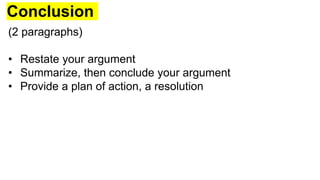
(2 paragraphs)
• Restate your argument
• Summarize, then conclude your argument
• Provide a plan of action, a resolution
Conclusion
All in all, homework should rather be
an option. Students understanding that
they are left behind at some subjects will
take their time to go over the material at
home. However, in other cases, they
should have time after school for other
activities.
Conclusion

EAPP.pptx

  • 1.
  • 2.
    1) Fact andDefinition, a text that presents a fact or definition along with a strong argument and put forward a strong argument that the readers can’t ignore.
  • 3.
    1) Fact andDefinition Example: Net lingo, as the written slang of the young generation, assures them of “inness” or of belonging to that group, but strangers within could bring trouble, although the young are wary of them, and protect themselves by blocking subsequent messages of undesirable online friends.
  • 4.
    2) Cause andEffect is used when an effect is being discussed with the support of the arguments describing the cause of an issue.
  • 5.
    2) Cause andEffect Example: Consequently, the bad language on television programs has kept young children imitating cursing and swearing that totally deviate from the values taught at home.
  • 6.
    3) Value isa statement used to argue over a value of something or how a certain thing should be valued. This concerns researching an issue that is being ignored generally. The writer is advocating judgment about something good or bad, right or wrong, beautiful or ugly, moral or immoral.
  • 7.
    3) Value Example: We shouldfind ways of creating not only clean but also cheap sources of energy that would halt climate change and transform the lives of the poorest families.
  • 8.
    4) Policy isa statement where you either support or oppose a solution or a policy. It provides strong reasons for opposing and should not be biased or personal.
  • 9.
    4) Policy Example: Instead ofsearching for more oil fields, we should increase the use of renewable energy and reduce oil consumption.
  • 10.
  • 11.
    a) Factual knowledgeis the information that is verifiable and agreed upon by almost everyone.
  • 12.
    b) Statistical Inferencesdenotes the interpretation and examples of an accumulation of facts.
  • 13.
    c) Informed opinionis the opinion developed through research and/or expertise of the claim.
  • 14.
    d) Personal Testimonyfocuses on the personal experience related to a knowledgeable party.
  • 15.
  • 16.
    Introduction (1 paragraph) •Hook • Introduce the issue (topic sentence) that summarizes the issue • Provide background of the issue explaining its importance • Assert the thesis (your view of the issue), Inform the reader of your point of Introduction
  • 17.
    SHOULD HOMEWORK BEMANDATORY? I can almost see many students nodding along with me as I ask this question. Younger generations overloaded with home tasks and numerous assignments have already raised this issue many times. Yet, homework remains mandatory. Is it fair or should it be canceled? I believe that homework should not be viewed as a mandatory part of education for several reasons. Introduction
  • 18.
    Body (3- 4paragraphs) Central argument a) Give evidence supporting the author’s position b) Summarize the counterclaims c) Refute the counterclaims Your Argument a) Assert point #1, #2 & # 3 of your claims - Give your reasons by using two reliable sources - Provide supporting details Elaboration that references documents and source data Past experiences and authoritative testimony Body
  • 19.
  • 20.
    First, children spendseven hours every single workday at school. That is a huge chunk of life, and with homework added on top of these hours, a child is left with no time to live his life to the fullest, socialize, or grow in other areas.
  • 21.
    Second, sitting atyour desk solving problems does no good to your health. Kids need time to get outside and have some fun, join a football league, or ride their bikes with friends around the block. Otherwise, children will be very smart but surprisingly weak physically.
  • 22.
    Another argument againstthis position is that homework is not always the best way to obtain knowledge quality-wise. Students tend to ask their parents or siblings for help whenever facing difficulties. Busy parents not always willing to spend extra time explaining school material to their little one solve the problems themselves aiming to have more time for family, not lessons. As a result, the child will have the homework done. But that’s really not his work. So, the whole idea of dedicating time to self-education is lost here.
  • 23.
    Finally, knowing thatafter classes you would still have to work at home makes a kid less concentrated at school. This results in short attention spans and difficulty to concentrate on something for too long.
  • 24.
    (2 paragraphs) • Restateyour argument • Summarize, then conclude your argument • Provide a plan of action, a resolution Conclusion
  • 25.
    All in all,homework should rather be an option. Students understanding that they are left behind at some subjects will take their time to go over the material at home. However, in other cases, they should have time after school for other activities. Conclusion

Editor's Notes

  • #3 1) Fact and Definition, a text that presents a fact or definition along with a strong argument and put forward a strong argument that the readers can’t ignore
  • #5 2) Cause and Effect is used when an effect is being discussed with the support of the arguments describing the cause of an issue.
  • #6 1) Fact and Definition, a text that presents a fact or definition along with a strong argument and put forward a strong argument that the readers can’t ignore
  • #7 3) Value is a statement used to argue over a value of something or how a certain thing should be valued. This concerns researching an issue that is being ignored generally. The writer is advocating judgment about something good or bad, right or wrong, beautiful or ugly, moral or immoral.
  • #8 1) Fact and Definition, a text that presents a fact or definition along with a strong argument and put forward a strong argument that the readers can’t ignore
  • #9 1) Fact and Definition, a text that presents a fact or definition along with a strong argument and put forward a strong argument that the readers can’t ignore
  • #10 1) Fact and Definition, a text that presents a fact or definition along with a strong argument and put forward a strong argument that the readers can’t ignore
  • #12 1) Fact and Definition, a text that presents a fact or definition along with a strong argument and put forward a strong argument that the readers can’t ignore
  • #13 1) Fact and Definition, a text that presents a fact or definition along with a strong argument and put forward a strong argument that the readers can’t ignore
  • #14 1) Fact and Definition, a text that presents a fact or definition along with a strong argument and put forward a strong argument that the readers can’t ignore
  • #15 1) Fact and Definition, a text that presents a fact or definition along with a strong argument and put forward a strong argument that the readers can’t ignore
  • #17 Introduction (1 paragraph)  Introduce the topic (topic sentence) that summarizes the issue  Provide background of the topic explaining its importance  Assert the thesis (your view of the issue)  Inform the reader of your point of view
  • #18 Introduction (1 paragraph)  Introduce the topic (topic sentence) that summarizes the issue  Provide background of the topic explaining its importance  Assert the thesis (your view of the issue)  Inform the reader of your point of view
  • #19 Body (3- 4 paragraphs)  Central argument a) Give evidence supporting the author’s position b) Summarize the counterclaims c) Refute the counterclaims  Your Argument a) Assert point #1, #2 & # 3 of your claims - Give your reasons by using two reliable sources - Provide supporting details  Elaboration that references documents and source data  Past experiences and authoritative testimony
  • #20 Body (3- 4 paragraphs)  Central argument a) Give evidence supporting the author’s position b) Summarize the counterclaims c) Refute the counterclaims  Your Argument a) Assert point #1, #2 & # 3 of your claims - Give your reasons by using two reliable sources - Provide supporting details  Elaboration that references documents and source data  Past experiences and authoritative testimony
  • #21 Body (3- 4 paragraphs)  Central argument a) Give evidence supporting the author’s position b) Summarize the counterclaims c) Refute the counterclaims  Your Argument a) Assert point #1, #2 & # 3 of your claims - Give your reasons by using two reliable sources - Provide supporting details  Elaboration that references documents and source data  Past experiences and authoritative testimony
  • #22 Body (3- 4 paragraphs)  Central argument a) Give evidence supporting the author’s position b) Summarize the counterclaims c) Refute the counterclaims  Your Argument a) Assert point #1, #2 & # 3 of your claims - Give your reasons by using two reliable sources - Provide supporting details  Elaboration that references documents and source data  Past experiences and authoritative testimony
  • #23 Body (3- 4 paragraphs)  Central argument a) Give evidence supporting the author’s position b) Summarize the counterclaims c) Refute the counterclaims  Your Argument a) Assert point #1, #2 & # 3 of your claims - Give your reasons by using two reliable sources - Provide supporting details  Elaboration that references documents and source data  Past experiences and authoritative testimony
  • #24 Body (3- 4 paragraphs)  Central argument a) Give evidence supporting the author’s position b) Summarize the counterclaims c) Refute the counterclaims  Your Argument a) Assert point #1, #2 & # 3 of your claims - Give your reasons by using two reliable sources - Provide supporting details  Elaboration that references documents and source data  Past experiences and authoritative testimony
  • #25 Conclusion 2 paragraphs  Restate your argument  Summarize, then conclude your argument  Provide a plan of action, a resolution
  • #26 Conclusion 2 paragraphs  Restate your argument  Summarize, then conclude your argument  Provide a plan of action, a resolution