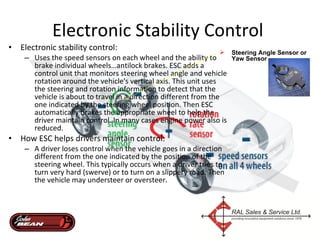
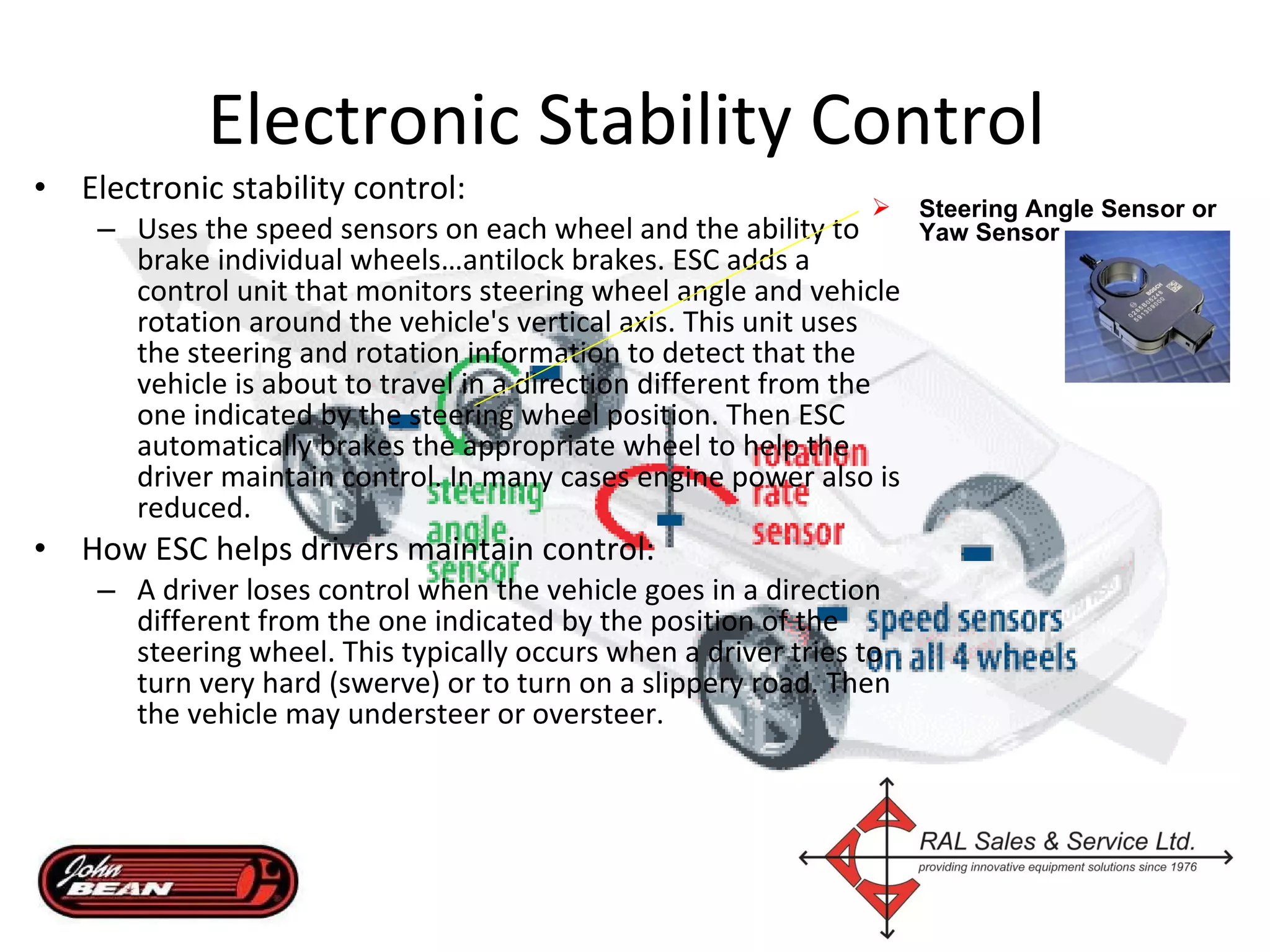
Electronic Stability Control  Electronic stability control:  Uses the speed sensors on each wheel and the ability to brake individual wheels…antilock brakes. ESC adds a control unit that monitors steering wheel angle and vehicle rotation around the vehicle's vertical axis. This unit uses the steering and rotation information to detect that the vehicle is about to travel in a direction different from the one indicated by the steering wheel position. Then ESC automatically brakes the appropriate wheel to help the driver maintain control. In many cases engine power also is reduced. How ESC helps drivers maintain control:  A driver loses control when the vehicle goes in a direction different from the one indicated by the position of the steering wheel. This typically occurs when a driver tries to turn very hard (swerve) or to turn on a slippery road. Then the vehicle may understeer or oversteer. Steering Angle Sensor or Yaw Sensor
Electronic Stability Control Systems Audi: Electronic Stability Program (ESP). BMW: Dynamic Stability Control (DSC). DaimlerChrysler: Electronic Stability Program (ESP). Ford Motor Company: Advance Trac. General Motors: Active Handling System (Corvette), Stabilitrak (Pontiac, Buick, Cadillac). Jaguar: Dynamic Stability Control (DSM). Lexus: Vehicle Skid Control (VSC) Porsche: Porsche Stability Management (PSM). Toyota: Vehicle Skid Control (VSC) Volkswagen: Electronic Stability Program (ESP). Volvo: Dynamic Stability Traction Control (DTSC).
A Primer on Electronic Stability Control Systems and effects on wheel alignment services Snap-on Equipment Jack D. Michaels Training Center Conway Arkansas Wednesday, April 22, 2009 Ron Racine Technical Training Specialist
Compliance Date The compliance date for vehicle manufacturers consist of a phase-in starting September 1, 2008: “  All new light vehicles must be equipped with an ESC system that meets the requirements of the standard by September 1, 2012.”  Page 3 of the FMVSS 126. Currently vehicle manufacturers equipped about 26% of model year 2006 light vehicles sold in the US with ESC. An increase to 71% is expected by model year 2011 with 100% ESC equipped vehicles by model year 2012. This applies to roadworthy vehicles with a gross weight rating of 4,536 kg (10,000 lbs) or less.
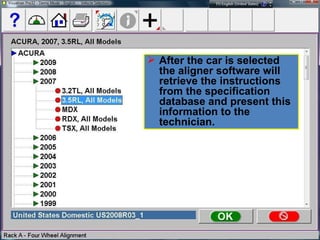
After the car is selected the aligner software will retrieve the instructions from the specification database and present this information to the technician.
 
 
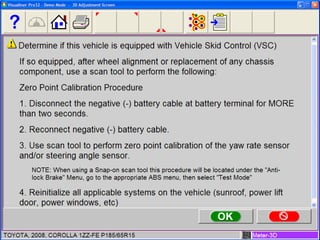
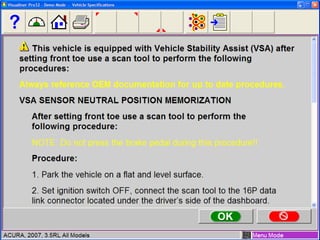
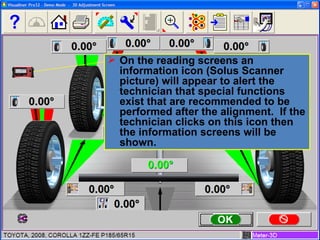
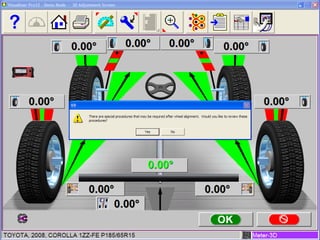
On the reading screens an information icon (Solus Scanner picture) will appear to alert the technician that special functions exist that are recommended to be performed after the alignment.  If the technician clicks on this icon then the information screens will be shown.
 
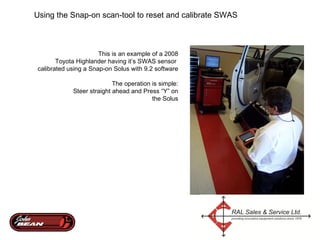
Using the Snap-on scan-tool to reset and calibrate SWAS This is an example of a 2008 Toyota Highlander having it’s SWAS sensor  calibrated using a Snap-on Solus with 9.2 software The operation is simple: Steer straight ahead and Press “Y” on the Solus
Existing customers can use their Snap-on scanner in conjunction with the alignment machines to reset SWAS Using the scanner in conjunction with the aligner eliminates the need to drive the vehicle on a flat surface to find straight ahead Alignment technicians can use the wheel alignment machine to steer straight ahead and the scanner to reset the various sensors Using the Snap-on scanner allows the undercar technician to retrieve ESC and EPS trouble codes whenever present and access valuable industry based repair information The John Bean alignment software will have some provisions to guide the  technician through the SWAS reset using a Snap-on Scanner Conclusion
Software Availability May aligner software release 161 vehicles are covered in the data base 9.2 Solus, Modis & Verus software release

Ral Electronic Stability

  • 1.
    Electronic Stability Control Electronic stability control: Uses the speed sensors on each wheel and the ability to brake individual wheels…antilock brakes. ESC adds a control unit that monitors steering wheel angle and vehicle rotation around the vehicle's vertical axis. This unit uses the steering and rotation information to detect that the vehicle is about to travel in a direction different from the one indicated by the steering wheel position. Then ESC automatically brakes the appropriate wheel to help the driver maintain control. In many cases engine power also is reduced. How ESC helps drivers maintain control: A driver loses control when the vehicle goes in a direction different from the one indicated by the position of the steering wheel. This typically occurs when a driver tries to turn very hard (swerve) or to turn on a slippery road. Then the vehicle may understeer or oversteer. Steering Angle Sensor or Yaw Sensor
  • 2.
    Electronic Stability ControlSystems Audi: Electronic Stability Program (ESP). BMW: Dynamic Stability Control (DSC). DaimlerChrysler: Electronic Stability Program (ESP). Ford Motor Company: Advance Trac. General Motors: Active Handling System (Corvette), Stabilitrak (Pontiac, Buick, Cadillac). Jaguar: Dynamic Stability Control (DSM). Lexus: Vehicle Skid Control (VSC) Porsche: Porsche Stability Management (PSM). Toyota: Vehicle Skid Control (VSC) Volkswagen: Electronic Stability Program (ESP). Volvo: Dynamic Stability Traction Control (DTSC).
  • 3.
    A Primer onElectronic Stability Control Systems and effects on wheel alignment services Snap-on Equipment Jack D. Michaels Training Center Conway Arkansas Wednesday, April 22, 2009 Ron Racine Technical Training Specialist
  • 4.
    Compliance Date Thecompliance date for vehicle manufacturers consist of a phase-in starting September 1, 2008: “ All new light vehicles must be equipped with an ESC system that meets the requirements of the standard by September 1, 2012.” Page 3 of the FMVSS 126. Currently vehicle manufacturers equipped about 26% of model year 2006 light vehicles sold in the US with ESC. An increase to 71% is expected by model year 2011 with 100% ESC equipped vehicles by model year 2012. This applies to roadworthy vehicles with a gross weight rating of 4,536 kg (10,000 lbs) or less.
  • 5.
    After the caris selected the aligner software will retrieve the instructions from the specification database and present this information to the technician.
  • 6.
  • 7.
  • 8.
    On the readingscreens an information icon (Solus Scanner picture) will appear to alert the technician that special functions exist that are recommended to be performed after the alignment. If the technician clicks on this icon then the information screens will be shown.
  • 9.
  • 10.
    Using the Snap-onscan-tool to reset and calibrate SWAS This is an example of a 2008 Toyota Highlander having it’s SWAS sensor calibrated using a Snap-on Solus with 9.2 software The operation is simple: Steer straight ahead and Press “Y” on the Solus
  • 11.
    Existing customers canuse their Snap-on scanner in conjunction with the alignment machines to reset SWAS Using the scanner in conjunction with the aligner eliminates the need to drive the vehicle on a flat surface to find straight ahead Alignment technicians can use the wheel alignment machine to steer straight ahead and the scanner to reset the various sensors Using the Snap-on scanner allows the undercar technician to retrieve ESC and EPS trouble codes whenever present and access valuable industry based repair information The John Bean alignment software will have some provisions to guide the technician through the SWAS reset using a Snap-on Scanner Conclusion
  • 12.
    Software Availability Mayaligner software release 161 vehicles are covered in the data base 9.2 Solus, Modis & Verus software release

Editor's Notes

  • #2 Electronic Stability Program (ESP). Other names include Vehicle Dynamics Control (Subaru), Dynamic Stability Control (Volvo), Vehicle Stability Assist (Honda), and Vehicle Stability Control (Toyota). Steering Angle Sensor or Yaw Sensor The steering-angle sensor basically consists of a resistance circuit and two wipers offset by 90°. The sensor, which is designed as a hollow shaft, is mounted on the steering column in the interior of the vehicle.