1
INTRODUCTION TO
RAILWAY ENGINEERING
Al Fattah Masudur Rahman
Joint Director General (Engineering)
Bangladesh Railway
2
History of Bangladesh Railway
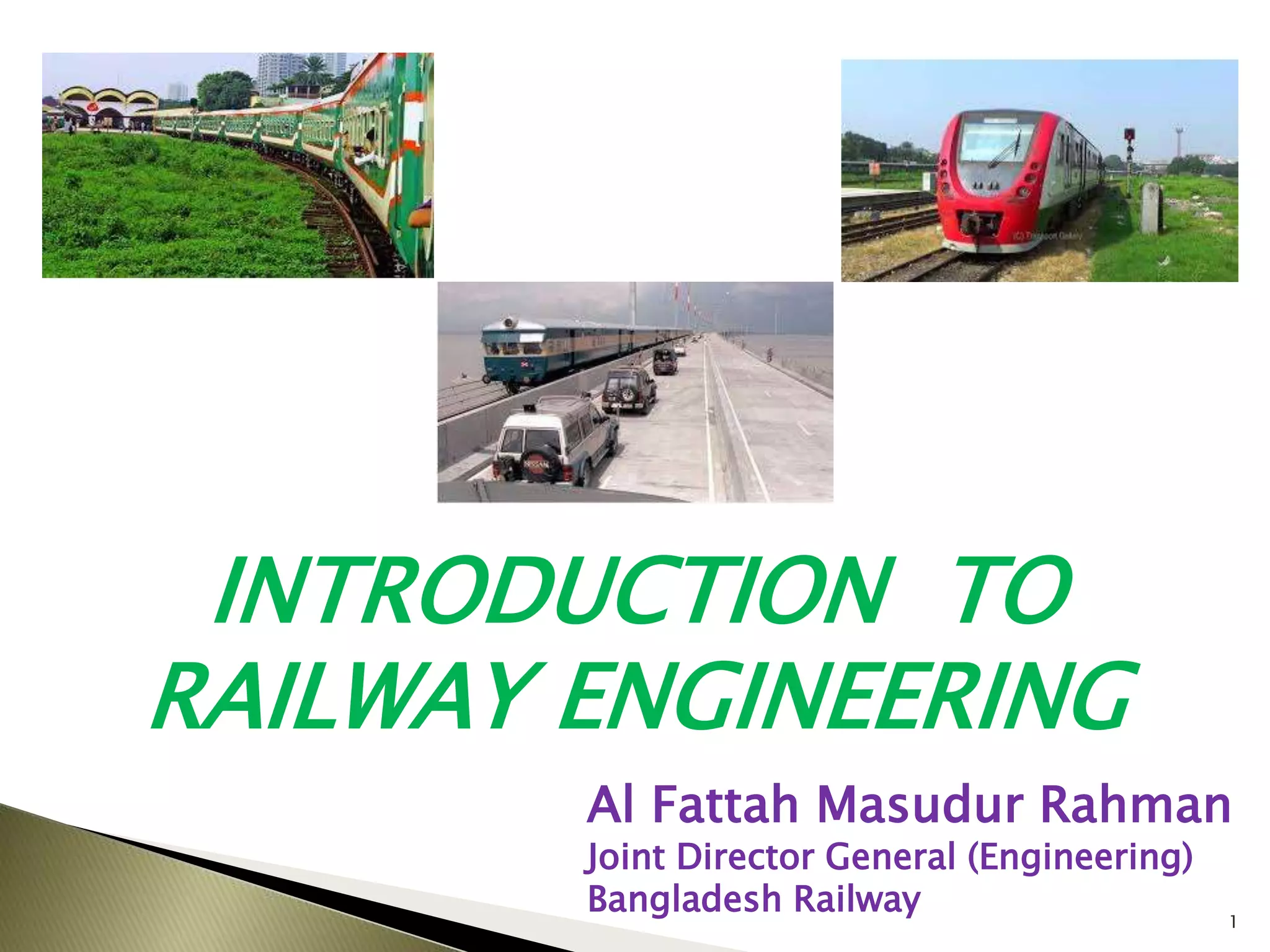
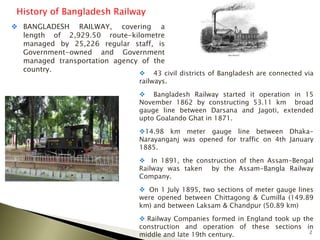
 BANGLADESH RAILWAY, covering a
length of 2,929.50 route-kilometre
managed by 25,226 regular staff, is
Government-owned and Government
managed transportation agency of the
country.
 43 civil districts of Bangladesh are connected via
railways.
 Bangladesh Railway started it operation in 15
November 1862 by constructing 53.11 km broad
gauge line between Darsana and Jagoti, extended
upto Goalando Ghat in 1871.
14.98 km meter gauge line between Dhaka-
Narayanganj was opened for traffic on 4th January
1885.
 In 1891, the construction of then Assam-Bengal
Railway was taken by the Assam-Bangla Railway
Company.
 On 1 July 1895, two sections of meter gauge lines
were opened between Chittagong & Cumilla (149.89
km) and between Laksam & Chandpur (50.89 km)
 Railway Companies formed in England took up the
construction and operation of these sections in
middle and late 19th century.
3
History of Bangladesh Railway
 In middle and late 19th century.
Bangladesh Railway was mostly inherited
from the British-established Assam Bengal
railway system after the partition of India in
1947.
 At present Bangladesh Railway has 2929.50
route-kilometers with 460 Stations.
 Bangladesh Railway's headquarter were located in
Chittagong, which had historically been the south-
eastern terminus of the Assam-Bengal Railway.
 After independence from Pakistan in 1971, It was
named as Bangladesh Railway (BR). Its Headquarter is
in Dhaka.
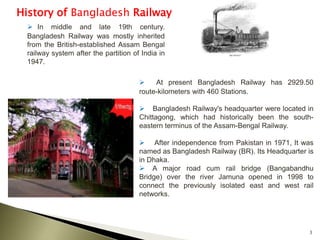
 A major road cum rail bridge (Bangabandhu
Bridge) over the river Jamuna opened in 1998 to
connect the previously isolated east and west rail
networks.
4
IMPORTANCE OF RAILWAY TRANSPORTATION
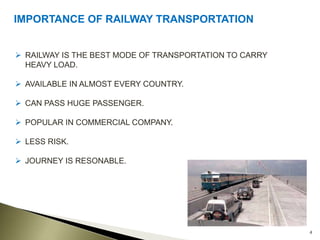
 RAILWAY IS THE BEST MODE OF TRANSPORTATION TO CARRY
HEAVY LOAD.
 AVAILABLE IN ALMOST EVERY COUNTRY.
 CAN PASS HUGE PASSENGER.
 POPULAR IN COMMERCIAL COMPANY.
 LESS RISK.
 JOURNEY IS RESONABLE.
5
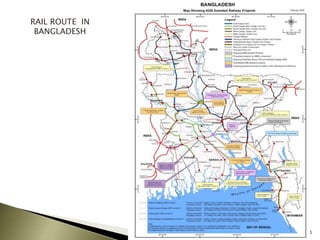
RAIL ROUTE IN
BANGLADESH
6
Railway Master Plan
 Bangladesh Railway (BR) completed revision of its masterplan with an investment
proposal of BDT 5.10 trillion until 2045 in five phases for making the railway efficient for
passenger and freight servicing.
 The plan activities include projects for increasing efficiency of the rail track, its
gradual upgrade and conversion from metre gauge to broad gauge through
transitional upgradation by converting into dual gauge, improving carriage and
locomotive maintenance capacity, developing institutional capacity, upscaling
significantly freight operational capacity and exploring prospects for introducing
electric trains or high-speed trains on some priority routes during the period
7
LEGAL FRAMEWORK OF BANGLADESH RAILWAY : ACTS & RULES
 THE RAILWAYS ACT, 1890 (ACT NO. IX OF 1890).
 General & Subsidiary Rules of Bangladesh Railway
 Bangladesh Railway Way & Works Manual.
 Bangladesh Railway Engineering Code.
 Bangladesh Railway Operation Manual.
 Bangladesh Railway Accounts Code.
8
Rapid transit or mass rapid transit (MRT), also known
as metro, subway, tube, U-Bahn or underground, is a type
of high-capacity public transport generally found in urban
areas. Unlike buses or trams, rapid transit systems
are electric railways that operate on an exclusive right-of-
way, which cannot be accessed by pedestrians or other
vehicles of any sort, and which is often grade
separated in tunnels or on elevated railways.
Different Types of Railway
 Conventional Railway : Train speed is less than 200 kmph
 High Speed Railway : Train Speed is equal or more than
200 kmph.
 Mass Rapid Transit:
9
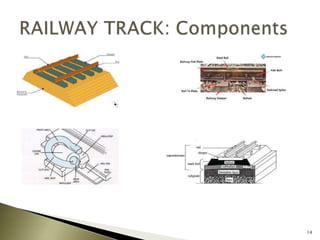
RAILWAY TRACK (PERMANENT WAY)
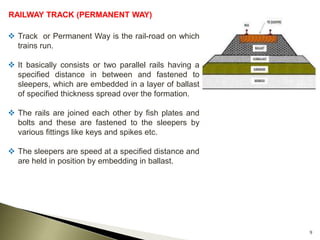
 Track or Permanent Way is the rail-road on which
trains run.
 It basically consists or two parallel rails having a
specified distance in between and fastened to
sleepers, which are embedded in a layer of ballast
of specified thickness spread over the formation.
 The rails are joined each other by fish plates and
bolts and these are fastened to the sleepers by
various fittings like keys and spikes etc.
 The sleepers are speed at a specified distance and
are held in position by embedding in ballast.
10
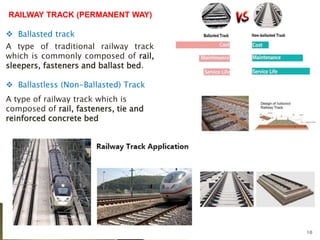
 Ballasted track
A type of traditional railway track
which is commonly composed of rail,
sleepers, fasteners and ballast bed.
 Ballastless (Non-Ballasted) Track
A type of railway track which is
composed of rail, fasteners, tie and
reinforced concrete bed
RAILWAY TRACK (PERMANENT WAY)
11
Track Gauge
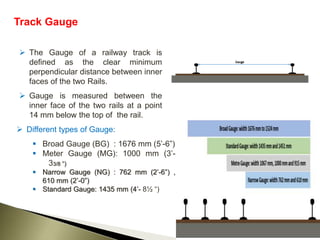
 The Gauge of a railway track is
defined as the clear minimum
perpendicular distance between inner
faces of the two Rails.
 Gauge is measured between the
inner face of the two rails at a point
14 mm below the top of the rail.
 Different types of Gauge:
 Broad Gauge (BG) : 1676 mm (5’-6”)
 Meter Gauge (MG): 1000 mm (3’-
33/8 “)
 Narrow Gauge (NG) : 762 mm (2’-6”) ,
610 mm (2’-0”)
 Standard Gauge: 1435 mm (4’- 8½ “)
12
Track Gauge
Factors affecting the choice of gauge:
1.Traffic Conditions.
2. Development of poor areas.
3. Cost of track.
4. Nature of country.
13
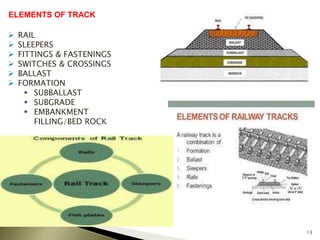
ELEMENTS OF TRACK
 RAIL
 SLEEPERS
 FITTINGS & FASTENINGS
 SWITCHES & CROSSINGS
 BALLAST
 FORMATION
 SUBBALLAST
 SUBGRADE
 EMBANKMENT
FILLING/BED ROCK
14
15
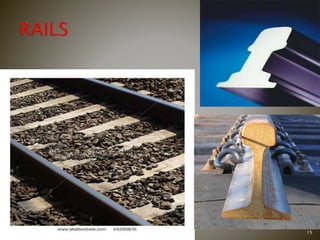
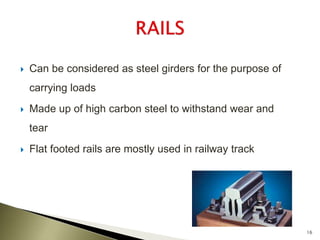
 Can be considered as steel girders for the purpose of
carrying loads
 Made up of high carbon steel to withstand wear and
tear
 Flat footed rails are mostly used in railway track
16
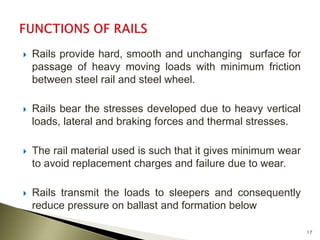
 Rails provide hard, smooth and unchanging surface for
passage of heavy moving loads with minimum friction
between steel rail and steel wheel.
 Rails bear the stresses developed due to heavy vertical
loads, lateral and braking forces and thermal stresses.
 The rail material used is such that it gives minimum wear
to avoid replacement charges and failure due to wear.
 Rails transmit the loads to sleepers and consequently
reduce pressure on ballast and formation below
17
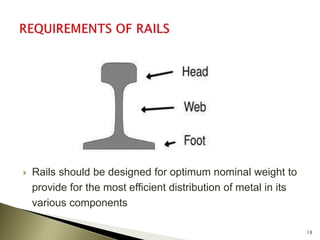
 Rails should be designed for optimum nominal weight to
provide for the most efficient distribution of metal in its
various components
18
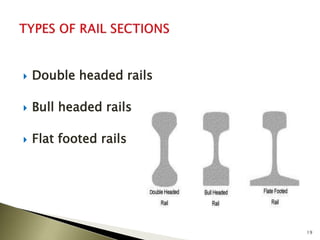
 Double headed rails
 Bull headed rails
 Flat footed rails
19
20
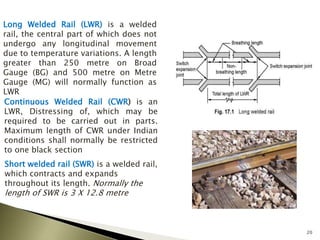
Long Welded Rail (LWR) is a welded
rail, the central part of which does not
undergo any longitudinal movement
due to temperature variations. A length
greater than 250 metre on Broad
Gauge (BG) and 500 metre on Metre
Gauge (MG) will normally function as
LWR
Continuous Welded Rail (CWR) is an
LWR, Distressing of, which may be
required to be carried out in parts.
Maximum length of CWR under Indian
conditions shall normally be restricted
to one black section
Short welded rail (SWR) is a welded rail,
which contracts and expands
throughout its length. Normally the
length of SWR is 3 X 12.8 metre
 The moving of number of wheels of train on rail
cause wear on rails
 Depending on location wear of rail can be:
◦ Wear of rails on top or head of rail
◦ Wear of rails at ends of rail
◦ Wear of rail on the sides of head of rail
21
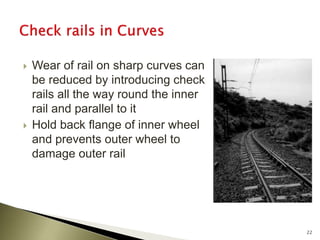
 Wear of rail on sharp curves can
be reduced by introducing check
rails all the way round the inner
rail and parallel to it
 Hold back flange of inner wheel
and prevents outer wheel to
damage outer rail
22
 Lubricating oil on sides of head of rail
reduces wear
 Lubrication of rail joint allows free expansion
of rails & reduces wear & tear of fish plates
23
24
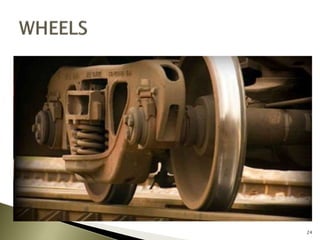
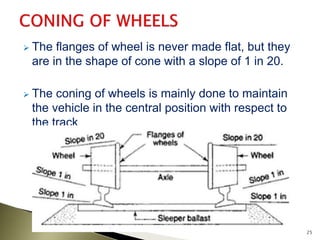
 The flanges of wheel is never made flat, but they
are in the shape of cone with a slope of 1 in 20.
 The coning of wheels is mainly done to maintain
the vehicle in the central position with respect to
the track
25
 To reduce wear & tear of the wheel flanges
and rails, which is due to rubbing action of
flanges with inside face of the rail head.
 To provide a possibility of lateral movement
of the axle with its wheels.
 To prevent the wheels from slipping to some
extent
26
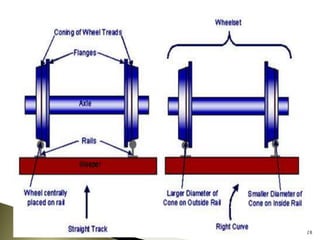
 At level surface
◦ Flanges of wheels have equal circumference
◦ Equal diameters on both rail
◦ Equal pressure on both rail
 At curves
◦ Outer rails has to cover great distance than inner rail
◦ Vehicle has tendency to move sideways towards outer rail
◦ Circumference of flange of outer wheel will be greater than
that of inner wheel
◦ Helps the outer wheel to cover longer distance than inner
rail
27
28
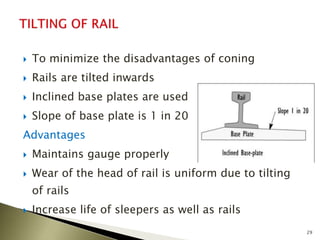
 To minimize the disadvantages of coning
 Rails are tilted inwards
 Inclined base plates are used
 Slope of base plate is 1 in 20
Advantages
 Maintains gauge properly
 Wear of the head of rail is uniform due to tilting
of rails
 Increase life of sleepers as well as rails
29
 Longitudinal movement of rails in a track
 Rails have tendency to move gradually in the
direction of dominant traffic
Indications of creep
 Closing of successive expansion spaces at rail
joints in the direction of creep and opening out
of joints at the point from where creep starts
 Marks on flanges and webs of rails made by
spike heads by scratching as the rail slide
30
 Changes in temperature
 Unbalanced traffic
 Alignment of track
 Grade of track
 Type of rail
 Poor maintenance of track components
31
32
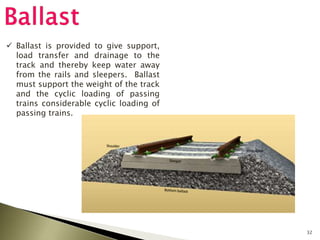
 Ballast is provided to give support,
load transfer and drainage to the
track and thereby keep water away
from the rails and sleepers. Ballast
must support the weight of the track
and the cyclic loading of passing
trains considerable cyclic loading of
passing trains.
33
Functions of Ballast
 To transfer and distribute the load from sleepers to a larger area
of formation.
 To provide elasticity and resilience to track for getting proper
riding comfort.
 To provide necessary resistance to track for longitudinal and
lateral stability.
 To provide effective drainage to track.
 To provide effective means of maintaining evenness and
alignment of the track.
34
Functions of Ballast
 To transfer and distribute the load from sleepers to a larger area
of formation.
 To provide elasticity and resilience to track for getting proper
riding comfort.
 To provide necessary resistance to track for longitudinal and
lateral stability.
 To provide effective drainage to track.
 To provide effective means of maintaining evenness and
alignment of the track.
35
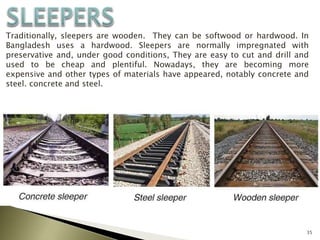
Traditionally, sleepers are wooden. They can be softwood or hardwood. In
Bangladesh uses a hardwood. Sleepers are normally impregnated with
preservative and, under good conditions, They are easy to cut and drill and
used to be cheap and plentiful. Nowadays, they are becoming more
expensive and other types of materials have appeared, notably concrete and
steel. concrete and steel.
36
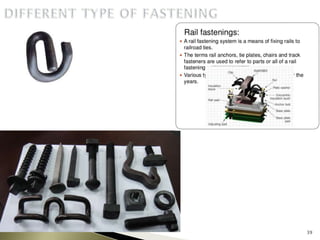
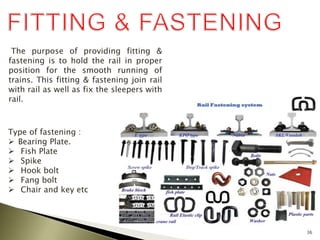
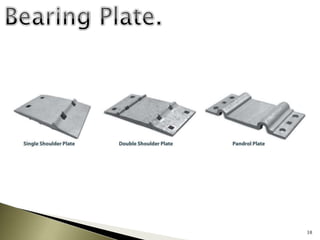
The purpose of providing fitting &
fastening is to hold the rail in proper
position for the smooth running of
trains. This fitting & fastening join rail
with rail as well as fix the sleepers with
rail.
Type of fastening :
 Bearing Plate.
 Fish Plate
 Spike
 Hook bolt
 Fang bolt
 Chair and key etc
37
38
39
40
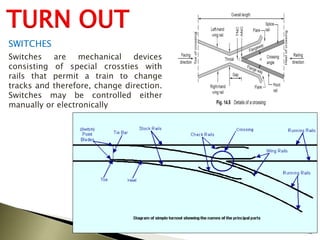
TURN OUT
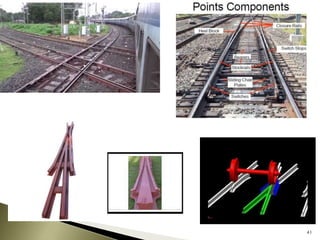
SWITCHES
Switches are mechanical devices
consisting of special crossties with
rails that permit a train to change
tracks and therefore, change direction.
Switches may be controlled either
manually or electronically
41
42
43
44
45
46
47
48
49
50
51
52
53
54
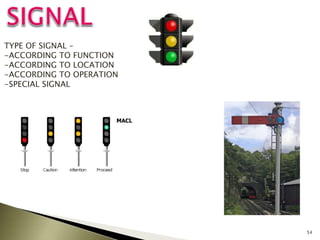
TYPE OF SIGNAL –
-ACCORDING TO FUNCTION
-ACCORDING TO LOCATION
-ACCORDING TO OPERATION
-SPECIAL SIGNAL
55
56
57
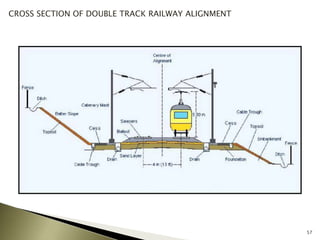
CROSS SECTION OF DOUBLE TRACK RAILWAY ALIGNMENT
58

Railway engineering-jdge@railway.gov.bd

  • 1.
    1 INTRODUCTION TO RAILWAY ENGINEERING AlFattah Masudur Rahman Joint Director General (Engineering) Bangladesh Railway
  • 2.
    2 History of BangladeshRailway  BANGLADESH RAILWAY, covering a length of 2,929.50 route-kilometre managed by 25,226 regular staff, is Government-owned and Government managed transportation agency of the country.  43 civil districts of Bangladesh are connected via railways.  Bangladesh Railway started it operation in 15 November 1862 by constructing 53.11 km broad gauge line between Darsana and Jagoti, extended upto Goalando Ghat in 1871. 14.98 km meter gauge line between Dhaka- Narayanganj was opened for traffic on 4th January 1885.  In 1891, the construction of then Assam-Bengal Railway was taken by the Assam-Bangla Railway Company.  On 1 July 1895, two sections of meter gauge lines were opened between Chittagong & Cumilla (149.89 km) and between Laksam & Chandpur (50.89 km)  Railway Companies formed in England took up the construction and operation of these sections in middle and late 19th century.
  • 3.
    3 History of BangladeshRailway  In middle and late 19th century. Bangladesh Railway was mostly inherited from the British-established Assam Bengal railway system after the partition of India in 1947.  At present Bangladesh Railway has 2929.50 route-kilometers with 460 Stations.  Bangladesh Railway's headquarter were located in Chittagong, which had historically been the south- eastern terminus of the Assam-Bengal Railway.  After independence from Pakistan in 1971, It was named as Bangladesh Railway (BR). Its Headquarter is in Dhaka.  A major road cum rail bridge (Bangabandhu Bridge) over the river Jamuna opened in 1998 to connect the previously isolated east and west rail networks.
  • 4.
    4 IMPORTANCE OF RAILWAYTRANSPORTATION  RAILWAY IS THE BEST MODE OF TRANSPORTATION TO CARRY HEAVY LOAD.  AVAILABLE IN ALMOST EVERY COUNTRY.  CAN PASS HUGE PASSENGER.  POPULAR IN COMMERCIAL COMPANY.  LESS RISK.  JOURNEY IS RESONABLE.
  • 5.
  • 6.
    6 Railway Master Plan Bangladesh Railway (BR) completed revision of its masterplan with an investment proposal of BDT 5.10 trillion until 2045 in five phases for making the railway efficient for passenger and freight servicing.  The plan activities include projects for increasing efficiency of the rail track, its gradual upgrade and conversion from metre gauge to broad gauge through transitional upgradation by converting into dual gauge, improving carriage and locomotive maintenance capacity, developing institutional capacity, upscaling significantly freight operational capacity and exploring prospects for introducing electric trains or high-speed trains on some priority routes during the period
  • 7.
    7 LEGAL FRAMEWORK OFBANGLADESH RAILWAY : ACTS & RULES  THE RAILWAYS ACT, 1890 (ACT NO. IX OF 1890).  General & Subsidiary Rules of Bangladesh Railway  Bangladesh Railway Way & Works Manual.  Bangladesh Railway Engineering Code.  Bangladesh Railway Operation Manual.  Bangladesh Railway Accounts Code.
  • 8.
    8 Rapid transit ormass rapid transit (MRT), also known as metro, subway, tube, U-Bahn or underground, is a type of high-capacity public transport generally found in urban areas. Unlike buses or trams, rapid transit systems are electric railways that operate on an exclusive right-of- way, which cannot be accessed by pedestrians or other vehicles of any sort, and which is often grade separated in tunnels or on elevated railways. Different Types of Railway  Conventional Railway : Train speed is less than 200 kmph  High Speed Railway : Train Speed is equal or more than 200 kmph.  Mass Rapid Transit:
  • 9.
    9 RAILWAY TRACK (PERMANENTWAY)  Track or Permanent Way is the rail-road on which trains run.  It basically consists or two parallel rails having a specified distance in between and fastened to sleepers, which are embedded in a layer of ballast of specified thickness spread over the formation.  The rails are joined each other by fish plates and bolts and these are fastened to the sleepers by various fittings like keys and spikes etc.  The sleepers are speed at a specified distance and are held in position by embedding in ballast.
  • 10.
    10  Ballasted track Atype of traditional railway track which is commonly composed of rail, sleepers, fasteners and ballast bed.  Ballastless (Non-Ballasted) Track A type of railway track which is composed of rail, fasteners, tie and reinforced concrete bed RAILWAY TRACK (PERMANENT WAY)
  • 11.
    11 Track Gauge  TheGauge of a railway track is defined as the clear minimum perpendicular distance between inner faces of the two Rails.  Gauge is measured between the inner face of the two rails at a point 14 mm below the top of the rail.  Different types of Gauge:  Broad Gauge (BG) : 1676 mm (5’-6”)  Meter Gauge (MG): 1000 mm (3’- 33/8 “)  Narrow Gauge (NG) : 762 mm (2’-6”) , 610 mm (2’-0”)  Standard Gauge: 1435 mm (4’- 8½ “)
  • 12.
    12 Track Gauge Factors affectingthe choice of gauge: 1.Traffic Conditions. 2. Development of poor areas. 3. Cost of track. 4. Nature of country.
  • 13.
    13 ELEMENTS OF TRACK RAIL  SLEEPERS  FITTINGS & FASTENINGS  SWITCHES & CROSSINGS  BALLAST  FORMATION  SUBBALLAST  SUBGRADE  EMBANKMENT FILLING/BED ROCK
  • 14.
  • 15.
  • 16.
     Can beconsidered as steel girders for the purpose of carrying loads  Made up of high carbon steel to withstand wear and tear  Flat footed rails are mostly used in railway track 16
  • 17.
     Rails providehard, smooth and unchanging surface for passage of heavy moving loads with minimum friction between steel rail and steel wheel.  Rails bear the stresses developed due to heavy vertical loads, lateral and braking forces and thermal stresses.  The rail material used is such that it gives minimum wear to avoid replacement charges and failure due to wear.  Rails transmit the loads to sleepers and consequently reduce pressure on ballast and formation below 17
  • 18.
     Rails shouldbe designed for optimum nominal weight to provide for the most efficient distribution of metal in its various components 18
  • 19.
     Double headedrails  Bull headed rails  Flat footed rails 19
  • 20.
    20 Long Welded Rail(LWR) is a welded rail, the central part of which does not undergo any longitudinal movement due to temperature variations. A length greater than 250 metre on Broad Gauge (BG) and 500 metre on Metre Gauge (MG) will normally function as LWR Continuous Welded Rail (CWR) is an LWR, Distressing of, which may be required to be carried out in parts. Maximum length of CWR under Indian conditions shall normally be restricted to one black section Short welded rail (SWR) is a welded rail, which contracts and expands throughout its length. Normally the length of SWR is 3 X 12.8 metre
  • 21.
     The movingof number of wheels of train on rail cause wear on rails  Depending on location wear of rail can be: ◦ Wear of rails on top or head of rail ◦ Wear of rails at ends of rail ◦ Wear of rail on the sides of head of rail 21
  • 22.
     Wear ofrail on sharp curves can be reduced by introducing check rails all the way round the inner rail and parallel to it  Hold back flange of inner wheel and prevents outer wheel to damage outer rail 22
  • 23.
     Lubricating oilon sides of head of rail reduces wear  Lubrication of rail joint allows free expansion of rails & reduces wear & tear of fish plates 23
  • 24.
  • 25.
     The flangesof wheel is never made flat, but they are in the shape of cone with a slope of 1 in 20.  The coning of wheels is mainly done to maintain the vehicle in the central position with respect to the track 25
  • 26.
     To reducewear & tear of the wheel flanges and rails, which is due to rubbing action of flanges with inside face of the rail head.  To provide a possibility of lateral movement of the axle with its wheels.  To prevent the wheels from slipping to some extent 26
  • 27.
     At levelsurface ◦ Flanges of wheels have equal circumference ◦ Equal diameters on both rail ◦ Equal pressure on both rail  At curves ◦ Outer rails has to cover great distance than inner rail ◦ Vehicle has tendency to move sideways towards outer rail ◦ Circumference of flange of outer wheel will be greater than that of inner wheel ◦ Helps the outer wheel to cover longer distance than inner rail 27
  • 28.
  • 29.
     To minimizethe disadvantages of coning  Rails are tilted inwards  Inclined base plates are used  Slope of base plate is 1 in 20 Advantages  Maintains gauge properly  Wear of the head of rail is uniform due to tilting of rails  Increase life of sleepers as well as rails 29
  • 30.
     Longitudinal movementof rails in a track  Rails have tendency to move gradually in the direction of dominant traffic Indications of creep  Closing of successive expansion spaces at rail joints in the direction of creep and opening out of joints at the point from where creep starts  Marks on flanges and webs of rails made by spike heads by scratching as the rail slide 30
  • 31.
     Changes intemperature  Unbalanced traffic  Alignment of track  Grade of track  Type of rail  Poor maintenance of track components 31
  • 32.
    32  Ballast isprovided to give support, load transfer and drainage to the track and thereby keep water away from the rails and sleepers. Ballast must support the weight of the track and the cyclic loading of passing trains considerable cyclic loading of passing trains.
  • 33.
    33 Functions of Ballast To transfer and distribute the load from sleepers to a larger area of formation.  To provide elasticity and resilience to track for getting proper riding comfort.  To provide necessary resistance to track for longitudinal and lateral stability.  To provide effective drainage to track.  To provide effective means of maintaining evenness and alignment of the track.
  • 34.
    34 Functions of Ballast To transfer and distribute the load from sleepers to a larger area of formation.  To provide elasticity and resilience to track for getting proper riding comfort.  To provide necessary resistance to track for longitudinal and lateral stability.  To provide effective drainage to track.  To provide effective means of maintaining evenness and alignment of the track.
  • 35.
    35 Traditionally, sleepers arewooden. They can be softwood or hardwood. In Bangladesh uses a hardwood. Sleepers are normally impregnated with preservative and, under good conditions, They are easy to cut and drill and used to be cheap and plentiful. Nowadays, they are becoming more expensive and other types of materials have appeared, notably concrete and steel. concrete and steel.
  • 36.
    36 The purpose ofproviding fitting & fastening is to hold the rail in proper position for the smooth running of trains. This fitting & fastening join rail with rail as well as fix the sleepers with rail. Type of fastening :  Bearing Plate.  Fish Plate  Spike  Hook bolt  Fang bolt  Chair and key etc
  • 37.
  • 38.
  • 39.
  • 40.
    40 TURN OUT SWITCHES Switches aremechanical devices consisting of special crossties with rails that permit a train to change tracks and therefore, change direction. Switches may be controlled either manually or electronically
  • 41.
  • 42.
  • 43.
  • 44.
  • 45.
  • 46.
  • 47.
  • 48.
  • 49.
  • 50.
  • 51.
  • 52.
  • 53.
  • 54.
    54 TYPE OF SIGNAL– -ACCORDING TO FUNCTION -ACCORDING TO LOCATION -ACCORDING TO OPERATION -SPECIAL SIGNAL
  • 55.
  • 56.
  • 57.
    57 CROSS SECTION OFDOUBLE TRACK RAILWAY ALIGNMENT
  • 58.