RADIOGRAPHS IN ENDODONTICS
AND LOCAL ANAESTHESIA - II
IMPORTANCE OF RADIOGRAPHY IN ENDODONTICS

 The evaluation of pathologic lesions of the head and neck
routinely involves the use of radiographs in attempting to
determine the nature of the disease process

 Radiographs are also essential to all phases of endodontic

therapy. They help in :
• Diagnosis
• During various treatment steps and

• Evaluation of the success or failure of treatment.
DIAGNOSIS

Identifying the Pathosis :
The radiographs help in identifying the lesion whether it is
 Pulpal
 Periapical
 Periodontal
 Bony lesions
Determining the Root and Pulpal anatomy :
 The number of roots/ root canals

 Unusual root morphologies
 Root curvatures
 Canal locations with respect to the pulp chamber
 Bifurcations/ trifurcations
 Calcifications
Characterizing Normal Structures :
 Helps in differentiating the normal from abnormal

structures.
TREATMENT

1. Determining Working Lengths

2. Moving superimposed structures:
Certain normal anatomic
structures may superimpose on
the apices of the teeth.
Changing the angulations help in
separating them.
Locating canals :
 Extra canals
 Missed canals
Evaluating the Obturation:

The radiographs help us to assess the quality of
obturation by helping us to evaluate the
1. Length - if the working length has been maintained
- overfilling

- underfilling
2. Density - the radiopacity of the material
3. Taper of the preparation of the configuration
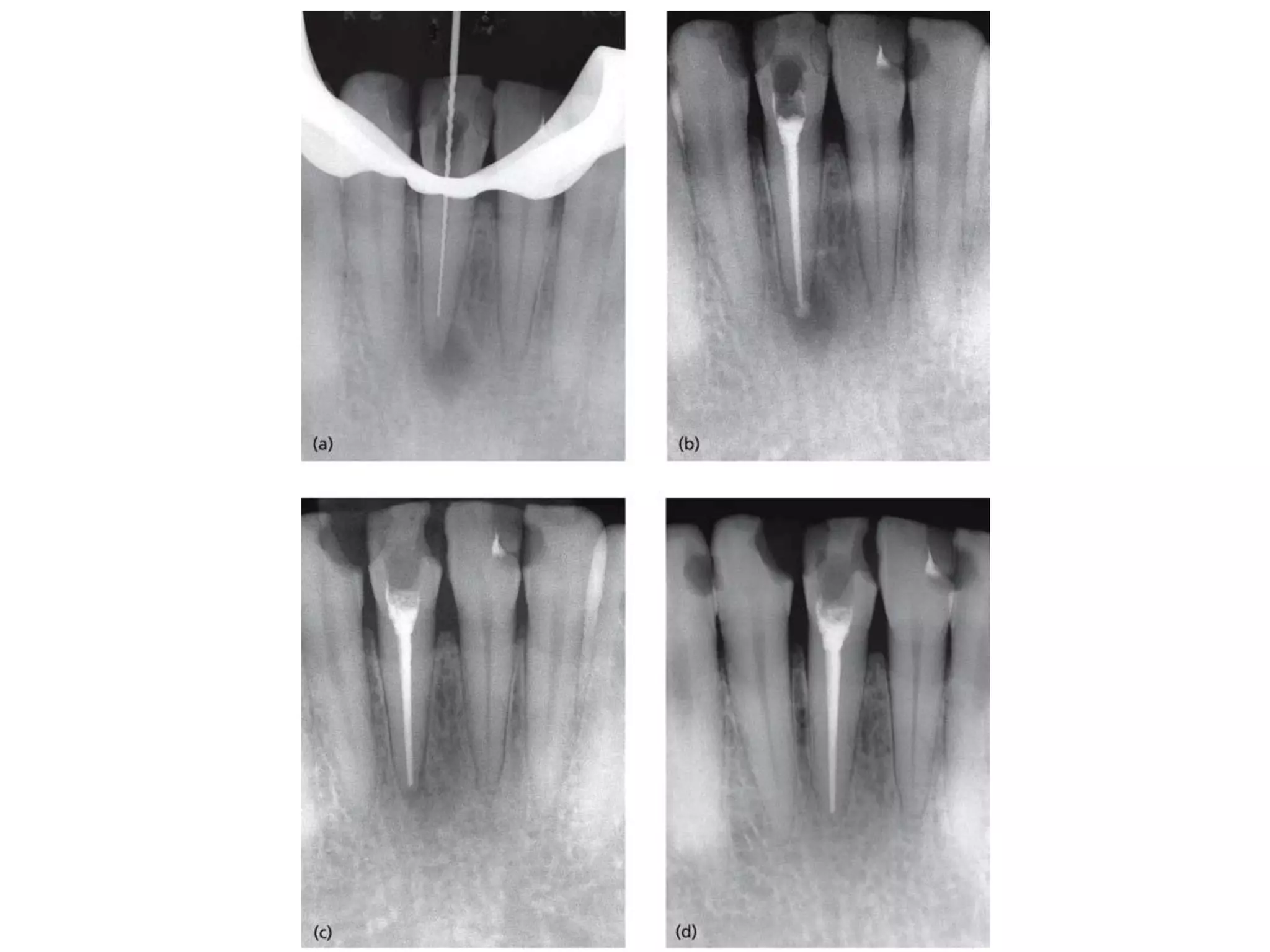
RECALL / FOLLOW UP

•

Most of the times the patient does not know the status of
the root canal treatment.

•

In most cases the patient may be asymptomatic.

•

In such cases only radiographs help in diagnosing the
endodontic failures

•

There may be evidence of
development of

new lesions :

Periapical,

Periodontal,

Nonendodontic
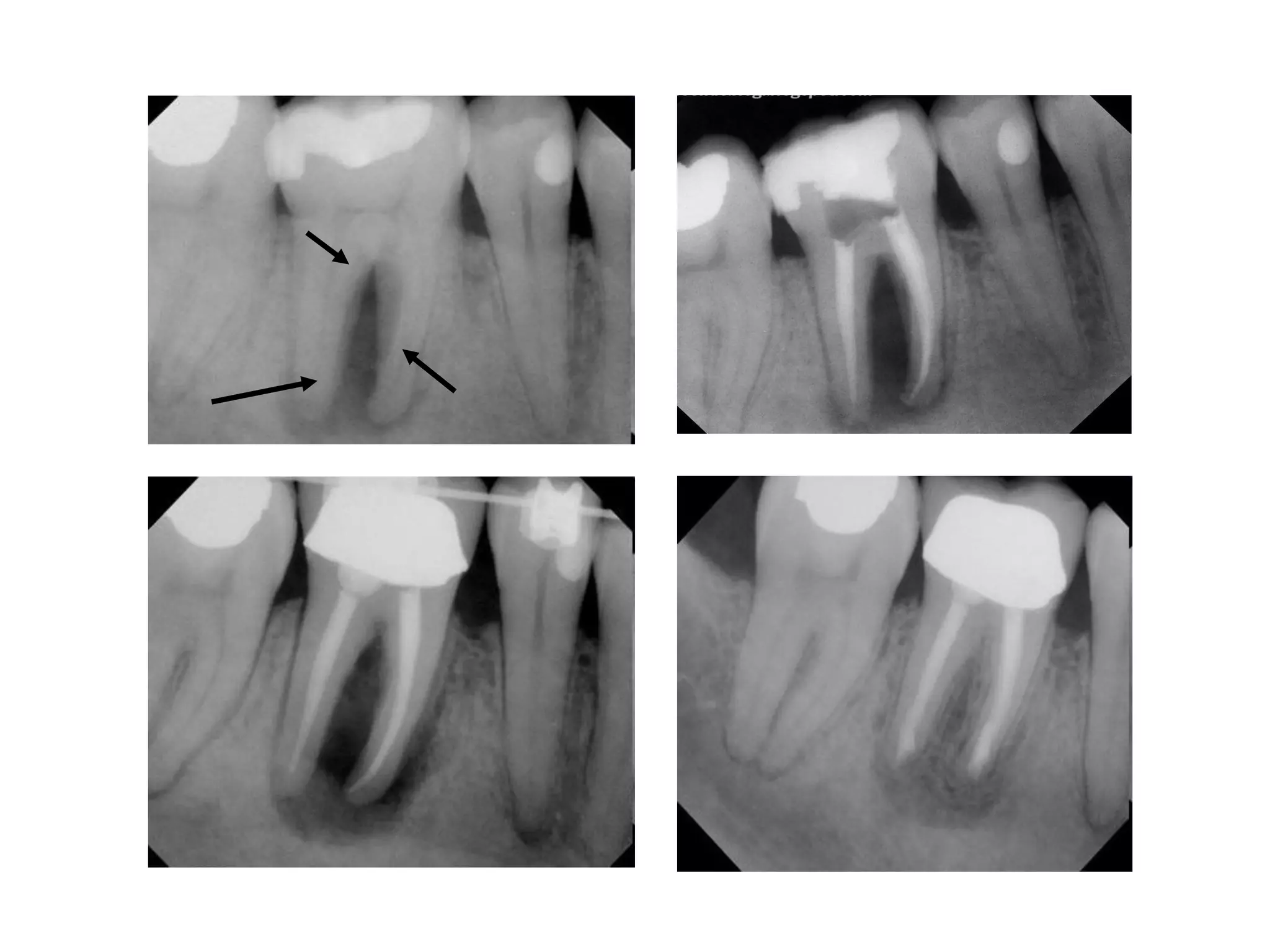
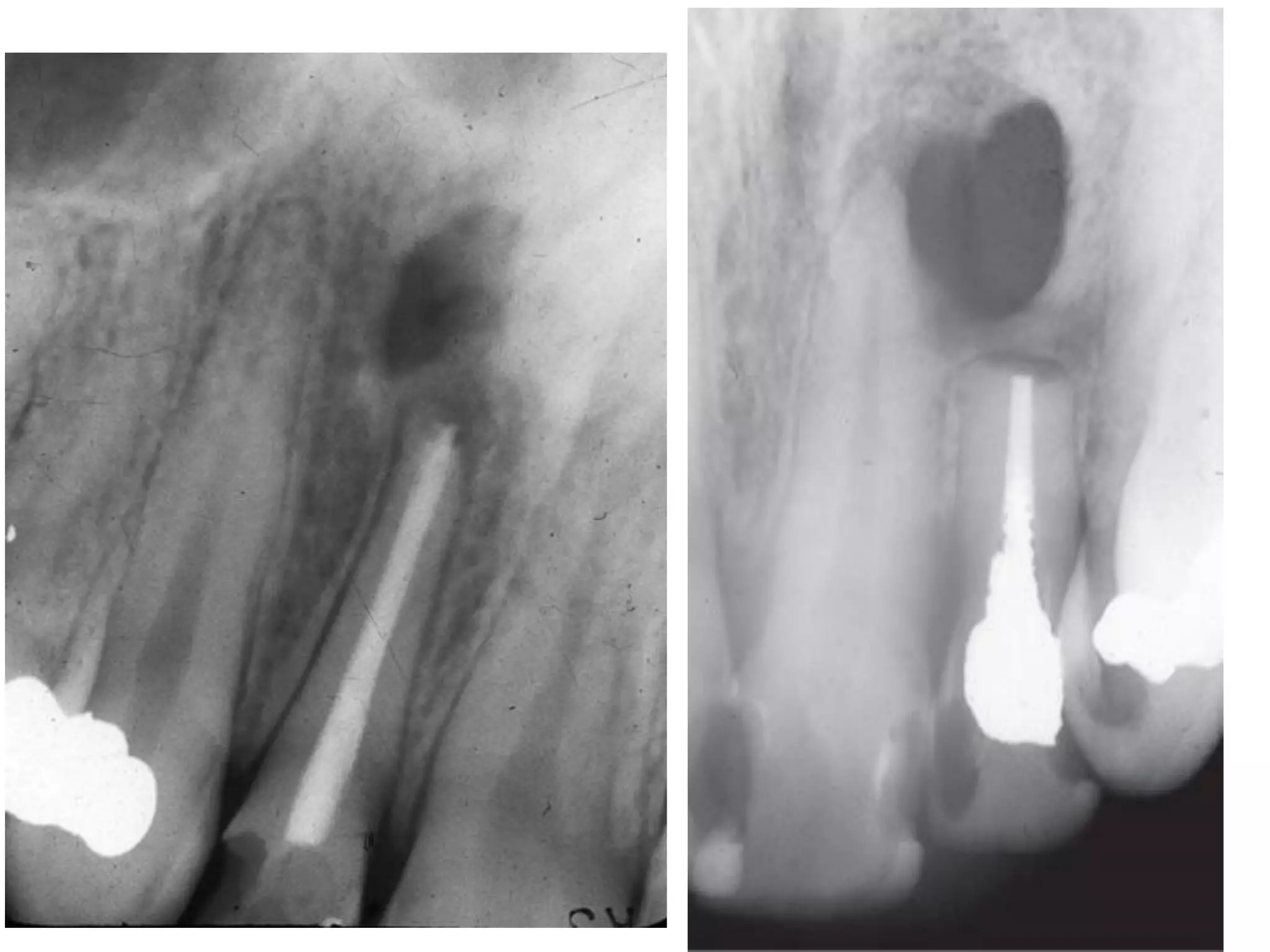
Or evaluation of the healing / progress of the treatment
LARGE PERI APICAL LESION

ENDODONTIC THERAPY

LESION DECREASES IN SIZE

LESION REMAINS SAME

LESION INCREASES IN SIZE

PERIODIC RECALL
RETREATMENT / RETREATMENT +
APICAL SURGERY
RADIOGRAPHIC SEQUENCE

I. Diagnostic :
The number of films used would depend upon the diagnostic
difficulty.
The first film should give us the basic details about the
Caries → Pulpal involvement → Periapical status
A properly positioned film should permit the visualization of
atleast 3 to 4mm beyond the apex
Angulation:
The most accurate radiographs are made using the paralleling
technique
Advantages :
Less distortion and more clarity
Reproducibility of film and cone placement [ using the XCP ]
Reproducibility : ability to take two or more radiographs of a
given tooth at different time intervals and producing an image
of same/ near to same characteristics.
Especially useful in evaluating the healing of large lesions

In cases of low palatal vault, exceptionally long roots, or
maxillary tori, the paralleling technique is not possible. In such
cases the bisecting angle technique is used
II. WORKING FILMS
These are the films which are used during the treatment
procedure.
Not essentially given to the patient for a record
These include
 Working length radiograph

 Master cone
 During obturation [ intermediate ]
Exposure and Film Speed
 The exposure gradients

for the working films are similar to

that of the Diagnostic radiographs.
 The films should be clear and the apical extent of the image
should be same as that for diagnostic films i.e 3-4mm beyond
the apex must be shown .

 The tip of the roots and the tips of the files/master cones
should be easily identified.
 The exposure time for the films depends on the speed.

 D>E>F
III. Obturation
Similar

basic principles as those required for diagnostic

radiographs.

But after obturation it is advisable to take atleast two
radiographs at different angulations to visualize any missed
canals
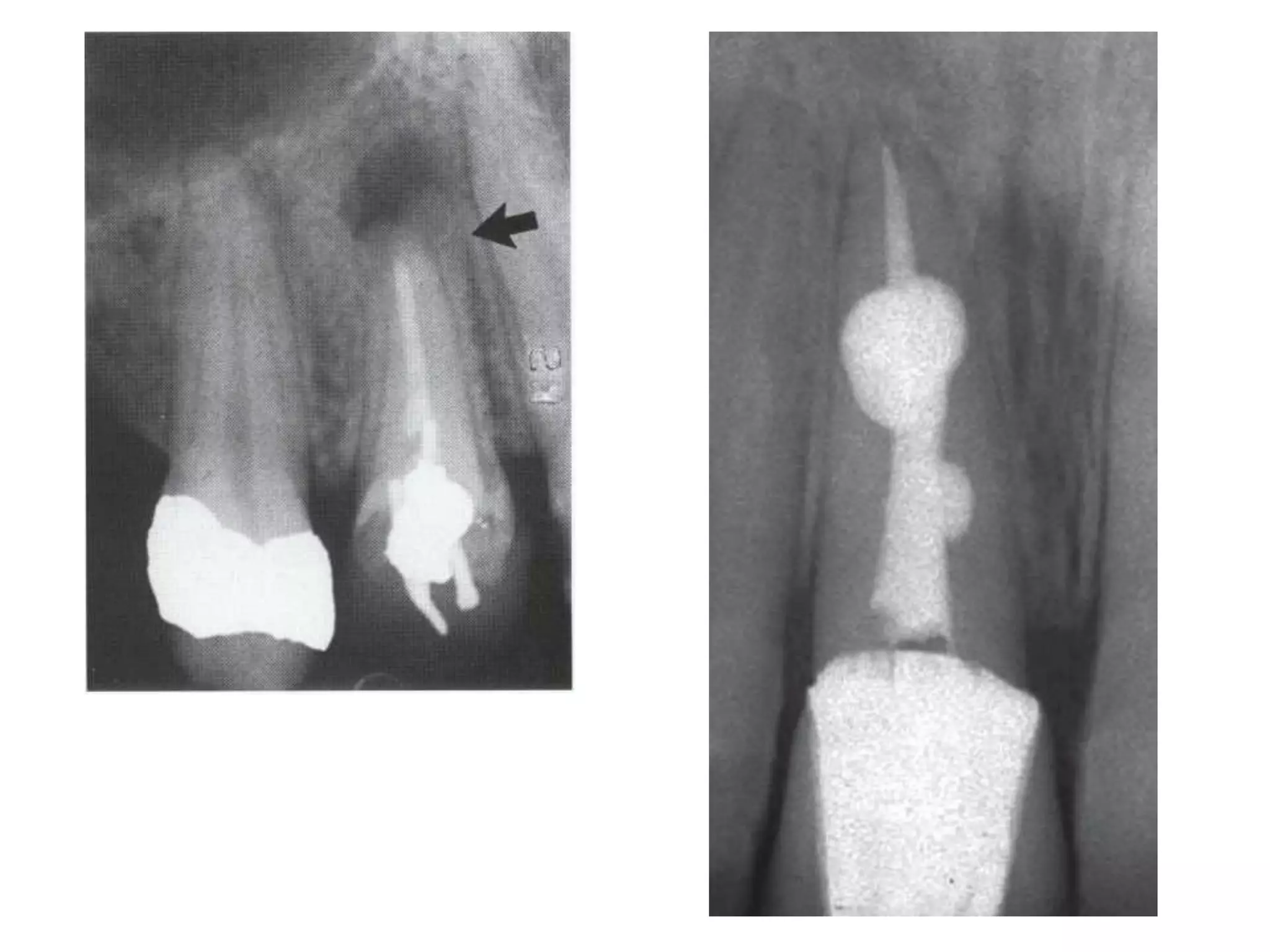
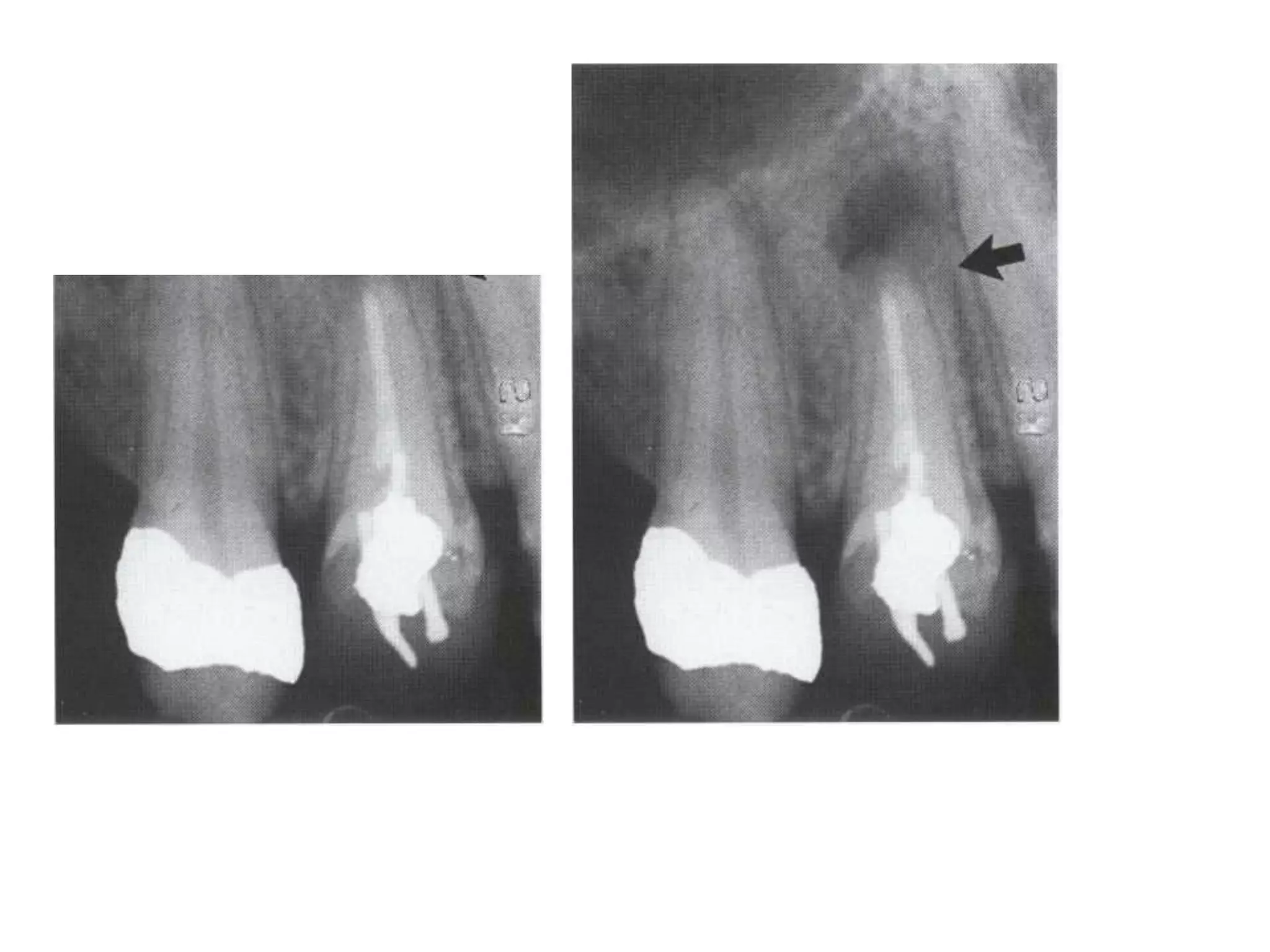
Extrusion of obturation
material

Obturation short of apex
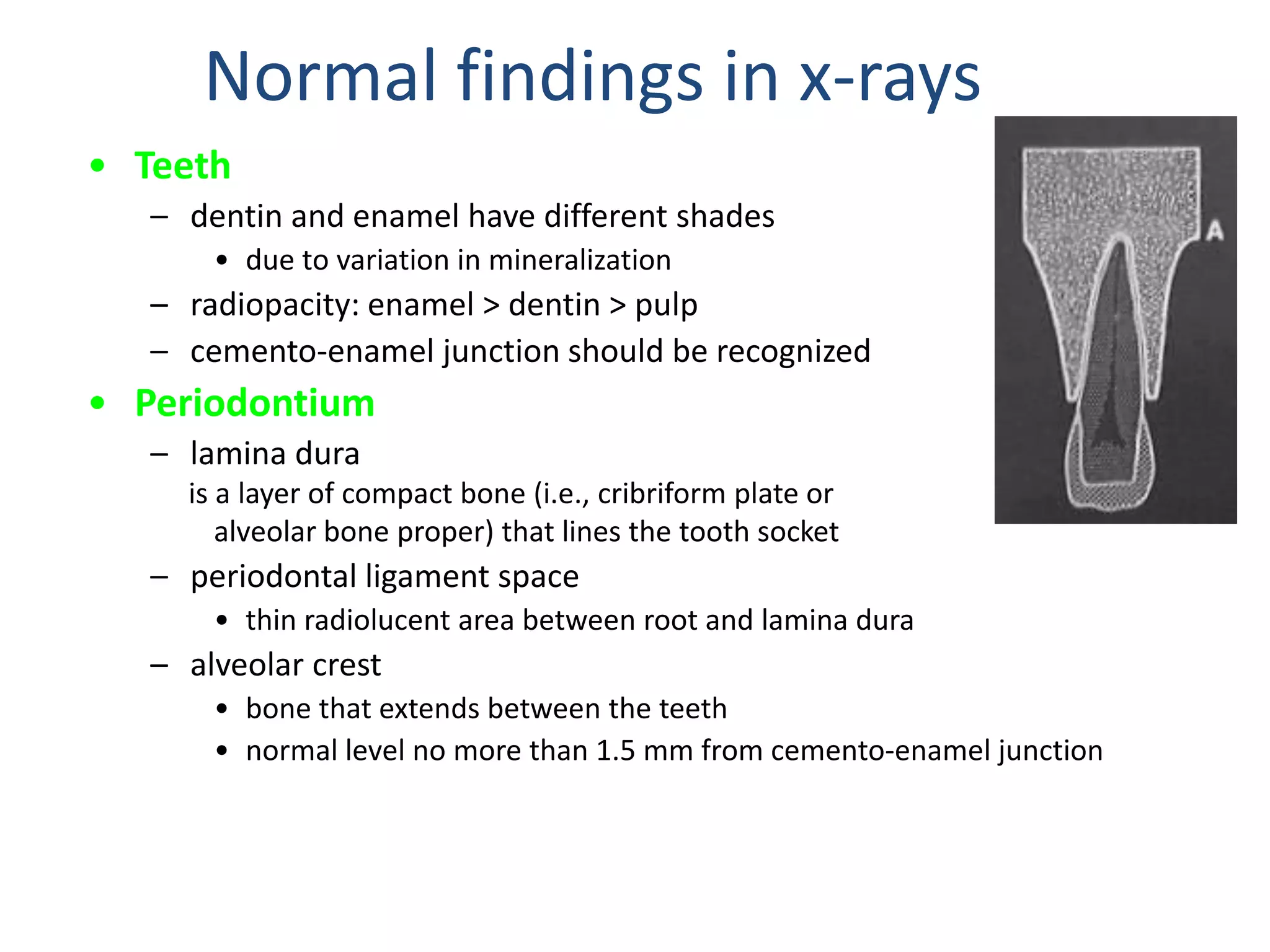
Normal findings in x-rays
• Teeth
– dentin and enamel have different shades
• due to variation in mineralization

– radiopacity: enamel > dentin > pulp
– cemento-enamel junction should be recognized

• Periodontium
– lamina dura
is a layer of compact bone (i.e., cribriform plate or
alveolar bone proper) that lines the tooth socket

– periodontal ligament space
• thin radiolucent area between root and lamina dura

– alveolar crest
• bone that extends between the teeth
• normal level no more than 1.5 mm from cemento-enamel junction
 The most consistent radiographic feature aiding diagnosis of
pulpal and periapical lesions is the continuity and shape of
the lamina dura and the width and shape of the PDL space.


Endodontic lesions must encroach on the junction of the
cancellous bone and cortical bone for radiographic detection.

 Lesions are larger than they appear radiographically
 The cortical plate must have 12.5% volume of bone loss or
7.1% of mineral bone loss to be detected radiographically.
The radiographic description of any lesion can give us
indications of:
 Tissue of origin
 Biological behavior
 Prognosis
 Treatment concerns
 Diagnosis or a Differential Diagnosis
A radiograph helps in describing the lesion’s


Size



Shape



Location



Density



Borders



Effect on adjacent structures
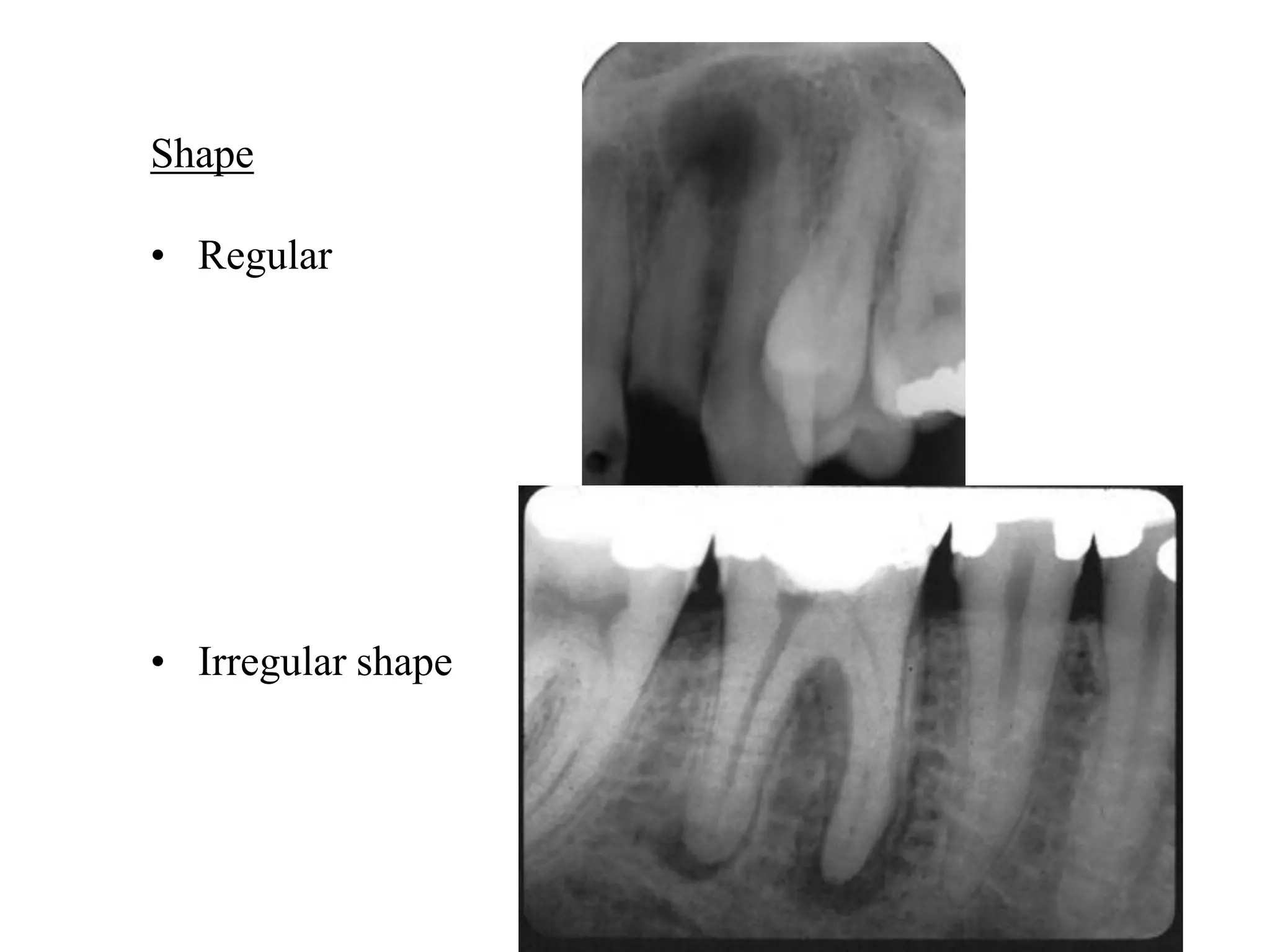
Shape
• Regular

• Irregular shape
Location

 Localized or generalized

 Unilateral or bilateral
Relation of the lesion to other structures and anatomic landmarks
 If the radiolucency is above the inferior alveolar nerve canal
(IAC), the likelihood is greater that it is odontogenic in origin.

 If it is below the IAC, it is unlikely to be odontogenic in origin.

 If it is within the IAC, the tissue of origin probably is neural or
vascular in nature.
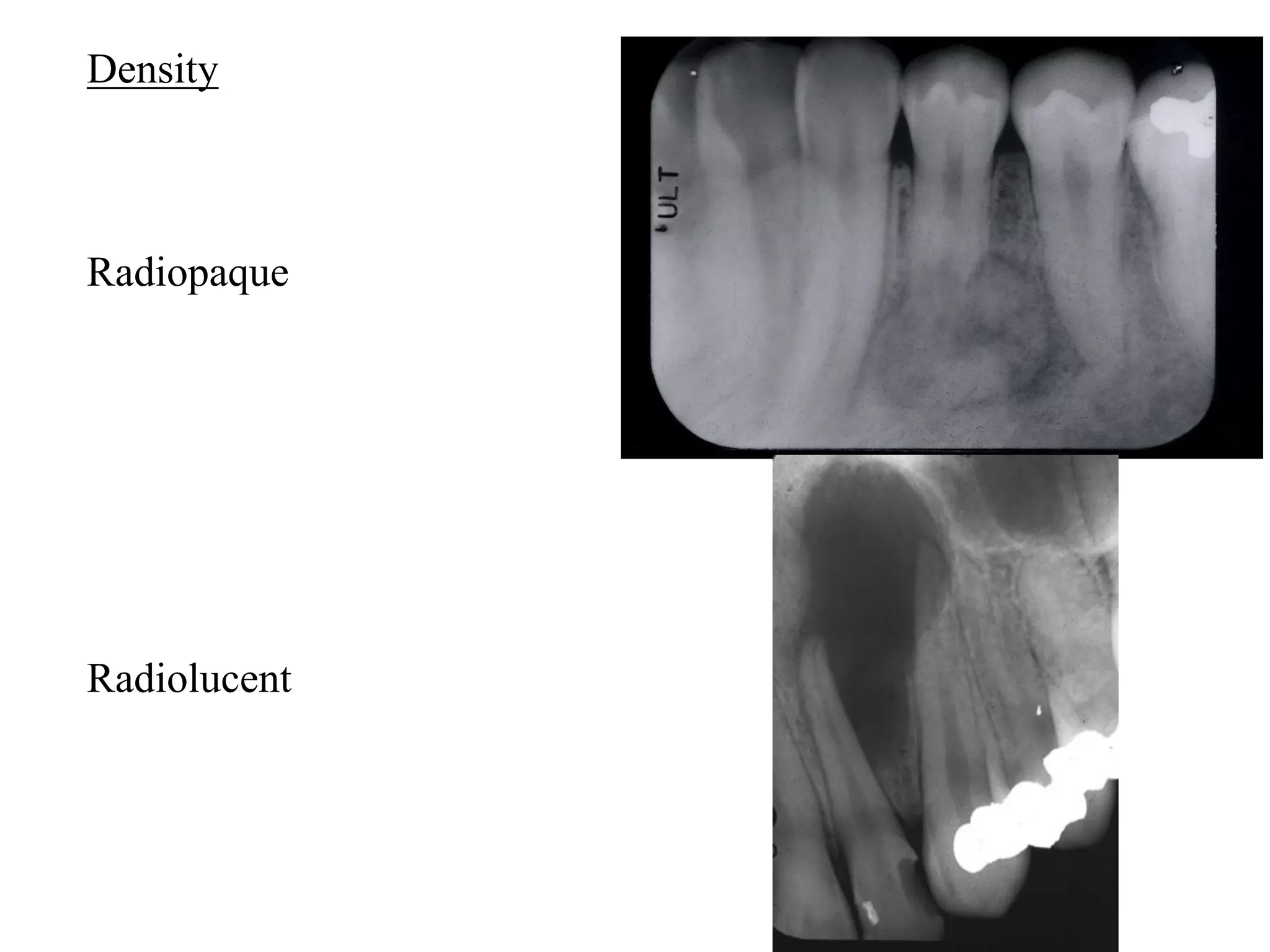
Density

Radiopaque

Radiolucent
Mixed density:
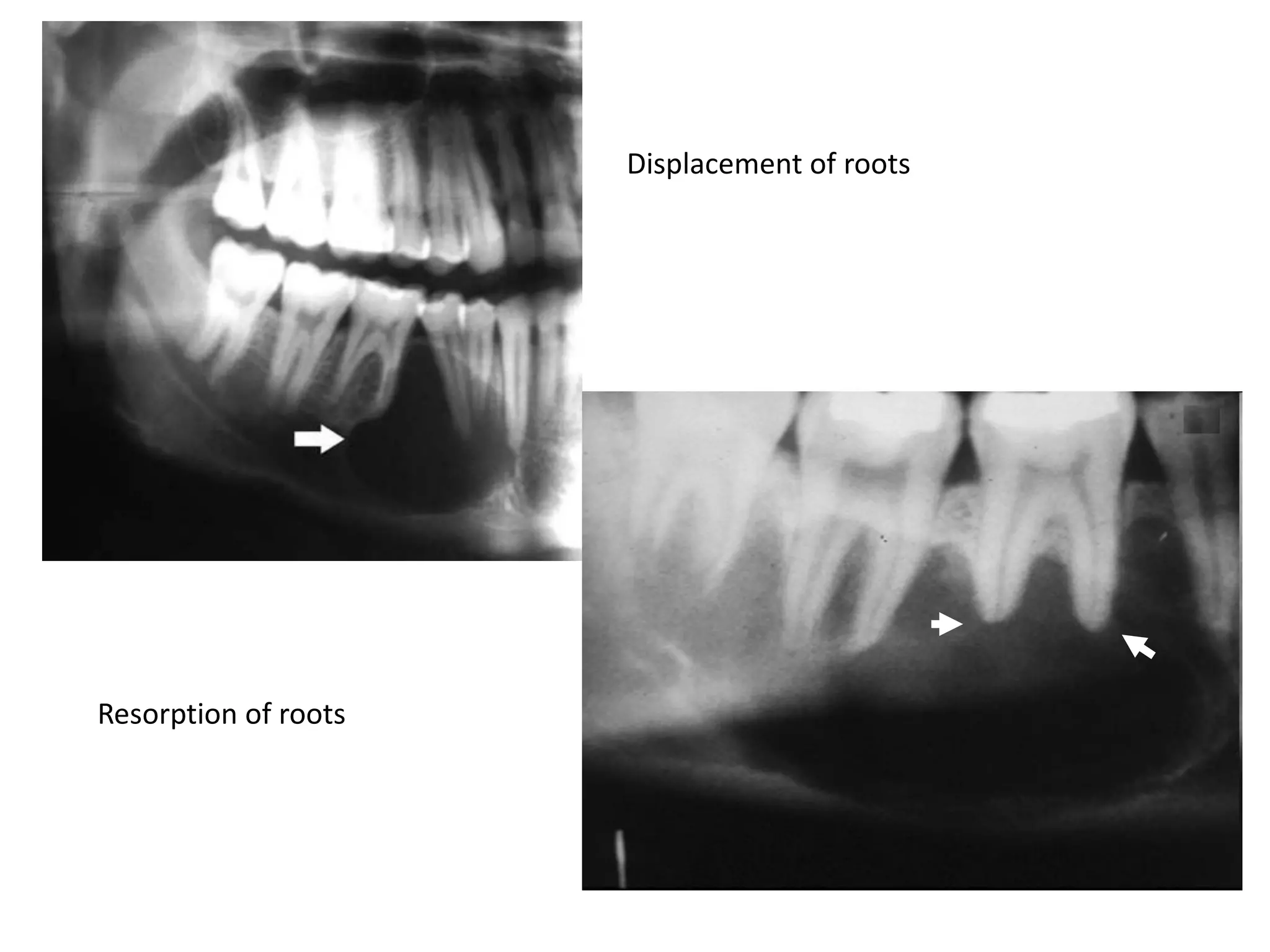
Effect on adjacent structures
• Resorption
• Displacement
[Space occupying lesions displace other structures]
• Destruction
• Remodeling
•

Expansion
Displacement of roots

Resorption of roots
Remodelling

Expansion
 Many anatomic structures and osteolytic lesions can be
mistaken for periradicular pathoses.

 Among the more commonly misinterpreted anatomic
structures are the mental foramen and the incisive foramen.
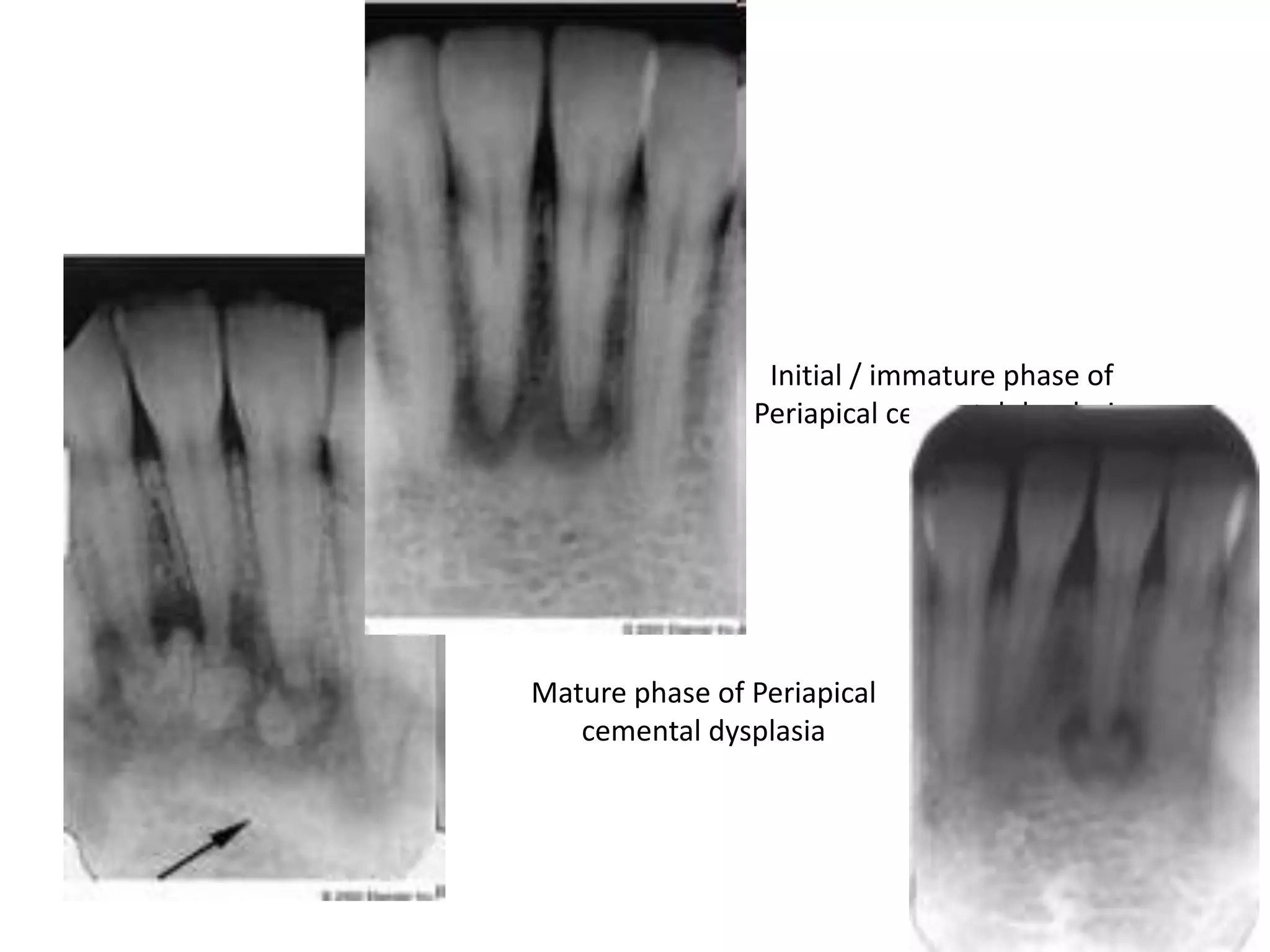
Initial / immature phase of
Periapical cemental dysplasia

Mature phase of Periapical
cemental dysplasia
 These radiolucencies can be differentiated from pathologic
conditions by exposures at different angulations and by

pulp-testing procedures.
 Radiolucencies not associated with the root apex will move

or be projected away from the apex by varying the
angulation
• Other anatomic radiolucencies that must be differentiated from
periradicular pathoses are
 Mental Foramen

 Lingual Foramen
 Submandibular Fossa
 Nutrient Canals
 Median Palatal Suture
 Incisive Canal Foramen
 Nasal Cavity
 Mandibular Canal
 Maxillary Sinus
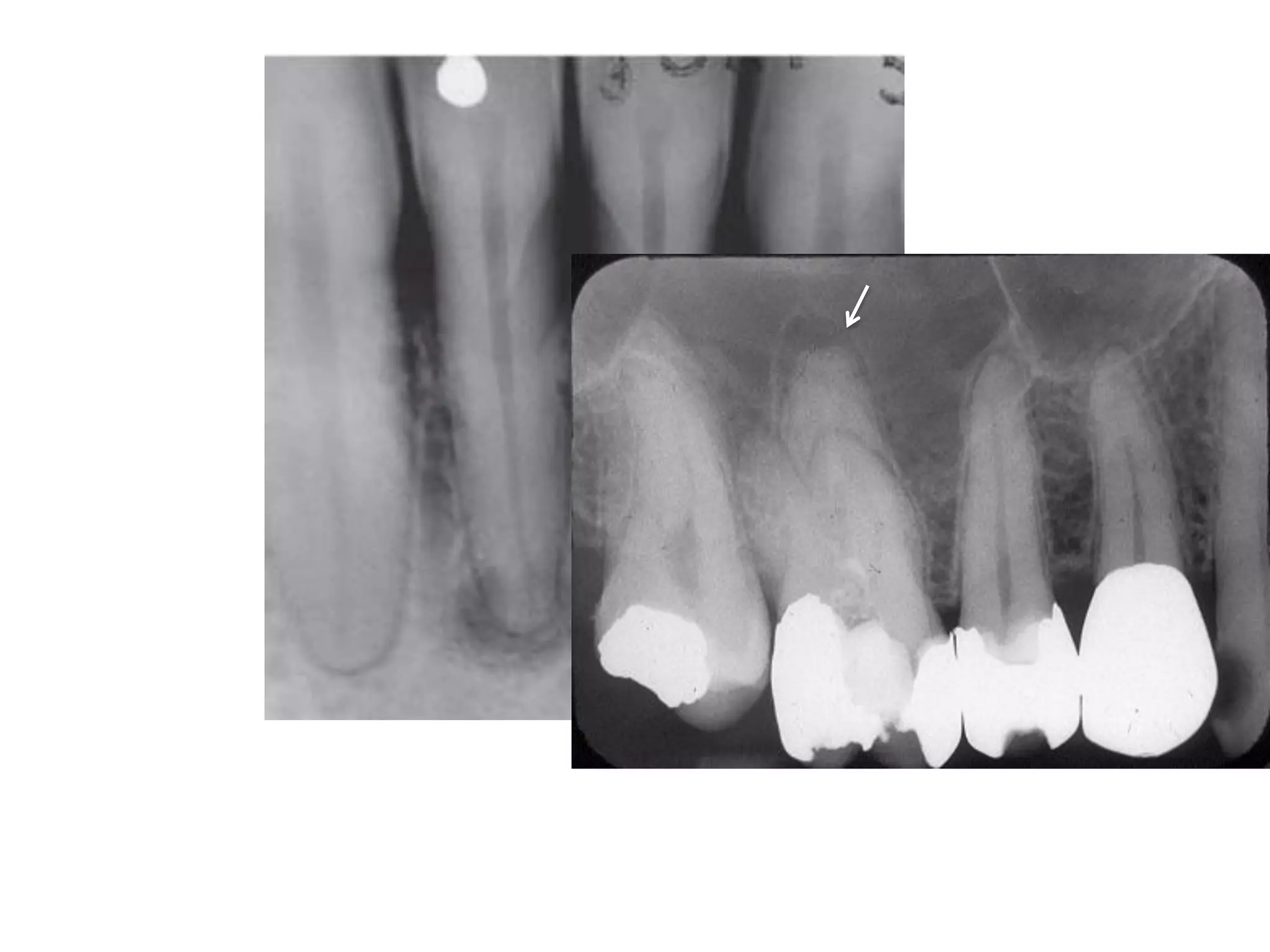
Differential diagnosis
Endodontic lesions
Radiolucent lesions :
1. Apical /radicular lamina dura is absent
2. A hanging drop of oil shape . Though a lesion ca be of
any shape
3. Radiolucency stays at the apex regardless of change in
the angulation.
4. The cause for pulp necrosis is ,in most cases ,evident
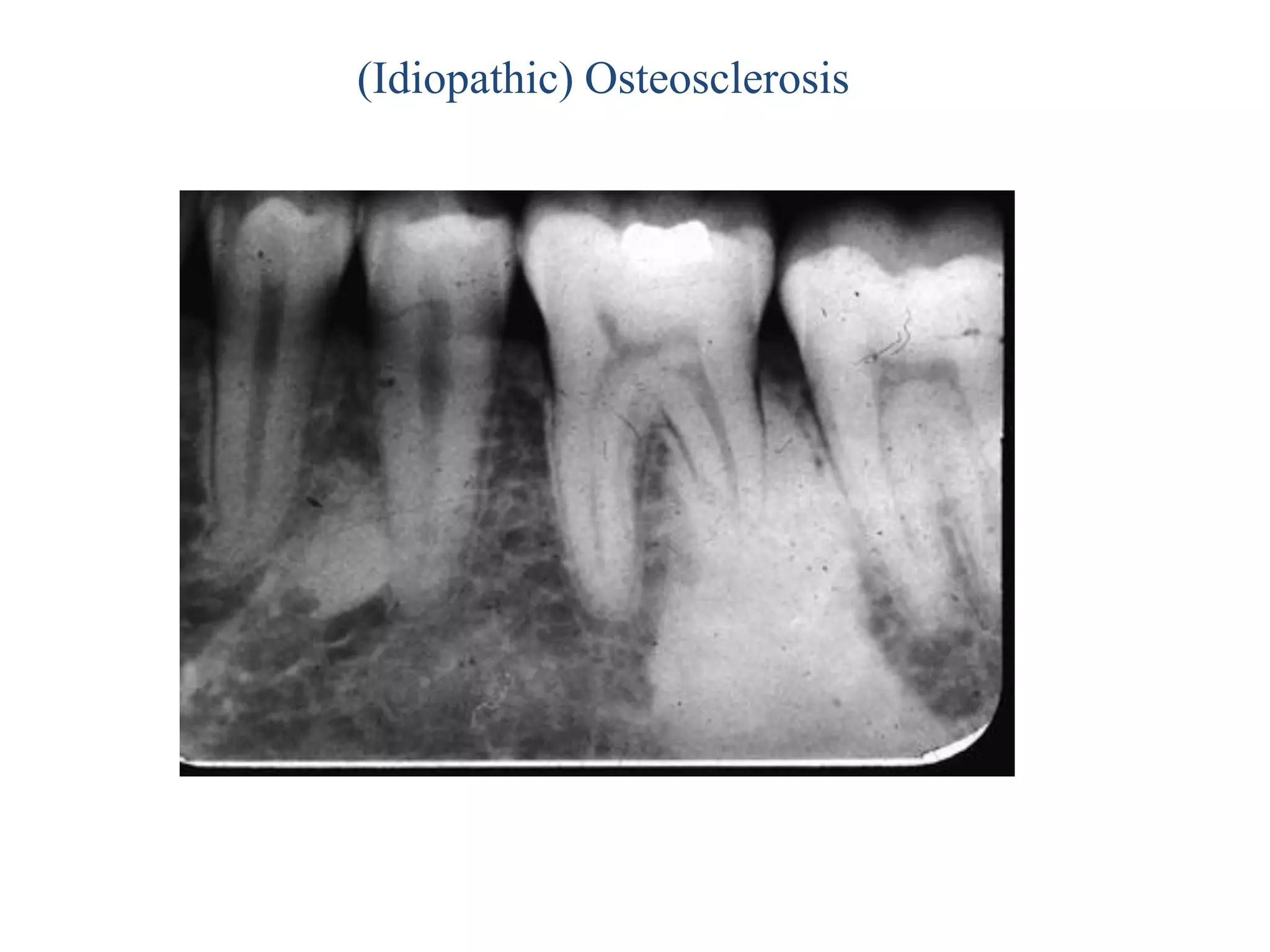
Radiopaque lesions

Condensing / sclerosing osteitis
Non odontogenic lesions
(Idiopathic) Osteosclerosis
Special Techniques :

Bitewing Projections : Useful in diagnosing dental caries

Especially the relation ship of the alveolar bone to the dental
caries [ proximal lesions]
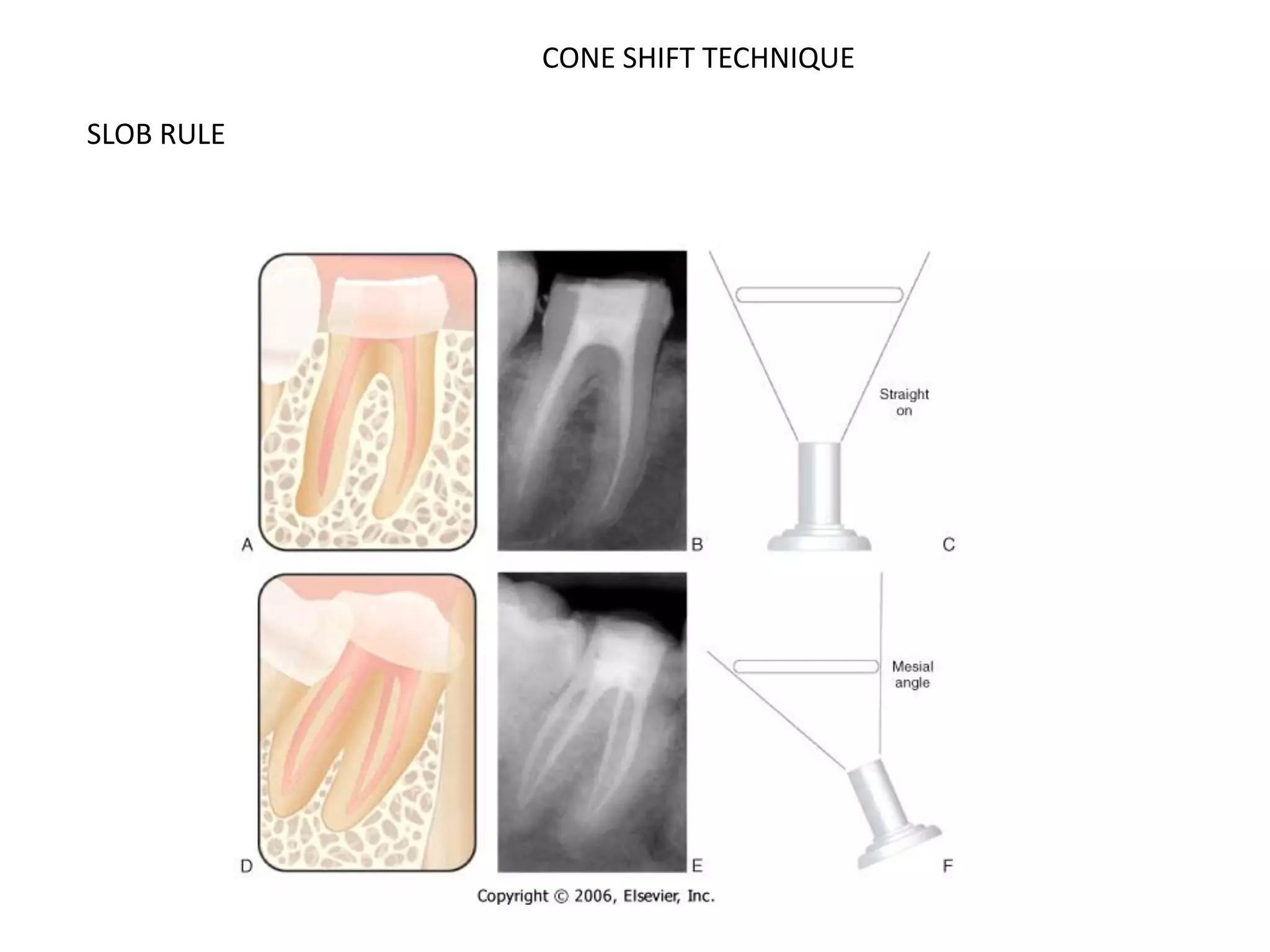
CONE SHIFT TECHNIQUE
SLOB RULE
A and B, A straight-on view will cause superimposition of the buccal object (yellow circle)
with the lingual object (red triangle). C and D, Using the tube-shift technique, the lingual
object (red triangle) will appear more mesial with respect to the mesial root of the
mandibular first molar, and the buccal object (yellow circle) will appear more distal on a
second view projected from the mesial. E and F, The object (red triangle) on the lingual
surface will appear more distal with respect to the mesial root of the mandibular first
molar, and the object (yellow circle) on the buccal surface will appear more mesial on a
view projected from the distal aspect.
Important considerations:
Film selection
Film Holders

Film Placement
Cone alignment
Latest Radiographic Devices
Digital Radiography
Micro Computed Tomography [Micro CT]
Cone beam CT
Radiographs in endodontics

Radiographs in endodontics

  • 1.
    RADIOGRAPHS IN ENDODONTICS ANDLOCAL ANAESTHESIA - II
  • 2.
    IMPORTANCE OF RADIOGRAPHYIN ENDODONTICS  The evaluation of pathologic lesions of the head and neck routinely involves the use of radiographs in attempting to determine the nature of the disease process  Radiographs are also essential to all phases of endodontic therapy. They help in : • Diagnosis • During various treatment steps and • Evaluation of the success or failure of treatment.
  • 3.
    DIAGNOSIS Identifying the Pathosis: The radiographs help in identifying the lesion whether it is  Pulpal  Periapical  Periodontal  Bony lesions
  • 4.
    Determining the Rootand Pulpal anatomy :  The number of roots/ root canals  Unusual root morphologies  Root curvatures  Canal locations with respect to the pulp chamber  Bifurcations/ trifurcations  Calcifications
  • 5.
    Characterizing Normal Structures:  Helps in differentiating the normal from abnormal structures.
  • 6.
    TREATMENT 1. Determining WorkingLengths 2. Moving superimposed structures: Certain normal anatomic structures may superimpose on the apices of the teeth. Changing the angulations help in separating them.
  • 7.
    Locating canals : Extra canals  Missed canals
  • 9.
    Evaluating the Obturation: Theradiographs help us to assess the quality of obturation by helping us to evaluate the 1. Length - if the working length has been maintained - overfilling - underfilling 2. Density - the radiopacity of the material 3. Taper of the preparation of the configuration
  • 10.
    RECALL / FOLLOWUP • Most of the times the patient does not know the status of the root canal treatment. • In most cases the patient may be asymptomatic. • In such cases only radiographs help in diagnosing the endodontic failures • There may be evidence of development of new lesions : Periapical, Periodontal, Nonendodontic Or evaluation of the healing / progress of the treatment
  • 12.
    LARGE PERI APICALLESION ENDODONTIC THERAPY LESION DECREASES IN SIZE LESION REMAINS SAME LESION INCREASES IN SIZE PERIODIC RECALL RETREATMENT / RETREATMENT + APICAL SURGERY
  • 16.
    RADIOGRAPHIC SEQUENCE I. Diagnostic: The number of films used would depend upon the diagnostic difficulty. The first film should give us the basic details about the Caries → Pulpal involvement → Periapical status A properly positioned film should permit the visualization of atleast 3 to 4mm beyond the apex
  • 19.
    Angulation: The most accurateradiographs are made using the paralleling technique
  • 20.
    Advantages : Less distortionand more clarity Reproducibility of film and cone placement [ using the XCP ]
  • 21.
    Reproducibility : abilityto take two or more radiographs of a given tooth at different time intervals and producing an image of same/ near to same characteristics. Especially useful in evaluating the healing of large lesions In cases of low palatal vault, exceptionally long roots, or maxillary tori, the paralleling technique is not possible. In such cases the bisecting angle technique is used
  • 23.
    II. WORKING FILMS Theseare the films which are used during the treatment procedure. Not essentially given to the patient for a record These include  Working length radiograph  Master cone  During obturation [ intermediate ]
  • 24.
    Exposure and FilmSpeed  The exposure gradients for the working films are similar to that of the Diagnostic radiographs.  The films should be clear and the apical extent of the image should be same as that for diagnostic films i.e 3-4mm beyond the apex must be shown .  The tip of the roots and the tips of the files/master cones should be easily identified.  The exposure time for the films depends on the speed.  D>E>F
  • 25.
    III. Obturation Similar basic principlesas those required for diagnostic radiographs. But after obturation it is advisable to take atleast two radiographs at different angulations to visualize any missed canals
  • 27.
  • 28.
    Normal findings inx-rays • Teeth – dentin and enamel have different shades • due to variation in mineralization – radiopacity: enamel > dentin > pulp – cemento-enamel junction should be recognized • Periodontium – lamina dura is a layer of compact bone (i.e., cribriform plate or alveolar bone proper) that lines the tooth socket – periodontal ligament space • thin radiolucent area between root and lamina dura – alveolar crest • bone that extends between the teeth • normal level no more than 1.5 mm from cemento-enamel junction
  • 29.
     The mostconsistent radiographic feature aiding diagnosis of pulpal and periapical lesions is the continuity and shape of the lamina dura and the width and shape of the PDL space.
  • 30.
     Endodontic lesions mustencroach on the junction of the cancellous bone and cortical bone for radiographic detection.  Lesions are larger than they appear radiographically  The cortical plate must have 12.5% volume of bone loss or 7.1% of mineral bone loss to be detected radiographically.
  • 31.
    The radiographic descriptionof any lesion can give us indications of:  Tissue of origin  Biological behavior  Prognosis  Treatment concerns  Diagnosis or a Differential Diagnosis
  • 32.
    A radiograph helpsin describing the lesion’s  Size  Shape  Location  Density  Borders  Effect on adjacent structures
  • 33.
  • 34.
    Location  Localized orgeneralized  Unilateral or bilateral
  • 36.
    Relation of thelesion to other structures and anatomic landmarks  If the radiolucency is above the inferior alveolar nerve canal (IAC), the likelihood is greater that it is odontogenic in origin.  If it is below the IAC, it is unlikely to be odontogenic in origin.  If it is within the IAC, the tissue of origin probably is neural or vascular in nature.
  • 39.
  • 40.
  • 41.
    Effect on adjacentstructures • Resorption • Displacement [Space occupying lesions displace other structures] • Destruction • Remodeling • Expansion
  • 42.
  • 43.
  • 44.
     Many anatomicstructures and osteolytic lesions can be mistaken for periradicular pathoses.  Among the more commonly misinterpreted anatomic structures are the mental foramen and the incisive foramen.
  • 45.
    Initial / immaturephase of Periapical cemental dysplasia Mature phase of Periapical cemental dysplasia
  • 46.
     These radiolucenciescan be differentiated from pathologic conditions by exposures at different angulations and by pulp-testing procedures.  Radiolucencies not associated with the root apex will move or be projected away from the apex by varying the angulation
  • 47.
    • Other anatomicradiolucencies that must be differentiated from periradicular pathoses are  Mental Foramen  Lingual Foramen  Submandibular Fossa  Nutrient Canals  Median Palatal Suture  Incisive Canal Foramen  Nasal Cavity  Mandibular Canal  Maxillary Sinus
  • 48.
    Differential diagnosis Endodontic lesions Radiolucentlesions : 1. Apical /radicular lamina dura is absent 2. A hanging drop of oil shape . Though a lesion ca be of any shape 3. Radiolucency stays at the apex regardless of change in the angulation. 4. The cause for pulp necrosis is ,in most cases ,evident
  • 51.
  • 52.
  • 53.
  • 54.
    Special Techniques : BitewingProjections : Useful in diagnosing dental caries Especially the relation ship of the alveolar bone to the dental caries [ proximal lesions]
  • 55.
  • 56.
    A and B,A straight-on view will cause superimposition of the buccal object (yellow circle) with the lingual object (red triangle). C and D, Using the tube-shift technique, the lingual object (red triangle) will appear more mesial with respect to the mesial root of the mandibular first molar, and the buccal object (yellow circle) will appear more distal on a second view projected from the mesial. E and F, The object (red triangle) on the lingual surface will appear more distal with respect to the mesial root of the mandibular first molar, and the object (yellow circle) on the buccal surface will appear more mesial on a view projected from the distal aspect.
  • 57.
    Important considerations: Film selection FilmHolders Film Placement Cone alignment
  • 58.
  • 59.
    Micro Computed Tomography[Micro CT] Cone beam CT