ENDODONTIC
RADIOGRAPHY
BDS 3rd YEAR
Name:- Paankhi
Sharma
CONTENT
 INTRODUCTION
 HISTORY
 INTERPRETATION OF RADIOGRAPH
 TYPES
 IMPORTANCE OF RADIOGRAPH
 INTRAORAL PERIAPICAL RADIOGRAPHS
 CONE BEAM COMPUTED TOMOGRAPHY
INTRODUCTION
 Radiograph is one of the most important clinical
tool in making a diagnosis in endodontic therapy.
• It permits visual examination of oral structures that would
be unseen by naked eye.
•Radiographs can contain information on the presence of
caries that may involve or may threaten to involve pulp.
•Radiographs may show number, course, shape, length and
width of root canals which provides proper detail for
undergoing endodontic treatment.
HISTORY
 1895- Discovery of cathode rays by Roentgen
 1895- Otto Walkhoff took 1st dental X ray of his own teeth
 1899- Edmund Kells used Radiograph to check working length
 1900- Weston Price advocated radiograph to check quality of
obstruction
 1901- WH Rollins presented first paper on dangers of X ray
 1904- WA Price introduced Bisecting technique
 1913 & 1920- Eastman Kodak Company introduced ‘prewrapped
dental films’ and ‘machine made film packets’
 1925- HR Raper introduced Bitewing technique
 1947- FG Fitzgerald introduced paralleling cone technique
INTERPRETATION OF RADIOGRAPH
ACCORDING TO APPEARANCE
APPERANCE TENTATIVE FINDINGS
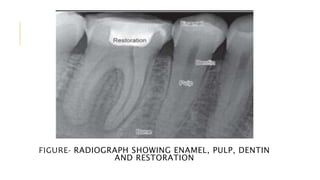
Black/Gray area a) Decay
b) Pulp
c) Gingiva or space between teeth
d) Abscess
e) Cyst
White area a) Enamel
b) Restoration [ metal, gutta percha,
etc. ]
Creamy white area Dentin appears as creamy white area
White line around teeth Lamina dura around teeth
FIGURE- RADIOGRAPH SHOWING ENAMEL, PULP, DENTIN
AND RESTORATION
TYPES
 INTRAORAL RADIOGRAPHS
•Intraoral Periapical
 Used to detect any abnormalities of the root structure and
surrounding bone structure
•Occlusal Radiographs
 Show full tooth development and placement
•Bitewing Radiographs
 Used to detect decay between teeth and changes in the bone
density caused by gum disease
 EXTRAORAL RADIOGRAPHS
•Panoramic Radiograph
•Lateral Cephalograms
•Cone Beam Computed Tomography
IMPORTANCE OF RADIOGRAPHS IN
ENDODONTICS
 Radiographs are essential to all phases of endodontic therapy.
1. DIAGNOSIS
 Helps in identifying pathosis i.e. Pulpal, Periapical, Periodontal
 Determining the root and pulpal anatomy:
• No. of roots/ root canals
• Unusual root morphologies
• Root curvatures
• Canal locations with respect to chambers
• Calcifications
 Characterizing normal structures
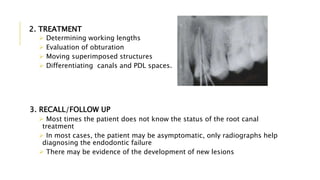
2. TREATMENT
 Determining working lengths
 Evaluation of obturation
 Moving superimposed structures
 Differentiating canals and PDL spaces.
3. RECALL/FOLLOW UP
 Most times the patient does not know the status of the root canal
treatment
 In most cases, the patient may be asymptomatic, only radiographs help
diagnosing the endodontic failure
 There may be evidence of the development of new lesions
INTRAORAL PERIAPICAL
RADIOGRAPHS
 To use radiographs properly, the clinician must have the
knowledge and skill necessary to interpret them correctly
 Understanding of the underlying:-
• Normal anatomical structures
• Anomalous anatomy
• Changes that occur due to aging, trauma, disease and healing
 Only then will these two dimensional black-and-white
shadows on processed film have meaning
 The information contained within a radiograph is so
essential to dental practice, it is important that
radiographs be of excellent quality
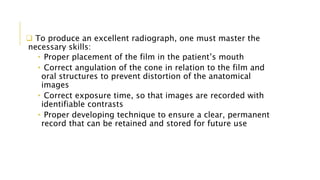
 To produce an excellent radiograph, one must master the
necessary skills:
• Proper placement of the film in the patient’s mouth
• Correct angulation of the cone in relation to the film and
oral structures to prevent distortion of the anatomical
images
• Correct exposure time, so that images are recorded with
identifiable contrasts
• Proper developing technique to ensure a clear, permanent
record that can be retained and stored for future use
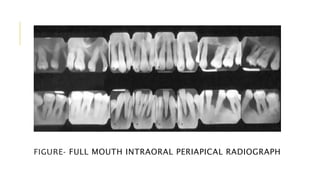
FIGURE- FULL MOUTH INTRAORAL PERIAPICAL RADIOGRAPH
CONE BEAM COMPUTED
TOMOGRAPHY
 It’s a diagnostic imaging modality that provides high quality,
accurate three-dimensional representation of the osseous
elements of the maxillofacial skeleton
 It is a form of computed tomography in which only a focused,
cone-shaped beam of X-ray is projected at the imaged tissue
 The limited volume significantly reduces the amount of
radiation compared with traditional computed tomography
 The resolution of the CBCT image is low, which allows
visualization of very small objects, such as difficult to find
canals [pixels resolution ranging from 0.4 mm to 0.076 mm]
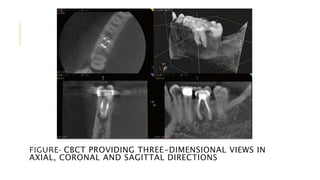
FIGURE- CBCT PROVIDING THREE-DIMENSIONAL VIEWS IN
AXIAL, CORONAL AND SAGITTAL DIRECTIONS
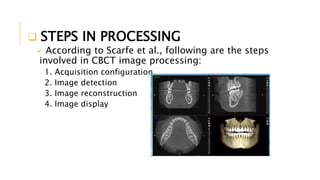
 STEPS IN PROCESSING
 According to Scarfe et al., following are the steps
involved in CBCT image processing:
1. Acquisition configuration
2. Image detection
3. Image reconstruction
4. Image display
 APPLICATIONS IN ENDODONTICS
 The applications of CBCT in endodontics include:
• Diagnosis of periradicular lesions
• Canal visualization
• Assessment of internal and external resorption
• Detection if root fractures and other dentoalveolar
trauma
• Preparation for endodontic surgery
• Detection of calcific metamorphosis
 ADVANTAGES
• Rapid scan time
• Beam limitation
• Image accuracy
• Reduced patient radiation dose
• Interactive display modes applicable to maxillofacial
imaging
• Multiplanar reformation
• Three dimensional volume rendering
 LIMITATIONS
• Artifacts ( X-ray beam related, patient related, cone
beam related and scanner related )
• Image noise
• Poor soft tissue contrast
 IMPORTANT POINTS
 The sensitivity of CBCT is higher than that of
Periapical Radiography in detecting periapical
lesions and identifying vertical root fractures
 It’s spartial resolution is however poor compared
to conventional radiographs
THANK YOU

Endodontic Radiography

  • 1.
  • 2.
    CONTENT  INTRODUCTION  HISTORY INTERPRETATION OF RADIOGRAPH  TYPES  IMPORTANCE OF RADIOGRAPH  INTRAORAL PERIAPICAL RADIOGRAPHS  CONE BEAM COMPUTED TOMOGRAPHY
  • 3.
    INTRODUCTION  Radiograph isone of the most important clinical tool in making a diagnosis in endodontic therapy. • It permits visual examination of oral structures that would be unseen by naked eye. •Radiographs can contain information on the presence of caries that may involve or may threaten to involve pulp. •Radiographs may show number, course, shape, length and width of root canals which provides proper detail for undergoing endodontic treatment.
  • 4.
    HISTORY  1895- Discoveryof cathode rays by Roentgen  1895- Otto Walkhoff took 1st dental X ray of his own teeth  1899- Edmund Kells used Radiograph to check working length  1900- Weston Price advocated radiograph to check quality of obstruction  1901- WH Rollins presented first paper on dangers of X ray  1904- WA Price introduced Bisecting technique  1913 & 1920- Eastman Kodak Company introduced ‘prewrapped dental films’ and ‘machine made film packets’  1925- HR Raper introduced Bitewing technique  1947- FG Fitzgerald introduced paralleling cone technique
  • 5.
    INTERPRETATION OF RADIOGRAPH ACCORDINGTO APPEARANCE APPERANCE TENTATIVE FINDINGS Black/Gray area a) Decay b) Pulp c) Gingiva or space between teeth d) Abscess e) Cyst White area a) Enamel b) Restoration [ metal, gutta percha, etc. ] Creamy white area Dentin appears as creamy white area White line around teeth Lamina dura around teeth
  • 6.
    FIGURE- RADIOGRAPH SHOWINGENAMEL, PULP, DENTIN AND RESTORATION
  • 7.
    TYPES  INTRAORAL RADIOGRAPHS •IntraoralPeriapical  Used to detect any abnormalities of the root structure and surrounding bone structure •Occlusal Radiographs  Show full tooth development and placement •Bitewing Radiographs  Used to detect decay between teeth and changes in the bone density caused by gum disease  EXTRAORAL RADIOGRAPHS •Panoramic Radiograph •Lateral Cephalograms •Cone Beam Computed Tomography
  • 8.
    IMPORTANCE OF RADIOGRAPHSIN ENDODONTICS  Radiographs are essential to all phases of endodontic therapy. 1. DIAGNOSIS  Helps in identifying pathosis i.e. Pulpal, Periapical, Periodontal  Determining the root and pulpal anatomy: • No. of roots/ root canals • Unusual root morphologies • Root curvatures • Canal locations with respect to chambers • Calcifications  Characterizing normal structures
  • 9.
    2. TREATMENT  Determiningworking lengths  Evaluation of obturation  Moving superimposed structures  Differentiating canals and PDL spaces. 3. RECALL/FOLLOW UP  Most times the patient does not know the status of the root canal treatment  In most cases, the patient may be asymptomatic, only radiographs help diagnosing the endodontic failure  There may be evidence of the development of new lesions
  • 10.
    INTRAORAL PERIAPICAL RADIOGRAPHS  Touse radiographs properly, the clinician must have the knowledge and skill necessary to interpret them correctly  Understanding of the underlying:- • Normal anatomical structures • Anomalous anatomy • Changes that occur due to aging, trauma, disease and healing  Only then will these two dimensional black-and-white shadows on processed film have meaning  The information contained within a radiograph is so essential to dental practice, it is important that radiographs be of excellent quality
  • 11.
     To producean excellent radiograph, one must master the necessary skills: • Proper placement of the film in the patient’s mouth • Correct angulation of the cone in relation to the film and oral structures to prevent distortion of the anatomical images • Correct exposure time, so that images are recorded with identifiable contrasts • Proper developing technique to ensure a clear, permanent record that can be retained and stored for future use
  • 12.
    FIGURE- FULL MOUTHINTRAORAL PERIAPICAL RADIOGRAPH
  • 13.
    CONE BEAM COMPUTED TOMOGRAPHY It’s a diagnostic imaging modality that provides high quality, accurate three-dimensional representation of the osseous elements of the maxillofacial skeleton  It is a form of computed tomography in which only a focused, cone-shaped beam of X-ray is projected at the imaged tissue  The limited volume significantly reduces the amount of radiation compared with traditional computed tomography  The resolution of the CBCT image is low, which allows visualization of very small objects, such as difficult to find canals [pixels resolution ranging from 0.4 mm to 0.076 mm]
  • 14.
    FIGURE- CBCT PROVIDINGTHREE-DIMENSIONAL VIEWS IN AXIAL, CORONAL AND SAGITTAL DIRECTIONS
  • 15.
     STEPS INPROCESSING  According to Scarfe et al., following are the steps involved in CBCT image processing: 1. Acquisition configuration 2. Image detection 3. Image reconstruction 4. Image display
  • 16.
     APPLICATIONS INENDODONTICS  The applications of CBCT in endodontics include: • Diagnosis of periradicular lesions • Canal visualization • Assessment of internal and external resorption • Detection if root fractures and other dentoalveolar trauma • Preparation for endodontic surgery • Detection of calcific metamorphosis
  • 17.
     ADVANTAGES • Rapidscan time • Beam limitation • Image accuracy • Reduced patient radiation dose • Interactive display modes applicable to maxillofacial imaging • Multiplanar reformation • Three dimensional volume rendering
  • 18.
     LIMITATIONS • Artifacts( X-ray beam related, patient related, cone beam related and scanner related ) • Image noise • Poor soft tissue contrast
  • 19.
     IMPORTANT POINTS The sensitivity of CBCT is higher than that of Periapical Radiography in detecting periapical lesions and identifying vertical root fractures  It’s spartial resolution is however poor compared to conventional radiographs
  • 20.