Radiographic views of
Thoracic Spine
Chandan Prasad Rajbhar
Tutor
College of paramedical sciences
TMU, Moradabad
Common Clinical Indication
• Clay shoveler’s fracture
• Compression fracture
• Herniated nucleus pulposus (HNP)
• Kyphosis
• Scoliosis
• Osteoporosis
• Osteoarthritis
• Spondylitis, ankylosing spondylitis
ALL RADIOGRAPHIC VIEWS MUST INCLUDE
• Anatomy
• Labelled diagram (if possible)
• Clinical indication
• Patient preparation
• Patient positioning
• Part positioning
• CR
• Technical factors
• Image review and evaluation
• Anatomical evaluation
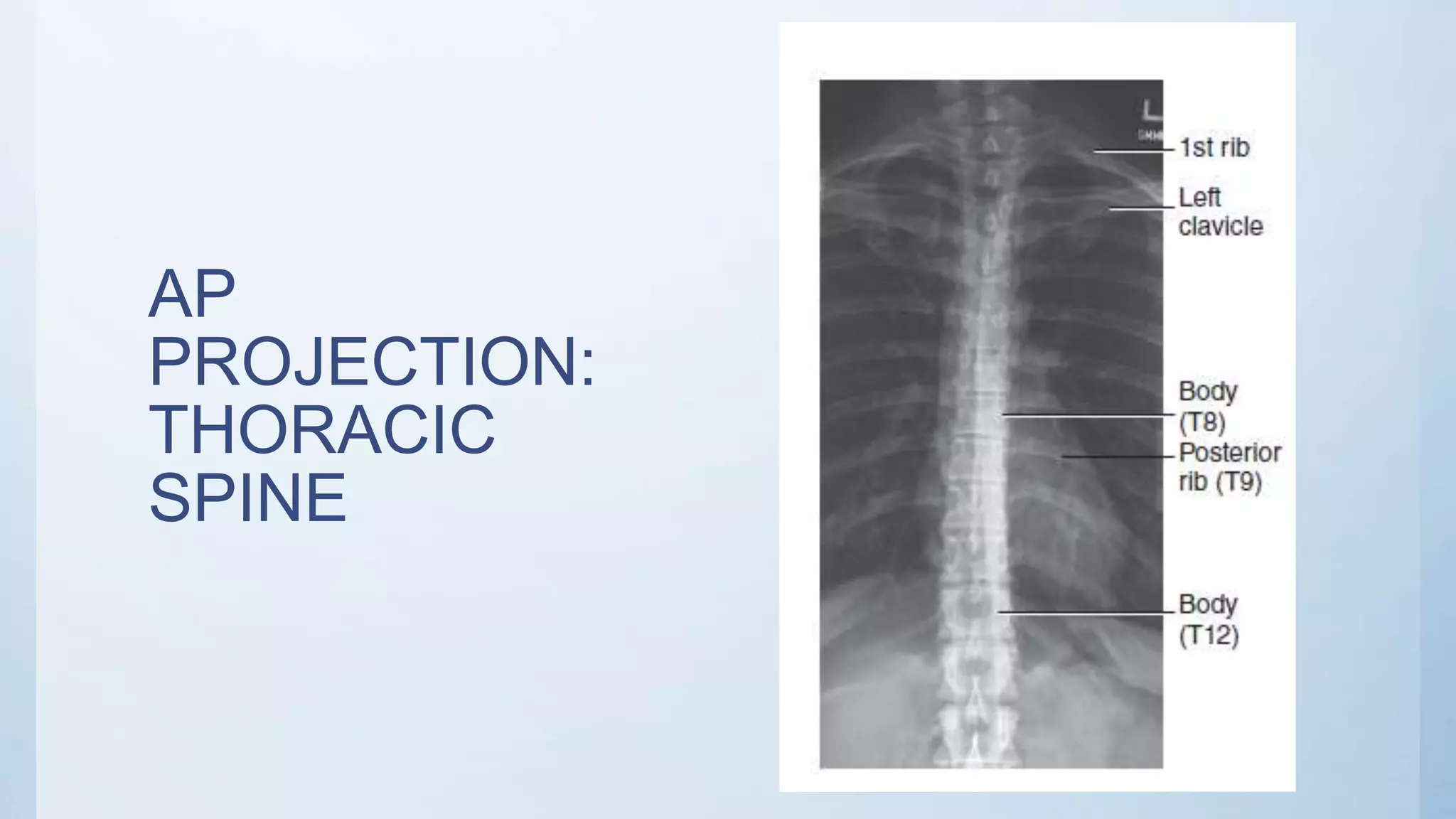
AP PROJECTION: THORACIC SPINE
• Pathology involving the thoracic spine, such as
compression fractures, subluxation, or kyphosis
• Patient Position—Recumbent and Erect
Position
• Position patient supine (preferred) with arms at
side and head on table or on a thin pillow.
• If patient cannot tolerate the supine position,
place erect with arms at side and weight evenly
distributed on both feet.
• Part Position
• Align midsagittal plane to CR and midline of
table and/or IR.
• Flex knees and hips to reduce thoracic
curvature.
• Ensure that no rotation of thorax or pelvis
exists.
CR perpendicular to IR.
Direct CR to T7 (3 to 4 inches [8 to 10 cm] below
jugular notch or 1 to 2 inches [3 to 5 cm] below
sternal angle). Centering is similar to that used with
AP chest
AP
PROJECTION:
THORACIC
SPINE
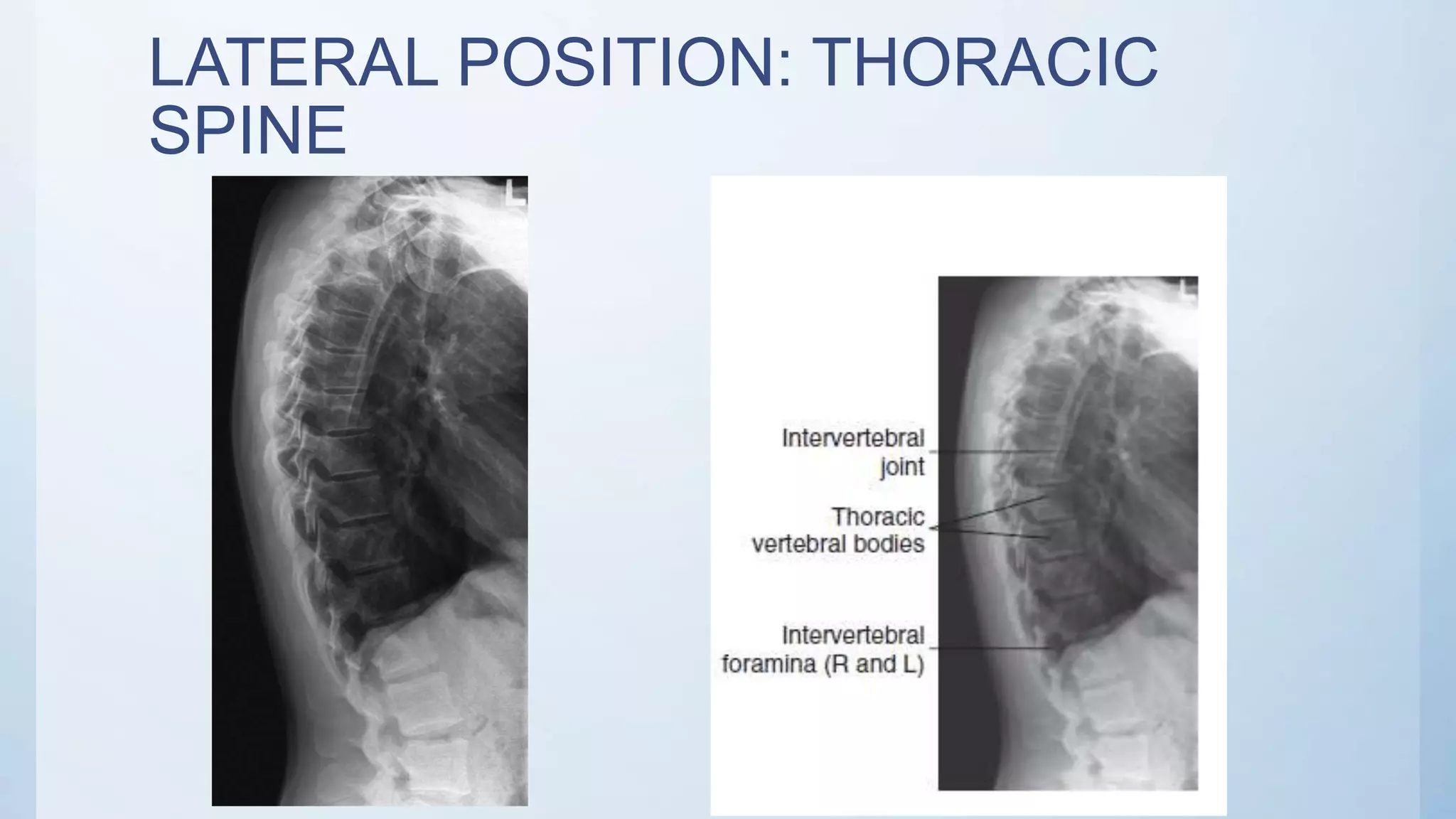
LATERAL POSITION: THORACIC SPINE
• Pathology involving the thoracic spine, such as compression
fractures, subluxation, or kyphosis.
• Patient Position—Lateral Recumbent or Erect Position
• Position patient in the lateral recumbent position (preferred),
with head on pillow and knees flexed. For the erect position,
place arms outstretched, with weight evenly distributed on both
feet.
• Part Position
• Align posterior half of thorax (between midcoronal plane and
posterior aspect of thorax) to CR and midline of table and/or IR.
• Raise patient’s arms to right angles to body with elbows flexed.
• Support waist so entire spine is near parallel to table. Palpate
spinous processes to determine alignment.
• Flex hips and knees, with support between the knees.
• Ensure that no rotation of shoulders or pelvis exists.
CR perpendicular to long axis of thoracic
spine.
• Direct CR to T7 (3 to 4 inches [8 to 10 cm]
below jugular notch or 7 to 8 inches [18 to 21
cm] below the vertebrae prominens).
LATERAL POSITION: THORACIC
SPINE
OBLIQUE POSITION—ANTERIOR OR POSTERIOR
OBLIQUE:
THORACIC SPINE
• Pathology involving the zygapophyseal joints of the thoracic spine.
• Both right and left oblique projections are taken for comparison.
• Patient Position—Oblique Anterior or Posterior Recumbent or Erect Positions
• Initially position patient in the lateral recumbent position (preferred), with head
on pillow and knees flexed. For the erect position, ensure equal distribution of
weight on both feet.
• Part Position
• Rotate the body 20° from true lateral to create a 70° oblique from plane of table.
Ensure equal rotation of shoulders and pelvis.
• Flex hips, knees, and arms for stability as needed.
• Align spinal column to CR and midline of table and/or IR
OBLIQUE POSITION—ANTERIOR OR POSTERIOR
OBLIQUE:
THORACIC SPINE
CR perpendicular to IR
Direct CR to T7 (3 to 4 inches [8 to 10
cm] below jugular notch or 2 inches [5
cm] below sternal angle).
Thank You

Radiographic views of thoracic spine

  • 1.
    Radiographic views of ThoracicSpine Chandan Prasad Rajbhar Tutor College of paramedical sciences TMU, Moradabad
  • 2.
    Common Clinical Indication •Clay shoveler’s fracture • Compression fracture • Herniated nucleus pulposus (HNP) • Kyphosis • Scoliosis • Osteoporosis • Osteoarthritis • Spondylitis, ankylosing spondylitis
  • 3.
    ALL RADIOGRAPHIC VIEWSMUST INCLUDE • Anatomy • Labelled diagram (if possible) • Clinical indication • Patient preparation • Patient positioning • Part positioning • CR • Technical factors • Image review and evaluation • Anatomical evaluation
  • 4.
    AP PROJECTION: THORACICSPINE • Pathology involving the thoracic spine, such as compression fractures, subluxation, or kyphosis • Patient Position—Recumbent and Erect Position • Position patient supine (preferred) with arms at side and head on table or on a thin pillow. • If patient cannot tolerate the supine position, place erect with arms at side and weight evenly distributed on both feet. • Part Position • Align midsagittal plane to CR and midline of table and/or IR. • Flex knees and hips to reduce thoracic curvature. • Ensure that no rotation of thorax or pelvis exists. CR perpendicular to IR. Direct CR to T7 (3 to 4 inches [8 to 10 cm] below jugular notch or 1 to 2 inches [3 to 5 cm] below sternal angle). Centering is similar to that used with AP chest
  • 5.
  • 6.
    LATERAL POSITION: THORACICSPINE • Pathology involving the thoracic spine, such as compression fractures, subluxation, or kyphosis. • Patient Position—Lateral Recumbent or Erect Position • Position patient in the lateral recumbent position (preferred), with head on pillow and knees flexed. For the erect position, place arms outstretched, with weight evenly distributed on both feet. • Part Position • Align posterior half of thorax (between midcoronal plane and posterior aspect of thorax) to CR and midline of table and/or IR. • Raise patient’s arms to right angles to body with elbows flexed. • Support waist so entire spine is near parallel to table. Palpate spinous processes to determine alignment. • Flex hips and knees, with support between the knees. • Ensure that no rotation of shoulders or pelvis exists. CR perpendicular to long axis of thoracic spine. • Direct CR to T7 (3 to 4 inches [8 to 10 cm] below jugular notch or 7 to 8 inches [18 to 21 cm] below the vertebrae prominens).
  • 7.
  • 8.
    OBLIQUE POSITION—ANTERIOR ORPOSTERIOR OBLIQUE: THORACIC SPINE • Pathology involving the zygapophyseal joints of the thoracic spine. • Both right and left oblique projections are taken for comparison. • Patient Position—Oblique Anterior or Posterior Recumbent or Erect Positions • Initially position patient in the lateral recumbent position (preferred), with head on pillow and knees flexed. For the erect position, ensure equal distribution of weight on both feet. • Part Position • Rotate the body 20° from true lateral to create a 70° oblique from plane of table. Ensure equal rotation of shoulders and pelvis. • Flex hips, knees, and arms for stability as needed. • Align spinal column to CR and midline of table and/or IR
  • 9.
    OBLIQUE POSITION—ANTERIOR ORPOSTERIOR OBLIQUE: THORACIC SPINE CR perpendicular to IR Direct CR to T7 (3 to 4 inches [8 to 10 cm] below jugular notch or 2 inches [5 cm] below sternal angle).
  • 10.