ATOMIC ENERGY
REGULATORY BOARD
(AERB).
CHANDAN PRASAD
RIT 2ND YEAR
WHAT IS AERB?
 stands for ATOMIC ENERGY REGULATORY BOARD
 An Indian regulatory body that regulates and control
the radiation exposure.
 Formed on 15 November 1983, under atomic
energy act 1962 and environmental(protection)
act 1986.
 Chairmen- Shri Shiv Abhilash Bhardwaj.
 Headquarter in MUMBAI.
AIM
AERB ensures the use of
ionization radiation and nuclear
energy in India that does not
cause harm to human beings and
environment
FUNCTION OF AERB
 1.To develop safety policies in nuclear radiation and
industrial safety areas.
 2.Maintaining Safety guides, safety guidelines, and
standards.
 For sitting, design, construction, layout,
commissioning and decommissioning operations for all
nuclear and radiation facilities.
 3.Grant consent.- to the same as mentioned above.
That include documentation for the estab. of nuclear
and radiation facilities.
 4.Ensuring compliance- regulatory requirement
prescribed by AERB during all the stages of
consenting through review and assessment.
5.Review of the safety measures during
the transport of large radioactive
source.
6. Review the training program,
qualification, and licensing policies and
radiation facilities.
7. Promote research and development
effort in the area of safety.
REGIONAL REGULATORY CENTRE.
 That carry out regional area inspection of nuclear and
radiation facilities.
 That include surprise inspection of the radiology
department of a particular hospital or diagnostic centre.
 Review related to consenting process of radiation
facilities
 Excessive exposure in radiation facilities.
 They are divided as.
 Eastern regional regulatory centre in KOLKATA
 Northern regional regulatory centre in NEW DELHI.
 Southern regional regulatory centre in CHENNAI.
AERB REGULATORY BOARD PROCESS.
 Regulated by a division of 5 main divisions.
 1. Document development
 2. Safety Review and Assessment.
 3.Licensing/Consenting
 4.REGULATORY INSPECTION.
 5. Regulatory enforcement.
AERB REGULATORY BOARD PROCESS.
1. Document development that include:
1. Safety documentation
2. Issued in under provision of AERB.
3. Safety codes and Standards and Guidelines.
4. Codes refer to establish the objective and
requirement that fulfill the safety.
5. Manuals include details about various safety
instruction for particular practice and
application.
2. Safety Review and Assessment.
 The review include.
1. Safety all the times
2. Ensures adherence of rules, safety
requirements, license condition and others.
3. Done by staff of AERB or multi-level expert of
different fields.
The assessment include
1. Grant of license
2. Enforcement action
3. Recommendation for further safety
3.Licensing/Consenting
 The regulatory consent is the global word for license
authorization, certification, registration, approval.
 Objective of consenting
 To ensure permittance the use of practices.
 Social benefits
 Radiation protection
 Radiation doses to personnel and general public.
 Consent mainly issued for many nuclear and radiation
facilities e.g..
 X ray units
 Ct units
 Radiotherapy
 Industrial radiography
 Brachy therapy
 Nuclear medicine.
4.REGULATORY INSPECTION.
1. Assures evaluation of rules requirement and
licensing condition providing by AERB
2. carried out by verification.
3. Verification carried out by skilled staff assigned
by AERB that include special inspection and
surprise real time evaluation
4. AERB inspector
5. Inspect during reasonable hours that include insp.
Of layout, construction operation.
6. Observe inspect examine and questioning to
personnel and do verification
7. Inspect safety point of view that fulfill
radiological safety requirement.
5. Regulatory enforcement.
 Take enforcement action against the breaking rules
made under atomic energy act 1962.
 That ensures the radiation safety and industrial
safety.
 Provision rule-31 of atomic energy (radiation
protection) that include, power to investigate, seal
radiation installation.
 Provision rule-35 that include offences and
penalties.
 Rules and protocols of AERB for radiation
protection.
1. LICENCE. No installation for sitting, design,
construction, layout, without any license.
without license- no installation, no radioactive
material usage.
2. FEES OF LICENSE……
wrt to the radiation practice and department
usage.
3. EXEMPTION……..
use and disposal of a substance and material that
spontaneously emit radiation.
And one should not allow the level of radiation
prescribed by AERB.
4.Issuance of license.. Issued after 120days of the
submission of the form on e-LORA website.
5. Suspension, modification and withdrawal of
the license.
6.Restriction use of sources- other then mentioned
in the license provided by AERB for example in toys and
cosmetics, etc.
7.Restriction on certain practices- addition of
radioactive substance in food stuffs, beverages,
ornaments etc.
8.Radiation symbols and warning signs.
8.Radiation symbols and warning signs
9. Safety standard, codes and guidelines
10. Assigning RSO.
11. Health surveillance of workers and
employers
12.Offences and penalties.
13.Inspectiom and power to appoint or
recognize person.
14.Prohibition of employment of person below
certain age.
15.Radiation monitoring.
 AERB in medical diagnostic imaging
 Since AERB controls most of the branches of radiation that
includes so many branches like,
 Radiation facilities (X RAY, CT), nuclear power plant,
transportation of radioactive material, nuclear medicines.
 In Diagnostic Radiology,
 Regulation of radiology facilities includes
 Medically use of x rays unit that include both benefits and
risk of radiation
 Proper care for the equipment, manufacturing, installation,
shielding.
 Properly licensed by AERB.
REGULATORY REQUIREMENT FOR DIAGNOSTIC
RADIOLOGY FACILITIES.
 1.Procurement of x ray equipment- authorization from supplier.
 2.Operation of x ray equipment
 3.Pre requisites for obtaining the license for operation of X rays(
control console, construction, layout, requirement).
 4.Staff requirement in department.
 5.X ray machine installation under eyes of radiologists and x ray
technologists under the rules of AERB.
 6.Assigning RSO (radiological safety officer). That maintains the
safety codes, standards, guidelines formed by AERB.
 Also maintains the availability of staff, skilled technicians and
proper shielding.
 In Diagnostic Radiology,
 Regulation of radiology facilities includes
 Medically use of x rays unit that include both benefits and
risk of radiation.
 (justification)
 Proper care for the equipment, manufacturing, installation,
and shielding.
 Properly licensed by AERB.
 A body of DSR formed by AERB
 Directorate of radiation safety that comes under health and
family welfare department of every state.
 It mainly carry out the regulatory inspection of x rays
facilities.
Maintaining 7.availability of monitoring devices
that include personnel and area.
8.Quality assurance-
QA of the equipments that going to be used in the
procedure of diagnostic imaging.
9.Servicing-
maintenance of equipments by carry out the
servicing of the equipments in every 2 years
That also include addition of some other machinery
that are damaged or not working properly.
10.Renewal of license-
by online media of e-LORA( discussed later on)..
Practical tips in ensuring radiation safety in
use of medical diagnostic imaging.
 In general purpose radiography.
What the personnel who are operating the equipment
need to know.
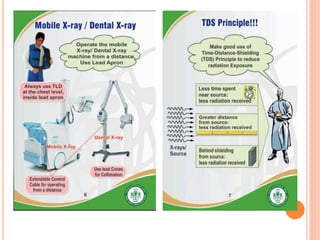
1. Operate from control unit/standing behind barrier 1.5mm
Pb
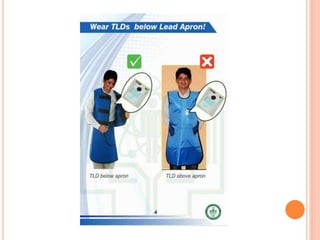
2. Use of TLD at chest level.
3. Always use collimators.
4. In portable maintain at least 2mm distance.
5. Ensure Pb apron.
6. For pregnant women abdomen covered with Pb apron
7. Avoid overcrowding of patient X ray department.
8. X ray room door closed during exposure.
What a RSO need to know?
1. Only AERB equipment.
2. AERB registration certificate should be displayed
on front of X ray door.
3. Quality assurance test.
4. Check for no. of required equipments in X ray
department.
5. Consistency of Pb apron- checked once in a year.
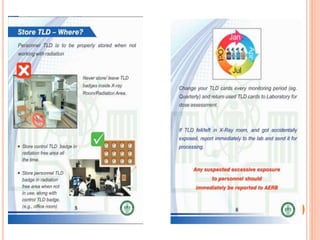
6. TLD badge provided to all operator and worker.
7. Routine maintenance.
8. Check for radiation symbol and warning signs.
What public need to know????
X ray only from AERB registered hospitals.
Do not crowd the department.
Co-operate the radiographer to avoid repeated x
rat examination.
Wear Pb apron when assisting patient.
e-LORA
 e-LORA stands for e-licensing of Radiation Application.
An e- governance initiate by AERB, web
based application for automation of
regulatory process of various radiation
facilities in India.
 AIM OF e-LORA.
To enhance the efficiency and transparency
in regulatory process of AERB. It aims to
achieving paperless licensing of radiation
facility.
 e-LORA include
 1.Institute registration
 That facilitates registration of institute in e-LORA.
 First, form user account formation
 Secondly, employer of the institute.
 Thirdly, e-LORA gives username and password for accessing on
AERB website.
 Institute registration is done on e-LORA mainly for operational
registration, amendments details made by AERB, functions.
 e-LORA accepts the registration mainly for many fields.
 Radiotherapy, nuclear medicine, medical cyclotron, research,
transport of the radiation.
 2. Radiation profession(RP)
 A radiation profession is a person working with Radiation whose
role is defined by AERB safety code.
 One RP must compulsory to register on e-LORA and they will
be provided with unique id called as RPID.
 RPID can be used by the RP in all future interaction with AERB
another employers and future details.
 3.Guidelines for submission of institute registration
application form.
1. This include entry of:-
2. Institute name
3. Type (govt/private)
4. Registered with only government authorities.
5. Certificate number.
6. Address of communication
7. Contact detail
8. Type of facility.
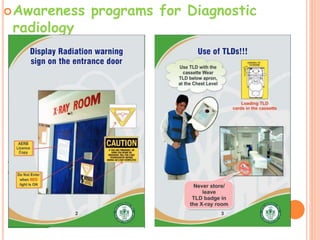
Awareness programs for Diagnostic
radiology
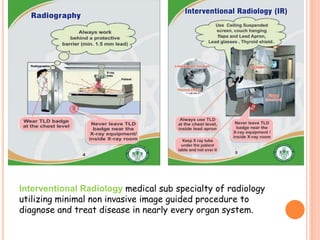
Interventional Radiology medical sub specialty of radiology
utilizing minimal non invasive image guided procedure to
diagnose and treat disease in nearly every organ system.
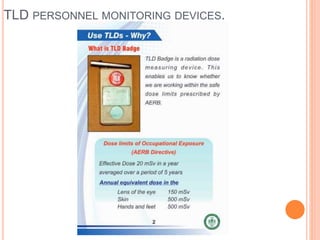
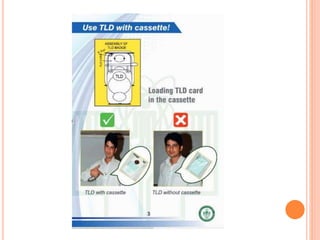
TLD PERSONNEL MONITORING DEVICES.
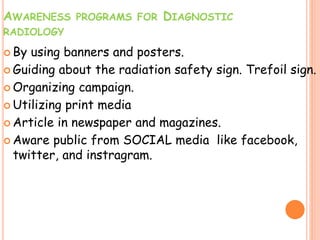
AWARENESS PROGRAMS FOR DIAGNOSTIC
RADIOLOGY
 By using banners and posters.
 Guiding about the radiation safety sign. Trefoil sign.
 Organizing campaign.
 Utilizing print media
 Article in newspaper and magazines.
 Aware public from SOCIAL media like facebook,
twitter, and instragram.

Atomic energy regulatory board (aerb)

  • 1.
  • 2.
    WHAT IS AERB? stands for ATOMIC ENERGY REGULATORY BOARD  An Indian regulatory body that regulates and control the radiation exposure.  Formed on 15 November 1983, under atomic energy act 1962 and environmental(protection) act 1986.  Chairmen- Shri Shiv Abhilash Bhardwaj.  Headquarter in MUMBAI.
  • 3.
    AIM AERB ensures theuse of ionization radiation and nuclear energy in India that does not cause harm to human beings and environment
  • 4.
    FUNCTION OF AERB 1.To develop safety policies in nuclear radiation and industrial safety areas.  2.Maintaining Safety guides, safety guidelines, and standards.  For sitting, design, construction, layout, commissioning and decommissioning operations for all nuclear and radiation facilities.  3.Grant consent.- to the same as mentioned above. That include documentation for the estab. of nuclear and radiation facilities.  4.Ensuring compliance- regulatory requirement prescribed by AERB during all the stages of consenting through review and assessment.
  • 5.
    5.Review of thesafety measures during the transport of large radioactive source. 6. Review the training program, qualification, and licensing policies and radiation facilities. 7. Promote research and development effort in the area of safety.
  • 6.
    REGIONAL REGULATORY CENTRE. That carry out regional area inspection of nuclear and radiation facilities.  That include surprise inspection of the radiology department of a particular hospital or diagnostic centre.  Review related to consenting process of radiation facilities  Excessive exposure in radiation facilities.  They are divided as.  Eastern regional regulatory centre in KOLKATA  Northern regional regulatory centre in NEW DELHI.  Southern regional regulatory centre in CHENNAI.
  • 7.
    AERB REGULATORY BOARDPROCESS.  Regulated by a division of 5 main divisions.  1. Document development  2. Safety Review and Assessment.  3.Licensing/Consenting  4.REGULATORY INSPECTION.  5. Regulatory enforcement.
  • 8.
    AERB REGULATORY BOARDPROCESS. 1. Document development that include: 1. Safety documentation 2. Issued in under provision of AERB. 3. Safety codes and Standards and Guidelines. 4. Codes refer to establish the objective and requirement that fulfill the safety. 5. Manuals include details about various safety instruction for particular practice and application.
  • 9.
    2. Safety Reviewand Assessment.  The review include. 1. Safety all the times 2. Ensures adherence of rules, safety requirements, license condition and others. 3. Done by staff of AERB or multi-level expert of different fields. The assessment include 1. Grant of license 2. Enforcement action 3. Recommendation for further safety
  • 10.
    3.Licensing/Consenting  The regulatoryconsent is the global word for license authorization, certification, registration, approval.  Objective of consenting  To ensure permittance the use of practices.  Social benefits  Radiation protection  Radiation doses to personnel and general public.  Consent mainly issued for many nuclear and radiation facilities e.g..  X ray units  Ct units  Radiotherapy  Industrial radiography  Brachy therapy  Nuclear medicine.
  • 11.
    4.REGULATORY INSPECTION. 1. Assuresevaluation of rules requirement and licensing condition providing by AERB 2. carried out by verification. 3. Verification carried out by skilled staff assigned by AERB that include special inspection and surprise real time evaluation 4. AERB inspector 5. Inspect during reasonable hours that include insp. Of layout, construction operation. 6. Observe inspect examine and questioning to personnel and do verification 7. Inspect safety point of view that fulfill radiological safety requirement.
  • 12.
    5. Regulatory enforcement. Take enforcement action against the breaking rules made under atomic energy act 1962.  That ensures the radiation safety and industrial safety.  Provision rule-31 of atomic energy (radiation protection) that include, power to investigate, seal radiation installation.  Provision rule-35 that include offences and penalties.
  • 13.
     Rules andprotocols of AERB for radiation protection. 1. LICENCE. No installation for sitting, design, construction, layout, without any license. without license- no installation, no radioactive material usage. 2. FEES OF LICENSE…… wrt to the radiation practice and department usage. 3. EXEMPTION…….. use and disposal of a substance and material that spontaneously emit radiation. And one should not allow the level of radiation prescribed by AERB.
  • 14.
    4.Issuance of license..Issued after 120days of the submission of the form on e-LORA website. 5. Suspension, modification and withdrawal of the license. 6.Restriction use of sources- other then mentioned in the license provided by AERB for example in toys and cosmetics, etc. 7.Restriction on certain practices- addition of radioactive substance in food stuffs, beverages, ornaments etc. 8.Radiation symbols and warning signs.
  • 15.
    8.Radiation symbols andwarning signs 9. Safety standard, codes and guidelines 10. Assigning RSO. 11. Health surveillance of workers and employers 12.Offences and penalties. 13.Inspectiom and power to appoint or recognize person. 14.Prohibition of employment of person below certain age. 15.Radiation monitoring.
  • 16.
     AERB inmedical diagnostic imaging  Since AERB controls most of the branches of radiation that includes so many branches like,  Radiation facilities (X RAY, CT), nuclear power plant, transportation of radioactive material, nuclear medicines.  In Diagnostic Radiology,  Regulation of radiology facilities includes  Medically use of x rays unit that include both benefits and risk of radiation  Proper care for the equipment, manufacturing, installation, shielding.  Properly licensed by AERB.
  • 17.
    REGULATORY REQUIREMENT FORDIAGNOSTIC RADIOLOGY FACILITIES.  1.Procurement of x ray equipment- authorization from supplier.  2.Operation of x ray equipment  3.Pre requisites for obtaining the license for operation of X rays( control console, construction, layout, requirement).  4.Staff requirement in department.  5.X ray machine installation under eyes of radiologists and x ray technologists under the rules of AERB.  6.Assigning RSO (radiological safety officer). That maintains the safety codes, standards, guidelines formed by AERB.  Also maintains the availability of staff, skilled technicians and proper shielding.
  • 18.
     In DiagnosticRadiology,  Regulation of radiology facilities includes  Medically use of x rays unit that include both benefits and risk of radiation.  (justification)  Proper care for the equipment, manufacturing, installation, and shielding.  Properly licensed by AERB.  A body of DSR formed by AERB  Directorate of radiation safety that comes under health and family welfare department of every state.  It mainly carry out the regulatory inspection of x rays facilities.
  • 19.
    Maintaining 7.availability ofmonitoring devices that include personnel and area. 8.Quality assurance- QA of the equipments that going to be used in the procedure of diagnostic imaging. 9.Servicing- maintenance of equipments by carry out the servicing of the equipments in every 2 years That also include addition of some other machinery that are damaged or not working properly. 10.Renewal of license- by online media of e-LORA( discussed later on)..
  • 20.
    Practical tips inensuring radiation safety in use of medical diagnostic imaging.  In general purpose radiography. What the personnel who are operating the equipment need to know. 1. Operate from control unit/standing behind barrier 1.5mm Pb 2. Use of TLD at chest level. 3. Always use collimators. 4. In portable maintain at least 2mm distance. 5. Ensure Pb apron. 6. For pregnant women abdomen covered with Pb apron 7. Avoid overcrowding of patient X ray department. 8. X ray room door closed during exposure.
  • 21.
    What a RSOneed to know? 1. Only AERB equipment. 2. AERB registration certificate should be displayed on front of X ray door. 3. Quality assurance test. 4. Check for no. of required equipments in X ray department. 5. Consistency of Pb apron- checked once in a year. 6. TLD badge provided to all operator and worker. 7. Routine maintenance. 8. Check for radiation symbol and warning signs.
  • 22.
    What public needto know???? X ray only from AERB registered hospitals. Do not crowd the department. Co-operate the radiographer to avoid repeated x rat examination. Wear Pb apron when assisting patient.
  • 23.
    e-LORA  e-LORA standsfor e-licensing of Radiation Application. An e- governance initiate by AERB, web based application for automation of regulatory process of various radiation facilities in India.  AIM OF e-LORA. To enhance the efficiency and transparency in regulatory process of AERB. It aims to achieving paperless licensing of radiation facility.
  • 24.
     e-LORA include 1.Institute registration  That facilitates registration of institute in e-LORA.  First, form user account formation  Secondly, employer of the institute.  Thirdly, e-LORA gives username and password for accessing on AERB website.  Institute registration is done on e-LORA mainly for operational registration, amendments details made by AERB, functions.  e-LORA accepts the registration mainly for many fields.  Radiotherapy, nuclear medicine, medical cyclotron, research, transport of the radiation.
  • 25.
     2. Radiationprofession(RP)  A radiation profession is a person working with Radiation whose role is defined by AERB safety code.  One RP must compulsory to register on e-LORA and they will be provided with unique id called as RPID.  RPID can be used by the RP in all future interaction with AERB another employers and future details.  3.Guidelines for submission of institute registration application form. 1. This include entry of:- 2. Institute name 3. Type (govt/private) 4. Registered with only government authorities. 5. Certificate number. 6. Address of communication 7. Contact detail 8. Type of facility.
  • 26.
    Awareness programs forDiagnostic radiology
  • 27.
    Interventional Radiology medicalsub specialty of radiology utilizing minimal non invasive image guided procedure to diagnose and treat disease in nearly every organ system.
  • 29.
  • 33.
    AWARENESS PROGRAMS FORDIAGNOSTIC RADIOLOGY  By using banners and posters.  Guiding about the radiation safety sign. Trefoil sign.  Organizing campaign.  Utilizing print media  Article in newspaper and magazines.  Aware public from SOCIAL media like facebook, twitter, and instragram.